
Judge, 1910-02-19 · page 3 of 16
Judge — February 19, 1910 — page 3: what you’re looking at
What you’re looking at
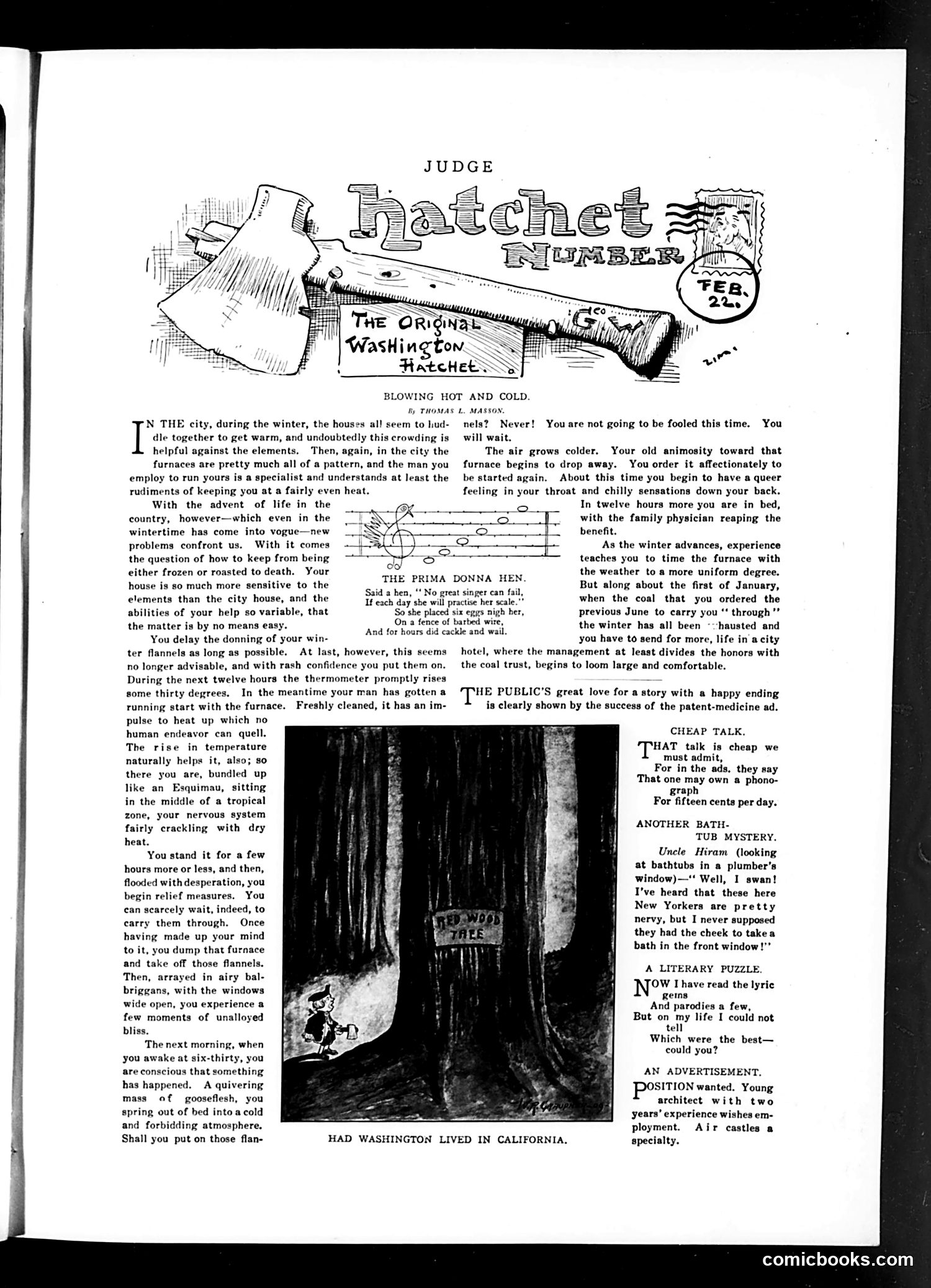
This page features "Judge Hatchet Number" with the subtitle "The Original Washington Hatchet" — a reference to the famous (apocryphal) story of young George Washington confessing to chopping down his father's cherry tree. The main article "Blowing Hot and Cold" by Thomas L. Masson satirizes winter furnace management—a relatable domestic complaint. The humor lies in describing the absurd temperature swings and inefficiency of residential heating systems: the furnace either fails entirely or overheats the house unbearably. The accompanying illustration shows what appears to be an interior scene titled "Had Washington Lived in California," likely mocking the contrast between Washington's legendary frontier hardship and California's milder climate. The page also contains advertisements and humor columns typical of Judge's satirical format.
📄 Transcribed text from this page (OCR, searchable)
Machine-transcribed from the original scan — historical spelling and the odd misread are preserved.
dle together to get warm, and undoubtedly this crowding is will w: JUDGE THe Originates = Washington Hatchet. BLOWING HOT AND COLD. By THOMAS 1. MASSON. You are not going to be fooled this time. You The air grows colder. Your old animosity toward that furnace begins to drop away. You order it affectionately to be started again. About this time you begin to have a queer I: THE city, during the winter, the houses al! seem to hud- nels?_ Never! helpful against the elements, Then, again, in the city the furnaces are pretty much all of a pattern, and the man you employ to run yours is a specialist and understands at least the rudiments of keeping you at a fairly even heat. With the advent of life in the country, however—which even in the wintertime has come into vogue—new problems confront us. With it comes the question of how to keep from being either frozen or roasted to death. Your house is so much more sensitive to the nts than the city house, and the es of your help so variable, that by no means easy. You delay the donning of your win- ter flannels as long as possible. some thirty degrees. pulse to heat up which no human endeavor can quell. The rise in temperature naturally helps it, also; so there you are, bundled up like an Esquimau, sitting in the middle of a tropical zone, your nervous system fairly crackling with dry heat. You stand it for a few hours more or less, and then, flooded with desperation, you begin relief measures. You can scarcely wait, indeed, to carry them through. Once having made up your mind to it, you dump that furnace and take off those flannels. Then, arrayed in airy bal- briggans, with the windows wide open, you experience a few moments of unalloyed bliss. The next morning, when you awake at six-thirty, you are conscious that something has happened. A quivering mass of gooseflesh, you spring out of bed into a cold and forbidding atmosphere. Shall you put on those flan- At last, however, this seems no longer advisable, and with rash confidence you put them on. During the next twelve hours the thermometer promptly rises In the meantime your man has gotten a running start with the furnace. Freshly cleaned, it has an im- THE PRIMA DONNA HEN. No great singer can fail, Said a hen, “* If each day she will practise her scale." So she placed six eggs nigh her, On a fence of barbed wire, And for hours did cackle and wail. HAD WASHINGTON LIVED IN CALIFORNIA. feeling in your throat and chilly sensations down your back. In twelve hours more you are in bed, with the family physician reaping the benefit. As the winter advances, experience teaches you to time the furnace with the weather to. more uniform degree. But along about the first of January, when the coal that you ordered the previous June to carry you “ through ’” the winter has all been --hausted and you have to send for more, life in a city hotel, where the management at least divides the honors with the coal trust, begins to loom large and comfortable. 'HE PUBLIC'S great love for a story with a happy ending is clearly shown by the success of the patent-medicine ad. CHEAP TALK. THAT talk is cheap we must admit, For in the ads, they say That one may own a phono- grap! For fifteen cents per day. ANOTHER BATH- TUB MYSTERY. Uncle Hiram (looking at bathtubs in a plumber’s window)—‘‘ Well, I swan! I’ve heard that these here New Yorkers are pretty nervy, but I never supposed they had the cheek to takea bath in the front window!" A LITERARY PUZZLE. NOW Ihave read the lyric geins And parodies a few, But on my life I could not tell Which were the best— could you? AN ADVERTISEMENT. POSITION wanted. Young architect with two years’ experience wishes em- ployment. Air castles a specialty. comicbooks.com