
Judge, 1910-02-19 · page 10 of 16
Judge — February 19, 1910 — page 10: what you’re looking at
What you’re looking at
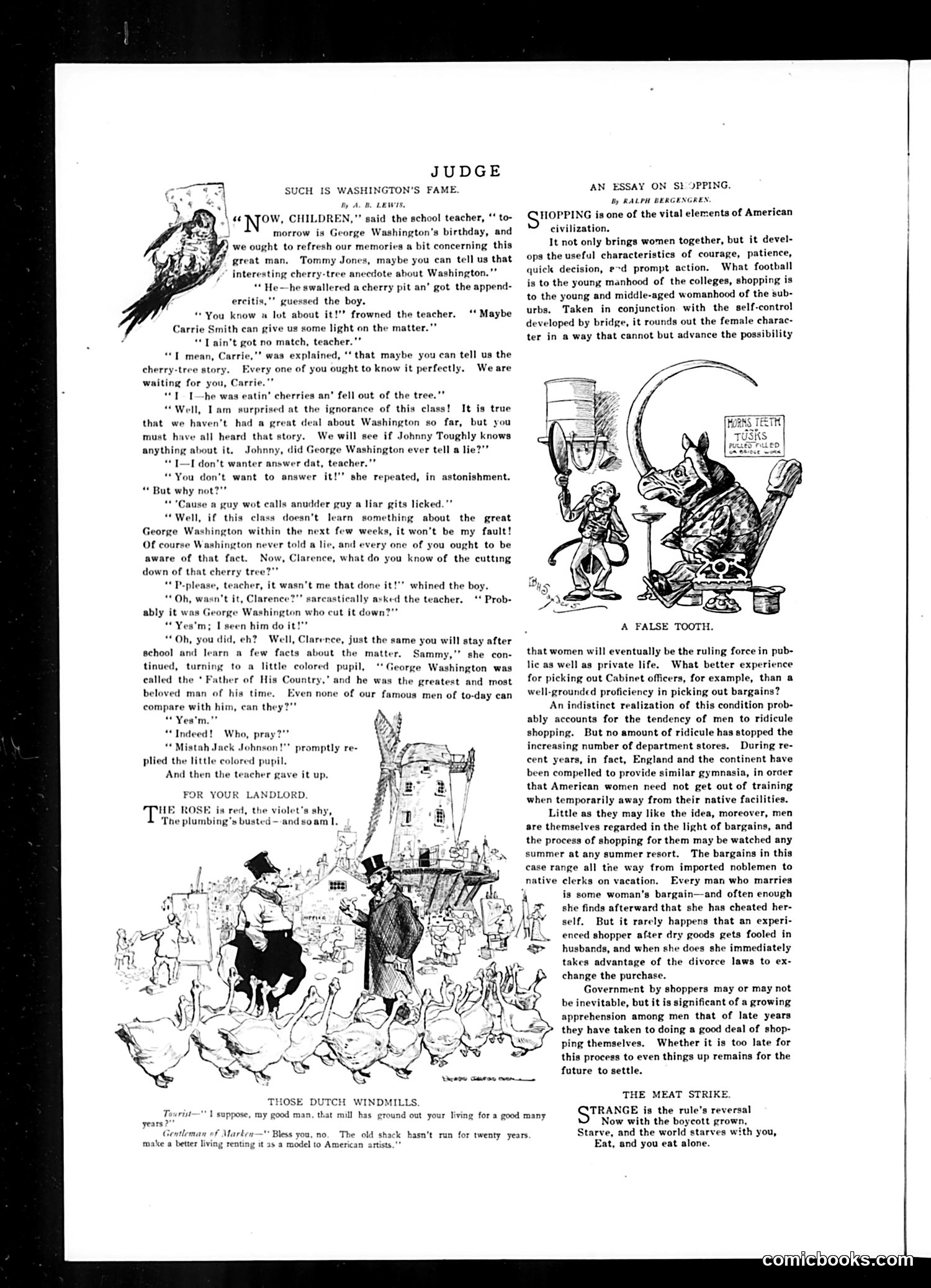
This page from *Judge* contains three satirical pieces: **"Washington's Fame"** (top): A schoolteacher tries to teach children about George Washington's cherry-tree legend (a famous but apocryphal story). The children either don't know it or misremember it absurdly. The joke's punchline: when asked to name someone great like Washington, a Black student answers "Jack Johnson"—the heavyweight boxing champion. This was shocking to the white audience because it equated a Black athlete with the nation's most revered founding father, undercutting American mythology. **"Those Dutch Windmills"** (bottom left): A landlord shows a tenant a dilapidated windmill, claiming it's been unused for twenty years but is "a model to American artists." The satire mocks either slumlords or false nostalgia. **"An Essay on Shopping"** (right): A mock-serious essay argues shopping develops female character like football develops male character, tongue-in-cheek suggesting women might eventually rule public life through their shopping expertise. It's simultaneously praising and gently mocking women's power.
📄 Transcribed text from this page (OCR, searchable)
Machine-transcribed from the original scan — historical spelling and the odd misread are preserved.
JUDGE IS WASHINGTON'S FAME. Dy A.B LEWIS, \ ce TOW, CHILDREN,” said the school teacher, “to- J morrow is George Washington's birthday, and } we ought to refresh our memories a bit concerning this great man. Tommy Jones, maybe you can tell us that interesting cherry-tree anecdote about Washington.” He—he swallered a cherry pit an’ got the append- ercitis,"” guessed the boy. “You know a lot about it!"? frowned the teacher. Carrie Smith can give us some light on the matter.”” *L ain't got no match, teacher."” was explained, ‘that maybe you can tell us the SUCH “Maybe “TL mean, Carri cherry-tree story. Every one of you ought to know it perfectly. We are waiting for you, Carr “1 [he was eatin’ cherries an’ fell out of the tre “Well, Lam surprised at the ignorance of this class! It is true that we haven't had a great deal about Washington so far, but you must have all heard that story. We will see if Johnny Toughly knows anything about it. Johnny, did George Washington ever tell a lie?’’ **1—I don’t wanter answer dat, teacher."’ “You don't want to answer i “ But why not?” “Cause a guy wot calls anudder guy a liar gits licked.” “Well, if this el: learn something about the great George Washington within the next few weeks, it won't be my fault! Of course Washington never told a lie, and every one of you ought to be aware of that fact. Now, Clarence, what do you know of the cutting down of that cherry tre her, it wasn’t me that done it!"’ whined the boy. n't it, Clarence? castically asked the teacher. ‘* Prob- ably it was George Washington who cut it down?" “Yes'm; I se “Oh, you did, school and Ie she repeated, in astonishment. 3 doesn't 2 Well, Clarence, just the same you will stay after facts about the matter. Sammy," she con- rn oa few tinued, turning to a little colored pupil, ‘orge Washington was called the ‘Father of His Country,’ and he was the greatest and most beloved man of his time. Even none of our famous men of to-day can compare with him, can they? “Yes'm. ** Indeed oN § Who, pra, ‘Dy Jack Johnson!"" promptly re- « \ plied the little colored pupil. a And then ti acher gave it up. FOR YOUR LANDLORD. ROSE is red, the violet's shy, The plumbing’s busted — and soam 1. THOSE DUTCH WINDMILLS. Towrit—" 1 suppose, my good man, that mill has yea Gentleman of Marten make a better living rentin; ** Bless you, no tas a model to American artists."* are themselves regarded in the light of bargains, and the process of shopping for them may be watched any summer at any summer resort. case range all tne round out your living for a good many The old shack hasn't run for twenty years. IPPING. AN ESSAY ON St by RALPH BERGENGREN. HOPPING is one of the vital elercents of American civilization. It not only brings women together, but it devel- ops the useful characteristics of courage, patience, quick decision, evd prompt action. What football is to the young manhood of the colleges, shopping is to the young and middle-aged womanhood of the sub- urbs, Taken in conjunction with the self-control developed by bridge, it rounds out the female charac- ter in a way that cannot but advance the possibility A FALSE TOOTH. that women will eventually be the ruling force in pub- lic as well as private life. What better experience for picking out Cabinet officers, for example, than a well-grounded proficiency in picking out bargains? An indistinct realization of this condition prob- ably accounts for the tendency of men to ridicule shopping. But no amount of ridicule has stopped the increasing number of department stores. During re- cent years, in fact, England and the continent have been compelled to provide similar gymnasia, in order that American women need not get out of training when temporarily away from their native facilities. Little as they may like the idea, moreover, men The bargains in this ‘ay from imported noblemen to clerks on vacation. Every man who marries some woman's bargain—and often enough she finds afterward that she has cheated her- self, But it rarely happens that an experi- enced shopper after dry goods gets fooled in husbands, and when she does she immediately takes advantage of the divorce laws to ex- change the purchase. Government by shoppers may or may not be inevitable, but it is significant of a growing apprehension among men that of late years they have taken to doing a good deal of shop- ping themselves. Whether it is too late for this process to even things up remains for the future to settle. THE MEAT STRIKE. TRANGE is the rule’s reversal Now with the boycott grown, Starve, and the world starves with you, Eat, and you eat alone.