
A complete issue · 16 pages · 1909
Judge — November 27, 1909
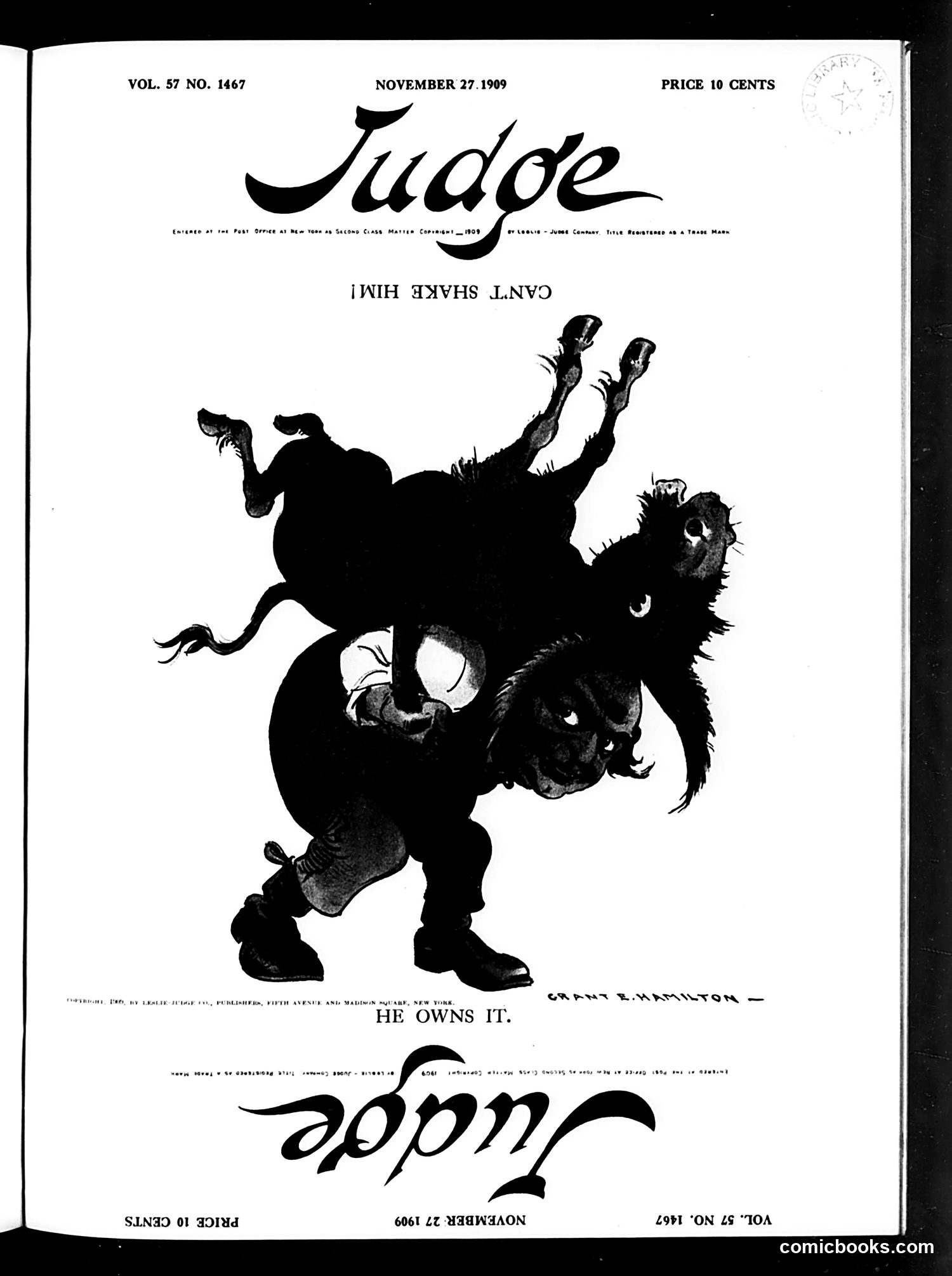
This satirical cover depicts a caricatured figure (labeled "GRANT E. HAMILTON" by the artist) engaged in acrobatic contortions while clutching what appears to be a monkey or ape. The caption "HE OWNS IT" suggests commentary on ownership or control of something. The image likely references contemporary political or social debates about wealth, power, or corporate control circa 1909. The figure's undignified posture and the animal imagery suggest mockery of a public figure's pretensions or behavior. Without clearer context about the specific events of November 1909 and Hamilton's identity, the precise satirical target remains unclear, though it appears to critique someone's relationship to power or property through physical caricature and animal metaphor.
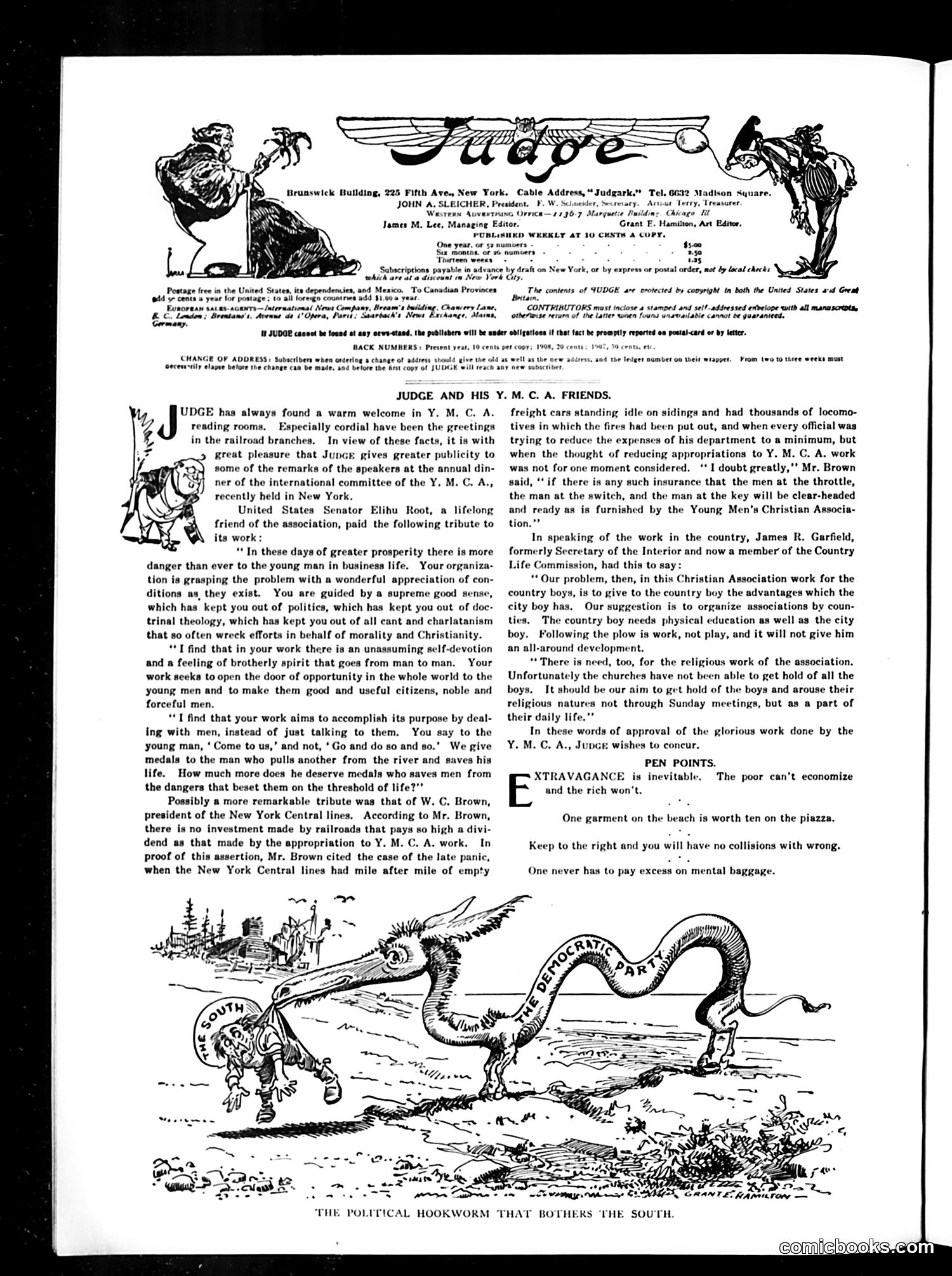
The bottom cartoon titled "THE POLITICAL HOOKWORM THAT BOTHERS THE SOUTH" depicts two serpentine creatures labeled "SOUTH" and "DEMOCRACY" in confrontation. This appears to be satirizing Southern political dysfunction or resistance to democratic principles during the Jim Crow era. The hookworm reference suggests parasitic corruption weakening the region. The main article discusses the Y.M.C.A.'s work, with tributes from Senator Elihu Root and others praising the organization's role in developing young men, particularly in rural areas. The "Pen Points" section contains light satirical observations about human nature and travel etiquette. **Note**: Without a specific date visible, the exact political moment being referenced remains unclear, though the Southern democracy critique suggests early 20th-century concerns.
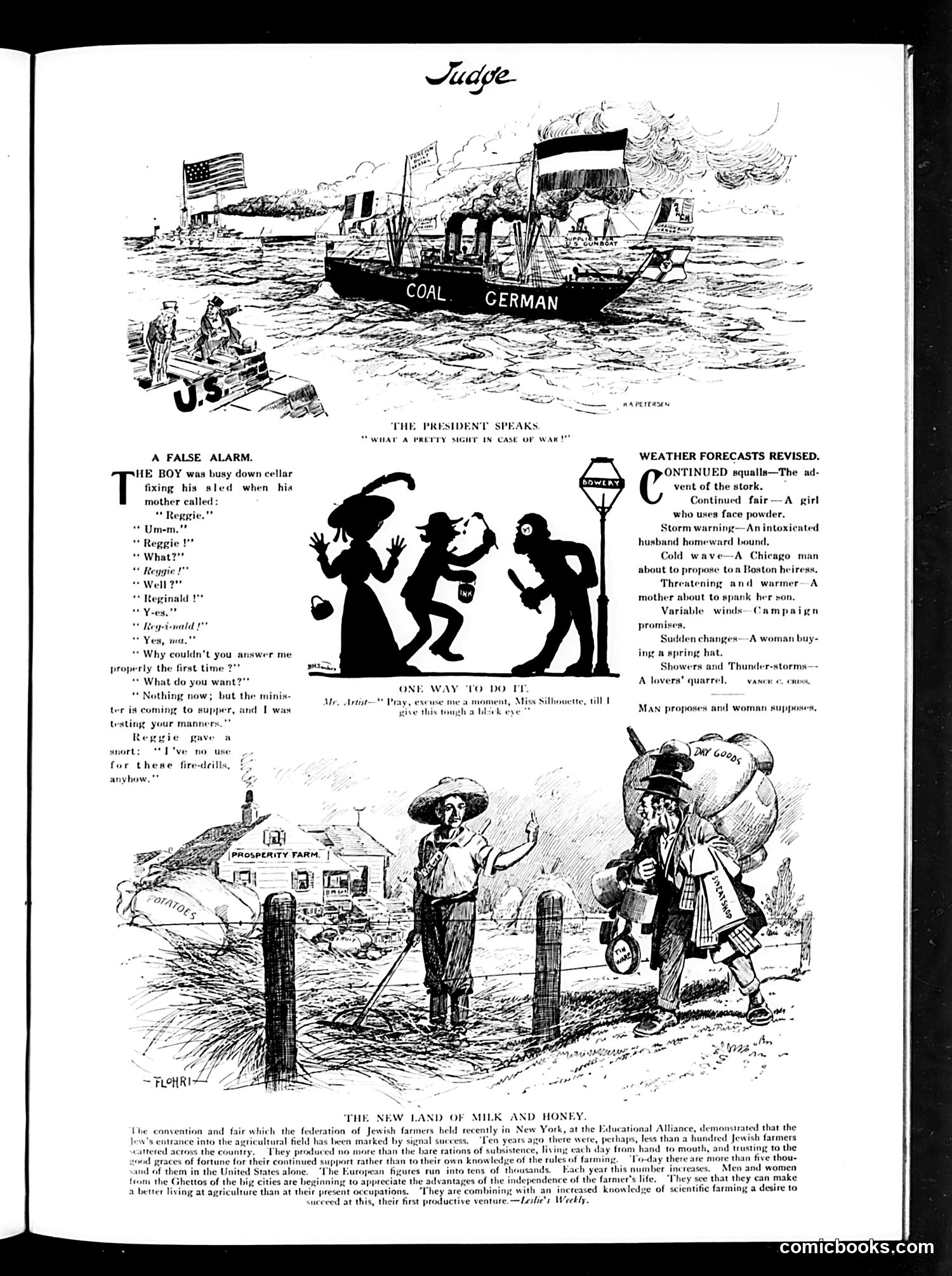
**Top Cartoon ("The President Speaks"):** Shows a German coal ship near U.S. waters with an American flag nearby. This appears to reference concerns about German naval activity or commerce near American shores—likely from the WWI era when German submarines threatened U.S. shipping. **Middle Section ("A False Alarm"):** Humorous anecdote about a boy crying "fire" repeatedly, satirizing exaggerated alarm-raising. The silhouette cartoon "One Way to Do It" depicts romantic comedy. **Bottom Cartoon ("The New Land of Milk and Honey"):** Shows farmers at a "Prosperity Farm," satirizing Jewish agricultural colonies. The accompanying text discusses Jewish farmers' convention, suggesting this cartoon mocks or celebrates their agricultural independence movement—though the specific satirical intent remains unclear from context alone.
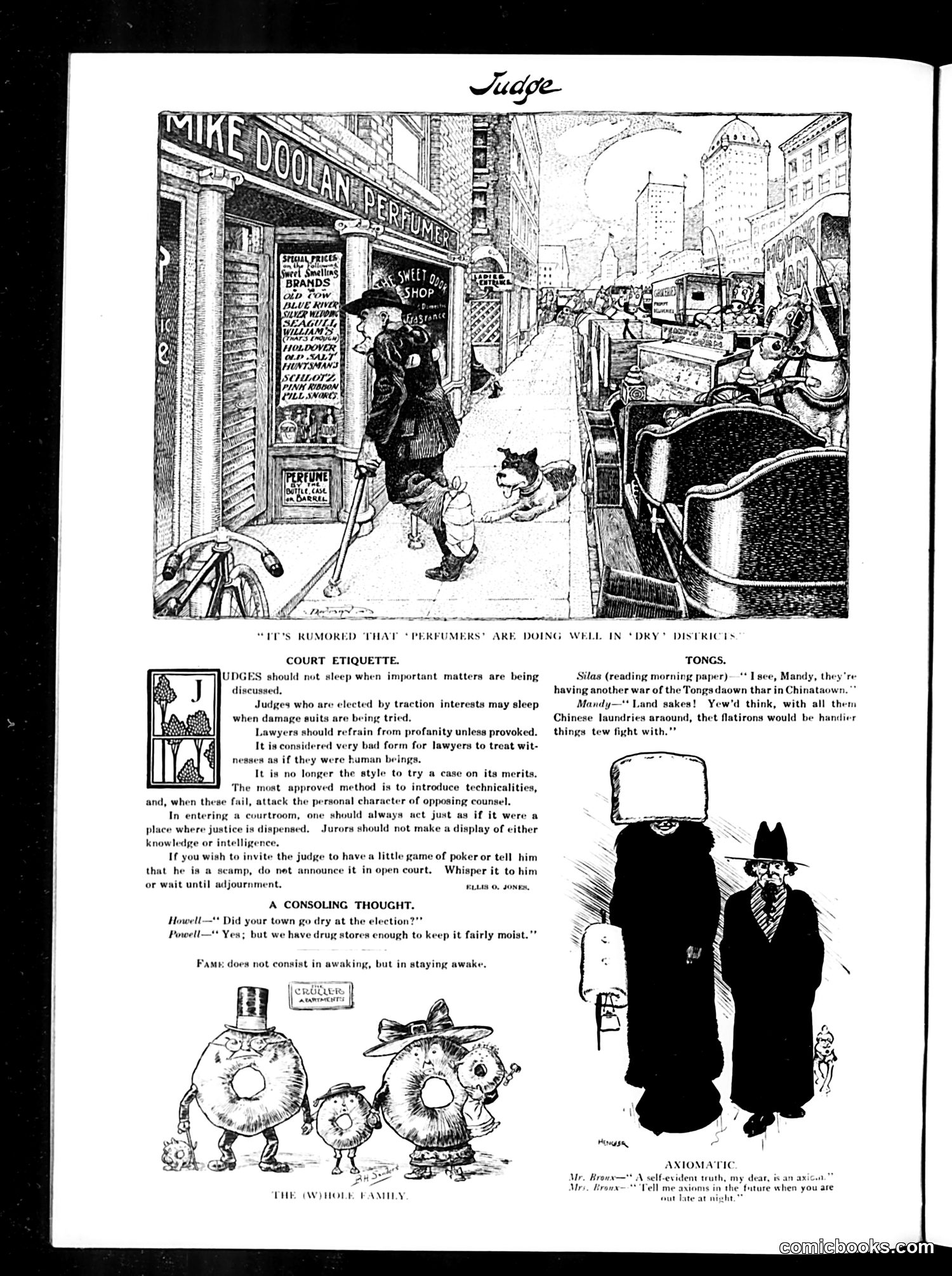
This page contains several satirical pieces targeting early 20th-century social issues: **Top cartoon**: Mocks perfume dealers thriving in "dry districts" (areas with alcohol prohibition). The joke suggests perfumers profit by selling alcohol-based fragrances as a loophole around prohibition laws. **"Court Etiquette"**: Offers sardonic advice about courtroom behavior, criticizing judges elected through "traction interests" (political machines) and lawyers who lack integrity. It advocates for treating courts with respect despite corruption. **"Tongs"**: References Chinese laundry disputes, using ethnic stereotypes common to the era. **"The Whole Family"**: Anthropomorphizes perfume bottles as a family, continuing the anti-perfume/prohibition satire. **"Axiomatic"**: A brief joke about self-evident truths. The page primarily satirizes prohibition enforcement loopholes and judicial corruption.
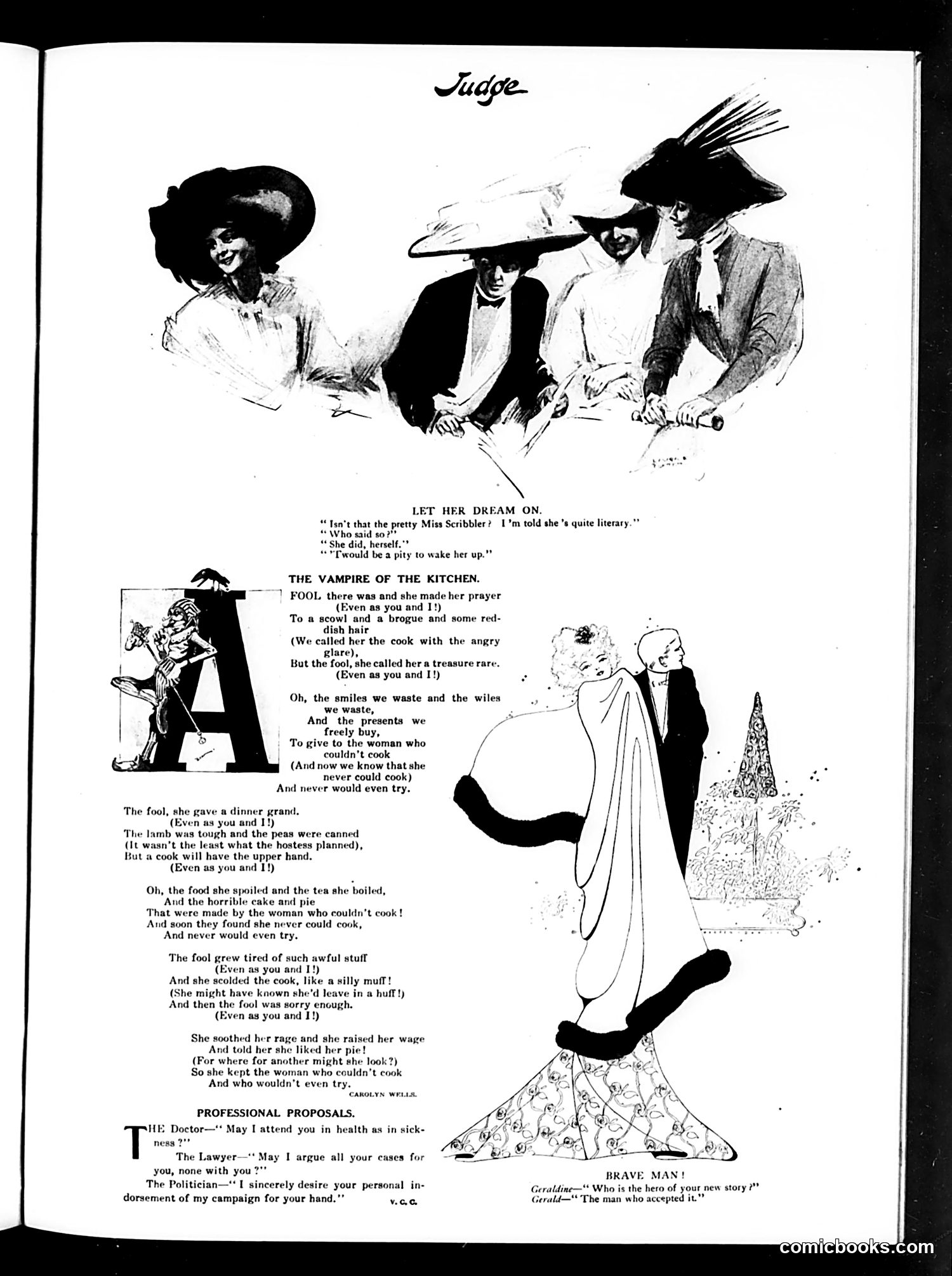
This page contains three distinct pieces of early 20th-century satire: **"Let Her Dream On"** (top): Four fashionable women discuss Miss Scribbler, a female writer, implying she harbors literary ambitions beyond her actual abilities—satirizing both women writers and society's dismissal of them. **"The Vampire of the Kitchen"** (center): A poem mocking a incompetent cook who ruins meals. The accompanying illustration shows a woman terrorizing a household, suggesting domestic incompetence. This reflects period anxieties about servant quality and women's domestic roles. **"Professional Proposals"** (bottom): Brief jokes where a Doctor, Lawyer, and Politician each make puns on their professional relationships, employing dated wordplay humor typical of the era. **"Brave Man"** (right): A cartoon showing a man presenting his new story, likely satirizing aspiring writers or publishers. The page represents Judge's typical blend of gender-focused humor and professional satire.
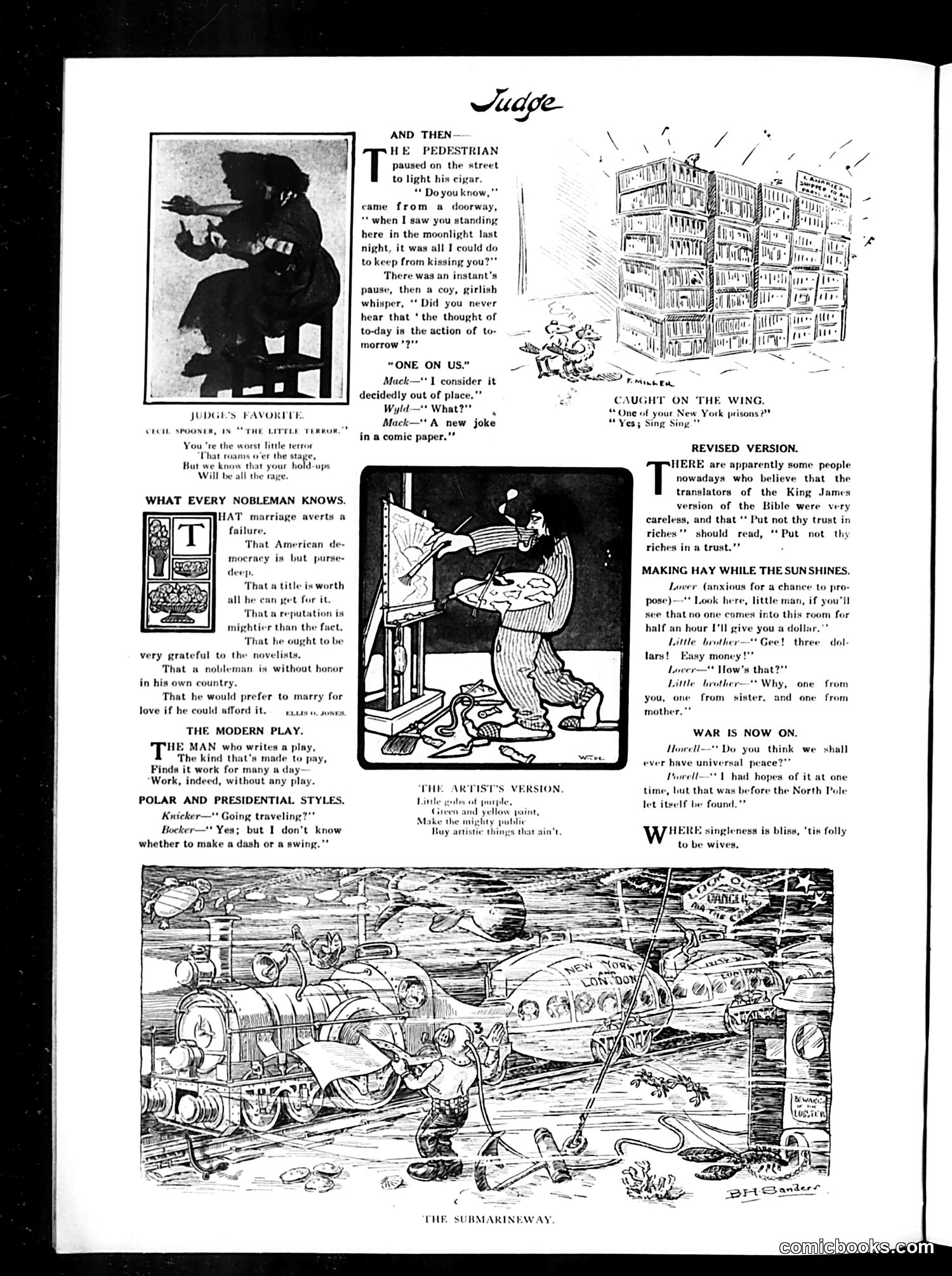
This page from Judge contains multiple satirical pieces typical of early 20th-century American humor: **"One on Us"** mocks a flirtation scenario where a woman cleverly deflects a man's romantic advance by invoking philosophy about future consequences. **"What Every Nobleman Knows"** satirizes European aristocracy, suggesting their titles are worthless, reputation matters more than reality, and they prioritize marrying for money over love—a common American critique of Old World nobility. **"The Modern Play"** jokes about playwrights finding their work exhausting despite initial promise. **"Revised Version"** contains wordplay mocking biblical translation, suggesting "Put not thy trust in riches" should become "Put not thy riches in a trust"—possibly critiquing financial advice or legal schemes of the era. **"War Is Now On"** references contemporary war affecting peace hopes, likely referencing WWI. **"The Submarineway"** (large illustration) appears a fantastical cartoon about submarine technology, common in Judge's satirical visual humor. The page reflects Judge's blend of social commentary, romantic humor, and contemporary political/technological references.
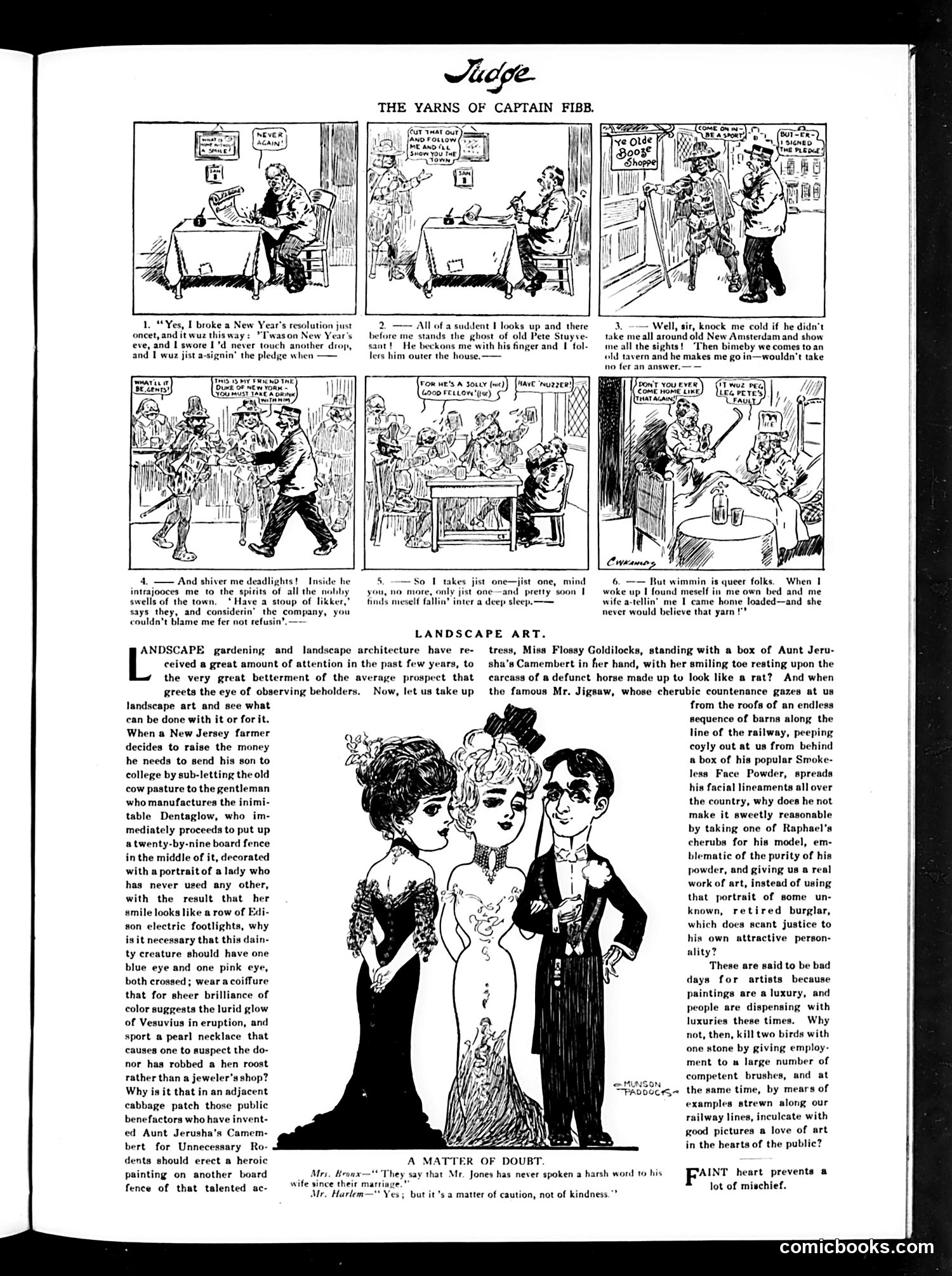
**Top Section:** A humorous tall tale where Captain Fibb breaks his New Year's pledge of sobriety when the ghost of Peter Stuyvesant (New Amsterdam's colonial founder) appears and drags him through old New York's taverns. The joke escalates through panels showing him drinking with "spirits" (pun intended) and eventually stumbling home drunk—his wife refuses to believe his supernatural excuse. It's straightforward comic absurdity mocking both drunkenness and implausible excuses. **Bottom Section:** Social satire criticizing ugly roadside advertisements. The author ridicules billboard advertisements for products like "Dentaglow" toothpaste and "Aunt Jerusha's Camembert" rodent poison that feature grotesquely made-up women and unattractive men. The satire argues such gaudy commercial art, unlike fine painting, wastes talented artists. The piece advocates hiring professional artists instead during economically hard times—killing "two birds with one stone" by employing artists while improving advertising aesthetics.
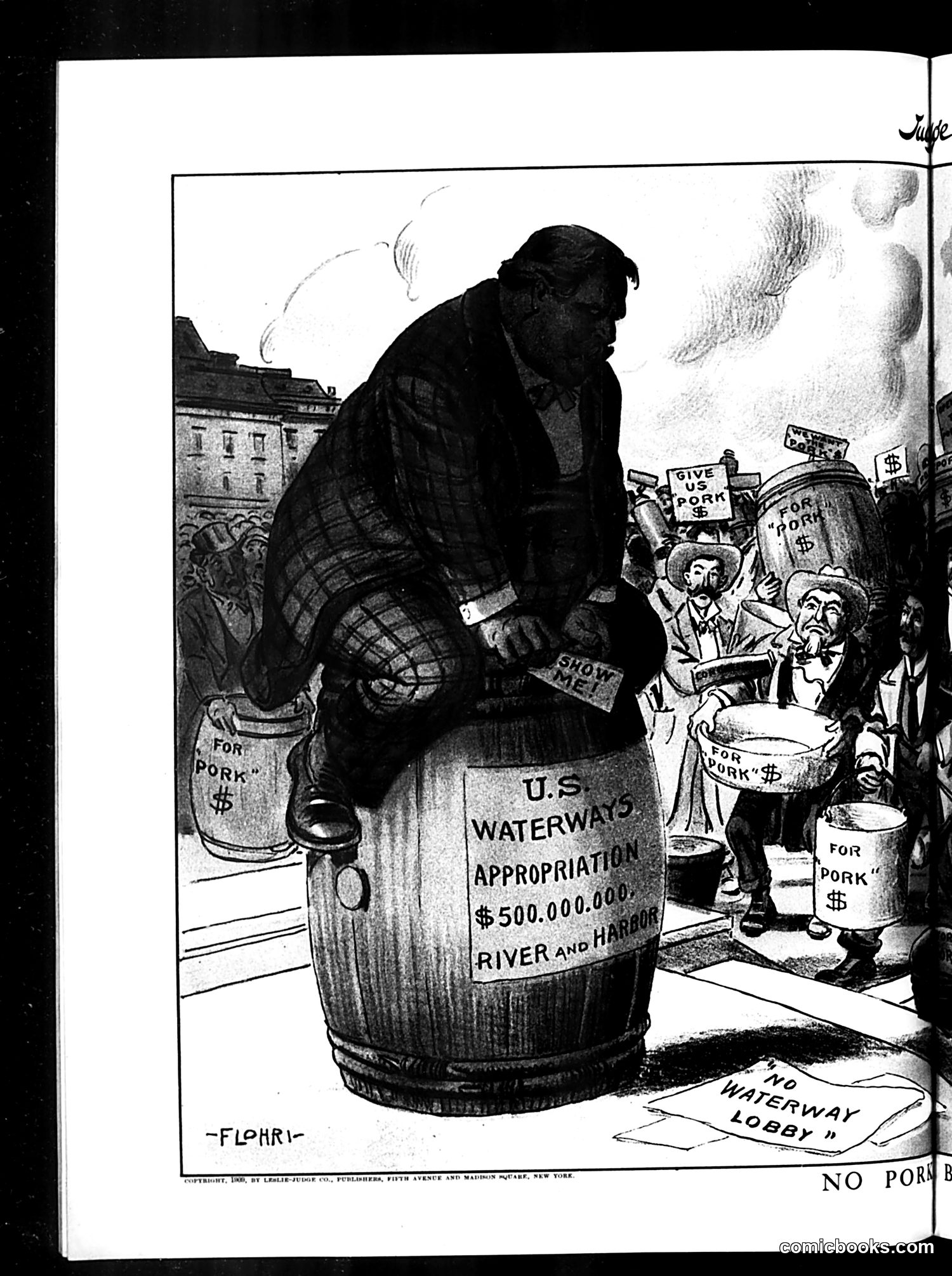
This Judge magazine cartoon satirizes government spending on waterway projects. A large politician (signed "FLOHR," likely the cartoonist's name) sits atop a barrel labeled "U.S. WATERWAYS APPROPRIATION $500,000,000 RIVER AND HARBOR," appearing indifferent or obstructive. Below, small figures holding signs reading "FOR PORK" and "$" demonstrate—appearing to beg for their share of the appropriation. A sign reading "NO WATERWAY LOBBY" lies on the ground, suggesting the cartoon's ironic commentary. The satire criticizes how massive federal appropriations ostensibly for infrastructure projects become vehicles for political patronage and "pork barrel" spending, with politicians controlling distribution while ordinary citizens scramble for benefits. The size disparity emphasizes the disconnect between power and public interest.
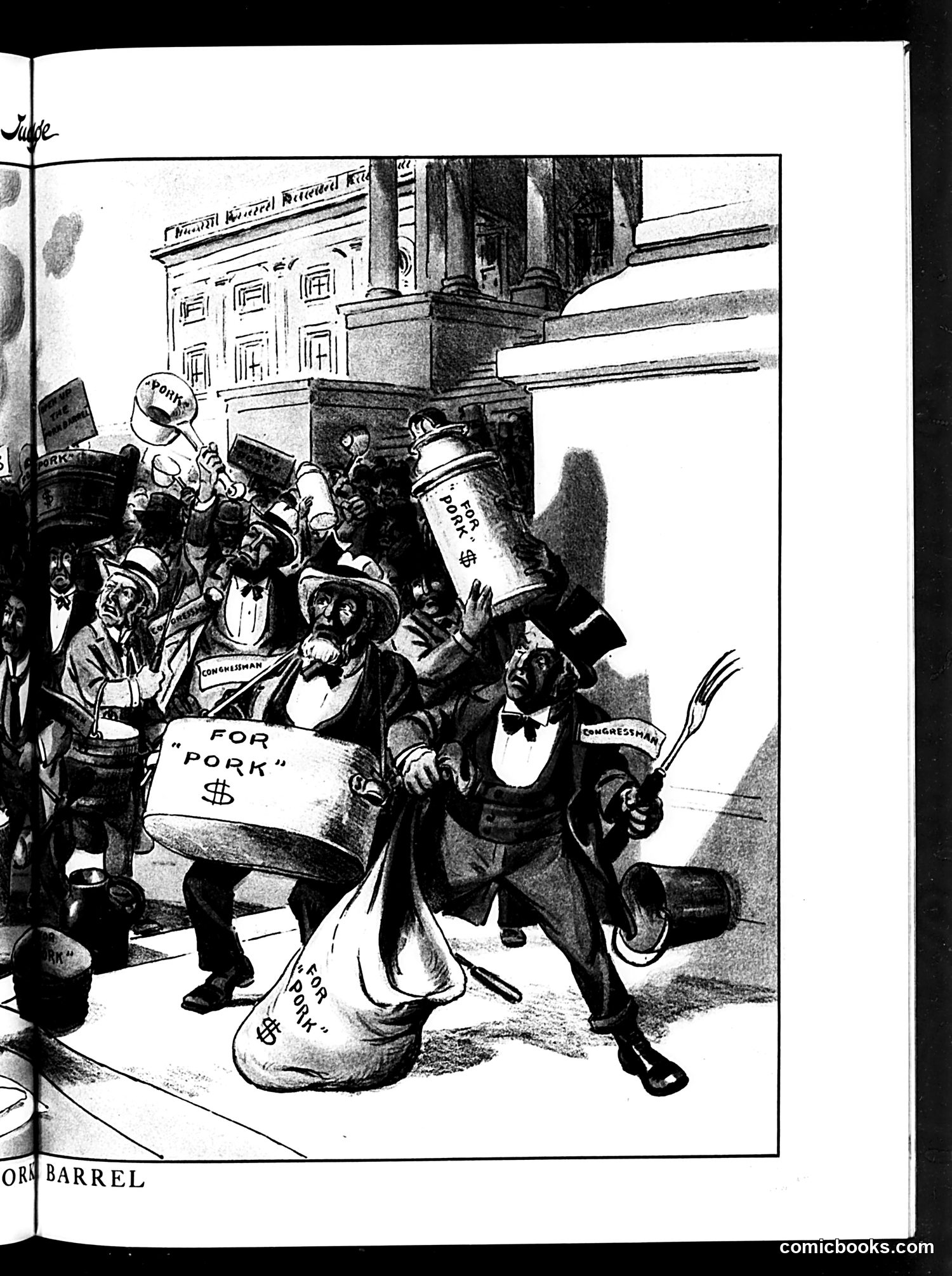
This Judge magazine cartoon satirizes Congressional corruption and "pork barrel" spending. The central figures labeled "CONGRESSMAN" are depicted as well-dressed politicians literally dispensing money from barrels marked "FOR 'PORK'" and "FOR 'INK'" to a crowd of eager recipients below a government building (likely the Capitol, given the classical architecture). The satire targets how politicians distribute federal funds to benefit their districts and supporters through "pork barrel" legislation—wasteful spending allocated for political gain rather than genuine public need. The caricatured figures grabbing at the money suggest both the desperation of those seeking funds and the casual corruption of those distributing them. The cartoon appears to reference late 19th or early 20th-century political practices, when such spending scandals were frequent public concerns.
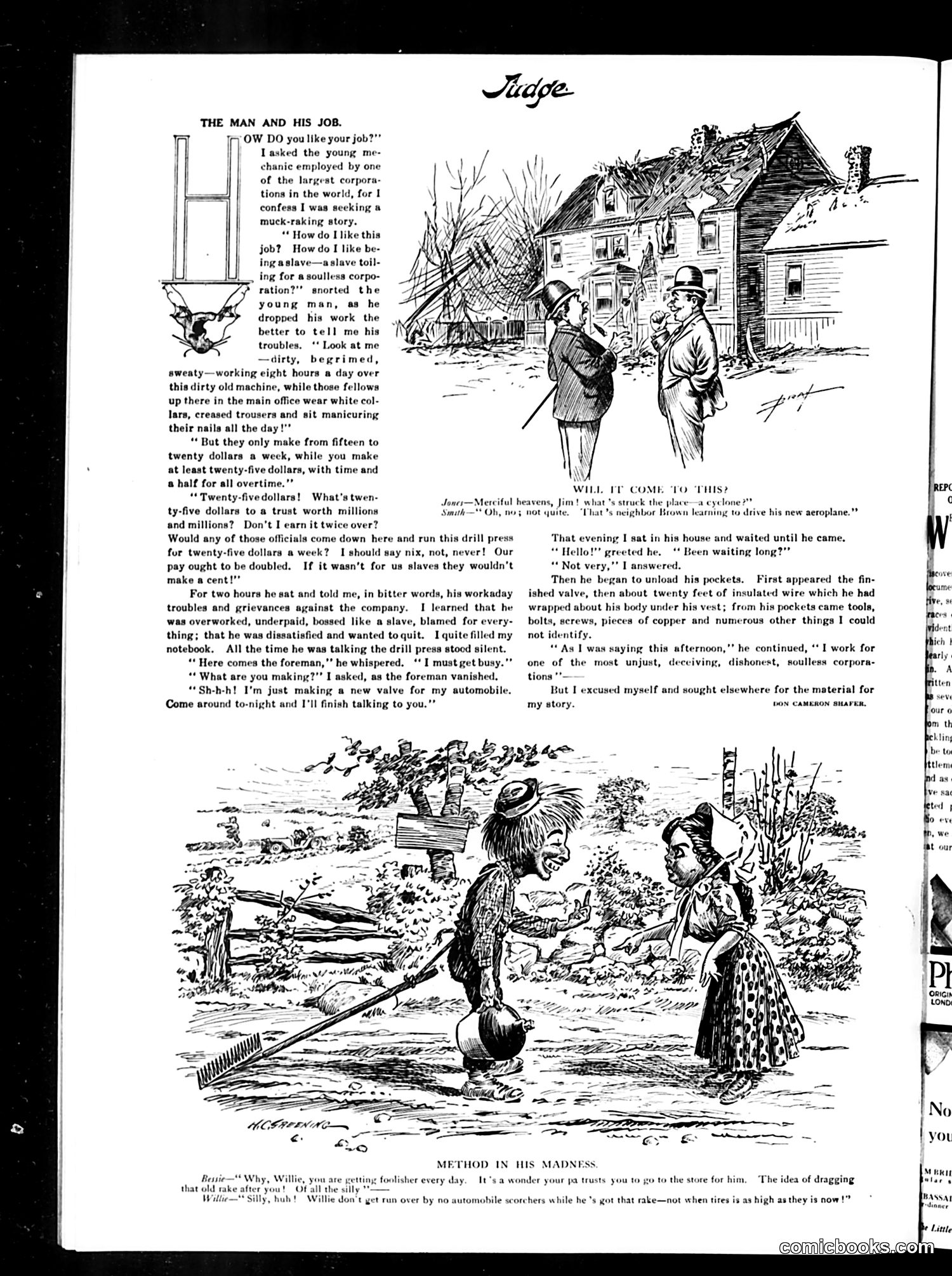
This article mocks a hypocritical factory worker who complains bitterly about corporate exploitation while the narrator observes him—yet ironically, the worker steals company materials and uses company time to build a personal automobile valve. The satire targets two things: First, the worker's exaggerated grievances (claiming $25/week is worthless to a "trust worth millions") despite earning more than office staff. Second, and more pointedly, his lack of moral consistency—he rails against "soulless corporations" while actively robbing from his employer, smuggling out tools, wire, copper, and bolts in his clothing. The cartoonist (Don Cameron Shafer) suggests the worker's complaints ring hollow when he himself engages in dishonesty. The narrator's decision to "excuse myself and seek elsewhere" implies the worker has lost credibility. The piece critiques labor radicalism of the era by portraying the complainant as a hypocrite rather than a sympathetic victim.
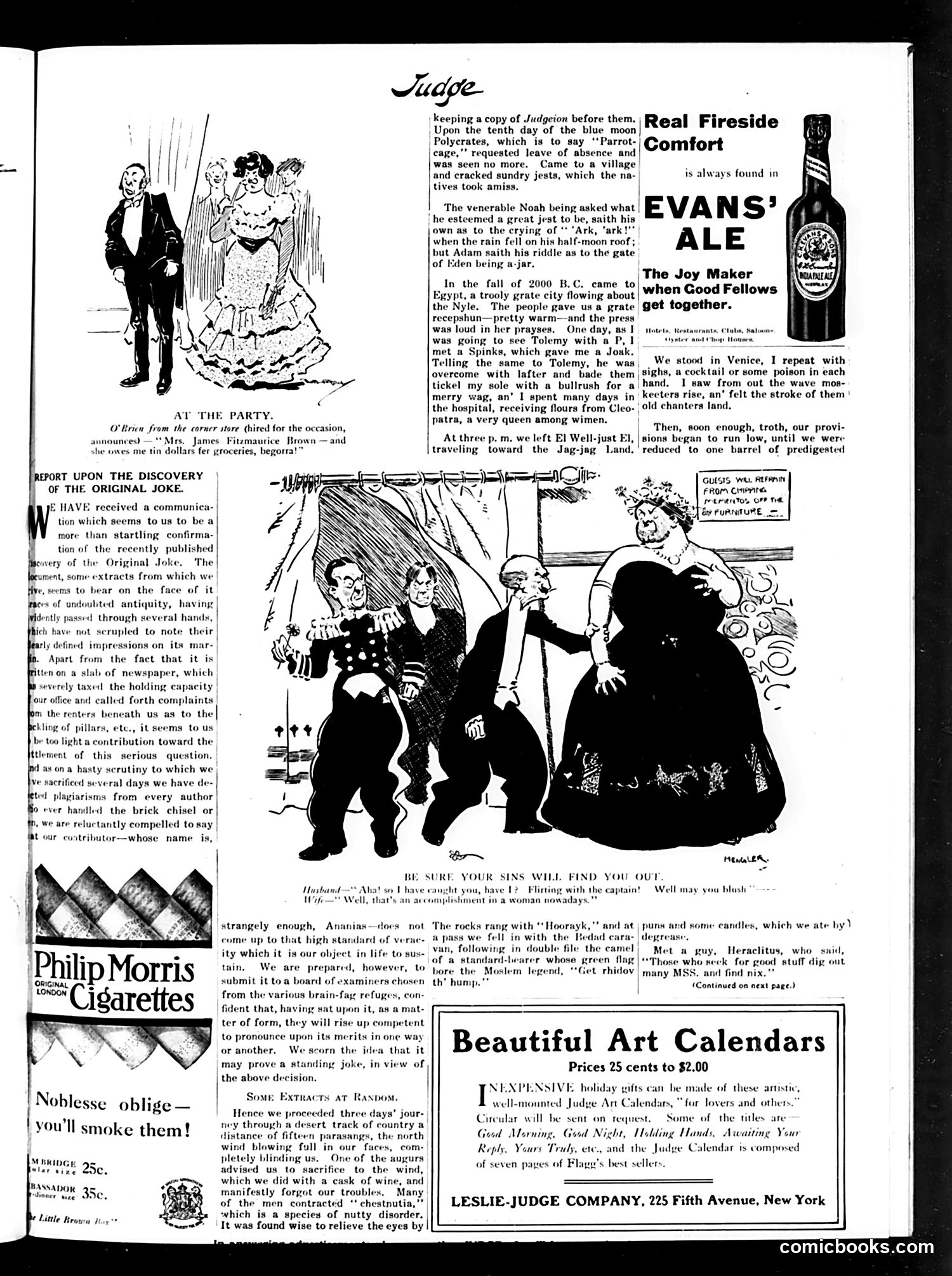
This page features a humorous article titled "Report Upon the Discovery of the Original Joke," presented as a faux-scholarly examination of joke history. The satire mocks both pompous academic pretension and the observation that jokes are endlessly recycled. The text humorously traces a joke's alleged ancient origins—through Biblical times (Noah, Adam), Egyptian antiquity, and Venice—suggesting that all modern jokes ultimately derive from this single prehistoric source. The joke itself appears trivial: a pun about "El" (the well) and wordplay about "Jag-jag Land." The accompanying cartoons illustrate party scenes and domestic humor unrelated to the main text. The satire's point: critics of Judge magazine had accused it of plagiarism; this article sarcastically suggests that because all jokes have ancient origins, accusing anyone of joke theft is absurd—all humor is fundamentally derivative. The overall message lampooned contemporary literary criticism while defending Judge's comedic legitimacy through humorous absurdism.
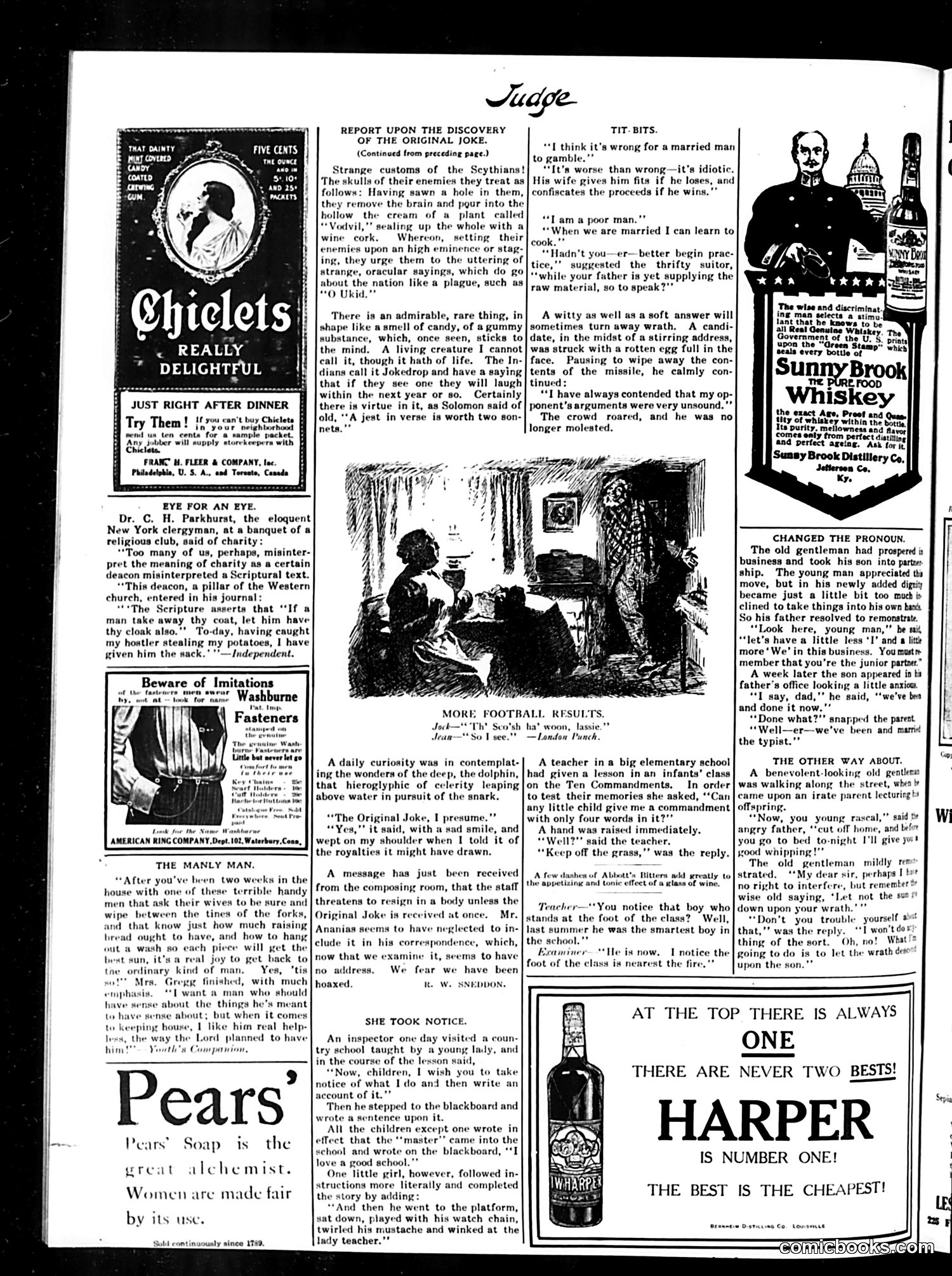
This page from *Judge* magazine contains several satirical pieces typical of early 20th-century American humor: **"Report Upon the Discovery of the Original Joke"** is a mock-scholarly article parodying anthropological writing. It humorously attributes the origin of jokes to ancient Scythian customs, presenting absurd pseudo-historical "evidence" about "Jokedrop" and oracular sayings. The satire targets both pretentious academic discourse and the magazine's own struggle to produce original humor—the framing device reveals composing room staff threatening to resign until the "Original Joke" arrives, a self-aware joke about creative exhaustion. **"Eye for an Eye"** presents Dr. C.H. Parkhurst (a real New York clergyman known for reform advocacy) ironically misinterpreting charity through a deacon's literal biblical interpretation that justifies stealing back potatoes. The remaining items are brief comedic anecdotes about marriage, masculinity, and classroom observation—typical of the magazine's "Tit-Bits" humor section. The advertisements (Chiclets, Pears' Soap, Sunny Brook Whiskey) represent standard period marketing.
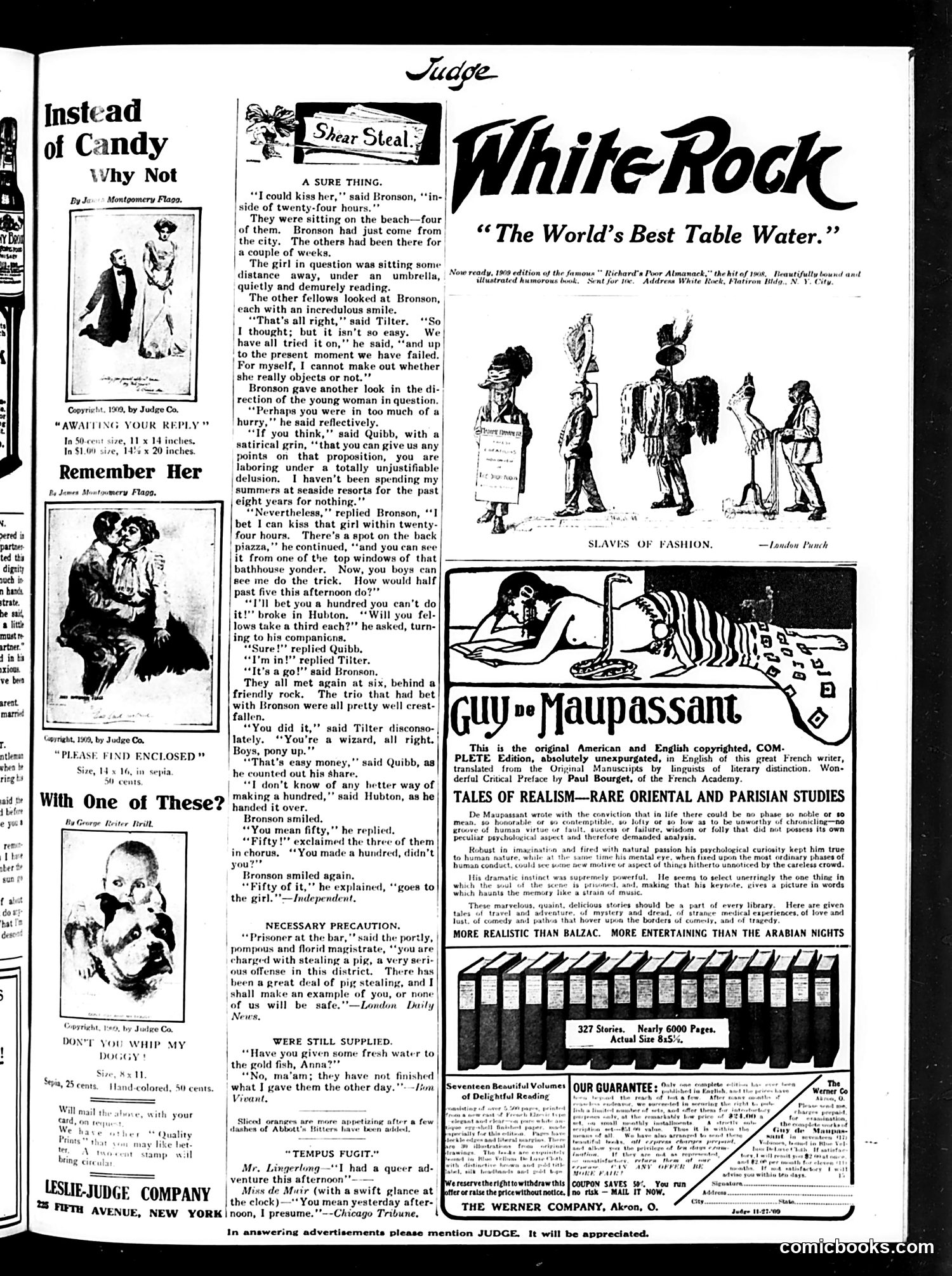
This page from *Judge* magazine contains primarily **advertisements and short fiction** rather than political cartoons requiring historical context. The main content includes: - **"Instead of Candy"**: A romantic short story (by Montgomery Flagg) about a man wagering he can kiss a woman within 24 hours at a beach resort—a lighthearted narrative about courtship and male bravado. - **Fashion illustration** titled "Slaves of Fashion" (from *London Punch*)—social commentary on women's restrictive clothing trends. - **Advertisement for Guy de Maupassant books**: Promoting a complete, unexpurgated English edition of the French writer's works, emphasizing "realism" and "tales" of Parisian and Oriental life. - **Leslie-Judge Company advertisements** for various products. The page reflects early 1900s leisure culture, publishing trends, and gender dynamics of the era—but contains no identifiable political figures or partisan satire requiring specialized historical knowledge to understand.
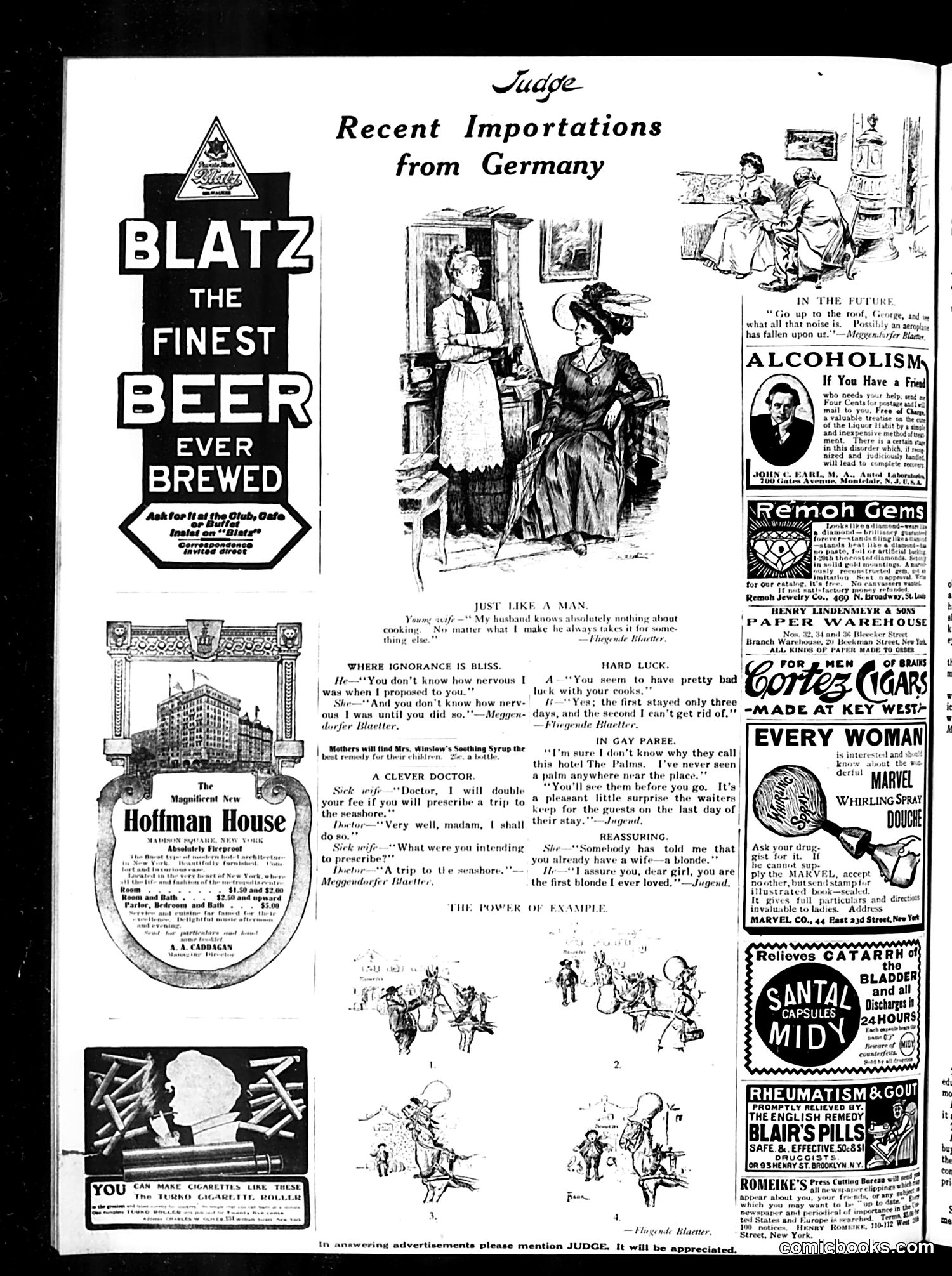
This page is primarily **advertising**, with a masthead reading "Judge: Recent Importations from Germany." The main content consists of commercial ads for German and American products (Blatz beer, the Hoffman House hotel, cigarettes, various patent medicines). The only substantive editorial content appears to be **humor captions** beneath sketches—likely reprinted from German satirical publications like *Fliegende Blätter* and *Jugend* (credited multiple times). These are brief domestic comedy dialogues: a husband ignorant of beer brands, a wife nervous about marriage proposals, doctors and seaside trips, hotel naming conventions. The cartoons themselves are generic Victorian-era couple or social situations with no identifiable political figures or specific social commentary visible. They represent standard early-20th-century marital humor—the kind of innocent domestic jokes common across European and American magazines of the period. **Context:** Judge was reprinting Continental European humor, reflecting American interest in German/European culture before WWI tensions made such imports less common.
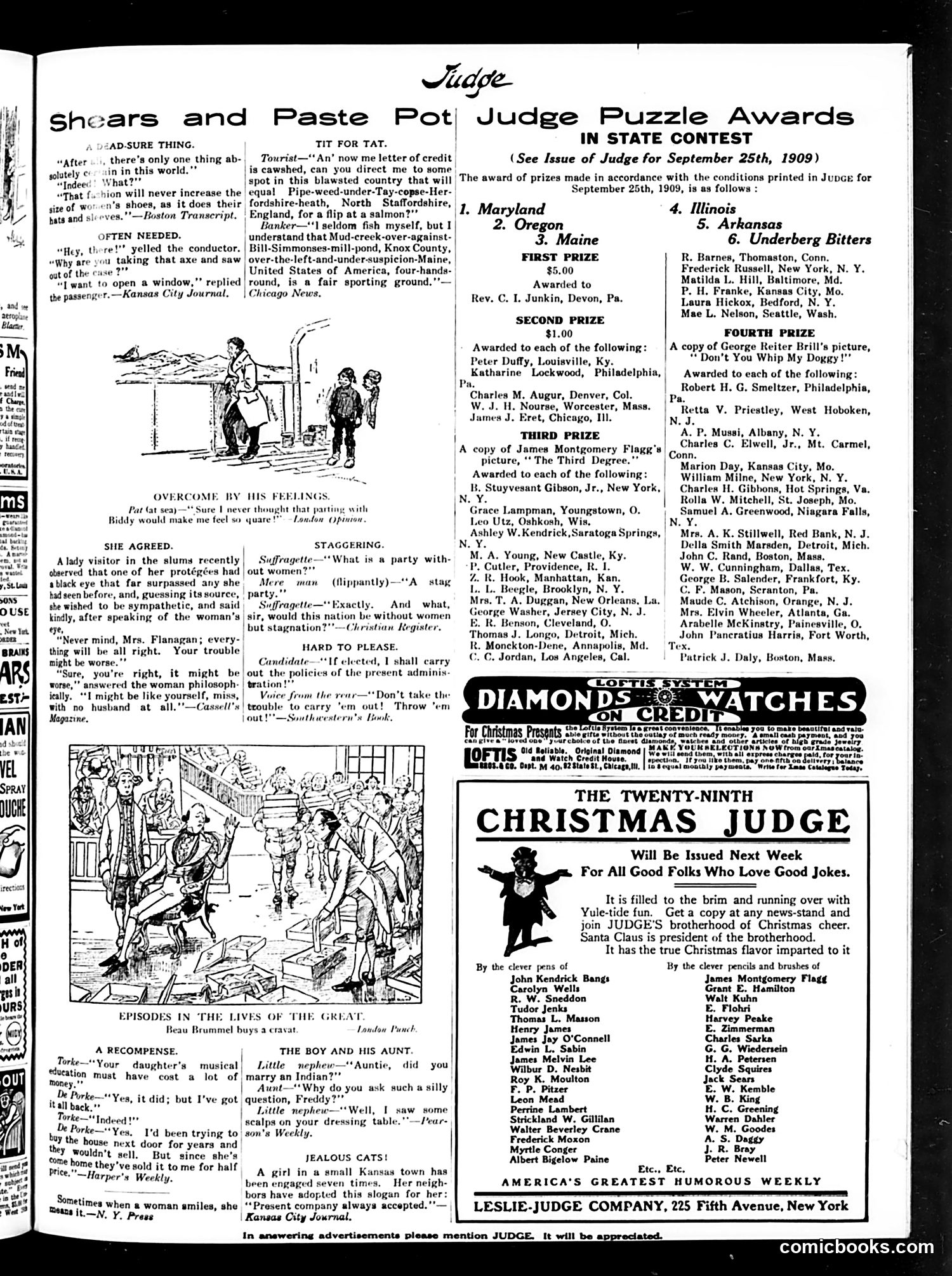
This page is primarily a **humor/joke column** and an **advertising section**, not a political cartoon requiring analysis. The "Shears and Paste Pot" section collects humorous short bits and jokes on everyday topics: fashion, travel, women's suffrage, family life, and romance. These satirize conventional society—for instance, a suffragette jabs at bachelor social events ("A party without women?... stagnation"), and a woman sympathetically suggests her life could be worse than having a black eye by joking she could be an unmarried woman like her visitor. The lower half announces contest **winners** for Judge's puzzle competition and advertises the upcoming "Twenty-Ninth Christmas Judge" issue featuring humor from writers like Grant Hamilton and Tudor Jenks. The tone reflects pre-WWI American magazine humor: lighthearted domestic comedy with gentle digs at gender relations and social conventions, presented without the sharp political edge we might expect. It's essentially a historical artifact of early 1900s popular entertainment.
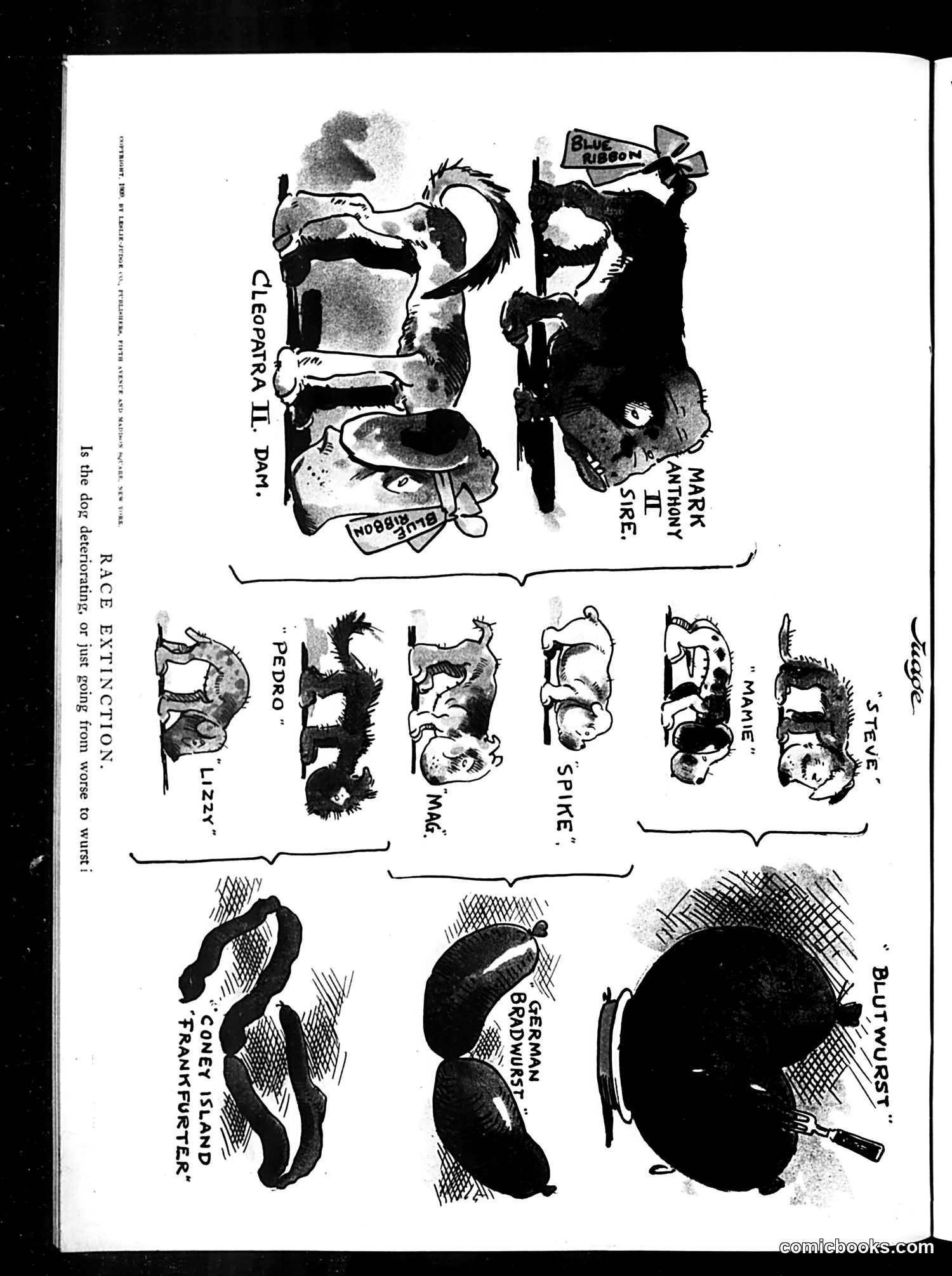
This is a humorous critique of dog breeding practices, using the "frankfurter" (hot dog) as visual pun. The page shows various dog breeds—labeled "CEORA II DAMP," "PEDRO," "LIMEY," "MIMI," "SPIKE," "MARIE," "STEW," "CORKEY ISLAND TRANSFIGURE," "GERMAN BIRDMAN," and "BULLWURT"—presented as increasingly exaggerated or deformed specimens. The cartoon satirizes selective breeding by suggesting dogs are being bred into absurd, unnatural forms that resemble sausages more than functional animals. The pun "going from worse to wurst" (worst/wurst) drives the joke home. The text asks whether this represents genuine "race extinction" or merely deterioration—critiquing the vanity breeding practices of the era that prioritized appearance over health or natural dog characteristics. This reflects genuine Progressive-era concerns about breeding ethics.