
Judge, 1909-11-27 · page 10 of 16
Judge — November 27, 1909 — page 10: what you’re looking at
What you’re looking at
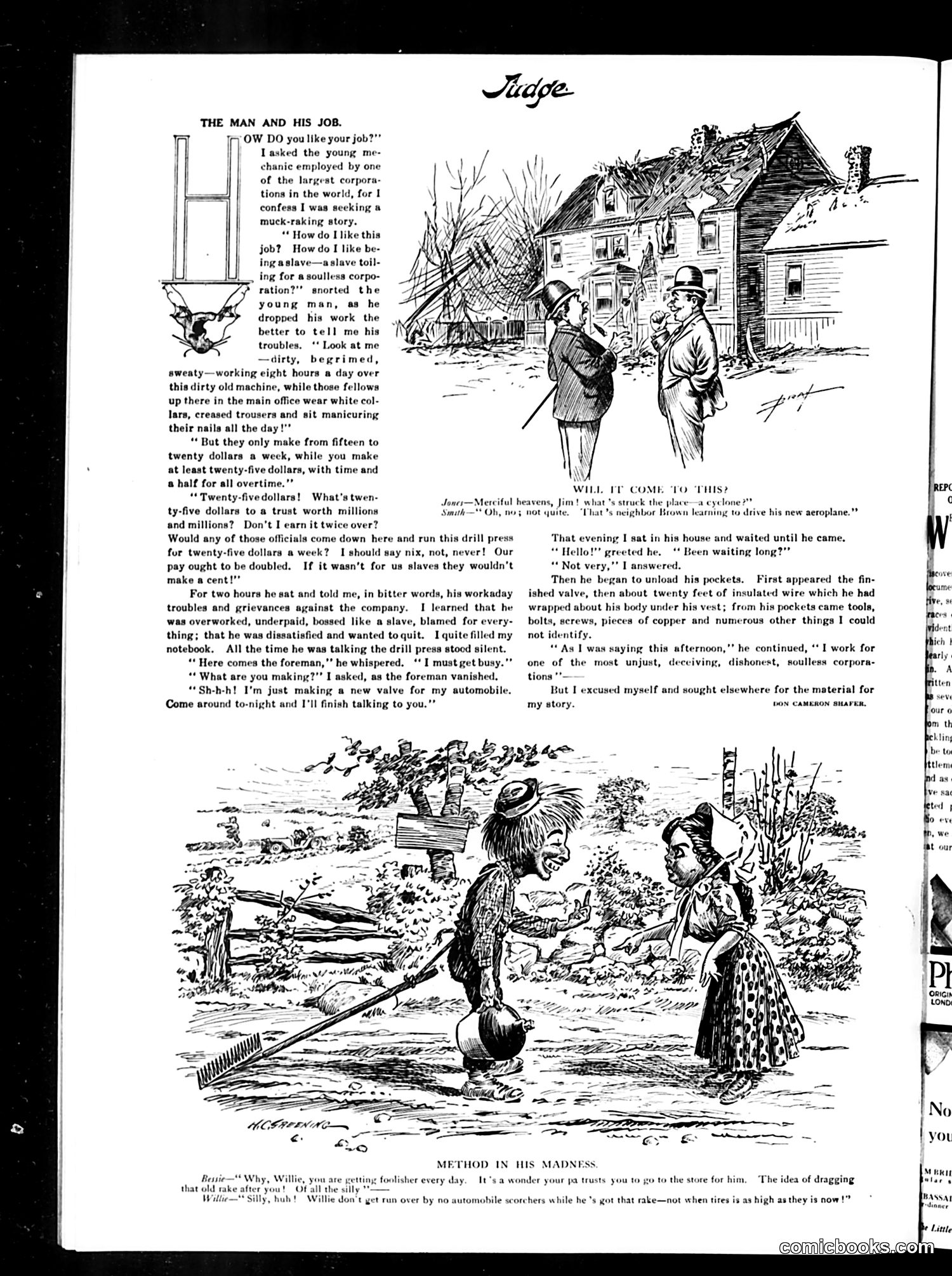
This article mocks a hypocritical factory worker who complains bitterly about corporate exploitation while the narrator observes him—yet ironically, the worker steals company materials and uses company time to build a personal automobile valve. The satire targets two things: First, the worker's exaggerated grievances (claiming $25/week is worthless to a "trust worth millions") despite earning more than office staff. Second, and more pointedly, his lack of moral consistency—he rails against "soulless corporations" while actively robbing from his employer, smuggling out tools, wire, copper, and bolts in his clothing. The cartoonist (Don Cameron Shafer) suggests the worker's complaints ring hollow when he himself engages in dishonesty. The narrator's decision to "excuse myself and seek elsewhere" implies the worker has lost credibility. The piece critiques labor radicalism of the era by portraying the complainant as a hypocrite rather than a sympathetic victim.
📄 Transcribed text from this page (OCR, searchable)
Machine-transcribed from the original scan — historical spelling and the odd misread are preserved.
THE MAN AND HIS JOB. JF OW DO you like your job?” asked the young me- chanic employed by one of the largest corpora- tions in the world, for I confess I was secking # muck-raking story. “* How do I like this job? How do I like be- ing aslave—a slave toil- _, ing for a soulless corpo- ration?"’ snorted the young man, as he dropped his work the better to tell me his troubles. ‘* Look at me —dirty, begrimed, sweaty—working eight hours a day over this dirty old machine, while those fellows up there in the main office wear whi ‘ol- lars, creased trousers and sit manicuring their nails all the day!"" “ But they only make from fifteen to twenty dollars a weck, while you make at least twenty-five dollars, with time and a half for all overtime.”” ““Twenty-fivedollars! What's twen- ty-five dollars to a trust worth millions and millions? Don’t I earn it twice over? Would any of those officials come down here and run this drill press for twenty-five dollars a week? I should say nix, not, never! Our pay ought to be doubled. If it wasn’t for us slaves they wouldn't make a cent!"" For two hours he sat and told me, in bitter words, his workaday troubles and grievances against the company. I learned that he was overworked, underpaid, bossed like a slave, blamed for every- thing; that he was dissatisfied and wanted toquit. I quite filled my notebook. All the time he was talking the drill press stood silent. “* Here comes the foreman,” he whispered. ‘I must get busy.”” “* What are you making?"’ I asked, as the foreman vanished, “Sh-b-h! I'm just making a new valve for my automobile. Come around to-night and I'll finish talking to you.’* Jones—Me Smith—" WILL FE COME ris? avens, Jim! what’ ce—a eyelone 2 quite,” n learning to drive his new aeroplane.”” ‘That evening I sat in his house and waited until he came. “Hello!” greeted he.‘ Been waiting long?” “Not very,’’ I answered. Then he began to unload his pockets. ished valve, then about twenty feet of insulated wrapped about his body under his vest; from his pock First appeared the fin- e which he had s came tools, bolts, screws, pieces of copper and numerous other things I could tify. As I was saying this afternoon,’’ he continued, ‘* 1 work for one of the most unjust, deceiving, dishonest, soulless corpora- tions ""— But I excused myself and sought elsewhere for the material for my story. DON CAMERON SHAFER, ra METHOD IN HIS MADNESS Ressie—* Why, Willie, you are get that old rake after Of all the silly * Willie—* Silly, hub! It'sa wonder your pa trusts: you to go to the store for him. ‘The idea of dragging Willie don't yet run over by no automobile scorchers while he’s got that rake—not when tires is as high as they is now!”