
A complete issue · 16 pages · 1909
Judge — October 30, 1909
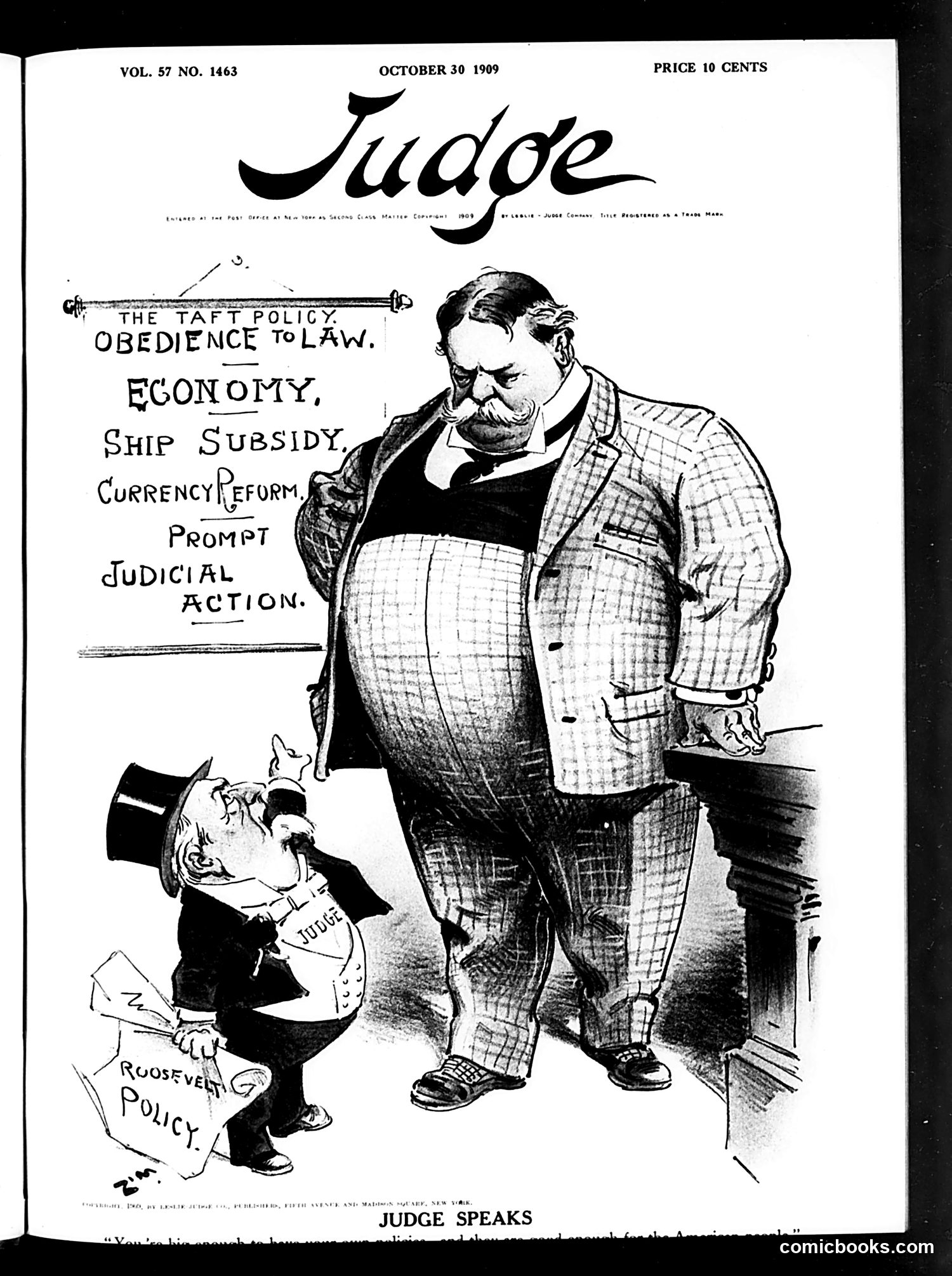
This political cartoon depicts a confrontation between two figures representing opposing policies. The large man in the checkered suit carries a barbell labeled "THE TAFT POLICY" with multiple demands: "OBEDIENCE TO LAW," "ECONOMY," "SHIP SUBSIDY," "CURRENCY REFORM," and "PROMPT JUDICIAL ACTION." The smaller figure labeled "Judge" (wearing a top hat and holding a paper marked "ROOSEVELT POLICY") appears diminished and struggling beneath this burden. The cartoon critiques President William Howard Taft's ambitious policy agenda as overly heavy and burdensome compared to his predecessor Theodore Roosevelt's approach. It suggests Taft's multiple simultaneous reform initiatives are impractical or contradictory, satirizing the new administration's attempt to balance competing priorities during its first year in office.
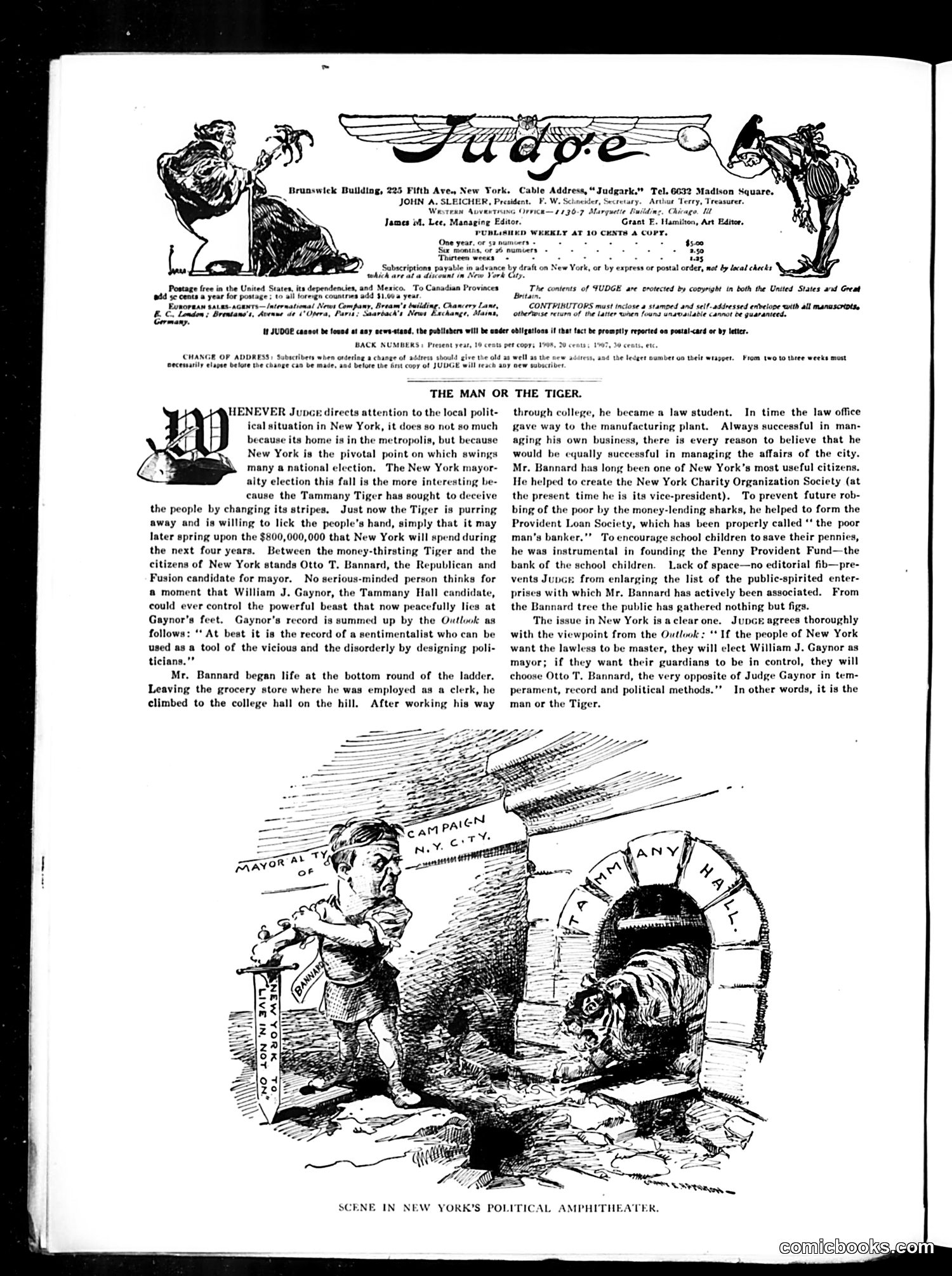
This cartoon satirizes New York City's mayoral race. The main illustration depicts a figure labeled "Mayor of N.Y.C." confronting a tiger emerging from a cage labeled "Tammany Hall" — a reference to the corrupt Democratic political machine that dominated NYC politics. The article discusses Judge Gould (misspelled "Gaynor" in the text), contrasting him with William J. Gould and Otto T. Bannard. The "tiger" metaphor represents the brutal, vicious nature of Tammany Hall politics. The satirist argues that voters must choose between a principled mayor or one controlled by Tammany's corrupt influence. The cartoon suggests Tammany Hall operates like a dangerous predator that must be contained or defeated.
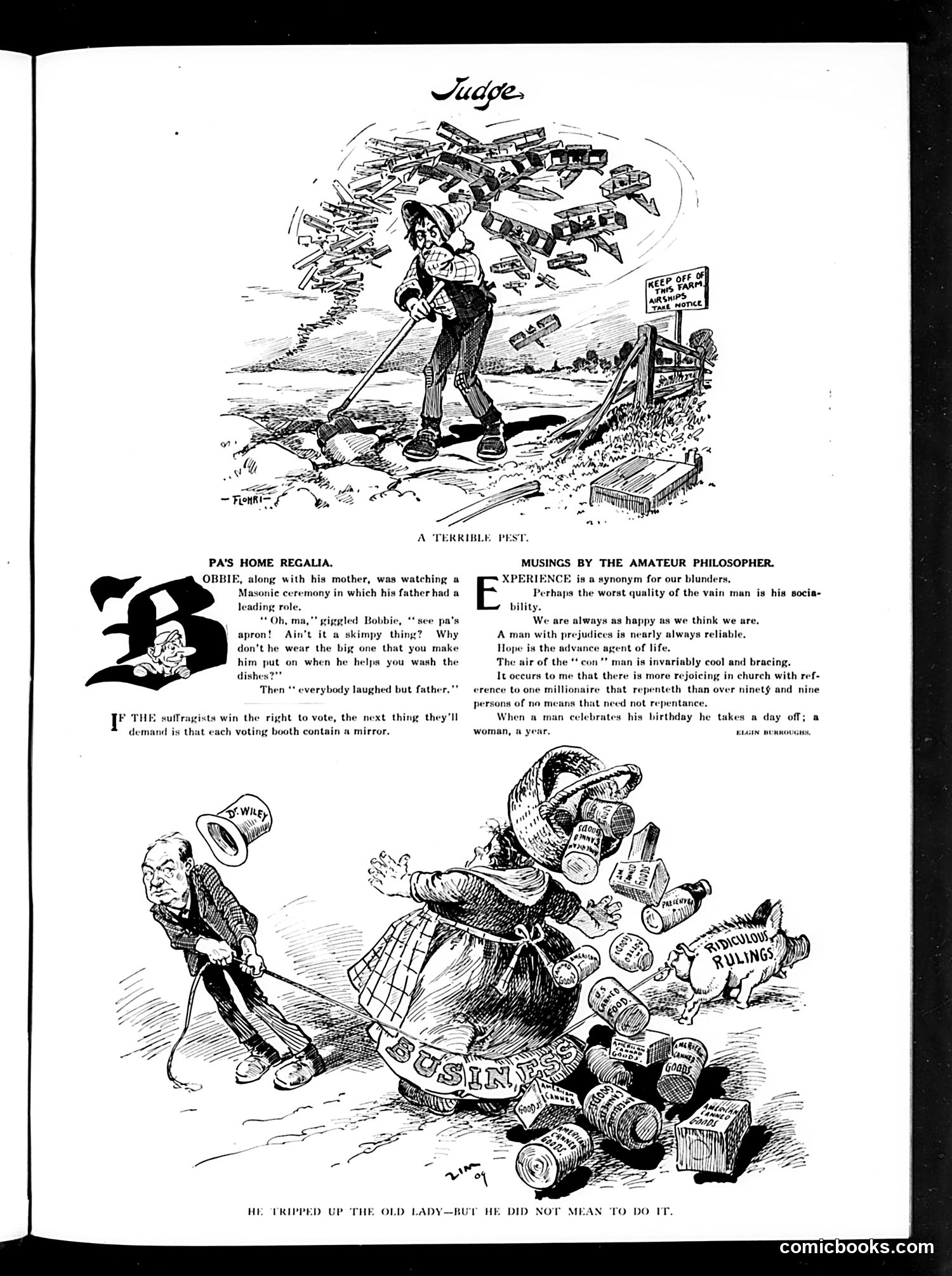
**Top Cartoon ("A Terrible Pest"):** A figure labeled "Judge" sweeps up scattered automobiles, suggesting regulatory concerns about automobiles as a nuisance or danger to society—likely early 20th-century automobile anxiety. **Middle Section:** Contains humor about suffrage (voting rights for women) and a philosophical essay by Elgin Burroughs on happiness and experience. **Bottom Cartoon ("He Tripped Up the Old Lady"):** A thin man appears to have knocked over a large woman laden with bottles and containers labeled "Business," "Rulings," and other terms. This likely satirizes conflict between business interests and government regulation or judicial decisions affecting commerce. The cartoons reflect Progressive Era tensions between regulation, women's rights, and business freedom.
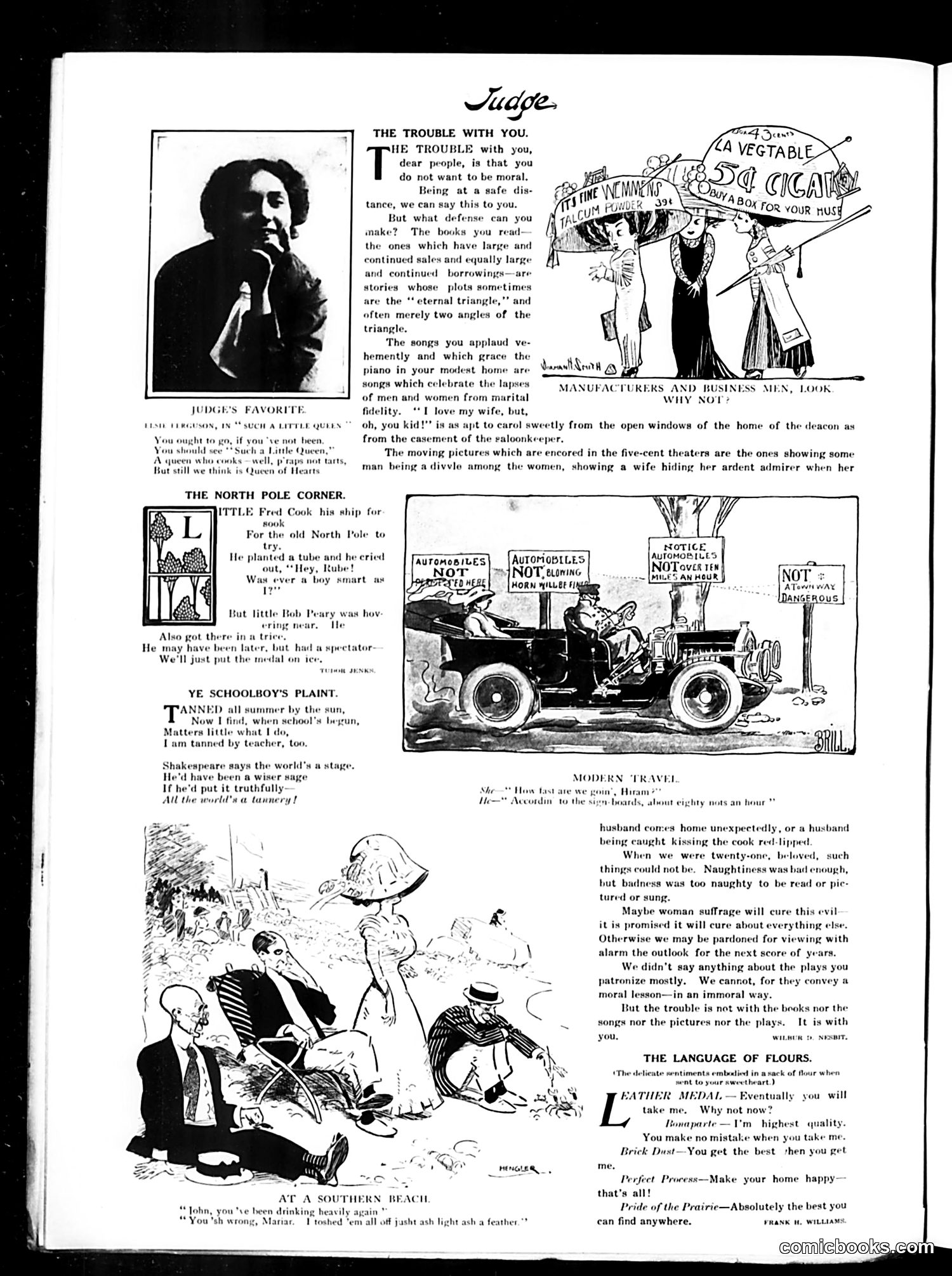
This page contains several satirical pieces targeting early 20th-century social behaviors: **"The Trouble with You"** attacks moralistic criticism of entertainment—books, songs, and motion pictures—suggesting critics wrongly blame these media for society's problems rather than addressing actual moral issues. **"The North Pole Corner"** mocks Captain Peary's Arctic expeditions with a pun about being "smart as a whip." **"Modern Travel"** satirizes automobile dangers, showing reckless driving with warning signs ignored—commentary on the new automobile age's risks. **"At a Southern Beach"** depicts drunken behavior, with unclear specific reference. **"The Language of Flours"** is an advertorial about flour quality, not satire. Overall, the page critiques public moralizing, transportation hazards, and drinking culture rather than targeting specific political figures.
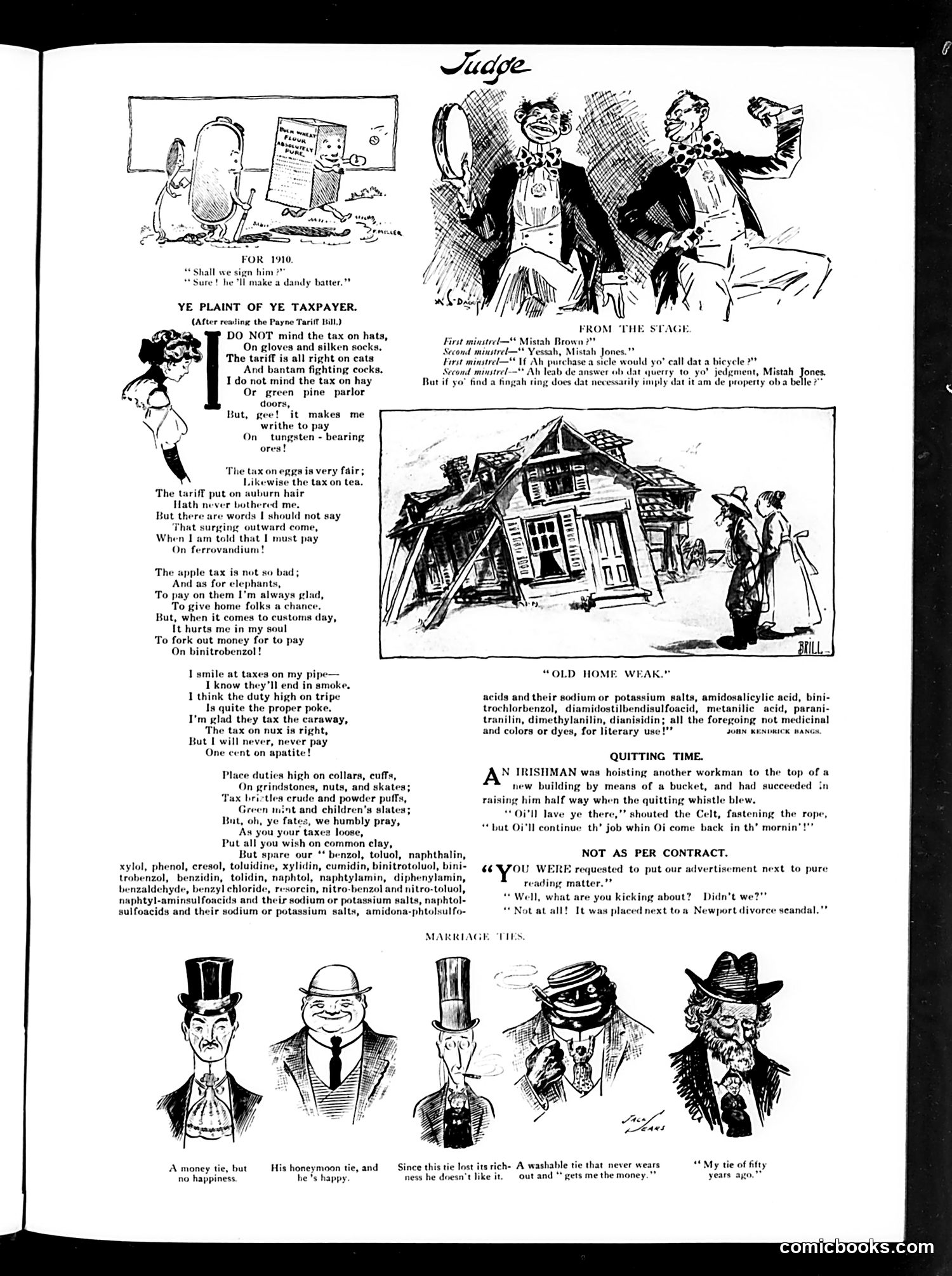
This page satirizes American taxation around 1910. The central poem "YE PLAINT OF YE TAXPAYER" complains about various taxes—on eggs, tea, collars, cuffs, and numerous chemical compounds—expressing the taxpayer's frustration with endless levies. The cartoons mock the tax burden's absurdity: the top-left shows someone struggling under bureaucratic paperwork; "From the Stage" depicts characters debating tax policy; "Old Home Weak" illustrates a house collapsing under weight (likely symbolizing financial strain). The bottom section presents humorous takes on marriage ties, suggesting matrimony is financially burdensome—a tie that brings "no happiness" but rather financial worry. Overall, the page ridicules government taxation as excessive, confusing, and economically destructive to ordinary citizens and households.
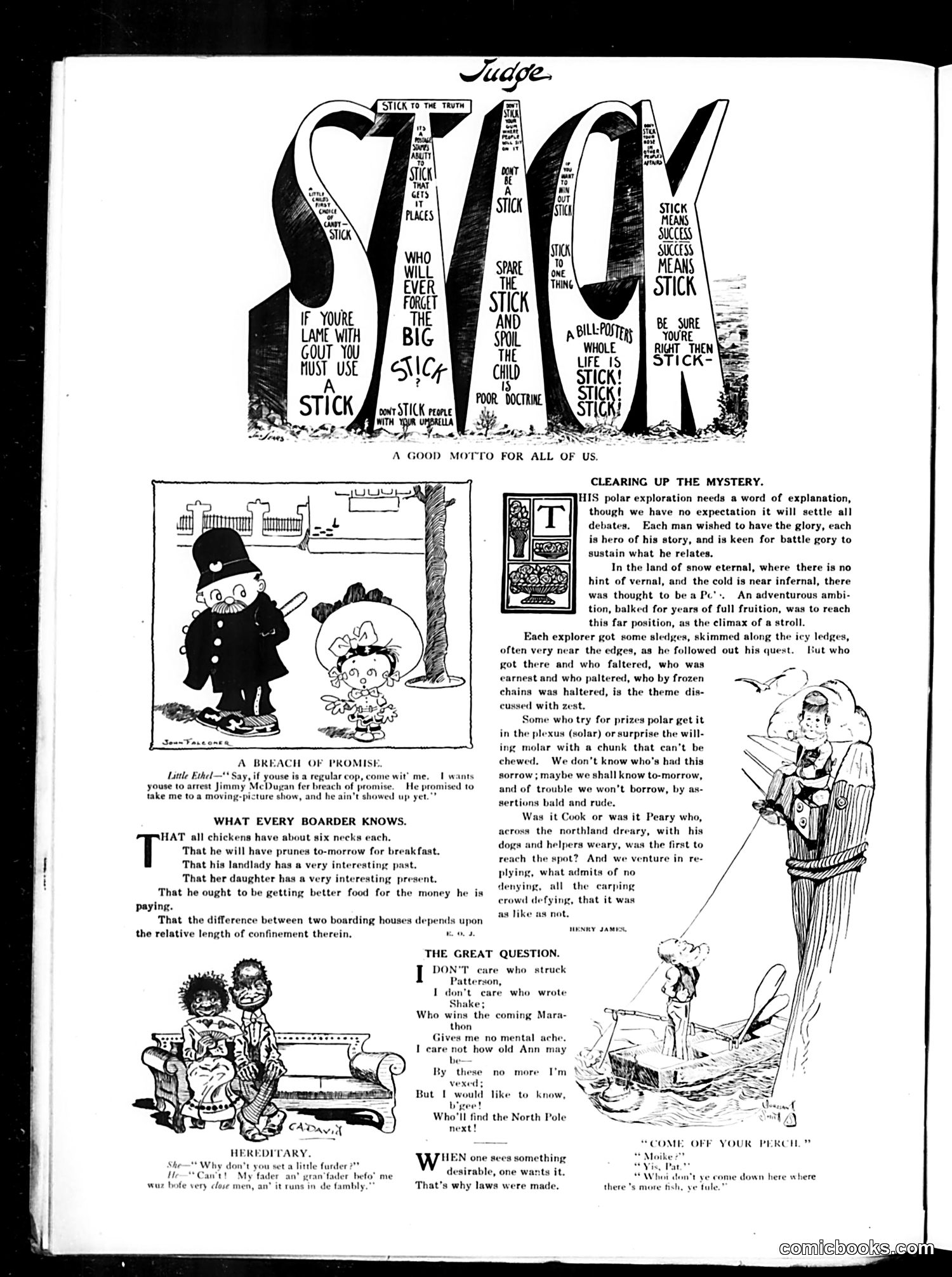
This page satirizes early 20th-century polar exploration controversies, likely the disputed claim over reaching the North Pole. The main cartoon "STICK TO THE TRUTH" plays on conflicting explorer narratives—apparently referencing competing claims by Frederick Cook and Robert Peary about who first reached the North Pole (a real 1909 controversy). The text "CLEARING UP THE MYSTERY" acknowledges that each explorer told his own heroic version, making truth difficult to establish. This mocks how explorers manipulated public opinion through contradictory accounts. Surrounding humor includes mild satirical pieces: "A BREACH OF PROMISE" (domestic comedy), "WHAT EVERY BOARDER KNOWS" (boarding house stereotypes), and "THE GREAT QUESTION" (a poem listing contemporary curiosities). The motto "STICK TO THE TRUTH" ironically caps a page discussing how difficult truth-telling actually is—the central joke being that public figures, even celebrated explorers, rarely do.
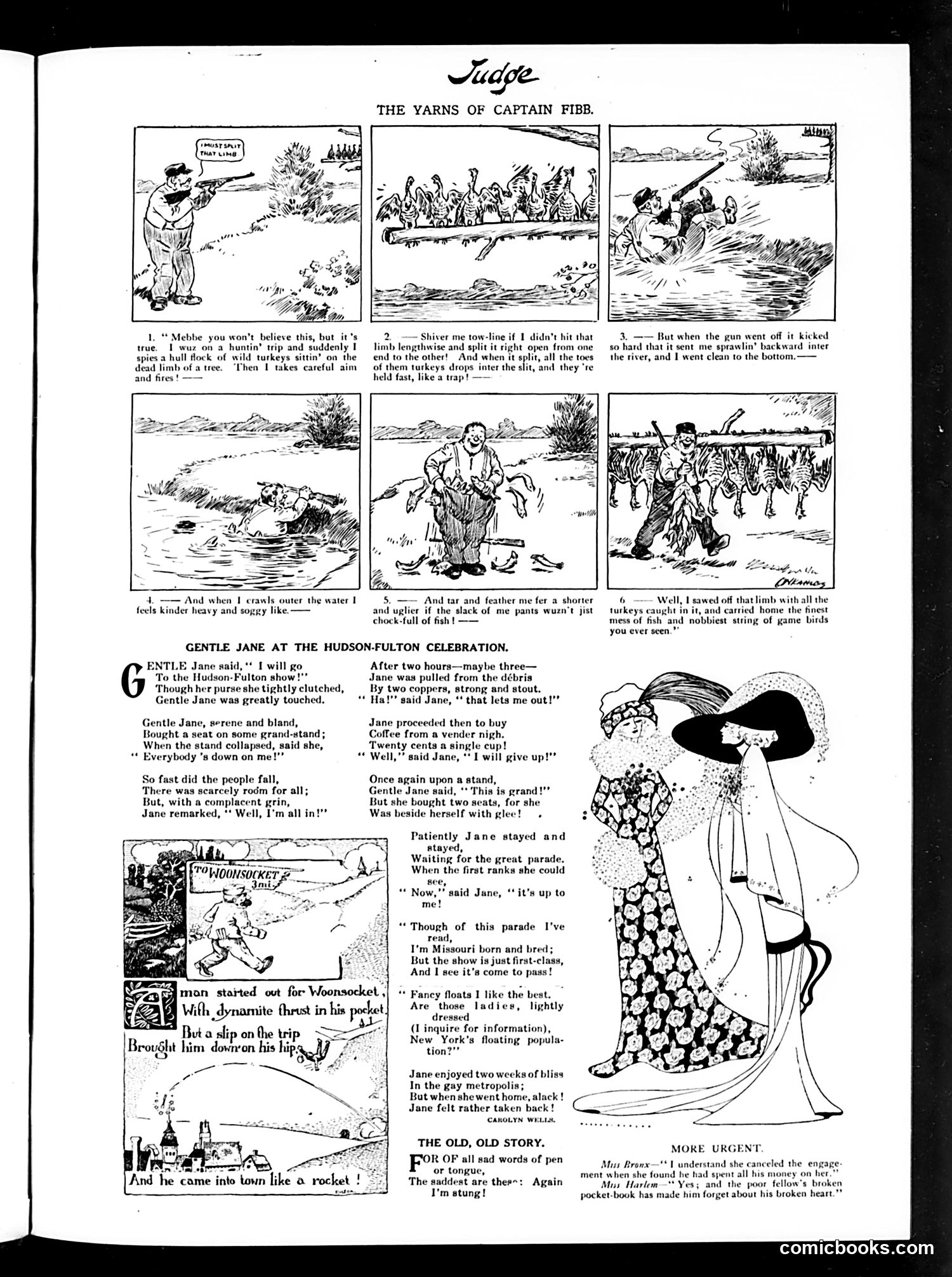
This page contains three distinct humor pieces: **"The Yarns of Captain Fibb"** is a tall-tale comic strip mocking exaggerated hunting stories. Captain Fibb recounts absurdly impossible feats—shooting turkeys so they fall into a tree slit like a trap, being knocked backward into a river and emerging full of fish. The satire targets men's fishing/hunting boasts, presenting increasingly ridiculous scenarios that no reasonable person would believe. **"Gentle Jane at the Hudson-Fulton Celebration"** satirizes a woman attending the 1909 Hudson-Fulton celebration (commemorating Hudson and Fulton's achievements). Jane is portrayed as cheap yet eager to participate; she complains about expensive coffee, repeatedly buys seats at parade stands, and finds New York's "floating population" (women) scandalous. The humor comes from her small-town moralism colliding with urban excess. **"The Old, Old Story"** is a brief caption joke about a man ruined financially by a woman, using the phrase "I'm stung!"—implying romantic/financial victimization. All three pieces use period stereotypes and employ gentle satire rather than sharp political commentary.
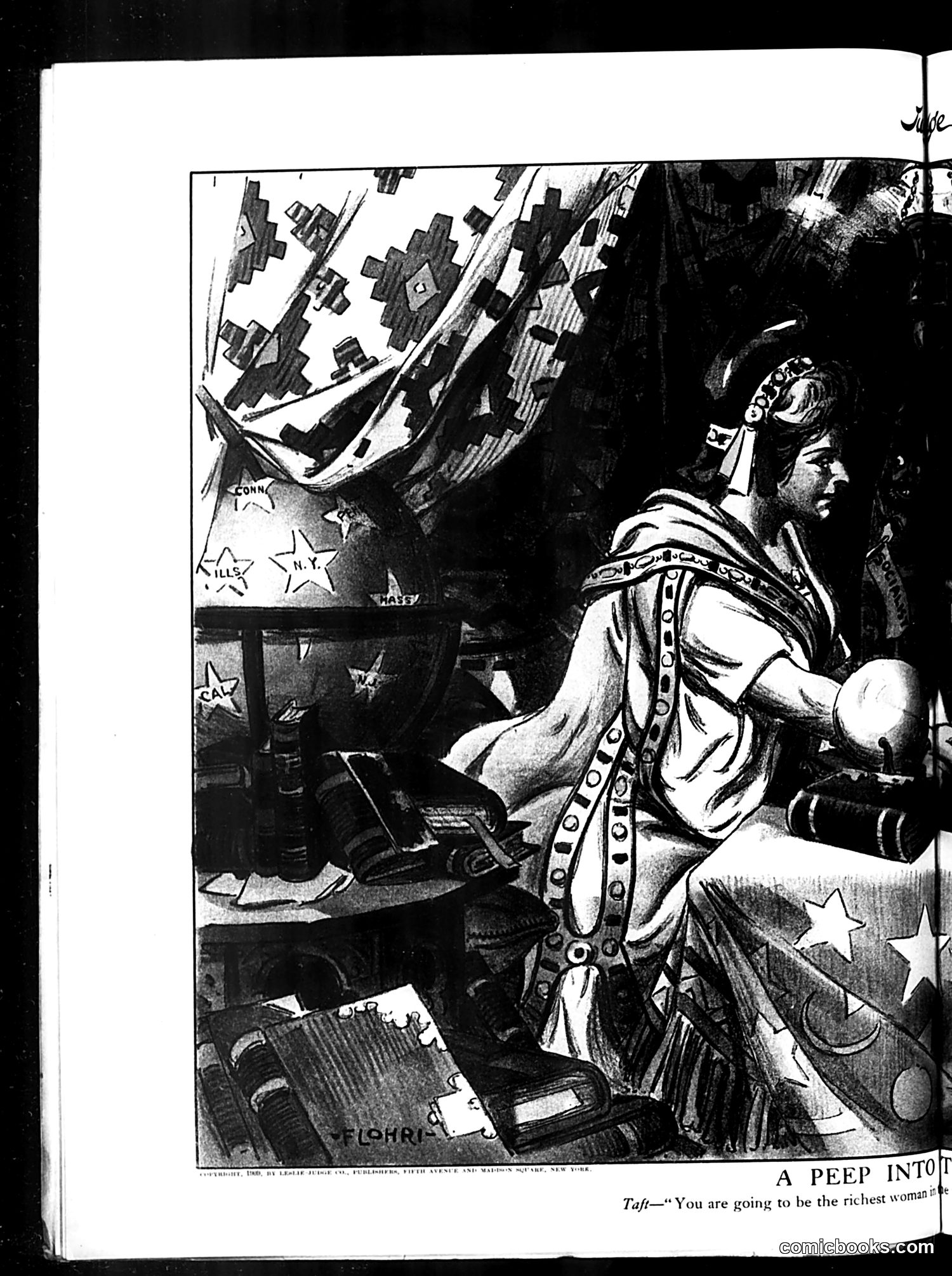
This appears to be a satirical cartoon titled "A Peep Into..." (caption cut off). The illustration shows figures in classical/theatrical dress examining what appears to be a map or plan of a city from above. The setting includes stars and patriotic imagery. The caption reads: "You are going to be the richest woman in..." (text cuts off). Based on the classical costume, architectural focus, and promise of wealth, this likely satirizes urban development schemes or real estate speculation—common Judge magazine targets. The theatrical staging suggests mockery of grandiose financial promises or dubious investment schemes popular in early-to-mid 20th century America. Without the complete caption and date, I cannot identify the specific figures or event referenced.
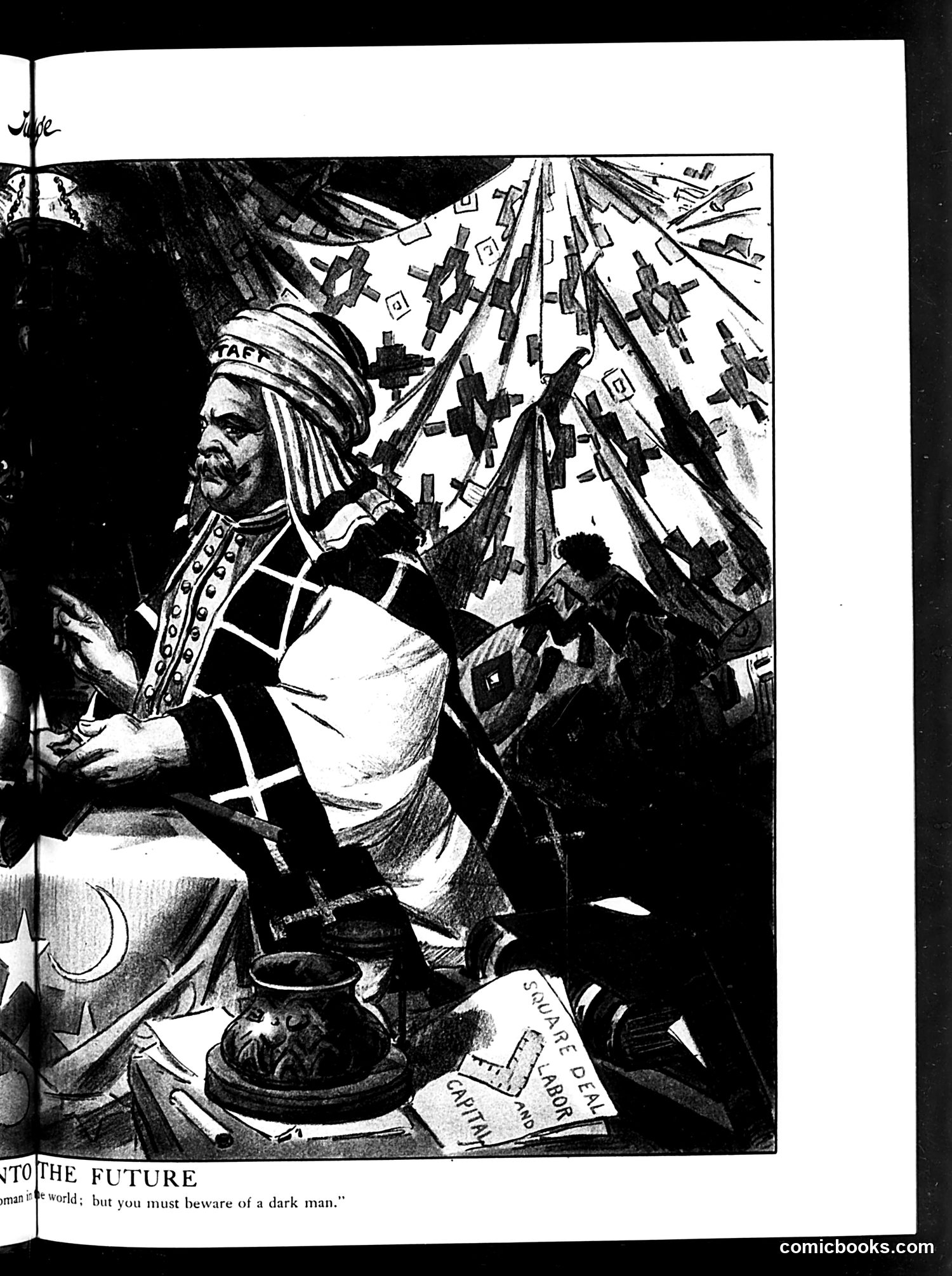
This appears to be a satirical illustration titled "INTO THE FUTURE" with a caption warning "beware of a dark man." The central figure is a turbaned man in ornate Eastern dress, depicted in a caricatured style common to early 20th-century American political cartoons. He appears to be gazing into a crystal ball or mystical sphere, surrounded by radiating crosses and weapons. The imagery suggests anxieties about non-Western influence or Islamic themes penetrating American society. The "dark man" likely represents fears about immigration, foreign influence, or religious otherness that were prevalent in Judge magazine's satirical commentary. The ominous tone and mystical framing reflect period stereotypes and xenophobic concerns, typical of the magazine's editorial stance toward perceived outsiders or threats to American values.
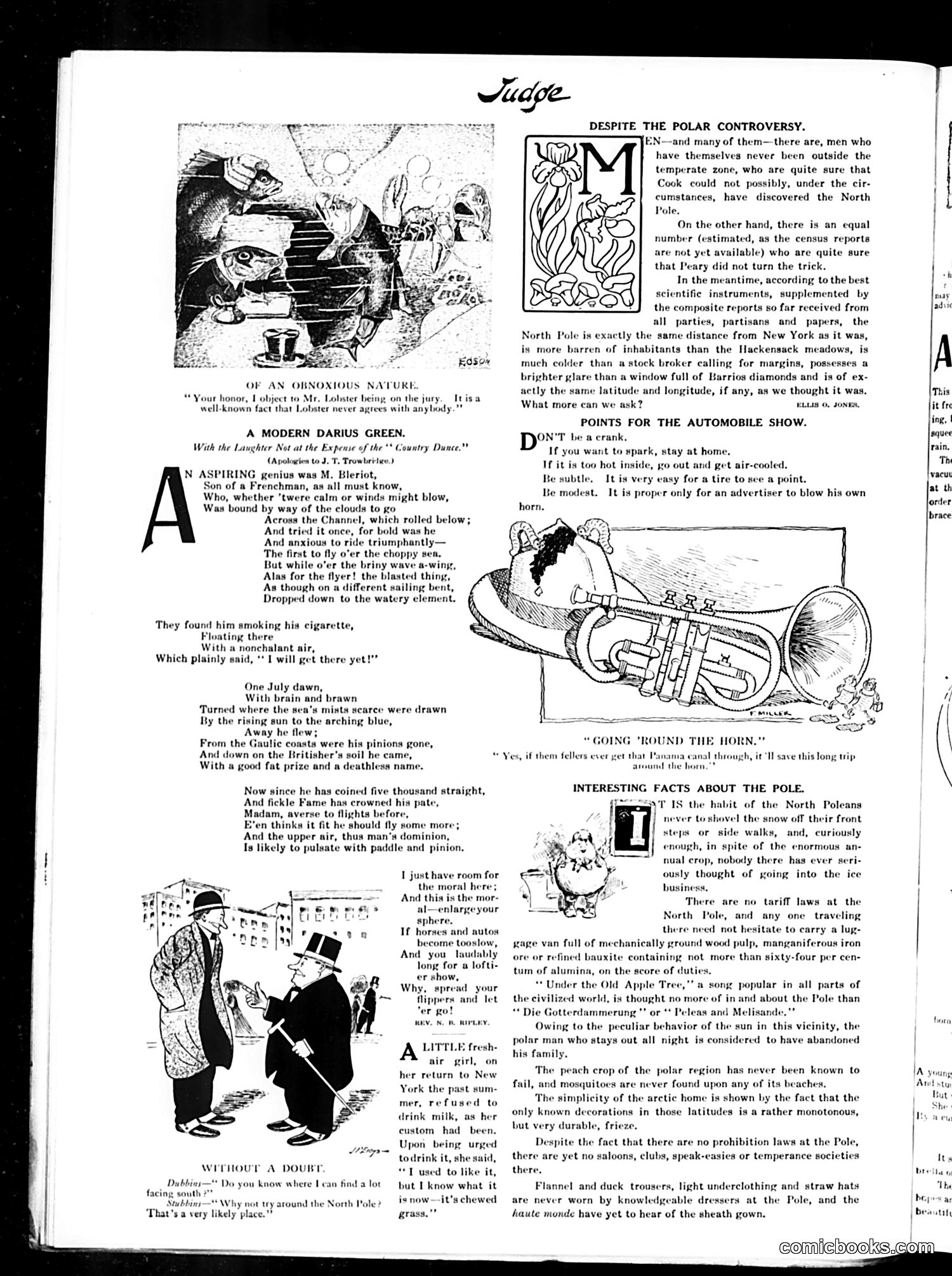
This page satirizes the heated public debate over who discovered the North Pole. Cook and Peary were rival explorers claiming priority; Judge mocks the public's certainty about claims neither group could verify independently. The cartoon notes the Pole remains unchanged regardless—equally distant from New York, equally barren and cold—making the dispute absurd. The page also includes "A Modern Darius Green," celebrating Louis Blériot's 1909 English Channel flight (referencing an earlier poem about an amateur flying machine). The sketch humorously depicts Blériot crashing into water, then calmly smoking a cigarette, declaring he'll "get there yet"—which he did on his successful crossing. Additional lighter content includes automobile etiquette tips and absurdist "facts" about the North Pole (Eskimos don't shovel snow, no tariff laws exist there), pure comic invention.
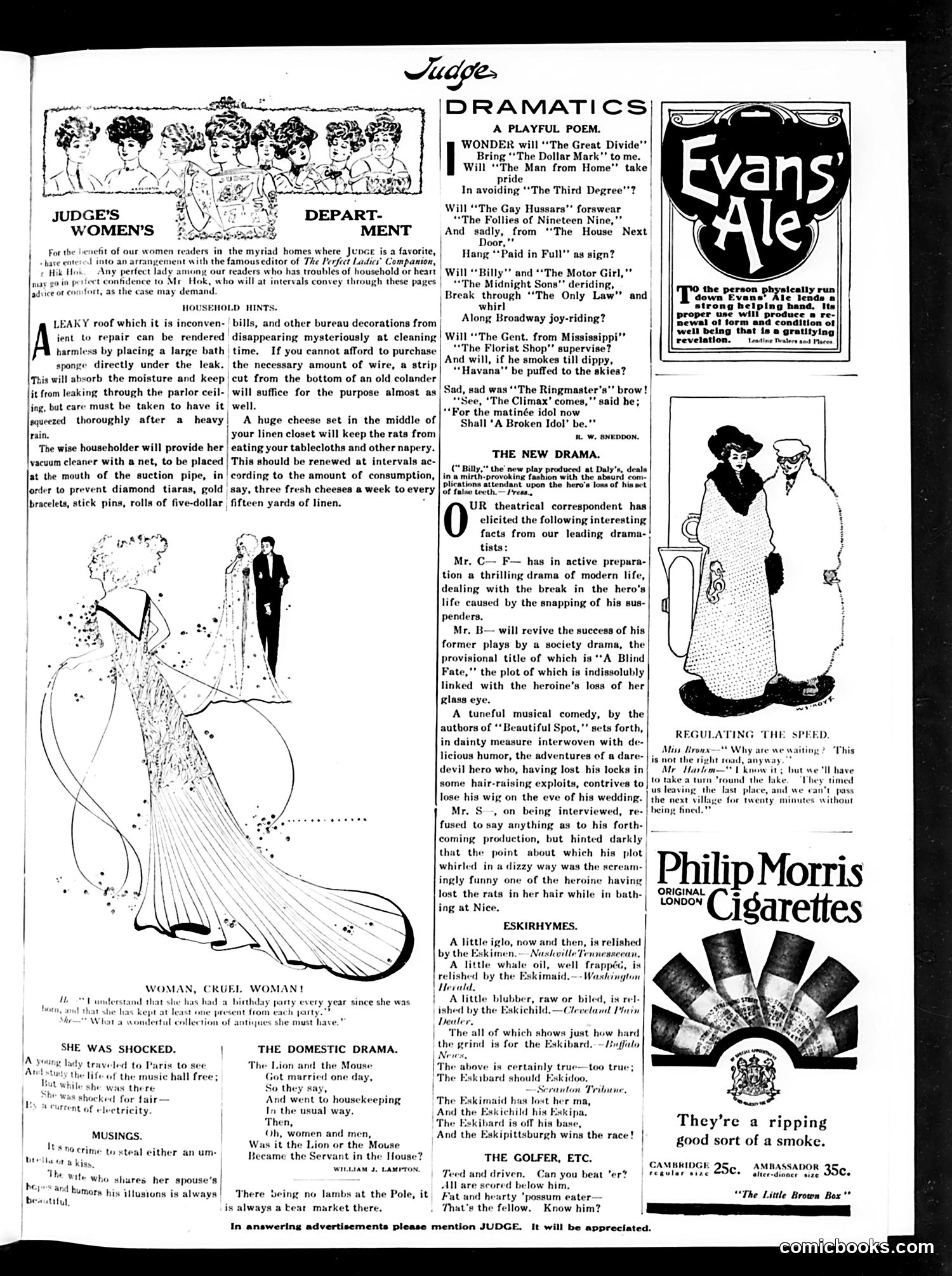
This page from *Judge* satirizes contemporary Broadway theatrical productions through a mock poem listing current plays with punning titles. The satire works by suggesting these shows' titles literally describe their plots—so "The Great Divide" is about financial gain, "The Man from Home" involves avoiding interrogation, and "The Gay Hussars" abandons frivolity. The accompanying section "The New Drama" mocks pretentious playwrights by inventing absurdly trivial plots for serious-sounding dramas: one features a hero's life destroyed by snapping suspenders; another hinges on a heroine losing her glass eye. The humor targets theatrical pretension and the gap between grandiose titles and mundane actual content. The page also includes typical *Judge* features: household advice, a satirical poem about a woman's cruelty, and period advertisements (Evans' Ale, Philip Morris Cigarettes). The overall tone is lighthearted social commentary on Gilded Age entertainment and domestic life.
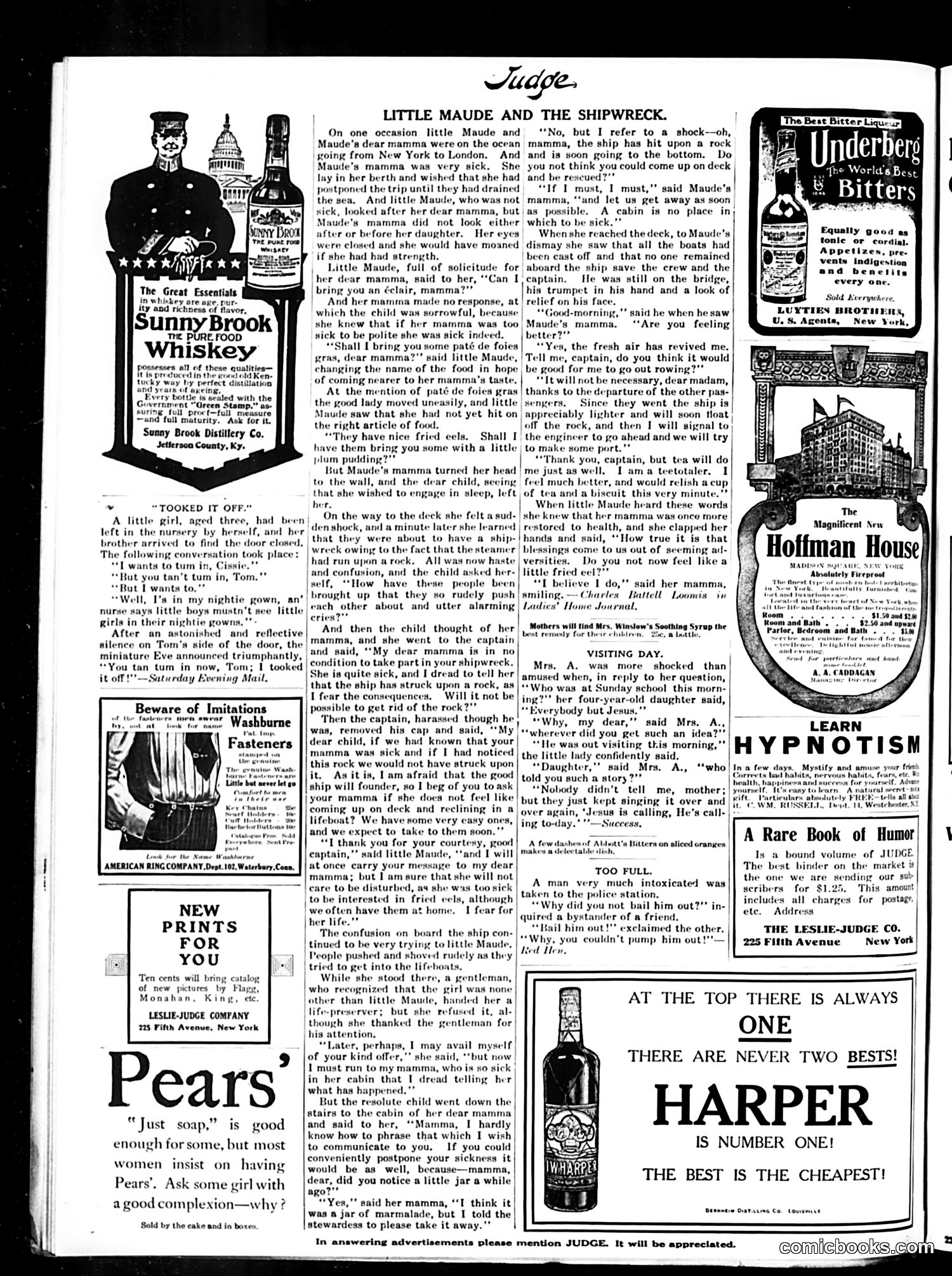
This is a satirical children's story published in *Judge* magazine, mocking Victorian sentimentality and exaggerated politeness. The humor centers on a precocious young girl, Maude, aboard a sinking ship. While other passengers panic, she remains fixated on her seasick mother's dietary preferences—offering éclairs, foie gras, and fried eels as the vessel founders. When she finally alerts the captain to the shipwreck, she does so primarily to warn him that her mother shouldn't be disturbed during this crisis. The satire targets the absurd priorities of genteel Victorian society: proper etiquette and social convention supersede actual danger. The joke is that Maude's concern for her mother's comfort and rest matters more to her than imminent disaster. Her politeness is so ingrained that even a sinking ship cannot shake her adherence to propriety and hierarchical family deference. The page also contains period advertisements (whiskey, soap, prints) typical of early 20th-century magazines.
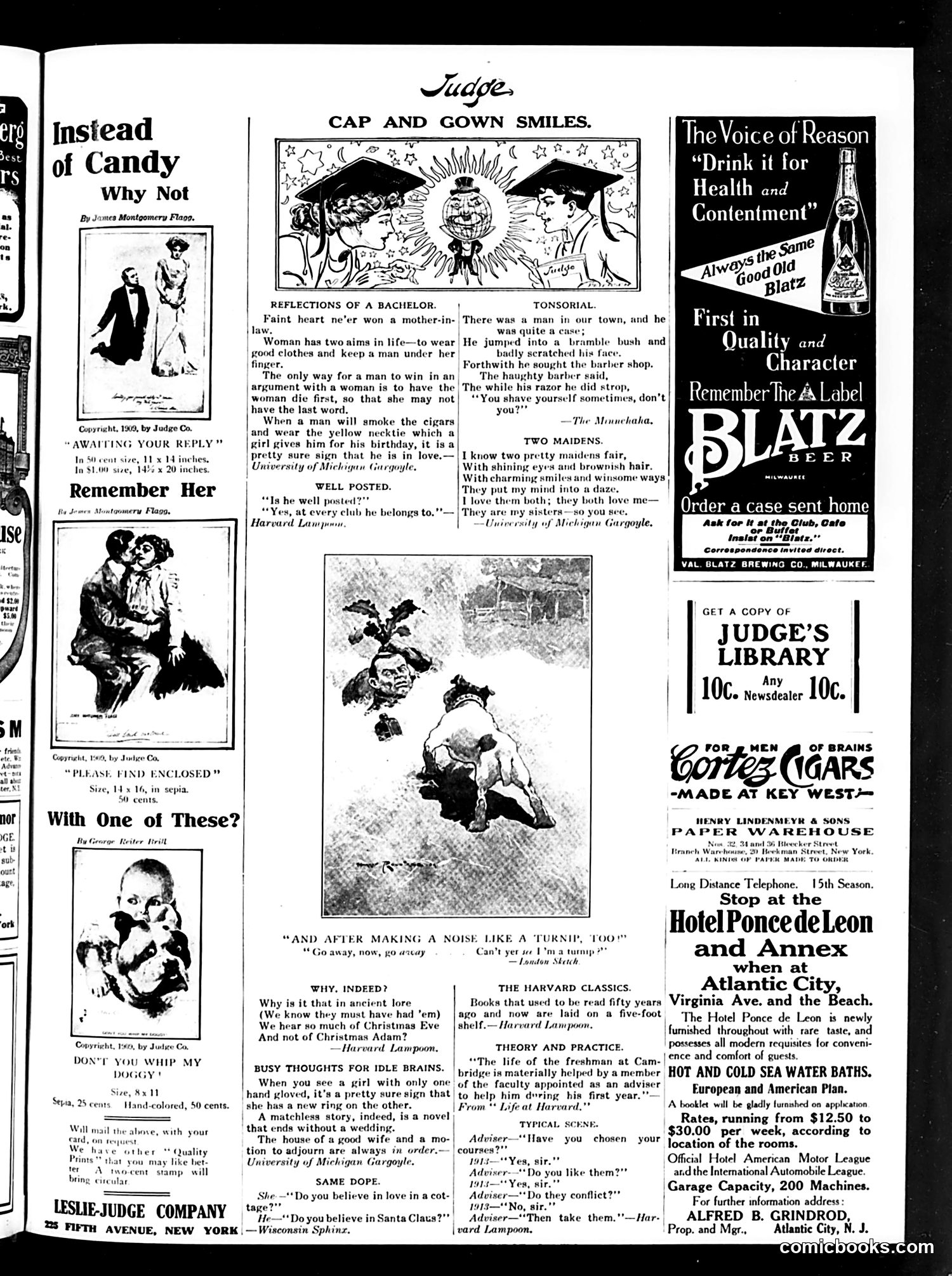
This page from Judge (circa 1909) is primarily **advertising and light humor content**, not political satire. The "Cap and Gown Smiles" section collects brief jokes—mostly observations about courtship, marriage, and college life—sourced from university publications like Harvard Lampoon and Michigan Gargoyle. These are genteel bachelor-pad humor typical of the era: quips about women's stubbornness, engagement rings, and the perils of matrimony. The accompanying illustrations by James Montgomery Flagg are sentimental gift-art rather than satirical: "Remember Her" (a soldier with his sweetheart), "Instead of Candy—Why Not" (romantic couple), and "With One of These?" (baby gifts). The remaining content is **period advertising**: Blatz beer, Judge's Library (10-cent anthologies), Cortes cigars, and the Hotel Ponce de Leon in Atlantic City. There is **no discernible political commentary or social satire** on this page—it reflects early 20th-century consumer culture and courtship conventions, but without critical edge.
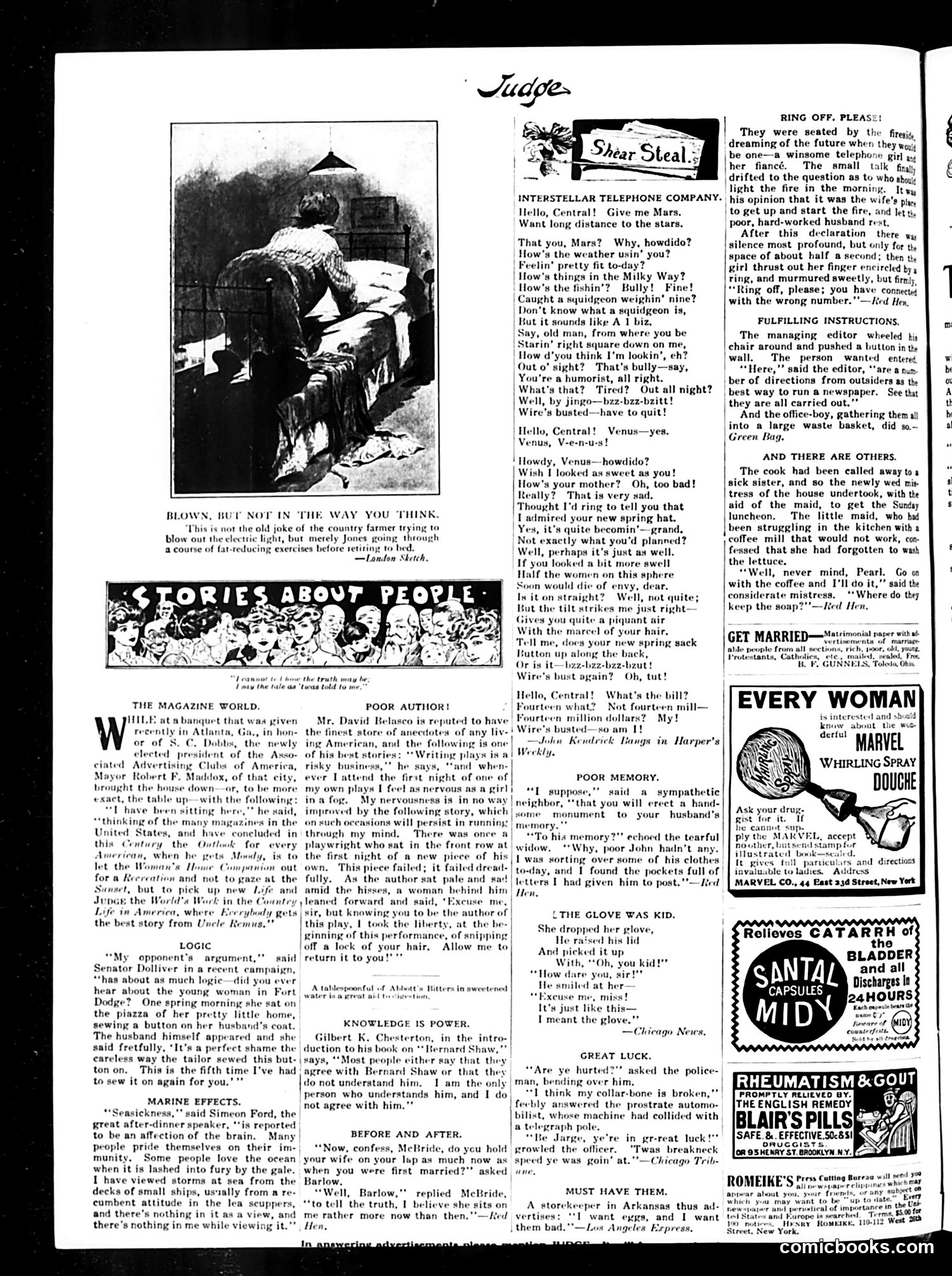
This page from the satirical magazine *Judge* contains several pieces of social humor typical of early 20th-century American satire: **Main Cartoon ("Blown, But Not In The Way You Think"):** Depicts someone performing weight-loss exercises rather than the old joke of blowing out an electric light. It satirizes the era's obsession with physical fitness and reducing exercises. **"Interstellar Telephone Company":** A humorous dialogue imagining long-distance calls to Mars and Venus, playing on the novelty of telephone technology and contemporary fascination with space/astronomy. The jokes rely on absurdist humor and puns. **Text Pieces:** Include anecdotes about authors, politicians (Senator Dolliver), and society figures, using them to illustrate broader points about human nature and logic. One story mocks an unsuccessful playwright; another uses a Fort Dodge woman's marital complaint as a springboard for commentary. The page reflects *Judge*'s satirical approach: poking fun at contemporary technology, social pretensions, and domestic life through short comedic pieces rather than direct political commentary.
This page is primarily **advertising and editorial content** rather than political satire. The main items are: **"Shear Steal" cartoon** (top left): A brief joke about a nervous wife who won't sleep, fearing burglars—a domestic humor piece with no political meaning. **White Rock advertisement** (top right): Promoting bottled water as "The World's Best Table Water," a product advertisement common to early 1900s magazines. **"Judge's Editorial Bench"** (right side): Announces upcoming content in *Judge* magazine, including "The Cynic's Examination Papers for Everybody" and "Home Training" articles—standard magazine promotion. **Various short jokes and anecdotes**: Humorously nostalgic stories about farming, Boston tourism, and children's behavior—typical light fare for a satirical magazine of this era. **"Fish Puzzle Contest"**: Announces prize winners from a reader competition. The page reflects early 1900s American domestic life and magazine advertising conventions rather than political commentary.
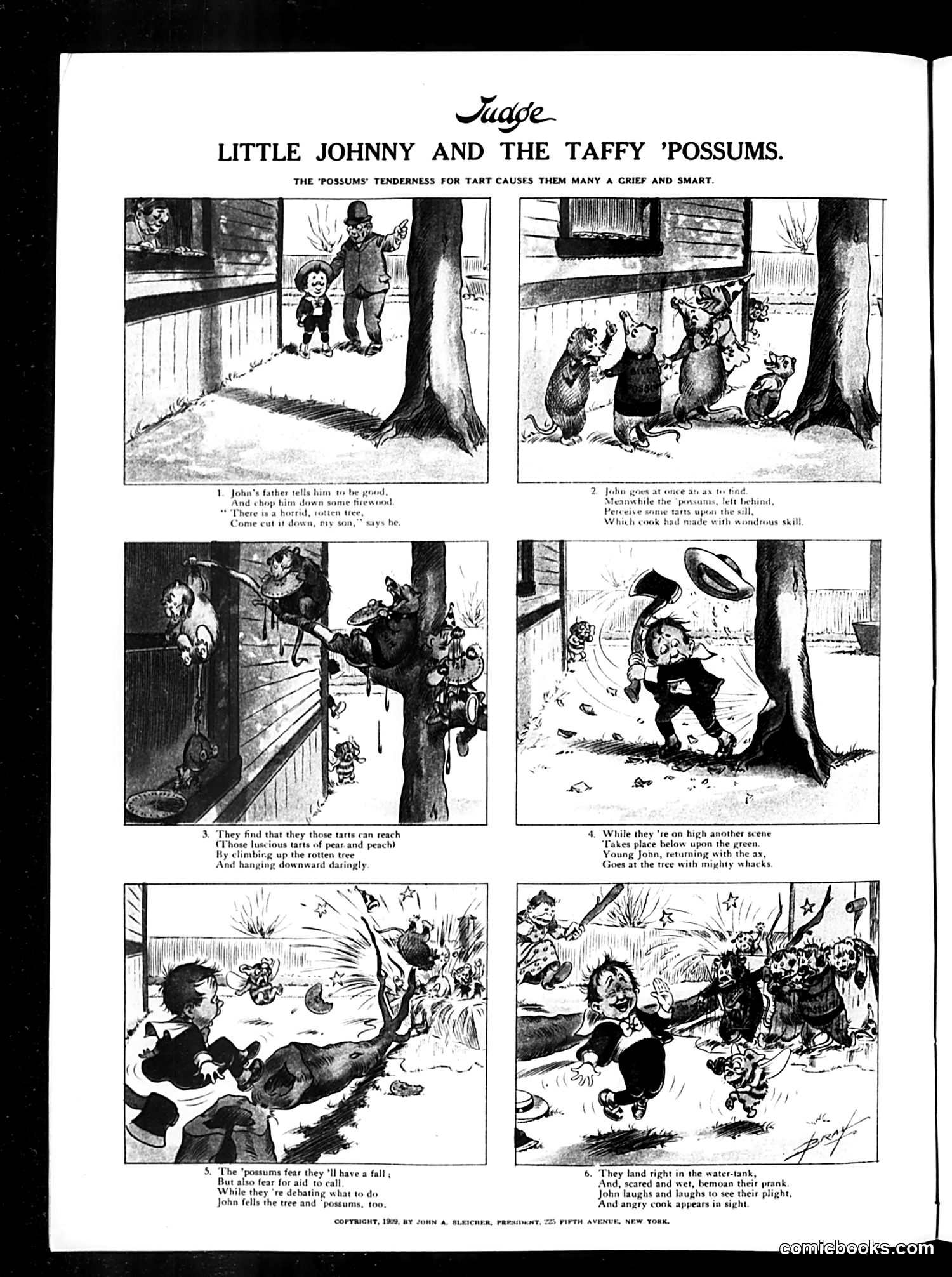
This is a six-panel humorous narrative comic, not political satire. It depicts a slapstick scenario where possums steal tarts (pastries) from a tree and face consequences. The plot: Johnny's father warns him about a "horrid, cursed tree" with hanging fruit. Johnny encounters possums stealing pear and peach tarts hung in the tree. While the possums squabble over whether to flee, Johnny chops down the tree with an ax, sending possums tumbling. They land in water, becoming soaked and panicked, while Johnny laughs at their misfortune. The sequence concludes with an "angry cook" appearing—presumably the tart's owner, adding final comic retribution. The humor relies on anthropomorphized animal mischief, slapstick consequences, and the possums' predicament. It's gentle domestic comedy typical of Judge magazine's family-oriented material, with no apparent political commentary.