
A complete issue · 16 pages · 1909
Judge — October 23, 1909
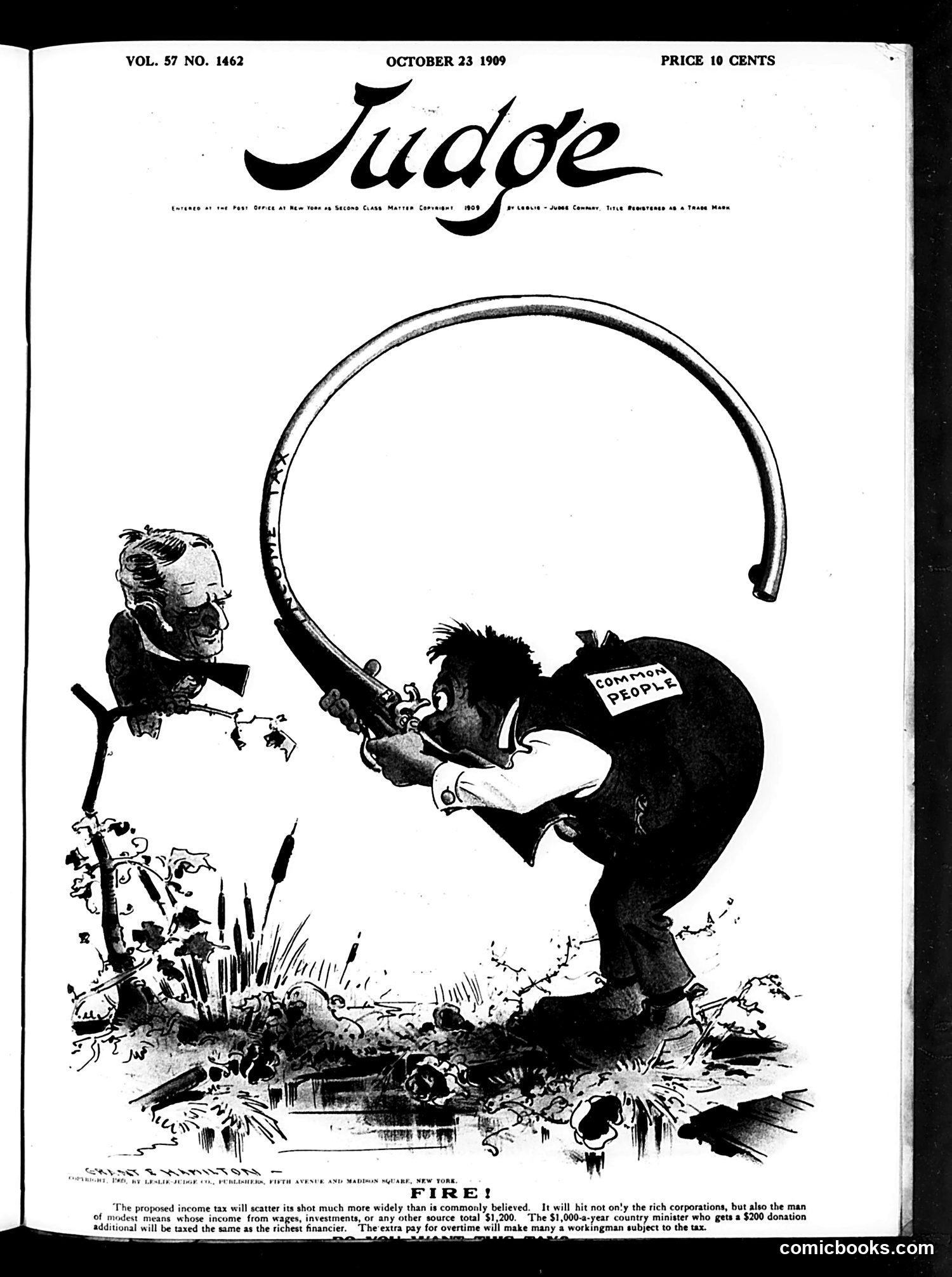
This political cartoon depicts a figure labeled "Common People" wielding a large horseshoe-shaped weapon or tool against a caricatured head on the left. The text below references a proposed income tax, stating it "will scatter its shot much more widely than is commonly believed" and will tax "the man of modest means from wages, investments, or any other source total $1,200." The satire criticizes the income tax proposal as a threat to ordinary working people despite claims it targets only the wealthy. The horseshoe suggests both good luck and a weapon—implying the "common people" ironically arm themselves against their own economic interests. This reflects early-1900s political debate over the nascent federal income tax's actual impact on average Americans.
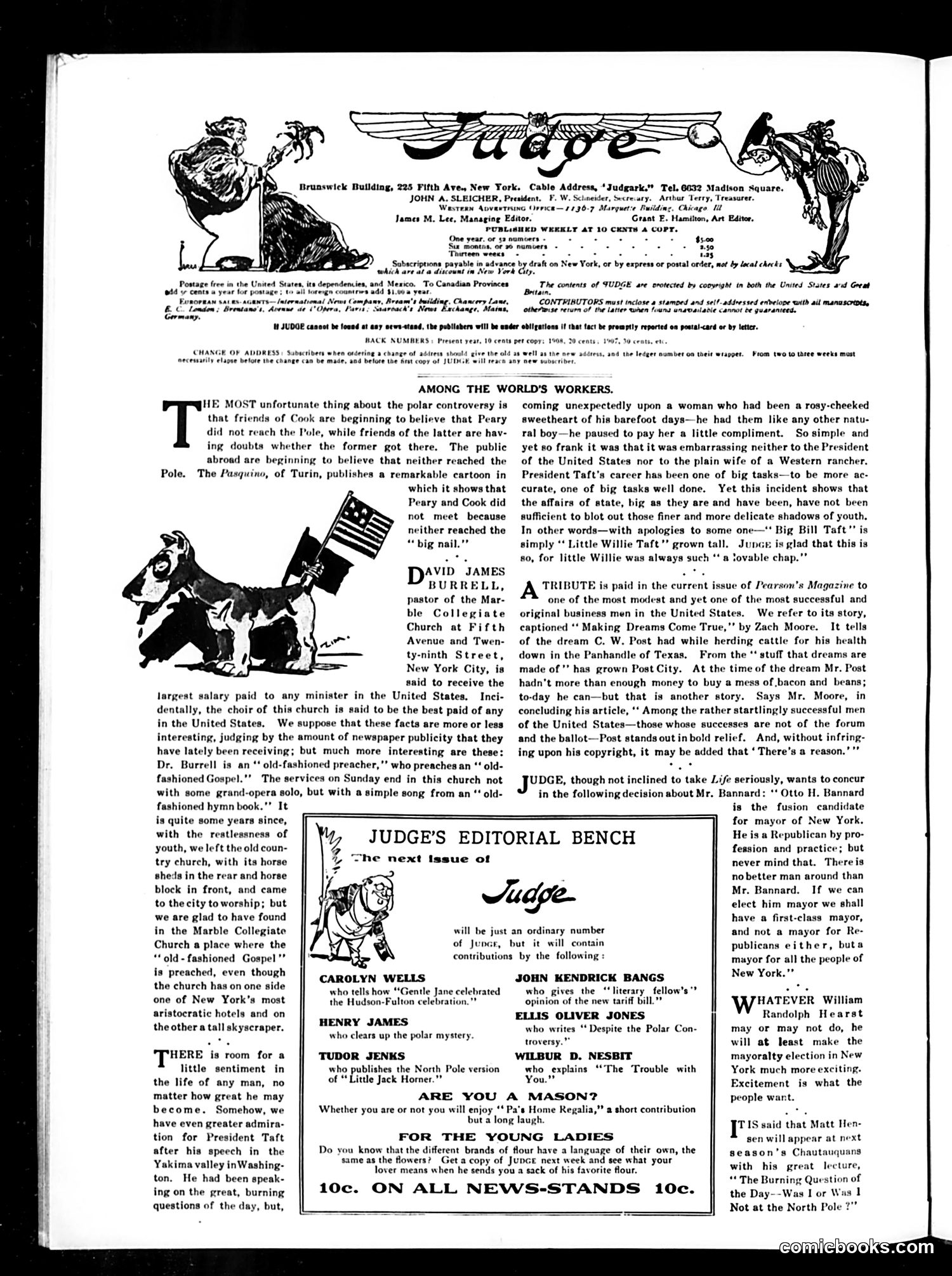
This page primarily features **editorial content and advertisements** rather than political cartoons. The main article, "Among the World's Workers," discusses a polar controversy involving explorers Cook and Peary, questioning which reached the North Pole first. The text suggests public doubt about Peary's claims while Cook's supporters grow skeptical. A secondary section promotes an upcoming Judge issue featuring contributions about various topics, including one titled "Are You a Mason?" and content for young ladies about flour brands. The illustrated masthead shows Judge's typical satirical mascot figures, but the page lacks substantial political cartooning. Instead, it demonstrates the magazine's role as a **general-interest publication mixing satire, commentary, and advertising** for early 20th-century American readers.
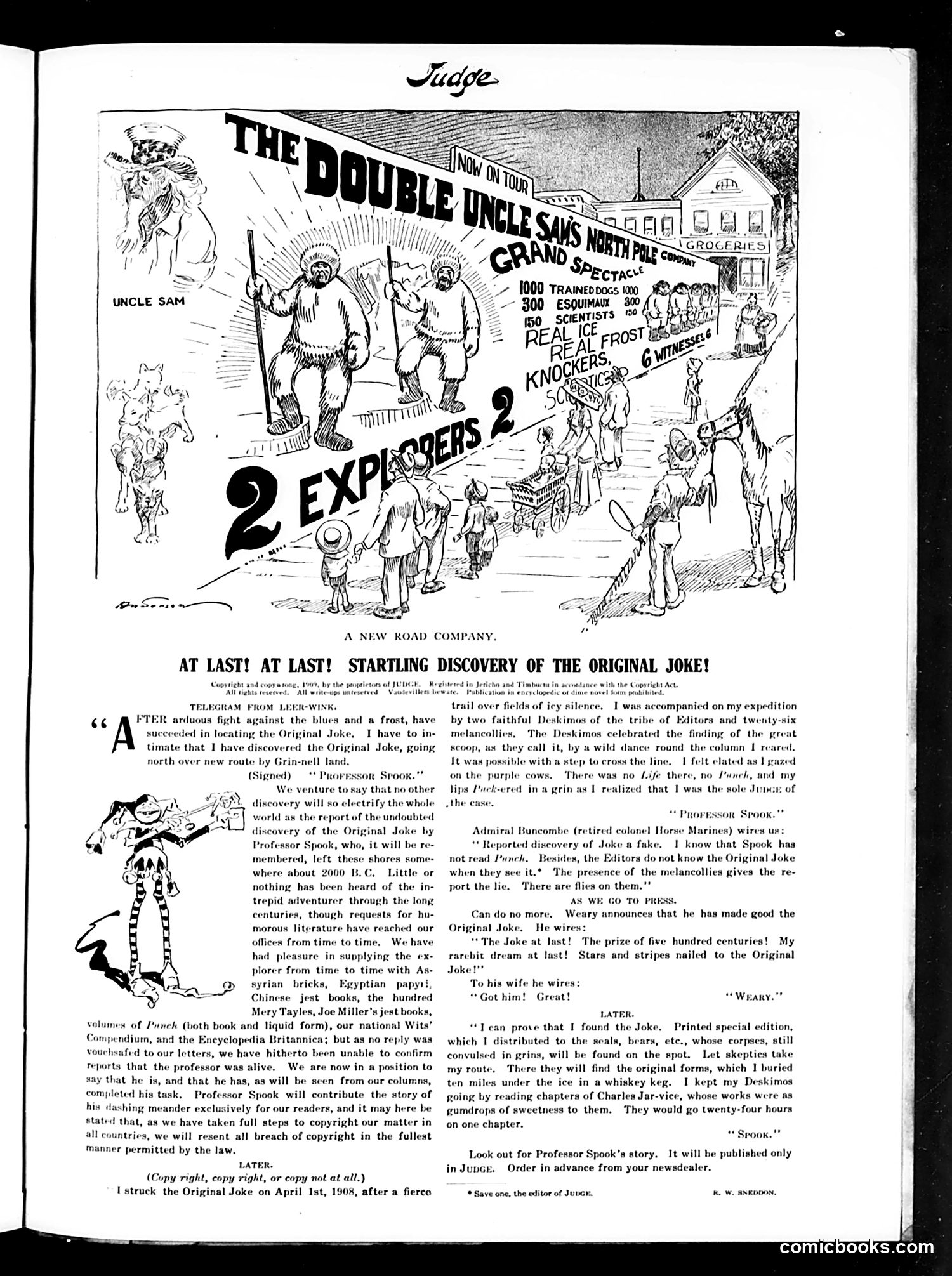
This page satirizes the explorer **Admiral Peary's** claim to have discovered the North Pole. The headline "AT LAST! AT LAST! STARTLING DISCOVERY OF THE ORIGINAL JOKE!" mocks a supposed discovery of "the Original Joke" by Professor Spock—a pun on Peary's polar expedition claims. The advertisement for "The Double Uncle Sans North Pole Company" parodies the commercialization and public spectacle surrounding Peary's achievement. The cartoon depicts two large figures (likely representing the claimed discovery) being presented to crowds as the "grand spectacle." The satirical letters from fictional characters like "Professor Spock" and "Admiral Huncombe" mock both Peary's credibility and the public's gullible fascination with exploratory claims. The joke targets how sensational discoveries could be marketed to naive audiences.
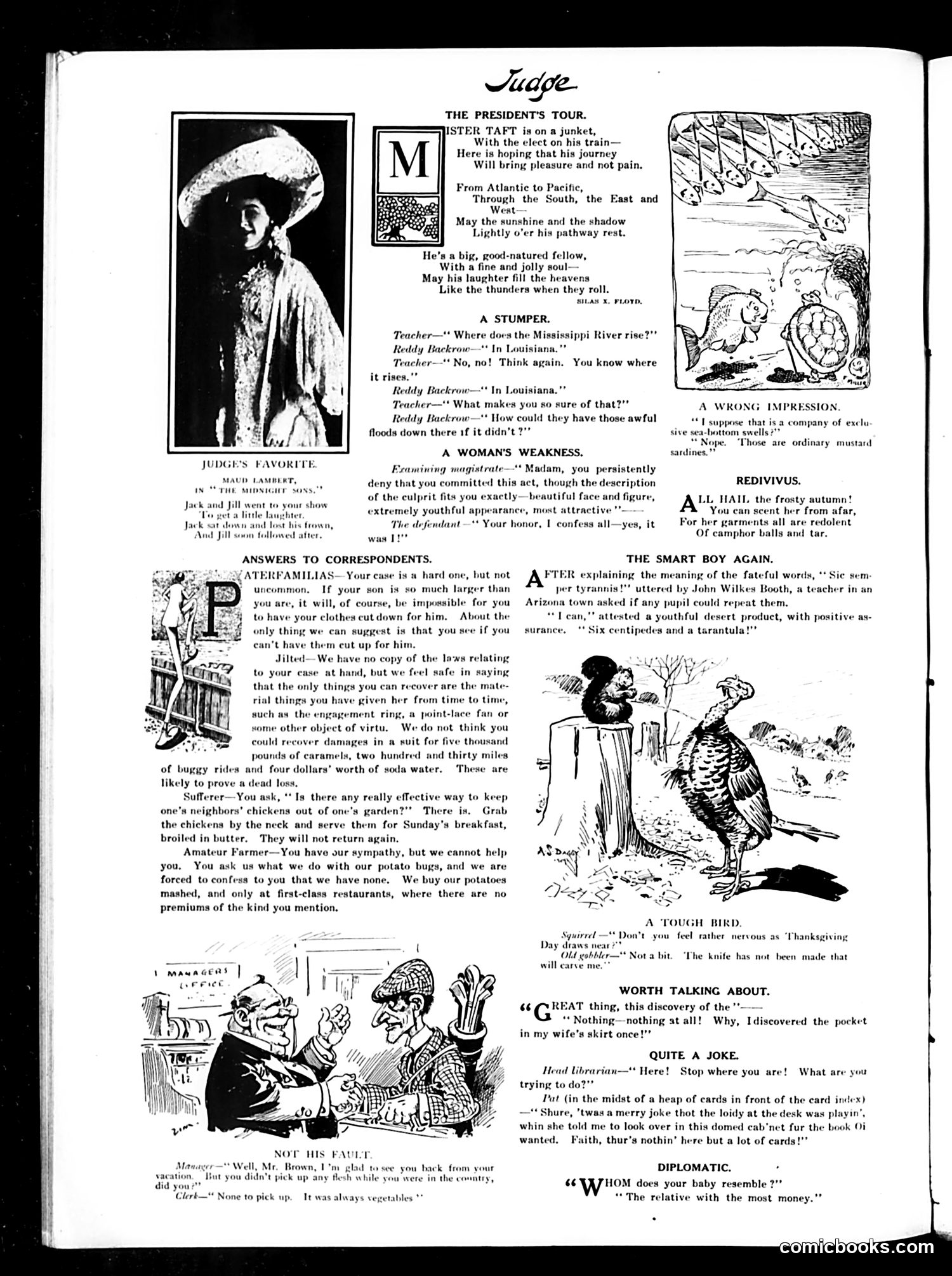
This page contains several unrelated satirical items typical of Judge magazine's format. "The President's Tour" references President Taft's railroad journey across America, hoping to bring "pleasure and not pain" to his travels. The verse mocks him as a "good-natured fellow." "A Stumper" is a classroom joke about a student (Reddy Backroe) who incorrectly locates the Mississippi River in Louisiana, missing the obvious answer. "A Woman's Weakness" depicts a magistrate scolding a woman for denying a crime, sarcastically noting her "youthful appearance" contradicts her protestations. The remaining items are brief humor pieces: "The Smart Boy Again" about a student's response about tyranny, "A Tough Bird" (about a squirrel and gobbler), and various jokes about lost items and babies. The cartoons are simple line drawings accompanying these short comic anecdotes rather than complex political commentary.
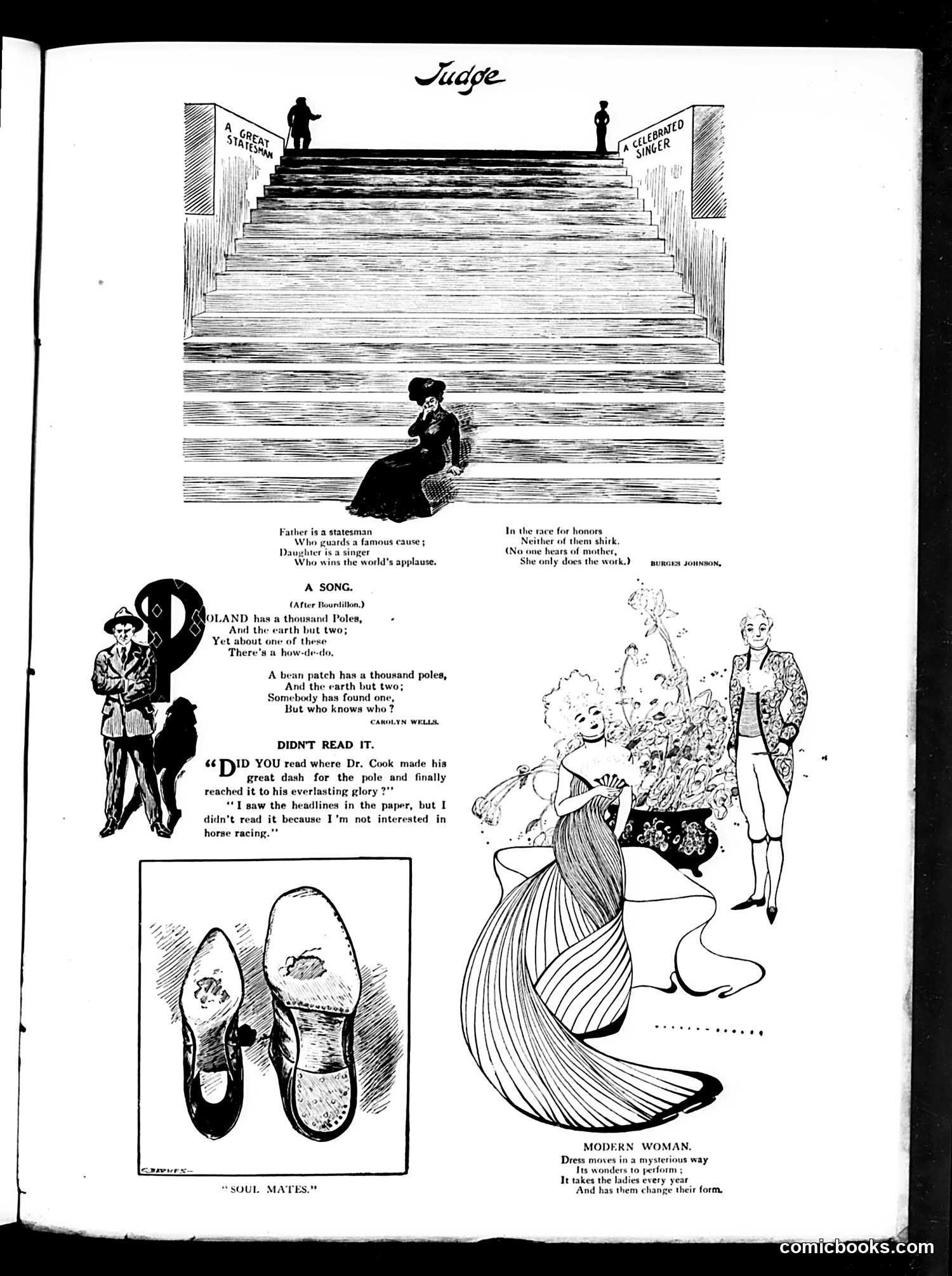
This page contains several satirical pieces typical of Judge's humor: **"A Song"** (attributed to various authors) uses a riddle format mocking Poland's geography and identity—likely referencing early 20th-century Eastern European political instability. **"Didn't Read It"** satirizes selective newspaper reading, where a man admits ignoring horse-racing coverage because he lacks interest—a common complaint about sensationalist journalism. **"Soul Mates"** is a visual joke showing shoe soles marked with matching initials, punning on "soul mates" (romantic partners) versus literal "sole mates." **"Modern Woman"** depicts a woman with exaggerated flowing hair, criticizing women's fashion as constantly changing and impractical—reflecting early 20th-century anxieties about evolving female fashion and social roles. These represent Judge's typical blend of wordplay, social commentary, and gender-based humor.
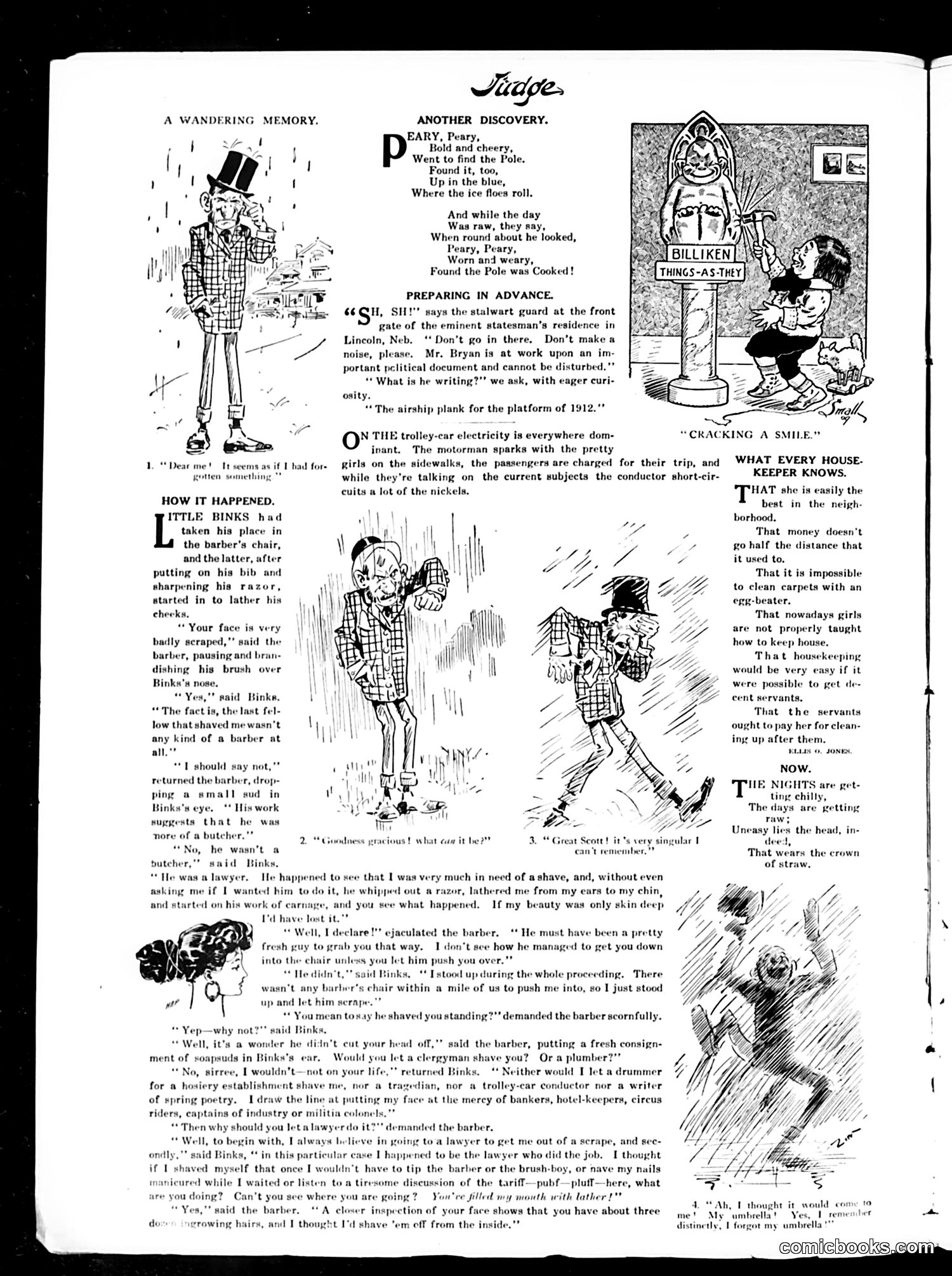
This page contains multiple satirical pieces typical of early 1900s Judge magazine: **"How It Happened"** is a humorous barber-shop dialogue where customer Binks describes a terrible shave he received from someone who wasn't a barber—possibly a lawyer or other professional. The joke satirizes incompetence across professions and the absurdity of untrained people attempting specialized work. **"Another Discovery"** mocks explorer Robert Peary's North Pole expedition, suggesting the Pole was "cooked"—meaning either fabricated or that Peary's claims were exaggerated. This reflects contemporary skepticism about Peary's 1909 expedition. **"Preparing in Advance"** references William Jennings Bryan (implied through "eminent statesman" in Lincoln, Nebraska), suggesting he's already drafting his 1912 campaign platform plank on airships—satirizing politicians' obsessive early campaign preparations. Other brief items mock electricity, servants, and domestic life. The "Billiken" illustration appears to be advertising related. These pieces reflect Progressive Era concerns about modernization, politics, and social change.
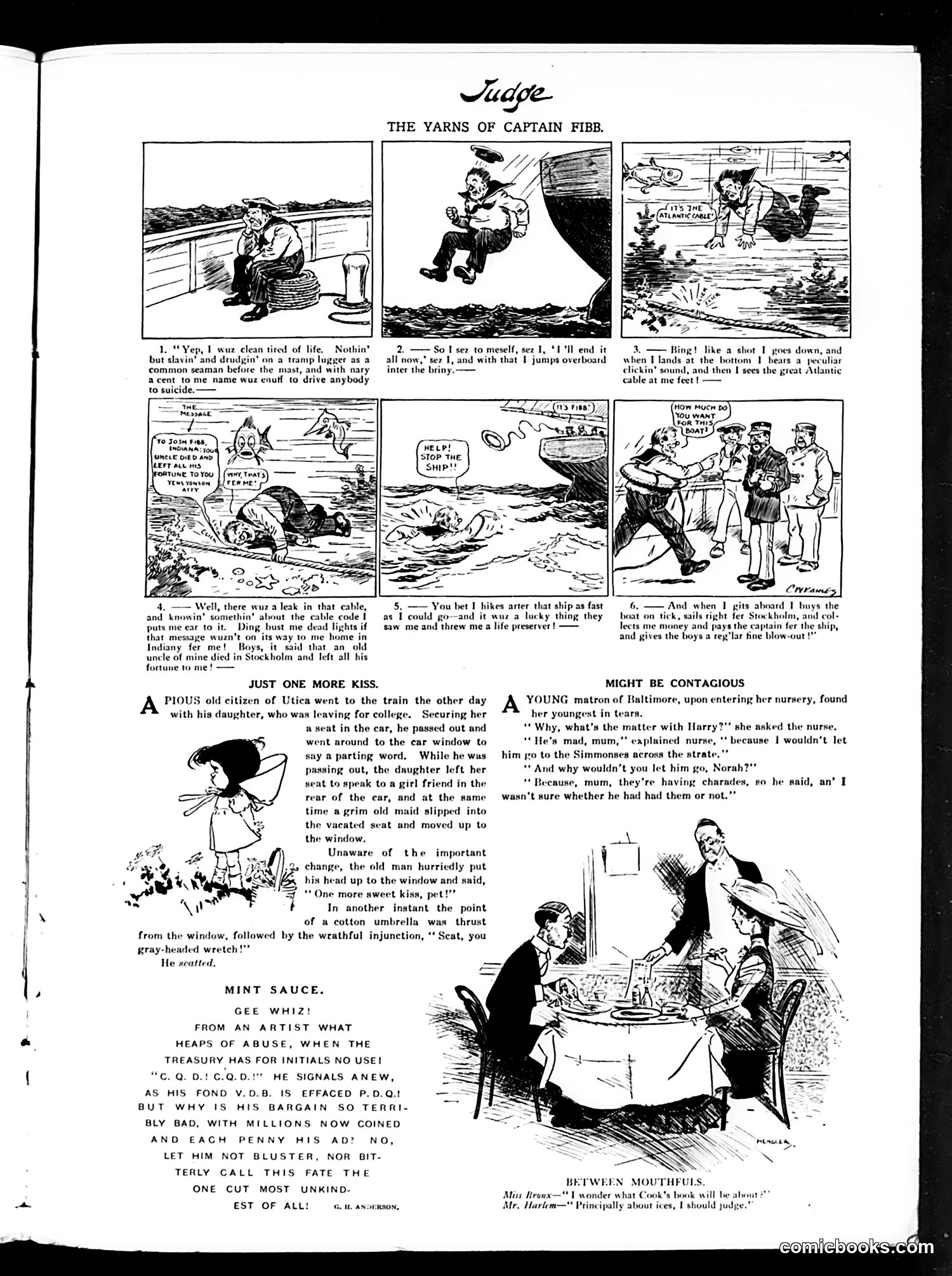
This Judge magazine page contains several unrelated humorous pieces typical of early 20th-century American humor: **"The Yarns of Captain Fibb"** is a tall tale comic strip mocking exaggerated seafaring stories. The con man jumps overboard, miraculously survives by finding a transatlantic cable, receives a telegram about an inheritance from Sweden, and becomes wealthy—absurd coincidences piled together to satirize implausible adventure narratives popular in the era. **"Just One More Kiss"** presents a crude farce: a father mistakenly kisses an elderly woman instead of his daughter goodbye at the train station, getting attacked with an umbrella. The humor relies on mistaken identity and physical comedy. The remaining short pieces—"Mint Sauce," "Might Be Contagious," and "Between Mouthfuls"—are brief observational jokes about everyday situations: artistic temperament, a nurse's confusion about contagious diseases, and dinner conversation. The humor is predominantly slapstick and situational rather than political, reflecting Judge's general satirical approach to American social life and character types of the period.
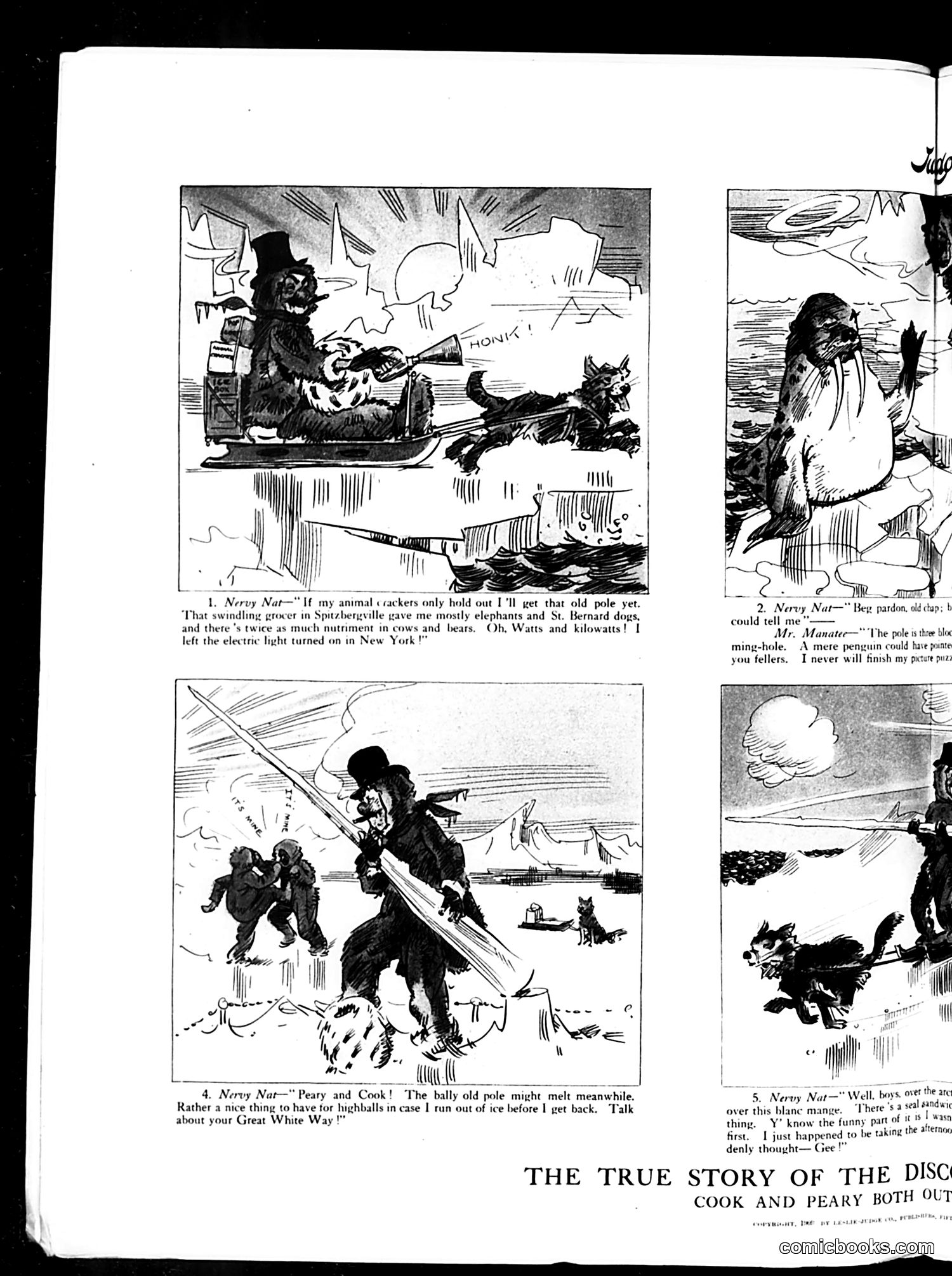
This comic strip mocks the famous 1909 controversy over who first reached the North Pole: Frederick Cook or Robert Peary. The protagonist "Nervy Nat" is an incompetent explorer attempting the same feat. The satire depicts Nat's absurd priorities and incompetence: he complains about a grocer's animal crackers assortment, mentions leaving New York's lights on, and treats the pole as a novelty ice-holder for drinks rather than a serious scientific achievement. A manatee character points out Nat doesn't even understand basic polar geography ("breathing-hole"). The reference to "Peary and Cook" in panel 4 directly invokes the real expedition rivalry, while the "Great White Way" joke plays on both Arctic imagery and the Broadway theater district nickname. The humor works by contrasting Nat's casual, buffoonish approach with the genuine heroic claims and acrimony between the actual explorers—satirizing both polar exploration mania and the dubious authenticity of competing expedition claims.
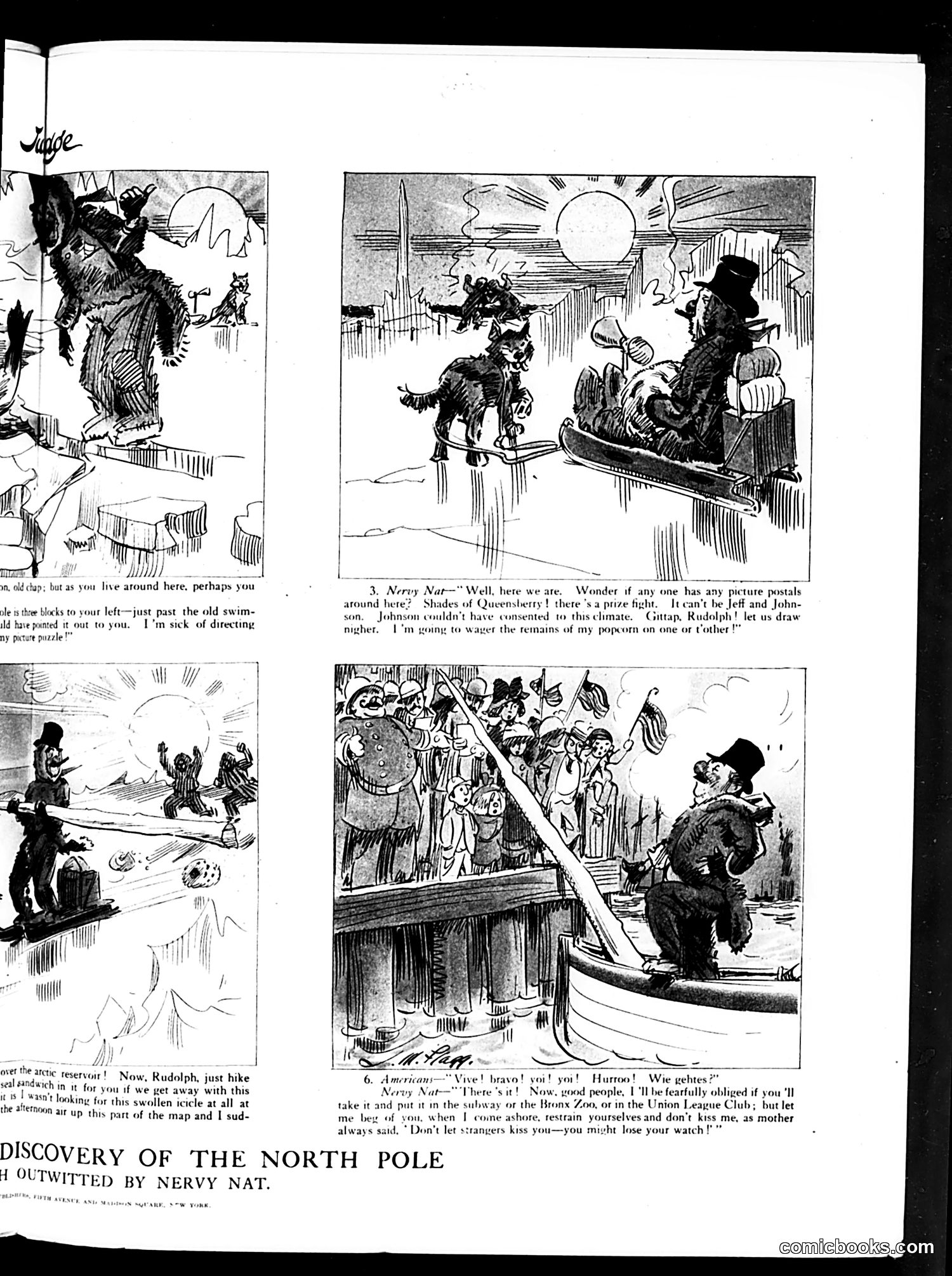
This is a humorous comic strip about Arctic exploration, likely referencing early 20th-century North Pole expeditions (when such claims were contested and newsworthy). The protagonist "Nervy Nat" appears to be an opportunistic character who attempts to claim or exploit Arctic discoveries. The satire mocks several things: the absurdity of Arctic exploration itself, the showboating around polar "discoveries," and the commercialization of exploration (references to picture postcards, zoos, and clubs suggest turning exploration into public spectacle). A passing reference to a "Jeff and Johnson" prize fight suggests boxing celebrity gossip was colliding with serious exploration news in public consciousness. The final panel's joke about strangers kissing and stealing watches is period-typical humor about urban pickpocketing and unwanted physical familiarity. The overall tone is lighthearted mockery of exploration pretensions and the media circus surrounding them.
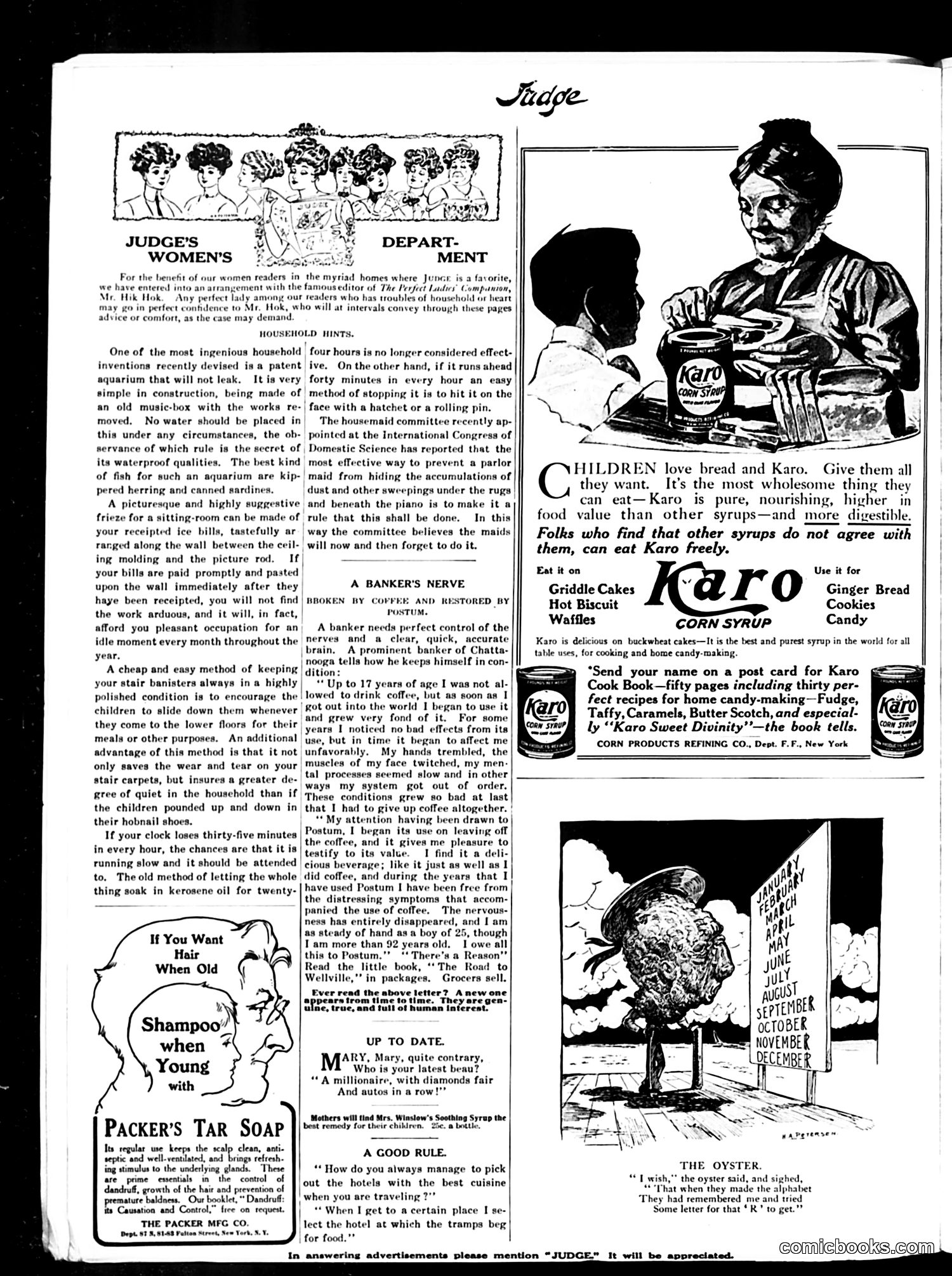
This page from *Judge* magazine combines household advice with advertisements and product endorsements typical of early 20th-century women's magazines. **Main Content:** The "Judge's Women's Department" offers satirical domestic advice under the guise of helpful hints. The humor lies in absurd suggestions presented seriously—like an "aquarium that will not leak" (which contains no water), or encouraging children to slide down banisters to polish them with their shoes. **Key Advertisements:** - **Karo Corn Syrup**: Features an illustration of a man enthusiastically using syrup, with testimonials about wholesome nutrition - **Postum**: A coffee substitute advertised through a banker's testimonial claiming coffee caused nerve damage and trembling, while Postum restored his health - **Parker's Tar Soap**: Promises to prevent baldness and dandruff **The Satire:** The page satirizes both domestic "expertise" and patent medicine culture, mocking the earnest self-help advice columns and dubious health claims that dominated early 1900s publications. The juxtaposition of absurd household tips with serious-toned product testimonials amplifies the satire.
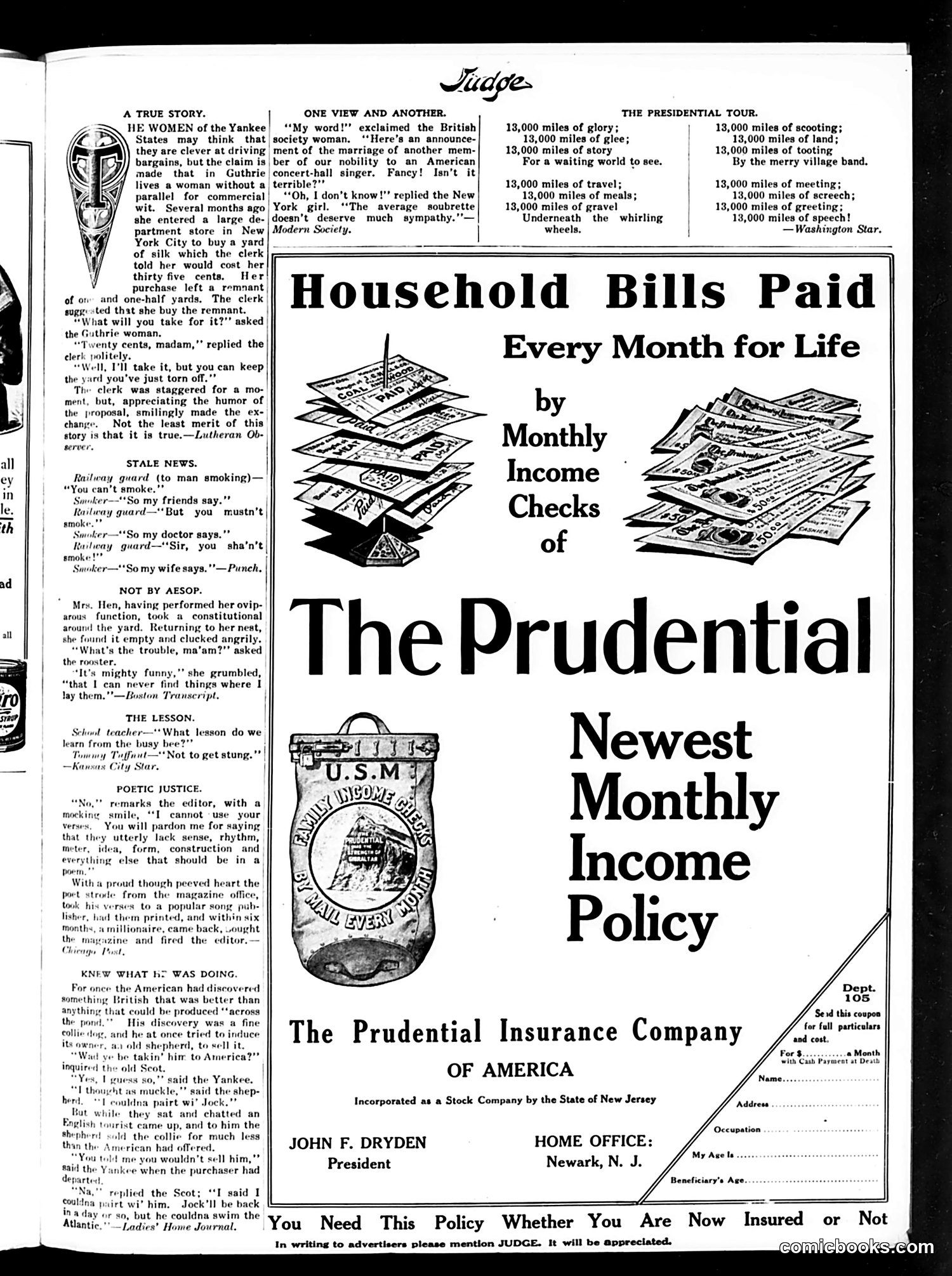
This page contains primarily **short humorous anecdotes and jokes** rather than political cartoons. The main content includes: **"A True Story"**: A anecdote about a shrewd woman in Guthrie who negotiates with a department store clerk over silk fabric remnants—she gets him to keep torn yardage while she takes the remainder at a discount. The humor derives from her commercial cleverness. **"One View and Another"**: A brief exchange contrasting British and American attitudes toward wealthy women marrying American performers, with the New York girl dismissing sympathy for the bride. **"The Presidential Tour"**: Paired lists from different newspapers humorously comparing a presidential tour (13,000 miles) as either glorious travel or tedious repetition. Additional filler includes "Stale News" (railway guard jokes) and brief anecdotes about a hen and schoolteacher. **The large advertisement** for The Prudential Insurance Company's new monthly income policy dominates the lower half—a practical financial product pitch typical of period magazines. No significant political commentary or caricature is evident; this appears to be a lighthearted, advertising-heavy issue.
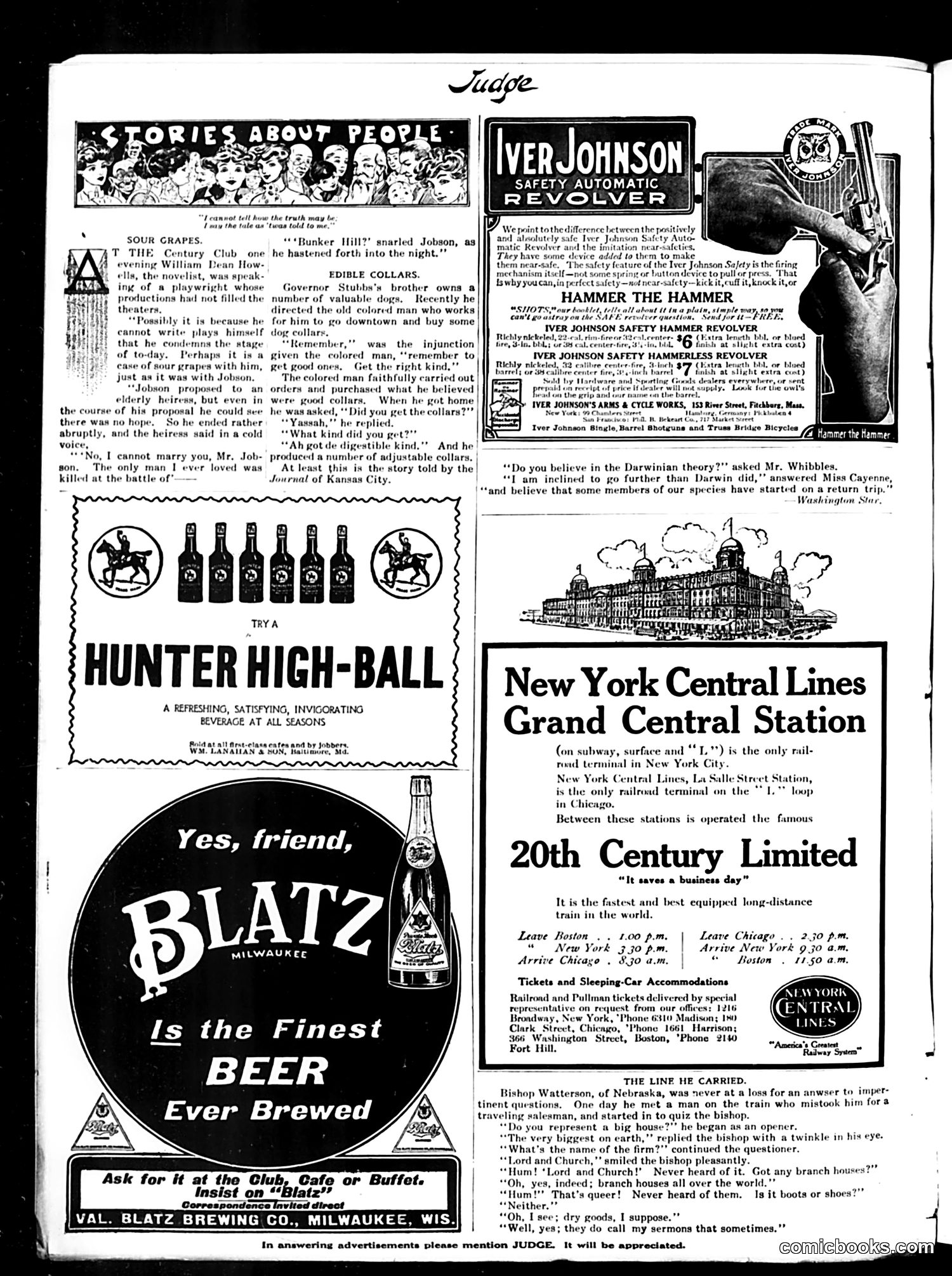
This page from *Judge* contains primarily **advertising and humor anecdotes** rather than political satire. The content includes: **"Sour Grapes"** — A brief humorous story about a playwright (William Dean Howells) whose theatrical productions failed, with a subplot about a man named Jobson whose marriage proposal was rejected. The "sour grapes" reference suggests Howells criticizes modern theater because his own work didn't succeed. **"Edible Collars"** — A short joke about Governor Stubbs's brother, who orders a servant to buy collars; the servant mistakenly purchases digestible/edible collars instead. **"The Line He Carried"** — An anecdote about Bishop Watterson of Nebraska, who cleverly deflects personal questions by claiming to work for "Lord and Church" (a religious pun), with locations "all over the world." The remainder is **commercial advertising** for Iver Johnson revolvers, Hunter High-Ball beverages, Blatz beer, and the New York Central's 20th Century Limited train. These are light social humor pieces typical of *Judge's* satirical magazine format—jokes about everyday life rather than political commentary.
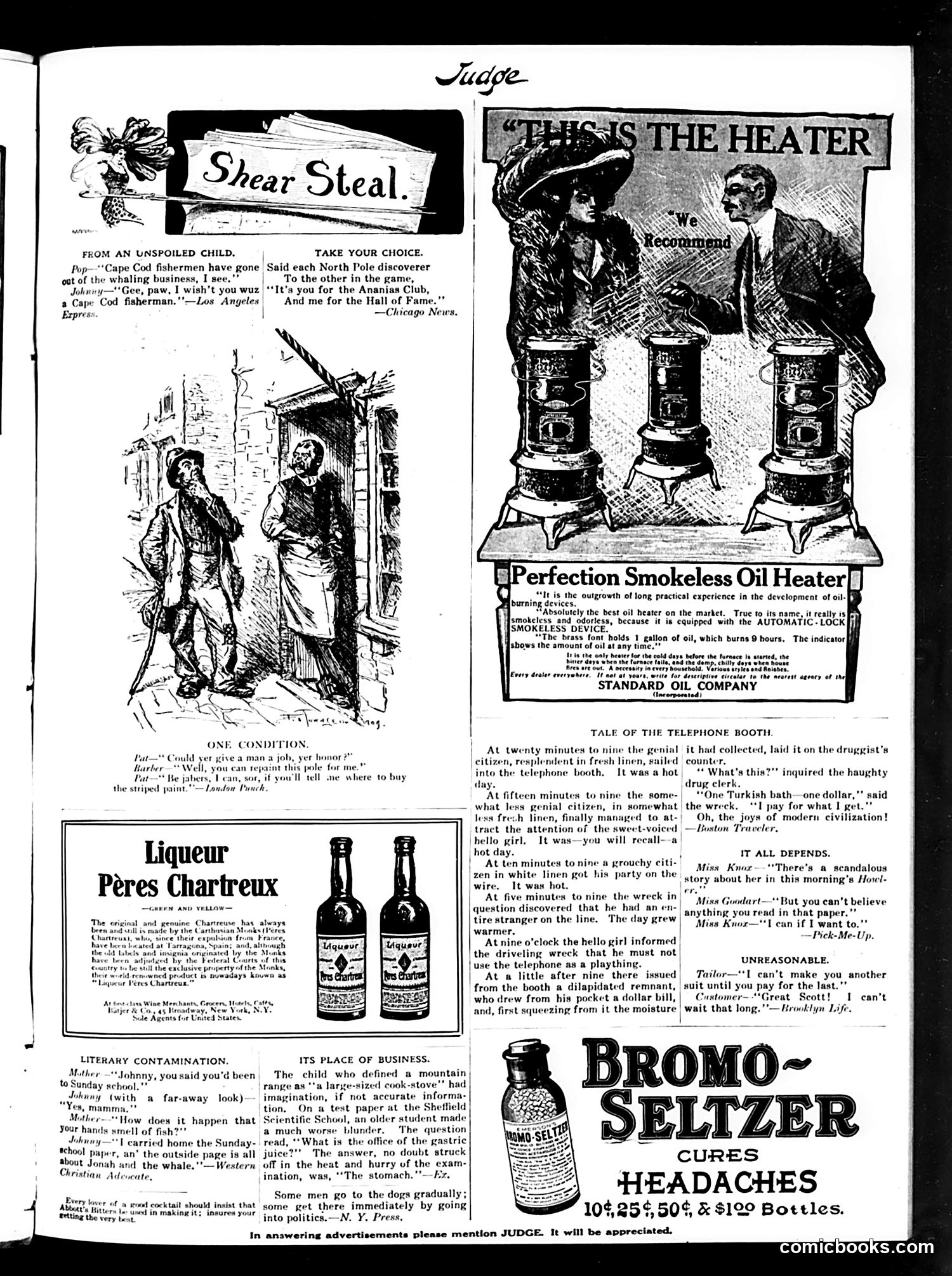
This page contains primarily **advertisements and short humor pieces** rather than political cartoons. The content includes: **"Shear Steal"** — A brief humorous dialogue mocking explorers claiming North Pole discoveries. Two "explorers" joke about joining the "Ananias Club" (a reference to lying) and the "Hall of Fame," satirizing the era's competitive polar exploration claims and the tendency of adventurers to exaggerate their accomplishments. **"Tale of the Telephone Booth"** — A comedic narrative about a man attempting to use a public telephone on a hot day, repeatedly interrupted. The humor derives from early 20th-century frustrations with telephone technology and shared public booths. The remaining content consists of **product advertisements** (Perfection Smokeless Oil Heater, Liqueur Pères Chartreux, Bromo-Seltzer) and brief **literary jokes** about children's misunderstandings. This appears to be a typical Judge magazine interior page mixing light satire with advertising revenue.
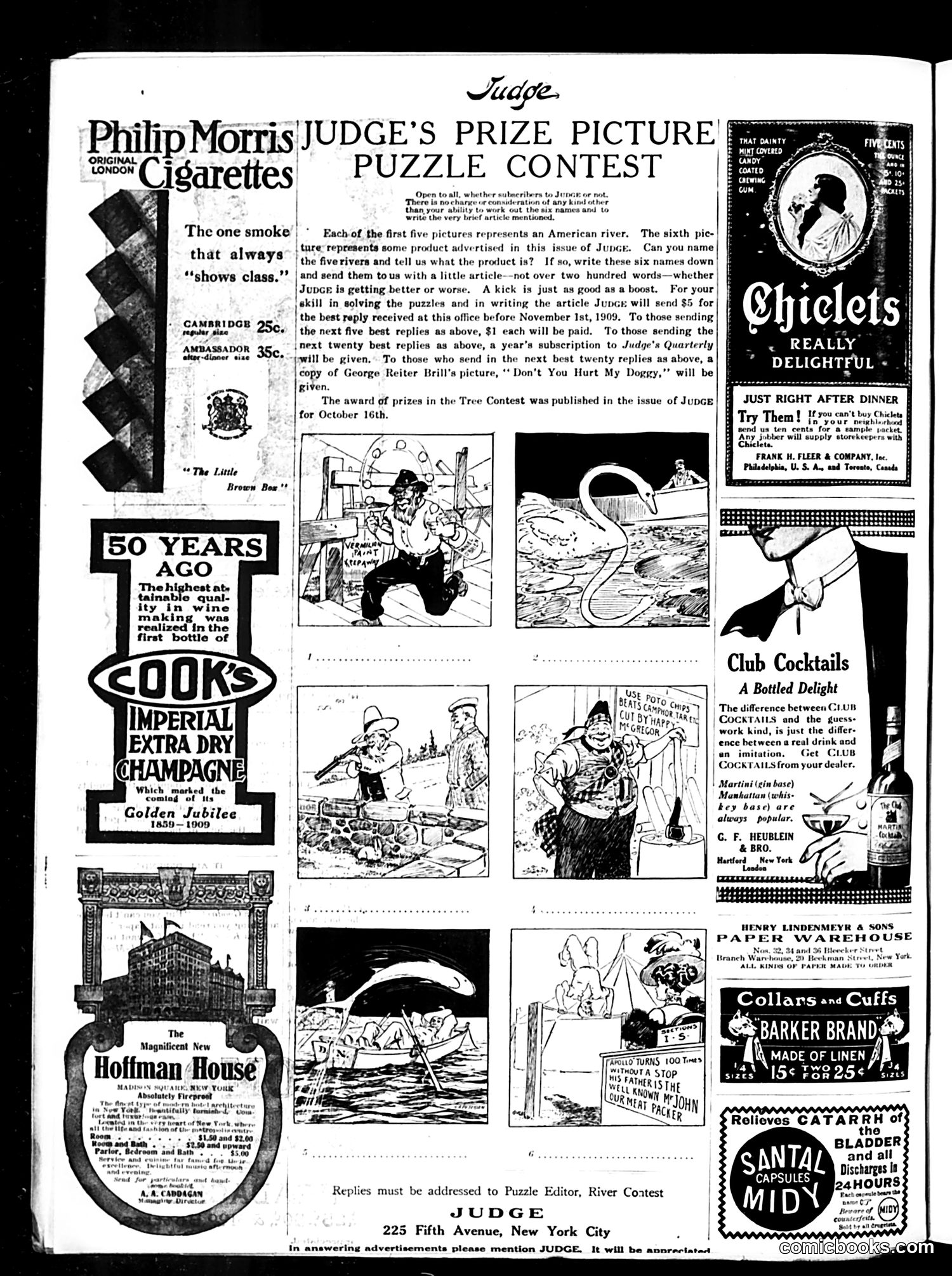
This page presents Judge magazine's reader competition: identify six American rivers depicted in cartoon illustrations, plus name a product advertised in the issue. Winners receive cash prizes ($5 for best entry) or subscriptions to Judge's Quarterly. The six small cartoon panels show rivers represented through visual metaphors—likely depicting characteristic features or scenes associated with specific American waterways. Contestants must write brief articles (under 200 words) arguing whether Judge is improving or declining as a publication. The page is surrounded by period advertisements for cigarettes, champagne, cocktails, collars, and other consumer goods typical of 1909. This contest format was common in early-20th-century magazines as an engagement strategy. The puzzle rewards both puzzle-solving skill and critical commentary on the magazine itself—a self-promotional mechanism disguised as entertainment.
This page is primarily **advertising and light humor content** rather than political satire. The two brief comic anecdotes ("Shears and Paste Pot") illustrate Victorian parenting philosophies through simple domestic scenarios—a boy refusing to fight despite provocation, and a mother accepting a hen's rough mothering as natural discipline. These are genteel moral lessons typical of the era's family magazines. The bulk of the page comprises **commercial advertisements**: the Pennsylvania Railroad's new express train service (featuring luxury amenities like dining cars and stenographers), Apollinaris mineral water, Diamond watches on credit, and prominently, **The Oliver Typewriter** ($100, available on a "Seventeen Cents a Day" payment plan). The Oliver ad invokes Benjamin Franklin's Poor Richard's Almanac philosophy of thrift to market the machine as an aspirational purchase within reach of ordinary workers. This reflects early 1900s consumer culture: making previously luxury goods accessible through installment payments. The small humor pieces appear designed simply as filler between advertisements—typical Judge magazine layout. There is no evident political commentary on this page.
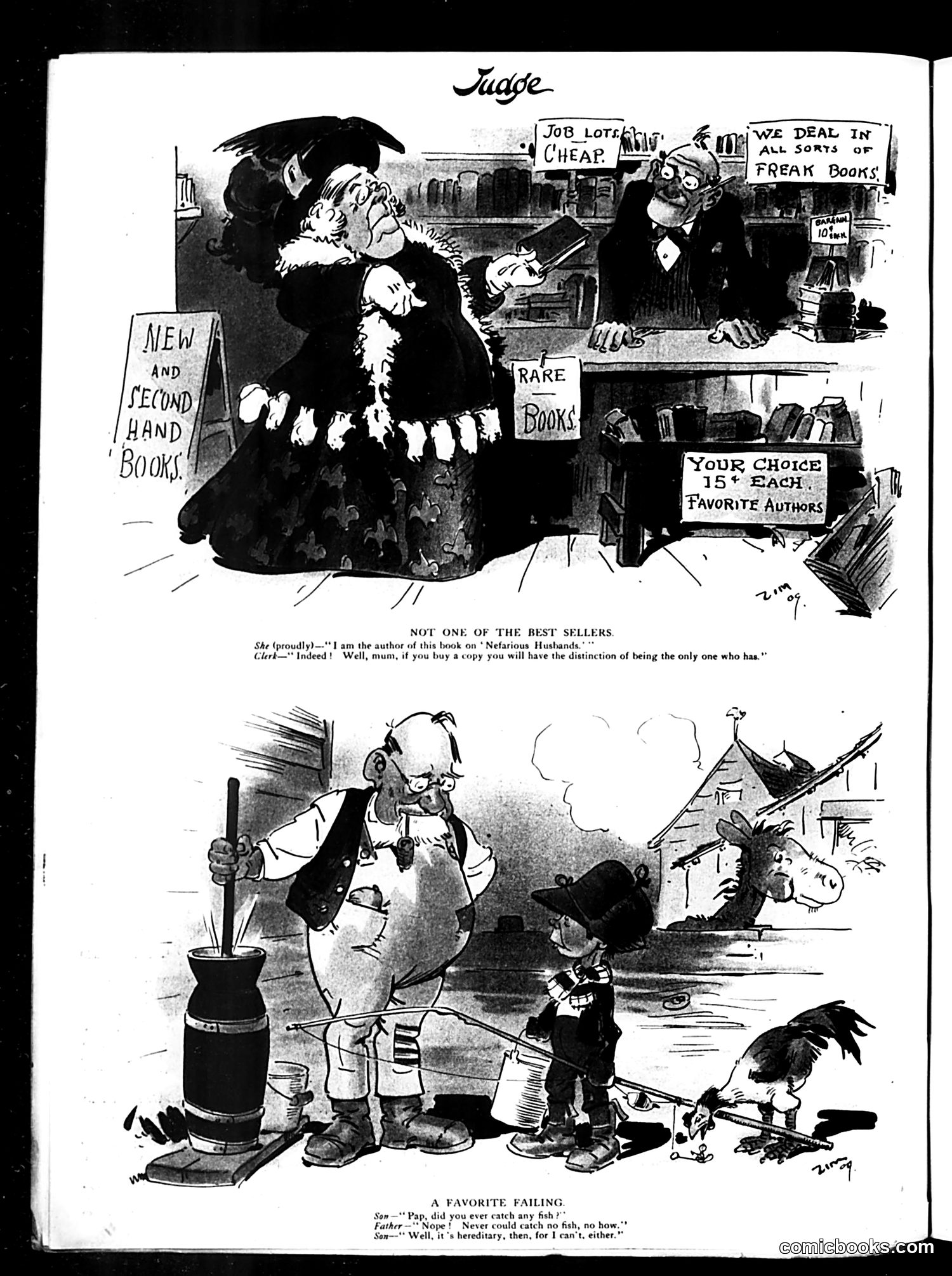
**Top Cartoon:** A woman in a bookshop boasts to the proprietor that she's the author of a book on "Nefarious Husbands." The shopkeeper's deadpan response—that buying a copy would make her "the only one who has"—satirizes vanity publishing and obscure authors. The joke targets self-important writers whose books have virtually no readership, despite their inflated self-regard. **Bottom Cartoon:** Titled "A Favorite Failing," it depicts a father and son fishing. The son notes that since his father has never caught fish, the inability must be hereditary. The humor lies in the father accepting this as inevitable family trait rather than blaming poor skill or luck—satirizing how people rationalize inherited incompetence or accept generational failure passively. Both cartoons employ social satire typical of Judge magazine's style, mocking human vanity, delusion, and acceptance of mediocrity.