
A complete issue · 16 pages · 1909
Judge — October 9, 1909
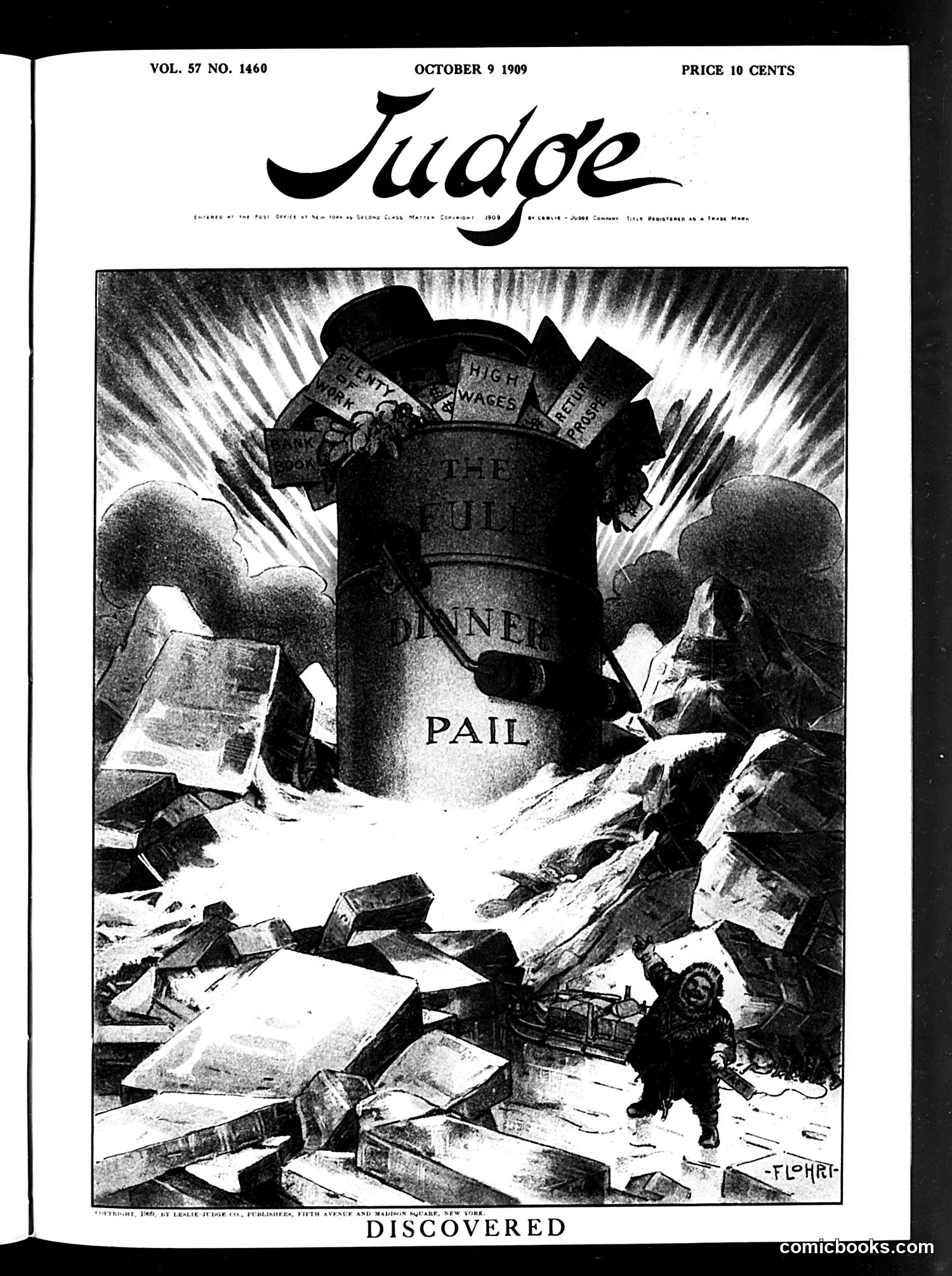
This satirical cartoon depicts a massive cauldron labeled "THE FULL DINNER PAIL" overflowing with problems—visible labels include "HIGH WAGES," "SCARCITY OF WORK," and other economic issues. Figures representing workers and politicians examine the chaos surrounding this supposedly positive campaign promise. The satire critiques the Republican slogan "the full dinner pail," which promised prosperity and employment. By 1909, the cartoon suggests this promise had been "discovered" as hollow—the pail now represents not abundance but economic turmoil and contradiction. Workers find themselves amid wreckage and conflict rather than the promised prosperity. The artwork likely comments on unfulfilled campaign promises during the early Roosevelt/Taft administration regarding labor conditions and wages.
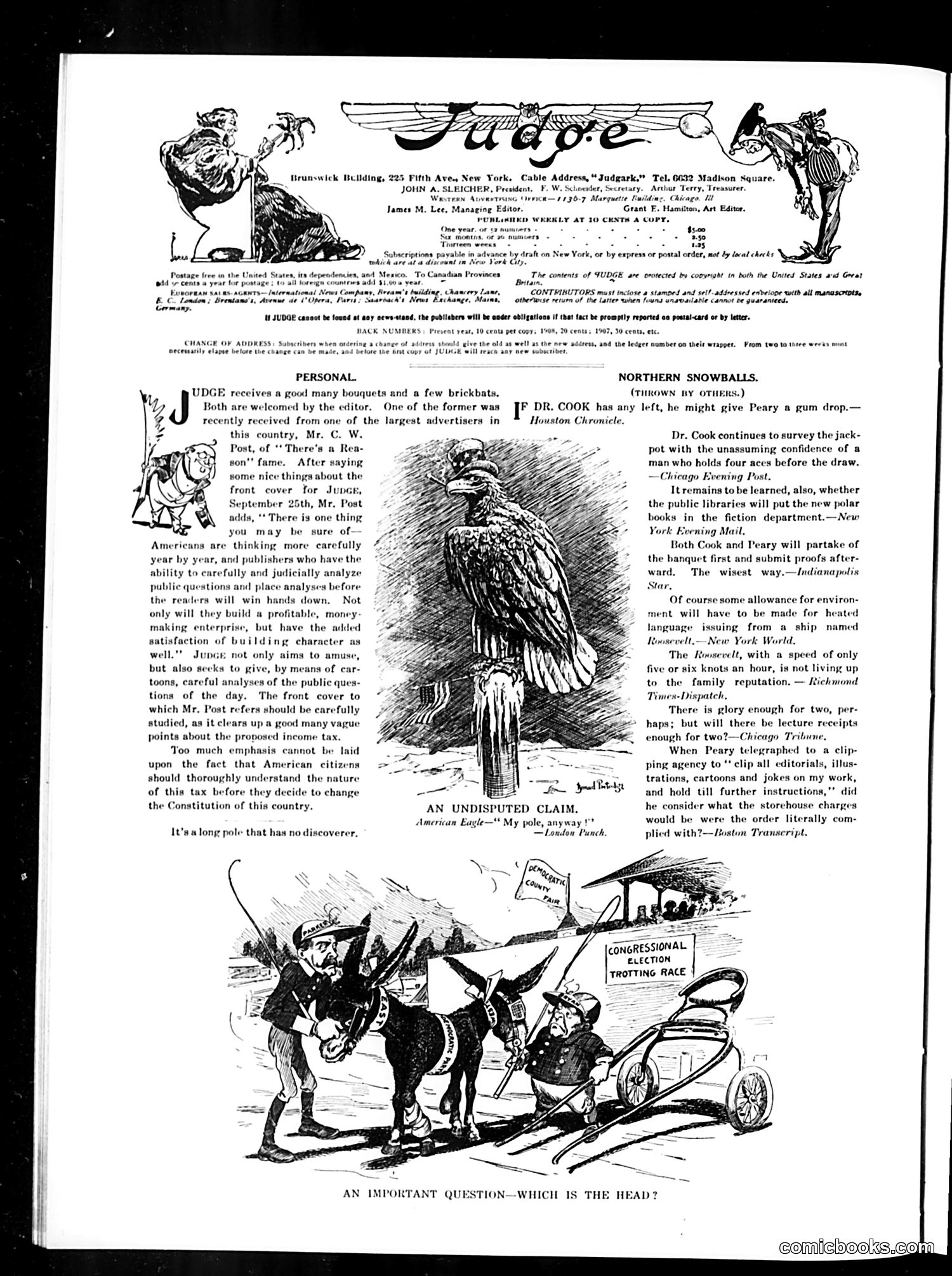
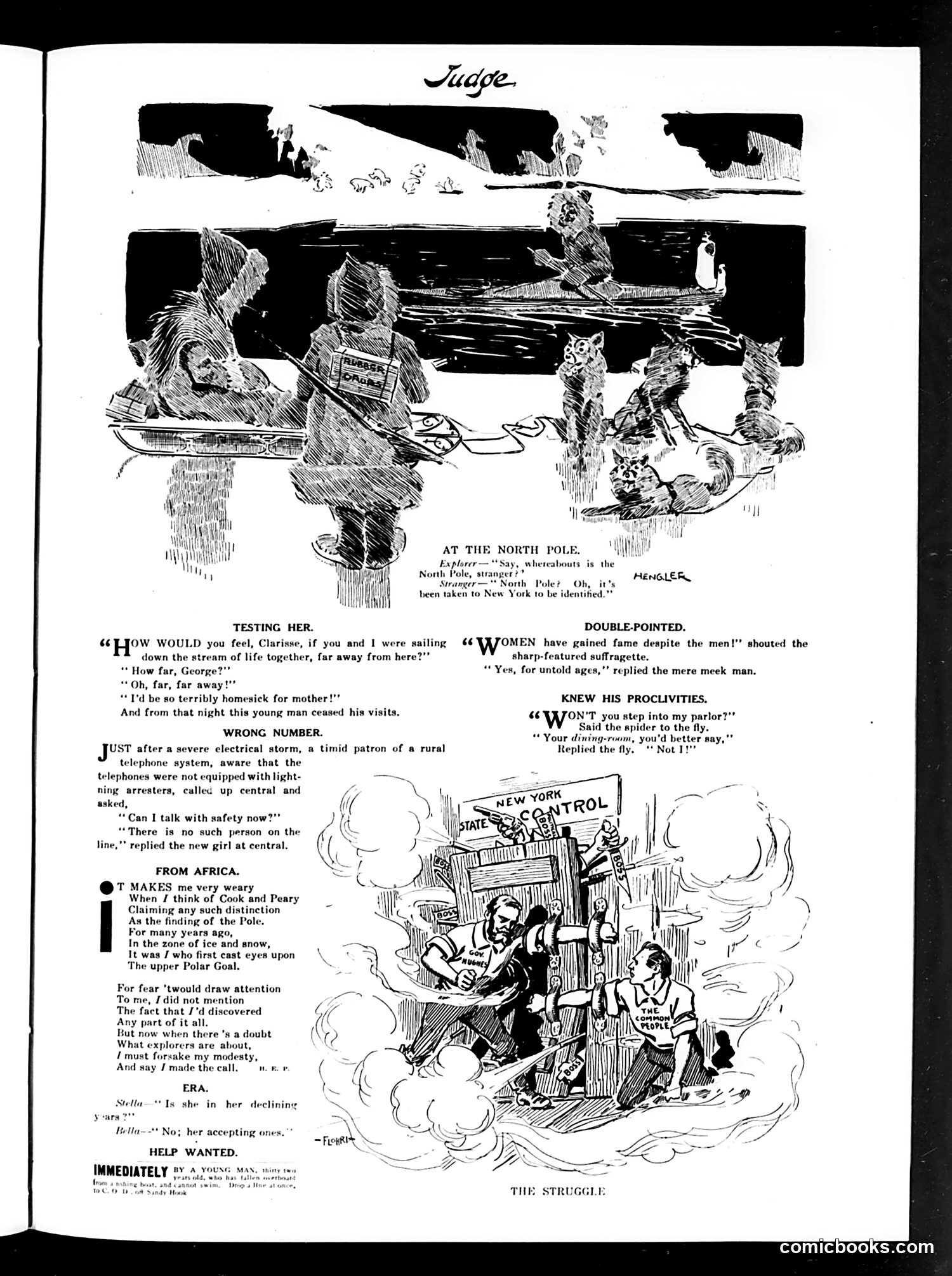
This page contains several unrelated satirical items typical of Judge's format: **"At the North Pole"** (top): A sketch mocking someone's claim to have reached the North Pole, with text suggesting the person's identity needs verification—likely referencing contemporary polar exploration debates. **"The Struggle"** (bottom): A cartoon showing a man at a "New York State Control" booth amid clouds of smoke, apparently struggling with state regulation or bureaucratic red tape. The figure labeled "The Fly" appears to represent either a persistent problem or political opposition to regulation. The other items ("Testing Her," "Wrong Number," "From Africa," etc.) are brief humorous anecdotes or jokes unrelated to political satire. The page reflects Judge's mix of topical satire with general humor, though without precise dating, the specific regulatory or exploration references remain unclear.
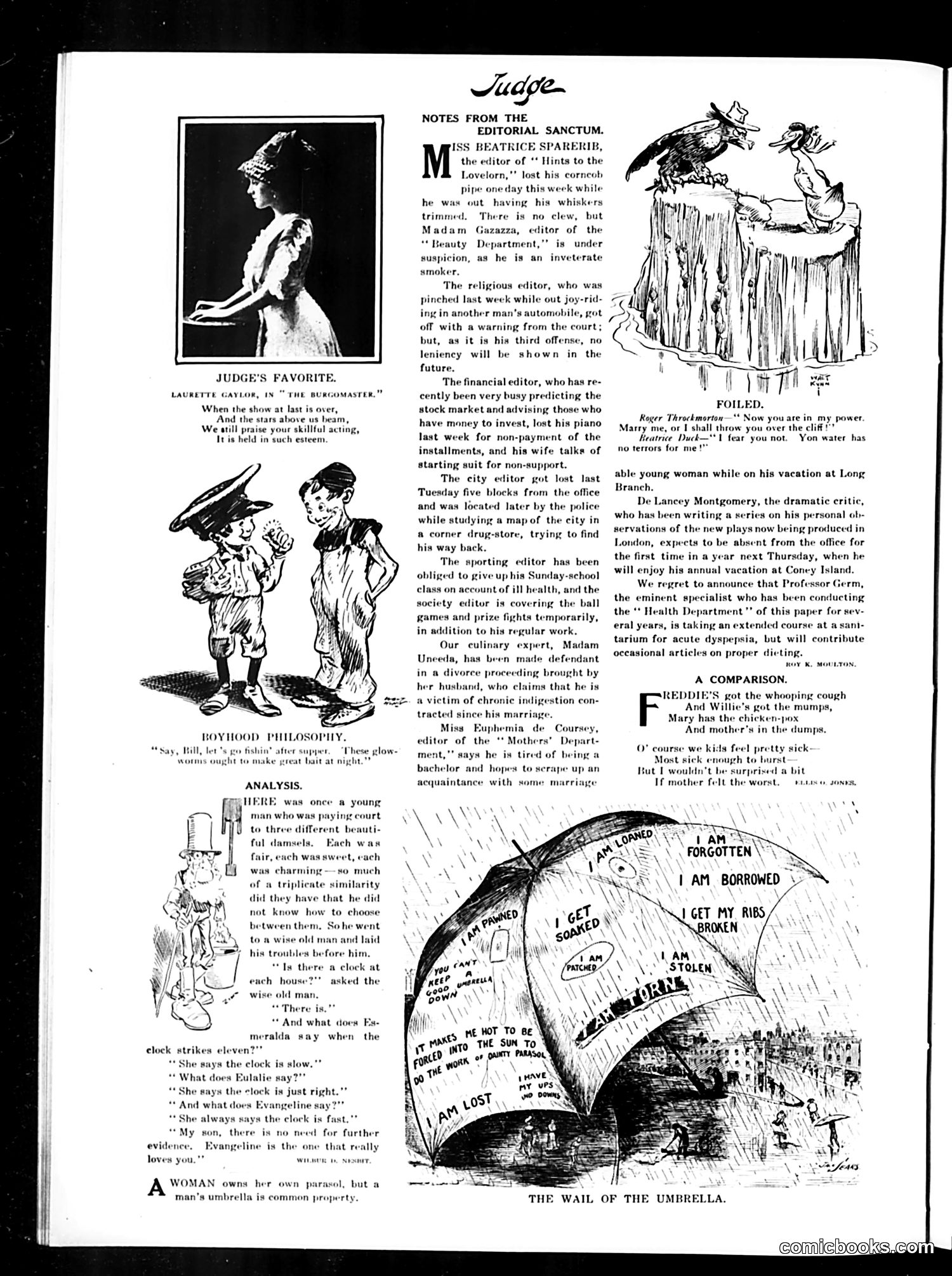
This page contains several satirical pieces targeting journalists and editors. The "Notes from the Editorial Sanctum" section mocks various newspaper department heads—a religious editor caught smoking, a financial editor who lost his piano to non-payment, a sports editor covering ball games on Sunday. The humor derives from hypocrisy: moralistic journalists behaving badly. "The Wail of the Umbrella" cartoon uses personification to satirize human misfortune—the umbrella's labels ("I am lost," "I am borrowed," "I am stolen") humorously list life's common troubles. "A Comparison" mocks the shared miseries of family life. The page reflects early-20th-century concerns about newspaper credibility and the gap between journalists' public moralizing and private conduct, presented through crude caricature and slapstick humor typical of Judge's satirical style.
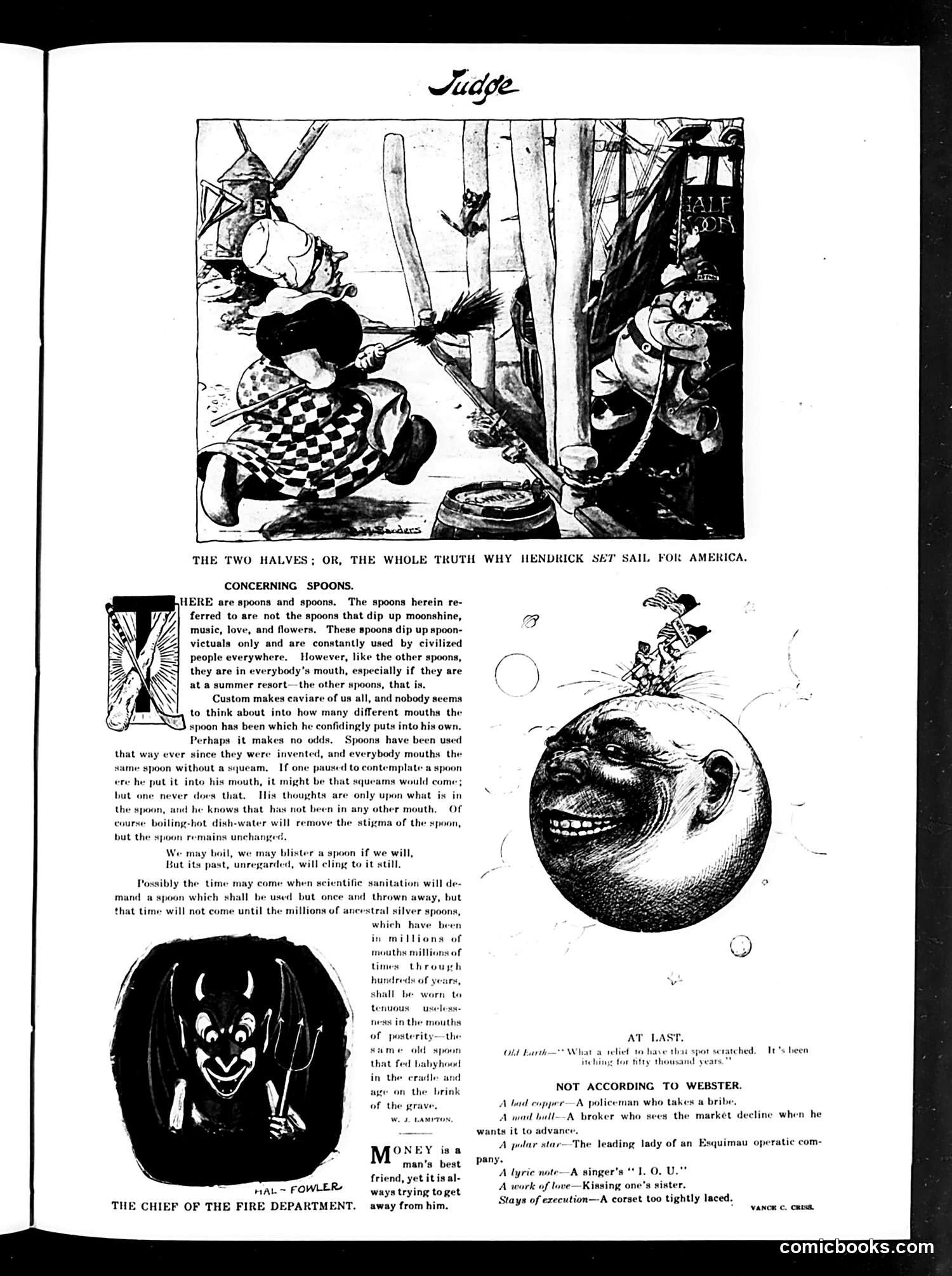
**Top Cartoon**: "The Two Halves; or, The Whole Truth Why Hendrick Set Sail for America" depicts a scene with sailors and cargo, likely satirizing a historical voyage. The title suggests commentary on Dutch explorer Hendrick Hudson, though the specific political reference is unclear without additional context. **"Concerning Spoons" Essay**: This section humorously discusses spoon etiquette and usage customs, appearing to satirize upper-class dining pretensions and the absurdity of social conventions around silverware. It mocks people who obsess over which spoon to use. **Bottom Section**: "Not According to Webster" offers mock dictionary definitions using wordplay—examples include "bad copper" (a corrupt policeman) and "palm note" (a singer's "I.O.U."). This satirizes contemporary social vices through humorous redefinition. The illustrations by Hal Fowler complement these satirical pieces with caricatured figures.
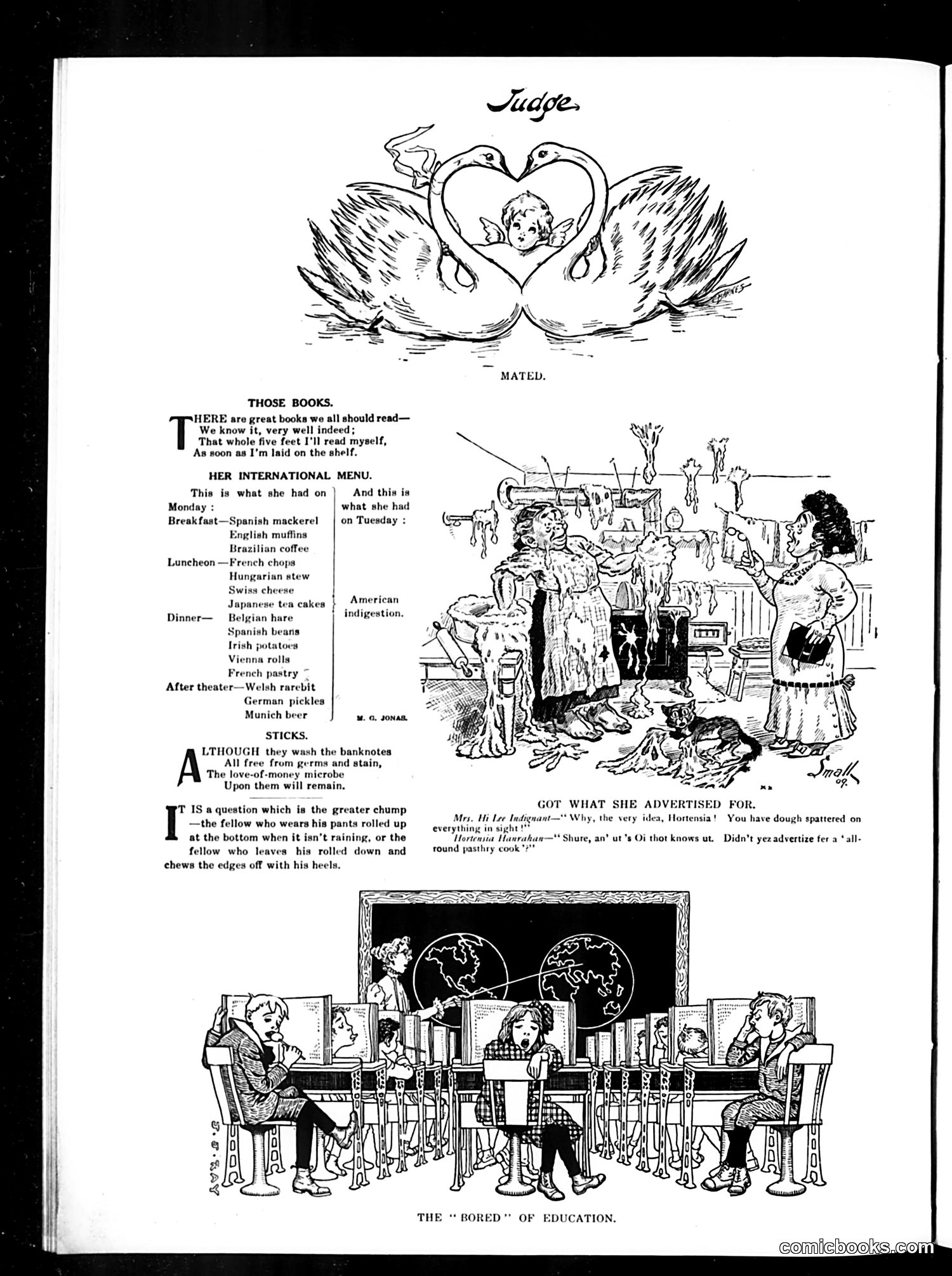
This page contains multiple satirical pieces typical of early-20th-century American humor: **"Her International Menu"** mocks cosmopolitan pretension—a woman dining on foods from various countries, culminating in "American indigestion," suggesting that affected sophistication causes digestive consequences. **"Got What She Advertised For"** satirizes miscommunication: a woman hired as an "all-round pastry cook" literally interprets the job, arriving covered in dough. The Irish servant's dialect ("Shure," "Oi") reflects period stereotyping. **"The 'Bored' of Education"** (bottom) appears to show bored schoolchildren in a classroom, punning on "board" (of education) while critiquing educational tedium. The remaining text pieces—"Those Books," "Sticks," and the unnamed quip about pants-wearers—are brief humor columns typical of Judge's format, offering social commentary through wordplay and observation rather than specific political targets.
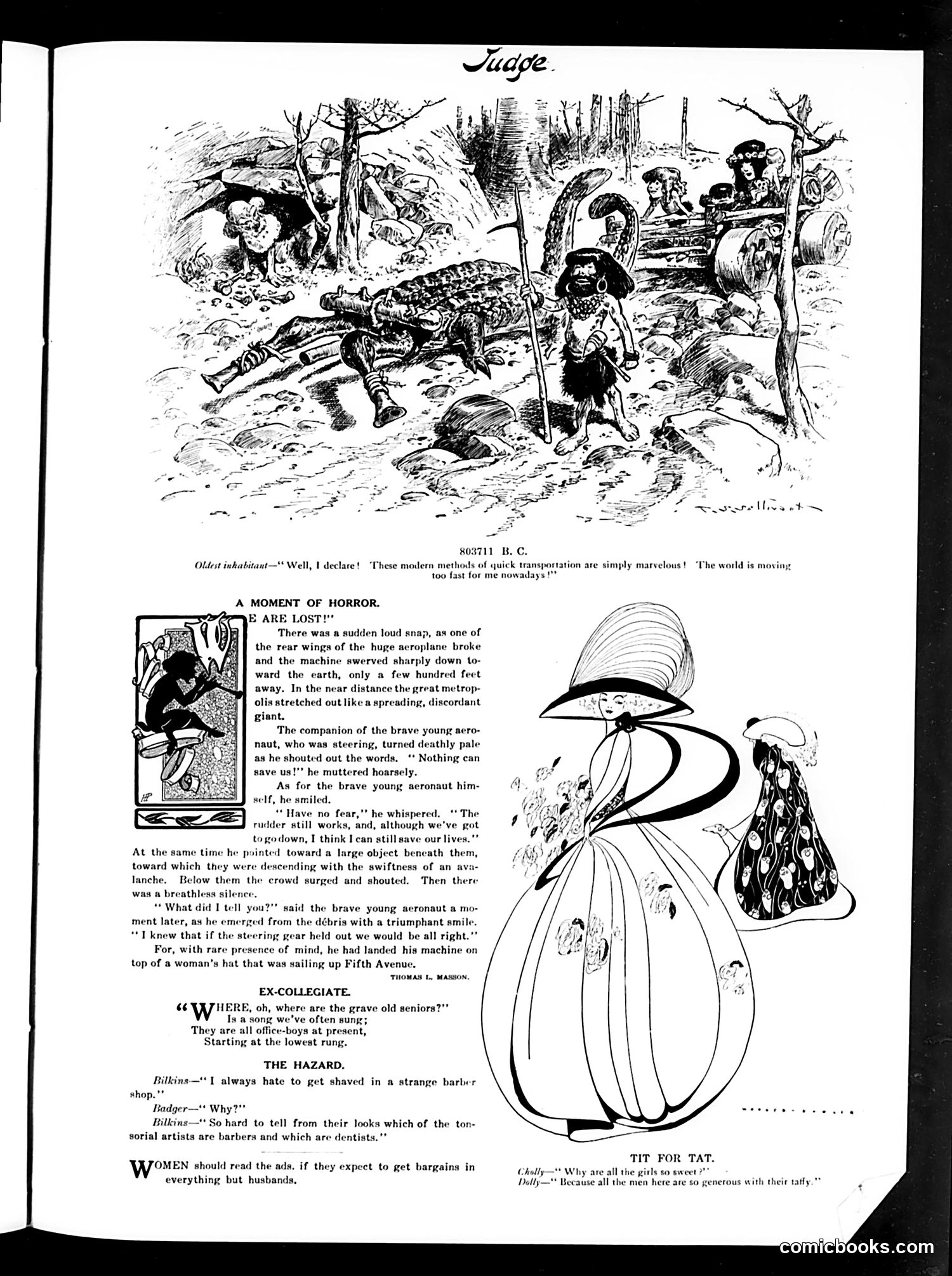
This page contains three satirical pieces satirizing early 20th-century American life: **"A Moment of Horror"**: Mocks both aviation technology's dangers and urban excess. An airplane crashes, but the pilot heroically lands on a woman's enormous hat sailing up Fifth Avenue—satirizing both the precarious state of early aviation and the absurdly oversized fashionable hats women wore during this era. **Top cartoon**: An elderly person complains that modern transportation (automobiles, airplanes) moves too fast, representing generational anxiety about rapid technological change. **Other sections**: "Ex-Collegiate" jokes that college graduates are reduced to entry-level office work; "The Hazard" plays on difficulty distinguishing barbers from dentists by appearance; final quips mock dating customs and gender relations. The satire targets technological anxiety, fashion excess, economic precarity for educated workers, and contemporary courtship dynamics—typical Judge magazine fare mocking American society's modern pretensions and contradictions.
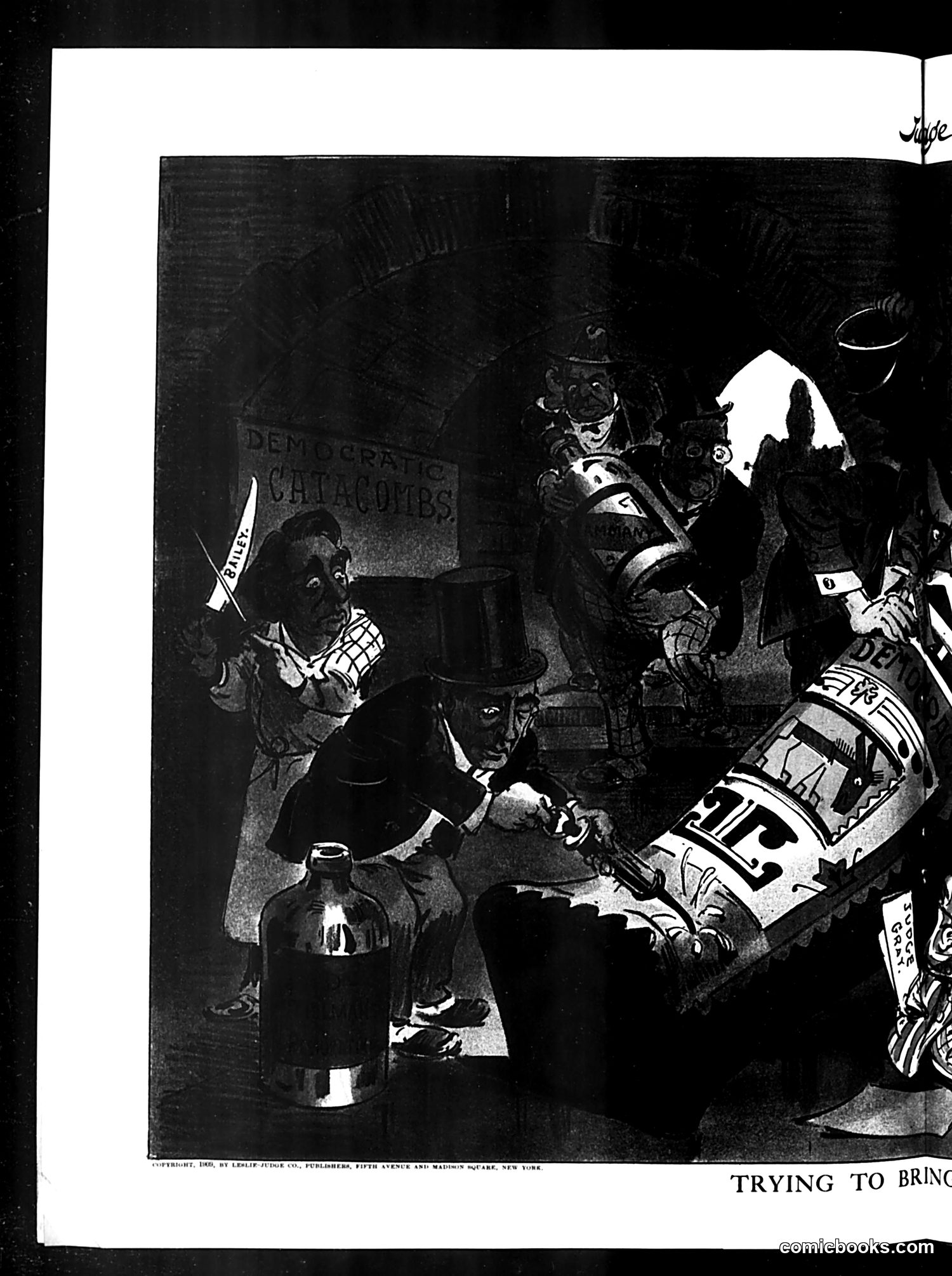
This Judge magazine cartoon satirizes Democratic Party internal conflicts, likely from the 1880s based on the style. The central figure appears to be a Democratic politician or party leader (dressed formally in center) surrounded by various party factions represented as caricatured figures holding signs labeled with different positions or groups ("DEMOCRATIC CATACOMBS" visible on wall sign). The cartoon's title "TRYING TO BRING..." (cut off) suggests the joke concerns failed attempts to unite fractious Democrats. The different figures with raised implements and conflicting gestures represent competing Democratic interests unable to cooperate. This reflects the era's real tensions between Democratic factions over currency, tariffs, and regional interests that repeatedly hampered party cohesion.
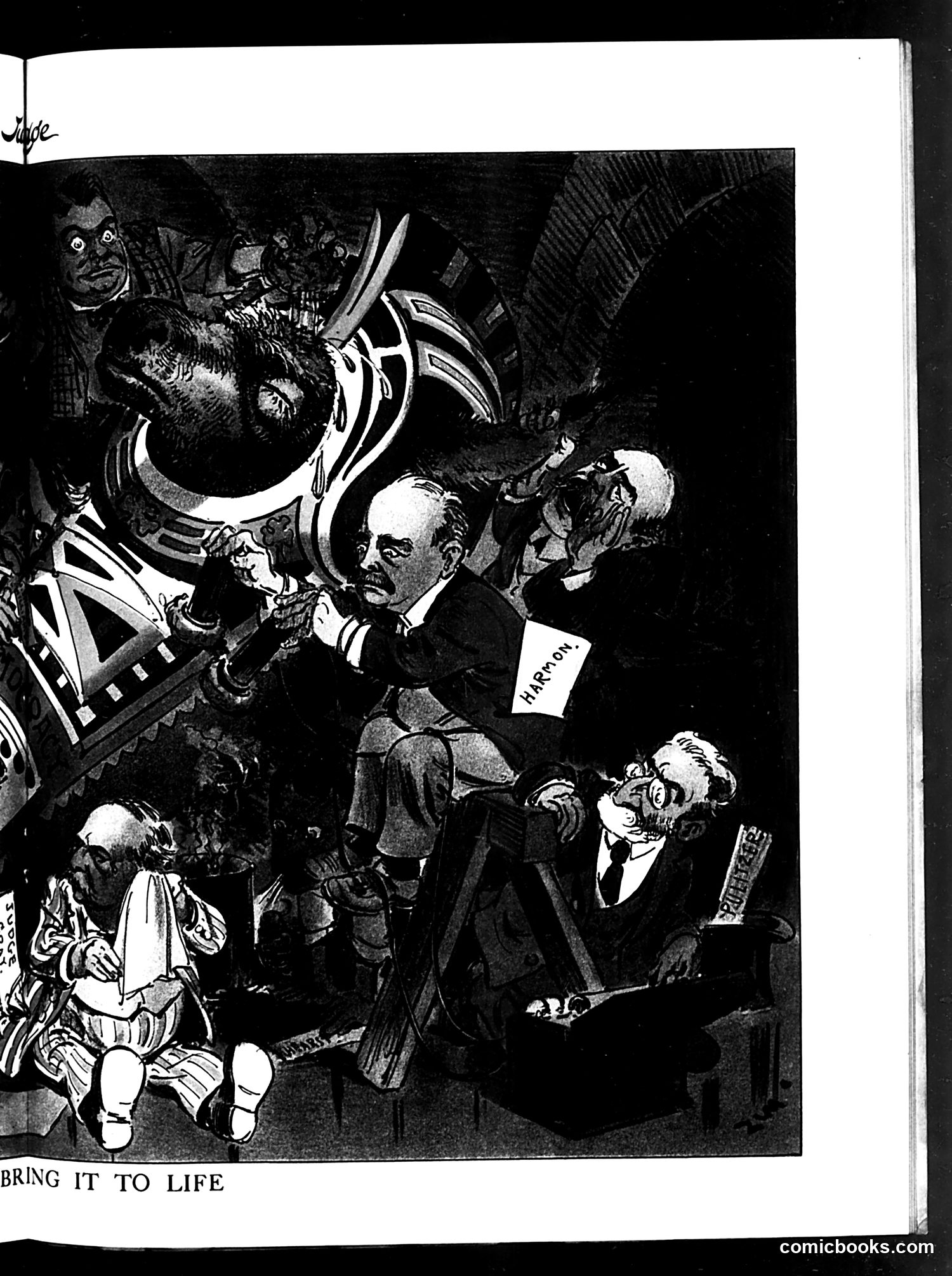
This political cartoon appears to satirize the creation or "bringing to life" of something, likely a political movement or ideology. The central figure labeled "HURON" (unclear if this is a name or location reference) stands among grotesque, demonic creatures and caricatured figures in formal dress. The style suggests early-to-mid 20th century Judge magazine satire. The composition—with monsters literally surrounding a suited gentleman—suggests the cartoon critiques how certain ideas or political movements attract unsavory elements or corrupt influences. The title "BRING IT TO LIFE" implies criticism of attempts to actualize a particular ideology or policy. Without clearer context about the specific date or political moment, I cannot definitively identify which historical event or figure this references, though the artistic style and imagery suggest commentary on authoritarianism or extremist movements.
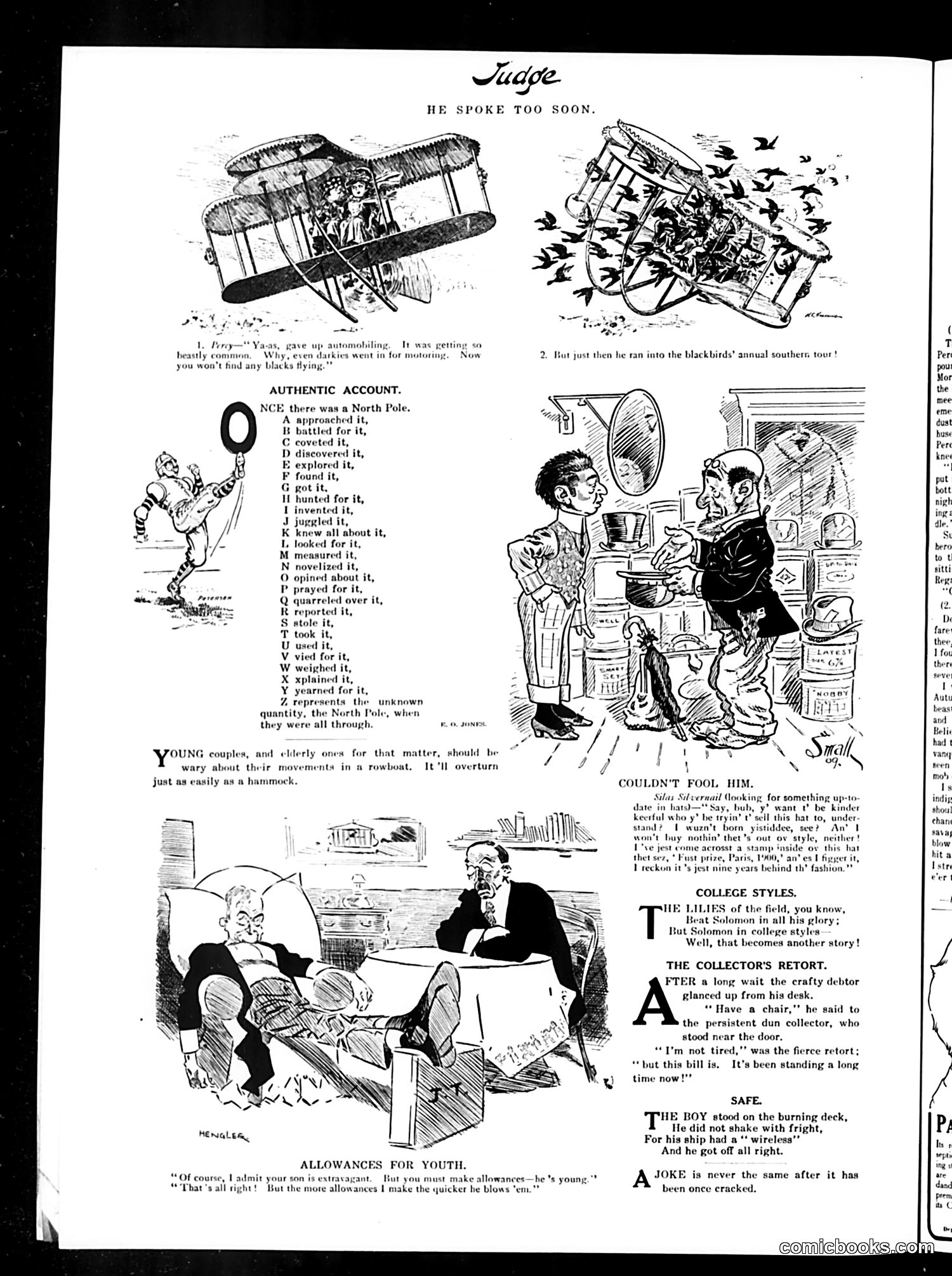
This page from the satirical magazine **Judge** contains several unrelated comic items typical of early 20th-century humor: **"He Spoke Too Soon"** depicts a early airplane crashing spectacularly after a passenger boasted about safety—satirizing public skepticism about aviation technology. **"Authentic Account"** is an alphabetic joke about the North Pole's discovery, listing competing explorers who all claimed credit (A-Z, ending with "Z represents the unknown quantity")—mocking the era's polar exploration rivalries and nationalist posturing. **Other sketches** cover domestic humor: rowboat safety, a debt collector's witty comeback, college fashion, and a child on a burning ship with a wireless radio. The recurring theme is early 1900s anxieties: new technologies (planes, wireless), social embarrassments (youth allowances), and the gap between aspirations and reality. The humor is gentle, pun-based, and family-oriented—characteristic of Judge's middle-class readership.
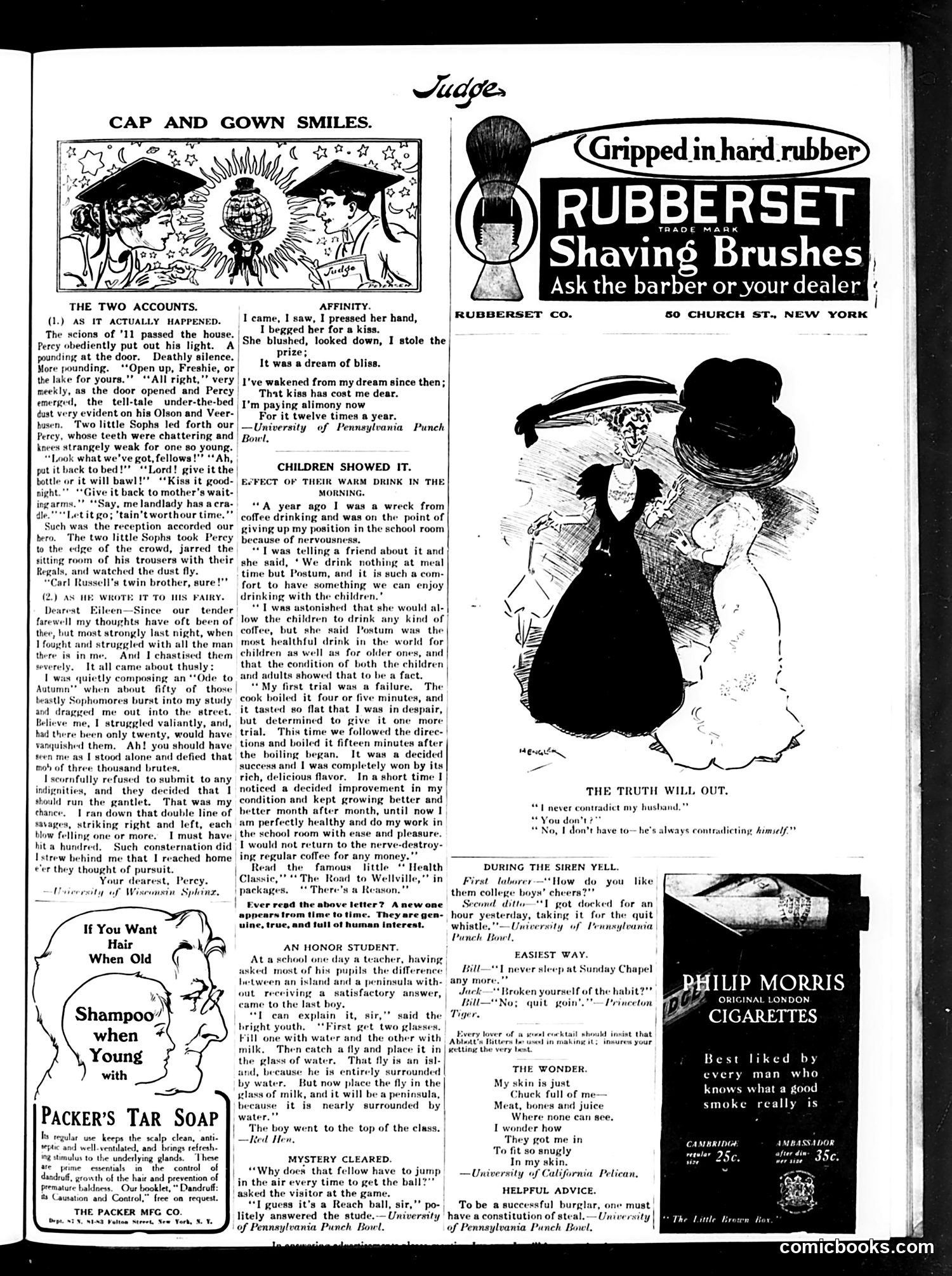
This page from Judge features primarily **humorous student anecdotes** rather than political satire. **"The Two Accounts"** presents a classic college prank narrative: a freshman (Percy) is hauled out by sophomores for initiation hazing. The satire lies in the **contrast between what actually happened** (he was roughed up and had dust knocked from his trousers) **versus his romanticized letter** to his "fairy" (sweetheart), where he claims he single-handedly fought off fifty attackers and defeated a "hundred" opponents before heroically escaping. This mocks the **exaggeration young men employed** when impressing romantic interests—common college humor of the era. The joke is transparent: readers see both the embarrassing truth and his inflated self-aggrandizing fiction. The page also includes period advertisements (Packer's Tar Soap, Philip Morris cigarettes, Rubberset shaving brushes) and humor pieces about student life, typical Judge content mixing light satire with commercial endorsements.
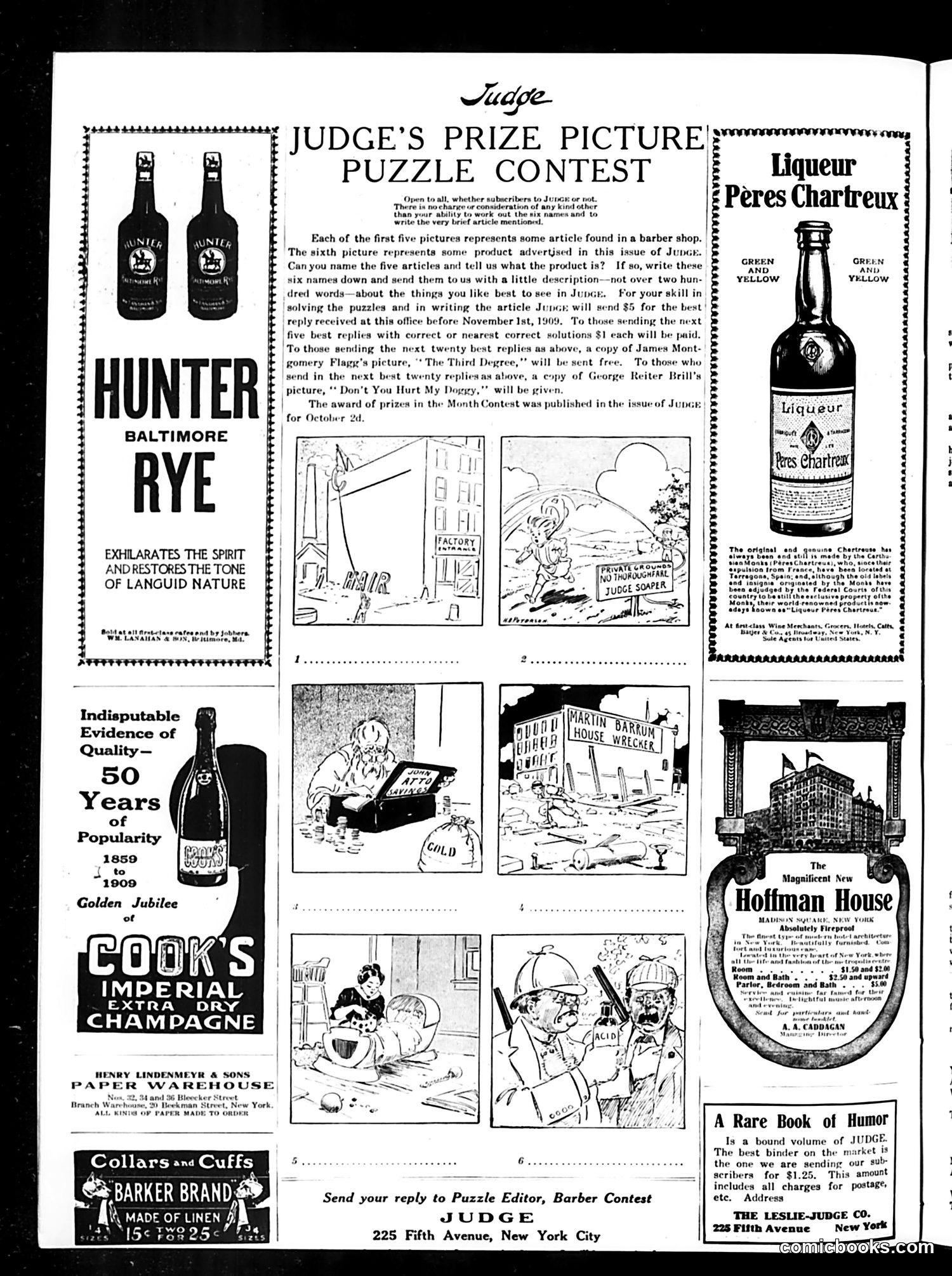
This page is primarily an **advertising and contest layout** rather than a political cartoon. The central content is "Judge's Prize Picture Puzzle Contest" inviting readers to identify six items: five barbershop articles visible in the first five cartoon panels, plus one advertised product from the magazine. Winners receive monetary prizes ($5 for best entry, $1 for next five best). The six unlabeled cartoon sketches appear to show generic barber-shop scenes—soap, haircuts, shaving, etc.—which readers must identify and describe. Surrounding this contest are advertisements for products mentioned in Judge's October 1909 issue: Hunter Baltimore Rye whiskey, Cook's champagne, Barker Brand collars, Liqueur Peres Chartreux, and the Hoffman House hotel. A small advertisement promotes bound volumes of Judge magazine itself as "A Rare Book of Humor." The page functions as a reader-engagement tool combining entertainment (puzzle-solving), product promotion, and magazine circulation-building through prize incentives.
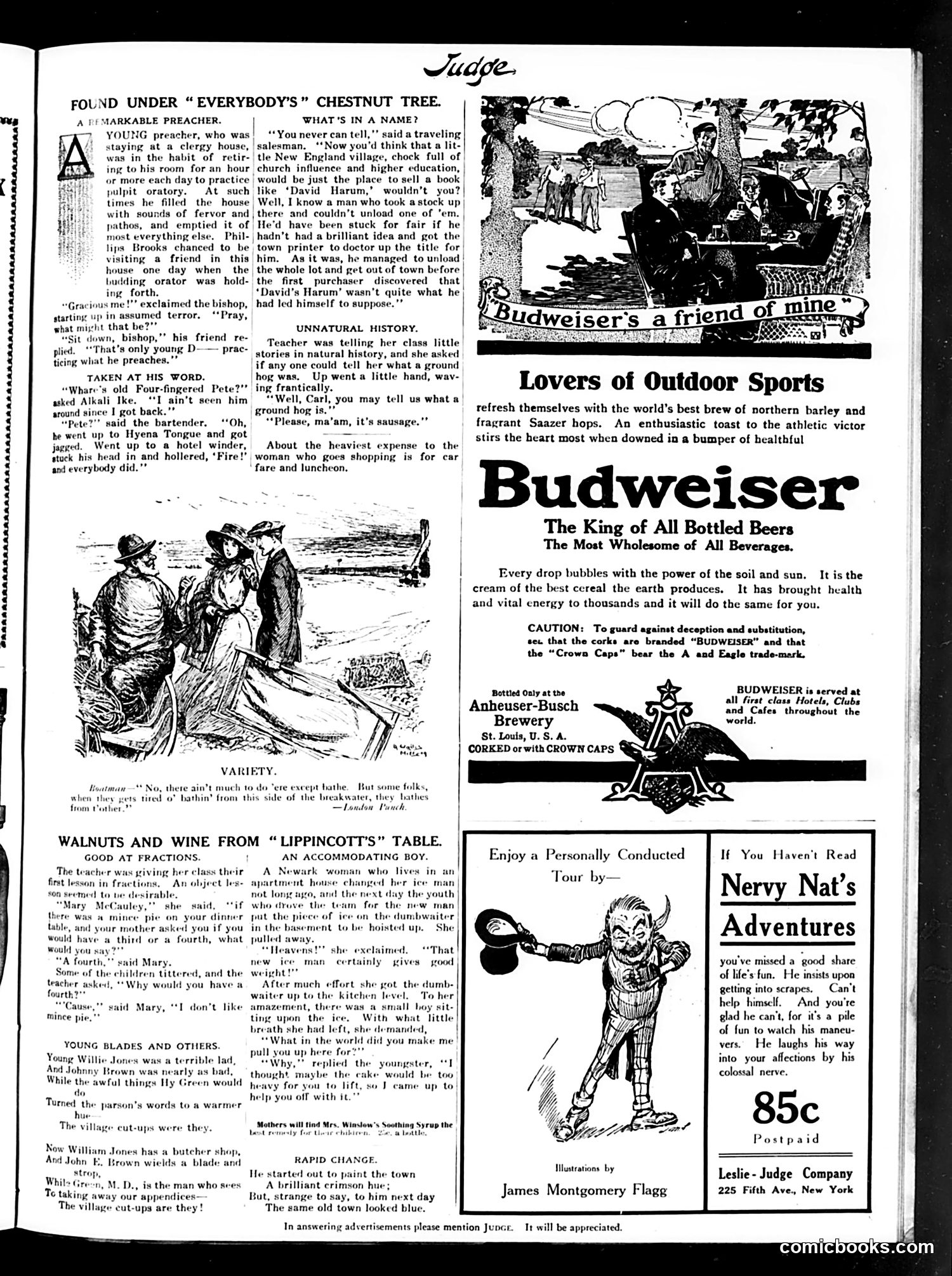
This page contains multiple short humorous anecdotes typical of Judge's satirical style, plus a prominent Budweiser beer advertisement. **The cartoons/jokes:** The sketches illustrate brief comedic stories about American life. "A Remarkable Preacher" depicts a young clergyman practicing sermons so loudly he empties a house—Bishop Phillips Brooks jokes he should stop "practicing" since his actual preaching is no better. Other pieces humorously capture small-town life and social awkwardness: a confused child defining "ground hog" as sausage, a traveling salesman's trick renaming "David Harum" to sell books, and a dumbwaiter mishap. **The advertisement:** The large Budweiser ad emphasizes the beer as wholesome refreshment for "outdoor sports" enthusiasts, using patriotic imagery (eagle emblem) and health claims ("vital energy"). This reflects early-1900s advertising before strict regulations, when breweries marketed beer as nutritious and athletic. **Overall context:** The page exemplifies Judge's formula: gentle satire of American provincial life mixed with commercial endorsements, appealing to educated, middle-class readers.
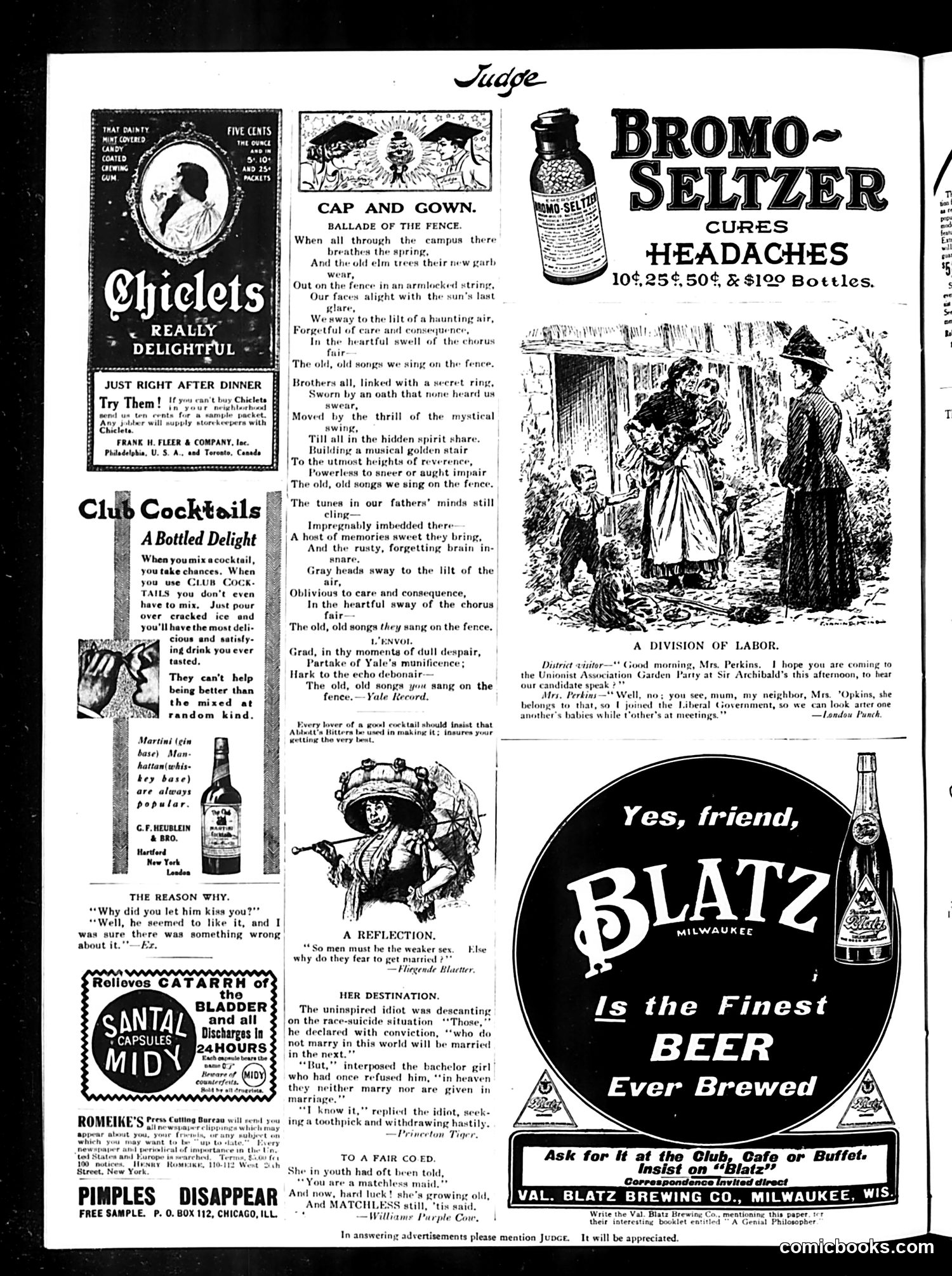
This page is primarily **advertising**, with minimal political content. The main cartoon is "Cap and Gown: Ballade of the Fence," a nostalgic poem about Yale University students singing traditional songs on campus fences—a sentimental tribute to collegiate tradition and shared memory. The other content consists of: - **Product advertisements**: Chiclets gum, Club Cocktails, Bromo-Seltzer (a popular headache remedy), Santal Capsules, and Blatz Beer - **Small humorous vignettes** on social topics (romance, marriage hesitation, class divisions) with no clear political targets - **"A Division of Labor"**: A brief class-conscious sketch about a wealthy visitor and her working-class neighbor, likely British (references to "Mrs. 'Opkins"), showing different social responsibilities The page reflects early 20th-century American consumer culture and genteel social humor rather than sharp political satire. Most content would appeal to middle/upper-class readers—college-educated, able to afford advertised products.
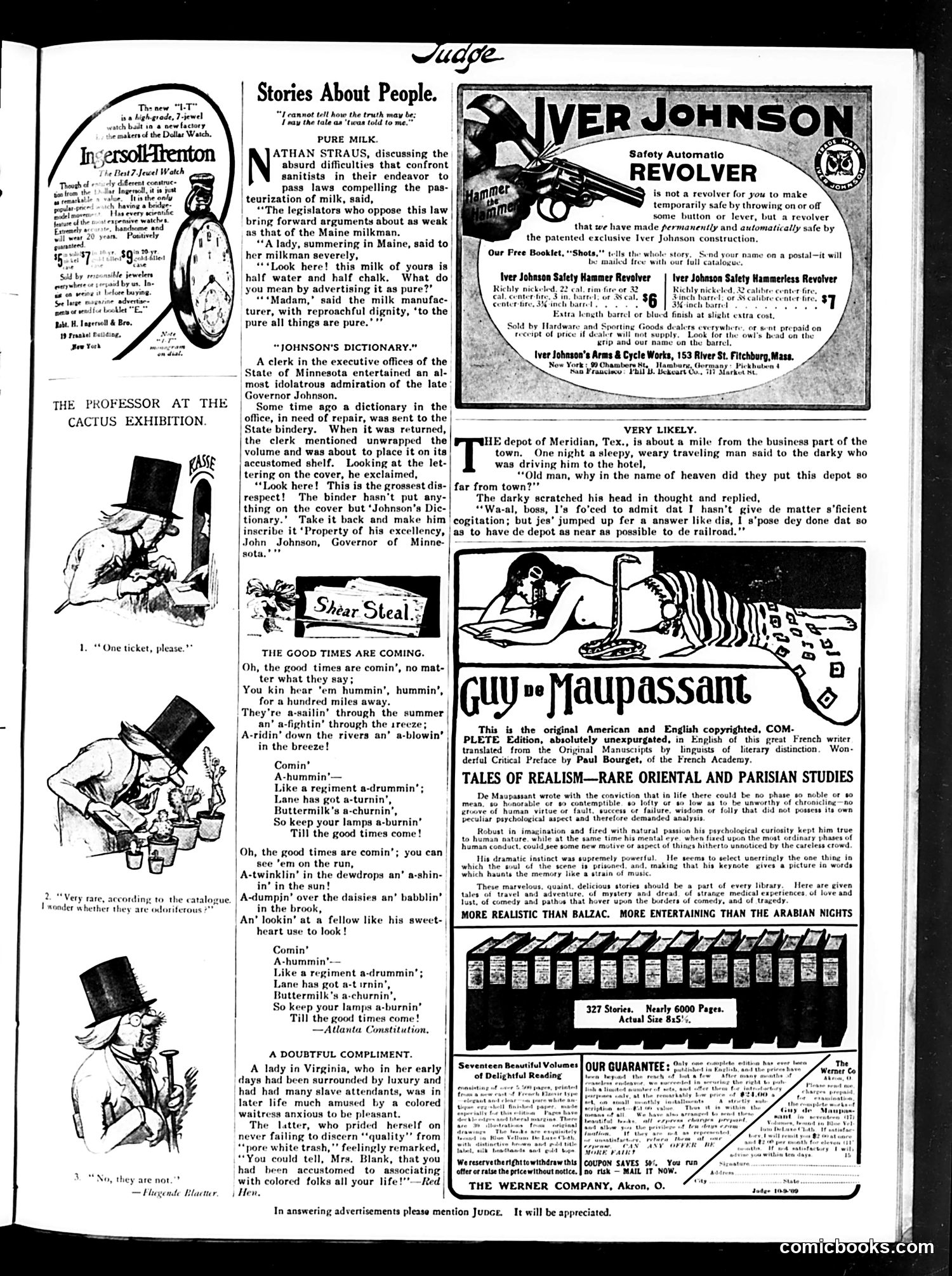
This page from the satirical magazine *Judge* contains several humor pieces mocking various subjects: **"Pure Milk" story**: Satirizes milk adulteration—a genuine public health problem of the era. A milkman selling watered-down, chalky milk defends himself with absurdist logic ("to the pure all things are pure"), mocking both dishonest vendors and weak regulatory arguments. **"Johnson's Dictionary"**: Jokes about a Minnesota clerk's excessive admiration for Governor John Johnson. When a dictionary returns from binding labeled only "Johnson's Dictionary," the clerk complains the binder failed to add "Property of his excellency, John Johnson, Governor of Minnesota"—satirizing obsequious flattery. **"Very Likely"**: A dialect humor piece where a Black porter explains the distant railroad depot location with circular logic, relying on period-typical racial caricature common to the era. The page also advertises Iver Johnson revolvers and Guy de Maupassant books, typical of *Judge*'s mixed content combining satire with commercial promotion.
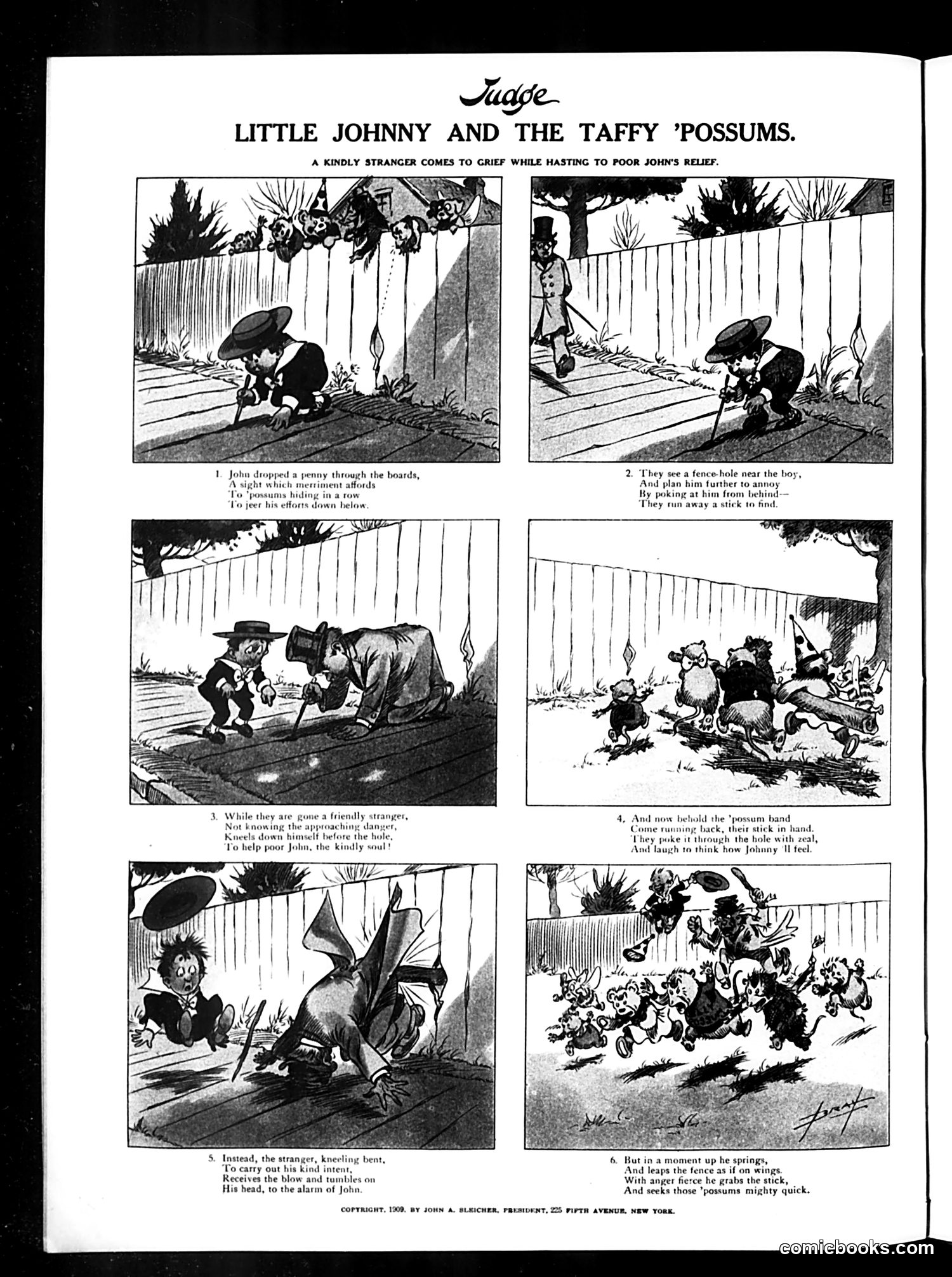
This is a humorous illustrated story (not political satire) from Judge magazine, circa 1909. It depicts a slapstick narrative where a well-meaning stranger encounters "Little Johnny" trying to catch possums near a fence. The humor derives from physical comedy: the stranger attempts to help Johnny by poking a stick into a possum hole, but the possums attack him aggressively in response. He's knocked down and tumbled about by the animals' fierce defense, much to Johnny's amusement. The "taffy" reference in the title appears to mean sticky/difficult situation rather than candy. The joke's appeal to contemporary readers was the contrast between the stranger's kindly intentions and his comeuppance from nature—a common theme in early 20th-century comic storytelling.