
Judge, 1909-10-09 · page 5 of 16
Judge — October 9, 1909 — page 5: what you’re looking at
What you’re looking at
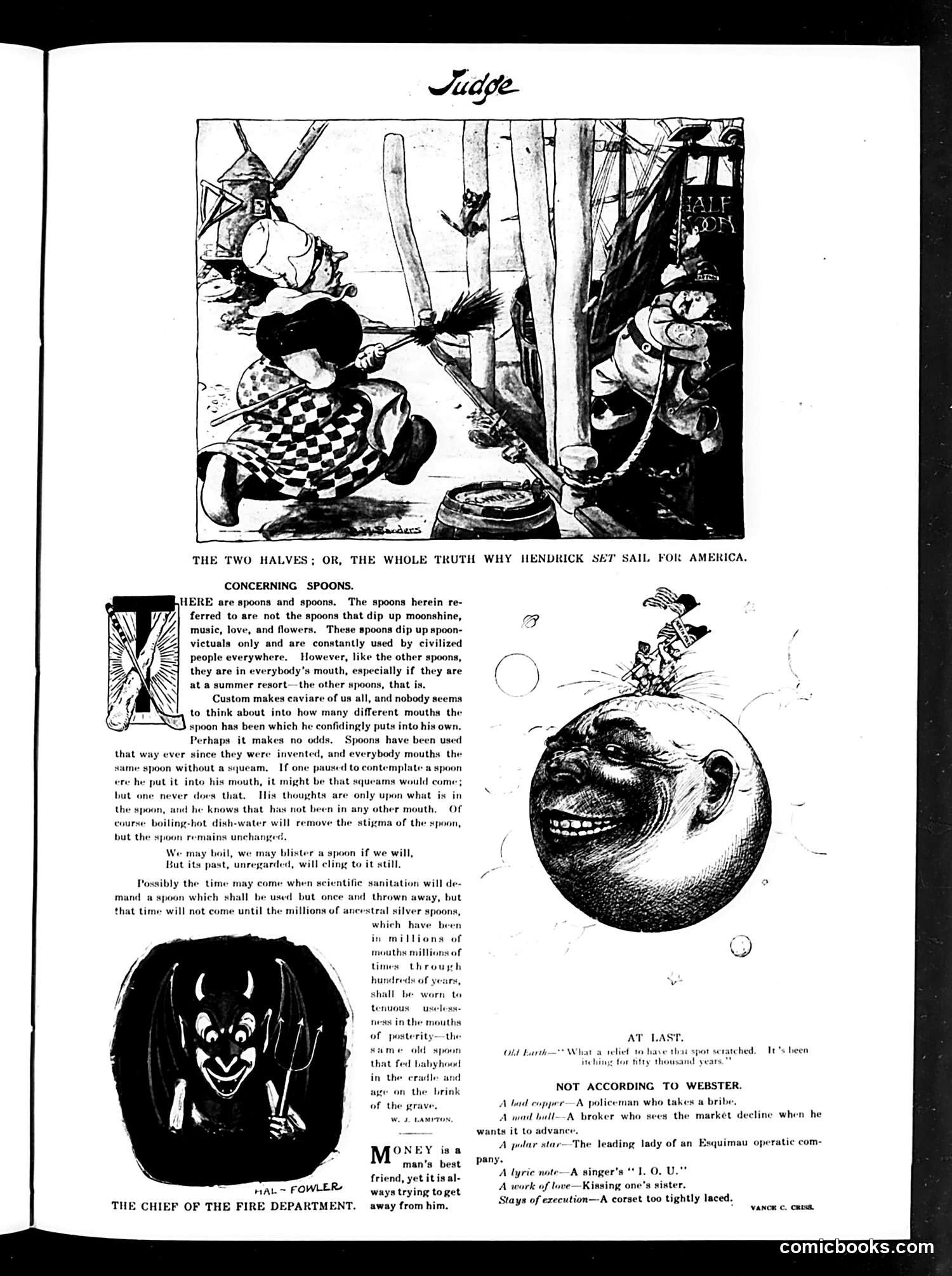
**Top Cartoon**: "The Two Halves; or, The Whole Truth Why Hendrick Set Sail for America" depicts a scene with sailors and cargo, likely satirizing a historical voyage. The title suggests commentary on Dutch explorer Hendrick Hudson, though the specific political reference is unclear without additional context. **"Concerning Spoons" Essay**: This section humorously discusses spoon etiquette and usage customs, appearing to satirize upper-class dining pretensions and the absurdity of social conventions around silverware. It mocks people who obsess over which spoon to use. **Bottom Section**: "Not According to Webster" offers mock dictionary definitions using wordplay—examples include "bad copper" (a corrupt policeman) and "palm note" (a singer's "I.O.U."). This satirizes contemporary social vices through humorous redefinition. The illustrations by Hal Fowler complement these satirical pieces with caricatured figures.
📄 Transcribed text from this page (OCR, searchable)
Machine-transcribed from the original scan — historical spelling and the odd misread are preserved.
THE TWO HALVES; OR, THE WHOLE TRUTH WHY HENDRICK SET’ SAIL FORK AMERICA, CONCERNING SPOONS. HERE are spoons and spoons, The spoons herein re- ferred to are not the spoons that dip up moonshine, music, love, and flowers, These spoons dip up spoon- victuals only and are constantly used by civilized people everywhere. However, like the other spoons, they ar rybody’s mouth, especially if they are at a summer resort—the other spoons, that is. Custom makes caviare of us all, and nobody seems, to think about into how many different mouths the spoon has been which he confidingly puts into his own. Perhaps it makes no odds, Spoons have been used that way ever since they were ted, and everybody mouths the me spoon without a squeam. If one paused to contemplate a spoon he put it into his mouth, it might be that squeams would com but one never does that, His thoughts are only upon what is in the spoon, and he knows that has not been in any other mouth, Of course jing-hot dish-water will remove the stigma of the spoon, but the spoon remains unchanged. We may boil, we may b! spoon if we will, But its past, unregarded, will cling to it still. Possibly the time may come when scientific sanitation will de- mand a spoon which shall be used but once and thrown away, but that time will not come until the millions of ance: ilver spoons, jouths mill times through hundreds of y shall be worn to tenuous useless. ness int puts of posterity—the AT LAST. same old spoon Old barth—* What a seliet to have that spot seratehed, It's been that fed babyhood itehinge for titty thousand years. ”* in the cradle and age on the brink NOT ACCORDING TO WEBSTER. of the g A bad copper—A policeman who takes a bribe, we 4 mad bull—A broker who sees the market decline when he — wants it to advance, M°%tY isa A polar star—The leading lady of an Esquimau operatic com- *e beat PANY: imenebest A lyric note—A singer's “1. 0. U."” A work of love—Kissing one’s sister. Stays of execution—A corset too tightly laced, friend, yet itis al- HAL ~ FOWLER- ways trying toget THE CHIEF OF THE FIRE DEPARTMENT. away from him. VANCE C. CRESS. comicbooks.com