
A complete issue · 16 pages · 1909
Judge — September 11, 1909
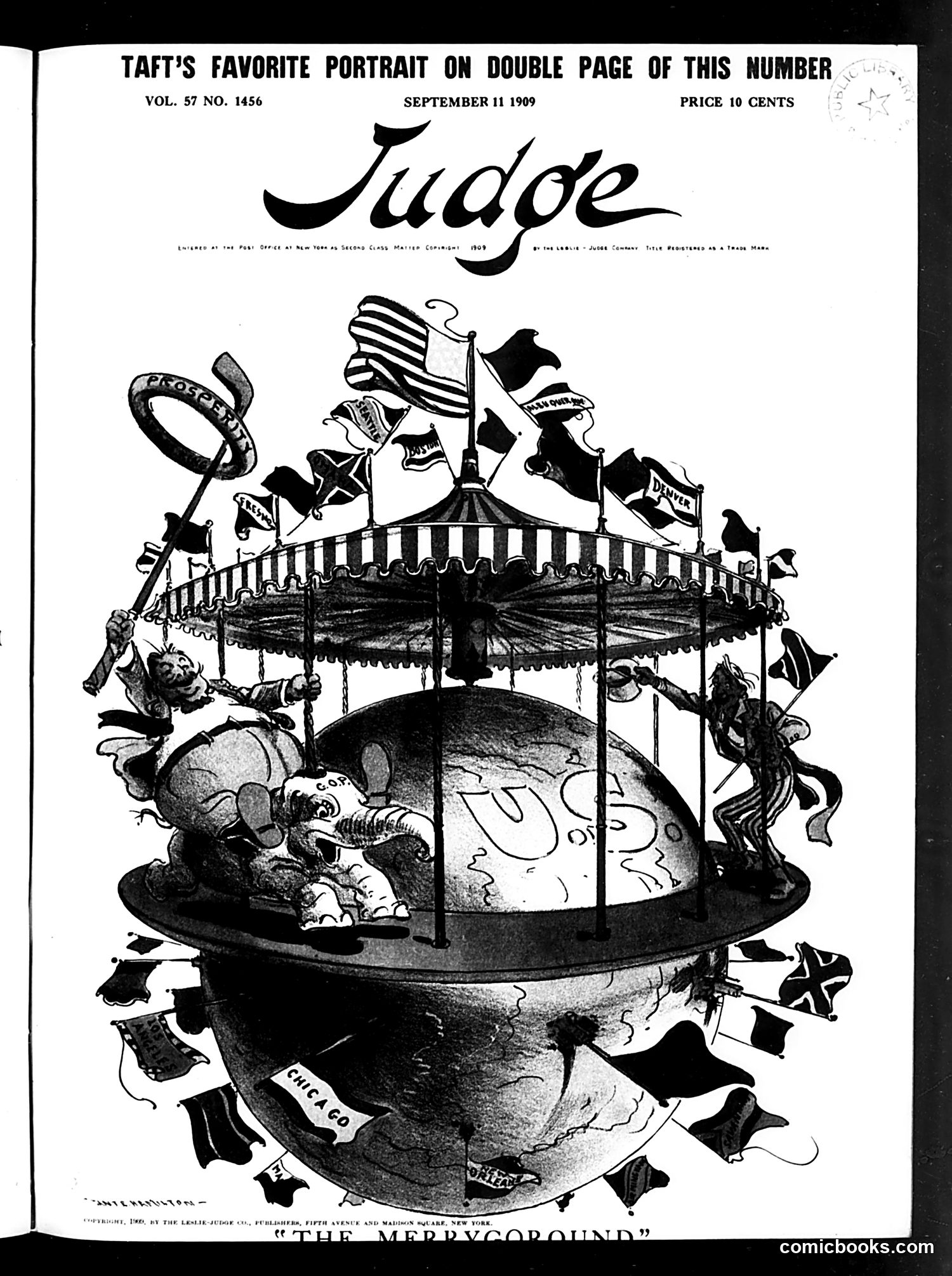
This political cartoon depicts a large human head in profile (labeled "CHICAGO") containing a rotating merry-go-round. Caricatured figures ride the carousel while various flags and symbols surround the structure. The satire appears to comment on Chicago's political instability or chaotic governance circa 1909. The merry-go-round metaphor suggests the city's leadership or politics were going in circles—round and round without substantive progress. The multiple flags and the carnival imagery imply superficial entertainment masking underlying dysfunction. The specific political context remains unclear without additional documentation, but the cartoon mocks Chicago's governance as cyclical, dizzying, and ultimately pointless activity. President Taft's connection (mentioned in the header) suggests possible federal-level commentary on the city's affairs.
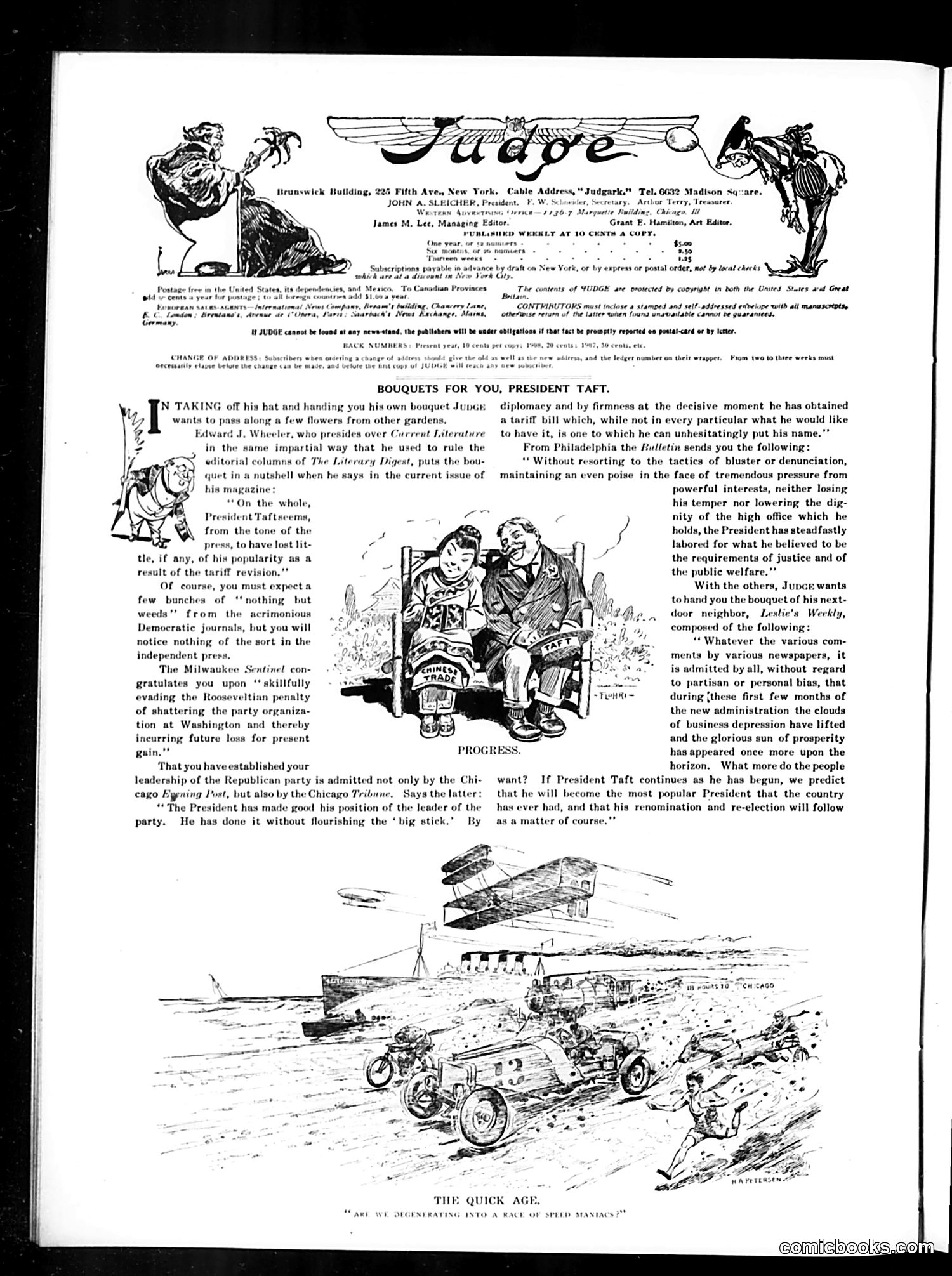
This Judge magazine page satirizes President Taft's political standing. The main article, "Bouquets for You, President Taft," uses ironic praise while discussing Taft's leadership of the Republican Party and his popularity among newspapers and the public. The central cartoon, titled "Progress," depicts two figures (likely representing the public or voters) riding in a vehicle labeled "TRADE," suggesting concerns about economic policy under Taft's administration. The lower illustration, "The Quick Age," shows speeding vehicles and aircraft, satirizing America's rapid modernization and what the text calls "degenerating into a race of speed maniacs"—critiquing the era's obsession with technological progress and speed. The overall page reflects early 20th-century political debate about Taft's presidency and anxieties about modern American society.
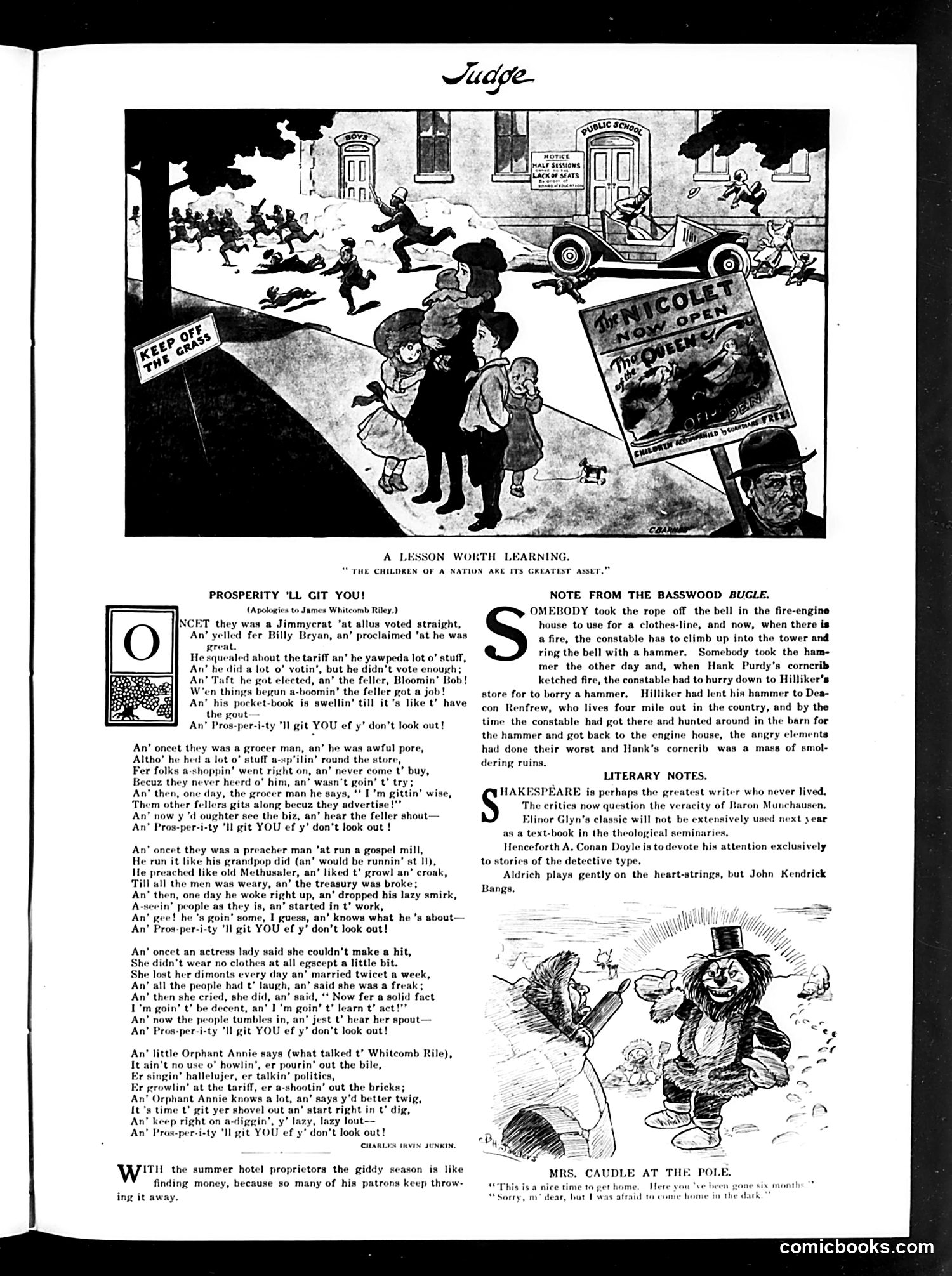
This page from *Judge* magazine contains a satirical poem titled "Prosperity 'll Git You!" mocking working-class optimism during an economic boom. The verse uses dialect humor to depict a laborer's naive confidence that prosperity will rescue him from poverty—he'll become prosperous, his children will thrive, and social problems will vanish. The accompanying illustration shows a chaotic street scene with a car, running children, and a "Public School" building, satirizing urban disorder and suggesting that despite talk of prosperity, actual conditions remain chaotic. The "Literary Notes" section briefly reviews classical literature and detective fiction. A cartoon labeled "Mrs. Caudle at the Pole" appears below, though its specific meaning is unclear without additional context. The overall message: prosperity rhetoric masks persistent working-class struggles.
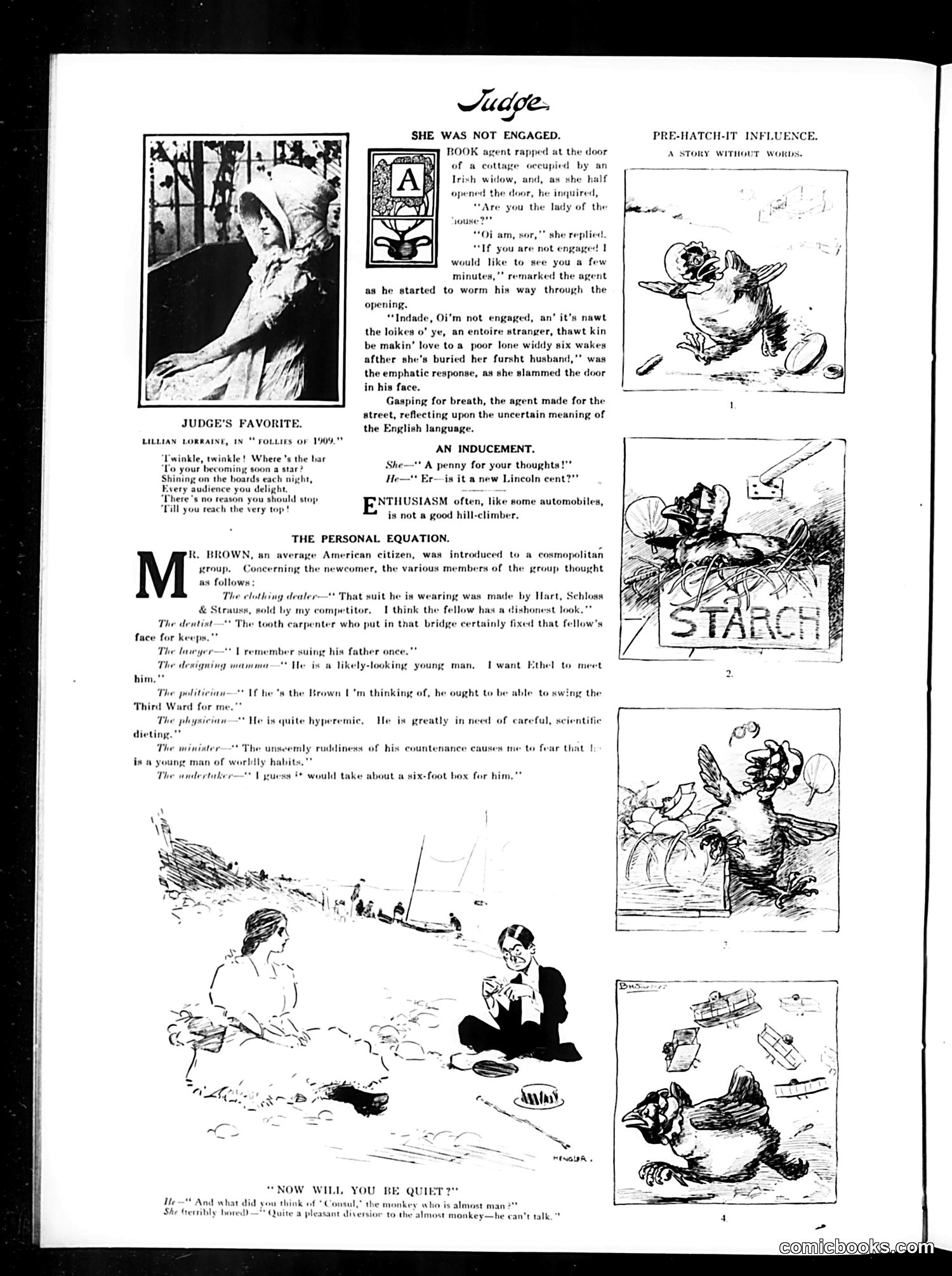
This page contains several unrelated satirical pieces rather than one unified cartoon: **"She Was Not Engaged"** mocks an Irish widow's aggressive rejection of a book agent's advances, using dialect humor and physical comedy typical of early 1900s ethnic stereotyping. **"Judge's Favorite"** is a poem about wealth and ambition. **"The Personal Equation"** presents a group of professionals (a clothing dealer, dentist, lawyer, clergyman, politician, physician, and minister) offering contrasting opinions about a man named Brown, satirizing how different professions interpret character through their specialized lenses. The right side contains **"Pre-Hatch Influence"** — four wordless comics about a character apparently named Starch, depicting comedic misadventures with vehicles and nature. The humor appears slapstick and visual rather than politically pointed. The overall tone reflects early 20th-century American magazine satire: class-conscious, occupation-focused, and reliant on visual gags.
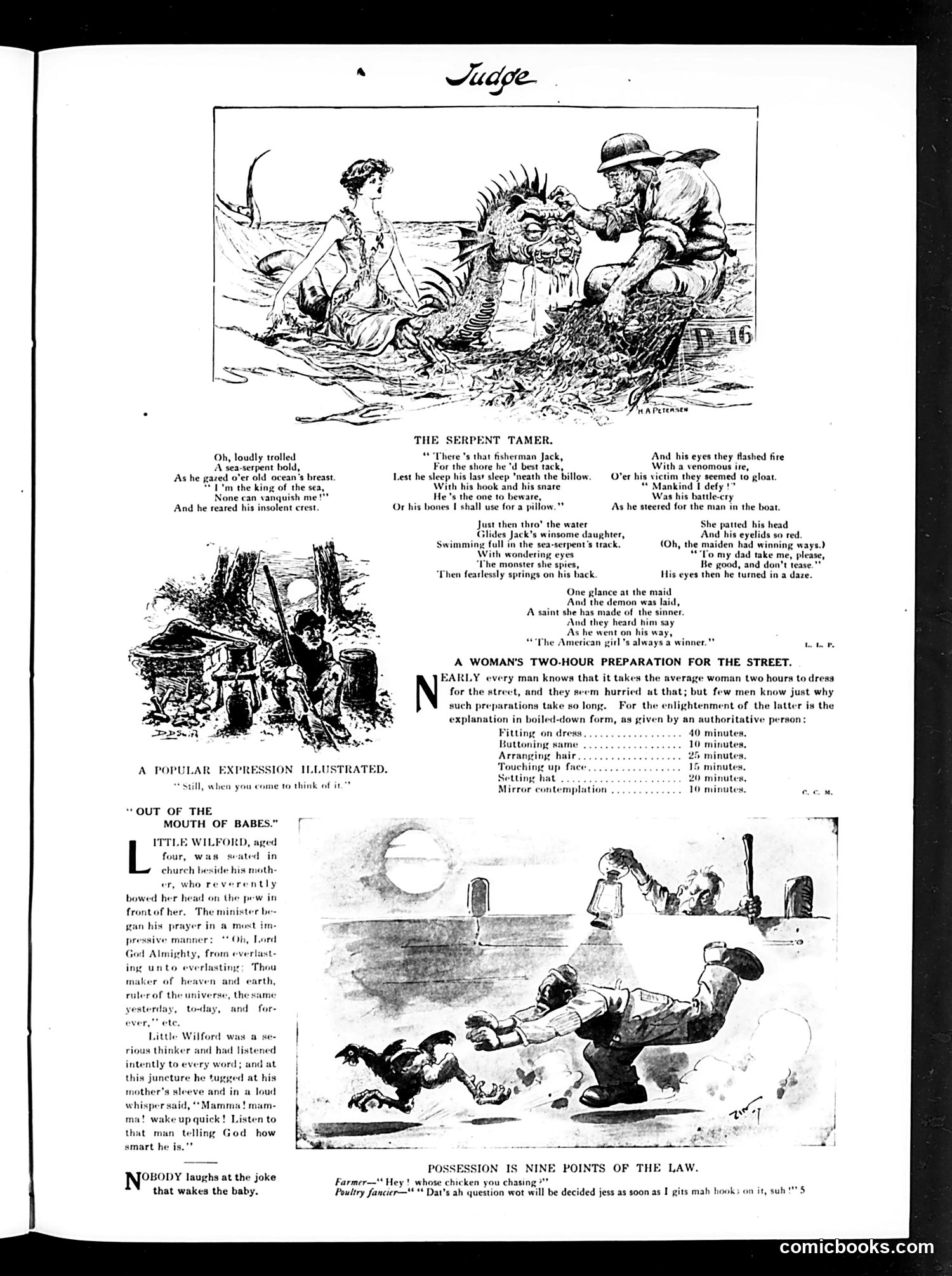
**"The Serpent Tamer"** (top): This poem depicts a fisherman confronting a sea serpent, likely referencing the famous 19th-century "sea serpent" sightings that periodically captivated American public imagination. The illustration shows a dramatic encounter where the fisherman appears to best the creature—a humorous inversion of expected danger. **"A Woman's Two-Hour Preparation for the Street"** (middle): This satirizes the time women spent dressing, listing specific durations for each task (40 minutes fitting on dress, 10 minutes mirror contemplation, etc.). The satire mocks both women's elaborate grooming rituals and the male impatience with these preparations—a common turn-of-century gender humor topic. **"Possession is Nine Points of the Law"** (bottom): A rural dispute joke about a chicken, playing on the legal maxim about property rights through possession rather than ownership claims.
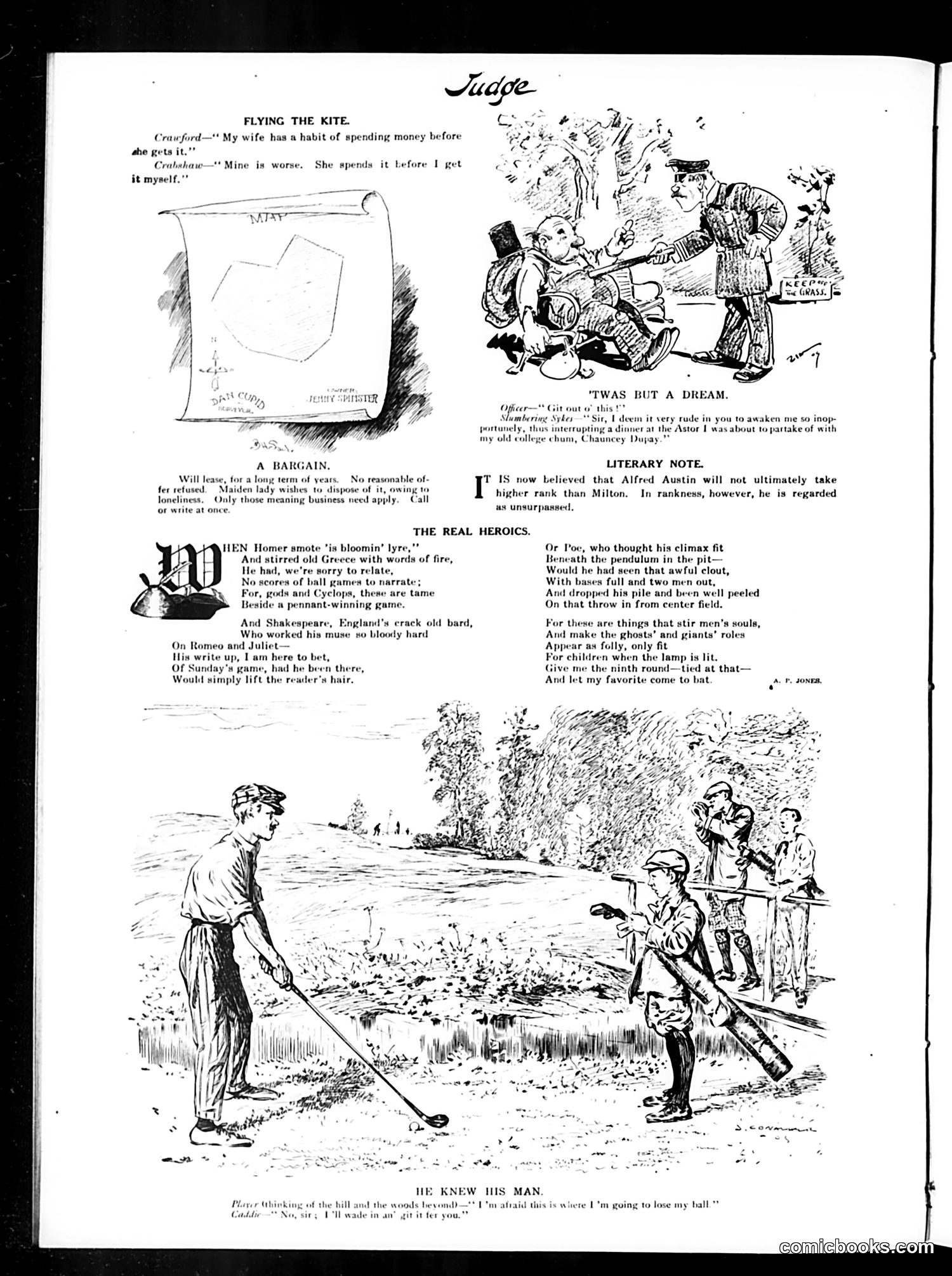
This page from Judge contains several satirical pieces about spending habits, dreams, and American cultural values: **"Flying the Kite"** mocks marital financial disputes, with husbands complaining their wives spend money before receiving it—the phrase "flying the kite" referring to spending money one doesn't yet have. **"'Twas But a Dream"** shows a policeman rudely waking a vagrant ("Slumbering Sykes"), disrupting his pleasant dream of dining at an upscale establishment. **"The Real Heroics"** argues that baseball has surpassed classical literature in cultural importance. It claims Homer, Shakespeare, and Poe—despite their genius—lacked the dramatic excitement of baseball games with bases loaded and crucial ninth-inning moments. This reflects late-19th-century American enthusiasm for baseball as the national sport, positioning it above traditional high culture. **"Literary Note"** briefly mentions Alfred Austin as a poet of lesser rank than Milton, reflecting contemporary literary criticism. The page satirizes both domestic money conflicts and American cultural priorities, celebrating baseball's grip on public imagination.
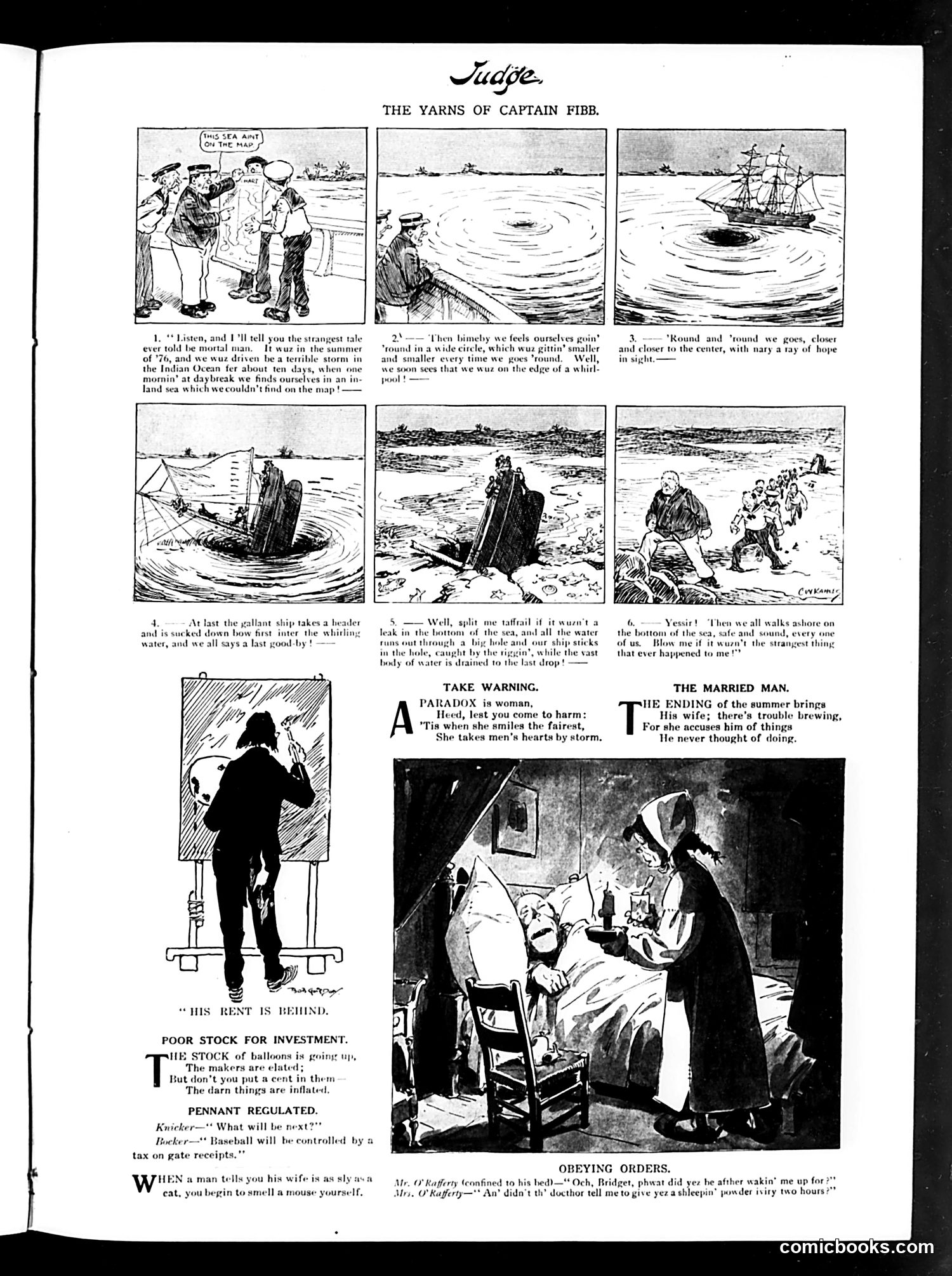
**"The Yarns of Captain Fibb"** is a tall-tale comic strip where a sailor recounts an absurdly impossible adventure—being sucked into a whirlpool, sinking to the ocean bottom, and walking ashore dry. The humor relies on the exaggerated, obvious falsehood of the narrative, playing on the tradition of seafaring tall tales. The surrounding single-panel gags target various subjects: "Take Warning" satirizes women's paradoxical nature (a common period trope); "The Married Man" jokes about wives accusing husbands of imagined misdeeds upon summer's end; "Poor Stock for Investment" mocks inflated balloon stock; and "Obeying Orders" presents Irish-dialect humor about a wife literally following a doctor's sleeping-powder instructions too literally. These reflect early 1900s American humor conventions: skepticism toward investment schemes, stereotypical Irish-American caricatures, and domestic comedy centered on marital conflict. The overall page demonstrates Judge's mix of narrative comics and topical satire aimed at middle-class readers.
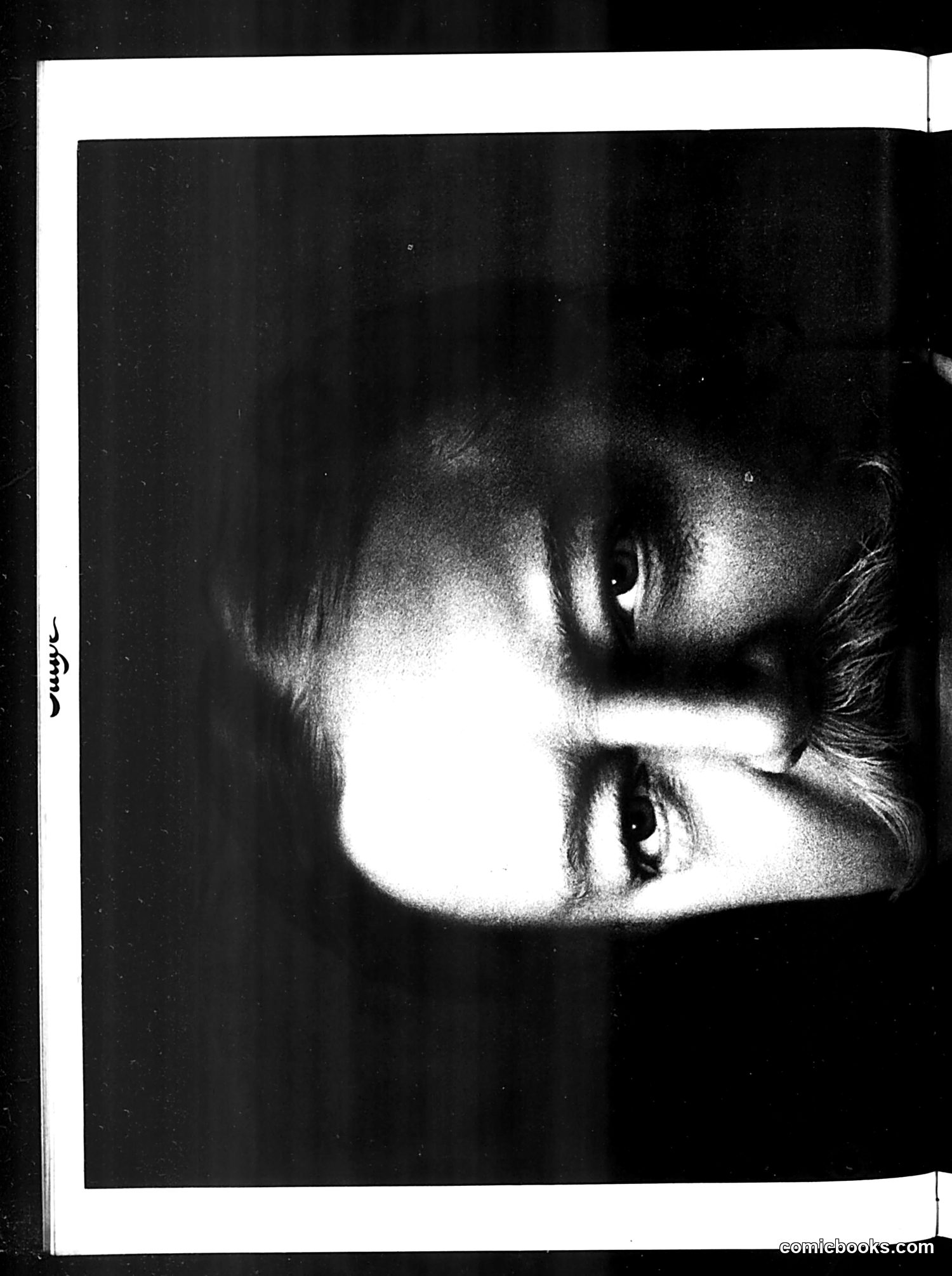
This appears to be a black and white photograph rather than a cartoon or satirical illustration. The image shows what looks like a close-up portrait of a person's face, rotated 90 degrees, displaying dramatic lighting typical of early-to-mid 20th century photography. Without visible text identifying the subject or clear satirical elements, I cannot definitively explain the political or social commentary this image was meant to convey in *Judge* magazine. The photograph's inclusion in a satirical publication suggests it may be a caricature or commentary on a public figure, but I cannot identify who is depicted or what specific reference is intended based solely on what's visible here. The OCR'd text provides only a symbol (%), offering no contextual information about the page's content or intent.
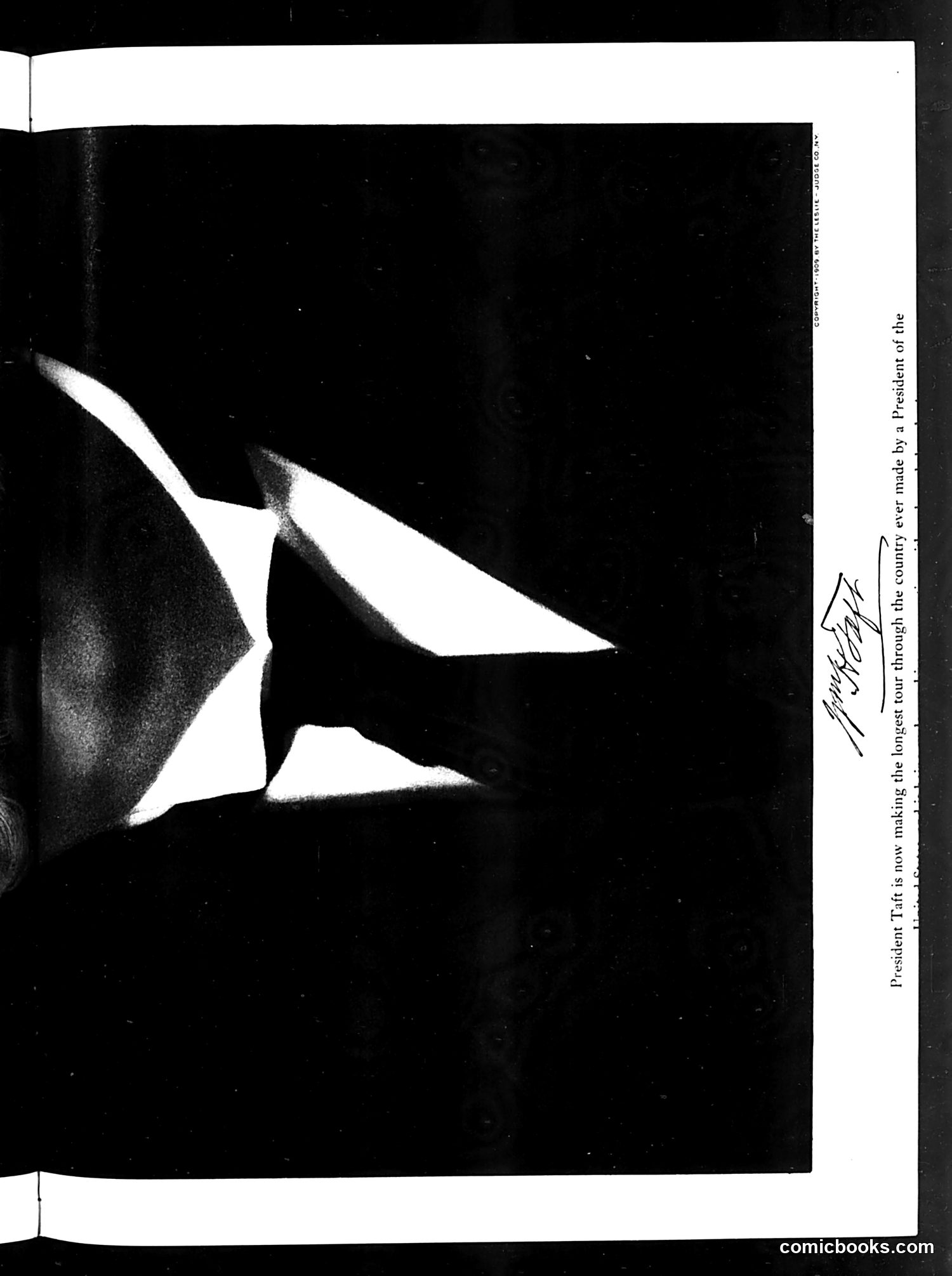
This page appears to be a title page or cover from *Judge* magazine. The image shows a stylized star or geometric shape in white against a black background, with what appears to be a signature or artist's mark. The OCR text is largely corrupted and unreadable, making it impossible to determine the specific political or social commentary intended. Without legible text or clear identification of caricatured figures, I cannot reliably explain what this cartoon satirizes or references. The geometric star design suggests it may relate to patriotic American themes, but without supporting text or context, I cannot specify which historical event, political figure, or social issue this was meant to critique.
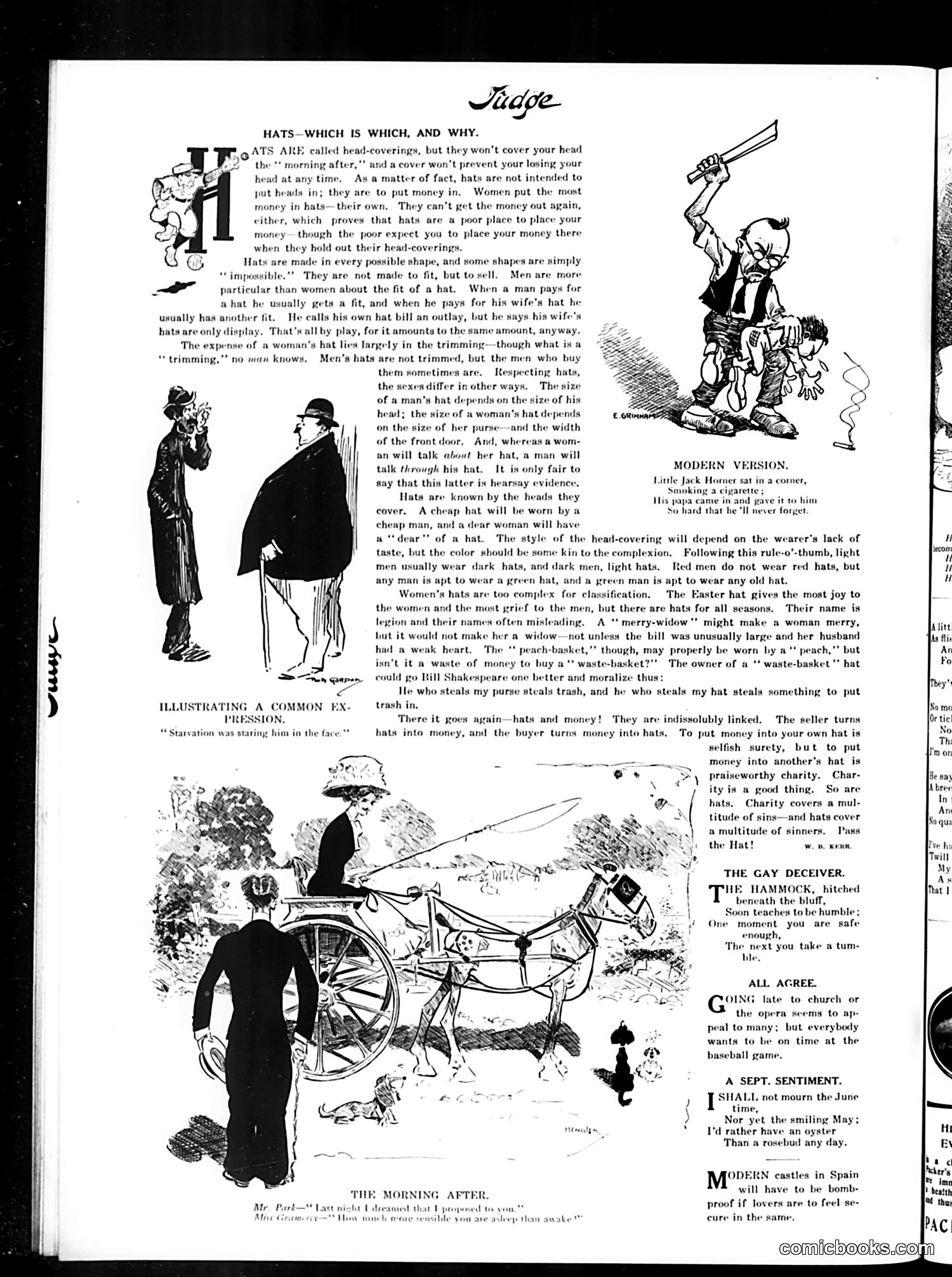
This satirical piece uses hats as extended metaphor for money and class. The main article, "Hats—Which Is Which, and Why," mocks social pretense through hat-wearing. Judge argues that hats are really about *money*, not function: women waste money on expensive hat trimming; poor people paradoxically save money in hats (literally placing coins in hat brims); cheap men wear cheap hats while wealthy women wear expensive ones. The accompanying cartoons illustrate related social observations: "Starvation was staring him in the face" shows desperation; "The Morning After" depicts romantic regret; smaller verses mock contemporary attitudes (baseball attendance, September sentiments about oysters). The satire targets gender differences in consumption, economic hypocrisy among the poor, and how visible clothing markers reveal—or fail to hide—one's true financial and social status. It's fundamentally about how Americans use material goods to signal (or fail to signal) wealth and respectability.
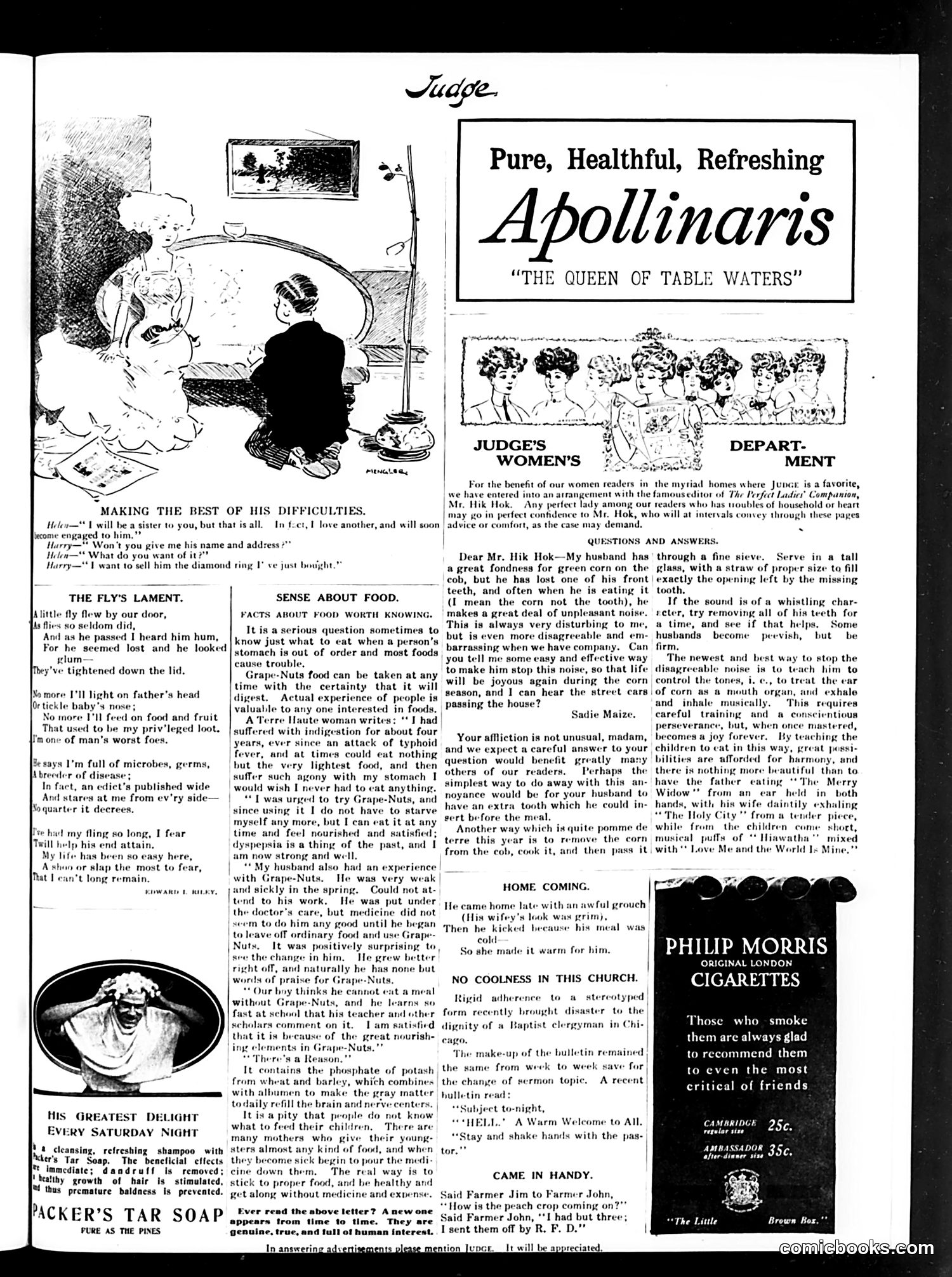
This page from **Judge** (a satirical American magazine) contains multiple humor pieces typical of the early 20th century: **"Making the Best of His Difficulties"** cartoons a romantic comedy: a woman tells a suitor she loves another man, then he asks for the rival's address—to sell him the expensive diamond ring he just bought her. The joke mocks male desperation and financial loss in romantic rejection. **"The Fly's Lament"** is sentimental doggerel where a fly mourns being excluded from human food and blamed for disease, now that "they've tightened down the lid"—likely referencing food sanitation concerns of the era. **"Judge's Women's Department"** features "Mr. Hik Hok" answering domestic advice questions. The sample answer about a husband noisily eating corn with a missing front tooth offers absurd "solutions" (get false teeth, use a straw, remove all teeth, learn musical breathing)—pure satire of sincere advice columns. The page also contains ads for **Apollinaris water**, **Packer's Tar Soap**, and **Philip Morris cigarettes**—period consumer products normalized despite modern health awareness.
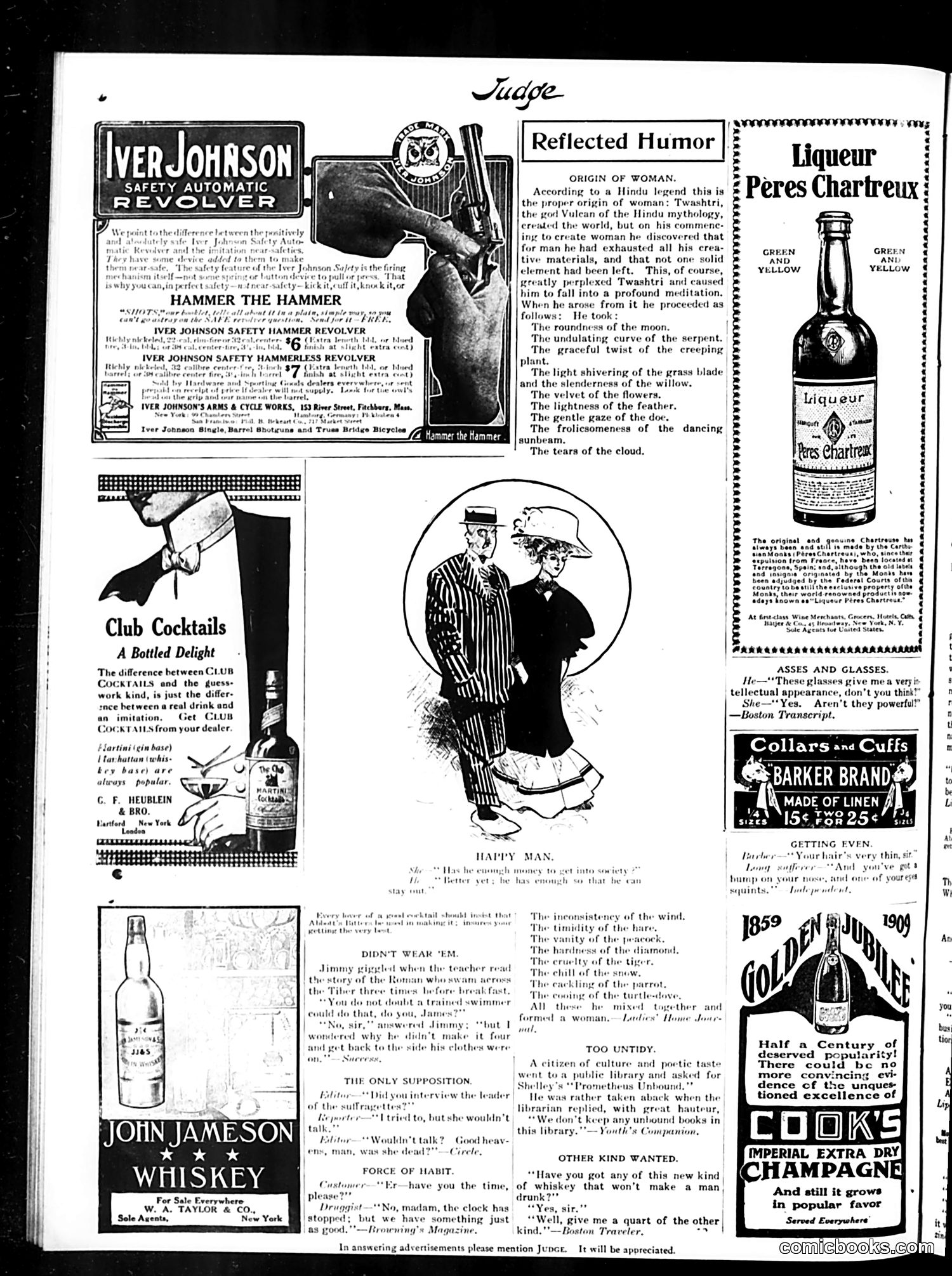
This is primarily an **advertising page** from Judge magazine (circa 1909, based on the Cook's Champagne centennial ad). The page contains multiple product advertisements with minimal editorial cartoon content. The few humor pieces present are brief anecdotes: - **"Happy Man"** jokes about courtship and marriage - **"Didn't Wear 'Em"** presents a dialogue about a swimmer avoiding glasses - **"The Only Supposition"** features a brief exchange about interviewing someone - **"Too Untidy"** satirizes a librarian's excessive focus on book condition over patron access - **"Other Kind Wanted"** is a simple joke about whiskey that won't intoxicate The advertisements include firearms (Iver Johnson revolvers), spirits (John Jameson whiskey, Cook's Champagne), cocktail mixers, and men's accessories. These products reflect upper-class Edwardian-era consumer culture. The humor and advertising together target affluent male readers interested in firearms, drinking, and social etiquette.
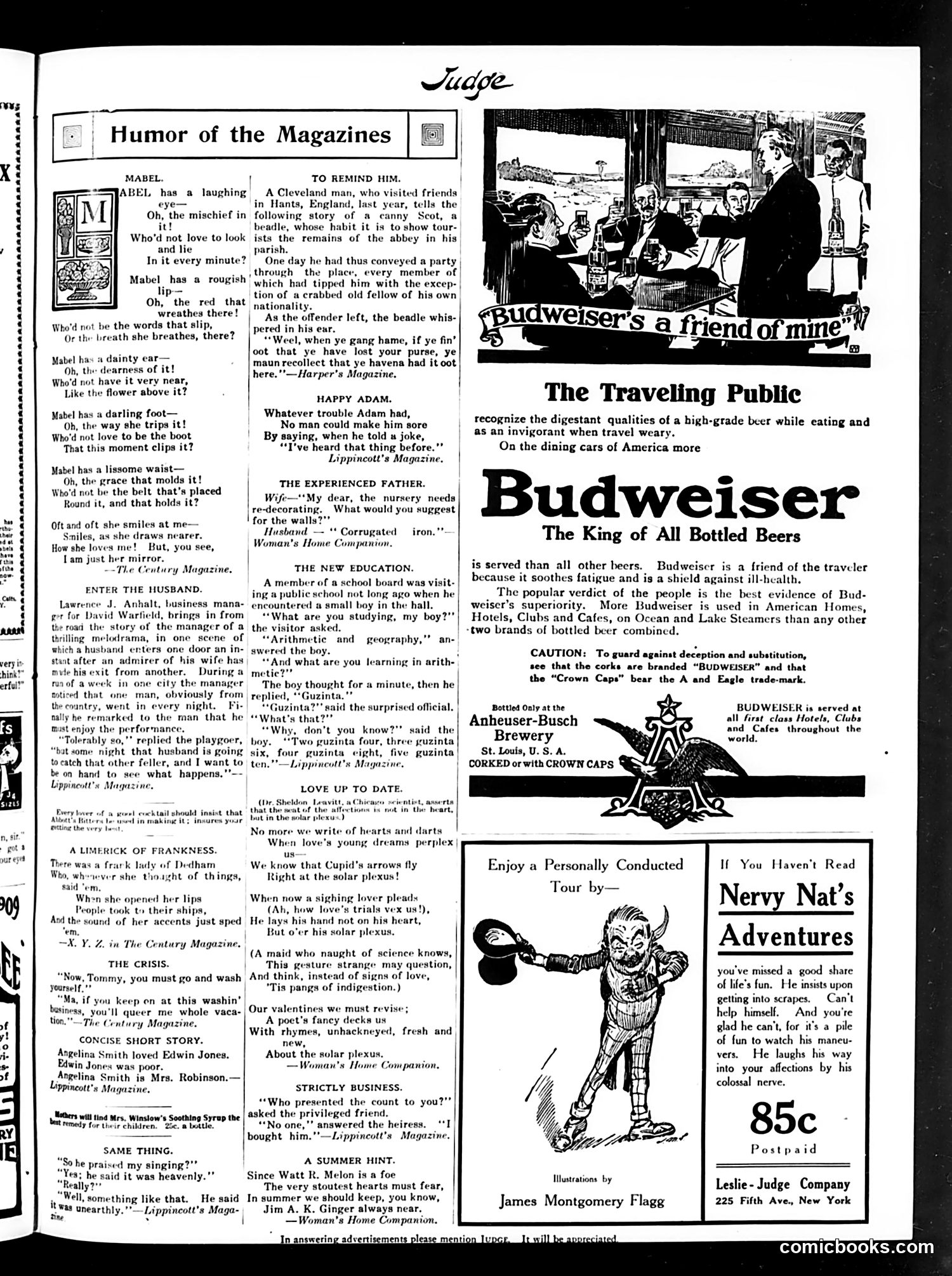
This page from *Judge* magazine consists primarily of **reprinted humor from other publications** — a common magazine feature. The content includes humorous poems, short jokes, and one-liners about relationships and domestic life. The cartoon at top right shows a **Budweiser advertisement disguised as editorial content**, depicting men in a dining car. The accompanying text promotes Budweiser as "a friend of the traveler" — standard early-20th-century beer advertising. The lower left contains **"Nervy Nat's Adventures"** — an illustrated serialized comic strip by James Montgomery Flagg featuring a mischievous character. The humor throughout reflects period preoccupations: absent-minded husbands, marriage complications, children's grammar ("How many guzinta eight?"), and gentle romantic wordplay. The tone is lighthearted domestic satire typical of family magazines of this era, with no apparent political content or sharp social criticism on this particular page.
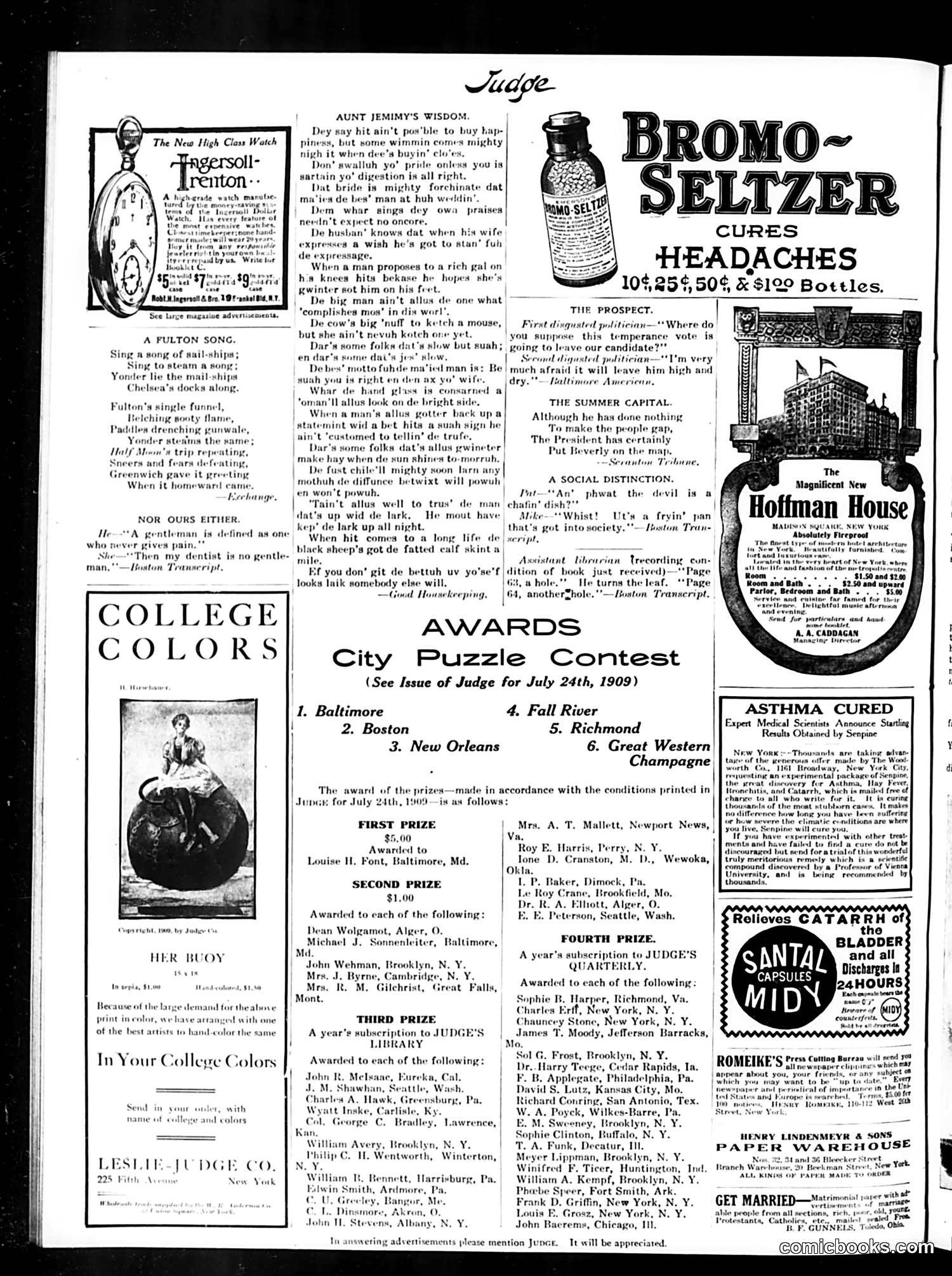
This page is primarily an **advertisement and contest results compilation** rather than satirical cartoons, though it contains brief humorous content. **Key elements:** 1. **"Aunt Jemmy's Wisdom"** — A series of folk sayings attributed to a Black female character using dialect ("ain't pos'ble," "dat bride"). This reflects early 1900s **racist stereotyping** presenting Black vernacular speech as comical homespun philosophy. The jokes themselves are mild observations about marriage and human nature. 2. **"A Fulton Song" and "Nor Ours Either"** — Brief joke items with minimal satirical content. 3. **"City Puzzle Contest" results** — The page announces winners of a puzzle contest from Judge's July 24, 1909 issue, listing prize recipients across the country. 4. **Advertisements** — For Bromo-Seltzer (headaches), Hoffman House hotel, Santal Capsules (asthma), and other products typical of the era. The page serves primarily as a **results announcement and advertising vehicle** rather than presenting political satire or commentary.
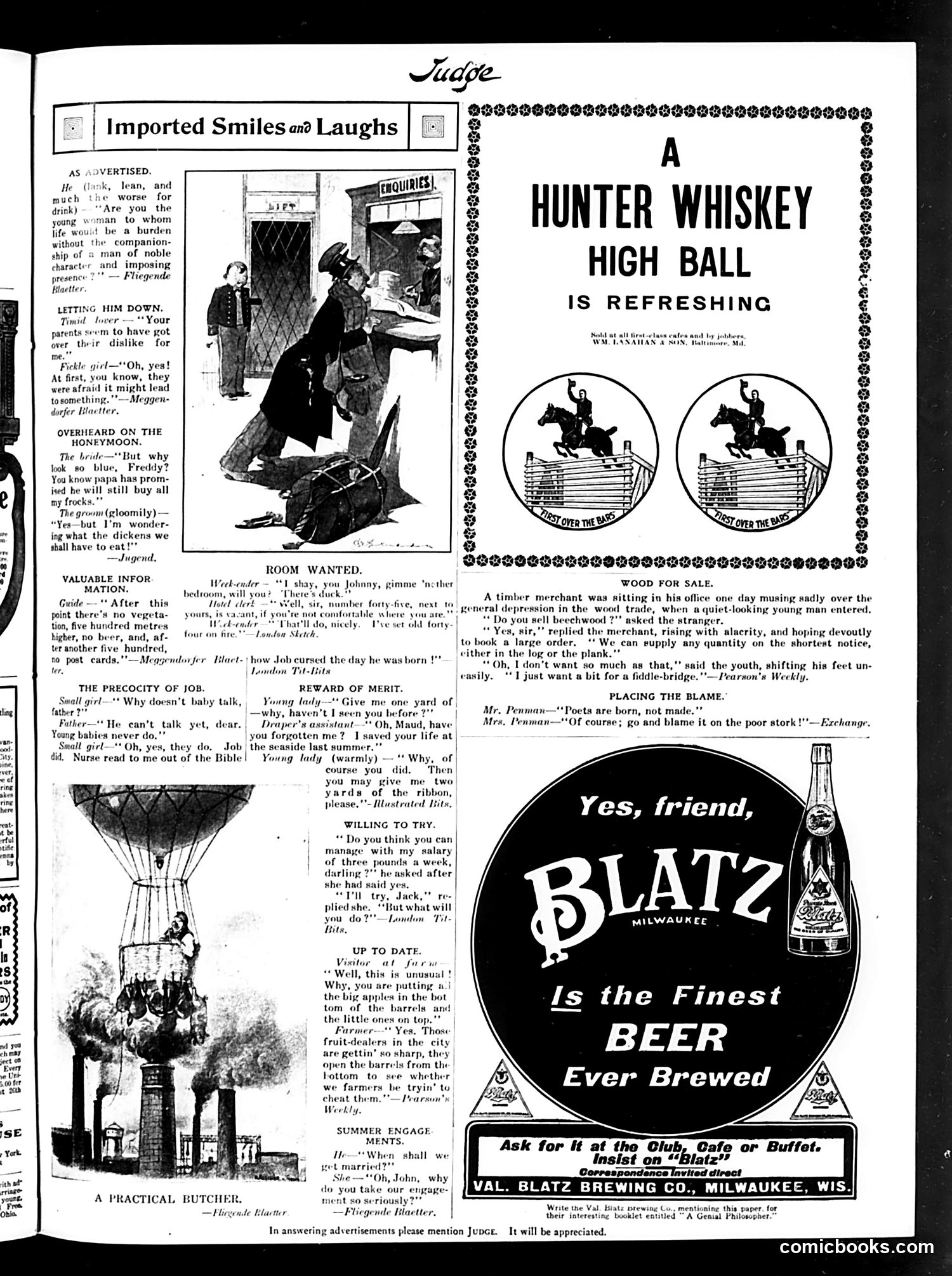
This page from *Judge* magazine consists primarily of **short humorous anecdotes and advertisements** rather than political cartoons. The content includes multiple brief comedic sketches, mostly about relationships and courtship mishaps—a drunk suitor, a fickle fiancée concerned about her trousseau, a timid lover, and newlyweds worried about finances. These reflect early 20th-century anxieties about marriage and class. The standalone stories include practical humor: a timber merchant confused when a customer requests beechwood only for a violin bridge, and a farmer's observation about fruit dealers' sharpness in business. The page is **dominated by advertisements**: Hunter Whiskey and Blatz Beer from Milwaukee are prominently featured, typical of *Judge's* revenue model. The humor is gentle and domestic rather than satirical—focused on universal comedic scenarios (marital misunderstandings, youth naiveté, business transactions) rather than political critique. The cartoons and anecdotes appear reprinted from international sources (*Fliegende Blätter*, *Pearson's Weekly*), indicating *Judge's* practice of borrowing international material.
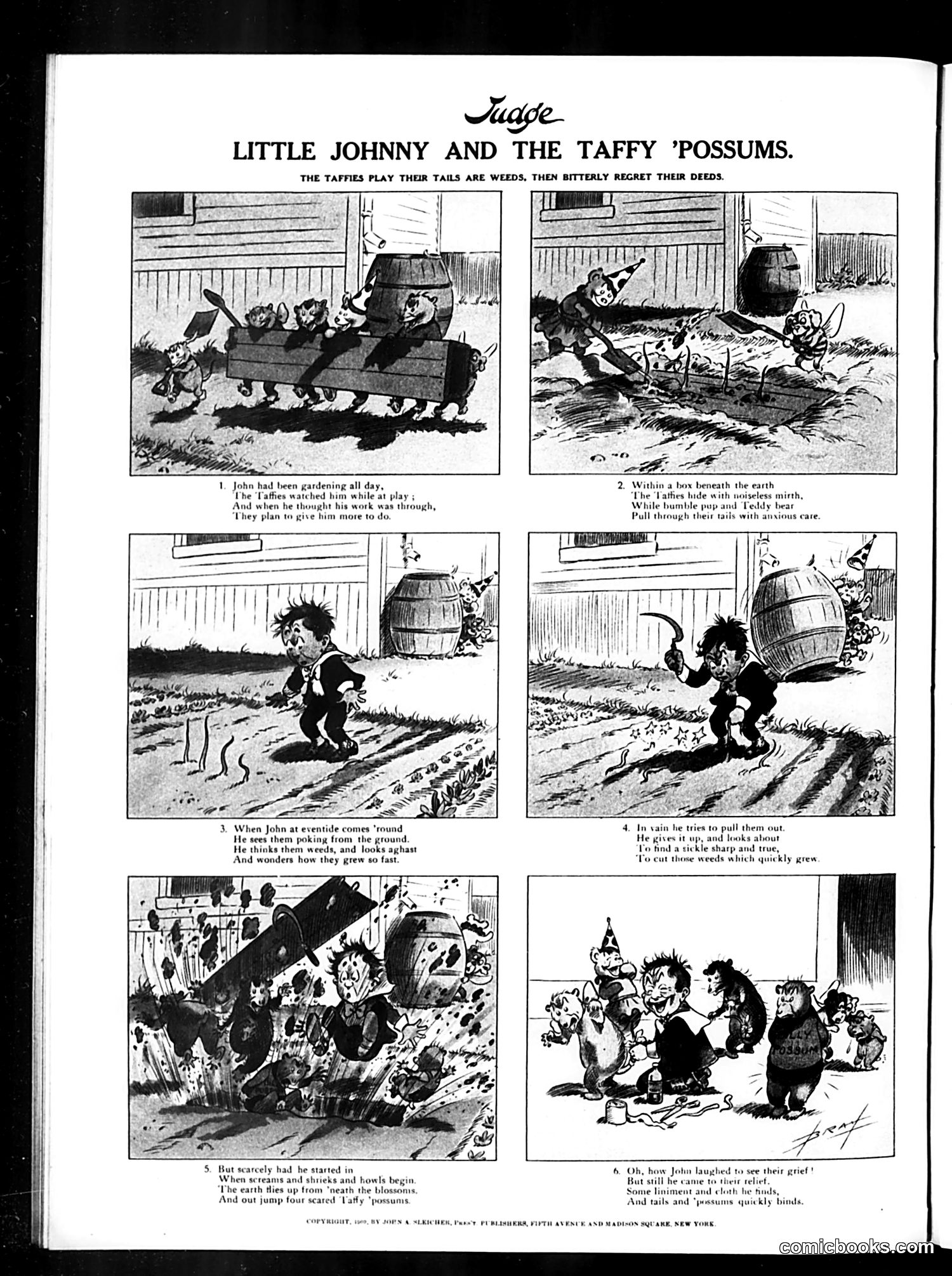
This is a children's comic story, not political satire. It depicts mischievous creatures called "Taffy 'Possums" who play a prank on a boy named John. The narrative follows: John gardens; the possums hide underground with their tails disguised as weeds; John attempts to pull out what he thinks are weeds; the possums emerge with screams and chaos; finally, John laughs at their misadventure and the possums regret their trick. The humor relies on wordplay ("Taffies" for taffy-colored possums), visual gags (mistaking tails for plants), and a moral lesson about pranks backfiring. This appears to be light family entertainment from Judge magazine's 1909 copyright. The anthropomorphic animals and whimsical plot are typical of early 20th-century children's comics, with no evident political commentary or social critique.