
A complete issue · 16 pages · 1909
Judge — August 21, 1909
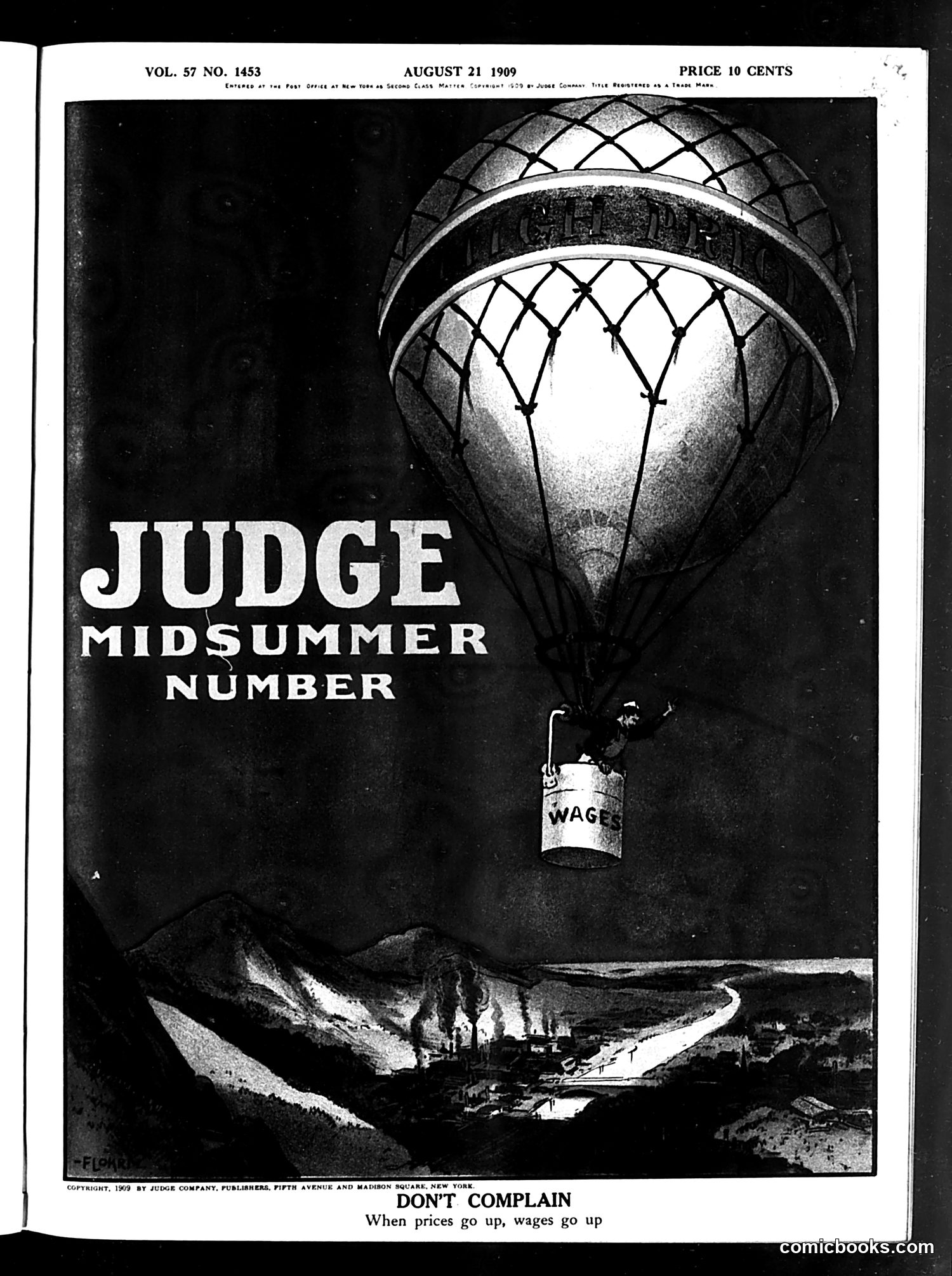
This is the **Midsummer Number** (August 21, 1909) of Judge magazine, priced at 10 cents. The cover features a hot-air balloon labeled "WAGES" floating above a landscape. The satirical message below reads: "DON'T COMPLAIN / When prices go up, wages go up." The cartoon's meaning is sarcastic—it critiques the gap between rising prices and stagnant worker wages during this period of economic inflation. The balloon image suggests wages are ethereal and rising only in appearance, not substance. Workers are being told not to complain about inflation, yet their actual purchasing power hasn't kept pace. This reflects genuine labor tensions of the early 20th century, when workers faced cost-of-living increases while real wage growth lagged.
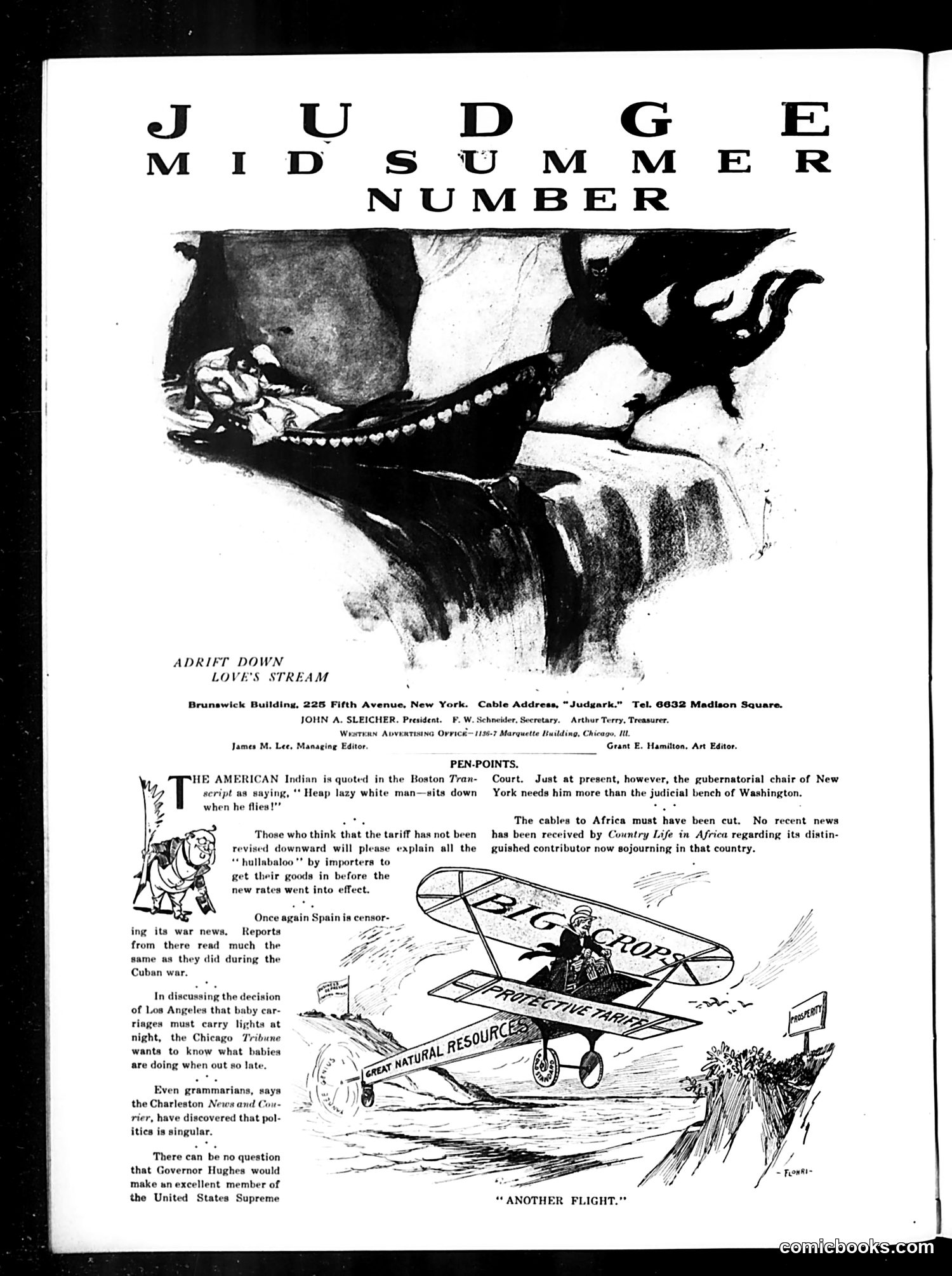
This satirical magazine page contains two political cartoons: **Top cartoon ("Adrift Down Love's Stream")**: Shows a couple in a gondola being crushed beneath an enormous foot—likely satirizing romantic entanglement's destructive power or a specific scandal. **Bottom cartoon ("Another Flight")**: Depicts an airplane labeled "Great Natural Resources" and "Profiteering" crashing or malfunctioning, with a figure falling. This appears to criticize war profiteering or excessive corporate exploitation of national resources during a period of conflict (likely WWI-era, given the aviation imagery). The "Pen-Points" section critiques various political figures and policies, including references to tariff debates, Spanish censorship, and gubernatorial decisions. The overall page satirizes governmental incompetence and corporate excess typical of early 20th-century Judge magazine editorial commentary.
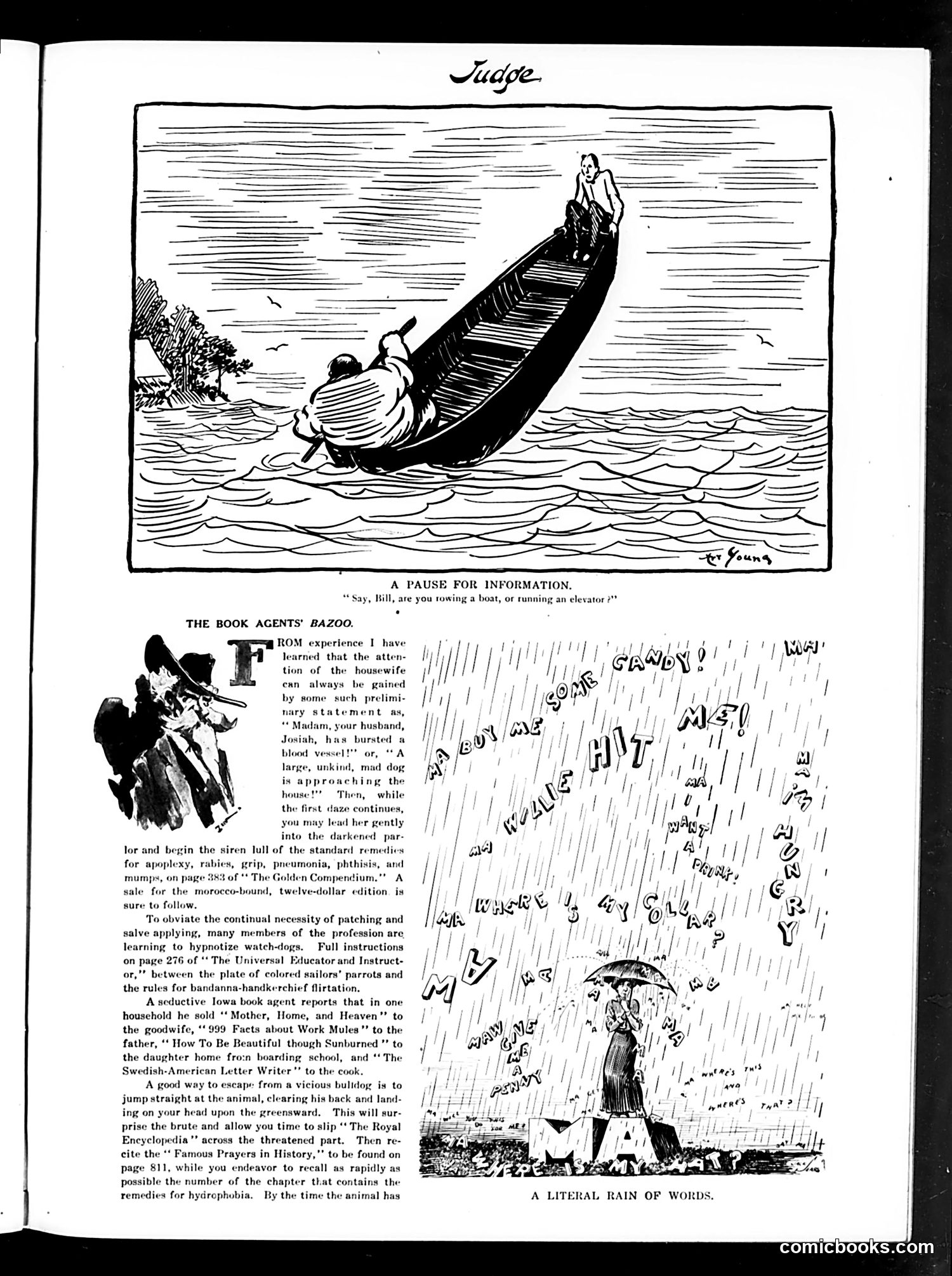
**Top Cartoon ("A Pause for Information"):** A man in a gondola asks his gondolier: "Say, Bill, are you towing a boat, or running an elevator?" The joke satirizes the gondolier's steep angle—he's nearly vertical in the water. This likely mocks either Venice's canal conditions or a specific contemporary incident involving gondolas. **Bottom Section ("The Book Agents' Bazoo"):** This is primarily **advertising copy** for books, not political satire. It discusses household books like "Mother, Home, and Heaven" and remedies for various ailments. The right-side illustration ("A Literal Rain of Words") shows words literally falling like rain on a person, mocking the excessive promotional language typical of book-selling advertisements of the era. The page is mainly commercial rather than politically satirical.
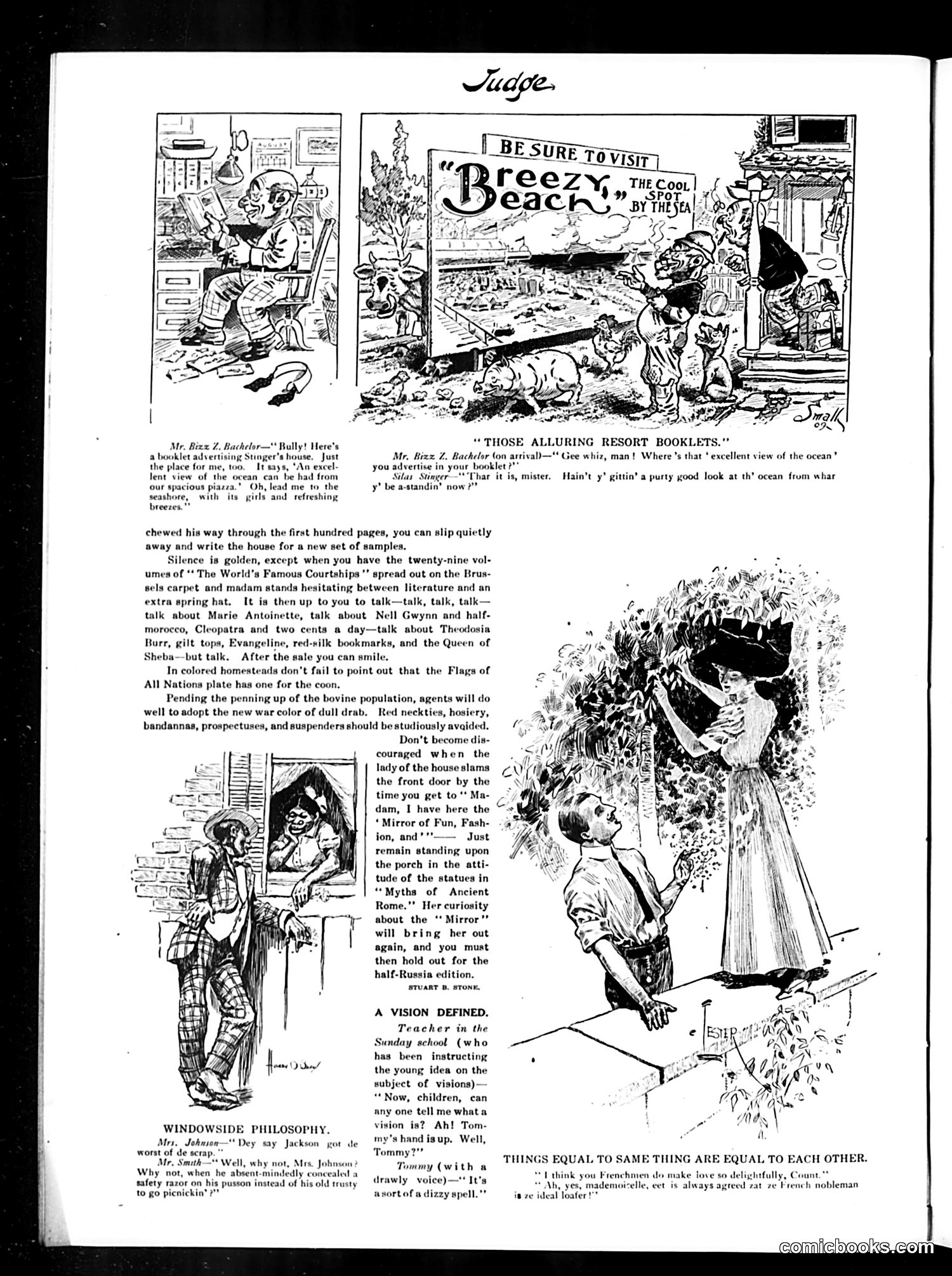
This page contains several satirical cartoons and text pieces typical of Judge's early 20th-century humor: **"Breezy Beach" Advertisement**: A mock travel advertisement satirizing resort promotions, showing chaotic beach scenes contradicting the "cool place by the sea" marketing claim. **"Windowside Philosophy"**: A domestic joke about a couple's differing views on picnicking—the wife wanting safety, the husband dismissing her concerns. **"A Vision Defined"**: A teacher-student exchange where a child misunderstands "vision" as a magical spell rather than abstract imagination. **"Things Equal to Same Thing"**: A brief logic joke about romantic equality. The page mixes advertisements, domestic humor, and educational satire—typical Judge content targeting middle-class readers through relatable scenarios and wordplay rather than explicit political commentary.
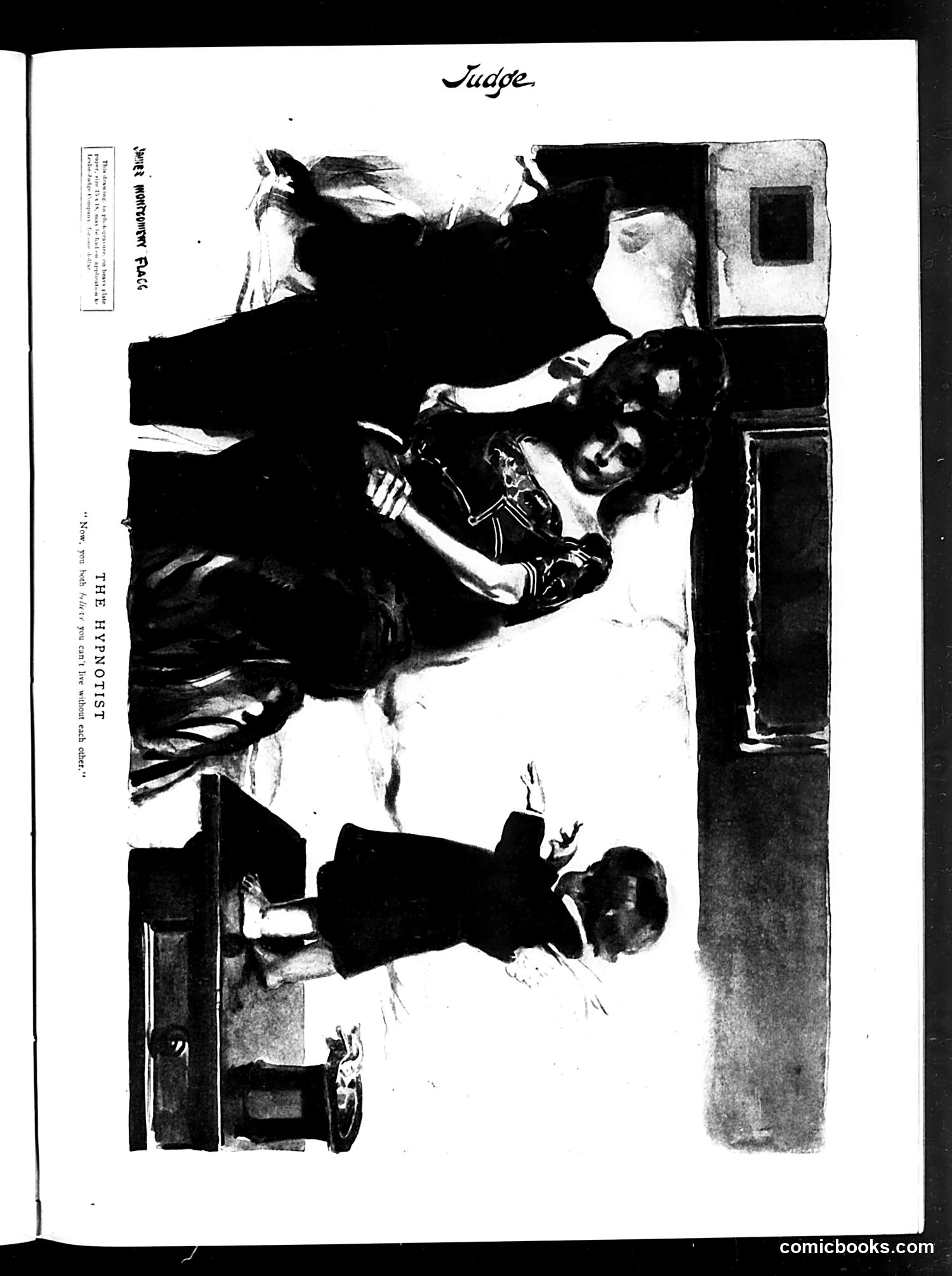
This page appears to be from Judge magazine's satirical content section, though the image quality and rotation make specific details difficult to discern with certainty. The OCR text references "The Hypocrite" and mentions "Back," suggesting political commentary on hypocrisy—a common Judge theme. The black and white illustration appears to show figures in an interior setting, likely depicting a social or political scenario meant to expose contradictory behavior. Without clearer visibility of identifying details or captions, I cannot confidently identify the specific figures or reference the particular political event or public figure being satirized. To accurately explain this cartoon's meaning would require either higher image resolution or additional contextual information about Judge's publication date and contemporary issues.
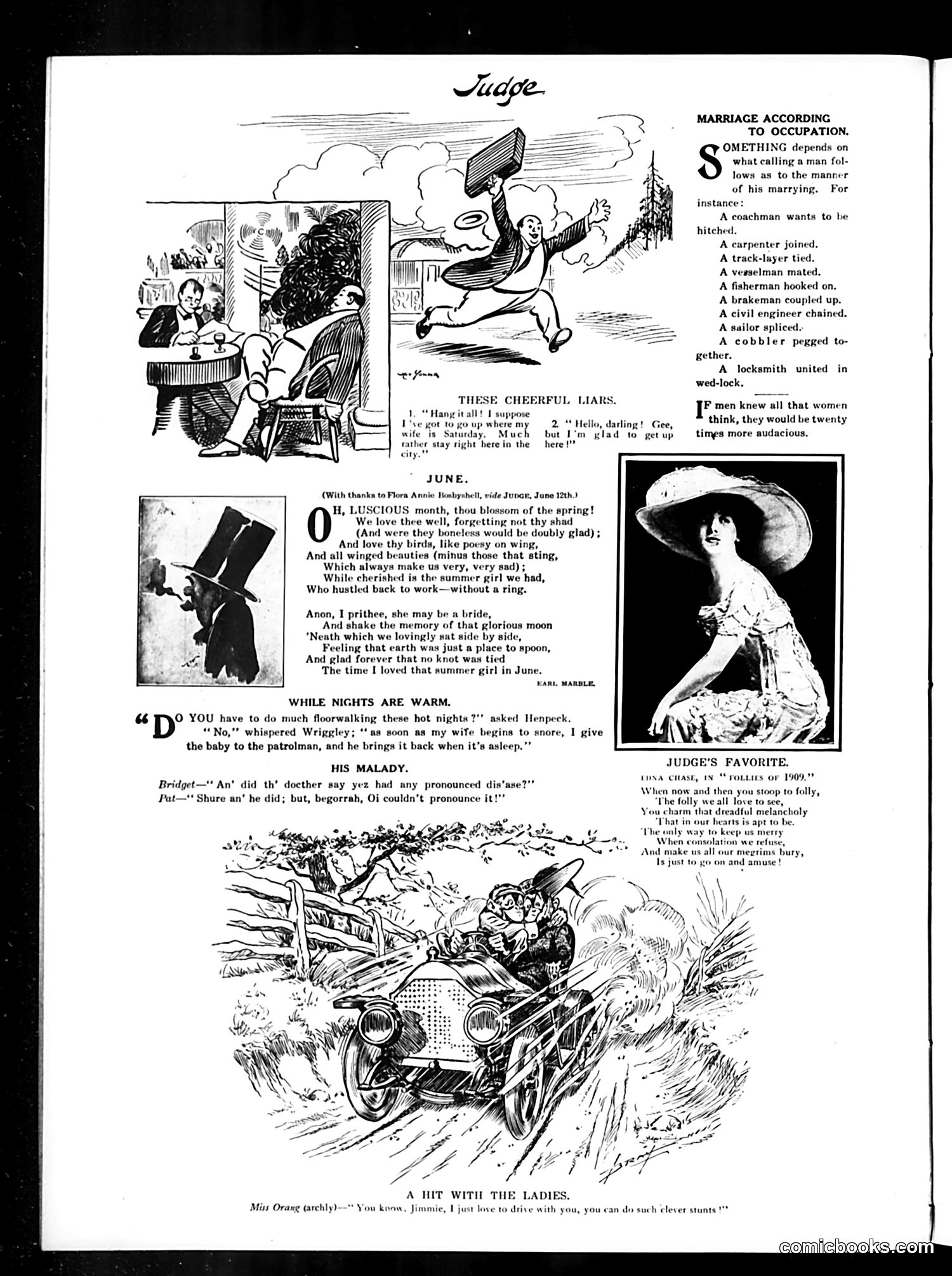
This page from Judge (circa 1909) contains several humorous sketches mocking social customs and gender relations: **"Marriage According to Occupation"** presents a punning list where professions determine marriage terminology—coachmen get "hitched," carpenters "joined," sailors "spliced," etc. The joke relies on occupational jargon applied literally to matrimony. **"These Cheerful Liars"** shows men making excuses to avoid domestic responsibilities—one claims work keeps him out Saturday nights; another avoids floorwalking by giving the baby to a patrolman once his wife snores. **"His Malady"** is an ethnic-dialect joke where an Irish woman (Bridget) mangles "pronounced disease" she can't pronounce herself. **"A Hit with the Ladies"** depicts an early automobile scene where a woman enjoys a reckless male driver's "clever stunts." The page's theme: men evading responsibility through deception, while simultaneously mocking working-class speech and celebrating masculine recklessness. The era's casual misogyny and class stereotyping are evident throughout.
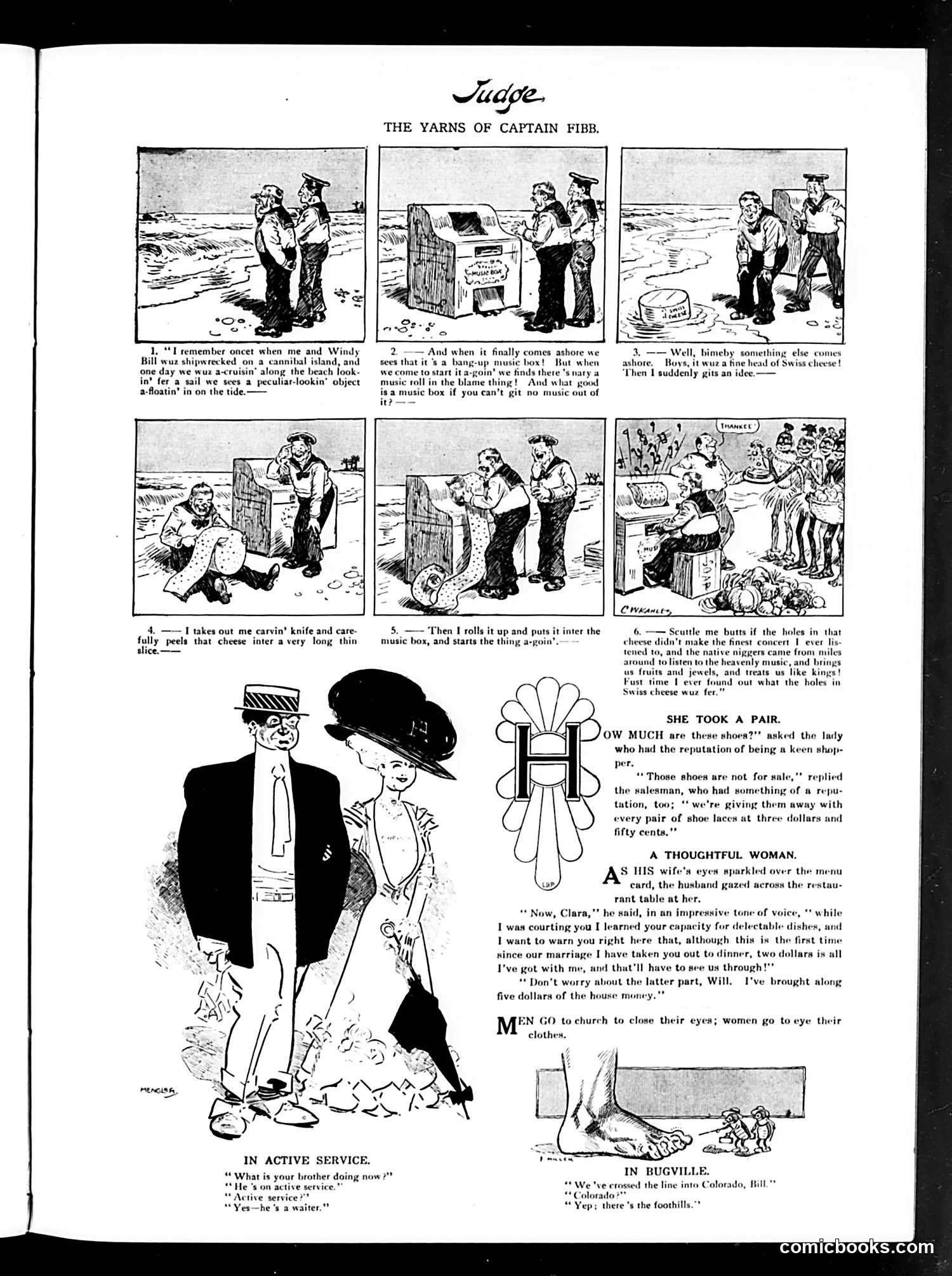
This page presents humorous tall tales told by a boastful sea captain. The main comic strip (panels 1-6) features Captain Fibb recounting an absurd adventure: he and a companion find a floating Swiss cheese, carve it into a musical roll, insert it into a music box, and the resulting "music" attracts native peoples who treat them like royalty. The satire mocks **exaggerated storytelling** and the gullibility of listeners. The joke plays on the absurdity of Swiss cheese's holes being "musical" and natives finding this noise enchanting—poking fun at both boastful seafarers and period-typical racial stereotypes. Additional short jokes on the page satirize **domestic life** (a husband's stinginess countered by his wife's resourcefulness) and **class pretension** (a shoe salesman's marketing gimmick). The "Active Service" joke conflates military service with waiter work, mocking working-class employment euphemisms. The content reflects early 20th-century Judge magazine's brand of genteel satire targeting social pretension and male boastfulness.
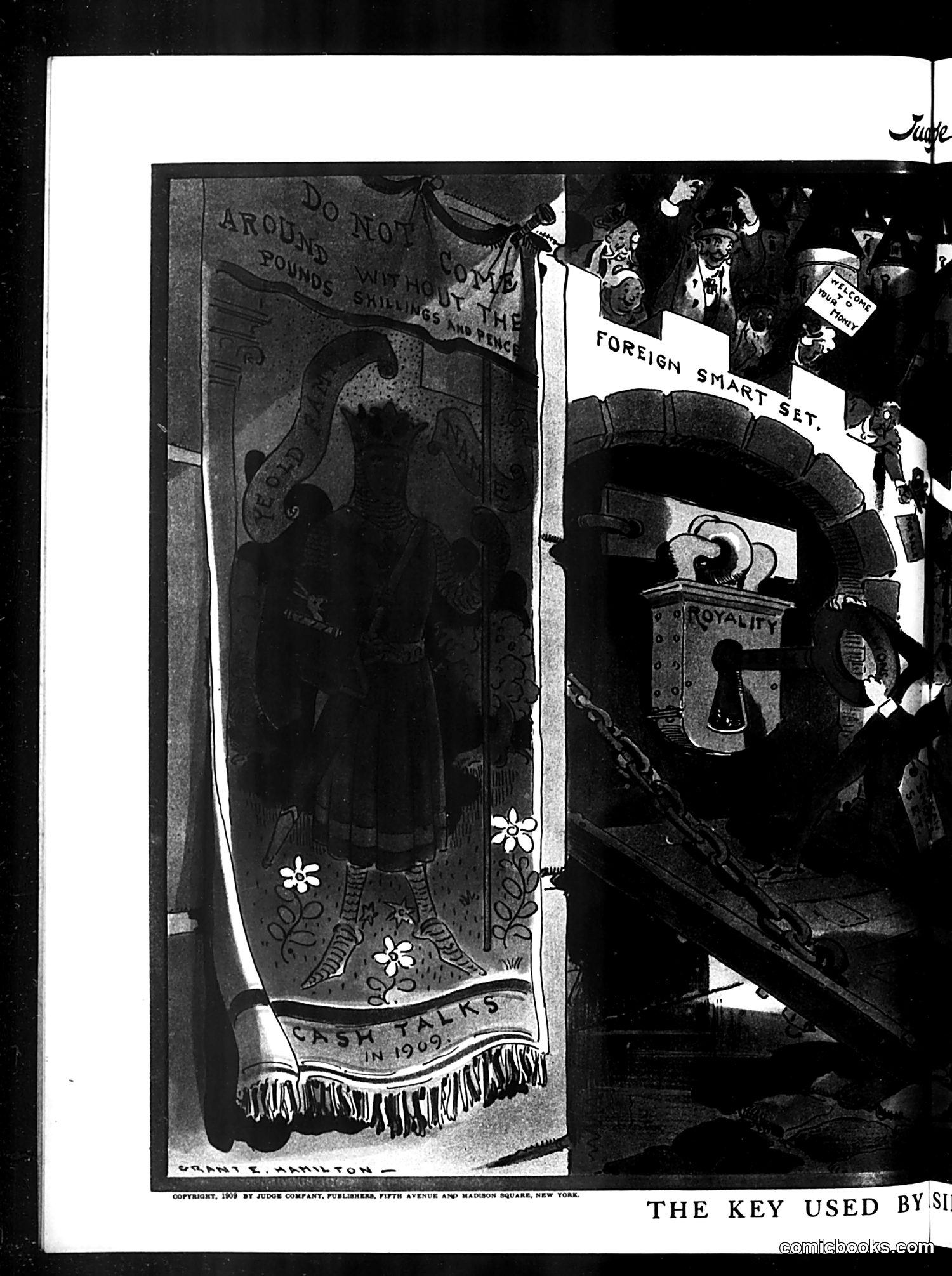
This appears to be a satirical political cartoon from Judge magazine (copyright 1908). The left panel shows a decorative banner or tapestry labeled "CASSTALKS" (dated 1909) depicting figures in formal dress. The right panel, titled "FOREIGN SMART SET," shows caricatured aristocratic figures gathered around what appears to be a box or platform labeled "ROYALTY," with a visible sign reading "DO NOT." The satire seems to mock European aristocratic pretension and foreign upper-class society, suggesting they treat royalty as a curiosity or spectacle ("Do Not" [Touch?]). The juxtaposition and the "smart set" label indicate ridicule of wealthy socialites imitating continental fashions and manners. Without clearer visibility of all text, the specific political figures or events referenced remain partially unclear.
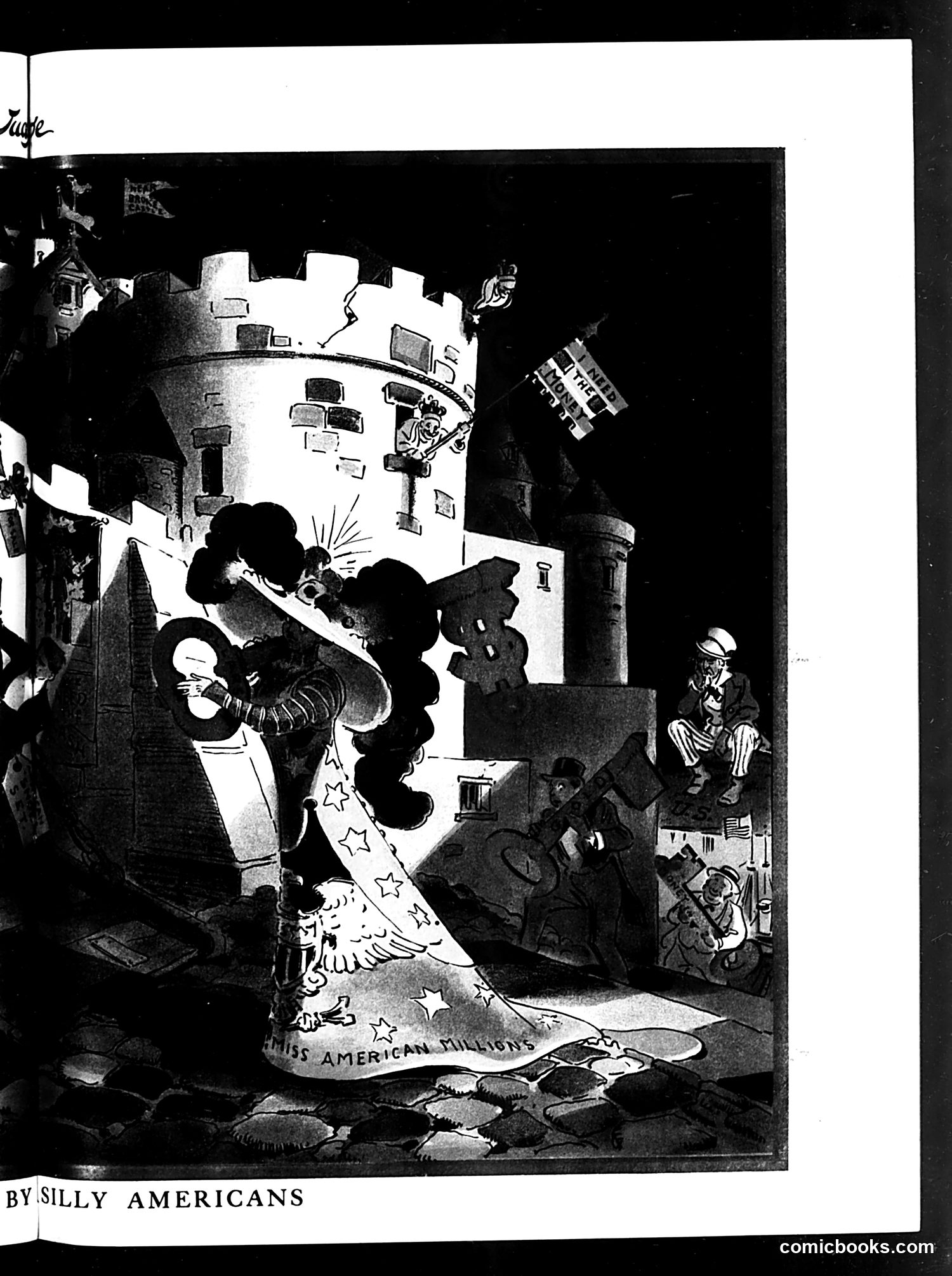
This political cartoon satirizes American intervention or military involvement abroad. The central image shows a fortified castle tower being assaulted by caricatured American soldiers climbing its walls. The banner reads "MISS AMERICAN MILLIONS," suggesting that American wealth is being squandered or misused in foreign military adventures. The "silly Americans" title indicates self-criticism—the cartoon mocks Americans for wasteful foreign spending or military overreach. The medieval castle setting appears deliberately anachronistic, possibly mocking the outdated nature of such conflicts or interventions. Without a specific date visible, the exact historical context remains unclear, though Judge magazine's satirical approach suggests this critiques contemporary American foreign policy decisions that the cartoonist viewed as foolish or financially irresponsible.
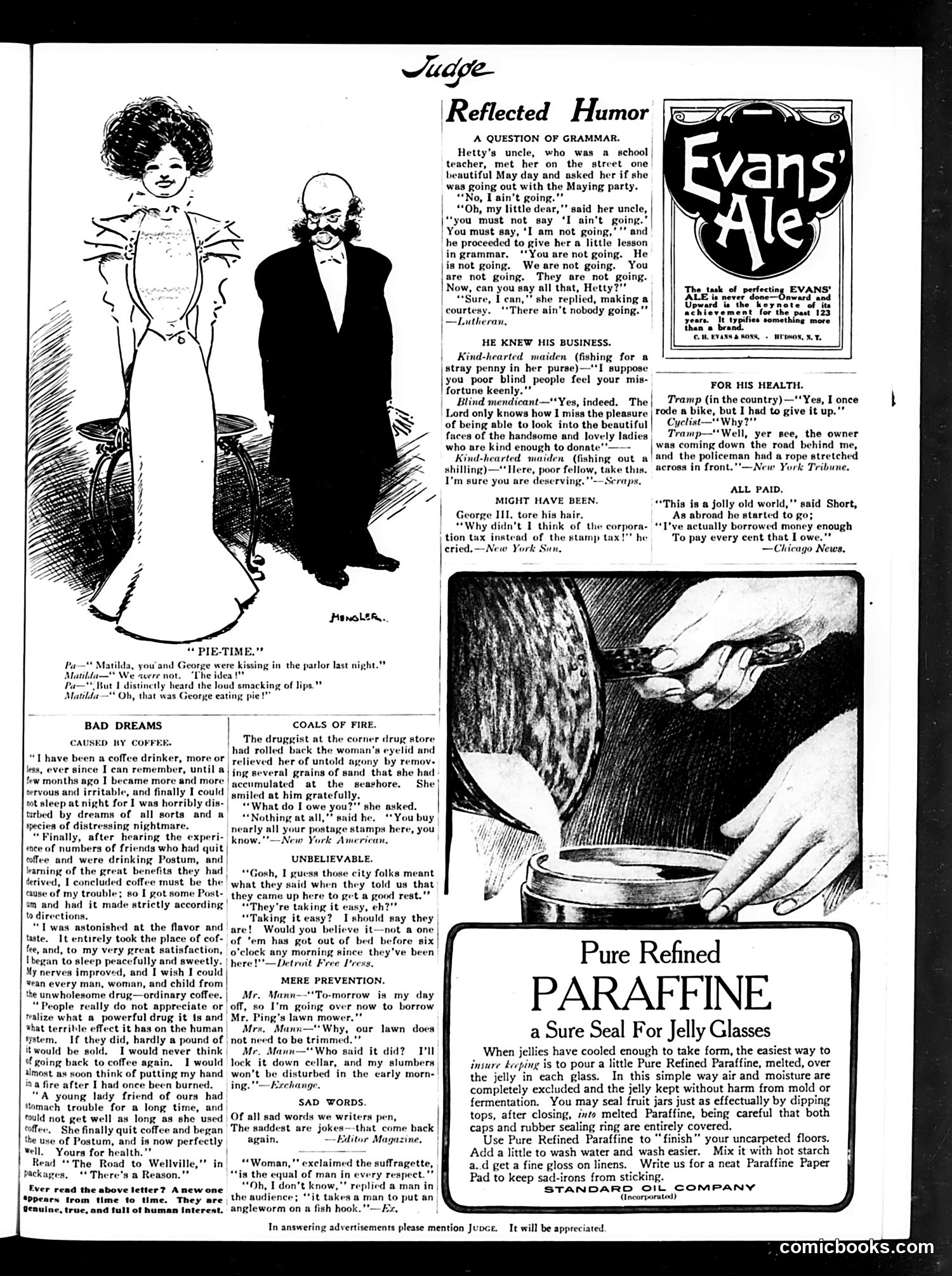
This page collects brief humorous anecdotes typical of Judge's "Reflected Humor" section. The main cartoon shows a rotund gentleman and a thin, stern-faced man (likely meant to represent contrasting personality types) with the caption "Pie-Time," depicting a domestic quarrel where a wife claims her husband was eating pie rather than kissing in the parlor. The surrounding jokes mock everyday situations: a schoolteacher's student who defeats his grammar lesson with impeccable logic ("There ain't nobody going"); a blind beggar who cynically admits missing beautiful women rather than sight itself; and various other observations about human nature. The humor relies on wordplay, irony, and mild social commentary typical of early-20th-century American satire—poking fun at pretension, vanity, and human contradiction without targeting specific political figures or events.
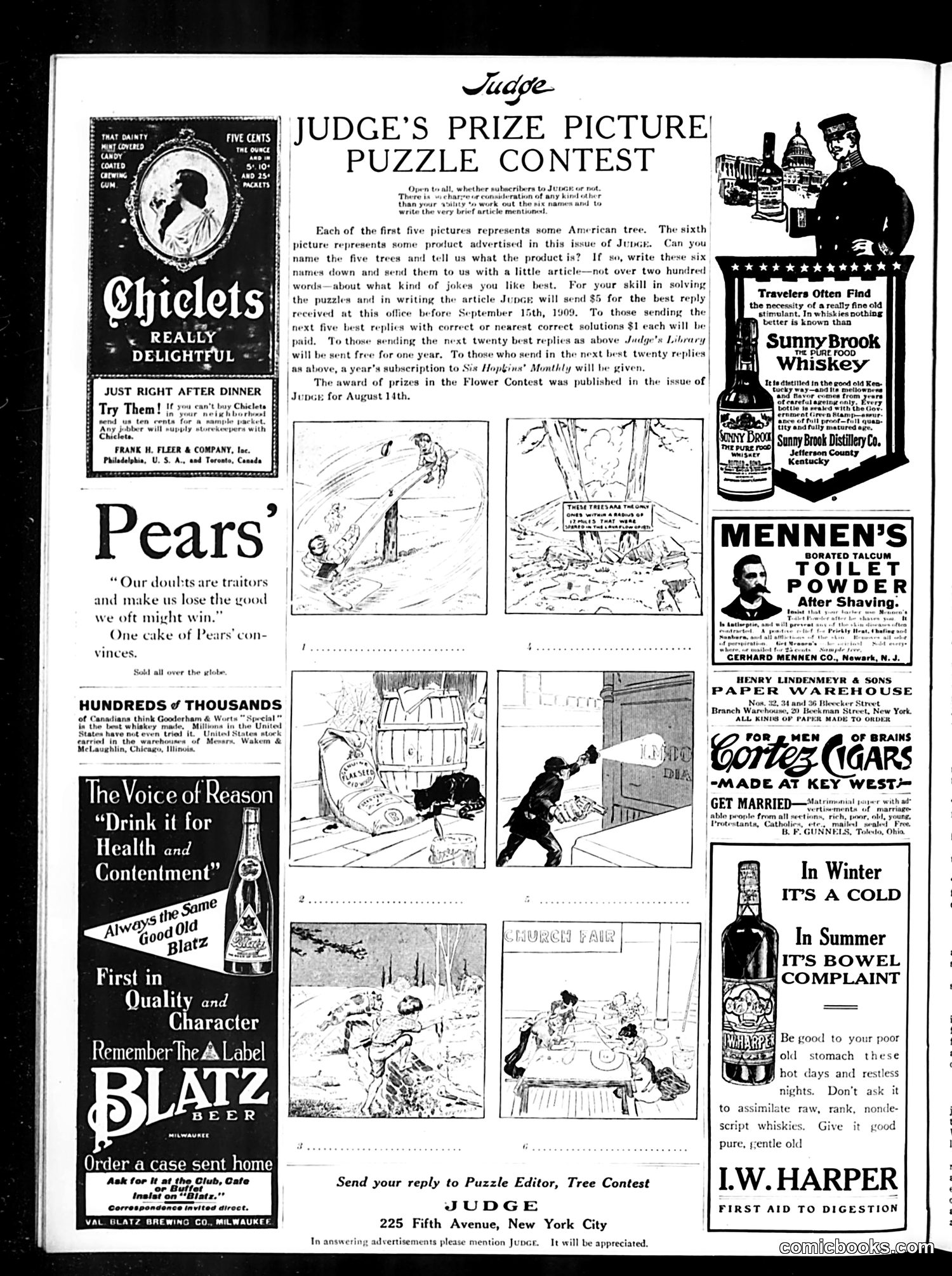
This page features an interactive puzzle contest for Judge magazine readers. Six cartoon panels depict American trees (first five) and an advertised product (sixth). Readers must identify all six subjects and submit their answers by September 15th, 1909 for prizes. The contest offers graduated rewards: $5 for the best correct answer, smaller prizes for next-best entries, plus free subscriptions to Judge and *Six Hopkins' Monthly* magazine. This represents the magazine's common practice of engaging readers through participation contests. The page is otherwise dominated by period advertisements—Chiclets gum, Pears' soap, Blatz beer, Sunny Brook whiskey, Mennen's talc powder, Cortez cigars, and I.W. Harper digestive tonic—typical commercial content that subsidized American magazines of this era. The puzzle itself serves as advertising vehicle while entertaining subscribers.
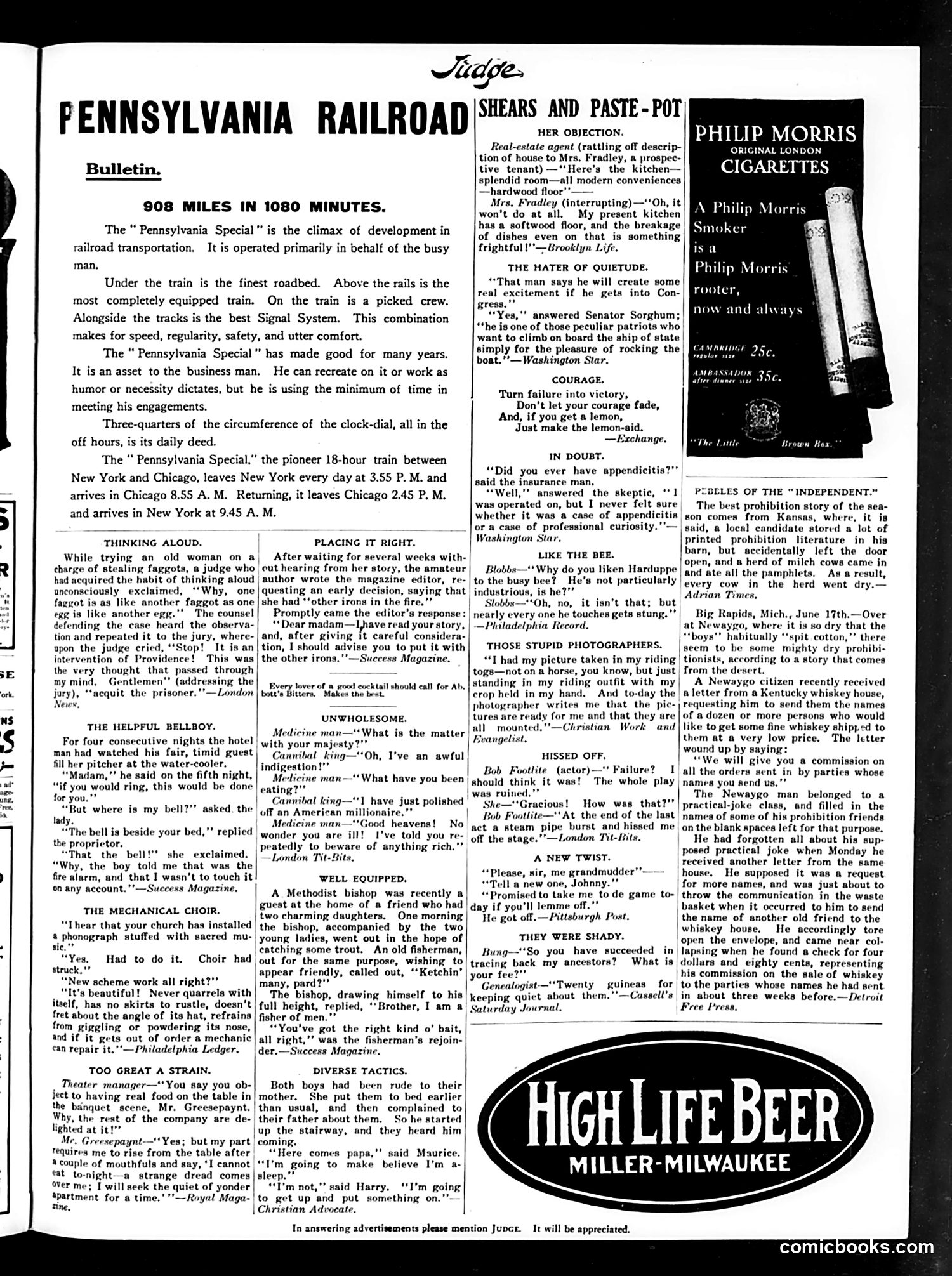
This page is primarily a **bulletin advertising the Pennsylvania Railroad's "Pennsylvania Special"** train service between New York and Chicago, which completes the 908-mile journey in 1,080 minutes (18 hours). The rest of the page contains typical **Judge magazine humor columns**—short comedic anecdotes poking fun at everyday situations: a judge's unconscious bias helping a defendant, a confused hotel guest mistaking a fire alarm for a bell, a church installing a phonograph choir, and theatrical absurdities. The only potentially political/social satire appears in the "Unwholesome" section, which uses a tired **"cannibal" stereotype joke** about a "Cannibal king" with indigestion from eating an American millionaire—commentary suggesting American businessmen are somehow consumable or distasteful, though this is crude period humor rather than sophisticated satire. The page also includes **period advertisements** for Philip Morris cigarettes and High Life Beer, indicating this is a commercial publication. Overall, it's a mix of railroad promotion and light entertainment typical of early 20th-century American magazines.
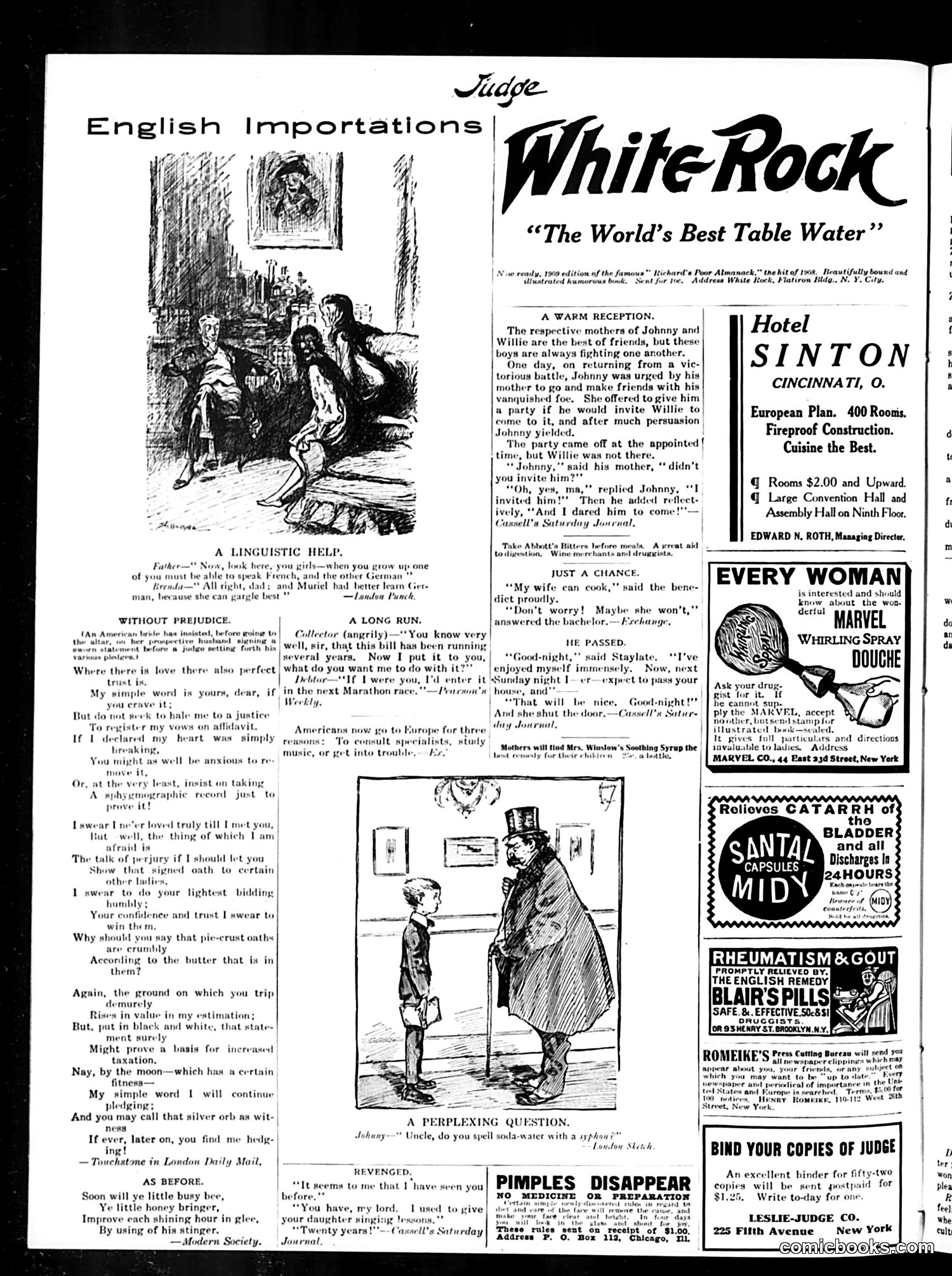
This page from Judge magazine (circa 1909) contains satirical poetry and humorous prose pieces typical of the era's wit-based humor: **"A Linguistic Help"** mocks upper-class pretension about speaking French, suggesting that wealthy fathers struggle with the language. **"Without Prejudice"** satirizes the contradiction between romantic oath-taking and legal liability—a gentleman worries that love vows, if documented, could be used against him for perjury, playing on Victorian anxieties about written commitments. **"A Warm Reception"** depicts class consciousness: a boy rejects his rival's party invitation, implying social snobbishness among children mirroring their parents' attitudes. The remaining pieces ("Just a Chance," "A Long Run," "He Passed," "A Perplexing Question") are brief joke vignettes about cooking, debt collection, and children's innocent questions. The page is predominantly **advertisements** for patent medicines, hotels, and services—typical of Judge's revenue model. The satirical content serves as filler between commercial pitches targeting contemporary readers.
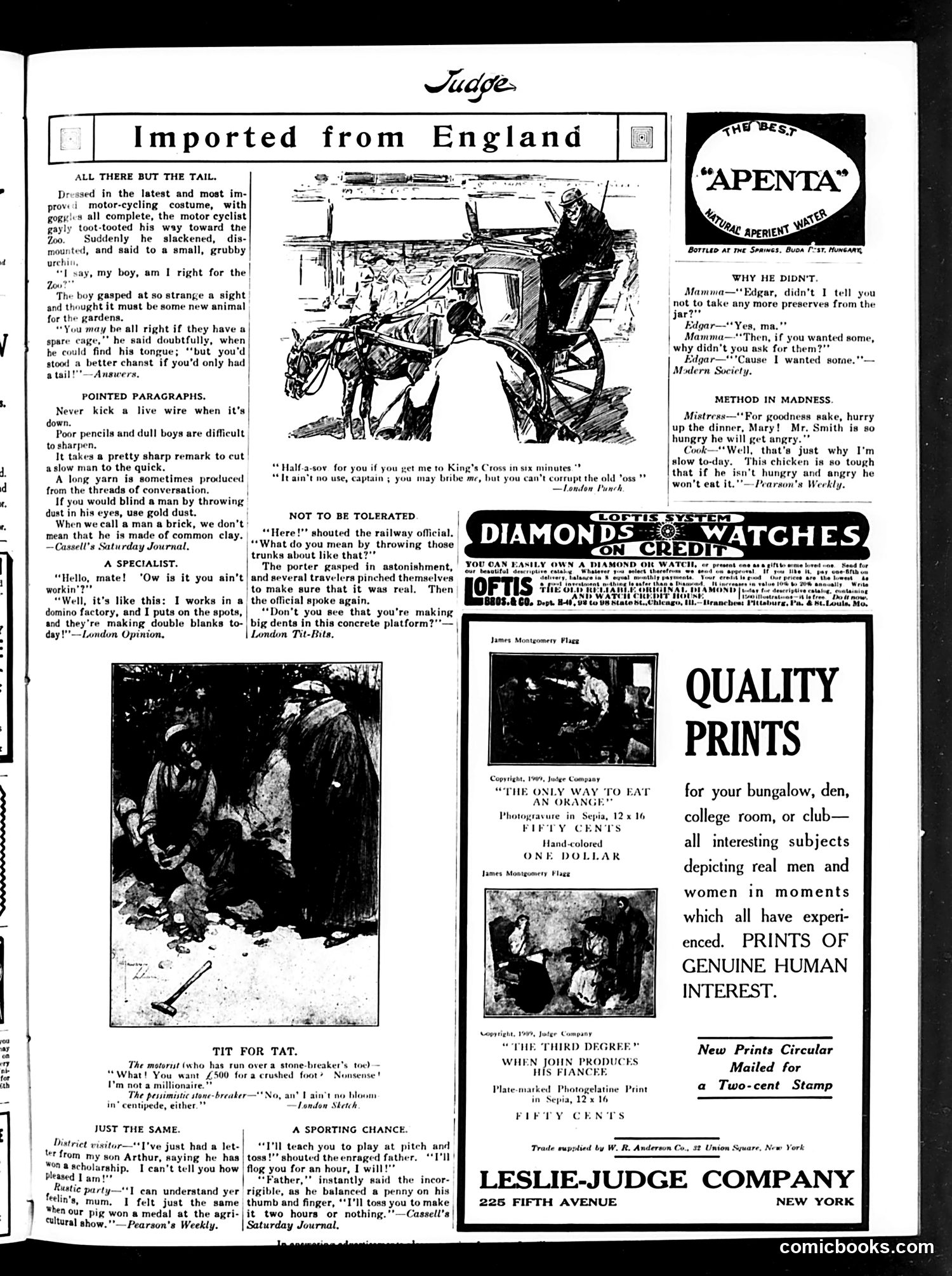
This page from *Judge* contains multiple brief humorous anecdotes and advertisements, rather than a single unified cartoon. The content reflects early 20th-century British and American social humor. **Main content**: Short comedic stories about class differences and social awkwardness. "All There But the Tail" depicts a motor-cyclist (a new, leisure-class activity) asking a street urchin for directions to the Zoo; the boy suggests he'd fit right in—as an animal lacking only a tail. The satire targets the pretension of the newly motorized upper classes. Other pieces mock domestic servants, railway workers, children's disobedience, and marital dynamics. "Not To Be Tolerated" satirizes a railway official rebuking a porter for damaging concrete with trunks—absurd priorities. **Context for modern readers**: These reflect a class-conscious society where motorists were novel curiosities, working-class characters spoke dialect, and humor relied heavily on hierarchy and social transgression. The magazine's audience was educated, urban, and amused by "types" rather than individuals.
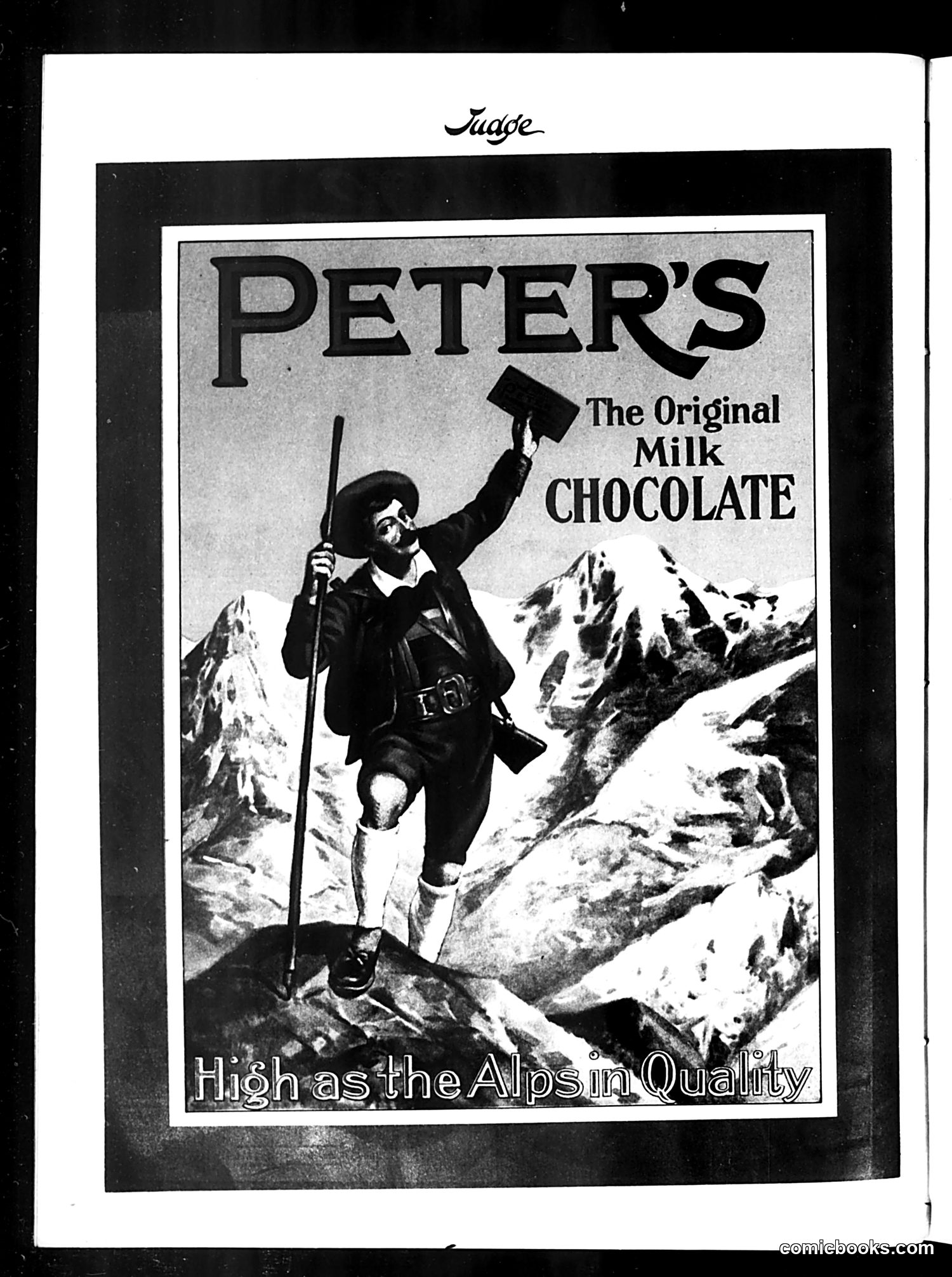
This is a **Peter's Milk Chocolate advertisement**, not political satire. The page shows a mountaineer in Alpine gear triumphantly planting a flag atop a snow-covered peak, with the tagline "High as the Alps in Quality." The imagery uses mountaineering—a popular early 20th-century adventure narrative—to convey premium quality. The climber's conquest of difficult terrain metaphorically represents the product's superior achievement. This was standard advertising rhetoric of the era, equating physical excellence and triumph with product superiority. There is no political cartoon or satire present. Judge, while primarily a satirical magazine, ran advertisements to support publication costs. This is purely a commercial message using romantic adventure imagery to appeal to consumers.