
A complete issue · 16 pages · 1909
Judge — July 24, 1909
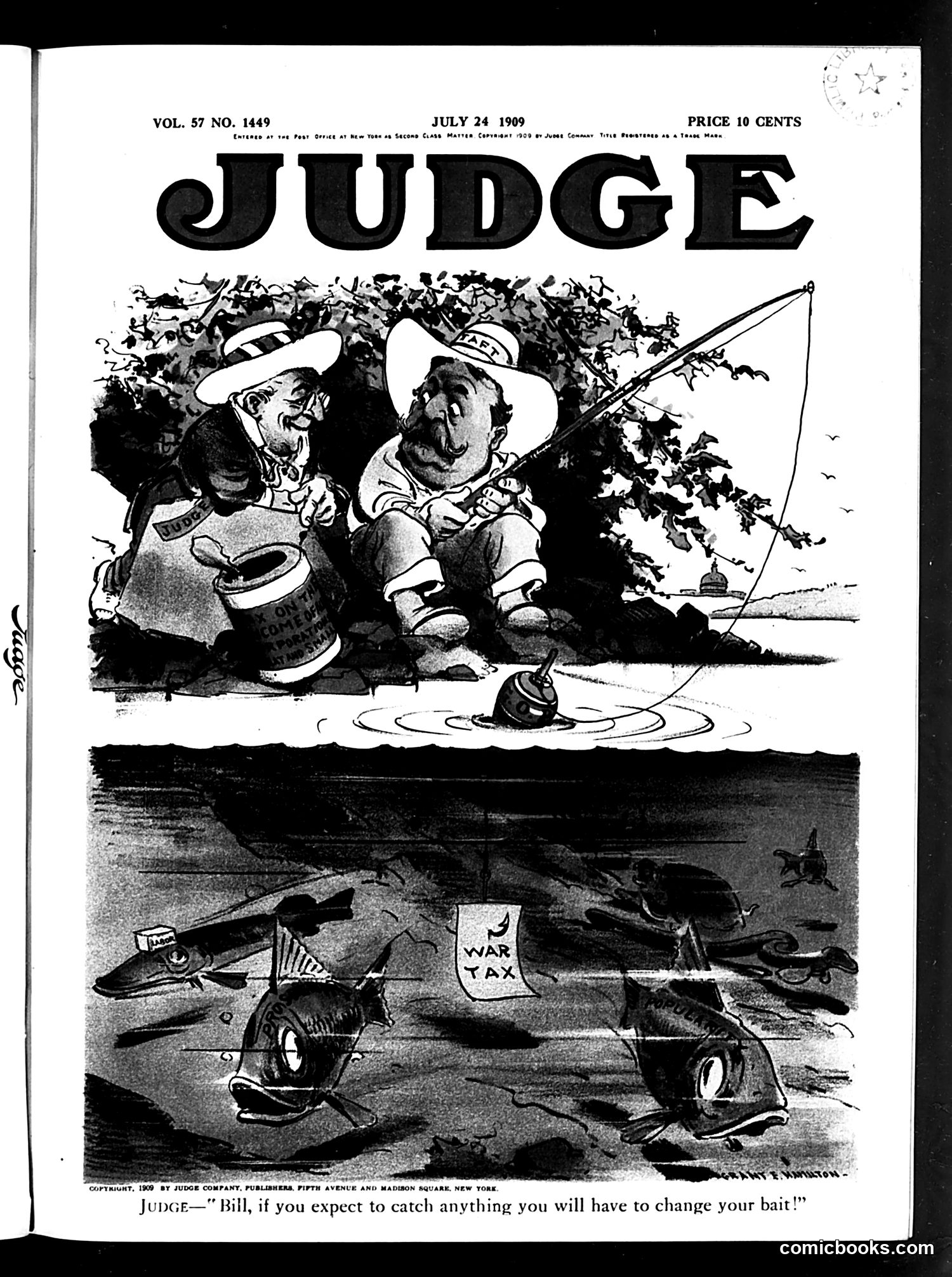
This is a two-panel political cartoon addressing international conflict. The top panel shows two figures in cowboy hats fishing peacefully together, suggesting diplomatic relations or truce. The bottom panel depicts underwater warfare—submarines, mines, and military equipment marked with a "WAR" shield, representing hidden military buildup and escalating tensions beneath the surface of apparent peace. The caption reads: "Bill, if you expect to catch anything you will have to change your bait!" The satire suggests that while nations publicly maintain friendly relations (the fishing scene), military preparation and weaponry secretly accumulate below. The joke implies that peaceful gestures won't succeed unless underlying conditions—the "bait"—change. This likely reflects early-1900s international tensions preceding World War I.
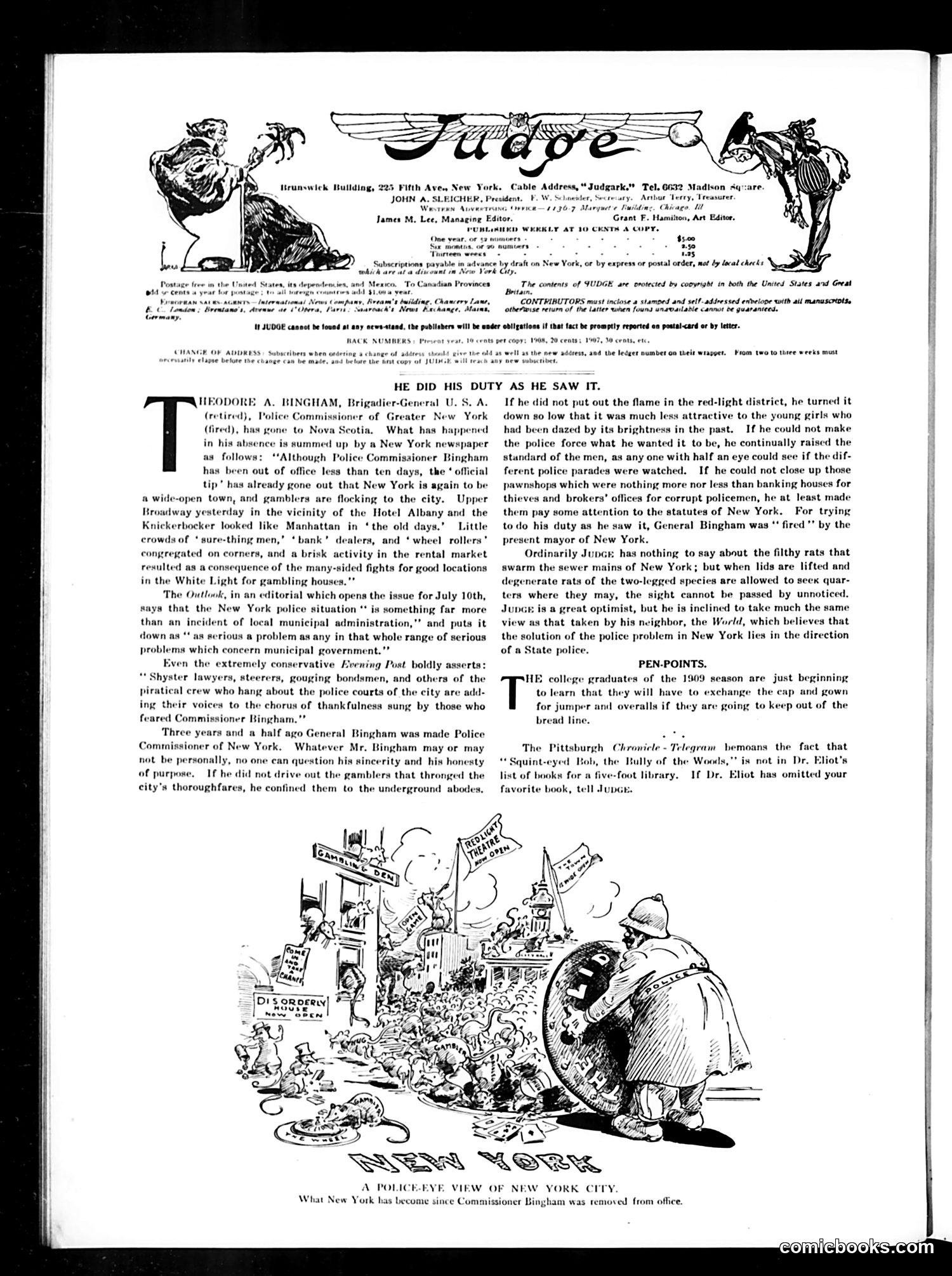
This Judge cartoon satirizes New York City's governance following Police Commissioner Theodore Bingham's removal from office. The main article criticizes Bingham for failing to address crime and corruption—specifically gambling operations, graft, and organized vice in the city's sewer system and underworld. The cartoon depicts New York as a chaotic, crime-ridden mess of illegal activity (gambling dens, vice operations, disorder), with a large police figure overwhelmed by the chaos. The caption suggests the city has descended into lawlessness since Bingham lost power. The satire targets both Bingham's ineffectiveness as commissioner and broader municipal corruption. It mocks the notion that removing a single official can fix systemic urban problems—the root issues remain despite leadership changes.
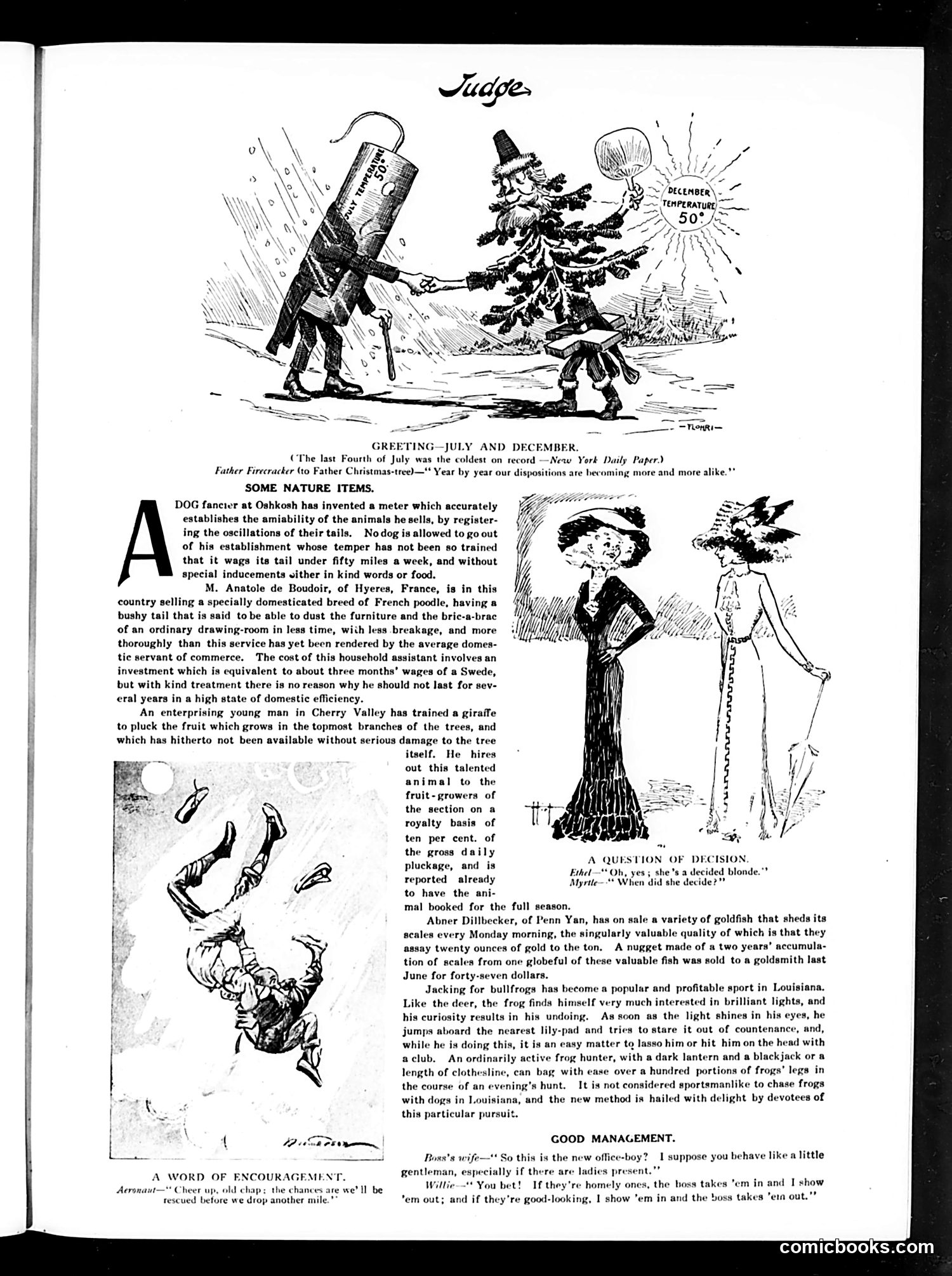
The top cartoon titled "GREETING—JULY AND DECEMBER" contrasts summer and winter through personified seasons. July (depicted as a caricatured man) holds a thermometer showing 50°F, while December appears as a figure in winter clothing. The caption references "the last Fourth of July was the coldest on record" from the New York Daily Paper, suggesting an unusually cold Independence Day occurred recently. The page's remaining content consists of "SOME NATURE ITEMS"—a column of miscellaneous anecdotes about animals (a dog meter, trained giraffe, goldfish, and bullfrog hunting). Below are two brief humorous dialogue pieces unrelated to the cartoons. The satire here appears mild, focusing on weather oddities rather than political commentary.
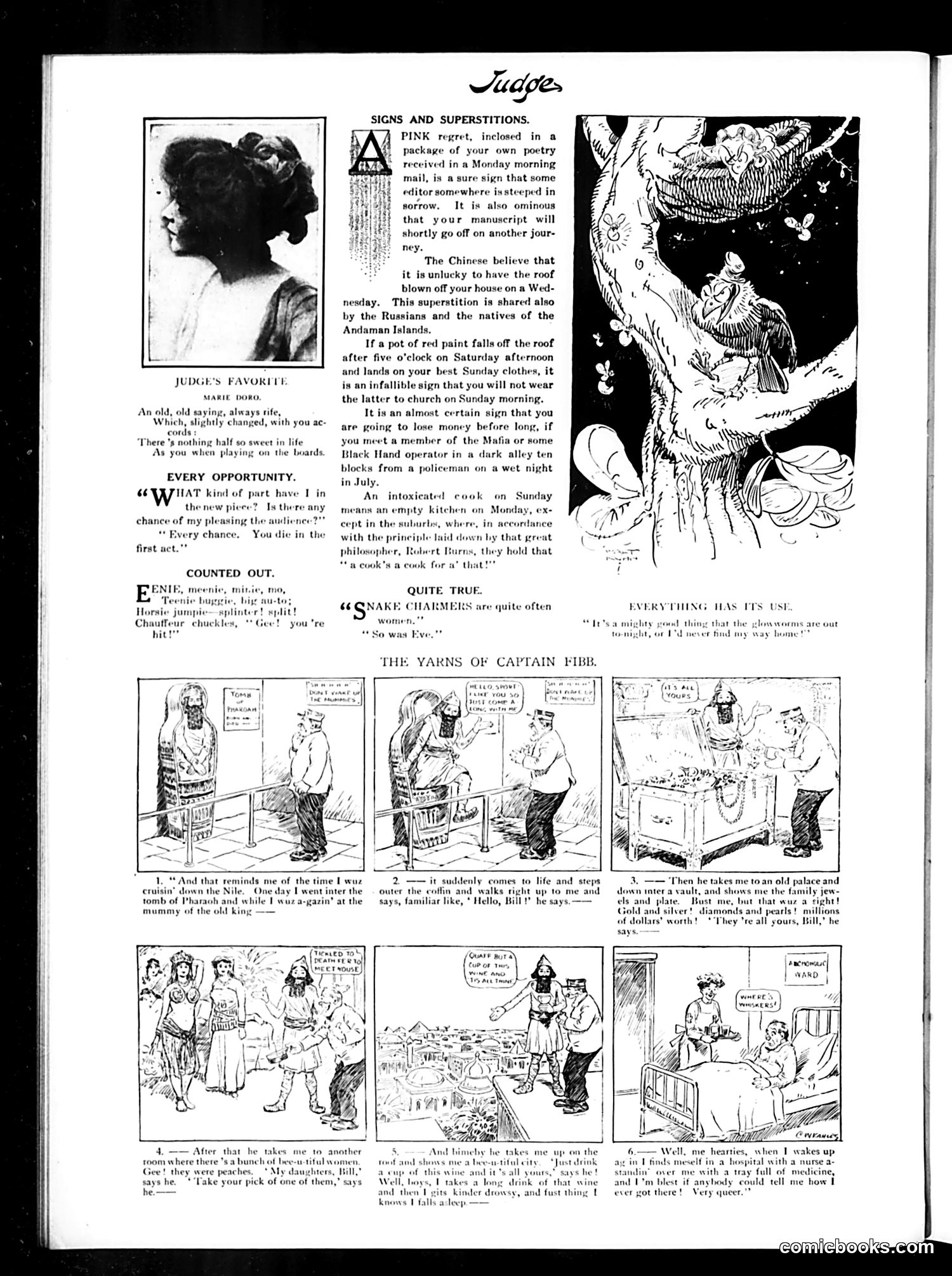
This page contains miscellaneous humor and illustration rather than political cartoons. The content includes: **"Signs and Superstitions"** — A column discussing folk beliefs (Chinese roof superstitions, Mafia threats, intoxicated cooks) presented as humorous commentary on contemporary urban anxieties and immigrant cultural practices. **"The Yarns of Captain Fibb"** — A sequential comic strip showing a seemingly elderly sailor telling fantastical tales to a younger man. The captain claims to have robbed Egyptian tombs and possessed extraordinary wealth, but his stories are clearly exaggerated yarns — a satirical take on tall tales and unreliable narrators. The illustrations mock both superstitious beliefs and boastful storytelling common in the era. No specific political figures or events appear to be targeted; instead, the page satirizes general human gullibility and the tendency toward self-aggrandizing fiction.
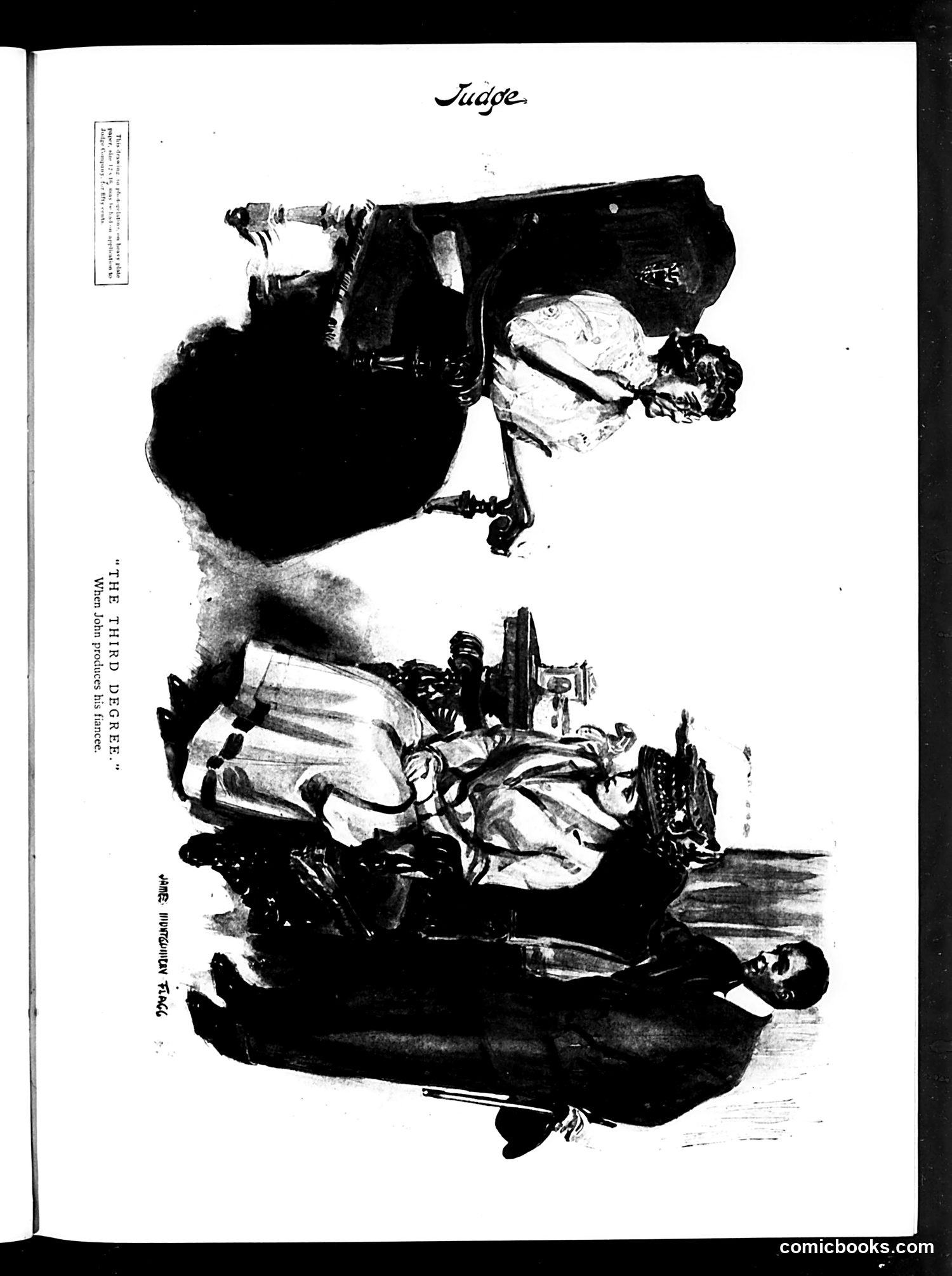
I can see this is a page from *Judge* magazine titled "Page" at the top, with what appears to be a political cartoon rotated 90 degrees. The OCR text reads "THE THIRD DEGREE: Where she produces his evidence" and credits "ALLIED NEWSPAPER PROD." The cartoon appears to depict an interrogation scene, likely satirizing police or legal practices of the era. The phrase "third degree" refers to harsh questioning tactics. However, without being able to clearly read all details in the rotated image, I cannot confidently identify the specific figures or the particular political/social event being referenced. The satire seems to address justice system practices, but I'd need clearer visibility of facial features or additional context to specify which contemporary incident or figures are being mocked.
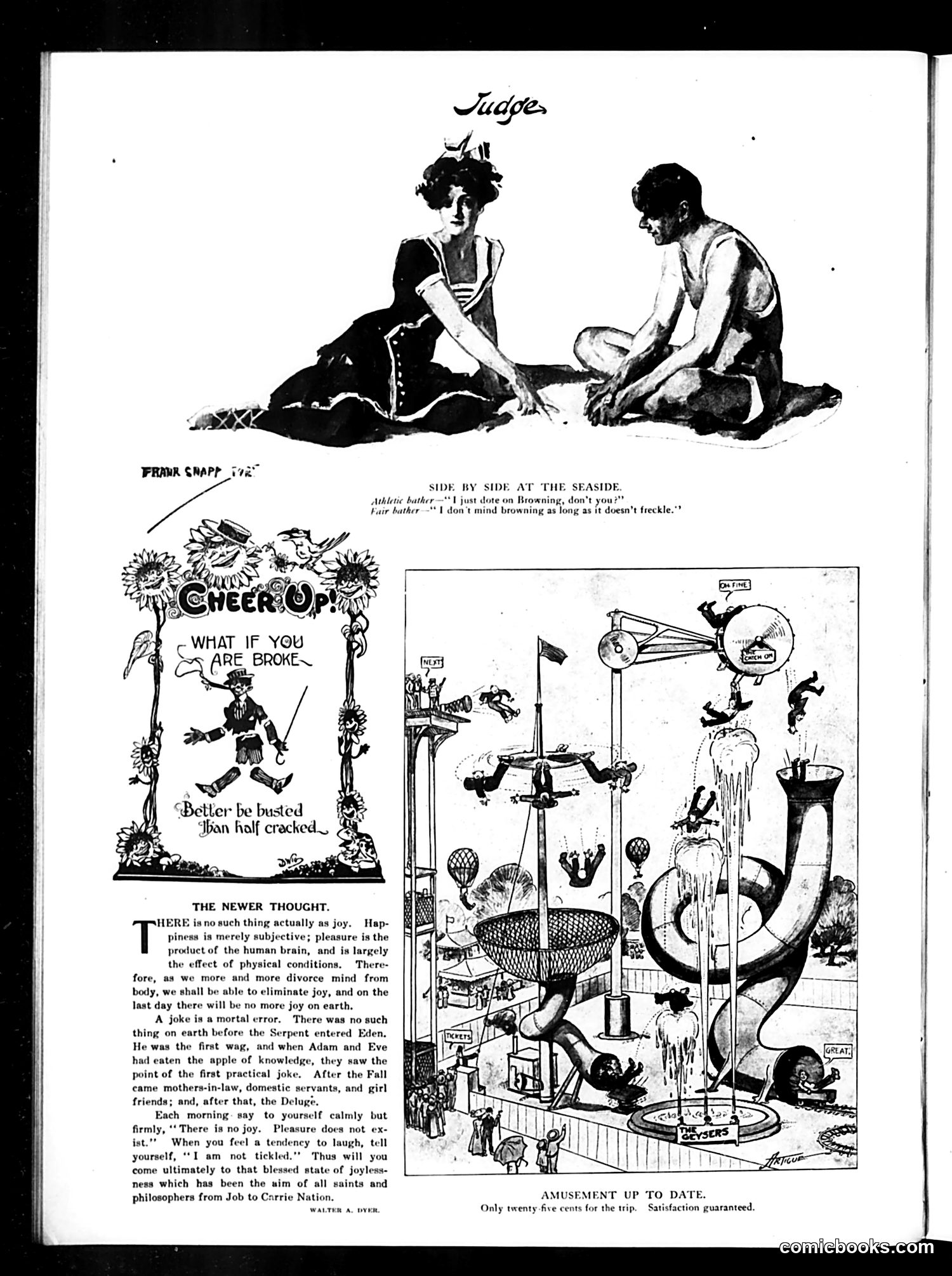
**Top Cartoon ("Side by Side at the Seaside"):** A playful exchange between two bathers at the beach. The "athletic bather" references Robert Browning (the Victorian poet), while the "fair bather" makes a joke about getting a suntan ("browning") without developing freckles. This is light social satire about beachgoers' vanity and literary pretension. **Middle Section ("Cheer Up!"):** A warning cartoon against pessimism, illustrated with figures and sunflowers. The text warns that excessive brooding is worse than being "half cracked" (somewhat foolish). **"The Newer Thought":** A satirical essay by Walter A. Dyer mocking contemporary philosophical and psychological trends—likely referencing early 20th-century movements emphasizing mind-body separation and the elimination of emotion. It cynically traces joy's origin to the Fall of Man and suggests modern philosophy aims to eliminate pleasure entirely, referencing figures like reformer Carrie Nation. **Bottom Image ("Amusement Up to Date"):** An elaborate mechanical contraption for amusement, satirizing overly complex modern entertainment technology. The page collectively ridicules modern intellectual pretension and joyless philosophies.
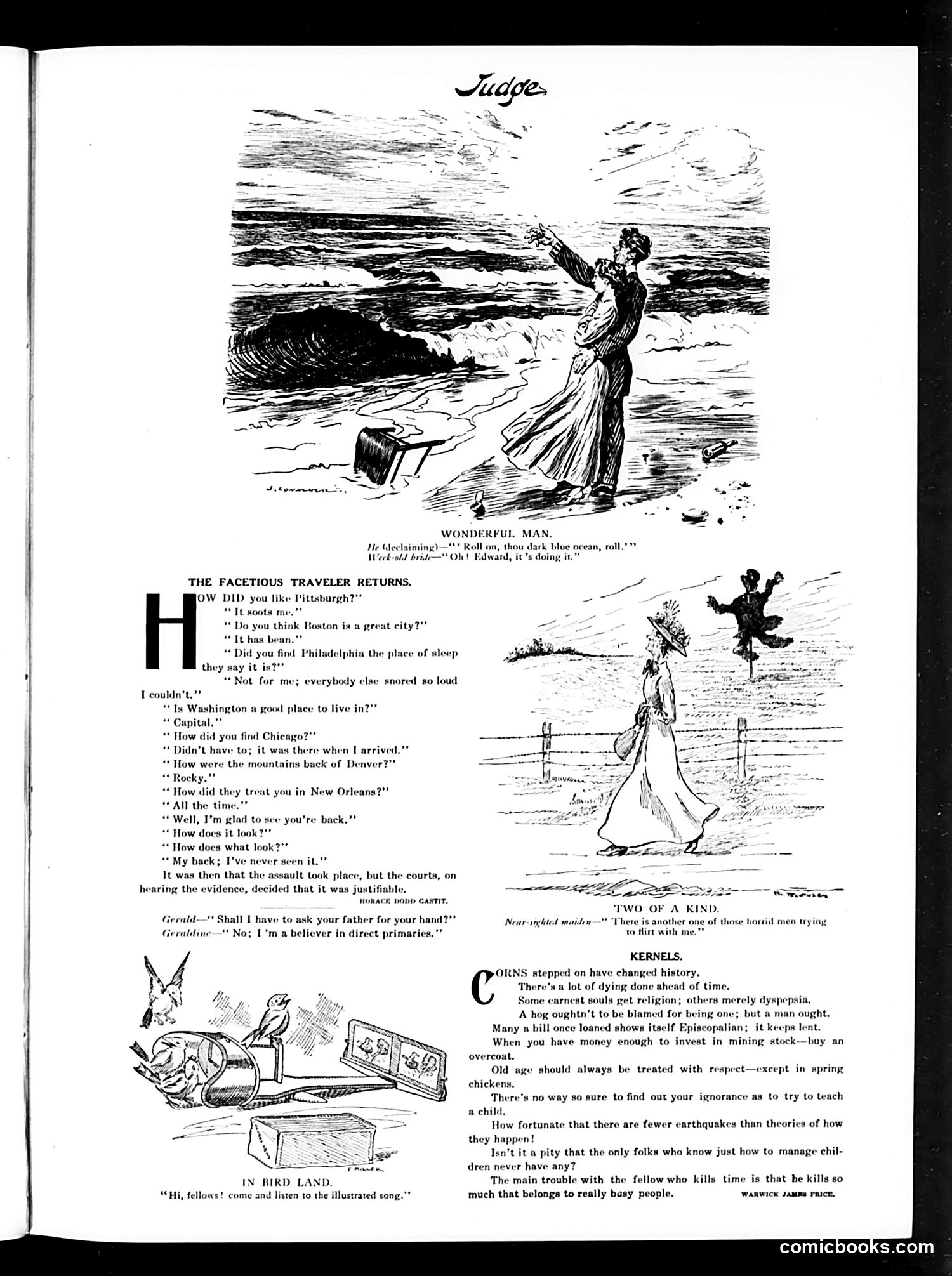
This page contains three separate satirical pieces typical of Judge's humor: **"The Facetious Traveler Returns"** mocks someone returning from American travels who makes tired puns about cities: Pittsburgh "soots," Boston "has bean," Philadelphia doesn't allow sleep because others snore. The joke culminates when he asks his wife about her back, she attacks him (justifiably, the courts rule), playing on the double meaning of "seeing one's back." **"Wonderful Man"** appears to ridicule pompous recitation—a newlywed bride interrupts her husband's dramatic declamation with an unglamorous complaint ("it's doing it"), deflating his pretension. **"Kernels"** is a collection of aphorisms and social observations—witty one-liners about religion, money, parenting, and time-wasting. These reflect Judge's tendency toward sophisticated, philosophical humor alongside broader comedy. The page uses puns, wordplay, and gentle social satire targeting vanity, pretension, and human folly rather than specific political targets.
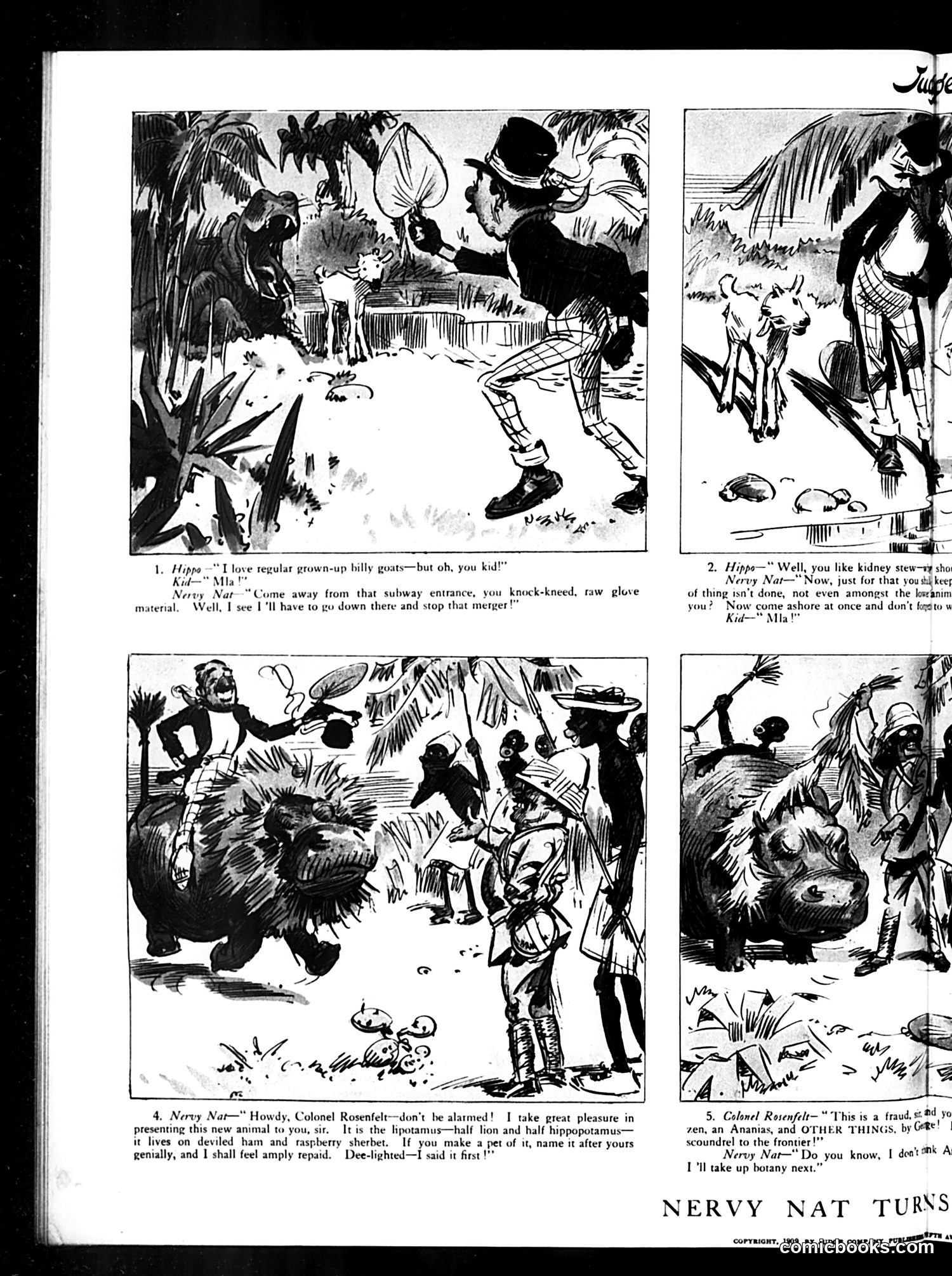
This is a comic strip titled "Nervy Nat Turns" from *Judge* magazine featuring a mischievous character named Nervy Nat causing chaos. The four-panel narrative shows: **Panel 1-2:** Nervy Nat antagonizes a hippopotamus at what appears to be a zoo or menagerie, taunting it and creating a dangerous situation that requires intervention. **Panel 3:** The escalation continues with multiple people attempting to control the agitated hippo. **Panel 4-5:** Nervy Nat presents a fictional hybrid animal (a "lipotamus"—half lion, half hippopotamus) to "Colonel Rosenfelt" (likely Theodore Roosevelt, given the frontier/hunting context), claiming credit for its creation. Rosenfelt calls him a fraud and charlatan. **The satire:** The joke targets Nervy Nat's compulsive troublemaking and dishonesty. He creates problems, then invents elaborate lies to escape blame. The Colonel Rosenfelt reference suggests this early 20th-century humor played on contemporary public figures' eccentricities and the era's fascination with exotic animals and frontier adventures.
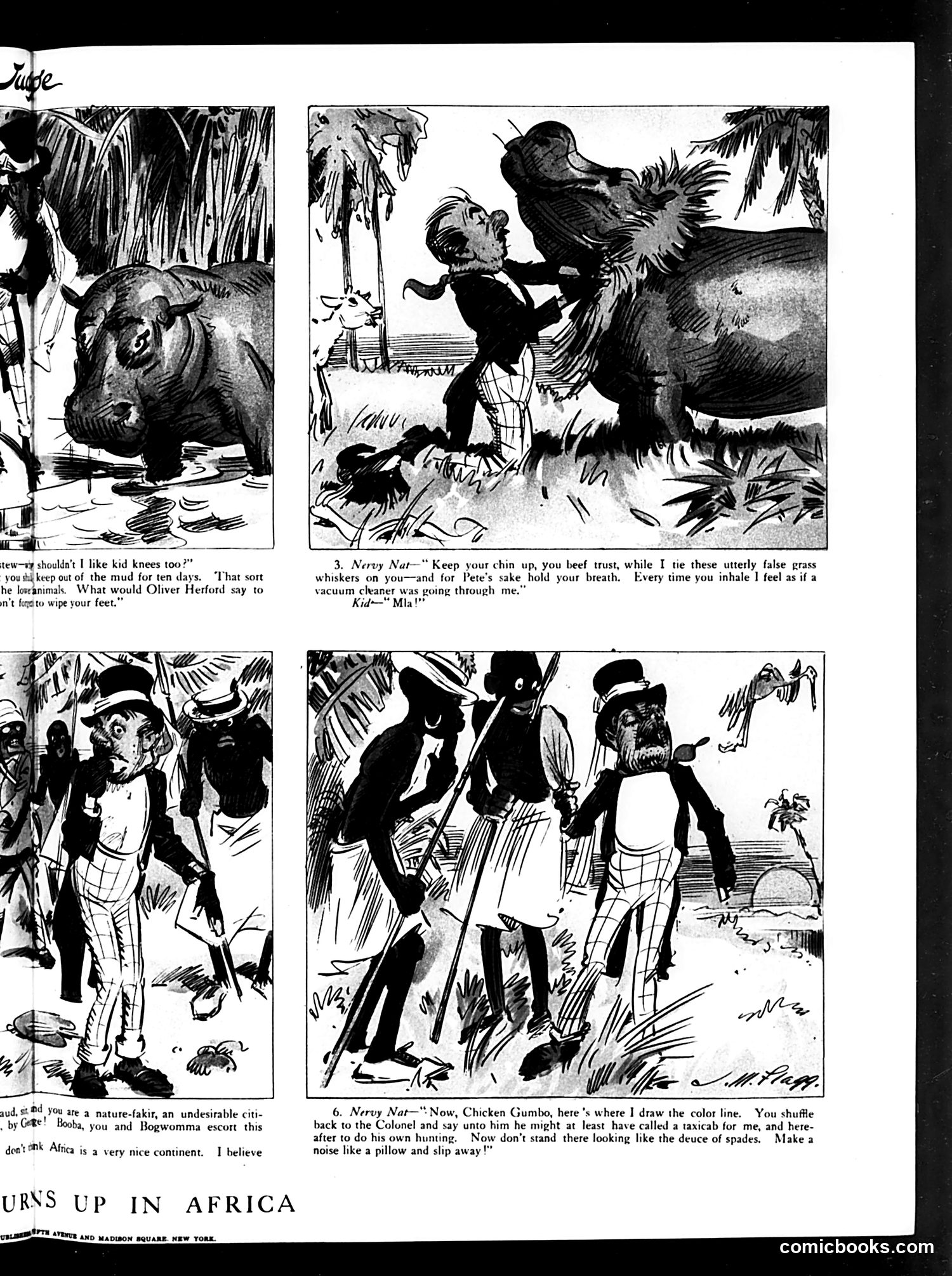
This appears to be a multi-panel satirical comic featuring a character called "Nervy Nat" (likely a recurring Judge character) encountering African animals and people during what seems to be a colonial-era African adventure. The satire works on several levels: Nat engages in absurd interactions with hippopotamuses and other wildlife, treating them as if they were human (mimicking period "nature faker" literature that anthropomorphized animals). The final panels mock colonial attitudes, with Nat commanding Black African individuals using condescending orders and racial stereotypes—he refers to one as "Chicken Gumbo" and makes jokes about "drawing the color line." The humor, by Judge's standards, targets both Nat's foolishness and contemporary colonial pretensions. The "nature-fakir" reference alludes to President Theodore Roosevelt's well-known criticism of exaggerated animal stories popular in that era. The overall tone reflects early-1900s American attitudes toward Africa and African peoples as subjects of ridicule.
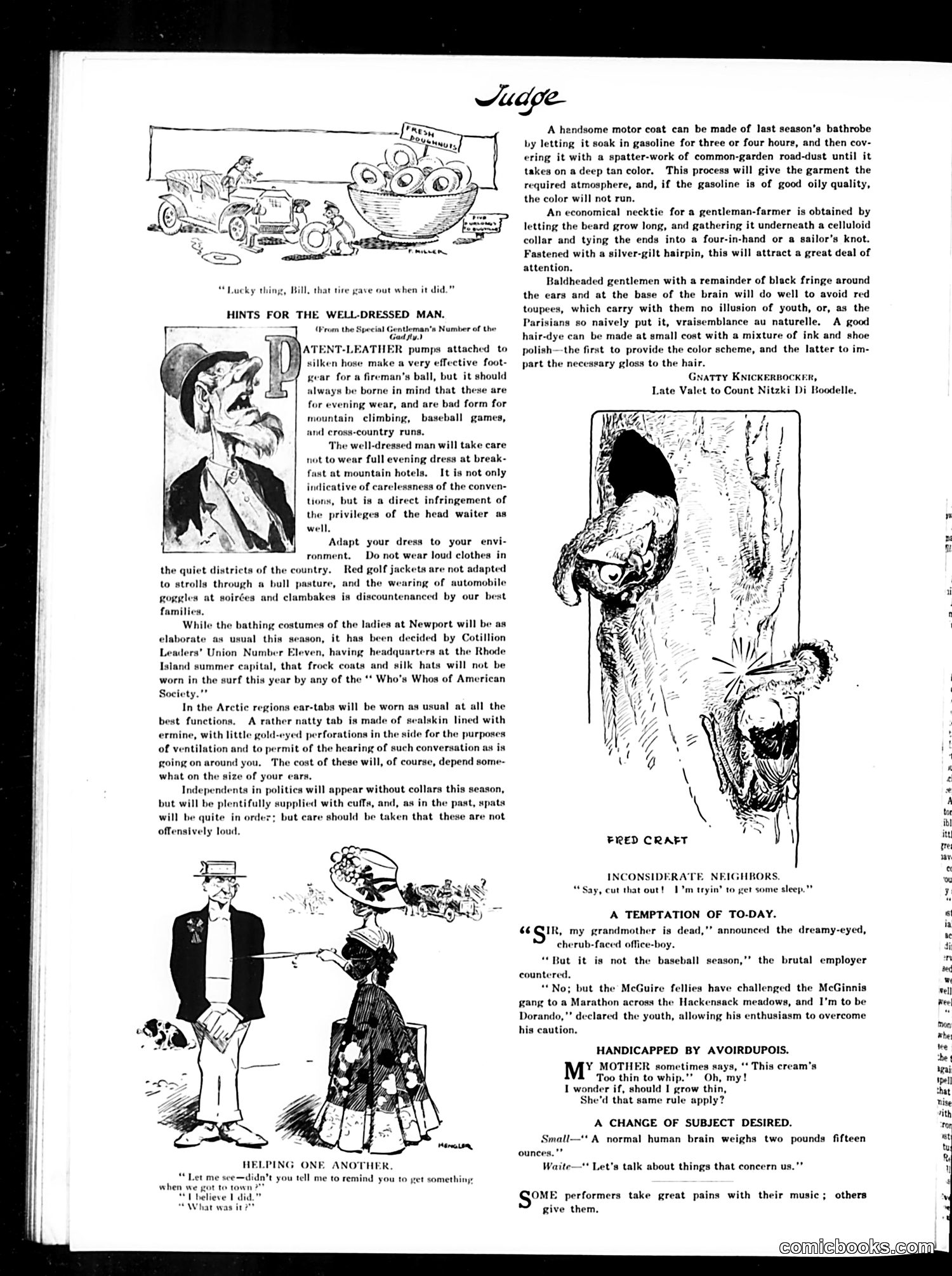
This page from Judge magazine (circa early 1900s) features satirical humor targeting multiple subjects: **"Hints for the Well-Dressed Man"** mocks fashion pretensions through absurd advice: transforming old bathrobes into motor coats via gasoline soaking, fashioning neckties from beard hair, and creating hair dye from ink and shoe polish. The byline credits "Chatty Knickerbocker, Late Valet to Count Nitzki Di Boodelle"—a fictional society figure parodying real gossip columnists. **Social satire includes**: mockery of rigid etiquette rules (evening dress at breakfast), class-consciousness about appropriate clothing for different settings, and commentary on Newport society's arbitrary fashion decisions. **Political reference**: "Independents in politics will appear without collars this season"—likely mocking political independents as slovenly or unreliable. The cartoons accompanying this text feature everyday situations (a man and woman chatting, neighbors complaining about noise) illustrating middle-class social awkwardness. Overall, Judge ridicules both fashion obsession and the arbitrary social conventions governing Edwardian-era America.
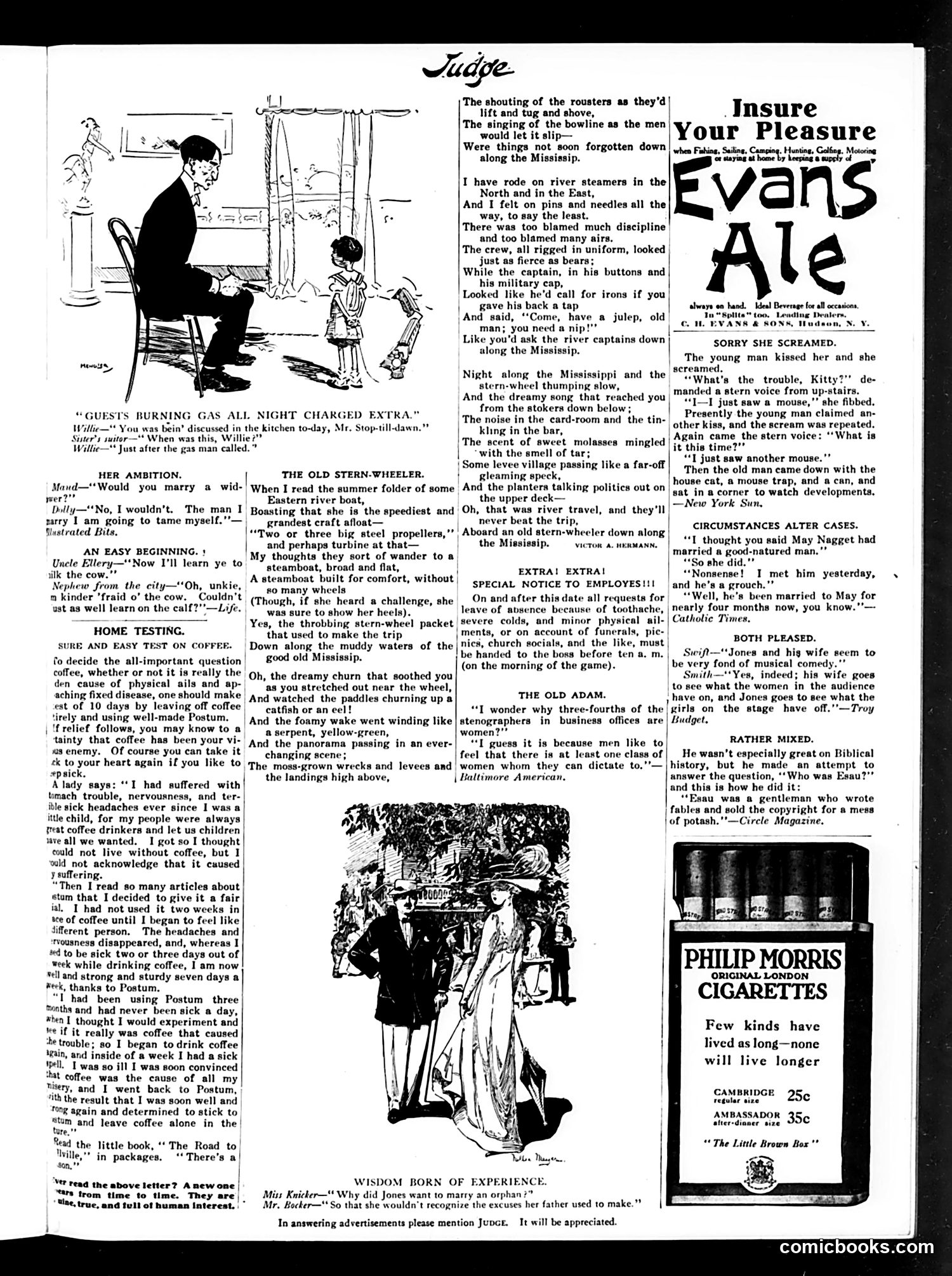
This page from Judge contains several brief satirical comics and a nostalgic poem, typical of early 20th-century American humor magazines. The main cartoon "Guests Burning Gas All Night Charged Extra" jokes about a young man (the sister's suitor) staying up late courting—the boy Willie teasingly notes the family discussed this visitor right after the gas man came, implying he burns through expensive gas by staying late. Other short comics mock everyday situations: a woman's modest courtship ambition, a city nephew afraid to milk a cow (urban vs. rural humor), and a young couple's kisses repeatedly interrupted by the girl claiming to see mice—actually excuses to scream and call her stern father downstairs. The longer poem "The Old Stern-Wheeler" nostalgically describes Mississippi riverboat travel—emphasizing its comfort, leisure, and romance compared to modern steamships with their rigid discipline and military captains. It's sentimental Americana celebrating a disappearing era. The advertisements promote Postum coffee substitute and Philip Morris cigarettes as leisure products.
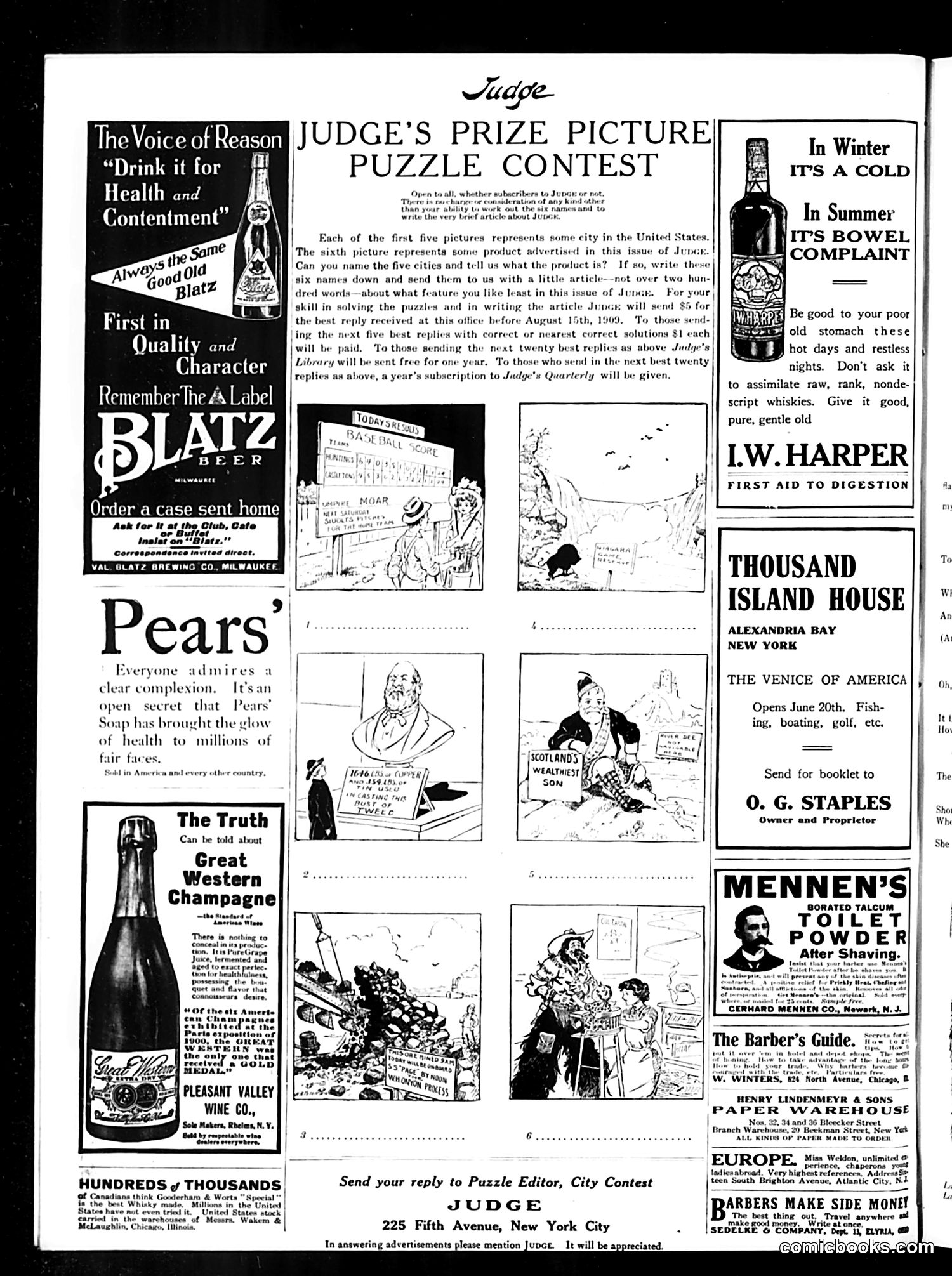
This is primarily an **advertising page** from Judge magazine (circa 1909) built around a puzzle contest. The "Judge's Prize Picture Puzzle Contest" occupies the center, asking readers to identify five American cities and one advertised product from six cartoon illustrations, then write an article explaining their choices. Winners receive cash prizes. The six cartoon panels (numbered 1-6) appear to be satirical city scenes, though specific identities are unclear from the OCR. The surrounding space is filled with period advertisements for alcohol (Blatz Beer, Western Champagne, whiskey), toiletries (Mennen's Talcum Powder), soap (Pears'), and vacation destinations (Thousand Island House). The satirical content is minimal here—this functions primarily as a **revenue-generating advertising vehicle** disguised as reader engagement. The "puzzle" format was a common early 1900s marketing tactic to encourage magazine purchases and reader participation while filling pages with paid advertisements.
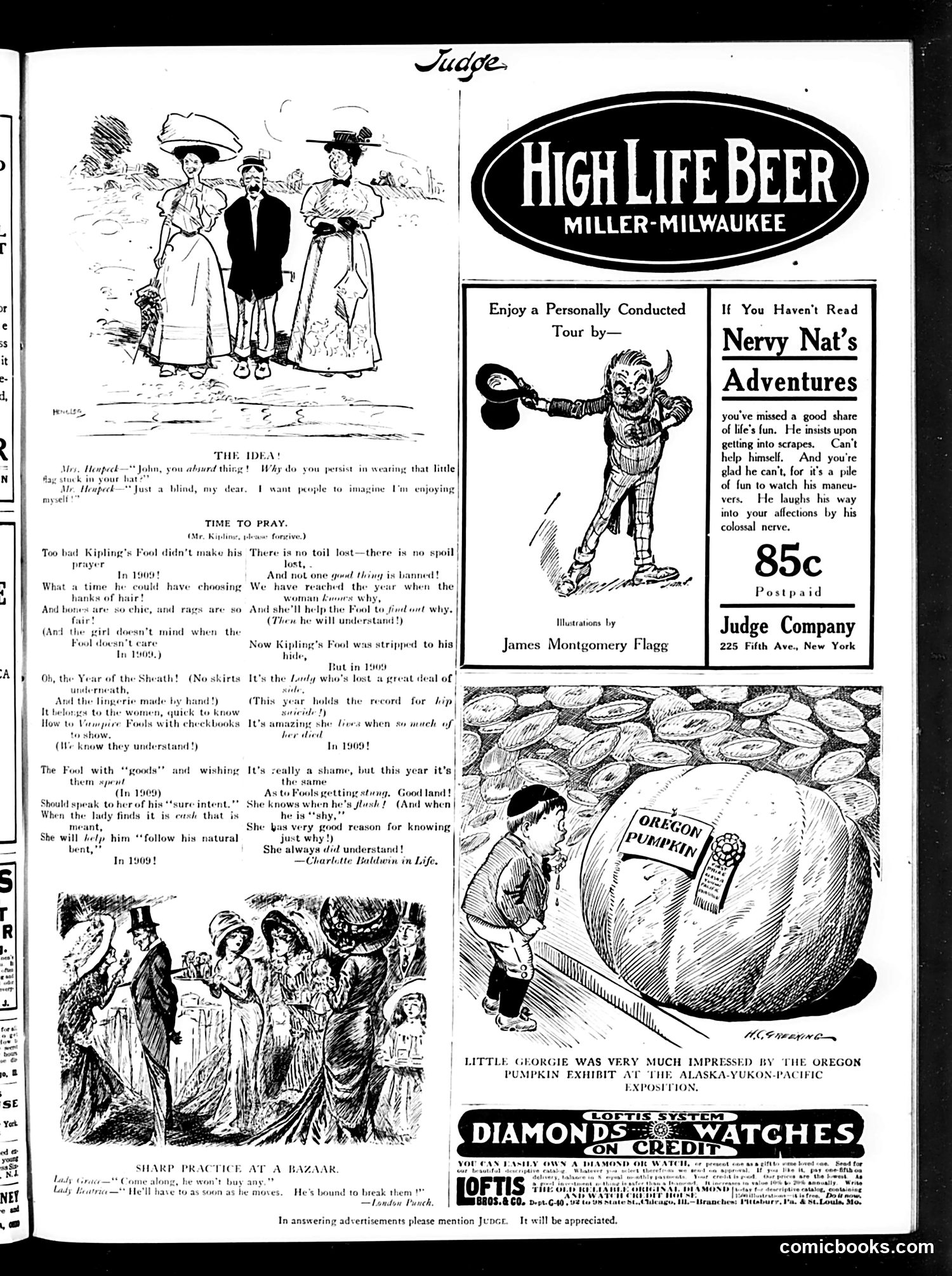
This page primarily contains **advertisements and literary content** rather than political satire. The main text, "Time to Pray," is a poem satirizing Rudyard Kipling's famous work "The Fool" through repeated references to "1909." The poem mocks societal changes and women's fashion (particularly "the Year of the Sheath"—likely referencing a narrow skirt silhouette). It suggests that Kipling's 1890s moral fable about foolishness would have different relevance in the modern era of 1909, with women pursuing wealth and independence rather than traditional roles. The illustrations by James Montgomery Flagg accompanying the text appear to depict period social scenes—a bazaar and street encounter—that humorously illustrate courtship and economic dynamics of the era. The page is otherwise dominated by **advertisements**: High Life Beer (Miller-Milwaukee), "Nervy Nat's Adventures" book, an Oregon pumpkin display notice, and Oftis diamonds. These are typical commercial content expected in Judge magazine's pages.
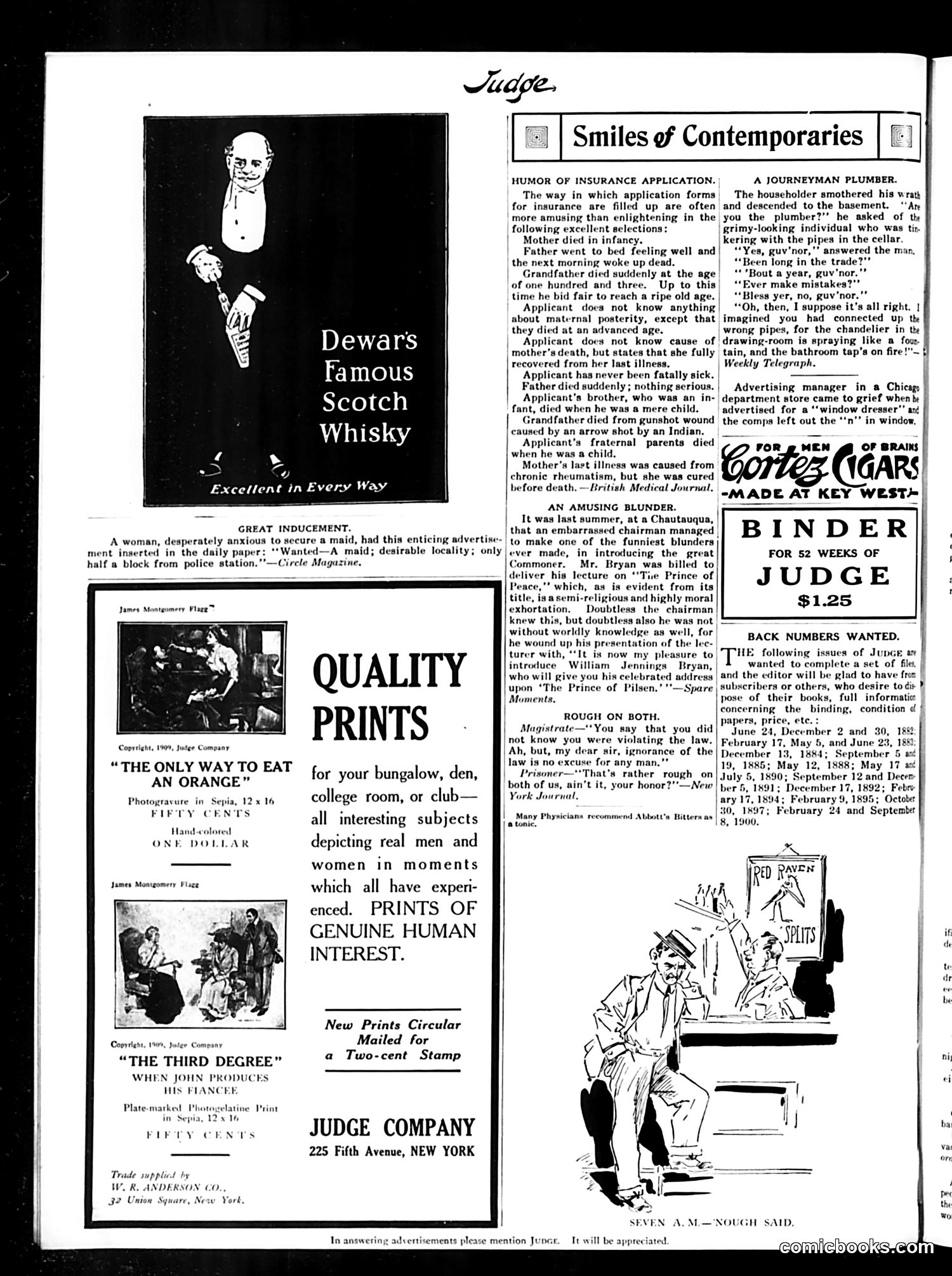
This page is primarily **advertisements and humor snippets** rather than political cartoons. The main satirical content includes: 1. **"Humor of Insurance Application"** — absurdist jokes about poorly-filled insurance forms with logical contradictions (e.g., "mother died in infancy" but applicant "does not know cause"; grandfather "bid fair to reach a ripe old age" despite dying at 103). The humor mocks careless bureaucratic language. 2. **"An Amusing Blunder"** — A chairman introducing William Jennings Bryan accidentally combines his lecture title "The Prince of Peace" with "Moments" (possibly from another event), creating an awkward phrase. This gently mocks public speaking mishaps. 3. **"Rough on Both"** — A magistrate tells a prisoner ignorance of law is no excuse; the prisoner retorts it's "rough on both of us," suggesting even magistrates don't know all laws. Social satire about legal hypocrisy. 4. **"Seven A.M.—'Nough Said"** — A plumber's incompetence causes bathroom fixtures to malfunction spectacularly. The page emphasizes **everyday absurdities** rather than political commentary.
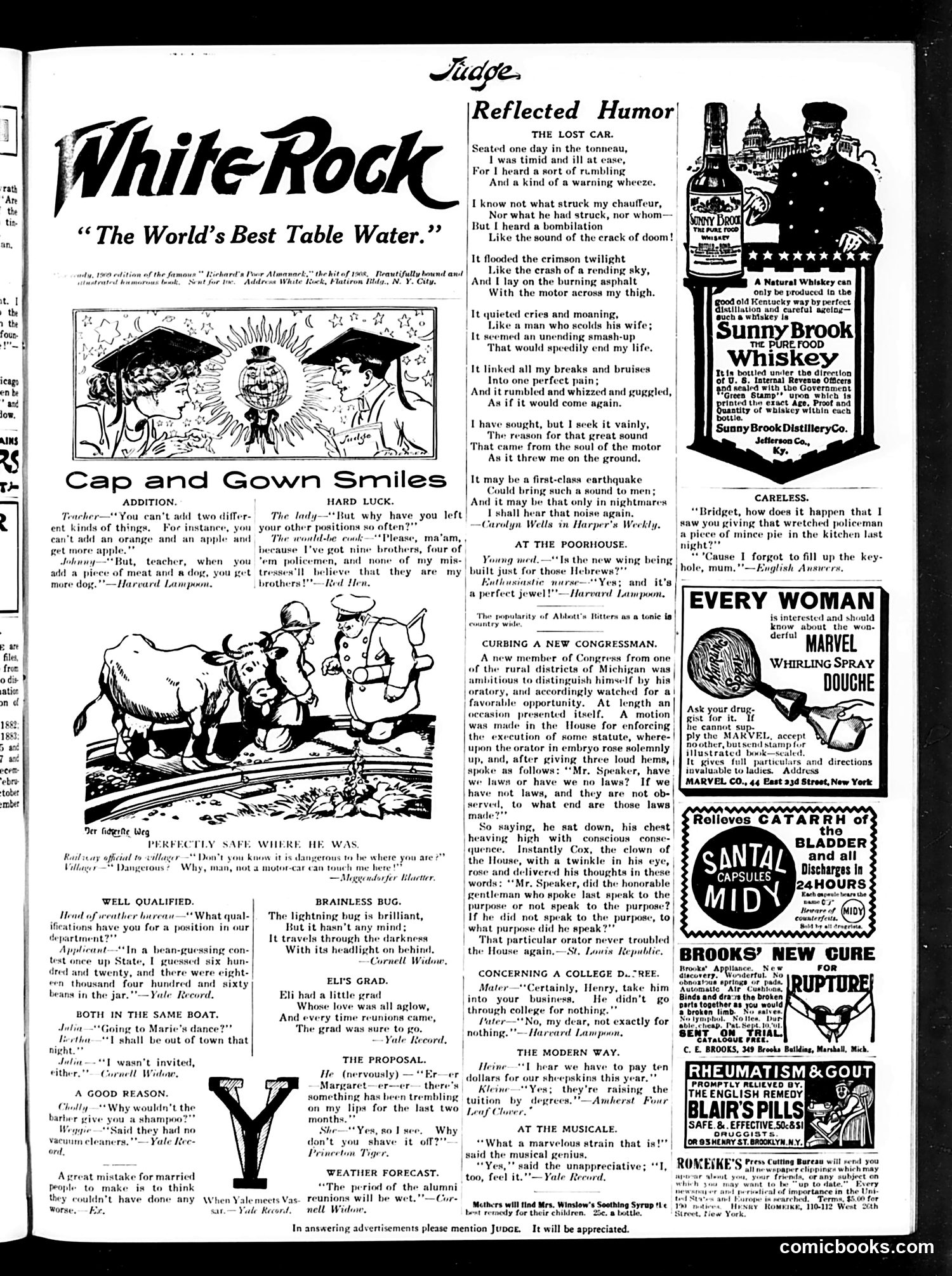
This page mixes humor columns and advertisements typical of early 1900s Judge magazine. The cartoons and jokes are mostly **non-political social satire**: **Main Content:** - "Cap and Gown Smiles" features brief jokes about teachers, students, and college life (Yale, Cornell, Princeton referenced) - "Reflected Humor" includes a comic poem about a motorcar accident—the humor centers on the mechanical noise and violence of early automobiles, a relatively new technology causing anxiety - Various one-liners mock everyday situations: incompetent job applicants, unfaithful husbands, servants, and social awkwardness **Context for Modern Readers:** The satire reflects **turn-of-century anxieties**: automobiles were dangerous novelties, college culture was fodder for ridicule, and domestic servants were common targets of humor. The motorcar poem especially reveals contemporary fear of this new technology. The page is **primarily advertising**—multiple patent medicines and whiskey ads occupy significant space, typical for Judge's business model. No identifiable political figures or events appear on this page.
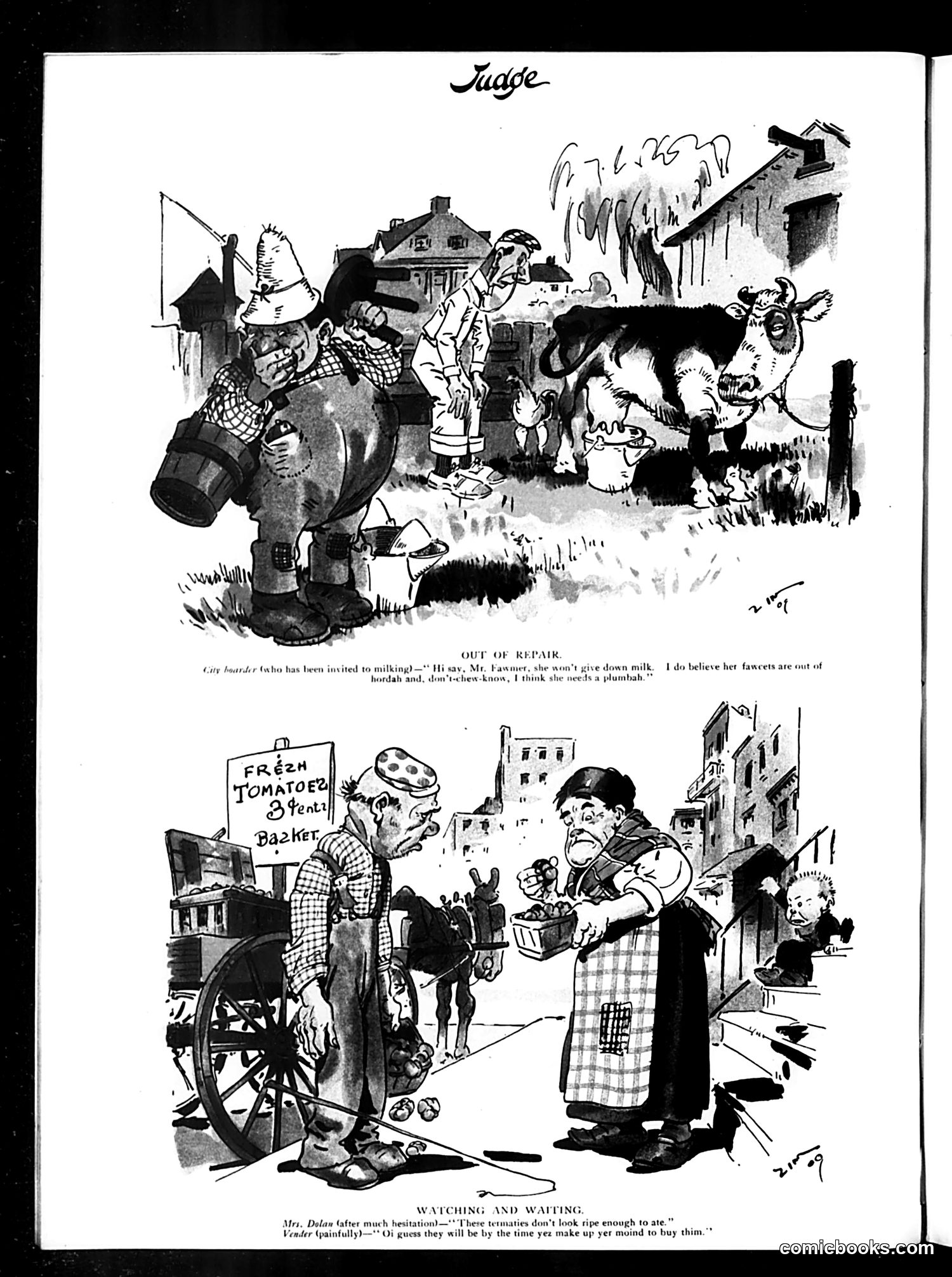
**Top cartoon ("Out of Repair"):** A city health inspector visits a farm, finding a cow unable to produce milk. The farmer blames broken faucets and plumbing rather than the cow itself—satirizing how people deflect responsibility by blaming circumstances instead of acknowledging real problems. **Bottom cartoon ("Watching and Waiting"):** A street vendor with unripe tomatoes hagggles with Mrs. Dolan, a housewife. She hesitates to buy because the tomatoes aren't ready to eat; he sarcastically suggests they'll ripen by the time she finally makes a purchase decision—mocking indecisive consumers and implying vendors exploit customer hesitation. Both cartoons use Irish-American characters (suggested by names and dialect) to humorously critique everyday urban and working-class life in early 20th-century America.