
A complete issue · 24 pages · 1909
Judge — March 27, 1909
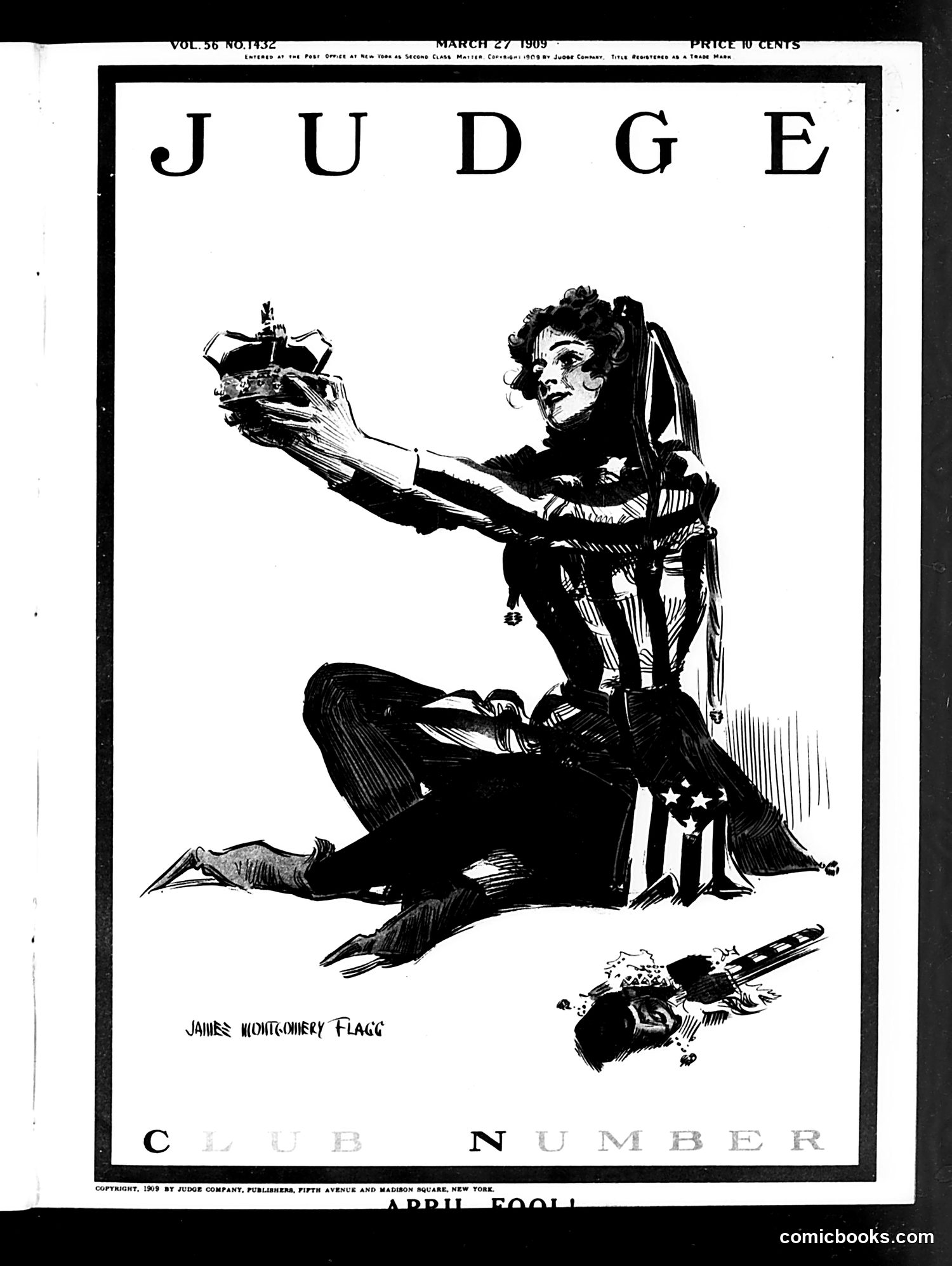
This is the cover illustration for "Judge" magazine's "Club Number" April issue (club being a social/membership organization). The artwork is by James Montgomery Flagg, a renowned illustrator of the era. The image depicts a woman in classical "Lady Justice" style—seated with a crown held aloft in one hand. She wears flowing robes and a veil, resting against what appears to be Uncle Sam (identifiable by the patriotic shield with stars). A gavel lies at the bottom. The satire likely celebrates American judicial institutions and democratic principles, using the allegorical female figure of Justice. The composition suggests themes of American law, fairness, and governance—typical subjects for Judge magazine's satirical commentary on civic matters.
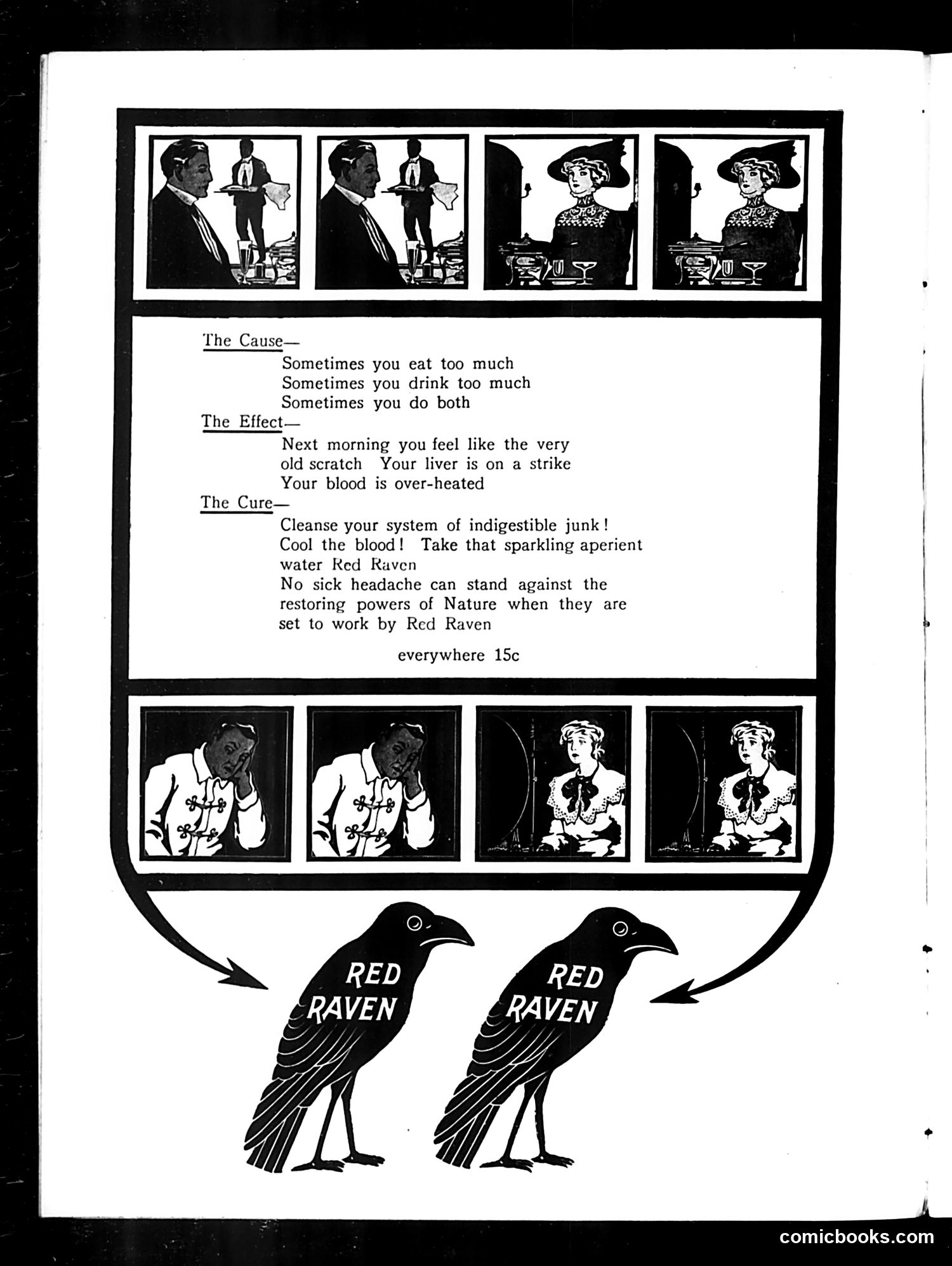
This is a vintage advertisement for "Red Raven," a sparkling aperitif water product, presented as satirical advice about hangovers. The page uses comic panels depicting a man and woman experiencing the consequences of overindulgence—eating too much, drinking too much, or both. The symptoms described ("feel like the very old scratch," liver trouble, overheated blood) represent a hangover. The "cure" humorously advocates Red Raven sparkling water as a restorative drink that will "cleanse your system of indigestible junk" and cool the blood. The product cost 15 cents everywhere. The red ravens at the bottom function as the brand mascot, framing the before-and-after narrative. This reflects early 20th-century patent medicine advertising conventions, mixing humor with health claims to market beverages.
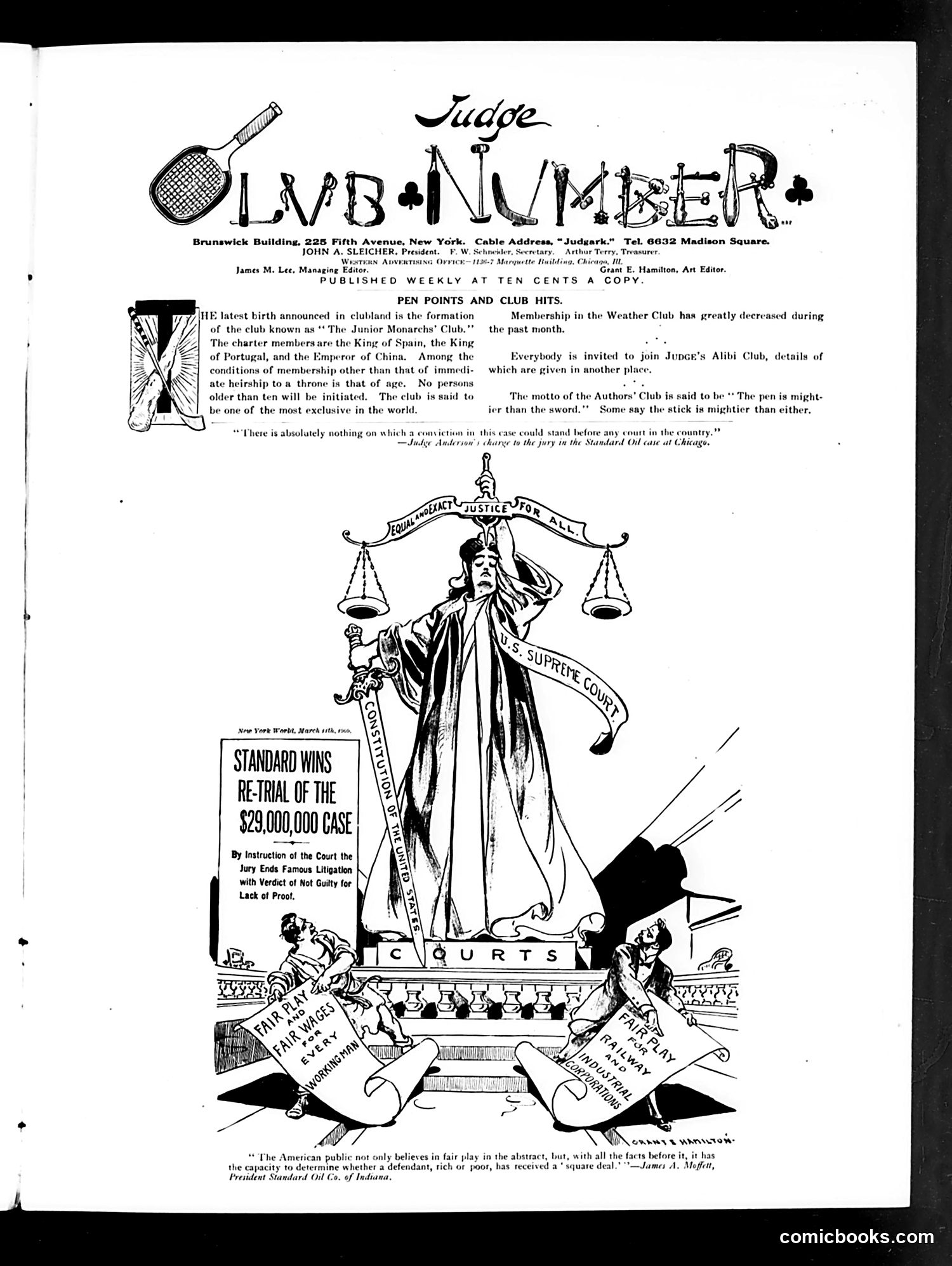
This page satirizes the **Standard Oil Company's $29,000,000 legal case**, depicted through Lady Justice holding her scales. The cartoon criticates Standard Oil's litigation strategy, showing the company attempting to manipulate the courts through what appears to be bribery or legal maneuvering (represented by the figures at the base trying to tip the scales). The headline states Standard Oil "wins re-trial" despite a "verdict of not guilty for lack of proof"—mocking the absurdity of retrialing a case already decided. The accompanying quote from James A. Moffett (Standard Oil's president, Indiana) ironically emphasizes the need for "fair play" and knowing "all the facts," suggesting the cartoon accuses Standard Oil of doing precisely the opposite through wealth and legal manipulation rather than honest justice.
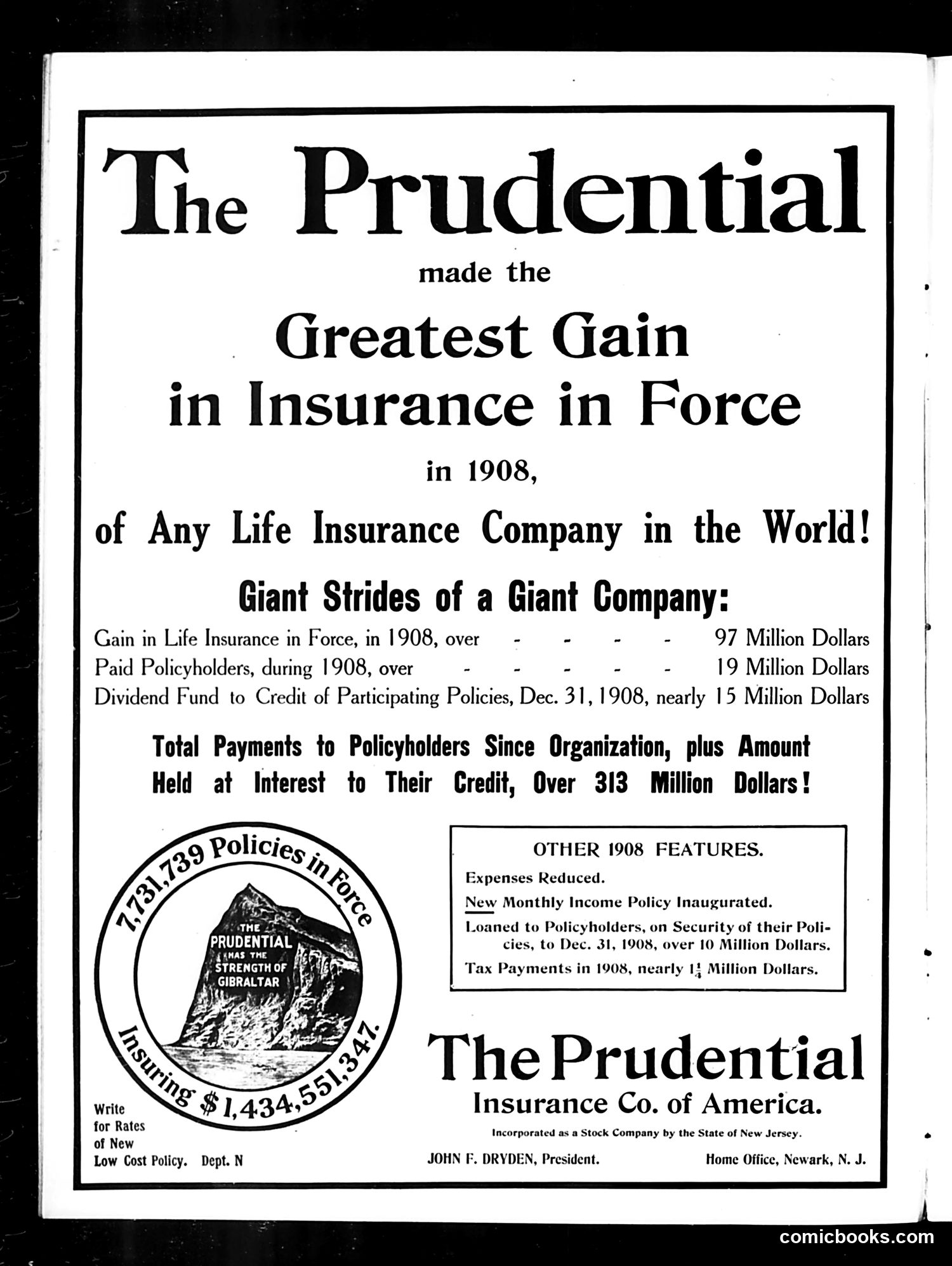
This page is **primarily an advertisement**, not satire or political commentary. The Prudential Insurance Company of America is promoting its financial success in 1908, emphasizing growth metrics: 97 million dollars in new life insurance policies, 19 million dollars paid to policyholders, and over 313 million dollars total disbursed since organization. The circular seal features the **Rock of Gibraltar**—Prudential's famous corporate symbol representing stability and strength. This was their standard branding, not a cartoon reference. The "Giant Strides of a Giant Company" language reflects common early-20th-century corporate boasting. There is no political satire present; this is straightforward business promotion in Judge magazine's advertising section, highlighting the company's expansion and policyholder benefits during the pre-Depression era.
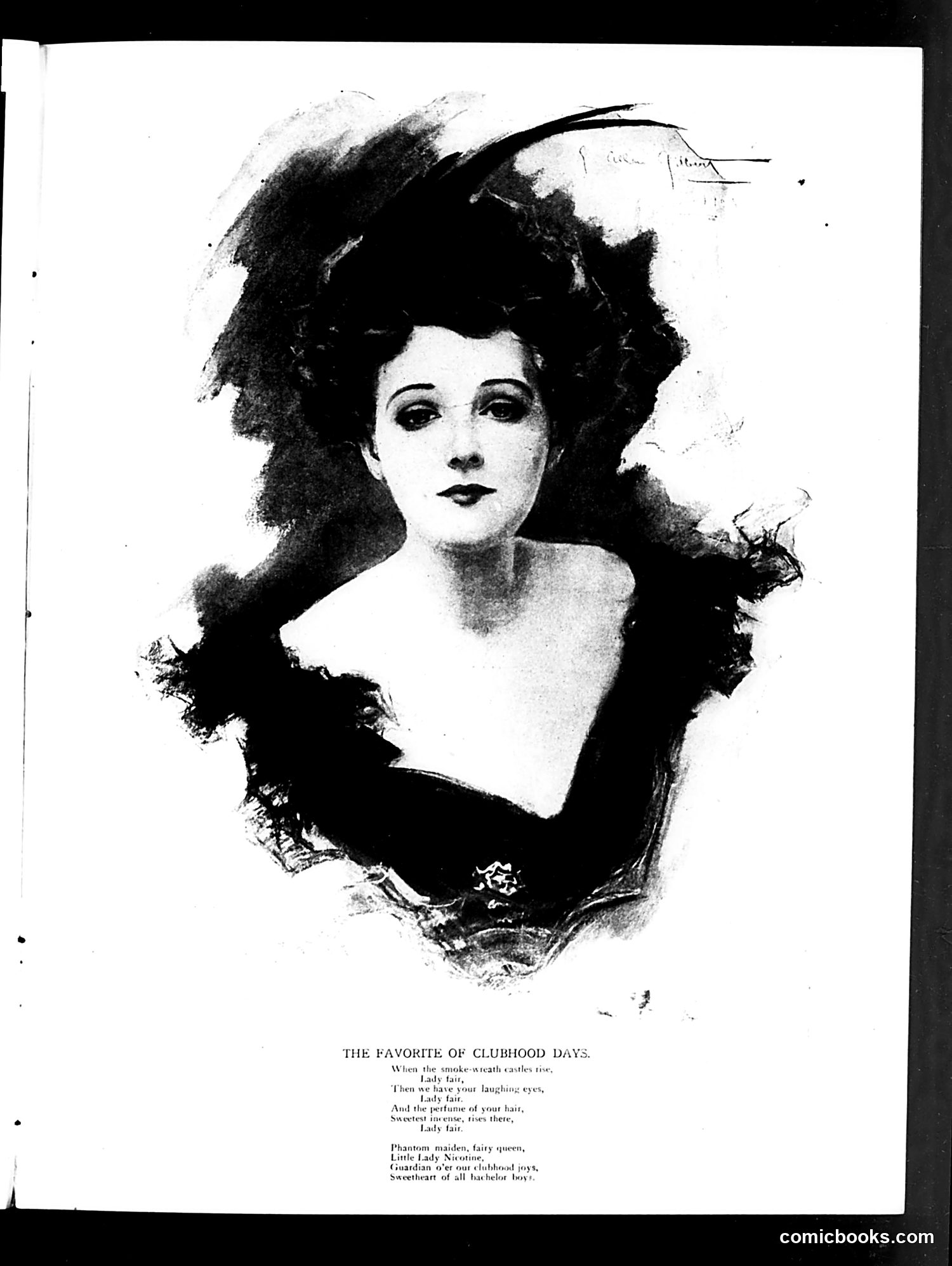
This page from *Judge* magazine features a portrait illustration titled "The Favorite of Clubhood Days," accompanied by sentimental verse praising a woman's beauty and charm. The poem references "Lady Fair" and "Little Lady Nicotine," and concludes with "Sweetheart of all bachelor love." The content appears to be a romanticized tribute to an attractive woman, likely a popular actress, performer, or public figure of the era. The repeated phrase "Lady Fair" and the emphasis on her "perfume" and "laughing eyes" suggest nostalgic appeal to male readers. This represents typical *Judge* magazine content: lighthearted, gender-conventional humor and portraiture aimed at an educated, affluent male readership. The specific identity of the woman depicted is not clear from the image alone.
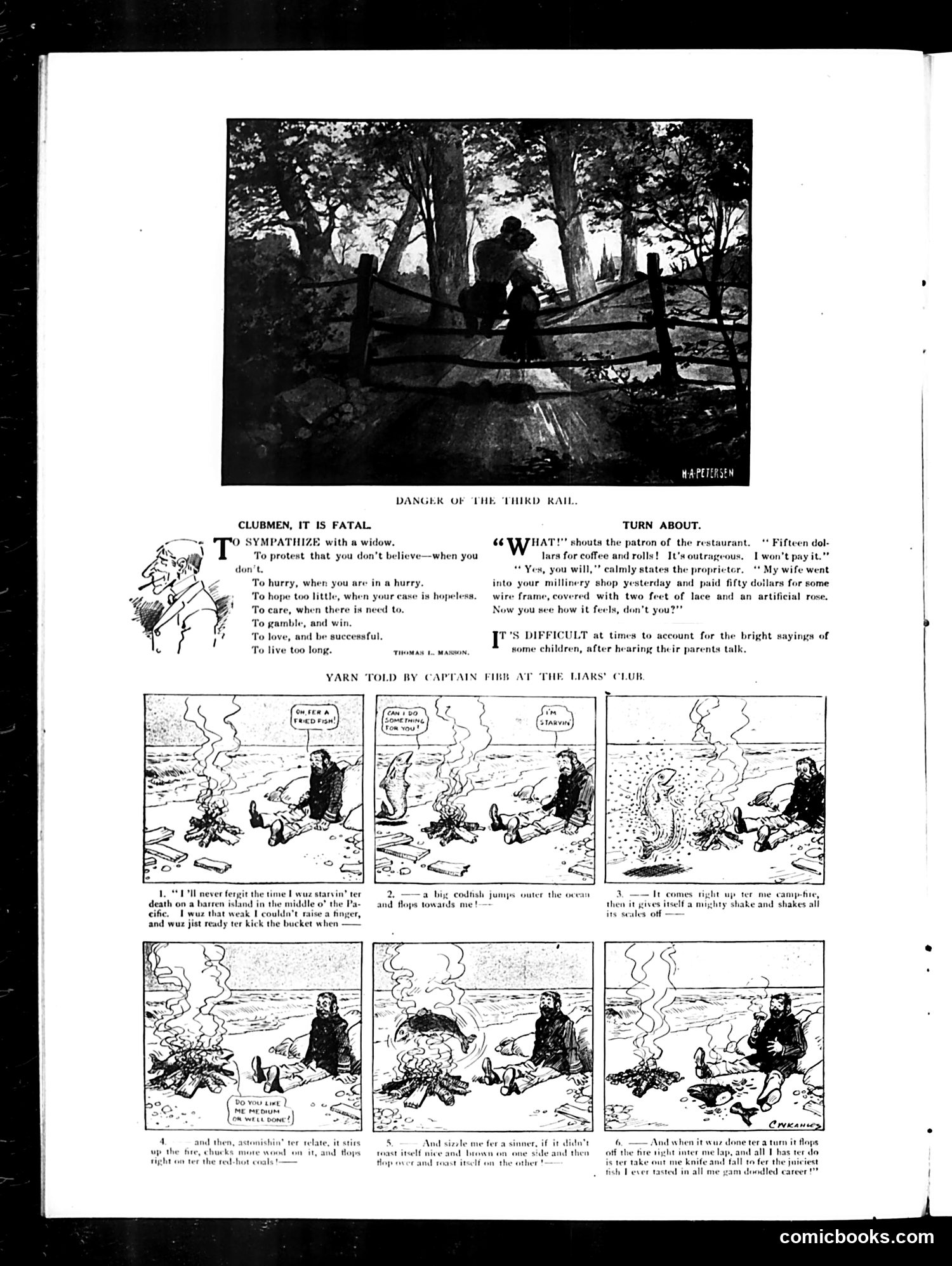
This page contains three distinct pieces of satire: **"Danger of the Third Rail"** (top): A moralistic poem warning against various character flaws—unsympathetic behavior toward widows, dishonesty, impatience—using the "third rail" (electrified rail in streetcars, deadly to touch) as a metaphor for fatal mistakes. **"Turn About"** (right column): Satirizes wealthy restaurant patrons complaining about inflated prices ($15 for coffee and rolls) while their wives spend extravagantly ($50 on millinery with lace and artificial roses). The joke exposes hypocrisy: men object to restaurant costs but ignore their wives' luxury spending. **"Yarn Told by Captain Firg at the Liars' Club"** (bottom): A tall tale about a starving castaway on a barren island whom a codfish conveniently jumps toward, then roasts itself on the fire—an absurdist story typical of the "Liars' Club" genre, poking fun at exaggerated adventure narratives. The page blends moral instruction with social satire and humorous fiction, characteristic of *Judge* magazine's mix of content.
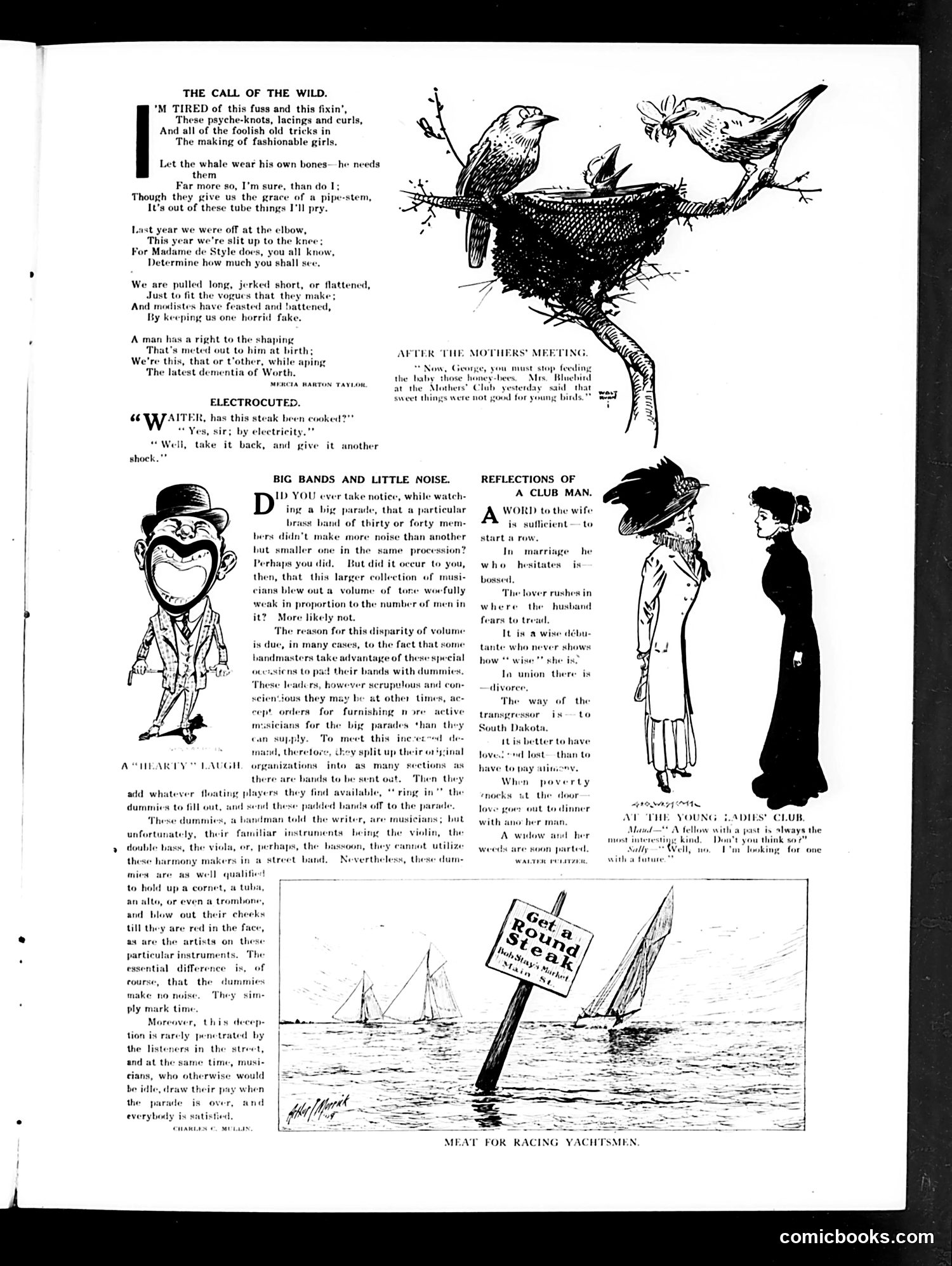
This page contains several satirical pieces typical of early 20th-century Judge magazine: **"The Call of the Wild"** mocks the extreme fashion constraints imposed on women—corsets, tight lacing, and elaborate styling that deform the body. The female speaker rebels against being artificially shaped by fashion designers (referencing "Worth," the famous designer), comparing women's suffering to whales wearing their own bones naturally. **"Big Bands and Little Noise"** satirizes orchestral padding—the practice where bandmasters hire non-musician "dummies" to fill out bands for parades, inflating headcount without improving sound quality. The joke targets both the dishonest practice and the useless dummies who simply "mark time." **"Electrocuted"** and other brief sections offer light social humor about modern life. **"Reflections of a Club Man"** and **"At the Young Ladies' Club"** present cynical observations on marriage and relationships—typical satirical commentary on domestic life. The naval cartoon advertises a boat product. Overall, the page targets fashion excess, orchestral fraud, and marital discord—common Judge targets for social satire.
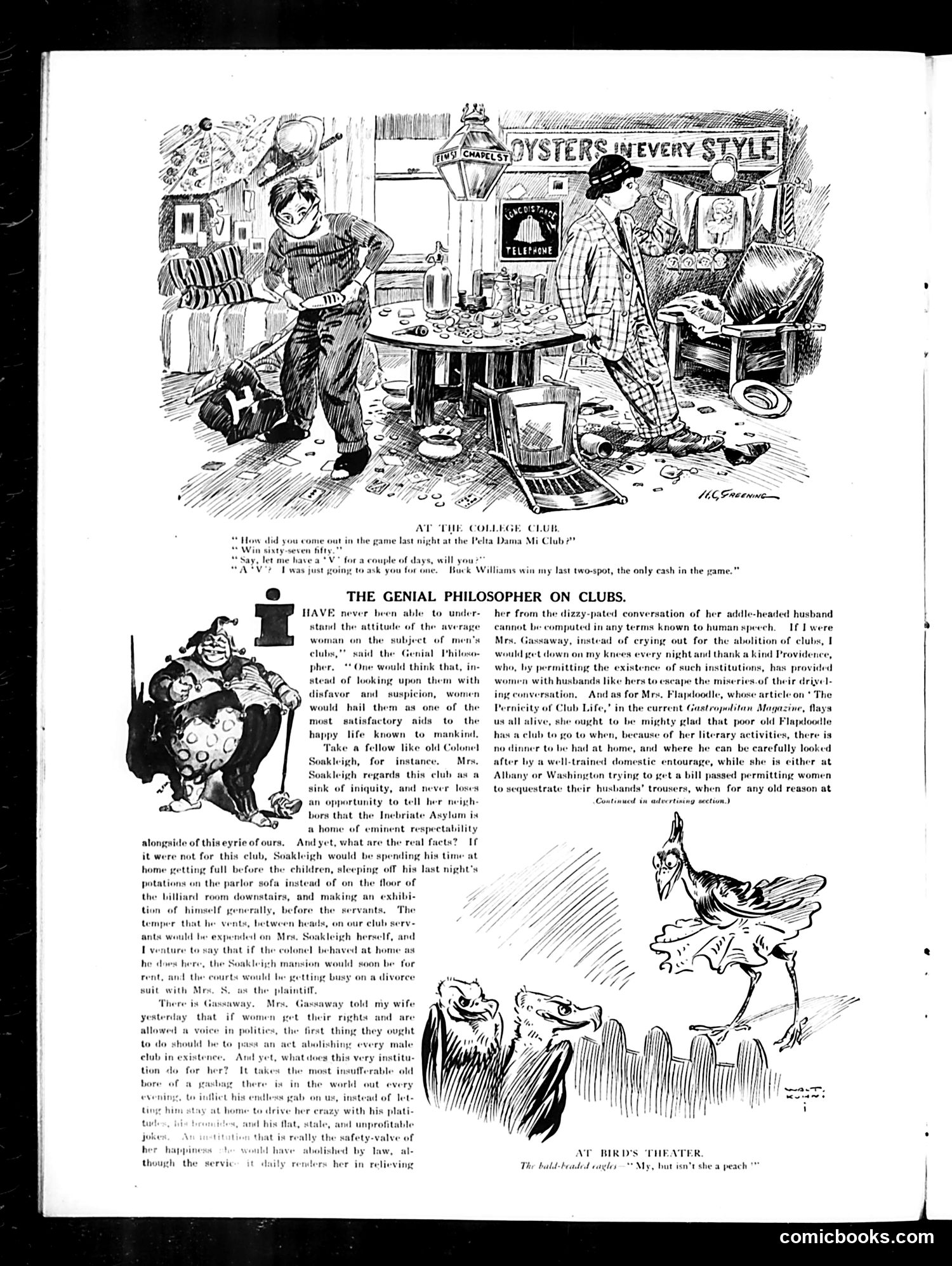
This page satirizes men's social clubs and their role in preserving male domestic comfort at women's expense. The top cartoon shows a college club scene with oysters and gambling. The main essay argues that clubs, while morally suspect to some (like the prudish Mrs. Soakleigh), actually serve an important purpose: they provide husbands refuge from home life. The "Genial Philosopher" defends clubs as allowing men to escape their wives' "drivel-driving conversation" and incompetent domestic management. The satire cuts both ways: it mocks club culture's self-importance while critiquing women's limited domestic sphere. A secondary jab targets women's suffrage advocates, suggesting if women gain political power, their first act should be abolishing male clubs—ironically, this would trap wives with their husbands full-time. The bottom cartoon, "At Bird's Theater," appears unrelated commentary on theatrical attendance.
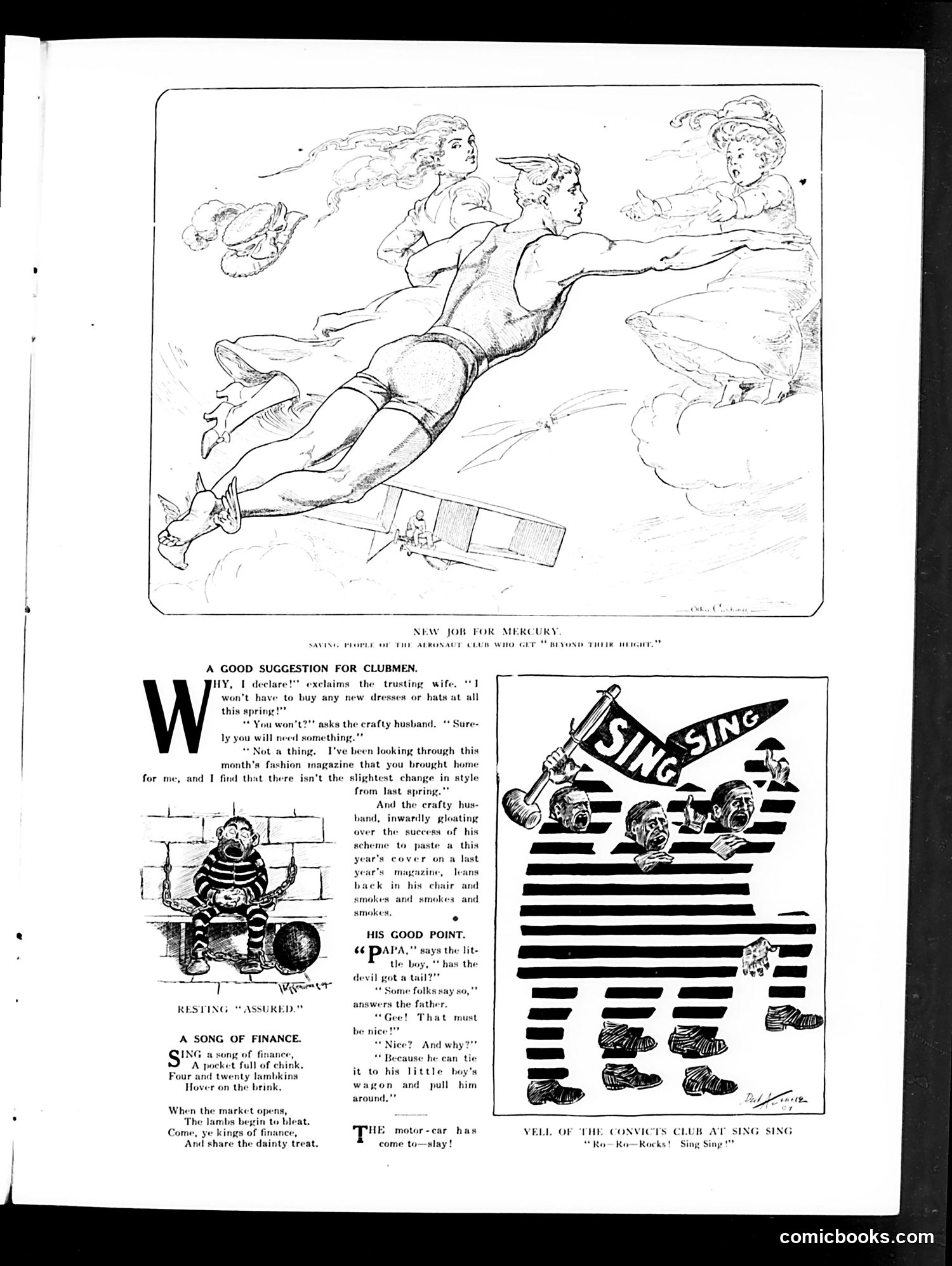
This page contains three separate satirical pieces typical of early 20th-century Judge magazine: 1. **"A Good Suggestion for Clubmen"**: A husband tricks his wife into believing fashion hasn't changed from last year, so she won't demand new clothes. He "gloats" while smoking—satirizing husbands' self-interested frugality disguised as logic. 2. **"His Good Point"**: A father explains to his son that the devil "got tied to a little boy's wagon"—suggesting even the devil would be worn down by a child's relentless demands. The joke mocks children's persistence and parental exhaustion. 3. **"A Song of Finance"** and **"Vell of the Convicts Club at Sing Sing"**: These appear to mock financial speculation ("Four and twenty lambkins / Hover on the brink") and reference Sing Sing prison's convict population, likely satirizing white-collar crime or prison conditions. The top illustration shows figures flying/floating, captioned "New Job for Mercury"—referencing the Roman messenger god, possibly satirizing job-seeking or economic mobility.
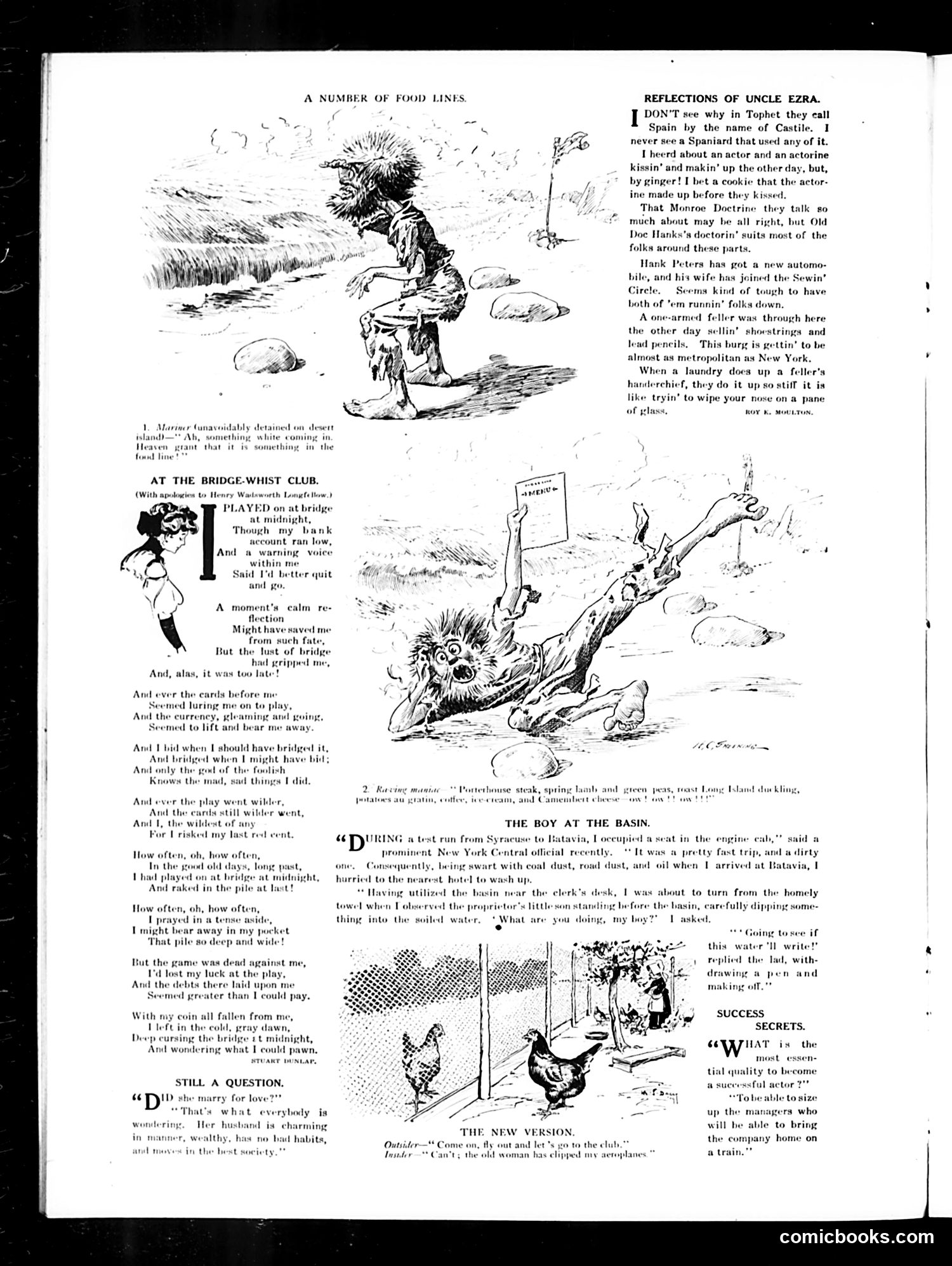
This page contains several satirical pieces typical of early 20th-century American humor: **"Reflections of Uncle Ezra"** presents a rustic character commenting on contemporary topics—the Monroe Doctrine, modern conveniences like automobiles, and urbanization. The humor relies on a rural persona's bemused observations about city life and politics. **"At the Bridge-Whist Club"** satirizes compulsive gambling among wealthy club members, depicting how card-playing addiction destroys finances and judgment. The melodramatic verse mocks the self-destructive behavior of the leisure class. **"The Boy at the Basin"** offers gentle humor about a hotel boy testing bathwater with a pen before a guest uses it—suggesting either cleanliness concerns or youthful mischief. **"Still a Question"** briefly mocks marriages of convenience, questioning whether a wealthy husband's charm masks mercenary motivations. The cartoons throughout are whimsical line drawings supporting the text. The overall tone is light social satire targeting urban leisure activities, class pretensions, and human folly rather than serious political commentary.
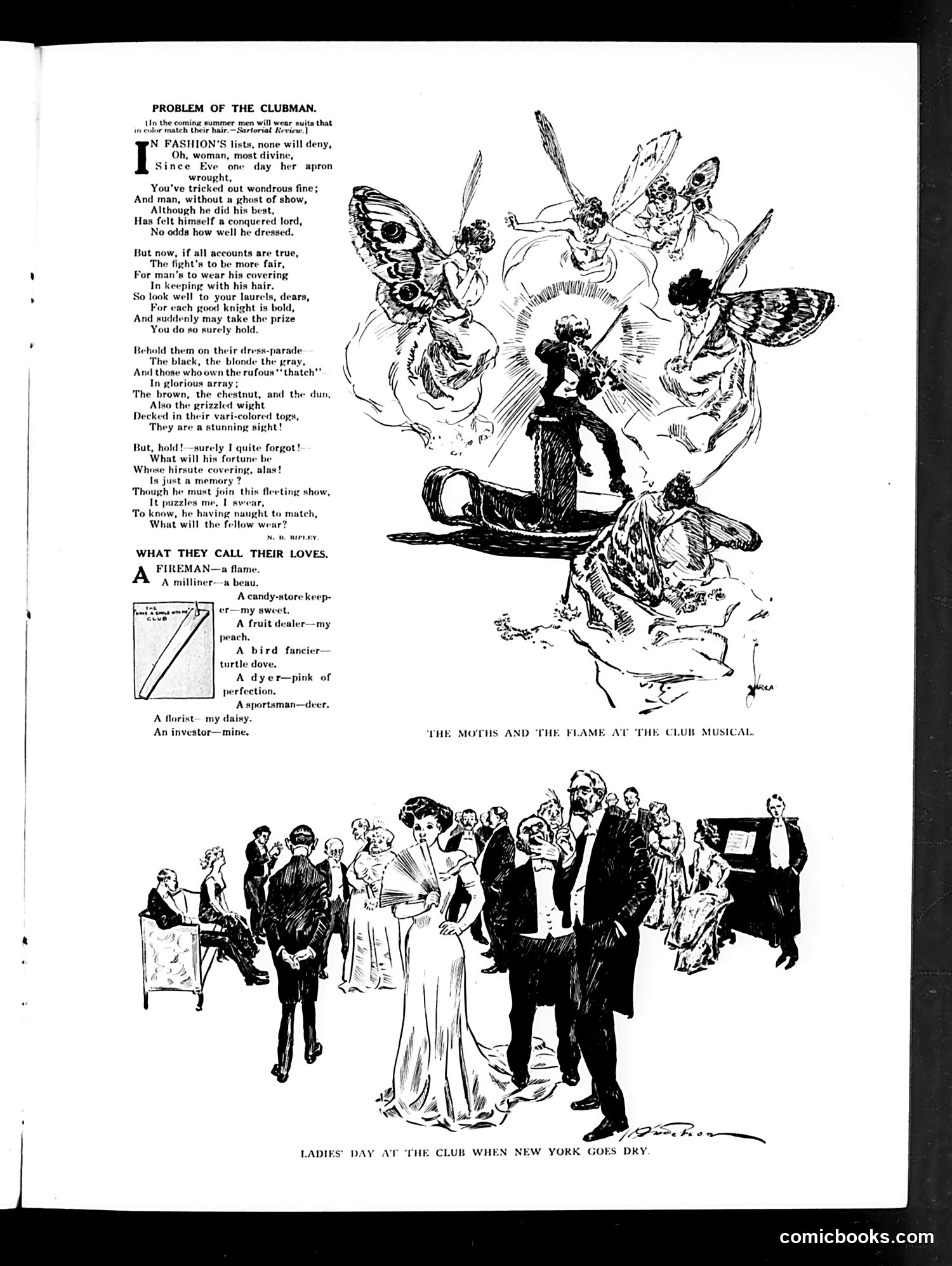
This Judge magazine page contains three satirical pieces about fashionable society: **"Problem of the Clubman"** (top): A humorous poem mocking men's obsession with matching their clothing to their hair color. The joke culminates in ridiculing bald men—if they have no hair to coordinate outfits with, what will they wear? This satirizes the vanity of well-dressed clubmen who carefully curate their appearance. **"What They Call Their Loves"** (middle): A punny wordplay list where professions are matched with romantic terms. A florist loves a "daisy," a dyer is "pink of perfection"—clever but lightweight humor typical of the era. **"The Moths and the Flame at the Club Musical"** and **"Ladies Day...When New York Goes Dry"** (bottom illustrations): These appear to reference Prohibition-era social life, likely satirizing the absurdity of upscale clubs adapting to alcohol bans, with women now attending previously male-dominated spaces. The "moths to flame" imagery suggests women attracted to these venues. The overall tone mocks upper-class pretension during the Prohibition period.
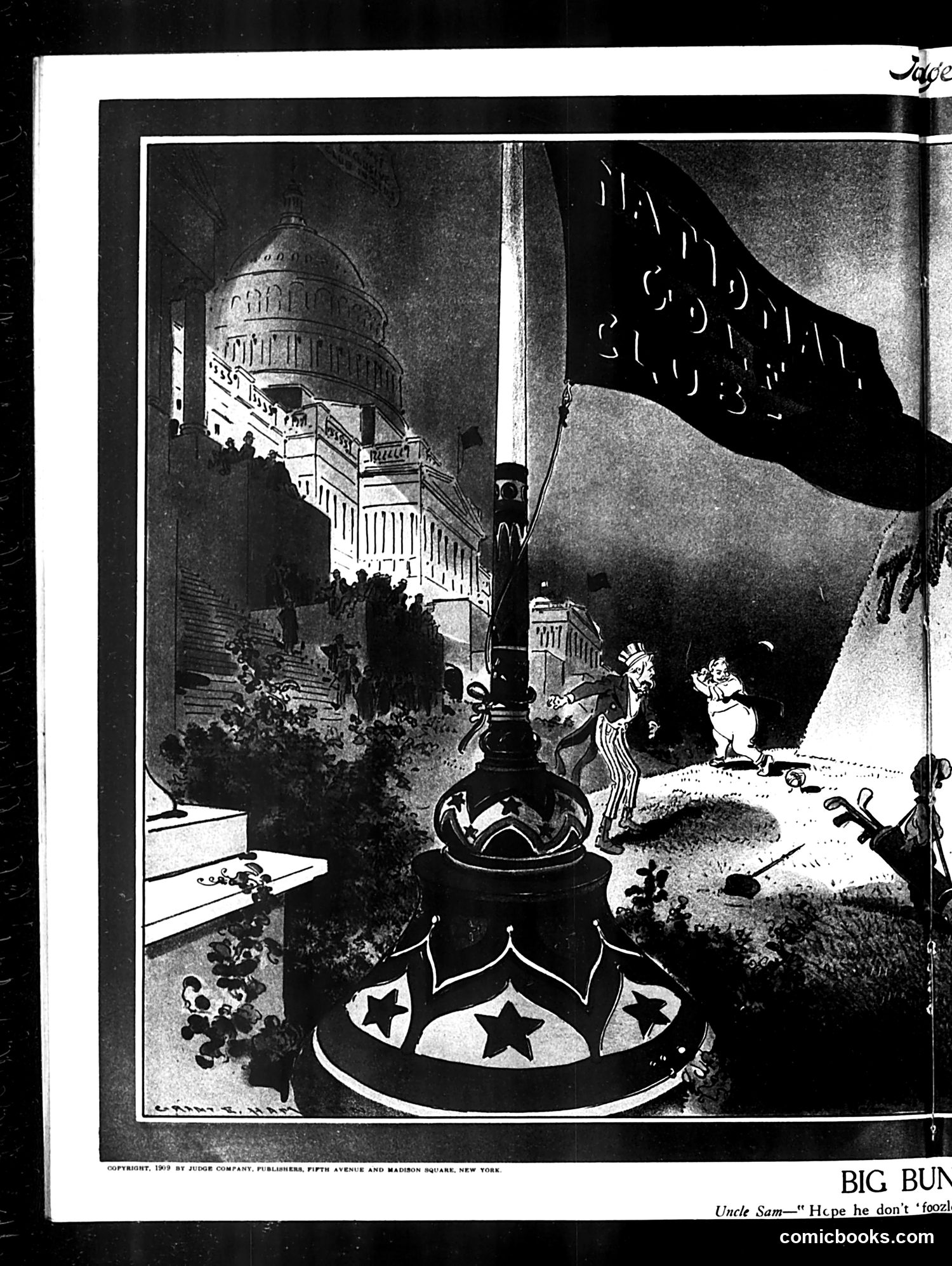
This appears to be a political cartoon from *Judge* magazine (copyright 1903, per the visible text). The image shows **Uncle Sam** (identified by the visible text) as a large figure in the foreground, looking toward the U.S. Capitol building in the background, where various figures and a flag are visible. The incomplete caption "Hope he don't foozl[e]" suggests Uncle Sam is expressing concern about political bungling or mismanagement by officials at the Capitol. The cartoon likely critiques governmental incompetence or political corruption of the early 1900s era. However, without the complete text visible ("BIG BU" appears to be a cut-off headline), the specific political issue being satirized remains unclear—whether it concerns a particular scandal, policy debate, or political figure.
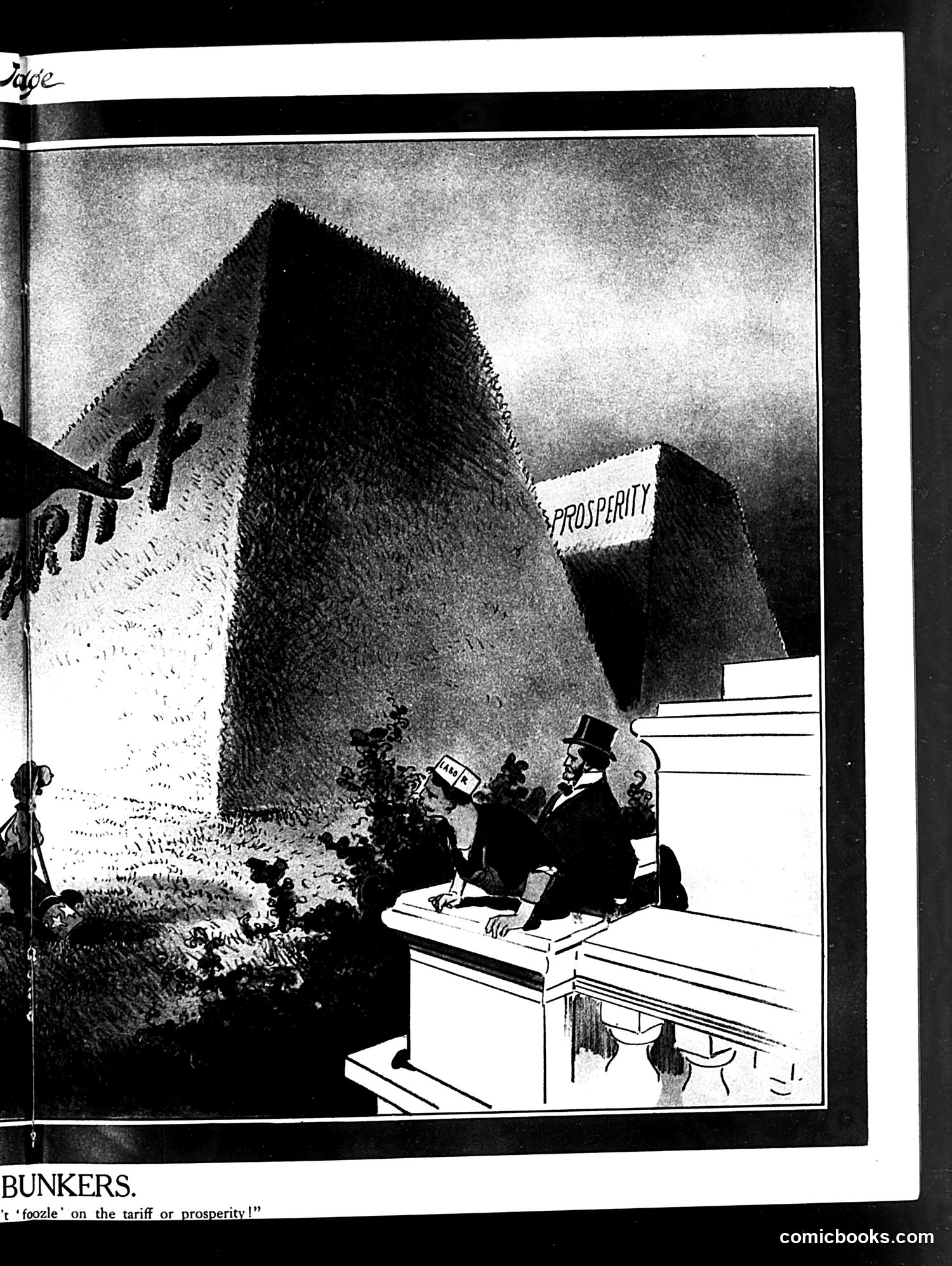
This cartoon satirizes political debate over tariffs and economic prosperity. The image shows figures in formal attire (top hats) positioned defensively in what appears to be a bunker or fortified position, with massive earthen walls looming overhead. The word "PROSPERITY" is visible on a sign in the background. The caption's reference to "foozle" (golf slang for a bungled shot) suggests politicians are making poor strategic decisions regarding tariff policy. The bunker imagery implies they've dug themselves into defensive positions from which escape is difficult. The cartoon likely criticizes how tariff debates—a major political issue of the era—had become entrenched, with politicians unable to move forward productively on economic matters. The small-scale figures versus the enormous fortifications emphasize how trapped or overwhelmed they are by the situation they've created.
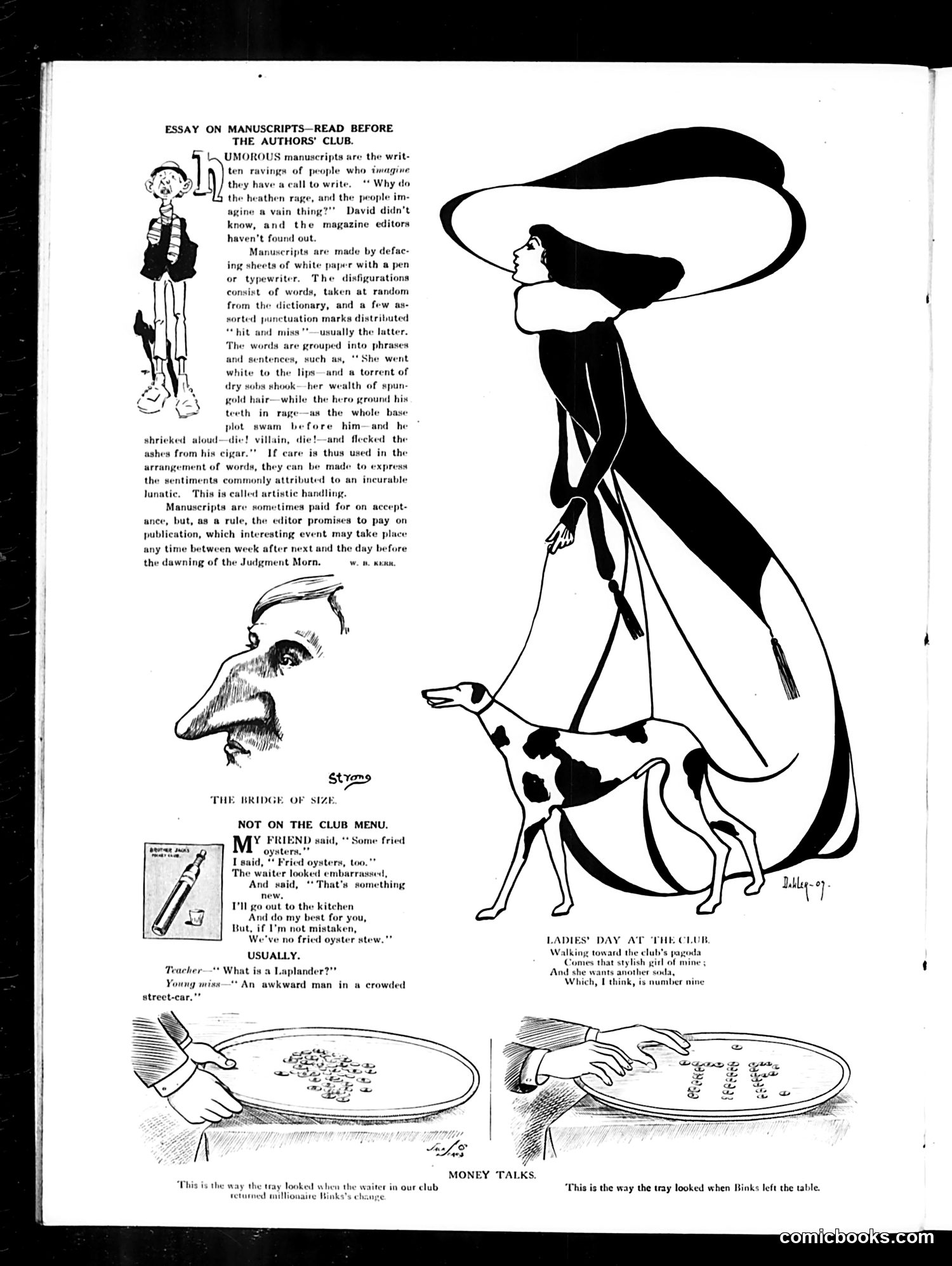
This page from *Judge* magazine contains several satirical pieces mocking early 20th-century social pretensions and literary absurdity. **"Essay on Manuscripts"** ridicules amateur writers submitting to magazines—their work is characterized as incoherent, poorly punctuated drivel masquerading as art. The essay sardonically notes editors "haven't found out" why people bother writing. **"Ladies' Day at the Club"** depicts a fashionable woman with her small dog, satirizing upper-class affectation and vanity—she wants "another suit / Which, I think, is number nine." **"Money Talks"** is a visual gag showing a restaurant tray before and after a wealthy diner ("millionaire Binks") leaves: the first image shows scattered coins/tips, the second shows them arranged to spell "TIP"—suggesting the rich use money to communicate even their gratuities ostentatiously. **"Not on the Club Menu"** jokes about a waiter's embarrassment when a member orders fried oysters unavailable at the club, revealing class anxieties about proper dining etiquette. The overall theme: mocking literary pretension, social climbing, and nouveau-riche display.
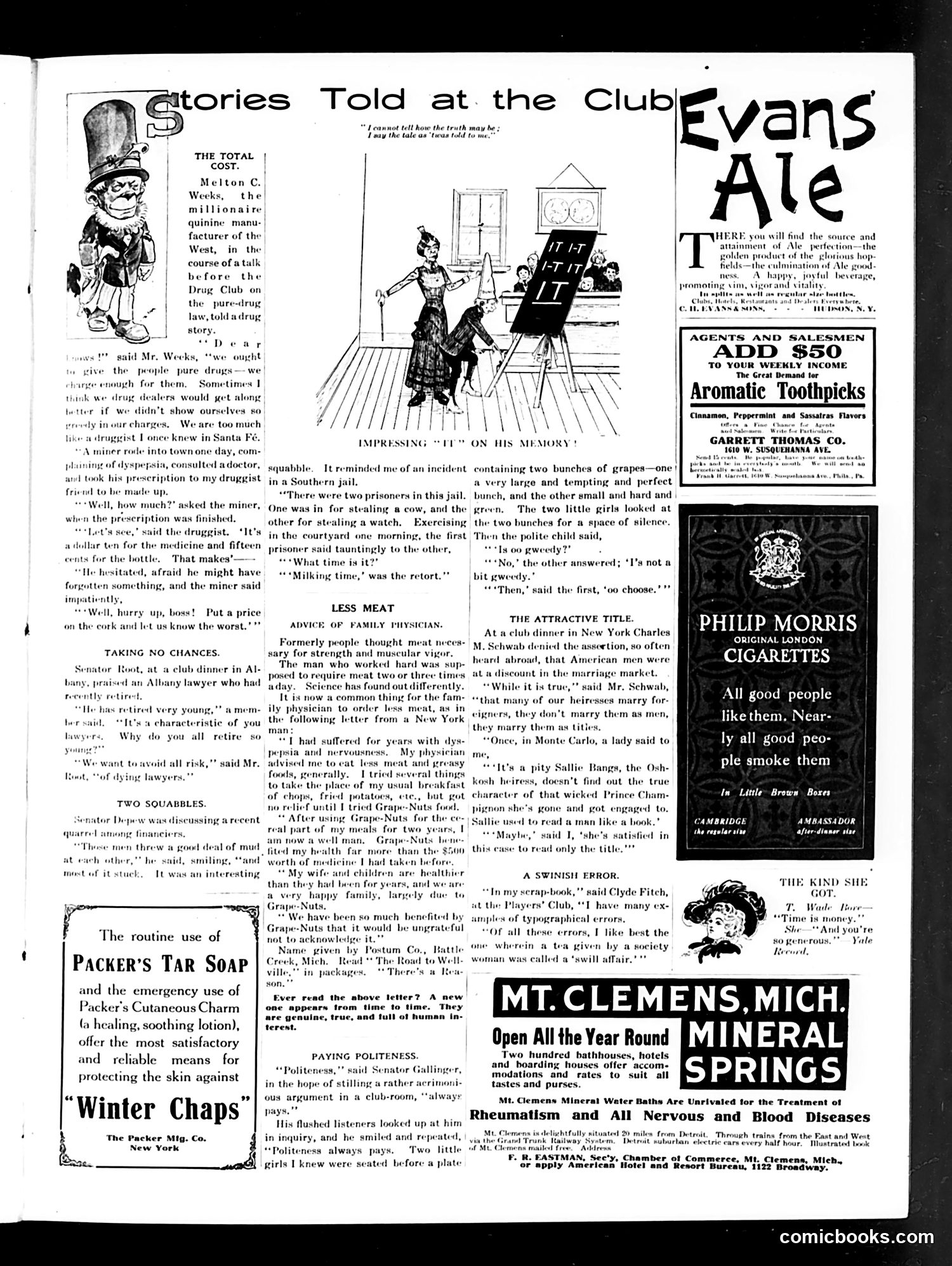
This page from *Judge* magazine features a series of anecdotal humor pieces—a common format for the publication. The main cartoon shows two young girls being offered a choice between two bunches of grapes, illustrating a lesson about greed ("greedy"). The framing device is "Melton C. Weeks," a wealthy quinine manufacturer, recounting stories at a Drug Club meeting about the importance of pure drugs and ethical business practices. The jokes themselves are genteel club humor typical of the era: a miner confused about prescription costs, discussions about dietary meat consumption and digestion (pepsia/dyspepsia was a common concern), and anecdotes about politeness and typographical errors. The satire is light and moralistic rather than political—emphasizing virtues like honesty in business, politeness, and moderation. The surrounding advertisements (toothpicks, cigarettes, mineral springs) reflect contemporary consumer culture. This represents *Judge*'s entertainment-focused content rather than hard political commentary.
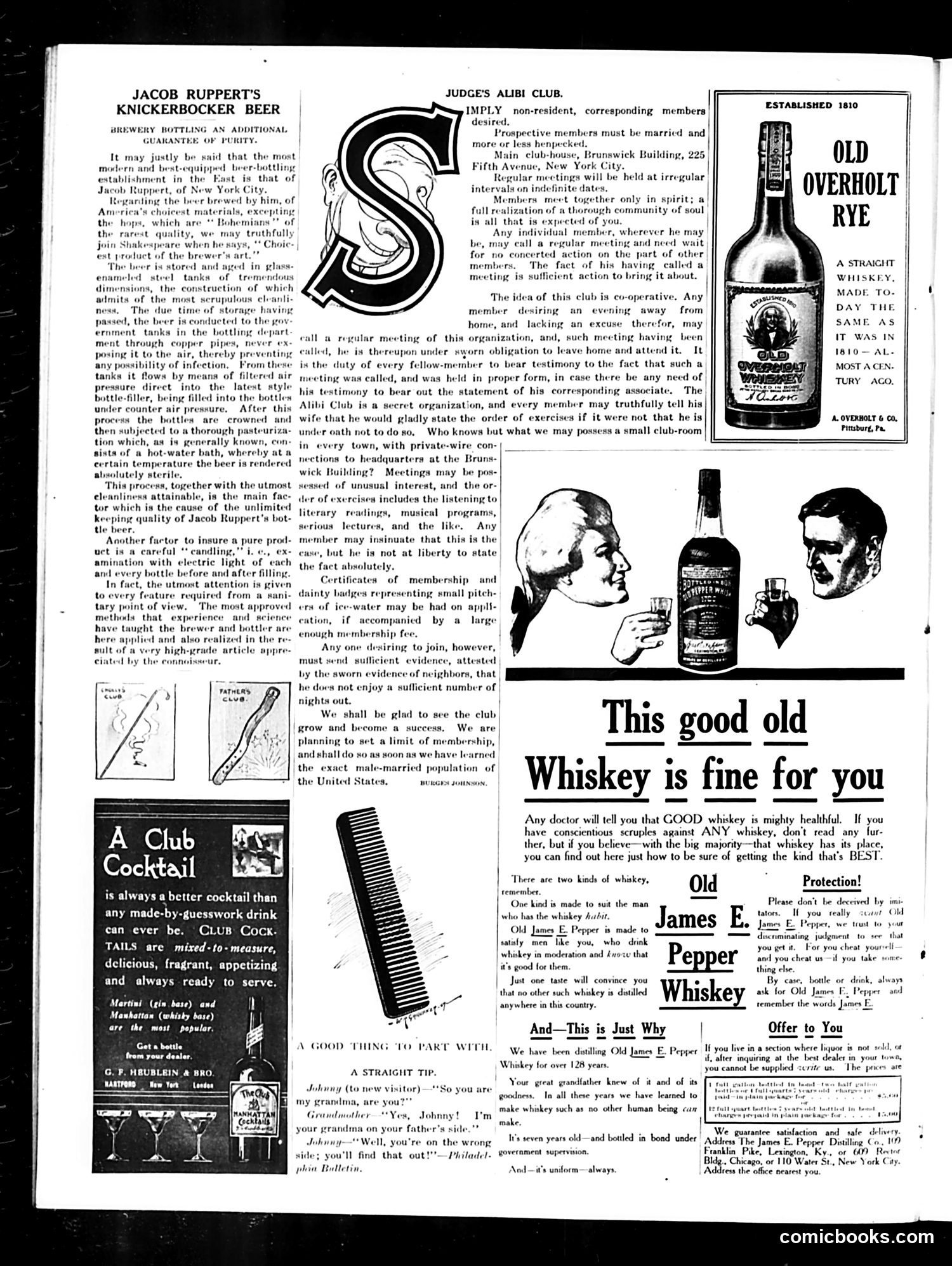
This page contains primarily **advertisements** rather than political cartoons, reflecting early 20th-century magazine content. **Main Features:** 1. **Knickerbocker Beer ad** (left): Lengthy promotional text detailing Jacob Ruppert's brewery's bottling process and purity standards—typical of period beer marketing emphasizing sanitation and modern manufacturing. 2. **Judge's Alibi Club** (center): A satirical piece describing a fictional "secret organization" for married men seeking excuses to leave home. The humor targets husbands fabricating pretexts ("alibis") to their wives for nights out. Members supposedly conduct sworn-secret meetings while maintaining plausible deniability—social satire on marital deception and masculine culture. 3. **Whiskey advertisements** (right): Multiple ads for Old Overholt Rye and Old James E. Pepper Whiskey, using period marketing claims about healthfulness and quality. The page reflects Prohibition-era advertising (alcohol was legal then) and period gender relations humor—mocking married men's desire for independence from spousal oversight.
This is a full-page advertisement for Budweiser beer by Anheuser-Busch Brewery of St. Louis. It's not a cartoon or satirical content—it's a straightforward commercial advertisement. The page features the Budweiser logo with an eagle and "A" emblem at the center, surrounded by decorative wheat stalks and hops imagery. The ad emphasizes the beer's availability "Everywhere" across homes, hotels, clubs, and cafes. This reflects early-to-mid 20th century advertising before Prohibition or during its aftermath, when breweries actively promoted their products through magazine placements in publications like Judge.
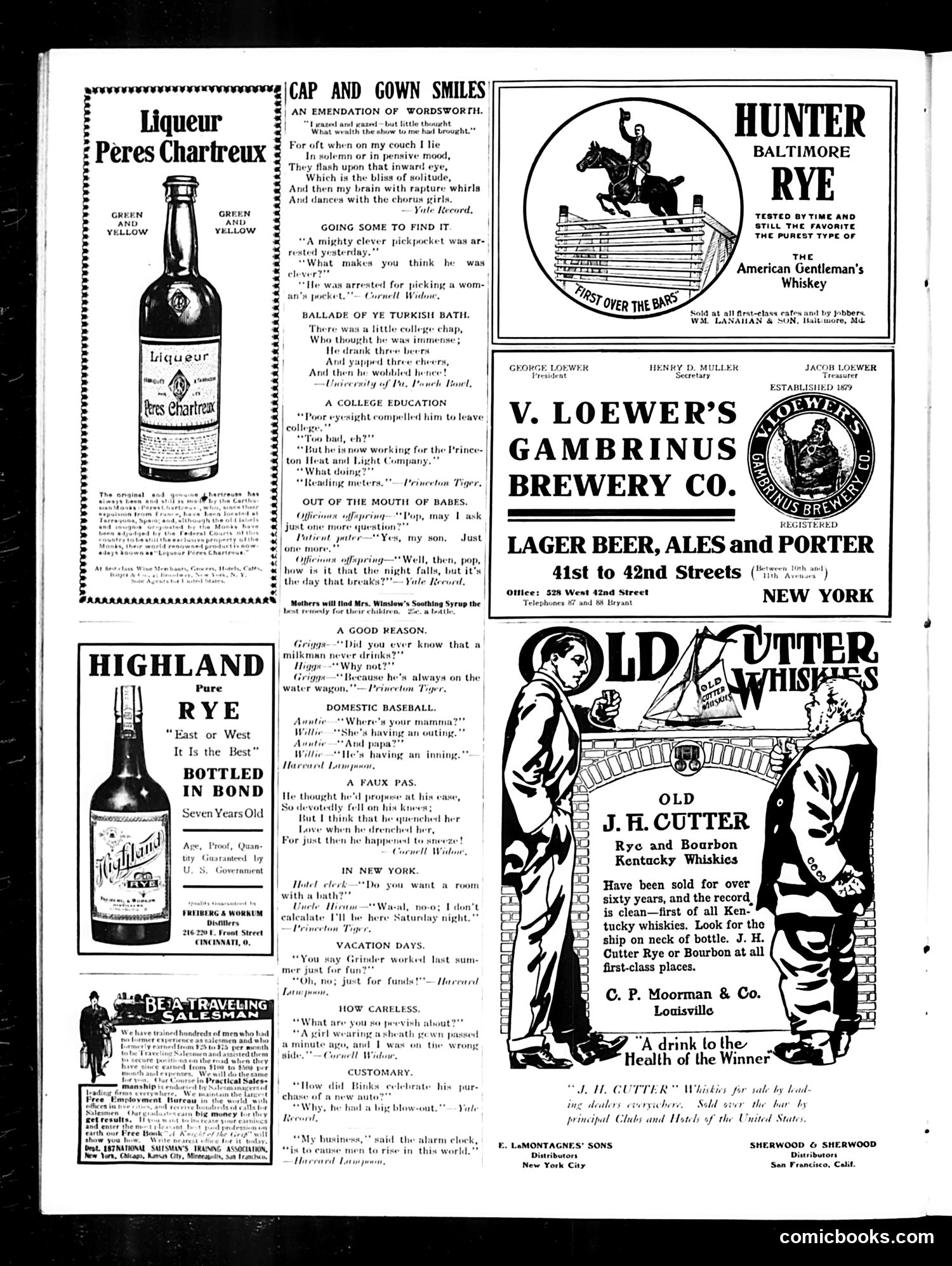
This page is primarily **advertising**, featuring multiple whiskey and beer advertisements from the late 19th/early 20th century. The ads promote products like Highland Rye, Hunter Baltimore Rye, V. Loewer's Brewery, Old J.H. Cutter, and Liqueur Peres Chartreux. Interspersed between ads are brief **humorous anecdotes and jokes**—typical Judge magazine filler content—touching on college life, domestic situations, and mild social observations (a pickpocket, a Turkish bath, a milkman who doesn't drink, etc.). These appear sourced from college humor magazines like Yale Record and Harvard Lampoon. The page reflects **early American drinking culture** and advertising practices, where spirits were marketed directly in satirical publications without modern regulatory restrictions. The jokes are gentle period humor with no apparent political satire or social commentary beyond light domestic comedy. No specific political figures or caricatures are identifiable on this page. It's essentially a advertisements-and-humor miscellany typical of Judge's format.
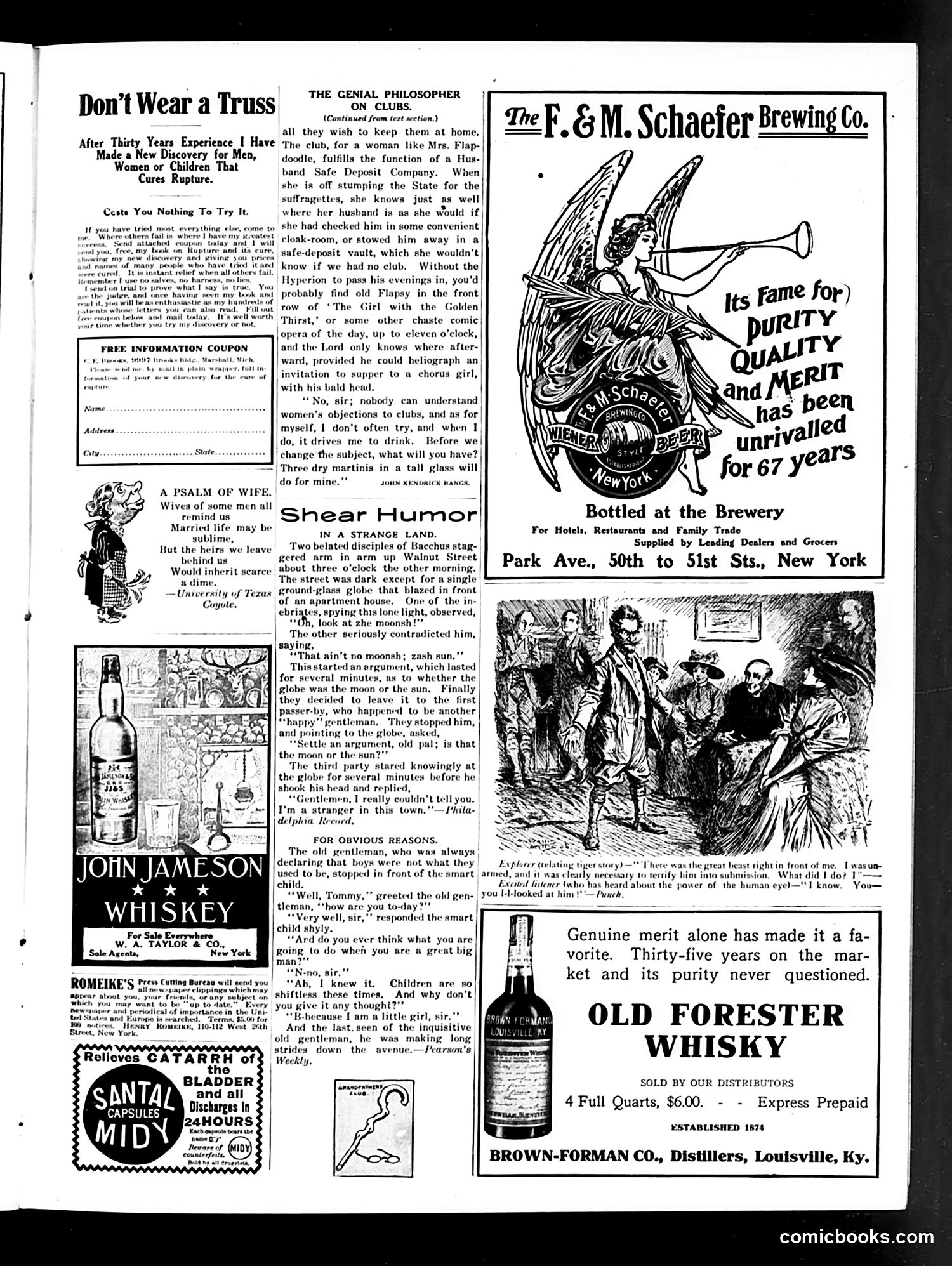
This page is primarily **advertising**, with brief humorous content interspersed. The main satirical piece is "The Genial Philosopher on Clubs," which defends gentlemen's clubs against suffragette criticism. The writer argues clubs serve as "safe deposit" for husbands while wives pursue political activism—a joking defense of male social spaces during the women's suffrage era. The shorter humor pieces ("In a Strange Land," "For Obvious Reasons") are mild workplace/domestic jokes typical of early 20th-century magazines. The "Psalm of Wife" is sentimental verse about wives' sacrifices. The page is otherwise filled with advertisements for whiskey (John Jameson, Old Forster), the F&M Schaefer Brewing Company, and patent medicines (Santal Capsules for catarrh). These ads reflect common Judge magazine content—alcohol and dubious health products marketed to male readers. The cartoons accompanying ads are generic illustrations with no specific political reference beyond period gender stereotypes and class assumptions about club-going gentlemen.
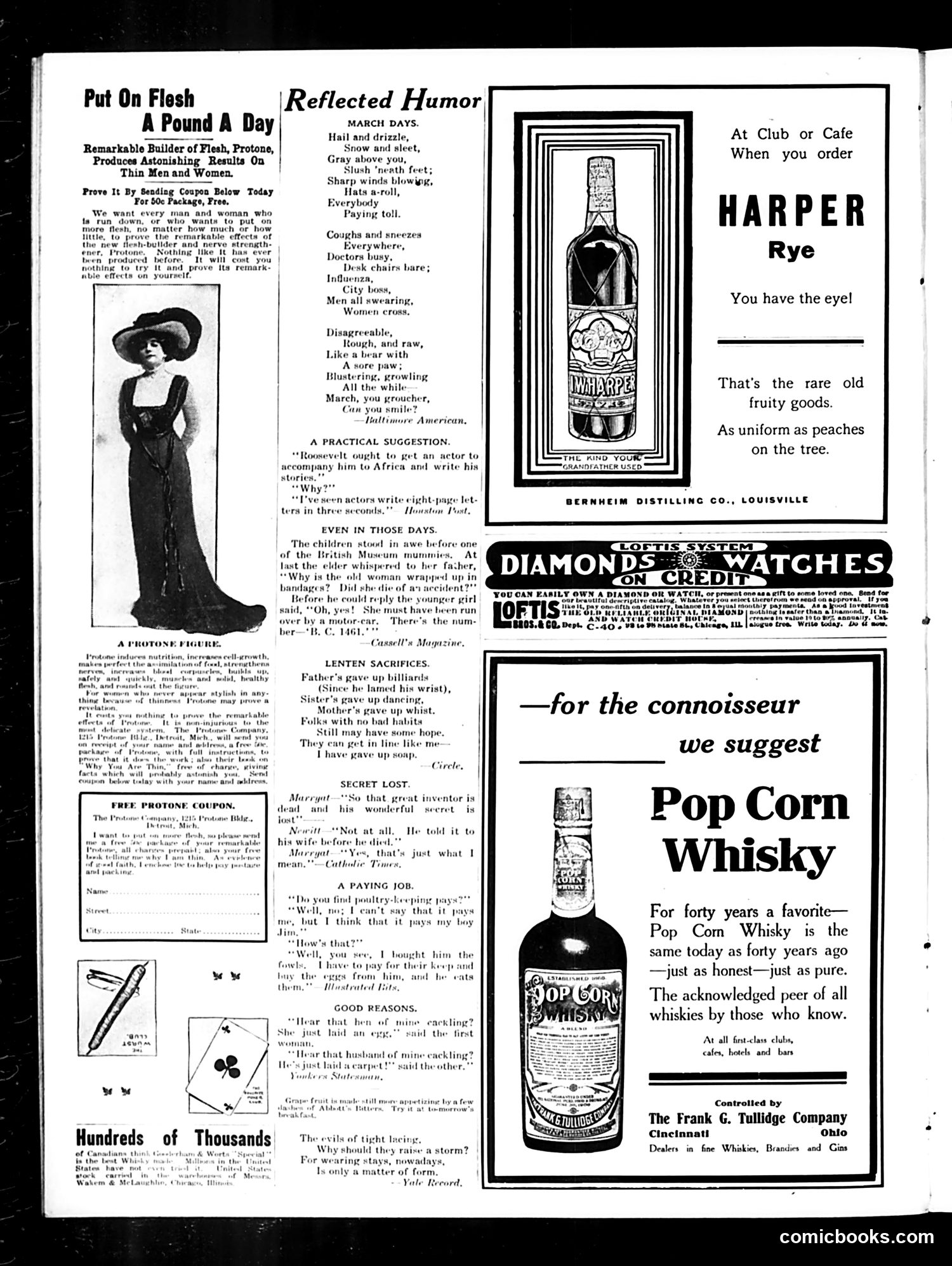
This is primarily an **advertising page** with minimal editorial content. The page features: **Main Advertisements:** - **Protone**: A health supplement promising weight gain ("A Pound A Day"), marketed to thin men and women - **Harper Rye** whiskey: Emphasizing quality and consistency - **Pop Corn Whisky**: Claiming 40 years of unchanged "honest" quality - **Diamonds & Watches on Credit**: Installment purchasing for luxury goods - **Loftis System**: Jewelry/watch credit promotion **Humor Section ("Reflected Humor"):** Contains brief satirical poems and jokes about March weather, Lenten sacrifices, and domestic life—typical light social commentary. One joke references Theodore Roosevelt as an actor, reflecting early 1900s political discourse. **Context for Modern Readers:** The ads reveal period concerns (weight gain supplements, credit purchasing) and Prohibition-era whiskey marketing using coded language about "honesty" and "purity." The overall tone reflects early 20th-century American consumer culture and modest satirical humor typical of Judge magazine.
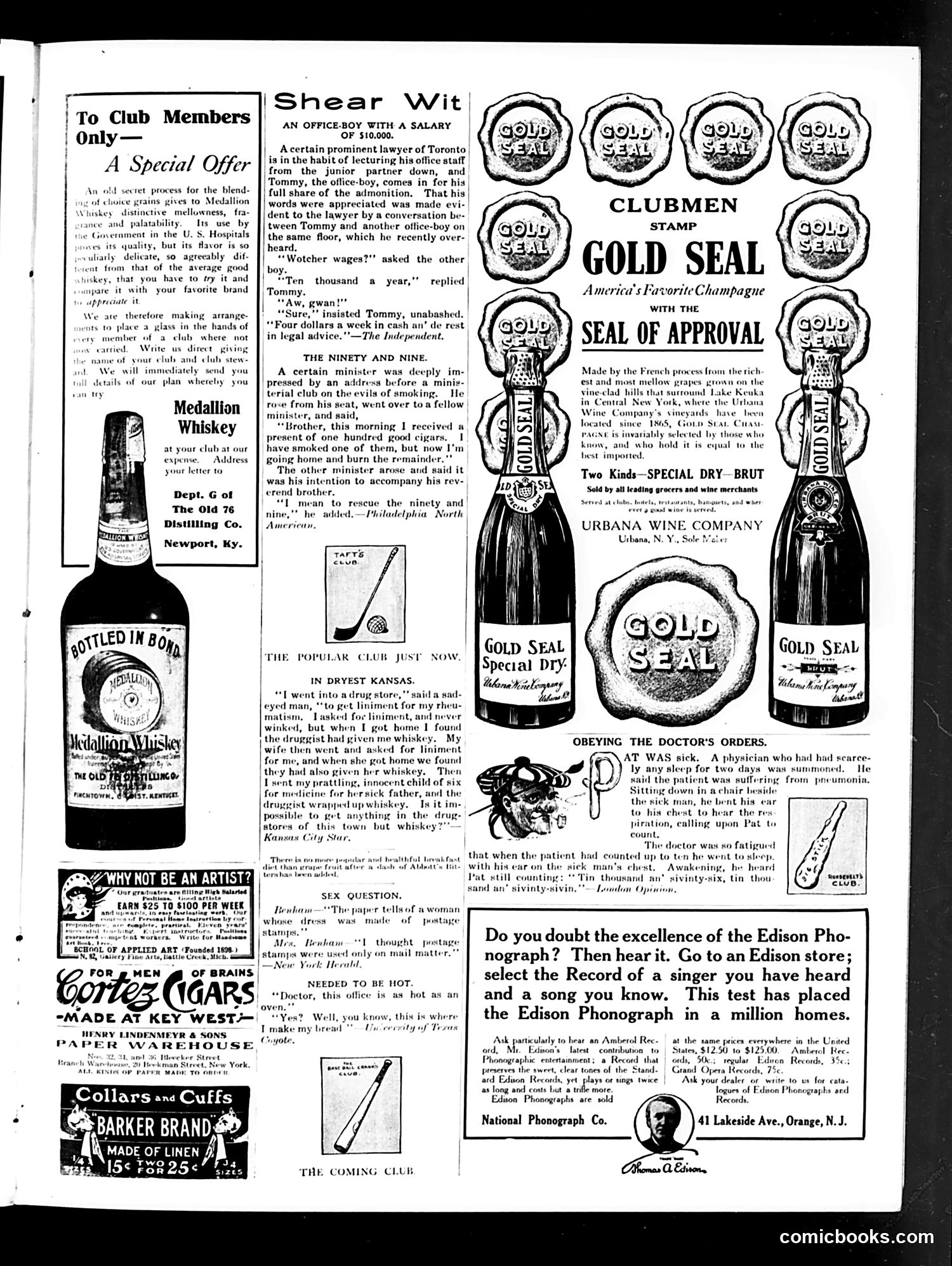
This page is primarily **advertising with comic anecdotes** rather than political satire. The humor relies on wordplay and situational comedy typical of early 20th-century magazines. **Key anecdotes:** 1. **"Office-boy with $10,000 salary"**: A lawyer's junior staff member claims to earn $10,000 yearly—$4 in cash weekly, the rest in "legal advice" (lectures). The joke is self-aware satire about workplace exploitation dressed as mentorship. 2. **"The Ninety and Nine"**: A minister receives 100 cigars, smokes one, then recruits a colleague to help "rescue" the remaining 99—mocking religious hypocrisy about sin and temptation. 3. **Whiskey confusion stories**: Multiple anecdotes about people accidentally receiving whiskey instead of medicine, playing on Prohibition-era anxieties and the irony that whiskey was commonly used medicinally. 4. **"Obeying the Doctor's Orders"**: A tired doctor conducting an exam can't count past "ten thousand and seventy-six"—absurdist humor about professional exhaustion. The page advertises whiskey, cigars, champagne, and Edison phonographs—products that would become controversial or banned during Prohibition.
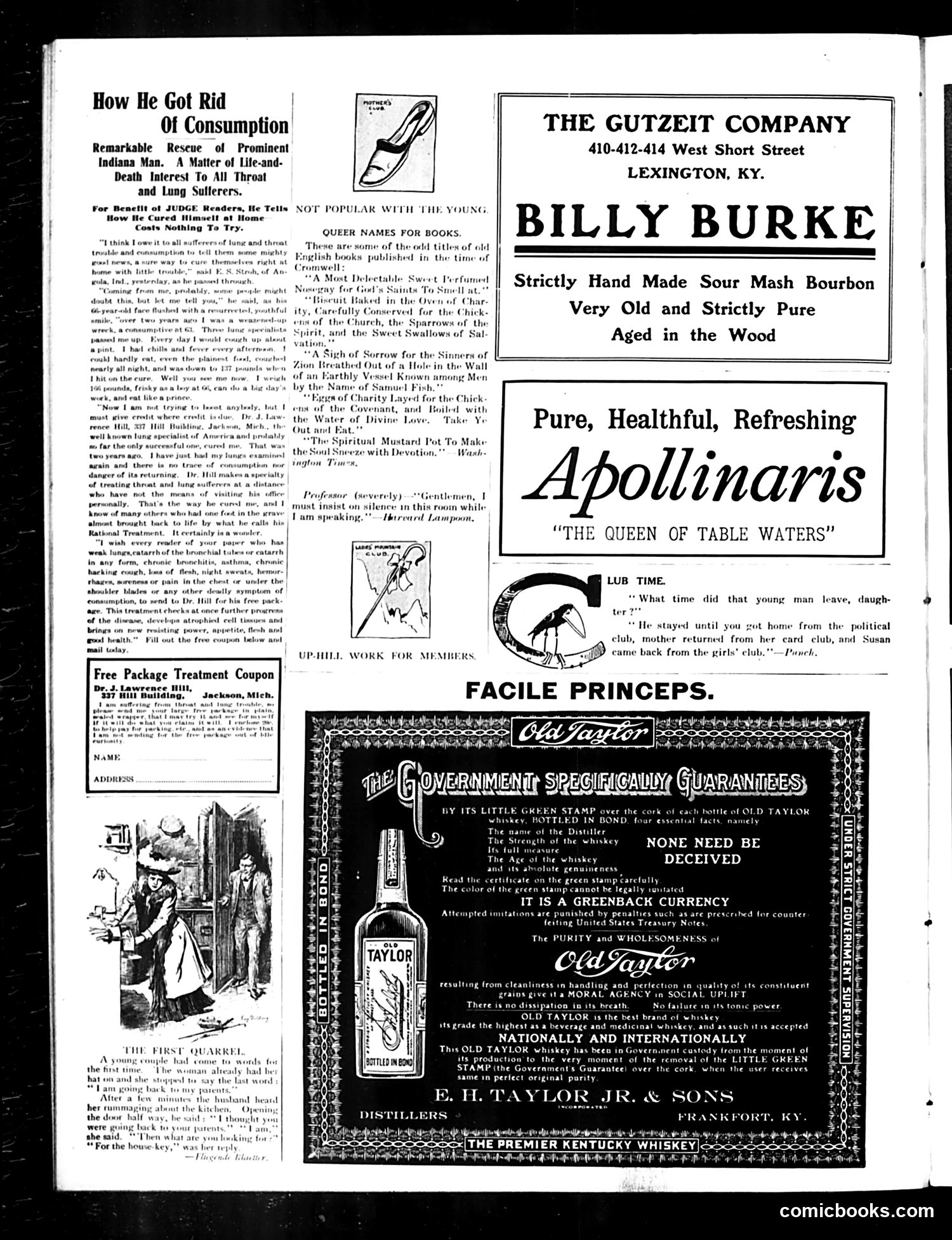
This page is primarily **advertising**, not editorial content or political satire. It contains: **Left side:** A medical testimonial ad for Dr. J. Lawrence Hill's tuberculosis treatment ("consumption"), featuring a patient success story and free coupon. This appears to be quack medicine marketing common in early 20th-century publications. **Right side:** Three liquor/beverage advertisements: - Billy Burke bourbon (Lexington, KY) - Apollinaris mineral water - Old Taylor whiskey (with elaborate "greenback currency" branding) **Small humor section ("Club Time"):** A brief joke about a young man overstaying his visit while the father was at a political club. The page reflects **early 1900s advertising standards**, mixing dubious health claims with luxury products. The Old Taylor whiskey ad's emphasis on "government guarantee" and "greenback currency" mimics official currency design—ironic marketing for alcohol in an era of Prohibition debates and patent medicine skepticism.
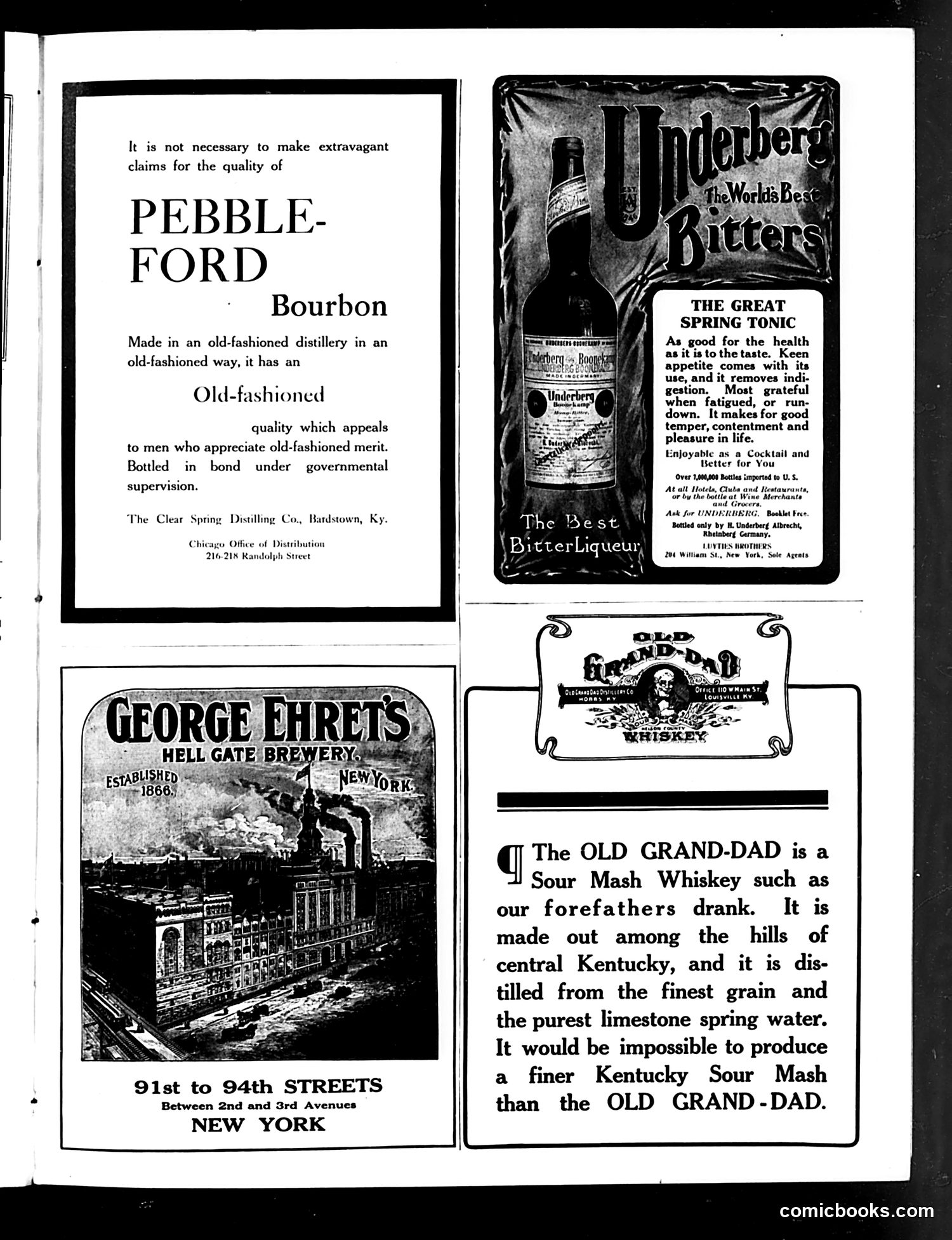
This is primarily a **liquor advertising page** from Judge magazine, not a political cartoon. It contains four separate alcohol advertisements: 1. **Pebble-Ford Bourbon** — emphasizes "old-fashioned" quality and government oversight (bottled-in-bond) 2. **Underberg Bitters** — marketed as a health tonic and appetizer 3. **George Ehret's Hell Gate Brewery** — New York brewery established 1866 4. **Old Grand-Dad Whiskey** — Kentucky sour mash positioned as traditional ("forefathers drank") **Historical context**: This likely dates from the **pre-Prohibition era** (before 1920), when alcohol advertising was common in magazines. The repeated appeals to tradition and "old-fashioned" qualities reflect marketing strategies of the time. The health claims for bitters reflect 19th-century patent medicine attitudes. There is no satire or political commentary visible—this is straightforward commercial advertising.
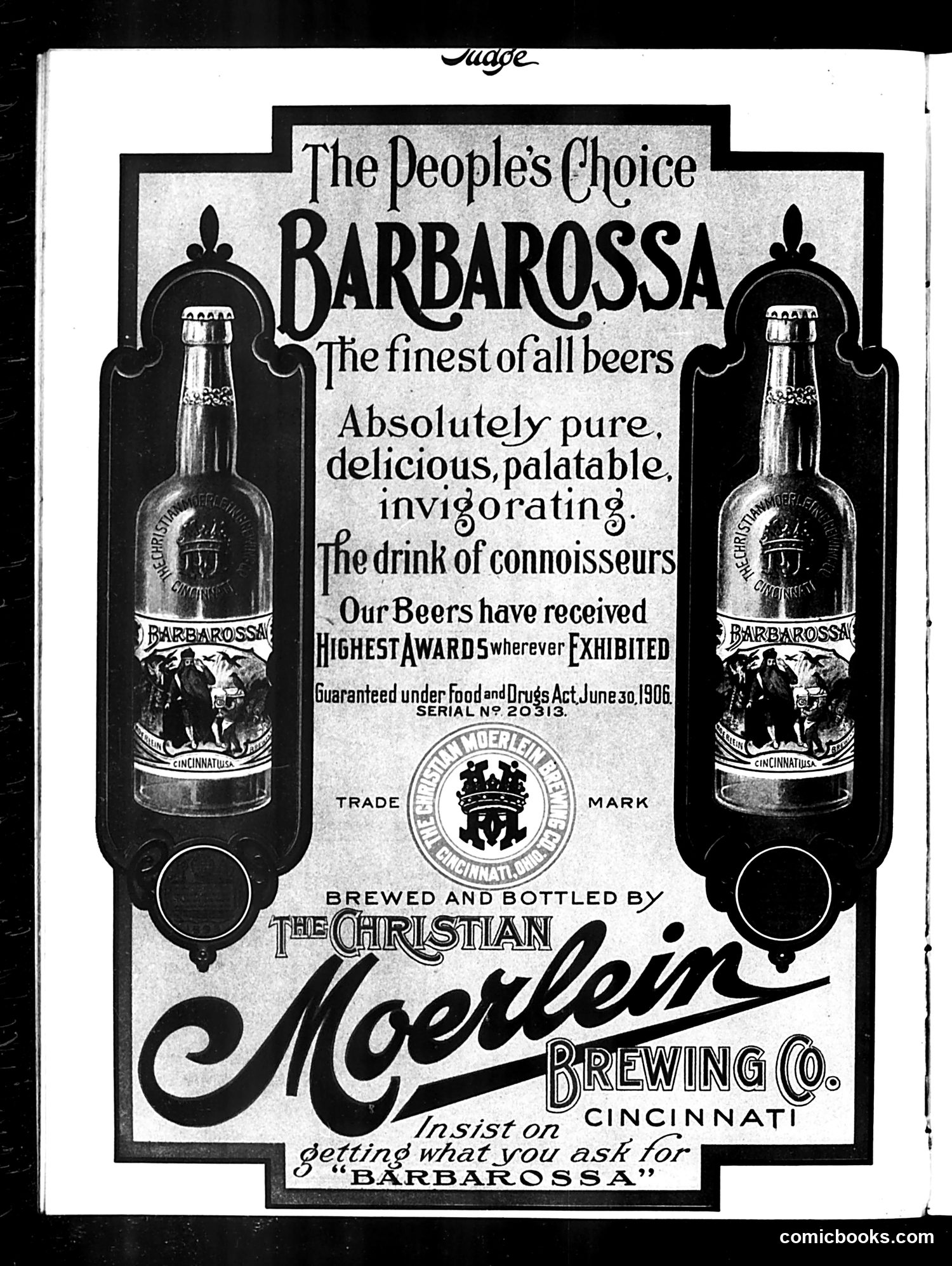
This is primarily a **beer advertisement**, not a political cartoon. It promotes Barbarossa beer, brewed by The Christian Moerlein Brewing Company in Cincinnati. The ad claims the beer is "The People's Choice" and "the finest of all beers," emphasizing purity and quality. It references the Food and Drugs Act (June 30, 1906), assuring consumers of government approval—a significant selling point in the early 1900s when food safety was a public concern. The decorative bottles frame the message, and the trade mark shows a crowned coat of arms. The bottom urges customers to "Insist on getting what you ask for: BARBAROSSA." This reflects the pre-Prohibition era (ended 1920) when breweries advertised openly in mainstream publications like *Judge*. There is no satirical commentary here—it's straightforward commercial advertising.