
Judge, 1909-03-27 · page 14 of 24
Judge — March 27, 1909 — page 14: what you’re looking at
What you’re looking at
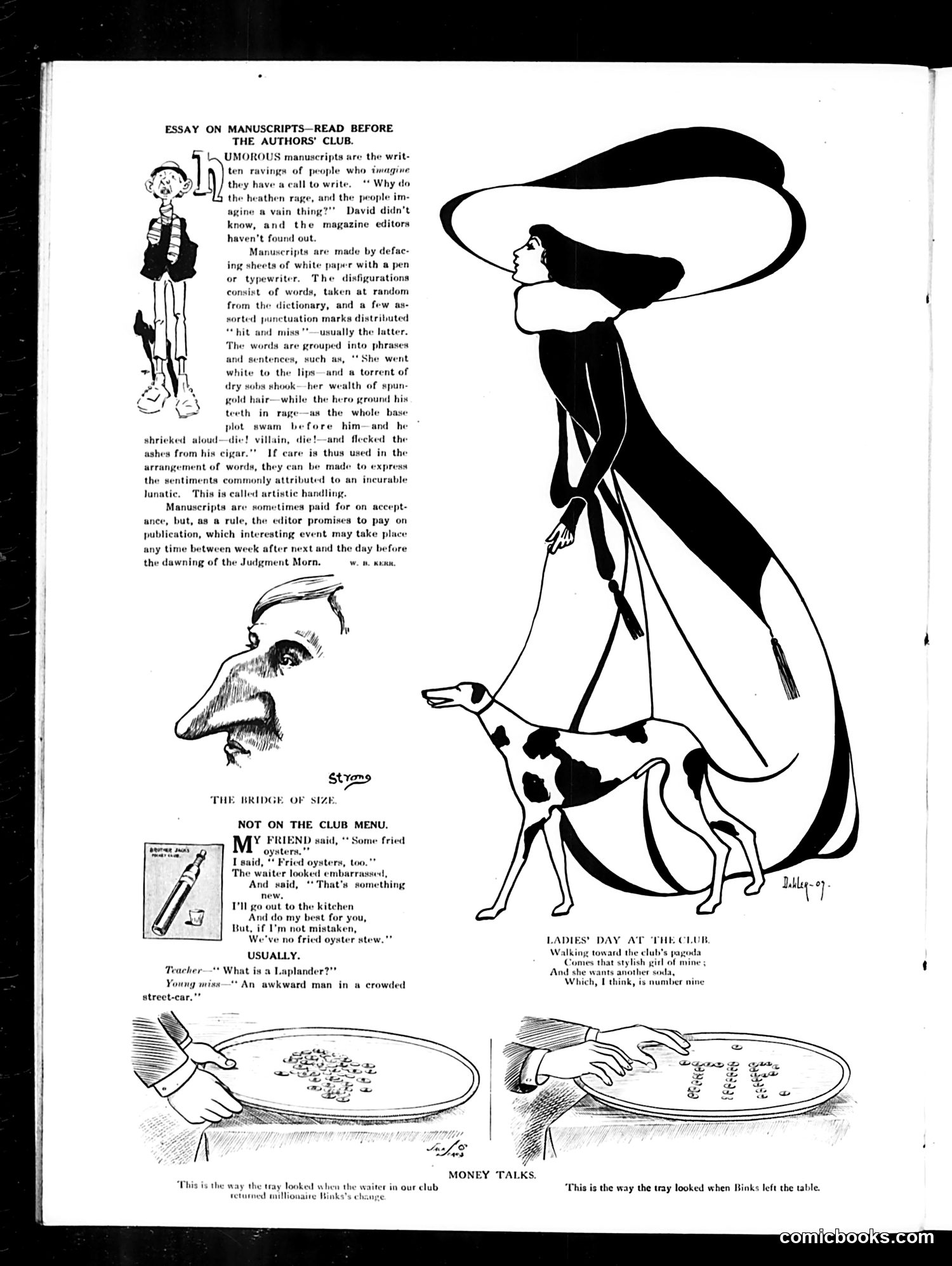
This page from *Judge* magazine contains several satirical pieces mocking early 20th-century social pretensions and literary absurdity. **"Essay on Manuscripts"** ridicules amateur writers submitting to magazines—their work is characterized as incoherent, poorly punctuated drivel masquerading as art. The essay sardonically notes editors "haven't found out" why people bother writing. **"Ladies' Day at the Club"** depicts a fashionable woman with her small dog, satirizing upper-class affectation and vanity—she wants "another suit / Which, I think, is number nine." **"Money Talks"** is a visual gag showing a restaurant tray before and after a wealthy diner ("millionaire Binks") leaves: the first image shows scattered coins/tips, the second shows them arranged to spell "TIP"—suggesting the rich use money to communicate even their gratuities ostentatiously. **"Not on the Club Menu"** jokes about a waiter's embarrassment when a member orders fried oysters unavailable at the club, revealing class anxieties about proper dining etiquette. The overall theme: mocking literary pretension, social climbing, and nouveau-riche display.
📄 Transcribed text from this page (OCR, searchable)
Machine-transcribed from the original scan — historical spelling and the odd misread are preserved.
ESSAY ON MANUSCRIPTS—READ BEFORE ashes from his ci nt of words, they can be made to express the sentiments commonly attributed to This is called artistic Manuscripts are sometim ance, but, as a rule, tl publication, which inte any time between week after next and the day before the dawning of the Judgme THE BRIDGE OF SIZE ** What i THE AUTHORS’ CLUB. UMOROUS manuscripts are the writ- ten ravings of people who imagine they hav Ito write.‘ Why do athen rage, and the people im- agine a vain thing?” David didn’t know, and the magazine editors haven't found out. Manuscripts are made by defac- ing sheets of white paper with a pen or typewriter. The disfigura consist of words, taken at random from the dictionary, and a few as- sorted punctuation marks distributed “hit and miss "*—usually the latter. The words are grouped into phrases and sentences, such as, “‘ She went white to the lips-—and a torrent of dry sobs shook—-her wealth of spun- gold hair—while the hero ground his teeth in rage—as the whole base plot swam before him—and he and flecked the r." If care is thus used in the ns die! villain, d 1 incurable andling. paid for on accept editor promises to pay on ting event may take place we KKH, Strams NOT ON THE CLUB MENU. Y FRIEN oyst I said, Fi The waiter looke And said, * new, I'll go out to the kitehen And do my best for you, But, if n not mistal We fried 0 USUALLY. said, ** Some fried a lander ?"* “An awkward man in a crowded MONEY ‘TALKS. our club ‘This is the way the tray looked when Binks left the table. y looked when fied millionaive Kink © waite