
A complete issue · 15 pages · 1909
Judge — March 13, 1909
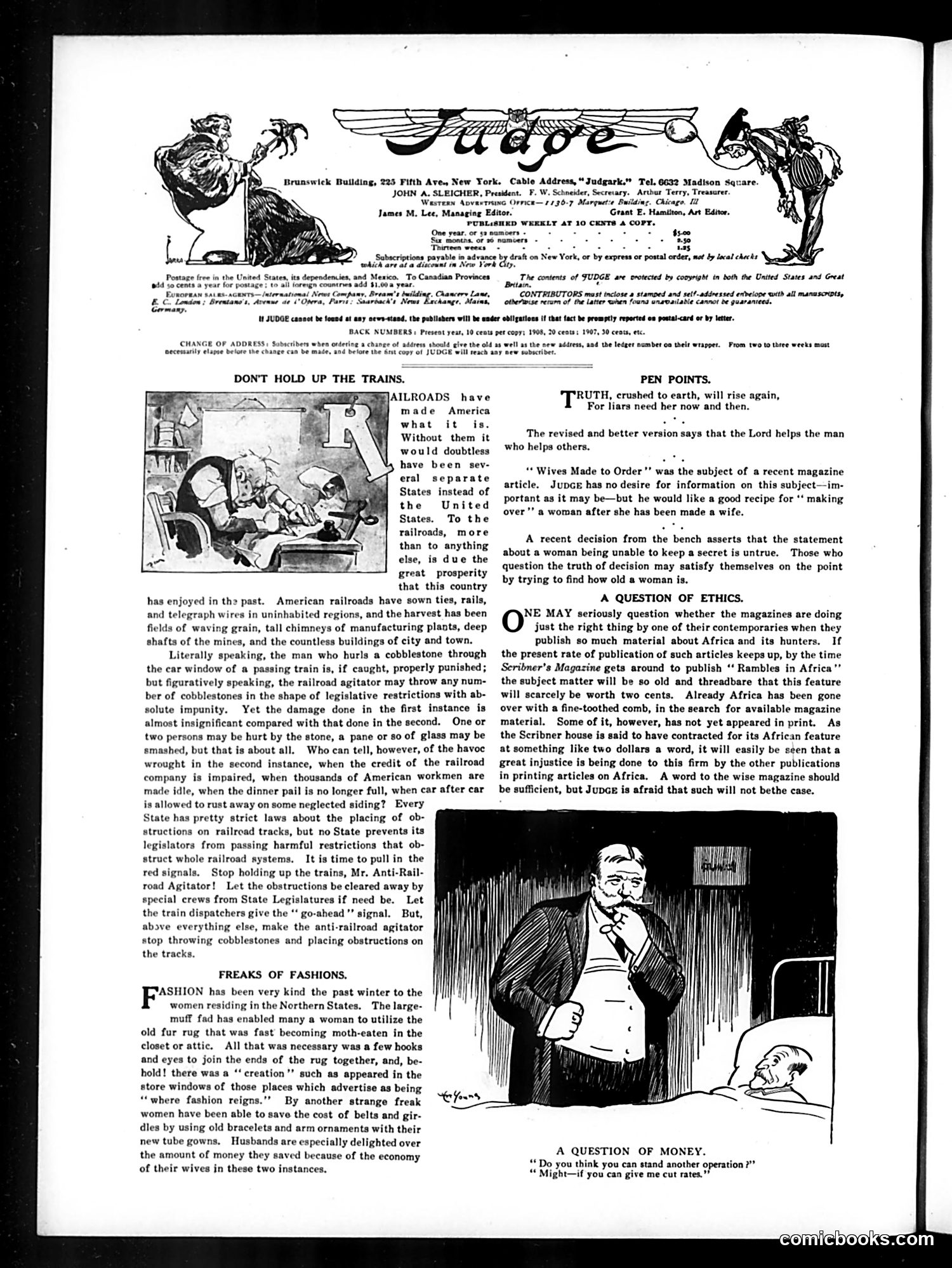
This page contains three distinct sections: **"Don't Hold Up the Trains"** criticizes anti-railroad agitators. The accompanying illustration shows what appears to be railway workers or laborers. The article argues that while railroads deserve regulation, obstructionist tactics harm the public good and that legislators should pass safety signals rather than allow agitators to place physical obstacles on tracks. **"Pen Points"** discusses magazine publication ethics regarding African content, noting concerns about republication rates and potential exploitation. **"Freaks of Fashions"** satirizes winter fashion trends—specifically women wearing large muffs and using old bracelets to economize, with husbands appreciating the savings. **"A Question of Money"** shows a cartoon of a man asking a woman for financial support, likely mocking evolving gender economics of the era. The page reflects early 20th-century debates about labor, journalism ethics, and social change.
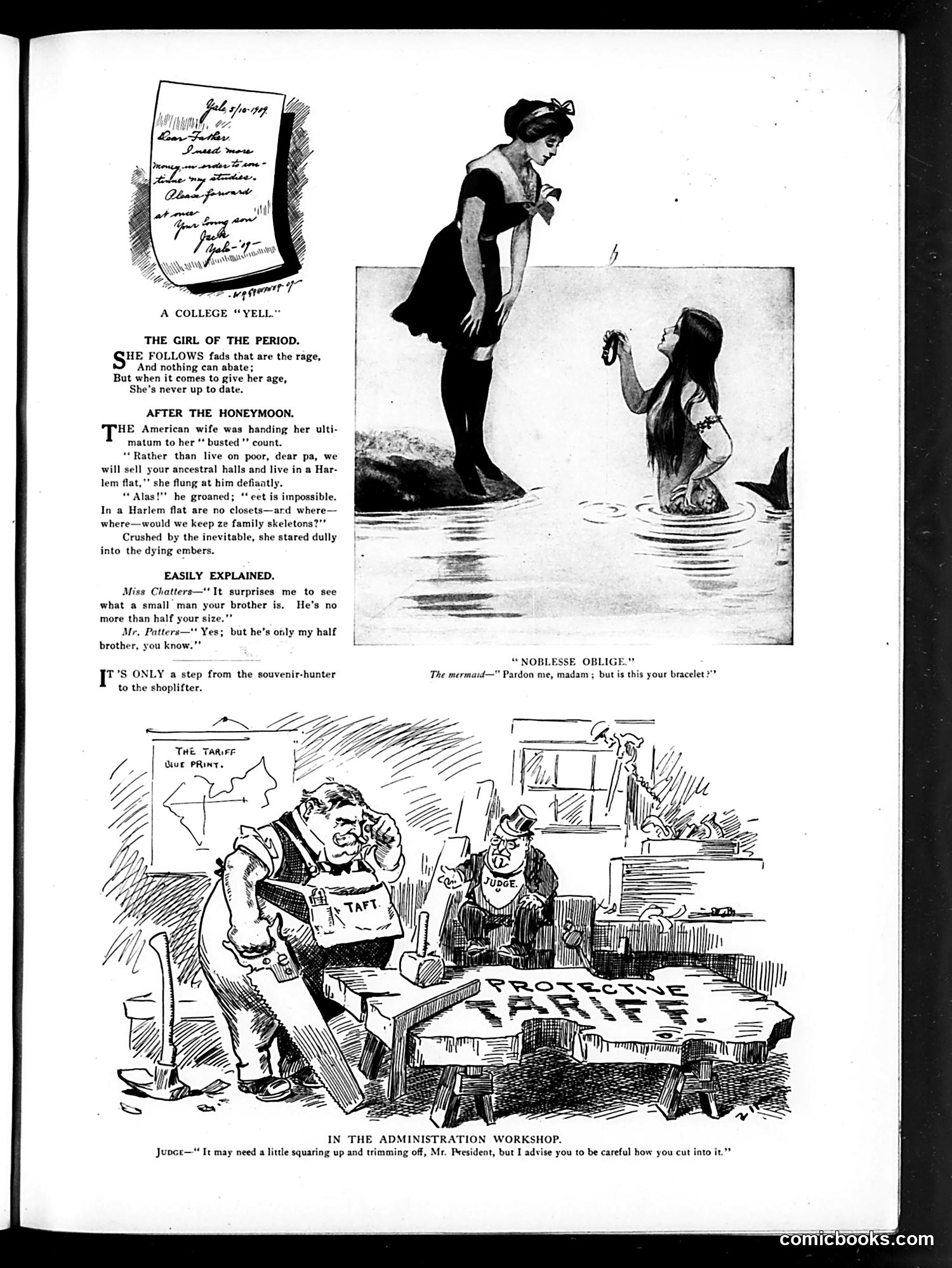
This Judge magazine page contains three separate satirical pieces: 1. **"A College Yell"** and **"The Girl of the Period"**: Social commentary on modern women following fashion trends uncritically. 2. **"After the Honeymoon"**: Satirizes marital conflict over finances and housing, with a wife rejecting poverty for her husband's ambitions. 3. **"In the Administration Workshop"**: Political cartoon showing a Judge figure advising a President (labeled "TAFT") on the "Protective Tariff." The judge warns careful handling, suggesting the tariff policy is delicate and risky—likely referencing William Howard Taft's administration and contemporary debates over protective trade policies that were politically contentious. The cartoons mock social pretension, marriage discord, and political caution regarding economic policy.
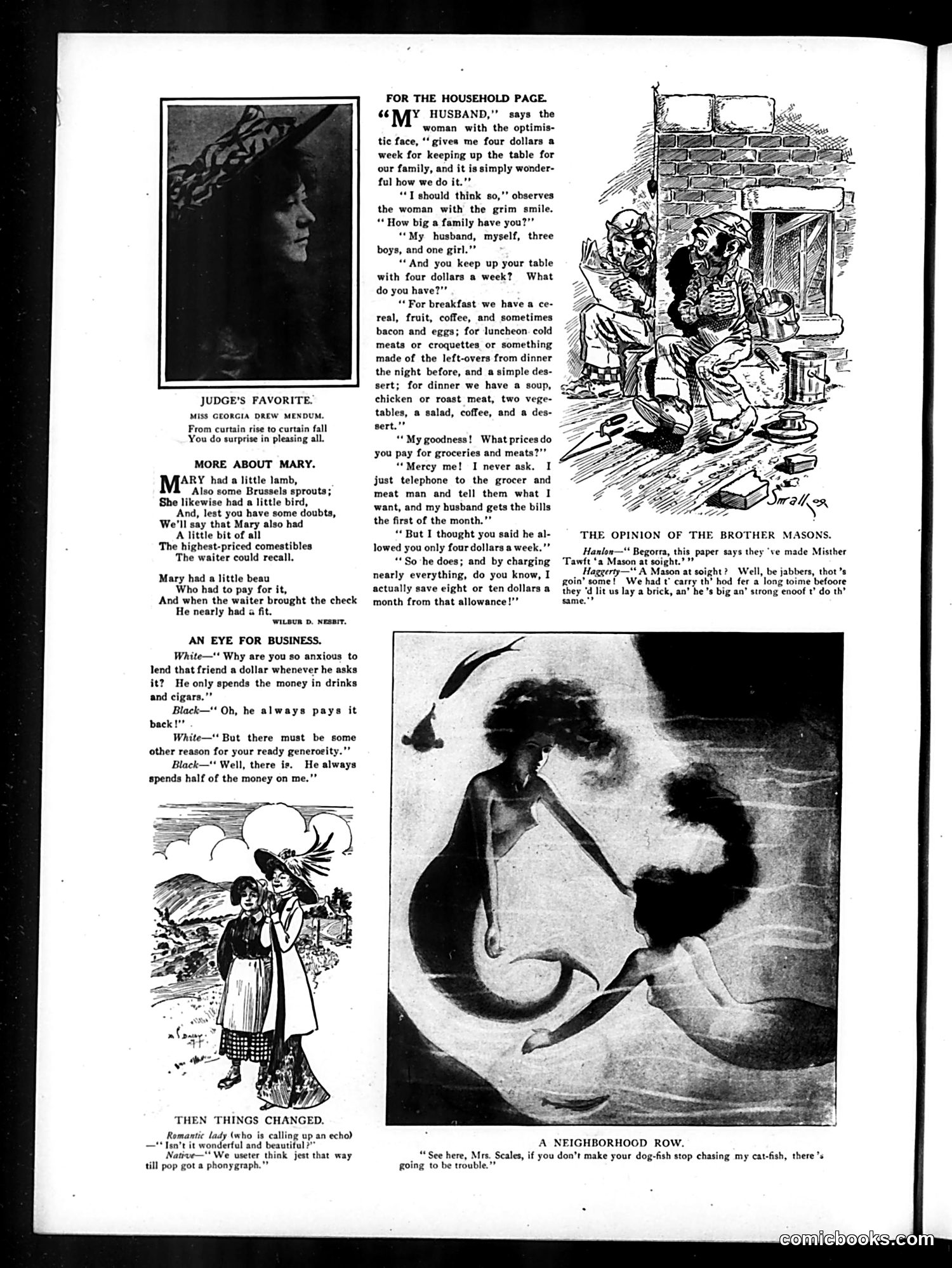
This page contains household humor and social satire typical of early 20th-century Judge magazine. **"For the Household Page"** features a woman defending her $4 weekly household budget to a skeptical friend. The satire targets gender economics: the woman stretches limited funds through careful shopping and meal planning, while her husband remains unaware she's actually saving money monthly through shrewd management. The joke reveals the financial acumen required of housewives despite limited allowances. **Other sections** include light verse about Mary's lamb, a dialogue joke about a man repaying borrowed money spent on drinks, and neighborhood humor about cat disputes. The cartoons use exaggerated illustrations typical of period humor magazines. Overall, the page satirizes domestic life, marital finances, and social class expectations of the era.
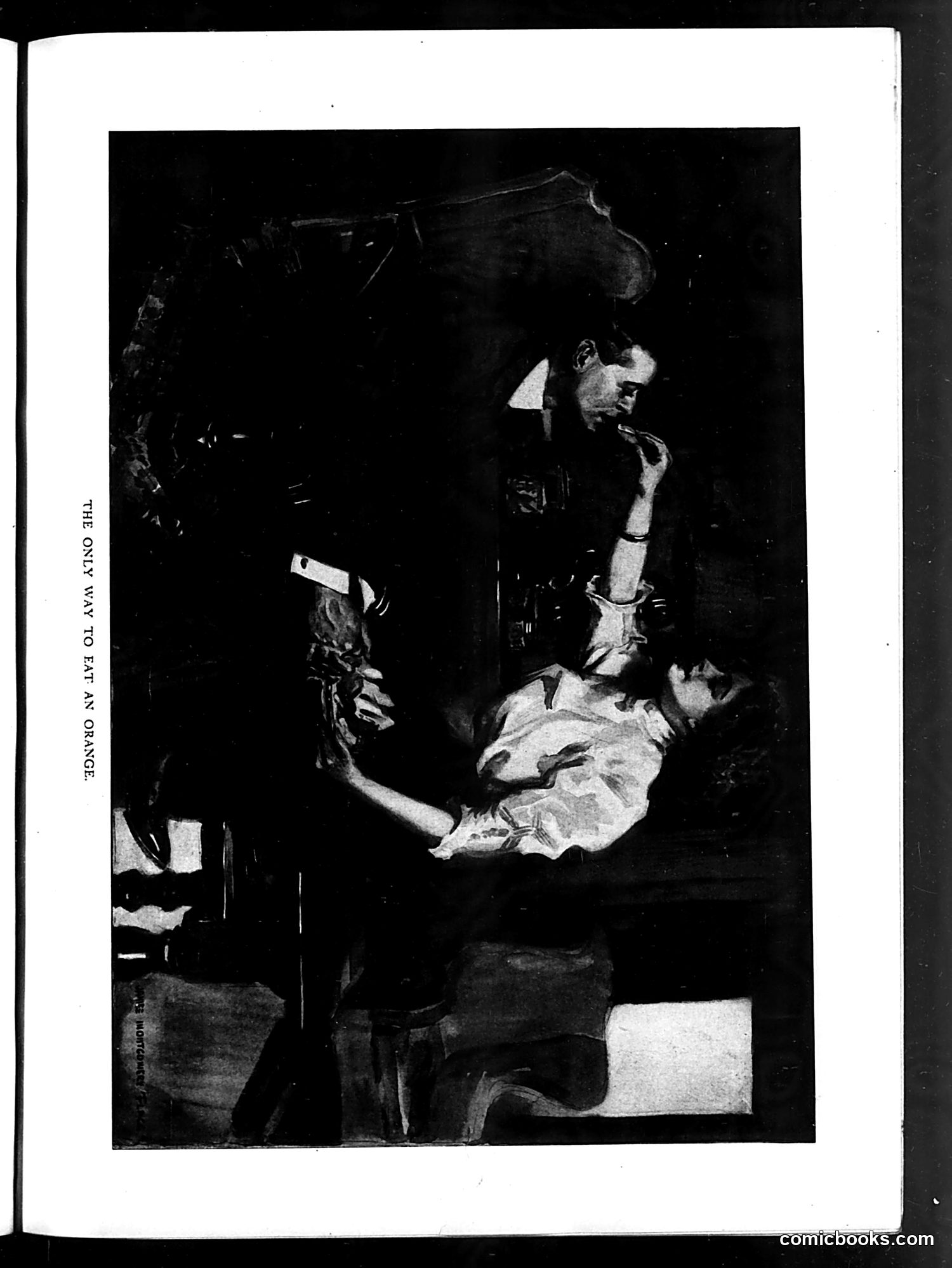
The text reads "THE ONLY WAY TO GET AN ORANGE" (printed vertically on the left margin). This appears to be a satirical illustration showing a figure forcibly extracting or squeezing something from another person or entity. The dramatic chiaroscuro lighting and violent composition suggest political commentary about coercion or exploitation. Without additional context or clearer identification of the figures, I cannot definitively identify who the specific caricatures represent or what historical event is referenced. The title suggests a metaphorical commentary—possibly about difficult extraction of resources, information, or compliance from an unwilling source—but the exact political or social reference remains unclear from the image and text alone. The style is consistent with early-to-mid 20th century Judge magazine satire.
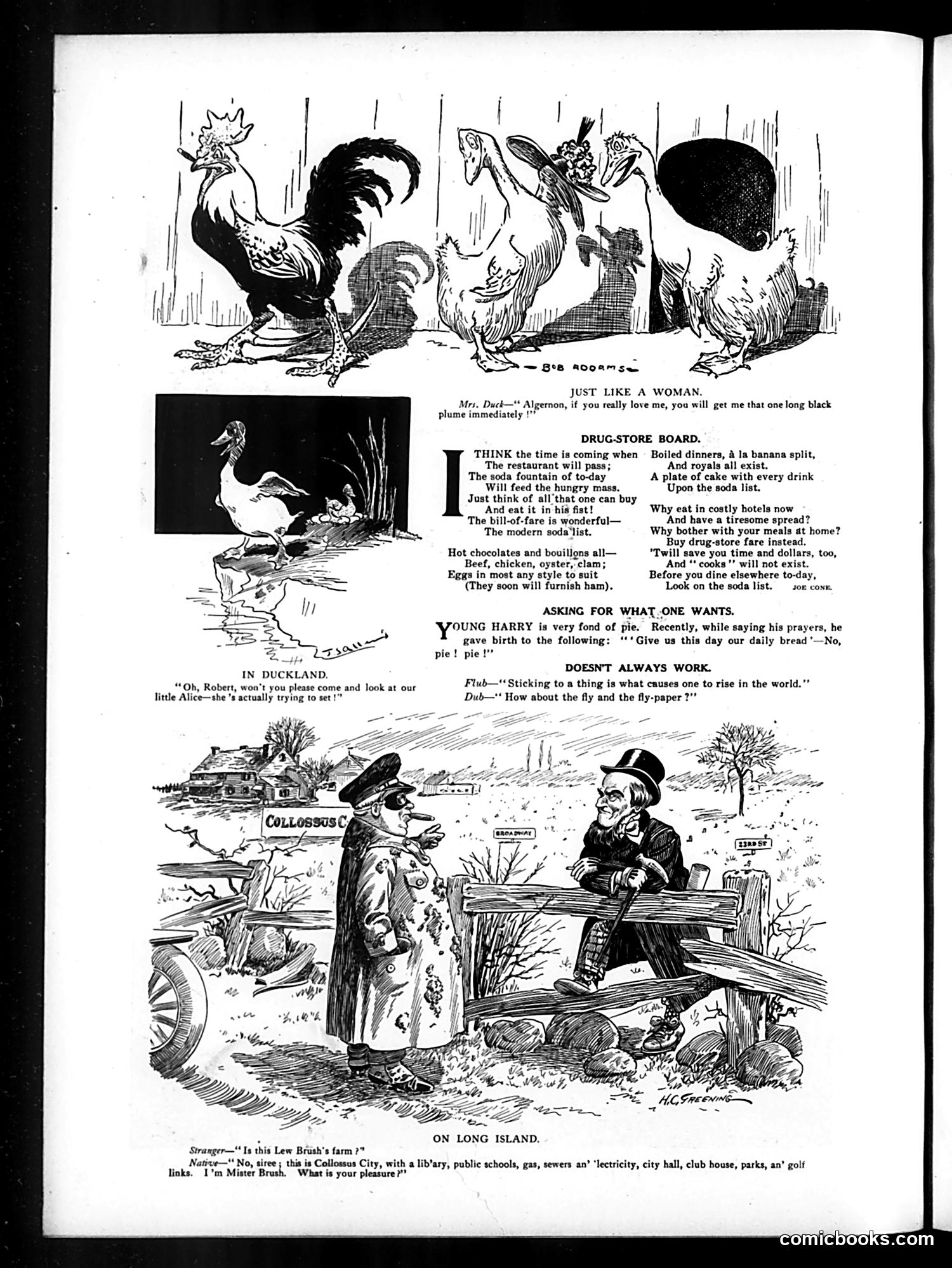
**Top Cartoon ("Just Like a Woman"):** Three roosters display colorful plumage. Mrs. Duck demands a "long black plume" from her husband, exemplifying the stereotype of women as vain and demanding, contrasting with male birds' natural display. **"Drug-Store Board":** Satirizes the decline of restaurants, suggesting cheap drug-store lunches replace proper dining. The verse mocks modern convenience culture replacing traditional hospitality. **"Asking for What One Wants":** A brief anecdote about young Harry's prayer request for pie—gentle domestic humor about children's directness. **Bottom Cartoon ("On Long Island"):** A wealthy "Colossus" figure represents New York City development; a rustic farmer represents old Long Island. The satire critiques urban expansion and the displacement of rural life by metropolitan growth and commercialization.
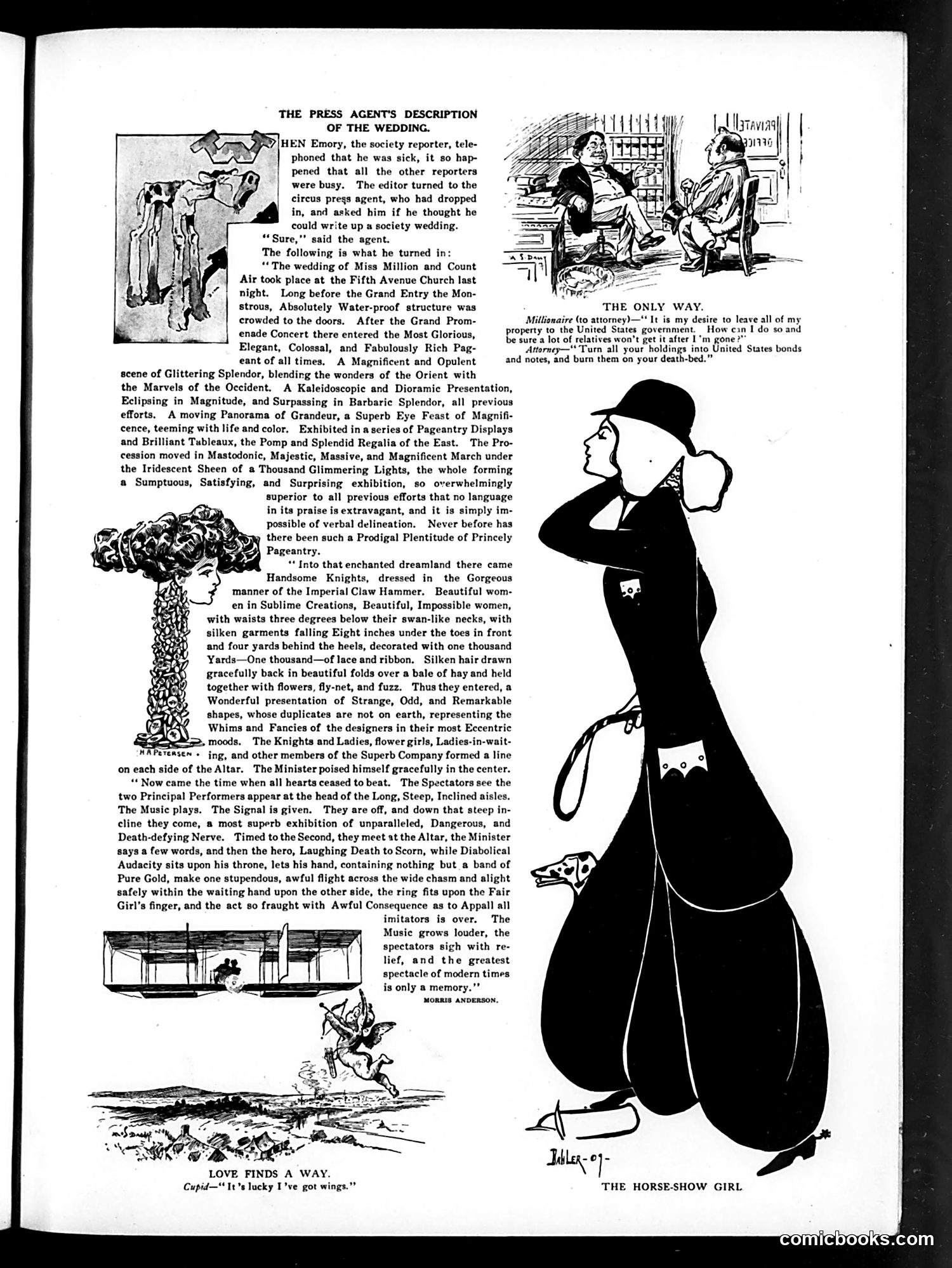
This page satirizes **press agents' hyperbolic promotion language** applied inappropriately to society events. The main article mocks how a circus press agent, filling in for a sick society reporter, describes a wealthy wedding (Miss Million and Count Air) using outlandish carnival-promotion rhetoric. He compares the bride's entrance to a death-defying circus act and describes guests' impossible fashions and "Prodigal Plentitude of Princely Pageantry" in absurdly inflated language. The satire targets two things: (1) **press agents' tendency toward exaggeration** in entertainment promotion, and (2) **high society's own pretension**, which lends itself to parody. The secondary cartoon "The Horse-Show Girl" (right) depicts a fashionable woman in exaggerated pose, likely mocking elite social-scene participants. The small tax-related cartoon critiques wealth: a millionaire wanting to donate to the U.S. government is advised to convert assets to bonds then "burn them on your death-bed"—satirizing how the wealthy avoid taxation.
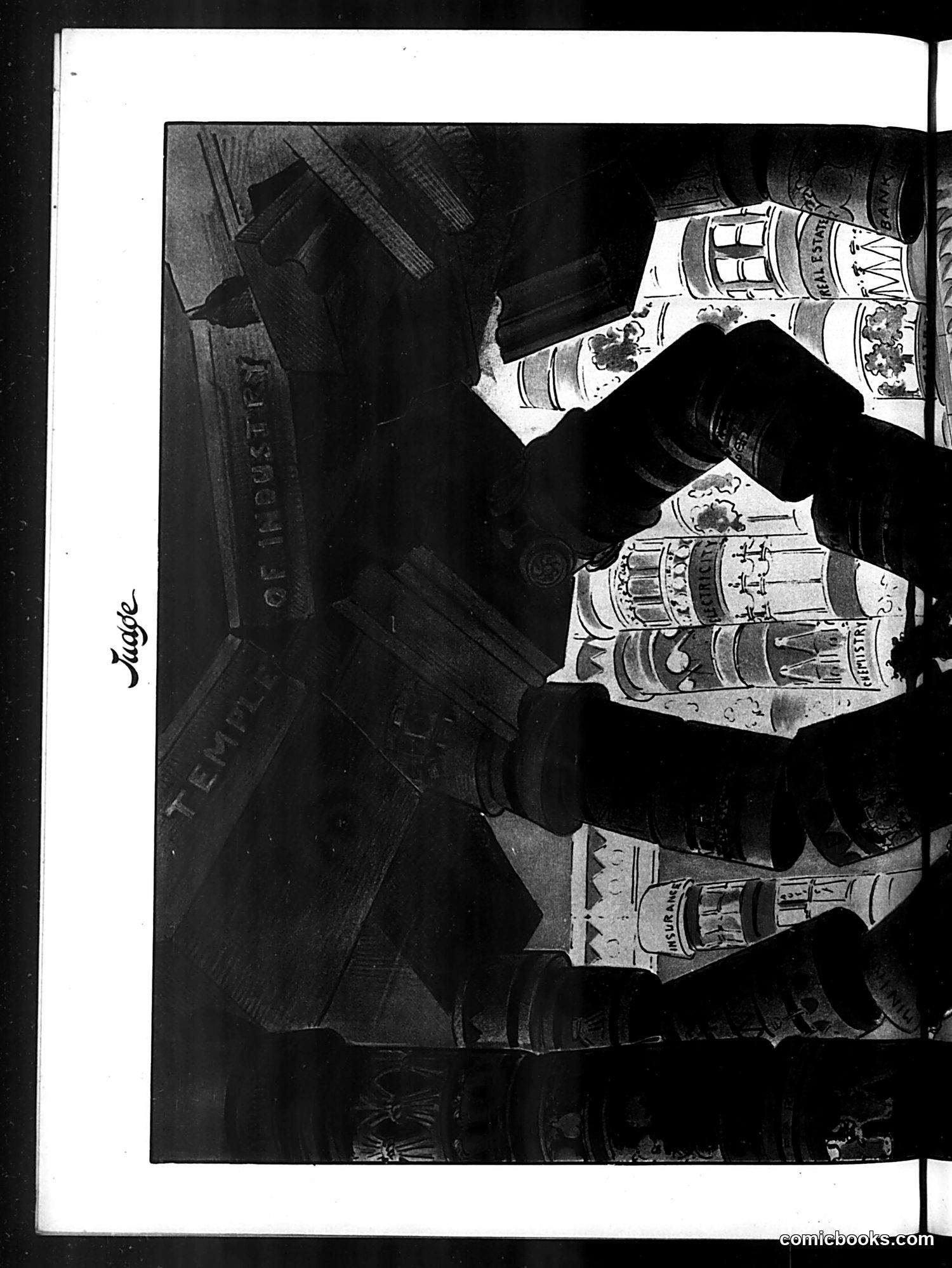
This page appears to be rotated 90 degrees, making it difficult to read clearly. The image shows what looks like decorative beer or wine bottles arranged vertically, with ornate labels and designs. The text "Judge" appears on the left margin, confirming this is from the satirical magazine. Without being able to read the OCR text clearly or see accompanying captions, I cannot definitively identify the specific political or social satire being depicted. The elaborate bottles with decorative labeling might reference alcohol regulation, import/trade policies, or consumer culture of the era, but I cannot assert this with certainty. To provide accurate historical context, I would need either a properly oriented image or clearer text identifying the cartoon's subject matter and date of publication.
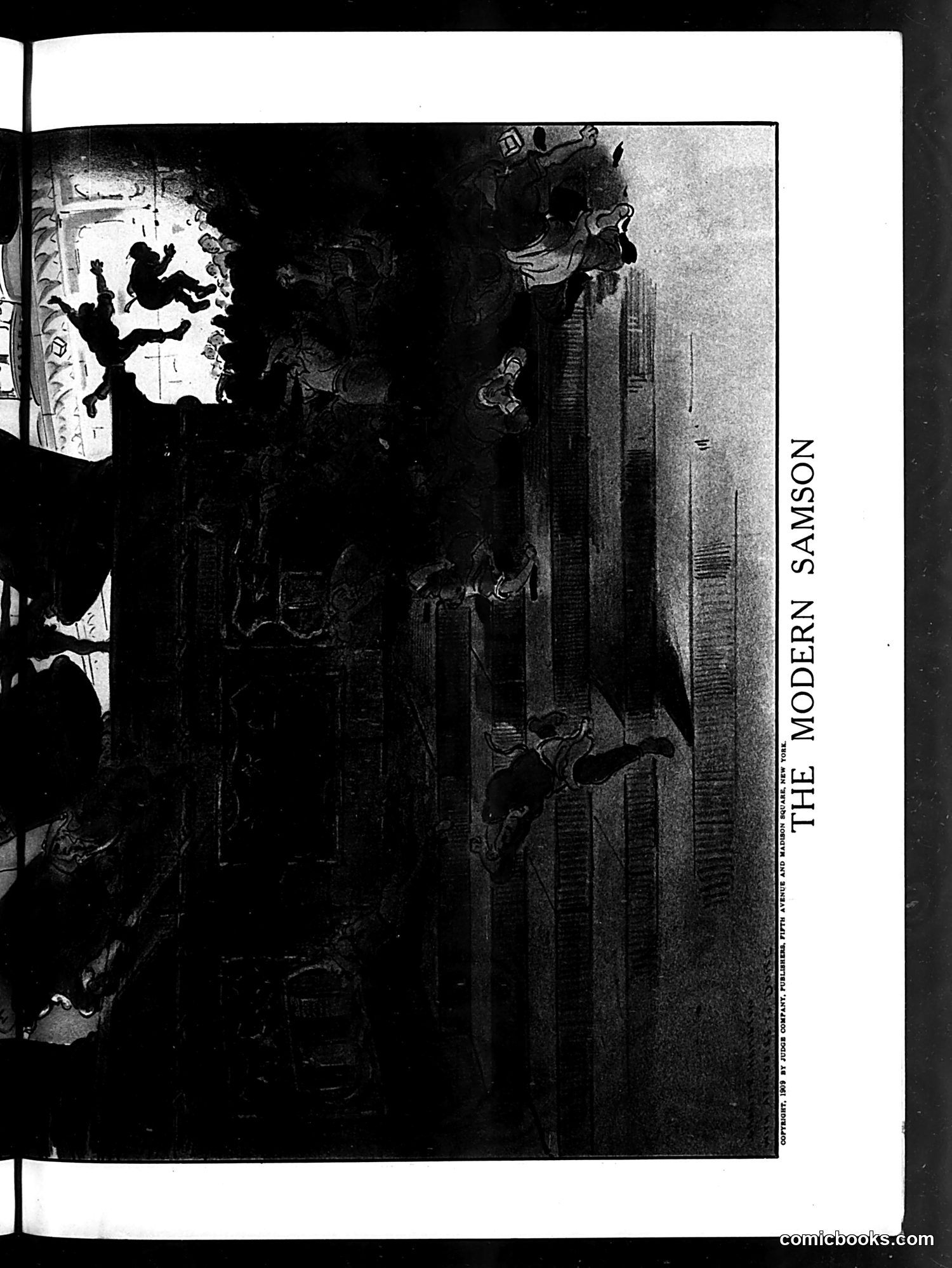
This page from *Judge* magazine presents "The Modern Samson"—a political cartoon satirizing what appears to be early 20th-century industrial or architectural ambition. The image shows a figure climbing or ascending tall brick buildings (skyscrapers), rendered in silhouette against a stark background. The biblical reference to Samson suggests themes of hubris or dangerous strength—evoking the biblical strongman who brought down a temple, destroying himself in the process. The cartoon likely critiques contemporary urban development, industrial excess, or a specific public figure's ambitious but potentially reckless projects. The comparison to Samson implies the "modern" figure possesses great power but poses dangers to the established social structure, much like the biblical figure whose strength ultimately proved destructive.
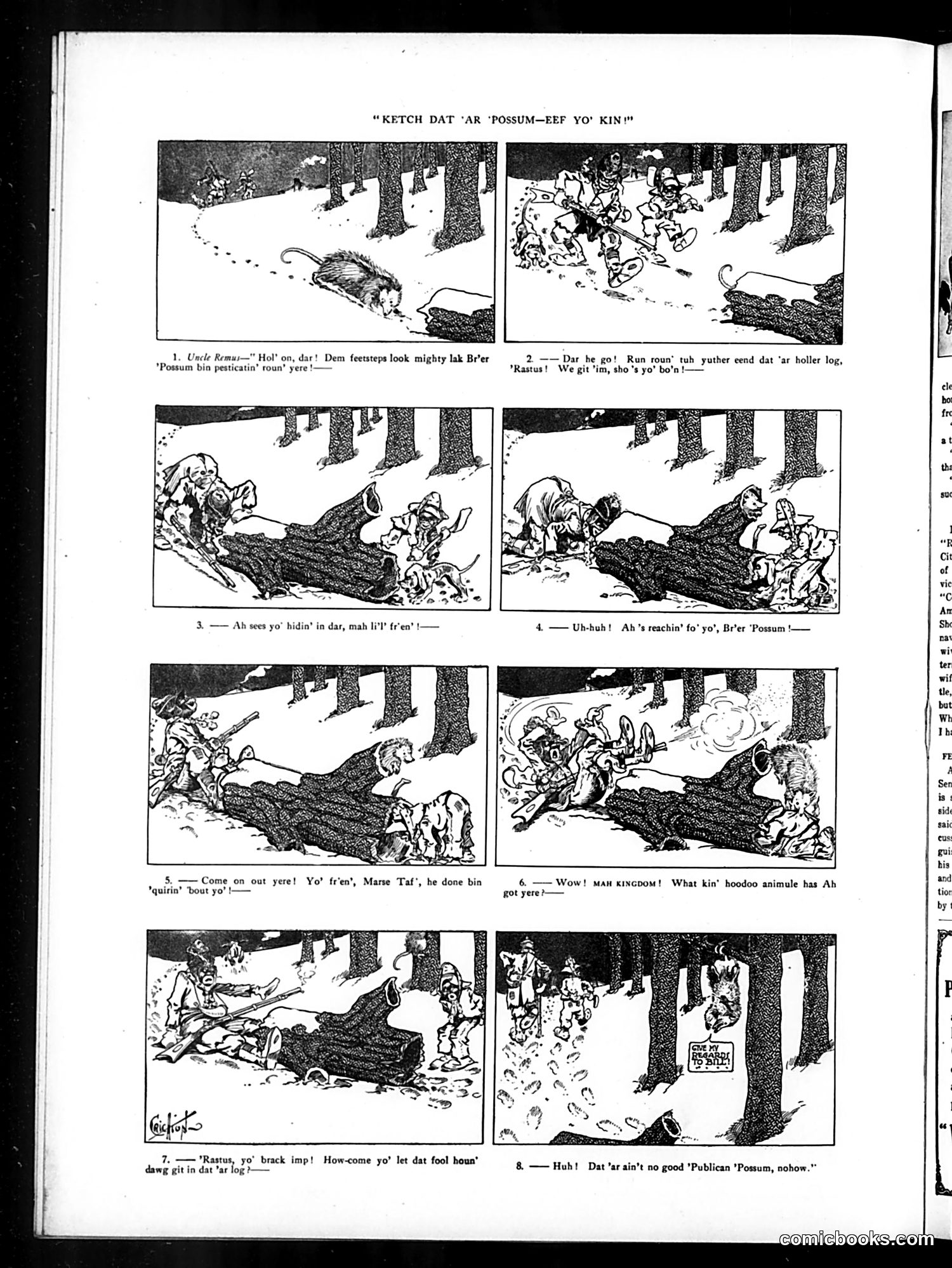
This is a humorous comic strip featuring characters from Joel Chandler Harris's Uncle Remus stories—specifically Uncle Remus himself and characters like Brer Possum and Rastus. The eight-panel sequence depicts a comedic possum hunt in a snowy forest setting. The humor relies on dialect humor and slapstick action: characters pursue a possum through a hollow log, attempt to catch it, and ultimately fail when the animal escapes. The final panel's reference to a "'Publican Possum" appears to be a political jab—likely a dig at Republican politics or politicians—suggesting even the possum won't cooperate with Republican causes. The satire employs the racial caricature conventions typical of early-20th-century American magazines, reflecting attitudes of that era rather than presenting any substantive political critique.
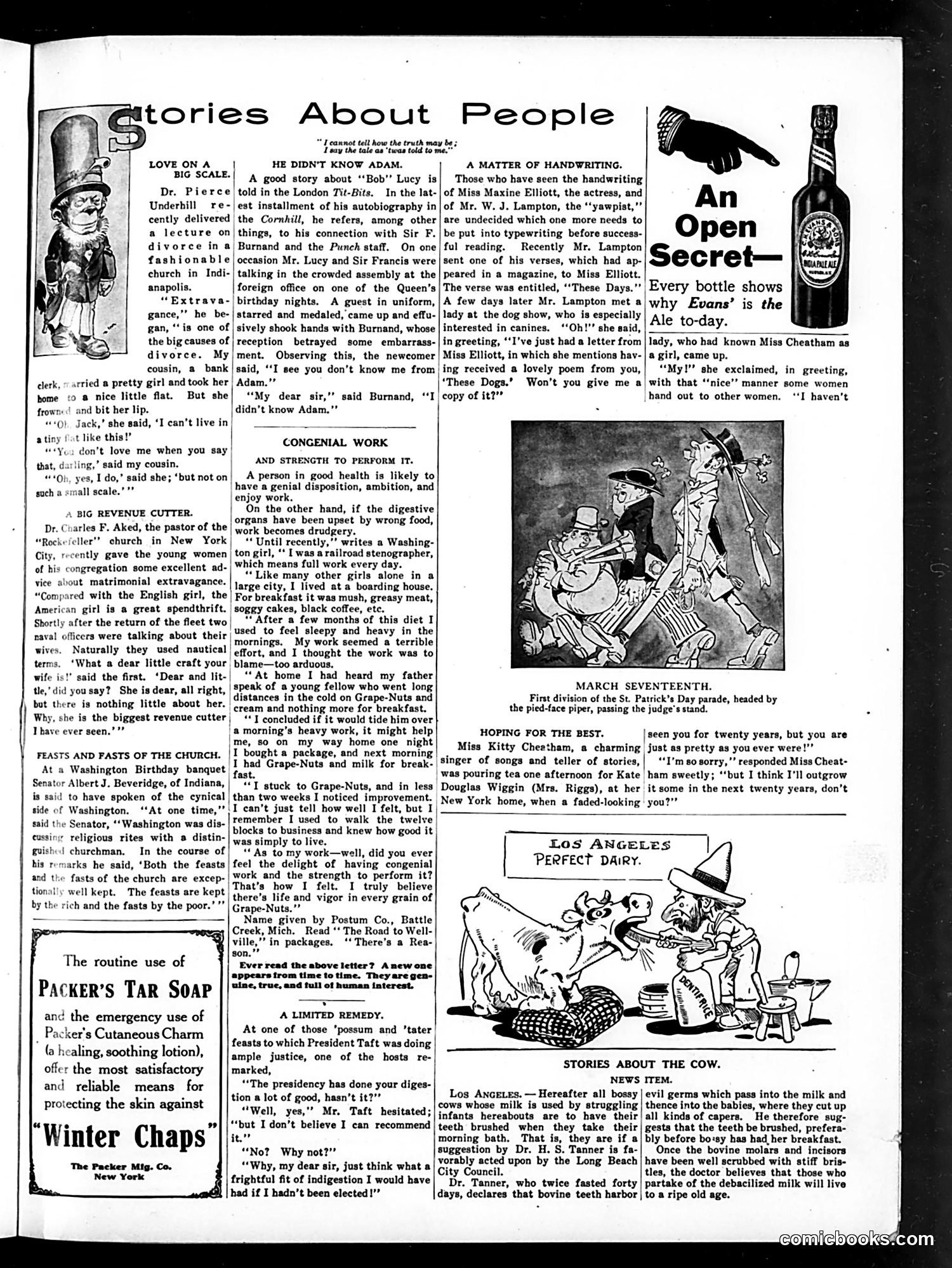
This page contains several humorous anecdotes satirizing American social attitudes, particularly regarding **marriage, gender, and class**. The main stories mock: 1. **Spousal extravagance**: A bank clerk's wife refuses their modest apartment, saying she loves him but "not on such a small scale"—satirizing wives' materialism and consumer expectations. 2. **Naval wives as "revenue cutters"**: Officers compare wives to ships, with one calling his wife a "big revenue cutter," mocking wives as expensive financial burdens. 3. **Class hypocrisy in religion**: Senator Beveridge recounts Washington's cynical observation that the church's feasts are kept by the rich while the poor observe the fasts—criticizing disparities between wealthy and poor congregants. 4. **Social awkwardness**: Lucy humorously claims not to know someone by saying "I didn't know Adam" (biblical reference to humanity's origin), implying the stranger is a nobody. The page also includes period advertisements for soap and Grape-Nuts cereal, reflecting early 1900s magazine culture.
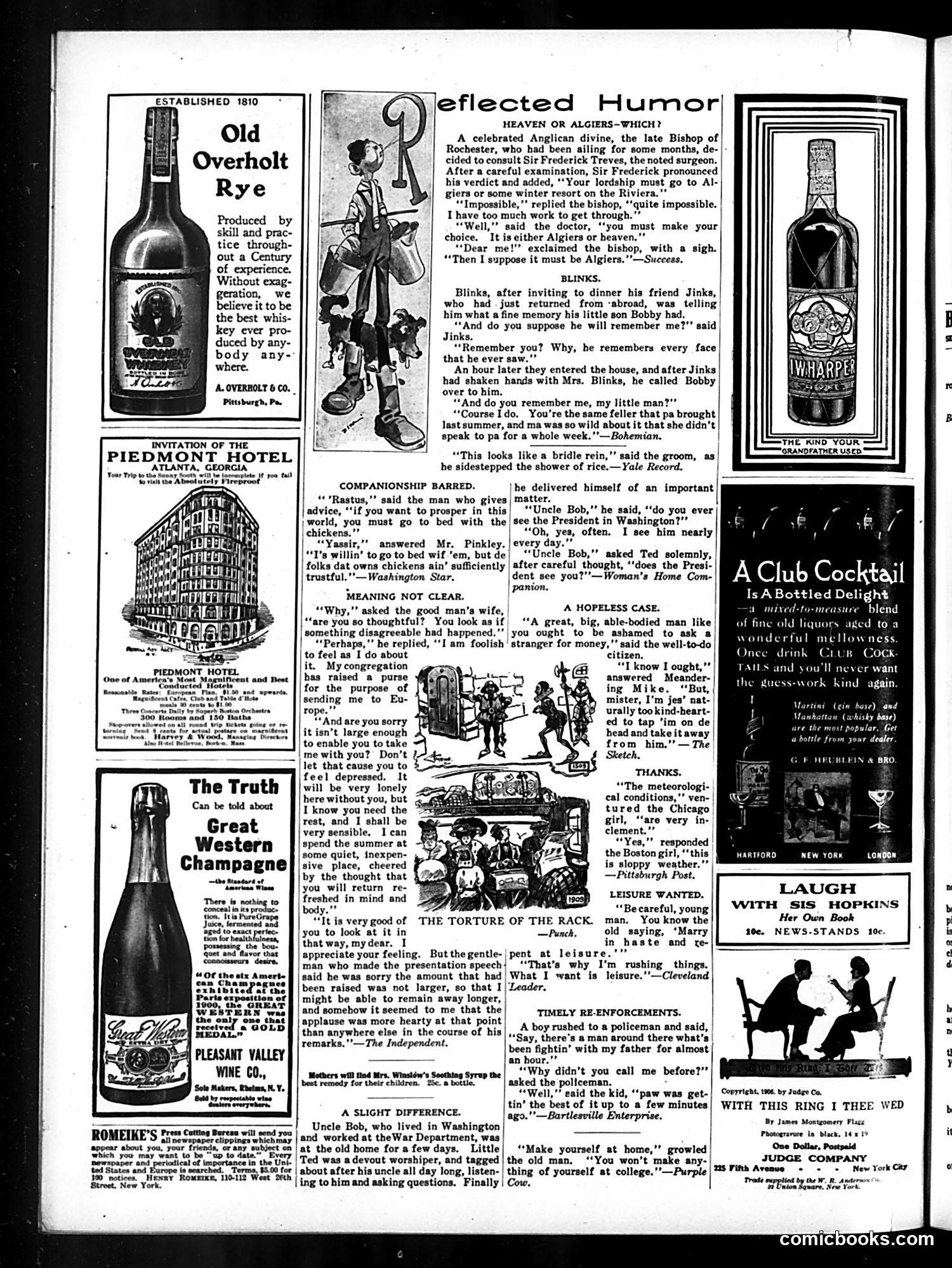
This page is primarily **advertising and humor anecdotes** rather than political satire. The advertisements promote liquors (Old Overholt Rye, Great Western Champagne, Club Cocktails) and hotels, reflecting early 20th-century magazine commerce. The "Reflected Humor" section contains brief jokes with social observations: - **"Heaven or Algiers"**: A bishop's dark humor about choosing an unpleasant health cure (Algiers) over death—satire on clerical work ethic. - **"Blinks"**: A child's innocent but embarrassing memory reveals his father's infidelity to the dinner guest—typical domestic humor about marital friction. - **"Companionship Barred"**: A racial dialect joke (Rastus) playing on distrust—reflects the era's casual racist humor conventions. - **"Hopeless Case"**: A beggar's logic about being unsuitable for honest work—commentary on poverty and charity attitudes of the period. The content reflects Judge's formula: liquor advertising mixed with light social comedy, mostly apolitical and focused on class, domestic, and racial stereotypes typical of early 1900s American humor magazines.
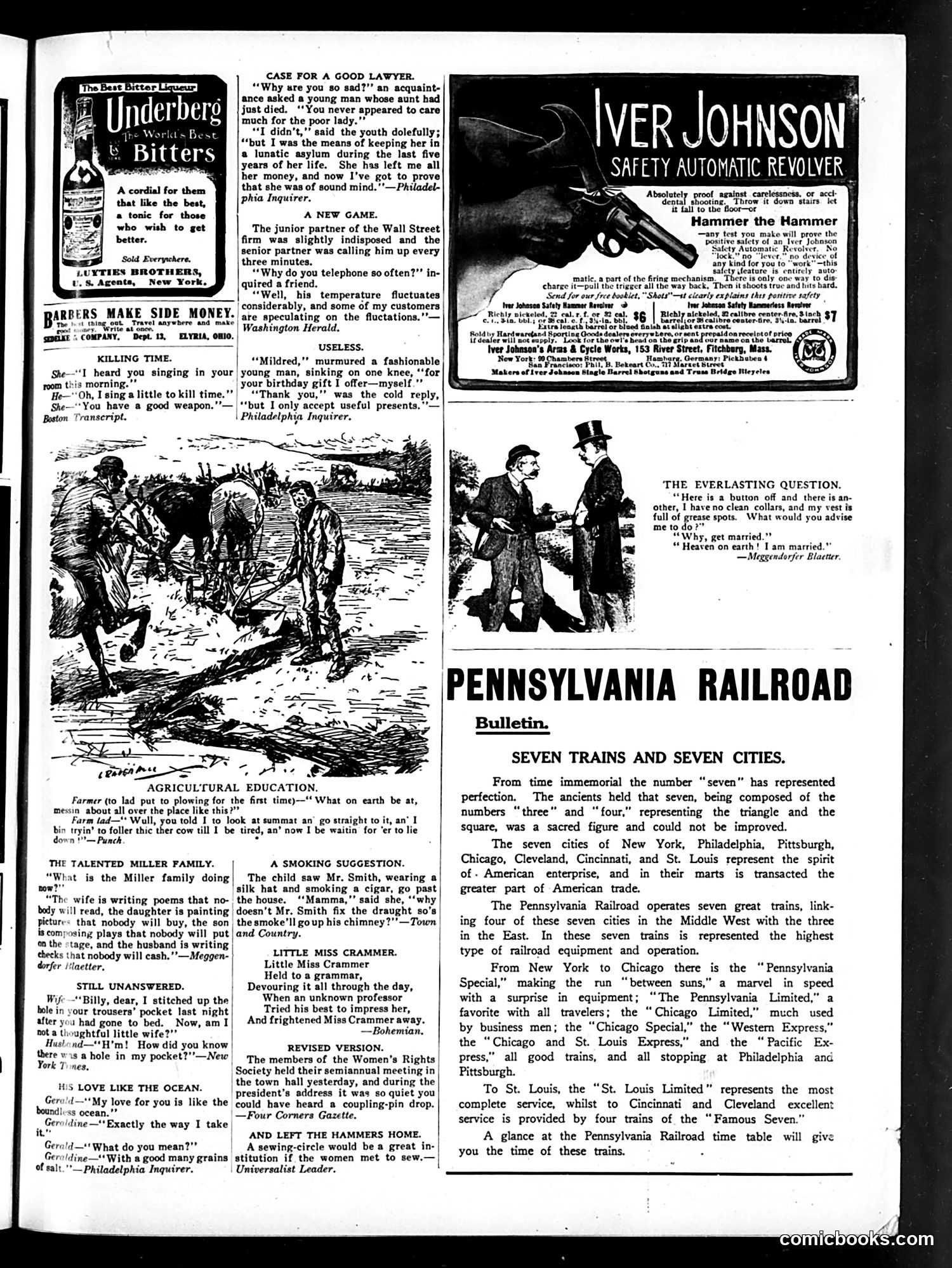
This page contains **mostly advertisements and short humorous anecdotes**, typical of Judge magazine's format. The cartoons and jokes satirize early 20th-century social conventions: **"Case for a Good Lawyer"** mocks inheritance law—a young man must now prove his aunt (whom he kept institutionalized to control her money) was mentally sound, creating an absurd legal paradox. **"Agricultural Education"** depicts a farmer's son confused by modern farming advice, representing rural skepticism toward "progressive" agricultural methods. **"The Talented Miller Family"** satirizes artistic pretension—a family producing unmarketable art while the breadwinner writes checks they can't afford. The romance vignettes mock courtship rituals: a woman rejecting a marriage proposal because a man offers only himself as a gift (lacking material substance), and another joking about love being "like the ocean" (vast but containing salt—implying bitterness). **Iver Johnson revolver advertisement** emphasizes "safety automatic" features—apparently a selling point for this era's firearms. The Pennsylvania Railroad bulletin promotes their "seven trains" connecting major cities, typical period transportation advertising.
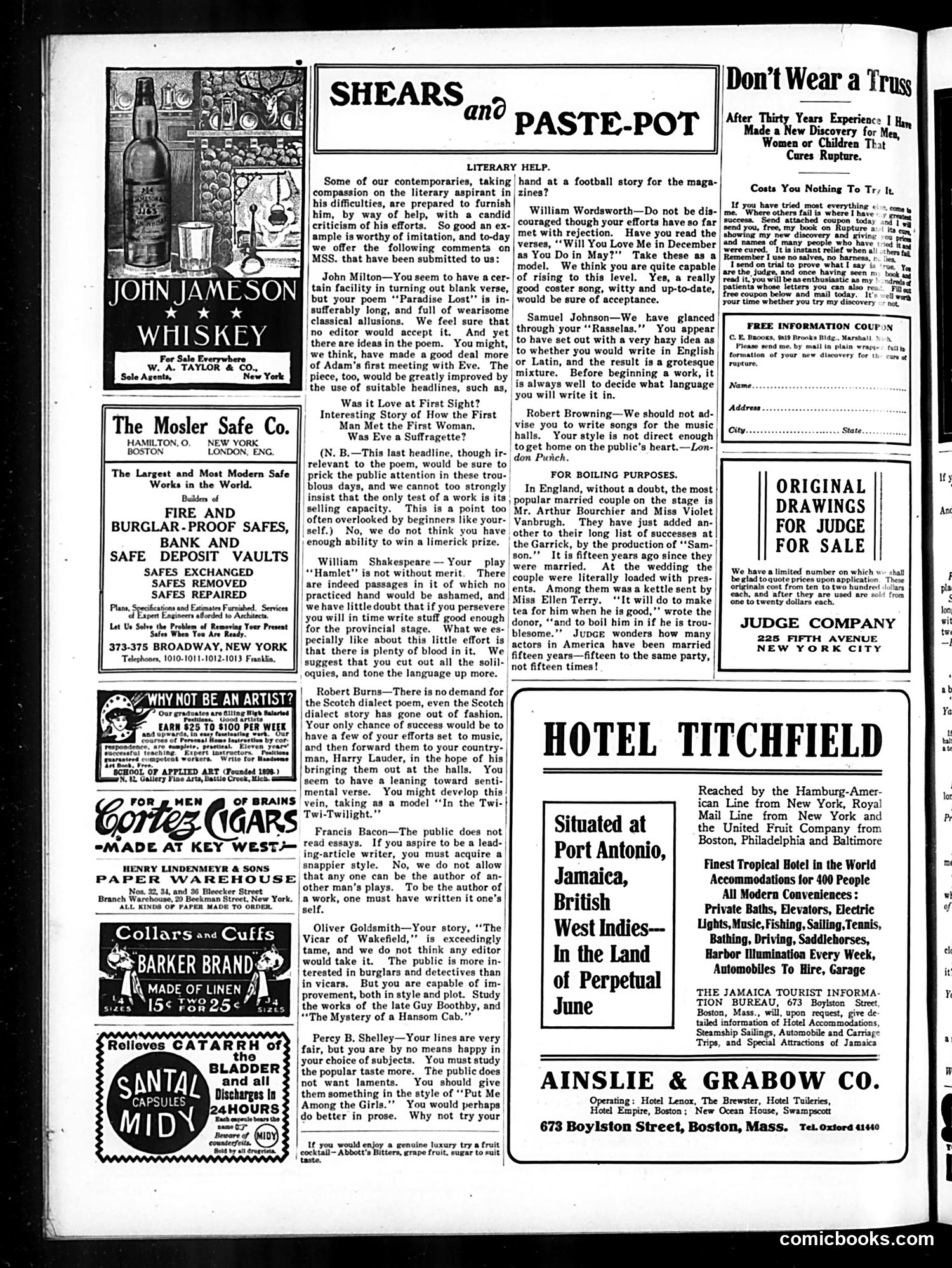
This page satirizes literary criticism and editing practices of the era. The main feature, "Shears and Paste-Pot," mocks contemporary magazines that offer aspiring writers harsh, commercially-driven feedback on submitted manuscripts. The satire presents fictional "rejections" of famous literary figures—Shakespeare, Burns, Goldsmith, Shelley, Bacon—as if they were amateur writers. The joke is that even canonical authors would be rejected by these philistine editors focused solely on sales appeal over artistic merit. Key satirical points: editors demanding "blood" and violence for public interest; dismissing dialect poetry unless set to music for music halls; rejecting essays entirely; praising only what sells to masses. The criticism is shallow and commercially cynical. This reflects Judge's critique of American publishing's degrading standards—prioritizing sensationalism and "selling capacity" over literary quality, even for genuinely talented writers.
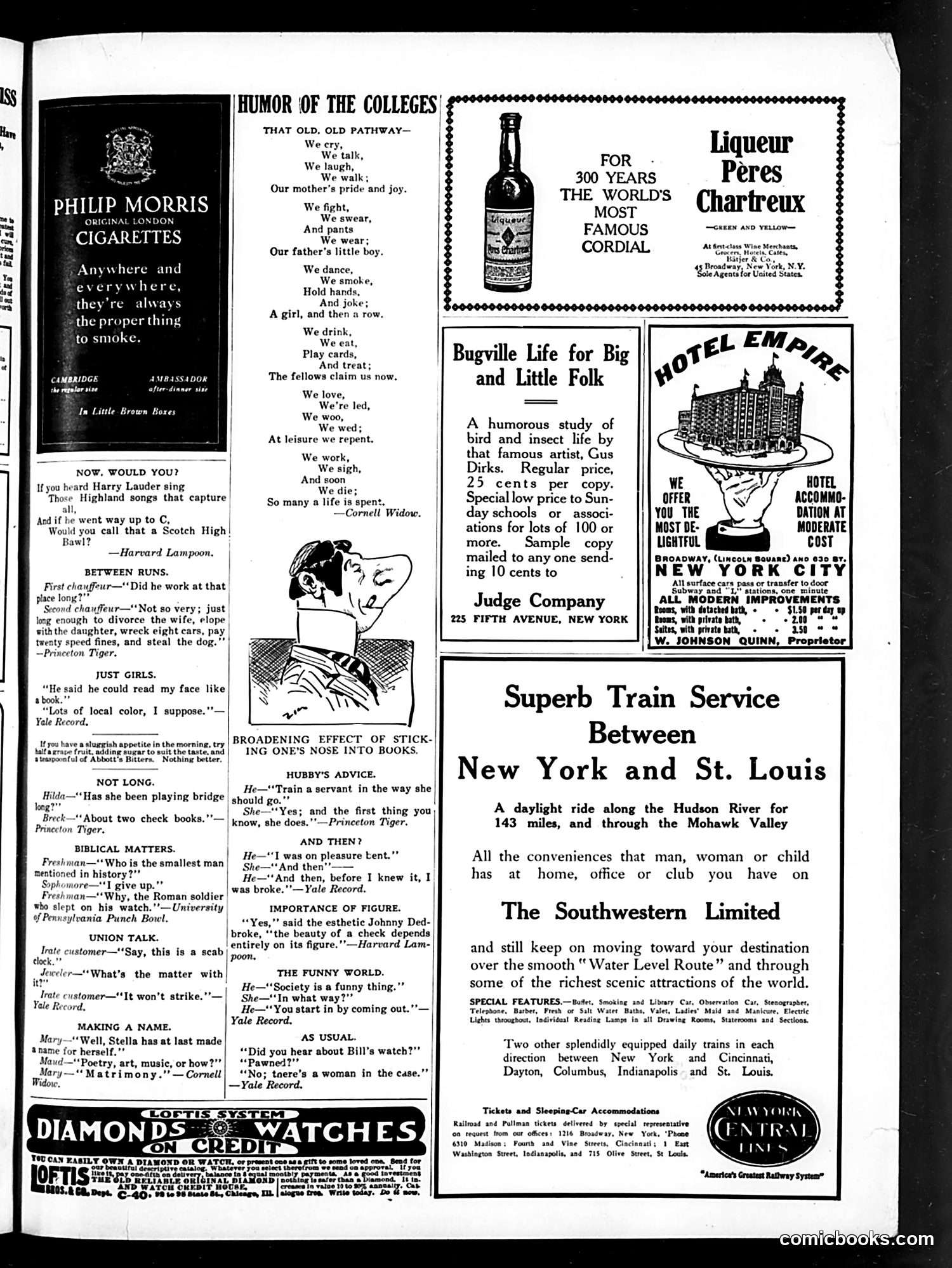
This page from *Judge* magazine is primarily **advertising and humor columns**, not political cartoons. The content includes: 1. **College humor**: Satirical verses about student life cycles ("We cry, We talk...We die"), poking fun at predictable college experiences across American universities (references to Harvard, Yale, Princeton, Cornell). 2. **One cartoon**: Shows a face being broadened by sticking one's nose in books—a visual pun on "broadening" one's mind through education. 3. **One-liner jokes**: Mostly about gender relations, servants, and material excess (a chauffeur stealing from employers, husbands advising wives on finances). 4. **Heavy advertising**: Cigarettes, liqueur, trains, hotels, watches, and jewelry dominate the page. The satire reflects early 20th-century college culture and domestic gender dynamics—husbands as financial authority, servants as untrustworthy, romance as predictable. The humor is gentle mockery of upper-class American life rather than political commentary.
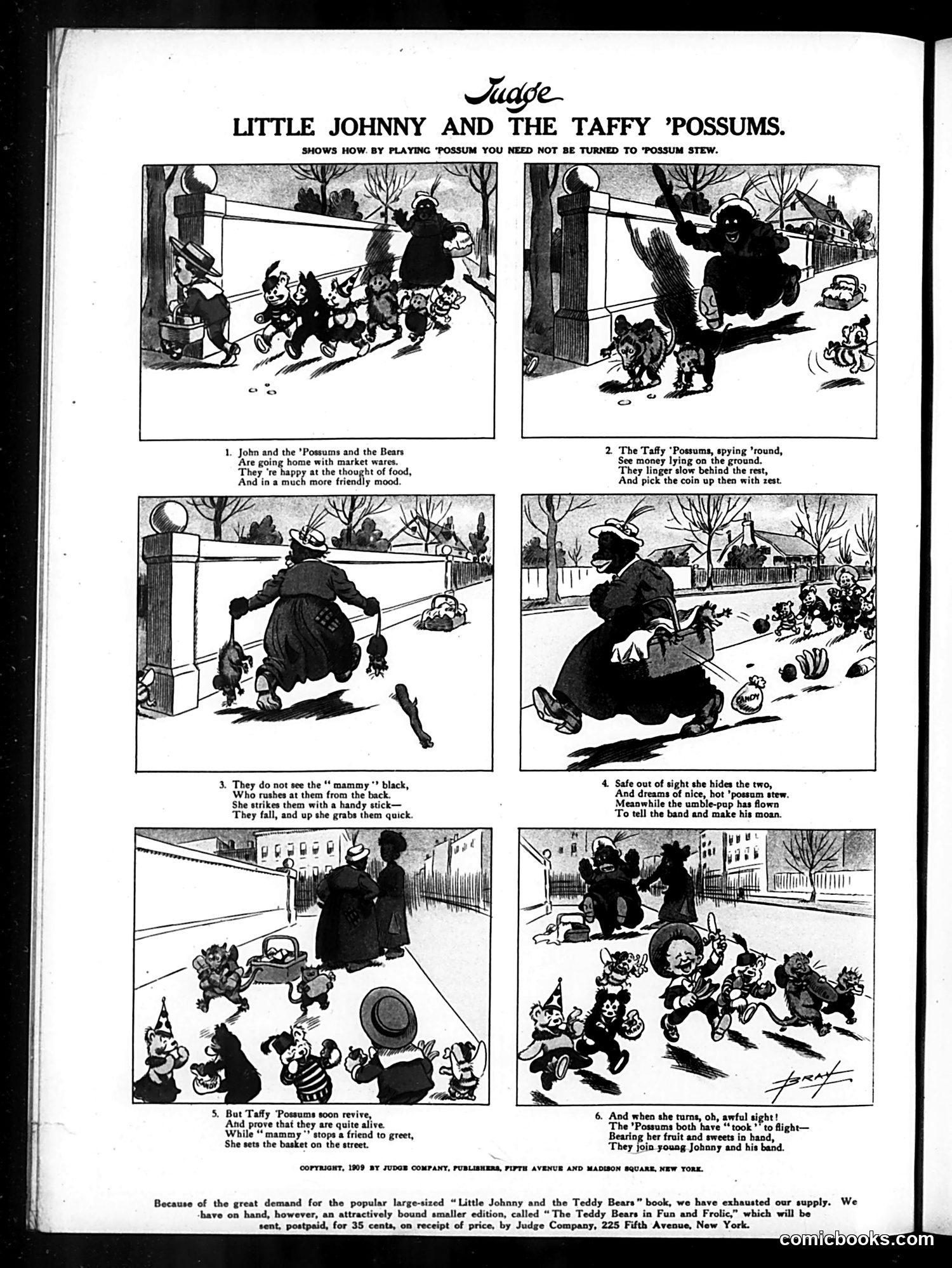
This is a six-panel children's comic strip from Judge magazine (1909) depicting a slapstick adventure story. Little Johnny and anthropomorphic animal characters encounter a Black woman ("mammy") who attempts to catch possums for stew. The humor relies on physical comedy: the woman strikes the possums with a stick, they fall, but later revive and escape with stolen goods (fruit and sweets), ultimately joining Johnny's group. The cartoon reflects early 20th-century racial stereotypes common to the era—the "mammy" figure is depicted as a threatening, violent caricature pursuing animals for food. The strip treats this darkly comedic scenario as entertainment for young readers. The artwork emphasizes exaggerated features and slapstick violence typical of Judge's illustrated humor of that period.