
Judge, 1909-03-13 · page 1 of 15
Judge — March 13, 1909 — page 1: what you’re looking at
What you’re looking at
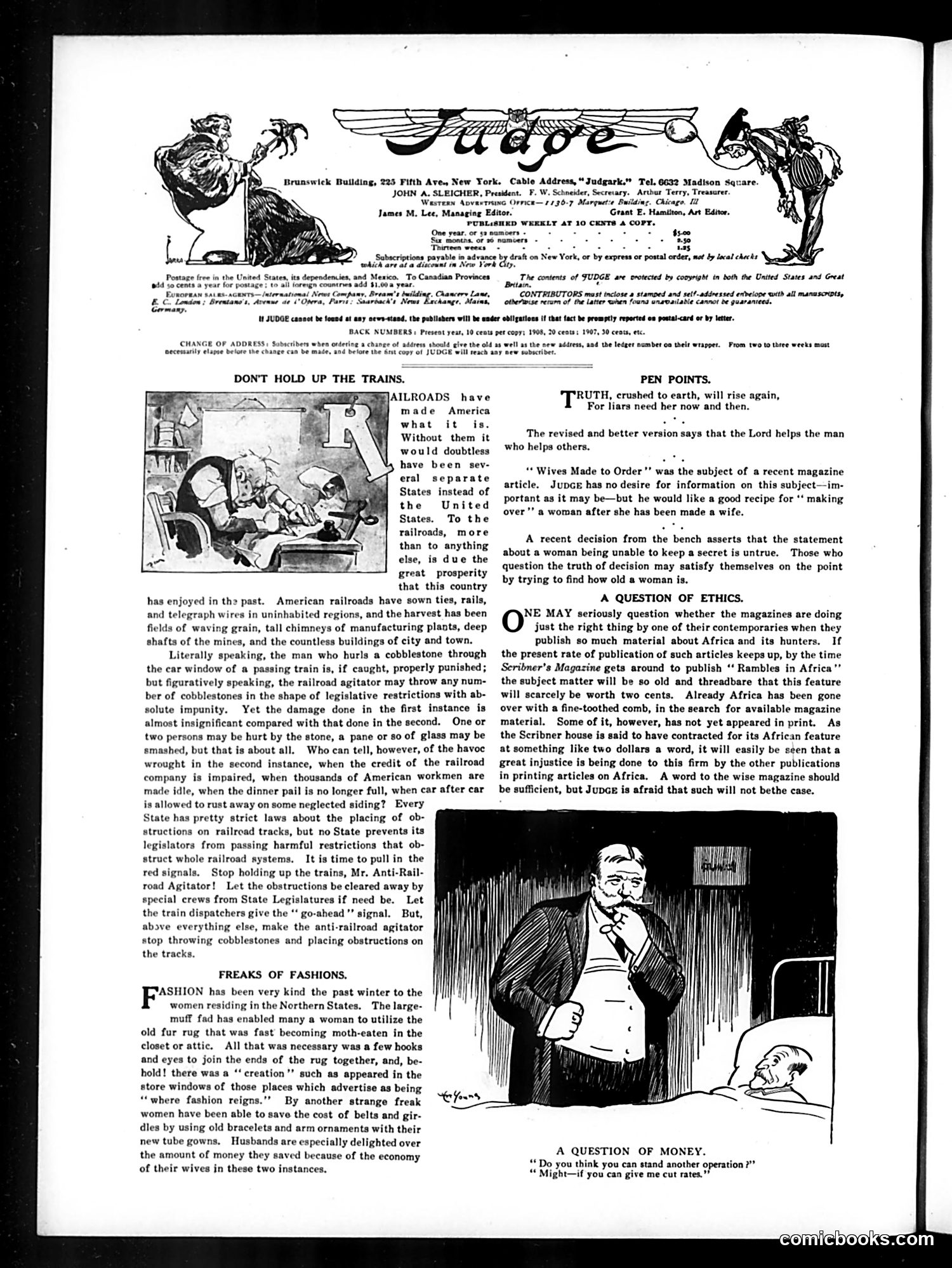
This page contains three distinct sections: **"Don't Hold Up the Trains"** criticizes anti-railroad agitators. The accompanying illustration shows what appears to be railway workers or laborers. The article argues that while railroads deserve regulation, obstructionist tactics harm the public good and that legislators should pass safety signals rather than allow agitators to place physical obstacles on tracks. **"Pen Points"** discusses magazine publication ethics regarding African content, noting concerns about republication rates and potential exploitation. **"Freaks of Fashions"** satirizes winter fashion trends—specifically women wearing large muffs and using old bracelets to economize, with husbands appreciating the savings. **"A Question of Money"** shows a cartoon of a man asking a woman for financial support, likely mocking evolving gender economics of the era. The page reflects early 20th-century debates about labor, journalism ethics, and social change.
📄 Transcribed text from this page (OCR, searchable)
Machine-transcribed from the original scan — historical spelling and the odd misread are preserved.
_Brunswiek Building, 225 Fifth Aves New York. JOHN A, SLEICHER, Presiden cs Address,“ Judgark.” Tel. 6632 Madison Square. 9. Arthur Terry, Treasurer. 1136-7 Marquet'e Building. Chicago, lit James M, Lee, Managing Editor. PUBLISHED WEEKLY AT 10 CENTS 4 COPY. able in advance by draft on ions payable in advance Subscriptions which are af a discount rm Postage free in the United States, its dependencies, and bid so cents a year for postage; to all iaregn countries add Eunorean sa.es-aceners—/uternational News Compas EC. Lomion ; Brentano's, Avenue ade Opera, Paris Germany. ‘Maraacd's News Lechange, Maras, othe/ivise rerarn of the Latter when The contents of FUDGE ave oroteced by conyright tn both the United States and Great Britain CONTRIBUTORS mast inciose 4 stamped and self-addressed enbeiope with all manasnots, found unavailable Cannot be guaranteed. UW JUDGE canset be found at any oews-stand, the publishers will be ander obligations if that fact be promptly reported on postal-card or by letter. BACK NUMBERS: Present year, 10 cents pet copy: 1908, 20 cents: 1907, 30 cents, etc. bers when otdeting a change of address should el CHANGE OF ADDRESS: 5 9 be made, and delote the frst copy of JUOGE DON'T HOLD UP THE TRAINS. made “Ameri a what it i Without them it would doubtless have been sev- eral separate States instead of the United States. To the railroads, more than to anything else, is due the great prosperity that this country has enjoyed in the past. American railroads have sown ties, rails, and telegraph wires in uninhabited regions, and the harvest has been fields of waving grain, tall chimneys of manufacturing plants, deep shafts of the mines, and the countless buildings of city and town. Literally speaking, the man who hurls a cobblestone through the car window of a passing train is, if caught, properly punished; but figuratively speaking, the railroad agitator may throw any num- ber of cobblestones in the shape of legislative restrictions with ab- solute impunity. Yet the damage done in the first instance is almost insignificant compared with that done in the second. One or two persons may be hurt by the stone, a pane or 80 of glass may be smashed, but that is about all. Who can tell, however, of the havoc wrought in the second instance, when the credit of the railroad company is impaired, when thousands of American workmen are made idle, when the dinner pail is no longer full, when car after car is allowed to rust away on some neglected siding? Every State has pretty strict laws about the placing of ob- structions on railroad tracks, but no State prevents its legislators from passing harmful restrictions that ob- struct whole railroad systems. It is time to pull in the red signals. Stop holding up the trains, Mr. Anti-Rail- road Agitator! Let the obstructions be cleared away by special crews from State Legislatures if need be. Let the train dispatchers give the ““ go-ahead” signal. But, above everything else, make the anti-railroad agitator stop throwing cobblestones and placing obstructions on the tracks. FREAKS OF FASHIONS. 'ASHION has been very kind the past winter to the women residing in the Northern States. The large- muff fad has enabled many a woman to utilize the old fur rug that was fast becoming moth-eaten in the closet or attic. All that was necessary was a few hooks and eyes to join the ends of the rug together, and, be- hold! there was a “creation”? such as appeared in the store windows of those places which advertise as being “where fashion reigns. By another strange freak women have been able to save the cost of belts and gir- dles by using old bracelets and arm ornaments with their new tube gowns. Husbands are especially delighted over the amount of money they saved because of the economy of their wives in these two instances. the ledger namber oa their wrapper. Prom two to three weeks mast PEN POINTS. RUTH, crushed to earth, will rise again, For liars need her now and then. The revised and better version says that the Lord helps the man who helps others. “ Wives Made to Order ”’ was the subject of a recent magazine article. Jupce has no desire for information on this subject portant as it may be—but he would like a good recipe for ‘* making over" a woman after she has been made a wife. A recent decision from the bench asserts that the statement about a woman being unable to keep a secret is untrue. Those who question the truth of decision may satisfy themselves on the point by trying to find how old a woman is, A QUESTION OF ETHICS. NE MAY seriously question whether the magazines are doing O just the right thing by one of their contemporaries when they publish so much material about Africa and its hunters. If the present rate of publication of such articles keeps up, by the time Scribner's Magazine gets around to publish ‘ Rambles in Africa’’ the subject matter will be so old and threadbare that this feature will scarcely be worth two cents. Already Africa has been gone over with a fine-toothed comb, in the search for available magazine material. Some of it, however, has not yet appeared in print. As the Scribner house is said to have contracted for its African feature at something like two dollars a word, it will easily be seen that a great injustice is being done to this firm by the other publications in printing articles on Africa. A word to the wise magazine should be sufficient, but Jupce is afraid that such will not bethe case. ul iN i il te hs A QUESTION OF MONEY. “Do you think you can stand another operation ?” “ Might—if you can give me cut rates.