
A complete issue · 17 pages · 1909
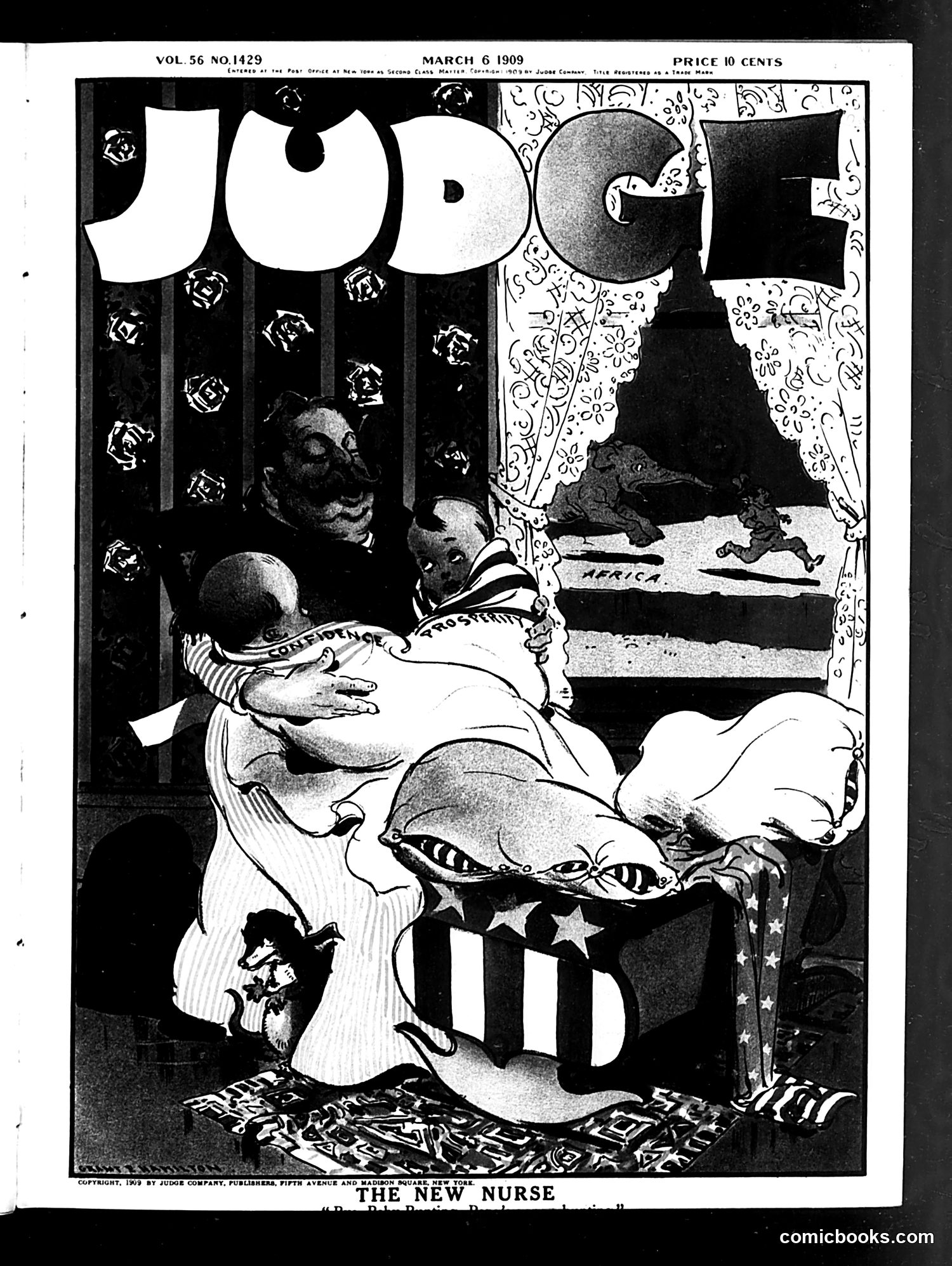
Judge — March 6, 1909
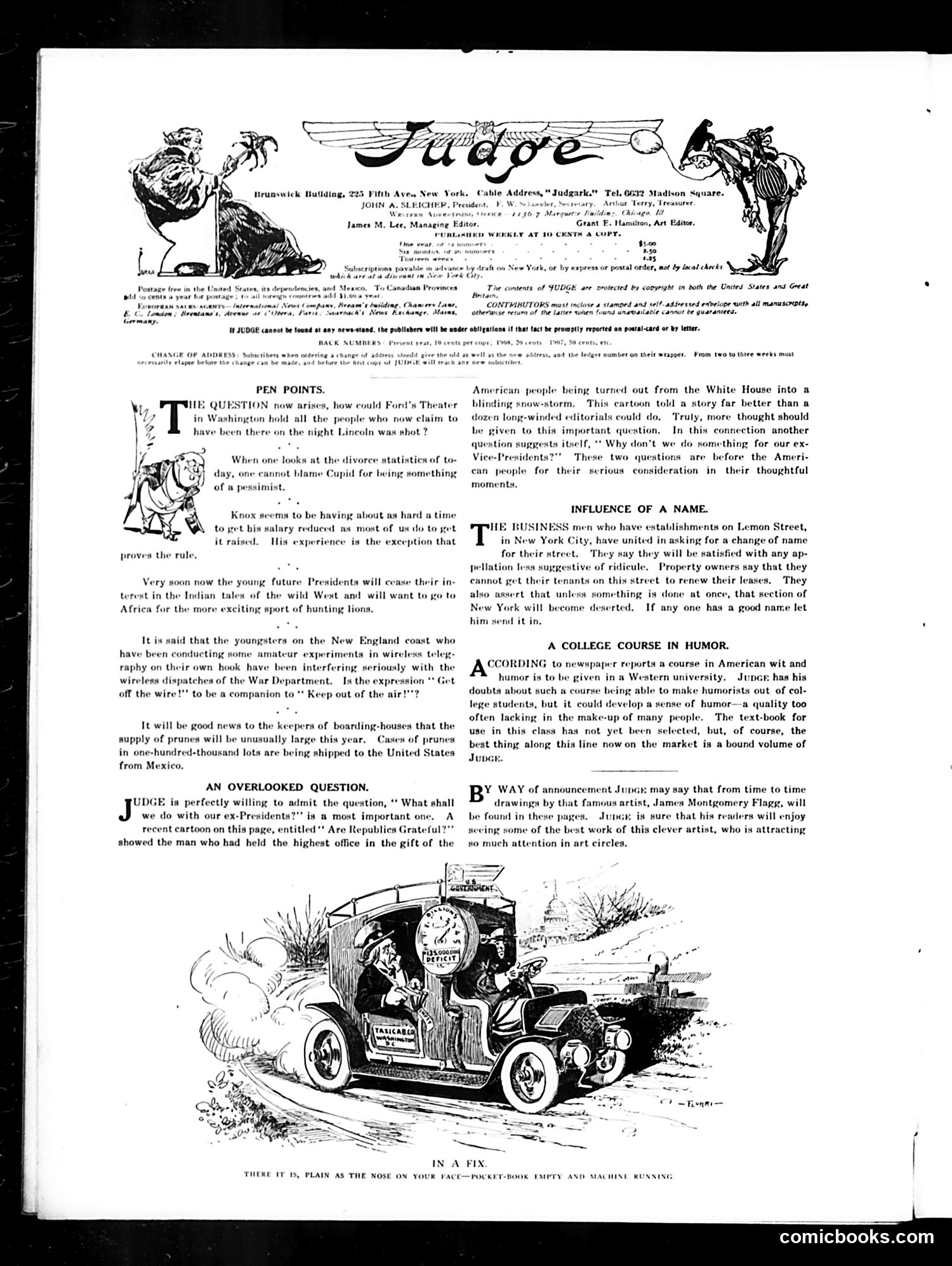
This page contains several satirical pieces about early 20th-century American politics and social issues: **"Pen Points" section** discusses Ford's Theater in Washington and questions about past U.S. Presidents, referencing contemporary political concerns about leadership. **"Influence of a Name"** satirizes New York City businessmen petitioning to rename Lemon Street, finding the name undignified. The joke mocks how property owners obsess over trivial details while neglecting actual urban problems. **"A College Course in Humor"** proposes teaching American wit at universities, suggesting humor was considered an important cultural skill worthy of academic study. **"In a Fix"** (bottom cartoon) depicts an early automobile overheating or malfunctioning, mocking the unreliability of nascent automobile technology—a common subject for period satire. The overall tone reflects Judge's satirical approach to American social pretensions and technological progress.
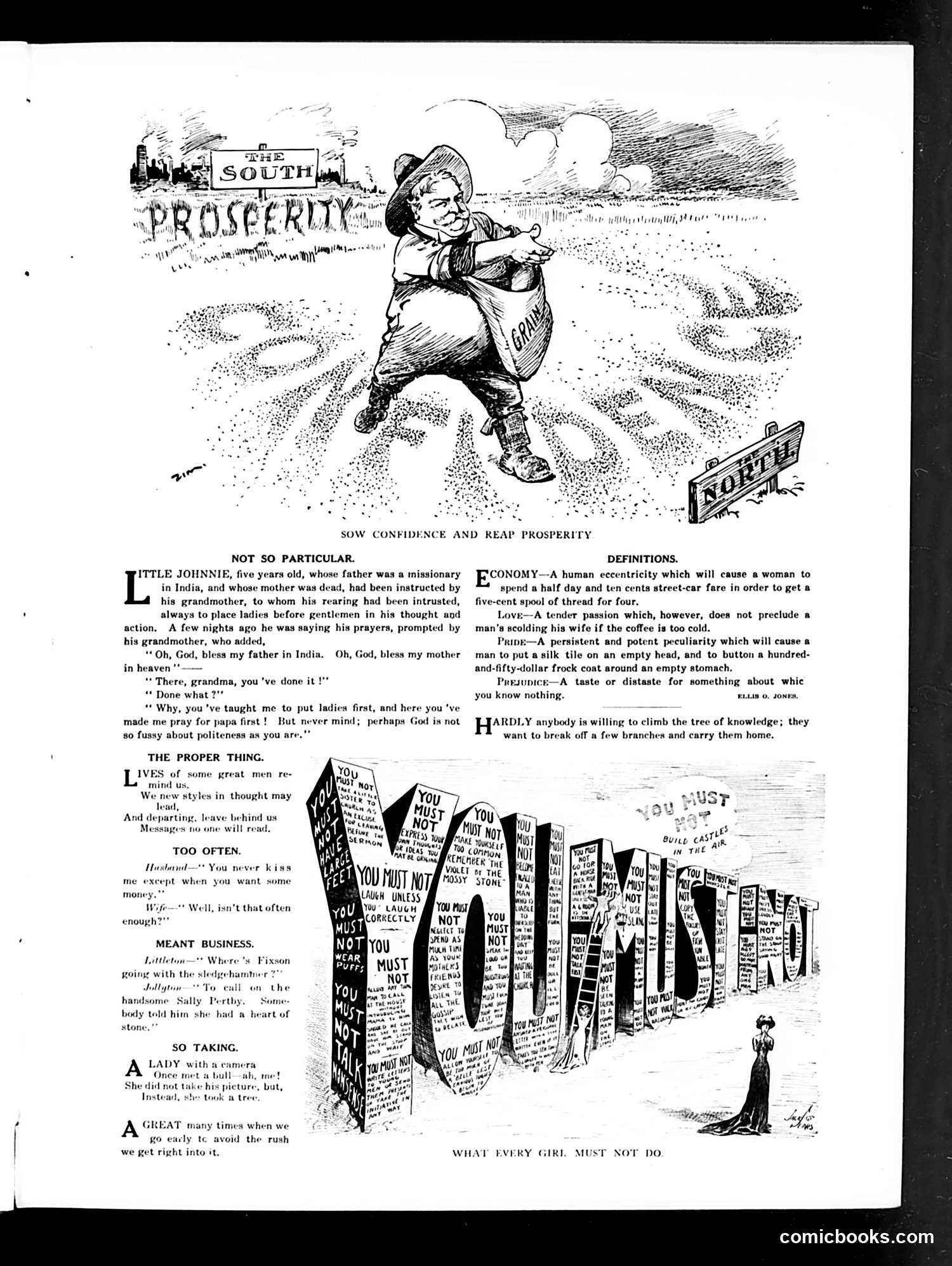
The top cartoon satirizes North-South economic disparity. A rotund figure labeled "CORN" (representing the South) attempts to sow seeds toward a "South Prosperity" sign while facing a "North" barrier. This appears to reference post-Reconstruction economic tensions between agricultural Southern and industrial Northern economies. The larger illustration titled "What Every Girl Must Not Do" depicts a massive wall of prohibitions—"You Must Not" repeated dozens of times—surrounding a small female figure. This satirizes the restrictive social codes governing women's behavior in the era, mocking the excessive and contradictory rules women faced regarding propriety, appearance, and conduct. The surrounding brief humorous pieces ("Not So Particular," "The Proper Thing," etc.) offer satirical commentary on social etiquette and hypocrisy.
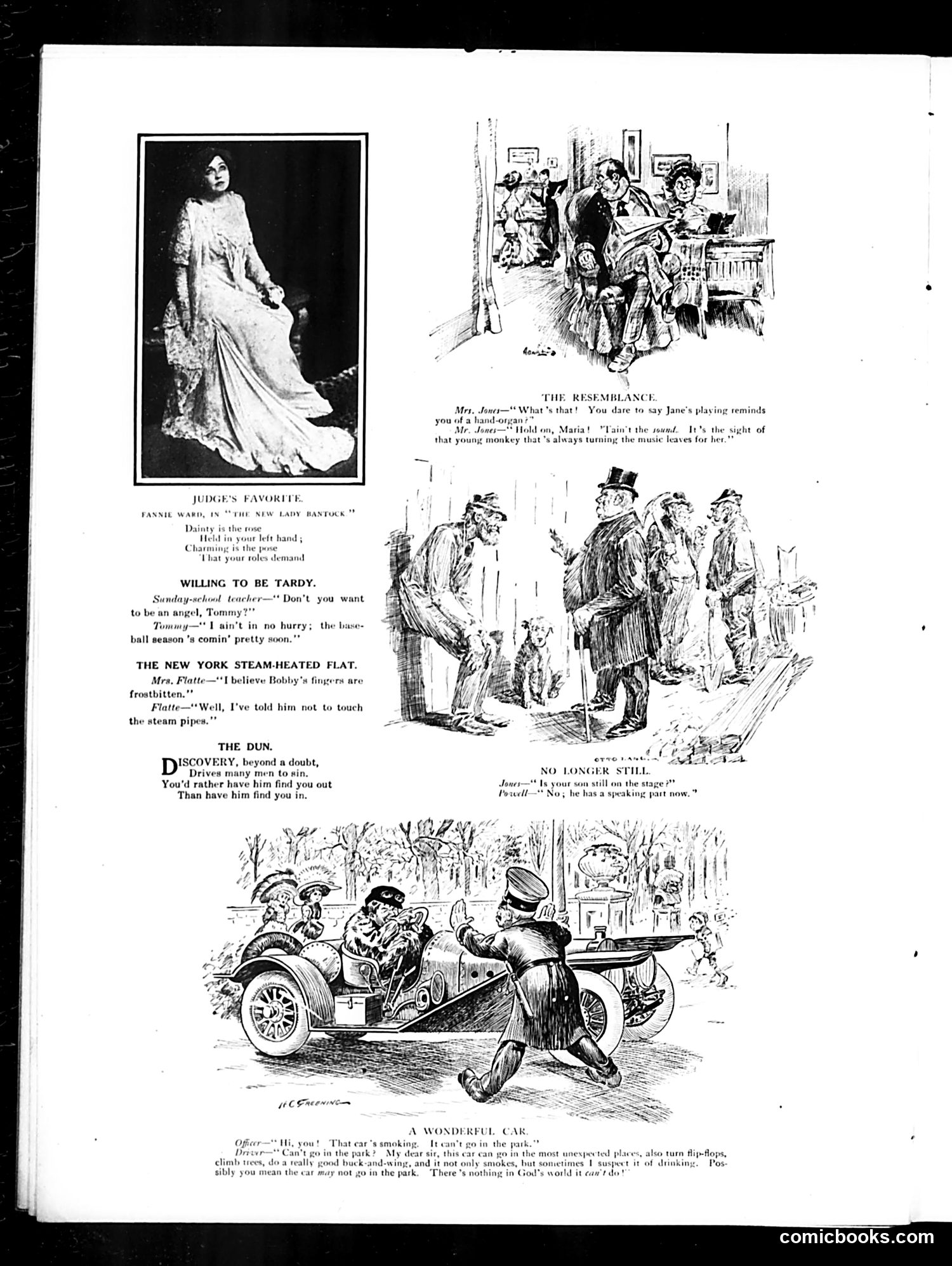
This page contains several unrelated satirical sketches and jokes typical of early 20th-century Judge magazine: **"Judge's Favorite"** features actress Fannie Ward in "The New Lady Bantock," a theatrical production, celebrating her performance. **"The Resemblance"** jokes about a young woman's piano playing disturbing neighbors—a common domestic comedy theme of the era. **"The New York Steam-Heated Flat"** satirizes urban apartment living and household management concerns. **"A Wonderful Car"** mocks the newfangled automobile and its unexpected places it can (and cannot) travel—likely poking fun at both the technology's capabilities and social anxieties about where cars should be permitted. The sketches reflect early 1900s upper-middle-class concerns: theater, urban living, and the social disruption caused by new technology.
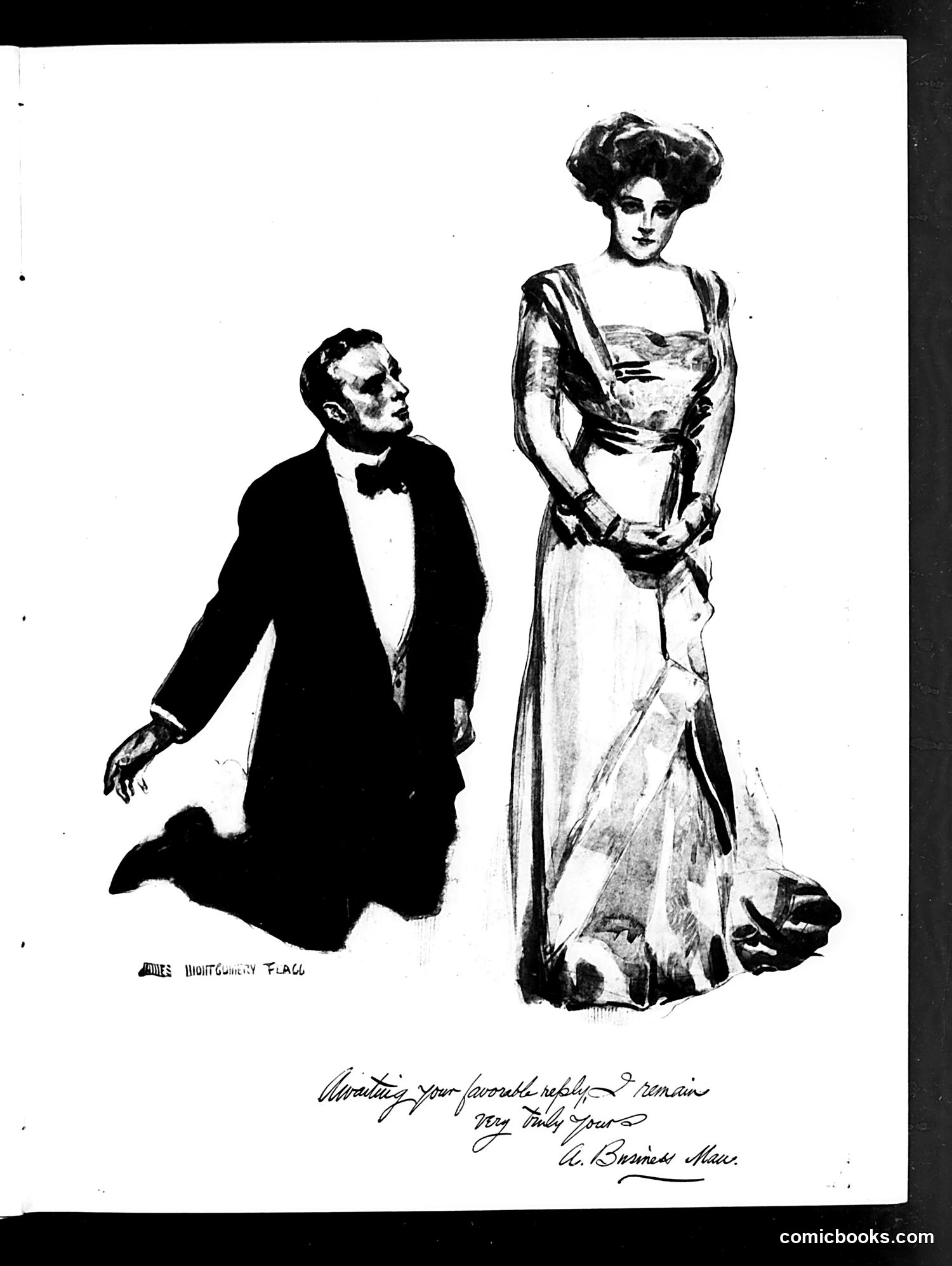
This appears to be a sketch by James Montgomery Flagg, the renowned American illustrator. The image depicts two figures in formal attire — a man in a tuxedo on his knees and a woman in an elegant evening gown standing above him in a dominant pose. The handwritten inscription below reads: "Awaiting your favorable reply, I remain very truly yours, C. Braman Starr" (or similar). This likely satirizes the reversal of traditional gender power dynamics in courtship. The kneeling man assumes the submissive posture typically associated with a woman being proposed to, while the woman stands imperiously — inverting Victorian-era romantic conventions. The satire comments on changing social relations between men and women in the early 20th century, mocking the shifting balance of power in romantic relationships.
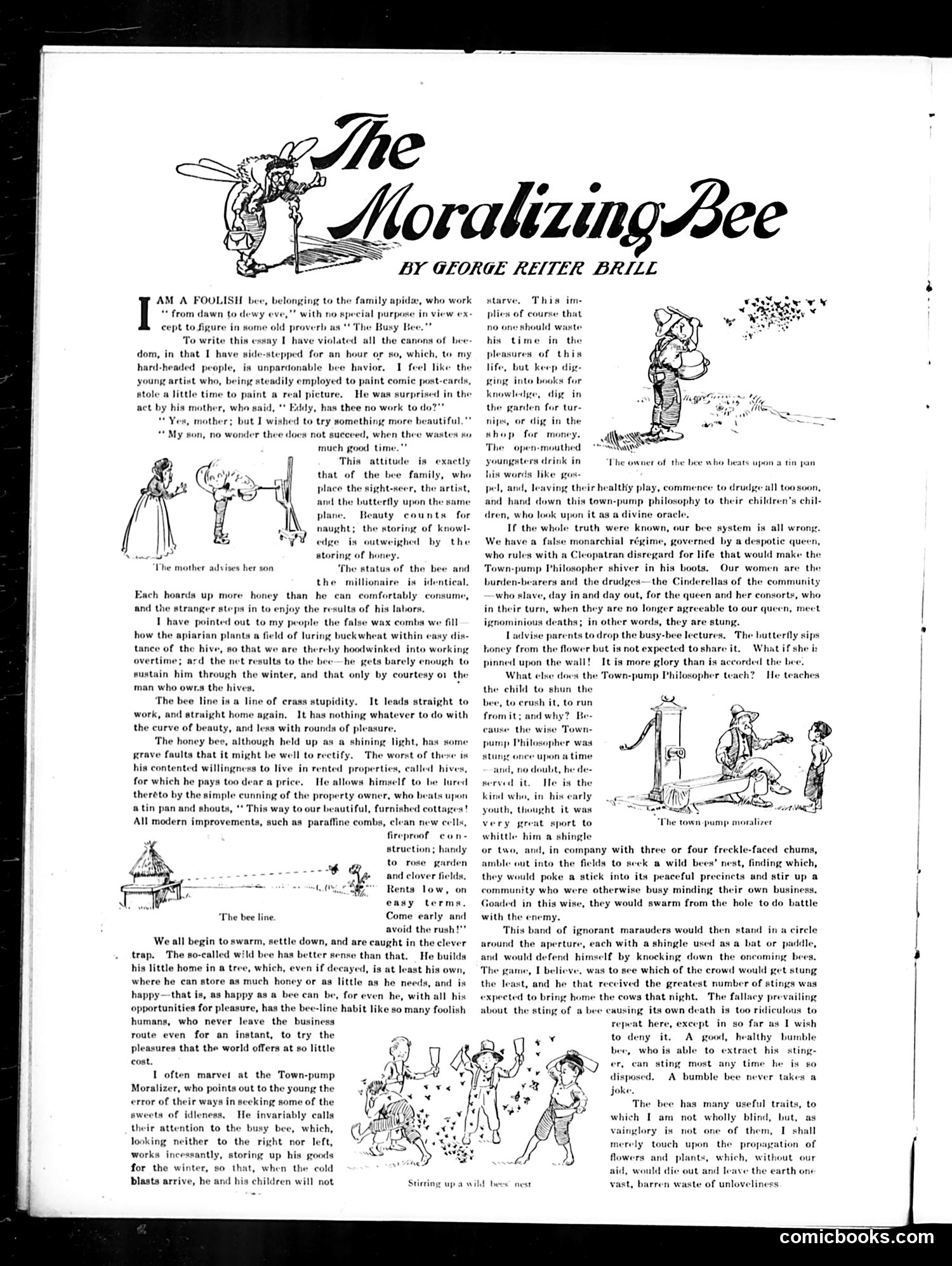
This essay-cartoon by George Reiter Brill satirizes the **"Town-pump Philosopher"** — a stock figure representing self-righteous moralizers who preach ceaseless work and duty while dismissing pleasure as idleness. The bee serves as an allegory for working-class humans. Brill critiques how: 1. **Capitalist exploitation**: Bees (workers) are tricked into renting hives from property owners, working overtime on planted crops, barely sustaining themselves while owners profit. 2. **False morality**: The "Town-pump Philosopher" lectures youth to shun idleness and "dig" for knowledge and money, discouraging any life enjoyment — essentially perpetuating the system that exploits them. 3. **Authoritarian systems**: The bee colony's "despotic queen" and "false monarchial régime" represent oppressive governance. Brill argues the entire system is fundamentally "wrong." The satire targets not lazy workers but rather the hypocritical authority figures who moralize work-at-all-costs ideology to maintain social control and economic advantage.
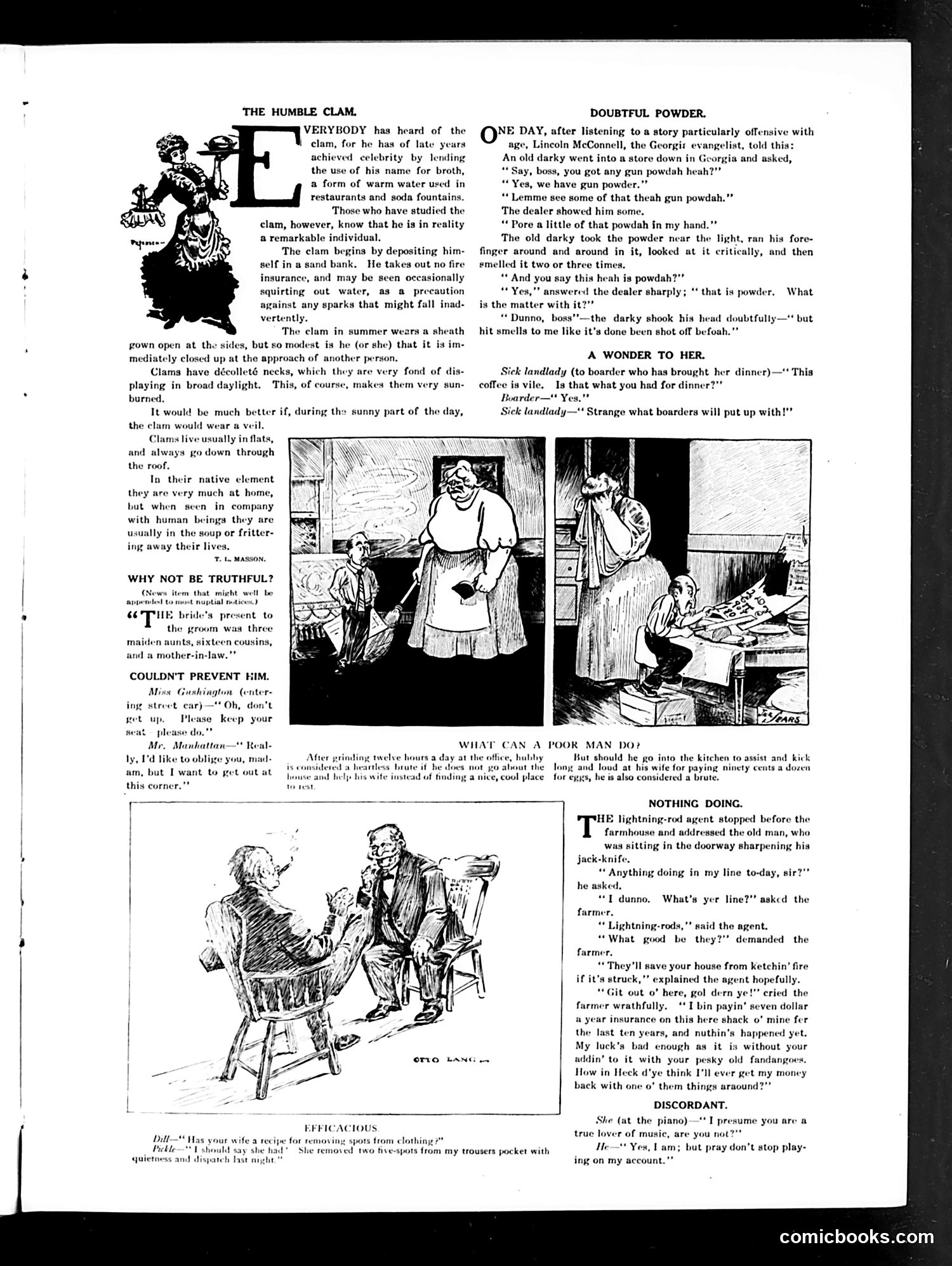
This page contains multiple brief satirical pieces typical of early 20th-century American humor magazines: **"Doubtful Powder"** presents a racist dialect joke where a Black man tests gun powder, expressing doubt that it's genuine because "it smells like it's done been shot off before." The humor relies on the character's supposed ignorance. **"The Humble Clam"** is a whimsical natural history piece anthropomorphizing clams, describing their modest behavior and tendency to close when approached by humans—likely satirizing overwrought nature writing. **Other brief items** include domestic comedy ("A Wonder to Her," "Why Not Be Truthful?") about marital discord, and "Nothing Doing," where a lightning-rod salesman fails to convince a farmer to buy protection, with the farmer reasoning his insurance means nothing will happen anyway. The page exemplifies Judge's mix of social commentary, slapstick humor, and period racism. The tone is lighthearted rather than explicitly political, focusing on everyday absurdities and character types rather than specific events or figures.
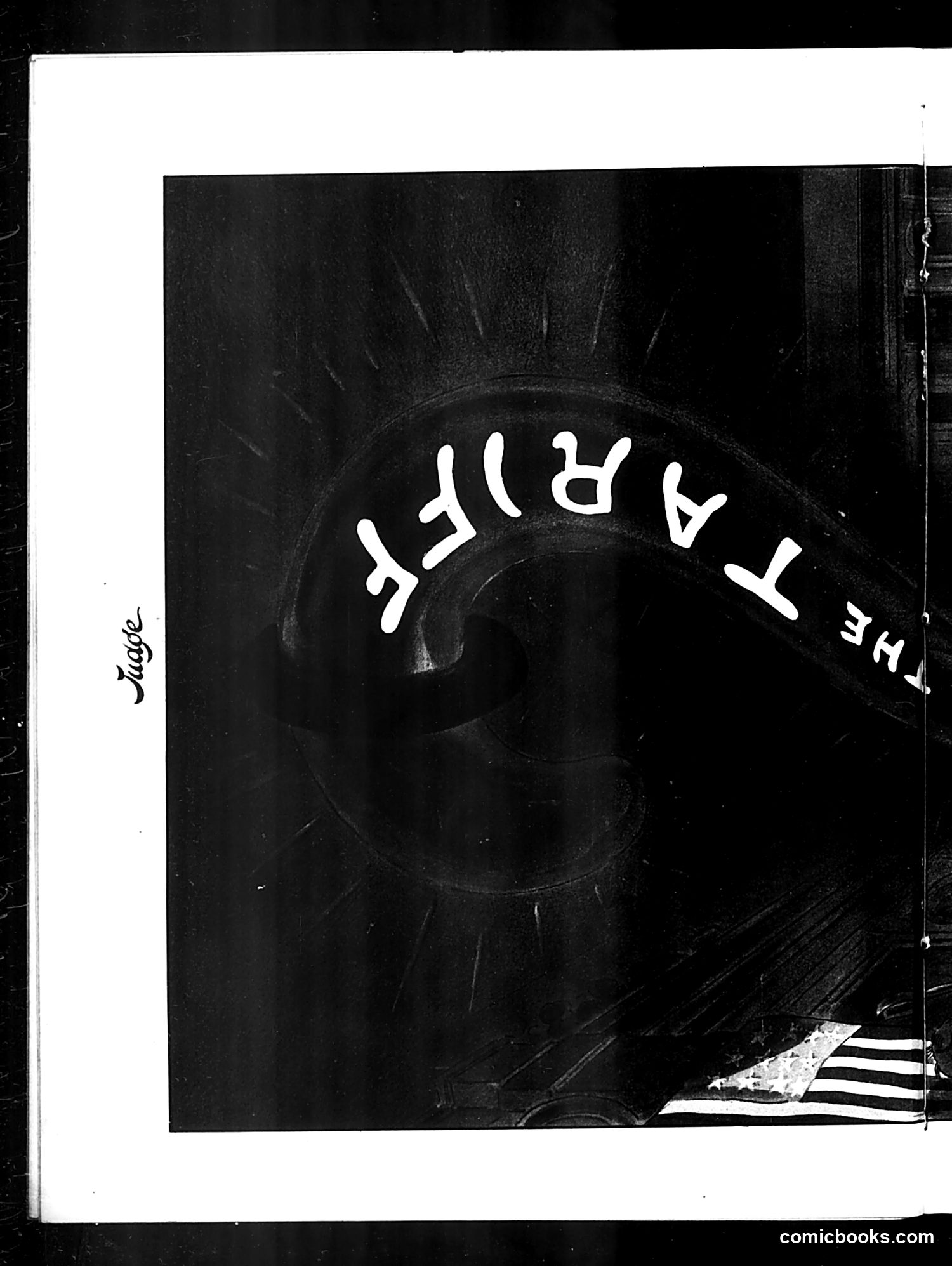
This appears to be a title page or cover from *Judge* magazine, featuring a circular seal or emblem against a dark background. The text reads "THE 1 JUDGE" arranged in a curved manner around the central circular design, which resembles an official seal with radiating lines. Without additional context or visible satirical imagery, caricatures, or accompanying article text, I cannot identify specific political figures, events, or social commentary this page references. The design suggests this is a decorative cover or section divider rather than a cartoon with identifiable satirical content. To explain the meaning and context to a modern reader, I would need to see accompanying illustrations, article titles, or clearer thematic elements that indicate what contemporary issue or figure was being satirized.
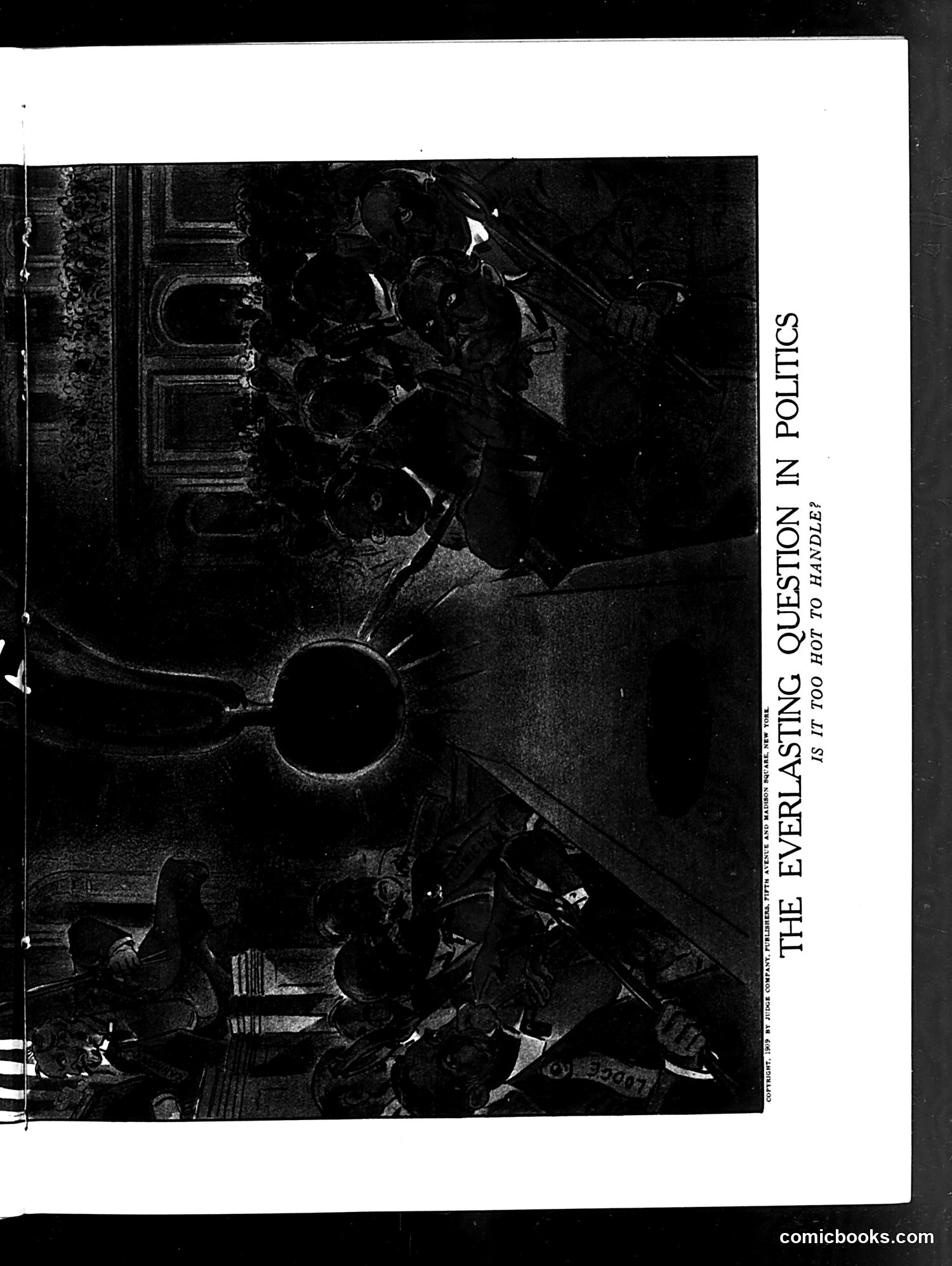
This page appears to be a title or section header from *Judge* magazine, showing a dark, crowded interior scene with multiple figures engaged in heated discussion or confrontation. The text reads "THE EVERLASTING QUESTION IN POLITICS" with a subtitle stating "IS IT TOO HARD TO HANDLE?" The cartoon satirizes the perpetual chaos and difficulty of political discourse—suggesting that fundamental political questions prove too complex or contentious for politicians to actually resolve. The crowded, tumultuous scene likely depicts lawmakers or political figures arguing, unable to reach consensus. The satire critiques politicians' perceived inability or unwillingness to tackle serious issues substantively, a timeless commentary on legislative gridlock and political posturing that remains relevant today.
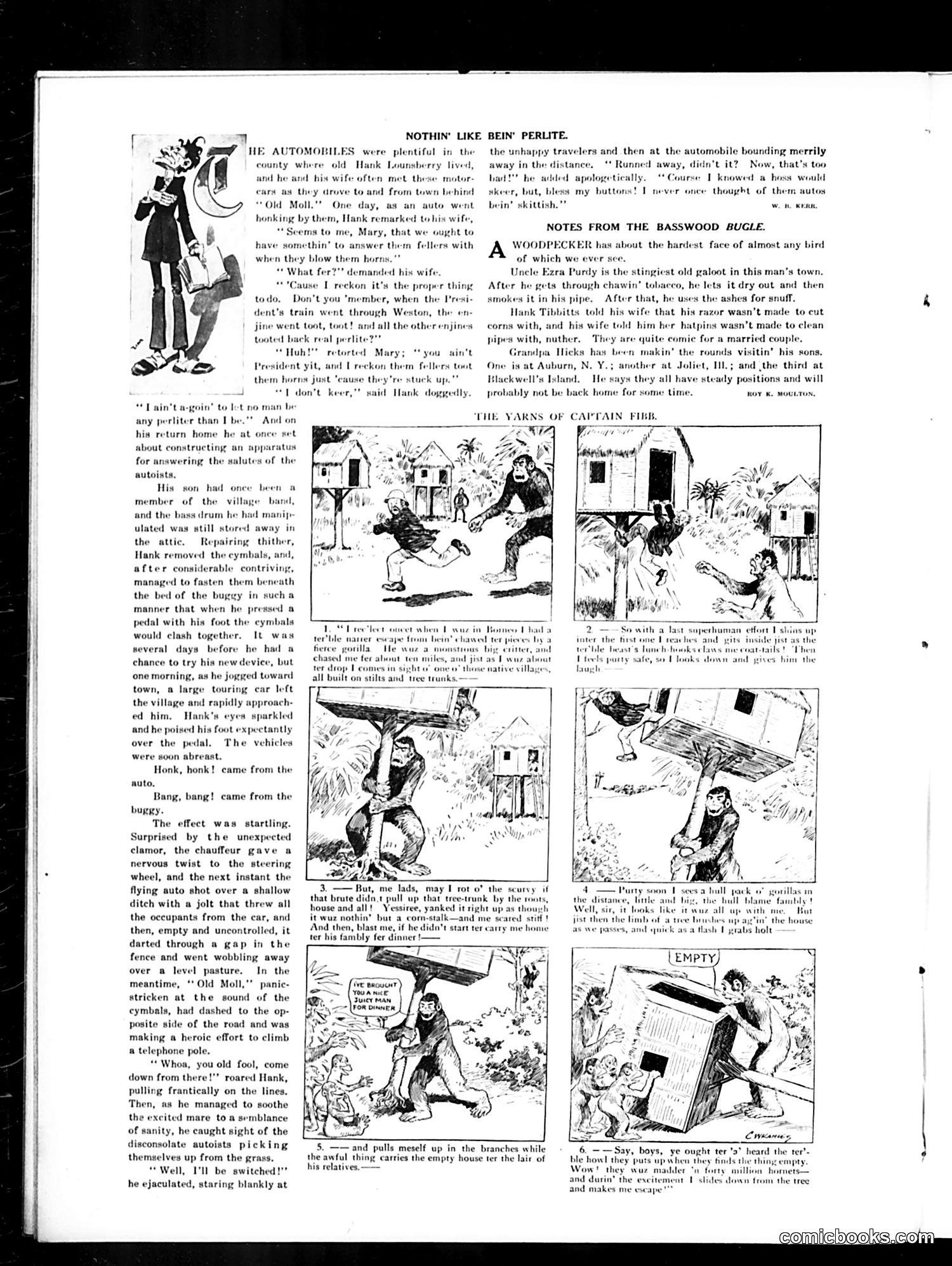
This page contains humorous rural fiction from *Judge* magazine. The main story, "Nothin' Like Bein' Perlite," satirizes early-automobile era social dynamics and class consciousness. **The Setup:** Old Hank Lounsberry, a farmer, feels socially inferior when automobiles pass his horse-drawn buggy honking their horns. He recalls that when the President's train passed through town, the locomotive "tooted back real perlite" (politely). Determined to assert his dignity, he fashions cymbals onto his buggy's bed as a noisemaker. **The Joke:** When an automobile honks at him, his contraption creates such startling noise that it terrifies the car's occupants, causing a crash. **The Satire:** The story mocks rural Americans' insecurity about modernity and technology, their desire for "respectability," and their resourceful but chaotic attempts to compete with urban progress. Hank's logic—that the President's train returned courtesy, so he should too—reveals both his earnestness and his misunderstanding of social hierarchy. The page also includes unrelated anecdotes in "Notes from the Basswood Bugle" and "The Yarns of Captain Fibb."
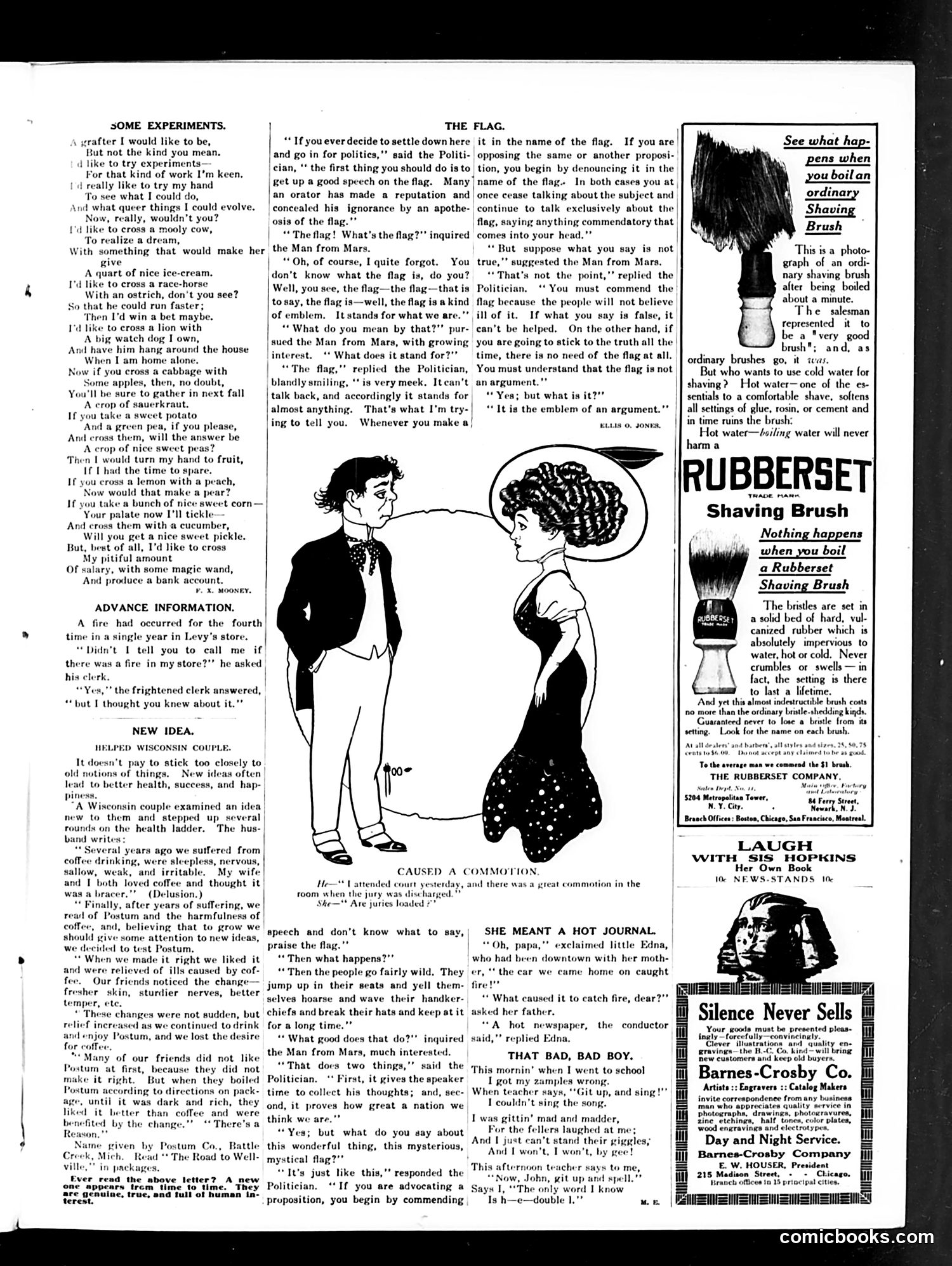
This cartoon satirizes political rhetoric and patriotic empty-talk. A "Man from Mars" (a naive outsider) asks a Politician to explain what the flag is and what it stands for. The Politician's response reveals the cynicism: the flag is "a kind of emblem" that "stands for what we are"—circular nonsense. More damningly, the Politician admits the flag "can't talk back, and accordingly it stands for almost anything. That's what I'm trying to tell you." The satire targets how politicians exploit flag-waving as a substitute for actual argument or policy. When audiences hear patriotic appeals, they "go fairly wild," yelling and waving handkerchiefs—emotional reaction replacing rational discourse. The cartoon mocks both the demagogue's cynical manipulation and the public's gullible response to empty nationalist sentiment. The joke: the flag means whatever a politician needs it to mean at any given moment.
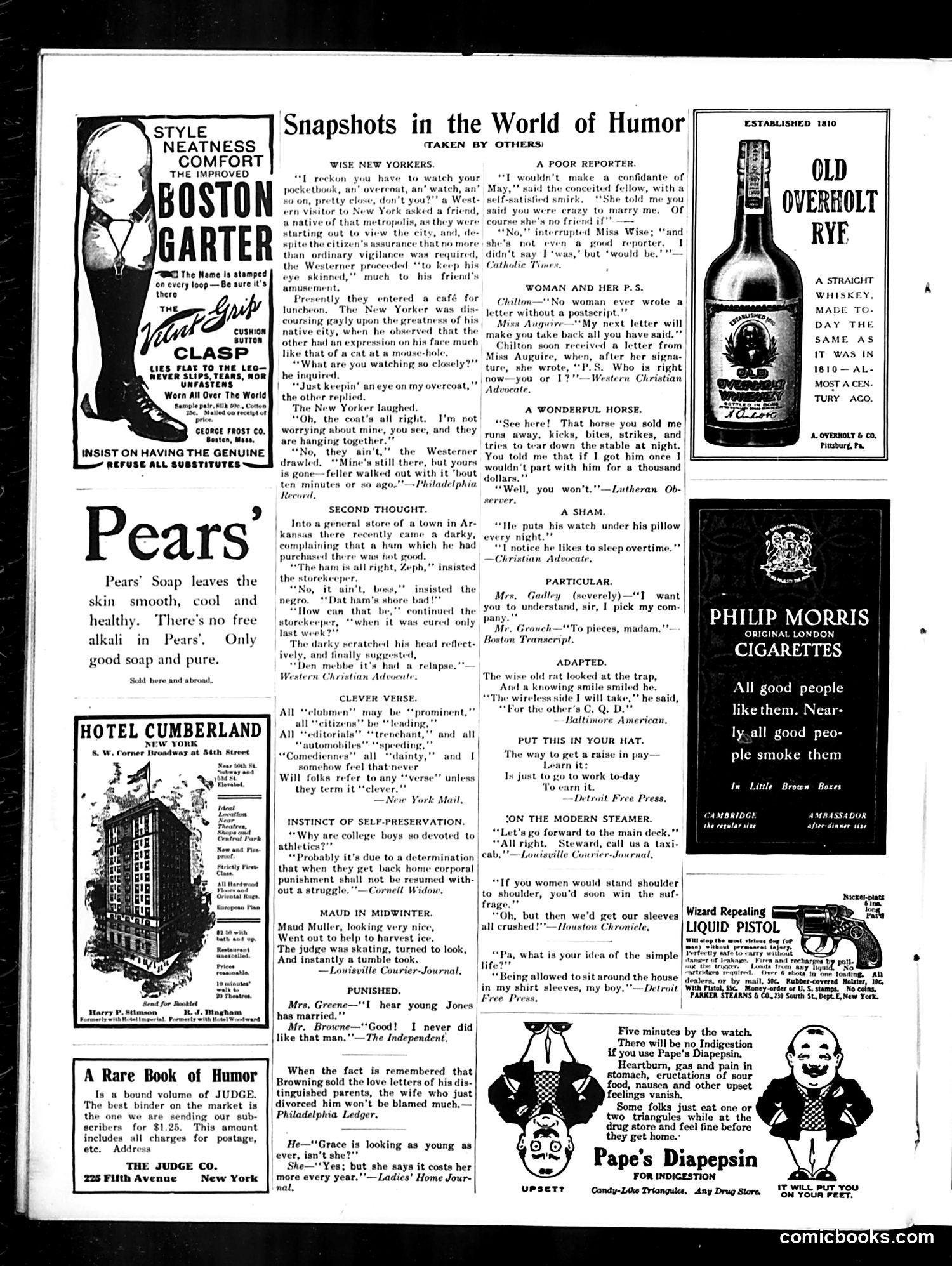
This page is primarily **advertisements and humor snippets** from Judge, a satirical weekly. The main content includes: **The Boston Garter ad** (top left): A shoe garter advertisement using a joke about a naive Western visitor to New York City who's warned to watch his pocketbook. The humor plays on New York's reputation for pickpockets and theft—a common stereotype of the era. **Pears' Soap ad**: Standard product advertisement. **The "Second Thought" anecdote**: A racial humor piece (typical of the period) depicting a Black man complaining about ham quality using dialect humor—common but offensive by modern standards. **Various short jokes and verses**: Brief one-liners about relationships, college life, and social situations—mostly unremarkable by today's standards. **Bottom section**: Advertisements for Old Overolt Rye, Philip Morris Cigarettes, Hotel Cumberland, Wizard Repeating Liquid Pistol, and Pape's Diapepsin (a digestive remedy). The page reflects turn-of-century American humor: focus on urban anxieties, casual racism, product advertising disguised as editorial content, and domestic/relationship jokes.
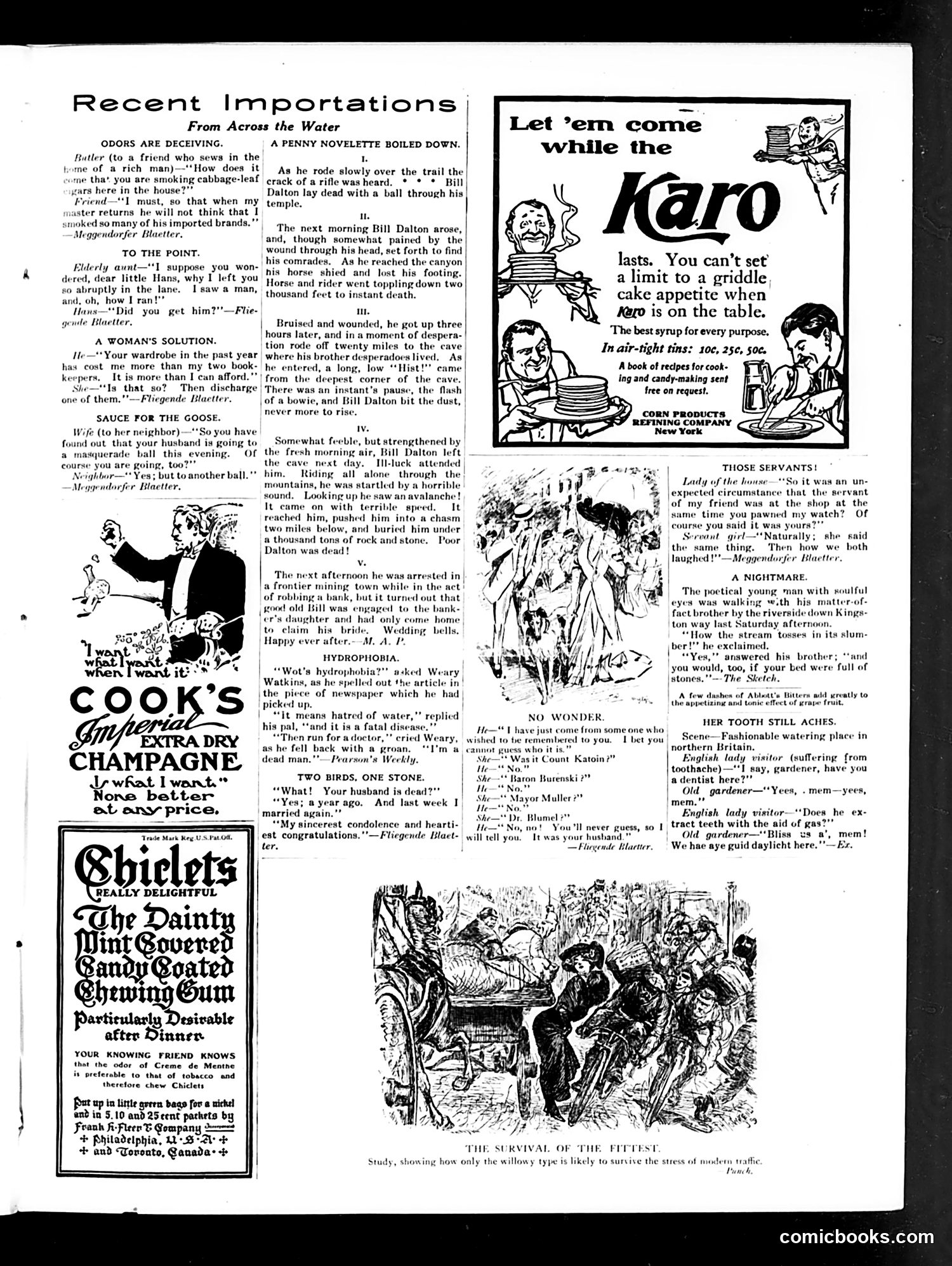
This page contains several humor pieces typical of early 20th-century Judge magazine—primarily brief anecdotes and advertisements rather than political cartoons. **The main content:** The "Recent Importations from Across the Water" section features translated European jokes, likely from German publications (references to *Fliegende Blätter*, *Meggendorfer Blätter*). These mock European manners and situations: a servant masking his smoking habits, an elderly woman fleeing from a man, marital discord over clothing expenses. The longest piece is a humorous serialized penny-dreadful parody—"Bill Dalton" keeps dying repeatedly in melodramatic fashion (shot, falls, avalanche), satirizing the absurd plot coincidences in cheap serial fiction popular at the time. **Advertisements** dominate: Cook's Champagne, Karo syrup, Chiclets gum, and Shiclets candy emphasize product benefits through domestic/social scenarios. **The satire targets:** European pretension, marital tensions, servant dynamics, and lowbrow entertainment conventions—standard humor for Judge's educated, middle-class readership mocking both foreign affectations and popular culture.
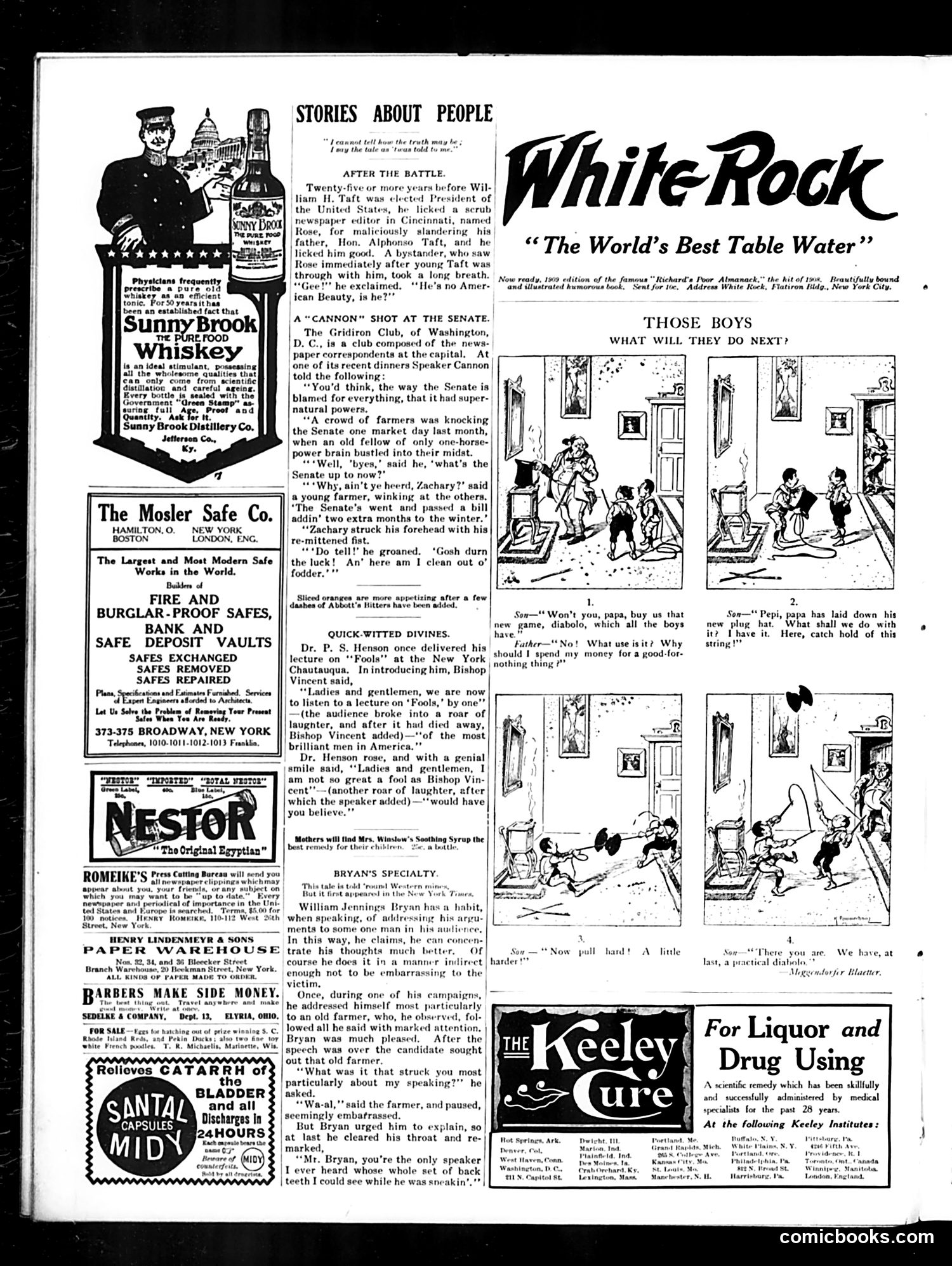
This page from Judge magazine (circa 1909) contains three main humorous anecdotes satirizing prominent figures: **"After the Battle"** ridicules President William H. Taft, recounting how years earlier he physically fought a Cincinnati editor who slandered his father (Alphonso Taft). The joke's punchline—calling the bruised editor no "American Beauty"—mocks Taft's refined, dignified image. **"A Cannon Shot at the Senate"** features Speaker Joseph Cannon telling a joke at the Gridiron Club (Washington correspondents' club) mocking the Senate as incompetent and blamed for everything, even controlling seasons. **"Bryan's Specialty"** targets William Jennings Bryan, the three-time presidential candidate, depicting him as obsessively focused on converting individual listeners rather than broader audiences during his speaking campaigns. All three anecdotes use humor to critique these political figures' vanity, incompetence, or character flaws—typical Judge magazine satire of the Progressive Era.
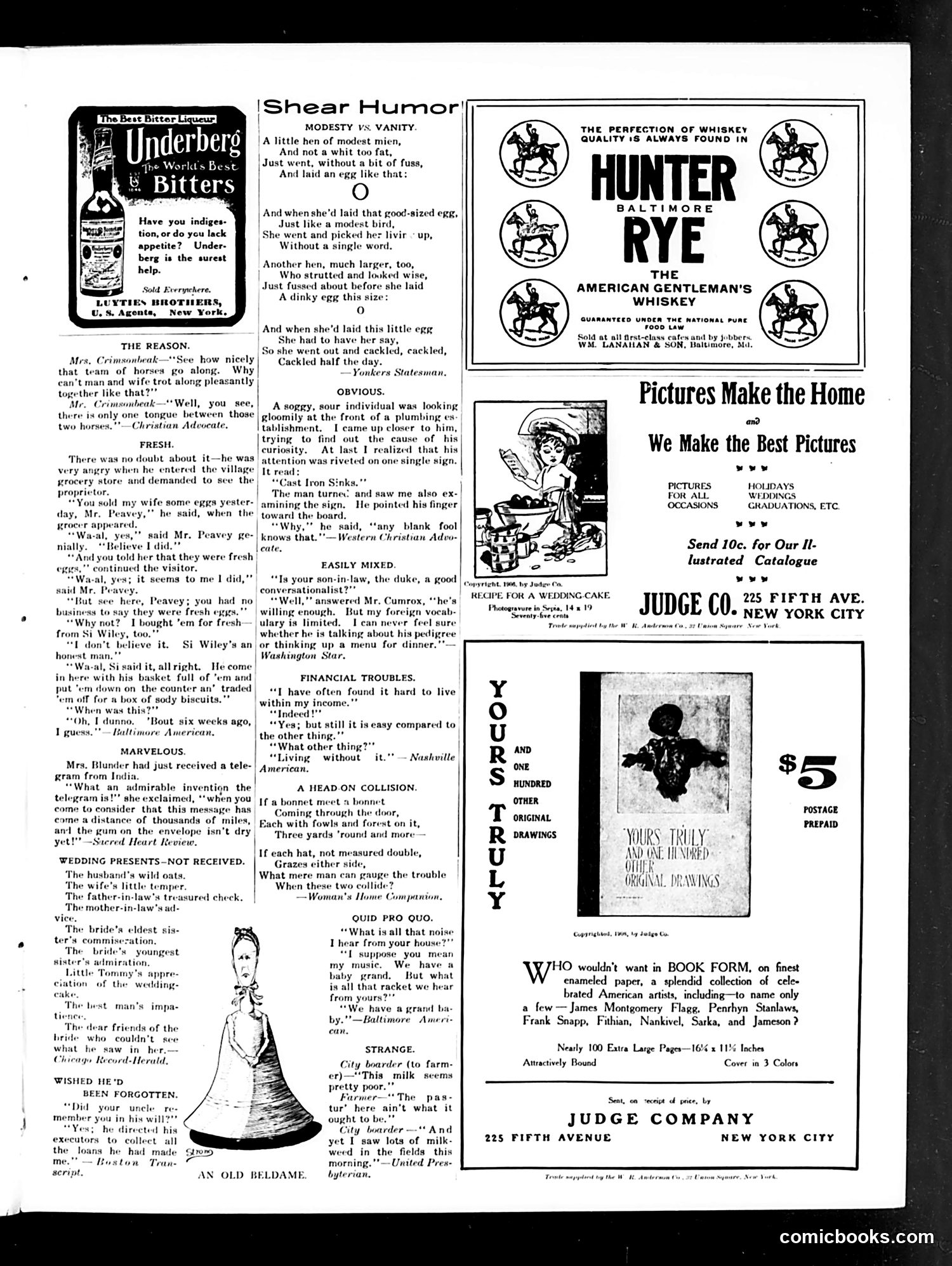
This page primarily contains **humorous anecdotes and advertisements** rather than political cartoons. The content reflects early-20th-century American domestic humor. **Main humor pieces:** 1. **"Modesty vs. Vanity"**: A fable contrasting a modest hen who lays a large egg silently versus a vain hen who lays a small egg but cackles about it—satirizing human vanity and self-promotion. 2. **Various short jokes** about married life, domestic situations, and social awkwardness (husbands and wives, in-laws, dinner conversations), typical of Judge's satirical approach to middle-class American life. 3. **References to contemporary products** like Underberg Bitters and Hunter Baltimore Rye whiskey advertisements. **The satire targets**: pretentiousness, marital discord, class affectation, and social anxiety—common Judge themes mocking American bourgeois behavior and expectations. The illustrations are simple line drawings accompanying lighthearted domestic scenarios rather than biting political commentary.
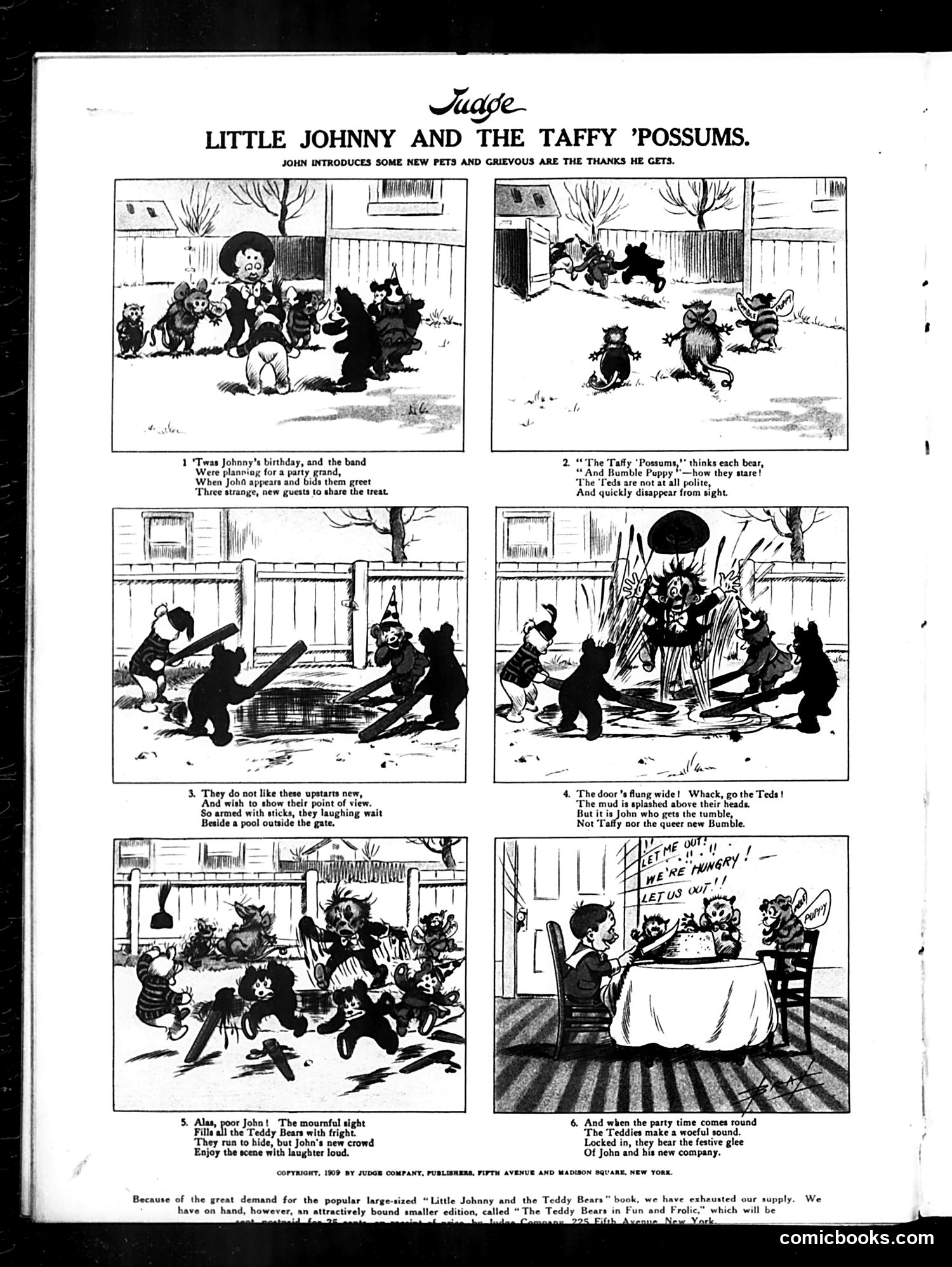
This is a children's comic strip from *Judge* magazine featuring a birthday party conflict. Little Johnny introduces new toy animals—"Taffy 'Possums" and a "Bumble Puppy"—to his existing Teddy Bears at his party. The strip depicts a rivalry between the toy groups: the established Teddy Bears resent the newcomers and attempt to drive them away by ambushing them with sticks near a muddy pool. The prank backfires when Johnny himself gets knocked into the mud instead. Eventually, the original Teddy Bears are locked indoors while Johnny celebrates his party with the new toys outside, reversing the initial social hierarchy. The humor operates on a simple level—toy animal conflict and physical comedy—though it may obliquely reflect early 1900s anxieties about new consumer goods displacing established ones. The strip concludes by advertising the publisher's related "Teddy Bears" book line.
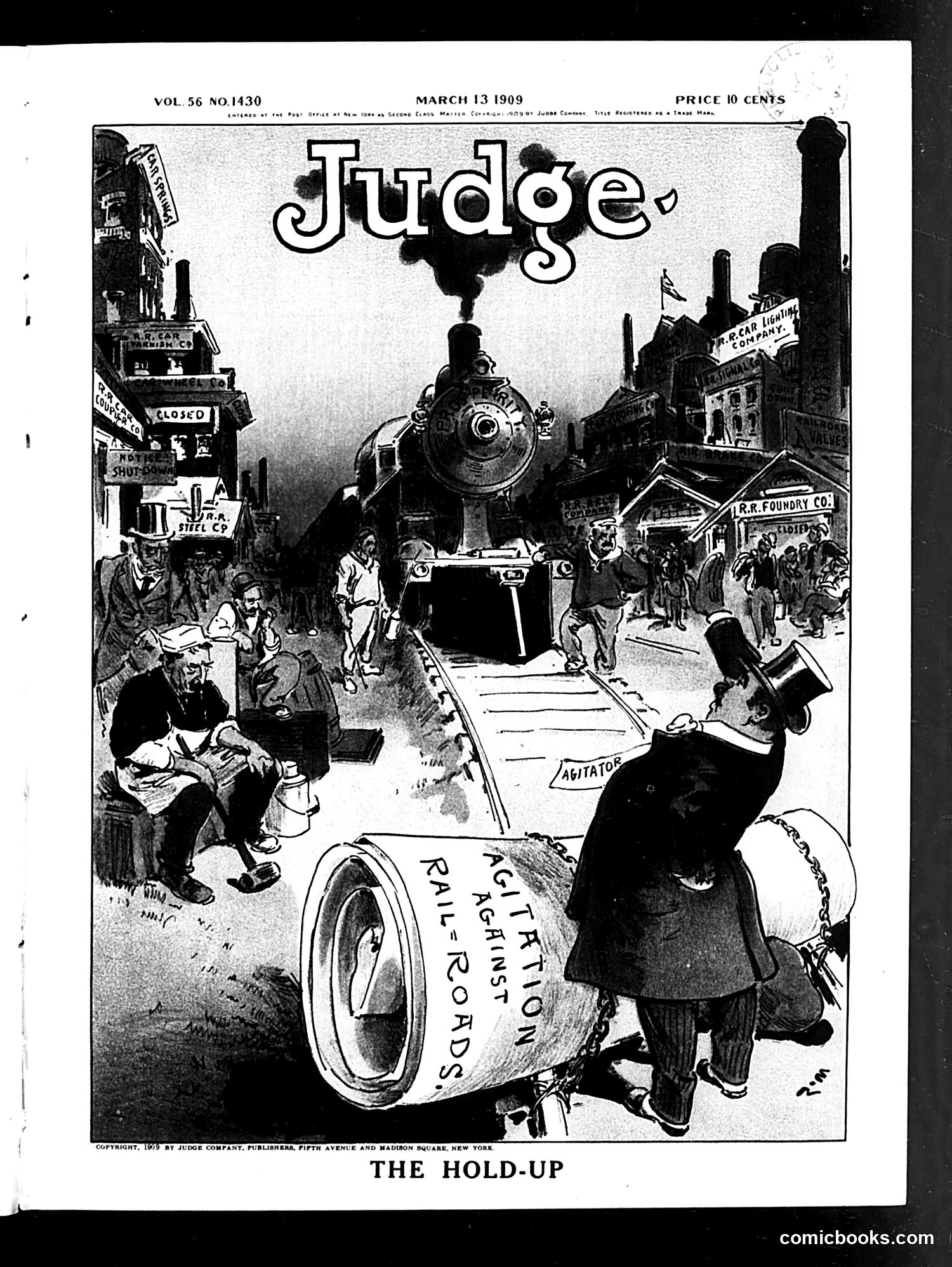
This cartoon satirizes railroad monopolies and their exploitation of the public. A locomotive has stopped traffic at a railroad crossing while a well-dressed man (likely representing a railroad baron or corporation) holds up a large barrel labeled "COTTON" and "RAILROAD FREIGHT RATES" — suggesting he's blocking commerce to extort higher shipping costs. The crowded street scene shows frustrated pedestrians and businesses affected by the stoppage. The satire criticizes how railroad companies held the economy "hostage" through monopolistic control of shipping rates, forcing businesses and consumers to pay inflated fees. This reflects early 20th-century Progressive Era concerns about corporate monopolies and the need for railroad regulation — issues that would lead to Theodore Roosevelt's trust-busting policies.