
Judge, 1909-03-06 · page 6 of 17
Judge — March 6, 1909 — page 6: what you’re looking at
What you’re looking at
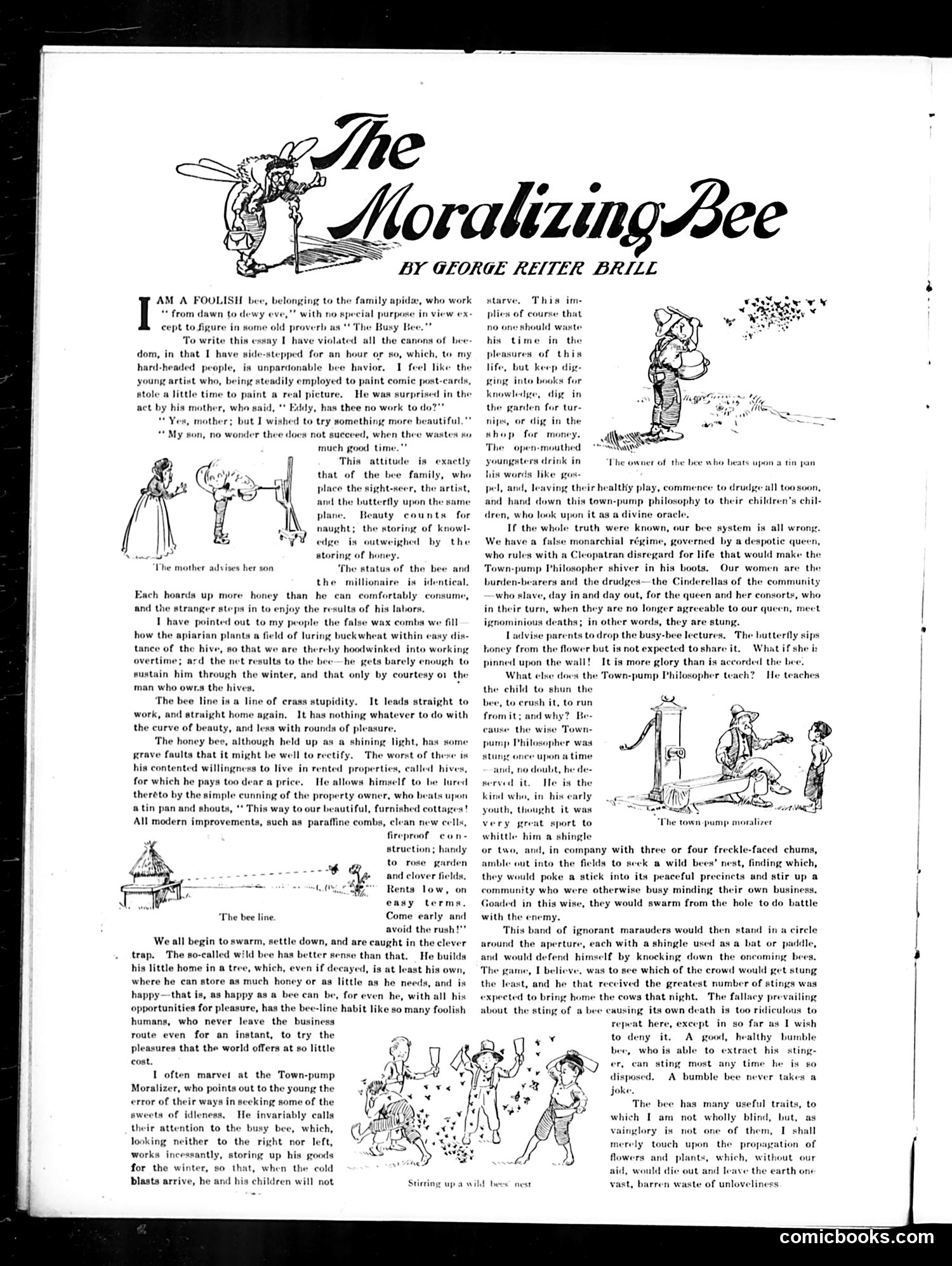
This essay-cartoon by George Reiter Brill satirizes the **"Town-pump Philosopher"** — a stock figure representing self-righteous moralizers who preach ceaseless work and duty while dismissing pleasure as idleness. The bee serves as an allegory for working-class humans. Brill critiques how: 1. **Capitalist exploitation**: Bees (workers) are tricked into renting hives from property owners, working overtime on planted crops, barely sustaining themselves while owners profit. 2. **False morality**: The "Town-pump Philosopher" lectures youth to shun idleness and "dig" for knowledge and money, discouraging any life enjoyment — essentially perpetuating the system that exploits them. 3. **Authoritarian systems**: The bee colony's "despotic queen" and "false monarchial régime" represent oppressive governance. Brill argues the entire system is fundamentally "wrong." The satire targets not lazy workers but rather the hypocritical authority figures who moralize work-at-all-costs ideology to maintain social control and economic advantage.
📄 Transcribed text from this page (OCR, searchable)
Machine-transcribed from the original scan — historical spelling and the odd misread are preserved.
* from dawn to dewy eve,"’ with no special purpose I AM A FOOLISH bee, belonging to the family apic Id proverbs 3‘ The Busy 1 all the canons of bee ed for an hour or so, which, to my havior, I feel like the mployed to paint comic post-cards, picture, He was surprised in the dy, has thee no work to do? t I wished to try something more beautiful. "* no wonder thee does not succeed, when thee wastes so cept to figure in som 1 dom, in that I have side-st hard: young ar onable d people, is unpar st who, being steadily tle time to paint a act by his mother, who si ‘es, mother; b “My stole a much good time." This attitude is that of the bee family, place the sight-seer, t and the butterfly upon th plane. Beauty counts for naught; the storing of knowl edge is outweighed by the storing of honey. ‘The status of the bee and 1 same The mother advises her son the iliona is identi Each hoards up more honey than he can comfortably consume and the stranger steps in to the results of his labors, I have pointed out to my people the false wax combs we fill how the api n plants a field of luring buckw! it within easy ¢ tance of the hive, so that we are thereby hoodwinked into working overtime; ard the net results to the t he gets barely enough to sustain him through the winter, and that only by courtesy o1 the man who owrs the hives, . The bee line iv a line of crass stupidity. It leads straight to work, and straight home again, It has nothing whatever to do with the curve of beauty, and less with rounds of pleasure. The honey bee, although held up as a shining light, has grave faults that it might be well to rectify. The worst the his contented willingness to live in rented properties, called hives, for which he pays too dear a pr He allows himself to be lured thereto by the simple cunning of the property owner, who beats upon atin pan and shouts, * This way to our beautiful, furi All modern improvements, such as paraffine combs, ished e and clover fields, See" Rents low, on easy terms. Come early and avoid the rush!"* We all begin to swarm, settle down, and are caught in the clever trap. The so-called wild be He builds his little home in a tree, wh ayed, is at least his own, where he can store as much hone ittle as he needs, and is happy—that is, as happy as a b with all his opportunities for pleasure, has the bee-line habit like so many foolish humans, who never leave the business route even for an instant, to try the pleasures that the world offers at so little cost. I often marvel at the Town-pump Moralizer, who points out to the young the error of their ways in seeking some of the sweets of idleness, He invariably calls their attention to the b which, looking neither to the right nor left, works incessantly, storing up his g for the wint blasts arrive, he and his children will not ‘The bee line. for even sy be nds + 8o that, when th (oralizing/ace BY GEORGE REITER BRILL Stirring up a wild bees nest ve. T sof course that pl no one should wast his time in t pleasures of this life, but keep dig- ging into books for knowledge, dig. in the en for ture nips, or dig in the shop for mone The youngst his words like gros- ing, their healthy play, commence to drudy and hand down this town-pump philosophy to th dren, who look upon it as adi If the whole truth were known, our bee system is all wrong. We have a false monarchial régime, governed by a despotic queen, who rules with a Cleopatran disregard for life that would make the Town-pump Philosopher shiver in his boots, Our wo drudges—the Cinderellas of the comn who sla y in and day out, for the queen and her consort: in their turn, when they a ble to our queen, meet ignominious deaths; in other words, they are stung. L advise parents to drop the busy-bee lectures. The butterfly sips honey from the flower but is not expected to share it, What if sh I! It is more glory than is accorded the bi ch? He teaches open-mouthed drink in The owner of the bee who beats upon a tin pan 1 too si pel, and, 1 n's chil- e oracle, n are the ity who burden-bearers and t no longer age pinned upon the v What else does the Town-pump Philosopher t » child to shun the tl bee, to crush it, to run from it; and why? Be- cause the wise Town- pump Philosopher w served it. He is the youth, th very great sport to whittle him a shingle or two, and, in company with three or four freckle-faced chums, amble ont into the fields to seck a wild bees’ nest, finding which, they would poke a stick into its peaceful precincts and stir up a community who were otherwise busy minding their own business, G in this wise, they would swarm from the hole todo battle with the enemy. This band of ignorant marauders would then stand in a circle the aperture, each with a shingle used as a bat or paddle, and would defend himself by knocking down the oncoming bees. The , believe, was to see which of the crowd would get stung the least, and he that reccived the greatest number of stings wa expected to bring home the cows that night. The ra about the sting of a bee causing its own death is too ridiculous to repeat here, e: in so far as I wish to deny it. A good, healthy bumble bee, who is able his sting- arot allacy preva time he is so useful tra , to which I am not wholly blind, but, as » of them, I shall nthe propayation of , without our ve the earth one jiness ¢ bee has m: vainglory is not o rely touch up flowers and. pli aid, would die out and le vast, barren waste of unlc nts, whi comicbooks.com