
A complete issue · 16 pages · 1909
Judge — January 9, 1909
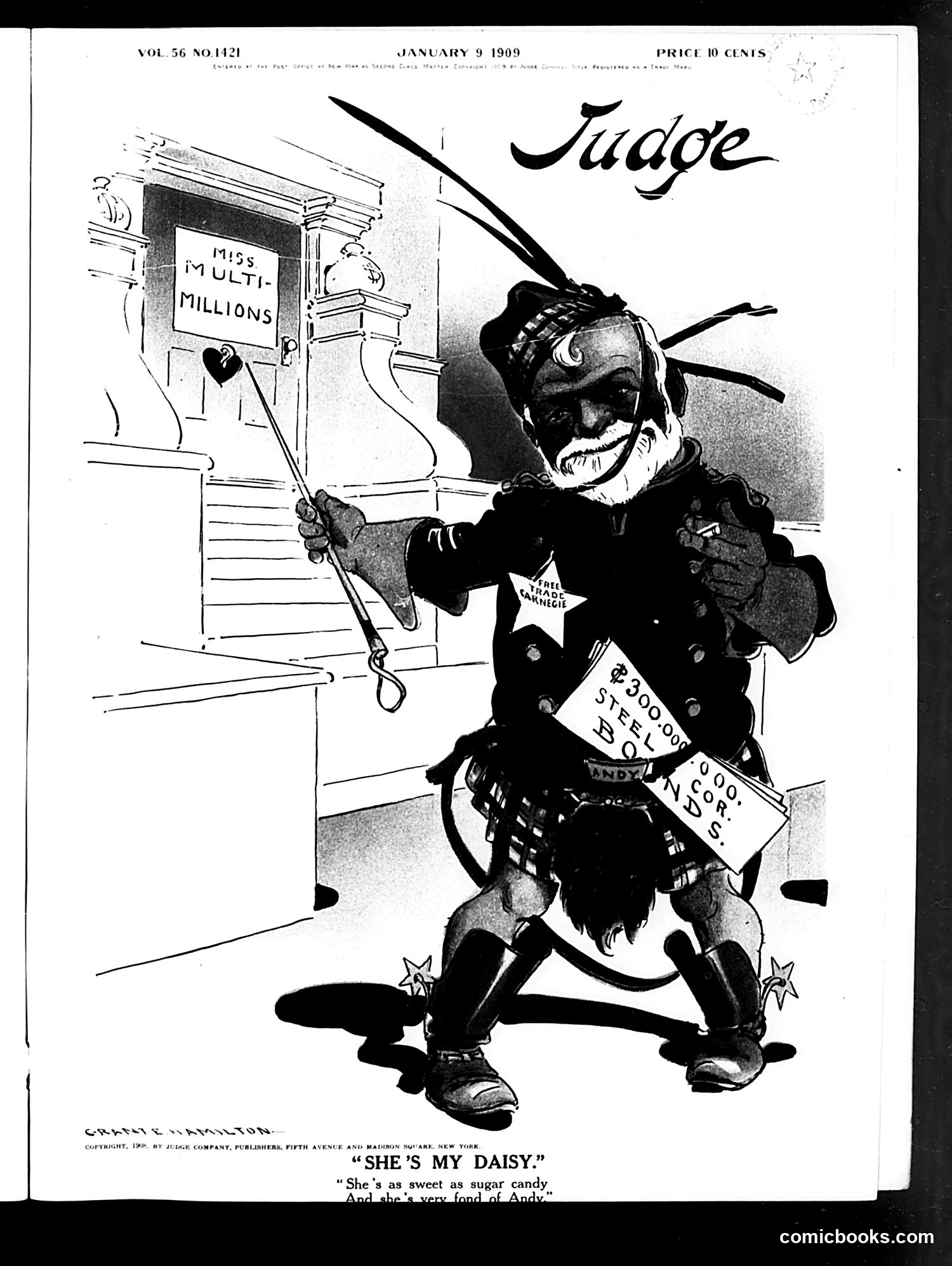
This satirical cover depicts a figure labeled "Miss Multi-Millions" as a grotesque caricature—drawn with exaggerated features characteristic of early 20th-century editorial cartooning. The character wears a star badge labeled "Carnegie" and carries signs displaying large monetary amounts ($2,300,000 and references to "Steel Bonds"). The satire appears to mock the excessive wealth and prominence of industrial magnates during the Gilded Age, likely referencing Andrew Carnegie's steel fortune. The grotesque artistic treatment suggests criticism of the ostentatious display of wealth. The caption "'She's My Daisy'" with lyrics about sweetness appears ironic, juxtaposing romanticized language against the ugly caricature. The overall message critiques American industrialists' accumulation of massive fortunes and their cultural influence.
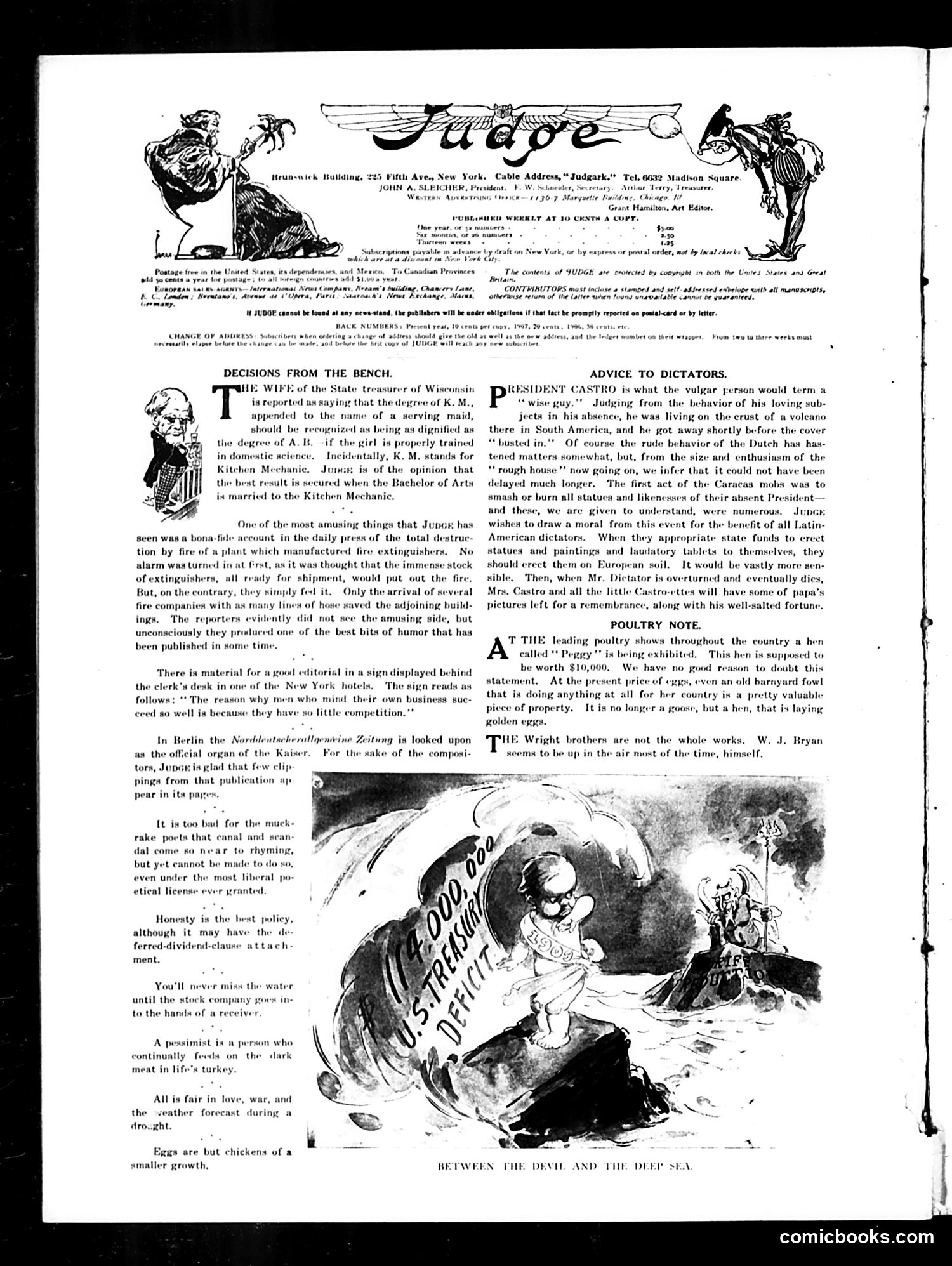
This page contains several editorial pieces and a political cartoon titled "Between the Devil and the Deep Sea." The main cartoon depicts a figure labeled "Good Old Arithmetic" being squeezed between two forces—appearing to reference fiscal or economic pressures of the period. The satire critiques how competing interests (likely political or commercial) create impossible situations for ordinary calculation or honest accounting. The "Decisions from the Bench" section discusses a legal opinion about whether a "K.M." (Kingdom of Morocco or similar) maid's degree qualifies as dignified. The accompanying "Advice to Dictators" mocks Latin American autocrats appropriating European statuary and art. A "Poultry Note" jokes about a hen called "Peggy" supposedly worth $10,000—likely satirizing inflated asset valuations or speculative excess of the era. Without clearer dating, specific political figures remain unclear.
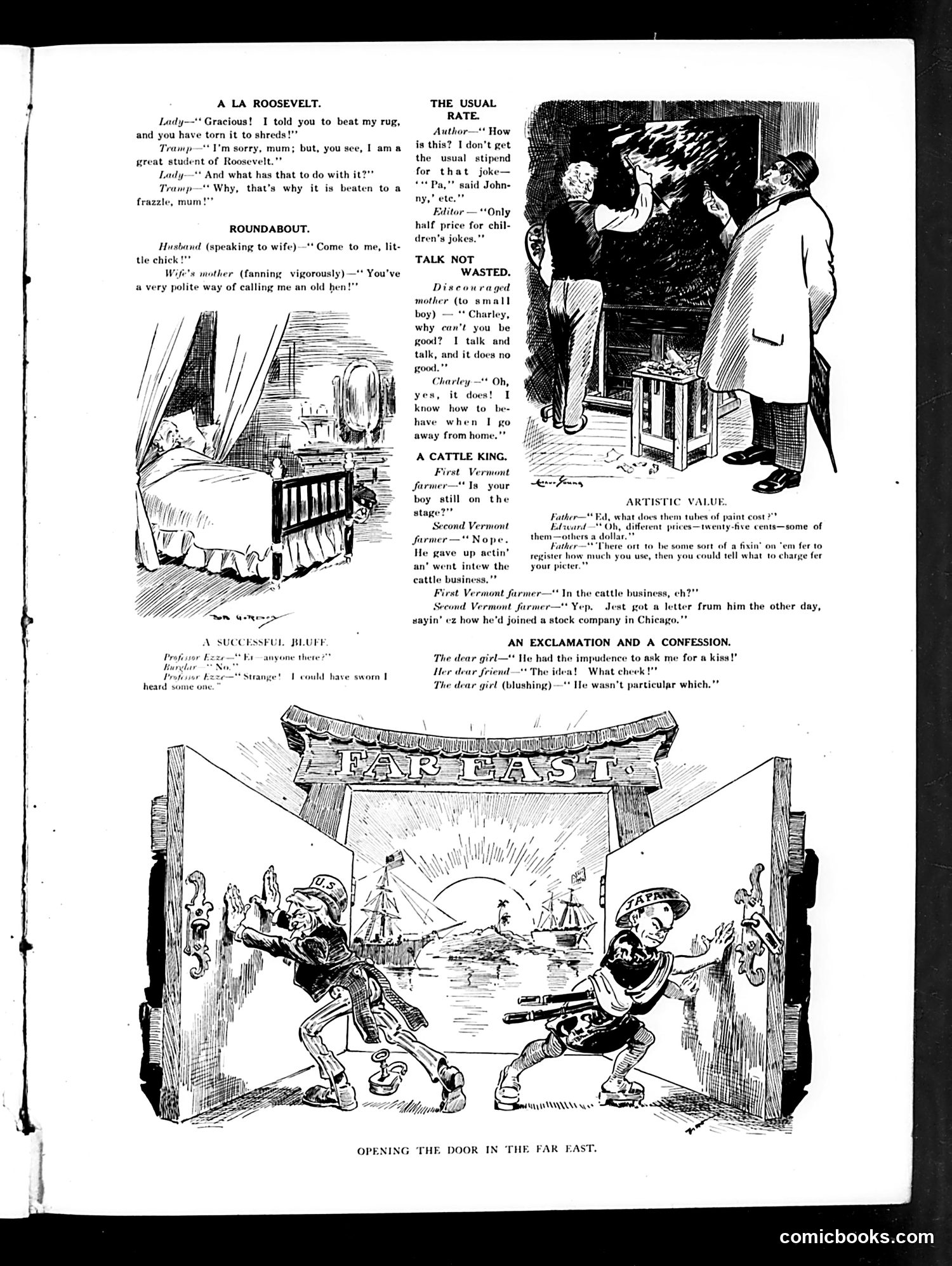
This Judge magazine page contains several satirical sketches mocking social behavior and pretension: **"A la Roosevelt"** ridicules someone claiming kinship with Theodore Roosevelt to appear important, only to reveal ignorance. **"Roundabout"** jokes about a husband euphemistically calling his wife an "old hen"—she responds by similarly insulting him back. **"The Usual Rate"** satirizes an author complaining about low payment for children's jokes, with an editor offering "half price for children's jokes." **"Talk Not Wasted"** mocks a boy who talks constantly despite his mother's complaints—he claims talking helps him when away from home. **"Artistic Value"** depicts a father questioning why a painting costs so much; the artist suggests removing the artistic value to lower the price. **"Opening the Door in the Far East"** (large cartoon) shows figures with "Far East" signage, likely satirizing Western imperial expansion into Asia through trade competition or military intervention.
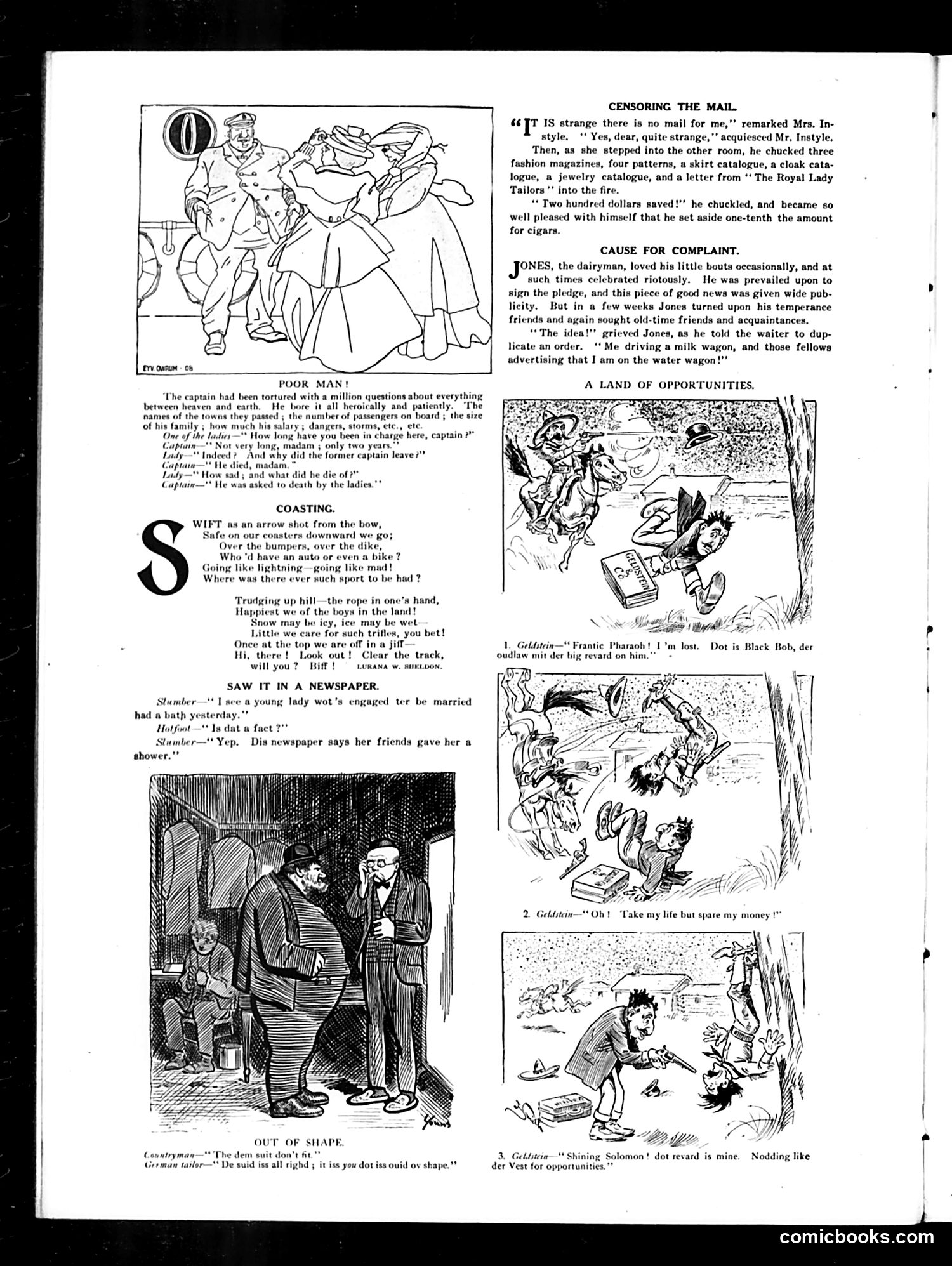
This page contains several humorous anecdotes and illustrations satirizing early 20th-century social situations: **"Censoring the Mail"** mocks postal censorship, likely WWI-era, where a postal worker destroys Mrs. Instyle's fashion magazines and personal correspondence, then saves only cigar advertisements—suggesting government censors were absurdly selective about what mail reached citizens. **"Jones the dairyman"** humorously depicts someone complaining about a milkman's poor service—an everyday domestic complaint turned comedic. The remaining sections—"Coasting," "Saw It in a Newspaper," "Out of Shape"—present brief jokes about sledding mishaps, gossip spread through newspapers, and physical fitness, featuring working-class characters and their domestic troubles. The illustrations use caricature typical of period humor magazines.
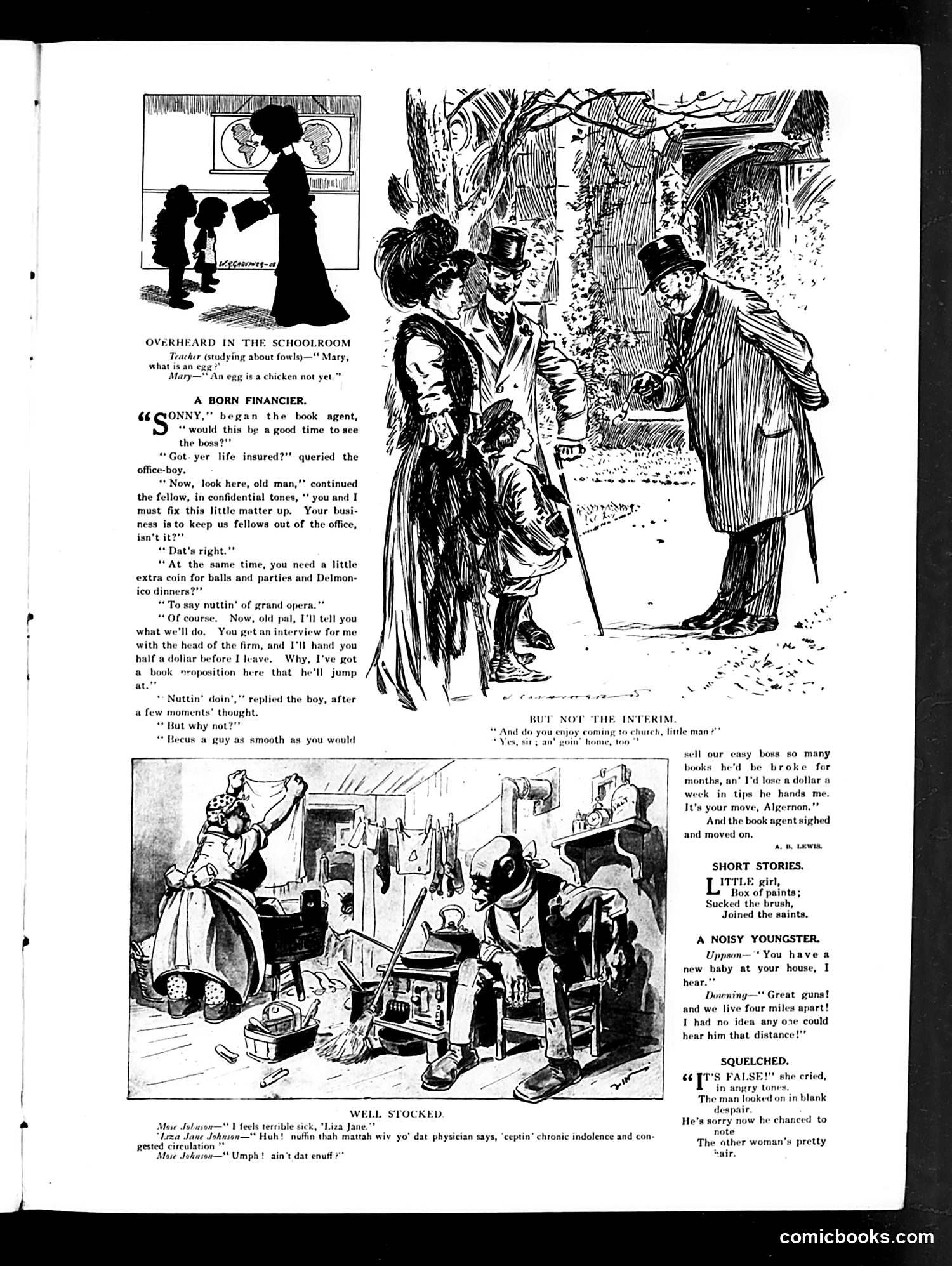
This page contains three separate satirical pieces from an early 20th-century American humor magazine: **"A Born Financier"** mocks a life insurance agent pressuring a reluctant client with increasingly absurd sales pitches—from basic coverage to opera tickets and dinners—suggesting aggressive insurance marketing tactics of the era. **"But Not the Interim"** depicts a book agent deceiving a potential customer with smooth talk about purchasing a composition, hinting at door-to-door sales fraud. **"Well Stocked"** shows a sick woman (Lisa Jane Johnson) complaining of ailments while her husband dismisses her concerns, satirizing both hypochondria and marital dismissiveness. The short stories and additional sketches continue this theme of everyday social satire—poking fun at contemporary consumer culture, domestic relations, and human foibles rather than specific political events.
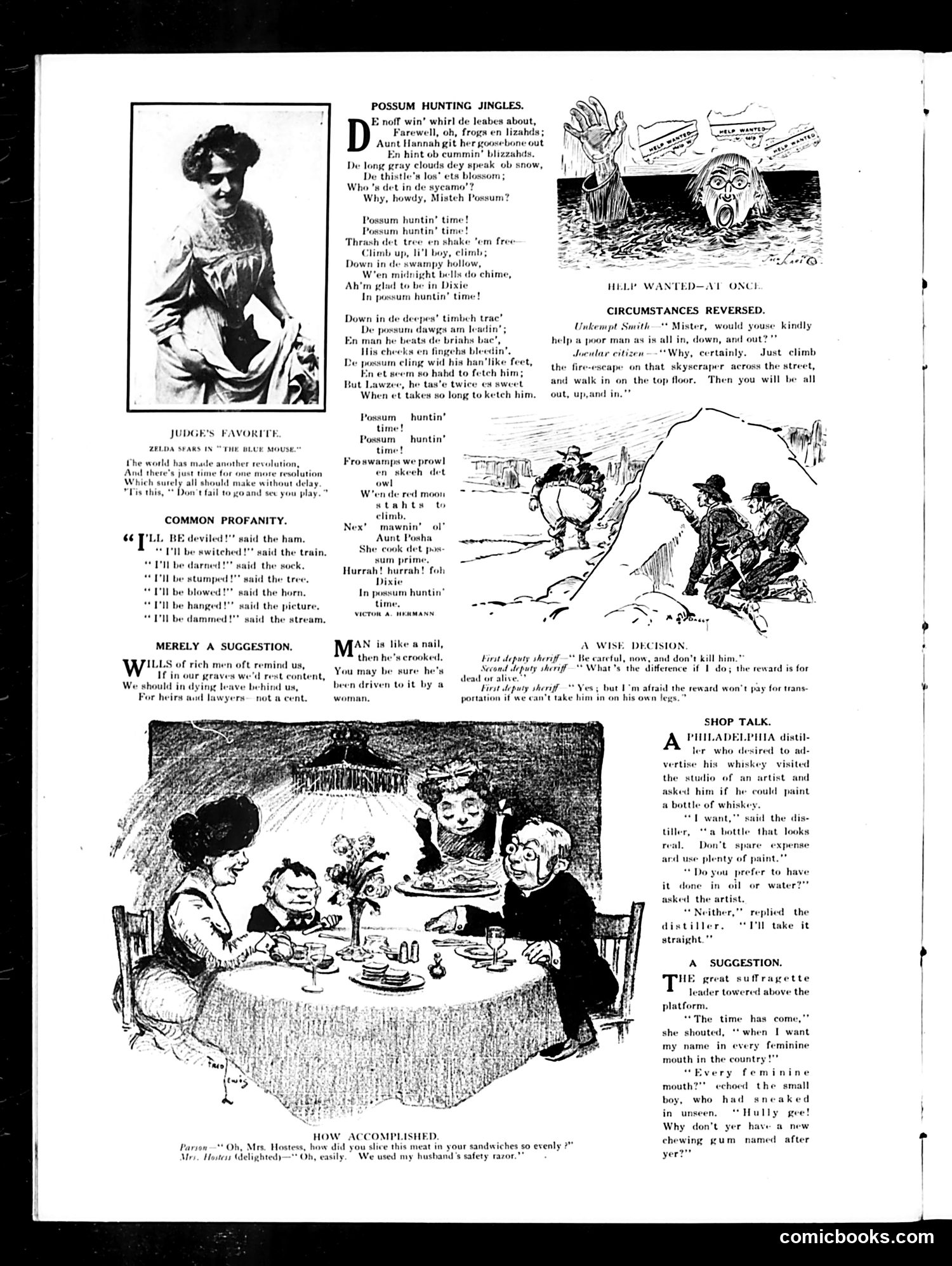
This page from Judge magazine contains several humor pieces reflecting early 20th-century American attitudes: **"Possum Hunting Jingles"** uses dialect humor common to the era, depicting possum hunting as a Southern/rural pastime with phonetic African American vernacular ("En hint ob cummin' blizzahds"). The satire appears gentle—celebrating hunting tradition rather than mocking participants. **"Circumstances Reversed"** and **"A Wise Decision"** present crude racial humor: a Black man asks for help, but is redirected to climb a fire escape instead; a sheriff debates whether a Black suspect's corpse is worth transporting. These reflect the casual racism normalized in early 20th-century mainstream publications. **"Common Profanity"** is a pun-based joke where inanimate objects curse. **"Shop Talk"** satirizes an artist through a whiskey-bottle painting anecdote—genteel middle-class humor. **"A Suggestion"** mocks suffragettes, a contemporary political movement, through a child's crude interruption. The page prioritizes verbal humor and social satire typical of Judge's demographic—educated, urban readers comfortable with period-typical racial stereotyping.
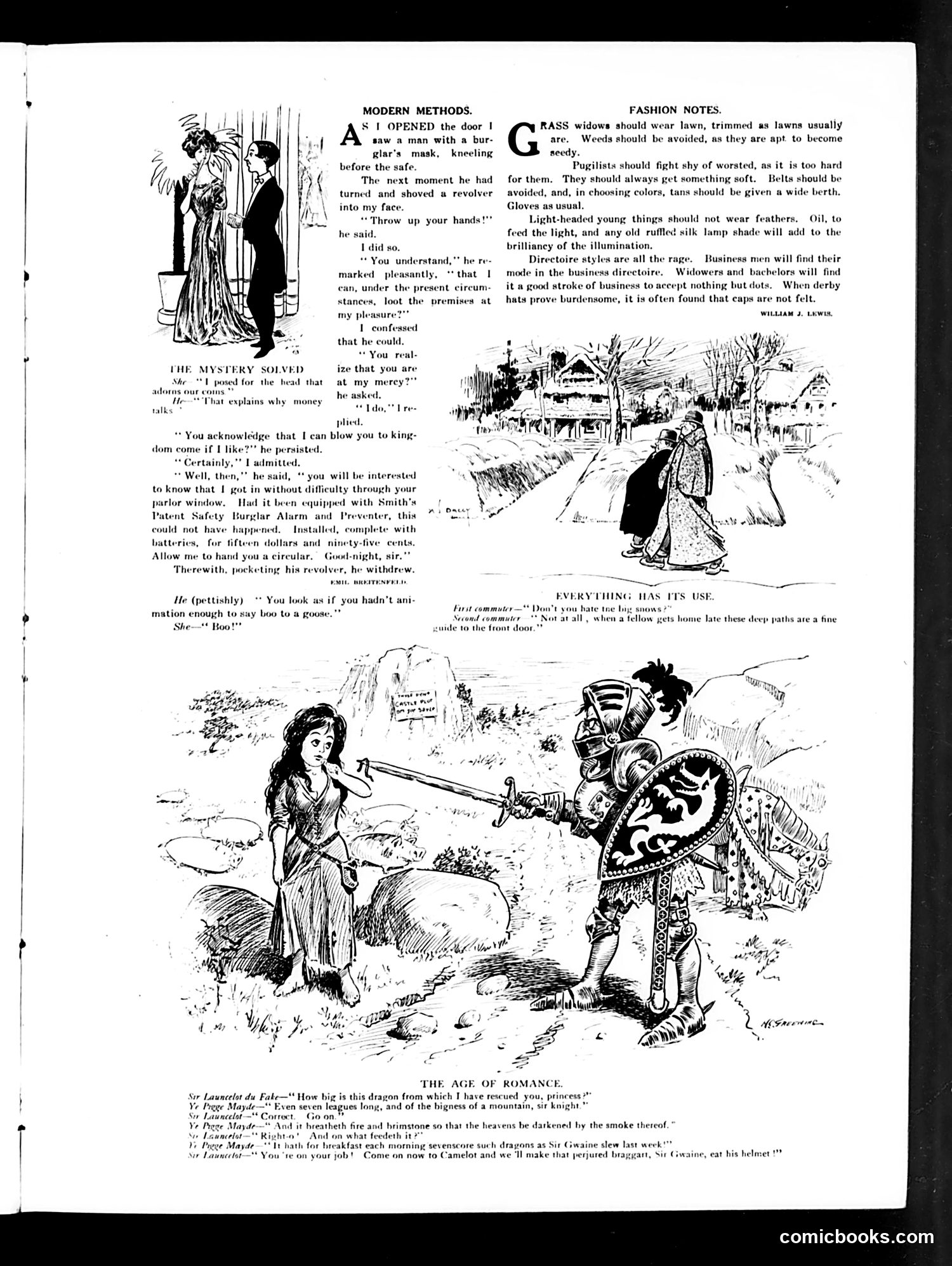
This page contains **three separate humorous pieces** from Judge magazine: 1. **"Modern Methods"** (top): A burglar breaks into a home, then—rather than robbing the owner—launches into a *sales pitch* for a Smith's Patent Safe Burglar Alarm. The satire mocks aggressive 1900s-era salesmanship: even criminals are depicted as pushy door-to-door salespeople. The joke is that the burglar uses threat and coercion not to steal, but to sell a security system. 2. **"The Mystery Solved"** (middle): A brief joke explaining why "money talks"—a woman poses for illustrations of heads on currency. 3. **"The Age of Romance"** (bottom): Medieval-style parody dialogue between characters like "Sir Launcelot" and a "Prege Mayde" (Pretty Maid), mocking romantic fantasy literature through ridiculous dragon-slaying boasts. It's lighthearted literary satire. The **"Fashion Notes"** (right column) uses puns to mock fashion advice—"grass widows" and "weeds" are literal clothing recommendations.
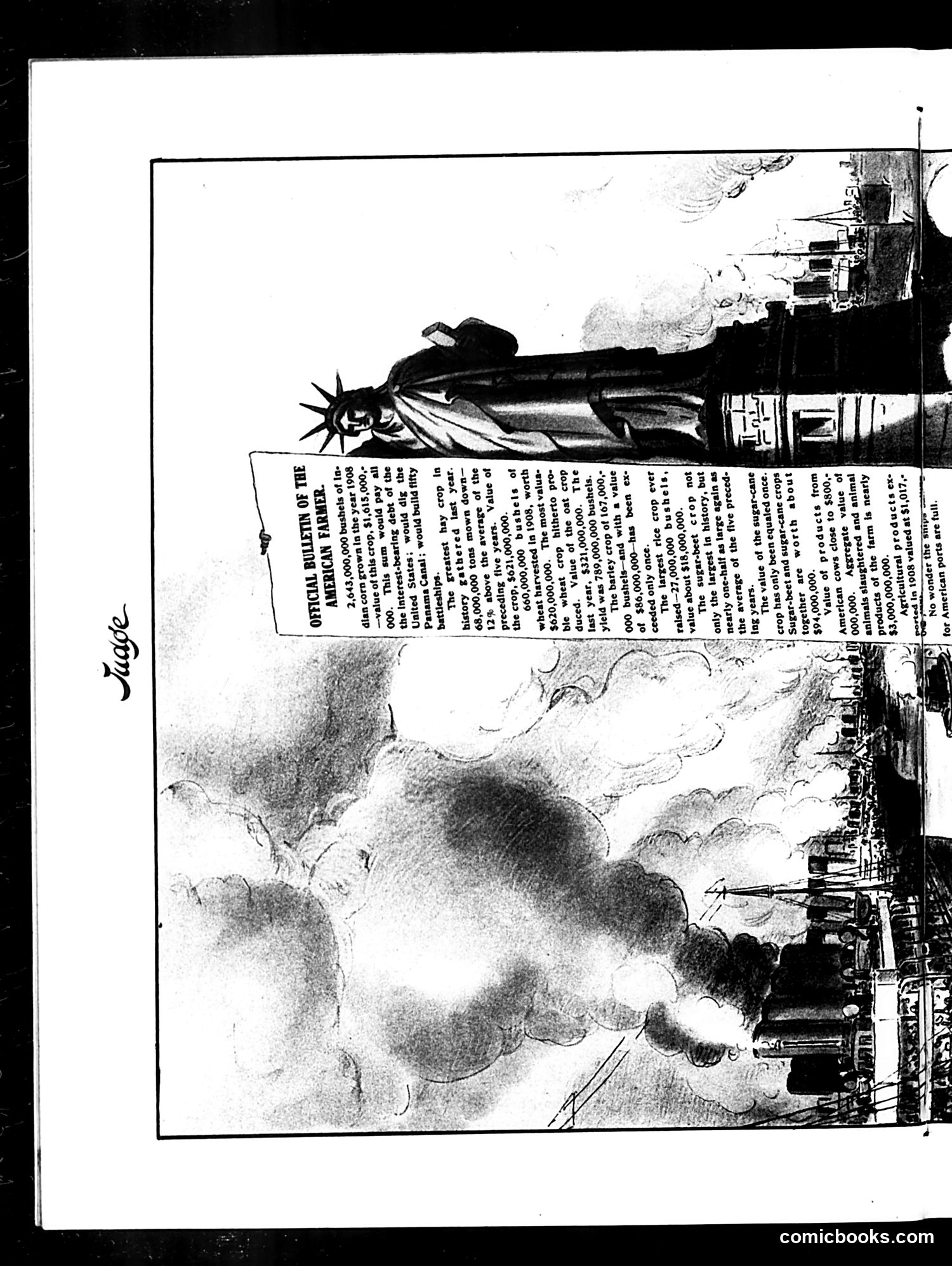
I cannot reliably interpret this page. The OCR text is severely corrupted and nearly illegible—it appears to be upside-down or heavily damaged text that doesn't form coherent sentences. The image shows what appears to be an illustration featuring the Statue of Liberty at the top and industrial/urban scenes below, suggesting themes about American progress or industry. There's a text block in the middle that's too blurry to read clearly in this reproduction. Without legible text or clear identification of specific figures and references, I cannot accurately explain the cartoon's political or social meaning to a modern reader. To properly analyze this Judge magazine page, a clearer, higher-resolution image with readable OCR would be necessary.
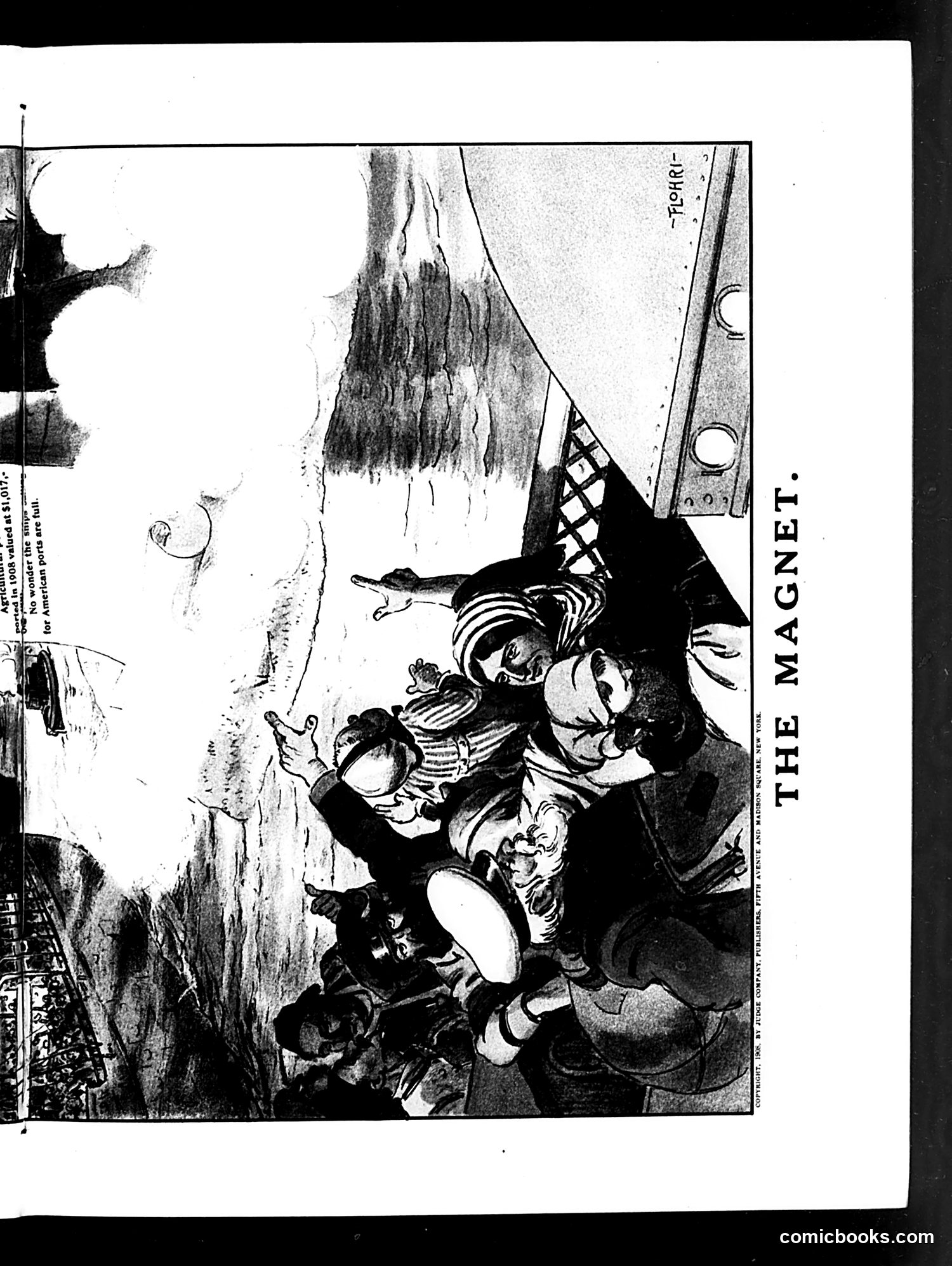
This cartoon depicts a figure in striped clothing and a hat (appearing to be a magician or con artist) using a large magnet to attract coins or money from the pockets of ordinary people below. The magnet is labeled "THE MAGNET," suggesting the satire targets someone or something that deceptively draws wealth from the public. The exact historical reference is unclear from the visible text, but the imagery suggests criticism of financial manipulation, fraud, or exploitative practices—likely targeting a specific politician, businessman, or institution that Judge magazine's readers would have recognized. The striped suit and theatrical presentation suggest a charlatan or swindler preying on everyday citizens. Without clearer OCR text or dating information, the specific target remains uncertain.
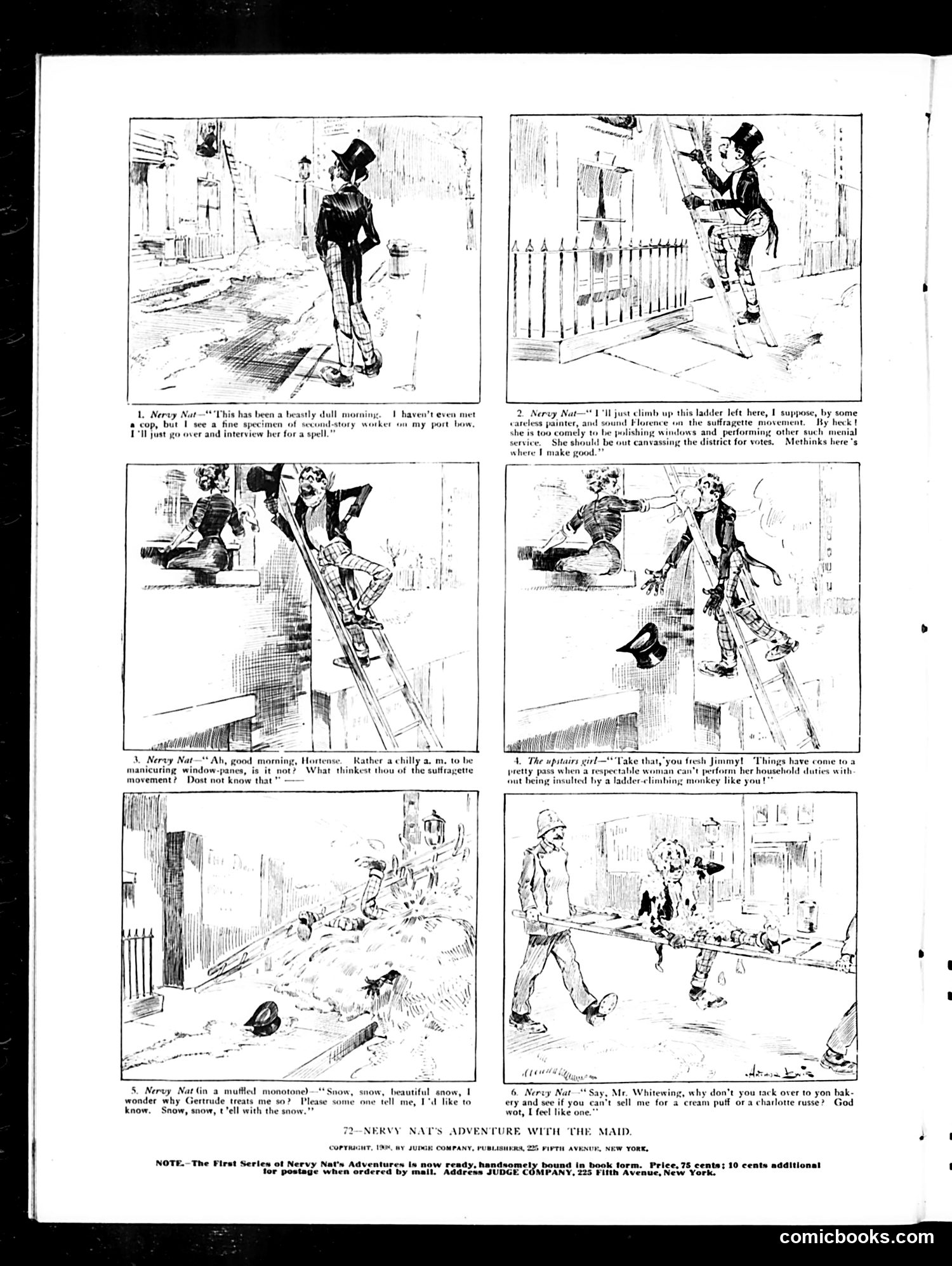
This is a comic strip following the character "Nervy Nat," a working-class man attempting to flirt with and court a maid. The humor derives from his persistent, awkward advances despite repeated rebuffs—he interviews her about her work, attempts to climb a ladder after her, and tries to arrange romantic meetings. The strip satirizes both working-class male entitlement and the suffragette movement (referenced in panel 3, where a character dismisses women's rights activism). The "maid" character represents the domestic servant class, and Nat's relentless pursuit despite her disinterest reflects period attitudes about class, courtship, and women's agency. Published by Judge magazine (known for satirizing social issues), the strip mocks lower-class masculine presumption while also poking fun at contemporary feminist activism—typical of early 20th-century American satirical humor.
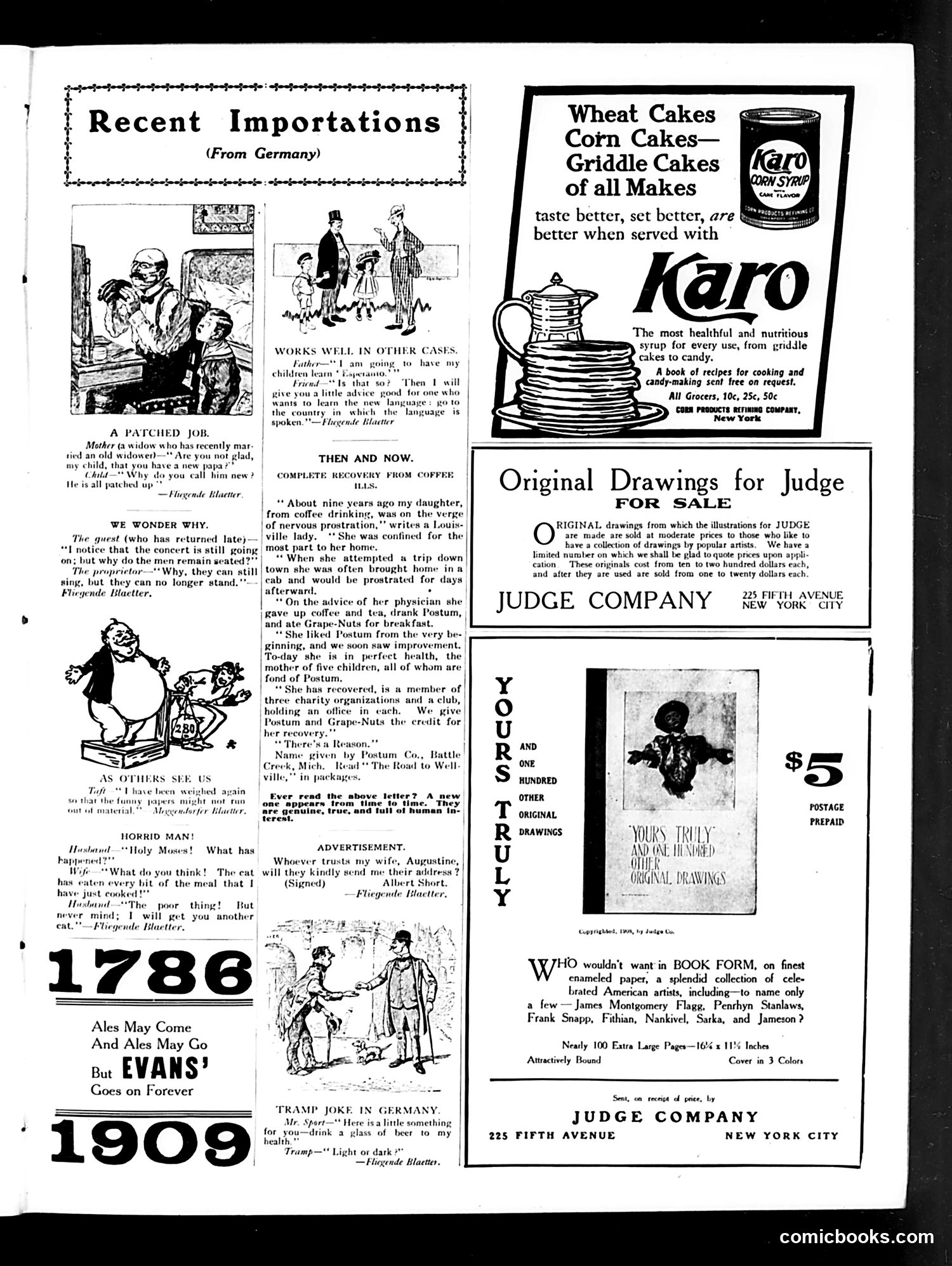
This page mixes humor with advertising. The left column contains reprinted German jokes from *Fliegende Blätter* (a German satirical publication), translated for American readers—typical of Judge's practice of importing European humor. The jokes are mild domestic/social humor: a widow remarrying, concert-goers too infirm to stand, a woman recovering from coffee addiction by switching to Postum (a coffee substitute), and a tramp asking for beer. These appear designed to amuse through gentle absurdity rather than sharp satire. The advertisements dominate: Karo corn syrup, Postum (emphasizing health benefits), and—most prominently—Judge Company selling original artwork from the magazine itself at $5 per drawing, marketed as collectible fine art. The page reflects Judge's dual identity: a satirical magazine importing cosmopolitan European humor for educated American readers, while simultaneously operating as a commercial venture selling its own cultural cachet back to collectors.
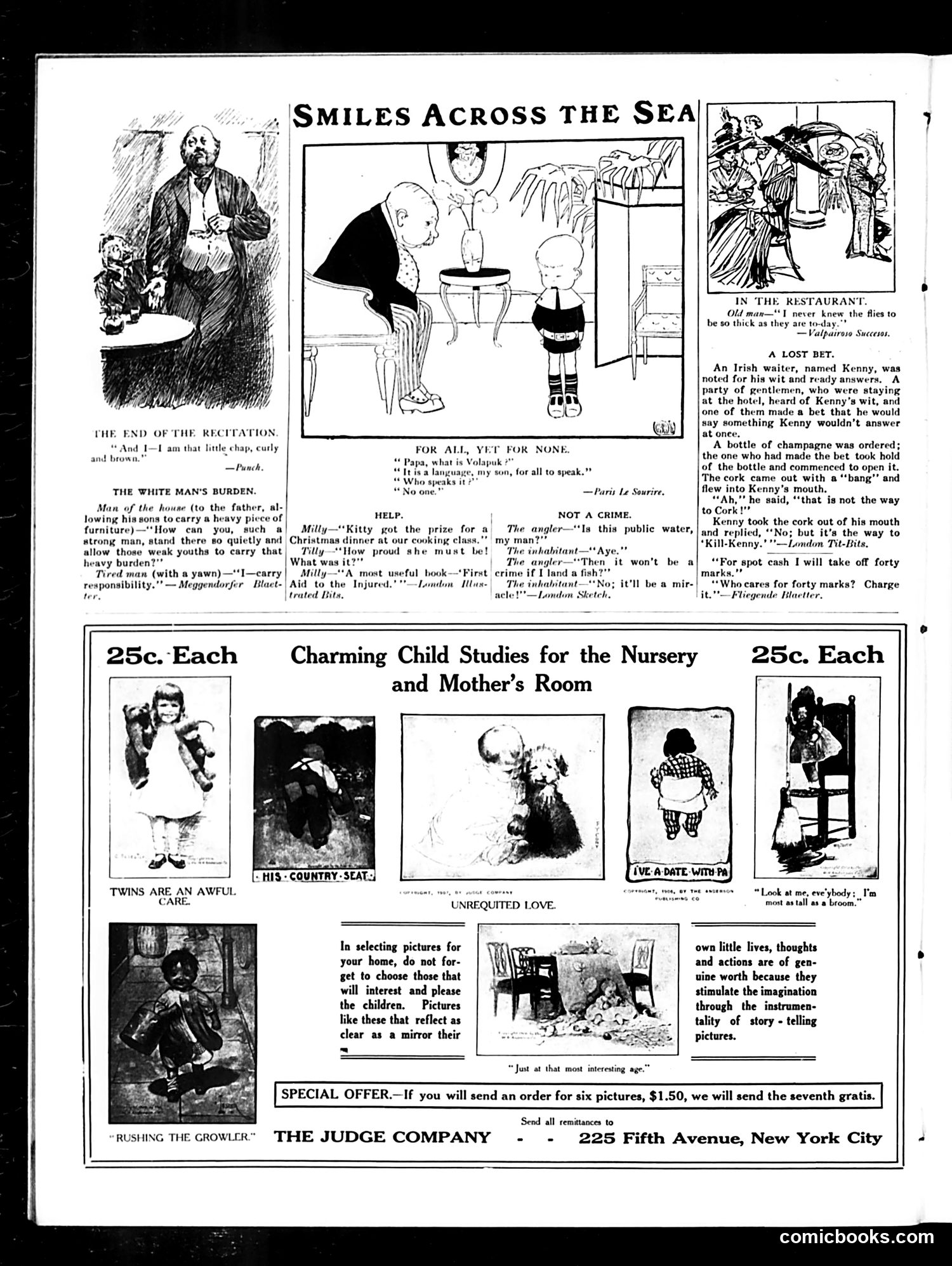
This page contains several brief satirical anecdotes and jokes rather than political cartoons. The humor focuses on everyday social situations: **"The White Man's Burden"** mocks a father's complaint about carrying his heavy child—a pun on Kipling's famous imperialist phrase. **"For All, Yet for None"** satirizes pretentious dinner conversation where a guest asks for something "for all to speak" but then demands silence. **"Help"** jokes about a cooking mishap at dinner class. **"Not a Crime"** features an Irish waiter named Kenny whose wife and friend make a bet about him taking a cork from his mouth—the joke being it's "the way to tell Kenny." The lower section advertises "Charming Child Studies" prints (25¢ each) for nurseries, showing sentimental Victorian-era children's imagery typical of the period's domestic décor marketing.
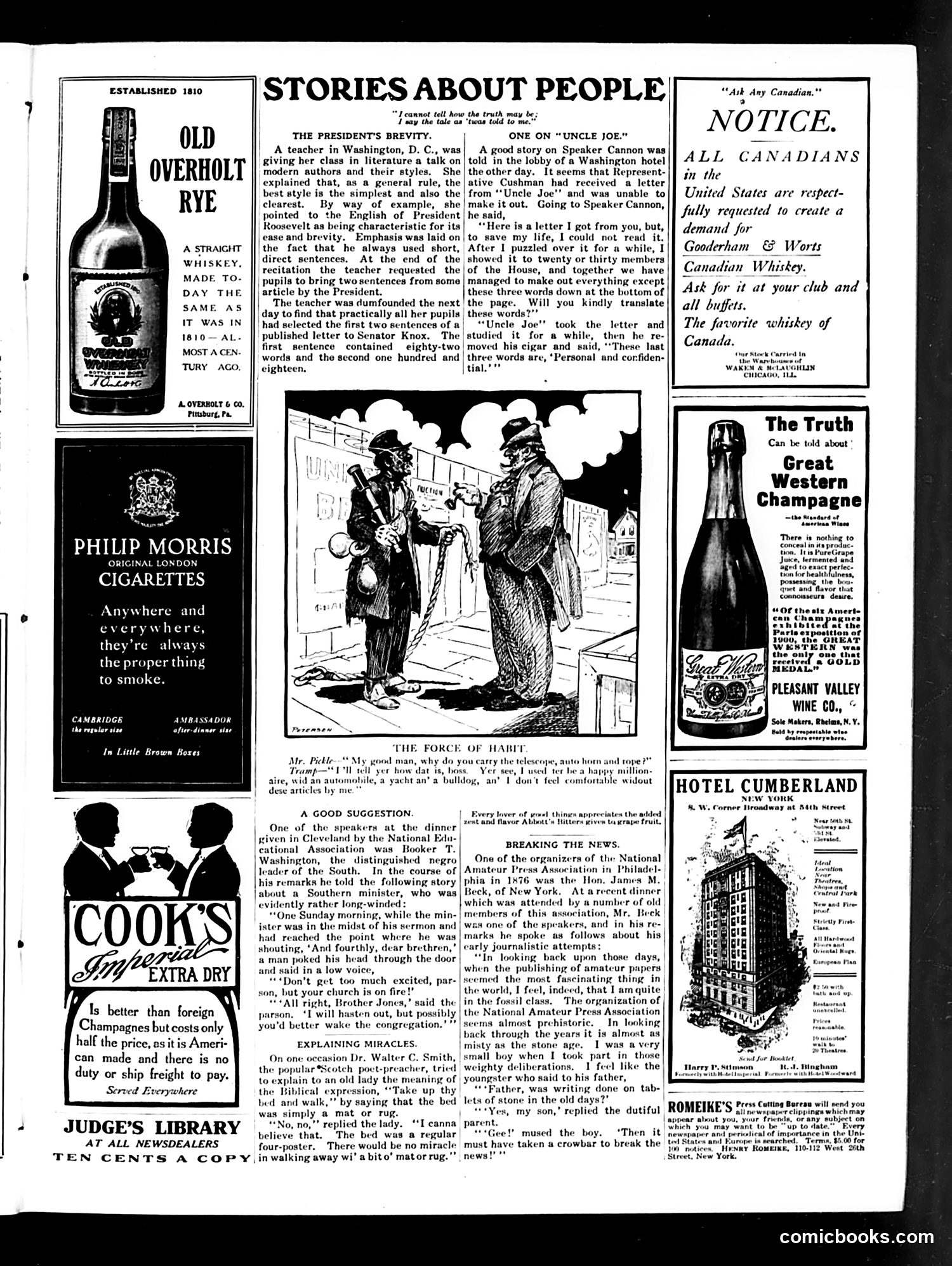
This page from Judge (circa early 1900s) is primarily **advertising with embedded humorous anecdotes** rather than political cartoons. The main cartoon, "The Force of Habit," depicts a wealthy man (labeled "Mr. Pickle") questioning why a tramp carries a telescope, auto horn, and rope. The joke: the tramp has grown so accustomed to possessing these items that he can't feel comfortable without them—a commentary on how habit shapes behavior regardless of logic or station. The text stories mock prominent figures through anecdotes: - **President Roosevelt** is praised for terse writing style, but a teacher is embarrassed when students find his published letter contains sentences of 82 and 118 words—directly contradicting his reputation for brevity. The satire undercuts Roosevelt's self-fashioned image. - **Speaker "Uncle Joe" Cannon** cannot read his own handwriting; when asked to translate three words from his letter, he admits they mean "Personal and confidential"—mocking his notoriously difficult penmanship. The page is otherwise filled with period advertisements for whiskey, cigarettes, champagne, and hotels.
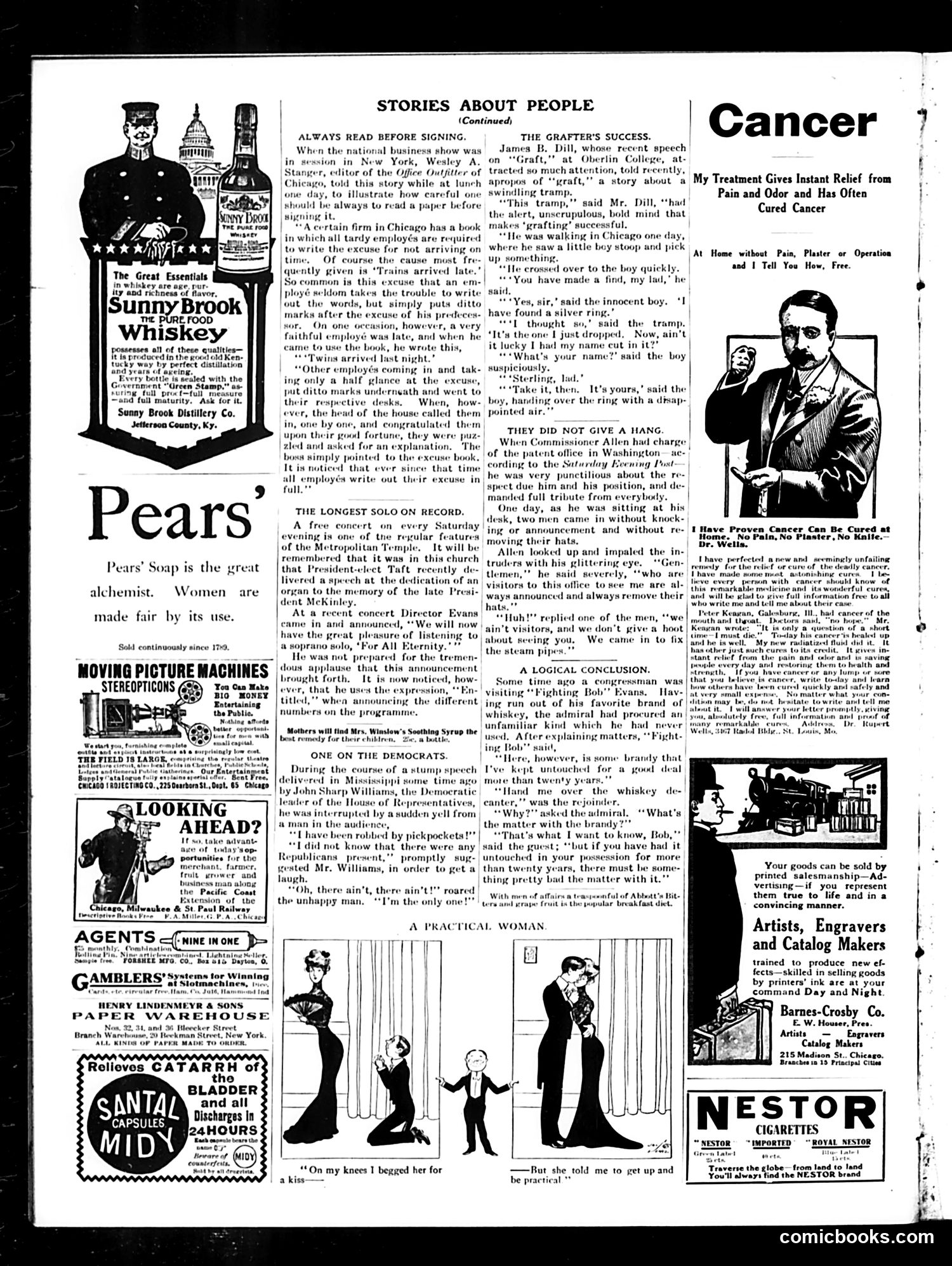
This page from the satirical magazine *Judge* contains several short humorous stories and advertisements typical of early 20th-century American journalism. **Main Content:** The "Stories About People" section includes anecdotes about workplace absurdity: an employee's tardiness excuse ("Trains arrived late") that gets copied by subsequent late arrivals; a Democratic politician's quip during a speech when a heckler turns out to be a Republican; and tales about business dealings involving grafting and honesty. **Political Reference:** The mention of "President-elect Taft" indicates this predates his 1909 inauguration, dating the magazine to 1908-1909. **Advertising:** The page heavily features period advertisements for Pears' Soap (claiming to make "women fair"), Sunny Brook Whiskey, moving picture machines, and medicinal products like "Santal Capsules" for unspecified ailments—typical patent medicine claims of the era. The humor relies on irony and workplace observations rather than sharp political satire, reflecting the magazine's focus on general American social commentary.
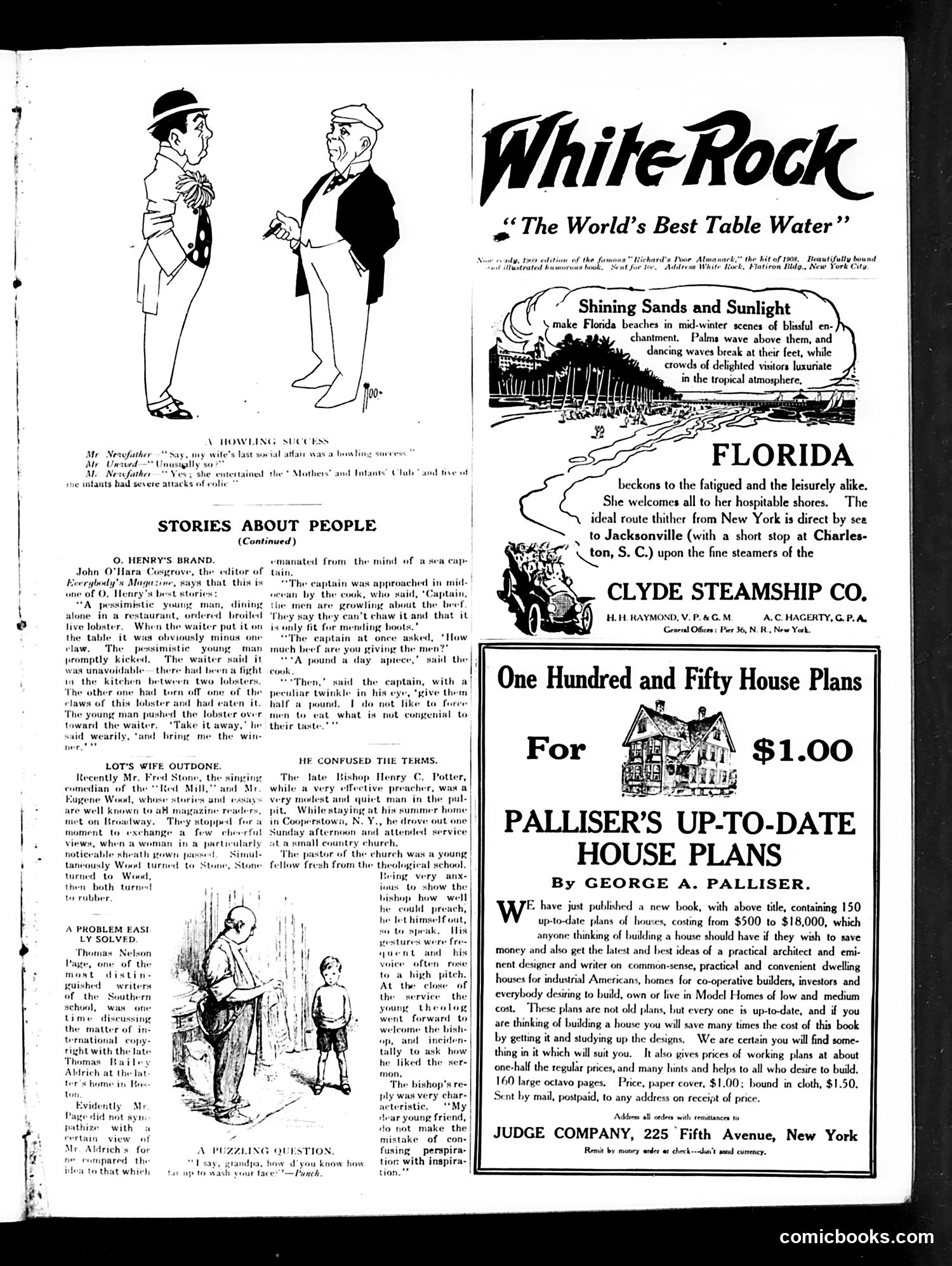
This page contains three humor pieces and advertising: **"A Howling Success"** depicts two men discussing a social event where infants had severe colic attacks—the joke being that what the host considers a "success" was actually chaotic and unpleasant. **"Stories About People"** offers O. Henry-style anecdotes: one involves a pessimistic diner complaining about a lobster dinner (the cook sarcastically serves him the lobster's other half), another concerns a bishop who confuses religious terminology, and a third discusses international copyright issues among writers. **"A Problem Easily Solved"** shows a child asking his grandfather how to wash his face—a nonsensical riddle meant to be humorous. The advertisements promote White Rock table water, Florida tourism via Clyde Steamship Company, and George Palliser's house plan book ($1.00-$1.50). These ads reflect early 1900s consumer culture and leisure travel interests. The page is primarily entertainment and commercial content typical of Judge magazine's satirical humor mixed with period advertising.
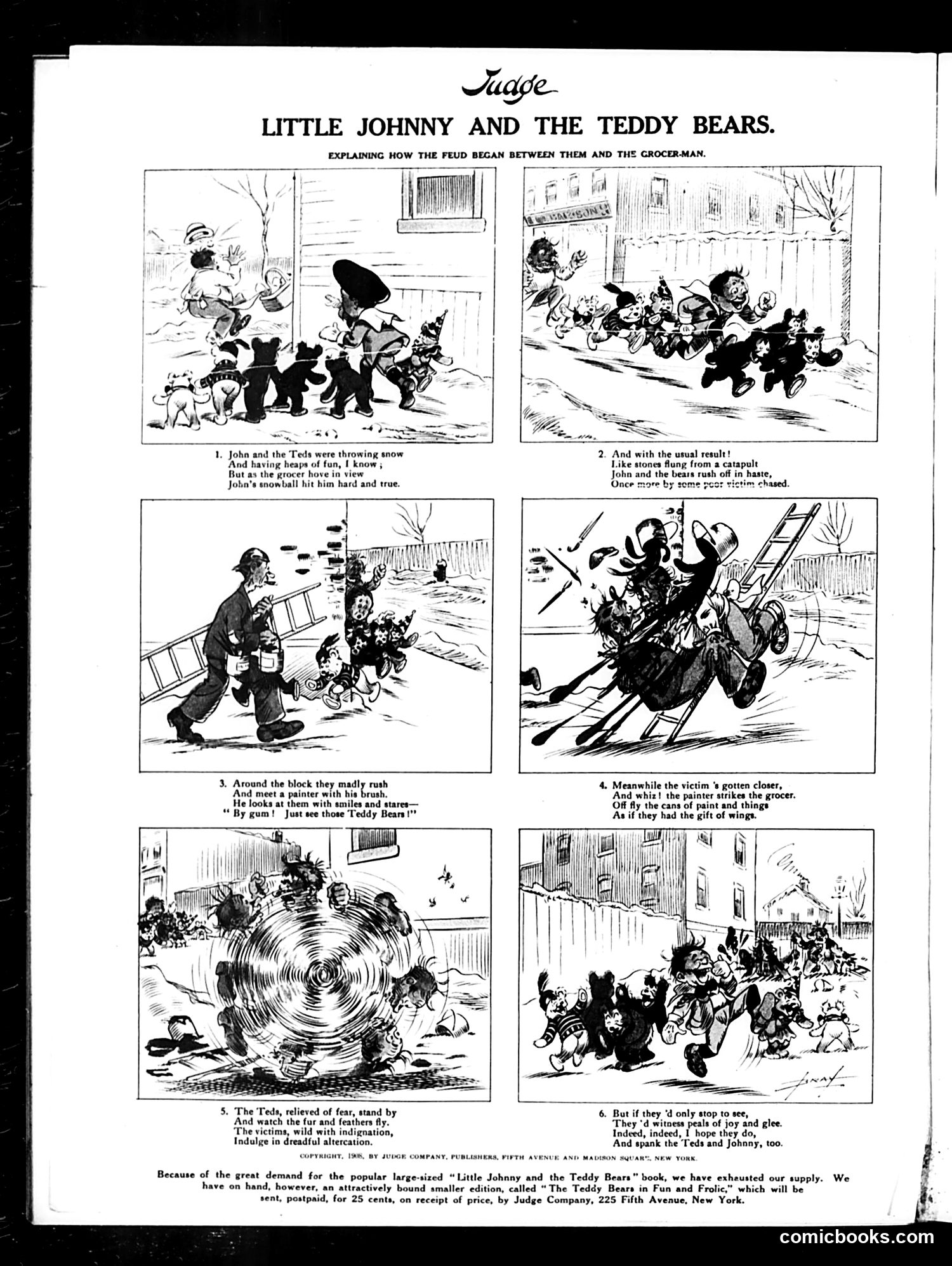
This is a six-panel slapstick comedy strip depicting escalating chaos. "Little Johnny" and toy "Teddy Bears" throw a snowball that hits a grocer-man, initiating a chain reaction of collateral damage: the grocer collides with a painter carrying a brush, who then strikes the grocer with paint cans, creating further mayhem. The bears watch the resulting "fur and feathers fly" (likely the painter's feathers from his hat) with amusement. The humor relies on classic slapstick tropes: innocent mischief spiraling into absurd consequences where bystanders suffer instead of the original culprits. The caption's final moral—hoping the adults will "spank the Teds and Johnny"—adds ironic commentary on the children's escape from punishment. The page functions partly as advertising, promoting Judge Company's smaller "Teddy Bears in Fun and Frolic" edition.