
A complete issue · 16 pages · 1909
Judge — January 2, 1909
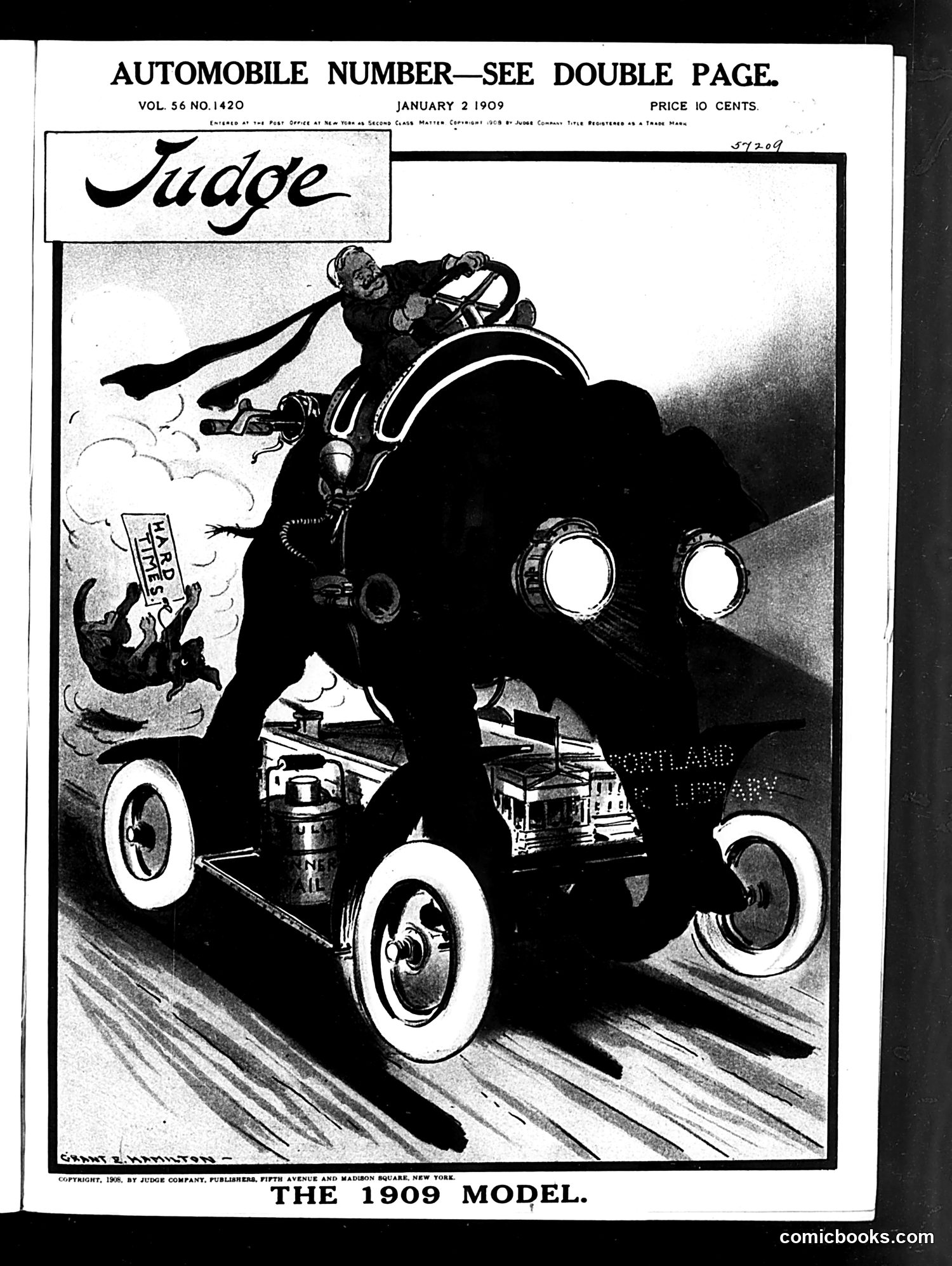
This January 2, 1909 Judge magazine cover satirizes the **1909 Automobile Model**, likely the Judge company's humorous commentary on early motorcar technology and dangers. The cartoon depicts a demon or devil-like figure perched atop a massive, menacing automobile with prominent headlights, racing at high speed. The demon holds what appears to be a "JUDAS" sign or similar label—a biblical reference suggesting the automobile represents a traitor or destructive force. The satire likely critiques **early automobiles as dangerous, devilish innovations** that threaten public safety. The wild, demonic driver and chaotic scene reflect common early-1900s anxieties about speeding vehicles, accidents, and the disruptive "modern" transportation technology invading traditional communities. This represents period concerns about automotive progress and social upheaval.
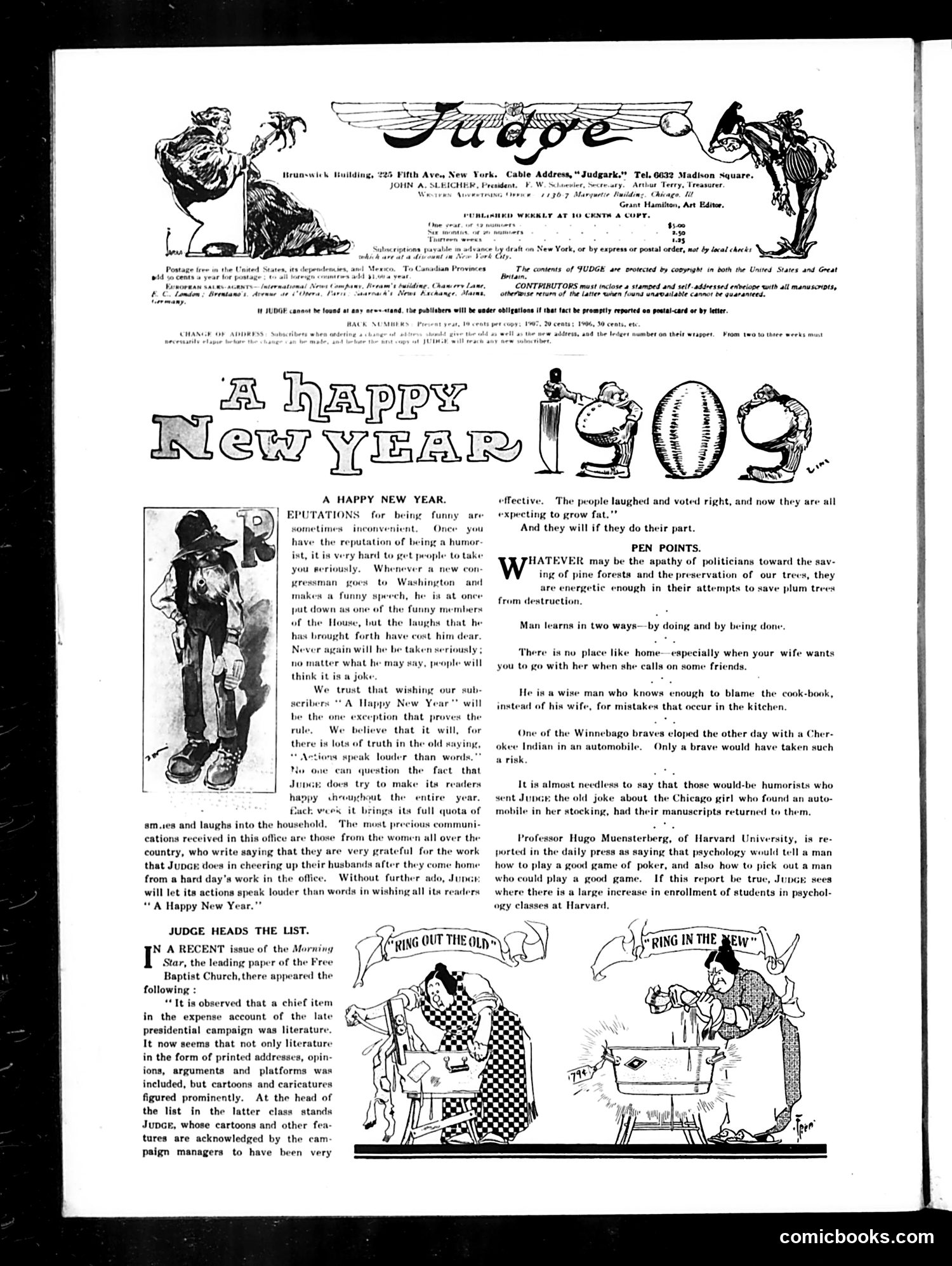
This is a New Year's issue (1909) combining editorial content with satirical cartoons. The main illustrated sections include: **"A Happy New Year"** - A humorous piece about the difficulty politicians face being taken seriously while also being funny, suggesting readers shouldn't take everything in Judge too seriously. **"Pen Points"** - Brief satirical observations about human nature and relationships, including quips about marriage, cooking, and domestic life typical of early 20th-century humor. **"Judge Heads the List"** - References Judge magazine's prominence in political cartooning and satire, noting the publication's cartoons were influential in campaign messaging. The two cartoons at bottom ("Ring Out the Old," "Ring In the New") appear to be New Year-themed illustrations, though their specific satirical targets are unclear from the visible portions. The page primarily demonstrates Judge's mix of political commentary, social satire, and domestic humor aimed at contemporary readers.
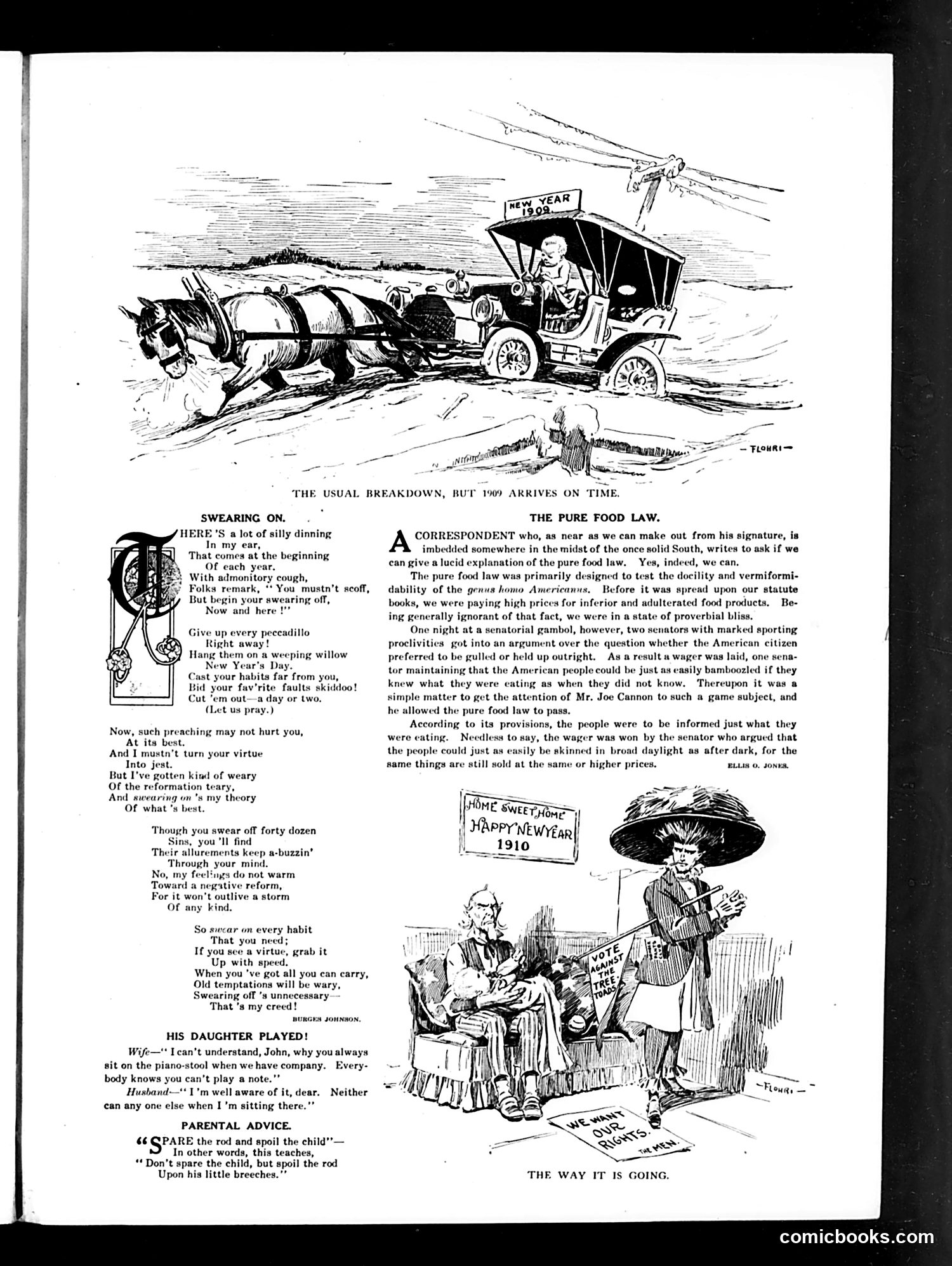
**Top Cartoon**: "The Usual Breakdown, But 1909 Arrives on Time" depicts Father Time's carriage breaking down while delivering the new year—a standard visual joke about the old year's deterioration. **"Swearing On"**: A humorous poem mocking New Year's resolutions, suggesting people make ambitious promises they won't keep (swearing off drinking, gambling, etc.). **"The Pure Food Law"**: An article defending the Pure Food Law (passed 1906), which regulated food safety and labeling. The author defends it against critics who claim American citizens were "kept in ignorance," arguing the law successfully informed consumers about food quality and prices. **"His Daughter Played!"** and other sections appear to be miscellaneous humor pieces about domestic life and parental advice typical of Judge's satirical content.
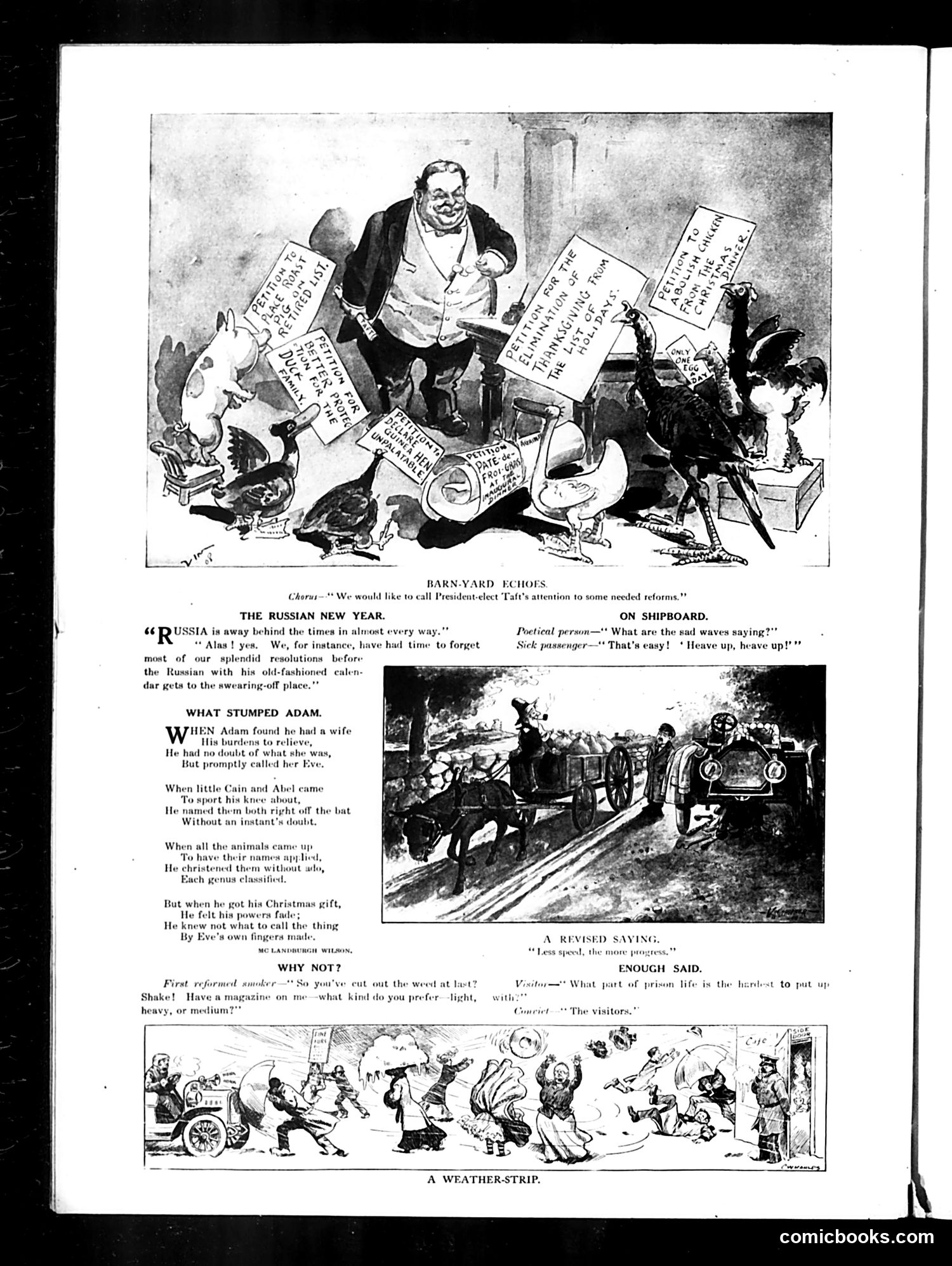
**"Barnyard Echoes"** (top): Animals holding protest signs surround a rotund man, asking President-elect Taft to enact reforms. The satire mocks various groups clamoring for the incoming administration's attention—depicted as barnyard creatures making noise rather than substantive demands. **"What Stumped Adam"** (middle-left): A humorous poem about Adam's difficulty naming things, particularly his wife—a pun on the challenge of nomenclature and classification. **"A Revised Saying"** (middle-right): A photograph with accompanying dialogue appears to mock prison conditions or administration. **"A Weather-Strip"** (bottom): A sequential comic strip depicting weather-related mishaps and human reactions. The page reflects early 20th-century American satirical commentary on politics, social issues, and everyday absurdities during the Taft transition period.
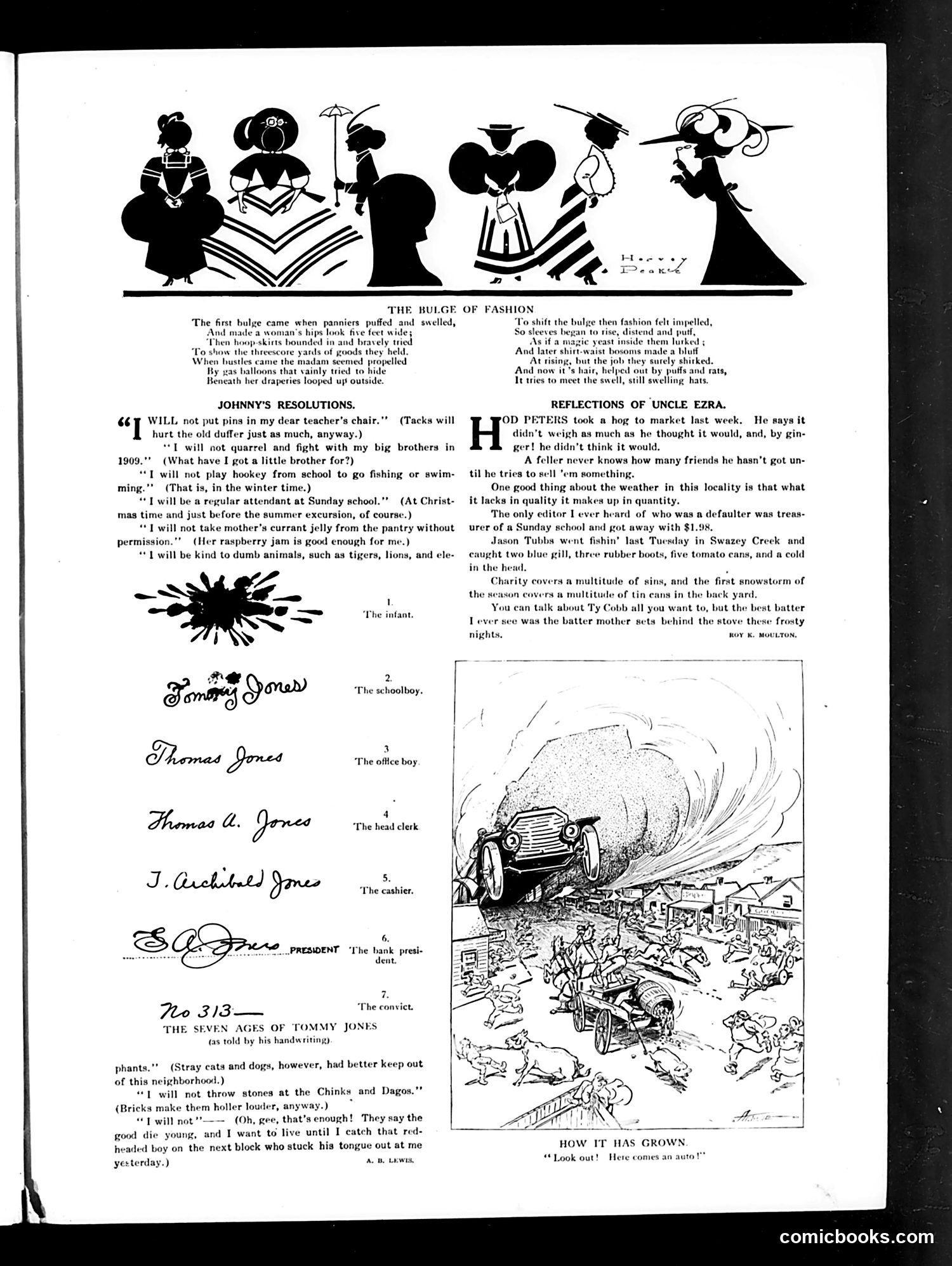
**"The Bulge of Fashion"** silhouette at top satirizes women's fashion trends of the era, showing exaggerated, distended silhouettes. The accompanying verse mocks how fashion created unflattering bulges and protrusions—women's clothing produced awkward shapes that "puffed and swelled." **"Johnny's Resolutions"** presents humorous New Year's pledges by a boy, including promises not to put pins in his teacher's chair or fight with his brothers—clearly comedic domestic/school humor. **"Reflections of Uncle Ezra"** offers folksy rural commentary, mentioning local gossip and weather observations in a rustic voice—typical period humor featuring rural character stereotypes. The bottom illustration, "How It Has Grown," depicts an early automobile causing chaos in a town, likely satirizing the social disruption caused by motor cars' rapid adoption in early 20th-century America.
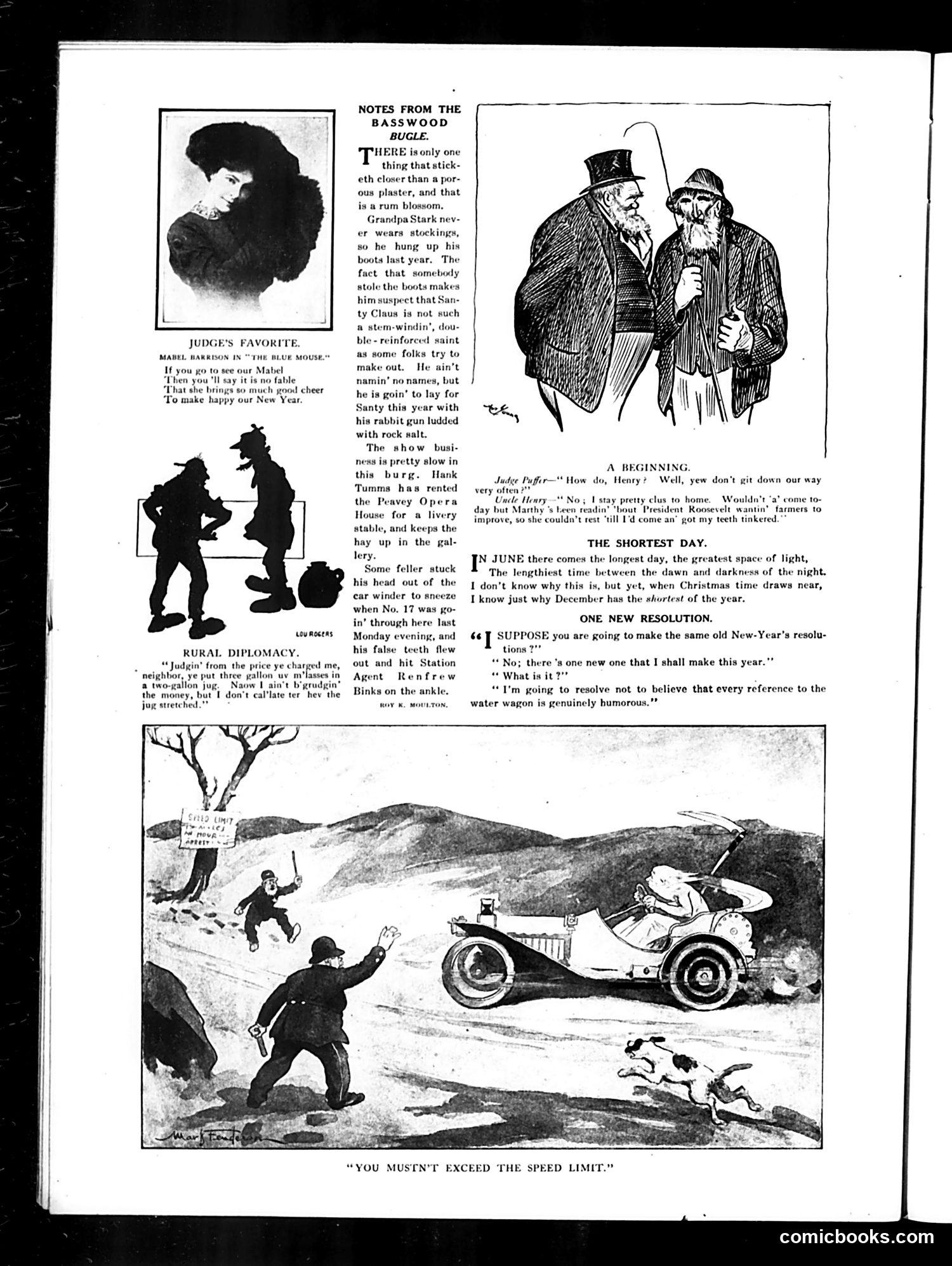
This *Judge* magazine page contains several brief rural/small-town humor pieces and cartoons, likely early 20th century. **"Judge's Favorite"** references a character named Mabel Barrison in a theatrical production, with silhouette gags about rural life and petty theft (stolen boots). **"Rural Diplomacy"** depicts a humorous misunderstanding about horse-drawn vehicles and sneezing, played for slapstick effect. **"A Beginning"** shows two men discussing President Roosevelt's agricultural reform initiatives—suggesting farmers should improve their methods. The joke implies the farmer's wife pushed him to get dental work done after hearing Roosevelt's speech. **"The Shortest Day"** is a poem about Christmas melancholy, contrasting June's longest daylight with December's brevity. **"One New Resolution"** satirizes tired New Year's humor about "the water wagon" (temperance/sobriety jokes), with the speaker resolving to reject such clichés. **The main cartoon** depicts traffic enforcement—someone being stopped for speeding, reflecting early automobile-era concerns about reckless driving.
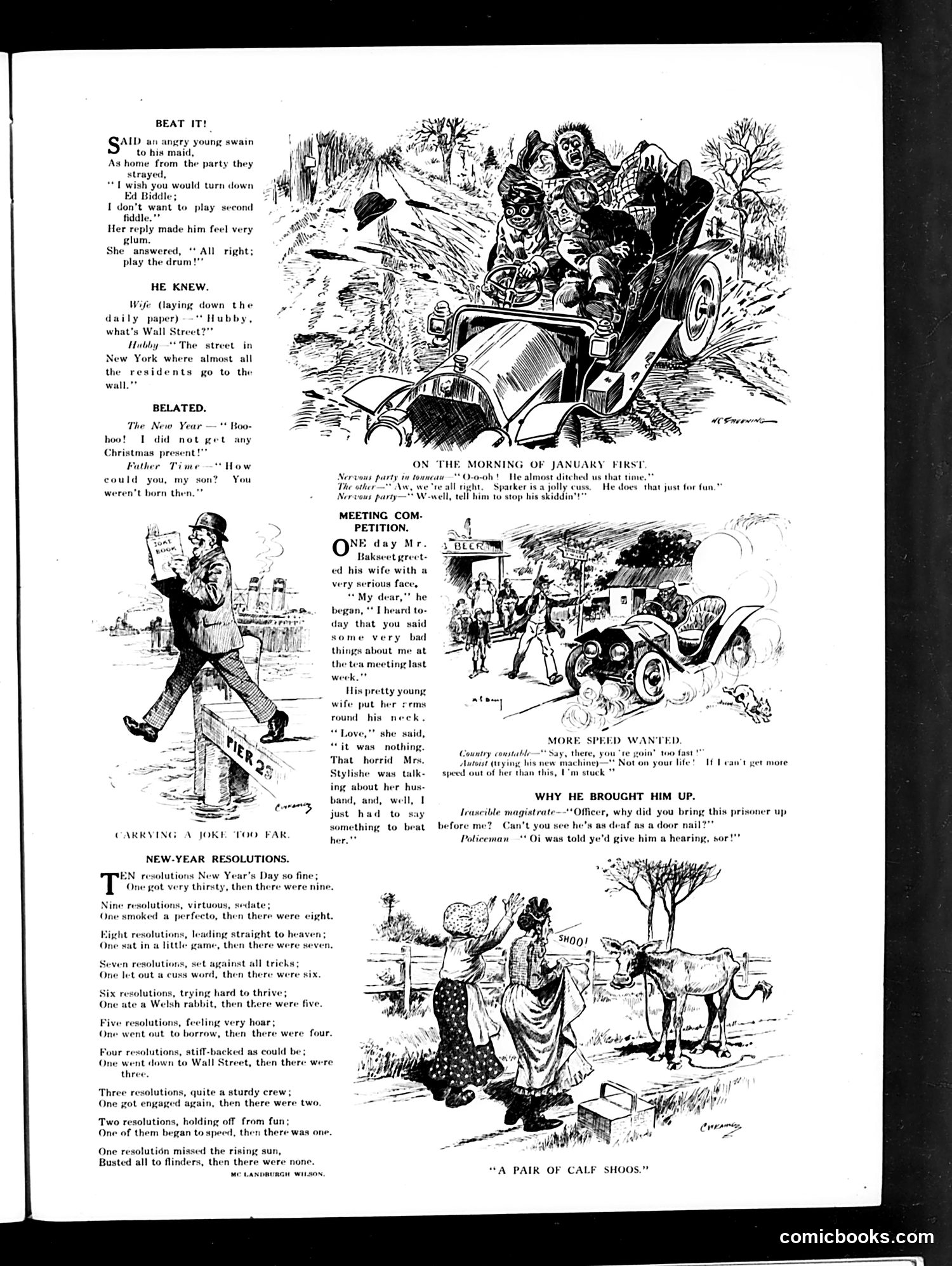
This page contains several brief humorous sketches typical of early 20th-century American satirical humor: **"Beat It!"** plays on a young man's frustration with his maid's romantic attention—he asks her to stop encouraging a suitor's advances, but she deflects with a pun about percussion instruments. **"He Knew"** jokes about Wall Street's reputation during financial troubles—a husband defines it as a place where residents figuratively "go to the wall" (face ruin), reflecting period anxieties about stock market crashes. **"Meeting Competition"** depicts a husband confronting his wife about insulting him at a social gathering; she claims she was merely criticizing a gossipy neighbor. **"New-Year Resolutions"** satirizes the universal failure of New Year's pledges through verse, where each resolution—sobriety, exercise, frugality—lasts only until temptation arrives. **"Why He Brought Him Up"** is a pun: a deaf prisoner is brought before a magistrate; the officer says he was told to give him a "hearing." These represent Judge's characteristic light domestic and social satire rather than deep political commentary.
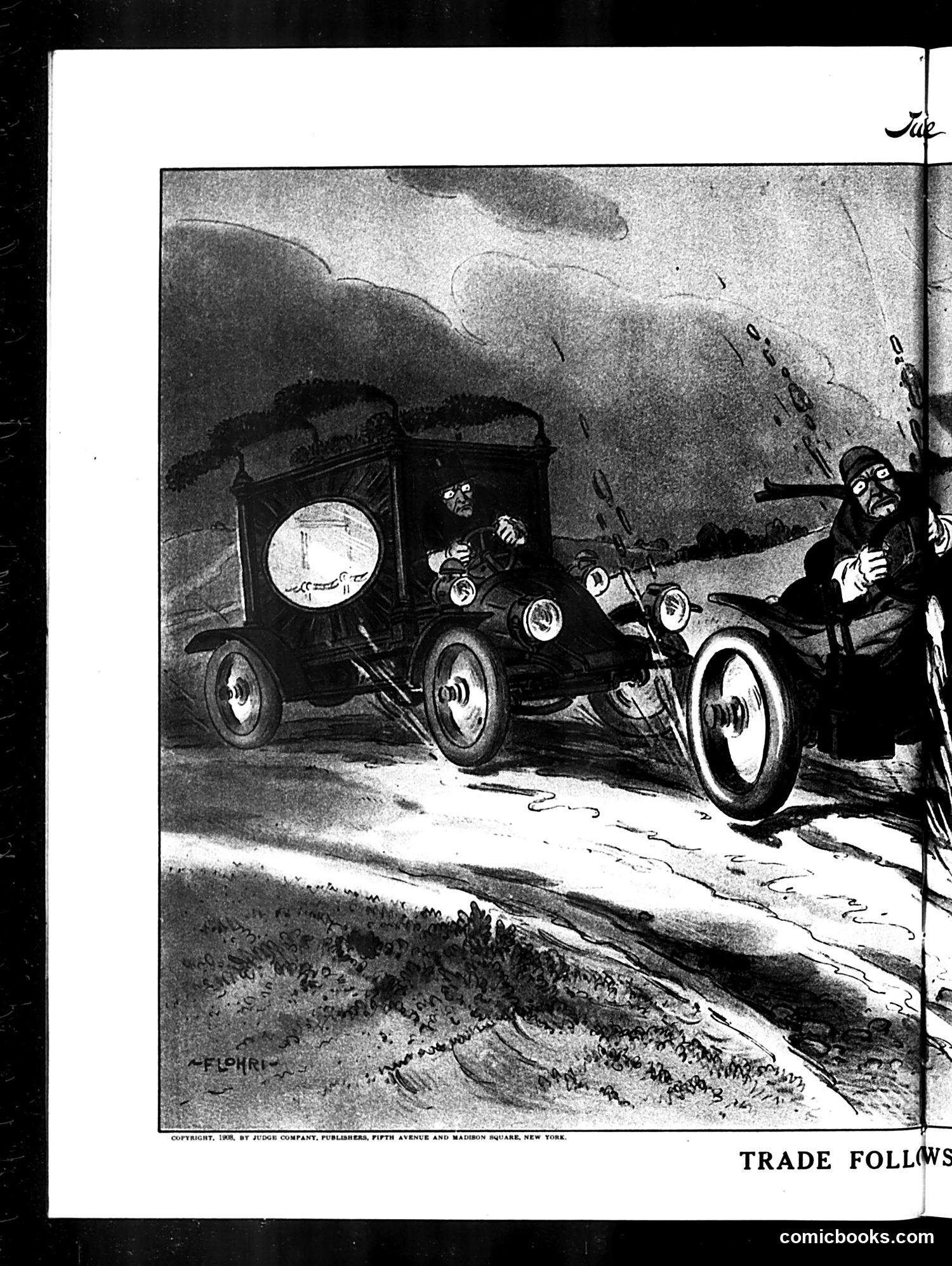
This appears to be a satirical cartoon about labor or trade disputes, likely from the early 20th century based on the art style and automobiles depicted. The image shows two cars meeting on a road: one appears to be a wealthy person's vehicle (suggested by its size and the figure inside), while the other carries what appears to be a worker or laborer. The caricatured faces and the confrontational positioning suggest social conflict or class tension. The title "TRADE FOLLWS" (likely "TRADE FOLLOWS" with OCR error) suggests commentary on how commerce or business practices follow certain patterns—possibly satirizing how different classes of workers or business interests clash or compete. The specific historical context—which trade dispute, labor movement, or business conflict this references—is unclear without additional documentation. The Judge magazine copyright and New York setting confirm this is American satire from the early 1900s era.
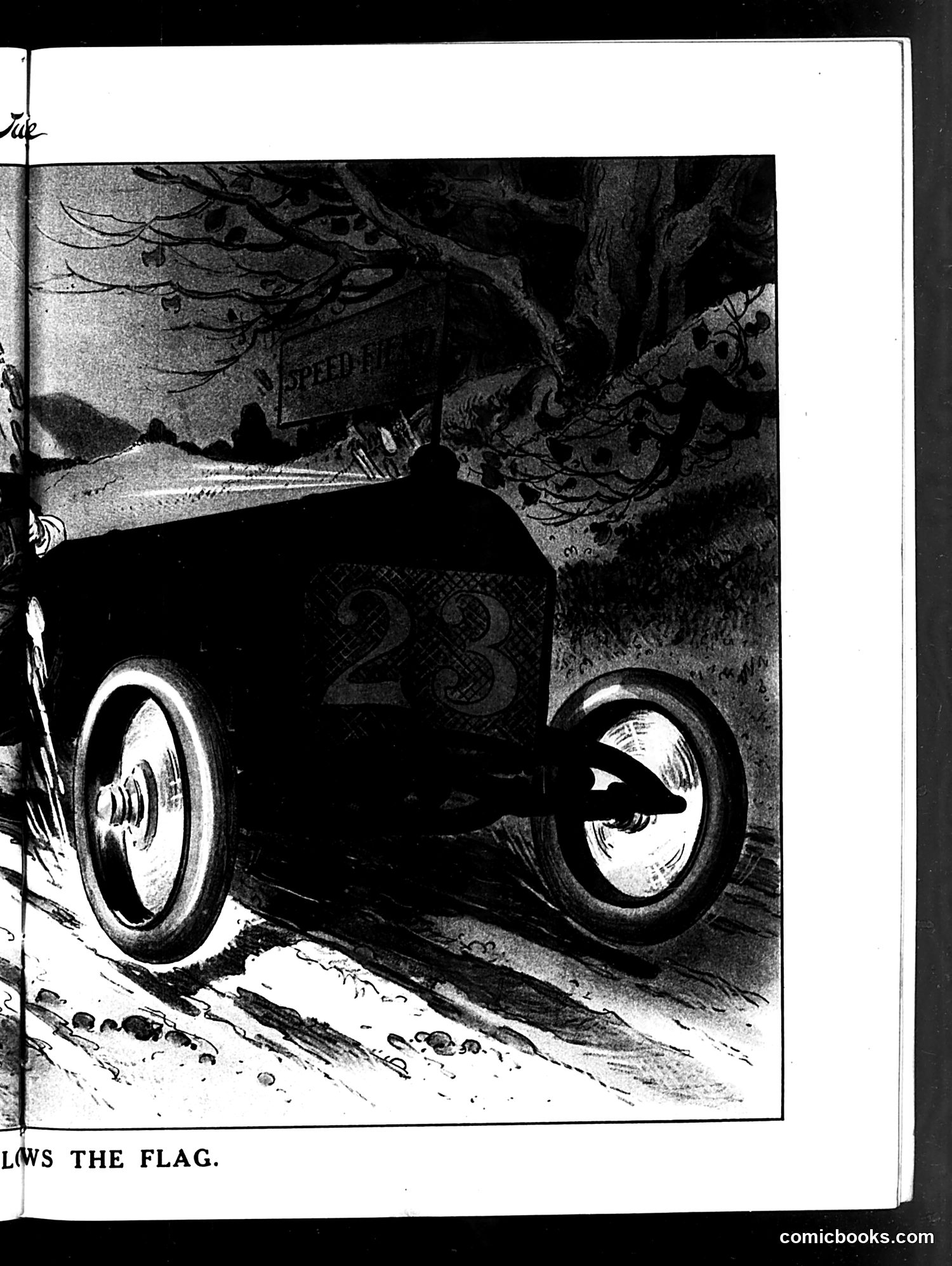
This appears to be a satirical illustration from Judge magazine showing a racing car numbered "23" passing beneath a drooping flag. The vehicle is depicted in silhouette against a dramatic landscape, with the flag notably lowered or "lowered" rather than raised proudly. The caption "LOWS THE FLAG" (likely "LOWERS THE FLAG") suggests political or social criticism—possibly mocking a person or institution for abandoning principles or patriotic standards. The racing context may reference competitive ambition or speed prioritized over honor. Without clearer identification of the specific historical moment or figures depicted, the precise target of satire remains unclear, though the overall message appears to criticize compromised integrity or patriotism in pursuit of victory or advancement.
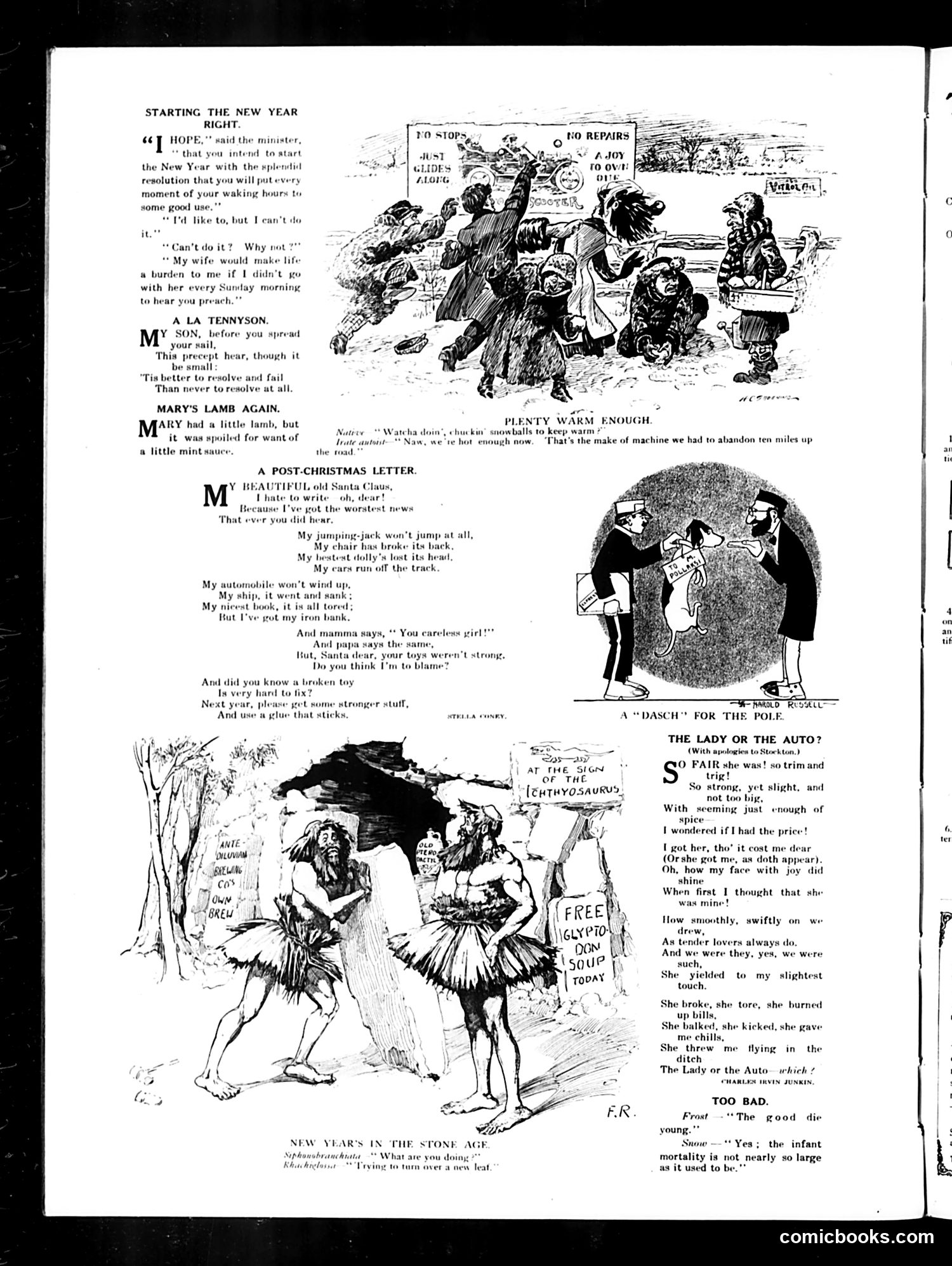
This page contains several New Year-themed satirical pieces mocking domestic life and consumer culture circa early 1900s. **"Starting the New Year Right"** jokes about a husband who can't keep resolutions because his wife forces him to attend church every Sunday—suggesting wives are obstacles to self-improvement. **"Mary's Lamb Again"** plays on the nursery rhyme, with a child's complaint about wanting lamb sauce, likely mocking spoiled children or rationing debates. **"A Post-Christmas Letter"** presents a child's bitter complaint to Santa that all toys broke immediately—satirizing cheap manufacturing and planned obsolescence in Christmas gifts. **"The Lady or the Auto?"** parodies Frank Stockton's "The Lady or the Tiger," comparing a woman to an automobile. The joke: both are unpredictable, unreliable, and will eventually "break" or betray you—contemporary misogynist humor equating women with malfunctioning machines. The page overall mocks marriage, consumerism, and childhood disappointment through period-specific anxieties about modern life.
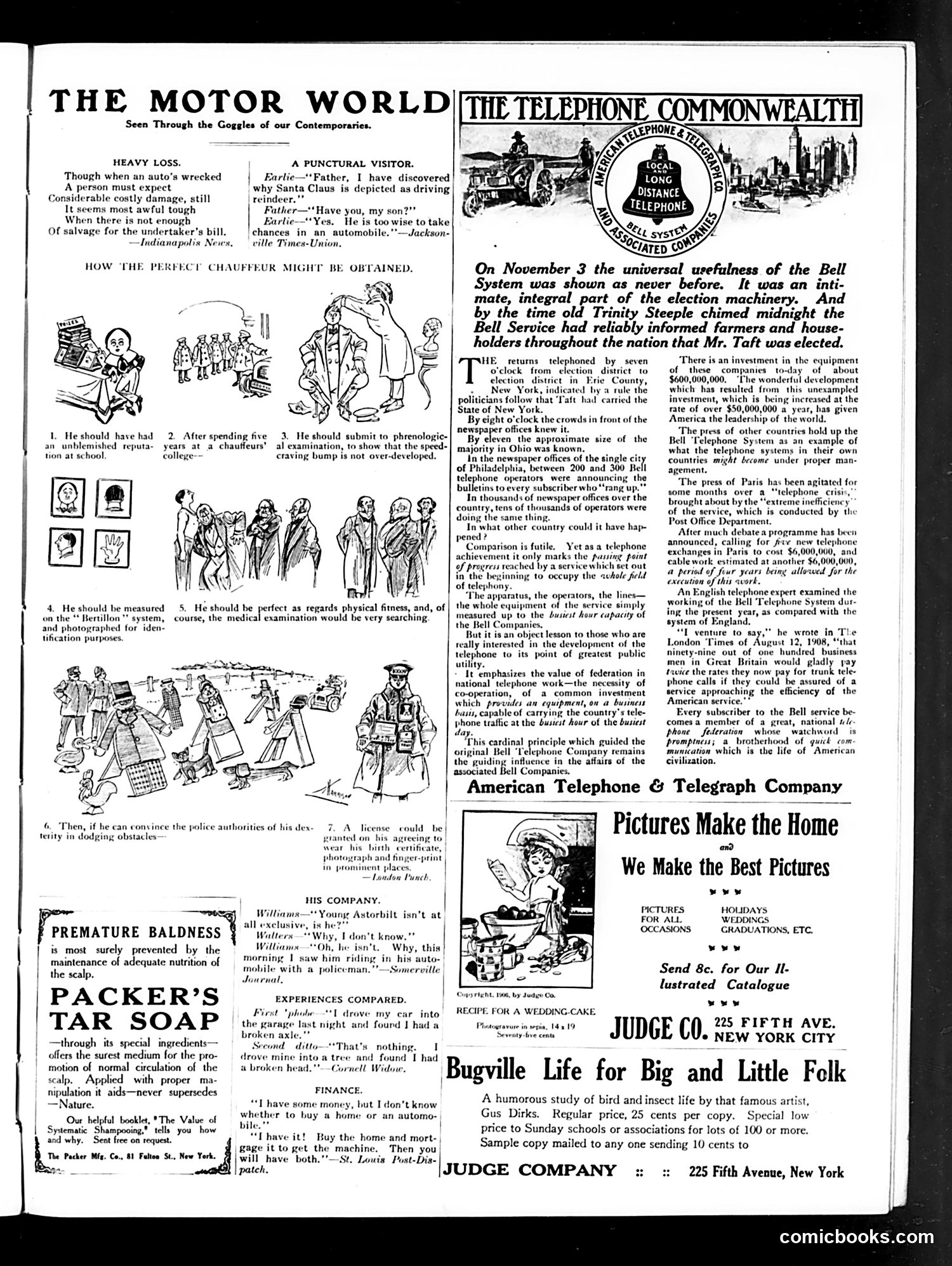
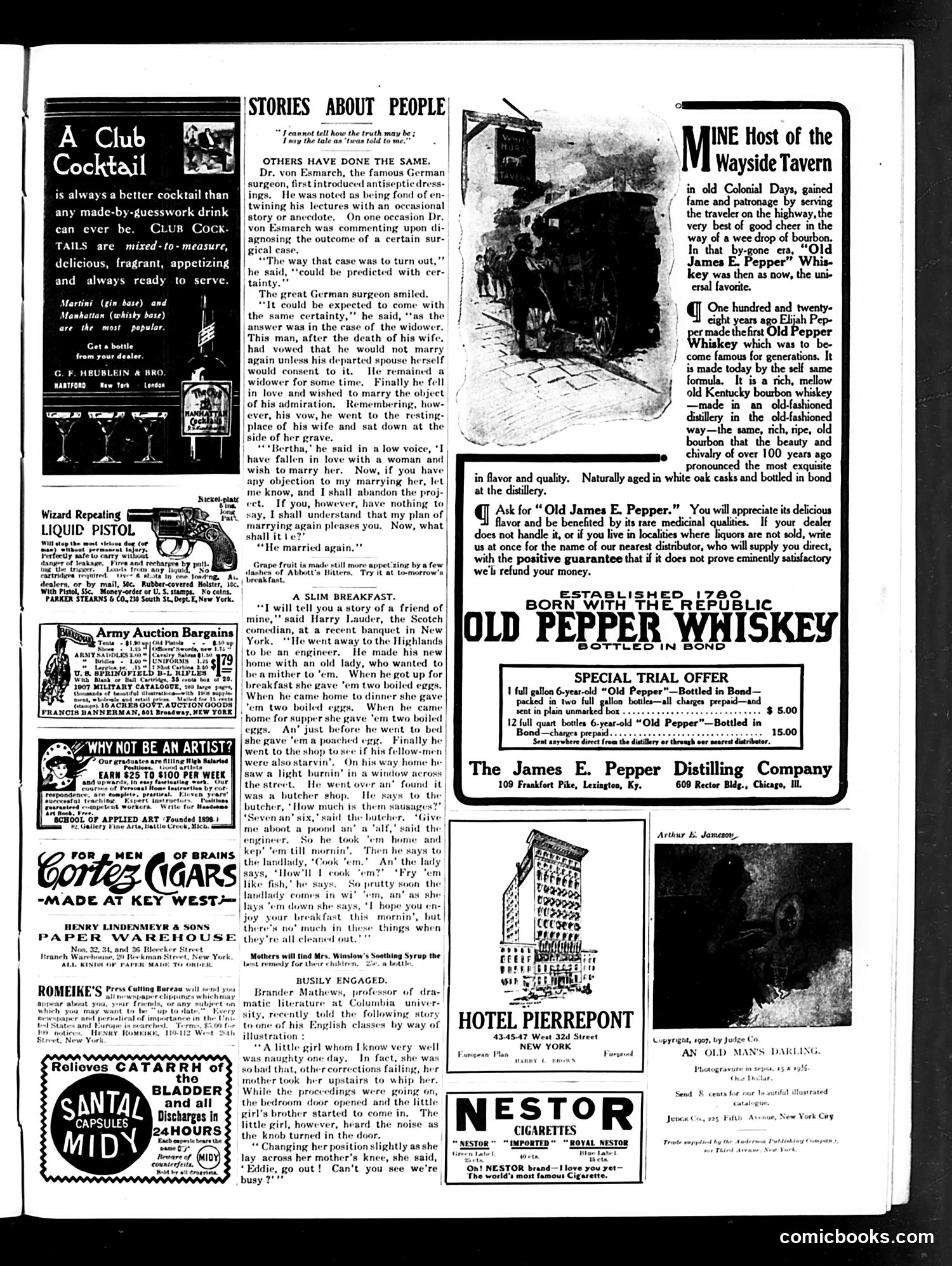
This page from *Judge* magazine contains automotive humor and advertisements rather than political satire. **"The Motor World" section** satirizes early automobile culture through several brief jokes: - **"Heavy Loss"** jokes about auto wrecks being financially devastating even when there's nothing left to salvage for the undertaker. - **"How the Perfect Chauffeur Might Be Obtained"** is a humorous seven-step process for vetting drivers, including phrenological examination and police background checks—poking fun at both emerging automotive safety concerns and pseudoscientific hiring practices of the era. - **"A Punctual Visitor"** makes a pun on "puncture" (tire blowouts), suggesting Santa's reindeer are depicted because automobiles have flat tires. The remaining jokes mock car owners' vanity and financial priorities. The advertisements for Packer's Tar Soap and Judge Company publications occupy significant space. The Bell Telephone ad celebrates the 1908 election night, when telephone operators helped disseminate Taft's victory results nationwide.
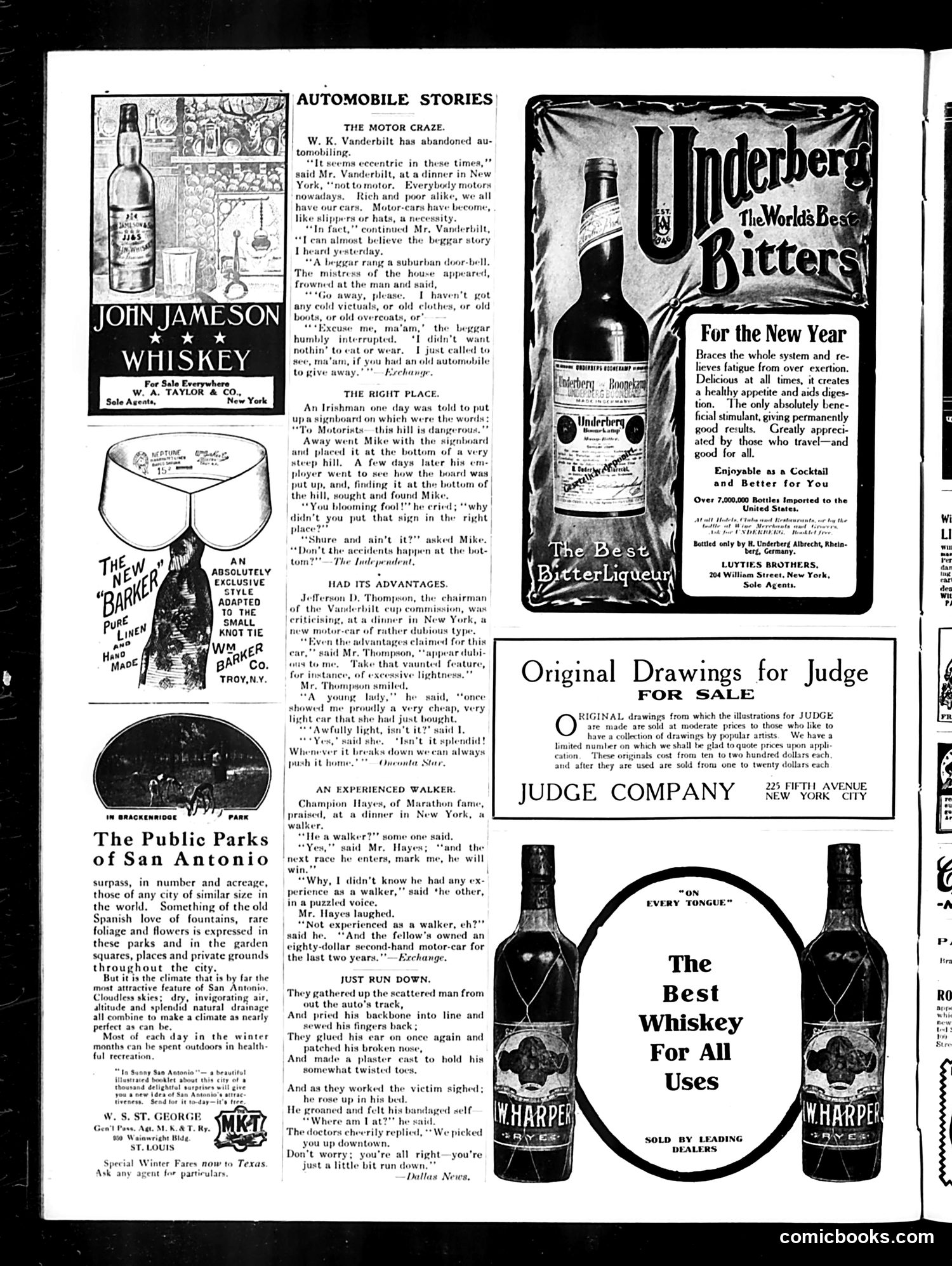
This page primarily contains **advertisements and humorous short stories** rather than political cartoons. The content reflects early 1900s American attitudes toward automobiles and leisure. The automobile stories satirize the then-new motor craze: W.K. Vanderbilt abandoning cars (presented as eccentric), an Irishman placing a "dangerous hill" warning at the *bottom* rather than top of a slope (Irish immigrant stereotype humor), and a woman praising her cheap car's lightness while needing to push it uphill. The final poem, "Just Run Down," darkly jokes about an accident victim being dismissed as merely "run down" rather than seriously injured. Surrounding these are **period advertisements** for John Jameson Whiskey, San Antonio tourism, Underberg Bitters, and Judge's own original artwork sales—typical of this magazine's revenue model. The humor assumes readers find automobiles novel and somewhat ridiculous, immigrant characters comical, and accident victims acceptable subjects for punchlines. These attitudes reflect values notably different from modern sensibilities.
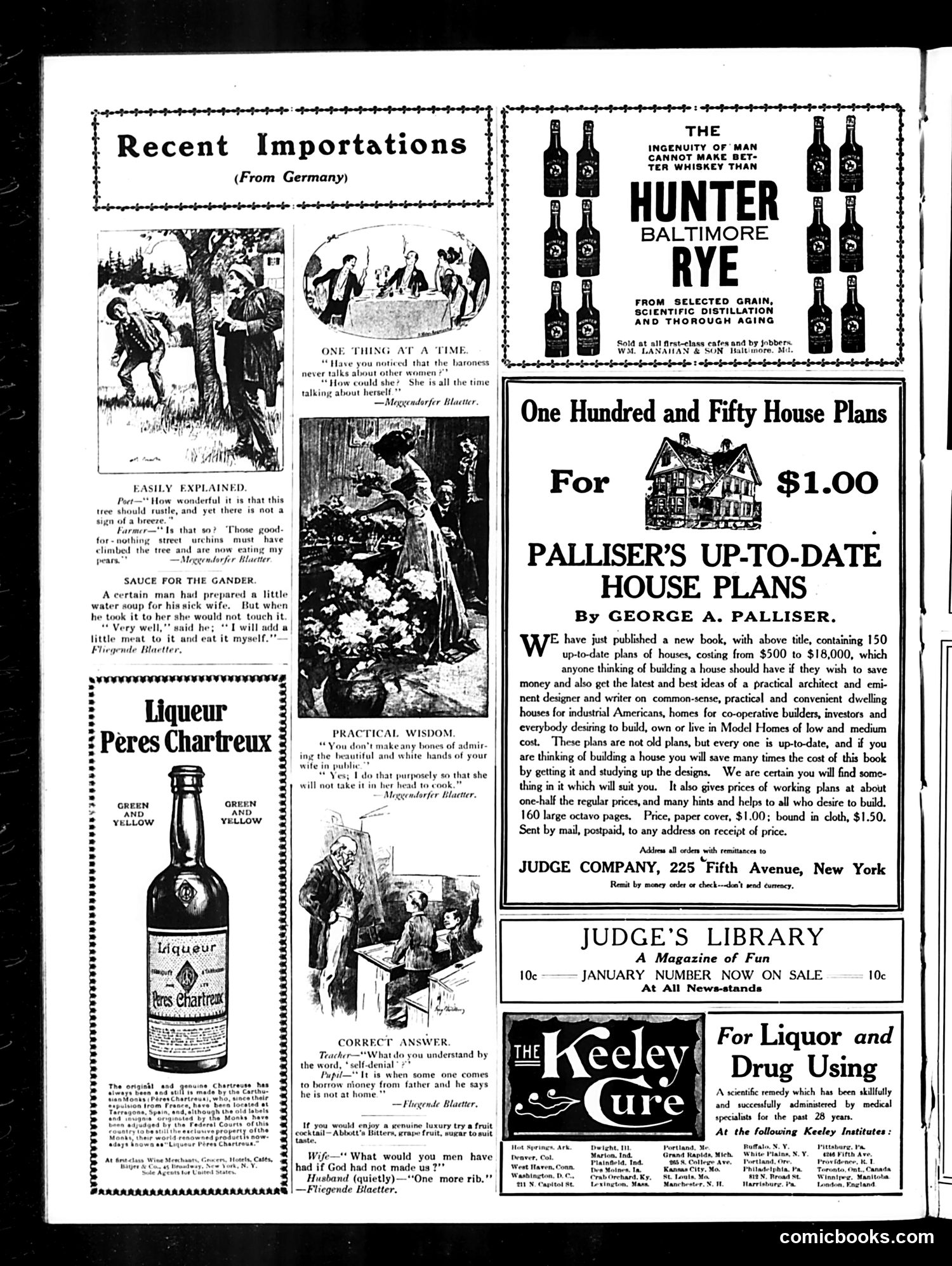
This page is primarily **advertising and filler content** rather than satirical cartoons. The main elements are: **Content:** - Several small humorous anecdotes labeled "Recent Importations (From Germany)," drawn from *Fliegende Blätter*, a German humor magazine - Jokes about domestic life and misunderstandings (a husband's quip about wanting "one more rib," a wife's soup mishap) **Advertisements:** - Hunter Baltimore Rye whiskey - Liqueur Percs Chartreux - Palliser's house plan book - Judge's Library magazine - The Keeley Cure (an alcoholism treatment) **Historical Context for Modern Readers:** The Keeley Institutes advertised were real institutions offering a famous (though ultimately ineffective) cure for alcoholism using a patent medicine. The German imports reflect Judge's frequent reprinting of European humor. This page shows how early 20th-century magazines mixed editorial humor with extensive advertising to fund publication.
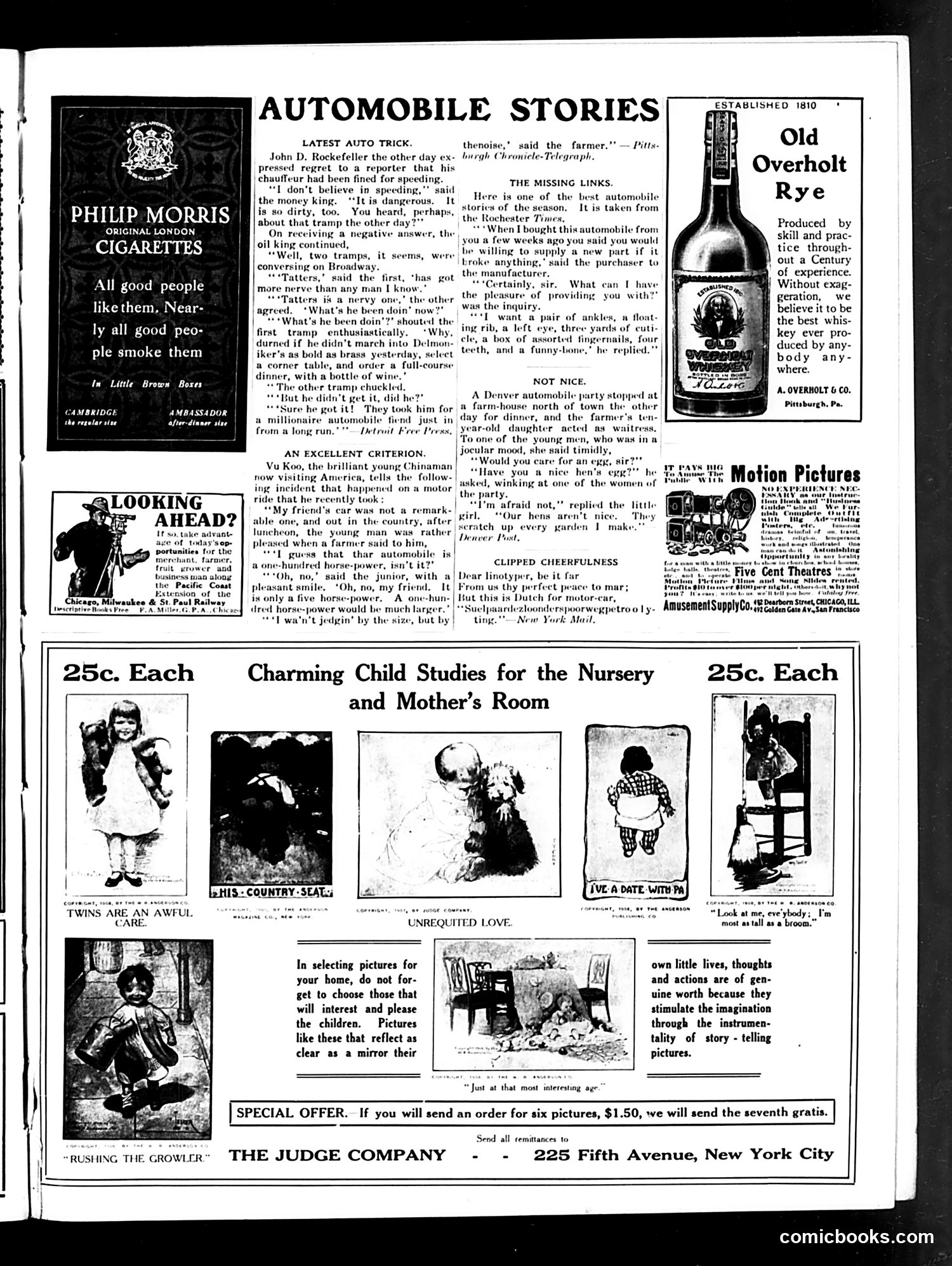
This page is primarily **advertising and humorous automobile anecdotes** rather than political satire. The "Automobile Stories" section contains three brief jokes: 1. **Rockefeller anecdote**: Mocks wealthy industrialist John D. Rockefeller's hypocrisy—he publicly opposes speeding while his chauffeur was fined for it. The joke suggests the wealthy hold different standards. 2. **Tramp dialogue**: Two homeless men marvel that a vagrant boldly entered a restaurant and ordered an expensive dinner, implying audacity or class transgression for humor. 3. **Chinese visitor story**: A visiting Chinese man (Vu Koo) misjudges an automobile's power by its size, played for "foreigner's confusion" comedy common to the era. The page also features **period advertisements**: Philip Morris cigarettes, Old Overholt Rye whiskey, motion pictures, and children's nursery prints. These occupy substantial space, indicating this is a commercial publication blending editorial content with paid advertising. The humor reflects early 1900s attitudes toward wealth, class mobility, and ethnic stereotyping.
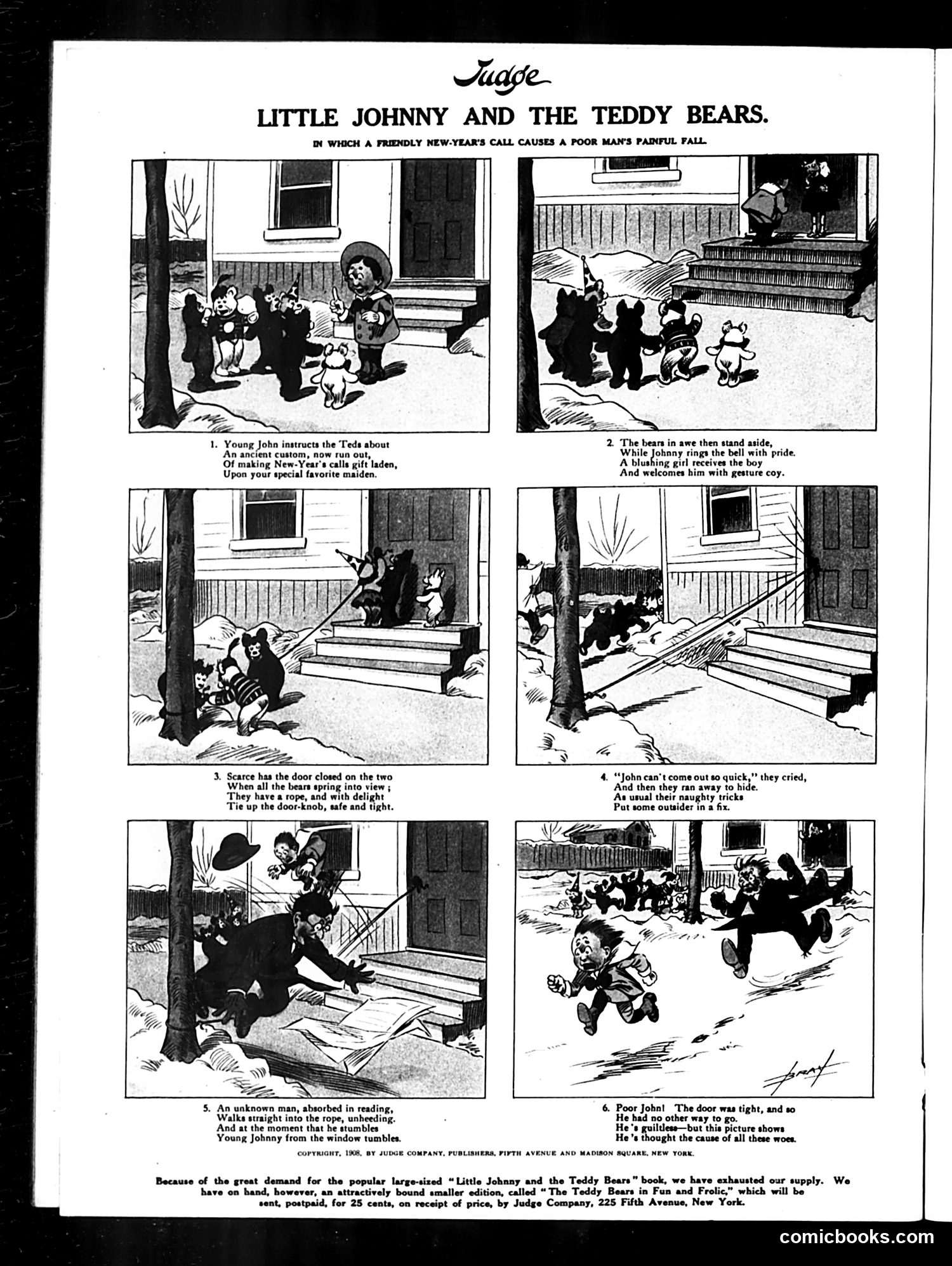
This is a six-panel children's comic strip about a New Year's prank gone wrong. Young Johnny instructs his toy teddy bears about making New Year's social calls with gifts. When Johnny visits a girl's house, the bears mischievously tie a rope around the door handle. An unsuspecting stranger reading outside walks into the trap, stumbles, and Johnny—watching from a window—falls out in shock and lands painfully on the ground. The humor relies on slapstick: innocent pranking by toys leads to accidental injury of an innocent bystander and the prankster himself. "Teddy bears" here refers to stuffed toy bears (named after President Theodore Roosevelt), which were wildly popular children's toys in this era. The strip's moral lesson—that Johnny, though guiltless of intent, caused someone's misfortune—was typical of early 1900s children's moral instruction through comic narrative.