
A complete issue · 16 pages · 1908
Judge — December 12, 1908
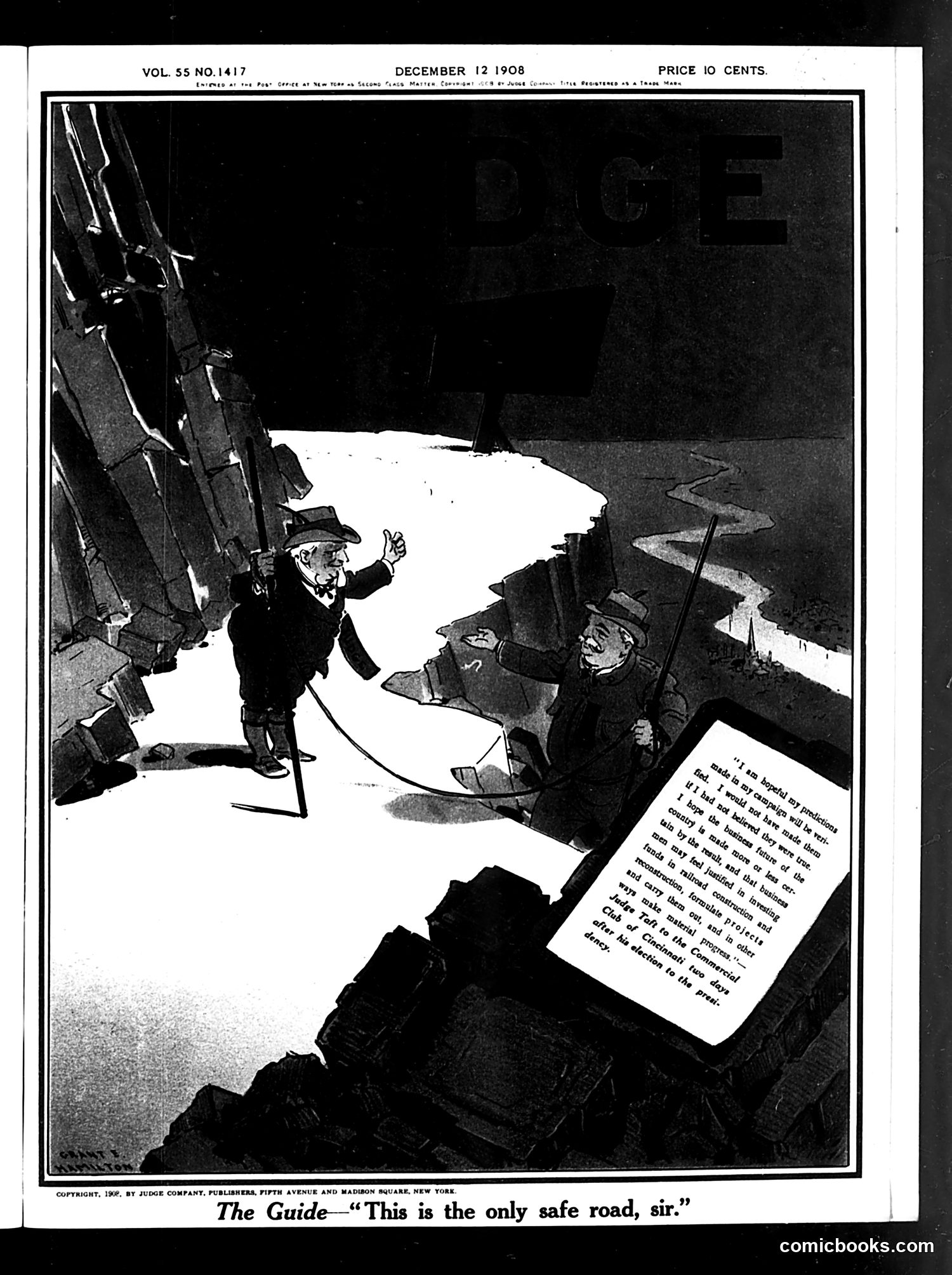
This 1908 Judge cartoon satirizes political or social navigation through treacherous terrain. A guide (likely representing an advisor or political figure) gestures toward a narrow, safe passage while two men on skis navigate a dangerous landscape of jagged rocks and crevasses. The dramatic chiaroscuro styling emphasizes the peril surrounding them. The caption suggests the guide is offering protection through expertise in a hazardous situation. Without additional context visible on the page, the specific political reference remains unclear—it could concern financial markets, foreign policy, or domestic politics of the 1908 era. The image appears to be a complete standalone cartoon rather than part of a serialized story.
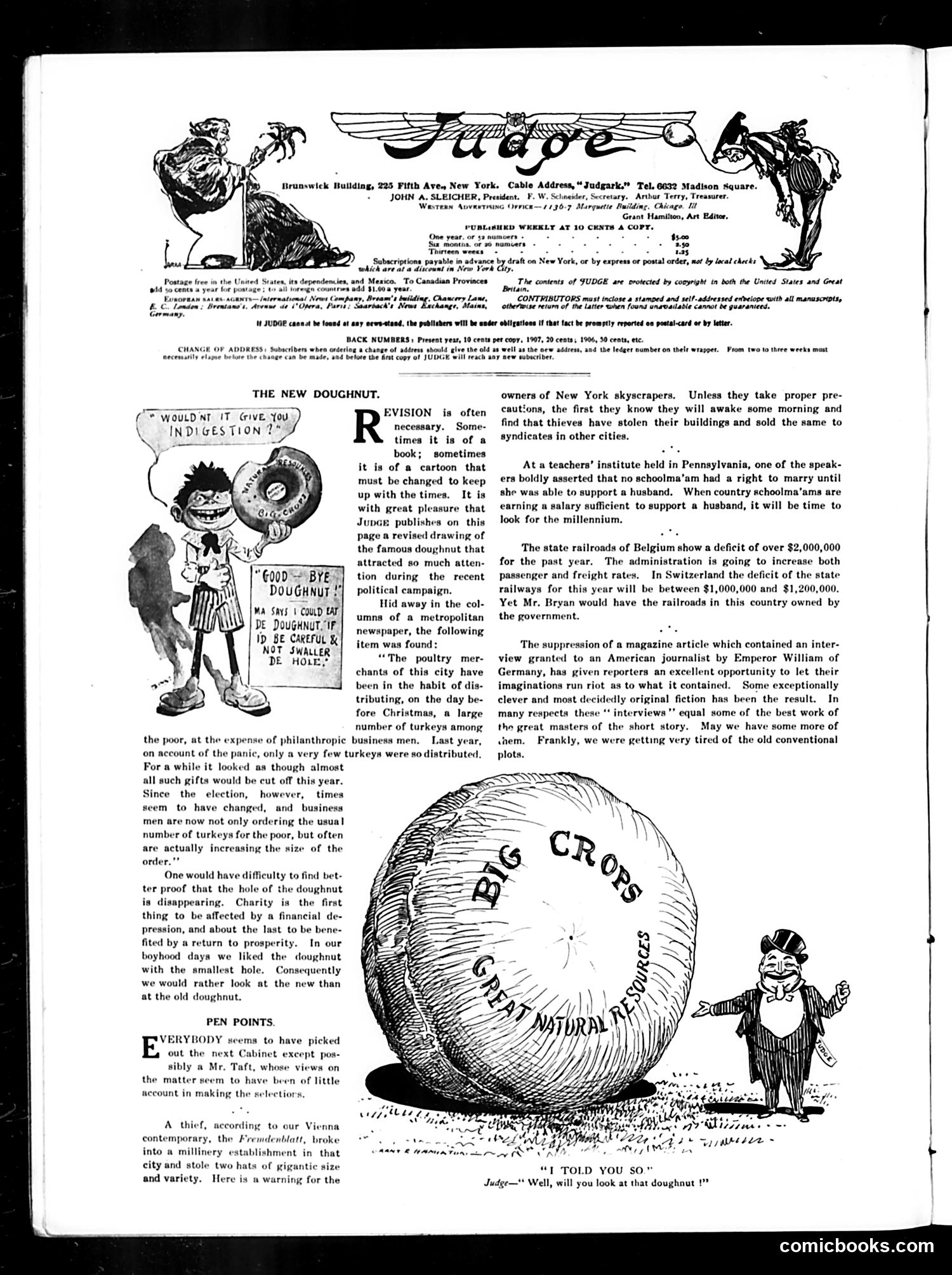
This page critiques **charity and doughnuts** through satirical commentary and cartoons. The main cartoon "The New Doughnut" mocks a revised drawing of a famous doughnut that "attracted much attention during the recent political campaign." The text suggests businessmen are *increasing* turkey donations to the poor around Christmas—not out of genuine charity, but to appear philanthropic while reducing actual assistance. The implication is that charity "is the first thing to be affected by a financial depression." The large bottom cartoon shows a massive doughnut labeled "BIG GROSS" with text about "natural resources." A small figure claims credit, saying "I told you so" to the Judge. This appears to mock someone (unclear who) taking undeserved credit for economic conditions. The satire targets hollow charitable gestures and false credit-taking during economic hardship.
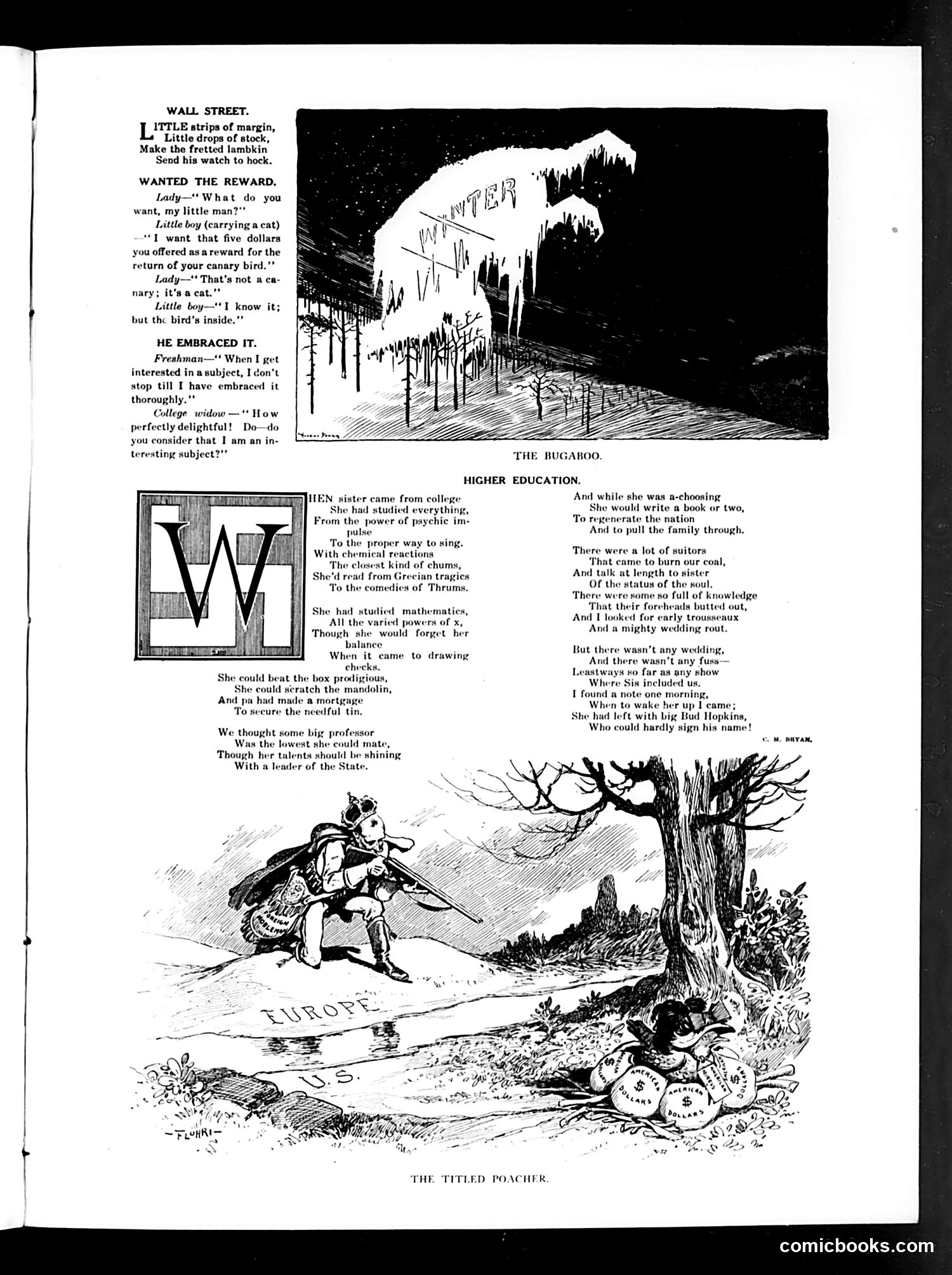
The bottom cartoon satirizes American-European relations, likely from the Gilded Age. A figure labeled "Europe" poaches from American territory (marked "U.S."), stealing money bags while Uncle Sam (represented by the tree) appears dormant or indifferent. The satire criticizes American weakness in protecting its economic interests against European exploitation and imperial competition. The "Higher Education" poem mocks educated women, suggesting college-educated females waste their learning on frivolous pursuits—writing novels, burning coal, gossiping—rather than substantive work. The satire reflects period anxieties about women's education and changing gender roles, implying higher education was wasted on women who wouldn't use it "properly." Both pieces express conservative social and economic anxieties of their era.
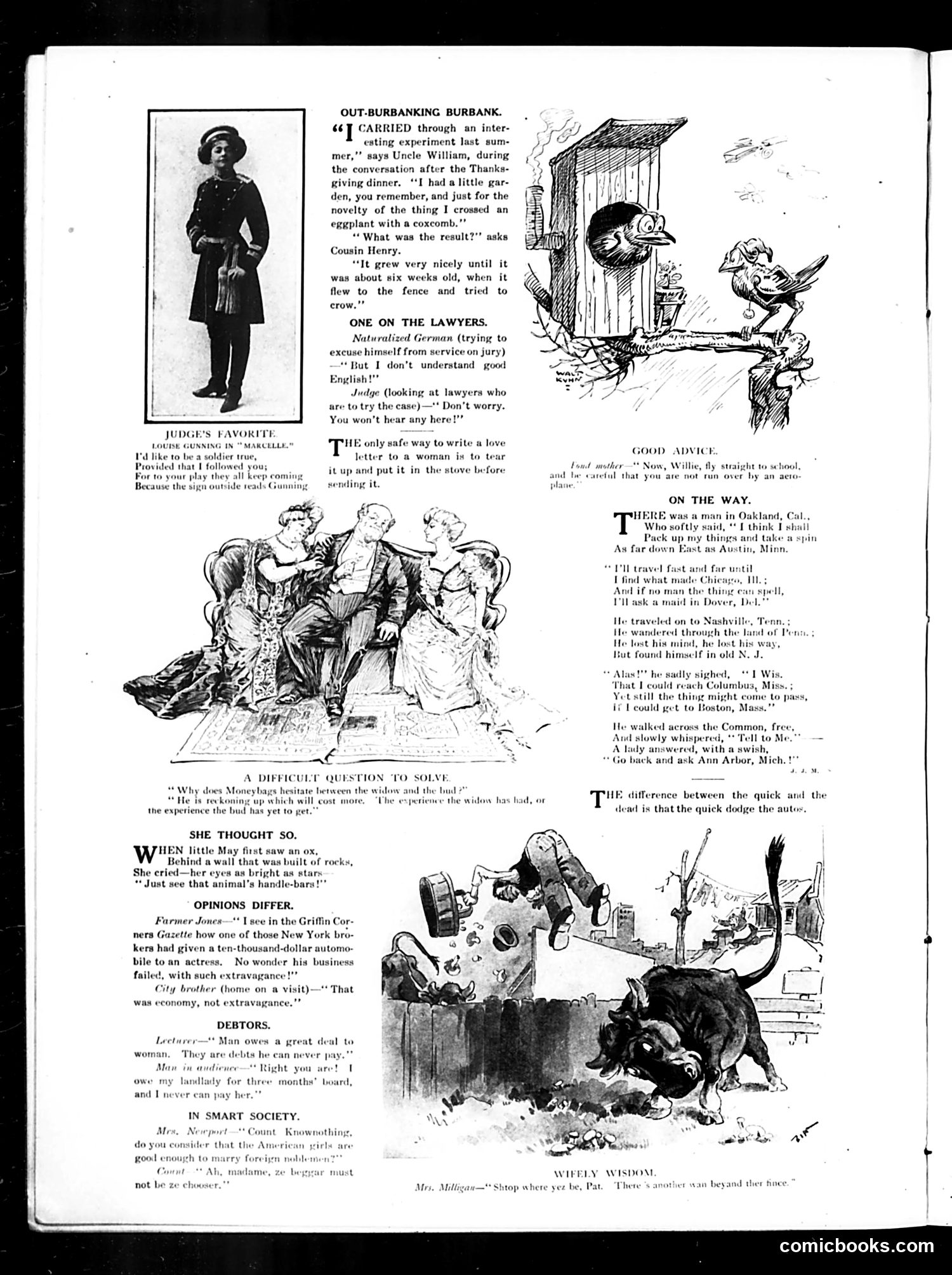
This page contains several disconnected satirical pieces typical of Judge's format: **"Out-Burbanking Burbank"** mocks Luther Burbank's horticultural experiments, suggesting he crossed an eggplant with a comb—absurdist humor about scientific ambition. **"One on the Lawyers"** shows a naturalized German evading jury duty, with a judge warning him not to expect leniency—commentary on immigration and legal responsibilities. The remaining sections are brief humorous observations: "She Thought So" about a child seeing an ox, "A Difficult Question" about money's indecisiveness, and "Opinions Differ" contrasting views on an actress's automobile accident. The bottom sections ("Debtors," "In Smart Society," "Wisely Wished") present short joke dialogues on predictable topics: debt, marriage prospects, and domestic humor. Overall, the page emphasizes light satirical commentary on contemporary American life rather than focused political critique.
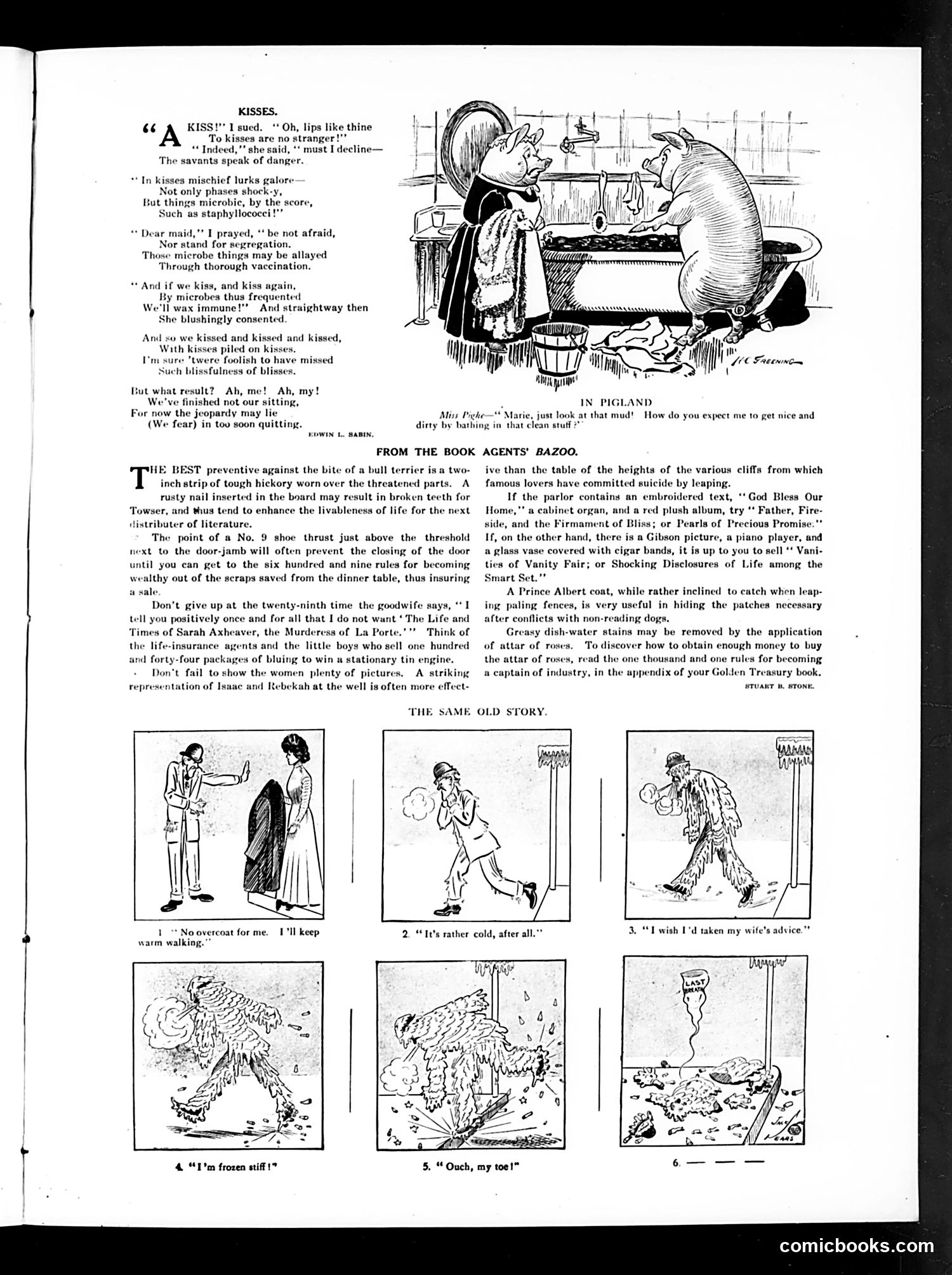
This page contains three distinct sections: **"Kisses" poem** (top left): A lighthearted Victorian-era verse about kissing and microbes, reflecting early 20th-century fascination with germ theory as a social concern. **"In Pigland" cartoon** (top right): A pig woman complains to a male pig about getting dirty while bathing—likely a humorous anthropomorphic domestic scene with no clear political reference. **"From the Book Agents' Bazoo"**: Satirical commentary mocking door-to-door book salesmen's pitches and their aggressive tactics. **"The Same Old Story" comic strip** (bottom): A six-panel sequence showing a man repeatedly getting into trouble with his wife—apparently freezing outside, receiving poor advice, and suffering consequences. It's a domestic comedy strip with no specific political content, just relatable married-life humor typical of Judge's satirical entertainment.
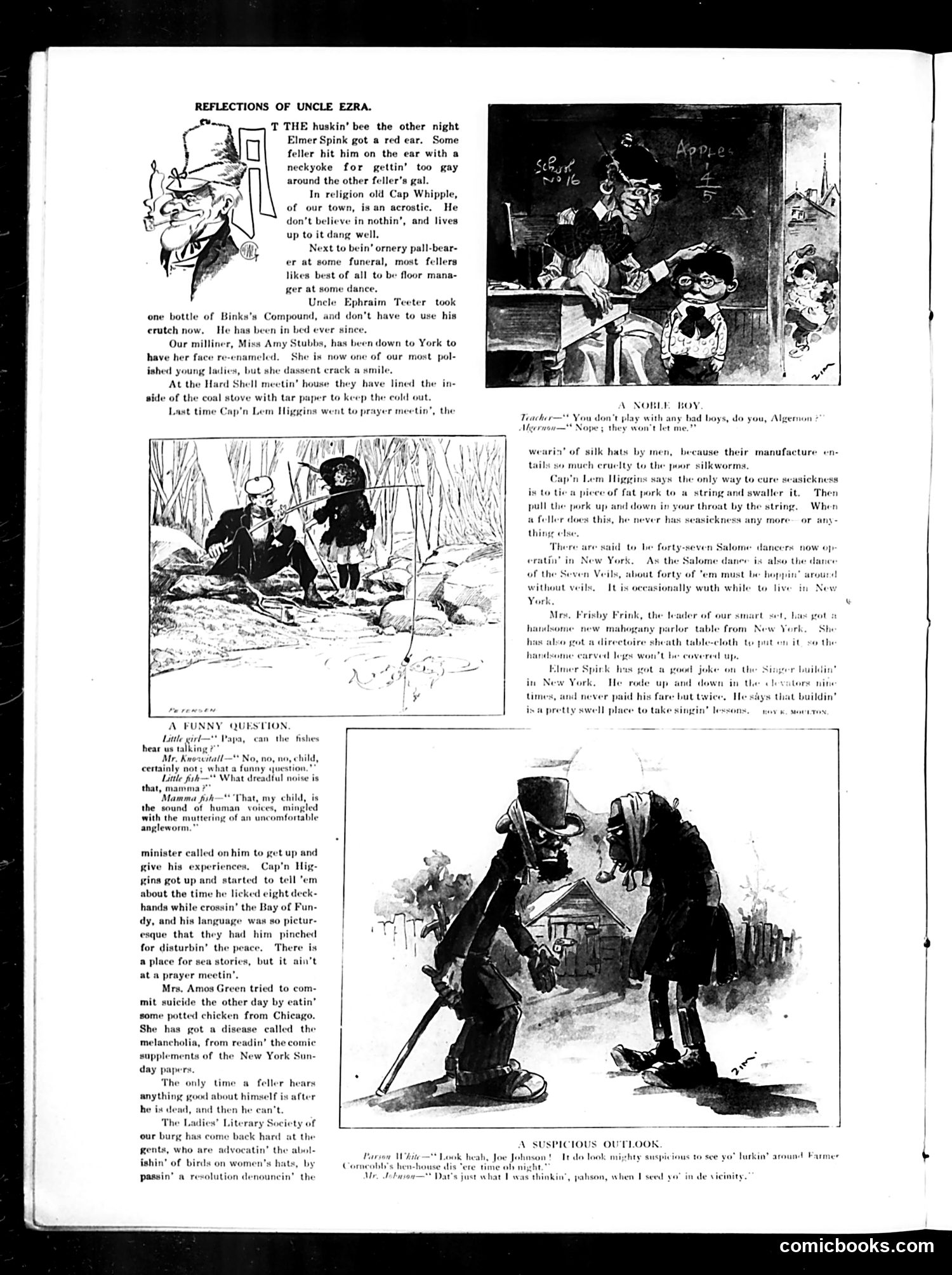
This page presents "Reflections of Uncle Ezra," a humorous rural-gossip column featuring folksy anecdotes about small-town characters and their misadventures. The satire targets various contemporary social issues through exaggerated country humor. Key targets include: **medical quackery** (a man disabled after taking patent medicine), **excessive religiosity** (prayer meetings disrupted by sailors' profanity), **fashionable crazes** (the "Salome dance" craze sweeping New York), and **urban affectation** (wealthy women copying Manhattan fashions). The accompanying cartoons mock **seasickness remedies** and social pretension. The column's humor relies on contrasting rustic common sense with urban sophistication, suggesting rural skepticism toward modern trends and city life. The overall tone is gently mocking of both small-town gossip and urban fashionability—typical Judge magazine satirical fare targeting American society's follies.
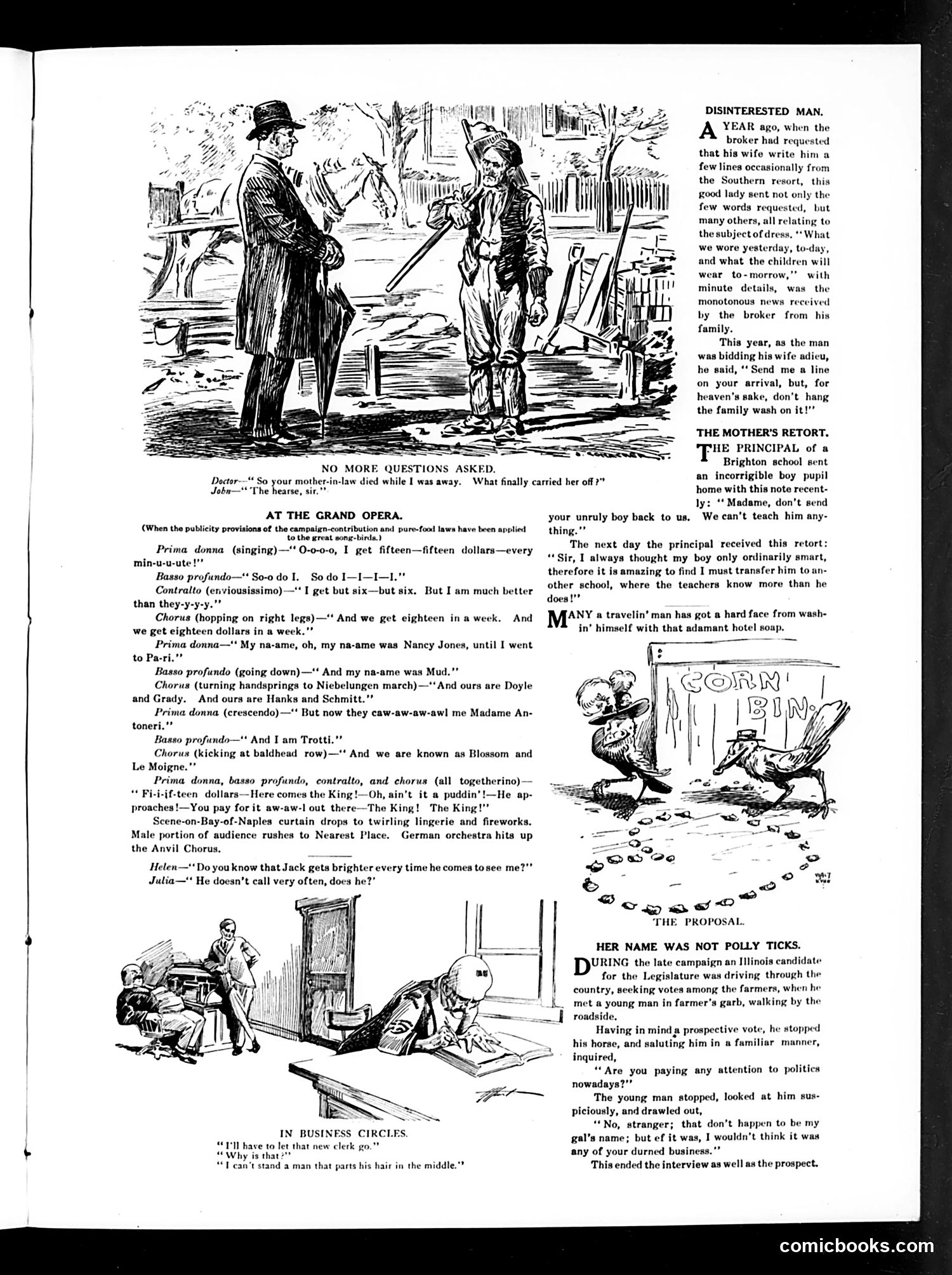
This page contains multiple satirical pieces typical of early 20th-century American humor: **"At the Grand Opera"** mocks newly required campaign finance and food safety disclosure laws by imagining opera singers loudly announcing their salaries during performance—turning transparency into absurdity. The joke suggests such regulations, when applied to entertainment, would destroy the art form. **"No More Questions Asked"** is a brief doctor-patient joke playing on the euphemism "the hearse" for a mother-in-law's death. **"The Mother's Retort"** satirizes rigid school authority: a principal expels a boy as unteachable; the mother's clever response—implying the school is too intellectually limited for her son—turns the insult back on the institution. **"Her Name Was Not Polly Ticks"** ridicules a political candidate's transparent vote-seeking. A farmer, suspicious of the stranger's sudden friendliness, misinterprets "politics" as a woman's name and angrily rejects the intrusion into personal affairs, ending the candidate's prospect. The remaining items are brief workplace and social humor unrelated to major events.
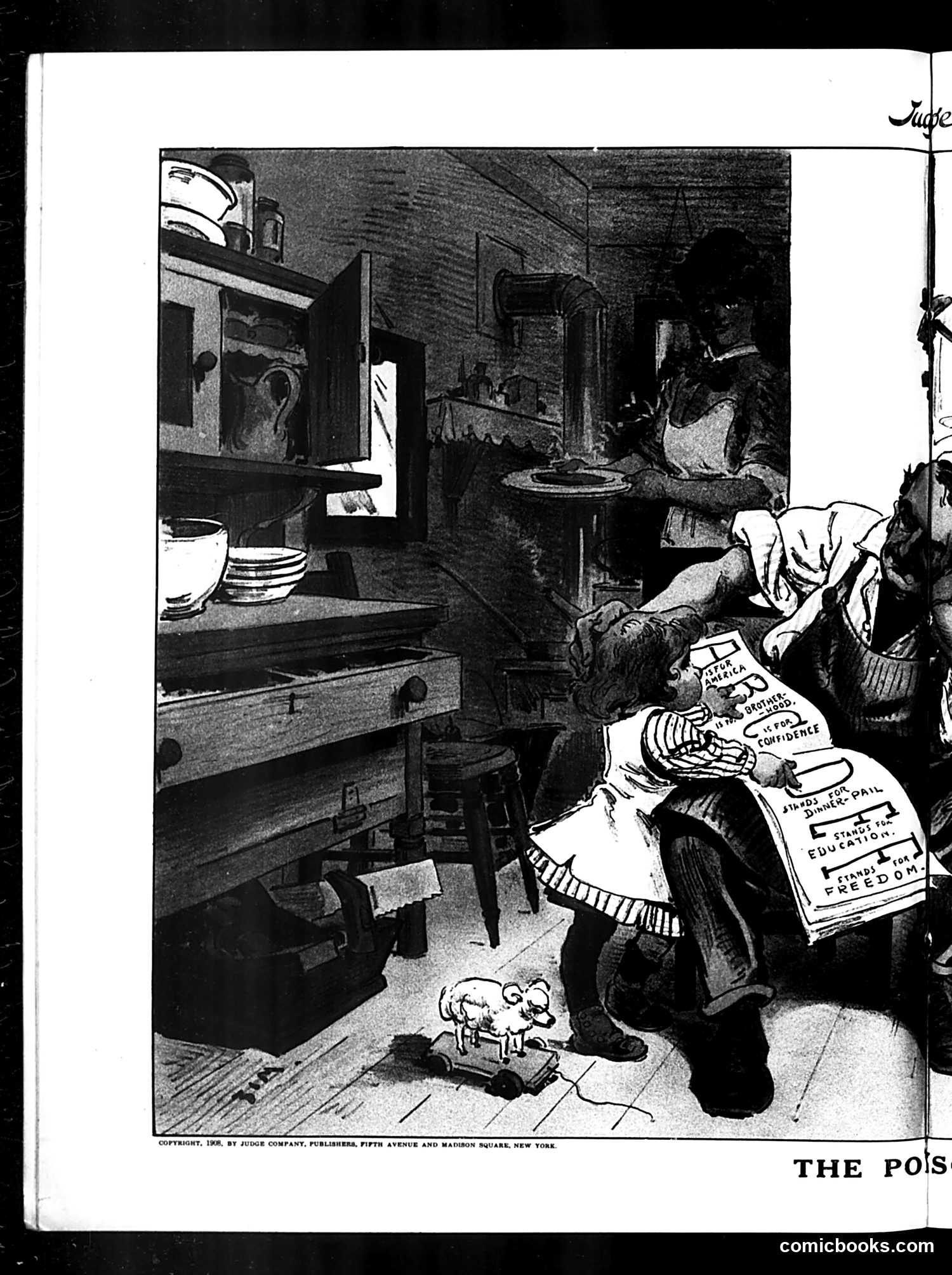
This 1908 Judge magazine illustration satirizes poverty and social inequality. A child wearing tattered clothes bearing labels like "Poverty," "Disease," "Lack of Confidence," and "No Freedom" stands in a humble kitchen, observing a stove and domestic scene. The contrast appears deliberate: while adults manage basic household tasks, the child—weighed down by societal burdens—represents the next generation inheriting these problems. The artwork critiques systemic failures affecting children in poor communities. The labeled clothing functions as a political statement about conditions beyond individual family control. Judge magazine frequently targeted social injustice and political corruption of the Progressive Era, using such visual metaphors to expose conditions ordinary citizens might ignore. The exact title is cut off ("THE PO..."), but the imagery unmistakably addresses poverty's intergenerational impact.
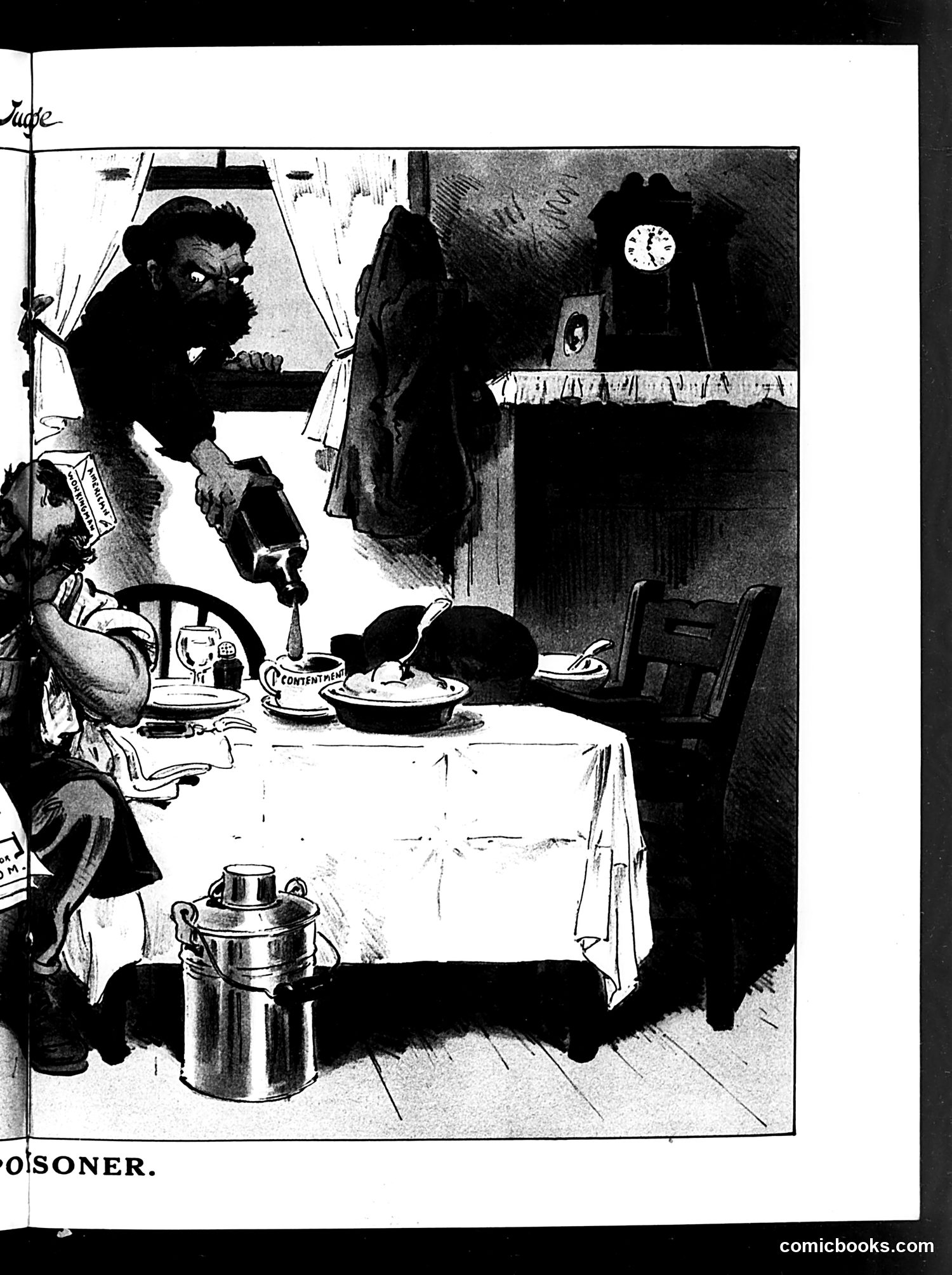
This Judge cartoon satirizes what appears to be a poisoning scandal or murder mystery. The caricatured figure on the left—identified as "O'Soner" in the caption—sits at a dinner table with plates of food and drink. A sinister shadowy figure looms in the doorway behind him, suggesting imminent danger or retribution. The imagery plays on contemporary anxieties about poisoning, a common motif in crime narratives of the early 20th century. The cartoon likely references a specific criminal case or public figure associated with poisoning, though without additional context, the exact target remains unclear. The dramatic chiaroscuro and Gothic atmosphere emphasize the dark humor Judge employed when covering sensational crimes and scandals.
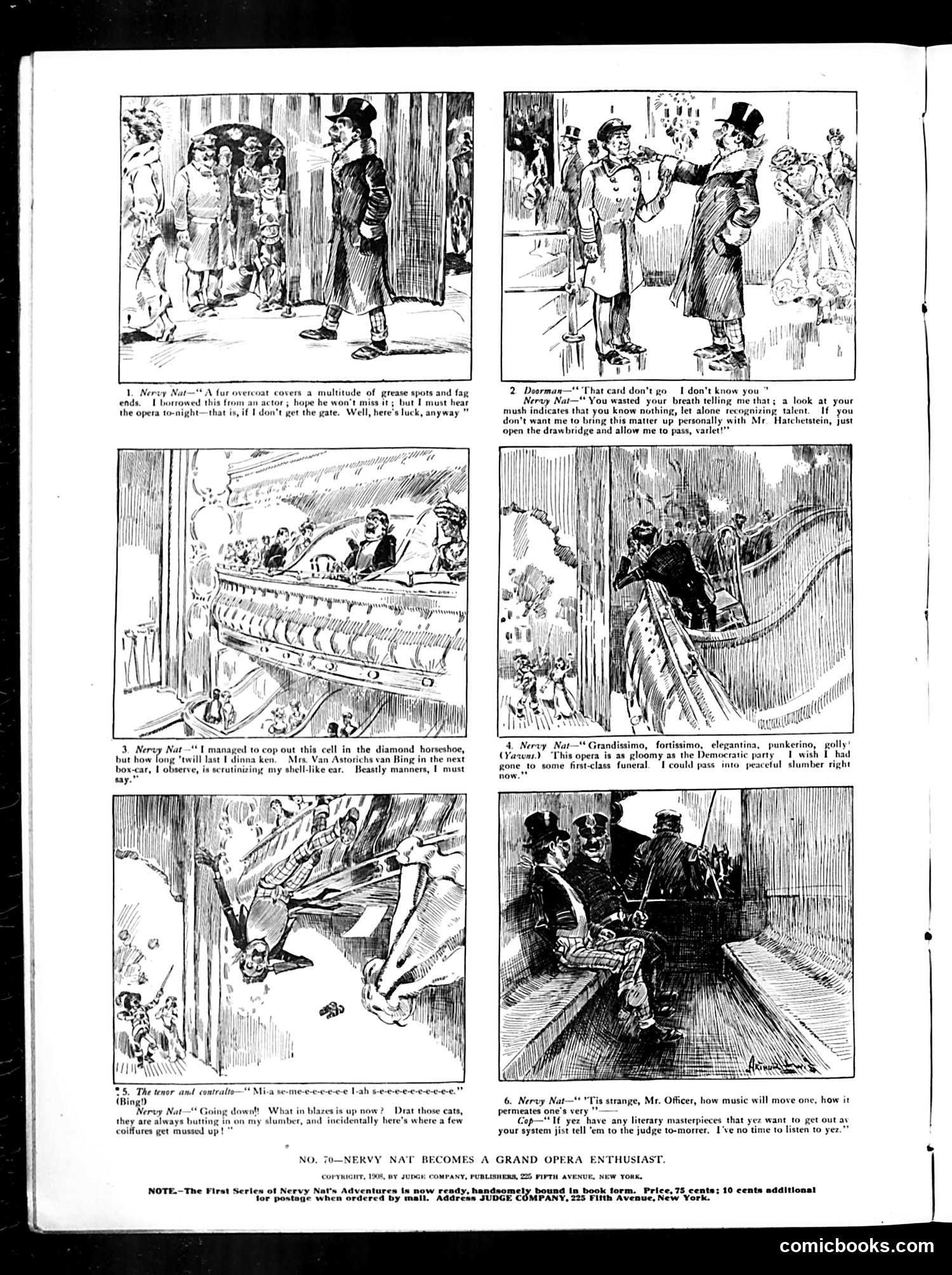
This is a six-panel comic strip satirizing a character called "Nervy Nat," who attempts to attend the opera without a ticket or invitation. The humor derives from his audacious con-artist schemes: he borrows a fur coat to hide grease stains, bluffs his way past a doorman with threats to complain to "Mr. Hatchetstein" (likely a theater magnate), sneaks into the Diamond Horseshoe box seats, and disrupts the performance with loud, vulgar commentary comparing the opera unfavorably to a funeral and a Democratic party gathering. The satire mocks both Nat's brazen working-class pretensions and upper-class opera culture itself. His constant chatter annoys singers, leads to his arrest, and he's finally ejected by a police officer. The strip ridicules social climbing and the stuffiness of high-society entertainment venues, while Nat's unrefined behavior suggests class-based humor typical of early-1900s American comic magazines.
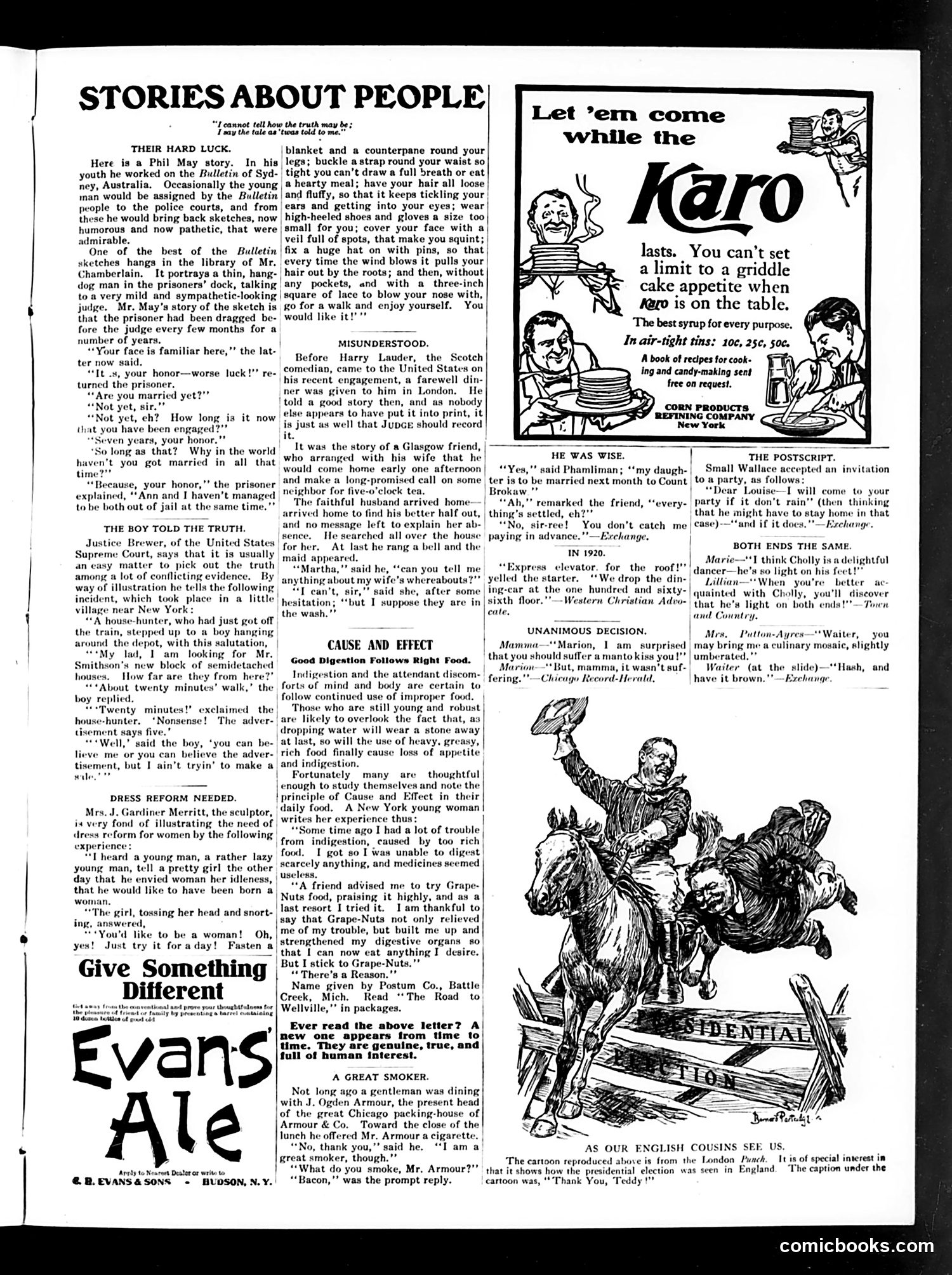
This page from *Judge* magazine contains multiple short humorous stories and advertisements typical of early 20th-century satirical publications. **"Their Hard Luck"** recounts an anecdote about artist Phil May's courtroom sketch of a repeat offender. The joke relies on sympathy for the prisoner's persistent bad fortune. **"Misunderstood"** tells of Scottish comedian Harry Lauder's story about a Glasgow husband who arranges to surprise his wife with an afternoon visit, only to find her absent—a mild domestic comedy about miscommunication. **The fashion/dress reform section** satirizes women's restrictive Victorian clothing (tight corsets, heavy layers, small shoes, elaborate hats) by describing absurdly impractical fashion requirements. **"Cause and Effect"** and other brief items offer observations on food, digestion, and social behavior. The **Karo syrup advertisement** dominates the right side, using period-typical marketing claims about appetite appeal. Overall, this reflects *Judge*'s format: genteel humor about everyday social mishaps, mild gender commentary, and advertising integrated with editorial content.
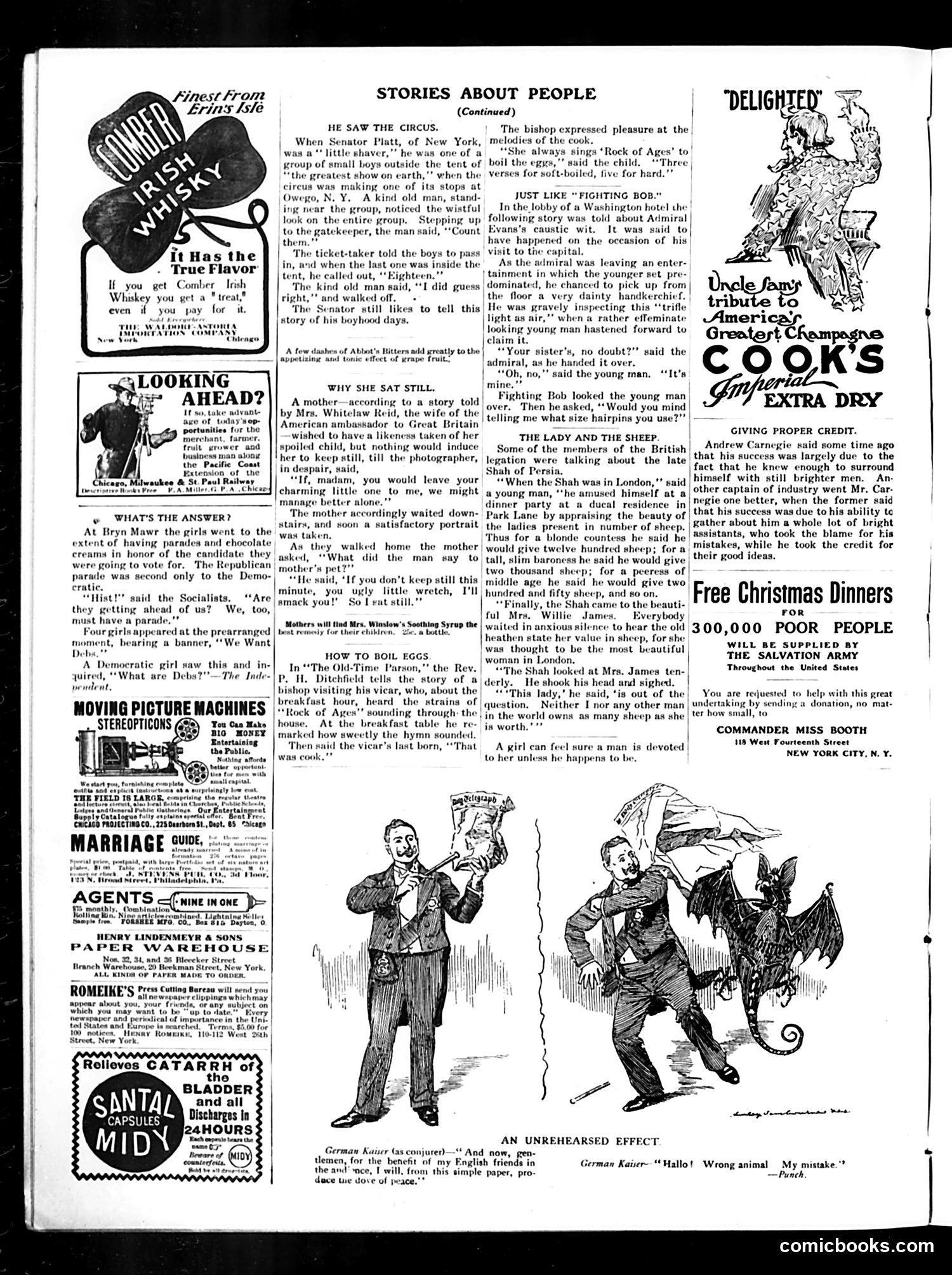
This cartoon depicts **German Kaiser Wilhelm II** (labeled "German Kaiser") attempting to conduct or present something to an English audience, with an unintended comedic result: a devil or demon figure emerges unexpectedly. The satire likely references German-British diplomatic tensions of the early 20th century. The "unrehearsed effect" suggests that Kaiser Wilhelm's foreign policy or public gestures, intended to impress or influence English opinion, produced opposite results—unleashing hostile or problematic consequences he didn't anticipate. The devil/demon symbolizes the threat or antagonism Germany represented to Britain, implying that the Kaiser's diplomatic efforts backfired, revealing underlying animosity rather than goodwill. This reflects pre-WWI anxieties about German militarism and expansionism as viewed by American and British observers. The joke hinges on the gap between the Kaiser's intentions and actual outcomes.
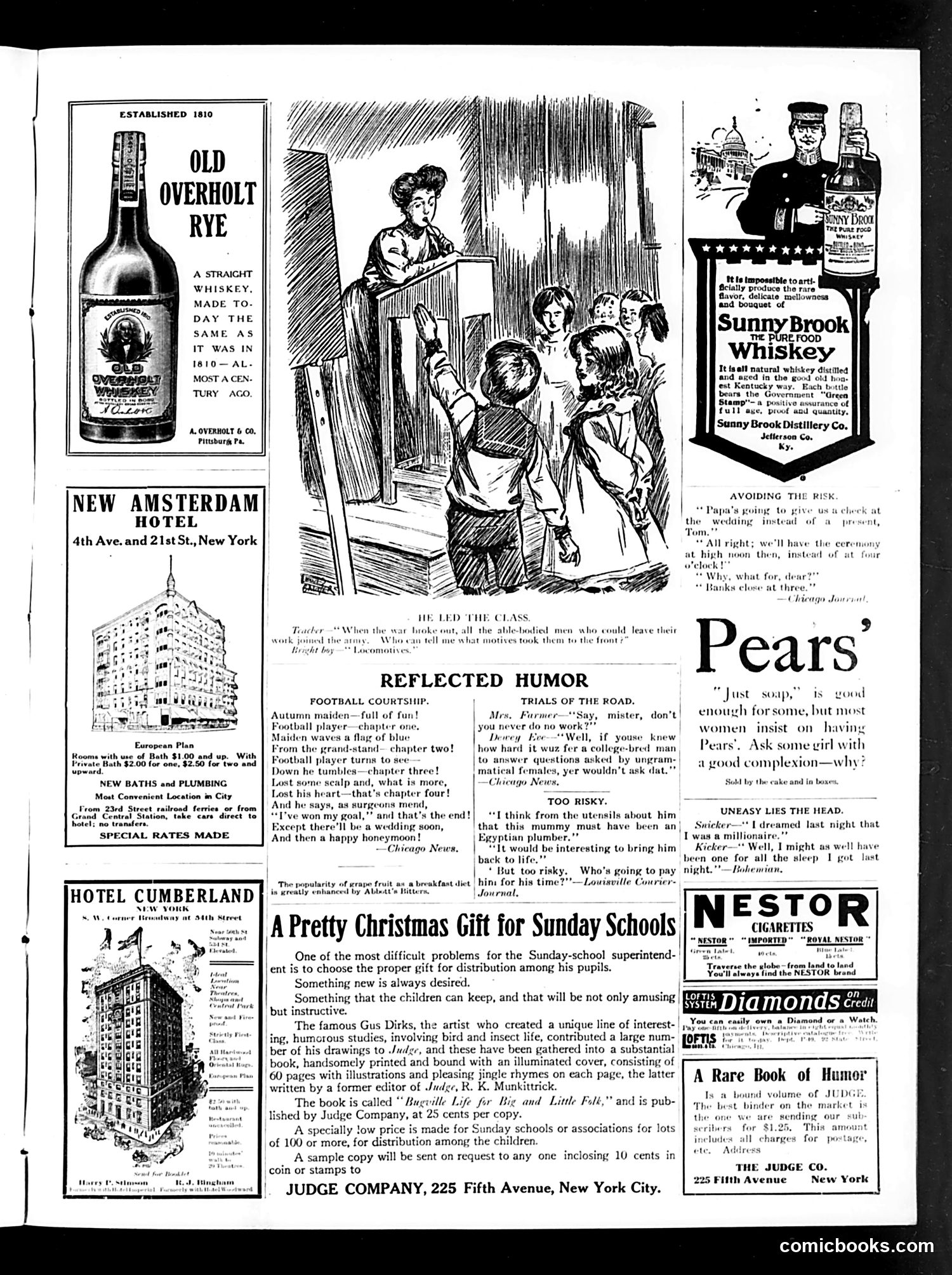
This page is primarily **advertising and promotional content** rather than editorial cartoons. The dominant features are: **Main Cartoon**: "He Led the Class" depicts a schoolteacher asking students what motivated soldiers to enlist in war. A boy answers "Locomotives"—a joke suggesting soldiers were motivated by the novelty of trains rather than patriotism. This appears to reference **WWI-era recruitment**, likely mocking either naive youth or questioning the genuine motivations behind enlistment. **Humor Sections**: Brief jokes about football dating, road trials, and an Egyptian mummy ("too risky" to revive due to labor costs). These reflect early 1900s everyday concerns and workplace humor. **Advertising**: The page features whiskey brands (Old Overholt, Sunny Brook), hotels, cigarettes, and promotes a children's book called "Bugville Life" illustrated by cartoonist Gus Dirks. **Context for Modern Readers**: Without specific dating visible, the WWI reference and advertising styles suggest **early 1910s**. The humor relies on period-specific cultural references now largely opaque to modern audiences.
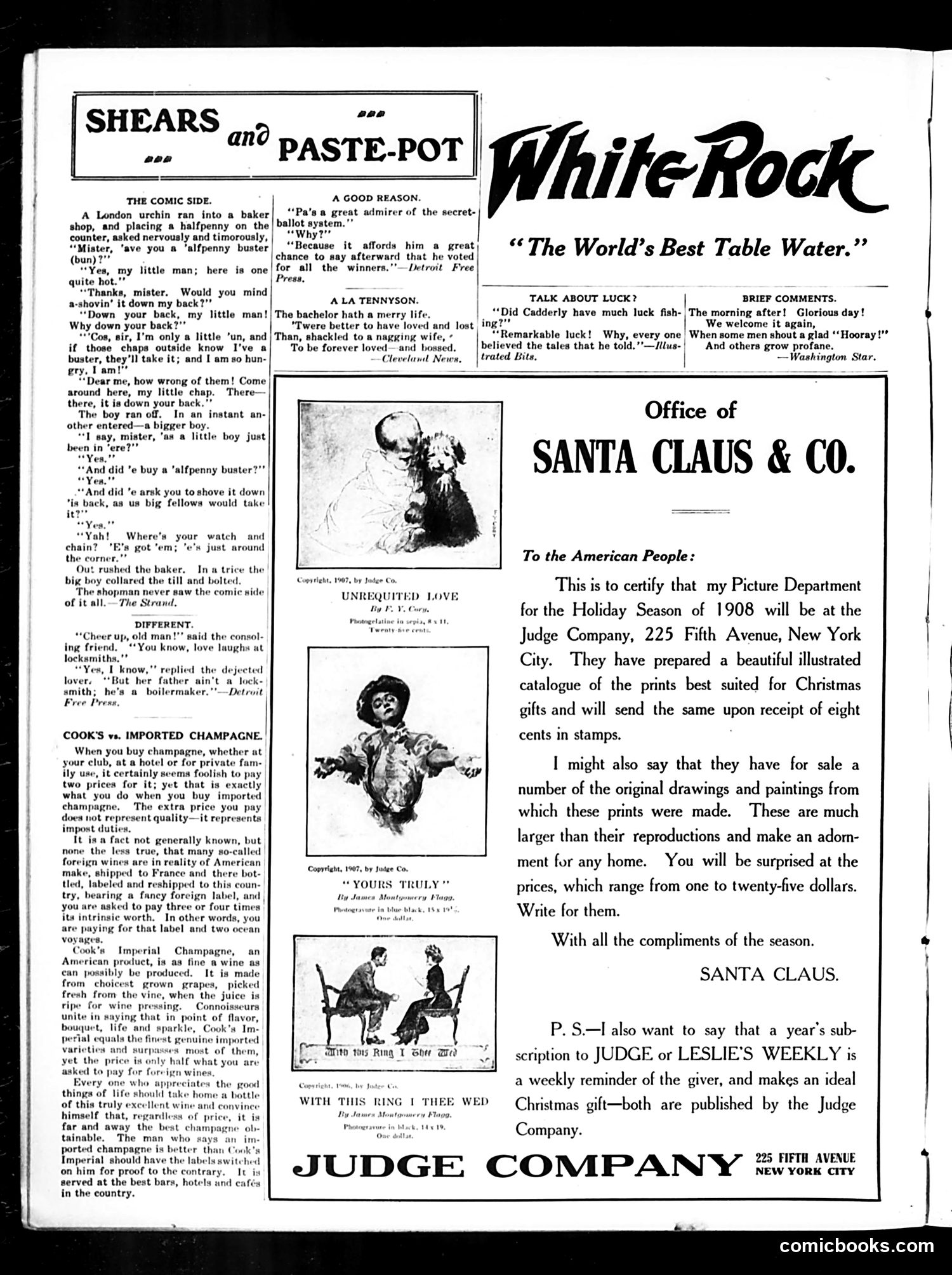
This is primarily an **advertising and humor page** from Judge magazine (circa 1907-1908), with two distinct sections: ## Comic Sketches (Left Side) The "Shears and Paste-Pot" section contains brief humorous anecdotes with no political content—just everyday comic situations: a poor London boy hiding his bun from bullies, a locksmith's daughter rejecting a suitor, and champagne snobbery. ## Advertisement (Right Side) The bulk of the page is a **Santa Claus & Co. advertisement** from the Judge Company promoting their Picture Department's Christmas offerings. It's a direct-mail pitch offering illustrated catalogs of prints (for 8 cents in stamps) and original artworks ranging from one to twenty-five dollars. The White Rock water advertisement appears incidental to the main content. **Notable context for modern readers:** This represents how magazines monetized holiday seasons by directly selling artwork and gift merchandise to readers—a precursor to modern seasonal marketing.
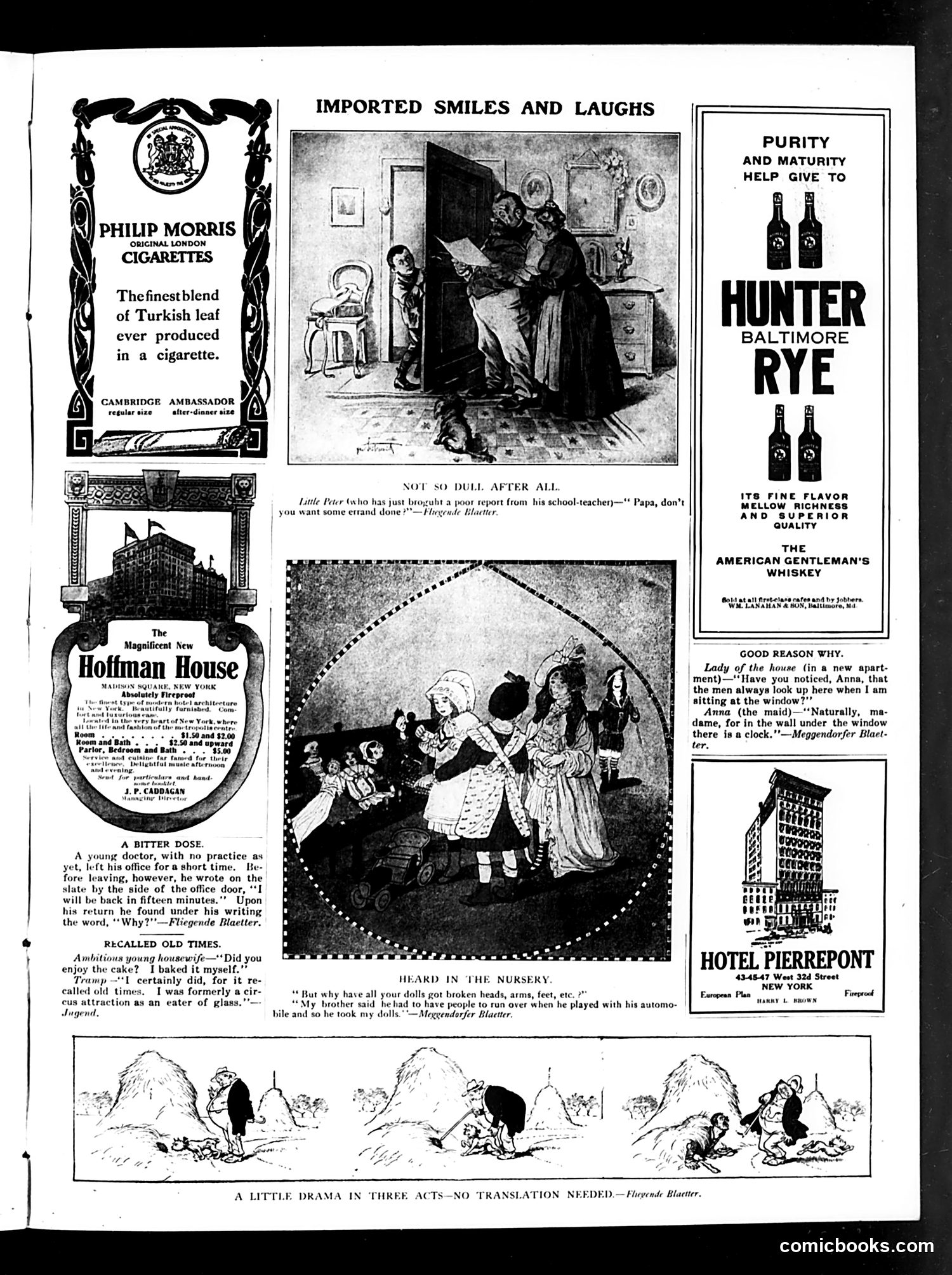
This page is primarily **advertising mixed with humor**, typical of Judge magazine's format. **The Advertisements** dominate: Philip Morris cigarettes, Hunter Baltimore Rye whiskey, the Hoffmann House hotel, and Hotel Pierrepont in New York promote luxury goods to affluent readers. **The Humor Section** ("Imported Smiles and Laughs") contains several brief jokes translated from European sources (noted as "Fliegende Blatter" and "Jugend"), indicating Judge's practice of reprinting international humor: - A boy tries bribing his father after a poor school report - A new tenant's maid explains men stare upward because of a clock - A desperate young doctor advertises his services - A vagrant nostalgically recalls eating glass in circuses - A child's dolls are damaged by her brother's toy automobile **The Bottom Cartoon** shows a silent three-panel narrative about what appears to be children near ant hills or mounds—"no translation needed" because it relies on visual storytelling rather than language. The page reflects early 20th-century middle-class humor emphasizing domestic situations and gentle social observation rather than hard satire.
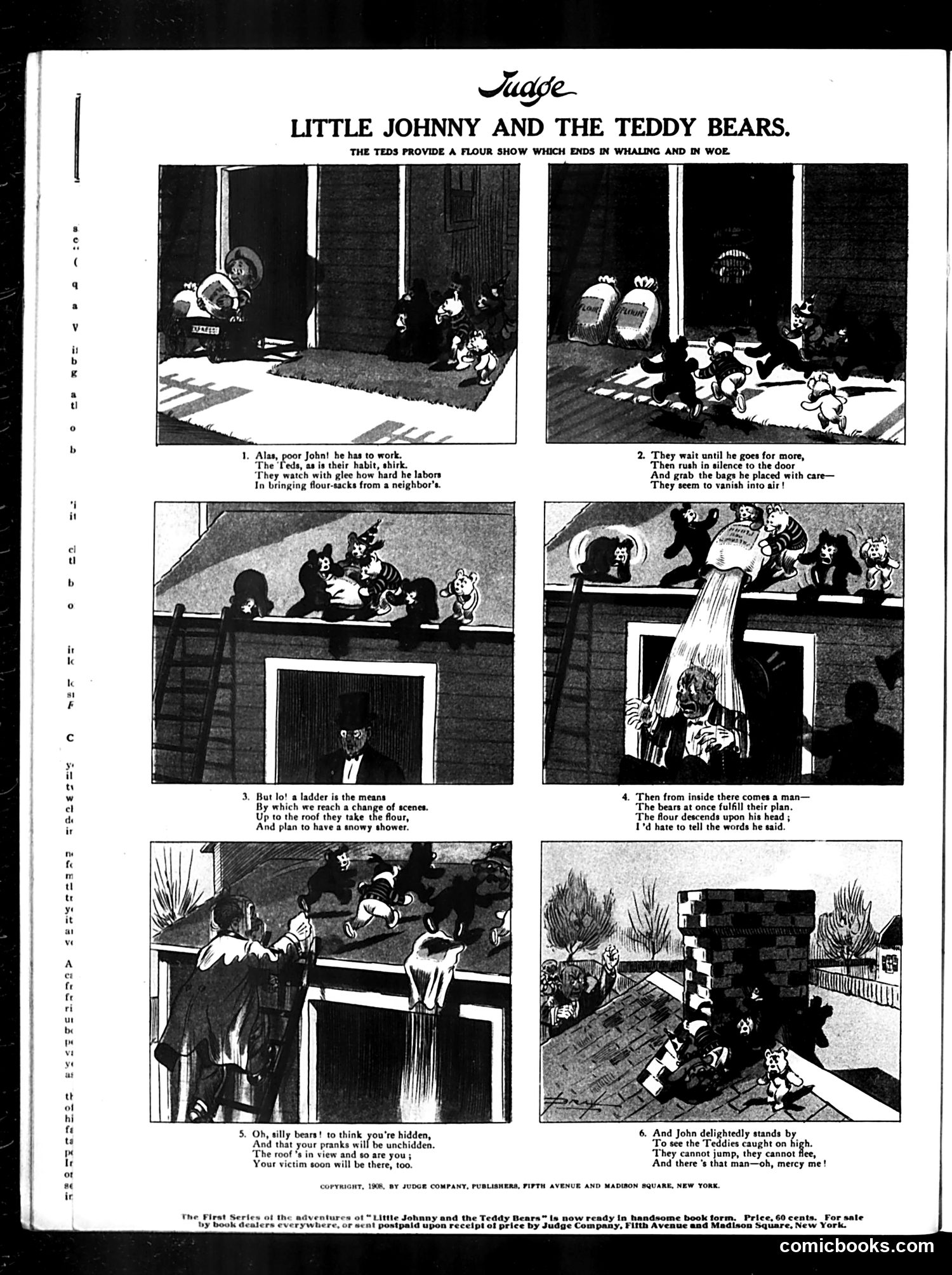
This is a humorous six-panel comic strip, not political satire. It tells a slapstick story about "Little Johnny" (a boy) and mischievous anthropomorphic teddy bears. The plot: Johnny works hard hauling flour sacks while the lazy "Teds" shirk responsibility. The bears steal his flour, climb to a roof, and dump it on Johnny's head as a prank. Johnny and a man (likely the neighbor) catch the bears on the roof, trapping them—they "cannot jump, they cannot flee." The humor relies on physical comedy and role-reversal: the teddy bears (toys, normally innocent) are depicted as lazy troublemakers who get comeuppance. The "Teddy Bear" was a popular toy phenomenon following President Theodore Roosevelt's 1902 hunting trip, so these animated bears would have been instantly recognizable to contemporary readers. The strip appears designed to promote a children's book advertised at the page's bottom.