
A complete issue · 16 pages · 1908
Judge — July 11, 1908
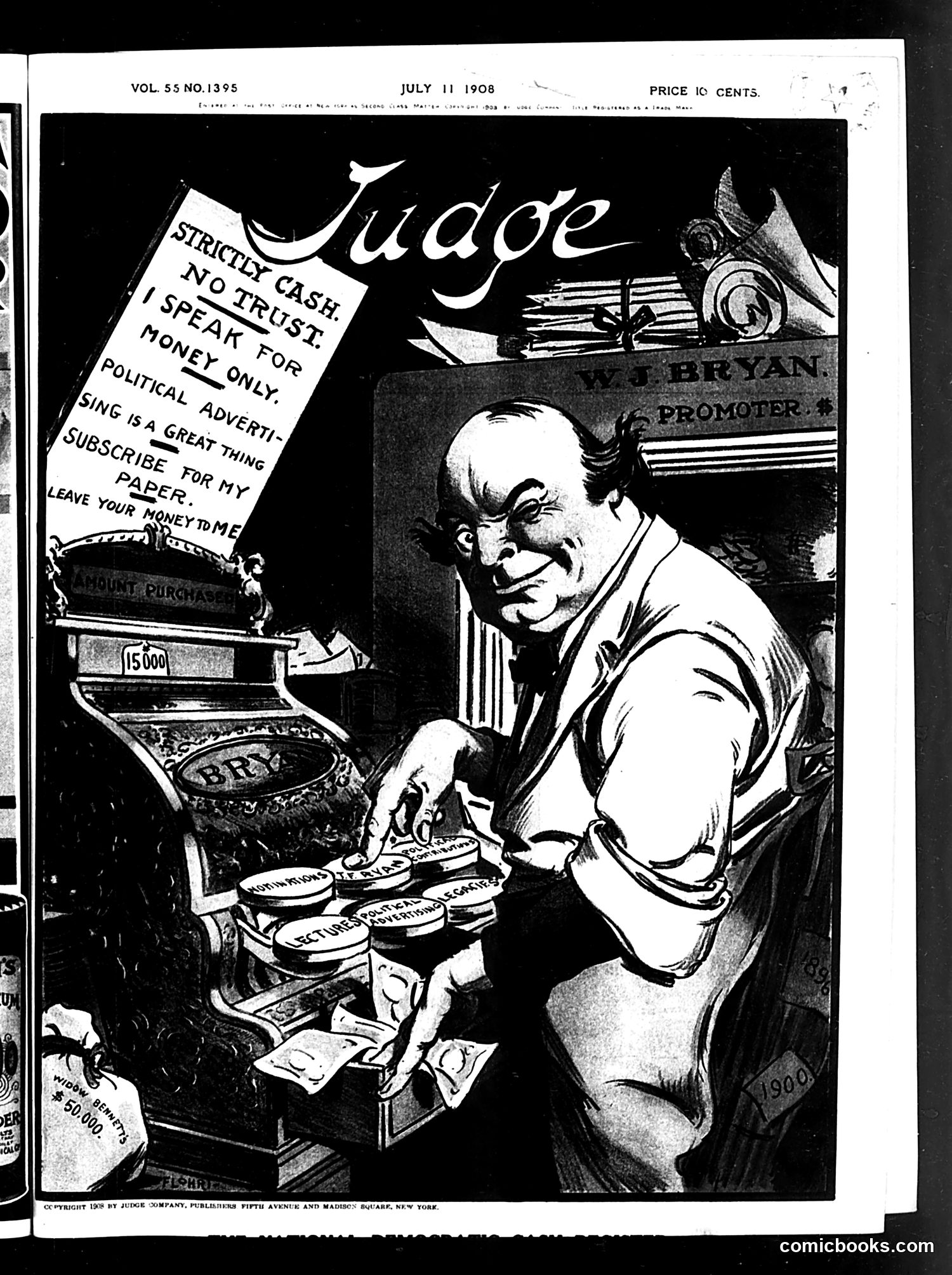
This cartoon satirizes **William Jennings Bryan**, the three-time Democratic presidential candidate (identifiable by the label "BRYAN PROMOTER" visible in the image). The figure operates a cash register labeled "STRICTLY CASH / NO TRUST," mocking Bryan's rhetoric about monetary policy and trust-busting. The satire targets Bryan's famous speaking tours and fundraising appeals—the sign reads "I SPEAK FOR MONEY ONLY" and references subscription pitches. The cartoon suggests Bryan exploited populist anti-corporate messaging while personally profiting from lectures and political promotion. The cascading coins and cash register symbolize his financial motivations, contradicting his public image as a champion of ordinary people against wealthy interests. This reflects contemporary criticism that Bryan's reform rhetoric masked personal financial ambition.
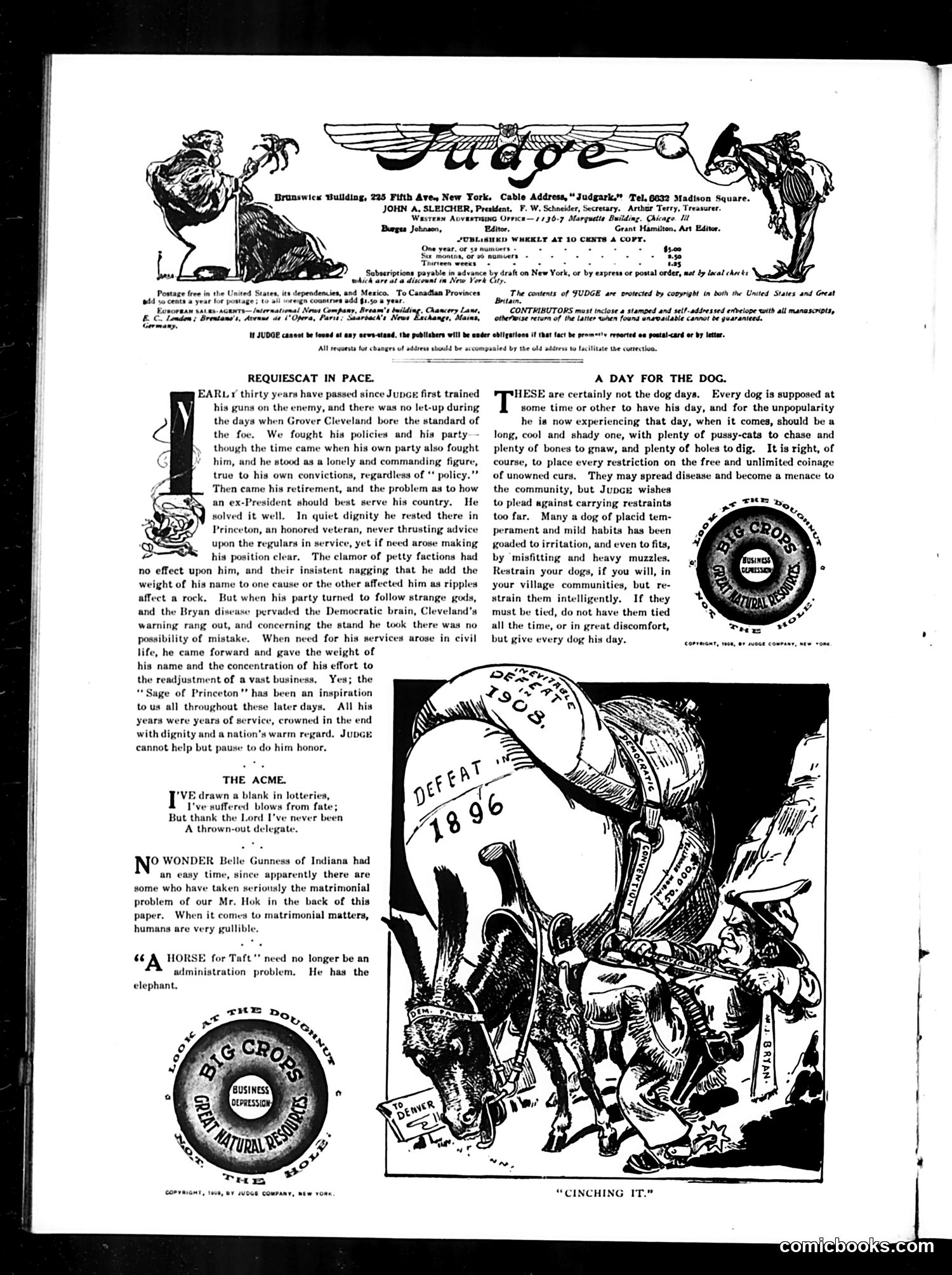
The main cartoon titled "Cinching It" depicts a donkey (representing the Democratic Party) being squeezed or "cinched" by various forces. The labels visible include "1896" and "Defeat," suggesting this relates to the 1896 presidential election aftermath. The accompanying text discusses Grover Cleveland's political legacy and Democratic Party struggles. References to Cleveland bearing "the standard of the free" and subsequent party divisions indicate internal conflict within the Democratic Party following Cleveland's administration. The smaller item about "A Horse for Taft" appears to be wordplay, though the specific reference is unclear without additional context about Taft's administration. The overall satire criticizes Democratic Party discord and electoral defeats during this period.
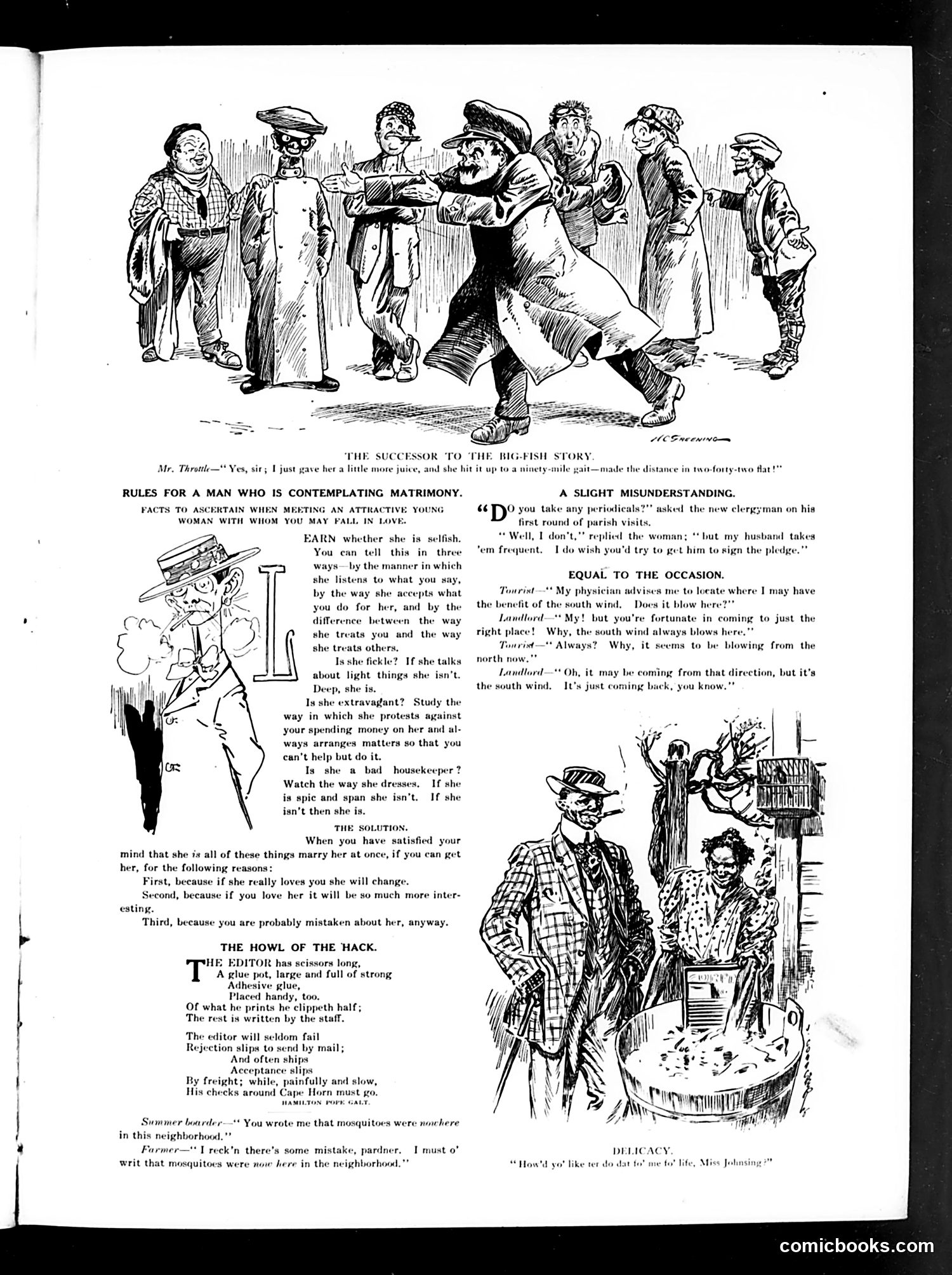
**Top Cartoon: "The Successor to the Big-Fish Story"** Shows a fisherman dramatically posturing before onlookers, claiming he caught a fish so large he had to transport it in a "ninety-mile gait"—meaning a very wide stance. This satirizes men who exaggerate their accomplishments or romantic conquests to impress others. The joke is that tall tales about "big fish" were common bar-room bragging, and here someone's embellishment is so absurd it physically distorts his body. **Text Sections Below:** Humor pieces about marriage advice, editorial rejection letters, and comic misunderstandings between characters (clergyman, tourists, landlord). These appear to be typical satirical humor vignettes common to Judge's format—poking fun at social pretension, miscommunication, and courtship customs of the era. The illustrations and tone suggest late 19th or early 20th-century social satire.
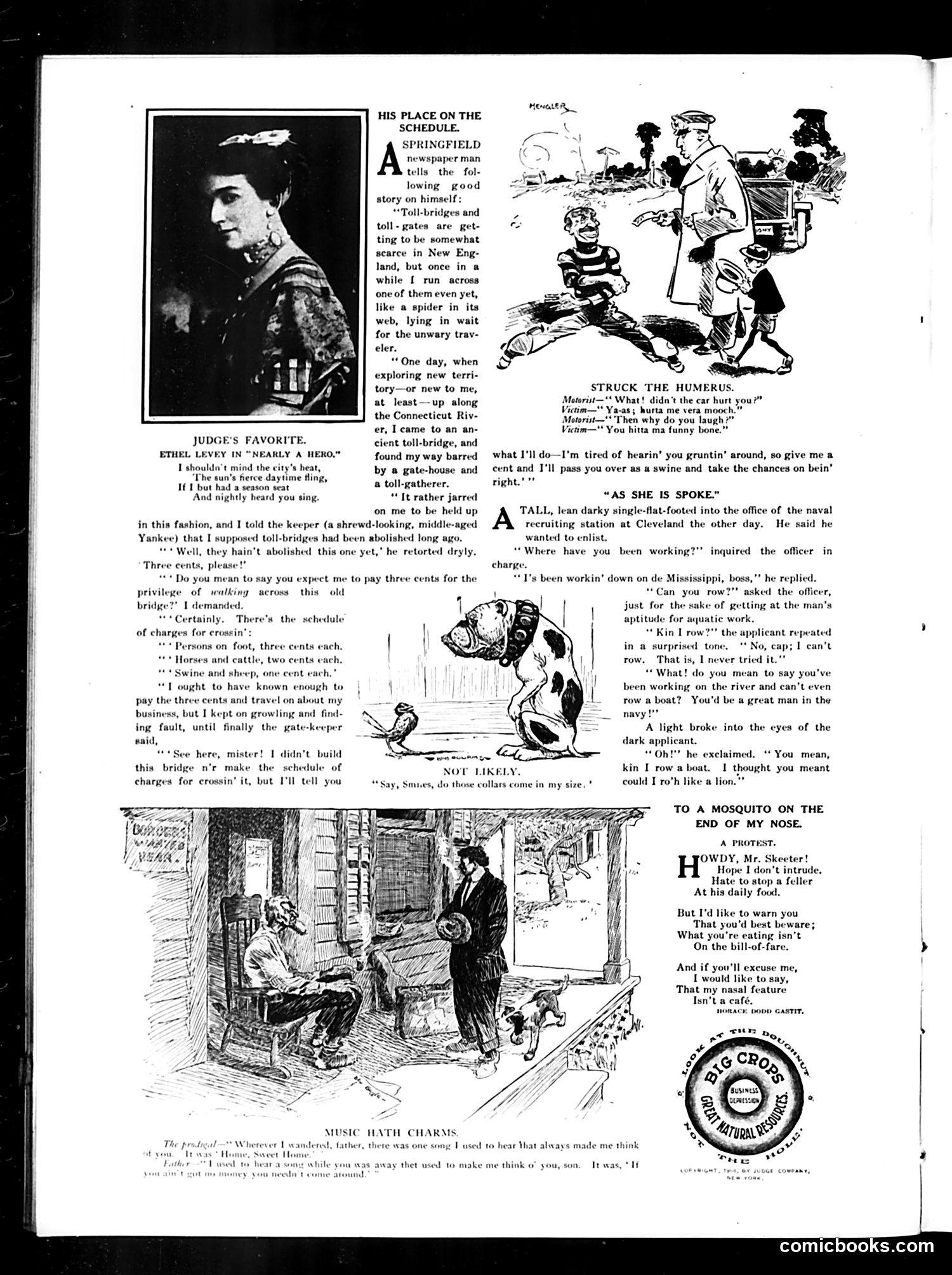
This page contains several humorous stories and illustrations typical of early 20th-century American satire: **"His Place on the Schedule"** features a Springfield newspaper man's anecdote about toll-bridge crossing fees in New England, with dialogue about the gate-keeper's fee structure. **"Struck the Humerus"** is a medical joke involving a character named Materiel and a doctor discussing a car accident injury. **"As She Is Spoke"** satirizes a naval recruiting officer's interaction with an applicant who claims river-working experience but can't row, poking fun at overqualified or incompetent military recruits. **"Music Hath Charms"** depicts a domestic scene with a dog, likely about noise or music disrupting household peace. The page also includes poetry and advertisements. These are gentle, domestic comedies rather than political satire—humor aimed at everyday American life and social mishaps.
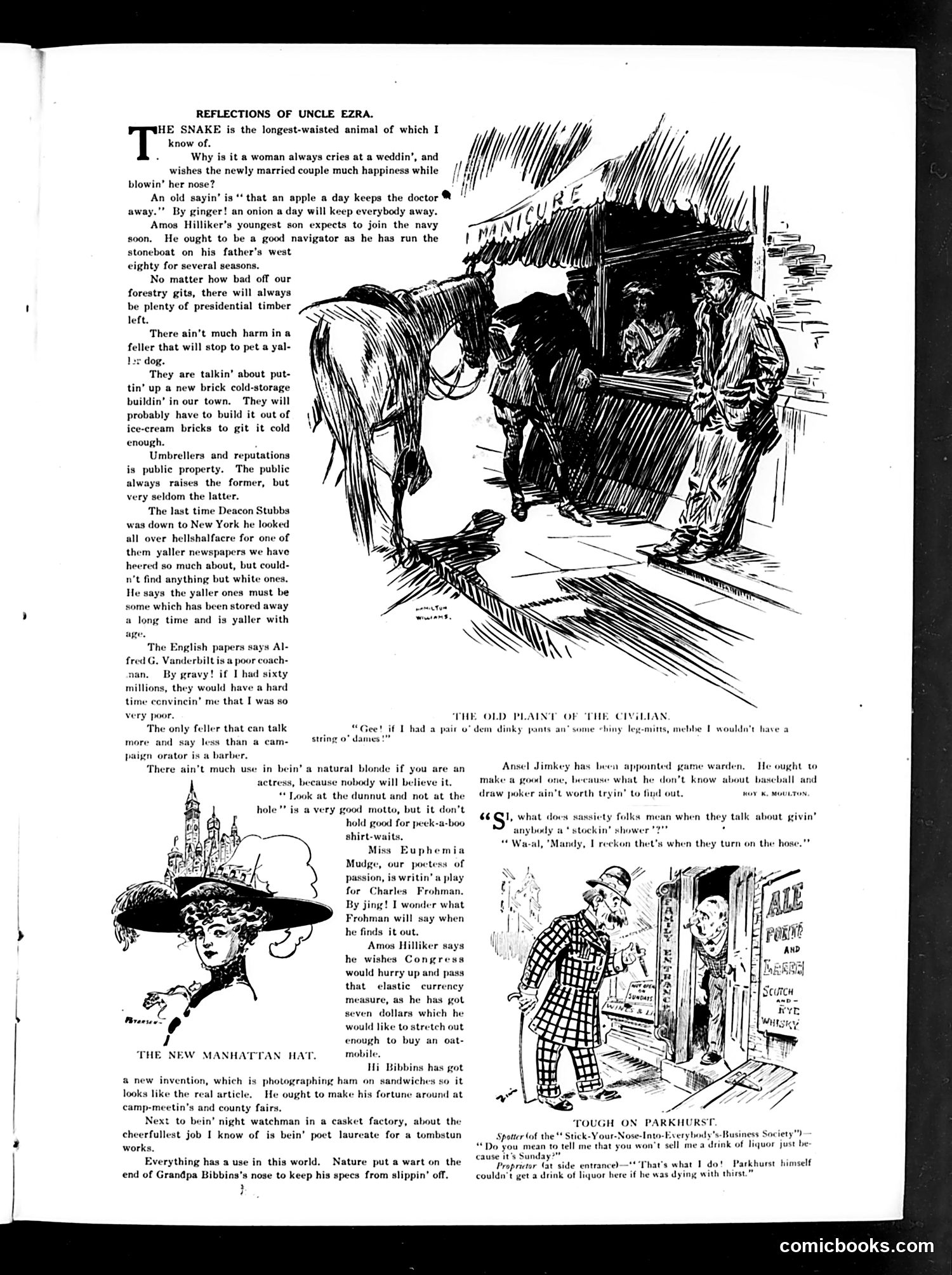
This page combines satirical commentary with humorous observations about early 20th-century American life. "Reflections of Uncle Ezra" offers folksy social criticism—commenting on weddings, naval appointments, and contemporary debates about cold storage facilities and new construction in towns. The cartoons include "The Old Plaint of the Civilian" (depicting someone complaining about military affairs), "The New Manhattan Hat" (satirizing a ridiculous women's hat fashion), and "Tough on Parkhurst" (likely referencing anti-vice crusader Rev. Charles Parkhurst, mocking temperance or moral reform efforts). The humor relies on period-specific references to fashion absurdities, social anxieties about modernization, and debates over moral regulation that readers of the era would immediately recognize.
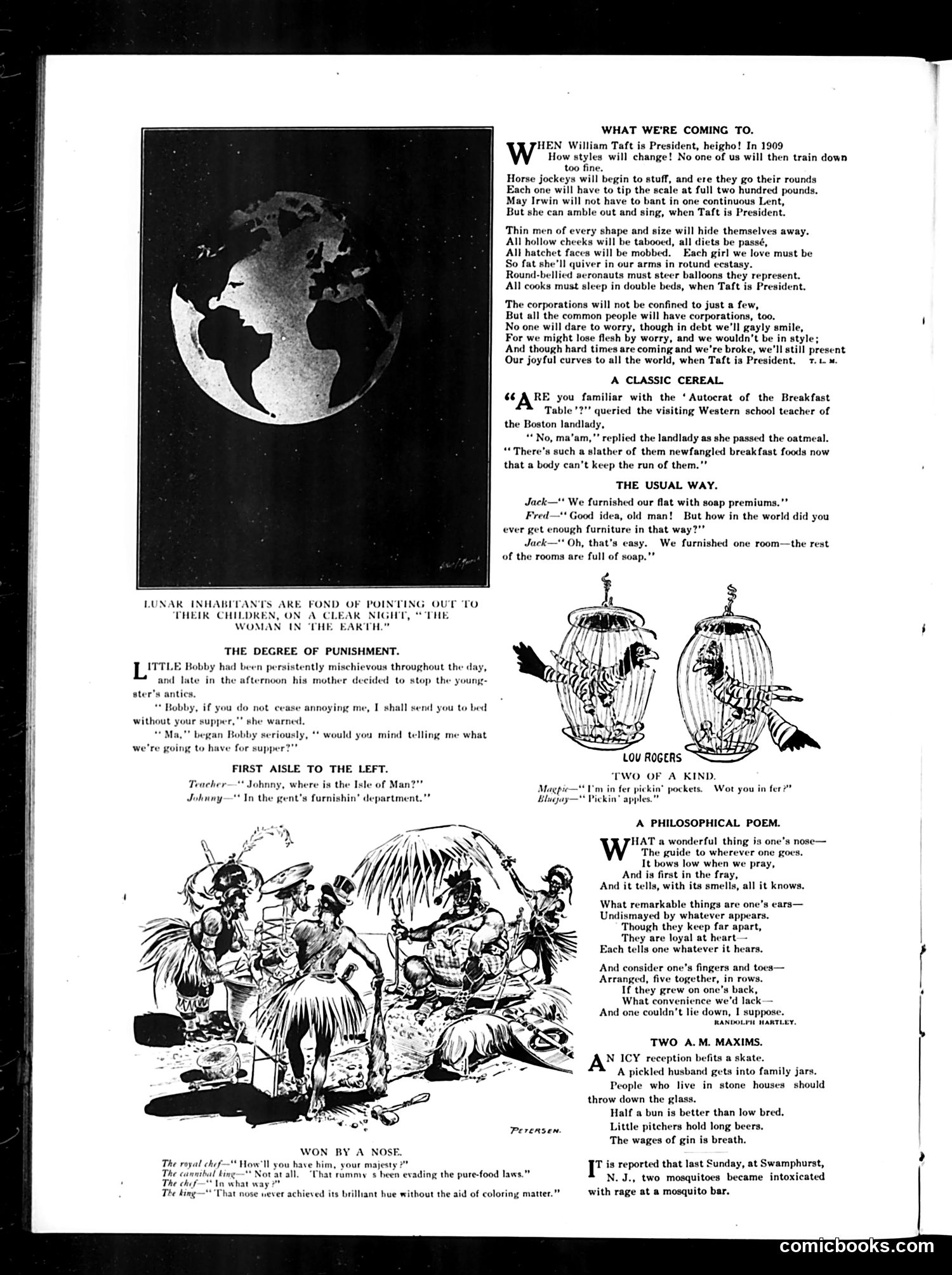
This page from Judge satirizes President William Howard Taft's well-known weight. The opening poem "What We're Coming To" mocks the expectation that under Taft's presidency, obesity will become fashionable—jockeys will "stuff," women won't need to diet, and "thin men" will hide away. The joke reflects contemporary anxiety about Taft's corpulence (he weighed approximately 340 pounds), suggesting his physical appearance will somehow normalize excess weight across society. The remaining content consists of brief humorous anecdotes and jokes unrelated to Taft: puns about soap premiums, breakfast cereals, and a philosophical poem about body parts. A "Two A.M. Maxims" section offers absurdist humor ("The wages of gin is breath"). The cartoon and miscellaneous jokes typify Judge's satirical blend of political commentary with lighthearted vaudeville-style humor aimed at early-20th-century readers.
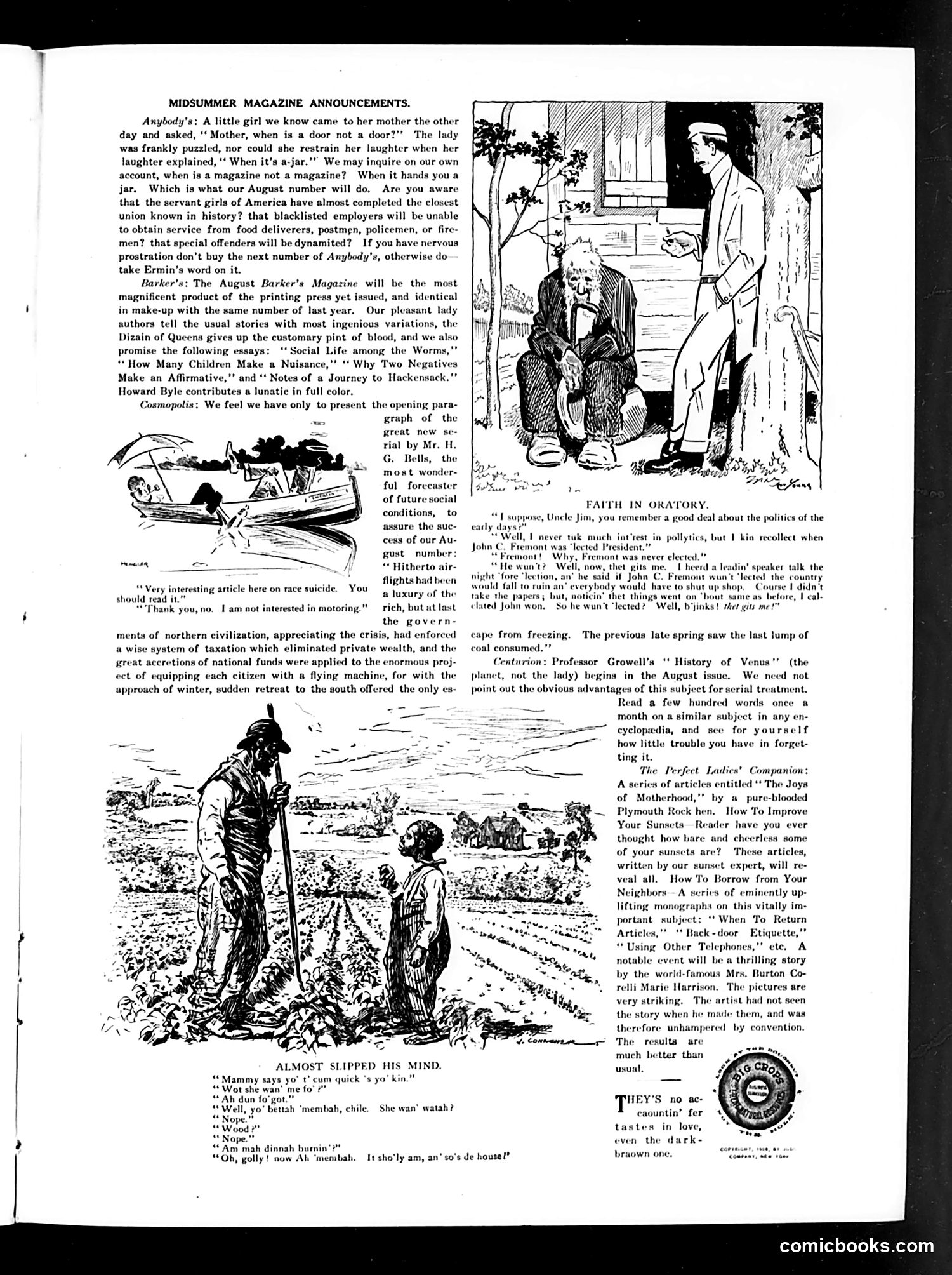
This page satirizes magazine advertisements through mock endorsements of competing publications. The humor operates on multiple levels: **The Setup:** Judge pretends to enthusiastically promote rival magazines' upcoming issues while describing their content as utterly trivial or ridiculous—essays titled "Social Life among the Worms" and "Why Two Negatives Make an Affirmative." **The Cartoons** illustrate social commentary: one depicts a man with surveying equipment and child (likely referencing H.G. Wells's serialized sci-fi forecasting), while another shows a confused elderly man recalling a political speech about John C. Frémont (1856 presidential candidate), demonstrating how citizens believed politicians' rhetoric over observable reality—a dig at electoral gullibility. **The Dialect Humor:** Racist dialect humor involving Black servants reflects the period's deeply problematic conventions. **The Satire's Point:** Judge mocks the shallow, sensation-seeking nature of contemporary magazine publishing and readers' credulity regarding both fictional content and political promises.
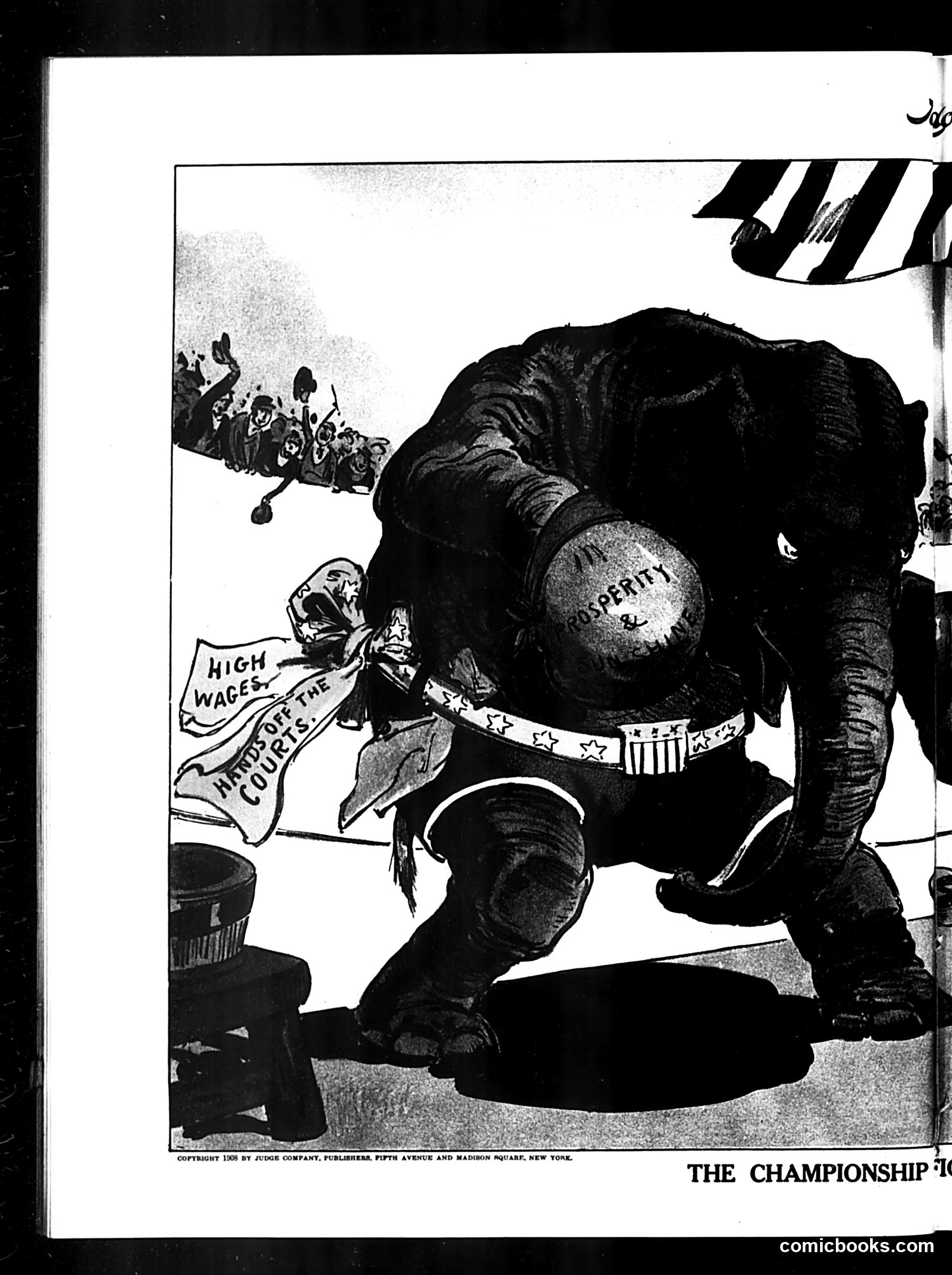
This 1908 Judge magazine cartoon depicts an elephant labeled "PROSPERITY" being ridden by a figure representing American political/corporate interests. The elephant wears a patriotic collar and carries a banner reading "HIGH WAGES" and "ATTITUDE OF THE COURTS." In the background, a crowd of workers appears to be protesting or demanding attention, suggesting labor unrest. The cartoon satirizes the disconnect between claimed prosperity and workers' actual conditions—prosperity seems to benefit the powerful elite riding atop the system while laborers below struggle for recognition and fair treatment. The title "THE CHAMPIONSHIP" (partially visible) likely refers to competing claims about who truly controls or benefits from American prosperity. This reflects early 1900s tensions between industrial expansion, labor movements, and judicial attitudes toward workers' rights.
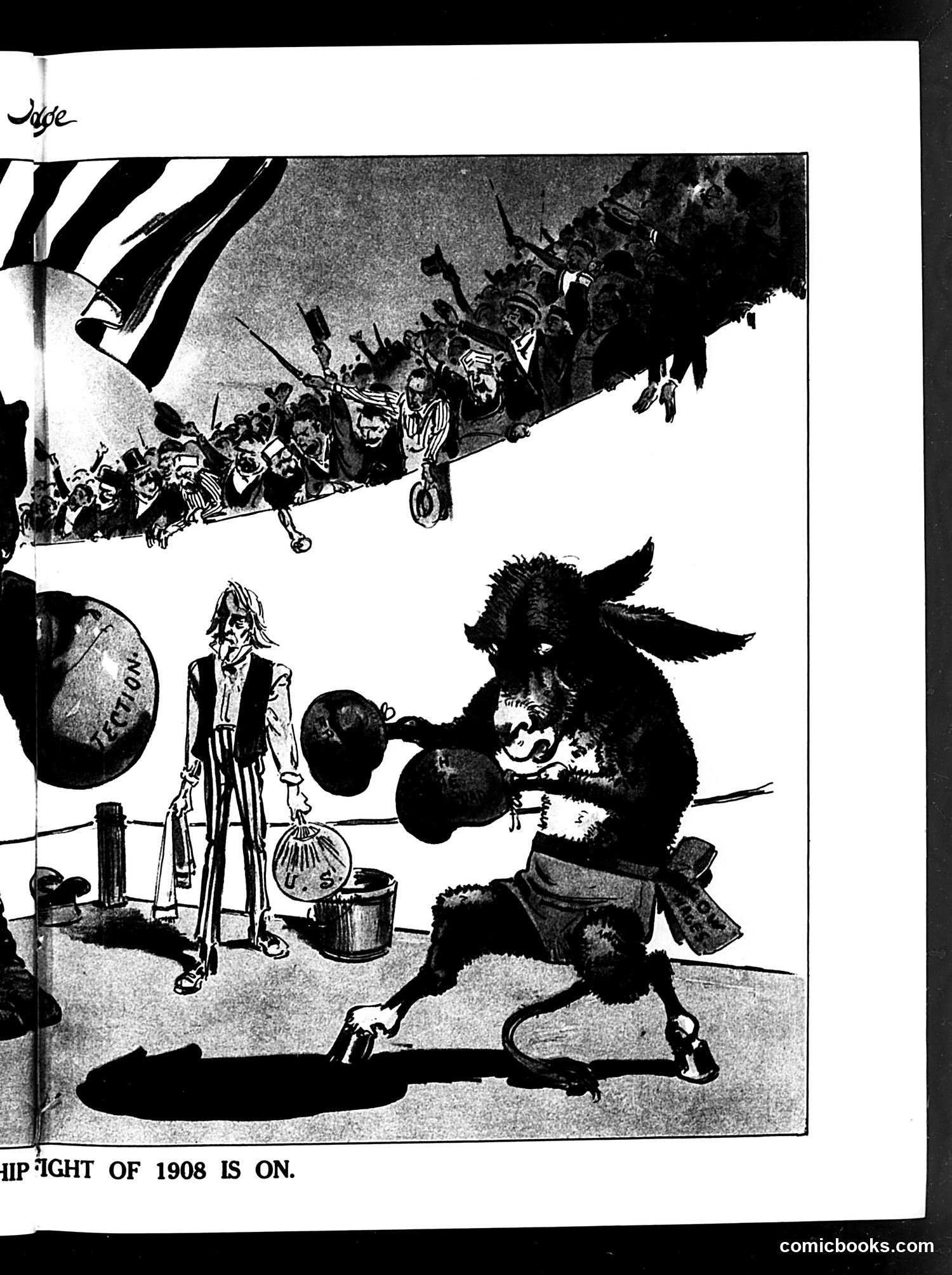
This Judge magazine cartoon satirizes the 1908 U.S. presidential election. The image shows a caricatured figure (likely representing a political candidate or party) depicted as a grotesque, aggressive creature with boxing gloves, confronting a well-dressed man in formal attire. Above, an airship carries crowds of supporters or politicians. The boxing-match metaphor suggests the fierce competition of the 1908 campaign. The creature's exaggerated, animalistic features appear designed to mock the opposing side as brutish or dangerous. The airship likely references either technological modernity or the inflated rhetoric of the campaign. The incomplete text references "1908," confirming this comments on that year's presidential contest, though the specific figures remain unclear from the image alone.
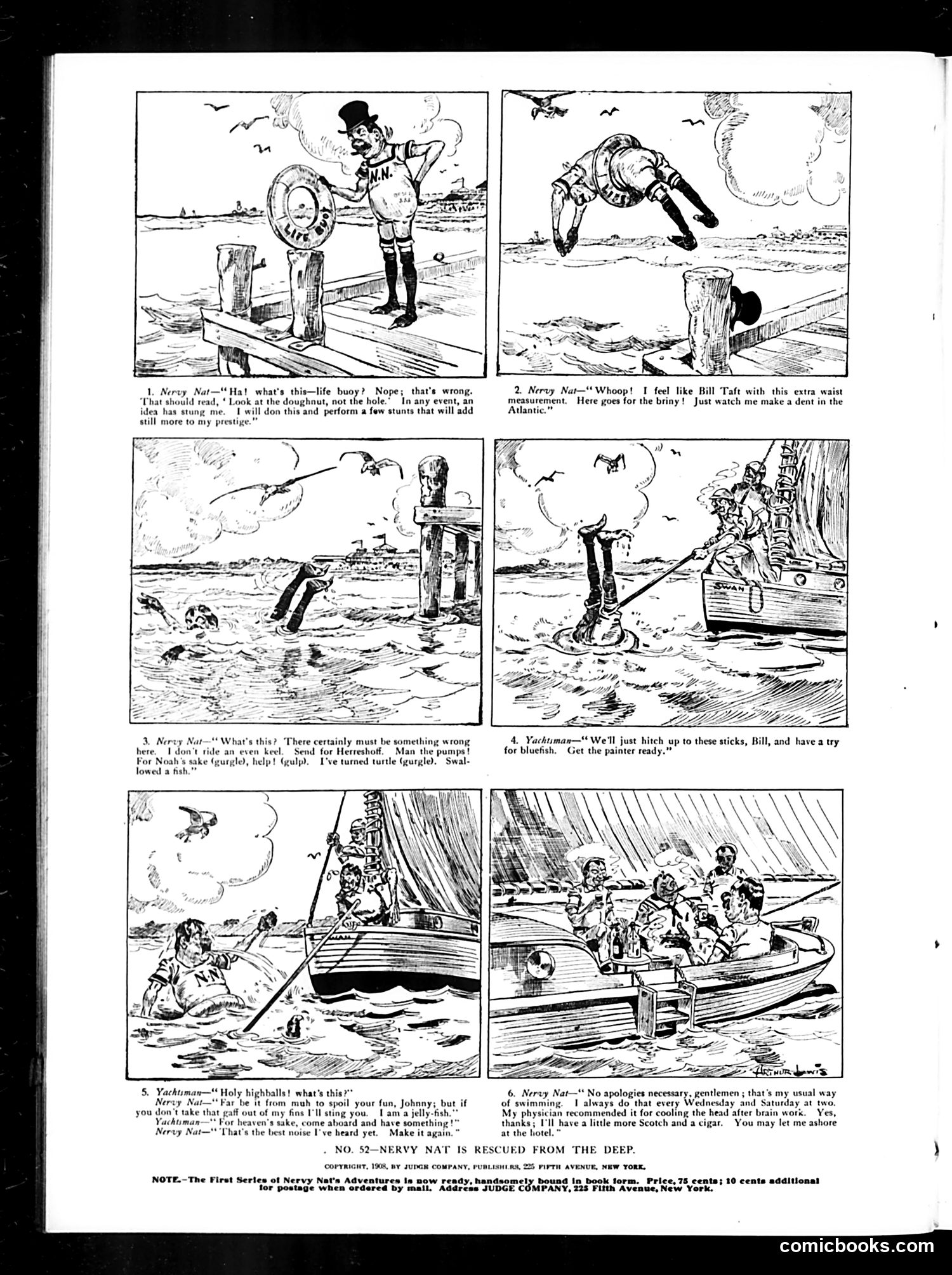
This is a comic strip (1908) featuring a character named "Nervy Nat," who appears to be a comedic daredevil or showman. The humor centers on Nat's boastful stunts and absurd mishaps at sea. The satire references **President William Howard Taft**, mocking his weight—Nat jokes about his "extra waist measurement" like "Bill Taft," a contemporary jab at Taft's well-known heaviness. Herreshoff (misspelled in OCR) likely refers to the famous yacht designer. The strip's joke is straightforward slapstick: Nat attempts swimming and boating stunts to impress onlookers, but repeatedly fails catastrophically (capsizing, nearly drowning). Yet he maintains absurd pomposity throughout, claiming his mishaps are actually intentional techniques—he swims upside-down "every Wednesday," drinks Scotch and cigars as recovery methods. The humor relies on the contrast between Nat's braggadocio and his obvious incompetence, a classic early-20th-century comedy formula. The Taft reference dates this to his presidency (1909-1913).
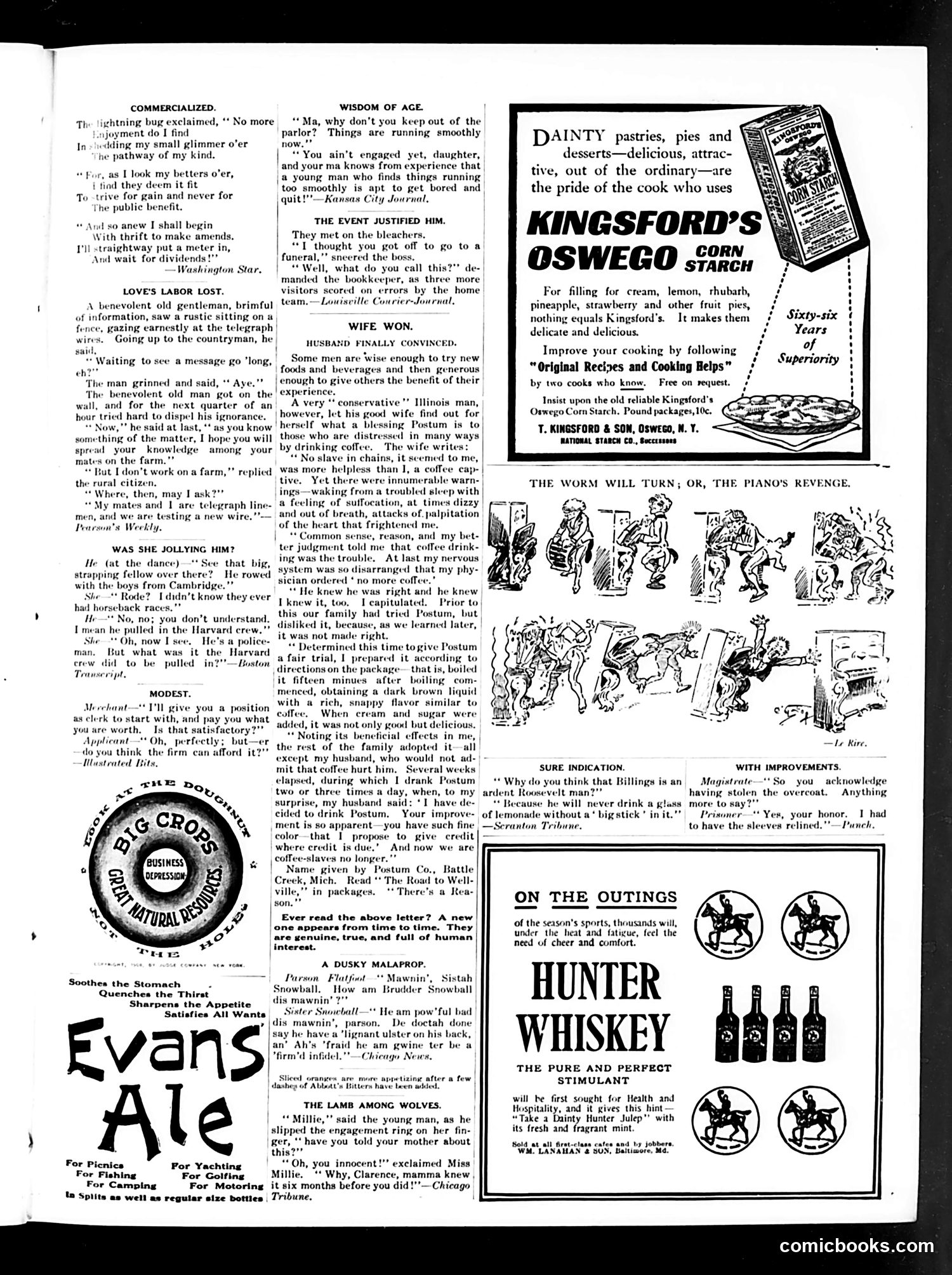
This page from *Judge* contains primarily **humorous short anecdotes and advertisements** rather than political cartoons. The jokes mock everyday situations: a lightning bug commercializing itself, a man caught skipping a funeral to attend a baseball game, a naive countryman waiting to "see" a telegraph message travel, and misunderstandings about rowing and Harvard crews. These reflect early 1900s American social anxieties about modernization, materialism, and rural-urban cultural gaps. The substantive content is **advertising**—notably lengthy testimonials for Postum (a coffee substitute) and Evans Ale. The Postum ad features a woman's dramatic conversion story about how abandoning coffee "cured" her nervous system, reflecting period health anxieties and marketing tactics that positioned products as medical solutions. The page shows how *Judge* blended light satire with commercial messaging, using humor to sell products to its middle-class readership.
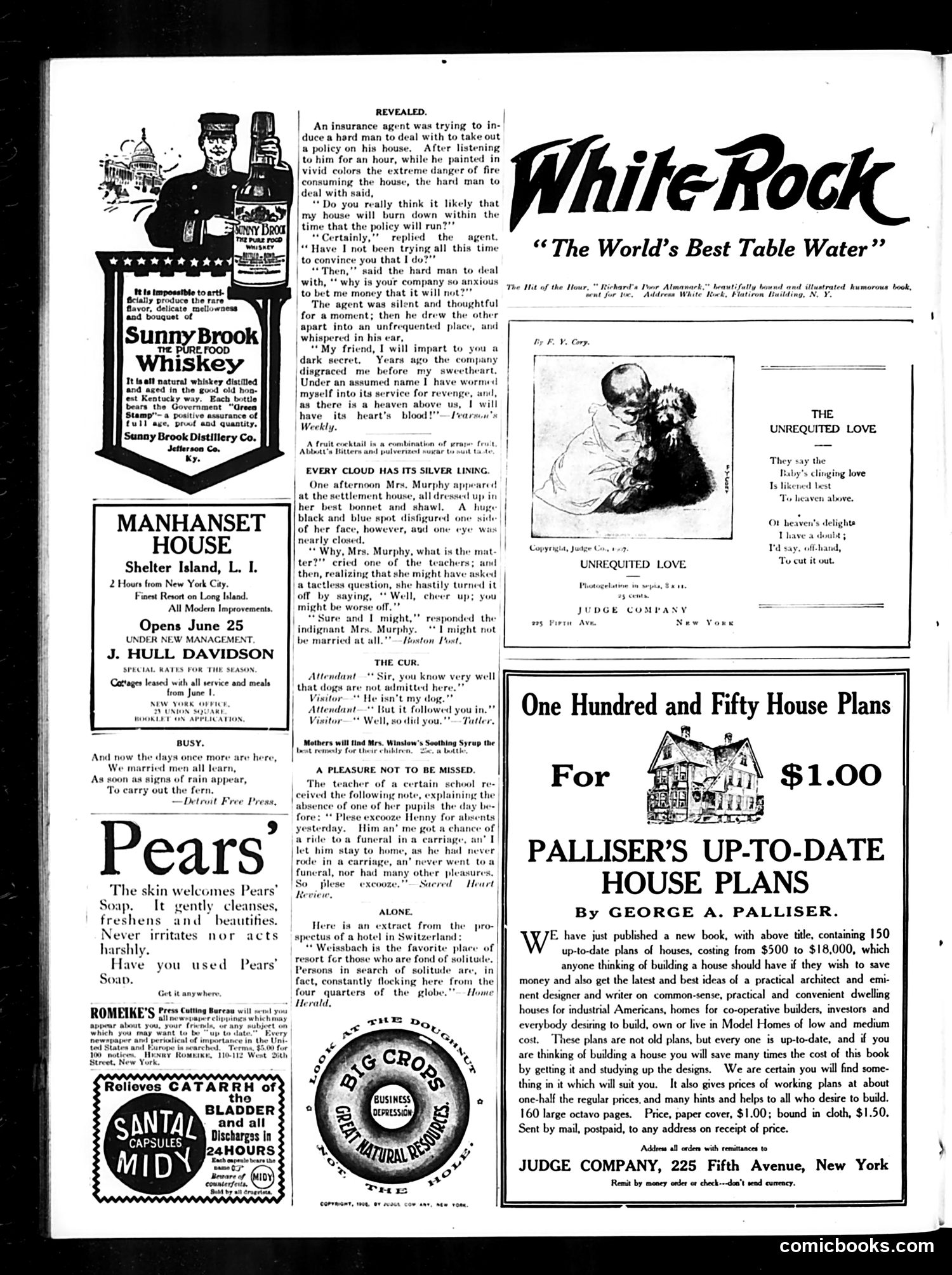
This page is primarily **advertisements and short humorous stories**, not political cartoons. The main content includes: **"Revealed"** — A joke about insurance agent logic: an agent spends an hour convincing a man his house will burn down, then can't explain why his company is so confident it won't. The man sarcastically points out the logical contradiction, exposing the agent's pressure tactics. **Other brief jokes** include a story about Mrs. Murphy's black eye (she's grateful because it could have prevented her marriage) and a dialogue about a dog following a visitor into a shop. The page is dominated by **product advertisements**: Sunny Brook Whiskey, White Rock table water, Pears' Soap, and notably **Palliser's House Plans** — a how-to book for building affordable homes ($500-$18,000), marketed to working Americans and builders. The humor is gentle, domestic satire typical of early 1900s American magazines, with no overt political content visible on this particular page.
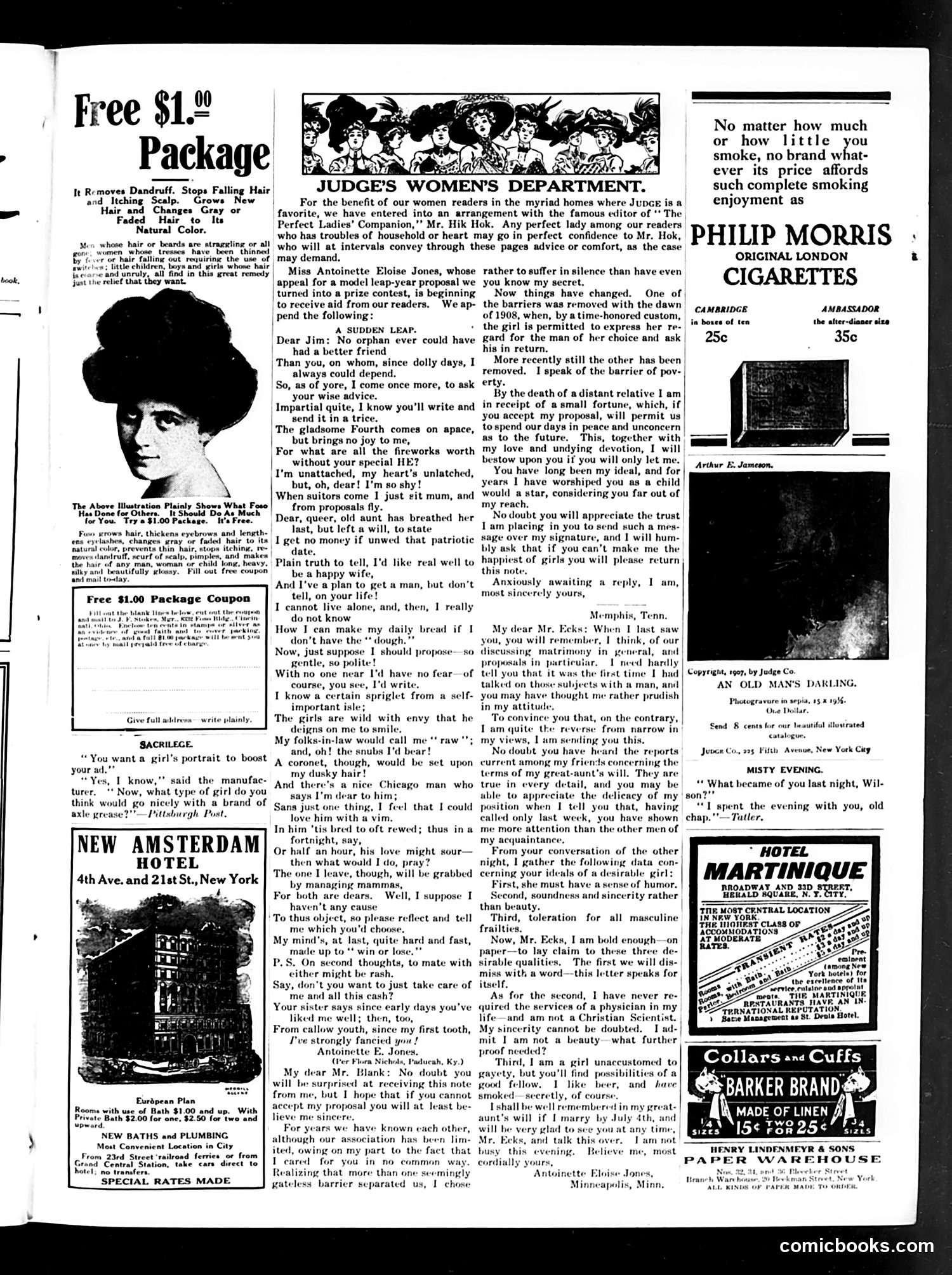
This page from **Judge** magazine features a satirical advice column titled "Judge's Women's Department," edited by "Mr. Hik Hok" (likely a pseudonym or joke name). The content parodies advice columns popular in women's magazines of the era. The main piece presents humorous letters about romantic and matrimonial matters. One prominent letter concerns a woman seeking advice on accepting a leap-year proposal—referencing the tradition where women could propose to men on leap day. The letter humorously catalogs the "barriers" preventing her acceptance: first her shyness, then her poverty, both now removed by an inheritance from a relative. The satire mocks both the earnest sentimentality of genuine women's advice columns and the anxieties of Edwardian-era courtship conventions. The exaggerated formality and overwrought emotional language parody the self-serious tone of contemporary relationship advice literature. The page is primarily advertising—including cigarettes, hotels, and hair products—with the satirical advice column serving as editorial content to attract female readers.
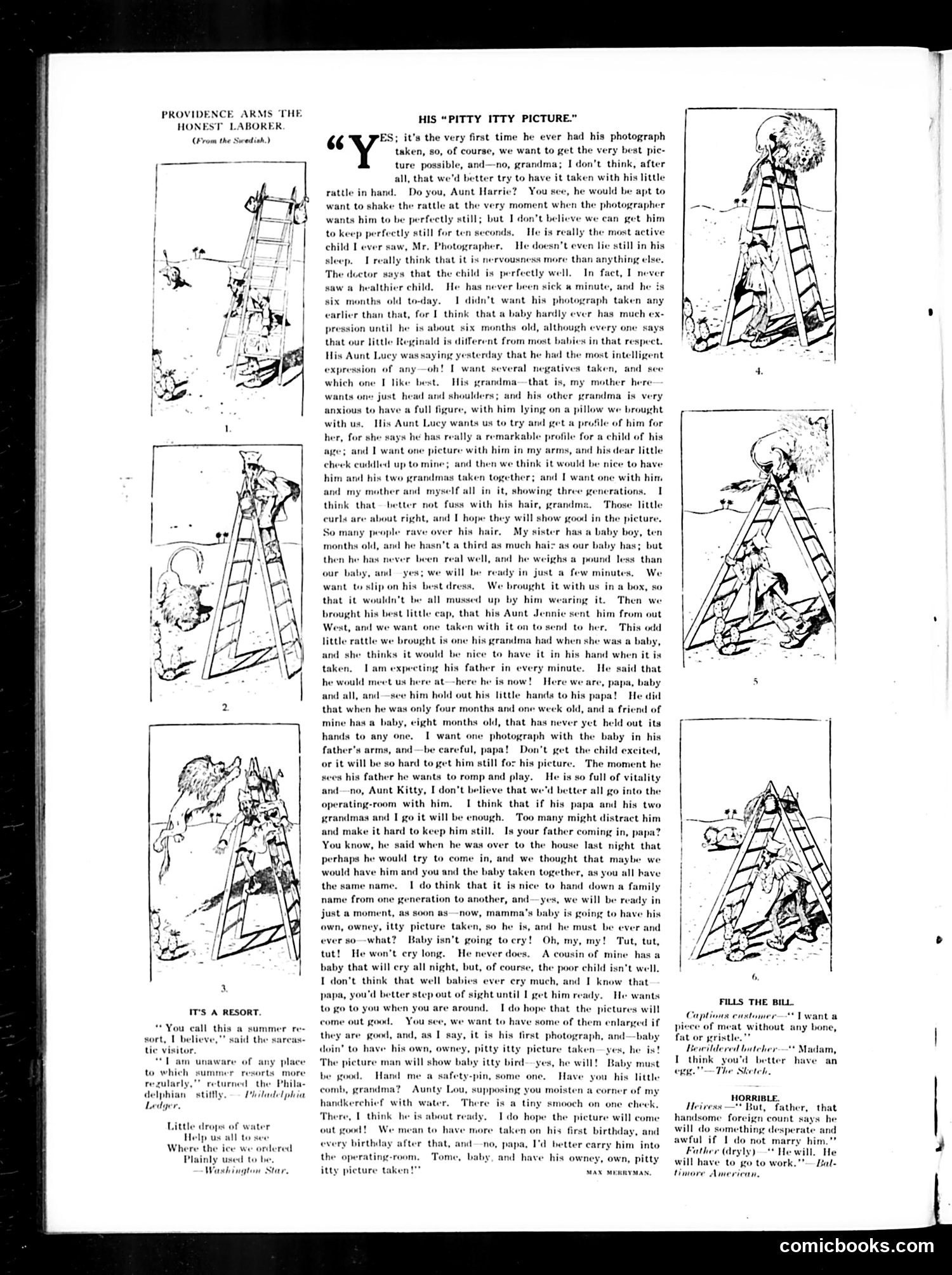
This page satirizes upper-middle-class parental obsession with infant portraiture through an excessively verbose monologue by a fussy mother arranging her baby's first photograph. The humor derives from her neurotic micromanagement: demanding multiple poses and compositions, worrying the child won't stay still, obsessing over trivial details (hair curls, dress condition), and involving multiple generations (both grandmothers, aunts, father). The accompanying sketches show a photographer struggling with an active toddler on a tall studio ladder—visual comedy of the practical chaos underlying the mother's anxieties. The satire targets the Victorian/Edwardian era's sentimental investment in documenting childhood and the pretentious middle-class culture of formal family portraiture, while the mother's stream-of-consciousness rambling mocks women's perceived chattiness and overprotective parenting.
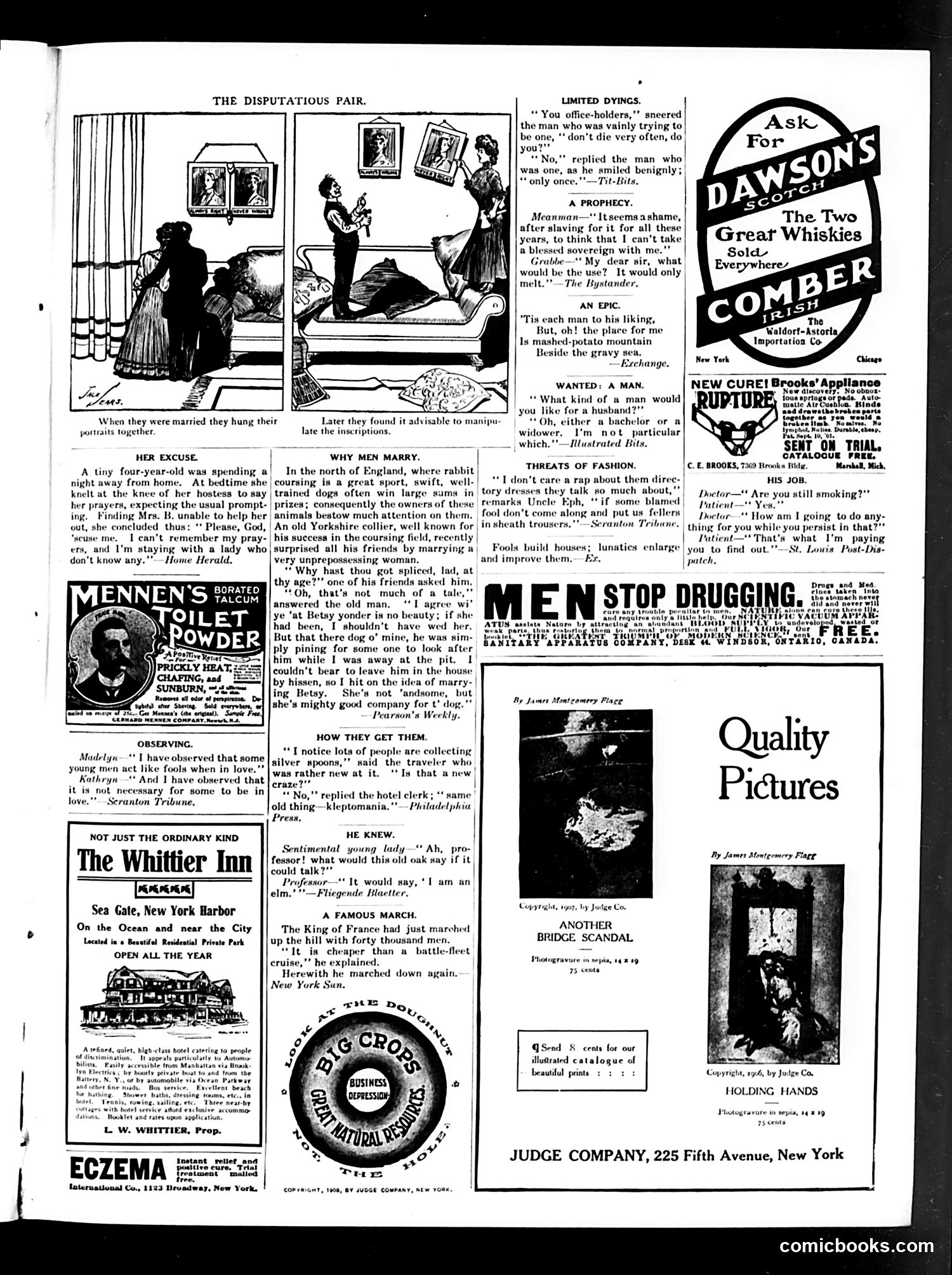
This page contains multiple short satirical jokes and cartoons typical of early 1900s Judge magazine. The main cartoon, "The Disputatious Pair," shows two men debating—one a frustrated office-seeker, the other an established office-holder. The joke satirizes political ambition: the office-seeker resents that politicians rarely die in office, while the comfortable incumbent replies he only visits once yearly. Other items mock marriage (why men marry), fashion absurdities (women's corsets and dress reforms), and human nature generally. "Why Men Marry" describes a Yorkshire miner who marries an unattractive woman solely to care for his dog while he works. The humor relies on Victorian-era social commentary about class, courtship, and genteel hypocrisy—targeting uptight morality, fashion pretension, and political careerism. Advertisements for remedies (Eczema salve, talcum powder) and resorts occupy the remaining space.
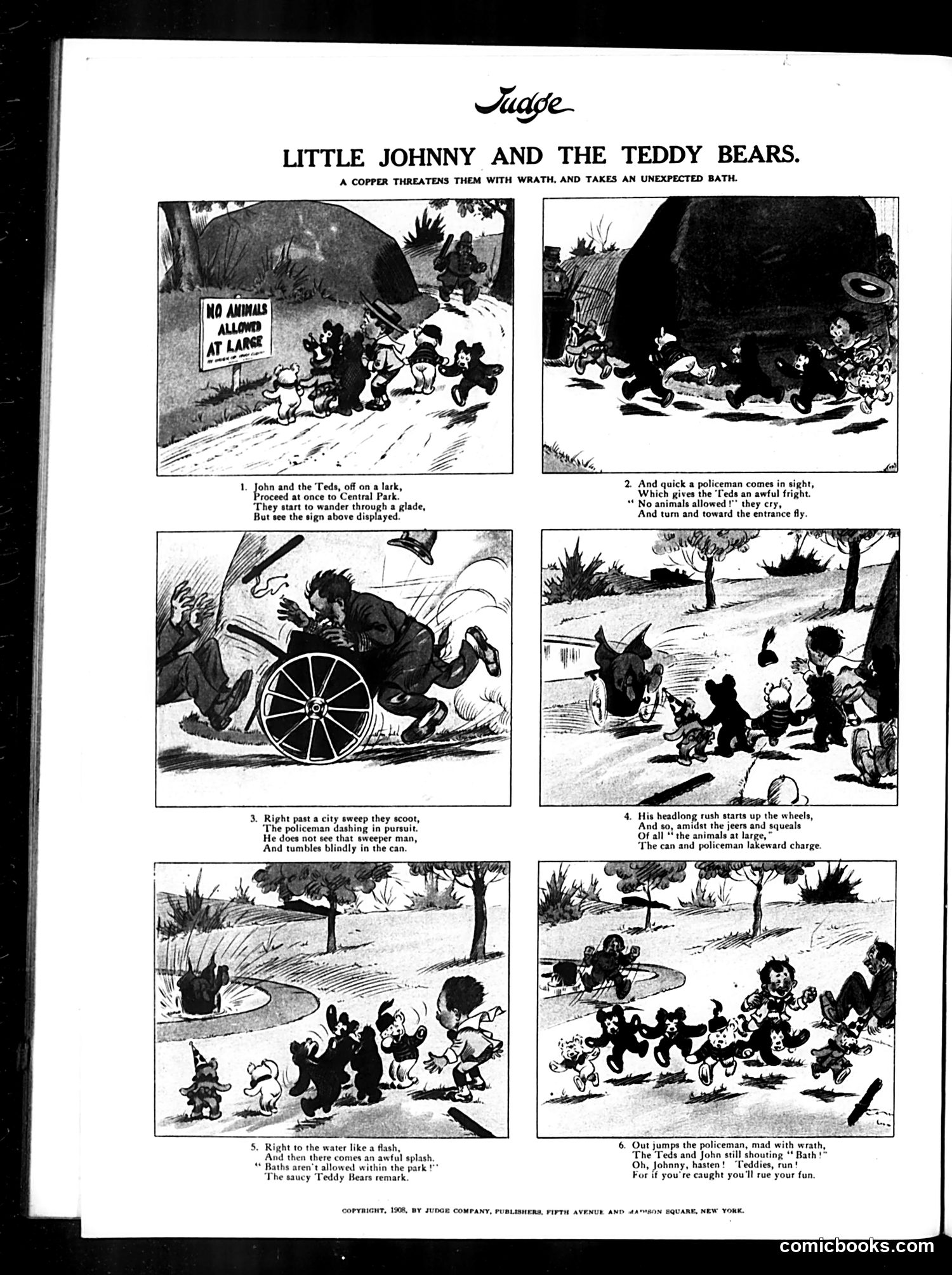
This is a humorous six-panel comic strip about a boy ("Johnny") and toy teddy bears who sneak into Central Park despite a "No Animals Allowed" sign. When a policeman spots them and gives chase, he's distracted and falls into a trash can ("dustbin"), which then rolls into a lake. The joke culminates with the soaked policeman emerging from the water while the children taunt him, suggesting the "saucy Teddy Bears" have outwitted authority. The humor relies on slapstick: the pompous cop's comeuppance through an undignified accident. The teddy bear reference likely reflects the popularity of "Teddy Bears" as toys following President Theodore Roosevelt's hunting exploits (the teddy bear was named after him around 1903). The cartoon mocks both the strict park rules and the foolishness of an adult authority figure outmaneuvered by children and toys.