
A complete issue · 28 pages · 1908
Judge — June 20, 1908
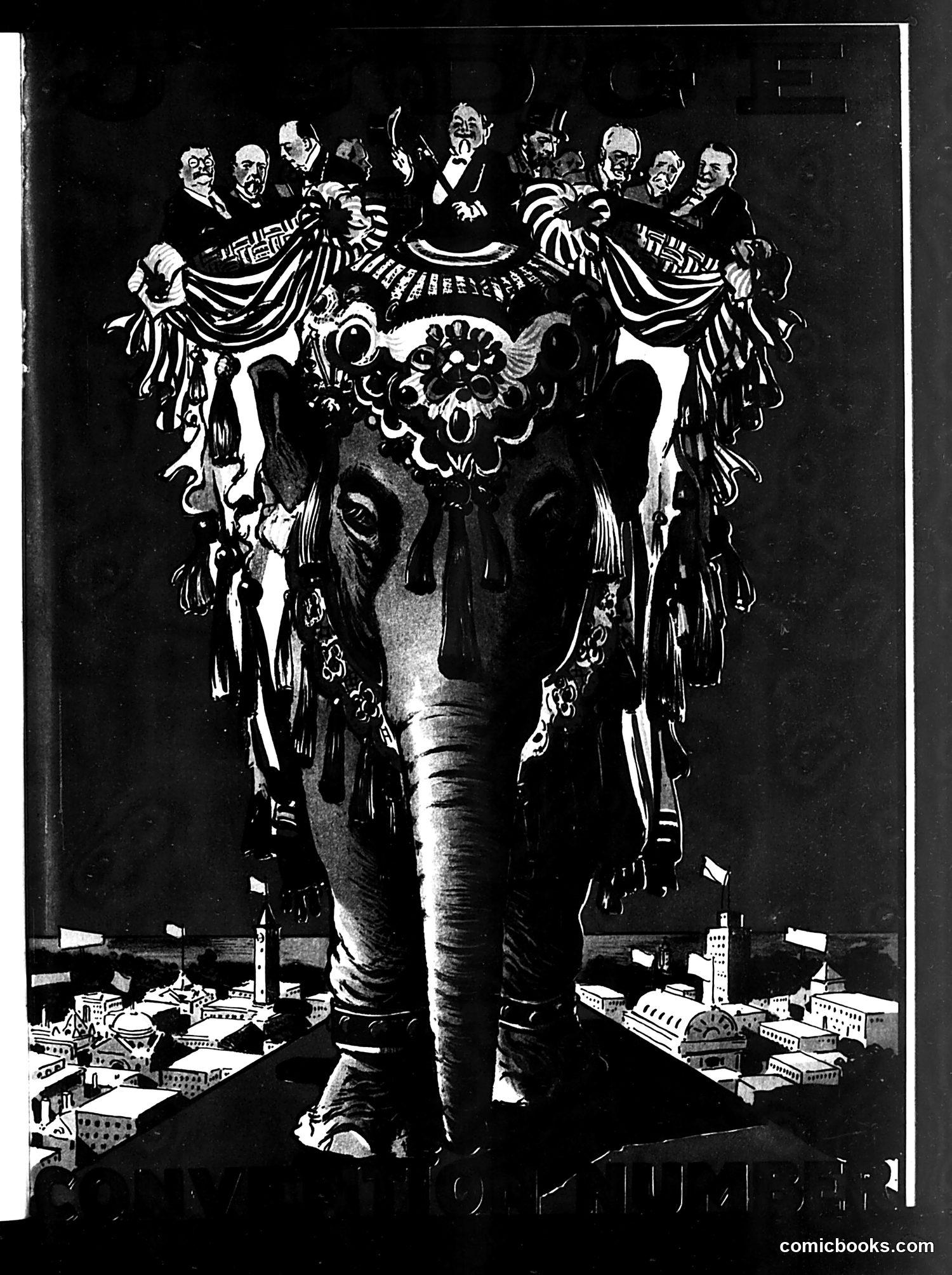
This appears to be a Gilded Age satirical illustration showing a giant elephant wearing elaborate decorative garments, with ten caricatured men (likely politicians or party bosses) positioned atop its head and shoulders. The elephant—the Republican Party symbol—is depicted as a massive beast being controlled by these powerful figures, who wear formal attire and sport exaggerated facial features typical of period caricature. Below the elephant lies a miniaturized cityscape, suggesting the party's dominance over urban America. The satire likely critiques Republican Party leadership and control during this era, portraying how a small group of elite men wielded disproportionate power over the entire party apparatus and, by extension, the nation.
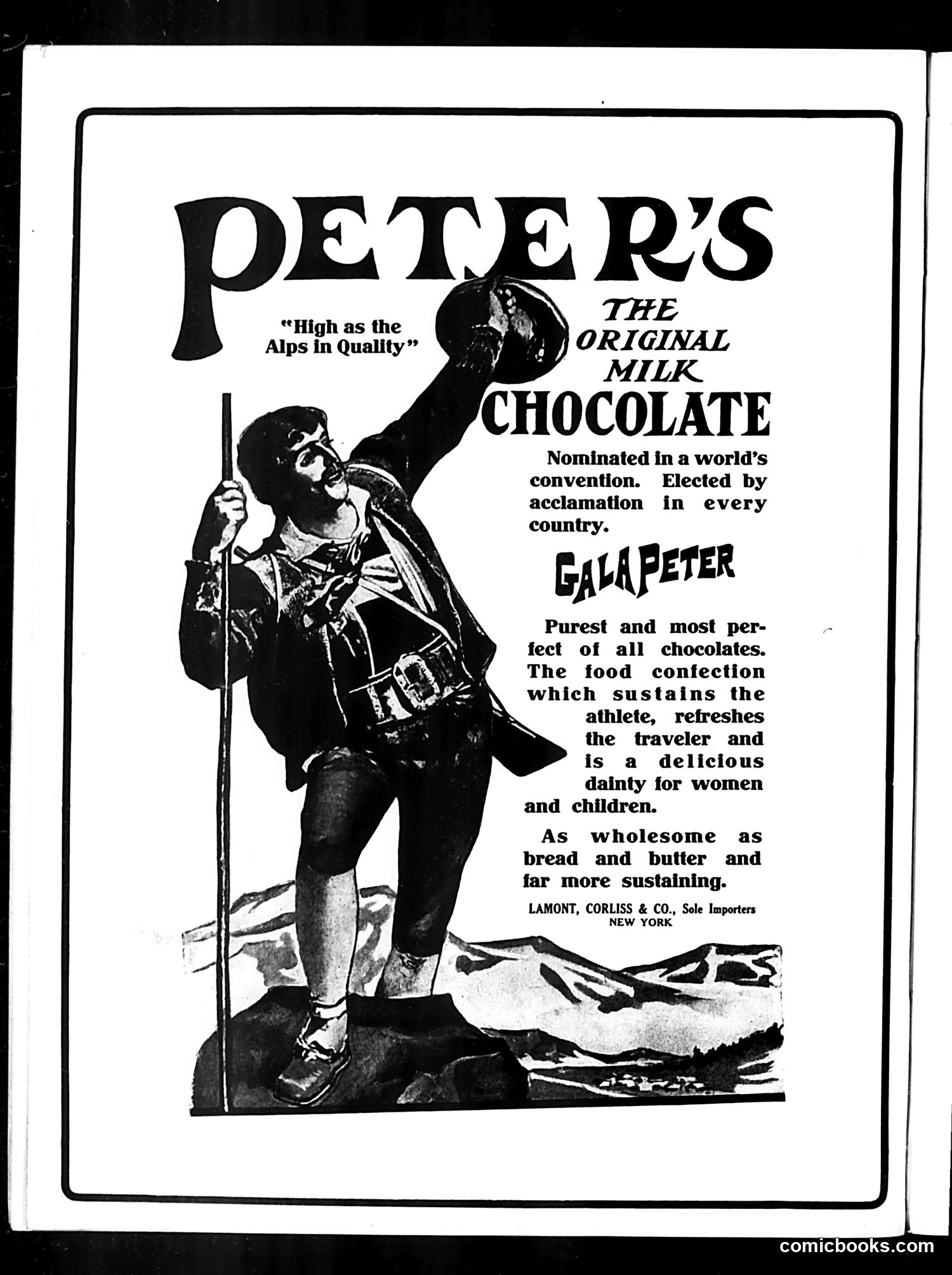
This is primarily a **product advertisement**, not political satire. It promotes Peter's milk chocolate, claiming it as "the original milk chocolate" and "the purest and most perfect of all chocolates." The ad features a mountaineer triumphantly planting a flag on a peak, with the slogan "High as the Alps in Quality." The imagery associates the product with Alpine excellence and achievement—a common early 20th-century marketing tactic linking consumer goods to prestigious European traditions. The text claims the chocolate was "nominated in a world's convention" and "elected by acclamation in every country," humorously positioning it as a globally recognized superior product. It promises the chocolate sustains athletes, refreshes travelers, and appeals to women and children. The importer was Lamont, Corliss & Co. of New York.
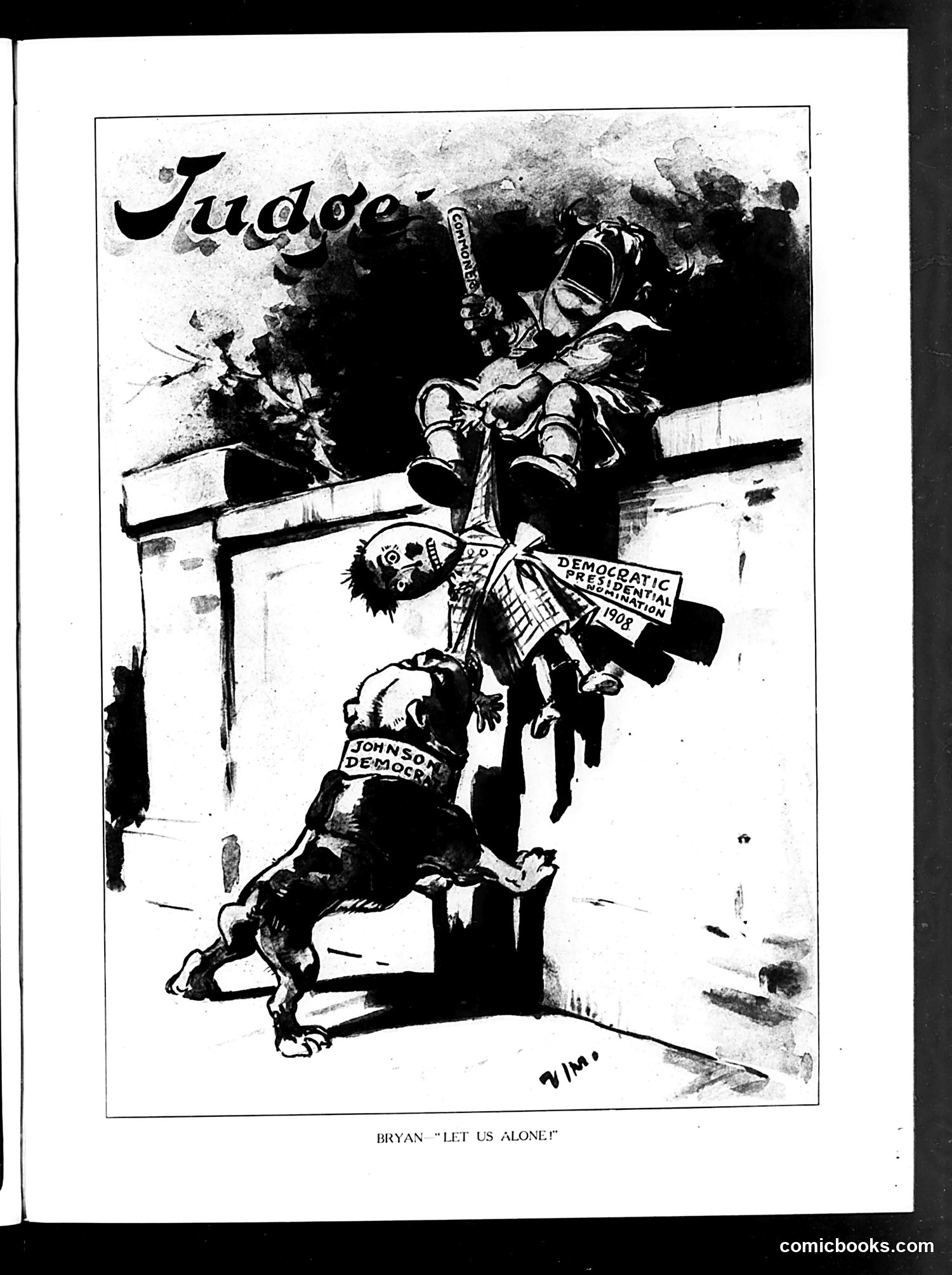
This is a political cartoon titled "Bryan 'Let Us Alone'" from Judge magazine, depicting William Jennings Bryan (identifiable by the label "JOHN" on the dog) as a submissive dog being judged. The cartoon mocks Bryan's political position, likely referring to his isolationist or non-interventionist stance (the "let us alone" motto). The judges above—appearing to represent military or political authority—are evaluating Bryan critically. Labels visible include "Democratic Presidential" references, suggesting this critiques Bryan's 1908 presidential campaign or political platform. The satire suggests Bryan's pacifist or isolationist position was weak or deserving of judgment by stronger political forces. This likely connects to turn-of-the-century debates over American imperialism and military intervention.
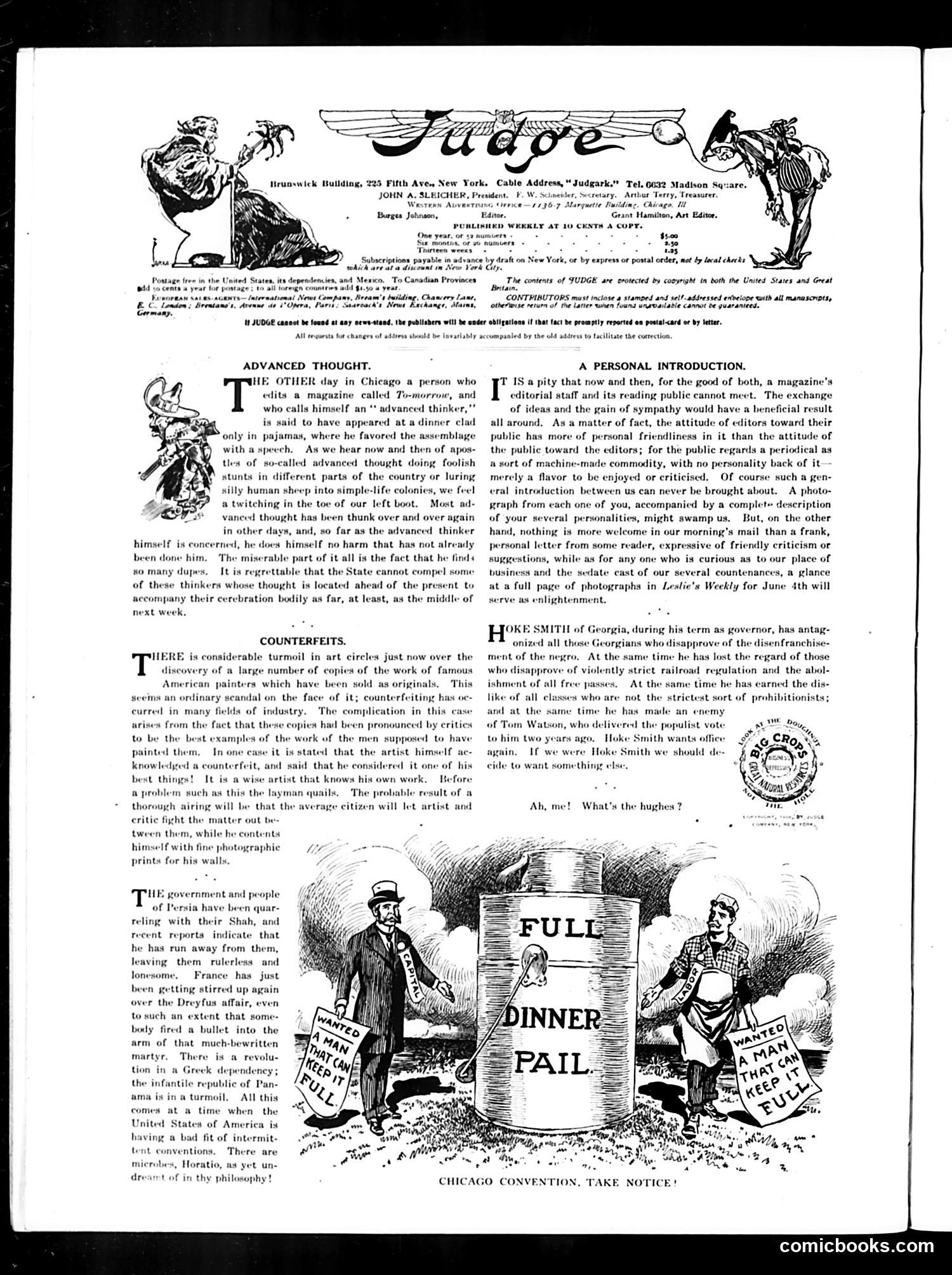
This page contains editorial content and a political cartoon titled "Chicago Convention, Take Notice!" The cartoon depicts two men flanking a large barrel labeled "Full Dinner Pail" — a famous Republican campaign slogan. Both figures hold signs reading "Wanted: A Man That Can Keep It Full," suggesting competition over who can deliver economic prosperity to voters. The "Full Dinner Pail" was William McKinley's 1900 campaign promise, symbolizing Republican prosperity claims. This cartoon appears critical of that rhetoric, questioning whether either political figure can actually fulfill such promises. The context suggests debate over economic policy and election-year claims during the Progressive Era, likely preceding a major party convention in Chicago.
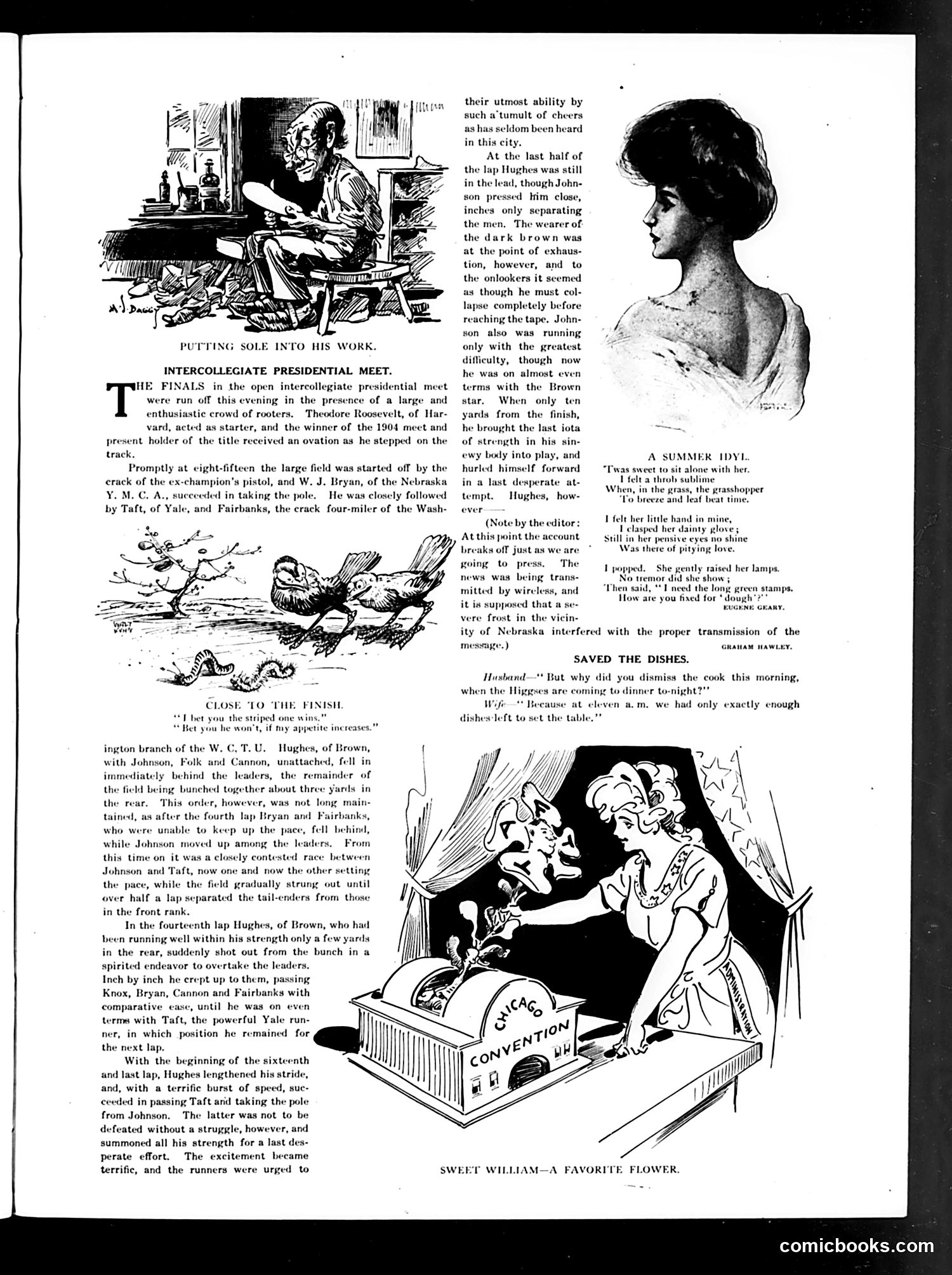
This page contains several distinct items: **"Putting Sole Into His Work"** (top left): A cobbler at his workbench—likely a general illustration rather than political satire, depicting manual labor. **"Intercollegiate Presidential Meet"** (center): Describes a 1904 track meet where Theodore Roosevelt started the race. The narrative mentions competitors from Yale, Nebraska, and other universities in what appears to be a lighthearted account of an actual sporting event rather than political commentary. **"A Summer Idyl"** (right): A poem about a woman, presented as romantic verse. **"Sweet William—A Favorite Flower"** (bottom): A cartoon showing what appears to be figures in or around a "Chicago Convention" box, likely satirizing the 1904 Republican National Convention, though specific figures are unclear from the image quality. The page mixes sports reporting, poetry, and political humor typical of Judge's format.
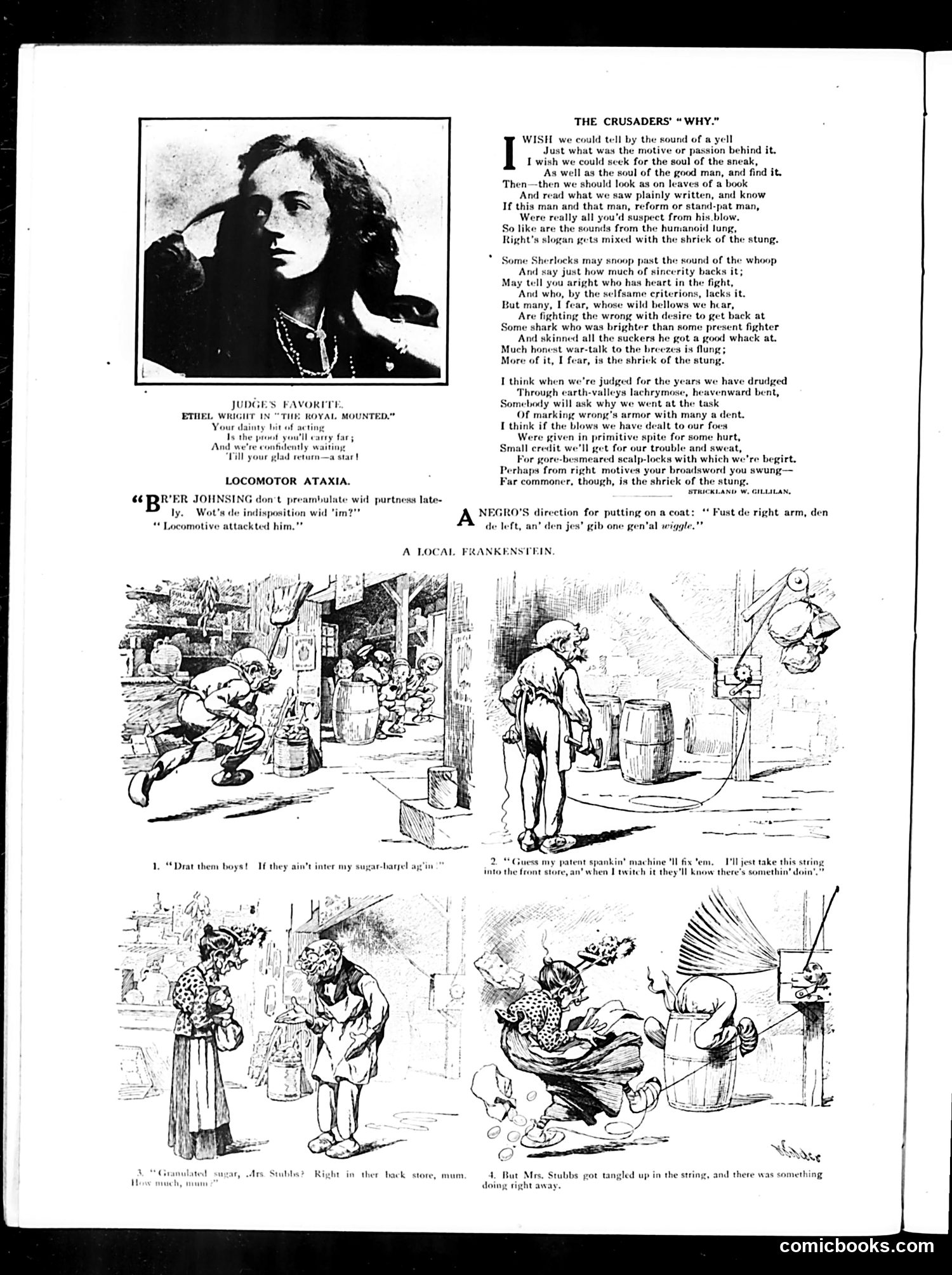
This page contains **poetry and satirical comics** from an era of American social commentary, likely early 20th century. **"The Crusaders' Why"** is a lengthy poem questioning the *motives* behind reform movements and social crusades. It skeptically suggests that crusaders' righteous-sounding rhetoric often masks baser motives—greed, personal vendettas, or desire for revenge ("the shriek of the stung"). The poem implies reformers aren't as noble as they claim. **"A Local Frankenstein"** is a four-panel comic strip depicting working-class characters, likely showing comic misadventures involving a dubious invention or scheme. The humor appears to be slapstick, involving patent schemes and physical comedy. The supporting jokes ("Locomotor Ataxia," "Judge's Favorite") are brief satirical quips mocking specific targets, though their precise references are unclear without additional context. **Overall theme**: Cynical commentary on American reform movements and social pretensions, presented through verse and working-class humor typical of Judge's satirical voice.
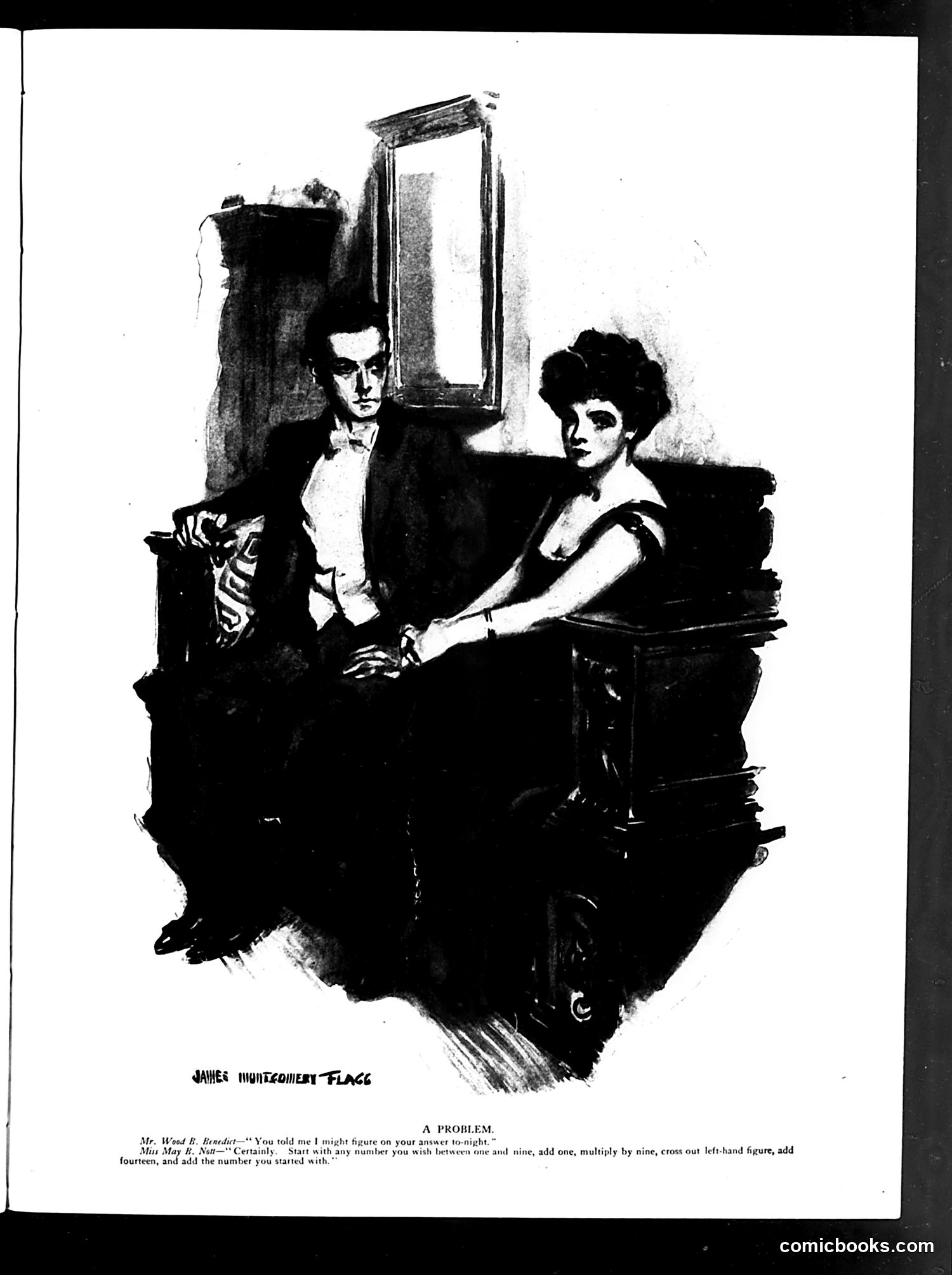
This cartoon satirizes a courtship problem using a mathematical puzzle as a metaphor. A man (Mr. Weed B. Benedia) seeks romantic advice from a woman (Miss May B. Not) about winning over another woman's affections. Her "solution" is deliberately obscured by convoluted mathematical instructions—a joke suggesting that romance itself is an unsolvable puzzle, or that her advice is deliberately unhelpful obfuscation. The humor lies in treating a heart matter with cold logic, and in the woman's arch response: she provides elaborate, confusing steps that ultimately yield a predetermined answer regardless of starting number—implying the man's romantic prospects are equally predetermined and futile. The illustration style and "Judge" publication date this to the early 20th century.
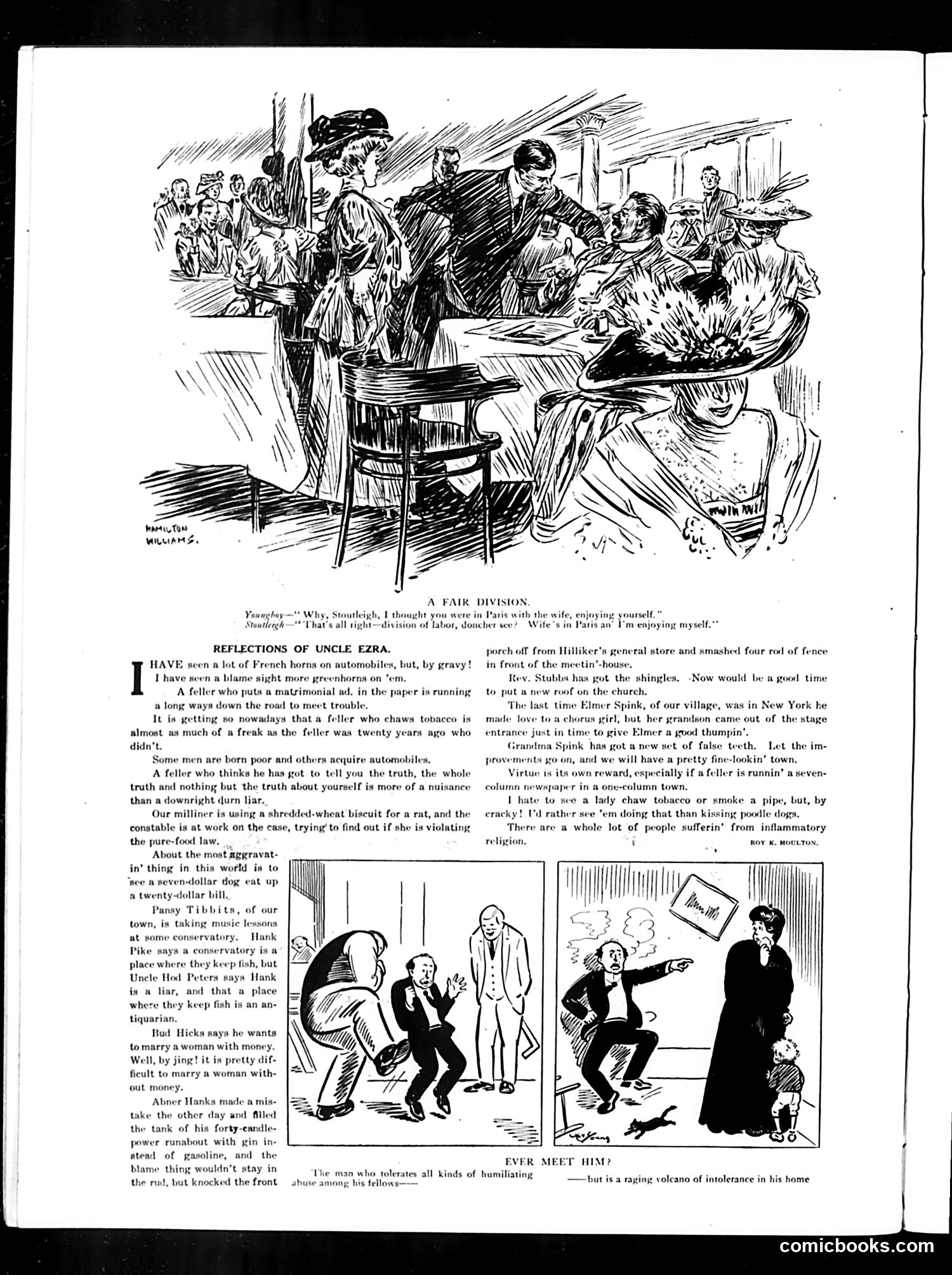
This Judge page combines two satirical sections mocking small-town American life and hypocrisy. **Top cartoon**: Shows a domestic dispute where a wife accuses her husband of enjoying Paris while she labored at home. His defense—that she's "all right" with leisure time—satirizes male dismissiveness toward women's domestic work and unequal marital dynamics. **"Reflections of Uncle Ezra"**: A rural gossip column parodying small-town life through fictional anecdotes—bad matrimonial ads, tobacco chewing becoming normal again, a milliner using shredded wheat as rat poison. The humor targets provincial foolishness and hypocrisy. **Bottom cartoons**: Two panels by Roy K. Moulton illustrating the column's theme: men who publicly tolerate others' flaws while being "a raging volcano of intolerance in his home." The first shows marital discord; the second depicts a man pointing out a child's misbehavior while his wife (arms crossed) observes his own hypocrisy. The satire targets masculine hypocrisy—men preaching virtue publicly while behaving poorly privately.
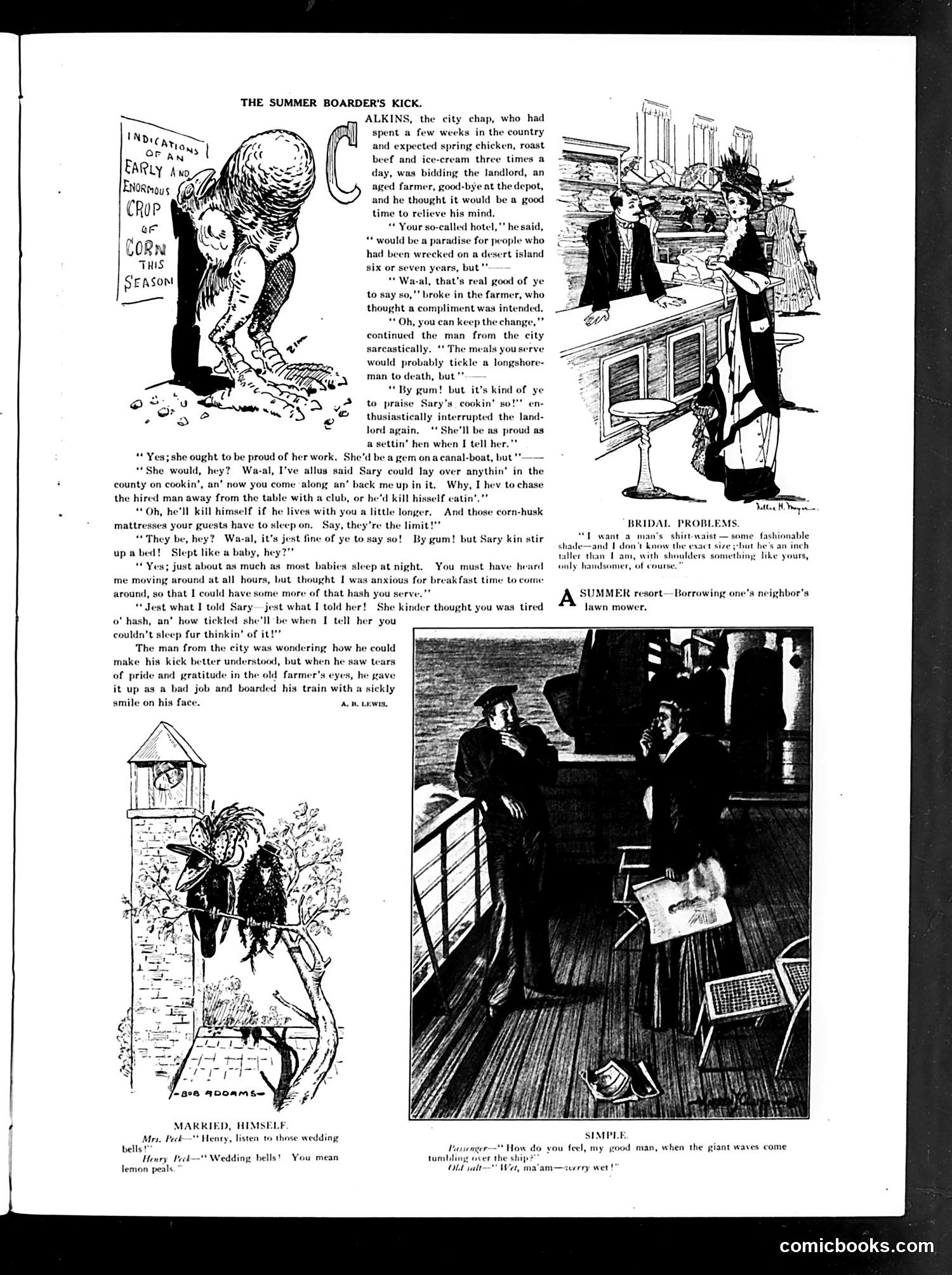
This satirical story depicts a city visitor's attempt to complain about poor accommodations at a rural farmhouse. The boarder criticizes the food, cooking, and corn-husk mattresses sarcastically, expecting the farmer to agree. However, the farmer—identified as old Alkins—consistently misinterprets each complaint as genuine praise, responding with pride about his wife Sary's abilities and the farm's hospitality. The satire targets the city boarder's condescension toward rural life and his failed attempt to assert urban superiority. Despite his sarcasm, every complaint backfires: the farmer boasts about his wife's cooking, the hired man's appetite, and the comfortable beds. The boarder eventually abandons his complaints, defeated by the farmer's good-natured obliviousness and genuine pride. The joke reflects period tensions between urban and rural values, mocking the city visitor's assumption that rural hospitality is inherently inferior while ultimately showing rural contentment superior to urban cynicism.
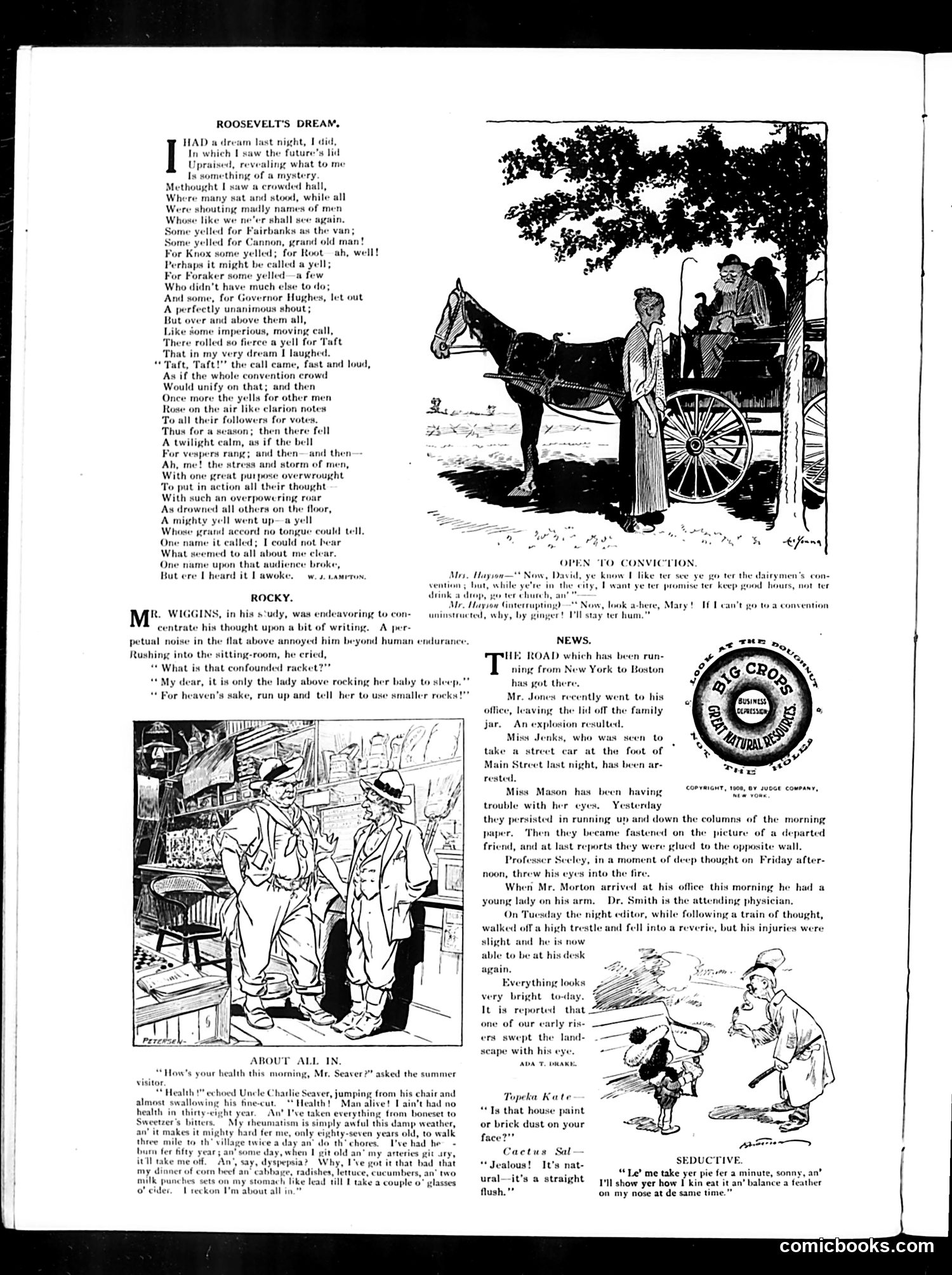
This page satirizes the 1908 Republican presidential convention. The main poem depicts Theodore Roosevelt dreaming of the convention hall where delegates shout names of potential successors. While supporters yell for various candidates (Root, Hughes, Knox), a "mighty yell" drowns them all out—calling for William Howard Taft, Roosevelt's chosen heir apparent. The satire captures the political reality: despite apparent competition among candidates, Taft's nomination was essentially predetermined by Roosevelt's endorsement. The dream imagery suggests the convention's outcome felt inevitable, almost orchestrated—a commentary on how Roosevelt's political dominance made the "democratic" selection process seem predetermined. The poem is credited to W.J. Lampoon, a Judge contributor.
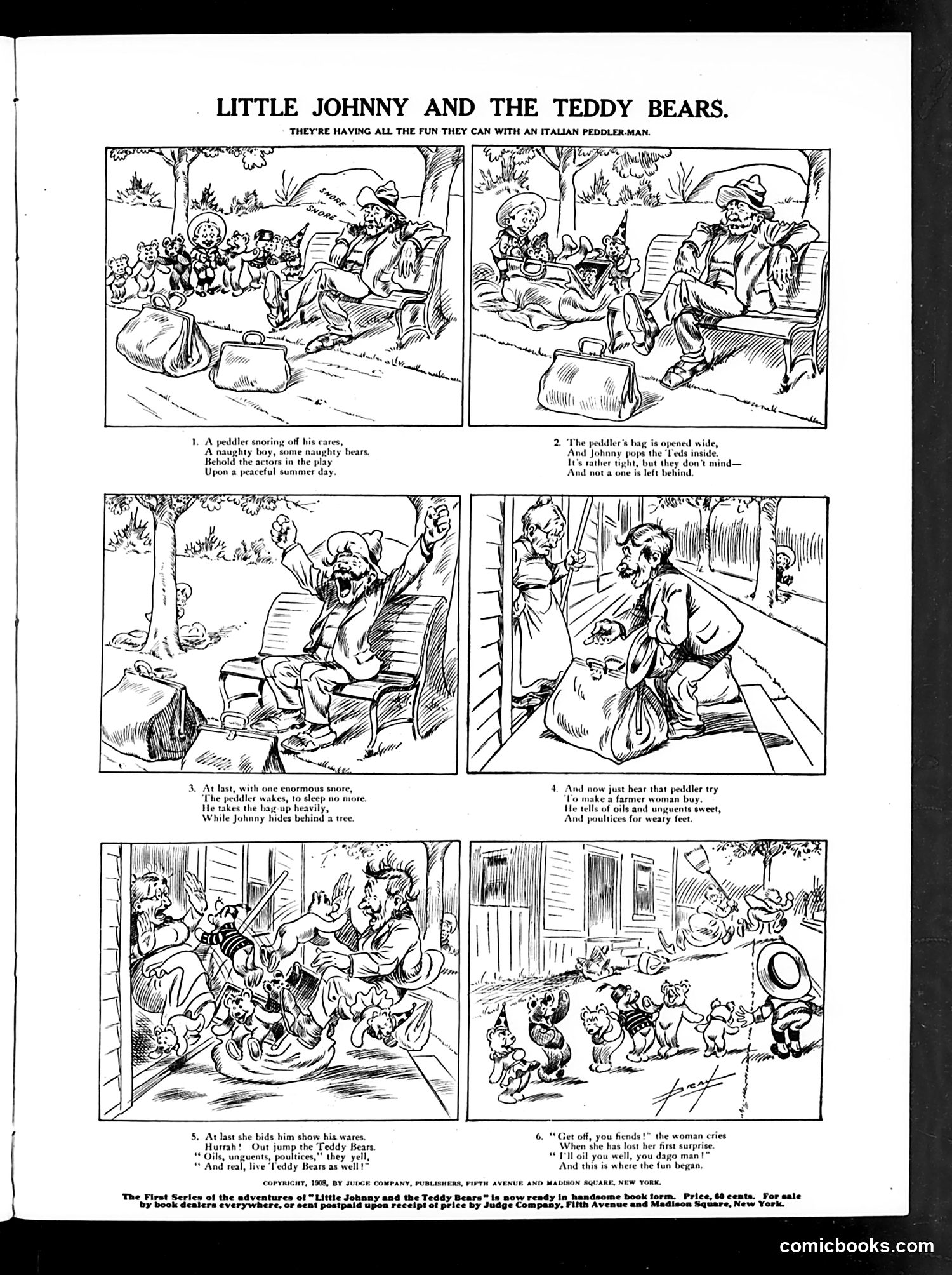
This is a six-panel comic strip featuring a mischievous boy ("Little Johnny") and his stuffed teddy bears playing pranks on an Italian street peddler. The narrative follows a simple arc: Johnny and the bears hide in the peddler's bag while he sleeps; when he tries to sell his wares (oils, unguents, poultices) to a farmwoman, the teddy bears suddenly jump out, startling everyone and causing chaos. The humor derives from slapstick surprise and the peddler's misfortune. The comic appears to play on period stereotypes about Italian immigrant street vendors, though the focus is primarily on childhood mischief rather than ethnic satire. The strip advertises an upcoming book collection, suggesting this was a popular recurring character series in *Judge* magazine.
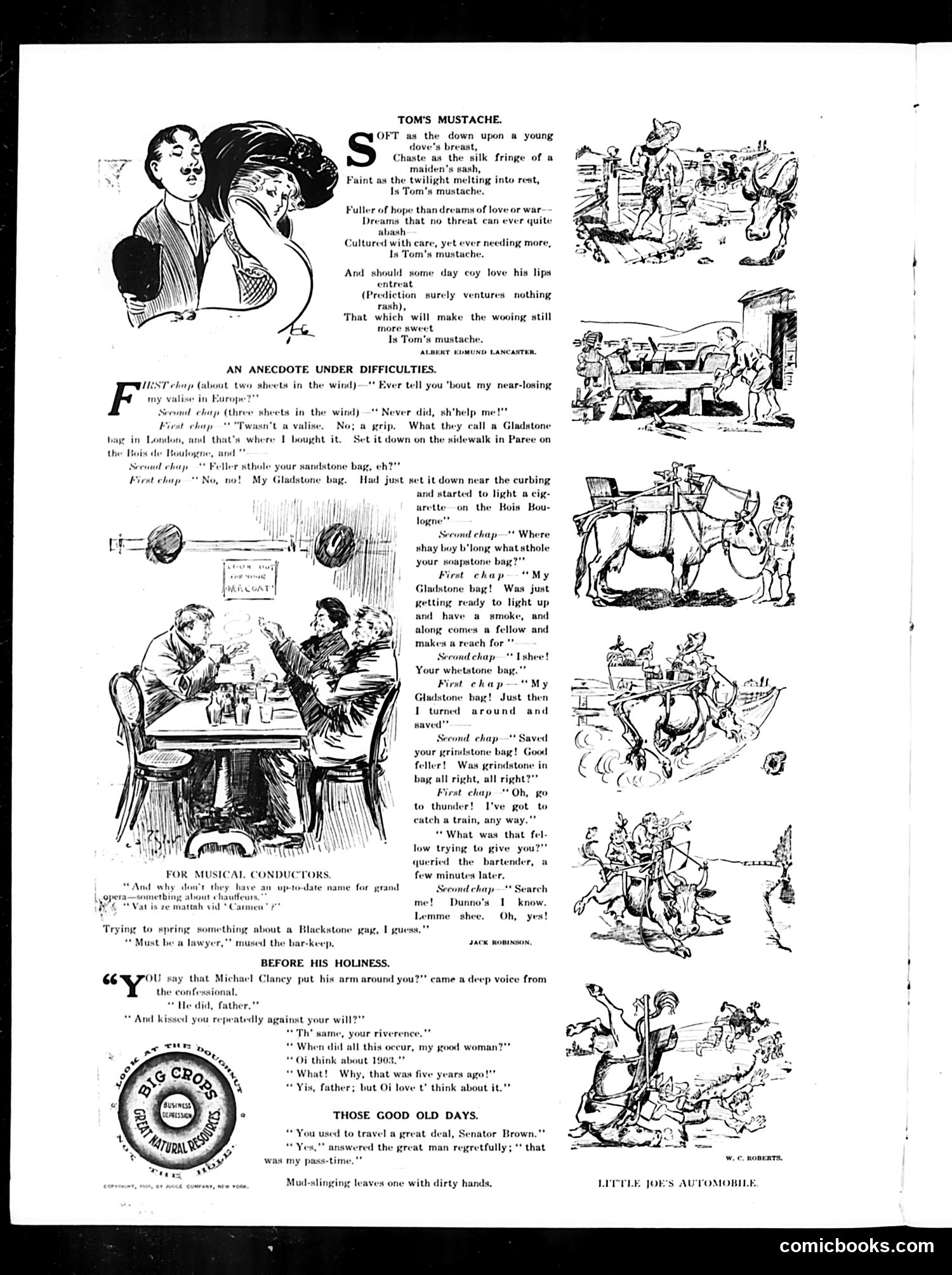
This page contains several brief humorous pieces typical of early 20th-century satirical magazines: **"Tom's Mustache"** is a romantic poem mocking sentimental Victorian verse by praising a young man's delicate facial hair in overwrought language. **"An Anecdote Under Difficulties"** depicts two drunk men mishearing each other's words—"Gladstone bag" becomes "sandstone," "whetstone," and "grindstone"—a comedy of phonetic confusion common to period drinking-humor. **"For Musical Conductors"** jokes that grand opera needs modern naming conventions (unclear specific reference). **"Before His Holiness"** appears to satirize Catholic confession, with a woman discussing Michael Clancy's behavior to a priest in broken English, likely poking fun at Irish-American stereotypes. **"Those Good Old Days"** contrasts past travel with modern "mud-slinging" (political attacks), suggesting nostalgia for simpler times. The page emphasizes wordplay, ethnic humor, and light social satire typical of Judge's era.
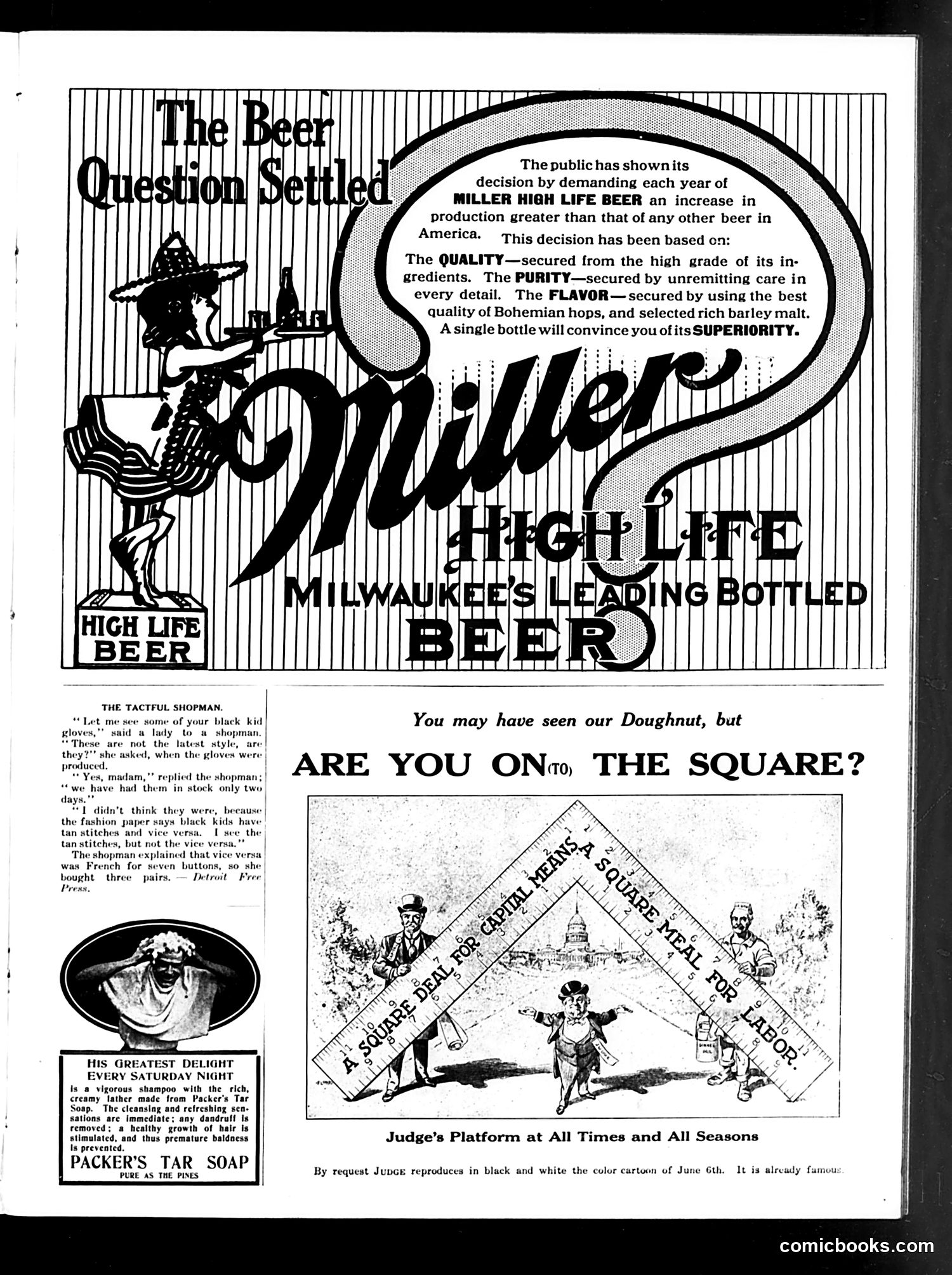
This page is primarily **advertising**, not political satire. It contains three commercial ads: 1. **Miller High Life Beer** (top): A large advertisement claiming the beer's superiority based on quality, purity, and flavor from Bohemian hops and barley malt. The accompanying illustration shows a jovial figure (the "Miller" mascot) with beer bottles. 2. **"The Tactful Shopman"** (left): A brief humorous anecdote about a lady asking a shopman for black kid gloves, claiming they're "not the latest style." The joke plays on fashion trends and retail salesmanship. 3. **Packer's Tar Soap** (bottom left): An advertisement for a hair-care product promising to stimulate hair growth and prevent baldness through vigorous shampooing. The bottom section references a cartoon from Judge's June 6th issue about "Are You On(to) the Square?" with a judge's platform—likely social commentary, though the full context isn't visible here. This appears to be a typical early 20th-century magazine page mixing light humor with commercial messaging.
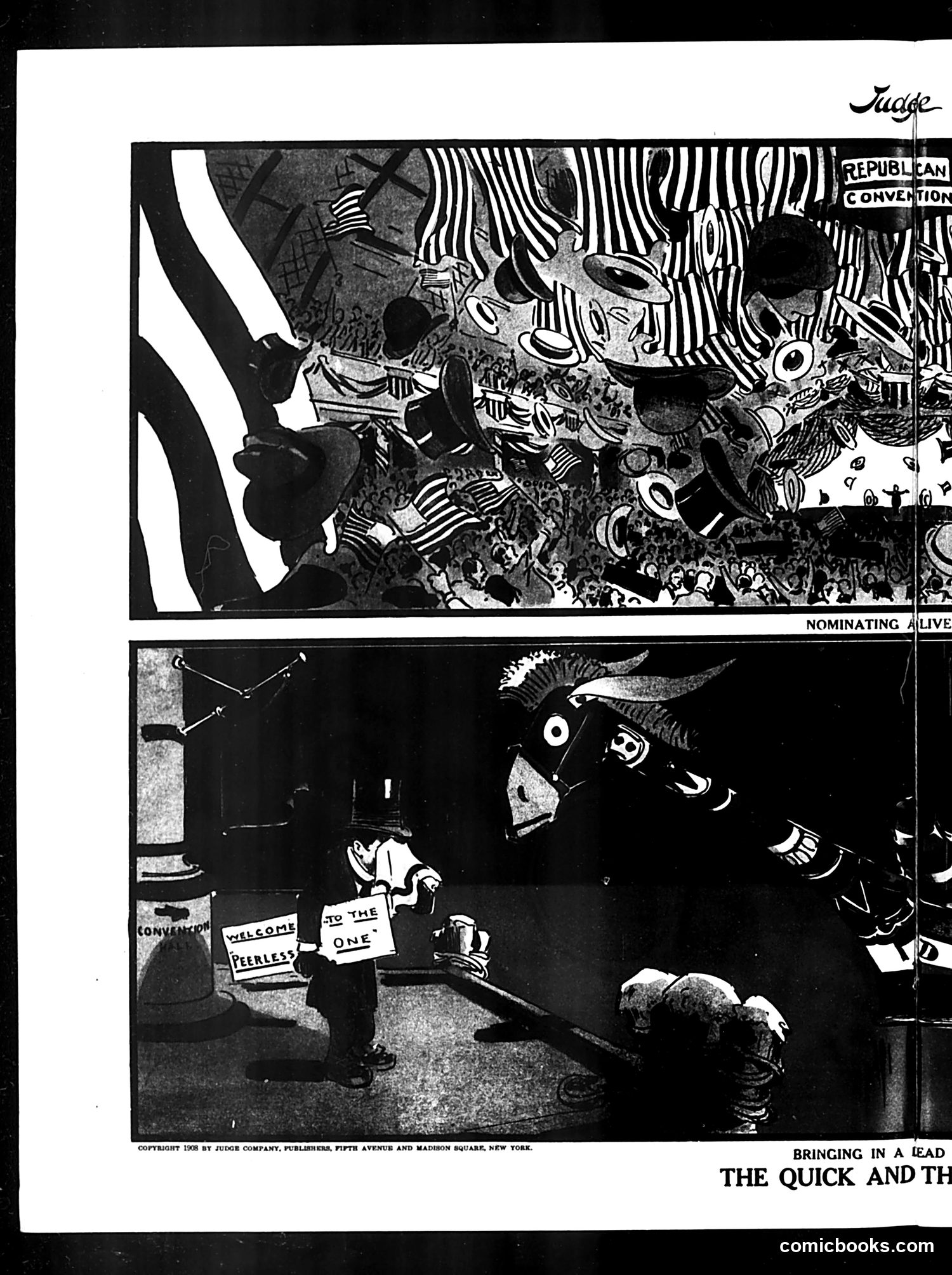
This page appears to be from a Judge magazine feature titled "Bringing In a Lead" and "The Quick and Th[e]..." (text cut off). The upper panel shows a Republican Convention scene with patriotic imagery—American flags and bunting dominate the composition, with silhouetted figures amid elaborate decorative elements. The lower panel depicts what appears to be a convention floor scene with figures holding signs reading "Welcome to the Peerless One," suggesting political maneuvering or nomination proceedings. Without the complete text and full context of the date, I cannot definitively identify which specific convention or political figures are being satirized. The imagery suggests early-to-mid 20th century political satire focused on Republican convention proceedings and the spectacle of presidential nomination politics. The "Peerless One" reference likely targets a particular candidate, but identifying them would require additional historical information not fully visible here.
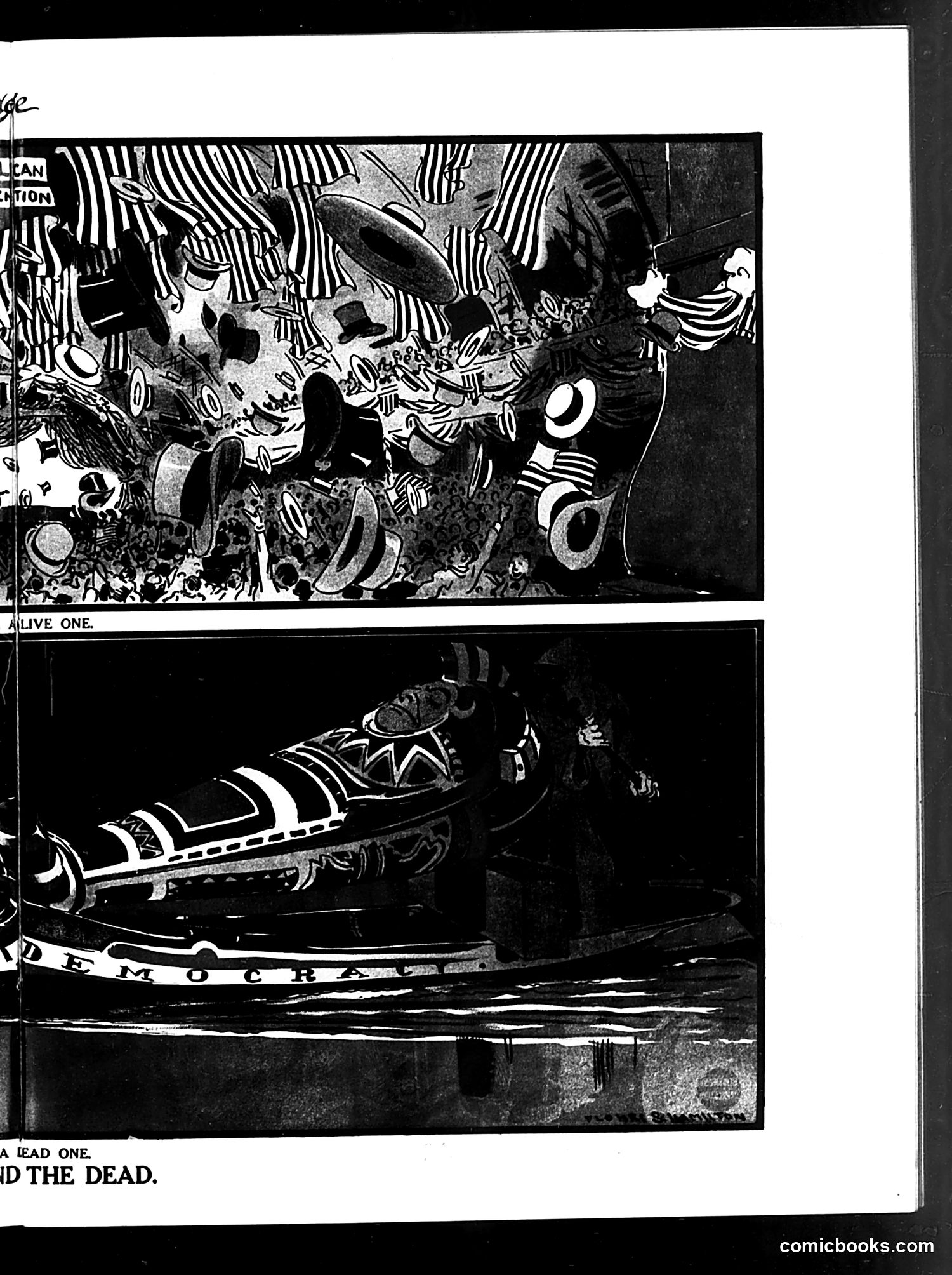
This page appears to show two panels from what the OCR text suggests is titled "...ID THE DEAD," likely a satirical piece about identifying corpses or casualties. The top panel depicts a chaotic, densely-packed scene with multiple figures and striped patterns, suggesting confusion or disorder—possibly a morgue or disaster scene rendered in Judge's characteristic exaggerated style. The bottom panel shows a single decorated or ornately-dressed figure on what appears to be a display platform or table, with "D MOOR" visible at the bottom (possibly a name or location). Without the complete OCR text and publication date, the specific political or social context remains unclear. However, the composition suggests dark satire about death or identification procedures. More context would be needed to identify who or what is being satirized.
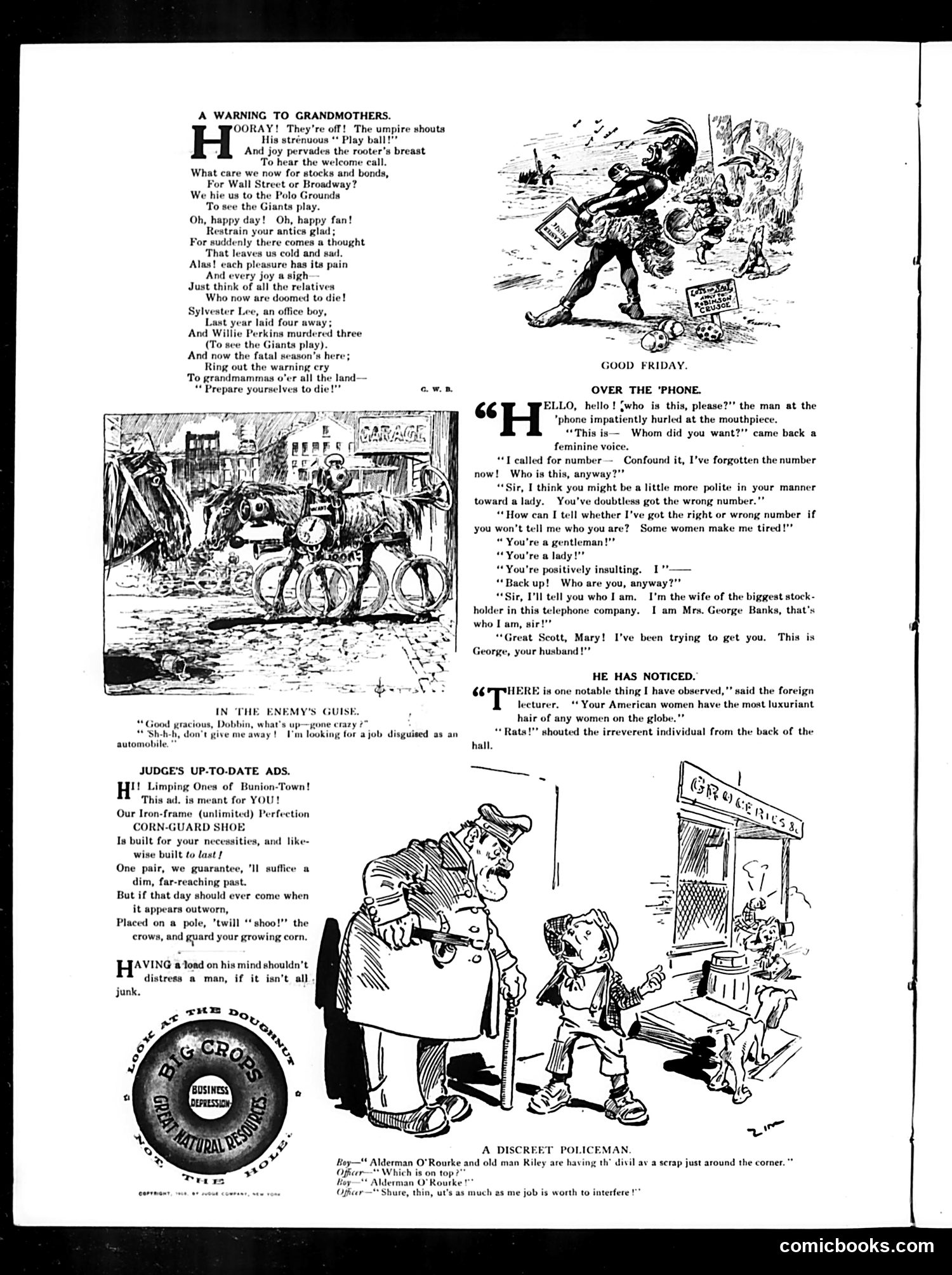
This page contains several satirical pieces typical of early 20th-century Judge magazine: **"A Warning to Grandmothers"** mocks the era's obsession with baseball (specifically the New York Giants at the Polo Grounds), suggesting that fans' enthusiasm for the sport is so consuming that relatives—particularly grandmothers—will literally die from neglect while everyone attends games. **"Over the Phone"** satirizes the awkwardness of early telephone communication and class consciousness: a man calls a wrong number and argues with the woman who answers; she's offended by his rudeness, then reveals she's Mrs. George Banks, wife of a telephone company stockholder—turning the tables on his presumption. **"In the Enemy's Guise"** shows a horse disguised as an automobile, joking about labor displacement as mechanical vehicles replace horse-drawn transport. **"Judge's Up-to-Date Ads"** parodies patent medicine-style advertisements, here promoting a "Corn-Guard Shoe" with absurdist humor. **"A Discreet Policeman"** features Irish dialect humor about a policeman's discretion in ignoring a street fight. The humor relies on period-specific references (Giants baseball, early telephones, class hierarchies) largely unfamiliar to modern readers.
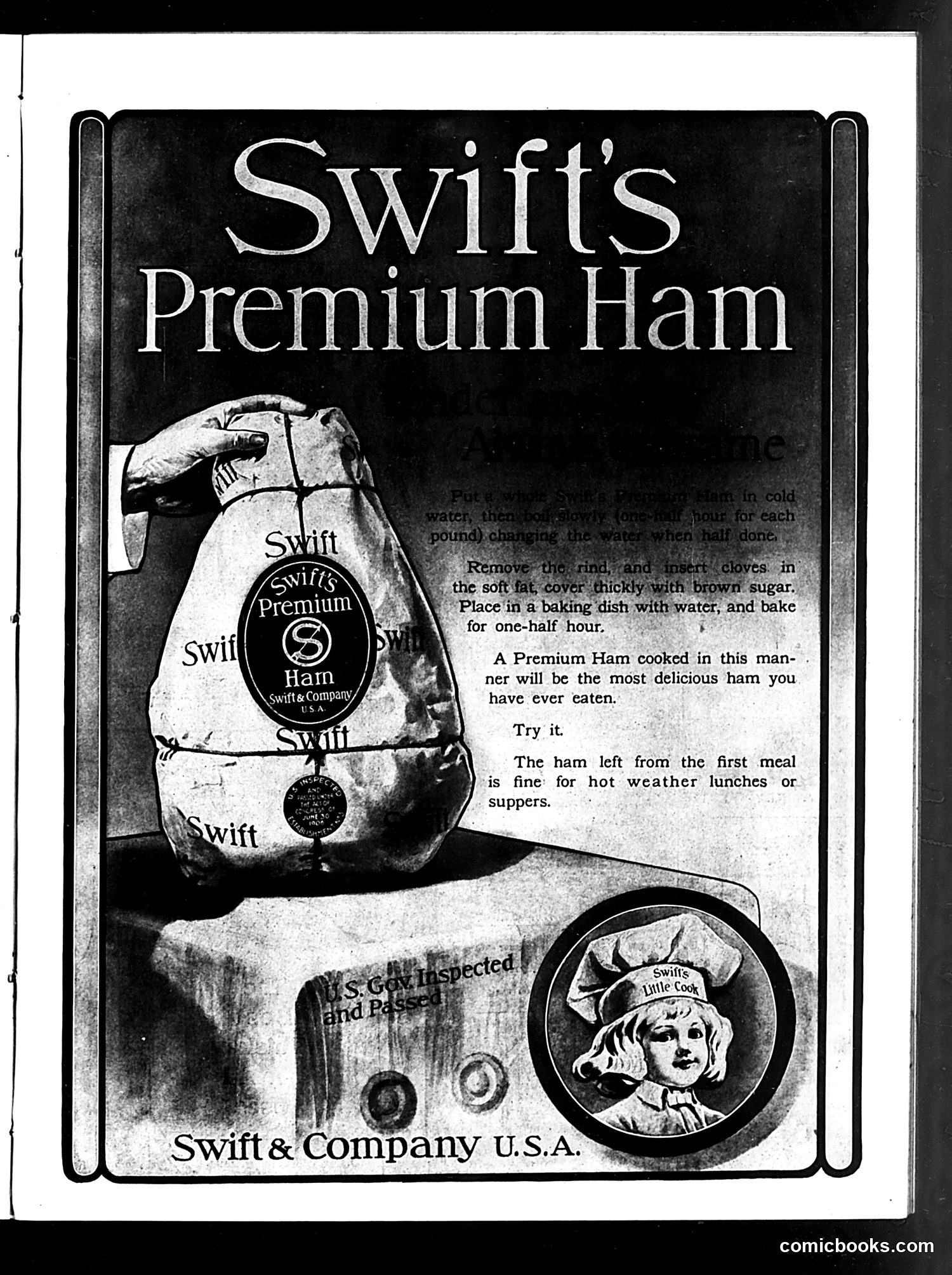
This is a **Swift & Company advertisement** for Premium Ham, not political satire. The page shows a packaged ham with the Swift's branding and includes cooking instructions: boil slowly for one-half hour per pound, then bake with brown sugar for thirty minutes. The ad emphasizes the product's quality and convenience—the cooked ham can be repurposed for "hot weather lunches or suppers." A circular inset features "Swift's Little Cook," the company's mascot character used in their marketing. This appears in *Judge* magazine simply as paid advertising space. There is no political commentary or satirical content on this particular page—it's straightforward product promotion from the early 20th century.
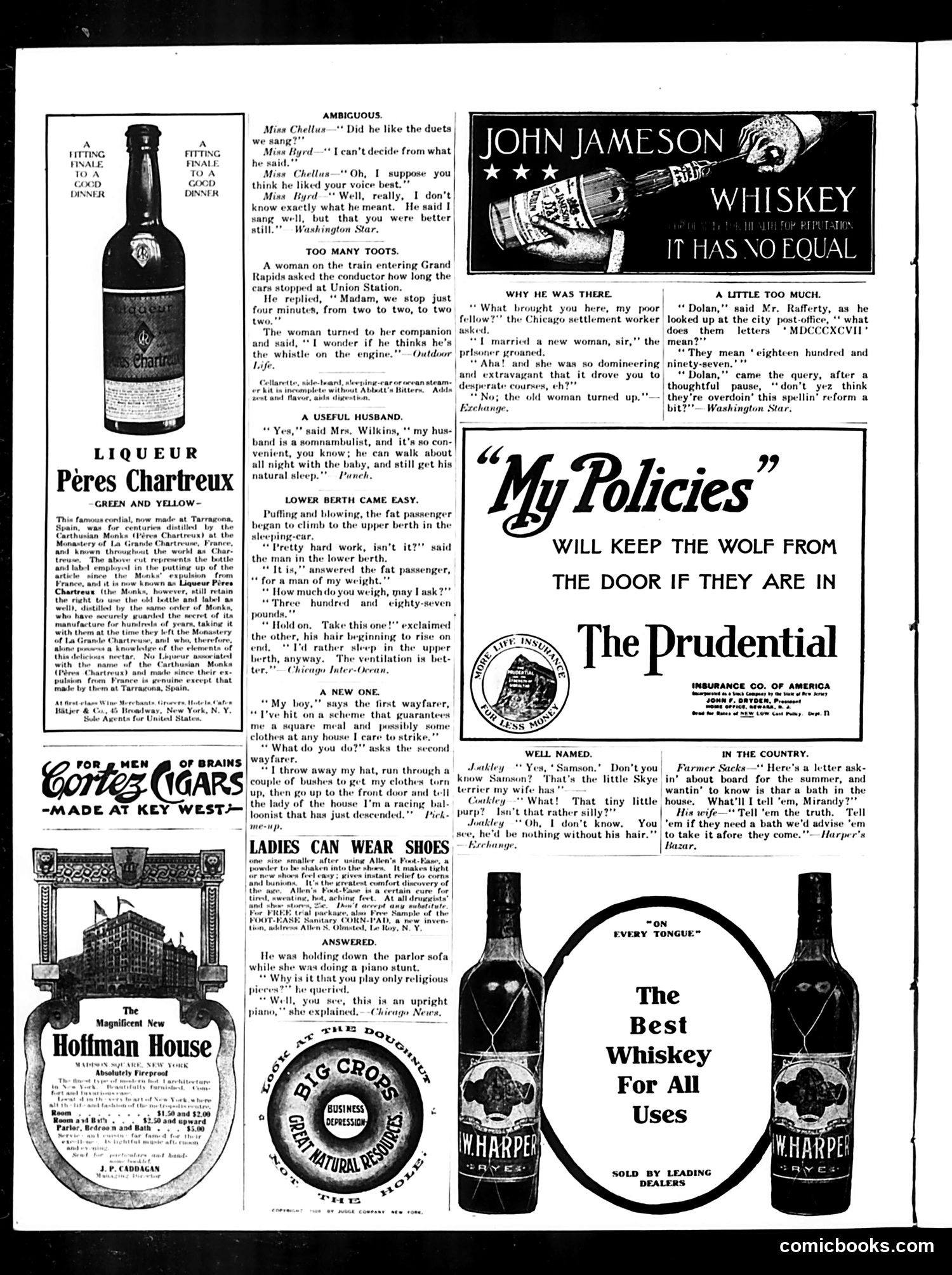
This is primarily an **advertising page** with scattered brief humor pieces, typical of early 20th-century magazines. The small cartoons are lightweight social humor with no political content: - **"Ambiguous"** and **"Too Many Toots"**: wordplay jokes about misunderstanding - **"Why He Was There"**: domestic humor about a prisoner married to an extravagant woman - **"A Useful Husband"**: joke about a sleepwalking husband who babysits at night - **"Lower Berth Came Easy"**: fat passenger humor - **"A New One"**: hobo deliberately gets clothes torn to pose as destitute The dominant content is **liquor and insurance advertising** (Peres Chartreux liqueur, John Jameson whiskey, W. Harper whiskey, The Prudential Insurance). There's also an ad for the Hoffman House hotel. **No significant political satire or caricature appears here.** The humor is purely social/domestic, reflecting period attitudes about marriage, class, and appearance without satirizing specific figures or events.
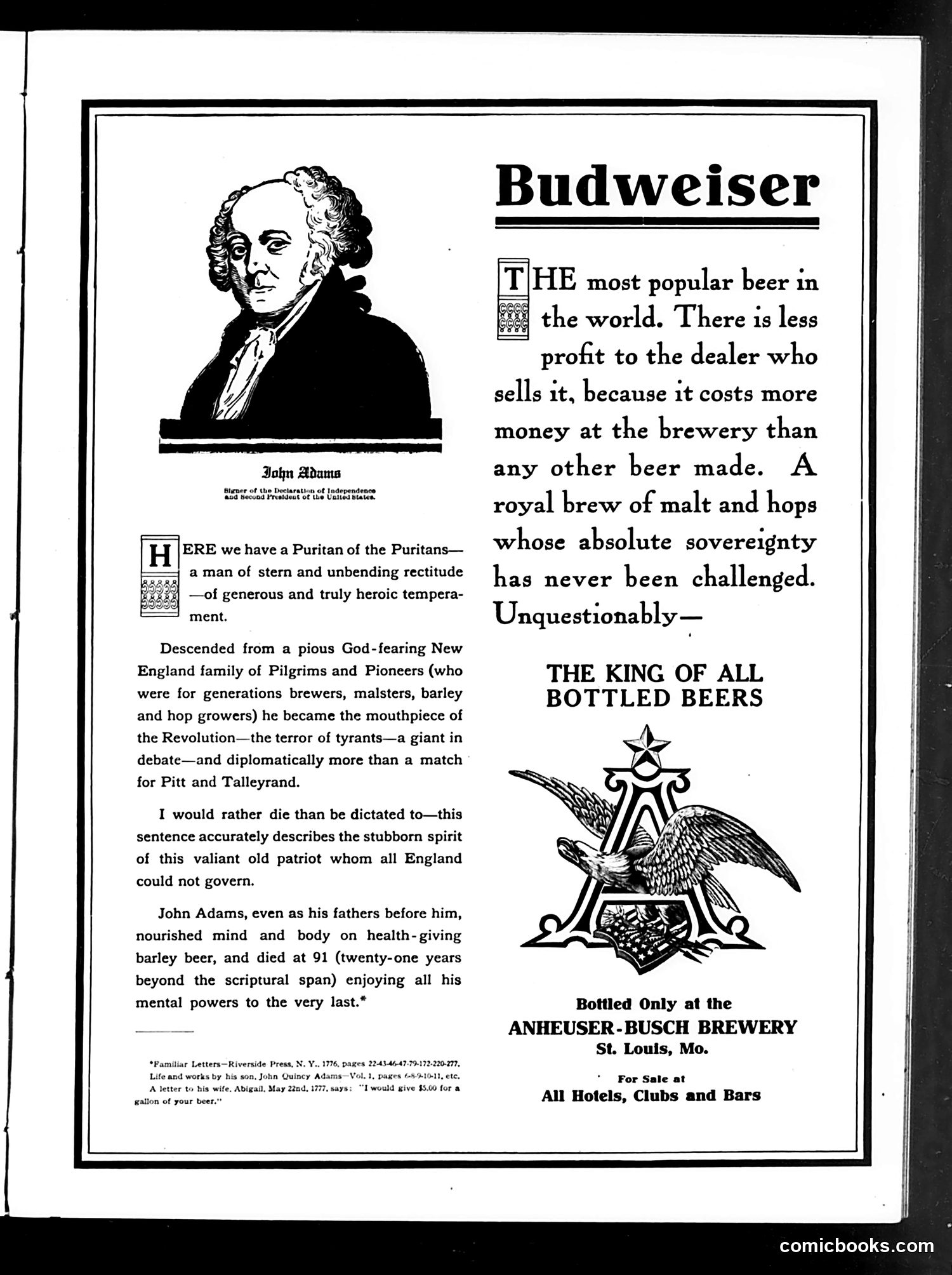
This is primarily a **Budweiser beer advertisement**, not satire. It appropriates the image and legacy of Founding Father **John Adams** to sell beer by claiming he was descended from brewers and drank barley beer throughout his long life (he lived to 91). The ad invokes Adams's reputation for principled independence and integrity, then connects this virtue to Budweiser by suggesting Adams's longevity and mental acuity came from drinking beer. The footnotes cite Adams's own letters—including one supposedly requesting beer from his wife—to lend historical authenticity. This marketing strategy exploits patriotic sentiment and associates the product with American founding ideals and personal vigor. For modern readers, it's striking how brazenly corporations once weaponized historical figures' images to promote alcohol consumption, framing beer-drinking as a mark of American character rather than mere consumption.
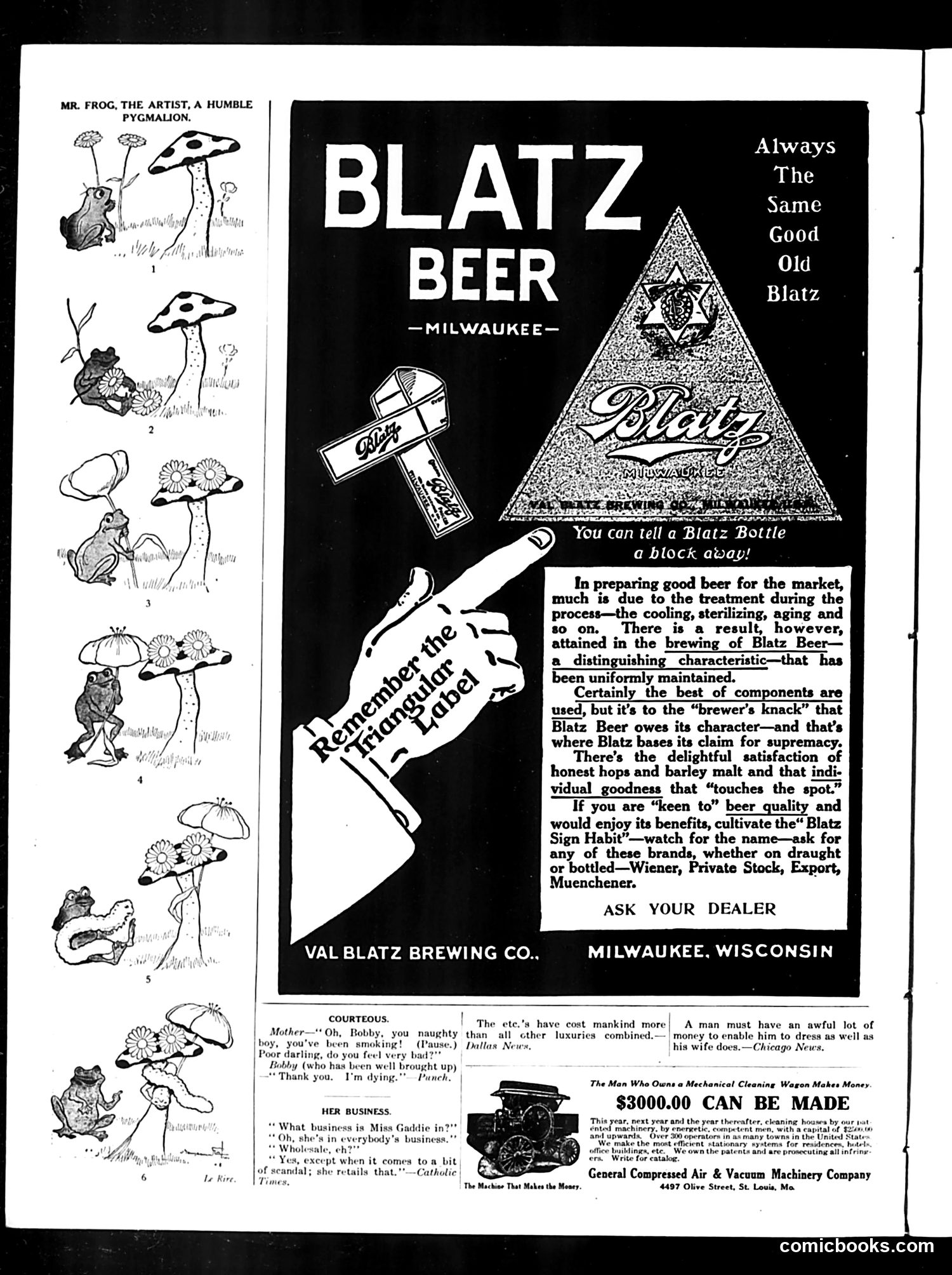
This page combines editorial cartoons with period advertising. The left side shows "Mr. Frog, the Artist, a Humble Pygmalion"—a six-panel visual gag about a frog attempting to create art or impress mushrooms, likely satirizing pretentious artistic ambitions or self-delusion. The center features a Blatz Beer advertisement from Milwaukee, emphasizing the brewery's distinctive character and quality, a common marketing approach for early 20th-century brewers competing in a crowded market. Below are brief comedic snippets: a "Courteous" joke about a boy smoking, and "Her Business," mocking a woman's gossiping as her primary occupation—reflecting period gender stereotypes about women as busybodies. The page concludes with advertisements for mechanical cleaning equipment and a vacuum machinery company promising $3,000 profit—typical entrepreneurial pitches from the era. The overall effect is typical *Judge* magazine content: light satire, gender-based humor, and commercial advertising mixed together.
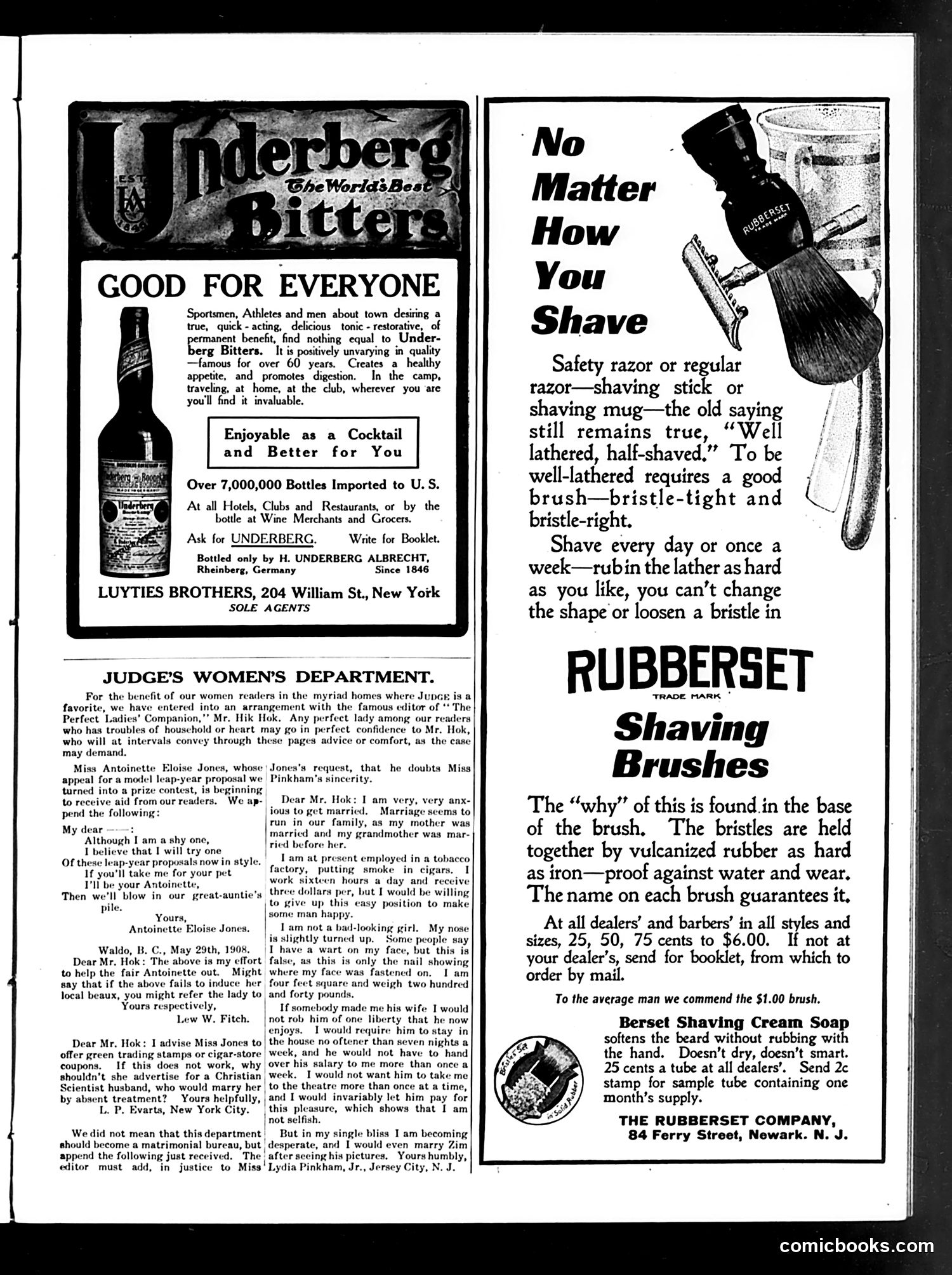
This page contains **advertisements and an advice column**, not political cartoons. **Left side:** An ad for Underberg Bitters, a German digestive liqueur marketed to sportsmen and clubmen as a health tonic and cocktail ingredient. The copy emphasizes its 60-year reputation and widespread availability in American establishments. **Right side:** An ad for Rubberset shaving brushes, emphasizing their vulcanized-rubber bases that keep bristles firm and durable. **Center/bottom:** "Judge's Women's Department"—a humorous advice column where readers respond to Miss Antoinette Eloise Jones's leap-year marriage proposal request. The responses are comedic: one suggests trading stamps or Christian Science absent-treatment marriage; another humorously describes an unattractive woman (with a detachable face) offering minimal marital freedoms. The satire targets both marriage-seeking women and the earnest advice-column format itself.
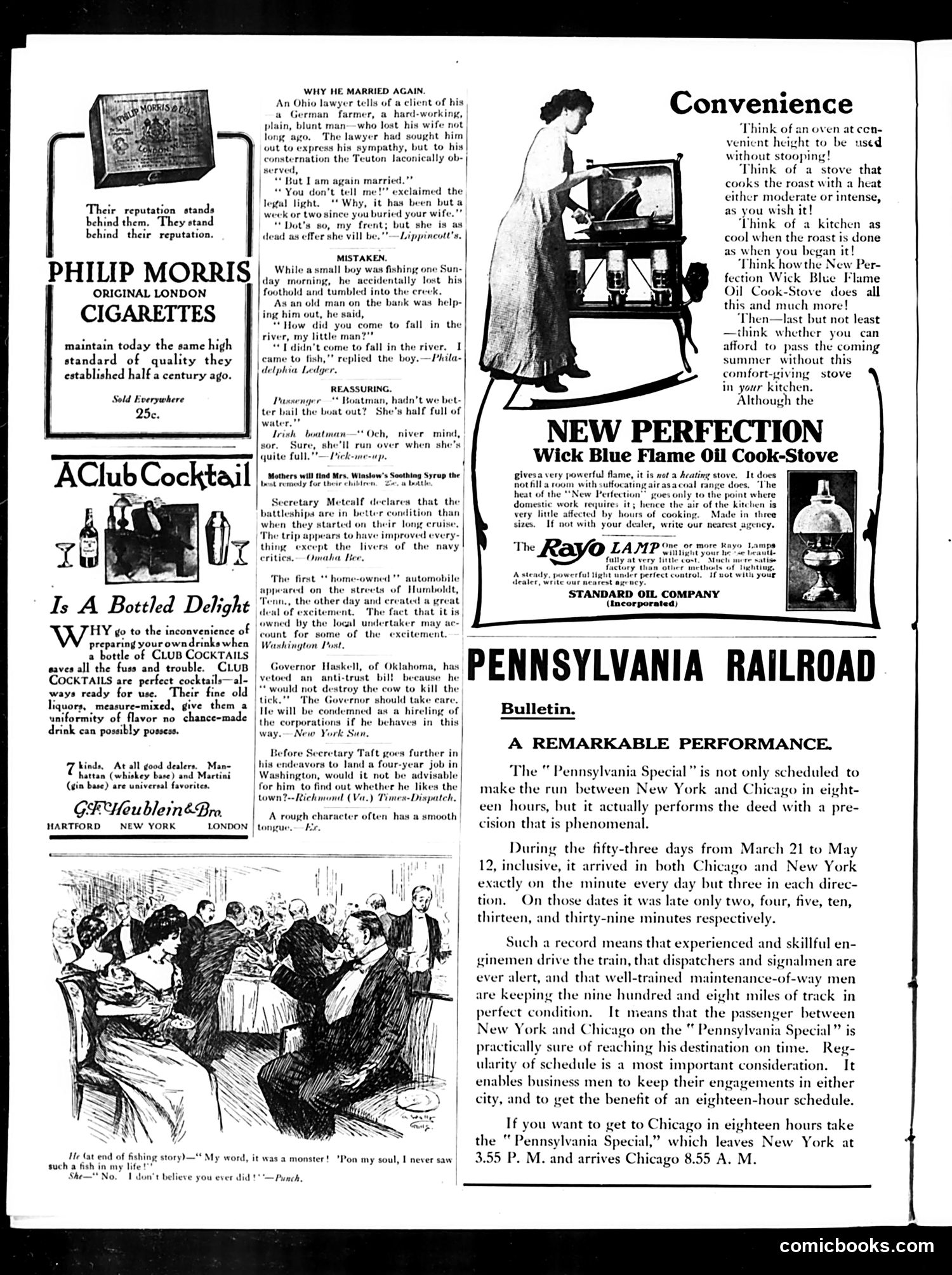
This page is primarily **advertising**, with several anecdotal humor pieces interspersed. The main cartoons/jokes are brief and ethnic in character—typical of early 20th-century American humor. One features a German farmer character ("Dot's so, my frent") who remarried, his comedic motivation being practical convenience (an oven at convenient height, a stove). Another involves an Irish boatman speaking in dialect. These relied on ethnic stereotype humor common to the period. The page is dominated by product advertisements: Philip Morris cigarettes, Club Cocktails, a New Perfection Wick Blue Flame Oil Cook-Stove (marketed for kitchen convenience), and a Pennsylvania Railroad "Pennsylvania Special" train service bulletin promoting its 18-hour schedule reliability between New York and Chicago. The humor and advertising reflect turn-of-the-century American consumer culture and period-typical reliance on ethnic caricature for comedic effect.
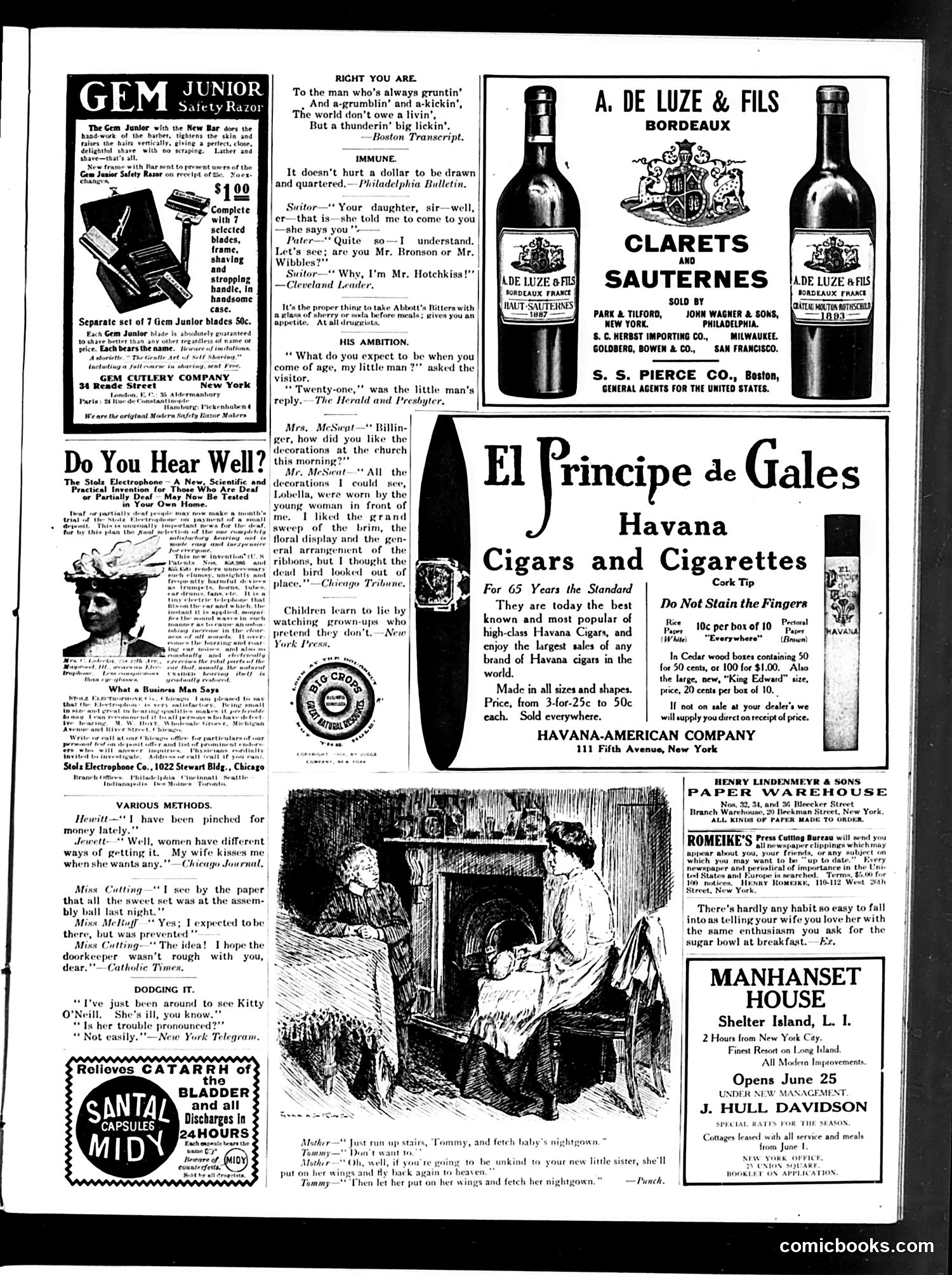
This is primarily an **advertising page** from Judge magazine, with minimal editorial content. The few satirical items are brief: **"Right You Are"** — A short joke mocking complainers who grumble endlessly but accept their fate without real resistance. The satire is mild social commentary on human nature. **"His Ambition"** — A child's joke where a visitor asks a boy what he wants to be, and the boy replies "twenty-one"—meaning he simply wants to reach adulthood rather than achieve any specific career. It satirizes childhood naiveté. **"Various Methods"** and **"Dodging It"** — Quick one-liners about domestic life and courtship, with predictable humor about how women manipulate men through affection. The rest of the page consists of period advertisements for **safety razors, wine, cigars, hearing aids, paper products, and real estate**—reflecting early 20th-century consumer goods aimed at middle-class readers. No significant political content is present.
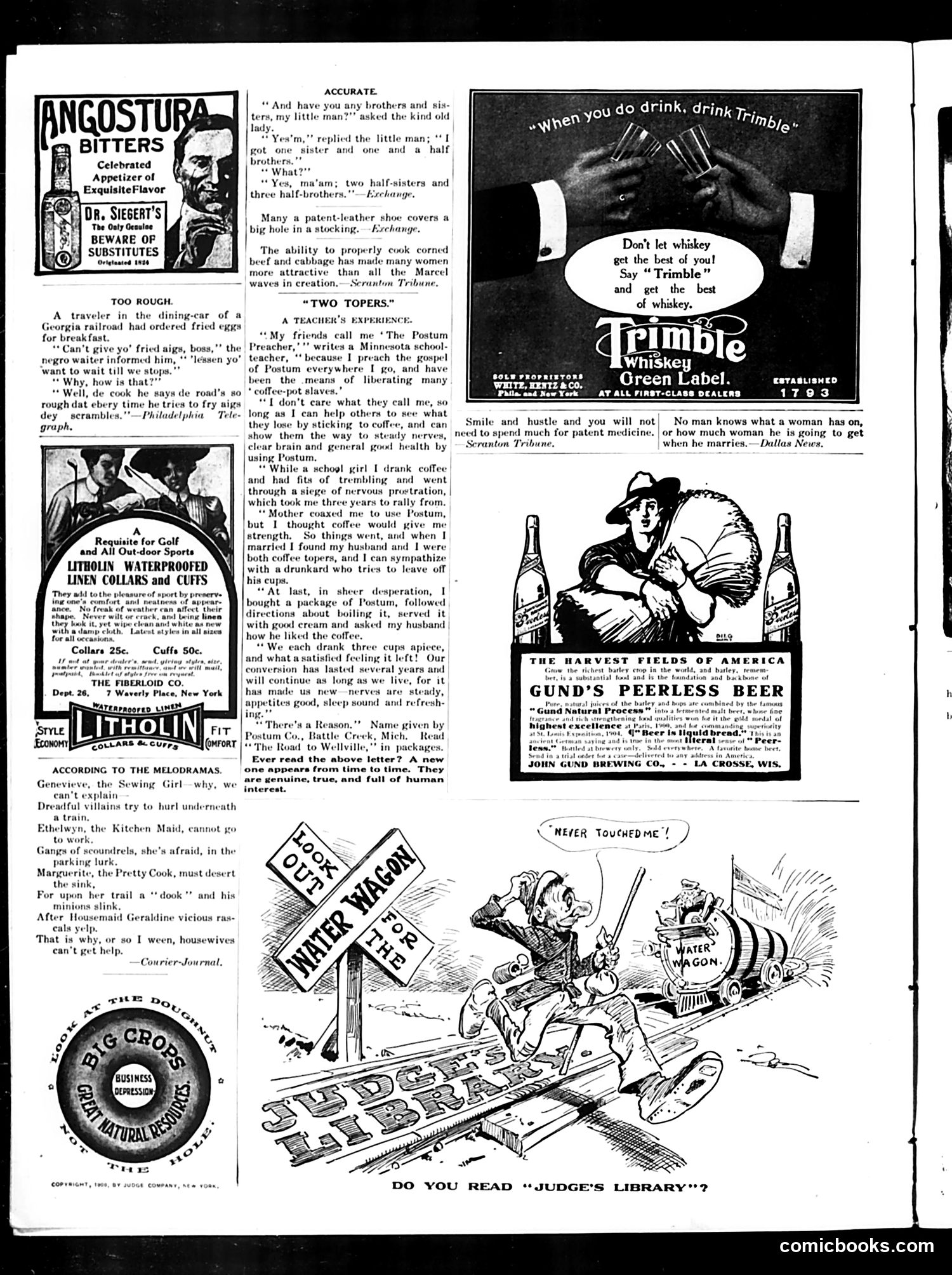
This page is primarily **advertising and miscellaneous content** rather than political satire. Key elements: **"Too Rough"** (top left): A racist joke about a Black railroad waiter unable to fry eggs properly—a crude stereotype of the era reflecting Jim Crow attitudes. **"Accurate" and "Two Topers"**: Anecdotes praising Postum (a caffeine-free coffee substitute), reflecting early 1900s health fads and temperance movement sympathies. **Advertisements**: Angostura Bitters, Litholin collars, and Trimble Whiskey dominate the page. The Gund's beer ad emphasizes American agriculture. **Bottom cartoon**: A crude illustration showing a character hit by wagons labeled "WINTER WAGON" and "SUMMER WAGON"—likely commenting on seasonal business cycles or hardship. **Bottom quotes**: Brief quips about gender relations reflecting period misogyny. The page showcases Judge as a vehicle for advertising and light humor rather than sharp political commentary, with content reflecting early 20th-century commercial and social attitudes.
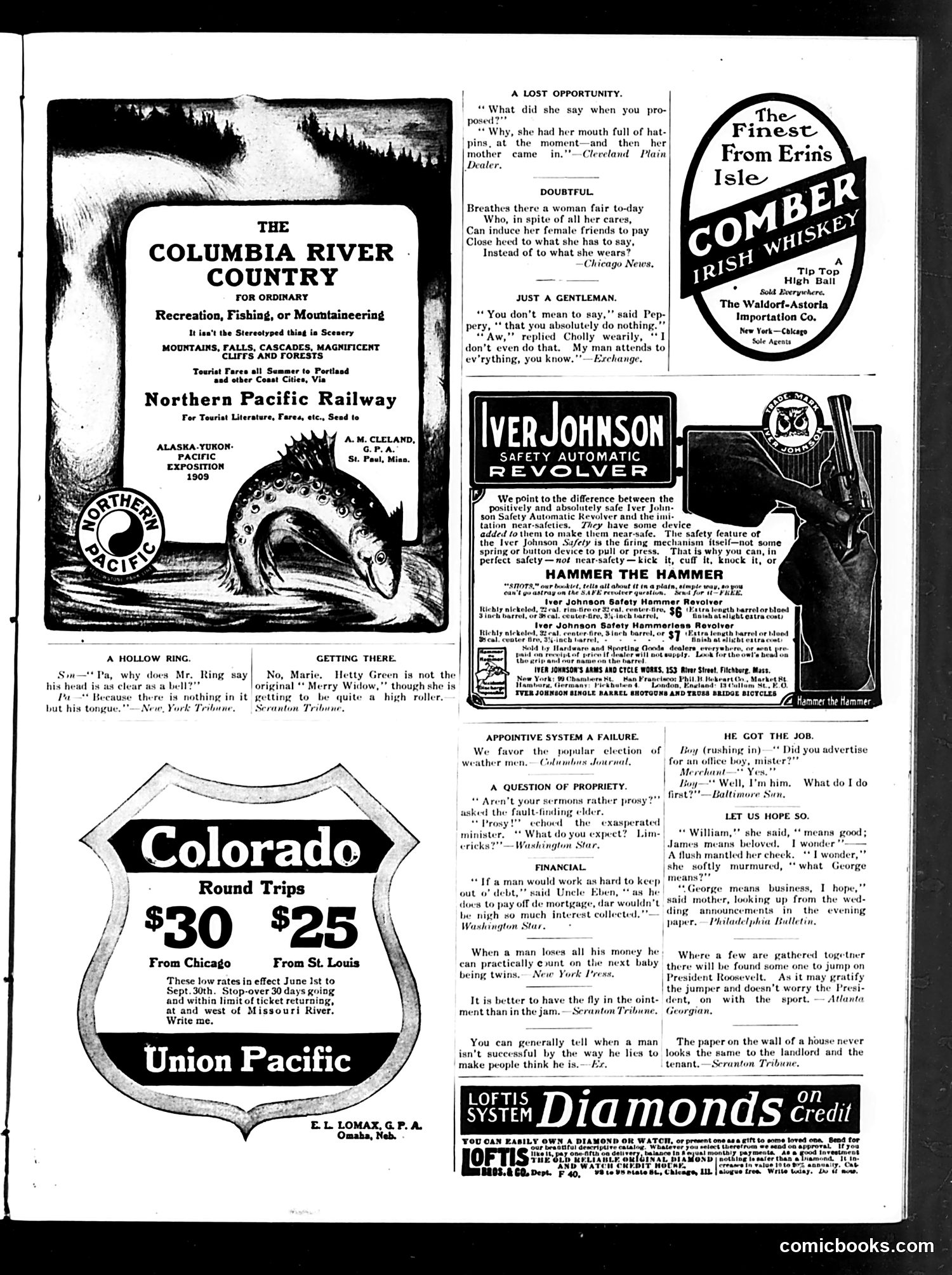
This page is primarily **advertising and humorous filler content** rather than political satire. It contains: **Main Elements:** - Travel advertisements (Northern Pacific Railway, Union Pacific Colorado trips) - Product ads (Iver Johnson Safety Revolver, Loftis Diamonds) - Brief humor columns with short jokes and quips **The Humor:** The jokes target early 1900s social conventions: a woman distracted by hatpins, a wealthy society gentleman ("Cholly") too idle to do anything himself, Hetty Green (real historical figure known for wealth and eccentricity) as a "merry widow," and various observations about debt, sermons, and marriage. **Historical Context:** References to "the Waldorf-Astoria" and idle wealthy men reflect turn-of-the-century American class consciousness. The Hetty Green reference suggests she was a notable public figure of gossip. **Bottom Line:** This appears to be a typical Judge magazine page mixing travel/product marketing with light social satire—nothing addressing major political events or figures.
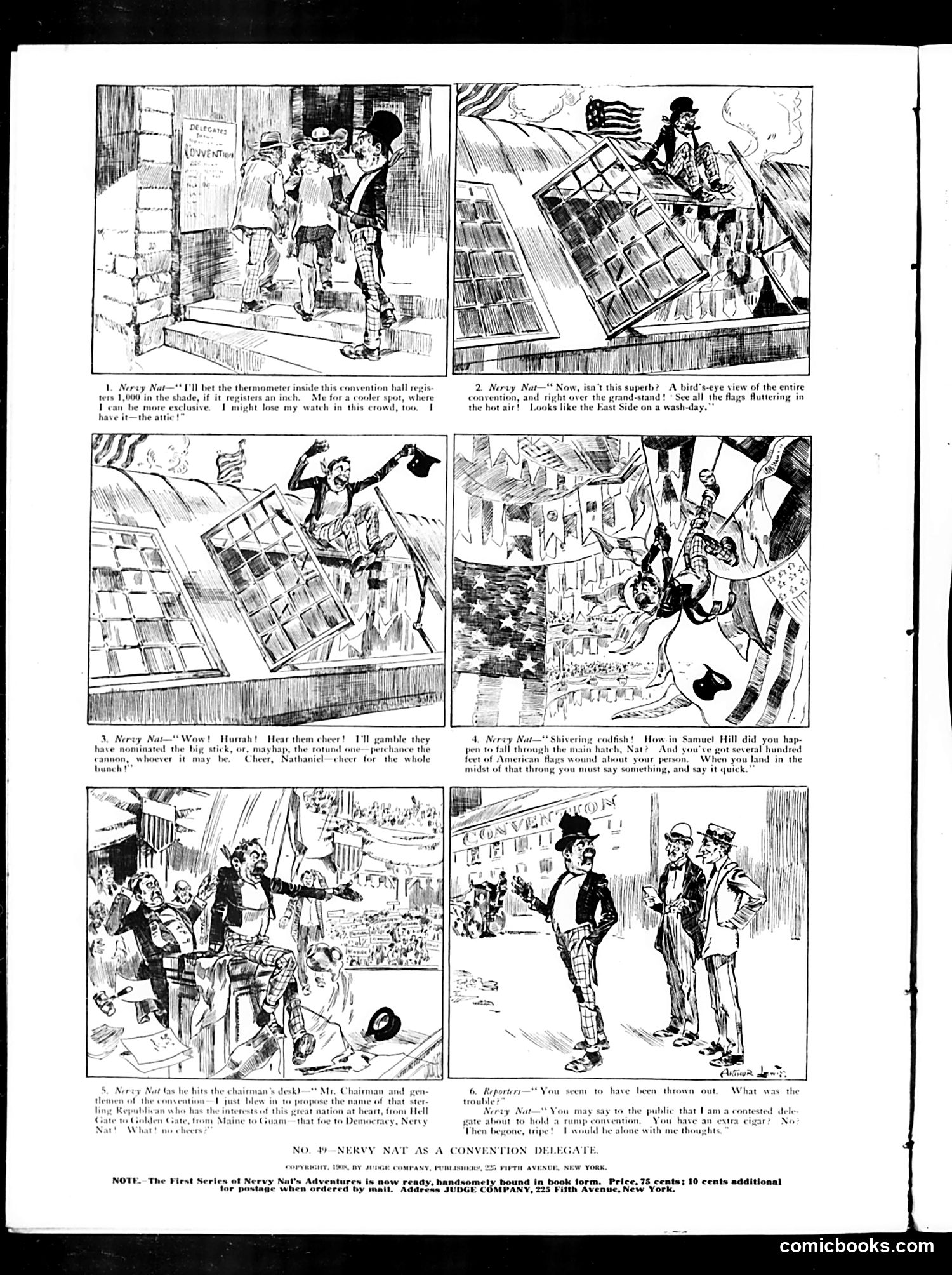
This is a comic strip following "Nervy Nat," an apparently resourceful character navigating a convention (likely political). The six-panel sequence shows Nat: 1. Sneaking a thermometer into a convention hall to measure temperature 2. Observing the convention from an elevated vantage point with American flags 3. Causing chaos—people gamble and cheer as he disrupts proceedings 4. Creating mayhem with American flags used as weapons 5. Participating in convention floor activities with visible crowds 6. Discussing his convention experience with other characters The humor relies on Nat's "nervy" (bold, mischievous) personality causing disruption at what appears to be a formal political gathering. The satire seems to mock convention delegates as easily excitable and prone to chaos. Without specific date information visible, the exact political convention targeted remains unclear, though the emphasis on flags and formal proceedings suggests a major party convention.
This is a **product advertisement**, not political satire. It promotes White Rock brand table water, which the tagline identifies as "The World's Best Table Water." The image depicts a woman in classical/allegorical style—a common advertising convention of the era—posed near a White Rock bottle and natural scenery. This artistic approach was typical of early 20th-century marketing, using idealized feminine figures to suggest purity, naturalness, and refinement. The advertisement capitalizes on contemporary consumer interest in "pure" bottled water as a health product. The classical imagery aims to associate the product with timeless quality and luxury rather than making any political or social commentary. This represents straightforward commercial advertising rather than satirical editorial content.
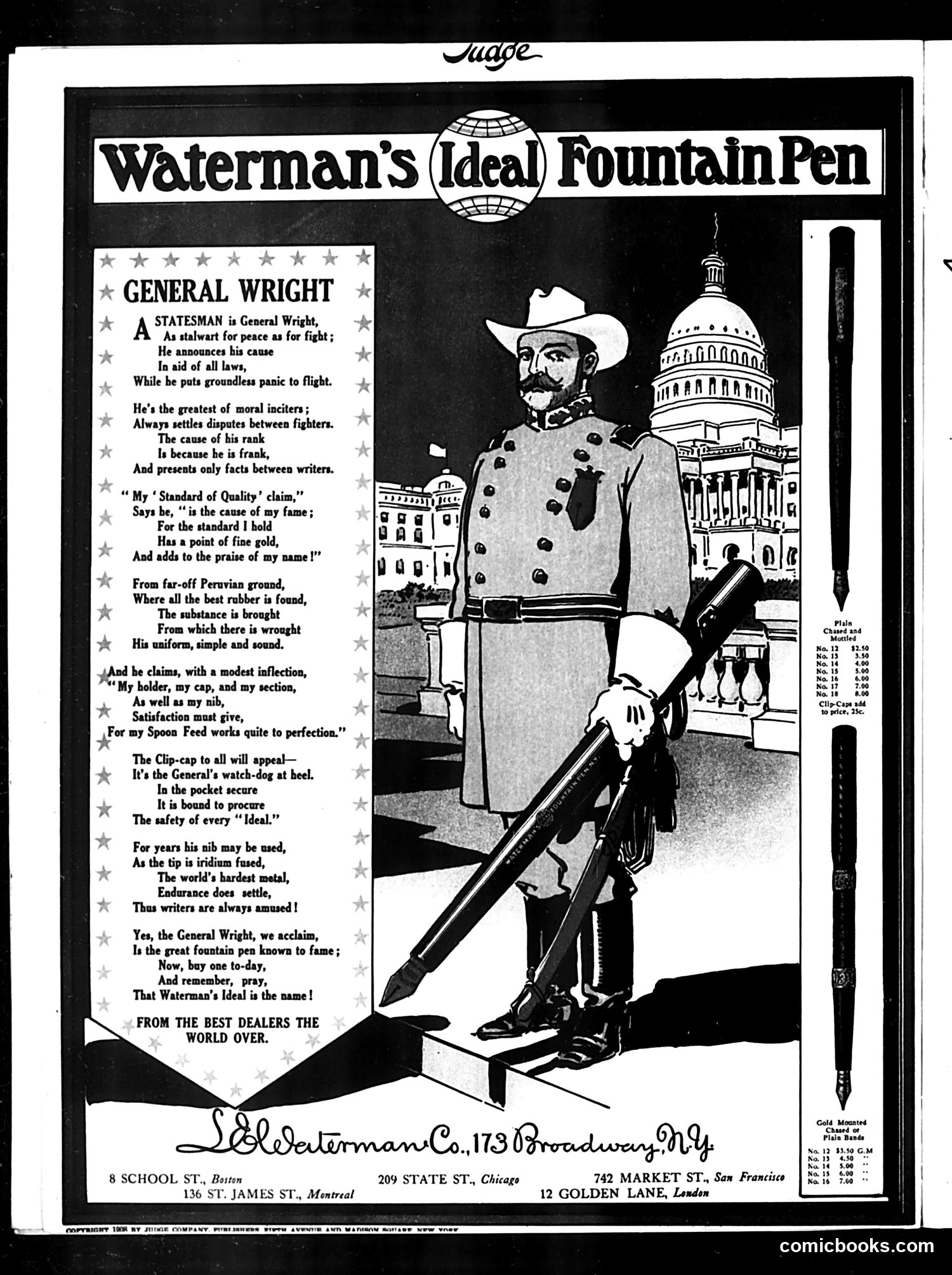
This is primarily a **commercial advertisement** disguised as satirical content in Judge magazine. The "General Wright" is a fictional character created to promote Waterman's "Ideal" fountain pens through elaborate wordplay and mock-heroic verse. The satire works by presenting the pen's features (clip-cap, iridium-tipped nib, rubber components from Peru, "Spoon Feed" mechanism) as though General Wright were a real military or political statesman announcing his virtues. Phrases like "Standard of Quality," "moral inciters," and settling "disputes between fighters" humorously anthropomorphize the pen's practical qualities. The illustration shows a mustachioed general in military dress posing with an oversized fountain pen near the Capitol building, emphasizing the pen's importance and prestige. The joke relies on treating commercial attributes with exaggerated political gravitas—a common advertising strategy of the era that exploited Judge's satirical format to sell products while entertaining readers.