
A complete issue · 16 pages · 1908
Judge — June 13, 1908
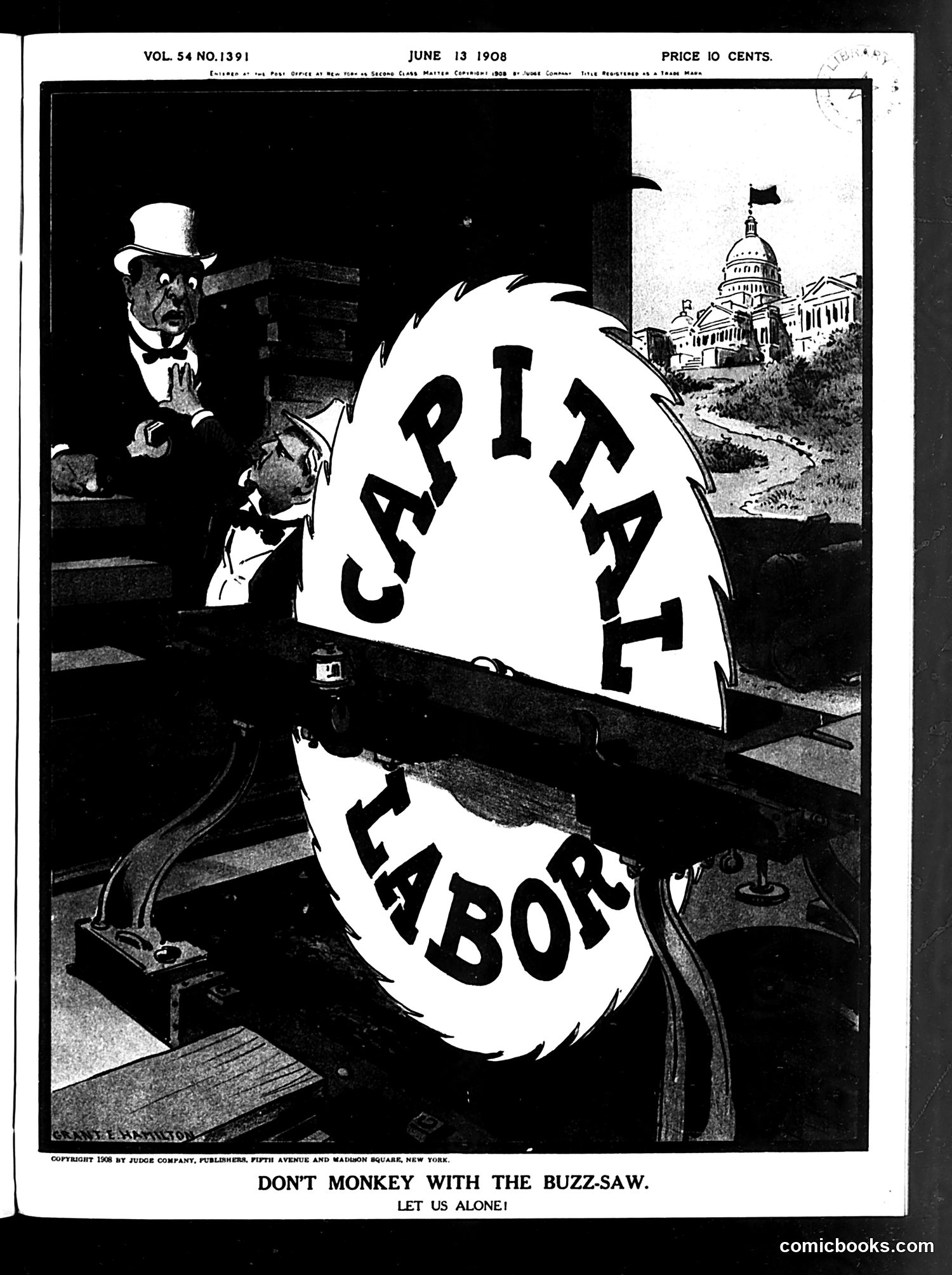
This June 1908 political cartoon uses a mechanical metaphor to warn against interference with labor. The large gear labeled "CAPITAL LABOR" represents the functioning economic machine, while a sinister figure in top hat (likely representing either a political agitator or problematic political figure) attempts to disrupt it with a saw labeled "CAPITAL" and "LABOR." The Capitol building visible in the background suggests this addresses Congressional or federal policy. The caption's warning—"Don't monkey with the buzz-saw"—urges politicians to leave labor-capital relations undisturbed, implying that tampering risks dangerous consequences for the entire economy. The cartoon reflects Progressive Era tensions between labor and capital, warning against radical intervention rather than advocating worker protection.
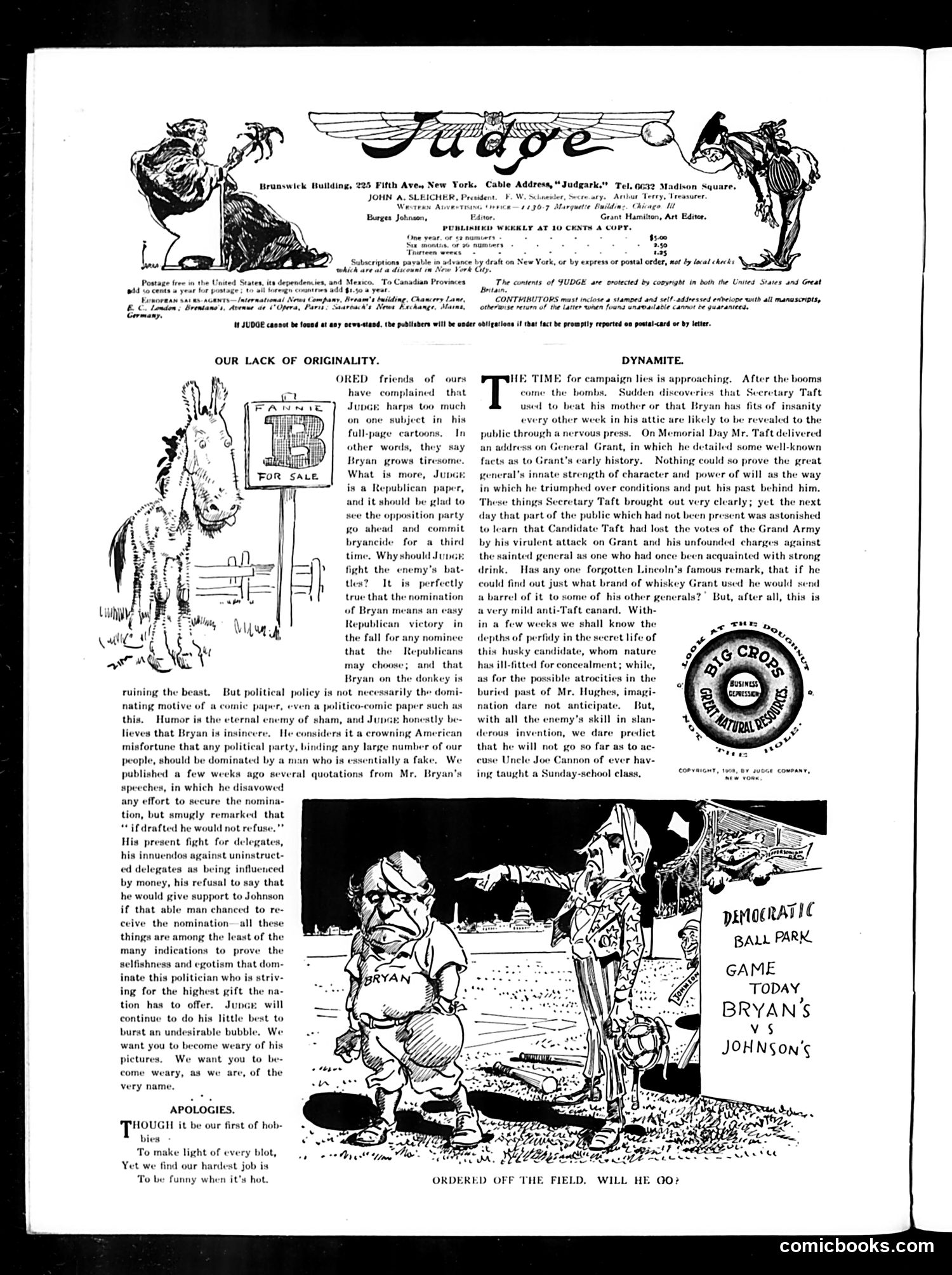
This page satirizes William Jennings Bryan's 1908 presidential campaign. The main cartoon depicts Bryan as a donkey (the Democratic Party symbol), labeled "BRYAN," being "ORDERED OFF THE FIELD" by a baseball umpire—suggesting Bryan should withdraw from the race. The text "OUR LACK OF ORIGINALITY" criticizes Bryan for repeating campaign tactics and arguments from previous elections, calling his continued political activity tiresome. The accompanying article "DYNAMITE" discusses Bryan's attacks on President Taft and Grant's legacy, portraying Bryan as using recycled ammunition against opponents. A smaller notice advertises a "Democratic Ball Park Game: Bryan vs Johnson's," continuing the baseball metaphor to mock the campaign's predictability and lack of fresh ideas.
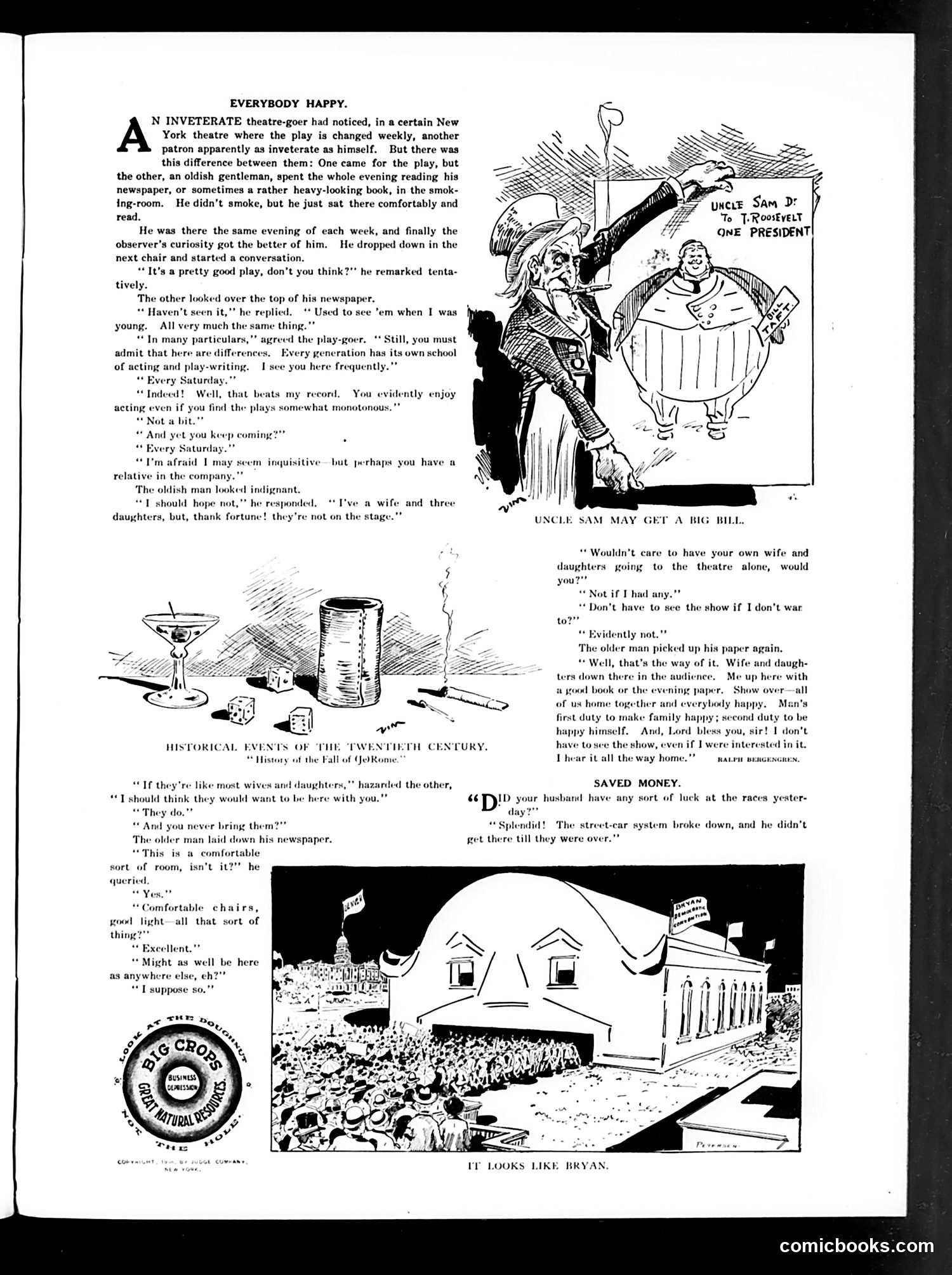
The page contains several satirical pieces. The top cartoon "Uncle Sam May Get a Big Bill" depicts Uncle Sam confronting a woman (likely representing a wife or family member) about theater expenses, satirizing the cost of entertainment and domestic spending debates. The middle section "Historical Events of the Twentieth Century: History of the Fall of Rome" uses Rome's fall as an allegory for contemporary social decline, with the dialogue suggesting wives and daughters attending theaters unsupervised—a social anxiety of the era. The bottom cartoon "It Looks Like Bryan" shows a large face-shaped structure surrounded by crowds, likely mocking William Jennings Bryan's political ambitions or public persona during his presidential campaigns. The overall page satirizes early-20th-century domestic economics, women's social independence, and political figures through historical and contemporary references.
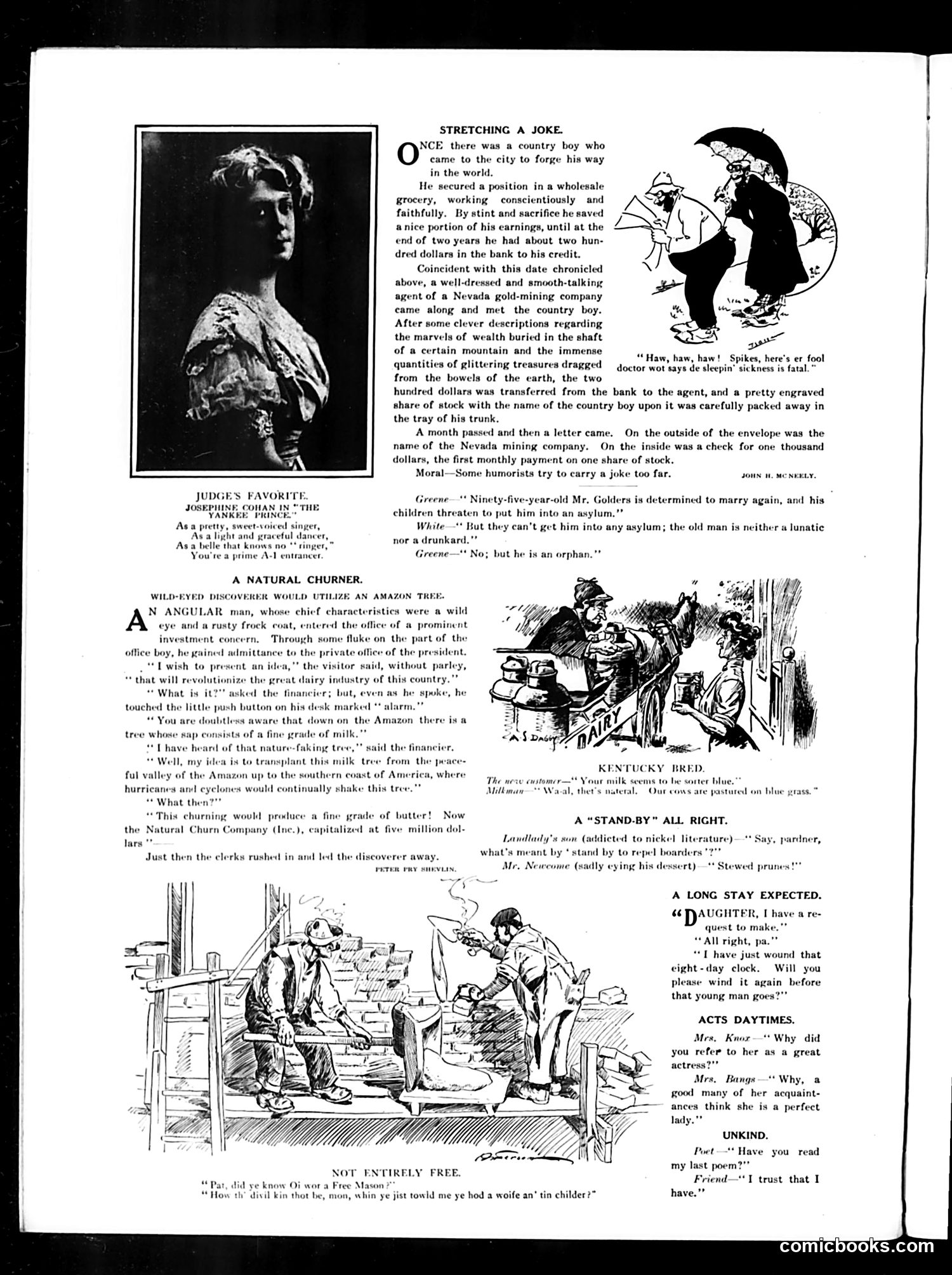
This page contains several short humorous pieces and anecdotes rather than political cartoons. The main content includes: **"Stretching a Joke"**: A story about a country boy who saves money at a grocery job, then gets swindled by a Nevada gold-mining company agent who tricks him into investing his $200 savings in worthless stock. **"A Natural Churner"**: A satirical piece mocking a businessman's absurd proposal to harvest milk from Amazon tree sap, lampooning get-rich-quick schemes and industrial ignorance. **Other brief jokes** about Free Masonry, Irish dialect humor, and social observations. The page reflects late 19th/early 20th-century American humor emphasizing swindles, rural naiveté, and ethnic stereotypes—common satirical targets in *Judge* magazine's social commentary on greed and gullibility.
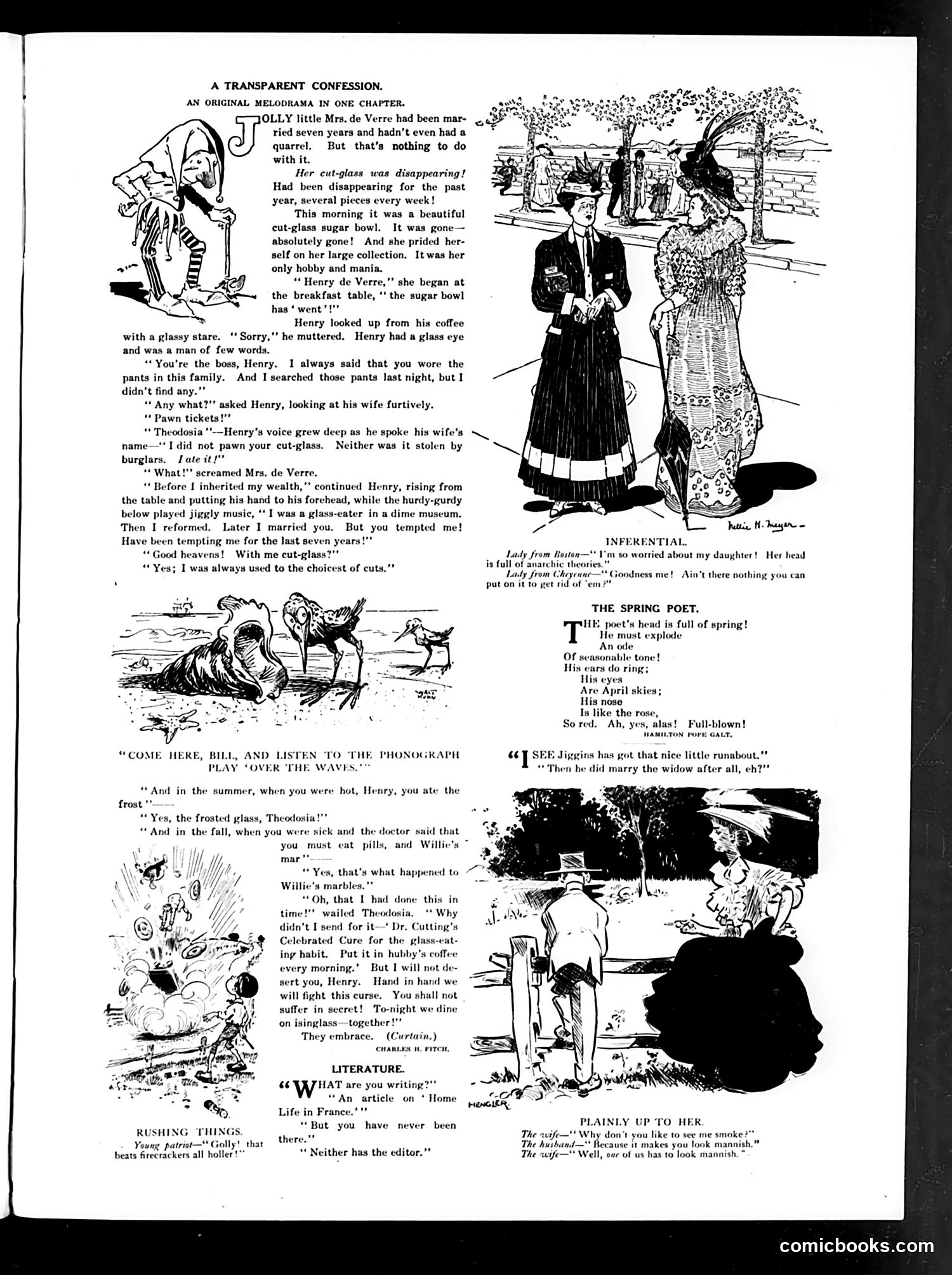
This page contains multiple short satirical pieces rather than a single political cartoon. **"A Transparent Confession"** depicts a domestic dispute where Henry confesses to his wife Theodsia that he stole her cut-glass sugar bowl years ago while working as a "sidecar in a dime museum." The satire mocks his delayed confession and her obsessive attachment to the missing object—poking fun at both marital dynamics and Victorian-era materialism around decorative glass collections. The other pieces ("The Spring Poet," "Literature," "Plainly Up to Her," "Rushing Things") are brief humor vignettes targeting contemporary targets like pretentious poetry, failed writers, and social awkwardness. The cartoons use exaggerated illustration styles typical of Judge's comedic approach to everyday middle-class life rather than political satire.
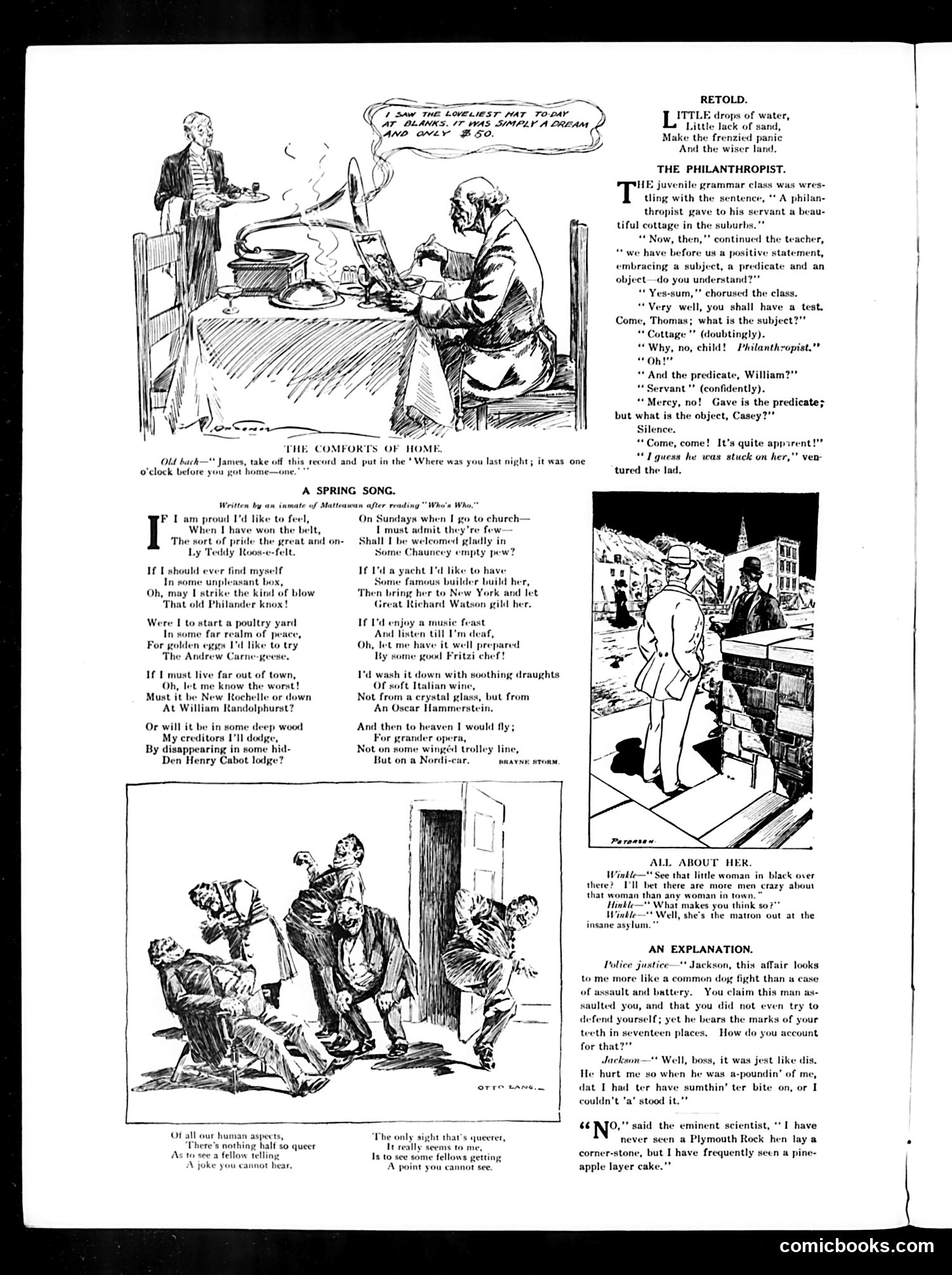
This page contains multiple satirical pieces targeting American social and political figures of the era. **"The Philanthropist"** mocks wealthy philanthropists through a grammar lesson where a student defines "philanthropist" as someone who "gave" to a servant—satirizing the performative charity of the rich. **"A Spring Song"** appears to parody aspirational daydreams, referencing real figures like Teddy Roosevelt, William Randolph Hearst, and others. The framing note mentions it's "written by an inmate of Matteawan"—a state psychiatric hospital—suggesting the fantasies are products of mental illness, darkly comedic commentary on American aspiration. **"All About Her"** and **"An Explanation"** are brief joke pieces about a woman in an asylum and a police court case involving assault. The overall tone is typical Judge magazine fare: punching down at the mentally ill, the poor, and lower classes while simultaneously mocking wealthy philanthropists and society figures. The humor relies on class-based stereotypes and institutional settings as inherently comic.
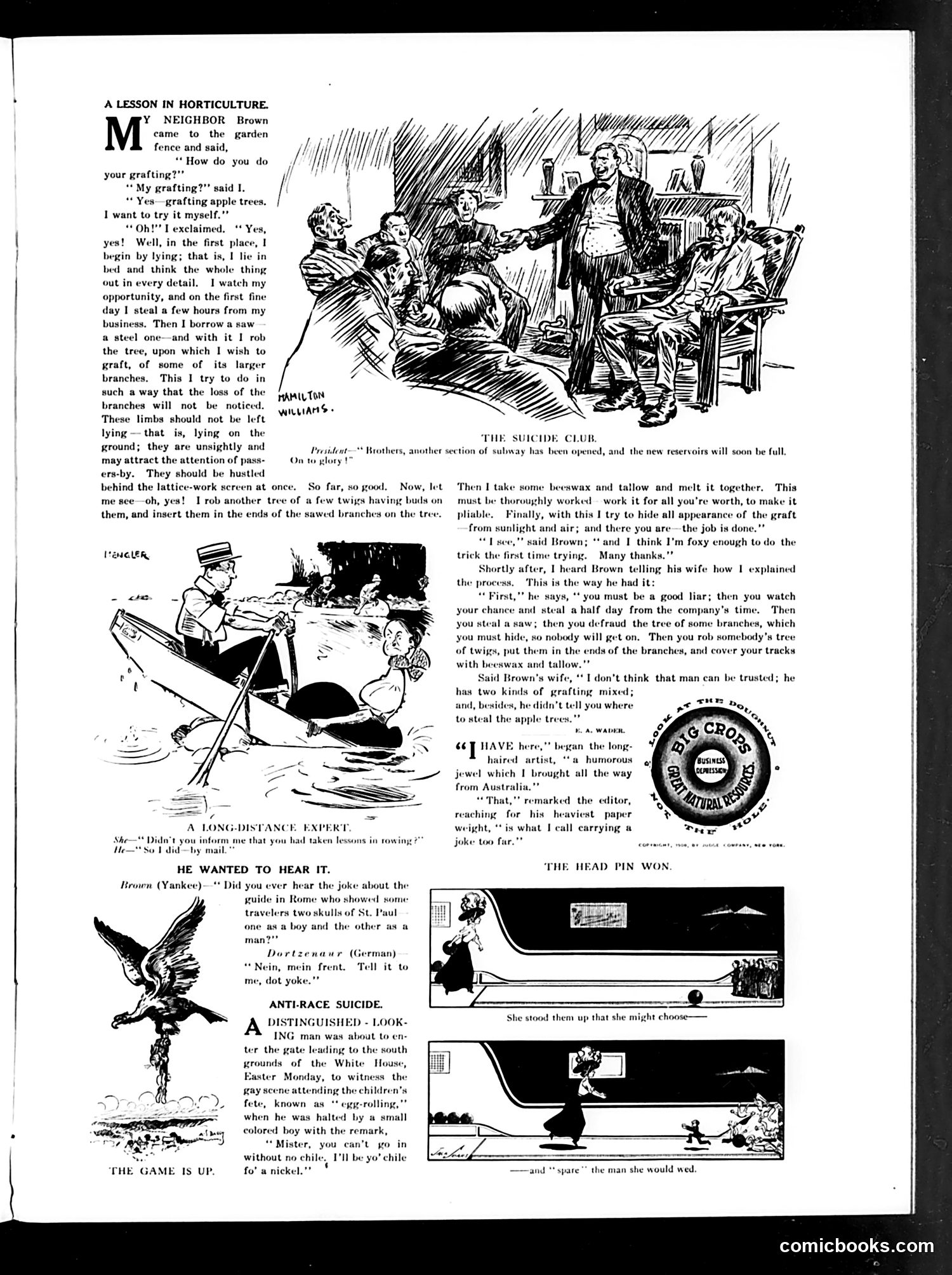
This page contains several unrelated satirical pieces typical of Judge's format. **"A Lesson in Horticulture"** presents a humorous dialogue where narrator Brown explains apple tree grafting in euphemistic language—actually describing theft and fraud (stealing time from work, stealing branches from neighbors' trees, hiding evidence). The joke satirizes dishonesty disguised in technical jargon. Brown's wife later exposes the deception, noting he "has two kinds of grafting mixed" and omitted where to steal the apple tree itself—the humor lies in treating larceny as horticultural technique. **"The Suicide Club"** cartoon appears to reference subway construction and water reservoirs, though context is unclear. **"Anti-Race Suicide"** cartoon references the early 1900s "race suicide" panic—a nativist concern about declining birth rates among white Americans. A distinguished man cannot enter the White House children's event without a child, forcing him to "rent" a Black child for a nickel, satirizing anxieties about demographic change. The remaining pieces are brief joke items with minimal political content.
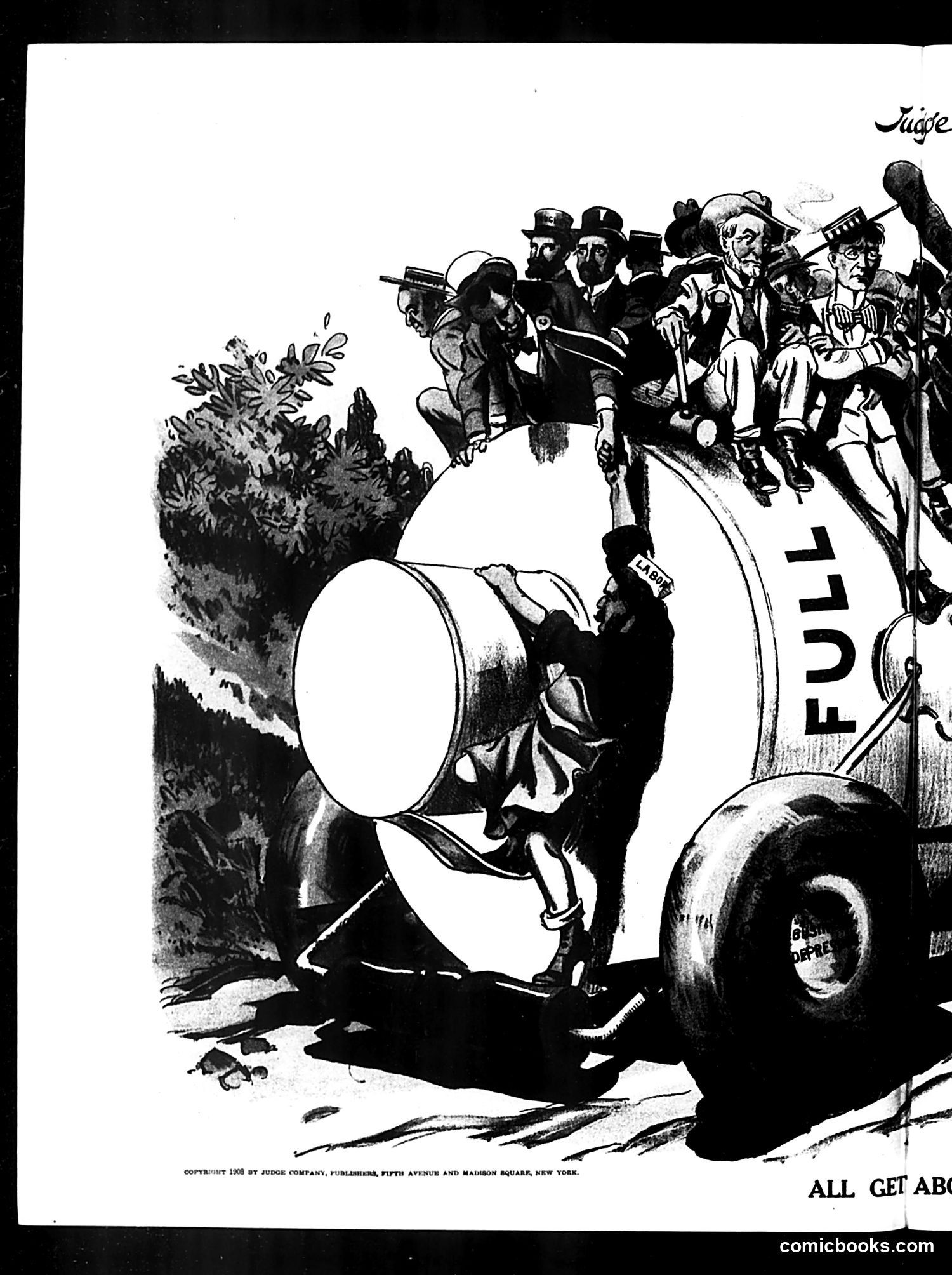
This appears to be a satirical cartoon from *Judge* magazine (copyright 1908) depicting a confrontation between a large, menacing figure on the left—likely representing a destructive force or problem—and military or armed officials on the right labeled "FULL" (possibly referring to "full force" or a full response). The cartoon satirizes a conflict or crisis requiring armed intervention. A lone figure in the center appears to be attempting negotiation or confrontation with the threatening force. The armed officials aboard what seems to be military equipment suggest governmental response to a perceived threat. Without clearer text or historical context visible in the image, the specific political issue—whether labor unrest, foreign threat, or domestic conflict—remains unclear, though the 1908 date suggests early 20th-century American concerns.
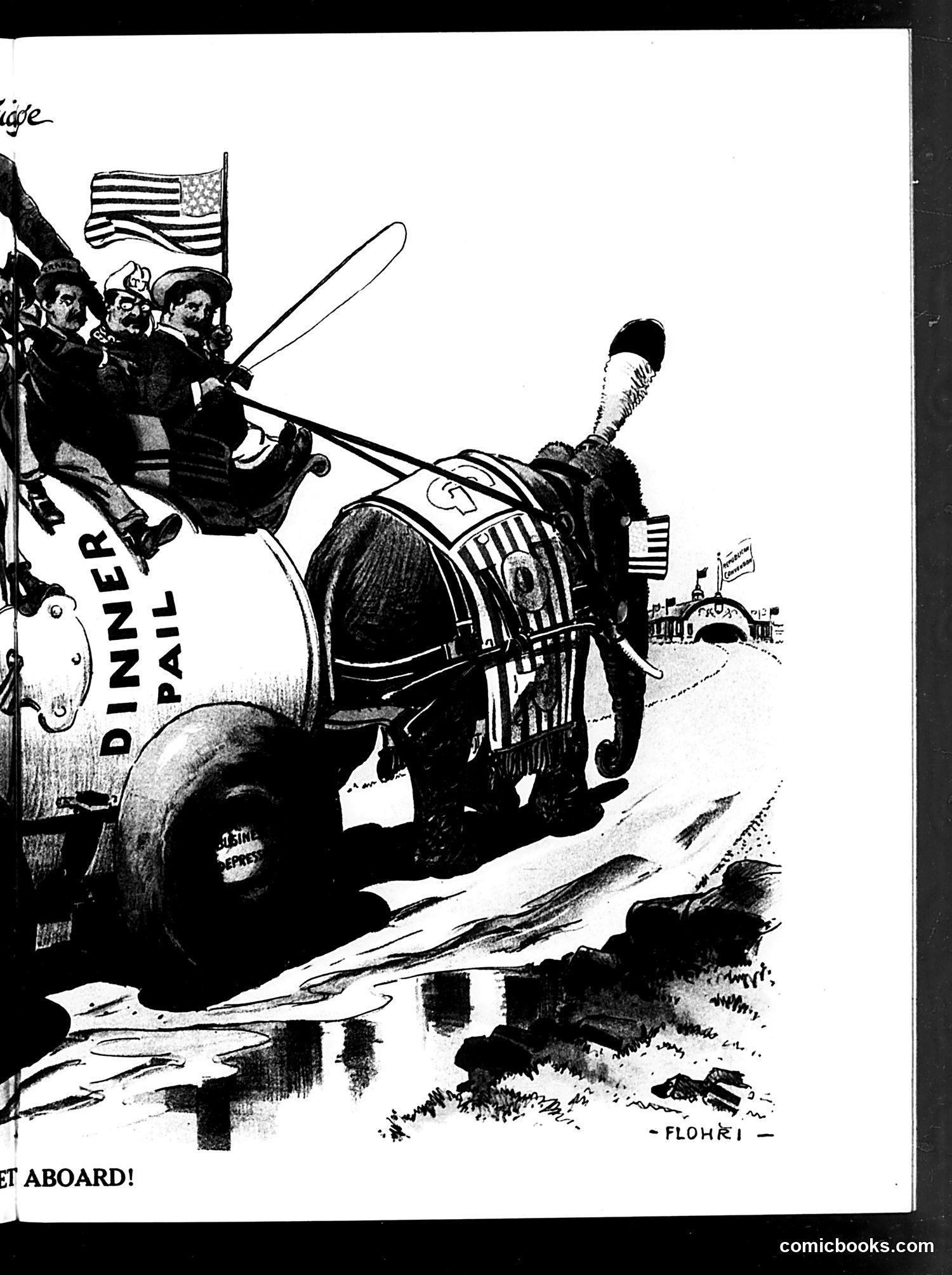
This cartoon depicts an elephant labeled "DINNER PAIL" being pulled by American soldiers carrying the U.S. flag. The phrase "ALL ABOARD!" suggests momentum or progression. The "dinner pail" was a common metaphor in early 20th-century American politics, symbolizing workers' economic prosperity and employment. The soldiers appear to be leading this symbol of prosperity forward, likely representing a political party or administration claiming credit for economic conditions. The cartoon's message seems to be satirizing political rhetoric about prosperity and military/national strength, possibly suggesting that promises of economic well-being are being used as propaganda. The detailed soldier figures and patriotic imagery contrast with the beast-of-burden elephant, implying skepticism about these claims. Without a visible date or clearer context, the specific historical reference remains unclear.
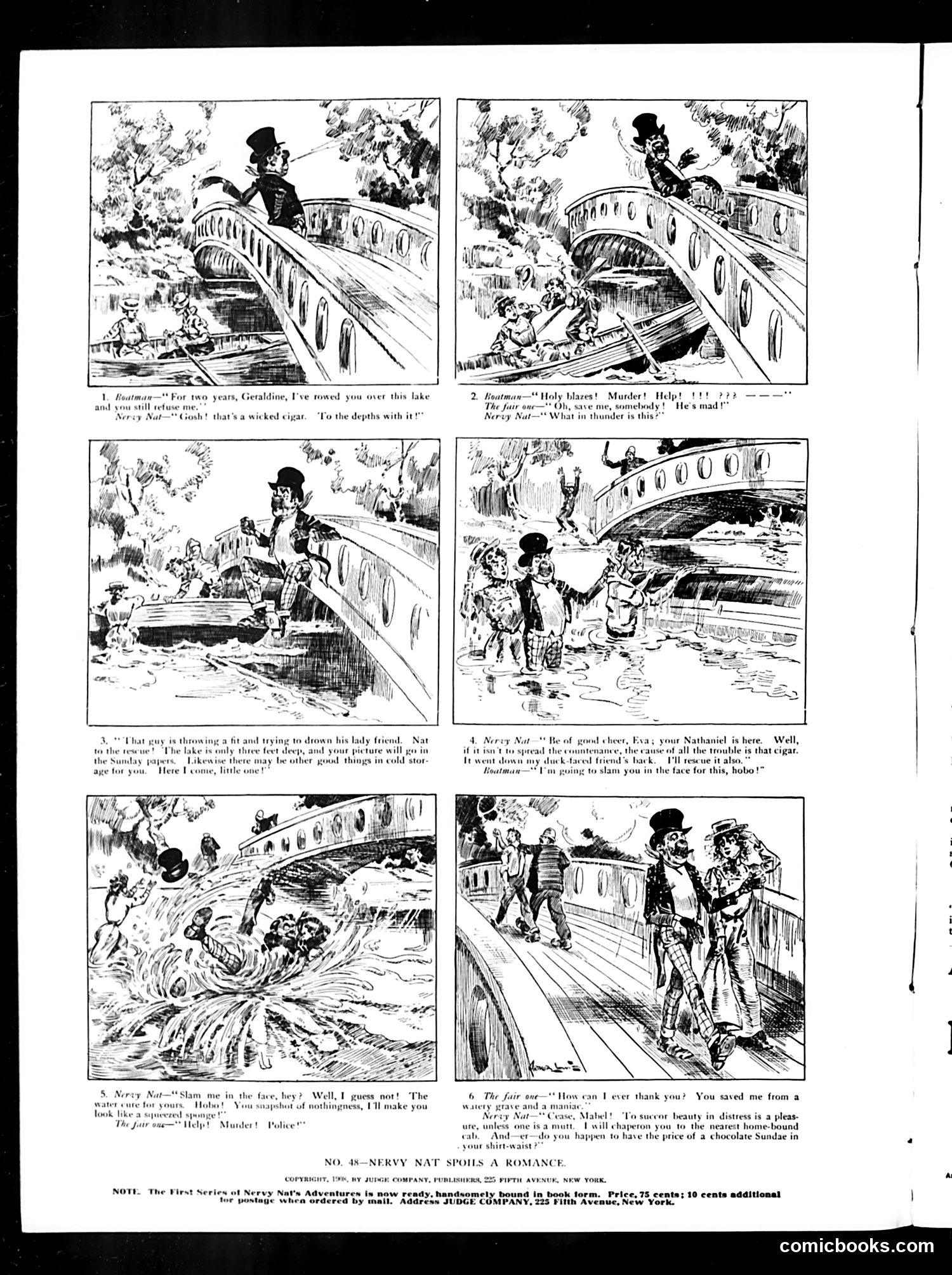
This is a six-panel comic strip following a character named Nat. The plot: a well-dressed man (Boatsman) has been romancing a woman (Geraldine) by ferrying her across a lake. When Nat arrives and throws a "wicked cigar" into the water, it creates chaos—people cry "Murder!" and fall in. The satire targets **turn-of-the-century courtship rituals** and male presumption. The "nervy" Nat disrupts a romantic moment through crude behavior (the offensive cigar), yet responds with mock-gallantry, offering to "chaperon" the distressed woman home while impudently asking if she has money for a chocolate sundae. The joke hinges on **class satire**: Nat's brash, poor manners and financial neediness contrast sharply with Boatsman's genteel courtship performance. The comic mocks both the artificiality of romantic posturing and the audacity of working-class presumption.
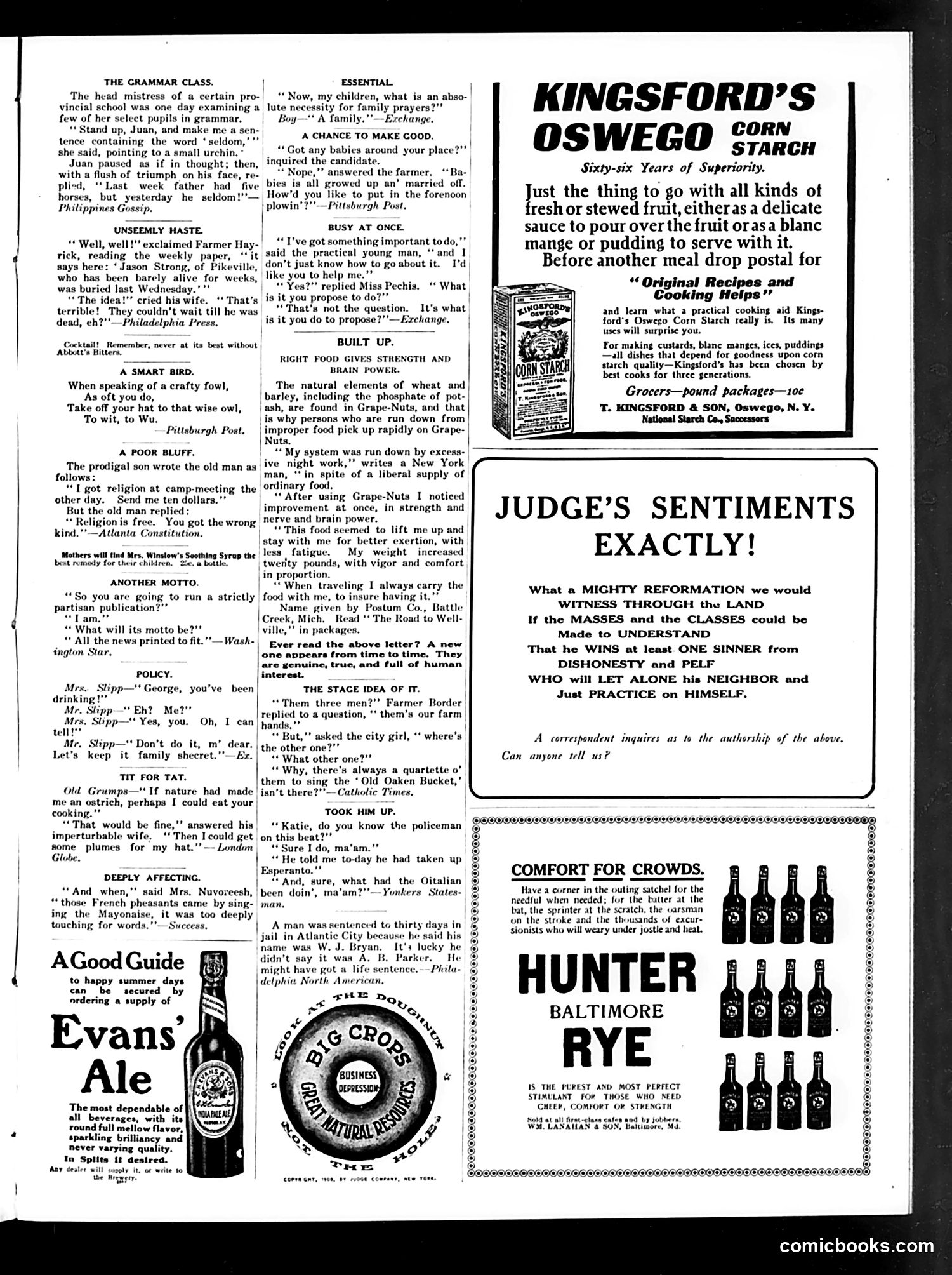
This page from *Judge* magazine consists primarily of short humorous anecdotes and advertisements rather than political cartoons. The jokes satirize everyday situations: a schoolboy's grammatical error about horses and "seldom," a farmer's practicality about grown children, a city girl's misunderstanding of farm life (expecting four men to sing "Old Oaken Bucket"), and marital banter about cooking and fashion. The humor is gentle domestic satire—poking fun at rural/urban differences, miscommunication, and family dynamics—typical of early 20th-century American humor magazines. There's no apparent political commentary. The advertisements for Evans Ale, Kingsford's Corn Starch, and Hunter Baltimore Rye occupy significant space, suggesting this is a commercial publication mixing entertainment with paid promotions rather than a primarily satirical or political issue.
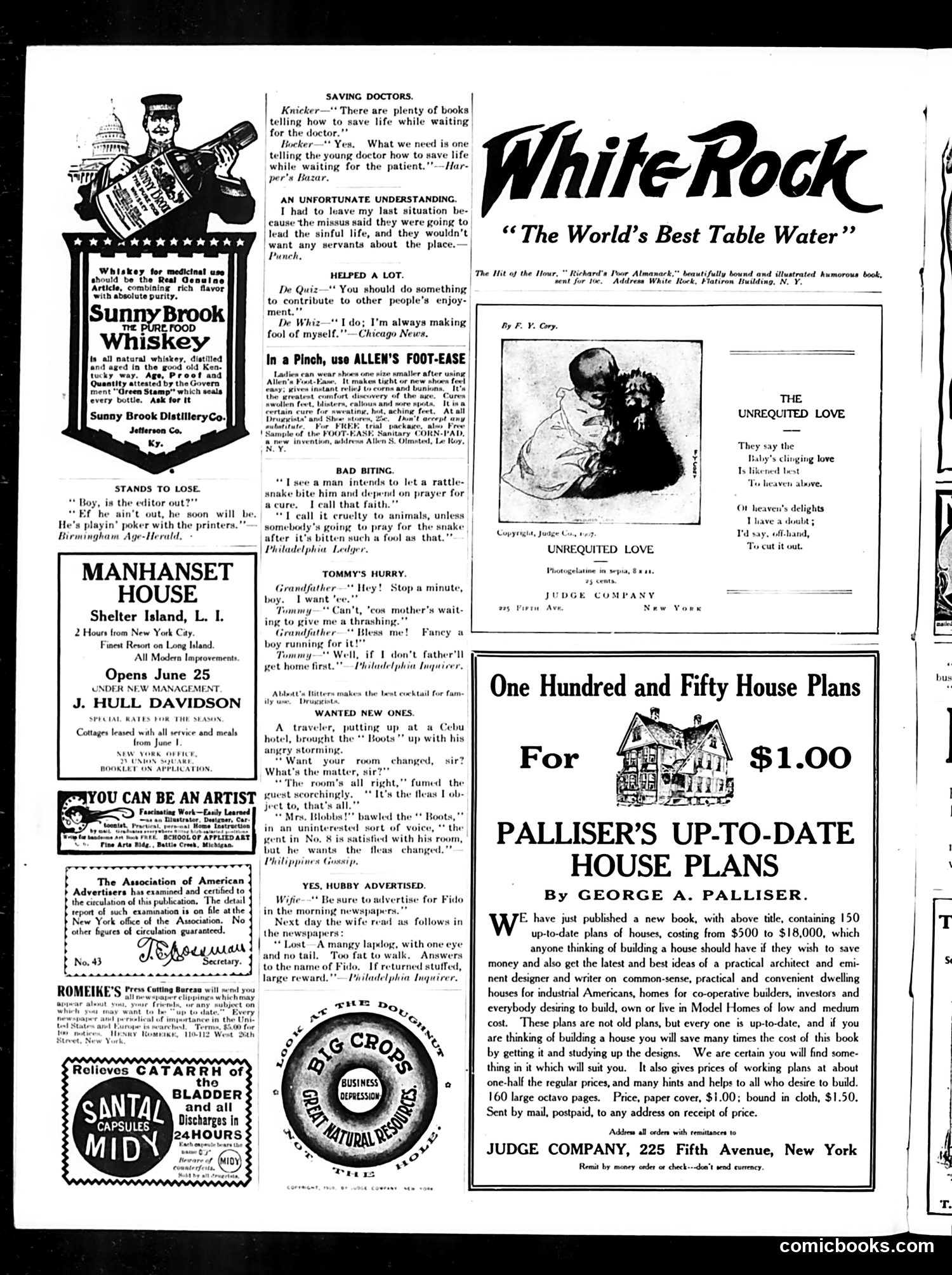
This is primarily an **advertising and humor page** from Judge magazine, a satirical weekly. The content mixes short jokes with product advertisements typical of early 20th-century publications. The humorous items are brief, topical quips about everyday life: - A joke about an editor playing poker instead of working - Wordplay about "saving doctors" (books on saving lives vs. saving money on doctor visits) - Domestic humor about servants, children, and lost pets - A recurring joke about a traveler complaining about fleas in his hotel room These jokes reflect common middle-class concerns: workplace productivity, domestic service, child discipline, and travel inconveniences. The advertisements promote whiskey, real estate, house plans, and other consumer goods to Judge's affluent readership. A prominent ad for "Palliser's Up-to-Date House Plans" ($1.00) targets homeowners interested in building modest residences ($500-$18,000). The page contains **no significant political satire or caricature**—it's primarily commercial content with mild domestic humor typical of the era.
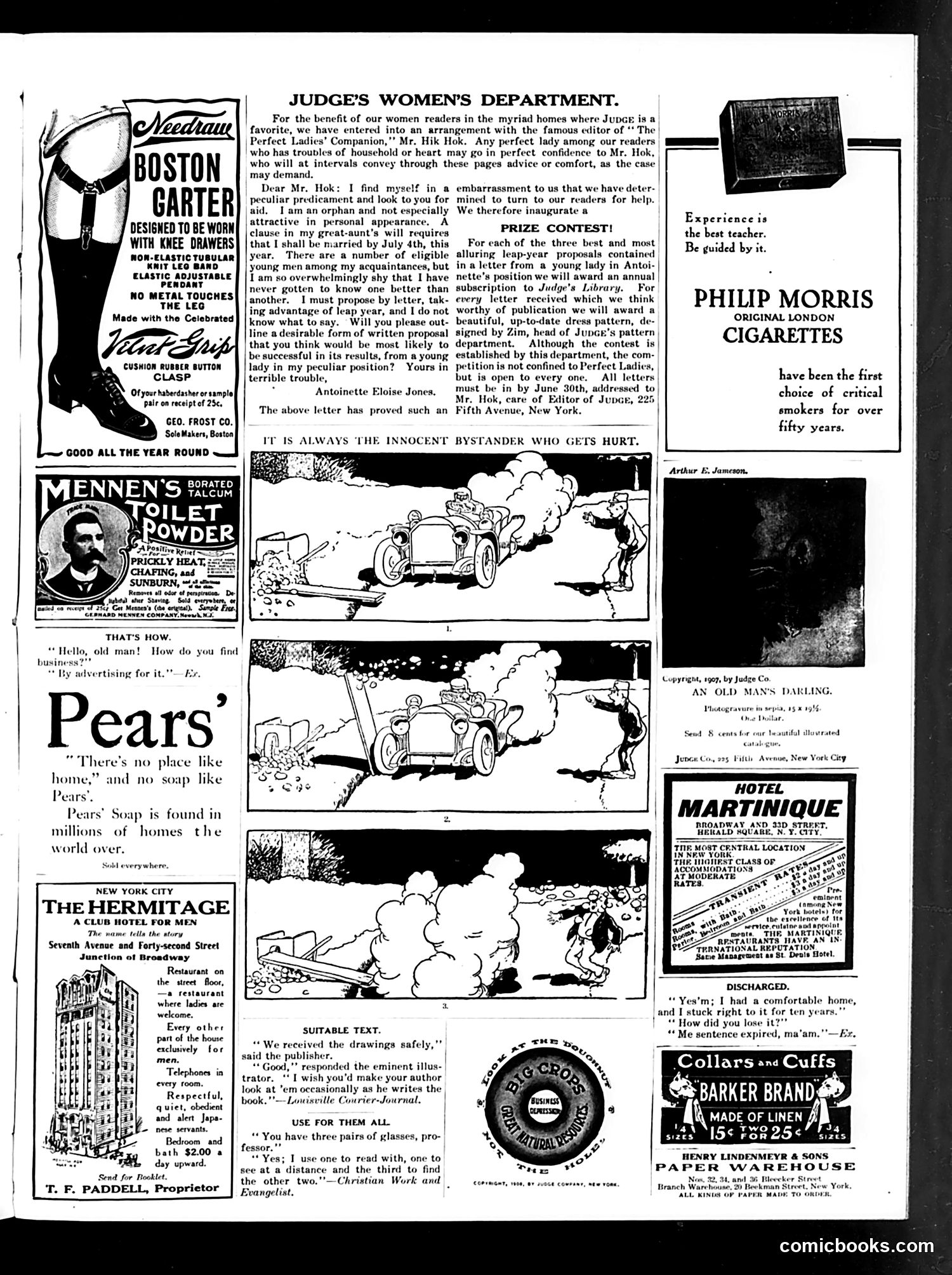
This page is primarily **advertisements and advice content**, not political satire. The central feature is "Judge's Women's Department," a new advice column where editor "Mr. Hik Hok" answers readers' questions about household and romantic matters. The notable content is a **"Leap Year Prize Contest"** soliciting marriage proposals from women. This references the historical tradition (dating back centuries) that during leap years, women are permitted to propose to men—reversing normal gender roles. The magazine offers prizes (dress patterns and subscriptions) for the best proposal letters submitted by young women seeking to marry. The surrounding advertisements are typical period products: Boston garters, Pears' soap, Mennen's talcum powder, and hotel listings. The three sequential cartoons above appear to show a comic sequence involving automobiles and pedestrians, illustrating the caption "It is always the innocent bystander who gets hurt"—apparently unrelated safety humor about early automobile traffic hazards.
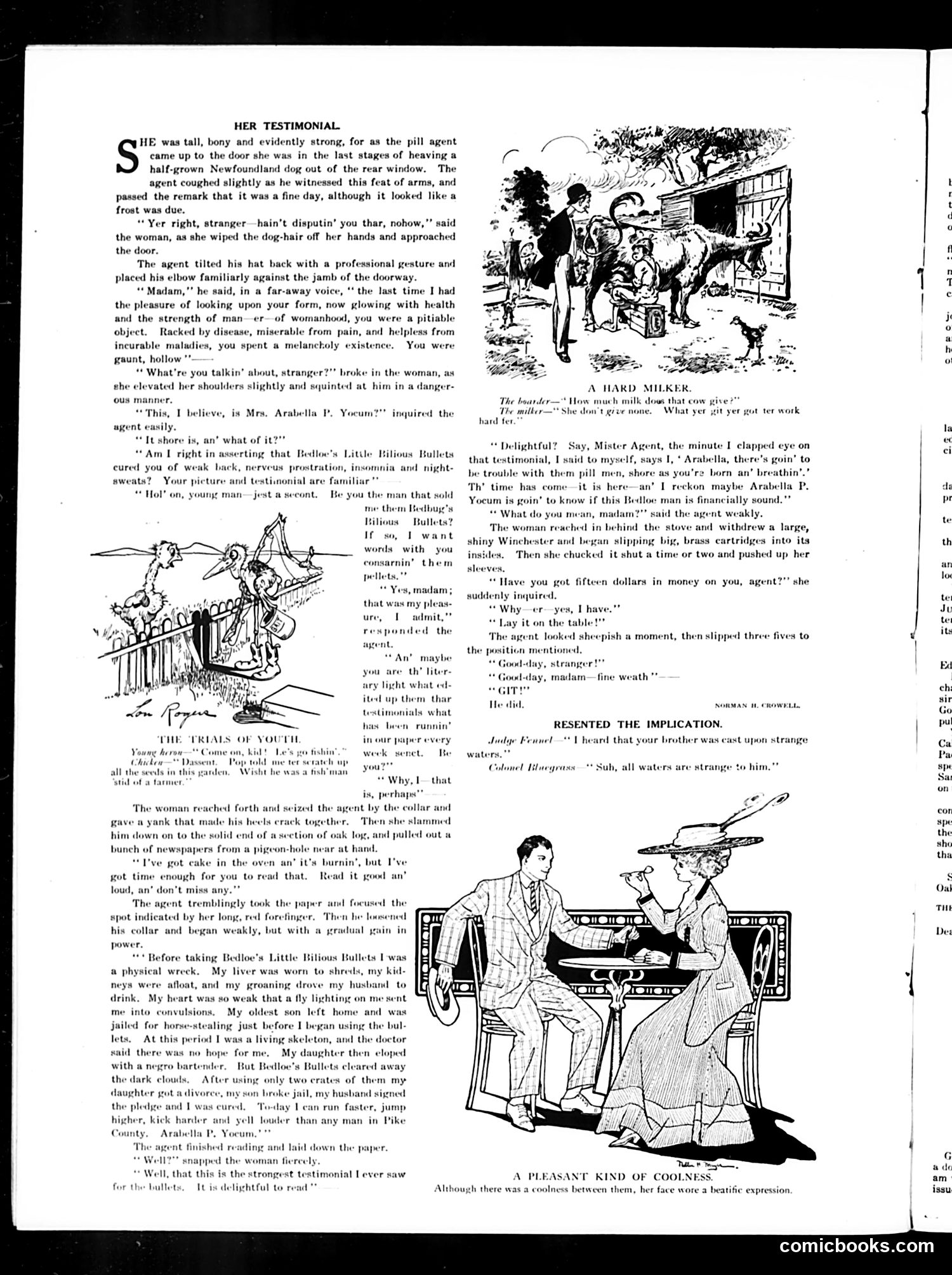
This page satirizes patent medicine advertising, specifically "Bedloe's Little Bilious Bullets," a fictional remedy. The main cartoon shows a traveling pill agent visiting a frontier woman (Mrs. Arabella P. Yocum) to solicit a testimonial endorsing the product. The joke: The agent attempts flattery, claiming she was once a "pitiable object" ravaged by disease until the pills "cured" her. The woman responds by retrieving a Winchester rifle and demanding fifteen dollars—threatening the agent into paying for her false endorsement. The satire targets the exploitative testimonial industry: patent medicine companies routinely fabricated or coerced "cures" from rural, desperate customers to market bogus treatments. By showing the woman literally *extorting* payment for her false testimony, Judge mocks both the fraud itself and the absurdity of these obviously fabricated claims. The implication is that such testimonials are worthless—obtained through deception or coercion rather than genuine results.
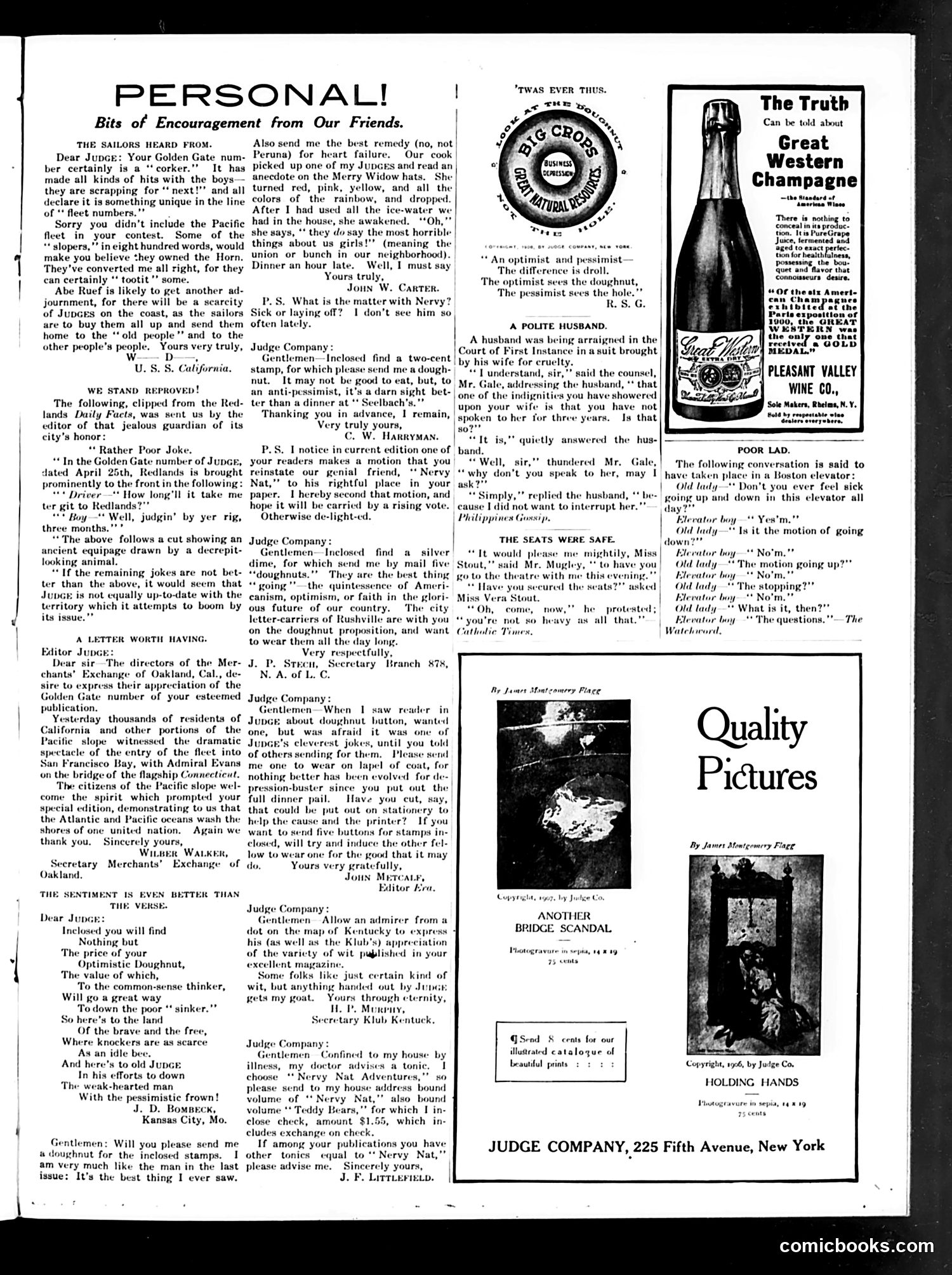
This page is primarily a **letters-to-the-editor section** ("Personal!") rather than featuring political cartoons. It contains reader feedback praising Judge's "Golden Gate" special edition, which apparently celebrated the U.S. Navy fleet's entry into San Francisco Bay with Admiral Evans commanding the flagship Connecticut. Key content: - **Sailors and Pacific Coast residents** express enthusiasm for Judge's fleet-themed issue - **Redlands, California** is gently mocked for complaining that Judge ridiculed their town (a decrepit horse and carriage joke) - **Abe Ruef** appears in a naval joke—he was a real San Francisco political figure involved in corruption scandals around this era - **The "Optimistic Doughnut"** is Judge's recurring satirical gimmick (advertised at bottom), with readers requesting copies The page also includes advertisements for **"Quality Pictures"** and **Great Western Champagne**, showing typical early-1900s magazine monetization. The overall tone is lighthearted patriotism mixed with local California humor.
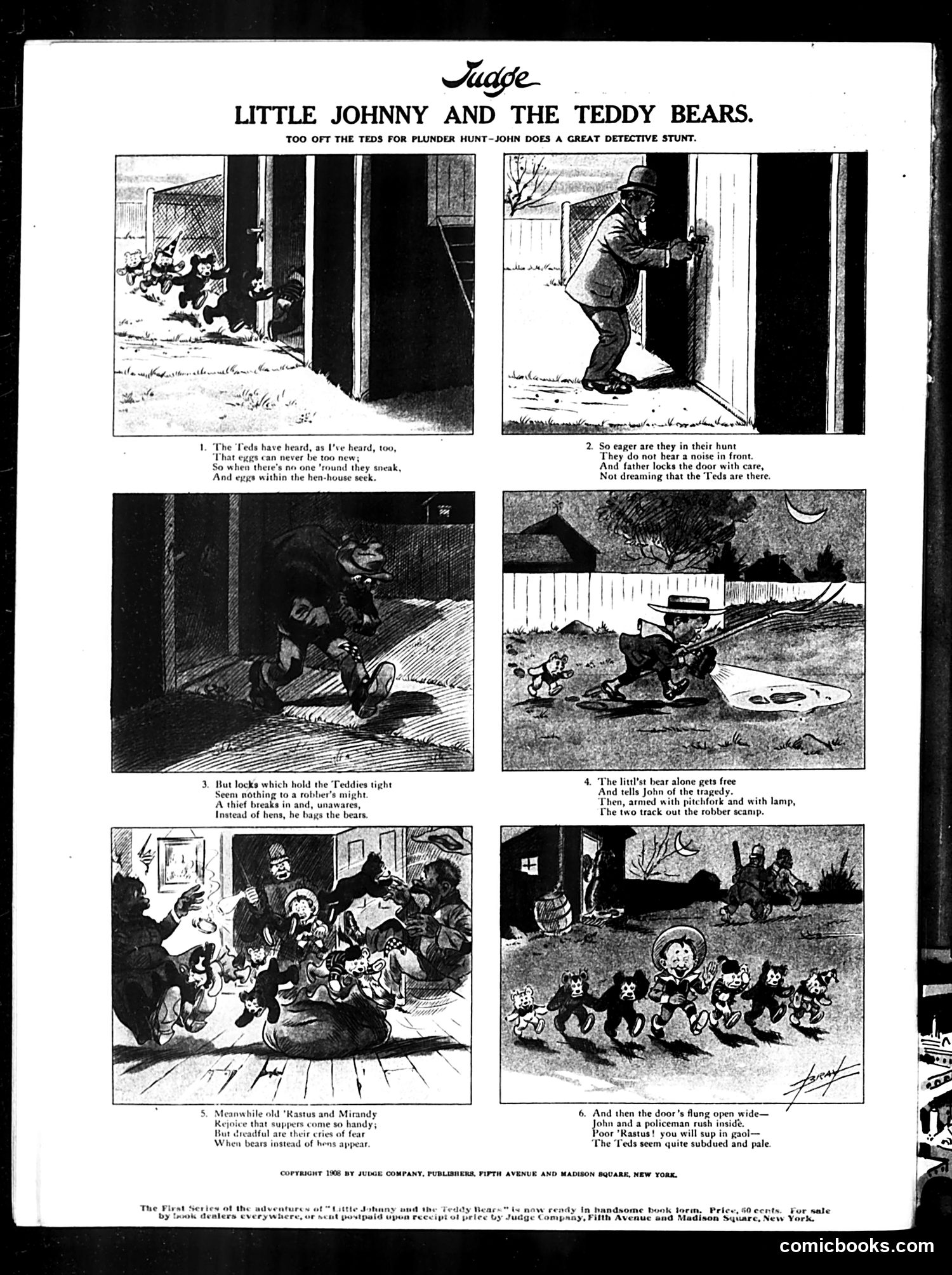
This 1908 Judge comic strip plays on the popularity of "Teddy Bears"—stuffed toys named after President Theodore Roosevelt. The story follows Little Johnny as he uses his detective skills to catch a burglar. The plot: Teddy Bears kept in a henhouse are mistaken for eggs by a thief, who steals them instead. The smallest bear escapes and alerts Johnny, who then tracks the robber with a policeman. The final panel shows "Rastus" (the burglar, depicted in period racist caricature typical of 1908 publications) being apprehended. The satire appears to mock both the craze for teddy bear collectibles and, more broadly, the romanticization of detective work. Johnny's "great detective stunt" is largely accidental—dependent on a toy bear's lucky escape. The humor relies on the incongruity of treating stuffed animals as valuable enough to warrant elaborate burglary and pursuit.