
Judge, 1908-06-13 · page 3 of 16
Judge — June 13, 1908 — page 3: what you’re looking at
What you’re looking at
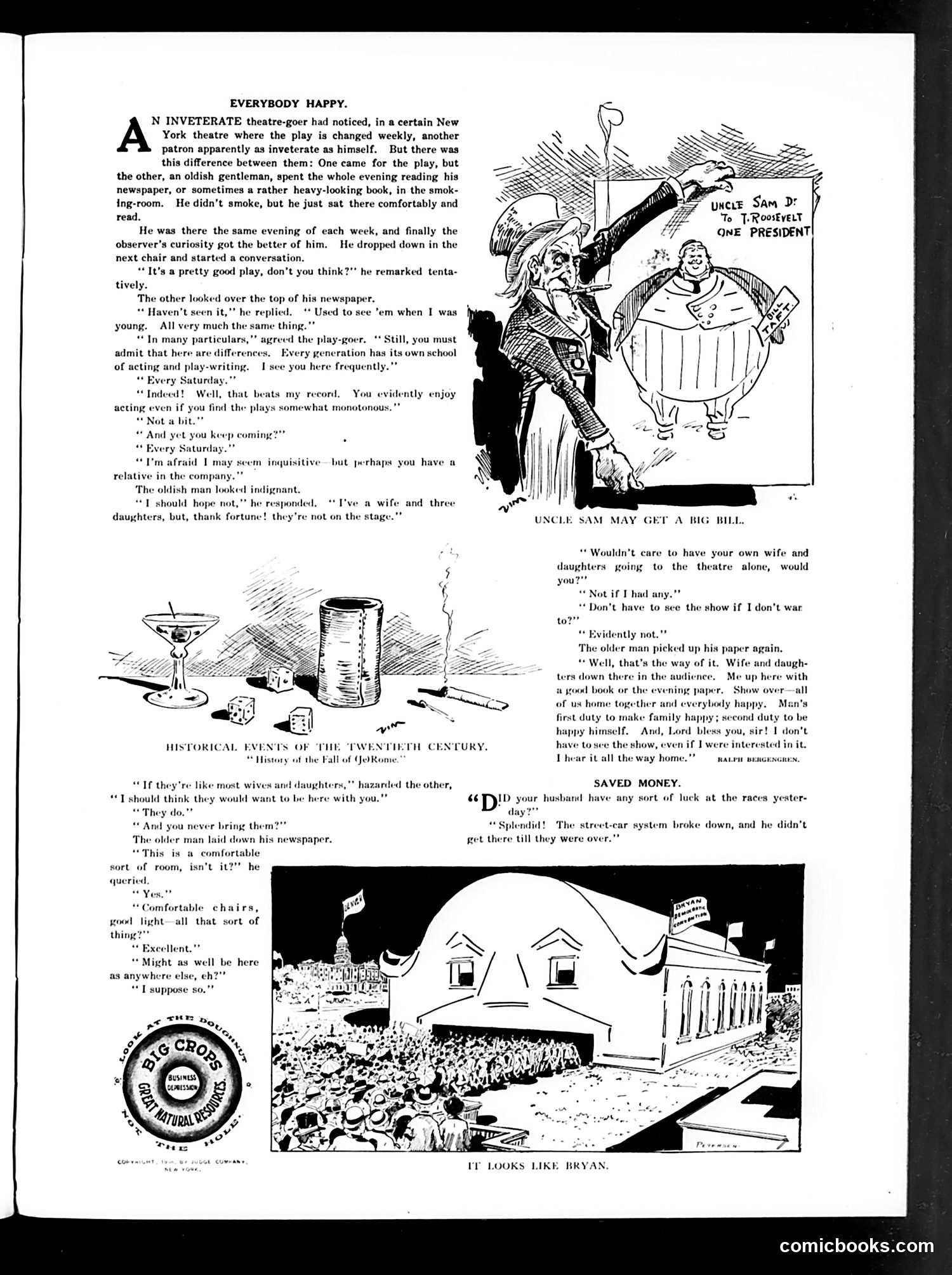
The page contains several satirical pieces. The top cartoon "Uncle Sam May Get a Big Bill" depicts Uncle Sam confronting a woman (likely representing a wife or family member) about theater expenses, satirizing the cost of entertainment and domestic spending debates. The middle section "Historical Events of the Twentieth Century: History of the Fall of Rome" uses Rome's fall as an allegory for contemporary social decline, with the dialogue suggesting wives and daughters attending theaters unsupervised—a social anxiety of the era. The bottom cartoon "It Looks Like Bryan" shows a large face-shaped structure surrounded by crowds, likely mocking William Jennings Bryan's political ambitions or public persona during his presidential campaigns. The overall page satirizes early-20th-century domestic economics, women's social independence, and political figures through historical and contemporary references.
📄 Transcribed text from this page (OCR, searchable)
Machine-transcribed from the original scan — historical spelling and the odd misread are preserved.
EVERYBODY HAPPY. N INVETERATE theatre-goer had noticed, in a certain New A York theatre where the play is changed weekly, another patron apparently as inveterate as himself. But there was this difference between them: One came for the play, but the other, an oldish gentleman, spent the whole evening reading his newspaper, or sometimes a rather heavy-looking book, in the smok- ing-room. He didn’t smoke, but he just sat there comfortably and read. He was there the same evening of each week, and finally the observer's curiosity got the better of him. He dropped down in the next chair and started a conversation. “It’s a pretty good play, don’t you think?” he remarked tenta- tively. ‘The other looked over the top of his newspaper. “* Haven't ** Used to see ’em when I was. young. All very much the same thing.”” “In many particulars," agreed the play-goer. admit that here are differences. Every generation has its own school of acting and play-writing. I see you here frequently.” “ Every Saturday."" “Indeed! Well, that b You ¢ acting even if you find the plays somewhat monotonous. ** Not a bit."" “And y ** Still, you must ss my record. em inquisitive but perhaps you h The oldish man looked indignant. “+L should hope not,”” he “Tye daughters, but, thank fortune! they're not on the stay sponded, a wi three EVENTS OF ‘THE ‘TWENTIETH CENTURY, “ History of the Fall of QeRome HISTORICAL rs," hazarded the other, with you.”” “If they're like most wives and daugh “T should think they would want to be hi “And you never bring them?”? The older man laid down his newspaper. “This is a comfortable sort of room, isn’t it?” he queried. pmfortable chairs, good light--all that sort of thing? ° ellent."” “Might as well be here as anywhere else, eh?” “T suppose so.”” LOOKS LIKE unere Sam Dr To J. RoosEvert ONE PRESIDENT! M MAY GET A BIG BIL Wouldn't care to have your own wife and daught the theatre alone, would you?” “Not if I had any.’? “Don’t have to see the show if I don’t war 3 going to ow ters down there a yrood book or tl of us home together a first duty to make family happy himself. have to sce the show, T hear it all the way home. the audience, ning paper. nd duty to be And, Lord bless you, sir! 1 don’t en if I were interested in it. SAVED MONEY. nd have any sort of luck at the races yester- ndid! The street-car system broke down, and he didn't Sr get there till they were over. BRYAN, comicbooks.com