
A complete issue · 16 pages · 1908
Judge — May 16, 1908
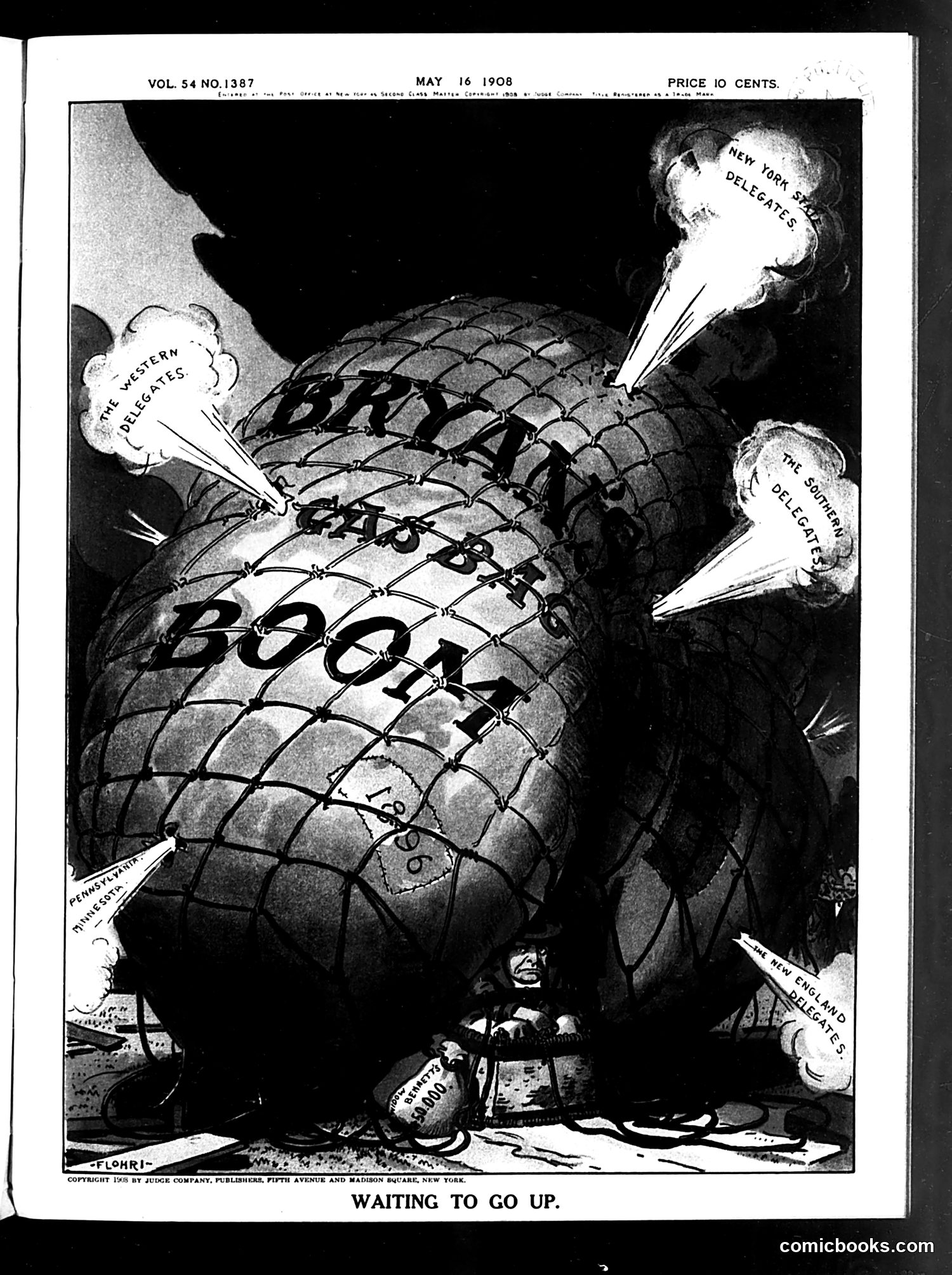
This satirical cartoon depicts a large bomb labeled "ANARCHIST BOMB" being held aloft by four regional political delegations: Western Delegates, New York State Delegates, Southern Delegates, and New England Delegates. The bomb's fuse is lit and ready to ignite. The satire criticizes the 1908 Republican National Convention, suggesting that regional party factions were preparing to "explode" the party unity. Rather than cooperating harmoniously, the delegates appear to be collectively restraining an unstable, dangerous force—likely representing internal party conflicts over the presidential succession following Theodore Roosevelt's tenure. The "waiting to go up" caption implies the convention itself would be volatile and contentious.
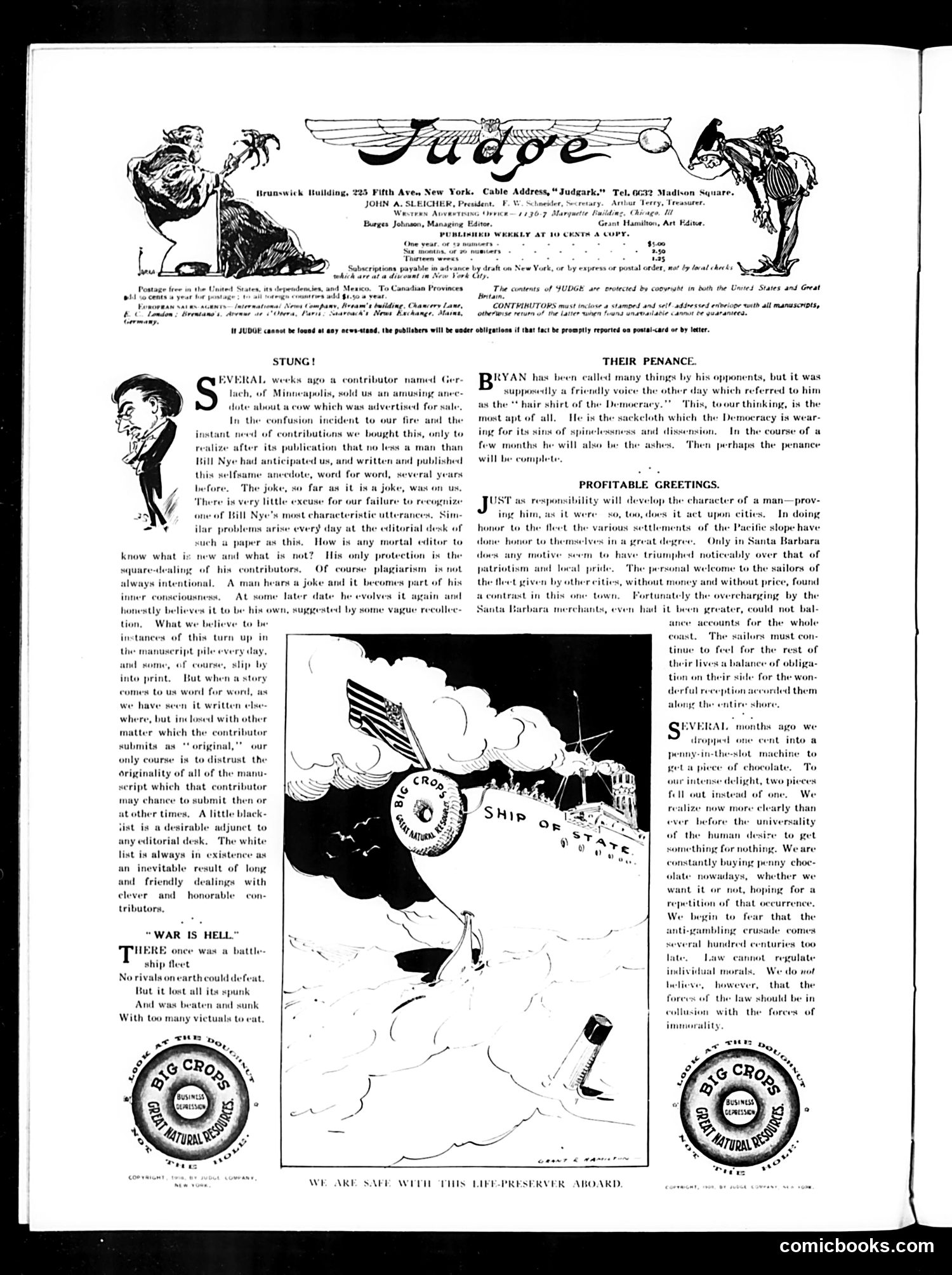
This page contains editorial commentary and a central illustration titled "Ship of State." The main cartoon depicts a vessel labeled "Ship of State" in stormy seas with a life preserver marked "Big Cross" nearby—referencing religious or charitable institutions as safety measures during national crisis. The left column "STUNG!" discusses editorial integrity and contributor disputes, critiquing plagiarism in journalism. The right column "THEIR PENANCE" and "PROFITABLE GREETINGS" address civic responsibility, patriotism, and Santa Barbara's treatment of sailors. The prominent illustration appears to satirize national instability or governance failures, suggesting the nation requires external moral/charitable "life preservers" to survive turbulent times. The specific historical context—likely early 20th century based on style—remains unclear without a date.
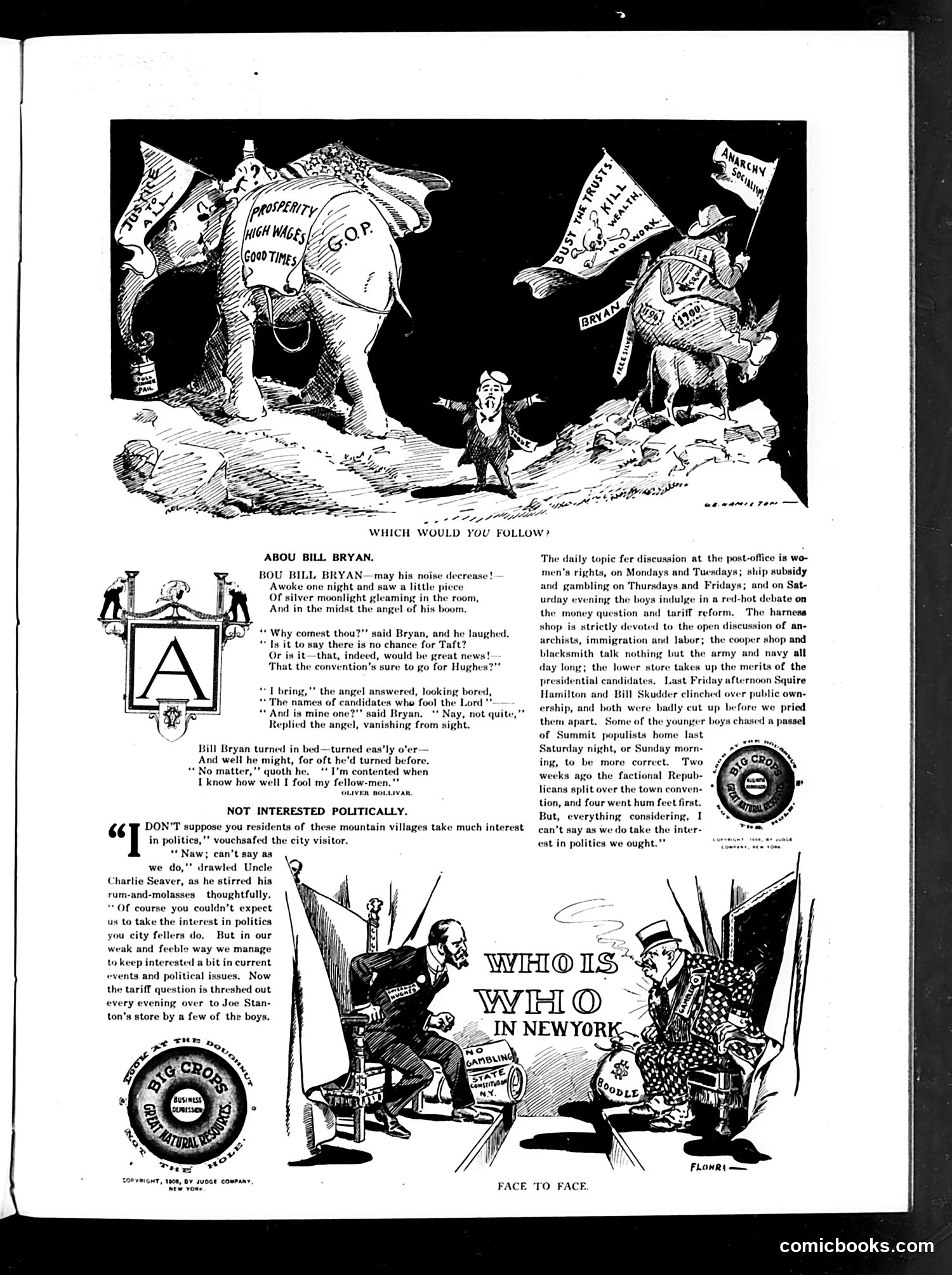
This page satirizes William Jennings Bryan's 1908 presidential campaign. The top cartoon depicts Bryan as an elephant labeled "G.O.P." (Republican Party), suggesting he's being manipulated by Republican interests despite his Democratic candidacy—a critique of his apparent alignment with establishment politics. The bottom section, titled "Who Is Who in New York," appears to mock local political figures and their competing interests around tariff policy and labor issues. The text references post-office discussions about "anarchists, immigration and labor," indicating contemporary urban political controversies. The satire suggests Bryan's campaign lacks genuine independence and that New York politics involves confusing, self-interested factionalism. The "Not Interested Politically" segment implies rural voters' indifference to these urban political machinations.
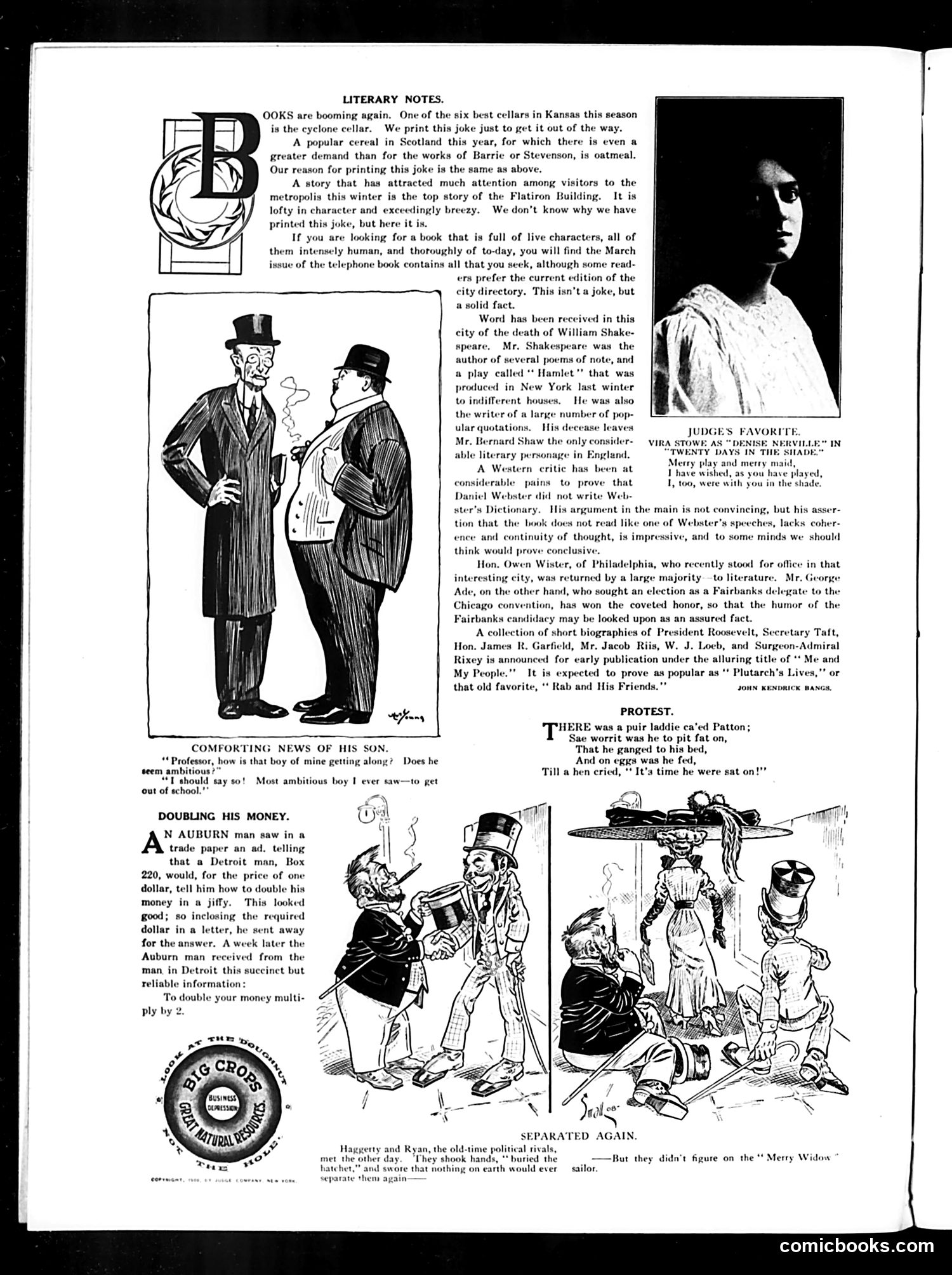
This page contains several satirical pieces. The main cartoons include: **"Comforting News of His Son"** and **"Doubling His Money"**: These appear to be genteel humor about fathers and sons, showing well-dressed men in top hats discussing money and ambition—typical Judge magazine fare mocking the aspirations of the wealthy. **"Protest"** and **"Separated Again"**: These reference political figures Haggart and Ryan, described as "old-time political cronies" who "shook hands at the late bat, and swore they would never separate again"—likely satirizing political reconciliations or broken alliances of the era. The page's "Literary Notes" section discusses William Shakespeare's death, oatmeal as a Scottish staple, and the Flatiron Building in New York, providing contemporary cultural commentary typical of Judge's middle-class readership.
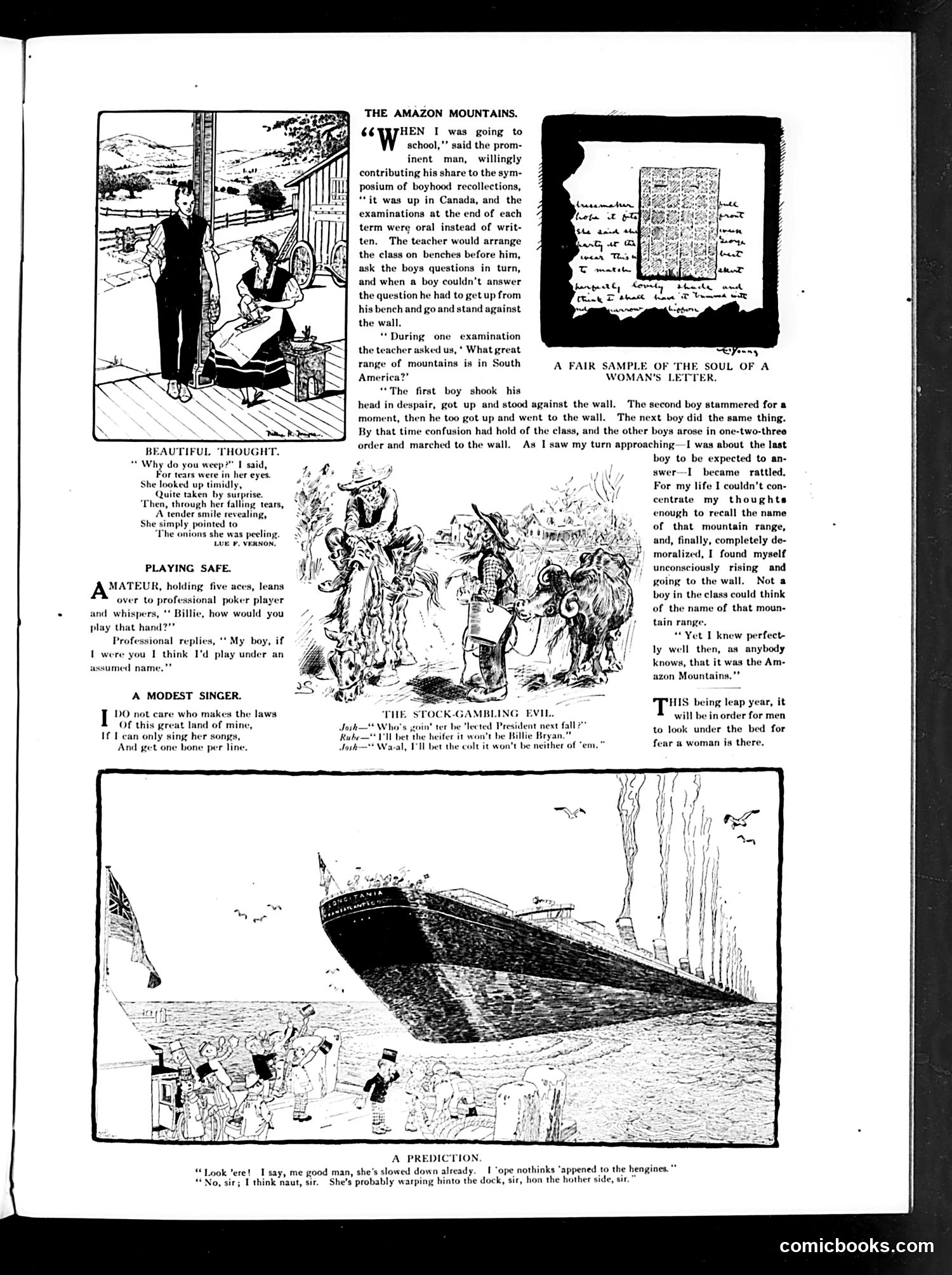
This page from *Judge* magazine contains several unrelated satirical pieces rather than a cohesive political cartoon. **"The Amazon Mountains"** depicts a schoolmaster conducting oral exams. The satire targets educational methods—specifically the humiliation of unprepared students forced to stand against walls when they cannot answer questions. It's a gentle critique of harsh classroom discipline practices. **"Playing Safe"** and **"A Modest Singer"** appear to be brief humorous verses about amateur performers. **"The Stock-Gambling Evil"** shows a dialogue mocking stock speculation. **"A Prediction"** depicts a beached ship with sailors observing it, likely satirizing predictions about maritime disasters or social calamities—though the exact reference is unclear without additional historical context. The page emphasizes social and educational critiques rather than partisan politics.
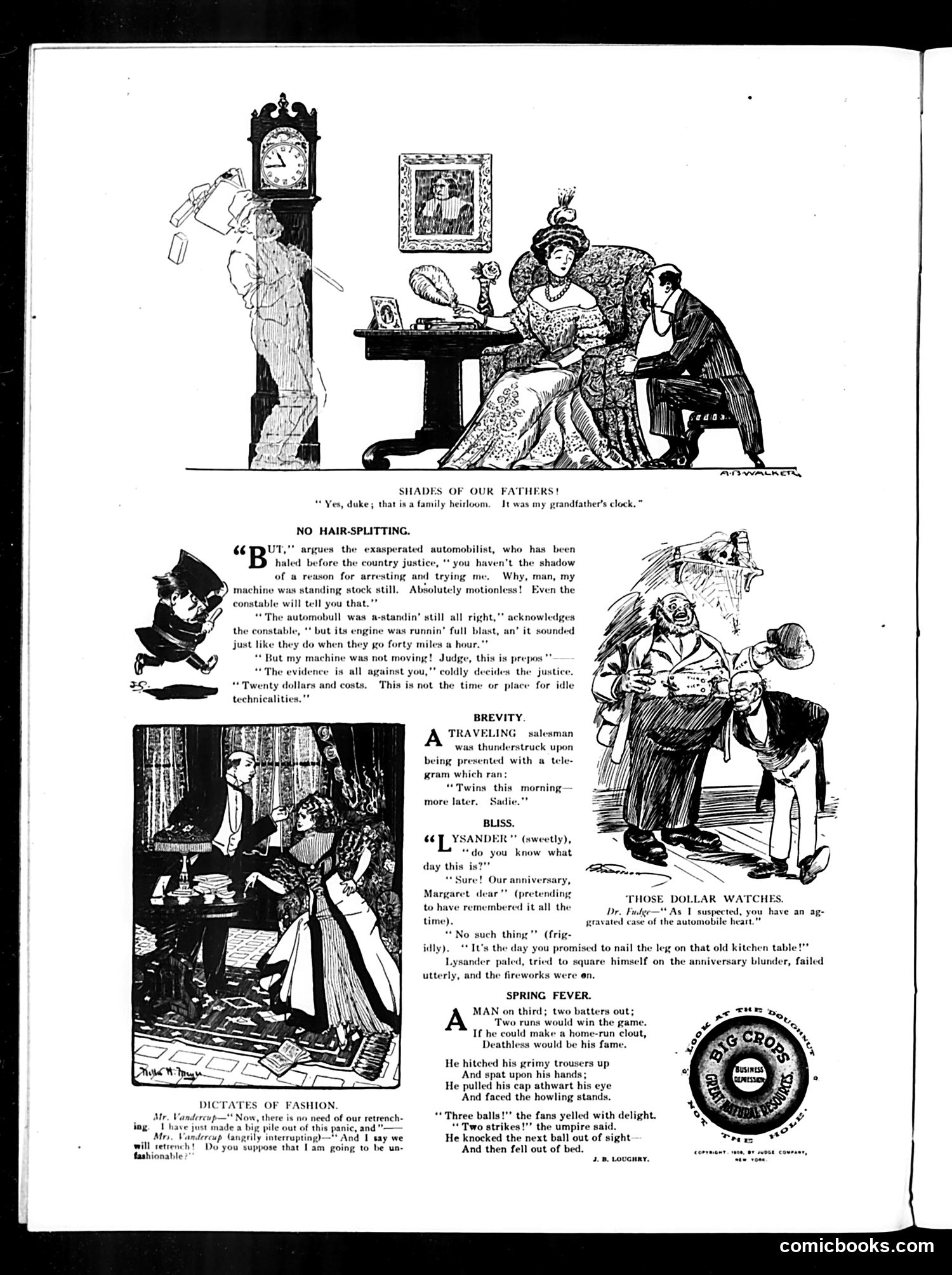
This page contains several unrelated satirical pieces typical of early 1900s humor magazines: **Top cartoon ("Shades of Our Fathers")**: A wealthy woman shows a visitor an antique grandfather clock, claiming it's a family heirloom—satirizing how the nouveau riche fabricate aristocratic pedigrees. **"No Hair-Splitting"**: Mocks early automobile regulations. A motorist argues his stationary car shouldn't be ticketed, but a country constable and justice convict him anyway because the running engine made noise—absurdist humor about rural officials misunderstanding new technology. **Other brief pieces** ("Brevity," "Bliss," "Spring Fever," "Fashion," "Those Dollar Watches"): Short anecdotes with modest punchlines about marital mishaps, sales pitches, baseball, social pretension, and cheap watches. The page reflects *Judge*'s style: satirizing new technologies (automobiles), class anxiety, marital discord, and rural-urban cultural gaps. No specific political figures appear; the humor targets universal social follies and contemporary anxieties about modernization.
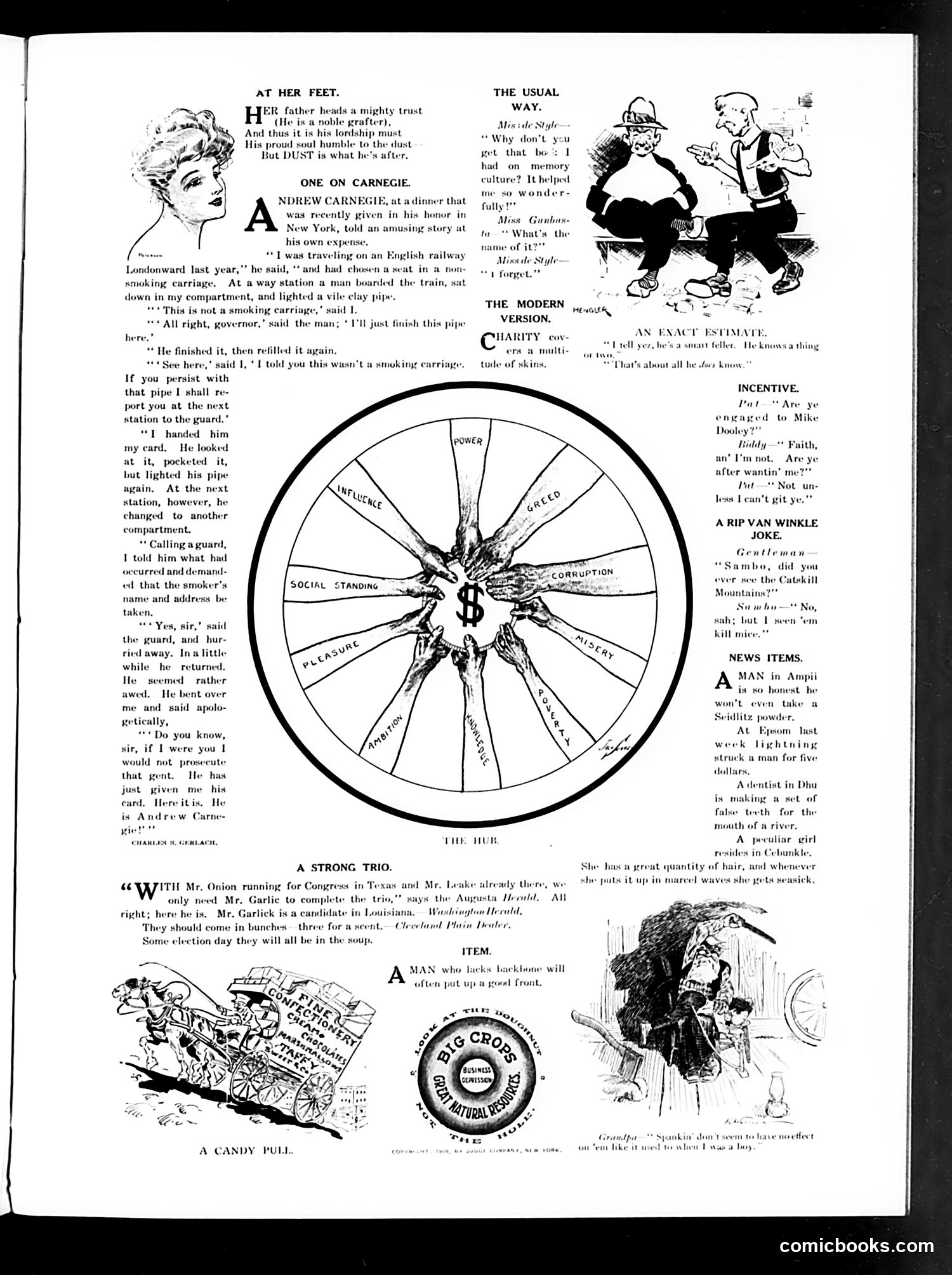
This page contains several disconnected satirical items typical of Judge's format: **"One on Carnegie"** mocks Andrew Carnegie's wealth and power. The anecdote shows a pipe-smoking man who, upon learning his fellow passenger is the famous industrialist, immediately defers—suggesting Carnegie's immense fortune commands automatic social deference even from strangers who've just annoyed him. **"The Hub" diagram** satirizes corruption by depicting a dollar sign at the center with radiating spokes labeled "Corruption," "Bribery," "Greed," "Influence," "Power," and "Social Standing"—suggesting money is the corrupting hub of American society. **"A Strong Trio"** jokes that political candidates named Onion and Garlic (with implied "Mr. Leek") create an unpleasant combination, playing on vegetable puns. The remaining items are brief humor pieces: jokes about Irish servants, dishonest men, false teeth, and a Rip Van Winkle reference—mostly disconnected social commentary and wordplay typical of turn-of-century satirical magazines.
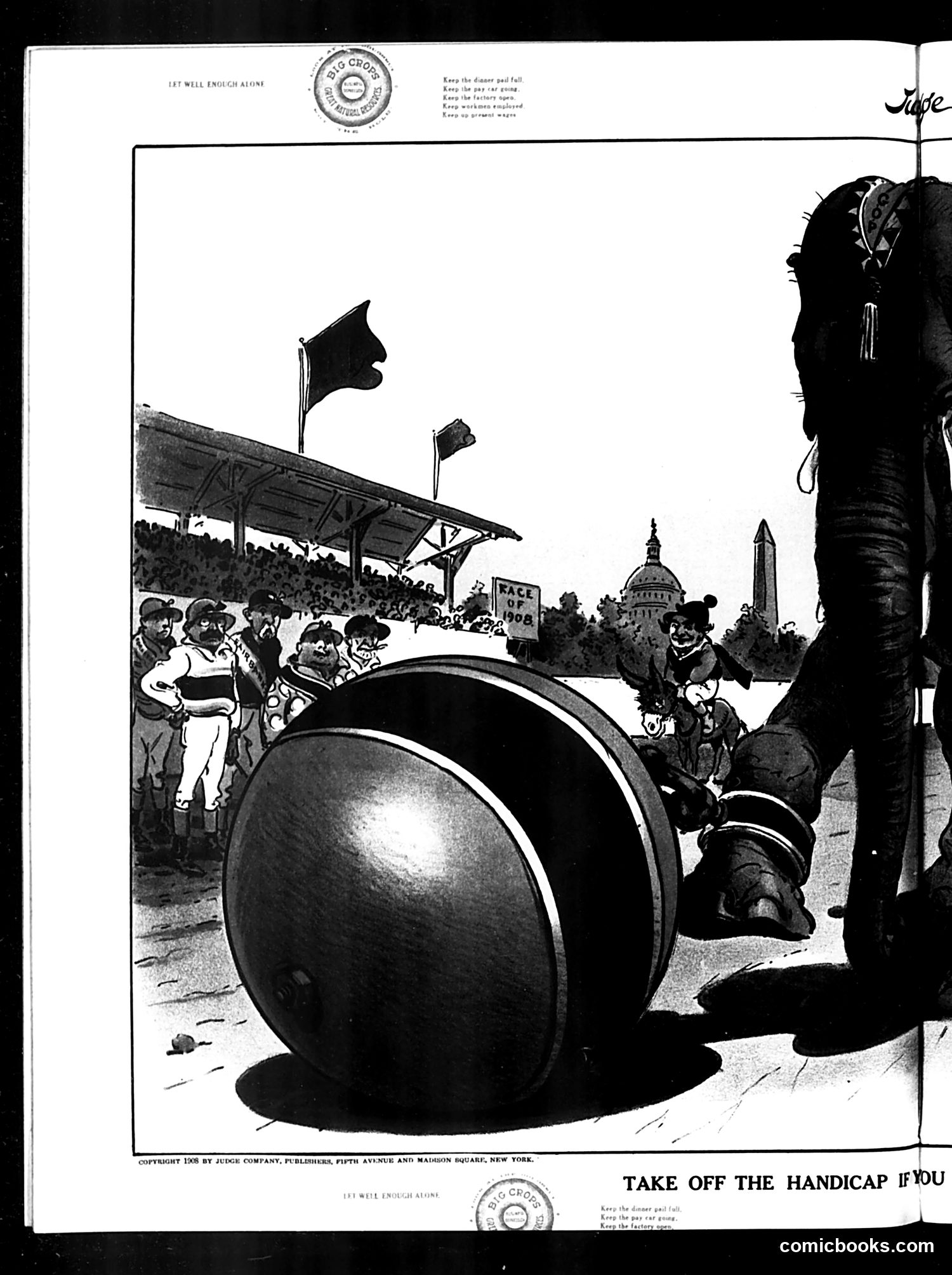
This Judge magazine cartoon depicts a massive spherical object labeled "RACE OF 1908" at what appears to be a public stadium or fairground, with spectators and officials observing. An elephant (the Republican party symbol) stands prominently on the right. The satire critiques the 1908 U.S. presidential race as inherently handicapped or unfairly weighted. The massive ball suggests the race itself is cumbersome and awkwardly constructed. The title "TAKE OFF THE HANDICAP IF YOU" (text cut off) implies the cartoon argues that removing some obstacle or burden would make the competition fairer. The Capitol and Washington Monument visible in the background confirm the political context. Without seeing the complete caption, the specific handicap referenced remains unclear, though it likely addresses perceived inequities in the electoral system or campaign process of that election year.
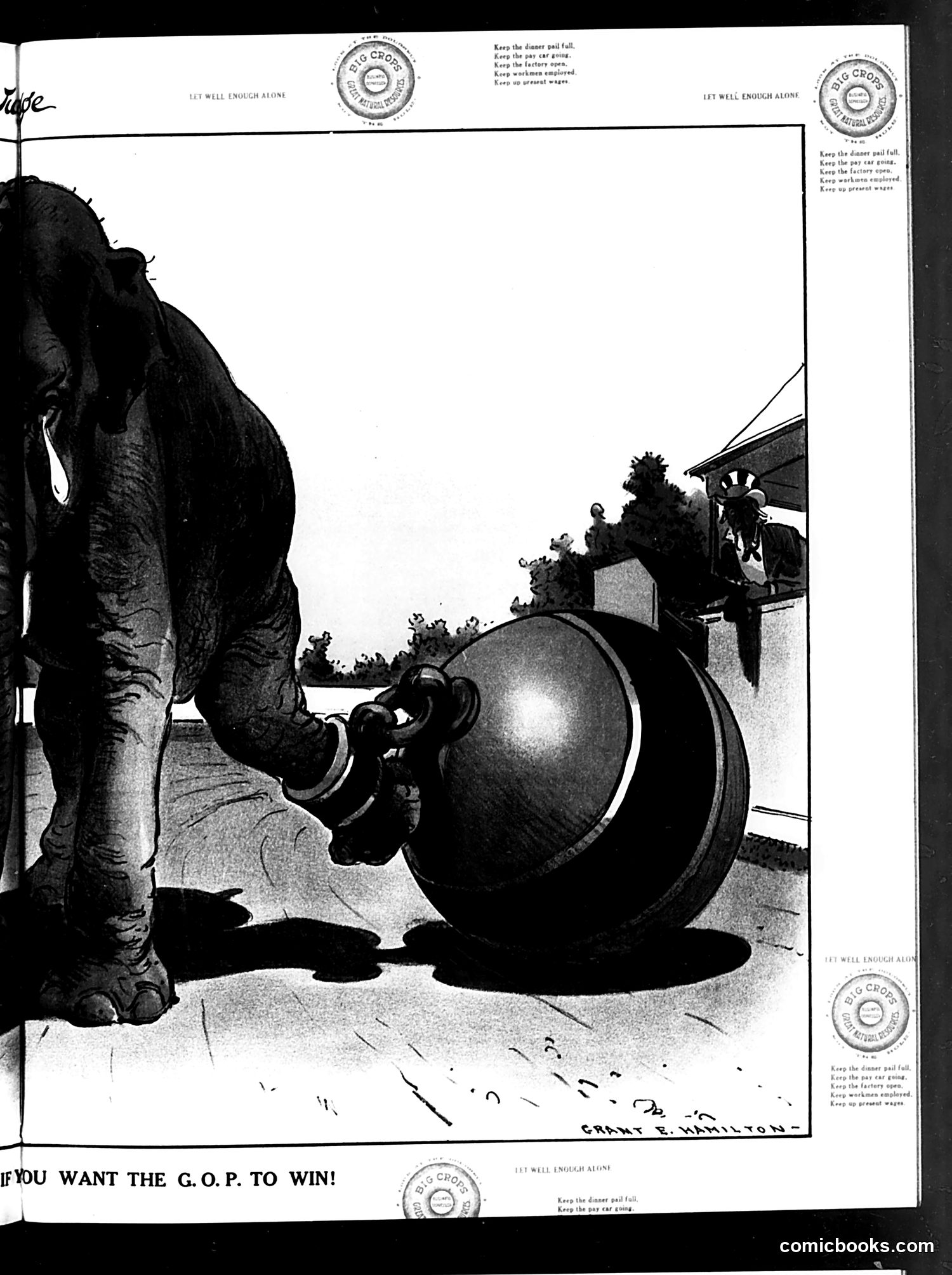
This appears to be a Republican campaign piece from Judge magazine, titled "If You Want the G.O.P. to Win!" The main image shows an elephant (the Republican Party symbol) playing with or pushing a large spherical object, while observers watch from a platform in the background. The phrase "Let Well Enough Alone" repeated across the page suggests the cartoon's core message: Republicans should avoid unnecessary actions or controversies that might jeopardize their electoral chances. The exact historical context—which election, which specific policies the elephant "shouldn't touch"—isn't clear from the visible text alone. However, the cautionary tone indicates the cartoon was warning the Republican Party against some risky course of action during an active campaign.
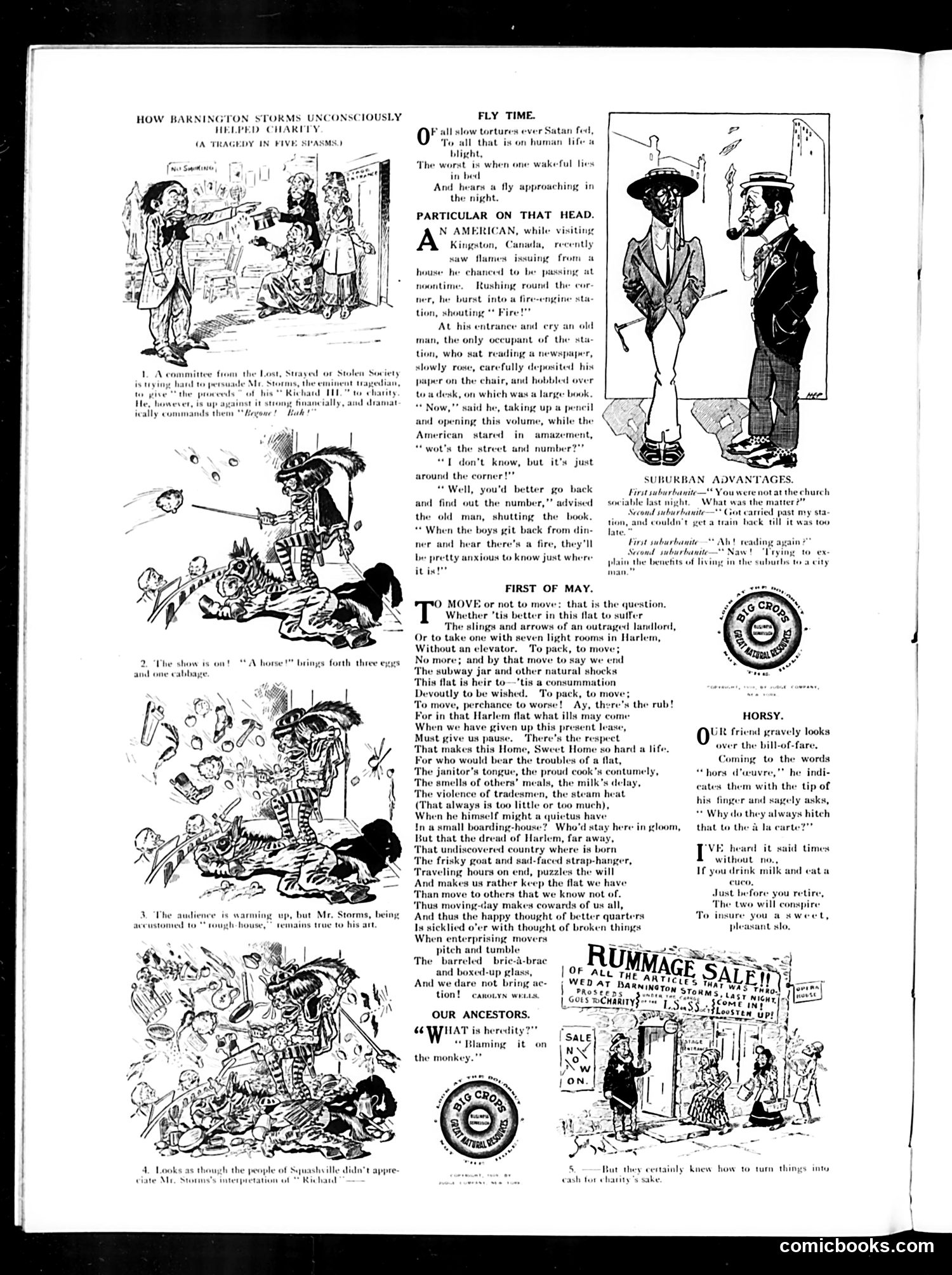
This page contains multiple satirical pieces typical of Judge magazine's humor: **"How Barkington Storms Unconsciously Helped Charity"** (left side): A comedic narrative about an American visitor in Kingston, Canada who mistakes a fire at a nearby house for an emergency. He rushes to a train station shouting "Fire!" The station attendant, reading a newspaper, calmly directs him to find the street address. The joke appears to mock both the American's excitability and the Canadian's phlegmatic response. The "charity" angle suggests the fire's proceeds benefit charitable causes. **"Fly Time"** and **"First of May"** (center/right): Humorous verse pieces—one about the annoyance of flies keeping one awake, another (parodying Hamlet) about the annual moving day anxieties of apartment dwellers facing elevators, janitors, and "strap-hangers" on subways. **"Horsy"** and **"Our Ancestors"**: Brief satirical quips about suburban life and inheritance. **"Rummage Sale"** (bottom right): An advertisement parody about a charitable sale where items are converted to cash for charity's sake. The page primarily offers social satire of middle-class urban and suburban life.
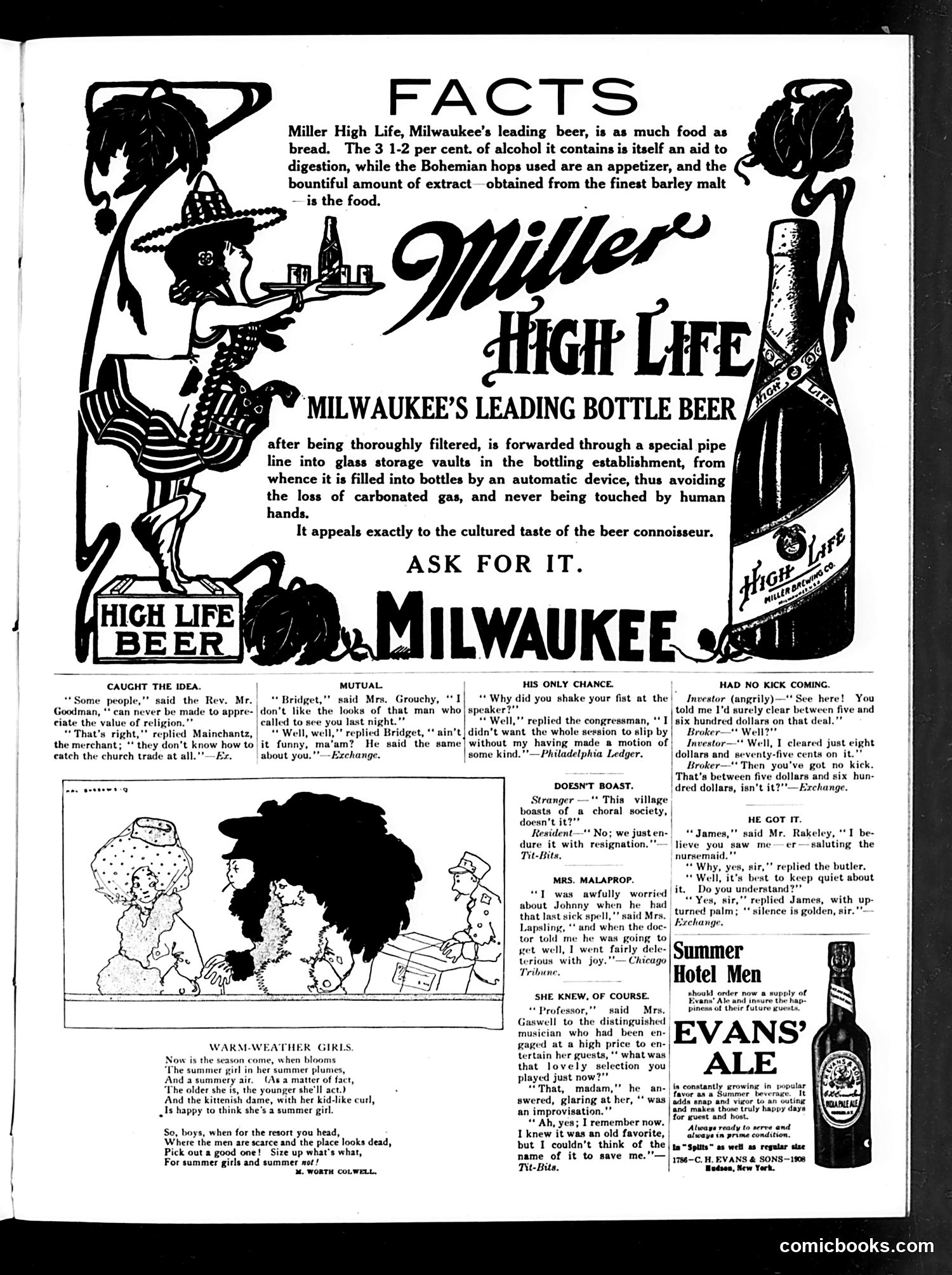
This page is primarily **advertising**, dominated by a large Miller High Life beer advertisement claiming the product is "as much food as bread" and contains digestive aids. The ad emphasizes the beer's purity and automated bottling process to appeal to "cultured taste." Below the ad are several **short comic anecdotes** mocking various social types: a clergyman who doesn't understand business ("catch the church trade"), a congressman defensive about backroom deals, a woman misusing vocabulary ("deleterious" instead of "delighted"), and a pretentious musician exposed for improvising. A poem, "Warm-Weather Girls," jokes about aging women at resorts dressing young and flirting excessively—reflecting period attitudes about female vanity. At bottom right, **Evans' Ale** advertises as a summer beverage for hotels. The humor targets hypocrisy, pretension, and social climbing—typical Judge satire—but the page is fundamentally commercial, using humor to sell beer and ale to readers.
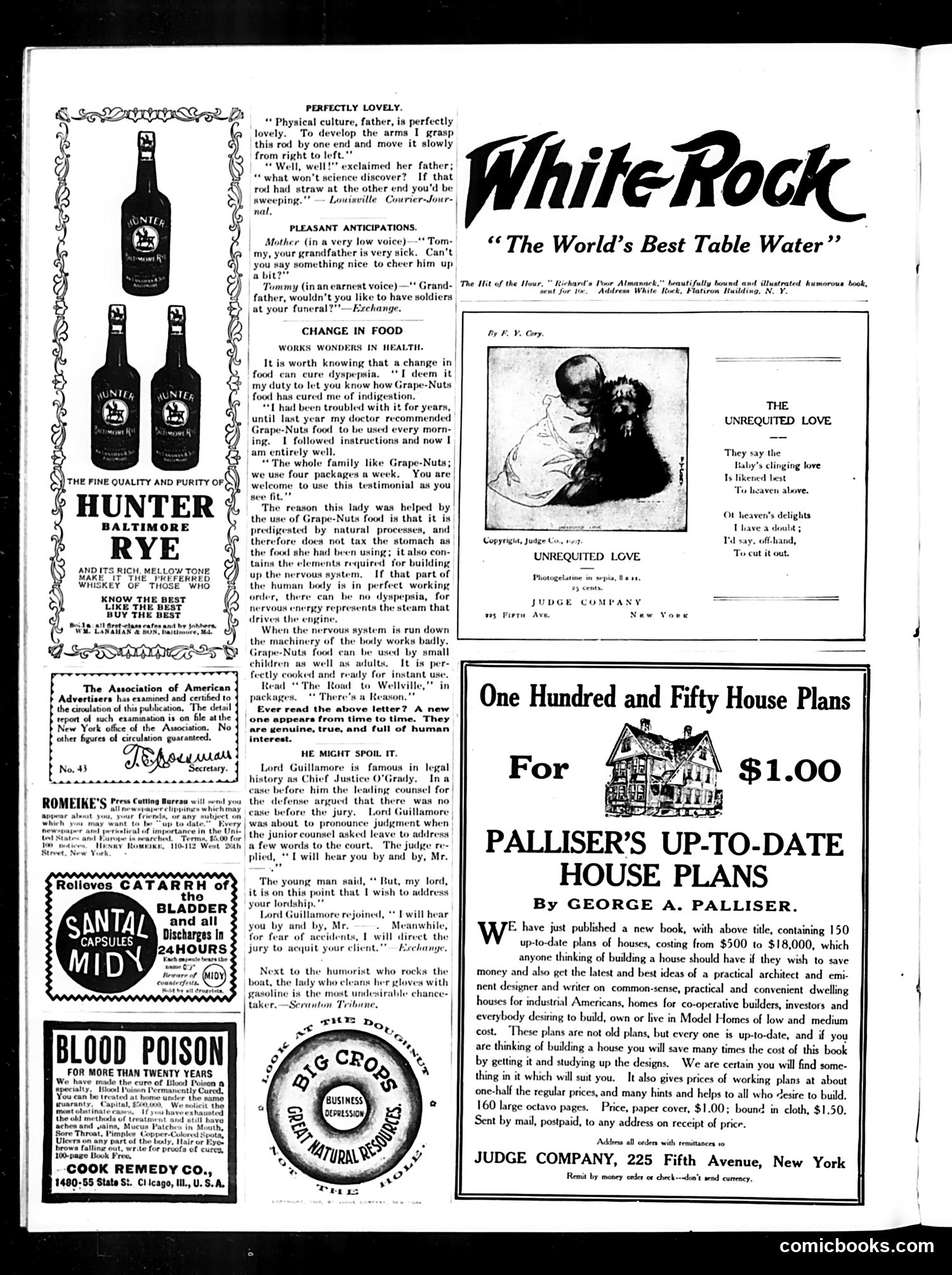
This page is primarily **advertising and filler content** rather than political satire. The layout includes: **Main Elements:** - Multiple product advertisements (Hunter Rye whiskey, Santal Capsules for "blood poison," Grape-Nuts food, White Rock water) - Several brief humorous anecdotes/jokes (standard magazine filler of the era) - A sentimental poem titled "The Unrequited Love" with accompanying illustration - Advertisement for house plan books **The Humor:** The jokes are mild domestic comedy—a father misunderstanding his daughter's physical exercise routine; a boy's dark comment to his sick grandfather; a judge's sardonic legal quip. These reflect early 20th-century attitudes about gender roles and social propriety rather than political commentary. **Historical Context:** This appears to be from Judge's later period (the magazine eventually declined). The page demonstrates how satirical publications survived through extensive advertising and reprinted light humor—not original political cartooning.
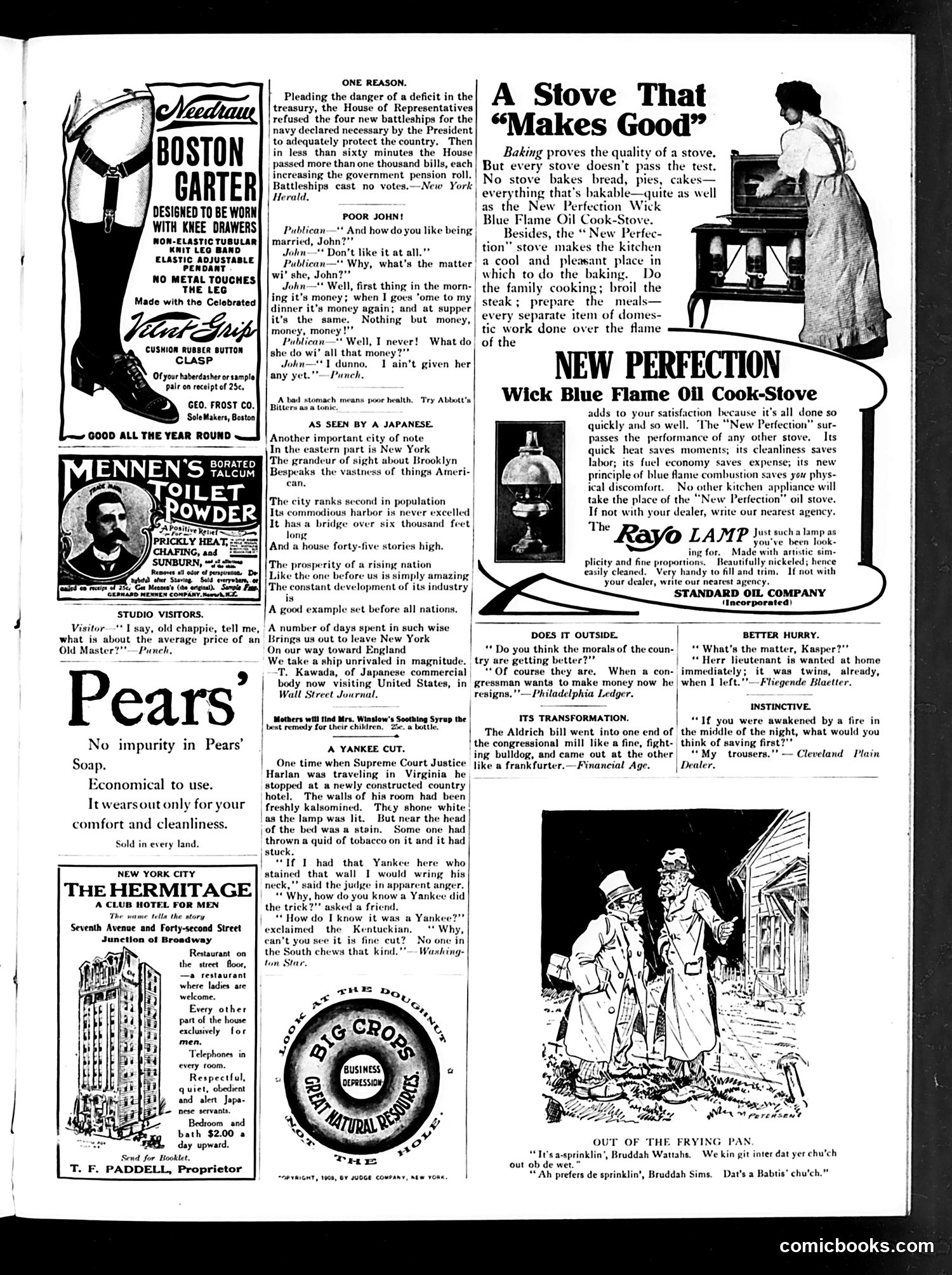
**"One Reason"** (top left): A political cartoon criticizing Congress's spending priorities. The House refused funding for four battleships the President deemed necessary for naval defense, yet within an hour passed over 1,000 pension bills. The satire's point: congressmen vote based on political self-interest ("Battleships cast no votes") rather than national security needs. **"As Seen by a Japanese"** (center left): A humorous piece describing New York and Brooklyn through an outsider's perspective, marveling at American industrial prosperity and the height of buildings. This reflects early-20th-century American pride in industrial achievement and urbanism, presented through the device of bemused foreign observation. The remainder of the page consists primarily of period **advertisements** for consumer goods (stoves, lamps, soaps, hotels, powders) typical of Judge's commercial content. **"Out of the Frying Pan"** (bottom right): A brief comic dialogue in dialect humor, likely Scottish or Irish, about domestic mishaps.
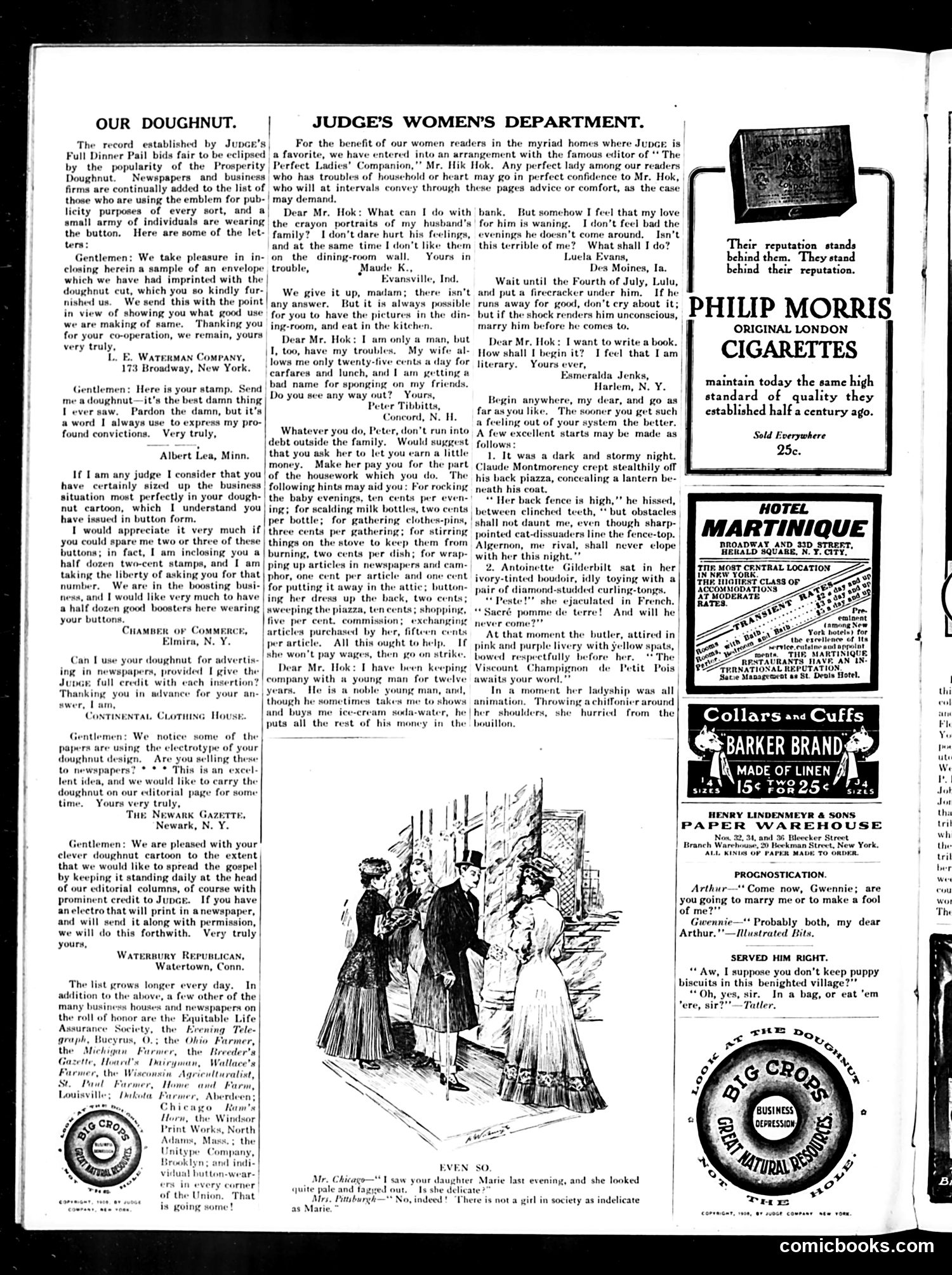
This page documents Judge magazine's successful promotional gimmick: a doughnut emblem used to advertise the magazine's optimistic messaging about American prosperity. The "Our Doughnut" section collects letters from newspapers, businesses, and individuals enthusiastically adopting the symbol for publicity purposes—some wearing it as buttons, others displaying it in their editorial columns. The satire is gentle: Judge is celebrating how widely its doughnut symbol has been embraced as a marker of business confidence and patriotic optimism during what appears to be a period of economic growth. The accompanying cartoons and advice column represent typical Judge content—domestic humor and practical (if tongue-in-cheek) guidance for readers' personal problems. The advertisements for Philip Morris cigarettes and the Martinique Hotel suggest this represented a prosperous advertising market. The "Big Cross" seed company logo indicates agricultural prosperity was part of the narrative being promoted.
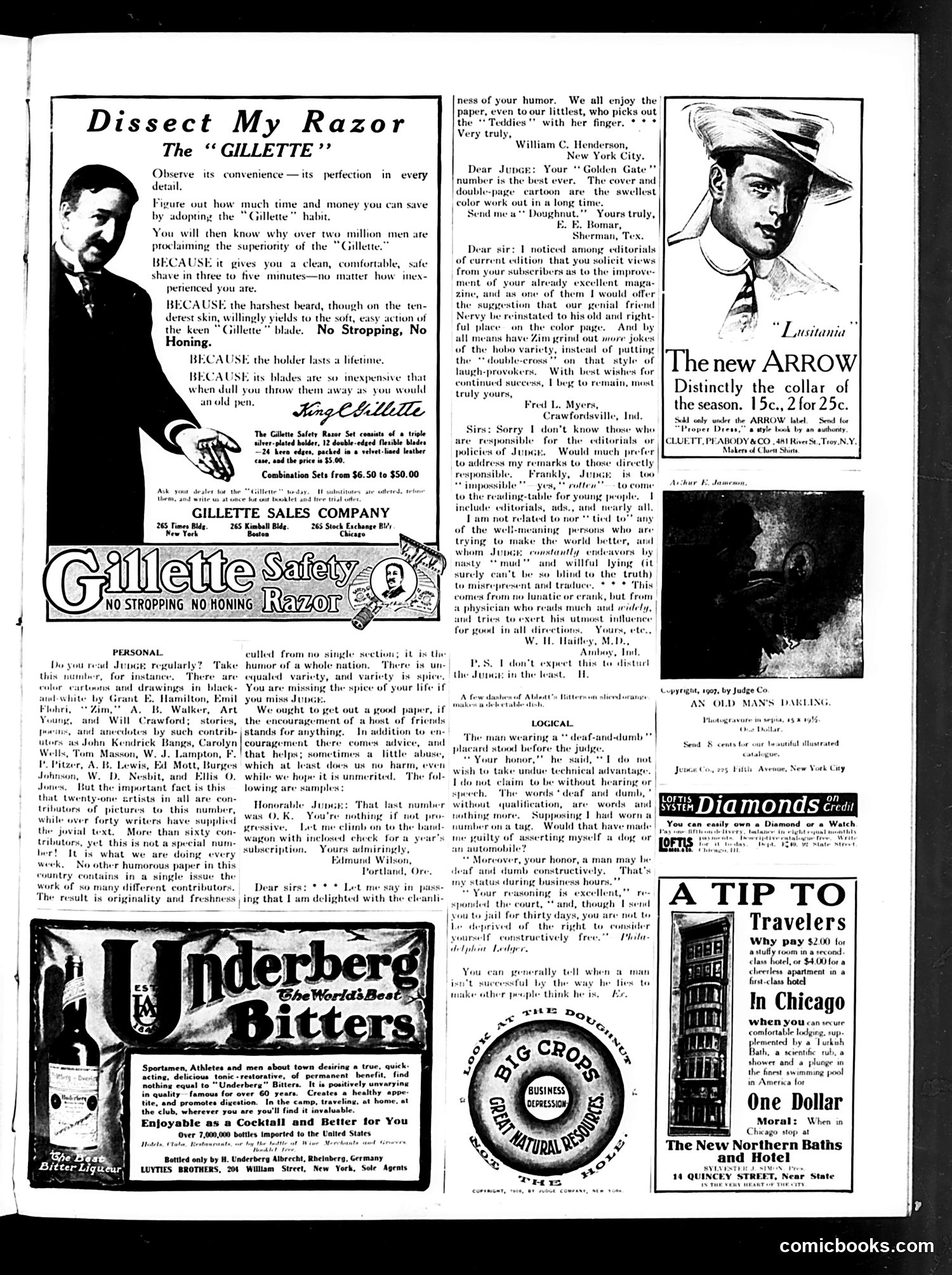
This page is primarily **advertising** interspersed with reader letters and a modest cartoon. The dominant content consists of advertisements for consumer products: Gillette Safety Razors, Underberg Bitters, Arrow Collars, and hotel/travel services. The small illustrated cartoon labeled "**An Old Man's Darling**" (bottom right) appears to be a sentimental domestic scene, though details are unclear from the reproduction. The reader letters discuss Judge magazine's content—one praises its humor and illustrations, another critiques the editorial policy, requesting more direct response to reader suggestions. These letters reveal Judge's editorial practice of printing reader feedback. The page reflects early 20th-century magazine culture: heavy advertising subsidizing editorial content, direct reader engagement, and product-focused marketing aimed at middle-class male consumers (razors, bitters, collars, travel). No significant political satire is evident on this particular page—it's primarily a commercial and reader-correspondence section.
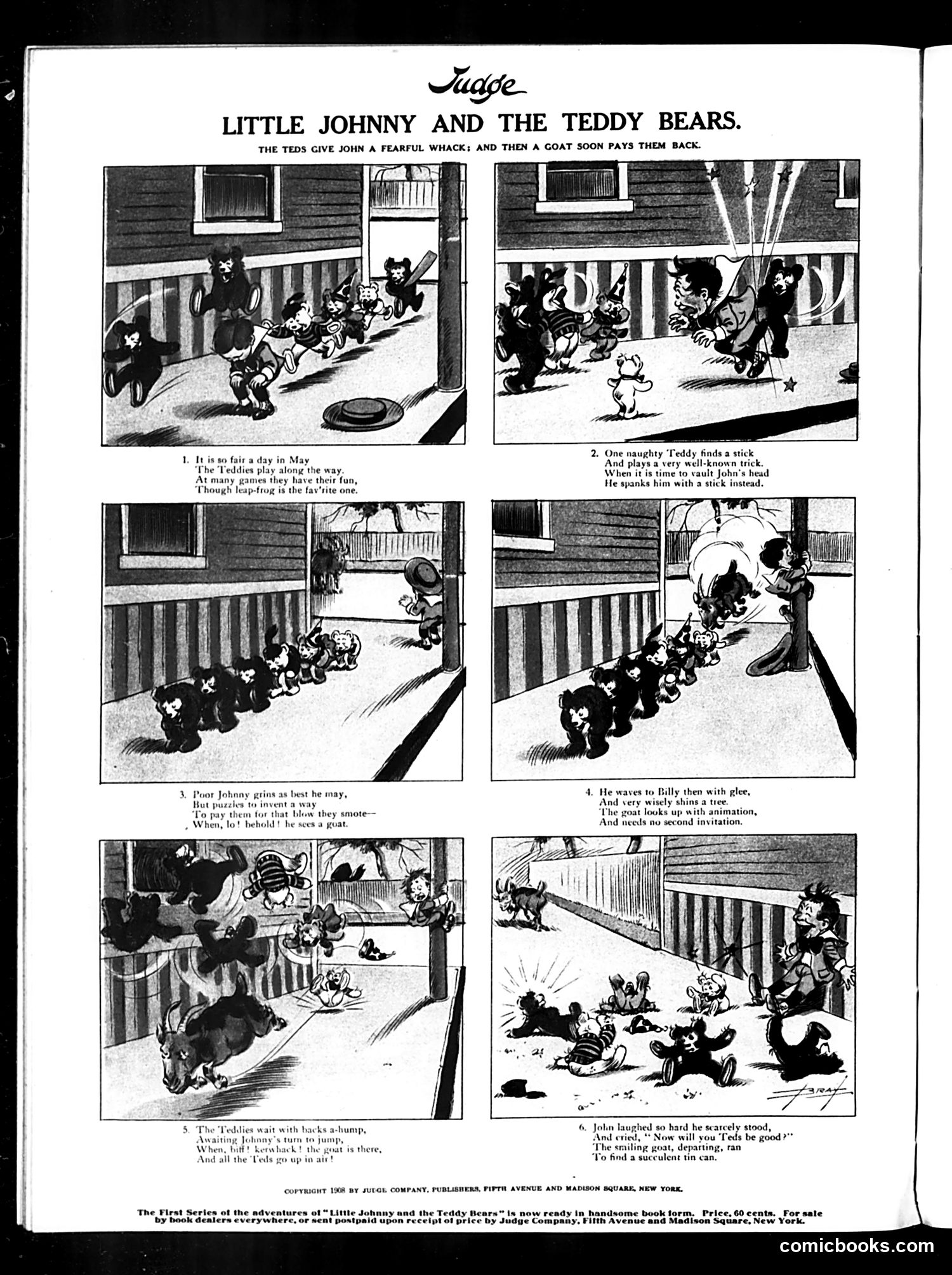
This is a children's comic strip rather than political satire. It depicts a slapstick narrative: Little Johnny plays with animated teddy bears on a fair May day. One bear mischievously hits Johnny with a stick during a game of leapfrog. Johnny retreats up a tree to escape, where he encounters a goat. The goat, needing "no second invitation," charges down and attacks the teddy bears, scattering them and avenging Johnny. The bears are defeated; Johnny laughs at their comeuppance. The humor relies on simple physical comedy—a child being pranked by toys, then vindicated by an animal. The "Teddy Bears" reference likely appeals to the Theodore Roosevelt teddy bear craze popular since 1902. This advertises an upcoming book collection available for 60 cents, making it primarily promotional content for Judge Company's merchandise rather than social or political commentary.