
A complete issue · 16 pages · 1907
Judge — December 14, 1907
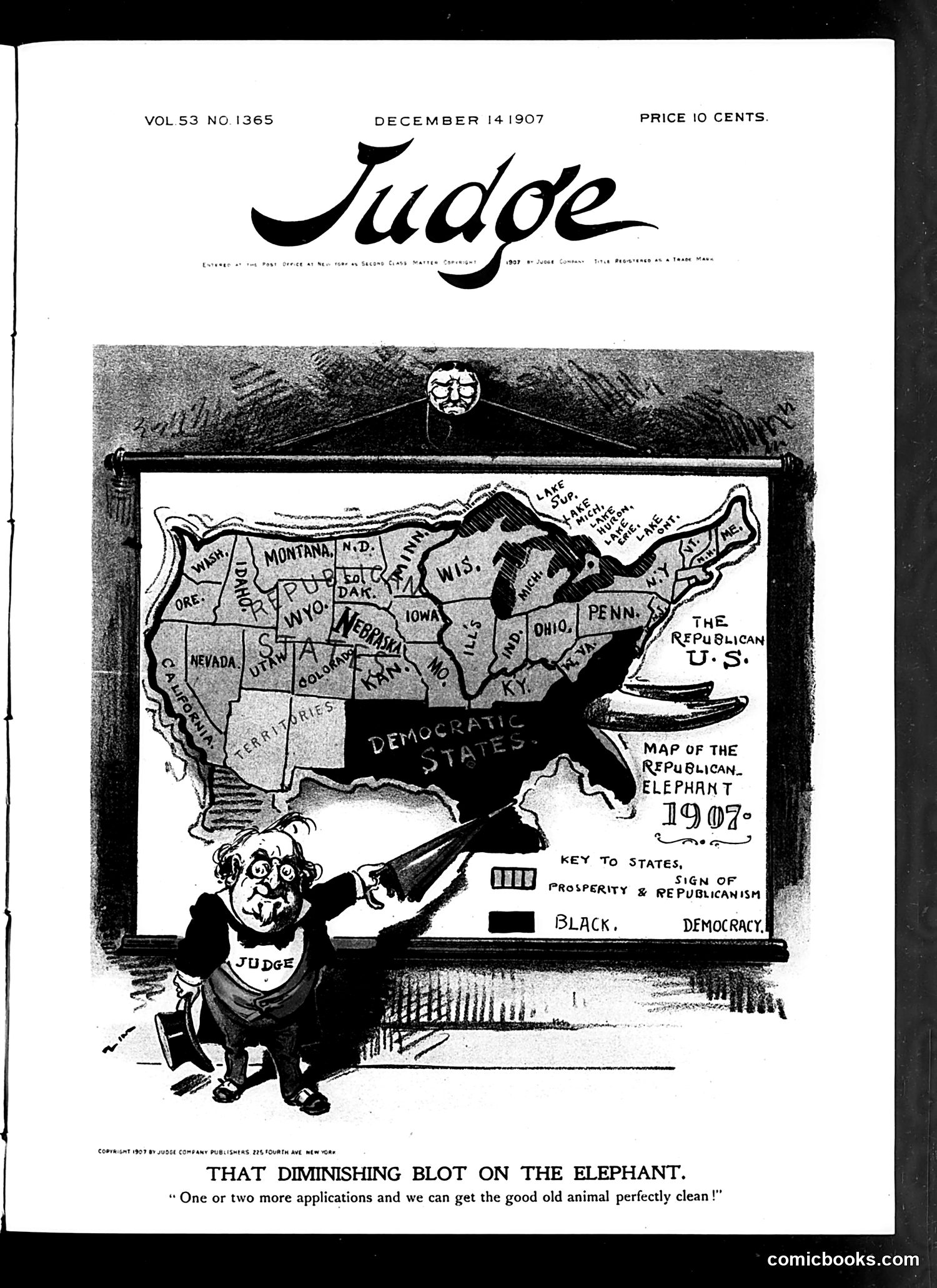
This Judge magazine cover from December 1907 presents a satirical map showing the Republican Party's territorial losses. The cartoon depicts a figure labeled "Judge" pointing to a map where black areas represent "Democratic States" while striped areas show "Prosperity & Republicanism." The visual metaphor uses the Republican elephant symbol with Democratic territory (shown in black) appearing as a stain or "blot." The caption—"One or two more applications and we can get the good old animal perfectly clean!"—suggests the cartoonist's optimistic view that Republican electoral efforts would eliminate Democratic gains. This likely reflects post-1906 midterm election dynamics, when Democrats made congressional gains, and conservative Republicans' determination to regain lost ground.
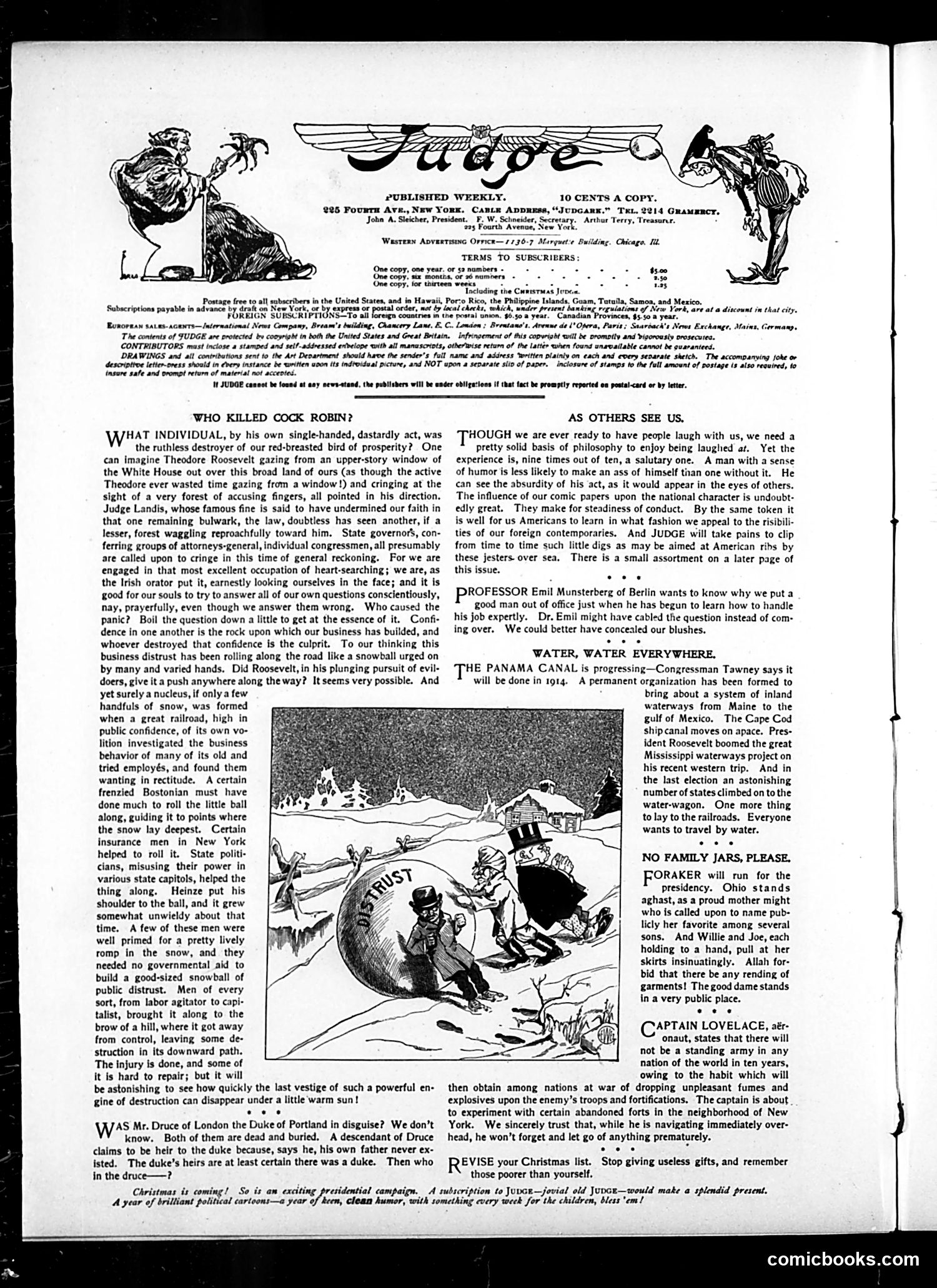
The main cartoon depicts a figure labeled "IN TRUST" (appearing to be a snowball or spherical object) being passed among multiple people in a snowy landscape. Based on the article "WHO KILLED COCK ROBIN?" above it, this satirizes political corruption and responsibility-shifting among government officials. The text criticizes various politicians—including a "Bostonian," "State governor," and "Judge Lands"—for their roles in some scandal involving "heart-searching" and destroyed confidence. The snowball metaphor suggests officials are tossing blame between themselves like a hot potato, evading accountability. The surrounding articles address unrelated topics (Panama Canal, presidential campaign, military matters), typical for Judge's satirical weekly format.
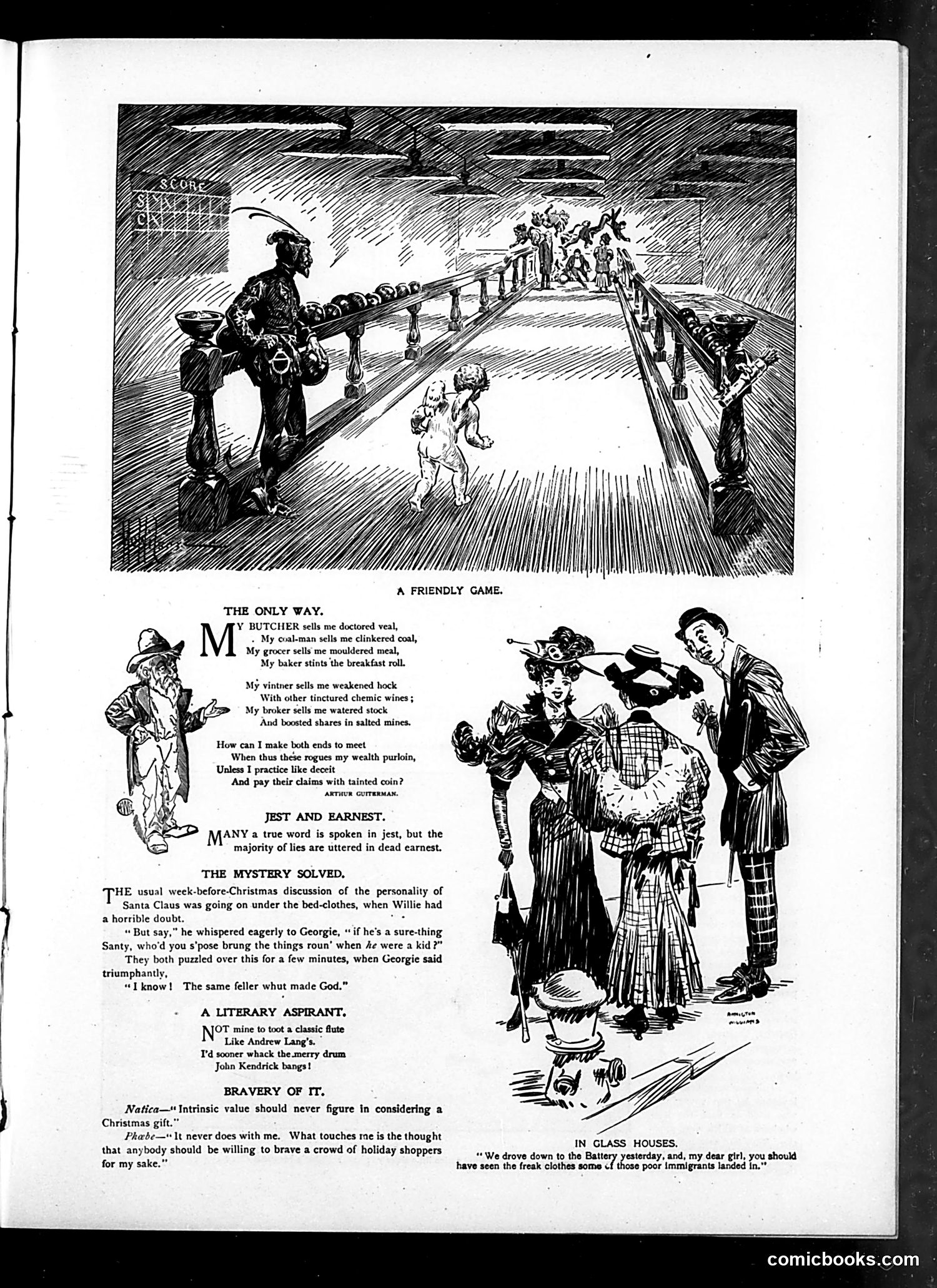
The top illustration depicts a children's game in an indoor space, likely a school or institutional setting. An adult supervises while children play, suggesting commentary on supervised recreation or institutional life. The accompanying text pieces—"The Only Way," "Jest and Earnest," "The Mystery Solved," "A Literary Aspirant," "Bravery of It," and "In Glass Houses"—appear to be standalone satirical poems and anecdotes rather than connected narratives. These mock various social types: merchants, pretentious people, and Christmas shoppers. Without clearer historical markers or identifying captions, the specific social or political targets remain ambiguous. The overall tone suggests gentle satire of middle-class Victorian society, commercialism, and human pretension, typical of Judge magazine's satirical approach.
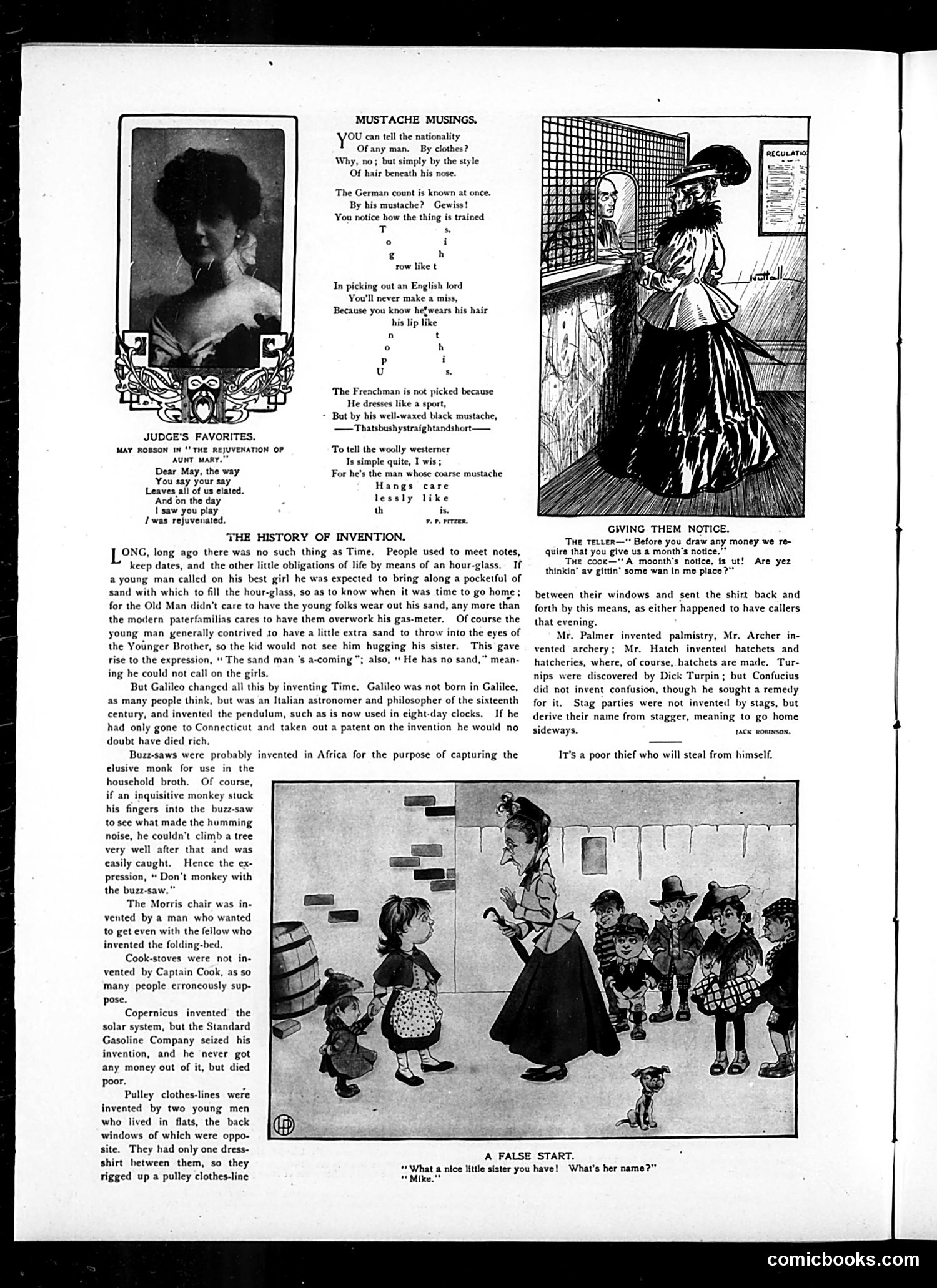
This page contains three distinct sections: 1. **"Mustache Musings"** - A satirical poem about identifying English gentlemen by their mustaches, playing on stereotypes of facial hair as a class marker. 2. **"Judge's Favorites"** - A short verse crediting May Robson in a theatrical production, likely promoting contemporary entertainment. 3. **"The History of Invention"** - A humorous essay attributing various inventions to unexpected sources (buzzsaws to Africa, the Morris chair to a man avoiding work, etc.), satirizing credit-taking and false attribution in invention narratives. 4. **"A False Start"** - A cartoon showing children with a woman, with dialogue suggesting mistaken identity regarding "Mike" and a "nice little sister." The page reflects Judge's typical blend of social satire, theatrical promotion, and lighthearted humor targeting contemporary attitudes.
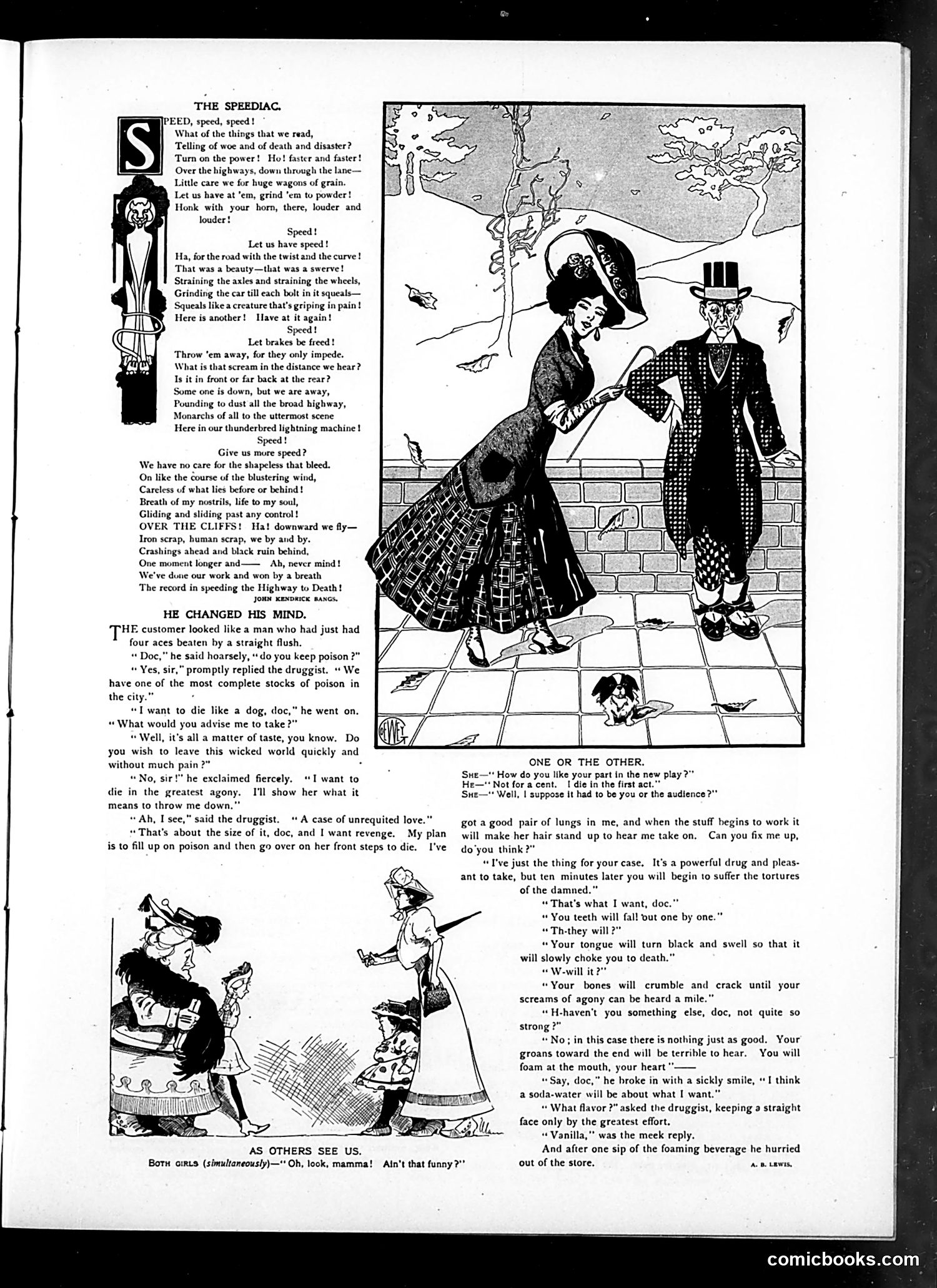
This page satirizes reckless automobile speeding, a contemporary social concern. "The Speediac" poem (left) mocks the obsession with speed and dangerous driving on highways, using dramatic language about death and disaster. The main cartoon depicts a wealthy woman in fashionable dress flirting with a well-dressed man, while a small dog appears crushed beneath the pavement—a dark visual joke about the human cost of speeding. The accompanying dialogue reveals the woman is seeking poison to kill herself over unrequited love, and a druggist suggests she simply take a "soda-water" instead, implying automobiles already provide sufficient danger. The satire targets both the period's speed obsession and gender/class attitudes toward reckless behavior among the wealthy.
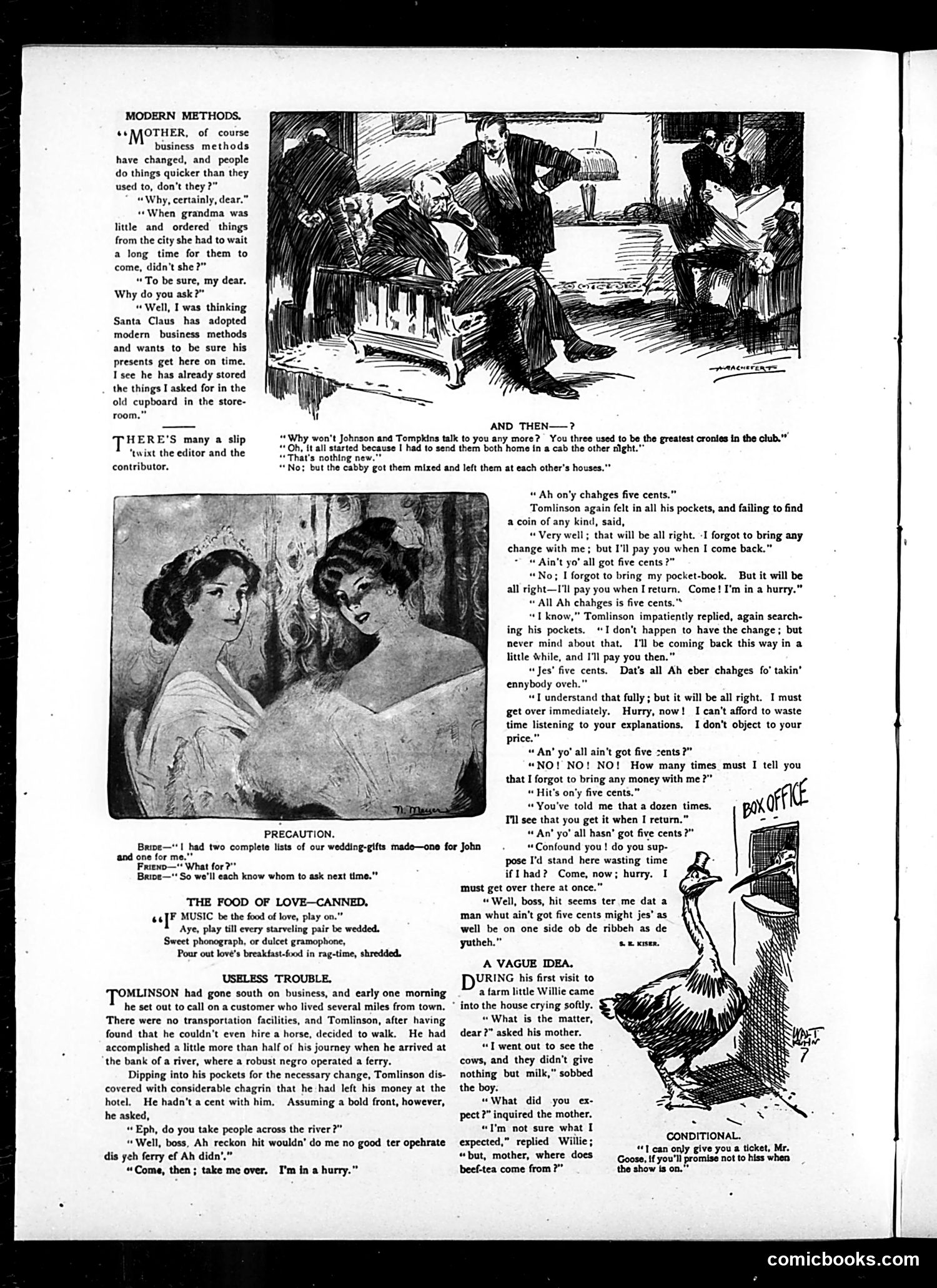
This page contains three satirical pieces from *Judge* magazine: 1. **"Modern Methods"**: A mother discovers her child has found Christmas presents hidden in the storeroom, humorously suggesting Santa has adopted efficient "modern business methods" by pre-storing gifts rather than delivering them on Christmas Eve. 2. **"Useless Trouble"**: A man (Tomlinson) repeatedly insists he has no money to pay a Black ferry operator the five-cent fare, yet keeps demanding passage "in a hurry." The ferry operator patiently repeats his modest price. The satire targets Tomlinson's impatience and entitlement—he expects service without payment while dismissing the worker's reasonable request. 3. **Supporting pieces** include wedding-gift satire and references to phonographs as romantic "food of love." The ferry story's satire criticizes wealthy or privileged individuals' disrespect toward working people and their services, regardless of race—a notable theme for early-20th-century American satire.
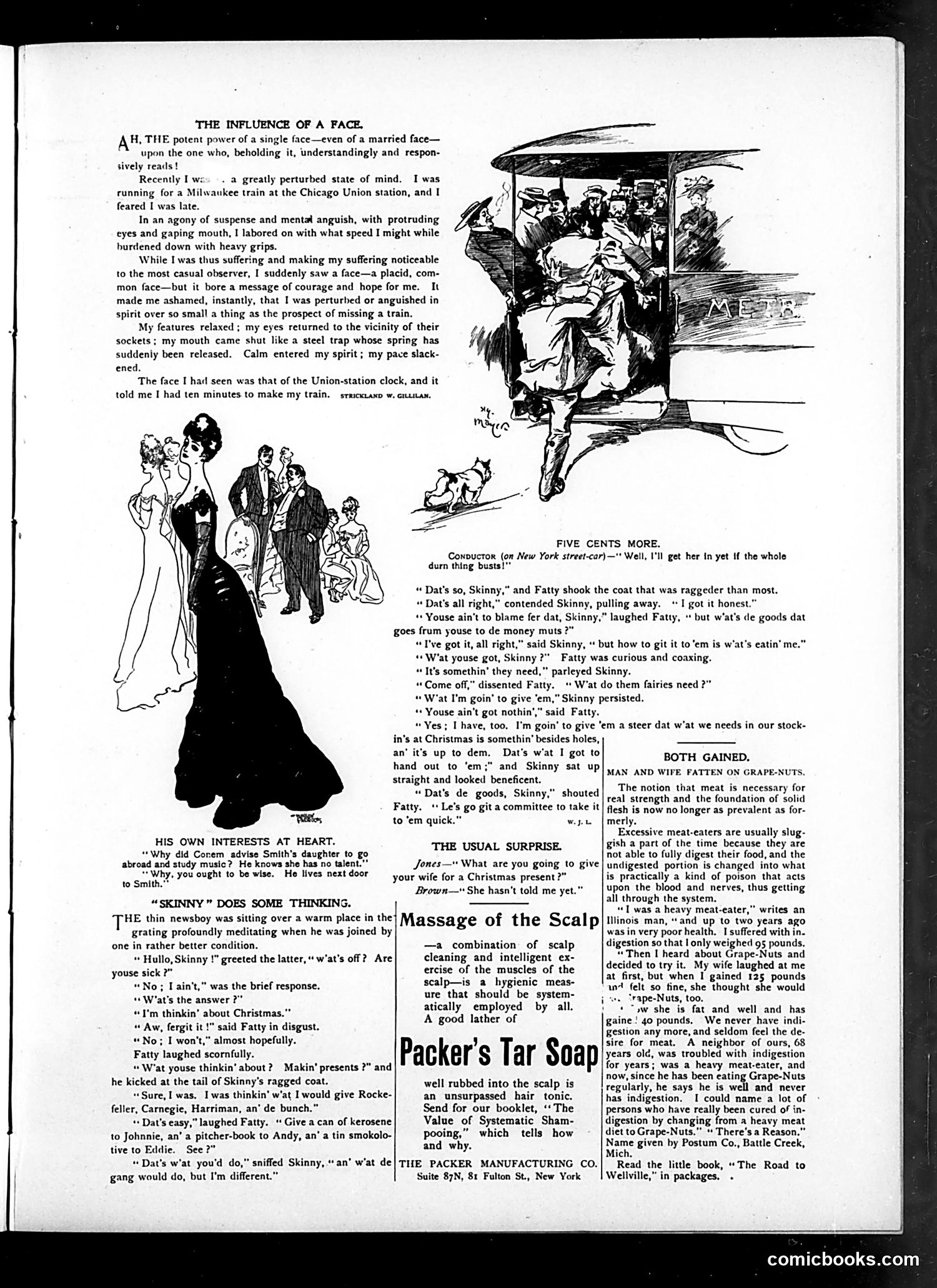
This page contains three satirical pieces typical of early 20th-century Judge magazine. The title story mocks overwrought emotional responses: a man anxiously rushing for a train is suddenly "calmed" by seeing what he believes is a wise, peaceful face—only to discover it's merely a clock. The joke satirizes how people project meaning onto neutral objects and how easily anxiety dissolves upon any perceived reassurance. The "Skinny" and "Fatty" dialogue depicts working-class street children (likely newspaper boys or similar urban poor) using heavy ethnic dialect and slang. Skinny proposes giving wealthy industrialists (Rockefeller, Carnegie, Harriman) advice about their Christmas stockings needing mending—satirizing both the vast wealth gap and the presumption that even the poorest have "wisdom" to offer the rich. A brief joke about a man giving his wife a Christmas present plays on marital indifference. The page also contains advertisements, including one for Packer's Tar Soap promoting scalp massage and one for Grape-Nuts cereal.
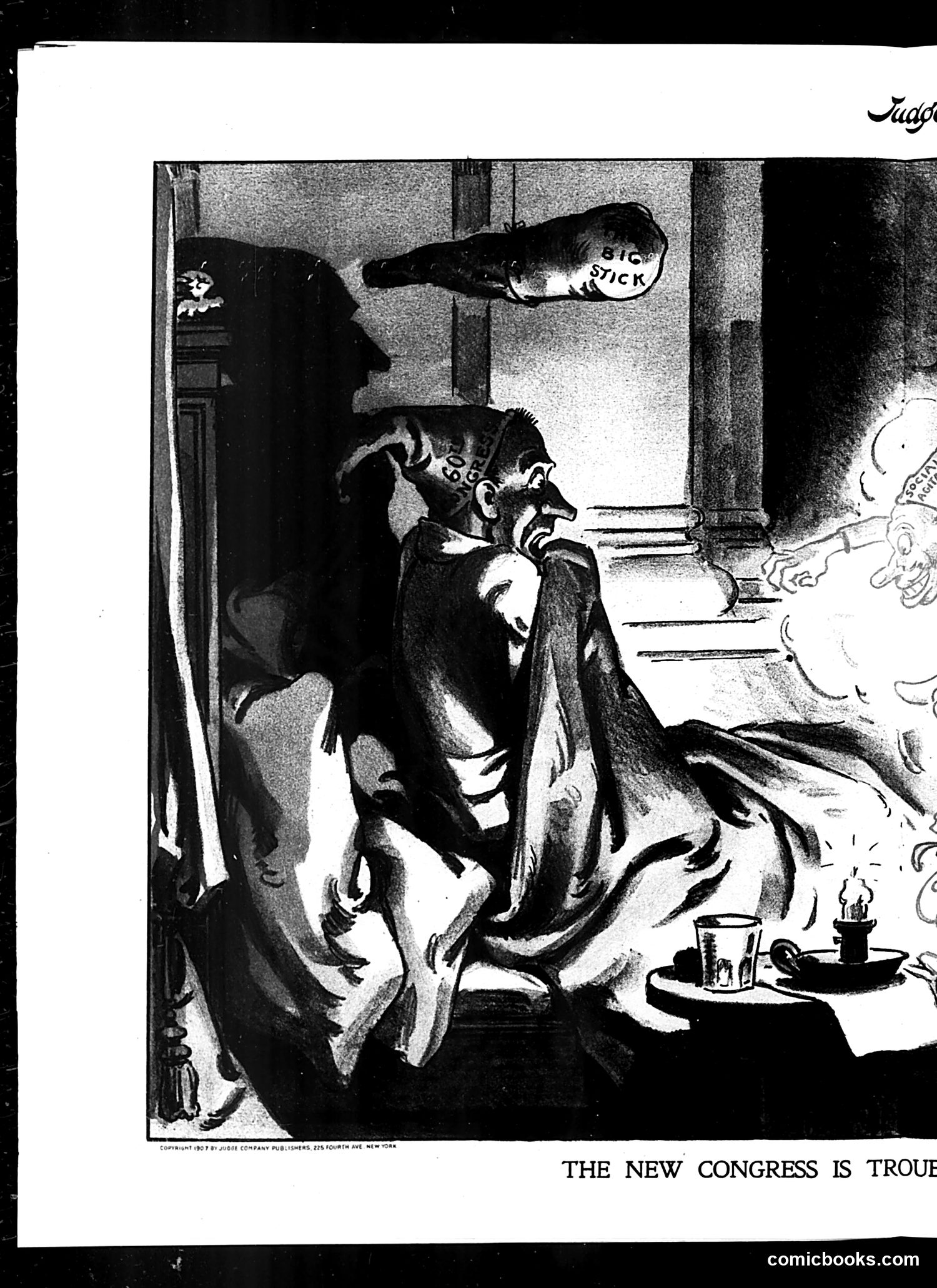
This political cartoon depicts a grotesque, demonic figure labeled "STICK" wielding what appears to be a club or stick, threatening or attacking a cowering individual on the right. A sinister shadow looms in the background on the left. The style and imagery suggest corruption or malevolent force infiltrating Congress. The incomplete caption "THE NEW CONGRESS IS TROU[E]" (likely "TROUBLED") indicates this satirizes problems within a newly-formed Congress. The demonic characterization labeled "STICK" appears to represent either a specific political figure, corrupt influence, or problematic legislative approach that Judge magazine's editors viewed as threatening to proper governance. Without the complete caption and publication date, the specific congressional session and targets remain unclear.
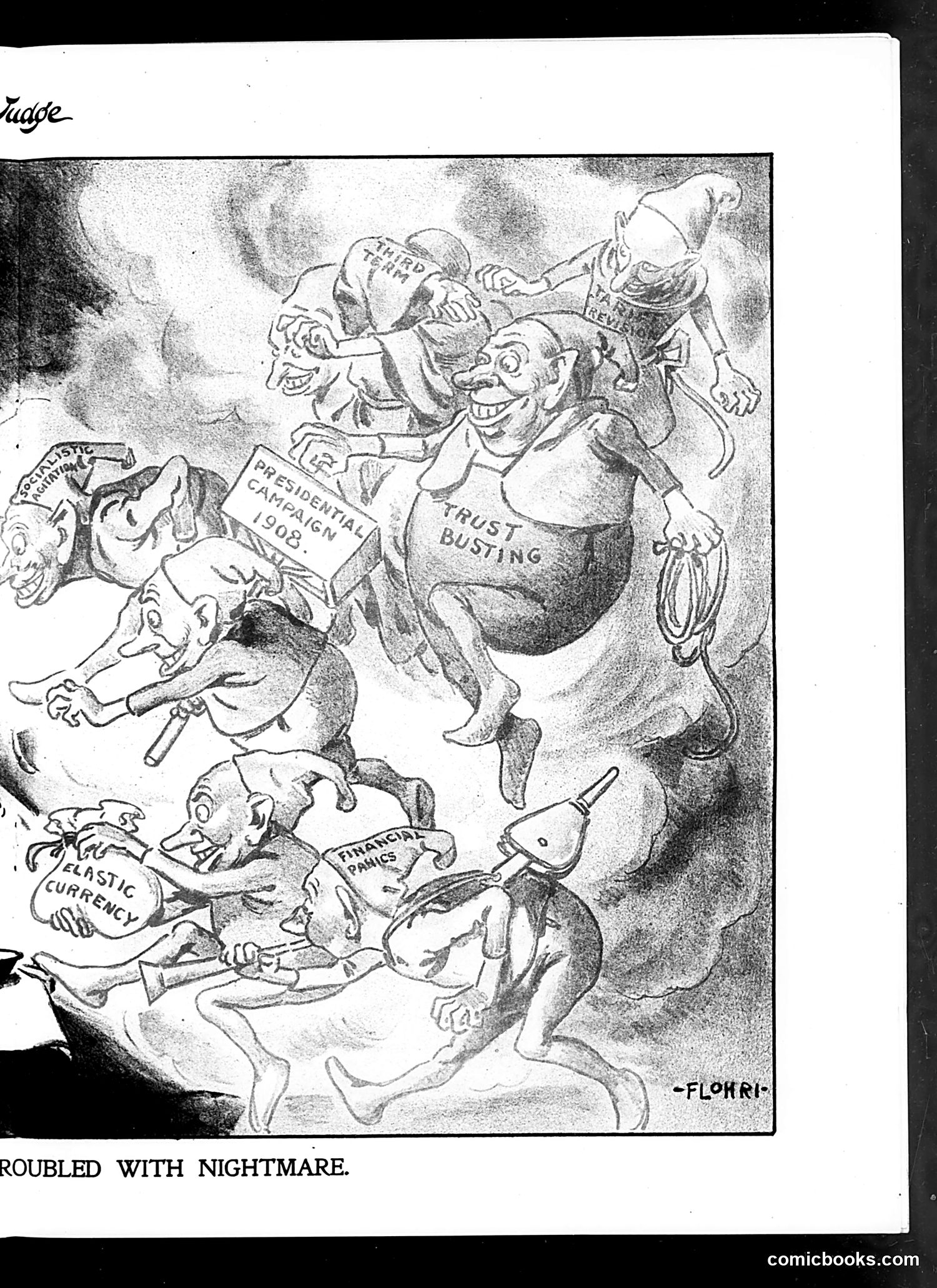
This 1908 political cartoon depicts a large figure labeled "TRUST BUSTING" having a nightmare. The sleeping figure is tormented by smaller caricatures representing various concerns: "ELASTIC CURRENCY," "FINANCIAL PANIC," and what appears to be "PRESIDENTIAL CAMPAIGN" labels. The satire critiques Theodore Roosevelt's trust-busting agenda (his aggressive antitrust policies). The cartoon suggests that Roosevelt's trust-busting efforts, while intended as reform, are causing economic anxiety—particularly regarding currency instability and financial panics. The nightmare imagery implies these policies create fears among business and financial interests rather than solving problems. The 1908 date places this during Roosevelt's presidency, when his antitrust campaigns were controversial and economically destabilizing to some observers.
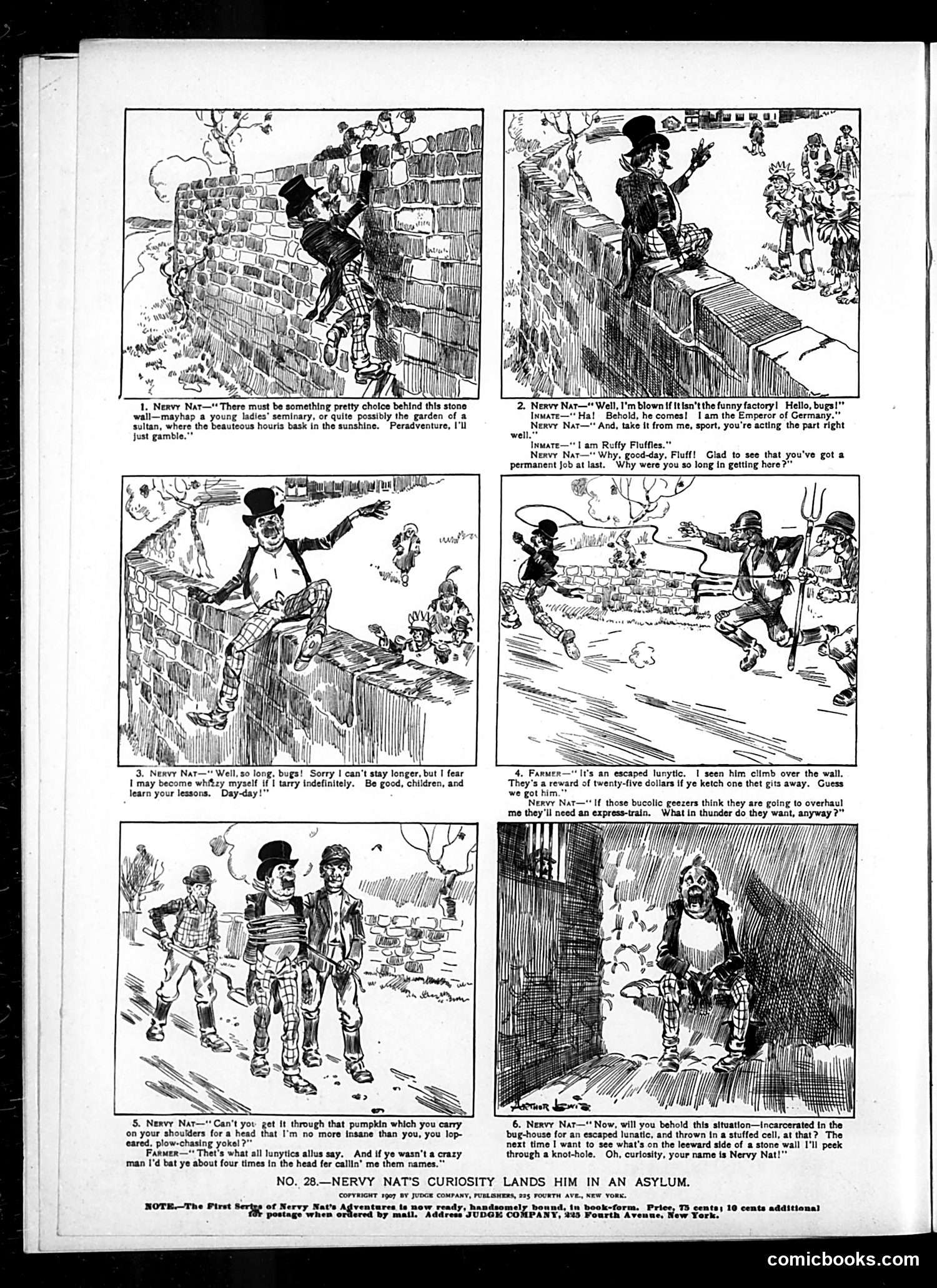
This is a six-panel comic strip from Judge (1907) following the character "Nervy Nat," a mischievous figure whose nosiness gets him committed to an asylum. The narrative: Nat peeks over a wall (panel 1), encounters an escaped lunatic (panel 4), and is mistaken for the escapee by a farmer offering a reward. Nat flees but is caught and institutionalized (panel 6). While confined, he encounters fellow inmates claiming to be the Emperor of Germany and "Ruffy Fluffles" (panels 2-3, 5). The satire plays on early 20th-century attitudes toward mental institutions and madness—portraying the asylum as populated by harmless eccentrics, and suggesting Nat's "crime" was mere curiosity. The joke is his comeuppance: his nosiness directly causes his wrongful confinement. The title emphasizes how curiosity, personified as an almost fatal flaw, backfires.
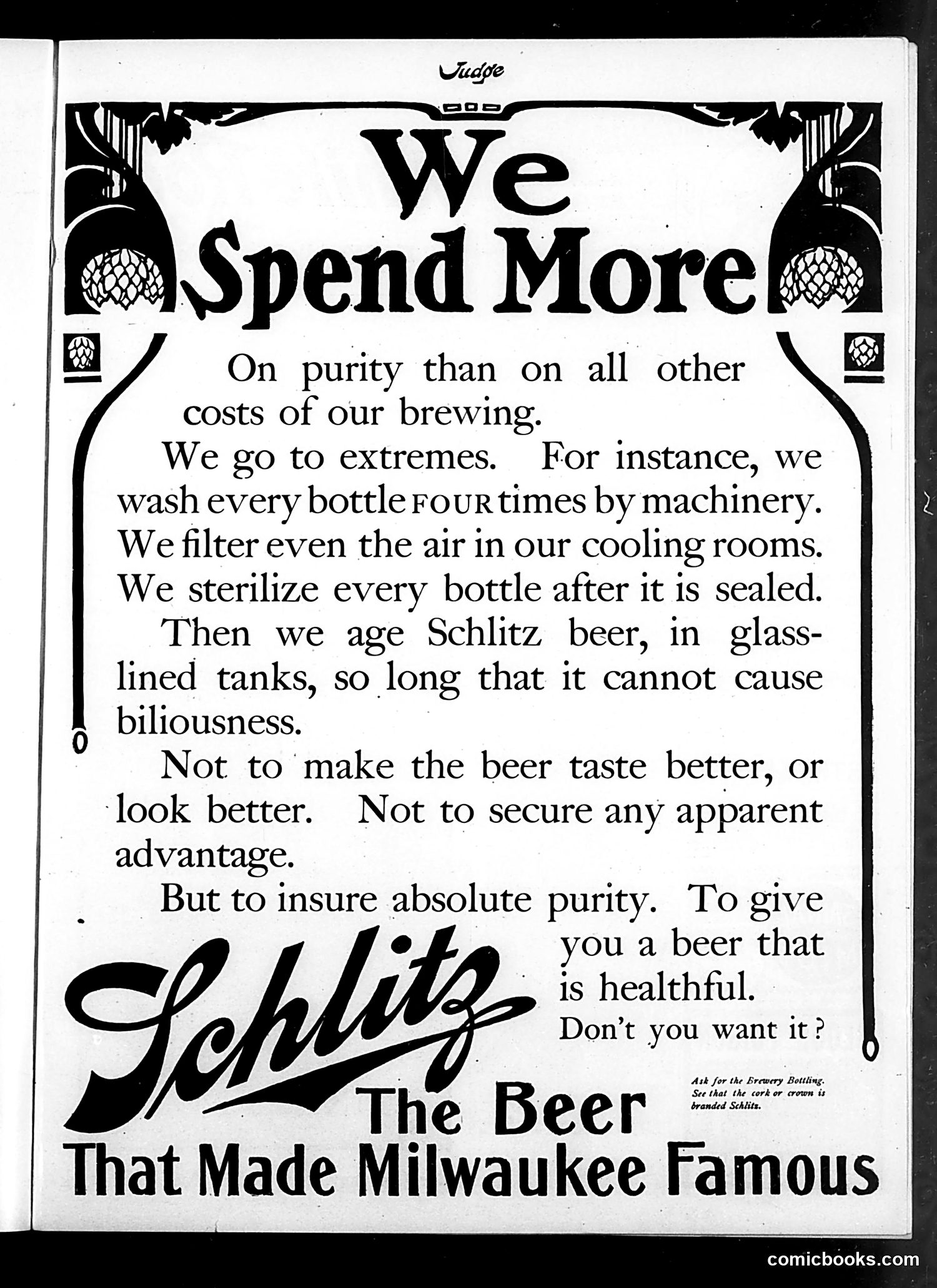
This is a **Schlitz beer advertisement**, not political satire. The ad promotes the brewery's quality control processes to a early-20th-century audience concerned with food and beverage safety. The pitch emphasizes purity and health rather than taste or appearance—reflecting contemporary anxieties about contaminated food and water that caused serious illness. The mention of preventing "biliousness" (nausea/digestive upset) addresses real public health concerns of the era. The ad claims Schlitz spends more on purity than competitors: washing bottles four times, filtering air, sterilizing after sealing, and aging in glass-lined tanks. This messaging reframes expensive manufacturing as consumer protection. "The Beer That Made Milwaukee Famous" was Schlitz's actual slogan, positioning the Wisconsin brewery as America's premier brand through claims of scientific rigor and healthfulness rather than flavor.
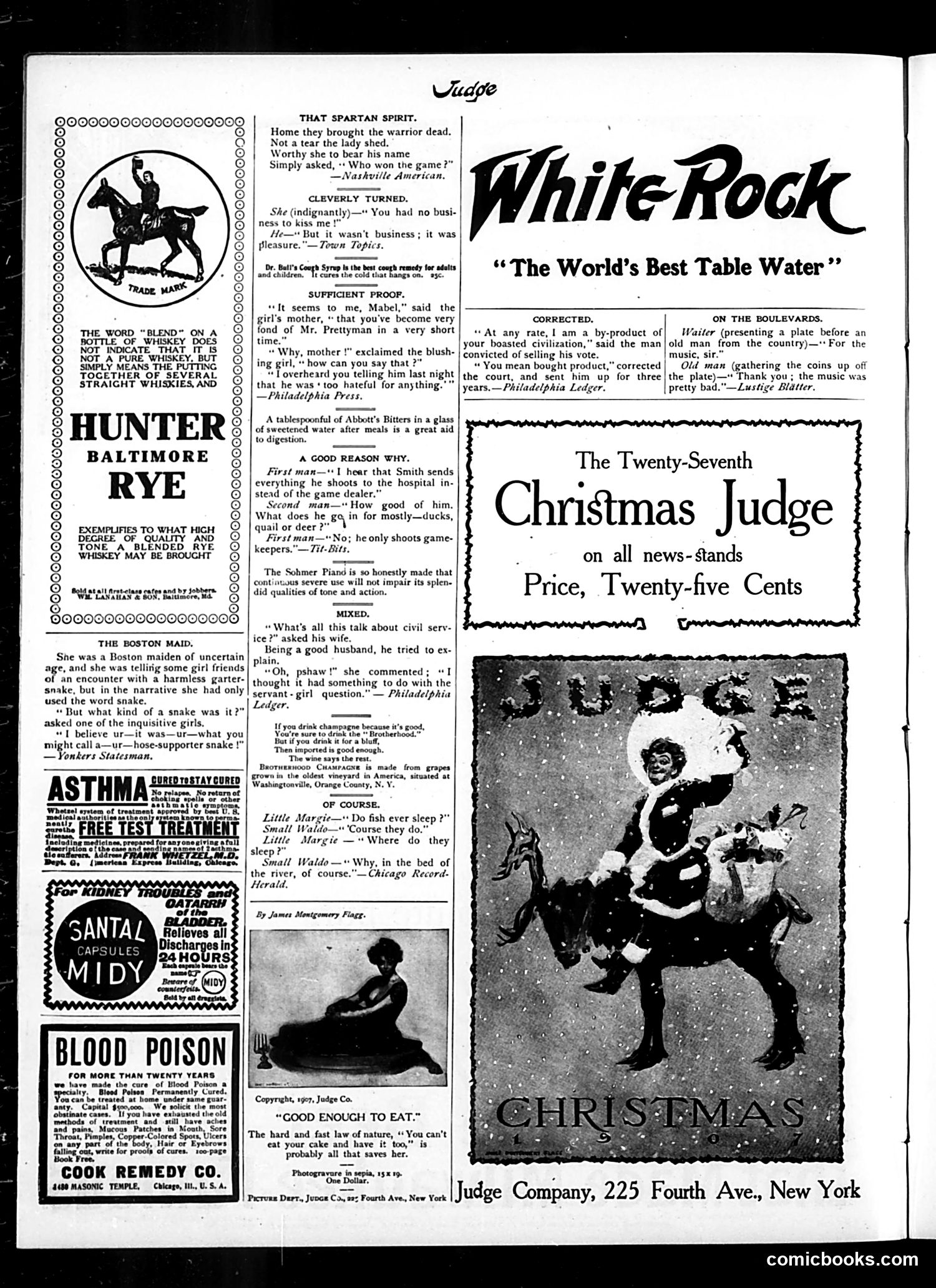
This page from Judge (a satirical weekly) is primarily **advertising and light humor**, not political commentary. The content consists of: **Main Items:** - Multiple short, domestic humor anecdotes (the Boston maid's garter-snake joke, the young couple's kissing debate, etc.) - Period advertisements for whiskey, patent medicines (asthma, blood poison "cures"), and a piano - A cartoon illustration advertising "The Twenty-Seventh Christmas Judge" (the magazine's annual holiday issue) **The Satire:** The humor targets **everyday social pretense and misunderstandings**—a woman's Victorian prudishness about a harmless snake, romantic deception framed as "pleasure" rather than impropriety. One piece mocks a woman's ignorance about civil service, reducing it to servant-girl complaints. **The Illustration:** Shows Santa delivering Christmas gifts, typical holiday advertising imagery. There is **no clear political satire** here. This appears to be a standard advertising/humor page from Judge's lighter content, likely targeting middle-class readers with genteel domestic comedy and patent medicine ads. The magazine itself was the advertiser, promoting its annual Christmas issue.
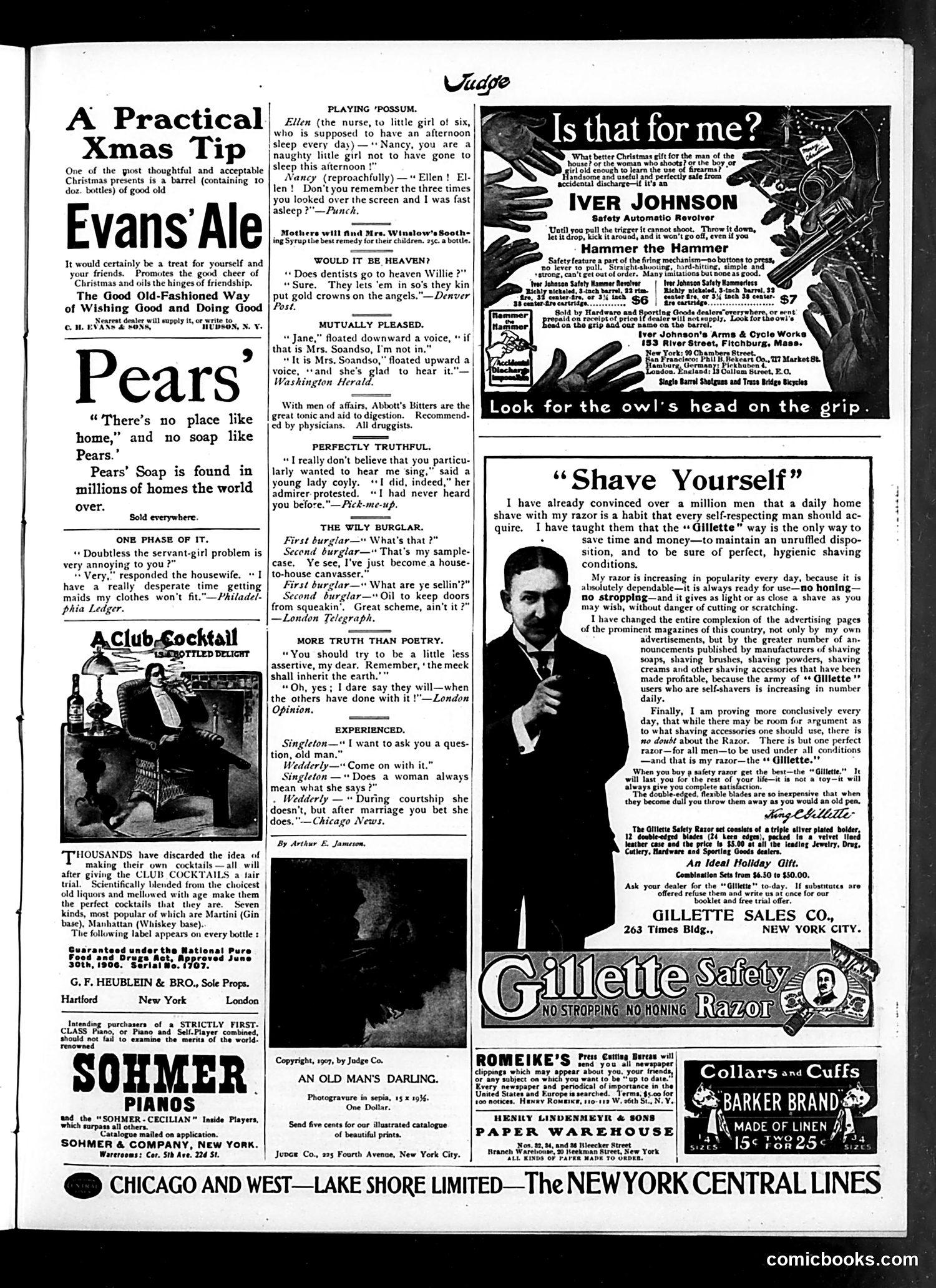
This page from Judge magazine contains mostly **short comic anecdotes and advertisements**, not political cartoons. **The humor** relies on early 20th-century domestic scenarios: a nurse catching a child faking sleep, a man's flirtation with a woman named Jane, a dentist joke about gold crowns in heaven, and a burglar posing as a door-to-door salesman. These are genteel, mild jokes typical of family magazines of the era. **The major content** is **advertising**—particularly for Iver Johnson Safety Automatics revolvers (marketed as child-safe), Gillette Safety Razors (pitched to men's daily routines), Evans' Ale, Pears' Soap, and other products. The Gillette ad notably emphasizes masculinity and efficiency. **Social context**: The ads reveal period concerns—domestic servants, the "servant-girl problem," and marketing safety features for firearms. The humor assumes middle-class domesticity and heterosexual courtship scenarios familiar to Judge's educated readership. There is no significant political satire on this particular page.
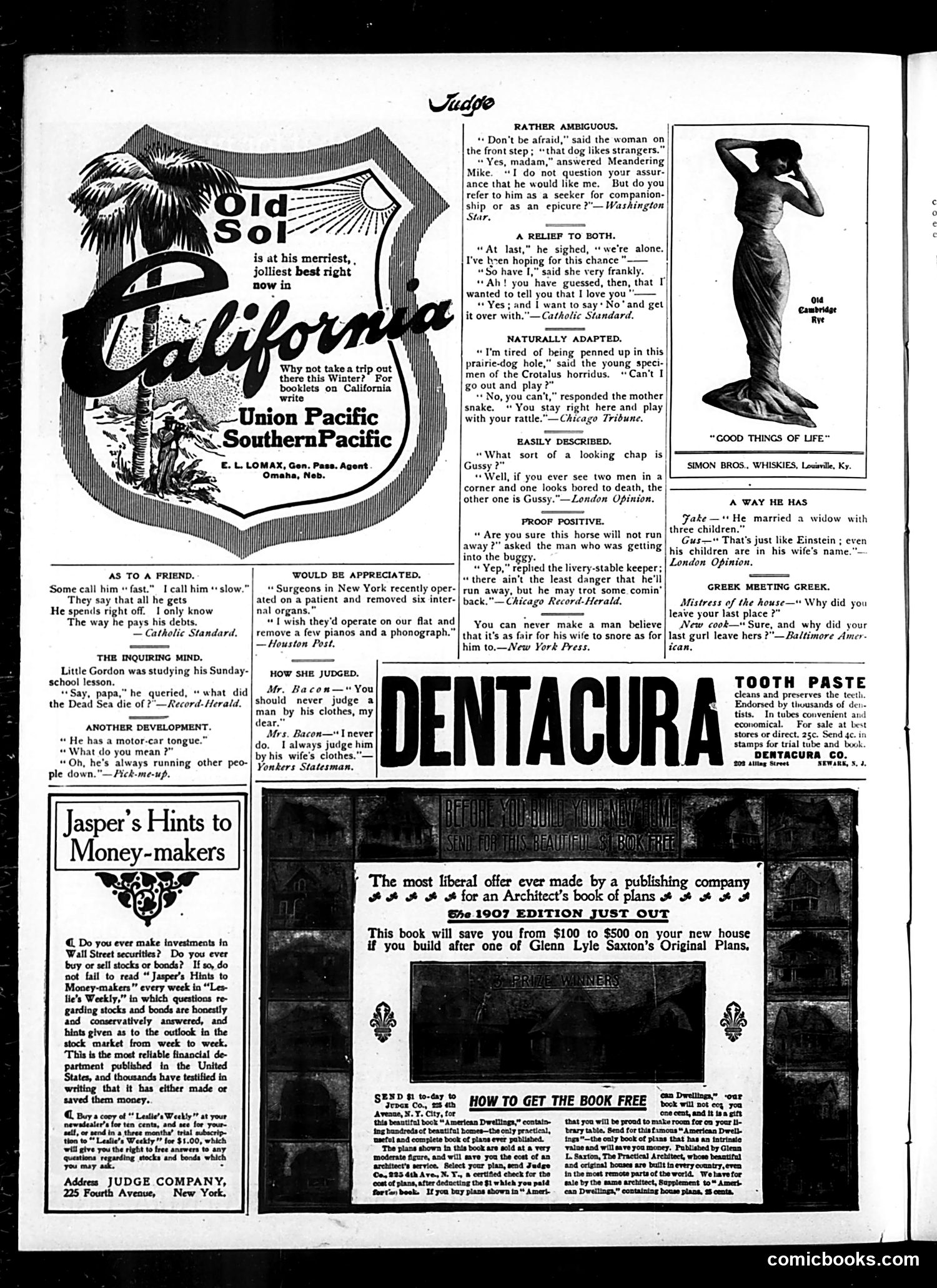
This page from *Judge* magazine consists primarily of **short humorous anecdotes** rather than political cartoons. The jokes satirize everyday social situations and human nature. **Key content:** The pieces mock various targets: a spendthrift called "fast" but who pays debts; a child's innocent question about the "Dead Sea"; someone with a "motor-car tongue" (always running people down); marital discord (a couple relieved to be alone, yet she refuses his love confession); and class/ethnic humor (a "New cook" with Irish dialect, Greek servants). **The main advertisement** promotes Union Pacific/Southern Pacific railroad travel to California—typical of the era's leisure tourism marketing. **Social satire themes** include: marital unhappiness, pretense in relationships, the gap between appearance and reality, and period-typical ethnic stereotyping. The **Dentacura toothpaste ad** and "Jasper's Hints to Money-makers" column fill remaining space. Nothing on this page addresses major political events—it's domestic humor aimed at middle-class readers.
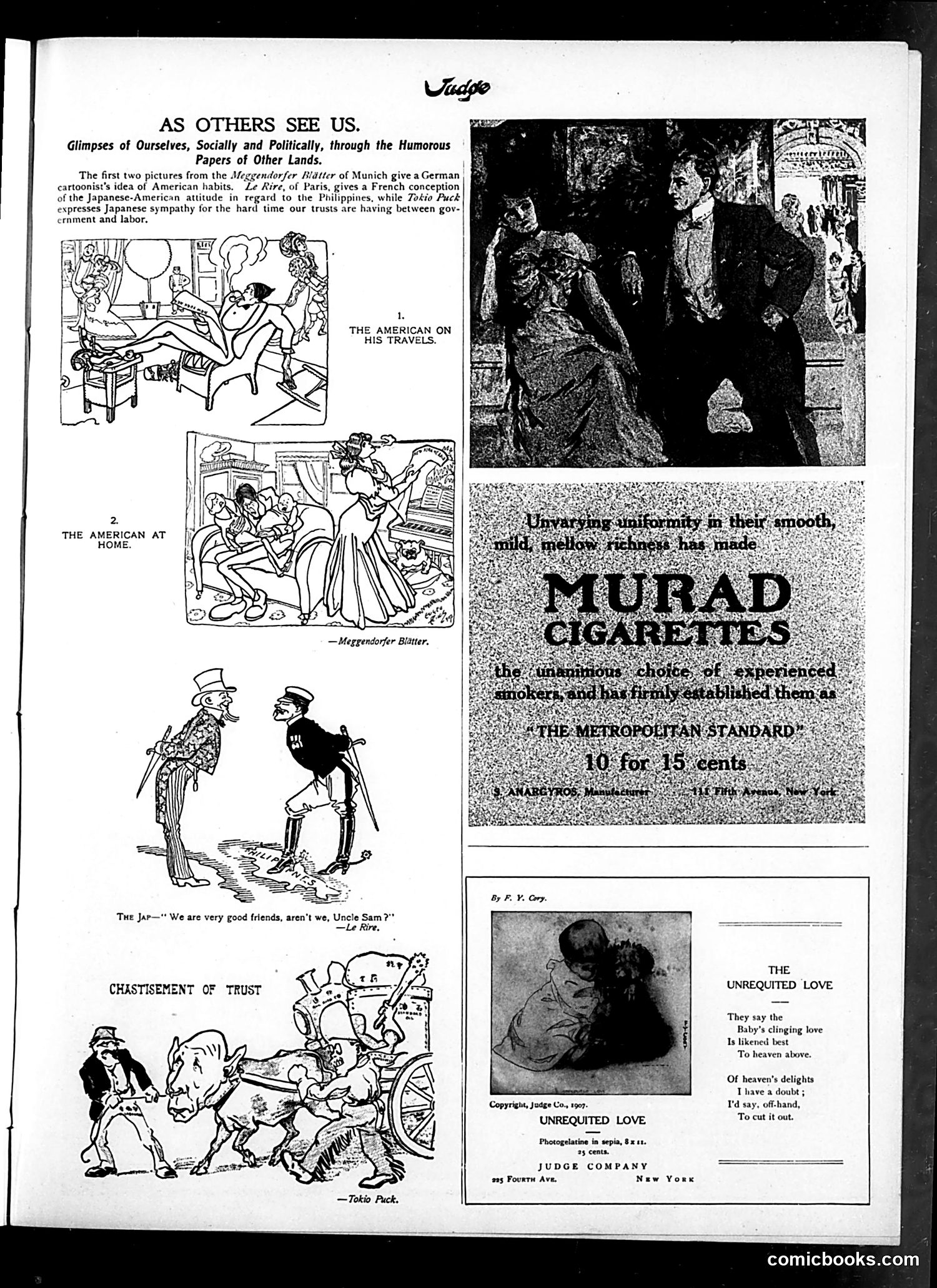
This page presents international cartoons mocking American society and foreign policy. German cartoons from *Meggendorfer Blätter* satirize American travelers as loud, ostentatious tourists and Americans at home as chaotic and undisciplined. A French cartoon from *Le Rire* comments on American-Japanese tensions regarding U.S. control of the Philippines—depicted through the "Jar" character's claim of friendship with "Uncle Sam," likely ironic commentary on colonial attitudes. A Japanese cartoon from *Zosio Puck* expresses sympathy for American trusts (monopolistic corporations) caught between government antitrust action and labor disputes—satirizing America's industrial conflicts. The page also includes advertisements and a sentimental poem about unrequited love, typical period filler content.
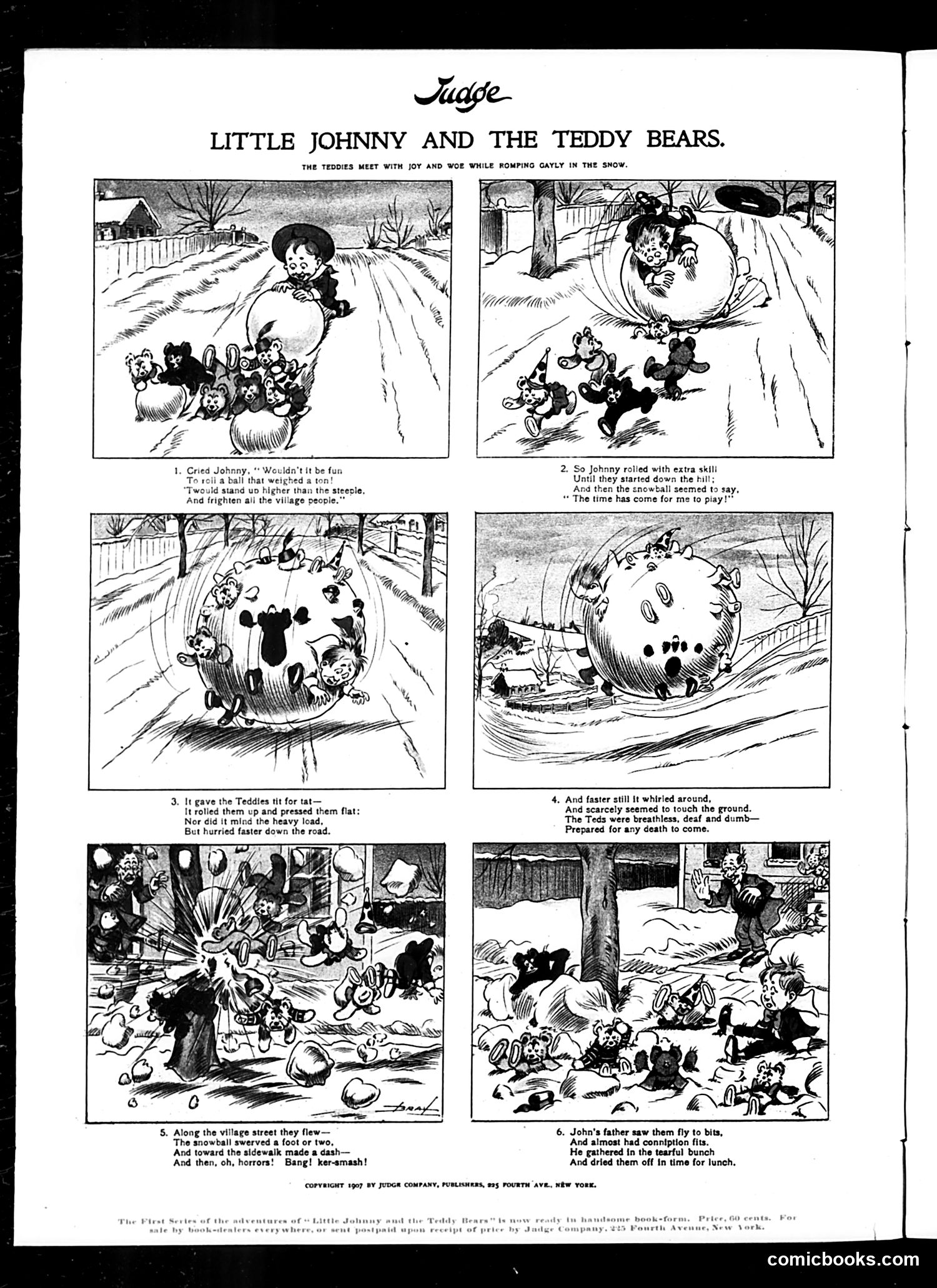
This is a humorous children's story comic from Judge magazine (1907). It depicts a boy named Johnny who rolls a giant snowball down a hill, accidentally trapping stuffed "Teddy Bears" inside it. The bears tumble chaotically through snow, down streets, and finally crash spectacularly. The "Teddy Bears" reference alludes to the popular toy craze of the early 1900s, inspired by President Theodore Roosevelt (nicknamed "Teddy"). These plush bears were mass-marketed toys that became wildly fashionable among children. The joke is straightforward slapstick: Johnny's innocent winter play causes comedic destruction to his beloved toys, which his father must rescue and dry off before lunch. There's no political satire here—it's simply lighthearted entertainment exploiting the era's Teddy Bear mania for comedic effect. The page is primarily narrative illustration rather than editorial commentary.