
Judge, 1907-12-14 · page 6 of 16
Judge — December 14, 1907 — page 6: what you’re looking at
What you’re looking at
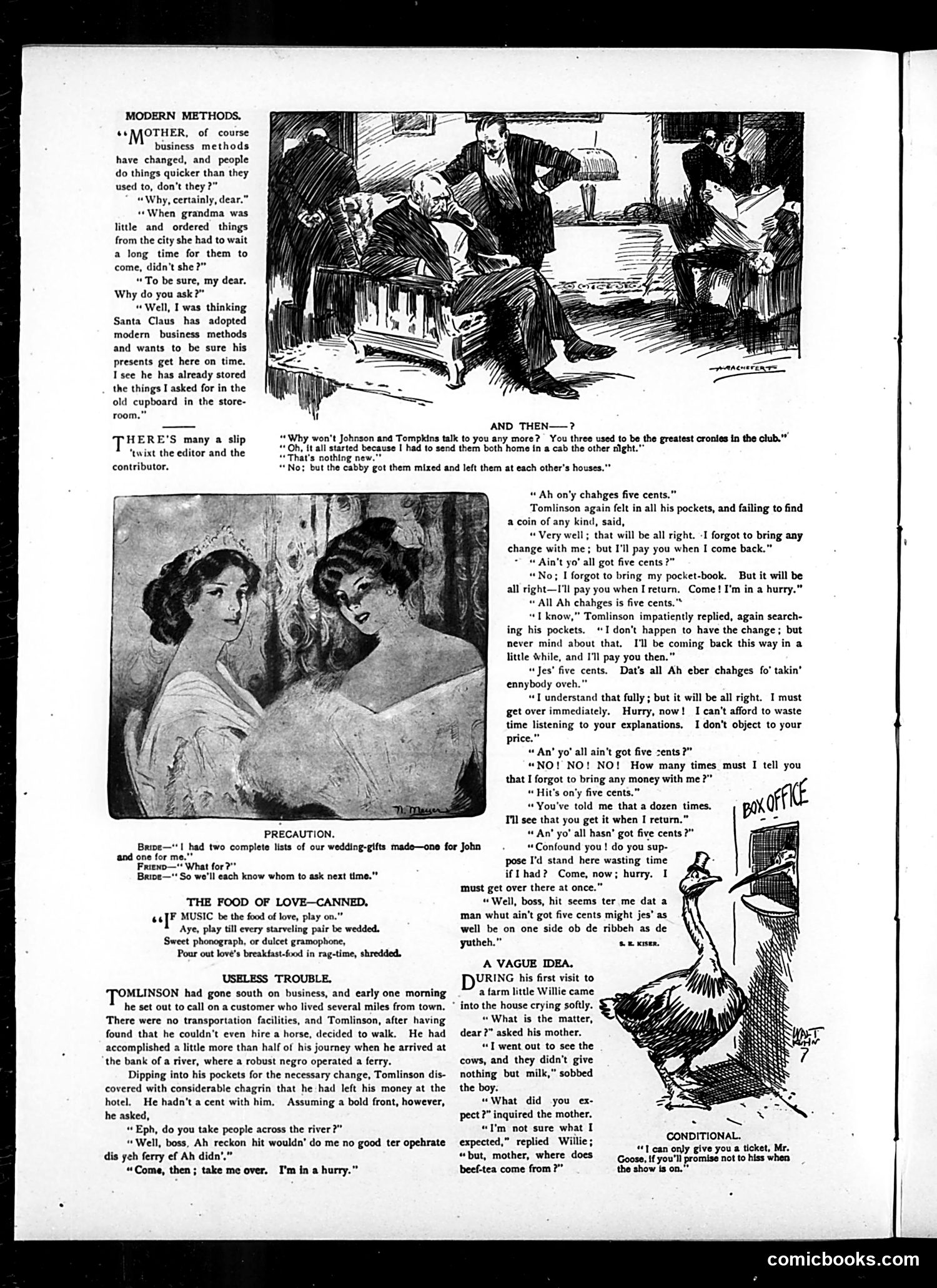
This page contains three satirical pieces from *Judge* magazine: 1. **"Modern Methods"**: A mother discovers her child has found Christmas presents hidden in the storeroom, humorously suggesting Santa has adopted efficient "modern business methods" by pre-storing gifts rather than delivering them on Christmas Eve. 2. **"Useless Trouble"**: A man (Tomlinson) repeatedly insists he has no money to pay a Black ferry operator the five-cent fare, yet keeps demanding passage "in a hurry." The ferry operator patiently repeats his modest price. The satire targets Tomlinson's impatience and entitlement—he expects service without payment while dismissing the worker's reasonable request. 3. **Supporting pieces** include wedding-gift satire and references to phonographs as romantic "food of love." The ferry story's satire criticizes wealthy or privileged individuals' disrespect toward working people and their services, regardless of race—a notable theme for early-20th-century American satire.
📄 Transcribed text from this page (OCR, searchable)
Machine-transcribed from the original scan — historical spelling and the odd misread are preserved.
MODERN METHODS. 4*sMOTHER, of course business methods have changed, and people do things quicker than they used to, don’t they ?” “Why, certainly, dear.” “When grandma was little and ordered things from the city she had to wait a long time for them to come, didn't she?” “To be sure, my dear. Why do you ask?” “Well, I was thinking Santa Claus has adopted modern business methods and wants to be sure his presents get here on time. Isee he has already stored the things I asked for in the old cupboard in the store- room.” THERE'S many a slip ‘twixt the editor and the contributor. PRECAUTION. Brive—"'| had two complete lists of our wedding-gifts made—one for John ‘and one for m Friewo>—‘* What for ?"* Baripe—‘‘ So we'll each know whom to ask next time.” ‘THE FOOD OF LOVE—CANNED. G4] F MUSIC be the food of love, play on.” Aye, play till every starveling pair be wedded. Sweet phonograph, or dulcet gramophone, Pour out lové’s breakfast-food in rag-time, shredded, USELESS TROUBLE, ‘TOMLINSON had gone south on business, and early one morning he set out to call on a customer who lived several miles from town. There were no transportation facilities, and Tomlinson, after having found that he couldn't even hire a horse, decided to walk. He had accomplished a little more than half of his journey when he arrived at the bank of a river, where a robust negro operated a ferry. Dipping into his pockets for the necessary change, Tomlinson dis- covered with considerable chagrin that he had left his money at the hotel. He hadn't a cent with him. Assuming a bold front, however, he asked, “Eph, do you take people across the river ?” “Well, boss, Ah reckon hit wouldn’ do me no good ter opehrate dis yeh ferry ef Ah didn’.” “Come, then; take me over. I'm in a hurry.” AND THEN—? “Why won't Johnson and Tompkins talk to you any more? You three used to be the greatest cronies in the club."* “Oh, it all started because I had to send them both home in a cab the other night." “That's nothing new.” “No; but the cabby got them mized and left them at each other's houses."” “Ah on'y chahges five cents.” Tomlinson again felt in all his pockets, and failing to find coin of any kind, said, “ Very well; that will be all right. -I forgot to bring any change with me; but I'll pay you when I come back.” “ Ain't yo" all got five cents ?” “No; I forgot to bring my pocket-book. But it will be all right—I'll pay you when I return, Come! I'm in a hurry.” “ All Ah chahges is five cent: “I know,” Tomlinson impatiently replied, again search- ing his pockets. «I don't happen to have the change; but never mind about that. I'll be coming back this way in a little ‘hile, and I'll pay you then.” « Jes’ five cents. Dat'’s all Ah eber chahges fo’ takin’ ennybody oveh.” “T understand that fully ; but it will be all right. I must get over immediately. Hurry, now! I can't afford to waste time listening to your explanations. I don't object to your price.” “ An’ yo’ all ain't got five cents?” “NO! NO! NO! How many times must I tell you that I forgot to bring any money with me?” 4 _— “ Hit's on’y five cents.” “You've told me that a dozen times. TIl see that you get it when I return.” “ An’ yo’ all hasn’ got five cents 2” “Confound you ! do you sup- pose I'd stand here wasting time if had? Come, now; hurry. I must get over there at once.” “Well, boss, hit seems ter me dat a man whut ain't got five cents might jes’ as well be on one side ob de ribbeh as de yutheh.” A VAGUE IDEA, URING his first visit to a farm little Willie came * into the house crying softly. “What is the matter, dear ?” asked his mother. “T went out to see the cows, and they didn’t give nothing but milk,” sobbed the boy. “What did you ex- pect ?” inquired the mother. «I'm not sure what I expected,” replied Willie; “but, mother, where does beef-tea come from ?” CONDITIONAL. ““Tcan only give you a ticket, Mr. Goose, if you'll promise not to hiss when the show is on.” comicbooks.com