
Judge, 1907-12-14 · page 4 of 16
Judge — December 14, 1907 — page 4: what you’re looking at
What you’re looking at
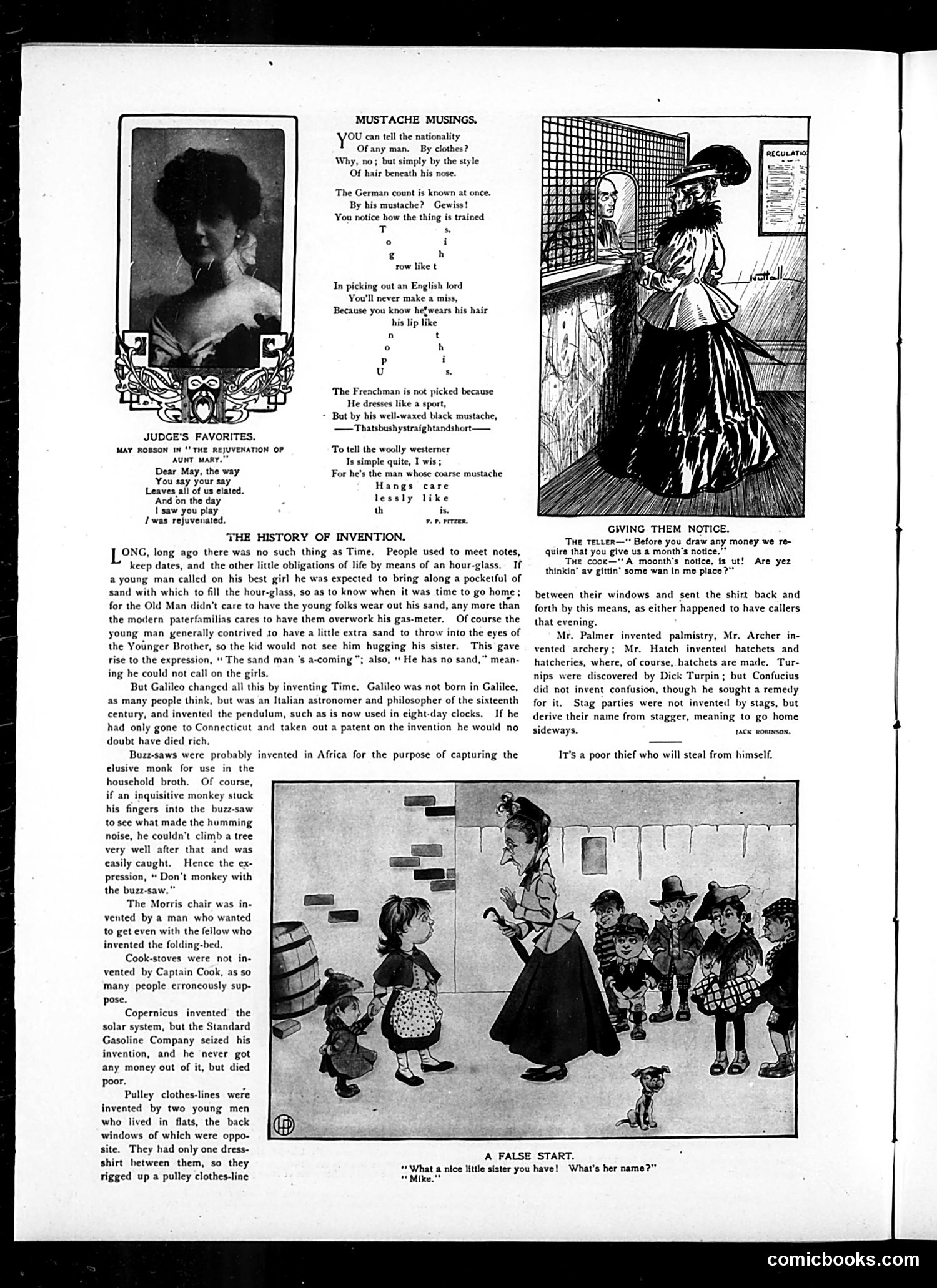
This page contains three distinct sections: 1. **"Mustache Musings"** - A satirical poem about identifying English gentlemen by their mustaches, playing on stereotypes of facial hair as a class marker. 2. **"Judge's Favorites"** - A short verse crediting May Robson in a theatrical production, likely promoting contemporary entertainment. 3. **"The History of Invention"** - A humorous essay attributing various inventions to unexpected sources (buzzsaws to Africa, the Morris chair to a man avoiding work, etc.), satirizing credit-taking and false attribution in invention narratives. 4. **"A False Start"** - A cartoon showing children with a woman, with dialogue suggesting mistaken identity regarding "Mike" and a "nice little sister." The page reflects Judge's typical blend of social satire, theatrical promotion, and lighthearted humor targeting contemporary attitudes.
📄 Transcribed text from this page (OCR, searchable)
Machine-transcribed from the original scan — historical spelling and the odd misread are preserved.
MUSTACHE MUSINGS. YOU can tell the nationality Of any man. By clothes? Why, no; but simply by the style Of hair beneath his nose. The German count is known at once. By his mustache? Gewiss! You notice how the thing is trained T s. ° i h row like t In picking out an English lord You'll never make a miss, Because you know hefwears his hair his lip like a t ° h P i U s. ‘The Frenchman is not picked because He dresses like a sport, But by his well-waxed black mustache, —Thatsbushystraightandshort— JUDGE'S FAVORITES. MAY ROBSON IN ‘THE REJUVENATION OF AUNT MARY.” Dear May, the way You say your say Leaves ail of us elated. ‘And on the day * I saw you play th Iwas rejuvenated. THE HISTORY OF INVENTION. ONG, long ago there was no such thing as Time. People used to meet notes, keep dates, and the other little obligations of life by means of an hour-glass. If, a young man called on his best girl he was expected to bring along a pocketful of sand with which to fill the hour-glass, so as to know when it was time to go home; for the Old Man didn’t care to have the young folks wear out his sand, any more than the modern paterfamilias cares to have them overwork his gas-meter. Of course the young man generally contrived to have a little extra sand to throw into the eyes of the Younger Brother, so the kid would not see him hugging his sister. This gave rise to the expression, “ The sand man 's a-coming; also, “* He has no sand,” mean- To tell the woolly westerner Is simple quite, I wis ; For he’s the man whose coarse mustache Hangs care lessly like is. Pov. rerzen, ing he could not call on the girls. But Galileo changed all this by inventing Time. Galileo was not born in Galilee, as many people think, but was an Italian astronomer and philosopher of the sixteenth century, and invented the pendulum, such as is now used in eight-day clocks. If he had only gone to Connecticut and taken out a patent on the invention he would no doubt have died rich. Buzz-saws were probably invented in Africa for the purpose of capturing the elusive monk for use in the household broth. Of course, if an inquisitive monkey stuck his fingers into the buzz-saw GIVING THEM NOTICE, Tue teLrer—"' Before you draw any money we re- Quire that you give us a month’s notice.” Tue coox—"*A moonth's notice, is ut! thinkin’ av gittin’ some wan in me place?" Are yez between their windows and sent the shirt back and forth by this means, as either happened to have callers that evening. Mr. Palmer invented palmistry, Mr. Archer in- vented archery; Mr. Hatch invented hatchets and hatcheries, where, of course, batchets are made, Tur- nips were discovered by Dick Turpin; but Confucius did not invent confusion, though he sought a remedy for it. Stag parties were not invented by stags, but derive their name from stagger, meaning to go home sideways. ack omsoN. It's a poor thief who will steal from himself. to see what made the humming noise, he couldn't climb a tree very well after that and was easily caught, Hence the ex- pression, * Don’t monkey with the buzz-saw.”” The Morris chair was in- vented by a man who wanted to get even with the fellow who invented the folding-bed. Cook-stoves were not in- vented by Captain Cook, as so many people erroneously sup- pose. Copernicus invented the solar system, but the Standard Gasoline Company seized his invention, and he never got any money out of it, but died poor. Pulley clothes-lines were invented by two young men who lived in flats, the back windows of which were oppo- site. They had only one dress- shirt between them, so they rigged up a pulley clothes-line A FALSE START. Ice little sister you have! What's her name?” comicbooks.com