
A complete issue · 16 pages · 1907
Judge — November 23, 1907
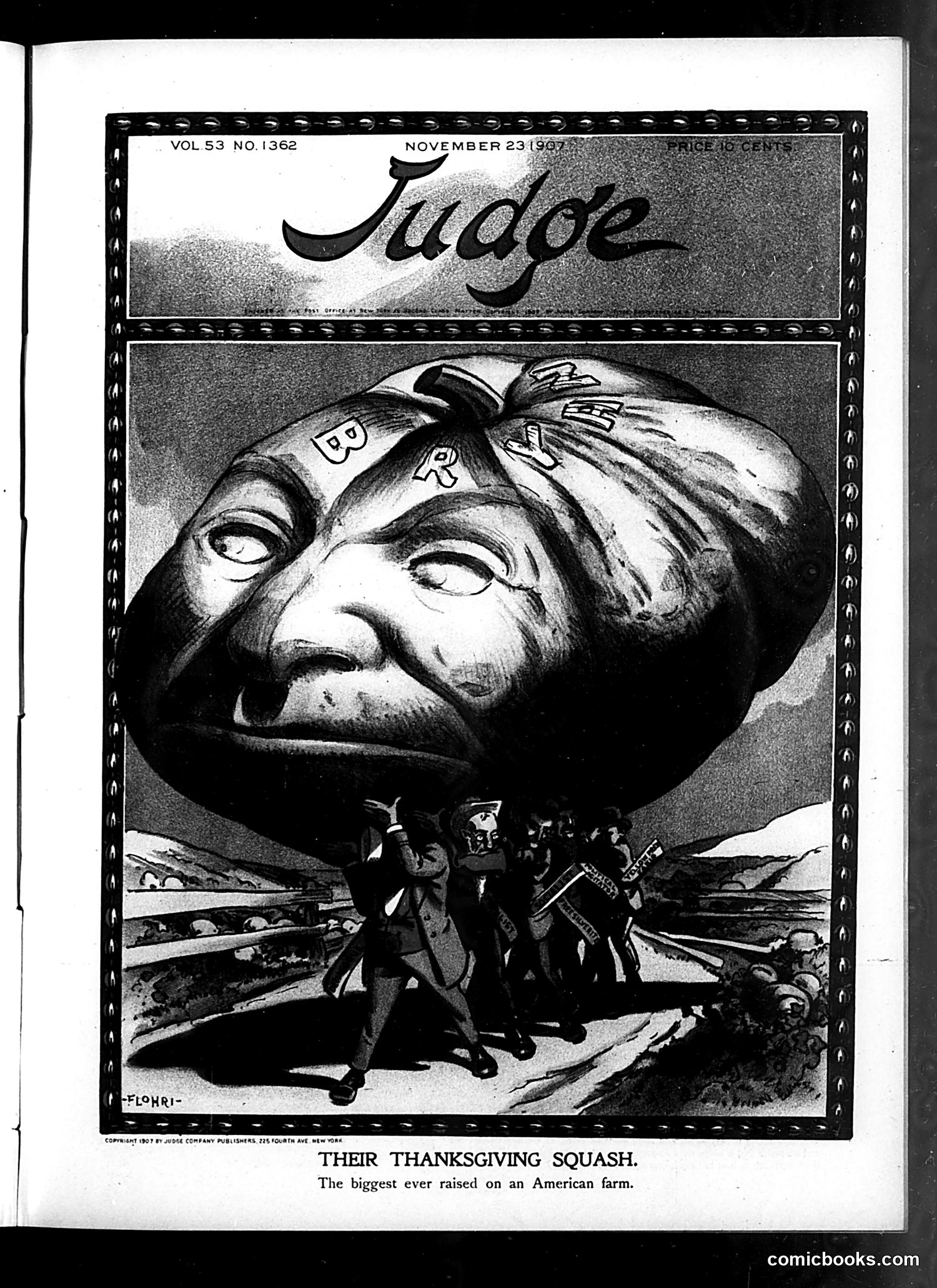
This November 23, 1907 Judge cover satirizes American politics through an enormous giant head labeled with "B" and "R" (likely representing political figures or parties). The grotesque visage—clearly a caricature—dominates the landscape while small suited men examine it below, suggesting politicians confronting some massive political problem or personality. The caption claims this represents "the biggest ever raised on an American farm," using agricultural language as metaphor. The joke appears to be mocking either an inflated political ego, a massive policy failure, or a prominent political figure's bloated importance. Without clearer identification of the "B" and "R" labels or specific 1907 political context, the exact satirical target remains unclear, though the artwork clearly expresses political ridicule through grotesque exaggeration.
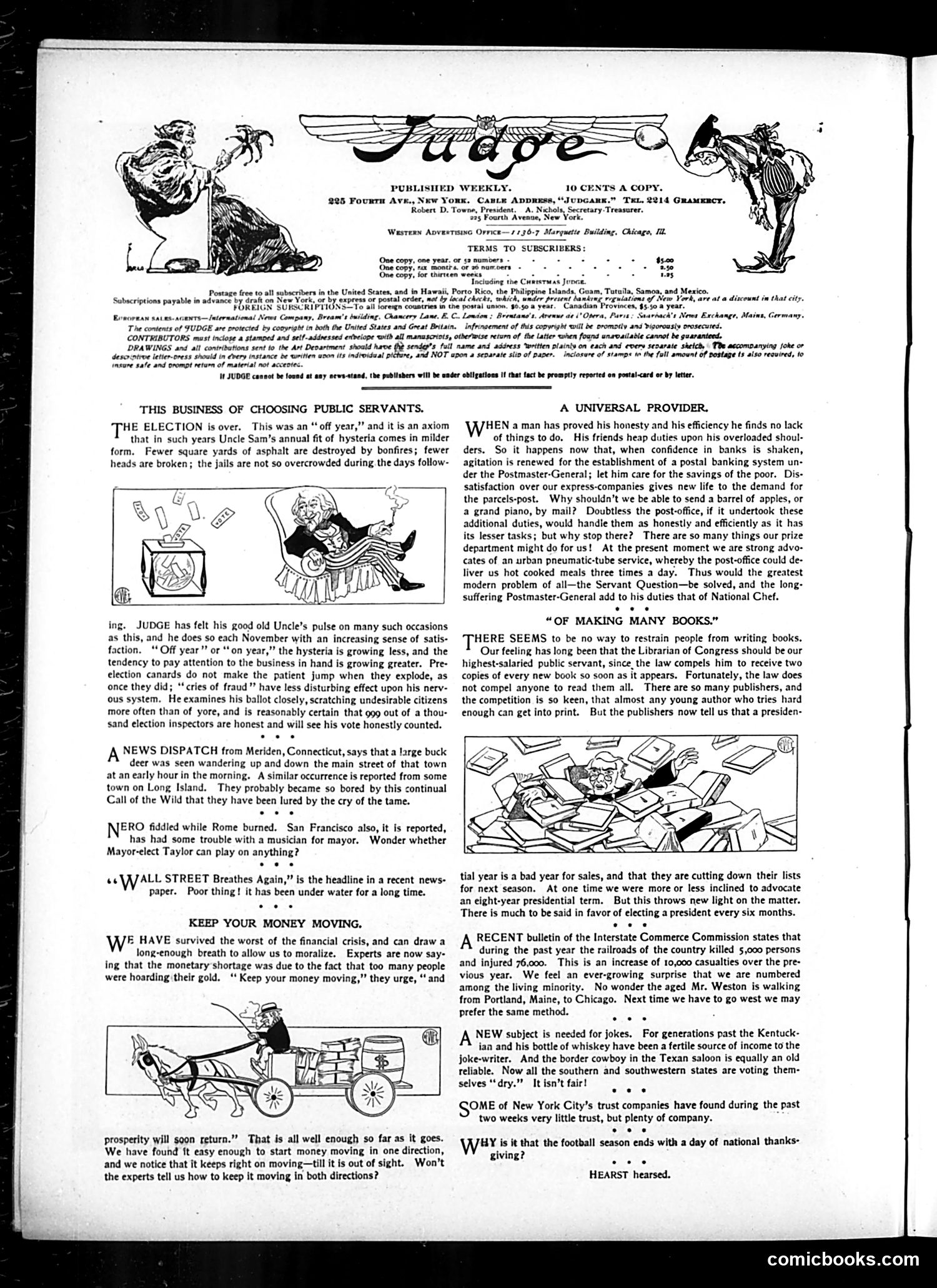
This page contains three distinct satirical pieces: 1. **"This Business of Choosing Public Servants"**: Critiques election aftermath, noting fewer casualties and heads broken than previous years—suggesting elections involved physical violence. References "JUDGE" feeling "Uncle's pulse" on public satisfaction, implying political temperature-taking. 2. **"A Universal Provider"**: Mocks the Post Office's expansion beyond mail delivery into additional services (hot meals, piano delivery). The satire questions why the Post Office shouldn't handle more tasks if it's proven efficient—likely ironic commentary on government overreach. 3. **"Of Making Many Books"**: Proposes the Librarian of Congress as highest-paid public servant, noting book competition is fierce and young authors struggle to publish. The page's overall tone satirizes government services, election violence, and bureaucratic scope.
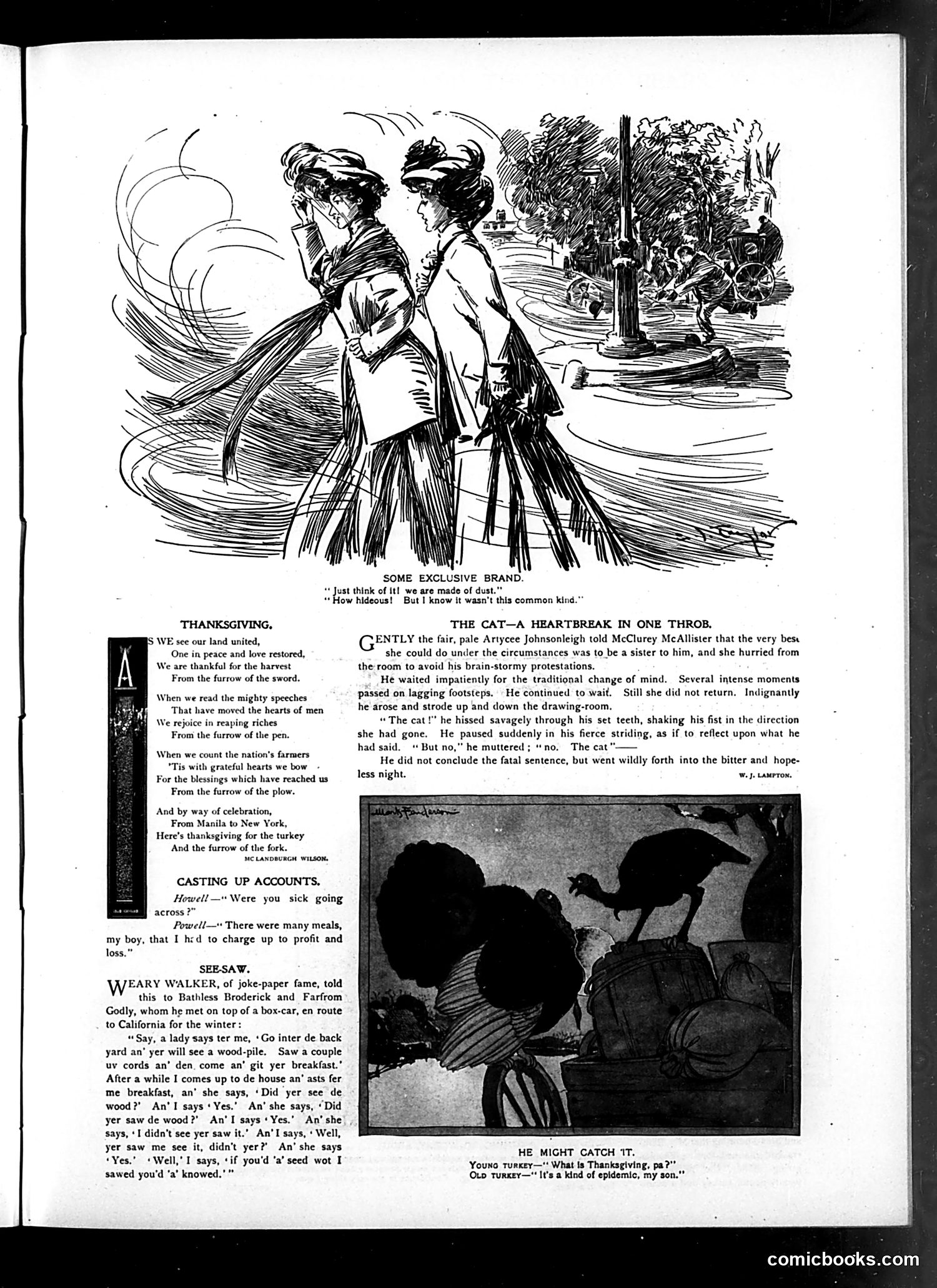
This page contains several distinct pieces of humor rather than a unified political cartoon: 1. **Top cartoon**: Two fashionably dressed women by water discuss being "made of dust" and "common kind"—likely satirizing pretentious social attitudes about class distinctions. 2. **"The Cat—A Heartbreak in One Throb"**: A short story about a man's cat causing domestic conflict when he won't accept his sister, featuring his frustrated pacing and the cat's defiant behavior. This is domestic humor rather than political satire. 3. **"Casting Up Accounts"**: A brief dialogue joke about charging meals for profit and loss. 4. **"See-Saw"**: A longer humorous anecdote by Weary Walker about a woman's repetitive questioning regarding seeing wood, playing on verbal confusion and domestic miscommunication. The page is primarily **light social humor** rather than political commentary, focusing on domestic situations and class pretension typical of Judge's satirical approach.
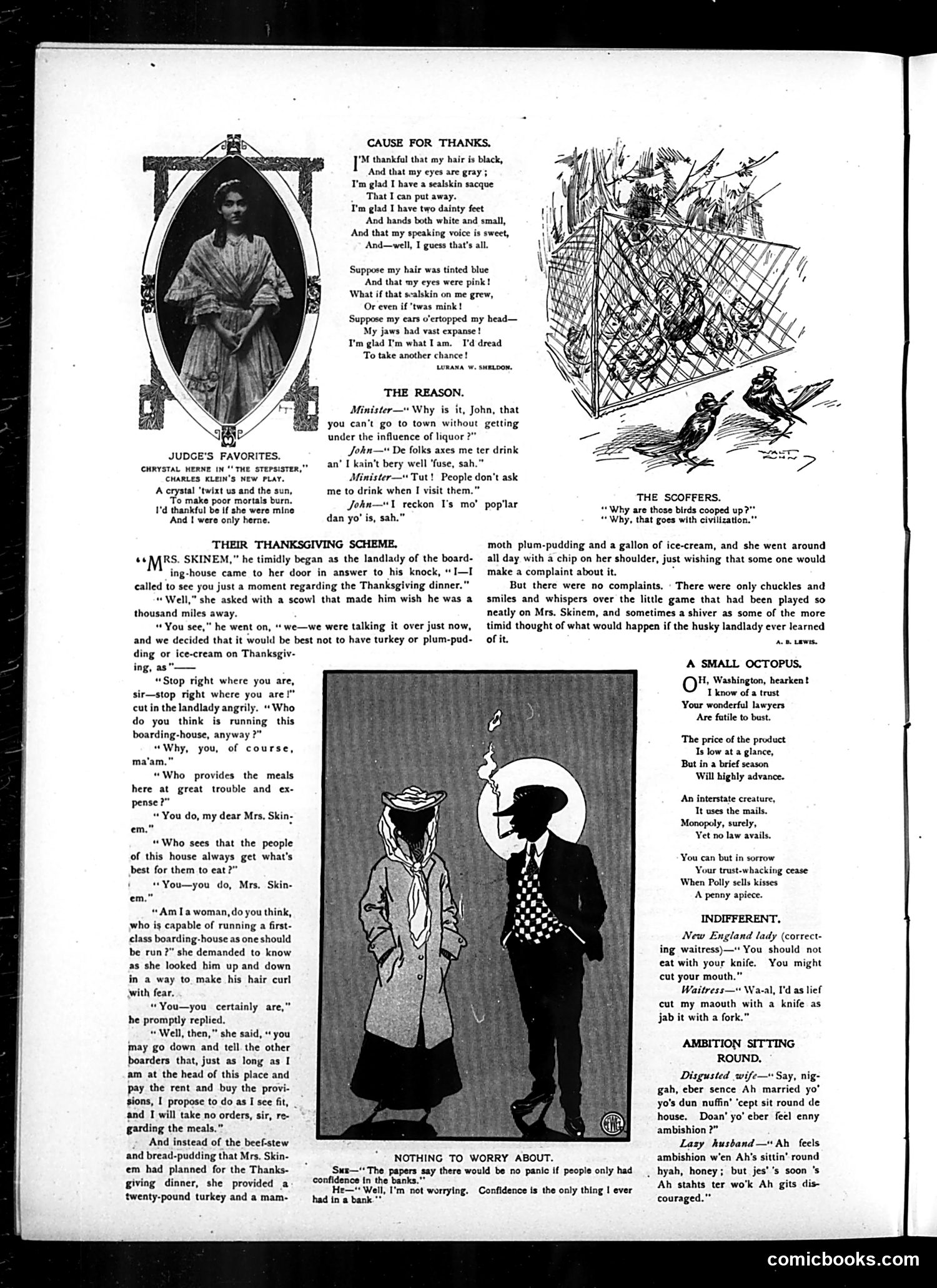
This page contains several humor pieces typical of early 20th-century Judge magazine: **"Their Thanksgiving Scheme"** depicts a landlady (Mrs. Skinnem) haggling with a tenant (John) about Thanksgiving dinner provisions. The satire mocks working-class financial anxiety and landlord-tenant tensions—the landlady refuses to provide traditional turkey and pudding, offering instead a meager twenty-pound turkey and mammoth bread-pudding while demanding rent payment. **Other sections** include brief humorous dialogues ("The Reason," "A Small Octopus," "Indifferent") offering social commentary through exaggerated situations—criticizing New England etiquette, political ambition, and marital dynamics. The cartoons illustrate these domestic and social scenarios with period-appropriate clothing and settings, appealing to readers through relatable class-based humor and domestic absurdity rather than specific political references.
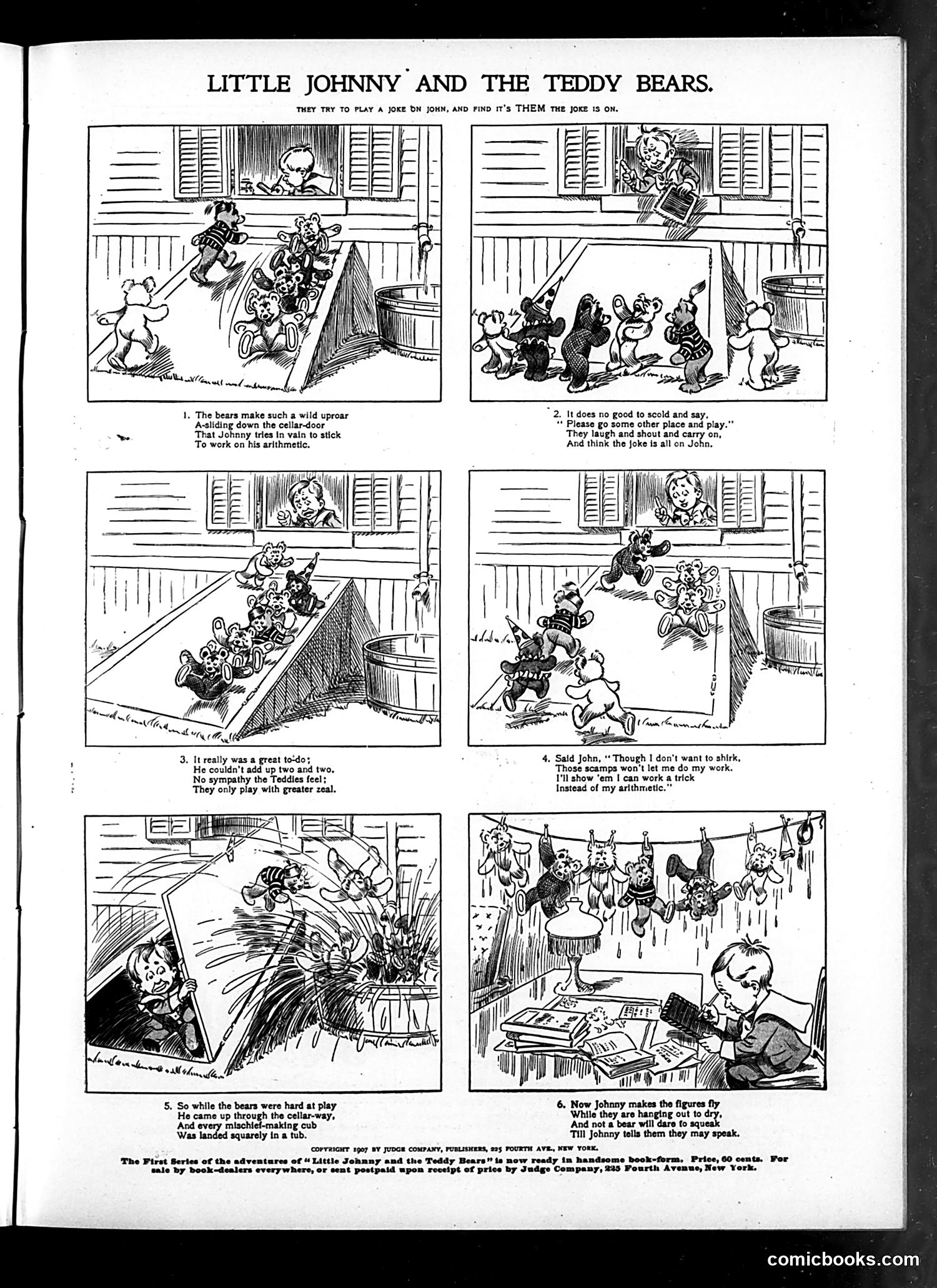
This is a children's story comic, not political satire. "Little Johnny" finds teddy bears loose in his house and attempts to corral them. The bears cause chaos—sliding down the cellar door, escaping up the stairs, and creating general mayhem while Johnny tries to contain them. The "teddy bears" reference likely alludes to President Theodore Roosevelt's popularity and the merchandising craze surrounding him in the early 1900s (teddy bears were named after "Teddy" Roosevelt). The comic humor comes from Johnny's frustrated attempts to control the wild, mischievous bears, which escape into a bathtub and eventually end up hanging on a clothesline. It's lighthearted children's entertainment rather than political commentary.
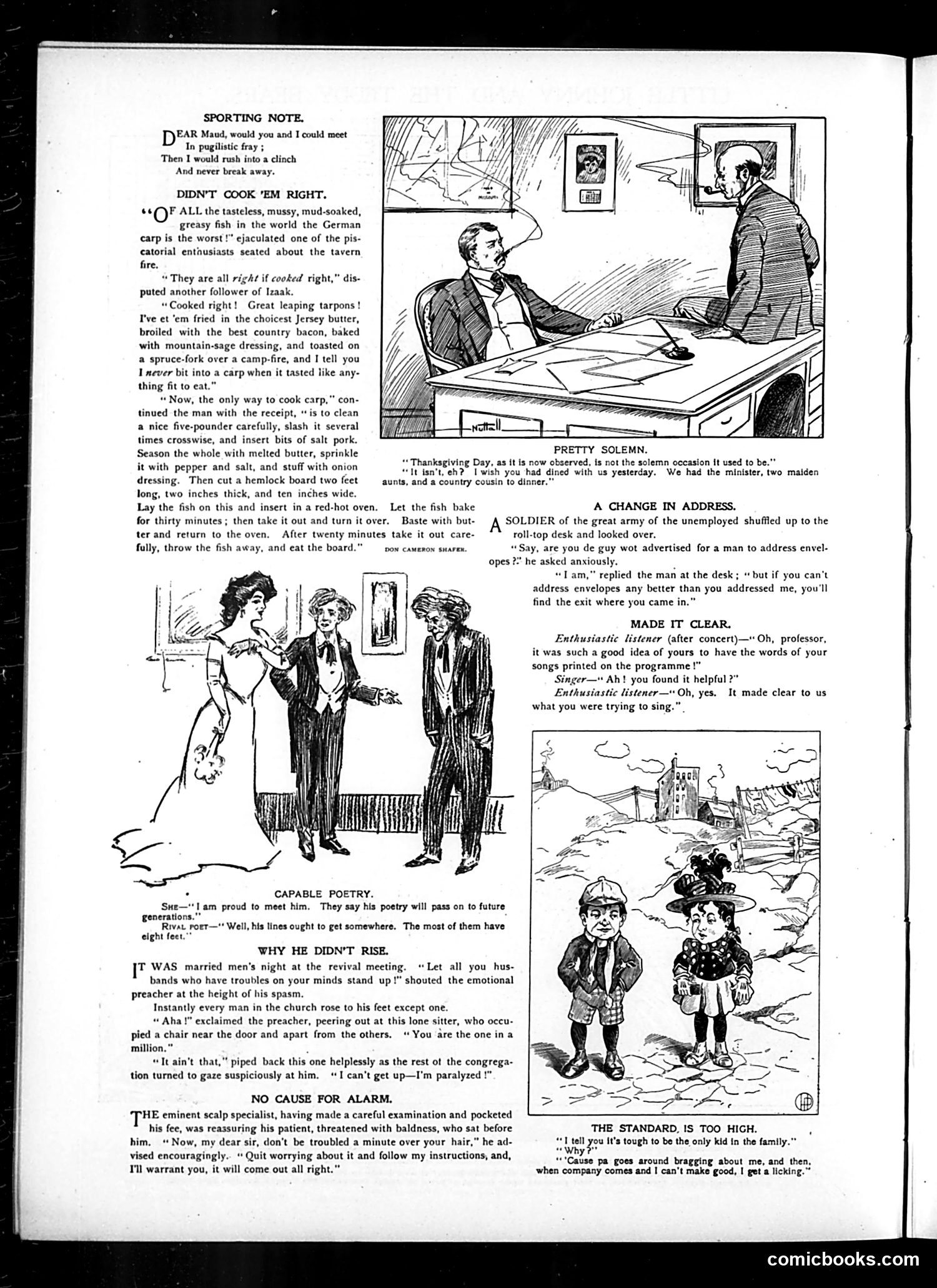
This page contains six unrelated humorous sketches typical of early 20th-century American humor magazines: **"Didn't Cook 'Em Right"** mocks fishing enthusiasts' debates over preparation methods through absurdist exaggeration—the punchline being that the best way to cook carp is to throw it away and eat the wooden board instead. **"A Change in Address"** jokes about unemployment during an economic downturn, where a jobless man seeking work at an employment agency is told his addressing skills are so poor he can't even address the agency itself correctly. **"Made It Clear"** satirizes a concert singer whose performance is so unclear that printing lyrics was necessary for the audience to understand what he was singing. **"Why He Didn't Rise"** uses physical humor—a paralyzed man cannot stand during a revival meeting's call for husbands with troubles, ironic given his clear predicament. The other sketches involve similarly light domestic and social humor. The page reflects Judge's focus on gentle satire of everyday American life rather than specific political events.
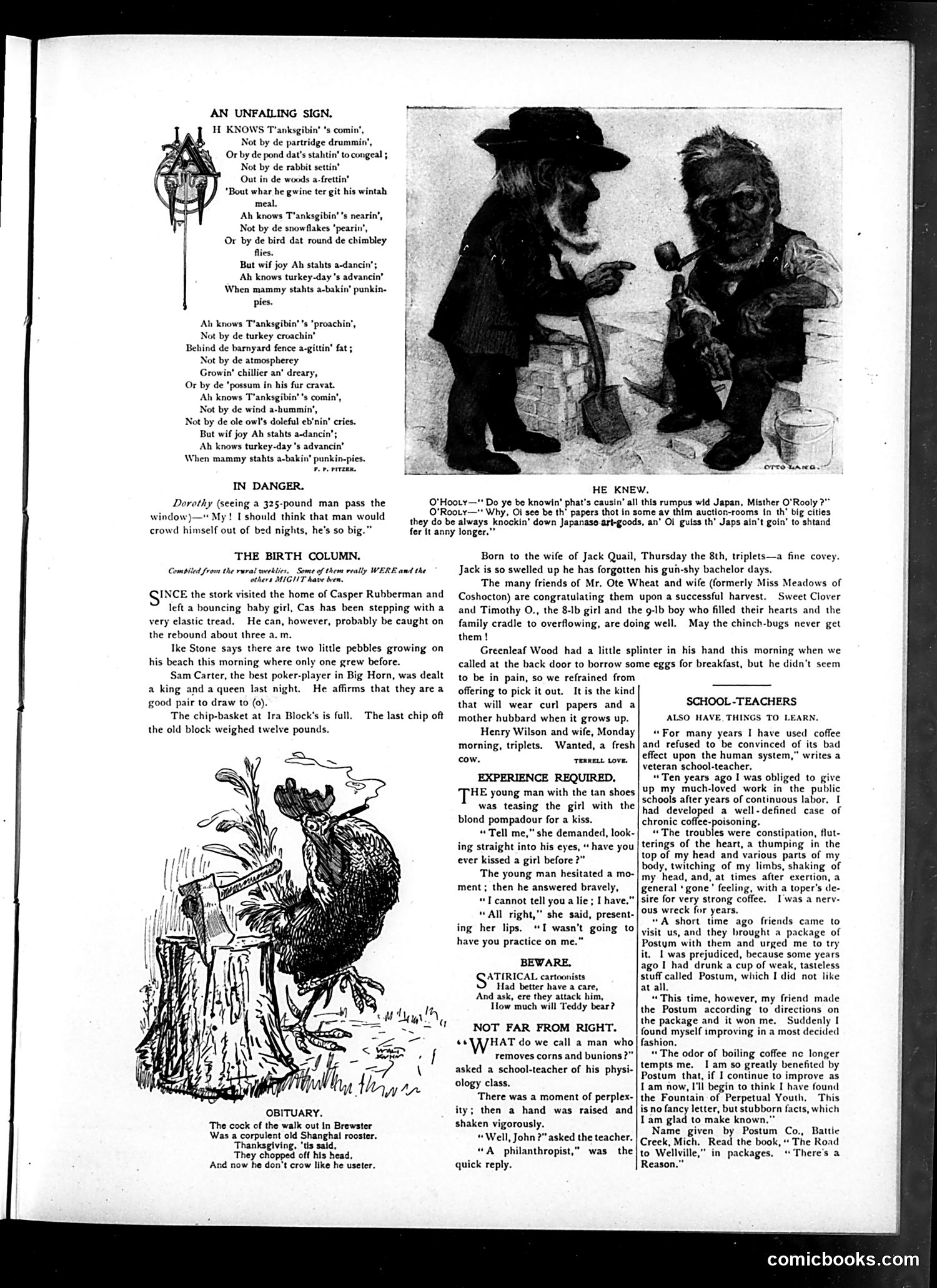
This page from *Judge* contains several distinct pieces of social humor from the early 20th century: **"An Unfailing Sign"** (poem with illustration): A dialect-heavy poem using racist stereotypes of African American speech to humorously describe how someone knows Thanksgiving approaches—not by nature's signs, but by mother's pumpkin pie baking. The humor relies on offensive period conventions. **"In Danger"** (cartoon): Two Irish characters (identifiable by names like "O'Rooty" and "O'Hooty" and accent) discuss Japanese goods being auctioned in American cities. This references trade tensions and likely Japan's early 1900s rise as an economic power, playing on fears that undercutting American merchants could provoke Japanese retaliation. **"The Birth Column"** and **"Obituary"**: Rural newspaper humor featuring humorous birth announcements with puns (babies named after plants, "chip-basket" jokes) and a brief obituary about a rooster killed for Thanksgiving. **"Experience Required"**: A flirtation joke where a girl demands her potential suitor have prior kissing experience—she won't let him practice on her. The page reflects early 1900s American humor emphasizing ethnic/racial stereotypes, rural comedy, and courtship.
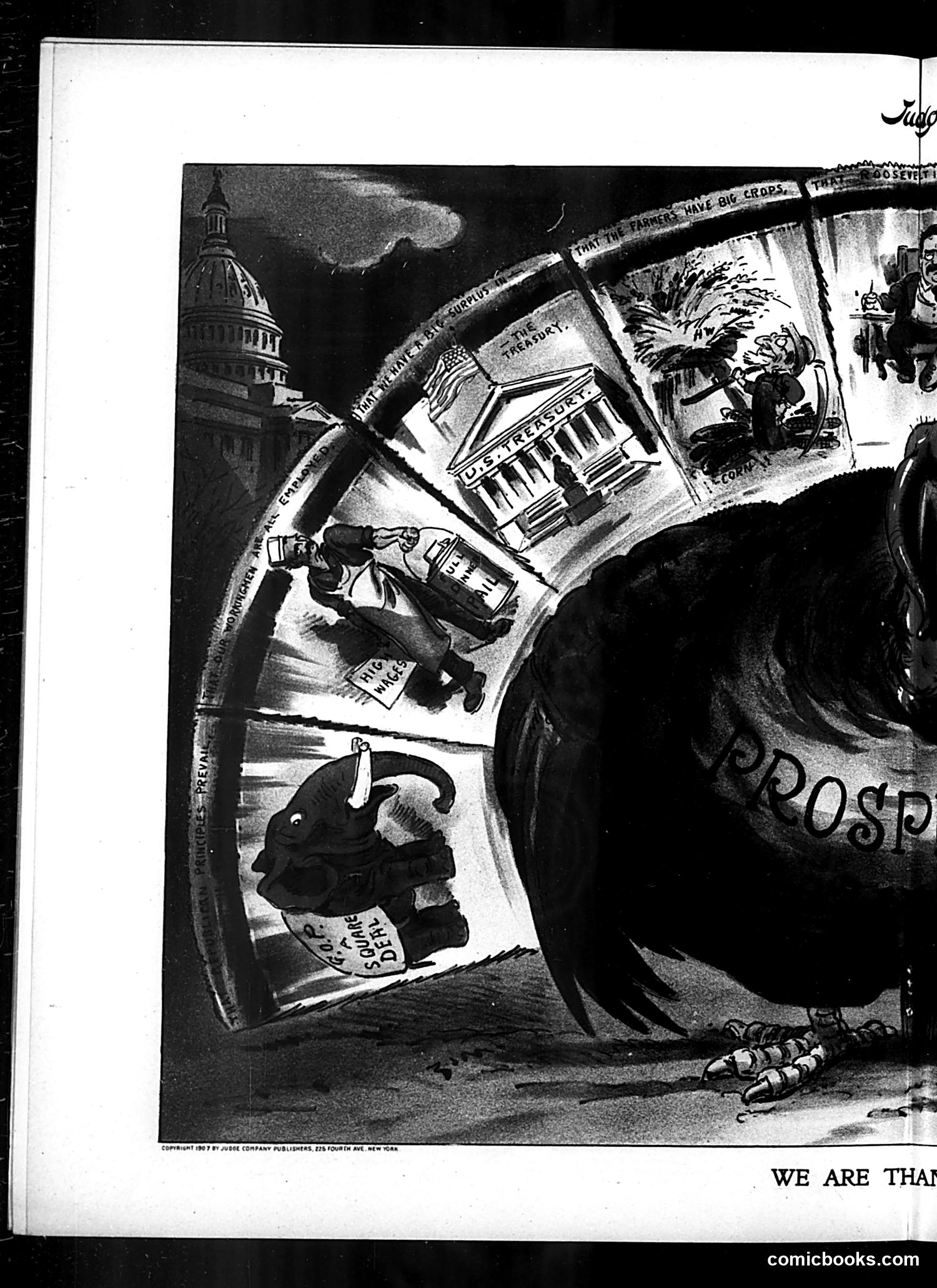
This appears to be a political cartoon from *Judge* magazine depicting prosperity and government resources being consumed or crushed by a large wheel labeled "PROSPERITY." The Capitol building is visible on the left, and various labeled elements—including what appears to be Treasury references and agricultural imagery—surround a central figure that looks like a goat or similar creature being squeezed or trampled. The partially visible text references "BIG CROPS" and mentions farmers, suggesting commentary on agricultural policy or the distribution of national prosperity during an economic period. However, **without a clear date, complete visible text, or artist attribution, I cannot confidently identify the specific historical moment, which political figures are caricatured, or the precise satirical point being made.** More context would be needed for accurate interpretation.
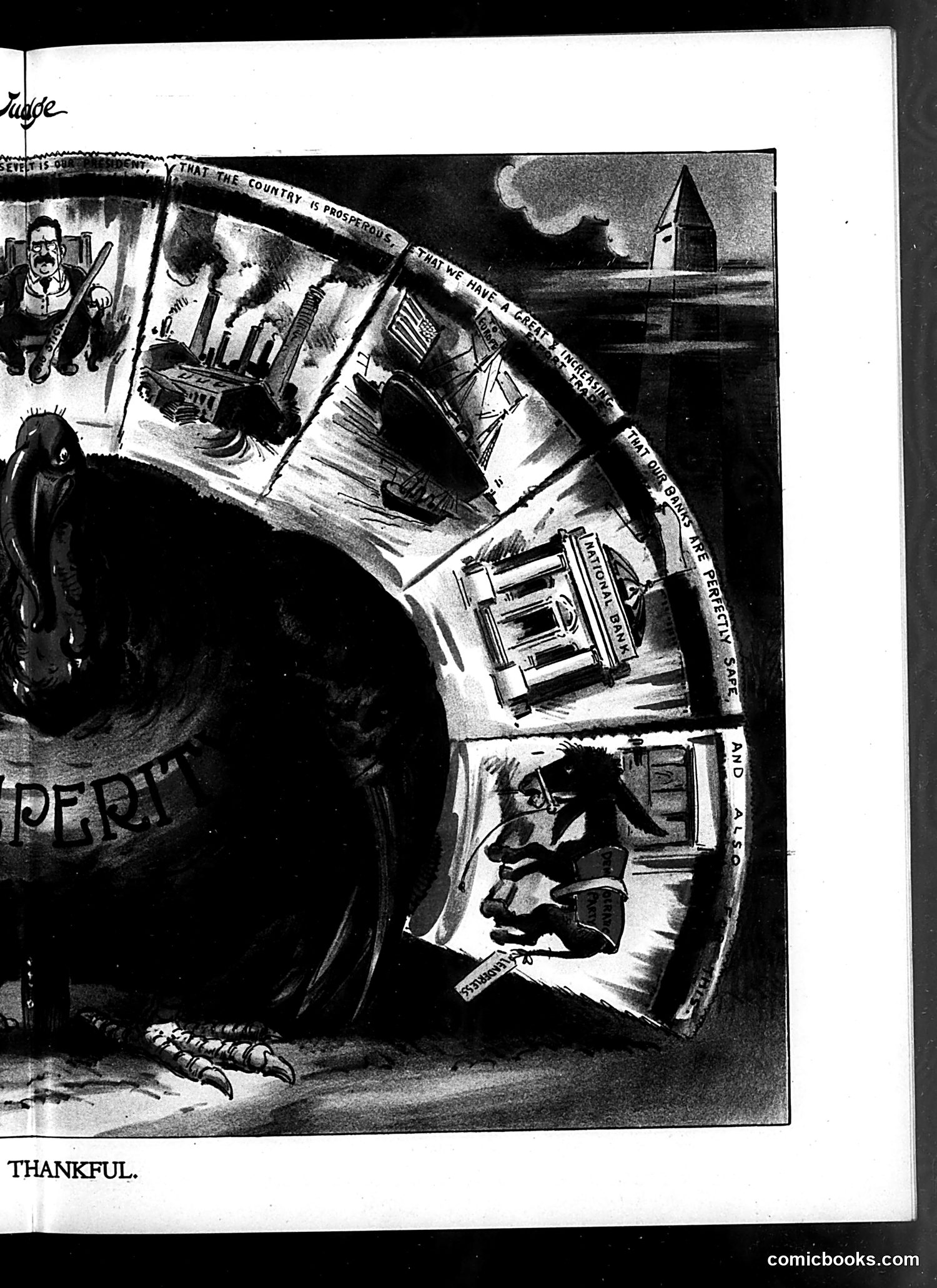
This Judge magazine cartoon depicts a massive, menacing figure (appearing to represent a destructive force or threat) looming over American institutions. A large scroll or banner winds through the composition, containing text reading "that the country is prosperous, that we have every advantage for our own perfection" and other phrases suggesting national prosperity rhetoric. The cartoon's point appears satirical: it contrasts confident claims about American success with the ominous shadow cast over the nation's symbols (including what appears to be government buildings and a church steeple). The title "THANKFUL" suggests ironic commentary on whether Americans should genuinely feel grateful given underlying threats or problems the cartoonist perceives. Without dating information visible, the specific historical context remains unclear, though the style suggests early-to-mid 20th century.
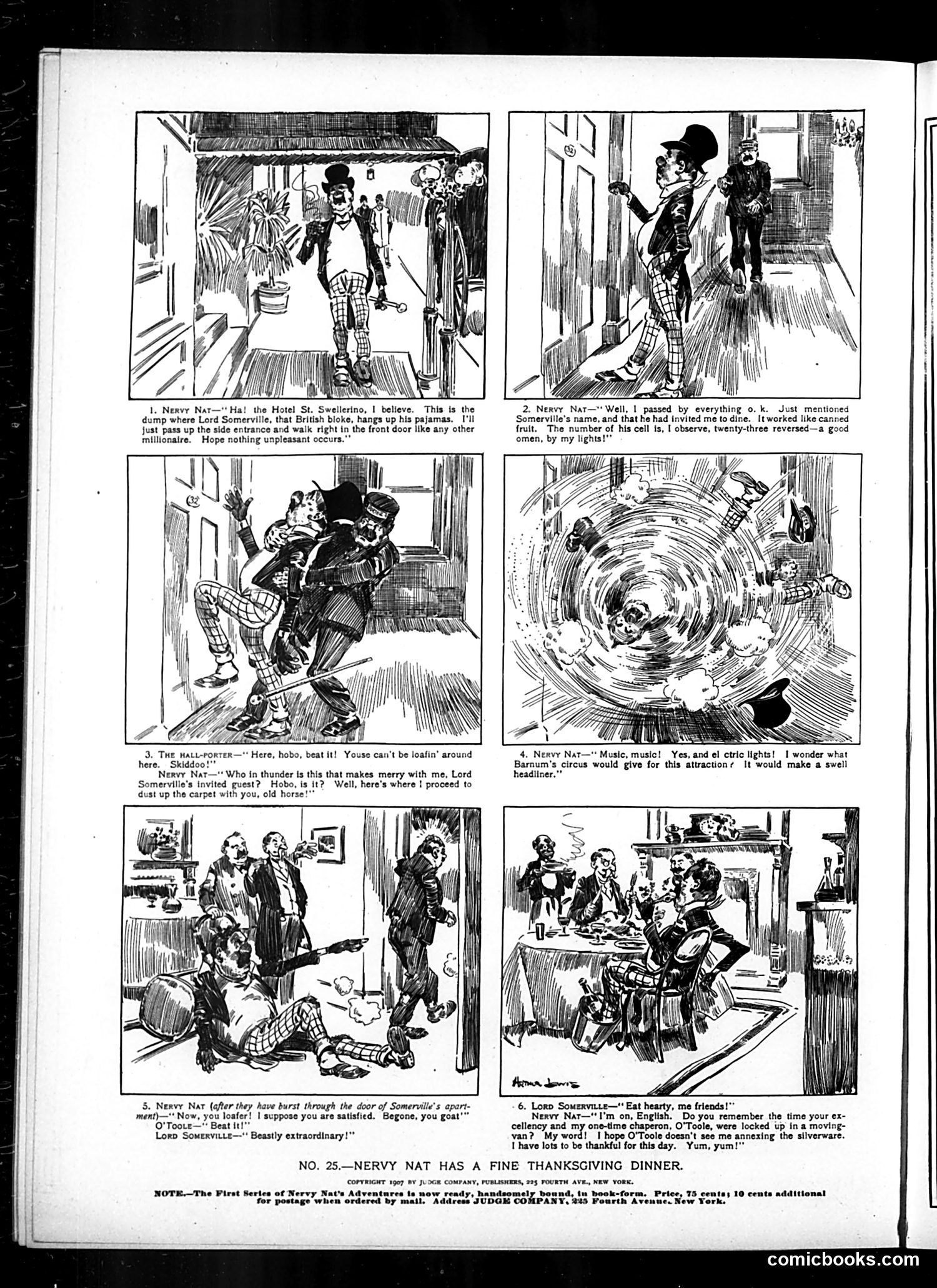
This 1907 Judge comic strip satirizes class-climbing and social deception. "Nervy Nat" is a con artist who impersonates an invited guest to infiltrate the wealthy Hotel St. Swellerino, home of "Lord Somerville," a British aristocrat. The joke plays on early 20th-century anxieties about social boundaries: Nat effortlessly crashes high society by merely dropping his host's name, then encounters O'Toole, apparently a former adversary now working as a doorman. After a scuffle, both are admitted to Somerville's dinner party, where Nat gleefully consumes the fine meal while pocketing silverware—treating the aristocratic gathering as an opportunity for theft. The satire mocks both Nat's shameless opportunism and the apparent ease with which social pretense penetrates wealthy circles. The "Thanksgiving" angle suggests American social mobility themes, contrasting the working-class schemer with British nobility.
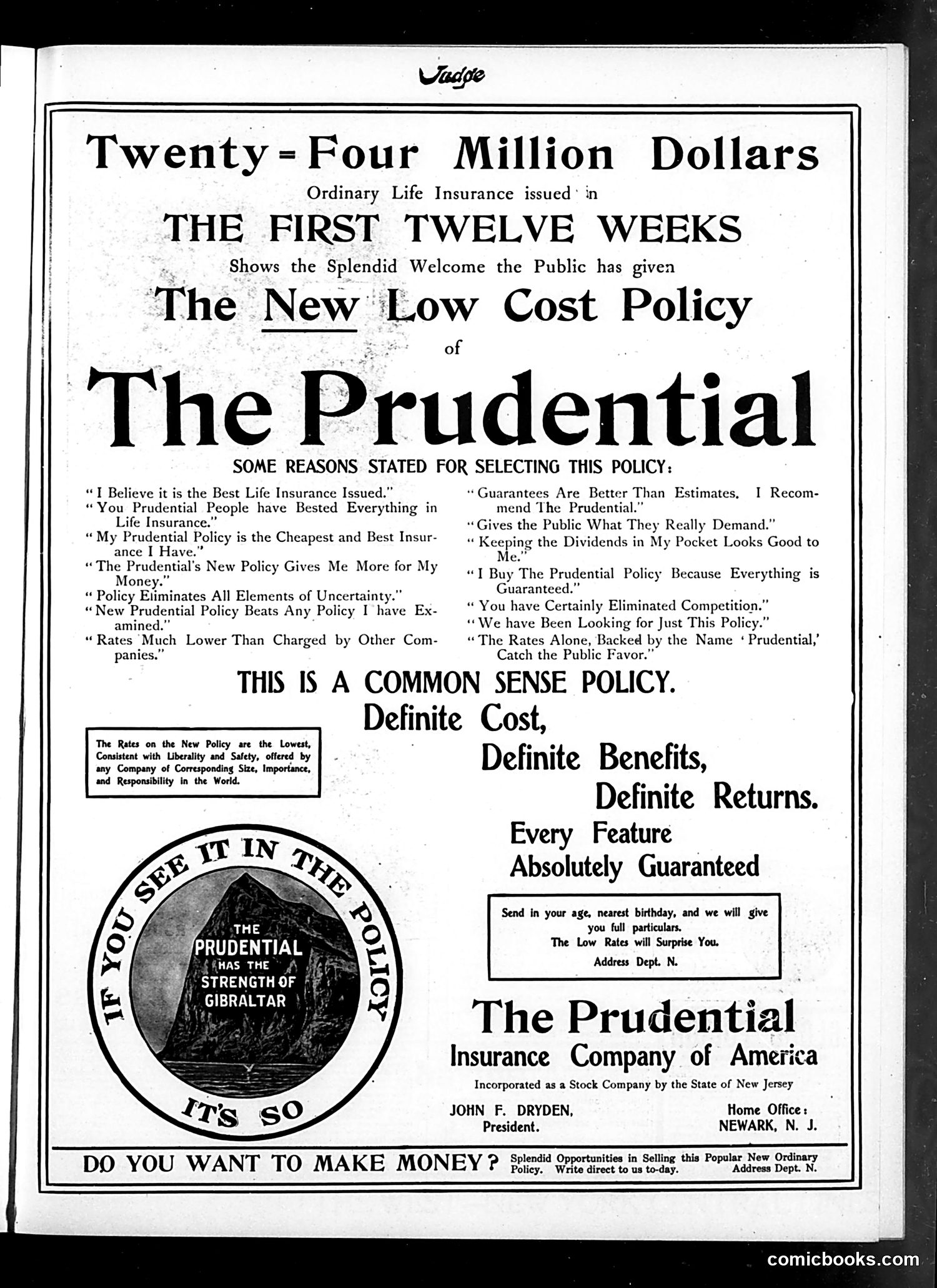
This is primarily **a full-page advertisement**, not satire. It appears in Judge magazine promoting The Prudential Insurance Company's new "low cost" ordinary life insurance policy. The page claims the policy sold $24 million in coverage in its first twelve weeks, presenting this as proof of public approval. The testimonials—"Best Life Insurance Issued," "Cheapest and Best," "Eliminates All Elements of Uncertainty"—are marketing claims rather than genuine quotes. The circular emblem featuring Gibraltar rock emphasizes strength and security ("The Prudential has the strength of Gibraltar"). The pitch targets ordinary people seeking guaranteed, affordable life insurance with "definite cost, definite benefits, definite returns." **The satire angle** (if Judge intended any) likely lies in the hyperbolic testimonials and the company's self-congratulatory tone—presenting marketing as consumer enthusiasm. However, the page functions primarily as paid advertising for a major American insurance company headquartered in Newark, New Jersey.
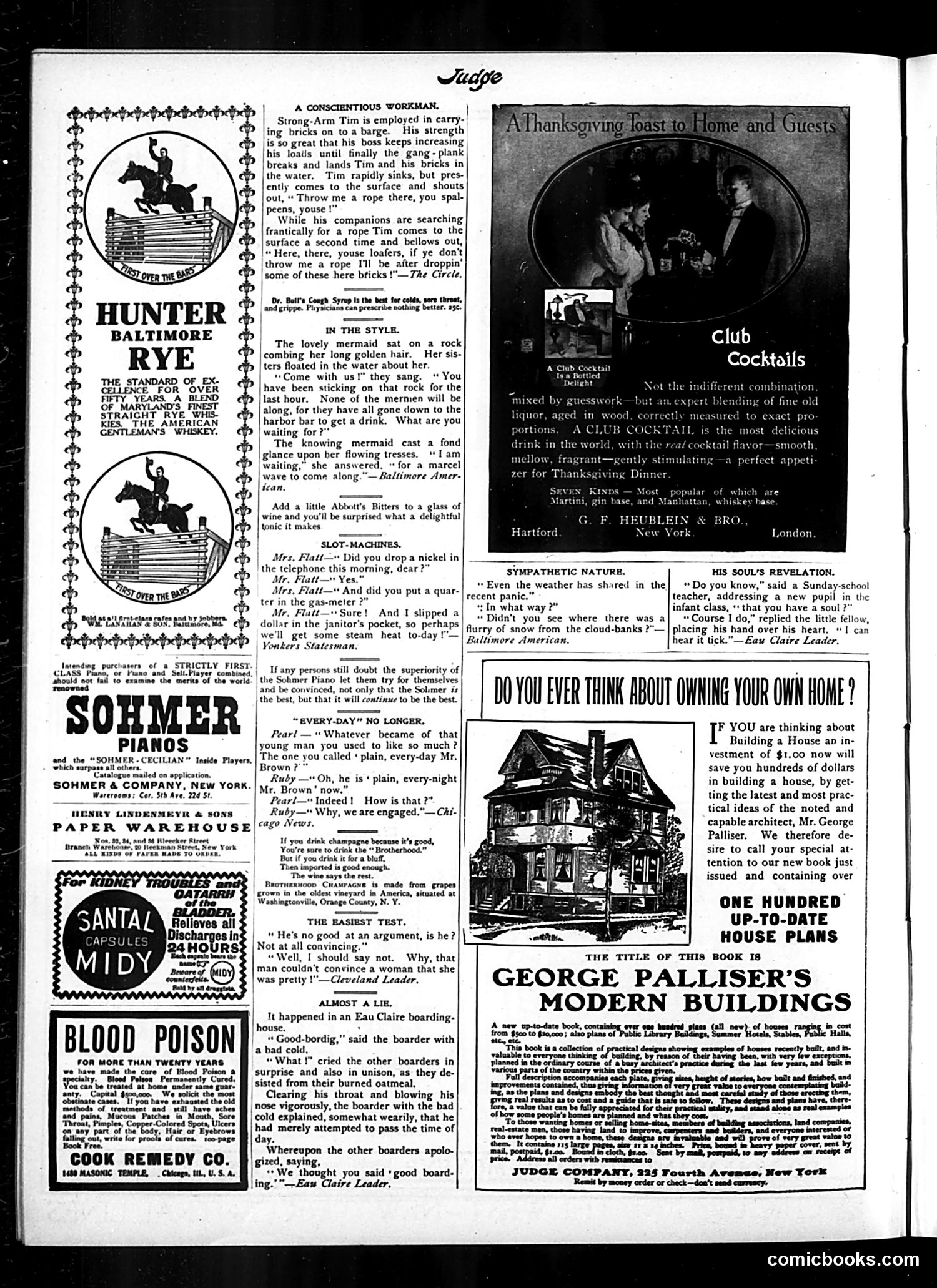
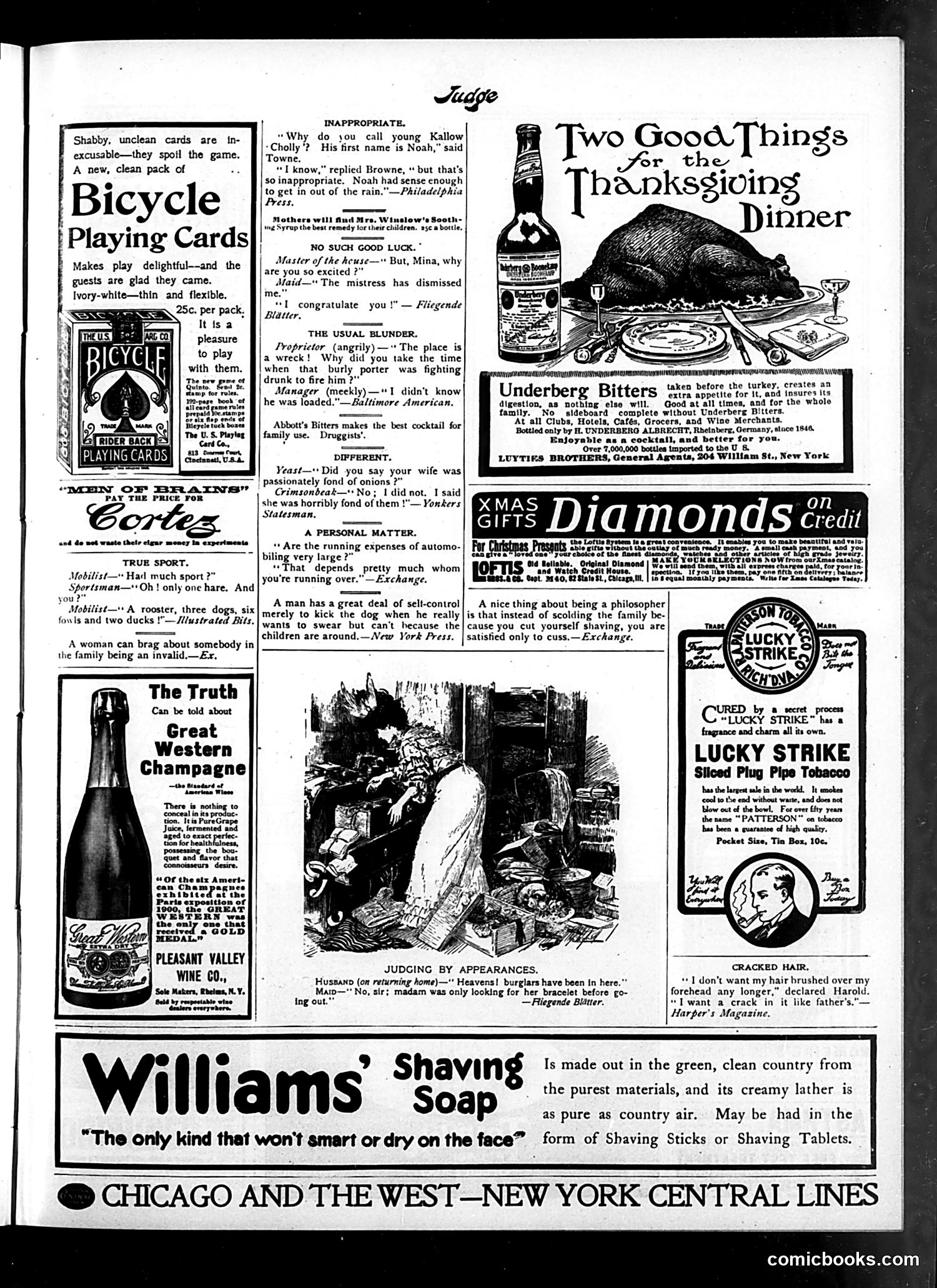
This page is primarily **advertisements and humorous anecdotes** rather than political cartoons. The two illustrated panels at left show "Hunter Baltimore Rye Whiskey" ads featuring a man on horseback jumping over a barrel. The humor pieces are genteel, turn-of-the-century jokes: - **"A Conscientious Workman"**: Irish immigrant ("spalpeens, youse") Tim sinks in water but prioritizes not losing his work bricks—satire on working-class earnestness. - **"In the Style"**: A mermaid refuses to leave a rock waiting for a "marcel wave" (fashionable hair treatment)—mocking women's vanity. - **"Slot-Machines"**: A husband feeds coins into phone, gas meter, and janitor like machines—satirizing urban life's nickel-and-diming. - Various one-liners about romance and marriage. The page reflects Judge's focus on domestic humor, class stereotypes (Irish accents), and consumer culture, alongside period product advertisements (pianos, blood poison cure, champagne).
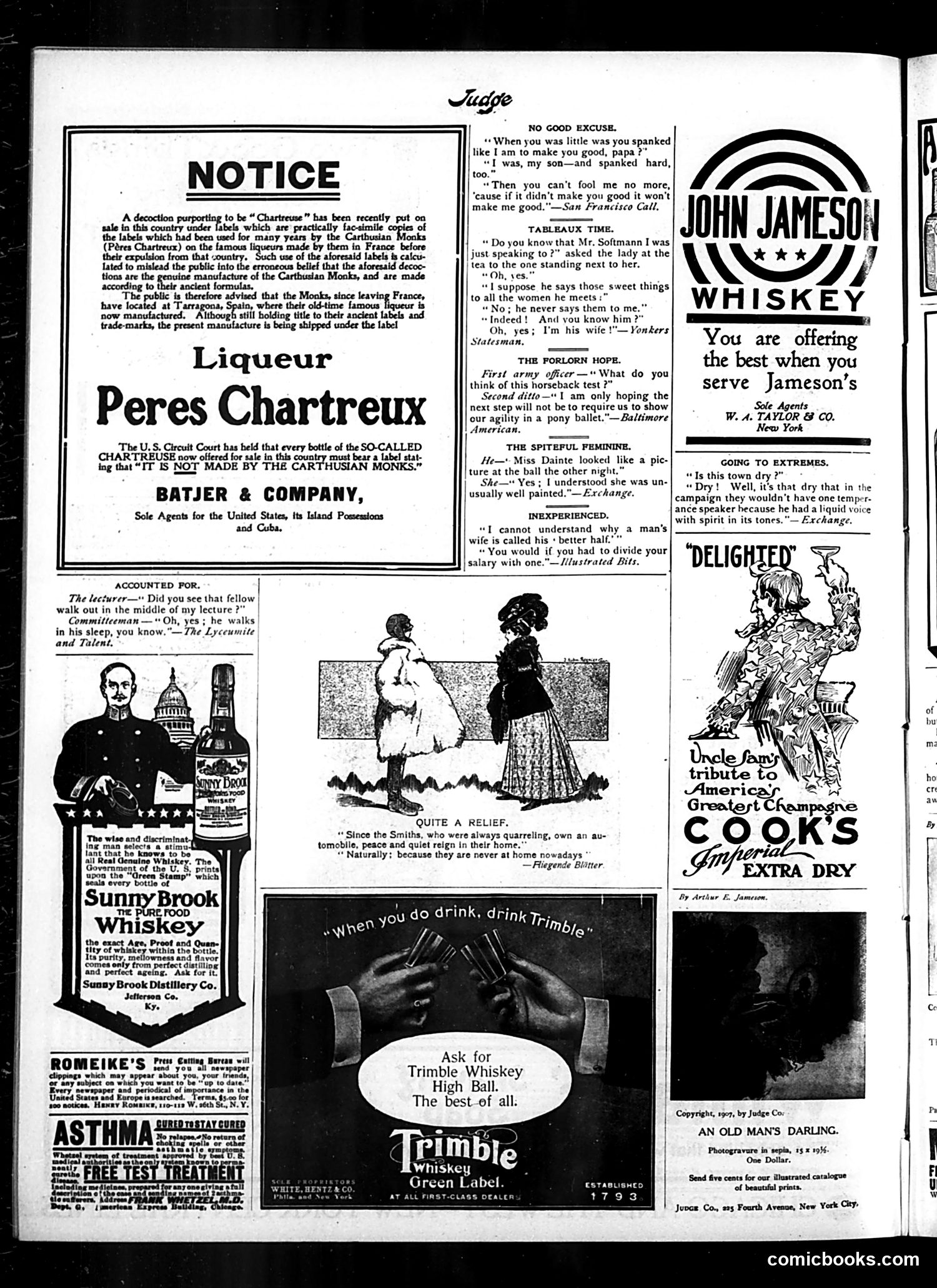
This is primarily an **advertising page** with several short humorous anecdotes interspersed. The main content is liquor advertisements (whiskey and champagne brands), not political cartoons. The notable feature is a **legal notice** about "Chartreux" liqueur: French monks (Carthusian order) were expelled from France, relocating their famous liqueur production to Tarragona, Spain. American counterfeiters were copying their labels. The notice warns consumers that genuine Chartreux now comes from Spain, not France—a cautionary statement about trademark fraud and product authenticity. The scattered jokes mock contemporary social conventions: spankings as ineffective discipline, flirtation ("Tableaux Time"), military concerns about equestrian tests, women's appearance at balls, marital dynamics, and automobile ownership disrupting family life. The cartoons and humor reflect *Judge* magazine's satirical style—light social commentary on manners and gender relations typical of early 1900s American humor, with no apparent political content.
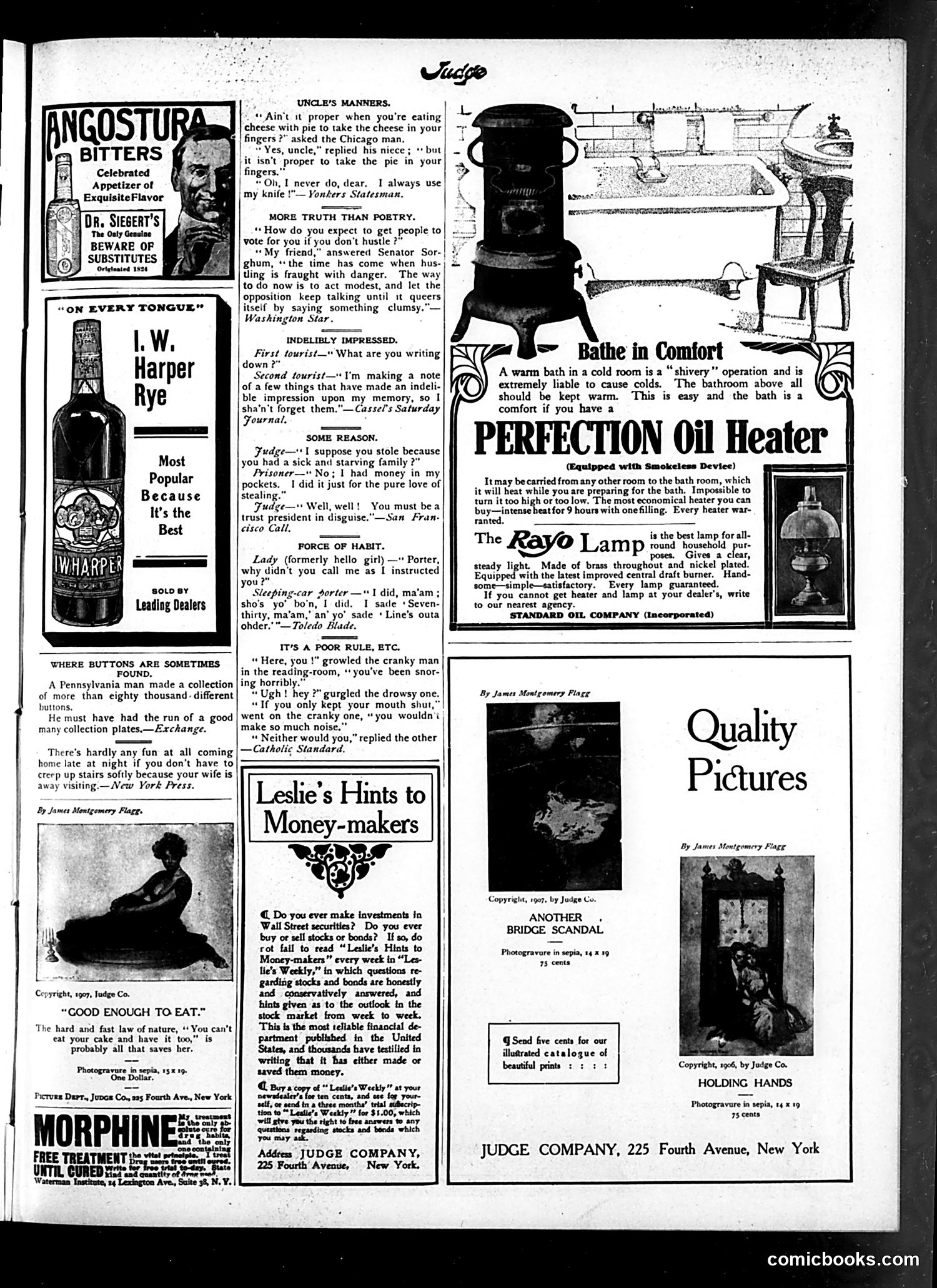
This page is primarily **advertising and humorous anecdotes** rather than political cartoons. **The humor pieces** are brief, satirical takes on contemporary social situations: - "Uncle's Manners" mocks rural table etiquette - "More Truth Than Poetry" satirizes political campaigning—a senator admits avoiding public visibility because active campaigning backfires when opponents expose his flaws - "Indelibly Impressed" jokes about tourists - "Some Reason" presents a judge interviewing a thief who admits stealing from habit rather than necessity—a veiled jab at wealthy "trust presidents" (monopoly industrialists) whose corporate practices resembled legalized theft - "Force of Habit" plays on a former telephone operator's conditioned responses **The advertisements** promote patent medicines (morphine treatments), liquor (Angostura Bitters), and household products (oil heaters and lamps)—typical of early 1900s Judge content. No specific political figures are caricatured here. The satire targets general social behaviors and institutional hypocrisy rather than individuals.
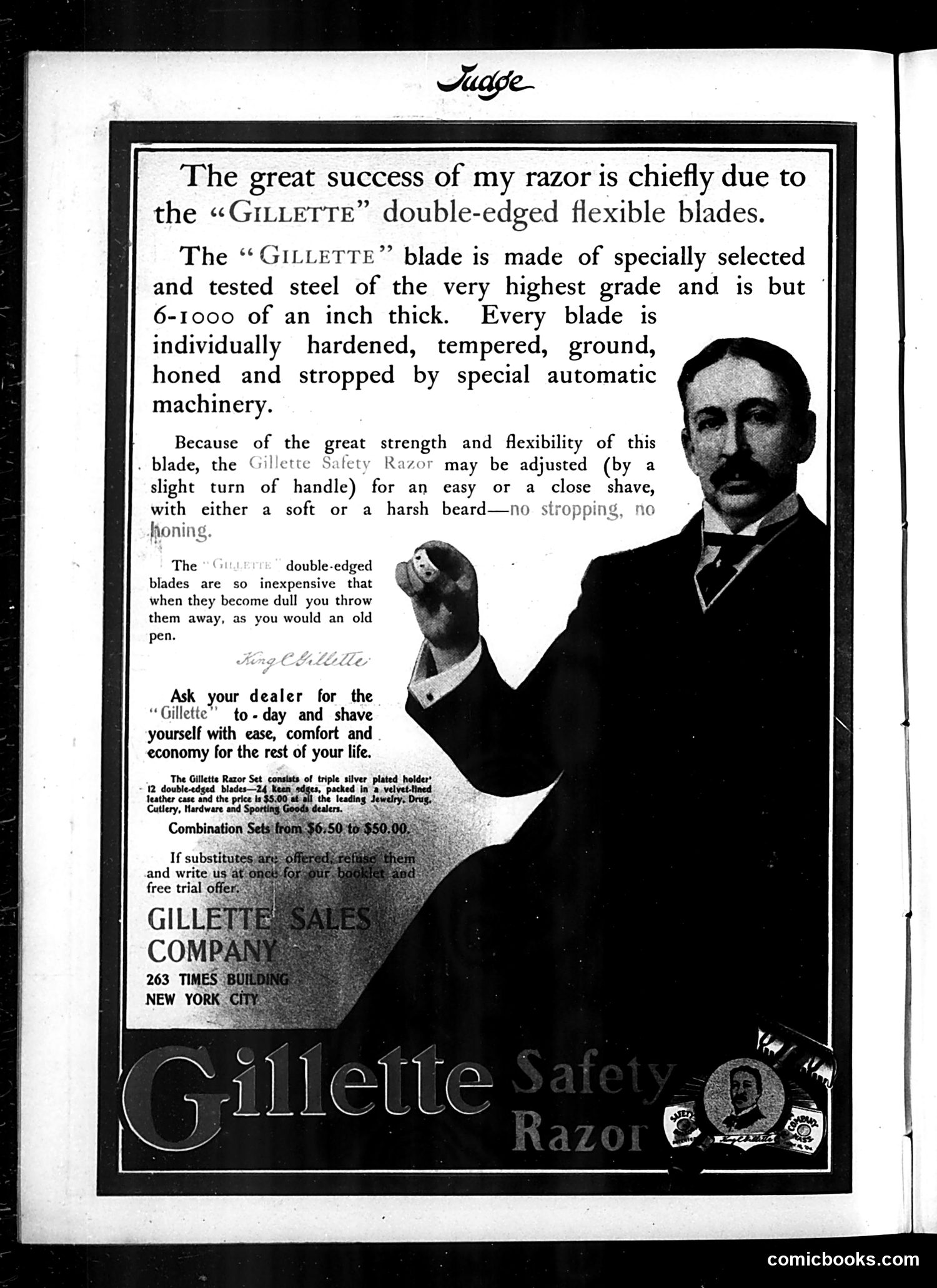
This page is entirely a **Gillette Safety Razor advertisement**—not a political cartoon or satirical content. It features a well-dressed man demonstrating the razor while the text promotes Gillette's double-edged blade technology. The ad emphasizes the blade's thinness (6-1,000 of an inch), durability, and disposability—the innovation being that users could simply throw away dull blades rather than maintaining them. The pitch emphasizes convenience and economy ("for the rest of your life"). Combination sets cost $6.50 to $50.00. The company address is listed as 263 Times Building, New York City. This is a straightforward commercial advertisement typical of Judge magazine's revenue model—not editorial satire or political commentary.