
A complete issue · 16 pages · 1907
Judge — November 9, 1907
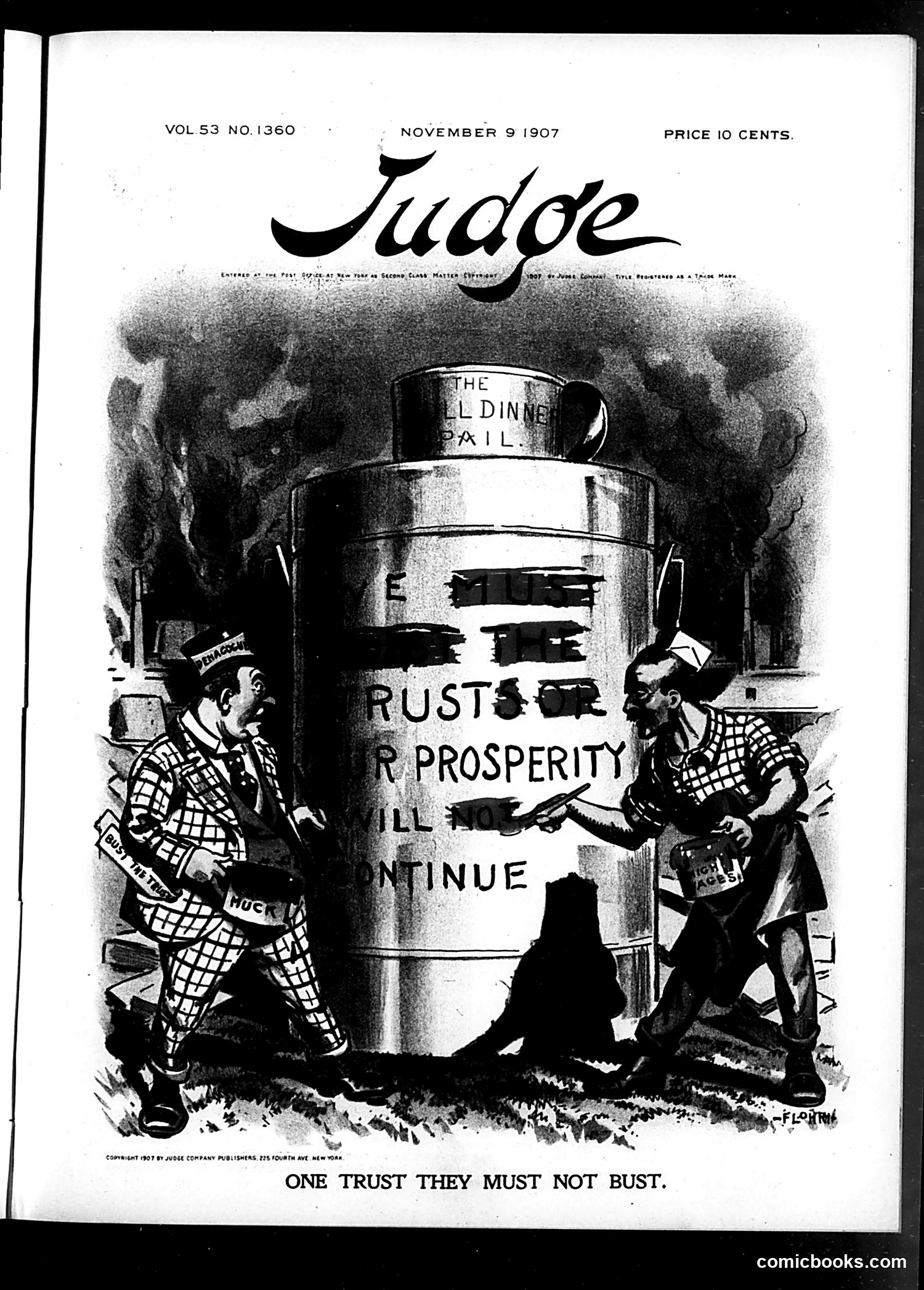
This political cartoon depicts two figures in checkered suits flanking a large cylindrical vessel labeled "The Gilded Pail" (likely referencing wealth/corruption). The vessel displays text about "Trusts," "Prosperity," and what appears to be "Will Continue." The caption reads: "ONE TRUST THEY MUST NOT BUST." The cartoon satirizes Theodore Roosevelt's trust-busting policies. Though Roosevelt campaigned against monopolies, this image suggests certain powerful trusts—particularly those supporting or aligned with political/economic establishment interests—would be left untouched despite his aggressive antitrust rhetoric. The two figures appear to be political or business operators protecting this privileged trust from regulation. The satire critiques the selective enforcement of antitrust laws and suggests hypocrisy in Roosevelt's reform agenda.
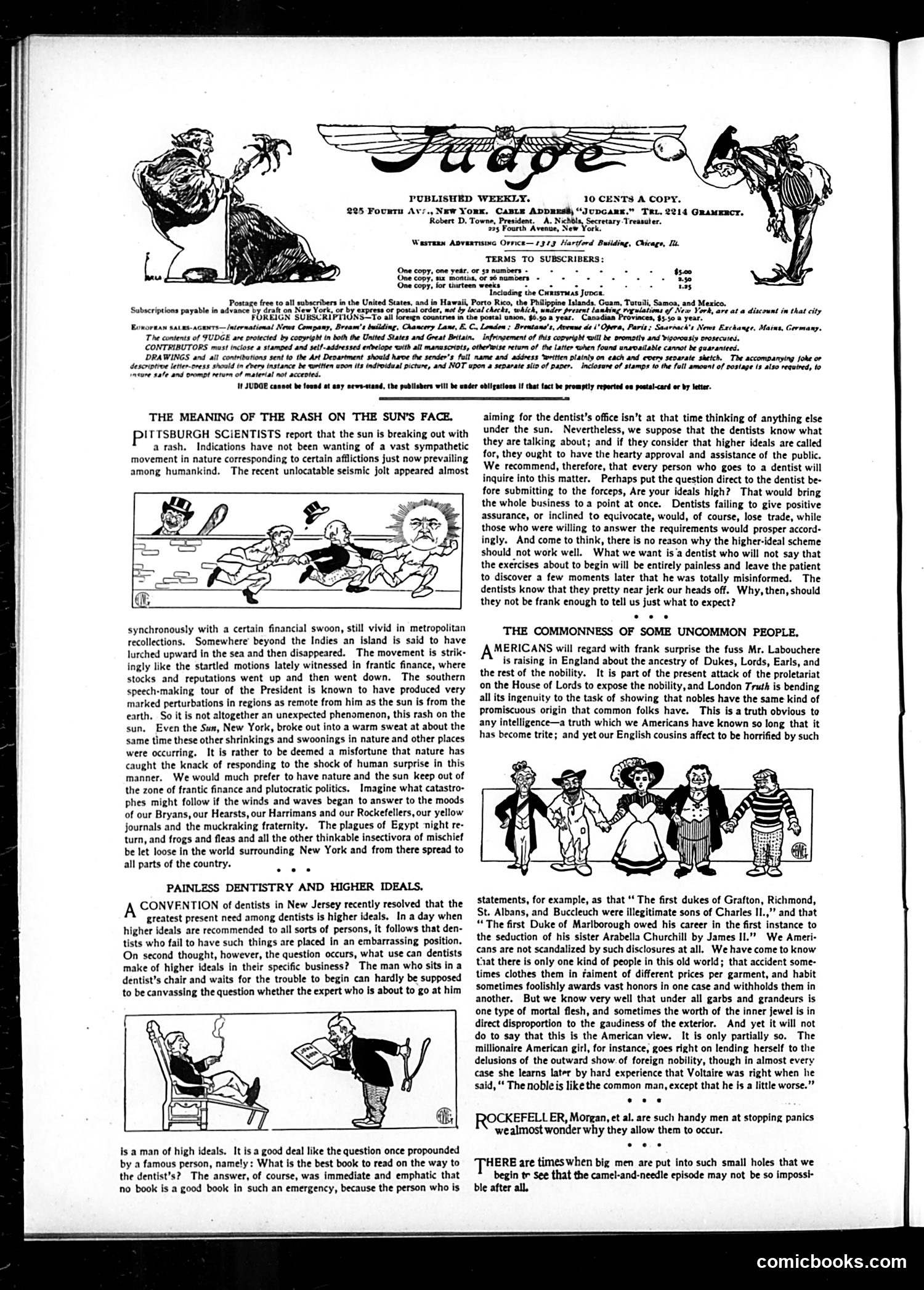
This page contains three satirical articles with accompanying illustrations: **"The Meaning of the Rash on the Sun's Face"** mocks financial market volatility, comparing recent stock fluctuations to solar phenomena and suggesting they reflect broader social anxiety rather than actual economic causes. **"The Commonness of Some Uncommon People"** critiques English aristocracy's rising prominence in America. The text argues that nobility claims ancestral superiority, yet Americans foolishly accept such pretensions despite supposedly rejecting class hierarchies. The accompanying caricatures appear to illustrate various social types. **"Painless Dentistry and Higher Ideals"** satirizes a dental convention's discussion of elevated professional standards, questioning whether dentists genuinely possess "higher ideals" while extracting teeth painfully remains their business. The cartoons use exaggerated figures to underscore each article's social commentary about American gullibility, class anxiety, and professional hypocrisy.
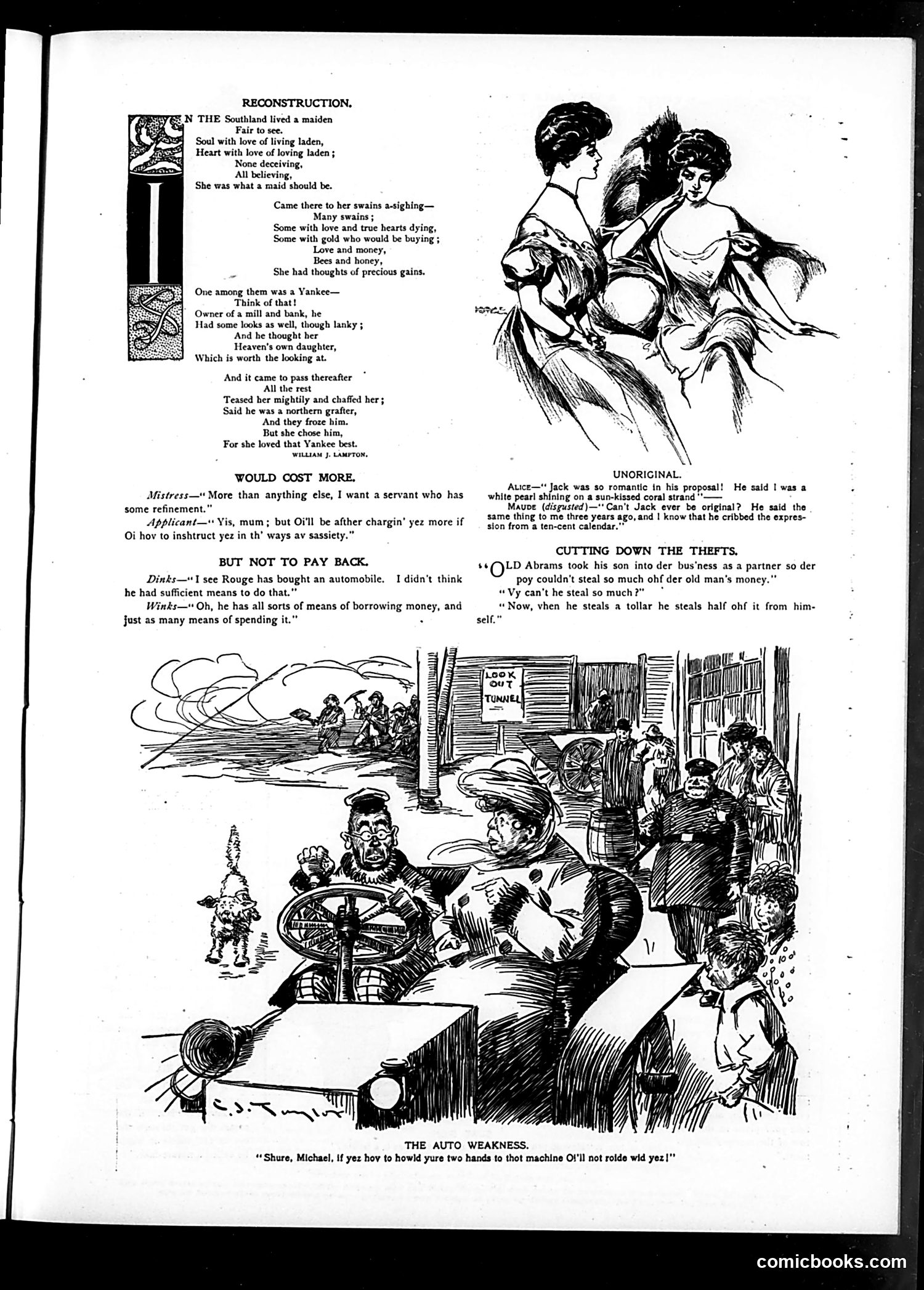
This page contains three distinct sections: 1. **"Reconstruction"** (top): A poem by William J. Lampson about a Scottish maiden courted by suitors seeking her wealth, including a Yankee mill owner. The accompanying illustration depicts three fashionable women. 2. **"Would Cost More"** and **"But Not to Pay Back"** (middle): Brief comic dialogues about servants and borrowing money—domestic humor with no apparent political reference. 3. **"Cutting Down the Thefts" / "The Auto Weakness"** (bottom): A satirical cartoon mocking automobile safety, showing a chaotic driving scene. The caption "Share, Michael, if yez hov to howld yure loo hands to that machine Oi'l not ride wild yez!" uses Irish dialect stereotyping common to the era, suggesting humor about reckless early automobile driving. The page reflects early 20th-century American social satire with emphasis on class, immigration stereotypes, and emerging automotive culture anxieties.
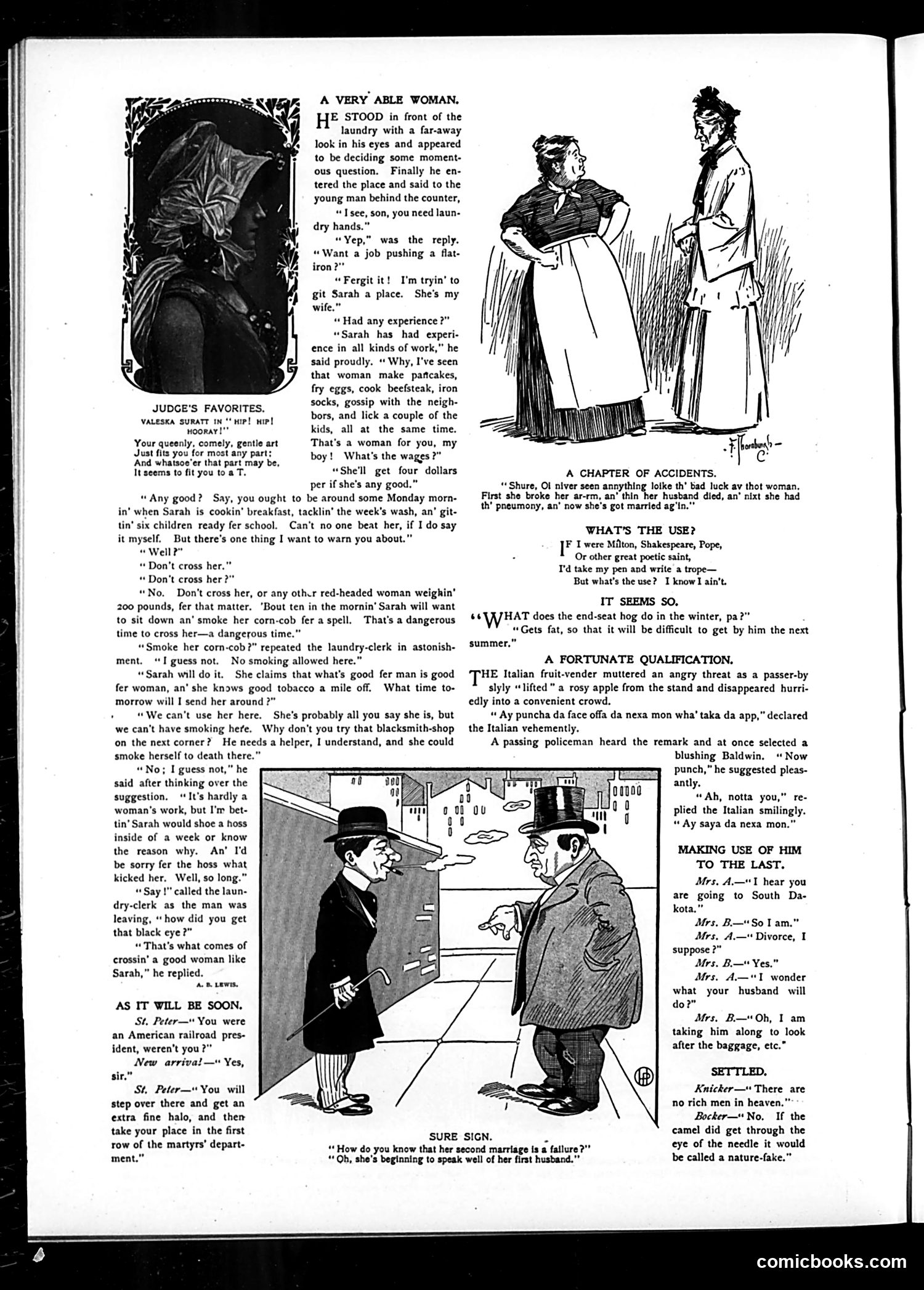
This page combines several humor pieces satirizing domestic and social situations. "A Very Able Woman" depicts Sarah, a capable housewife who can perform multiple tasks simultaneously—cooking, cleaning, childcare—but whose husband dismisses her value. The satire critiques how men underestimated women's labor and expertise. "Judge's Favorites" section includes jokes about marriage, gender relations, and workplace dynamics typical of early 20th-century humor. The central cartoon shows two men in conversation, likely about railway or business matters. Other sections mock marital disputes, Italian immigrants (through dialect humor), and social pretensions. The overall tone reflects period attitudes about gender roles, immigration, and class, presented as humorous observations rather than serious social commentary.
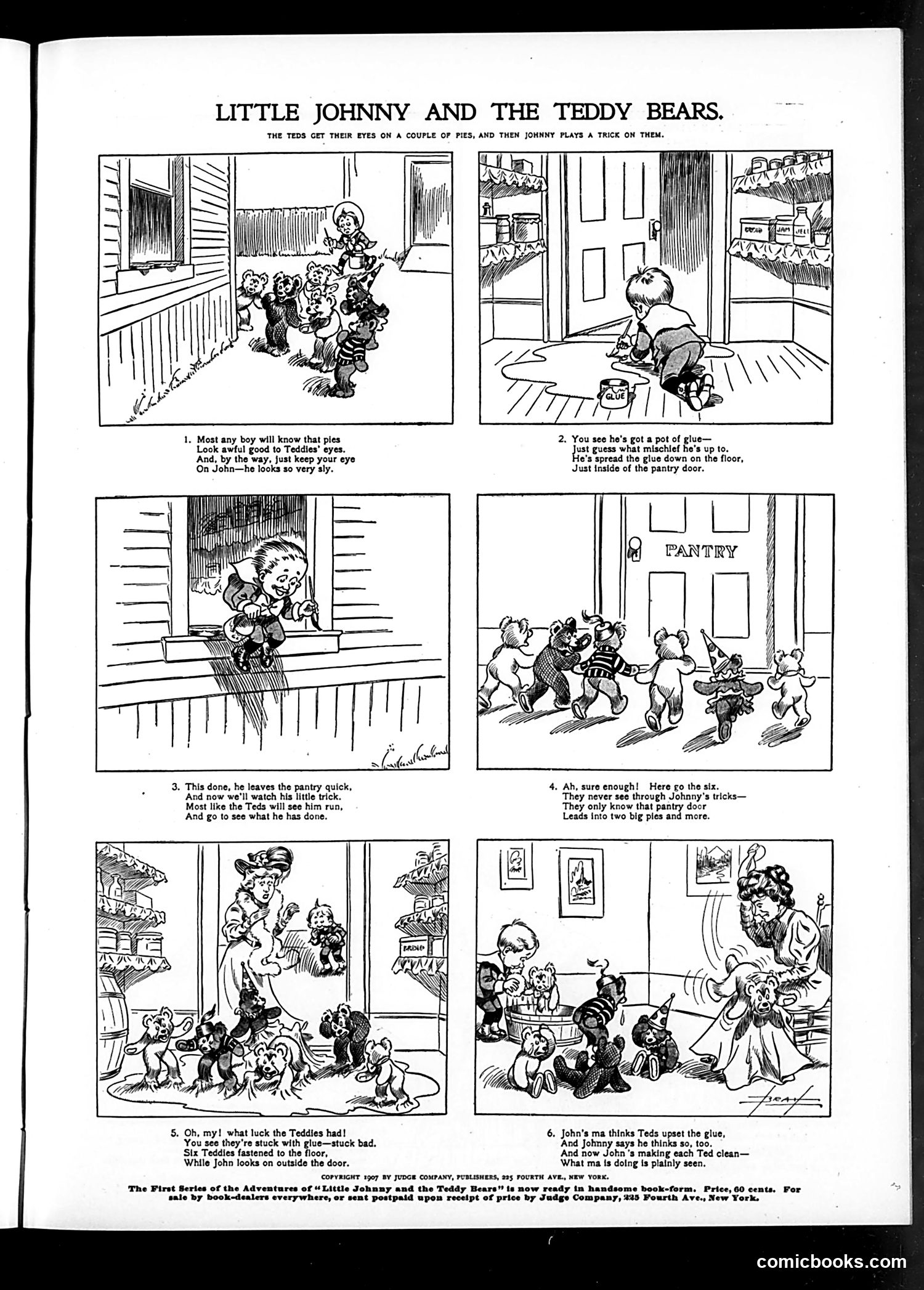
This is a children's story comic, not political satire. It depicts a boy named Johnny who tricks teddy bears (his toys) into various mishaps using glue and other pranks. The narrative follows Johnny's mischievous exploits: he glues the bears' feet to the floor, watches them struggle, and creates chaos in the pantry. The bears become increasingly distressed by his tricks. The "Teddy Bears" reference likely alludes to the popular stuffed toy craze of the early 1900s (named after President Theodore Roosevelt). However, this particular comic strip appears to be simple children's entertainment rather than political commentary—just a humorous tale of a mischievous boy tormenting his toy animals, drawn in the slapstick style typical of Judge magazine's lighter content.
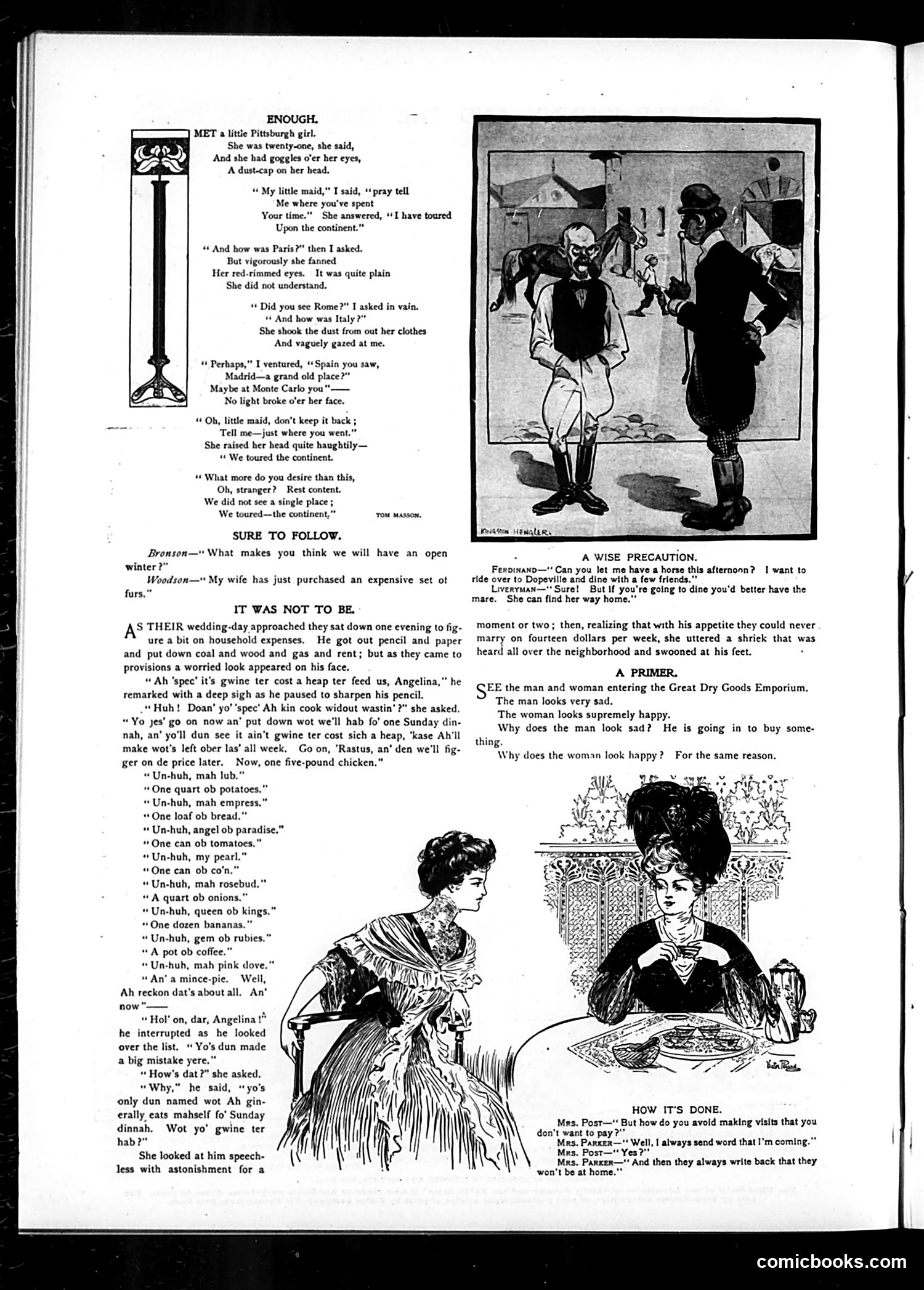
This page contains several satirical pieces targeting early 1900s social conventions and gender dynamics: **"Enough"** mocks a young woman from Pittsburgh who claims to have "toured the continent" but proves completely ignorant of European geography and landmarks. The satire targets pretentious travel boasting and superficial claims of sophistication among the newly wealthy. **"It Was Not To Be"** uses dialect humor (African American characters) to satirize marital budget planning. A couple planning their Sunday dinner discovers the husband's enormous appetite makes marriage financially impossible—the joke being his casual expectation that his wife will somehow feed both of them. **"A Wise Precaution"** is a one-liner about lending horses to dinner guests—implying the mare knows the way home even if a drunk rider cannot. **"A Primer"** and **"How It's Done"** present contrasting gender stereotypes: women love shopping/social calls while men dread them; women avoid unwanted visits by sending advance notice (ensuring hosts will be absent). The page exemplifies Judge's humor: mocking pretension, marital tensions, class anxieties, and traditional gender roles through exaggeration and irony.
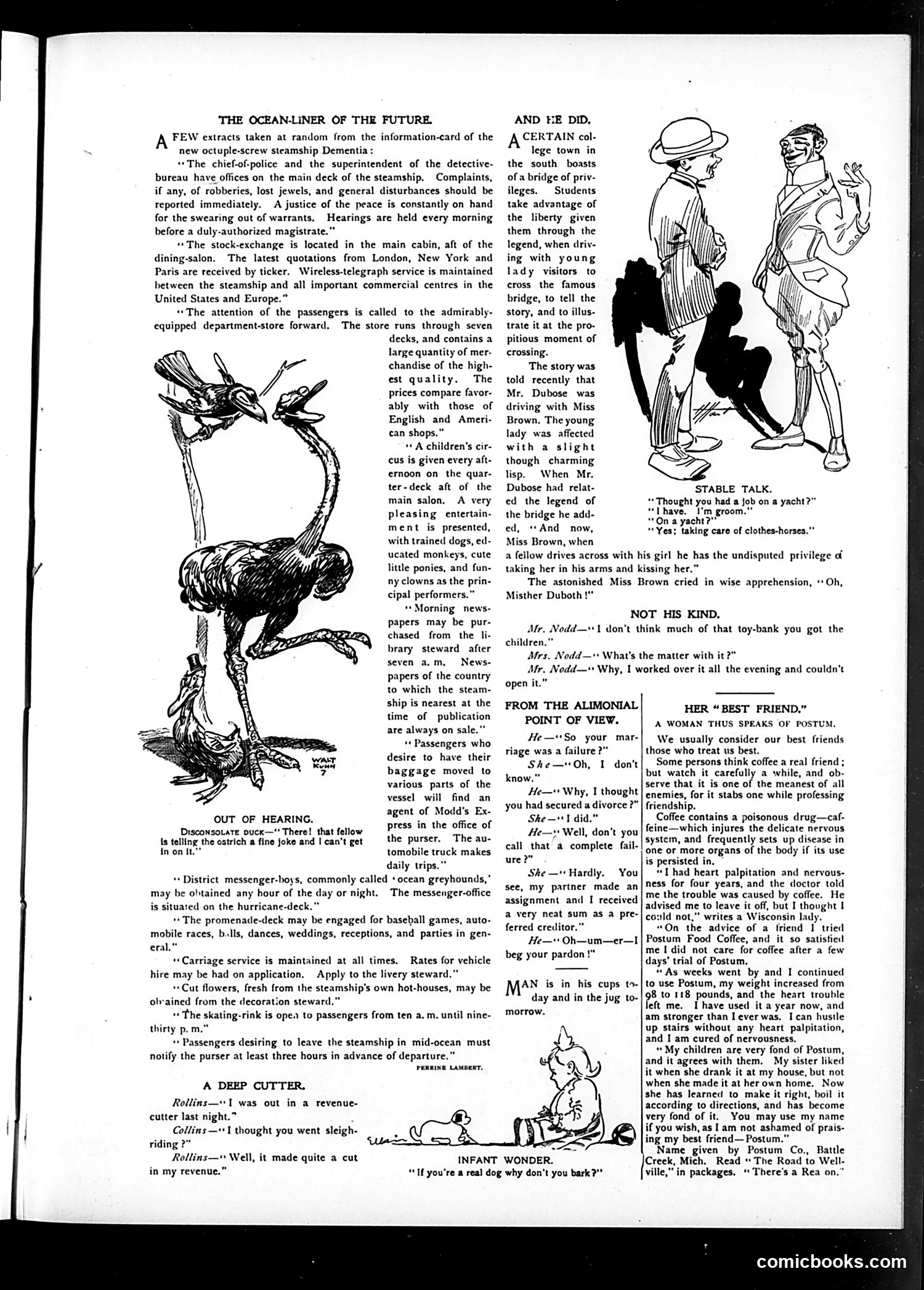
This Judge magazine page satirizes the absurdity of future ocean liners by imagining a ship called the *Dementia* equipped with urban conveniences: police stations, stock exchanges, department stores, children's circuses, and even a skating rink. The satire suggests that wealthy travelers of the era demanded such extensive onboard amenities that ships were becoming floating cities—a critique of excess and commercialization in luxury travel. The smaller cartoons are period humor jokes unrelated to the main feature: one depicts animals unable to hear gossip, another plays on "cut" as both a wound and a financial loss, and the college town anecdote presents a mild romantic scenario involving a bridge's supposed "privilege" of kissing. The content reflects early 20th-century anxieties about technology, consumer culture, and the blurring of public/private spaces in modern life.
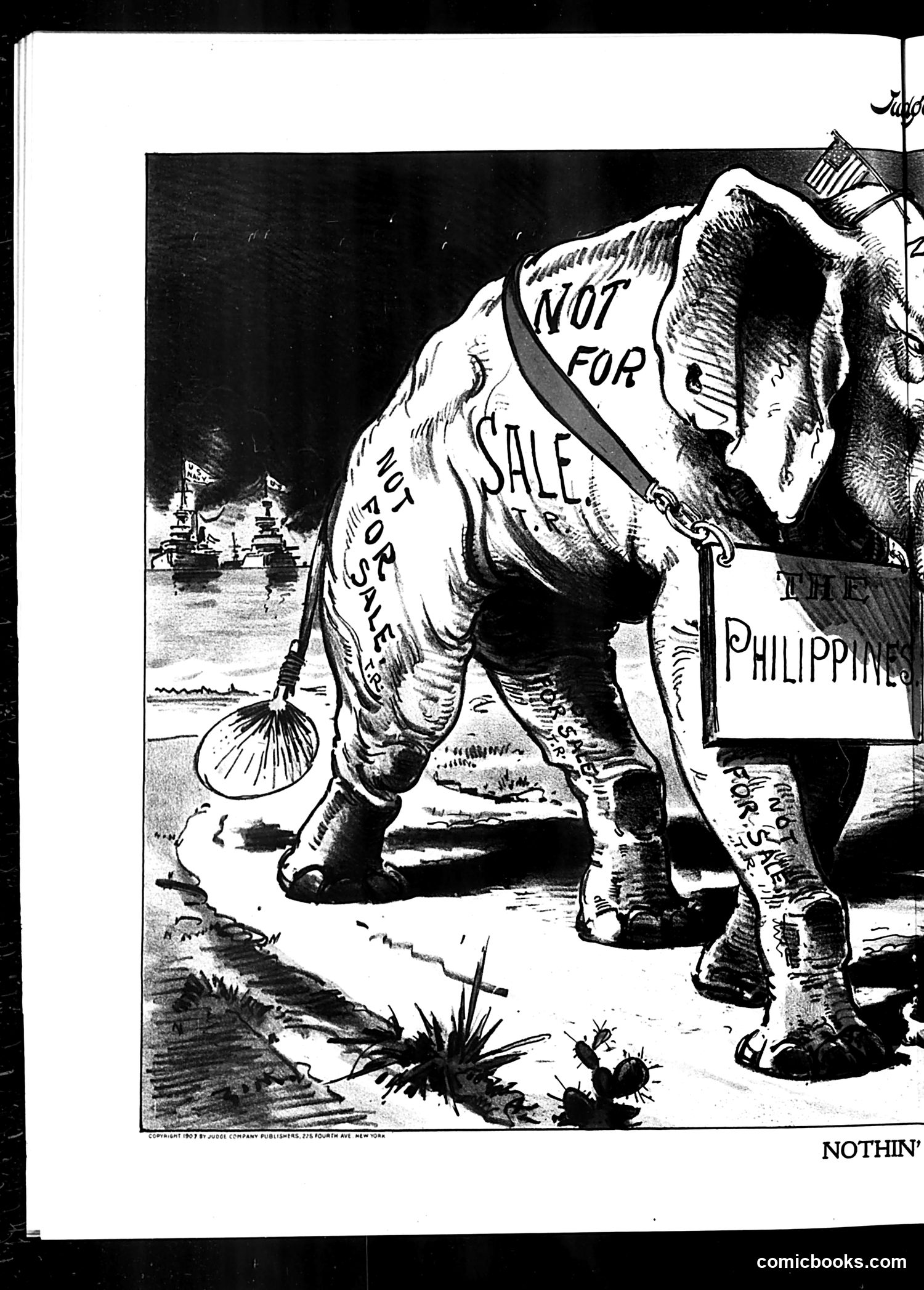
This is a satirical cartoon from *Judge* magazine depicting an elephant labeled "NOT FOR SALE" with text reading "OUT OF SALE" on its body. The elephant appears to represent the Philippines, labeled on a sign to the right. The cartoon satirizes American colonial policy regarding the Philippines. The "not for sale" messaging suggests resistance to the notion that the territory could be sold or ceded, while the elephant—a traditional Republican symbol—indicates this was a Republican administration policy concern. Ships are visible in the background, suggesting naval/military involvement. The satire appears critical of American imperialist ambitions in the Philippines during the early 20th century, mocking the rhetoric around U.S. control of the territory.
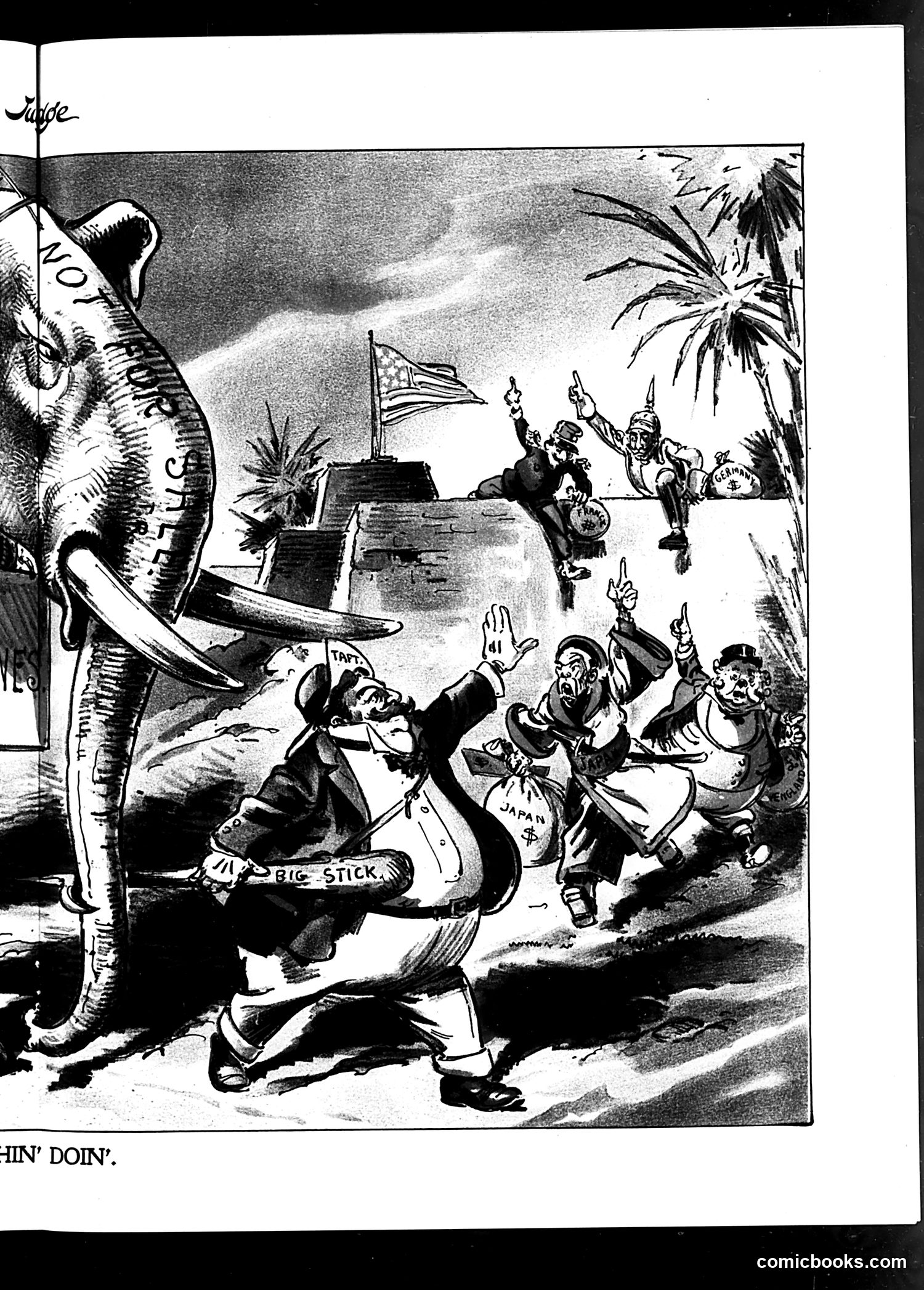
This **Judge** magazine cartoon satirizes American imperialism and the "Big Stick" foreign policy (referenced by the label on the figure). The image depicts Theodore Roosevelt as a massive, threatening elephant towering over smaller caricatured figures labeled "Japan" who appear frightened and submissive. The scene appears set in a tropical location (palm trees, colonial setting), likely representing contested Pacific territories. American military personnel on a ship behind Roosevelt reinforce U.S. military dominance. The satire critiques Roosevelt's aggressive "Big Stick" diplomacy—the threat of military force to enforce American interests abroad—particularly regarding tensions with Japan over regional expansion and influence. The cartoon's point: Roosevelt's intimidating approach to international relations reduced other nations to cowering subordinates.
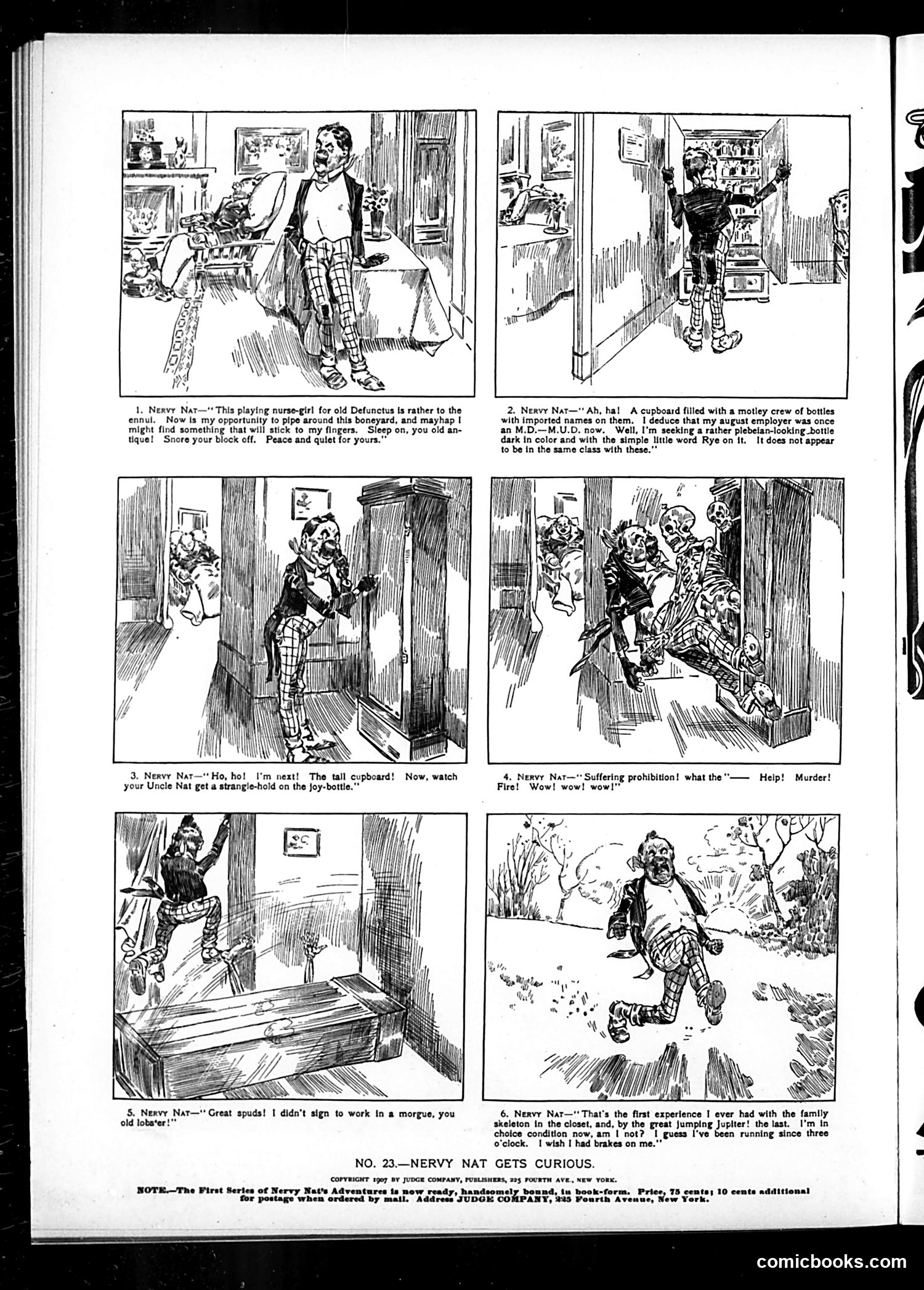
This is a comic strip following the character "Nervy Nat," a mischievous young servant employed by an elderly, deceased employer ("old Defunctus"). The six-panel narrative shows Nat exploring his late master's home, discovering a medicine cabinet of alcohol bottles, and searching specifically for whiskey labeled "Rye." The satire targets **Prohibition-era anxieties** (the strip is dated 1907, before national Prohibition but when temperance movements were gaining momentum). Nat's quest for hidden liquor in a doctor's cabinet—combined with the reference to "suffering prohibition"—mocks both the hypocrisy of wealthy employers keeping contraband alcohol and society's anxiety about alcohol availability. The "family skeleton in the closet" reference adds another layer: the joke conflates literal horror (discovering a skeleton while burglarizing the house) with the moral scandal of discovering the household's drinking habits. The humor relies on working-class irreverence toward social pretense.
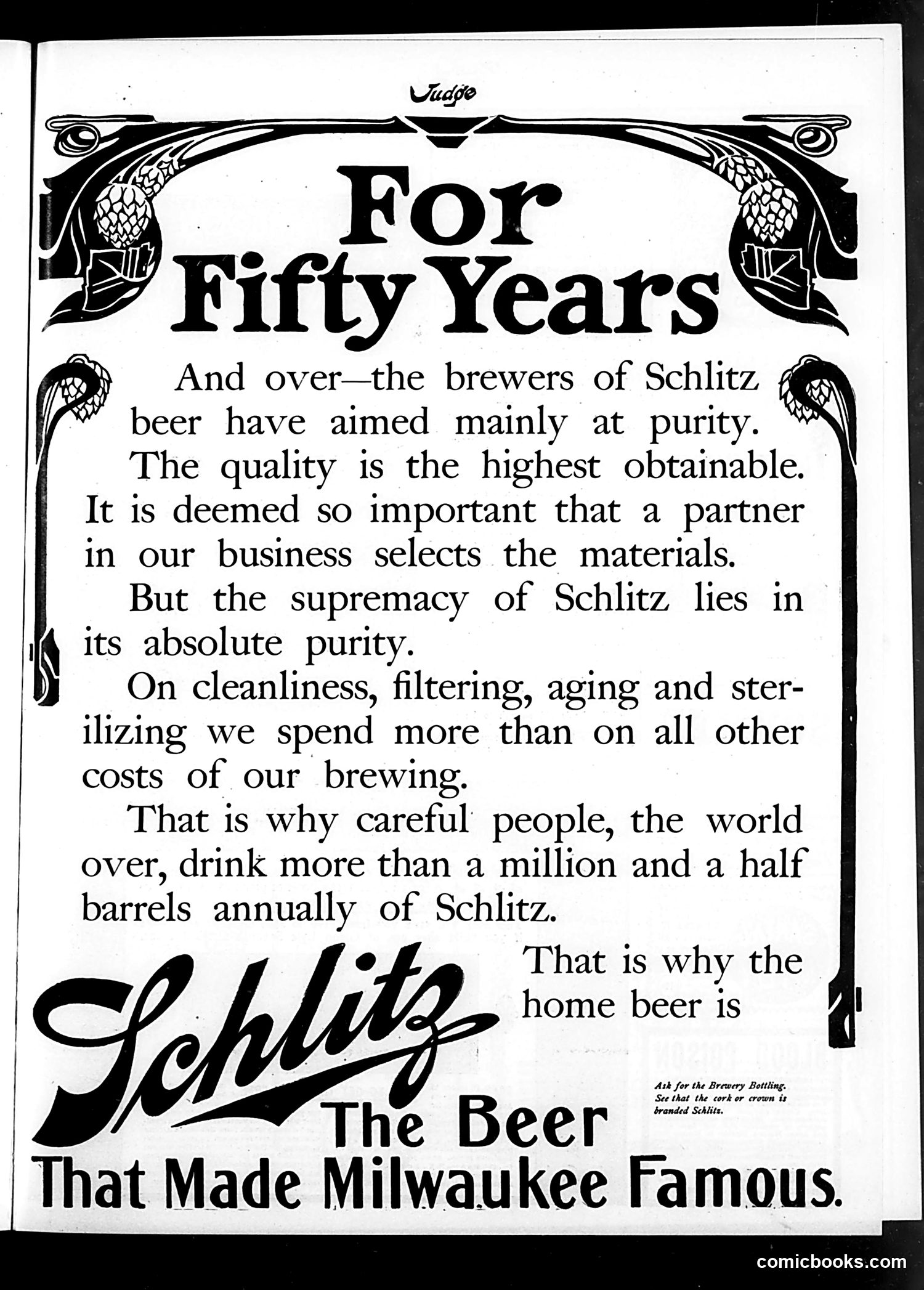
This is **not a cartoon or satire**—it's a straightforward advertisement for Schlitz beer, likely from the early 20th century (the "fifty years" reference suggests around 1900-1920). The ad emphasizes Schlitz's competitive advantage: **purity**. It claims the brewery spends more on cleanliness, filtering, aging, and sterilization than any other brewing costs, positioning purity as their defining quality. The appeal to "careful people" suggests health-consciousness was a marketing angle. The decorative hop imagery and formal layout reflect period advertising aesthetics. "The Beer That Made Milwaukee Famous" references Milwaukee's dominance in American beer production during this era. **Context modern readers miss**: This predates Prohibition (1920-1933), when such beer advertising was ubiquitous. The emphasis on "purity" likely responded to contemporary concerns about food safety and contamination—genuine public health issues before modern regulations.
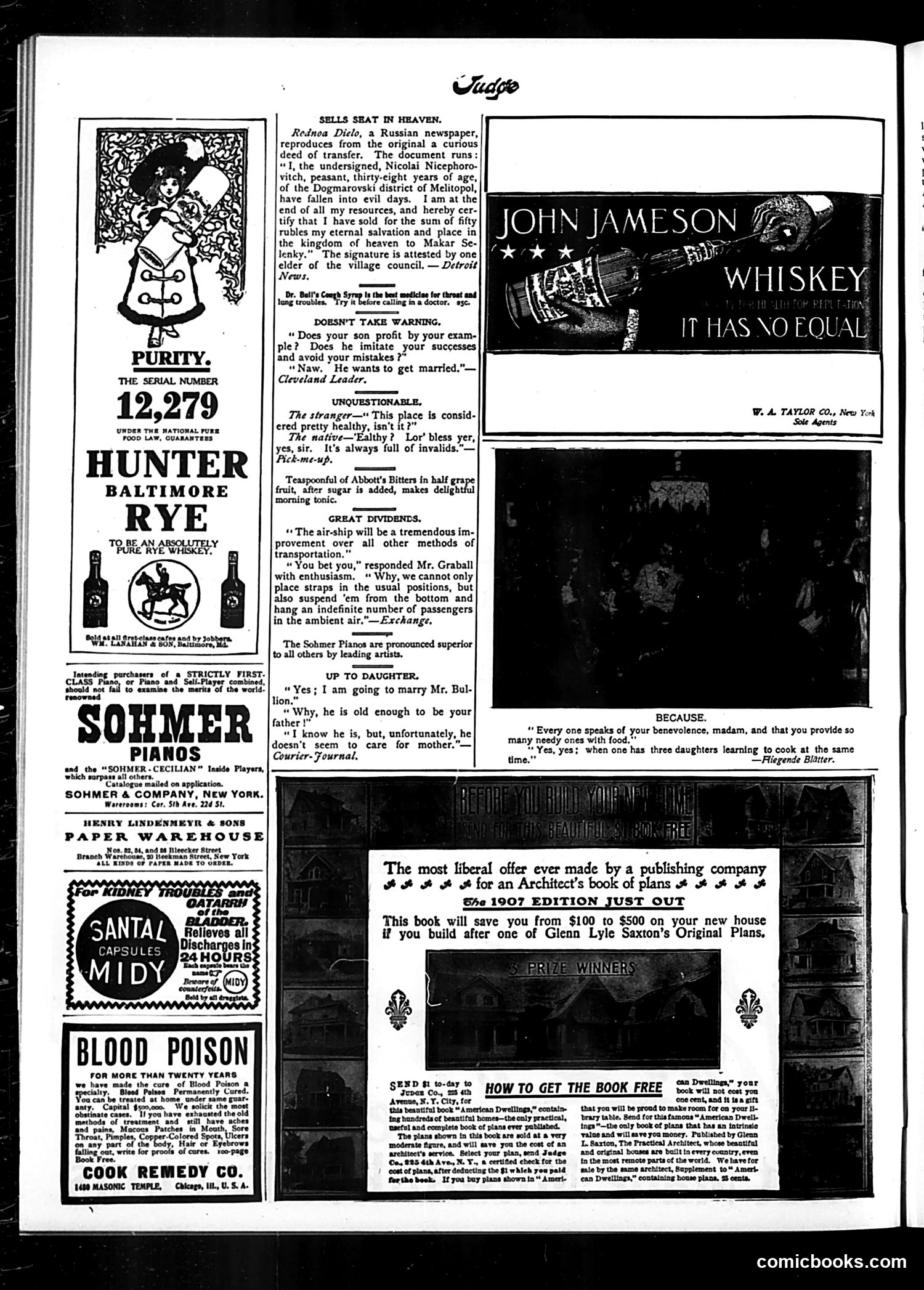
This page is primarily **advertising**, with brief humorous filler items typical of early 1900s magazines. The main satirical content is "SELLS SEAT IN HEAVEN"—a brief joke about a Russian peasant literally selling his salvation to another man for fifty rubles. The humor targets both Russian peasant superstition and the commodification of religious faith; it's presented as an actual historical anecdote ("curious deed of transfer") to heighten the absurdity. The remaining items are **short quips and jokes**: a daughter marrying an elderly man (she wants to escape her mother), a farmer claiming his land is "healthy" because it's "full of invalids," and a businessman excited about airships because they'd allow hanging unlimited passengers from them—satirizing corporate greed and dangerous labor practices. The page otherwise showcases period advertisements for whiskey, pianos, medical treatments (including "blood poison" cures), and architectural plans—reflecting both Judge's commercial content and contemporary medical quackery the magazine implicitly endorsed through advertising.
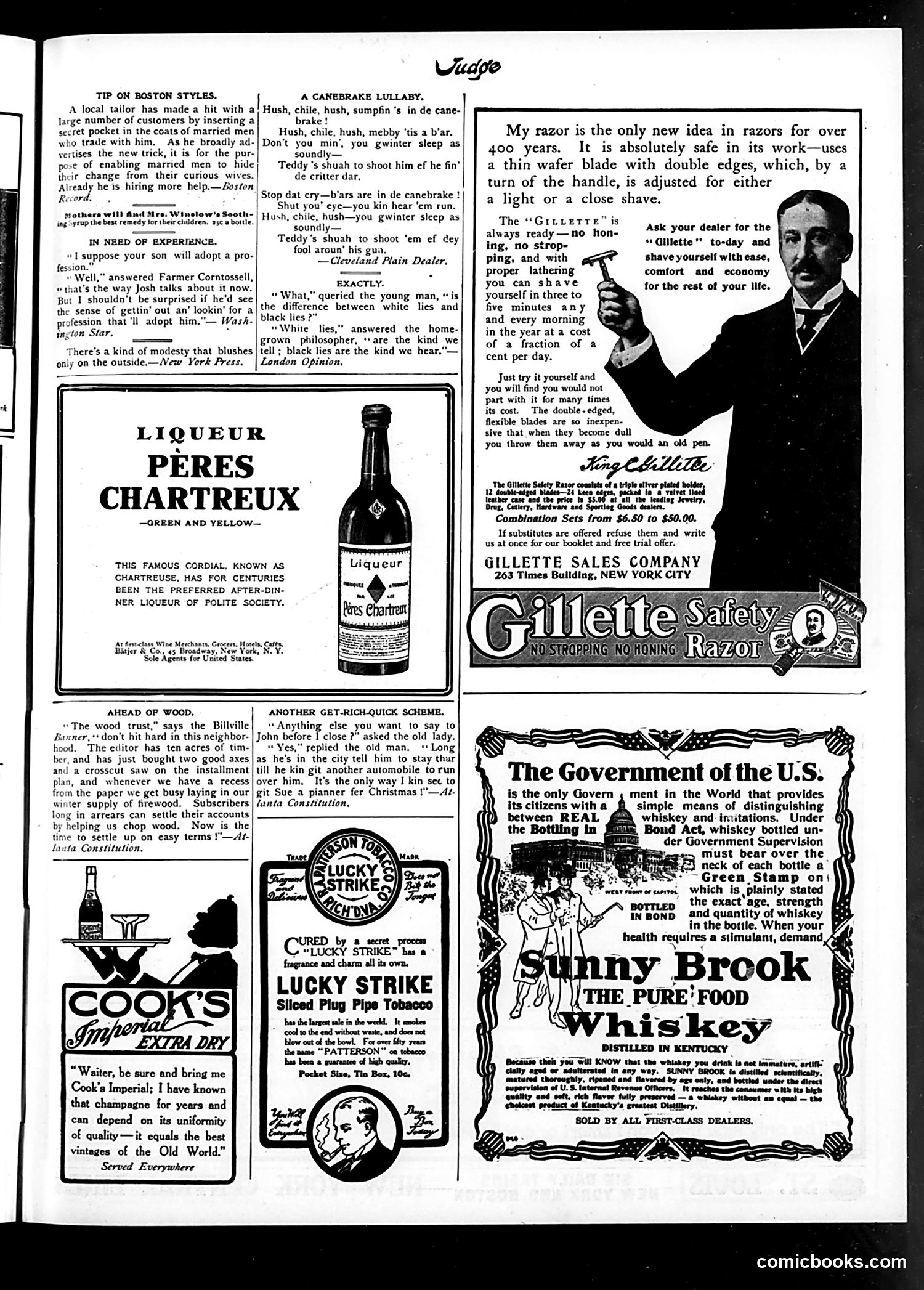
This page is primarily **advertising**, featuring product promotions for liqueurs, tobacco, razors, and whiskey. The small satirical items are brief humor pieces typical of Judge's format. **Notable content:** The **"Canebrake Lullaby"** references President **Theodore Roosevelt**, who was famous for big-game hunting. The poem humorously uses Roosevelt's reputation as a hunter to comfort a Black child about dangerous animals in the canebrake—implying Teddy will shoot any threat. This reflects Roosevelt's popular image as a vigorous outdoorsman, though the dialect and racial framing reflect period attitudes. Other brief items mock: - Married men hiding money from wives (Boston tailors) - Rural life and unemployment (a farmer's son needing a job) - The wood shortage/monopolies The **Gillette Safety Razor advertisement** is prominent, claiming it's the only innovation in 400 years of razor design—a bold marketing claim emphasizing convenience and economy. The page represents typical early-20th-century magazine content: mixing light satire with substantial advertising revenue.
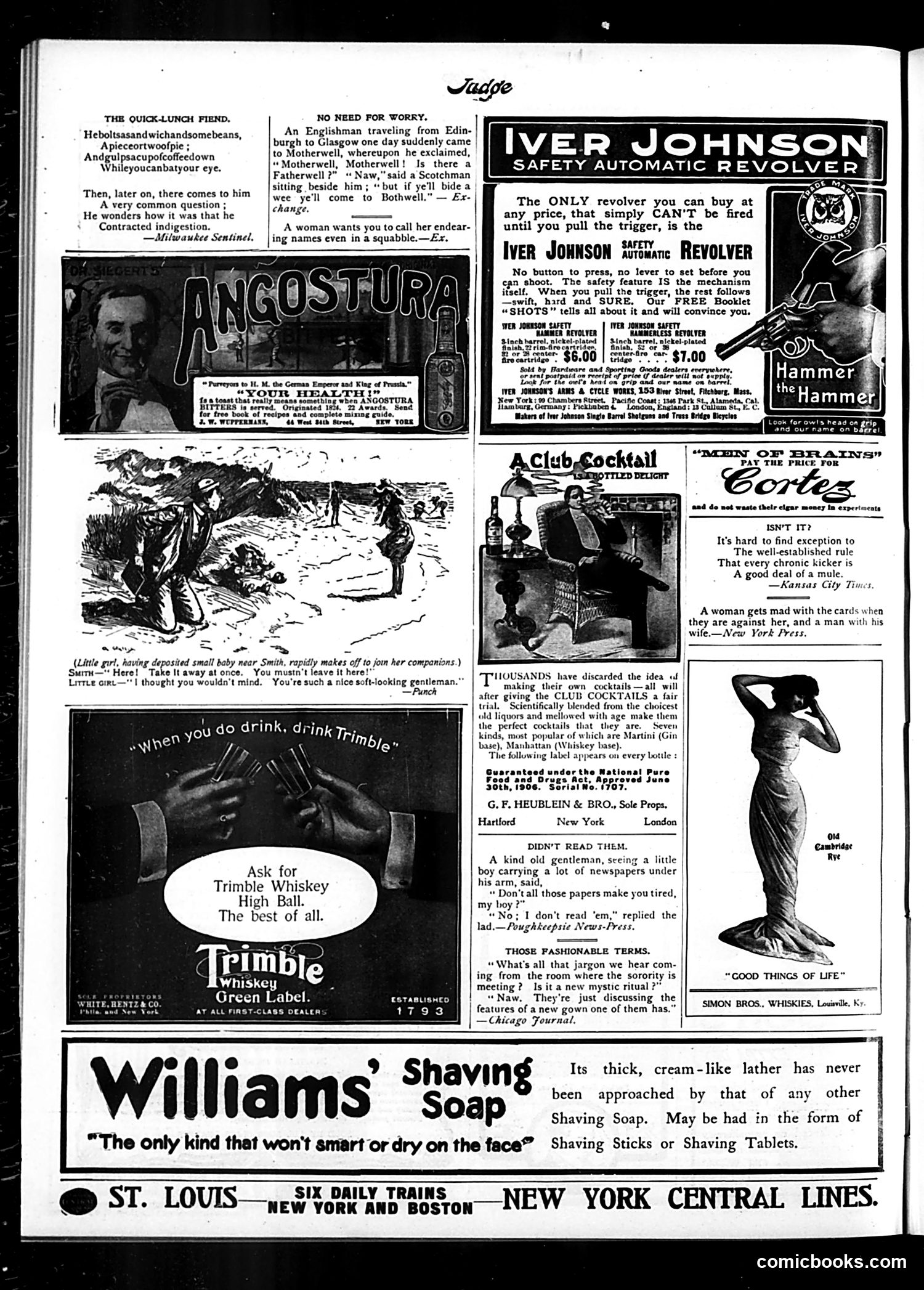
This page is primarily **advertising** rather than editorial cartooning, typical of Judge magazine's revenue model. The main content includes: **"The Quick-Lunch Fiend"** - A brief satirical piece mocking Americans who rapidly consume cheap meals (beans, pie, coffee) while standing, resulting in indigestion. This reflects early 20th-century social anxiety about modern urban pace and working-class eating habits. **Scottish Dialect Joke** - A pun-based exchange about English place names (Motherwell/Fatherwell/Bothwell), using heavy Scottish dialect for humor. The page is dominated by **product advertisements**: Iver Johnson revolvers (emphasizing safety features), Trimble Whiskey, Club Cocktails, Williams Shaving Soap, and Simon Bros. Whiskies. Notably, these ads for alcohol and firearms appear without modern regulatory restrictions. Minor **humorous quips** about gender relations and social behavior are scattered throughout, typical of Judge's light satirical tone. The page reflects period attitudes toward consumption, gender, and product marketing in the pre-Prohibition era.
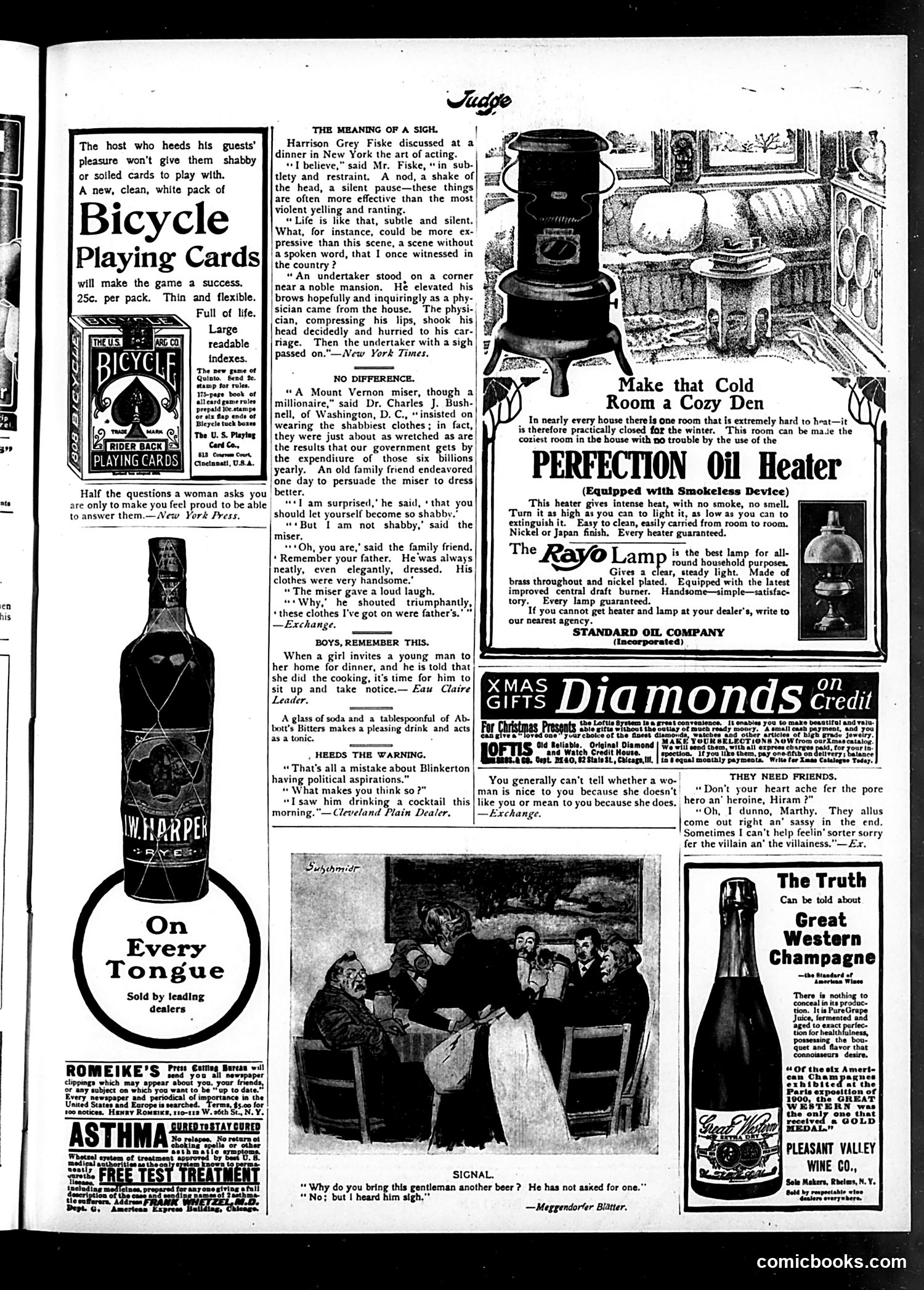
This page from *Judge* magazine is primarily **advertising**, with several humorous anecdotes interspersed. The main content includes: **"The Meaning of a Sigh"**: Harrison Grey Fiske (a theater figure) illustrates acting subtlety through a darkly comic scenario—an undertaker's hopeful expression turns to resignation when a physician exits a mansion, implying death. The joke plays on nonverbal communication's power. **"No Difference"**: A satire on government waste. A miserly millionaire refuses to dress well despite wealth, claiming his shabby clothes (inherited from his father) are fine. The point: the government spends six billion dollars yet produces equally shabby results—wasteful spending yields nothing worthwhile. **Various one-liners** about gender dynamics and political ambition round out the humor. The advertisements promote playing cards, oil heaters, lamps, champagne, and dubious patent medicines—typical early-20th-century magazine fare. The overall tone is genteel, middle-class humor aimed at prosperous readers.
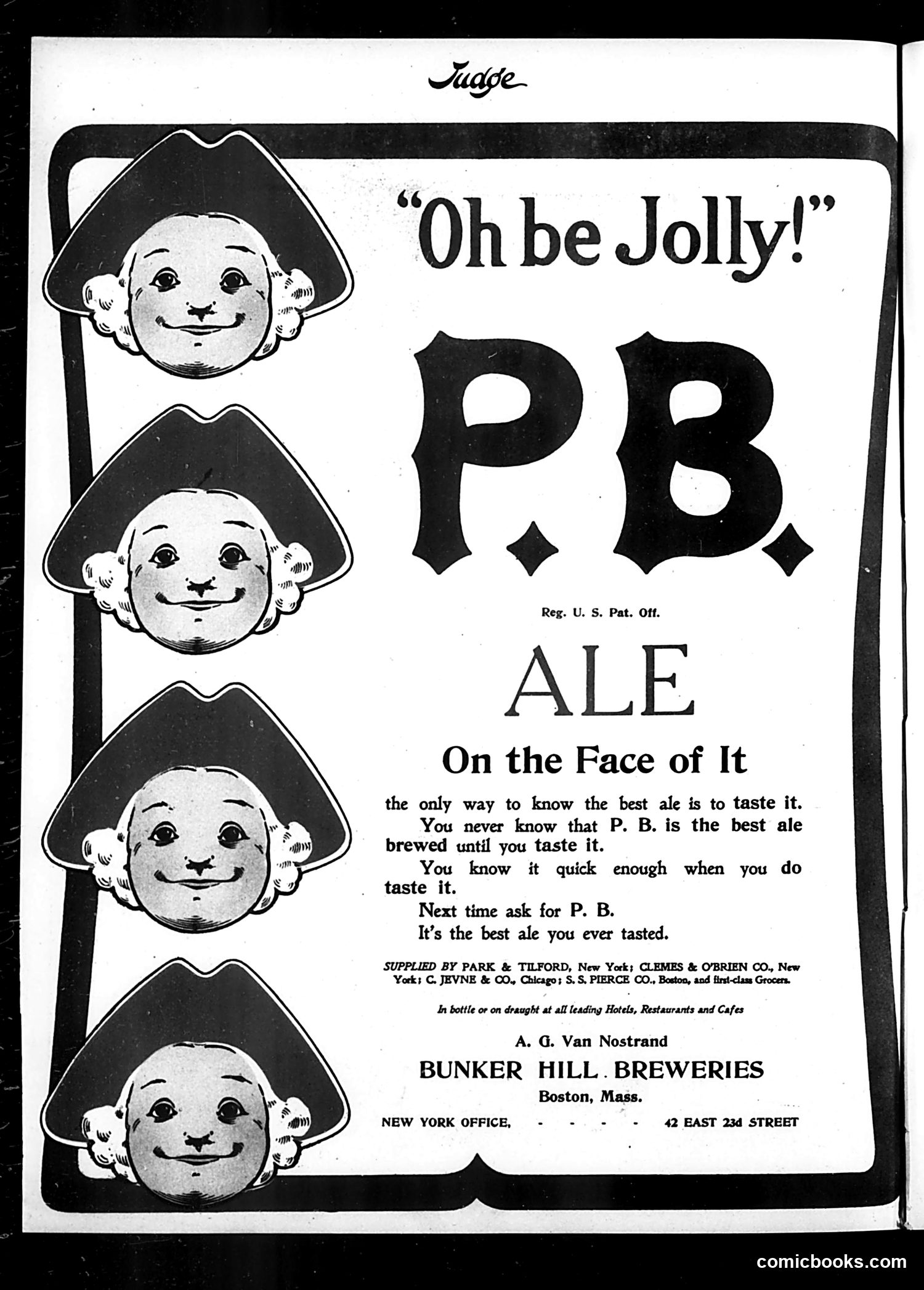
This is primarily a **beer advertisement**, not political satire. It promotes P.B. Ale from Bunker Hill Breweries (Boston) through Judge magazine. The visual gimmick features four identical cartoon faces of a jolly, rotund man in a tricorn hat—a character design meant to suggest hearty conviviality and the product's appeal. The repeated faces reinforce the advertising message. The ad's humor is mild and commercial: it uses wordplay ("On the Face of It") and the simple claim that P.B. ale's quality is immediately obvious upon tasting. The phrase "Oh be Jolly!" ties consumption to happiness and good cheer. This reflects early-20th-century advertising strategy—using Judge's satirical platform to reach affluent readers. The distribution list (Park & Tilford, upscale grocers, hotels) targets middle-to-upper-class consumers. There is **no political commentary**; it's purely commercial content masquerading as entertainment within the magazine's pages.