
Judge, 1907-11-09 · page 4 of 16
Judge — November 9, 1907 — page 4: what you’re looking at
What you’re looking at
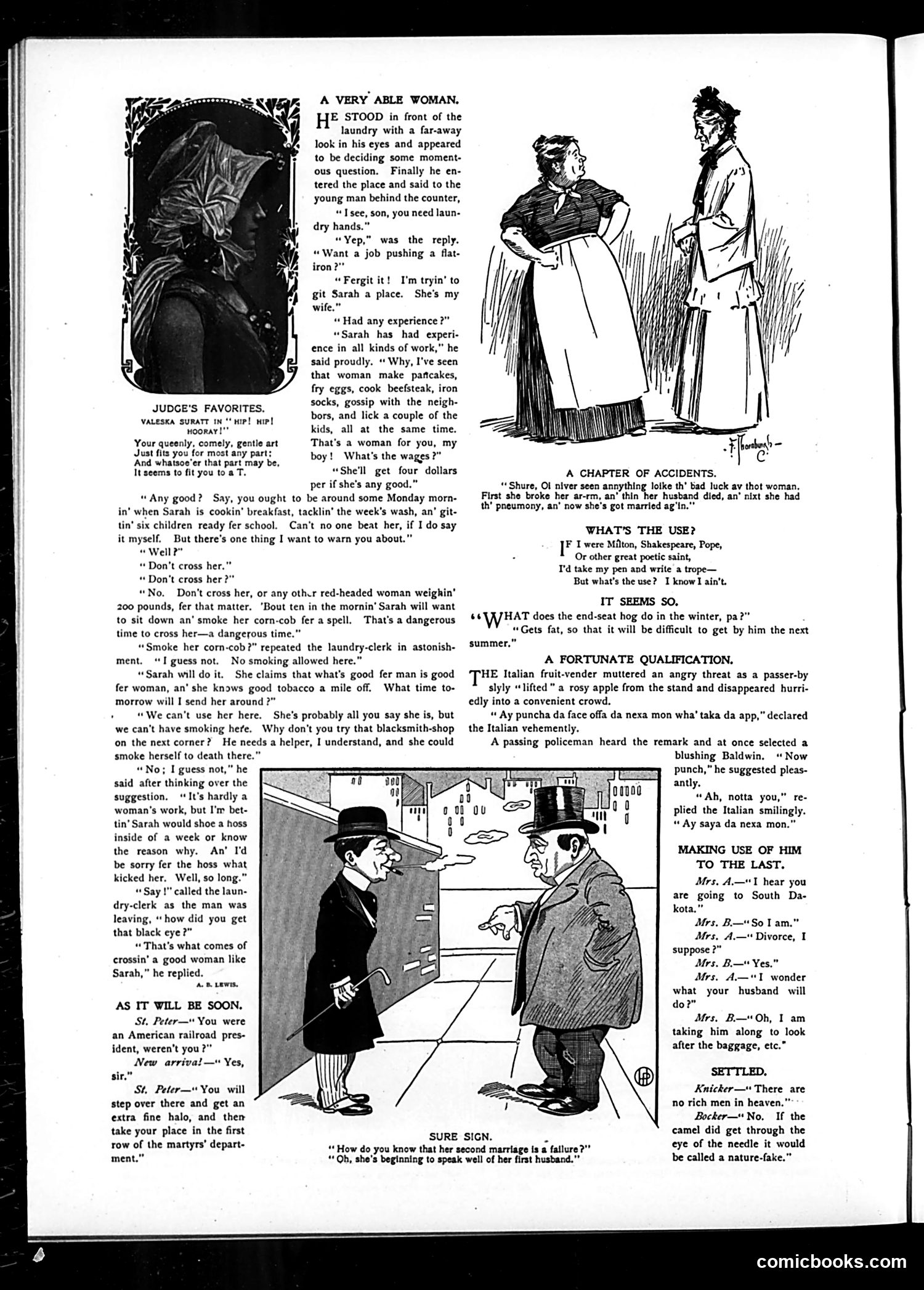
This page combines several humor pieces satirizing domestic and social situations. "A Very Able Woman" depicts Sarah, a capable housewife who can perform multiple tasks simultaneously—cooking, cleaning, childcare—but whose husband dismisses her value. The satire critiques how men underestimated women's labor and expertise. "Judge's Favorites" section includes jokes about marriage, gender relations, and workplace dynamics typical of early 20th-century humor. The central cartoon shows two men in conversation, likely about railway or business matters. Other sections mock marital disputes, Italian immigrants (through dialect humor), and social pretensions. The overall tone reflects period attitudes about gender roles, immigration, and class, presented as humorous observations rather than serious social commentary.
📄 Transcribed text from this page (OCR, searchable)
Machine-transcribed from the original scan — historical spelling and the odd misread are preserved.
A VERY ABLE WOMAN. E STOOD in front of the laundry with a far-away look in his eyes and appeared to be deciding some moment- ous question. Finally he en- tered the place and said to the young man behind the counter, “ Tsee, son, you need laun- dry hands." “Yep,” was the reply. “Want a job pushing a flat- iron?” « Fergit it! I'm tryin’ to git Sarah a place. She's my wife.” Had any experience ?” “Sarah has had experi- ence in all kinds of work,” he said proudly. “ Why, I've seen that woman make paftcakes, fry eggs, cook beefsteak, iron socks, gossip with the neigh- bors, and lick a couple of the kids, all at the same time. That's a woman for you, my boy! What's the wages?” “She'll get four dollars per if she’s any good.” “Any good? Say, you ought to be around some Monday morn- in’ when Sarah is cookin’ breakfast, tacklin’ the week's wash, an’ git- tin’ six children ready fer school. Can't no one beat her, if I do say it myself, But there's one thing I want to warn you about.” “Well?” “Don't cross her.” “Don't cross her?” “No. Don't cross her, or any othcr red-headed woman weighin’ 200 pounds, fer that matter. ‘Bout ten in the mornin’ Sarah will want to sit down an’ smoke her corn-cob fer a spell. That's a dangerous time to cross her—a dangerous time.” “Smoke her corn-cob?” repeated the laundry-clerk in astonish- ment. “I guess not. No smoking allowed here.” “Sarah will do it. She claims that what's good fer man is good fer woman, an’ she knows good tobacco a mile off. What time to- morrow will I send her around ?” “We can't use her here. She's probably all you say she is, but we can't have smoking hefe. Why don't you try that blacksmith-shop on the next corner? He needs a helper, I understand, and she could smoke herself to death there.” “No; I guess not,” he said after thinking over the suggestion. “It’s hardly a woman's work, but I'm bet- tin’ Sarah would shoe a hoss inside of a week or know the reason why. An’ I'd be sorry fer the hoss what kicked her. Well, so long.” “Say !" called the laun- dry-clerk as the man was leaving, “ how did you get that black eye?” “ That's what comes of crossin’ a good woman like Sarah,” he replied. AB Lewis, AS IT WILL BE SOON. St, Peter—" You were an American railroad pres- ident, weren't you?” New arrival — Yes, St, Peter—“You will JUDGE'S FAVORITES. VALESKA SURATT IN‘ HIP! HIP! wooray !"* Your queenly, comely, gentle art Just fits you for most any part: And whatsoe’er that part may be, It seems to fit you toa T. step over there and get an extra fine halo, and then take your place in the first row of the martyrs’ depart- ment.” SURE S! “ How do you know that her second marriage is a failure?” Ob, she's beginning to speak well of her first husband." A CHAPTER OF ACCIDENTS. “Shure, Ol niver seen anything loike th’ bad luck av thot woman. First she broke her ar-rm, an’ thin her husband died, an’ nixt she had th’ pneumony, an’ now she’s got married ag'in.” WHAT'S THE USE? F I were Milton, Shakespeare, Pope, Or other great poetic saint, T'd take my pen and write a trope— But what's the use? I know ain't. IT SEEMS SO, AT does the end-seat hog do in the winter, pa?” Gets fat, so that it will be difficult to get by him the next seWH A FORTUNATE QUALIFICATION. THE Italian fruit-vender muttered an angry threat as a passer-by slyly “lifted” a rosy apple from the stand and disappeared hurri- edly into a convenient crowd. “ Ay puncha da face ofa da nexa mon wha’ taka da app,” declared the Italian vehemently. A passing policeman heard the remark and at once selected a blushing Baldwin. «Now punch,” he suggested pleas- antly, “Ah, notta you,” re- plied the Italian smilingly. “ Ay saya da nexa mon.” MAKING USE OF HIM TO THE LAST. Mrs. A.—"1 hear you are going to South Da- kota.” Mfrs. B—" So Tam,” Mrs. A.—" Divorce, 1 suppose 2” Mrs. B—" Yes." Mrs, A.—“1 wonder what your husband will do?” Mrs. B.—*Oh, I am taking him along to look after the baggage, etc.” SETTLED. Knicker—" There are no rich men in heaven.” Bocker—“No, If the camel did get through the eye of the needle it would be called a nature-fake.” IGN. comicbooks.com