
A complete issue · 16 pages · 1907
Judge — October 26, 1907
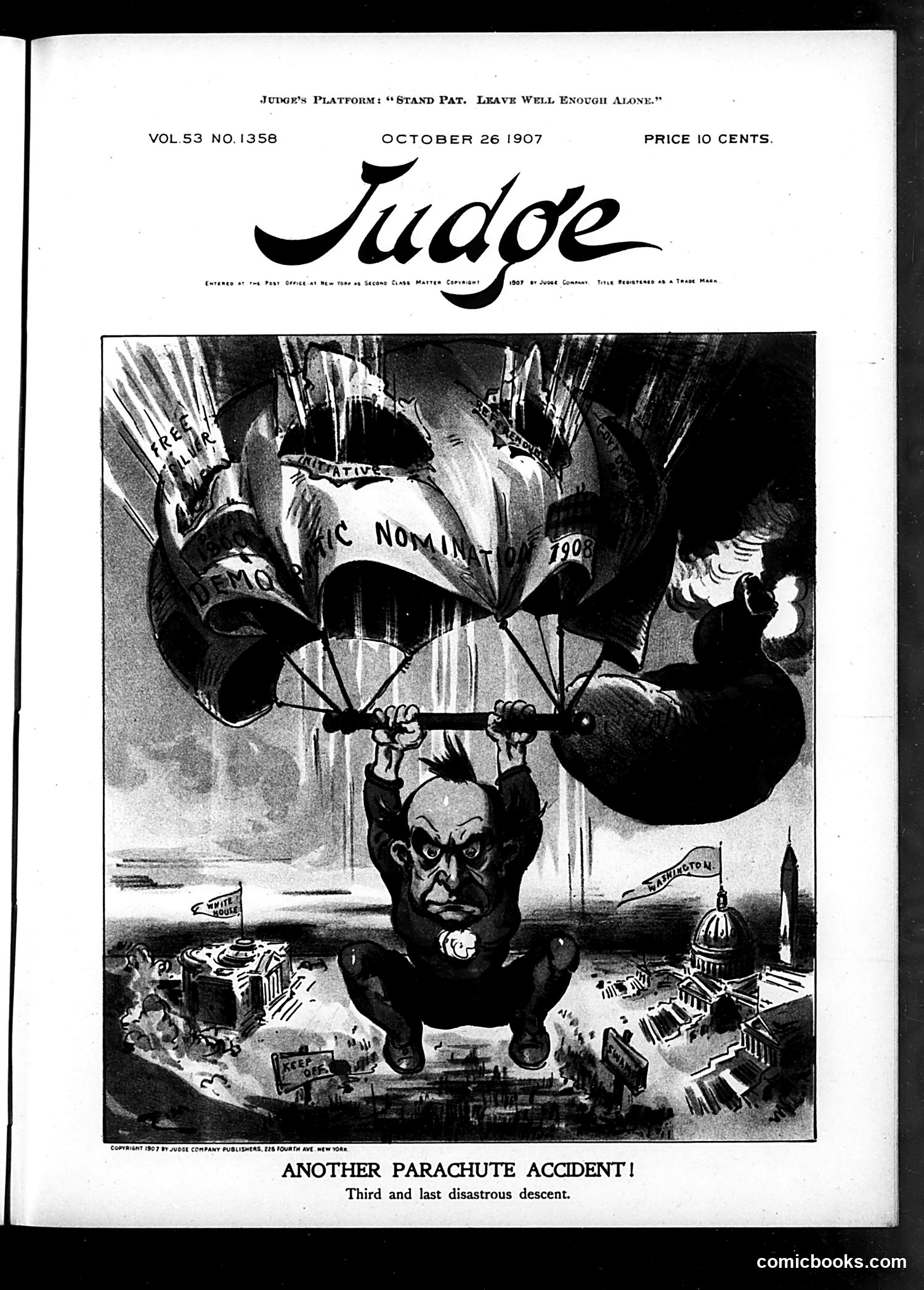
This 1907 Judge cartoon satirizes a political figure—likely a corrupt politician or industrialist—as a grotesque demon struggling to control a parachute descent over Washington D.C. (identifiable by the Capitol dome). The labeled balloons above suggest multiple failed ventures or schemes ("nominative," various corporate or political interests marked with "1906" and "1907"). The "parachute accident" metaphor represents the figure's political or financial collapse—their inability to maintain control as they fall. The "third and last" suggests this is their final downfall after previous scandals. The demonic caricature emphasizes moral corruption, while the Washington setting indicates this concerns national politics. The cartoon celebrates anticipated governmental or legal consequences.
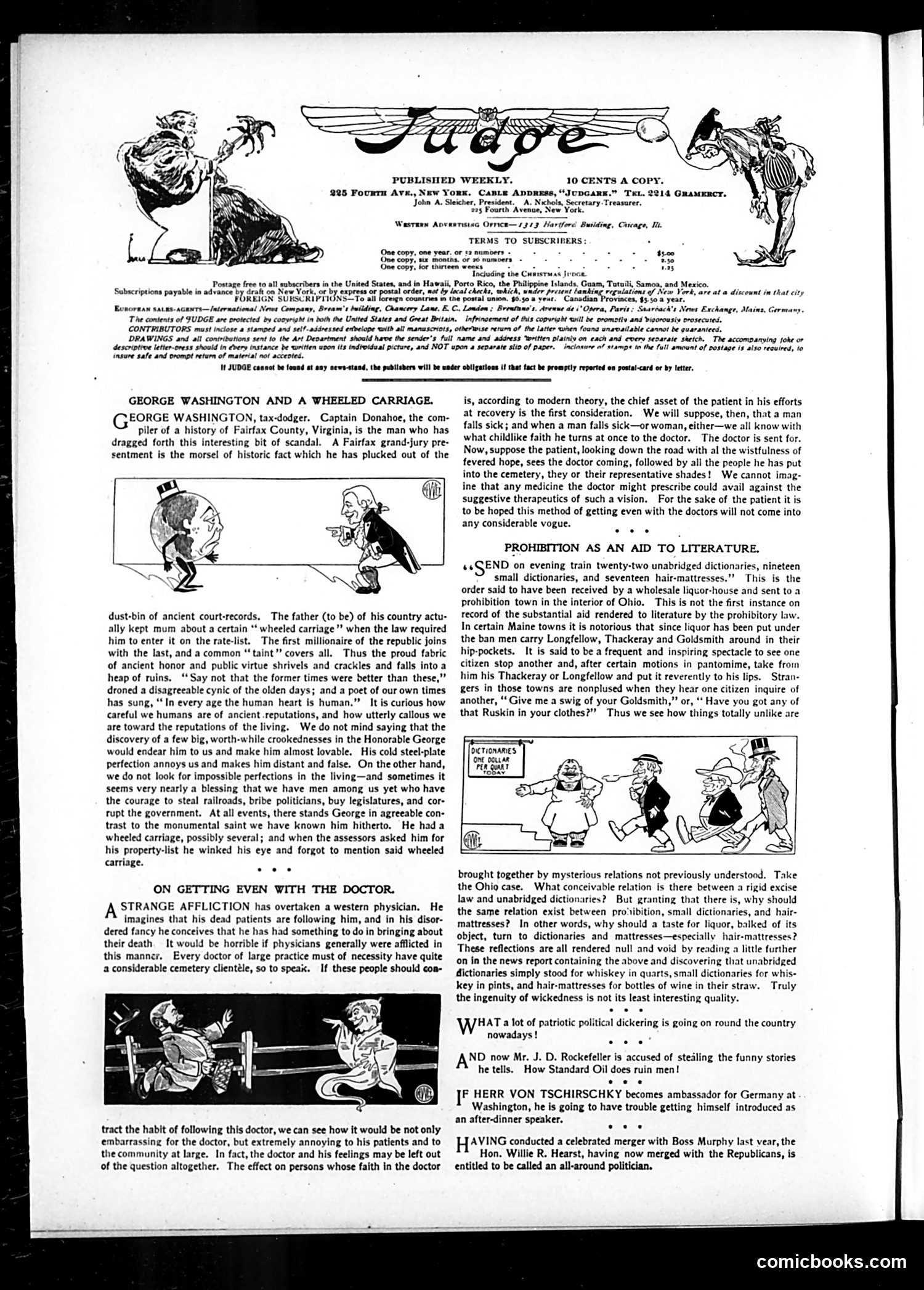
This page contains three satirical pieces targeting early 20th-century figures and social issues: 1. **"George Washington and a Wheeled Carriage"**: A humorous piece mocking a prominent Virginia politician (unnamed in visible text) for claiming descent from George Washington while his family fell into disrepute. The satire critiques how people invoke historical prestige to cover contemporary scandal. 2. **"On Getting Even with the Doctor"**: Satirizes folk remedies and superstition, mocking patients who follow bizarre home treatments rather than trusting physicians—suggesting public distrust of medical authority. 3. **Brief political items** at page bottom mock contemporary politicians: Rockefeller accused of theft, a German ambassador causing trouble, and Willie Hearst's political merger. The cartoons use exaggerated caricature and crude humor typical of Judge's satirical style attacking politicians, class pretension, and public gullibility.
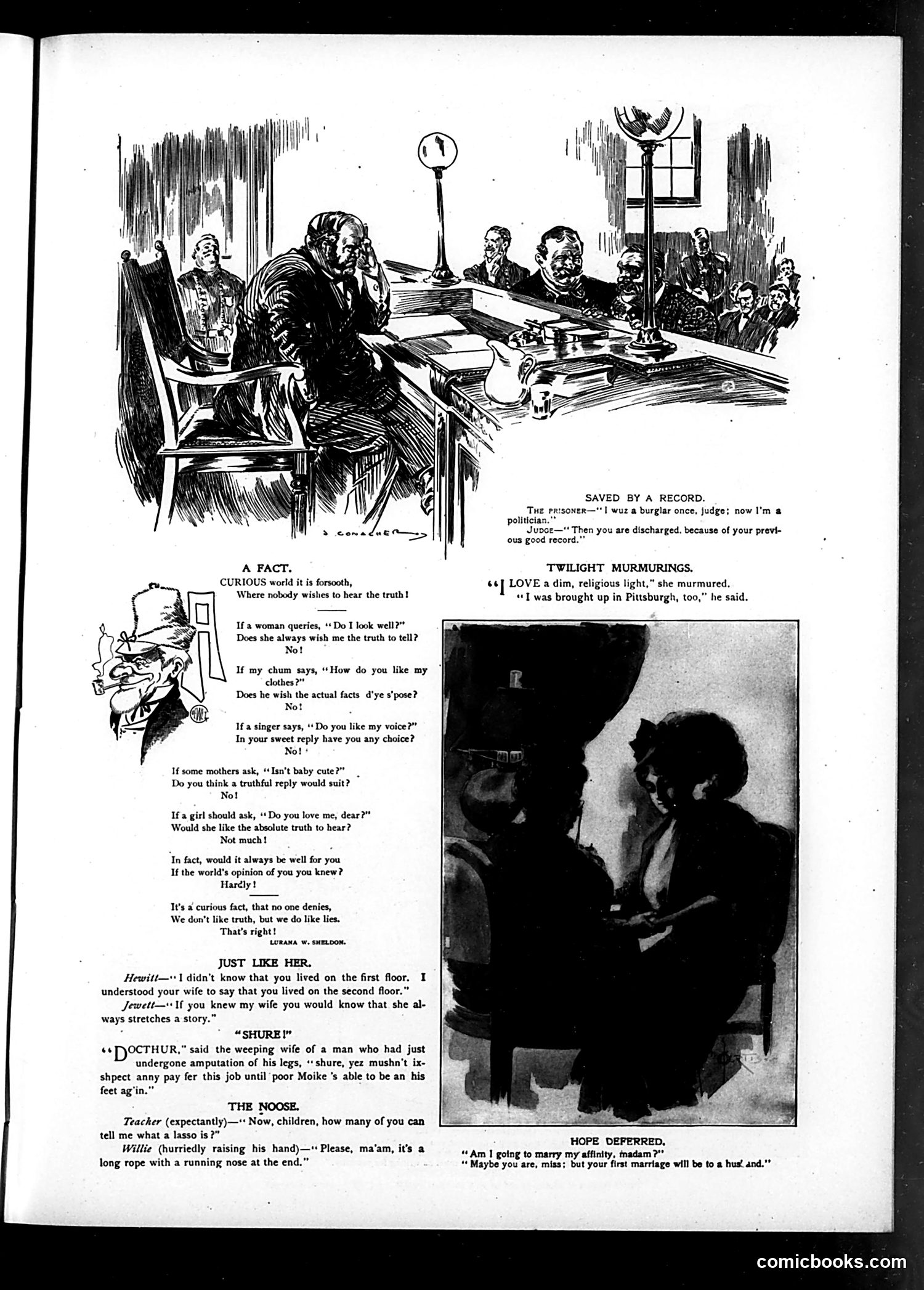
This Judge magazine page contains satirical humor pieces and a courtroom sketch. The top illustration depicts a legal proceeding where a prisoner claims reform: "I was a burglar once, Judge; now I'm a politician." The judge's response—discharging him due to his "good record"—satirizes politicians as morally equivalent to criminals. Below are several brief humorous anecdotes ("A Fact," "Just Like Her," "Shure!," "The Noosal") mocking human behavior and domestic life through exaggerated scenarios. The photograph captioned "Hope Deferred" shows a couple, with the woman asking about marriage while the man expresses uncertainty about his first marriage—typical domestic comedy of the era. The overall page uses satire to critique political corruption, domestic relations, and social hypocrisy typical of early 20th-century American humor magazines.
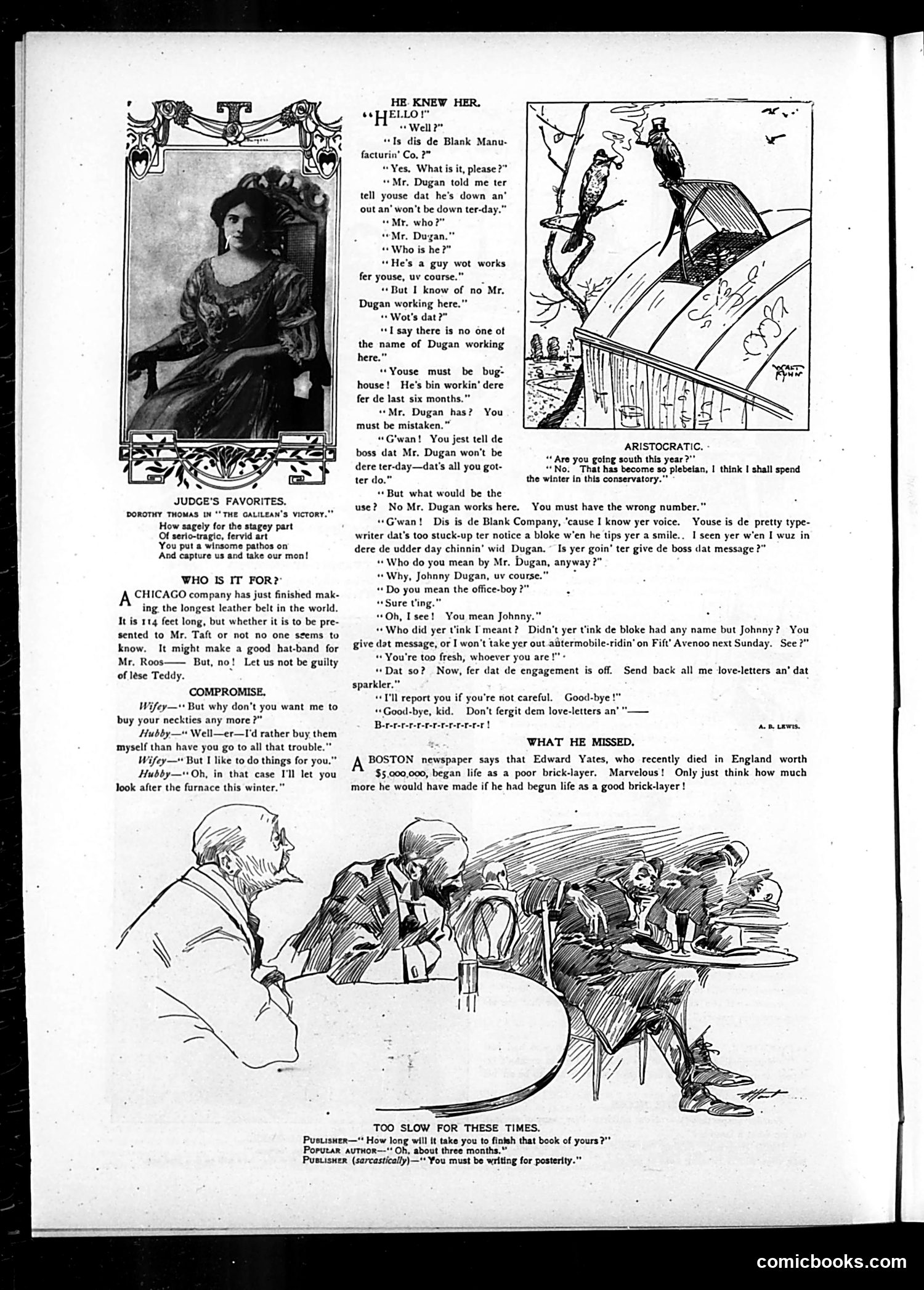
This page contains three distinct pieces of satirical content: 1. **"He Knew Her"** (top left): A dialogue-based sketch about a woman claiming to know someone named "Mr. Dugan" at the Black Manufacturing Company, while company staff insist no such person works there. The humor derives from the woman's insistence versus institutional denial—likely satirizing workplace confusion or someone's invented credentials. 2. **"Compromise"** (middle): A brief domestic exchange where a wife asks her husband to buy more groceries, he resists, and she threatens to stop cooking. The satire targets marital negotiations and economic domestic tensions. 3. **"What He Missed"** (bottom): A cartoon about Edward Yates, an Englishman who died poor after starting as a brick-layer. The satire suggests he would have prospered more had he remained working-class rather than attempting social advancement. These reflect early 20th-century American class and domestic anxieties.
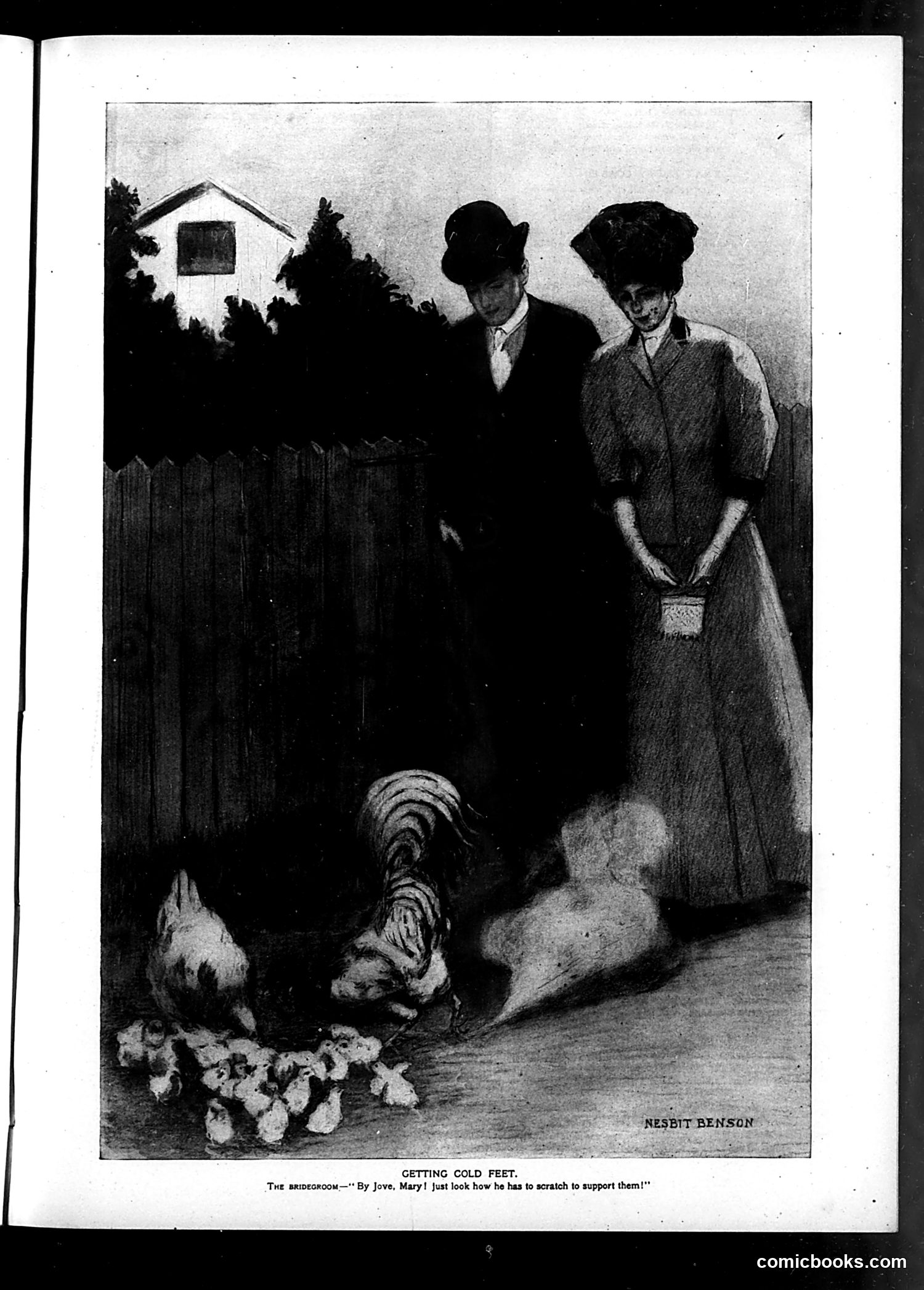
This cartoon depicts a bride and groom at their wedding, with the groom literally experiencing cold feet—chickens are pecking at his feet while the bride looks on. The caption quotes the bride: "By Jove, Mary! just look how he has to scratch to support them!" The satire appears to target newlywed financial struggles, particularly the groom's inability to support a household. "Cold feet" (nervousness about marriage) is treated literally, while the scratching chickens suggest poverty-level subsistence farming. The joke criticizes inadequate male wages or earning power that forces newlyweds into financial hardship. The artist is credited as Nesbit Benson. This likely reflects early 20th-century concerns about working-class marriage economics and the bride's financial dependence on an often-inadequate male income.
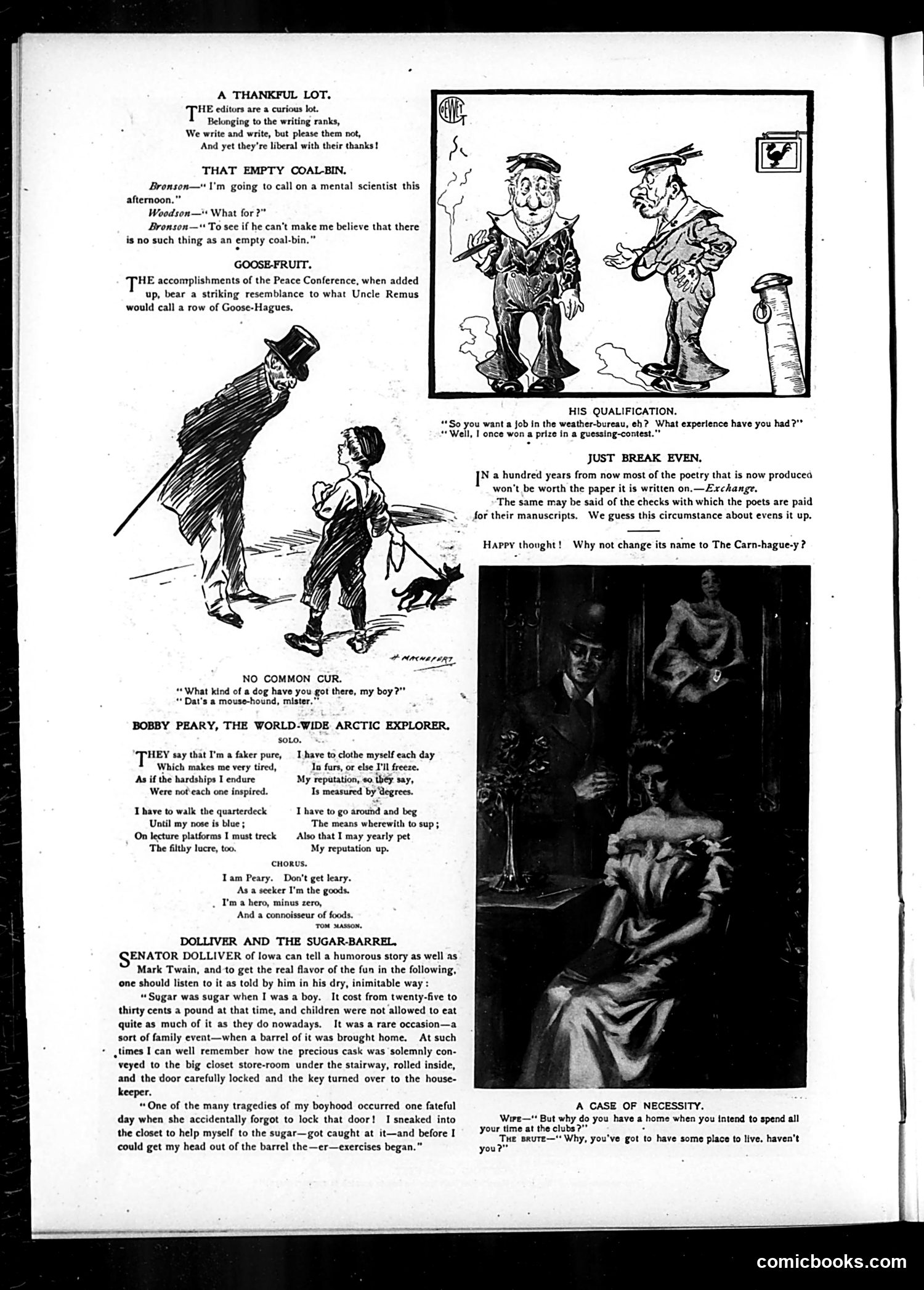
This page contains several unrelated satirical items typical of Judge magazine's format: **"Goose-Fruit"** mocks the Peace Conference (likely post-WWI) by comparing its accomplishments to "a row of Goose-Hagues"—a reference to Uncle Remus stories suggesting the results were worthless or absurd. **"Bobby Peary, the World-Wide Arctic Explorer"** satirizes explorer Robert Peary, mocking claims that his Arctic expeditions were genuine achievements. The song portrays him as a faker who survives through lecturing and fundraising rather than actual exploration, measuring his "reputation by degrees" (a pun on temperature). **"Dolliver and the Sugar-Barrel"** is a humorous anecdote by Senator Jonathan Dolliver of Iowa, comparing childhood sugar rationing to modern times—nostalgia humor with no political bite. The remaining items are light social humor about editors, coal shortages, weather bureau incompetence, and domestic life. The page reflects Judge's mix of political commentary and gentle comedic filler.
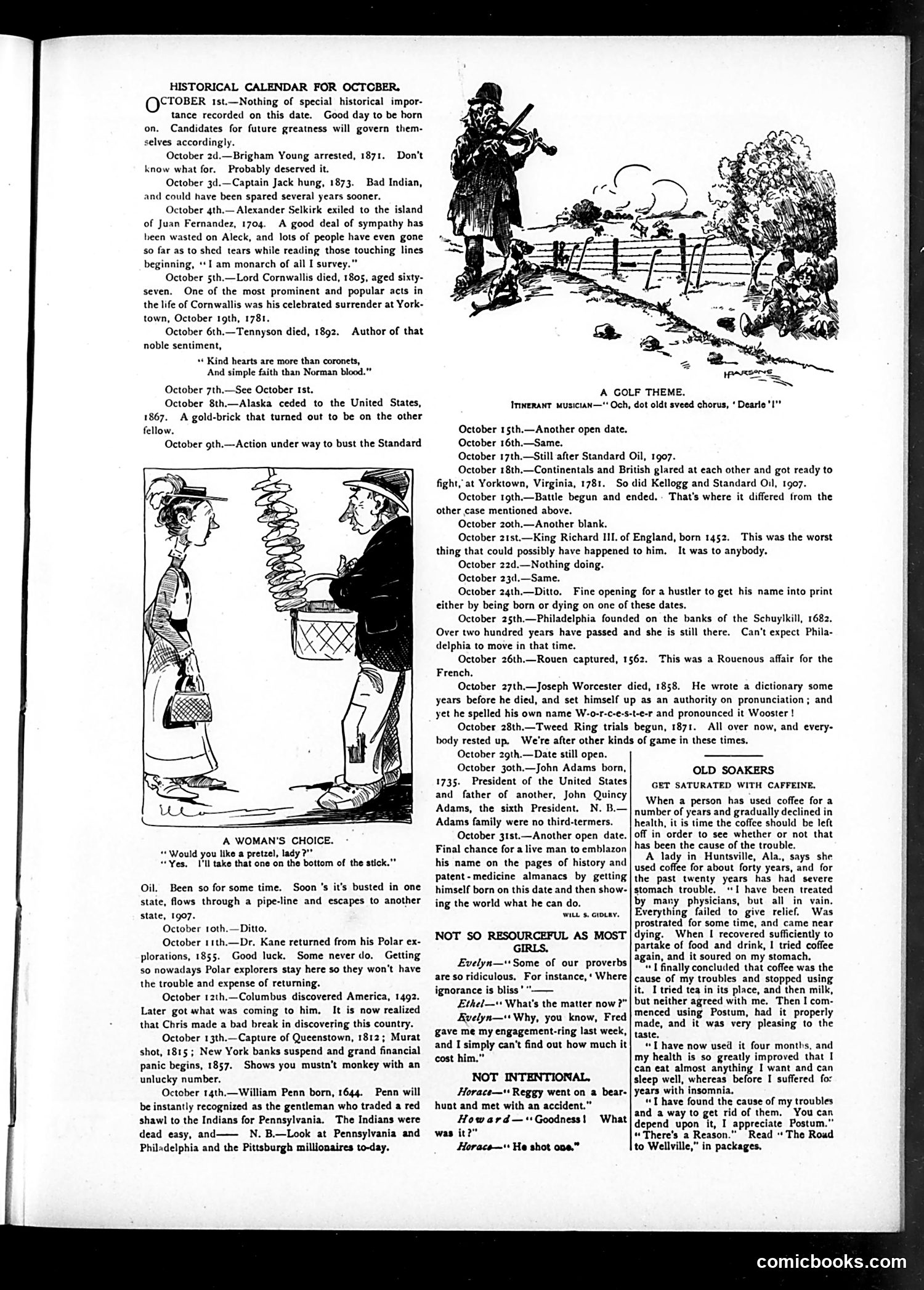
This page is primarily a satirical "Historical Calendar for October" mixed with period humor and advertisements. **Main Cartoon**: "A Woman's Choice" shows a street vendor offering pretzels. The joke plays on a woman selecting the bottom pretzel to extract it from the stick—a visual double-entendre about choosing something because of its position rather than quality. This reflects Victorian-era humor about women's reasoning. **Calendar Content**: The satirical entries mock American history and contemporary issues. References include: - Brigham Young's arrest (polygamy criticism) - Standard Oil antitrust actions (1907 ongoing legal battles) - Columbus discovering America framed as a mistake - William Penn and Pennsylvania's development into an industrial powerhouse **"Golf Theme" Section**: A musician with a fiddle—likely satirizing golfers' distraction from actual cultural pursuits. **Other Articles**: Include sections on coffee's health effects and resourceful versus helpless girls—typical period advice content. The page reflects Judge's satirical approach: irreverent historical commentary combined with contemporary social observation.
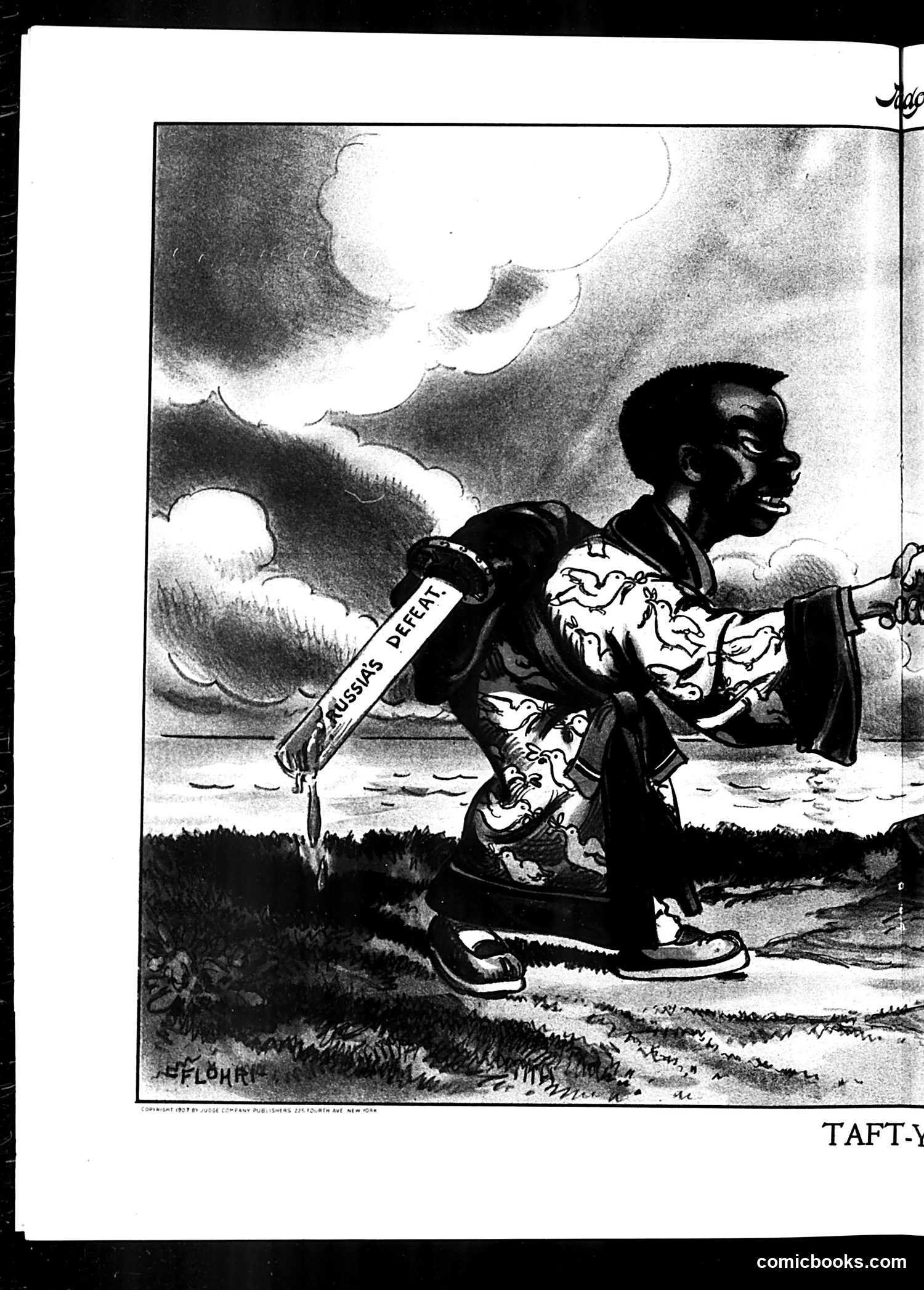
This appears to be a political cartoon from Judge magazine depicting a figure carrying a large bundle labeled "RUSSIA'S DEFEAT." The caricatured character is drawn in an exaggerated style, striding forward against a stormy backdrop with dramatic clouds. The satire likely comments on early 20th-century geopolitical events—possibly relating to Russia's military losses (the Russo-Japanese War of 1904-05 is a strong possibility given the period). The figure appears to represent either a political leader or symbolic representation bearing the burden or weight of national military failure. The cartoon uses physical caricature and the visual metaphor of the heavy burden to satirize the political consequences or national shame associated with the military defeat. Without clearer identification of the figure or specific date visible, the exact political target remains uncertain.
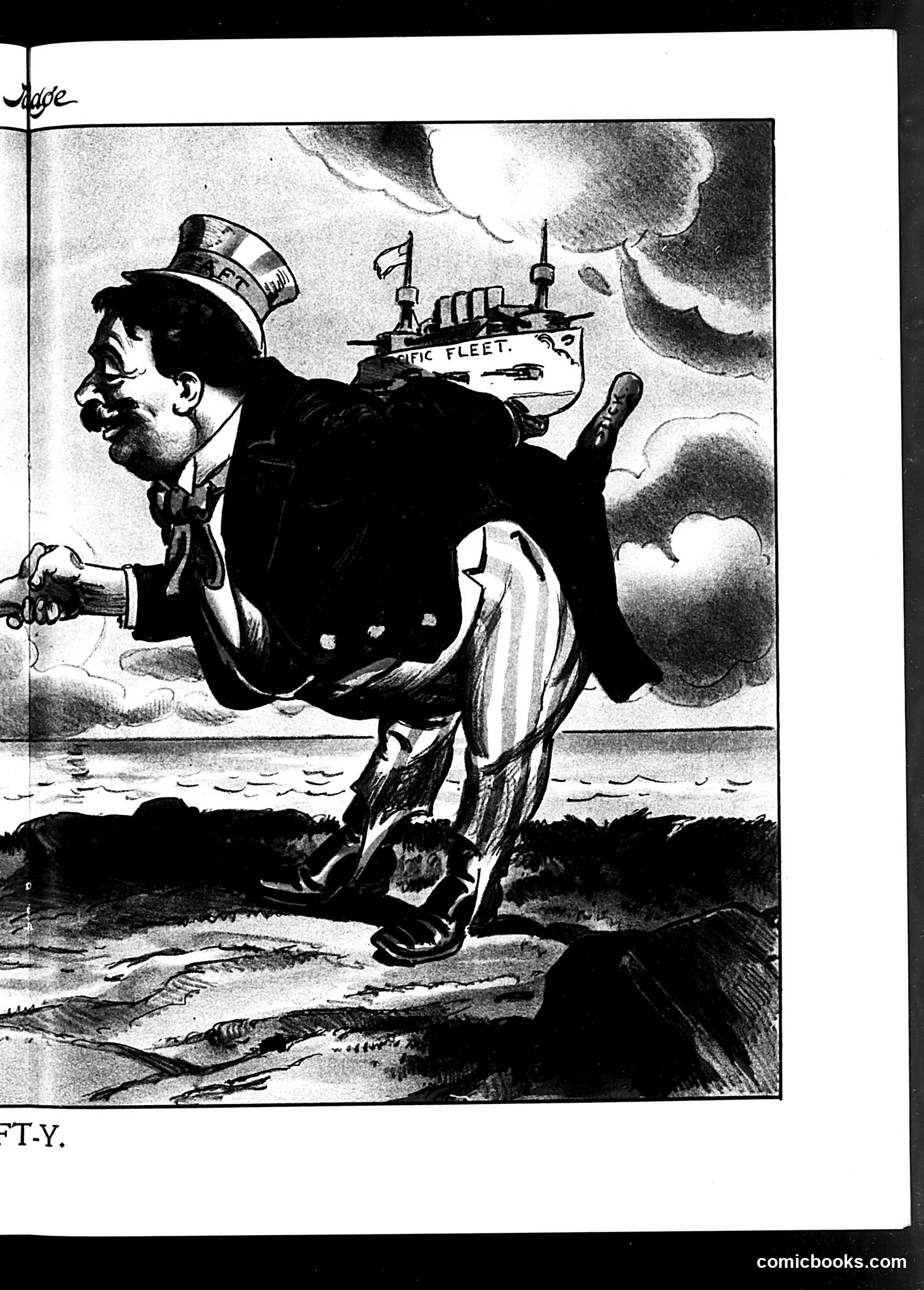
This Judge magazine cartoon depicts a bearded man in formal attire (top hat, military-style jacket) carrying a warship labeled "PACIFIC FLEET" on his back. The figure appears to be struggling or straining under this burden while wading through water. The satire criticizes a political or military figure—likely a U.S. president or government leader—for the heavy responsibility of maintaining or managing the Pacific Fleet. The caricature style and formal dress suggest this targets a specific historical figure, though without a visible byline or date, I cannot definitively identify who. The cartoon's message appears to be that naval expansion or fleet maintenance represents an unsustainable burden on leadership or the nation's resources.
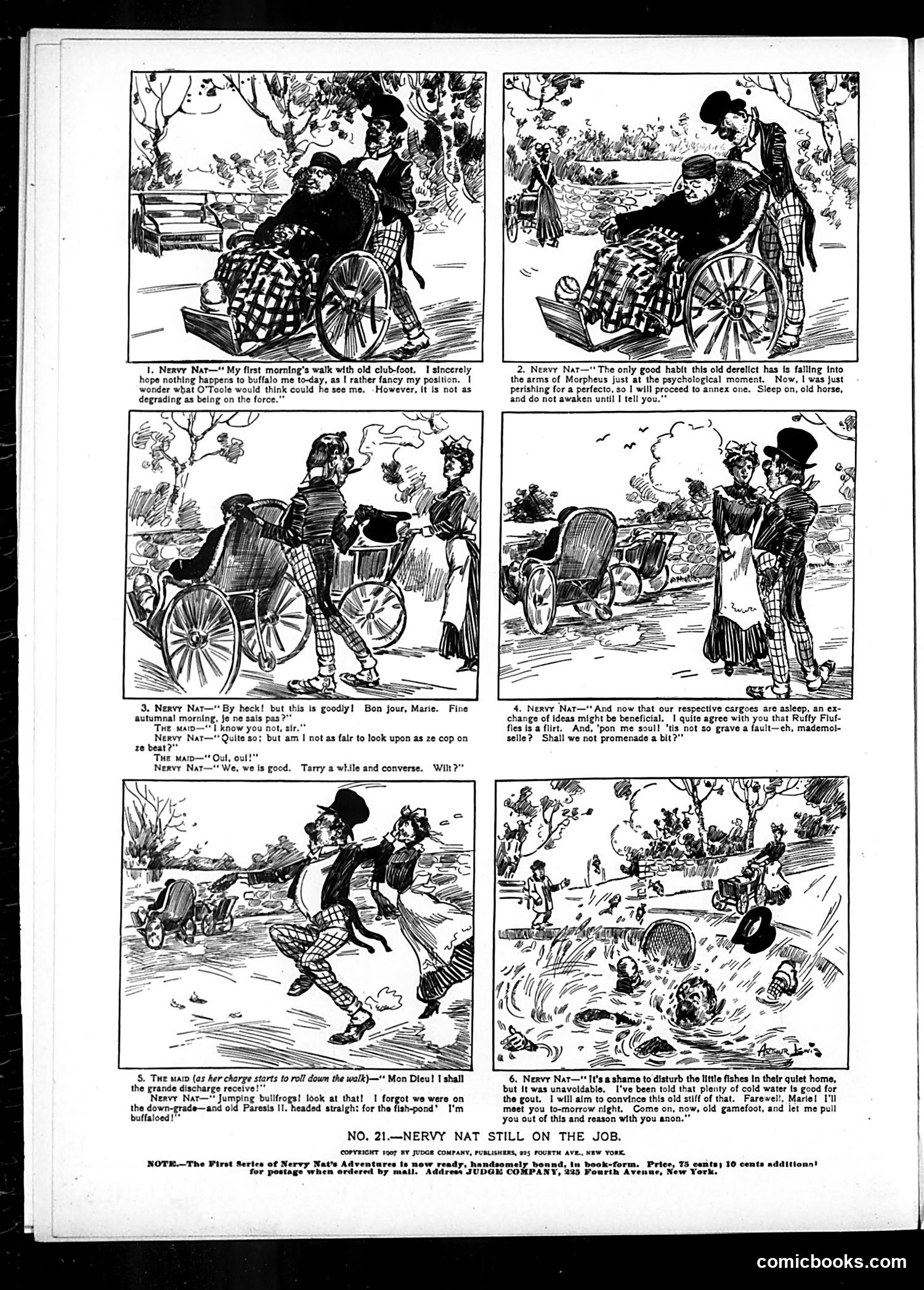
This is a comic strip following "Nervy Nat," a character apparently dismissed from the police force who's now working as a nanny/caretaker pushing a baby carriage. The humor derives from Nat's constant scheming and moral shortcuts despite his new humble position. The satire mocks working-class opportunism: Nat steals cigars from his sleeping employer, flirts with a French maid while neglecting childcare, and nearly allows the carriage to roll into a fish pond while distracted. His repeated exclamations ("buffalooed," "jumping bullfrogs") and affected French phrases underscore his pretensions. The strip appears to satirize both the character's inability to reform and the era's class anxieties about unreliable servants. References to "club-foot," "Paresis" (suggesting syphilis), and "the force" (police) suggest Nat is a morally compromised figure unsuitable for trust—a common character type in early-1900s American humor magazines.
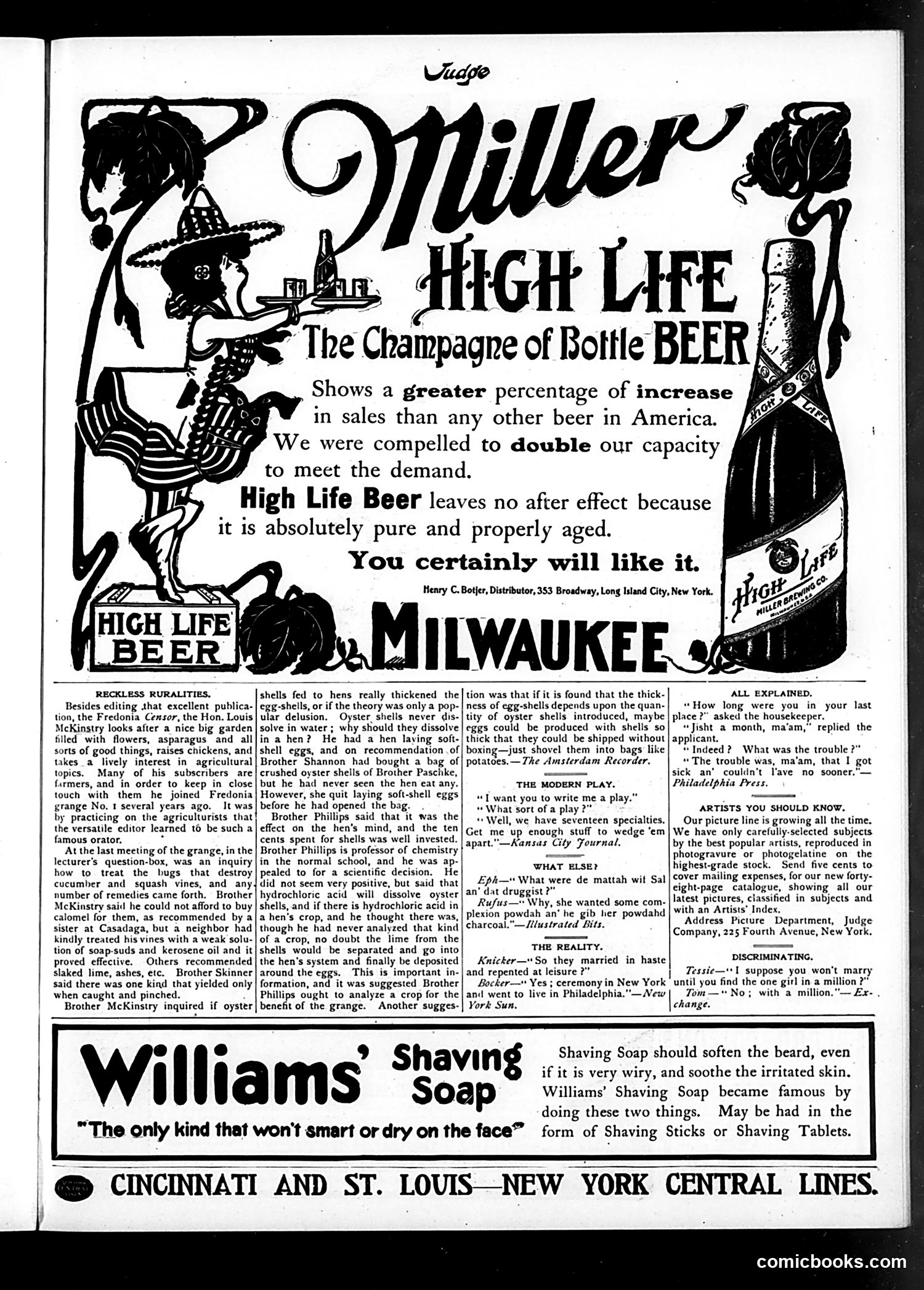
This page is primarily **advertising and light humor**, not political satire. The dominant feature is a **Miller High Life beer advertisement** featuring an ornate Art Nouveau design with a jester-like figure. The ad claims Miller shows "greater percentage of increase in sales than any other beer in America" and boasts the beer is "absolutely pure and properly aged"—typical marketing claims of the era. Below are several brief **humorous anecdotes**: - "Reckless Ruralities" depicts a farmer's grange discussing whether oyster shells strengthen hen eggshells (a folk remedy debate). - "The Modern Play" jokes that theatrical producers just string together seventeen specialty acts. - Other brief gags play on racial dialect humor and marriage complications. A **Williams Shaving Soap advertisement** appears at the bottom. The page reflects early 20th-century American consumer culture and period humor conventions—largely innocent agricultural comedy and product promotion rather than sharp social or political commentary.
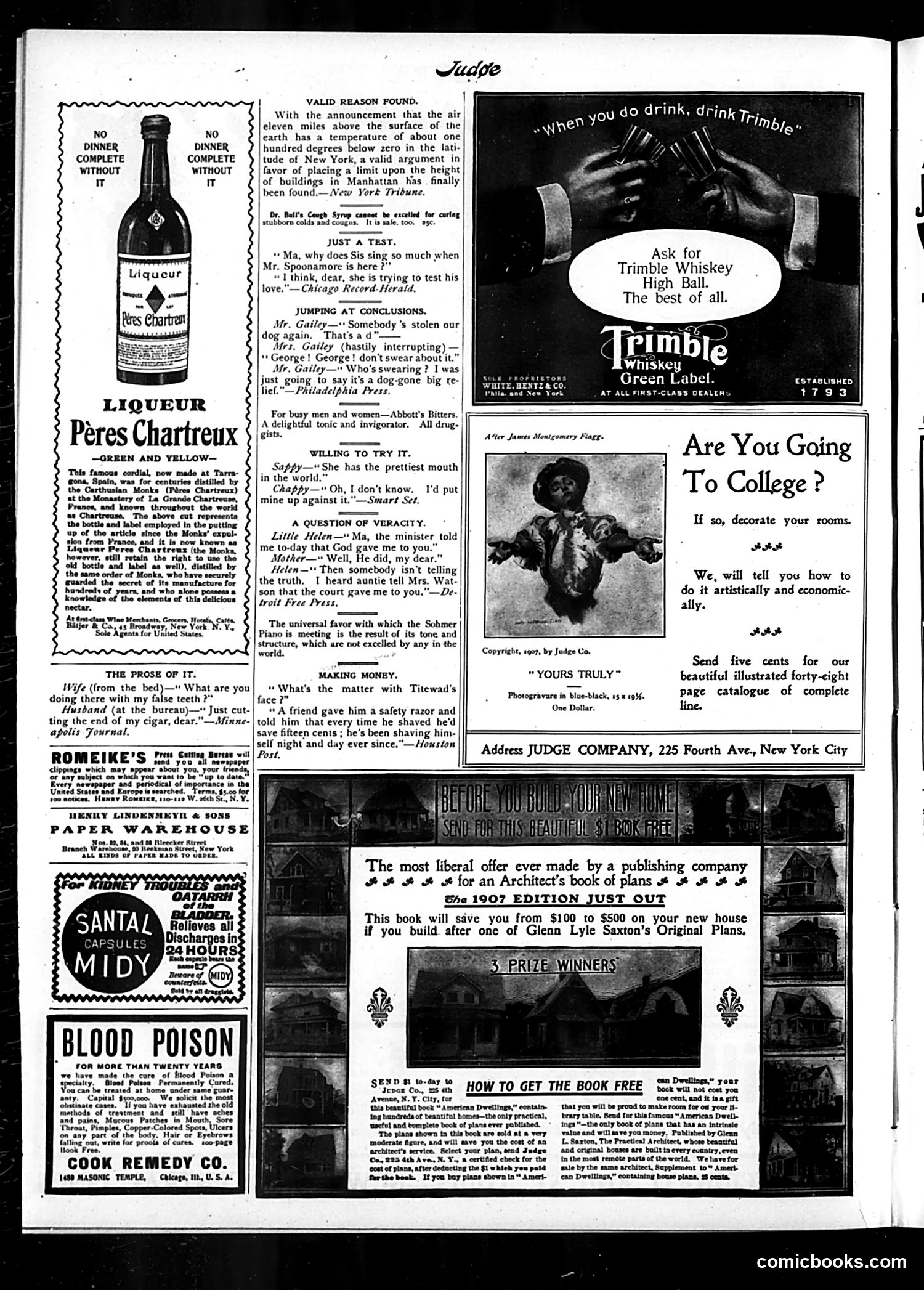
This page from *Judge* magazine is primarily **advertising with scattered humorous filler content** typical of early 1900s publications. The main satirical pieces are brief, punchy jokes: - **"Valid Reason Found"** mocks the absurdity of using extreme high-altitude temperatures as justification for limiting Manhattan building heights—clearly nonsensical reasoning presented deadpan. - **"Just a Test"** plays on courtship conventions: a young woman's constant singing around a suitor is framed as "testing his love"—satire of Victorian romance rituals. - **"Question of Veracity"** presents a child's logical contradiction: if God gave her to her mother, why did Auntie say the *court* gave her to her mother? This likely references adoption or custody proceedings, poking fun at adult evasiveness with children. The remaining content consists entirely of **period advertisements**: liqueurs, pianos, blood poison remedies, and paper warehouses. The Trimble Whiskey ad and Péres Chartreux liqueur ads are prominent. The page reflects *Judge's* dual purpose: satirical commentary mixed with revenue-generating advertisements directed at upper-middle-class readers.
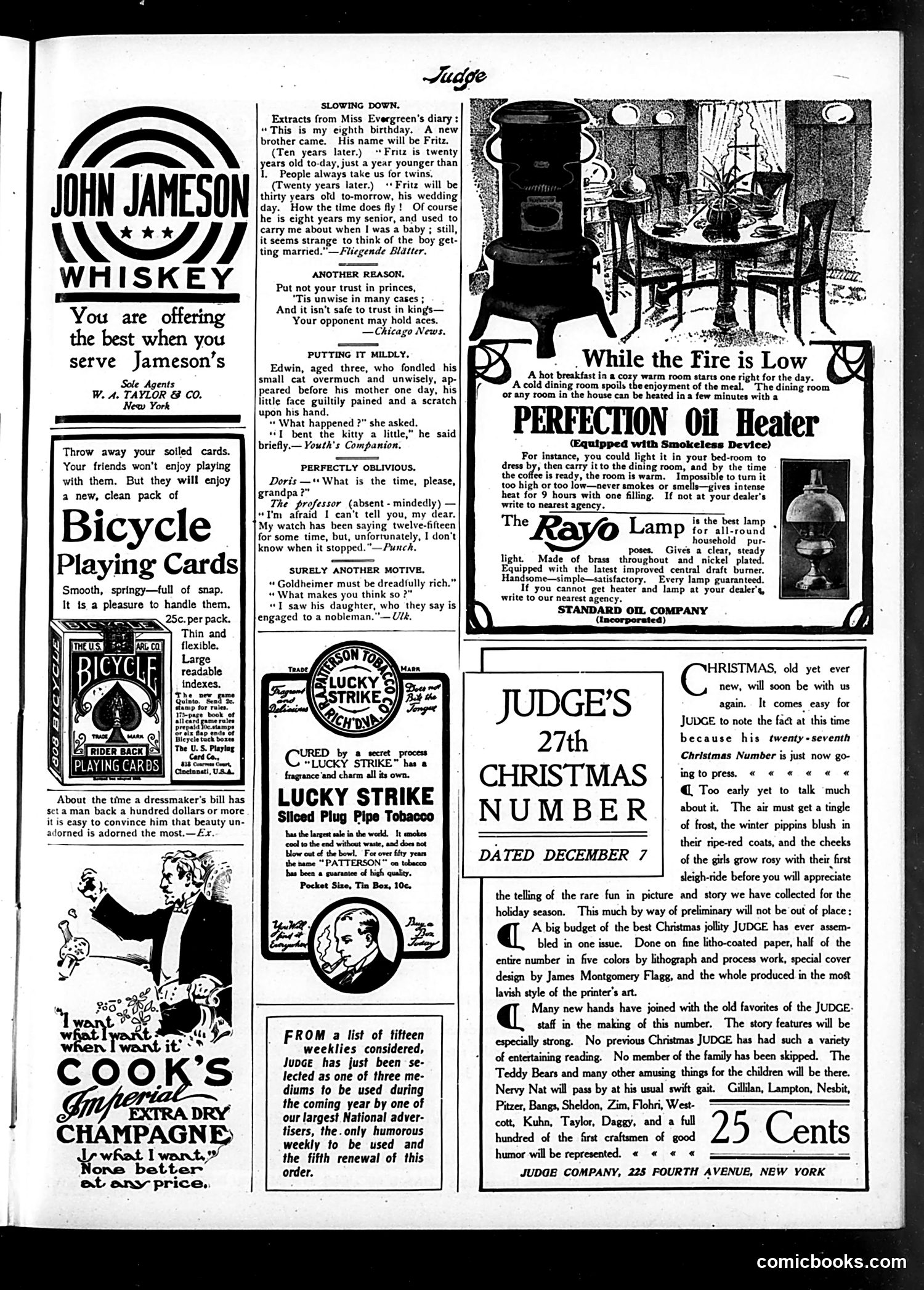
This page is primarily **advertising and announcements**, not political satire. The content includes: **Advertisements:** - Jameson's Whiskey, Bicycle Playing Cards, Cook's Champagne (left column) - Perfection Oil Heater and Rayo Lamp (center/right) - Lucky Strike tobacco **Editorial Content:** - Several brief humorous anecdotes and jokes (typical of Judge's "joke filler" format), including pieces about a girl named Evergreen tracking time ironically, a child's innocent misstatement about a cat, and observations about trust and wealth - **Main announcement:** Judge's 27th Christmas Number, dated December 7, costs 25 cents. The description emphasizes it features five-color lithography, entertainment by various cartoonists and illustrators (Teddy Bears, Nervy Nat, Gillian, Lampoon characters mentioned), and promises "good humor" **The Point:** This appears to be a promotional issue advertising Judge's holiday edition rather than featuring political or social satire. The magazine relied on advertising revenue and used such pages to promote special issues.
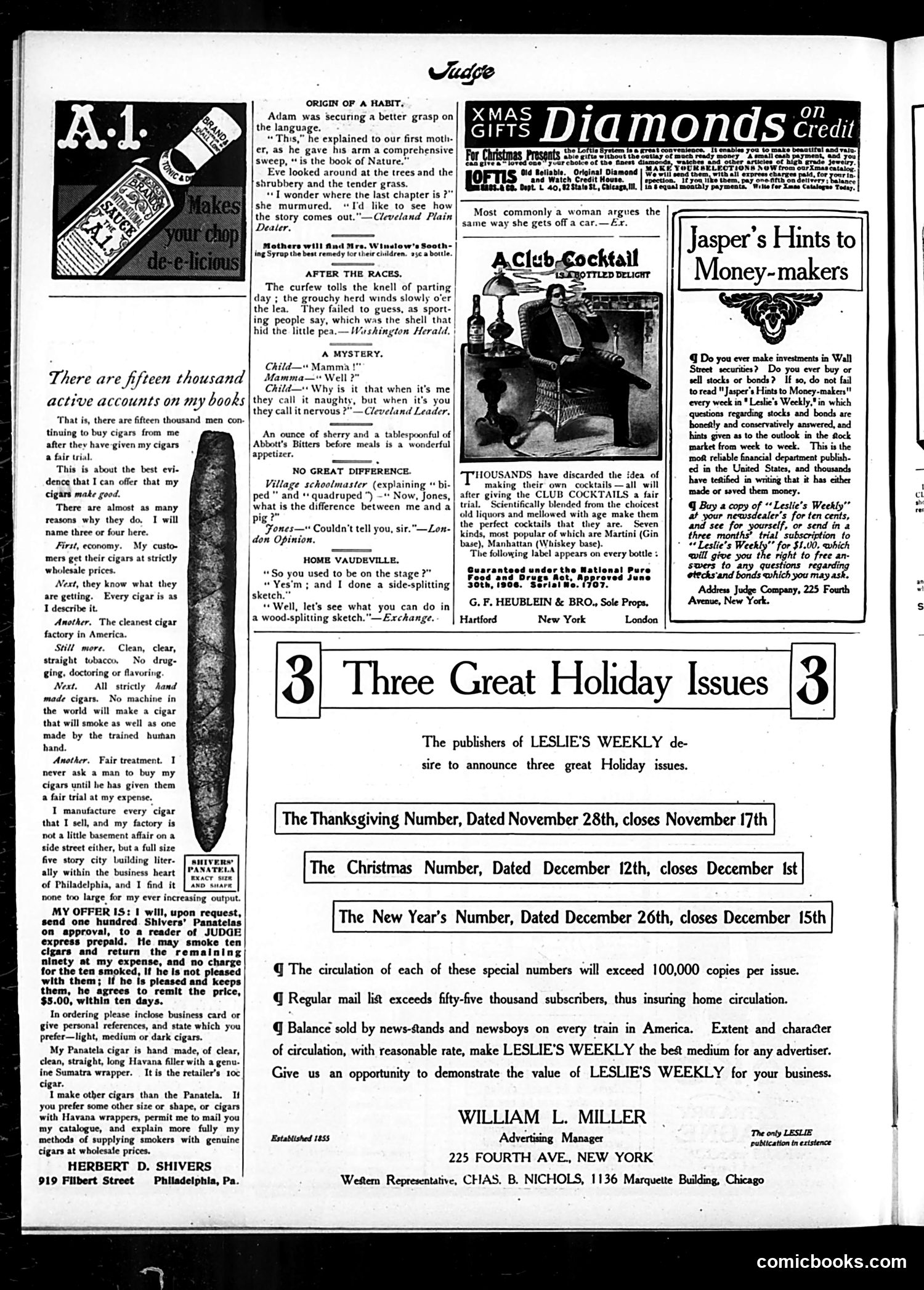
This page is primarily **advertising and filler content** rather than political satire. The dominant feature is a lengthy cigar advertisement by Herbert D. Shivers (Philadelphia), emphasizing his manufacturing standards and offering trial shipments. The page includes several brief **humorous anecdotes** rather than political cartoons: - **"Origin of a Habit"**: A joke about Eve questioning where Adam's "book of Nature" ends—mild satire on women's curiosity - **"A Mystery"**: A child's observation that adults call identical behavior "naughty" in children but "nervous" in adults—social commentary on adult hypocrisy - **"No Great Difference"**: A schoolmaster's failed attempt to explain the difference between humans and pigs to a student The remaining space contains advertisements for diamonds, cocktail mixers, and Leslie's Weekly holiday issues. **For modern readers**: This reflects early 20th-century magazine culture, mixing light domestic humor with aggressive product marketing. The jokes rely on simple observations about everyday life and gender behavior rather than topical political commentary.
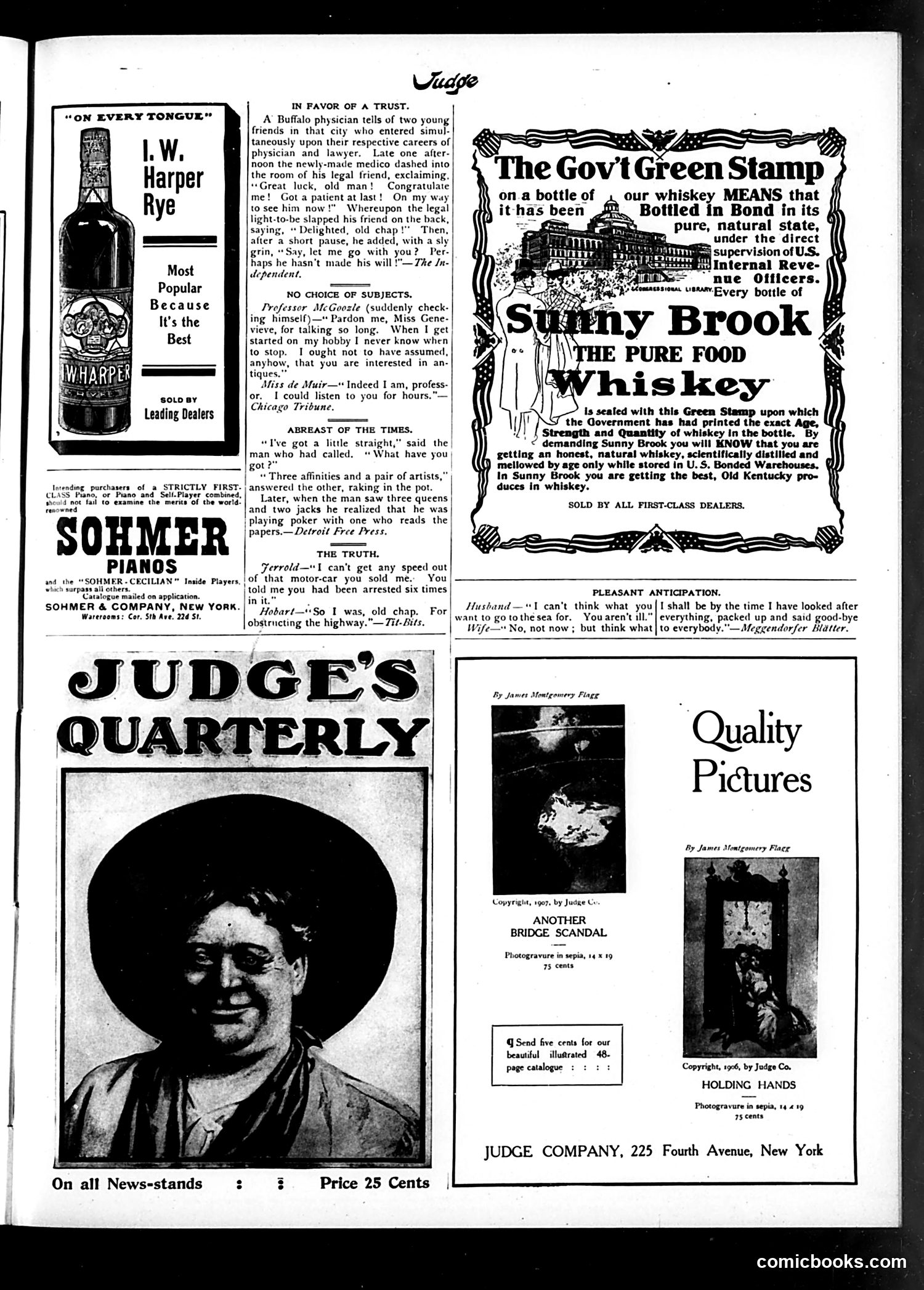
This page contains mostly **advertisements and short humor pieces**, not political cartoons. The content includes: **Humor Pieces:** - "In Favor of a Trust": A joke about a new doctor and lawyer where the lawyer quips he should accompany the doctor to his first patient—implying the patient will need a will drawn up. The "trust" reference is a pun on business monopolies. - "No Choice of Subjects": A mild anecdote about a professor boring a woman with talk of antiques. - "Abreast of the Times" and "The Truth": Brief jokes about poker and a slow motor car. **Advertisements:** - I.W. Harper Rye whiskey - Sohmer pianos - Sunny Brook whiskey (emphasizing government regulation via the "Green Stamp") - Judge Company's photography reproductions **Notable Context:** The Sunny Brook ad references the **government "Green Stamp" on bonded whiskey**—a regulatory seal verifying age and purity under U.S. supervision, reflecting early 20th-century consumer protection measures. The page is primarily commercial rather than satirical.
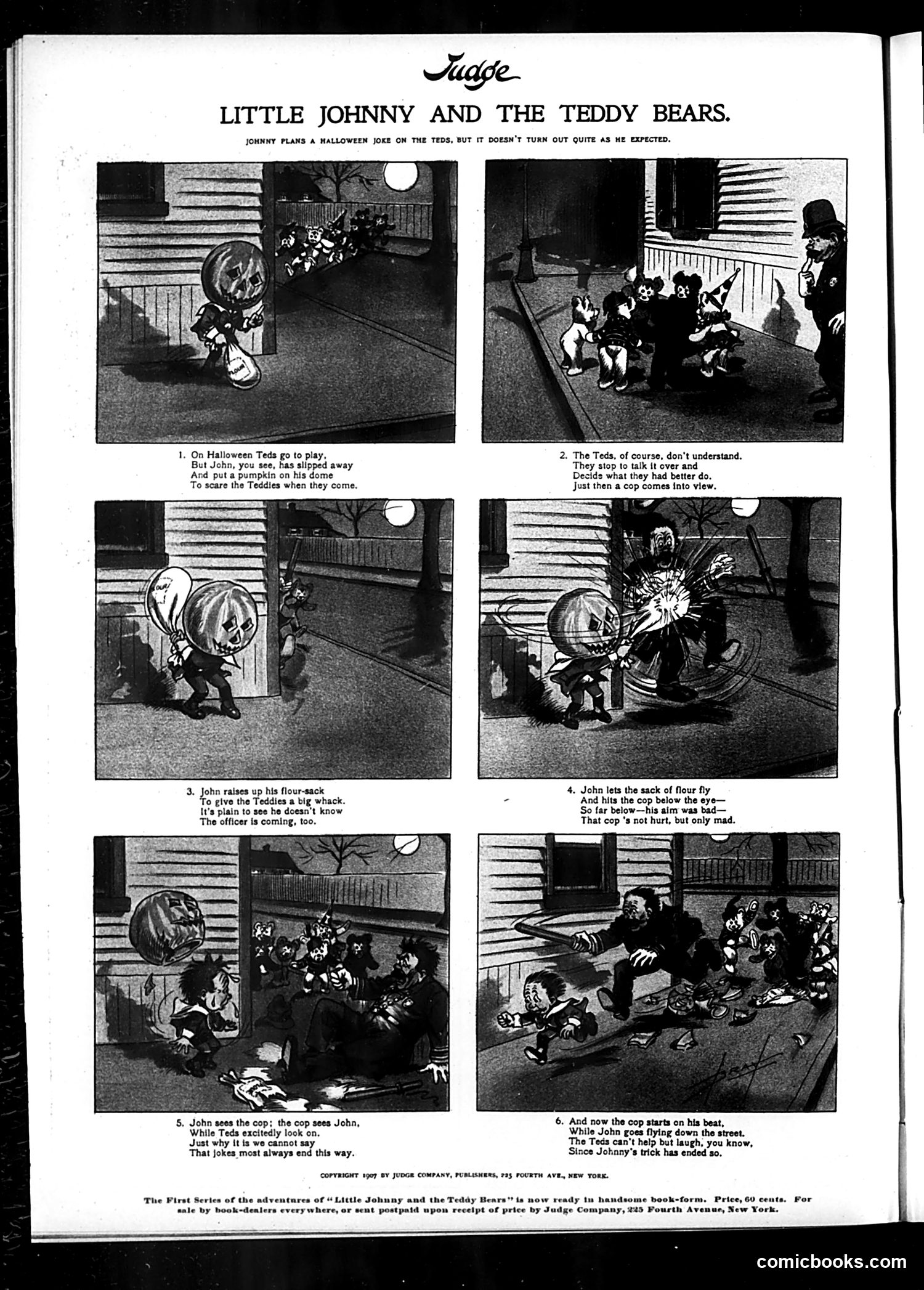
This is a humorous six-panel comic strip about a Halloween prank gone wrong. "Little Johnny" attempts to scare a group of "Teddies" (likely referring to "Teddy Boys" or young troublemakers of the era) by wearing a jack-o'-lantern costume. However, his plan backfires when he throws a sack of flour intended for the gang but accidentally hits a police officer in the eye instead. The joke's irony is that while the Teddy Bears laugh at Johnny's misfortune with the cop, Johnny himself becomes the target of police pursuit. The humor reflects early 1900s attitudes about street pranks, youth mischief, and the comedic inevitability of comeuppance. The strip advertises a book collection available for 60 cents, indicating this was part of an ongoing series in Judge magazine.