
A complete issue · 16 pages · 1907
Judge — August 17, 1907
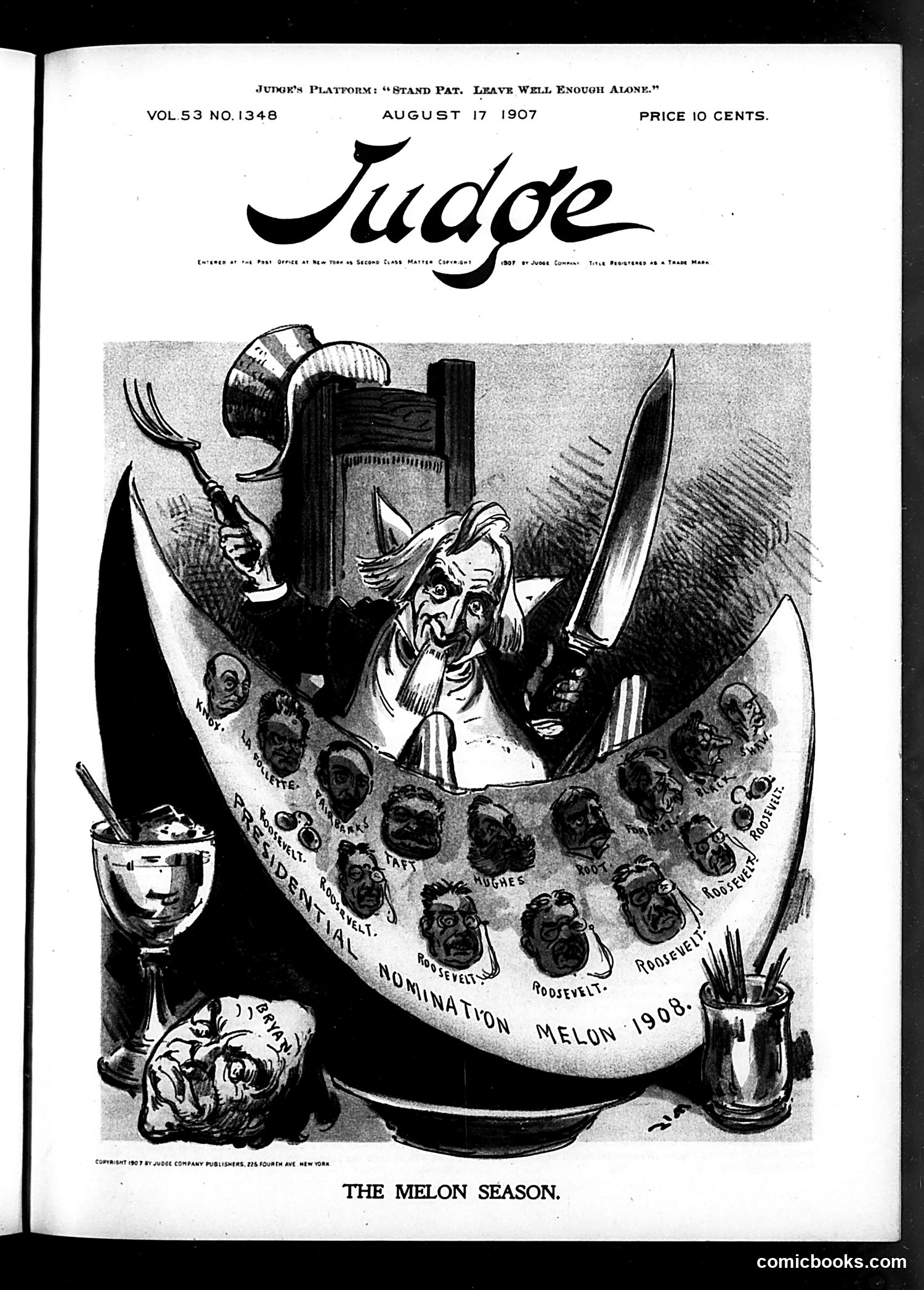
This Judge magazine cover (August 17, 1907) satirizes the 1908 presidential nomination process. A grim reaper figure wielding weapons sits atop a large melon labeled "Nomination Melon 1908," surrounded by caricatured heads of potential candidates including Roosevelt and Hughes. The satire compares the cutthroat competition for the Republican presidential nomination to a deadly battle. The melon—a seasonal fruit—metaphorically represents the temporary availability of the nomination prize. The weaponry and death imagery suggest the fierce, destructive infighting among candidates vying for the party's support. The cartoon mocks how politicians will metaphorically kill each other in pursuit of power, presenting nomination season as a violent competition rather than a dignified democratic process.
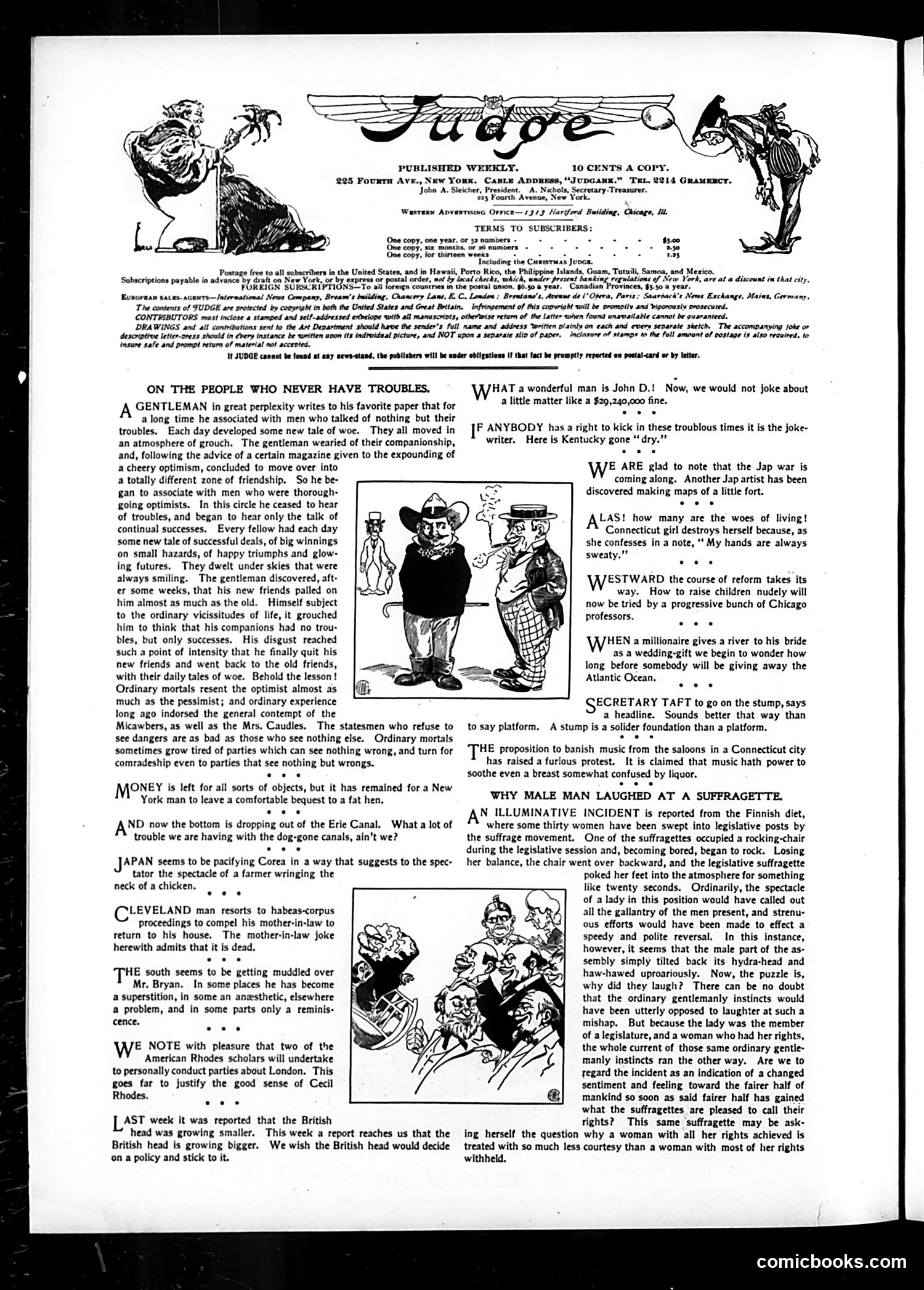
This page contains editorial commentary rather than political cartoons. The main cartoon shows two figures in conversation—appearing to be political or social commentators discussing current events. The text references several contemporary issues: Japanese military expansion ("the Jap war is coming"), suffrage debates, and labor reform. One section satirizes male laughter at a suffragette who lost her balance in the Finnish legislature, arguing this reveals hypocrisy—men would defend women's dignity in normal circumstances but mock a female legislator's misfortune, suggesting society hasn't truly accepted women's political equality. The overall tone criticizes social inconsistencies and gender double-standards of the era, while commenting on international military tensions. Without clear date markers visible, the specific year remains uncertain, though the suffrage references suggest early 20th century.
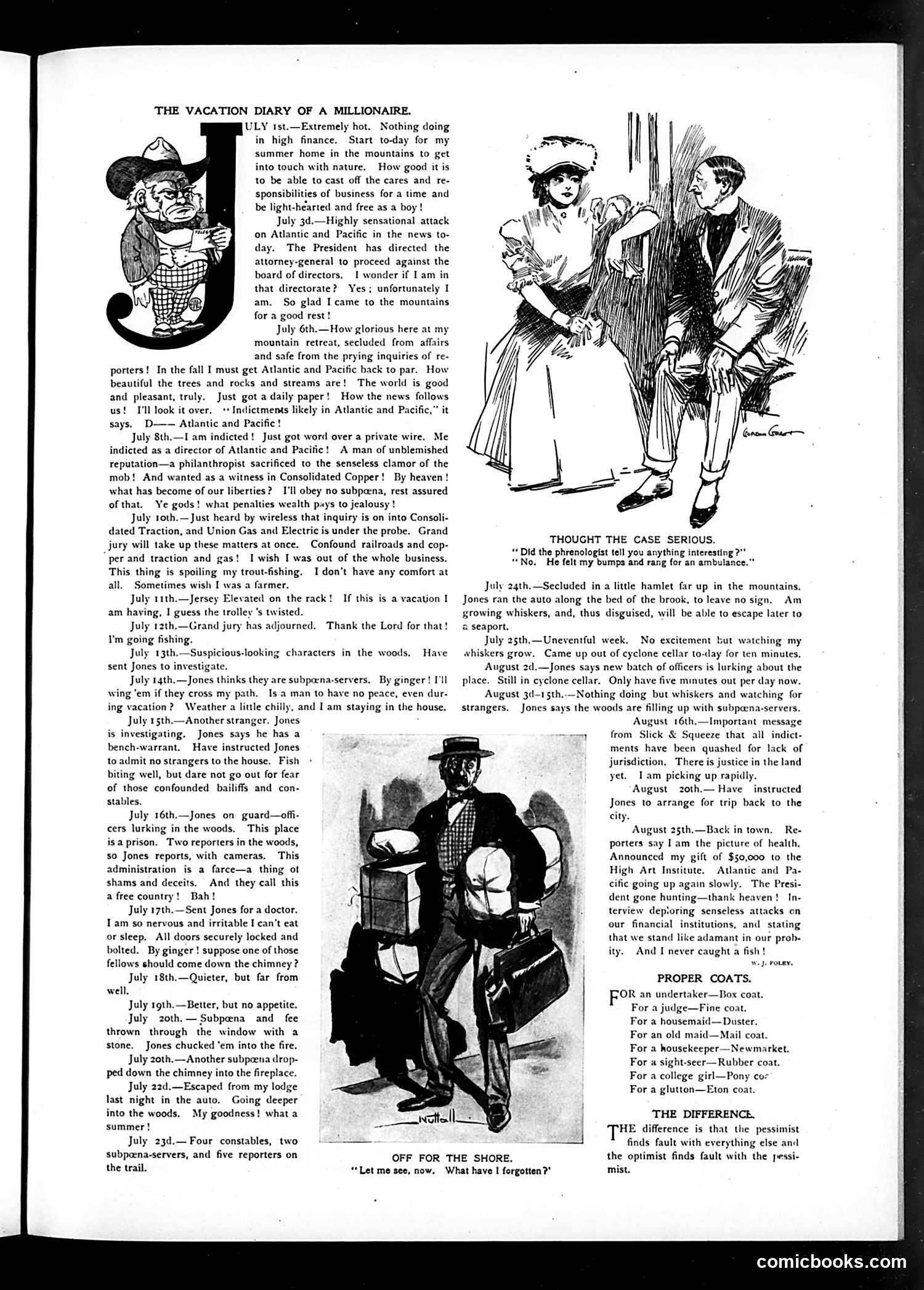
This satirical diary entry mocks a wealthy businessman attempting a rustic mountain vacation while remaining obsessed with corporate intrigue. The millionaire character complains about labor disputes (Atlantic and Pacific railroad strikes), antitrust investigations into consolidated corporations, and suspicious activities in the woods—interpreting ordinary events as conspiracies. The humor targets Gilded Age plutocrats' inability to escape their cutthroat business world, even during leisure. References to "subpoena servers" and inquiries into "Consolidated Traction, and Union Gas and Electric" suggest real monopoly scandals of the 1900s-1910s era. The cartoons accompanying the text—showing well-dressed men in awkward rural situations—reinforce the joke: wealth cannot purchase genuine peace or escape from legal/business consequences. The satire reflects Progressive Era criticism of unchecked corporate power.
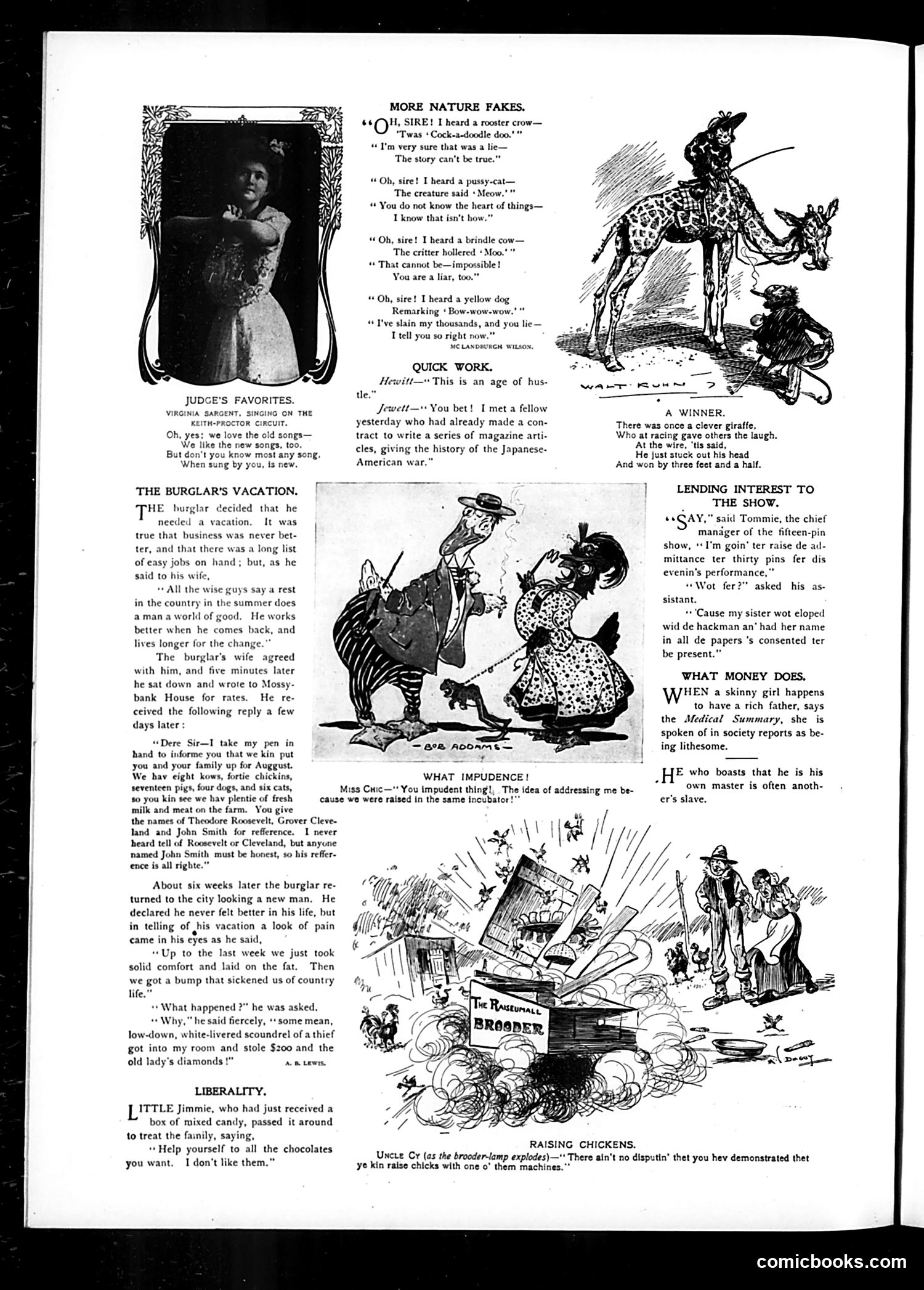
This page contains several independent humor pieces rather than unified political commentary: **"More Nature Fakes"** satirizes a woman repeatedly claiming to have witnessed implausible animal behaviors (roosters crowing "Cock-a-doodle-doo," cows saying "Moo"). The joke mocks exaggerated nature stories and credulous storytelling—likely referencing early 1900s debates about fraudulent nature photography and tall tales. **"The Burglar's Vacation"** is a straightforward comedic narrative about a burglar claiming a rest improves his criminal work. **Other pieces** ("A Winner," "What Impudence," "Raising Chickens") are brief gags with accompanying illustrations—typical Judge magazine filler content. The page demonstrates the magazine's mixed format: political satire combined with lighter social humor and domestic comedy sketches, all aimed at educated middle-class readers.
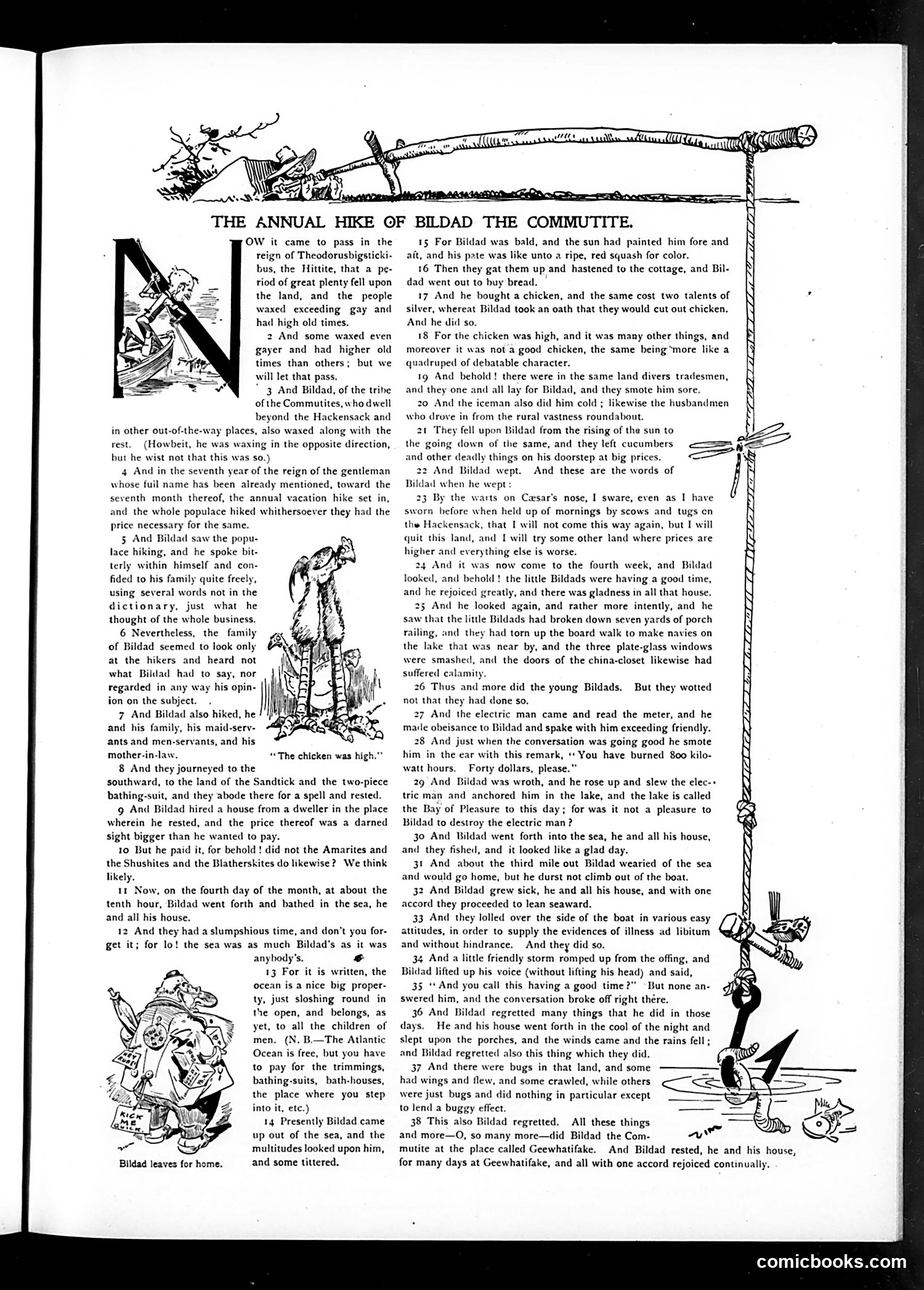
This appears to be a satirical narrative about a character named Bildad, presented as a mock-biblical story (note the antiquated language and numbered verses). The text describes Bildad's complaints about various hardships—high prices, poor quality goods, heat, bugs, and general misery—during an outing with a committee. The satire targets chronic complainers or pessimists who find fault in everything despite circumstances being reasonably pleasant. Each installment catalogs Bildad's grievances: expensive chicken, broken porch railings, storms, illness, and even chastising the electric meter reader. The cartoonish illustrations support this comedic portrayal of perpetual dissatisfaction. Without dating information visible, the specific committee referenced remains unclear, though the piece mocks the universal human tendency toward complaint.
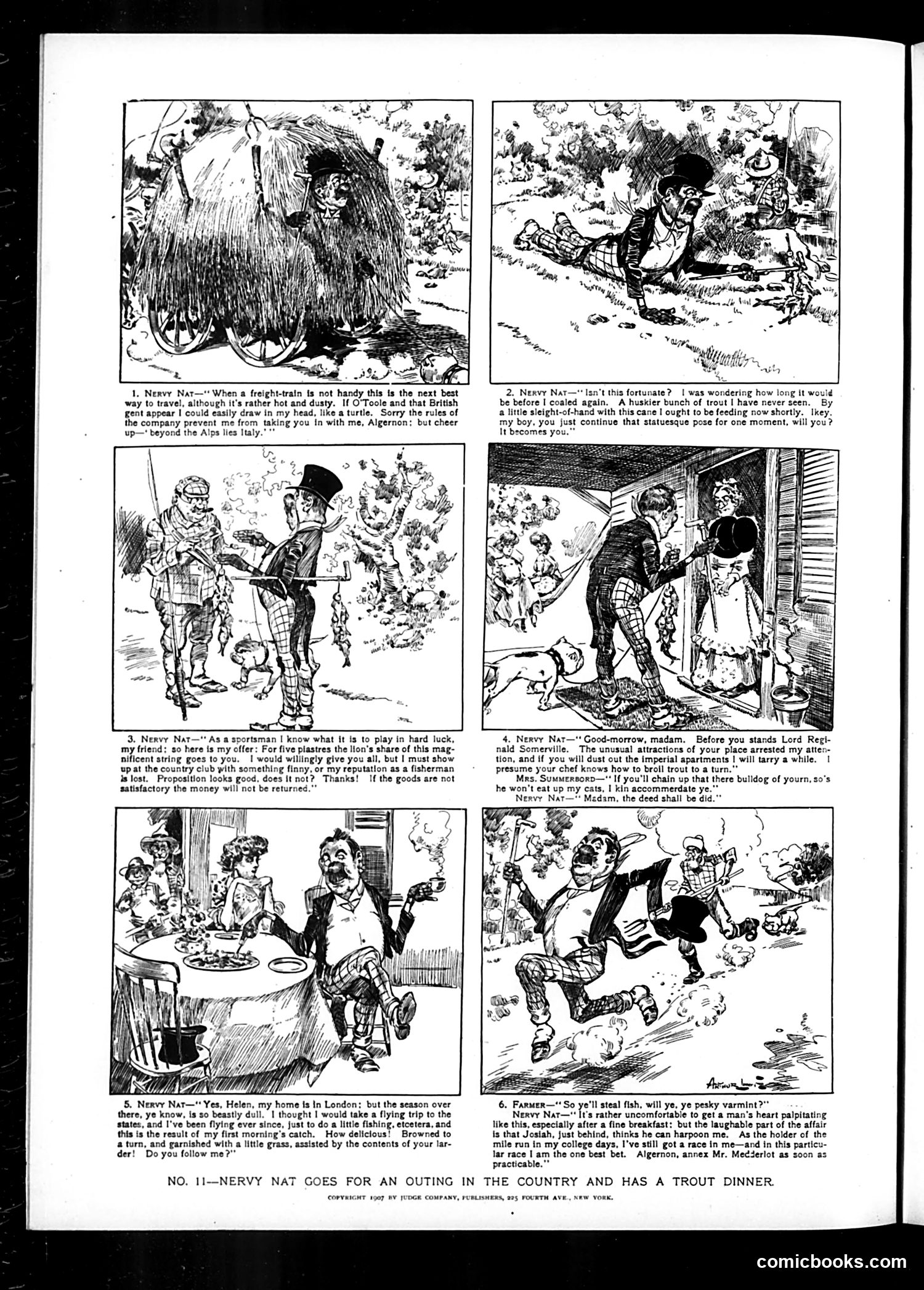
This six-panel Judge comic satirizes a stock character—"Nervy Nat," a scheming con artist and social climber. The humor centers on Nat's outlandish lies and fraudulent schemes during a country fishing trip. The strip mocks: - **Class pretension**: Nat claims false British aristocratic credentials ("Lord Reginald Somerville"), fabricates fishing prowess, and invents elaborate excuses for his behavior - **Dishonesty**: He swindles fellow fishermen with a rigged fish-sharing deal, steals trout, and talks his way into lodging through transparent flattery - **Perpetual escapes**: Despite being caught repeatedly (by farmers with harpoons, suspicious hosts), he evades consequences through quick wit and running ability The satire reflects early 20th-century anxieties about social fraud and unscrupulous drifters. Nat embodies the "confidence man" archetype—charming but utterly untrustworthy. The comedy assumes readers recognize these transparent deceptions as obviously foolish, making Nat's success darkly absurd.
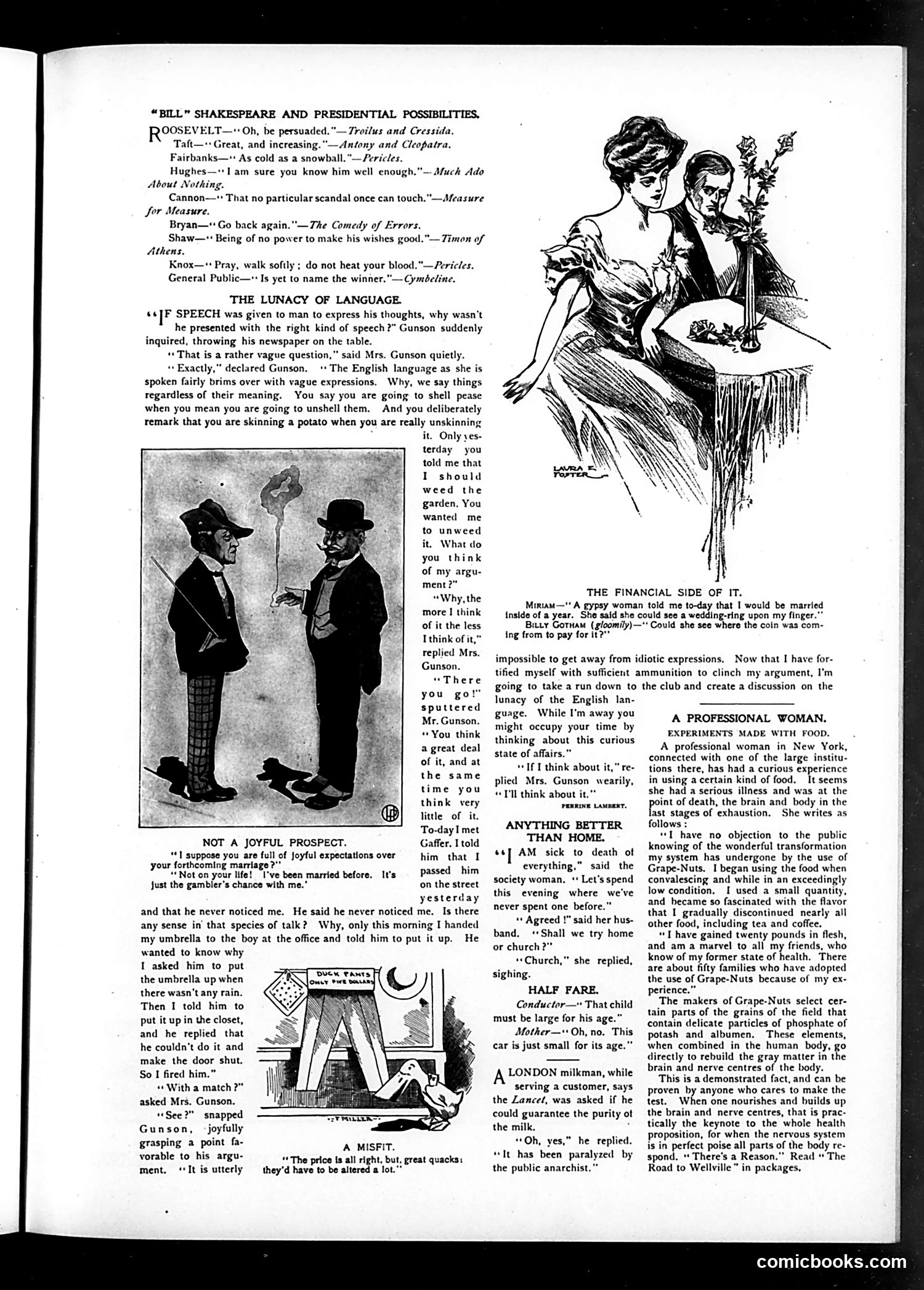
This page contains multiple satirical pieces typical of early 20th-century American humor: **Top Section - "Shakespeare and Presidential Possibilities"**: Uses Shakespeare quotes to characterize potential presidential candidates. Roosevelt gets "be persuaded," Taft "great and increasing," Fairbanks "cold as a snowball," Hughes shows he's "well enough" known, Cannon avoids scandal, and Bryan/Shaw receive critical quotes. The General Public "is yet to name the winner"—satirizing uncertainty about the 1908 or 1912 election. **Main Story - "The Lunacy of Language"**: A domestic comedy where Mr. Gunson argues English is illogical because people say opposite things ("weed" vs. "unweed," "shell peas" vs. "unshell"). His wife tolerates his pedantic rant. The joke mocks overwrought linguistic complaint. **Minor Humor Pieces**: Scattered brief jokes about marriage disappointments, gypsy fortune-telling, a woman preferring church to home, conductor/child size confusion, and milk purity—typical light domestic satire of the era. The cartoons feature period-appropriate illustrations supporting the text-heavy humor format characteristic of Judge magazine.
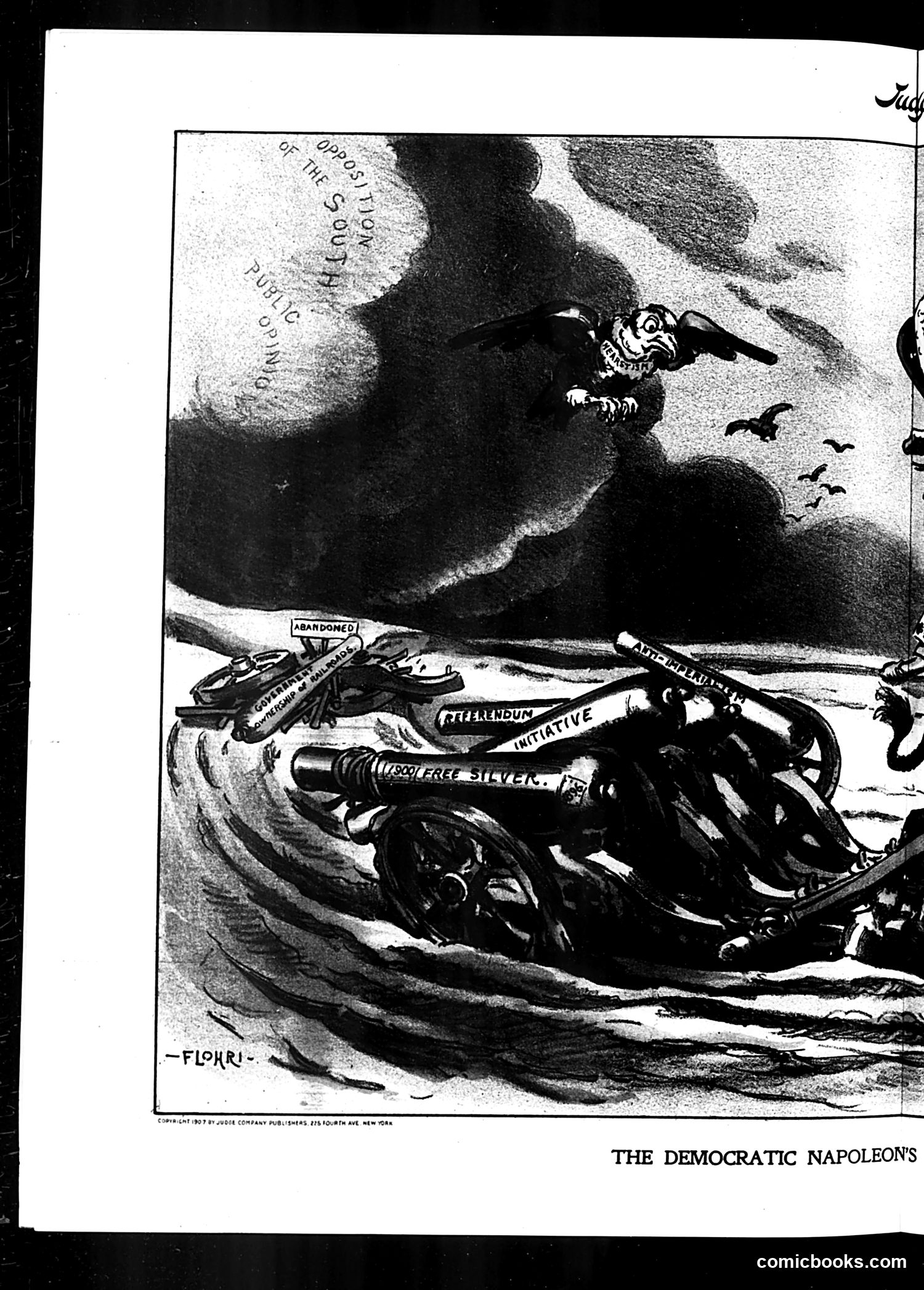
This political cartoon satirizes a Democratic political figure by comparing him to Napoleon Bonaparte. The image shows an abandoned cannon labeled with Democratic initiatives ("Battle Initiative," "Free Silver," "Tariff Reduction") alongside other discarded weapons and military equipment. A caricatured figure (likely a Democratic leader) stands atop a hill, gesturing dramatically against stormy clouds and flying birds, evoking Napoleon's famous pose. The satire suggests the Democratic party's ambitious political agenda has failed—the weapons/policies are "abandoned" and ineffective. By likening the Democratic leader to the historically defeated Napoleon, the cartoon mocks both his grandiose ambitions and his ultimate failure. Judge magazine, Republican-leaning, uses this visual metaphor to ridicule Democratic political strategies and leadership during what appears to be the Gilded Age or Progressive Era.
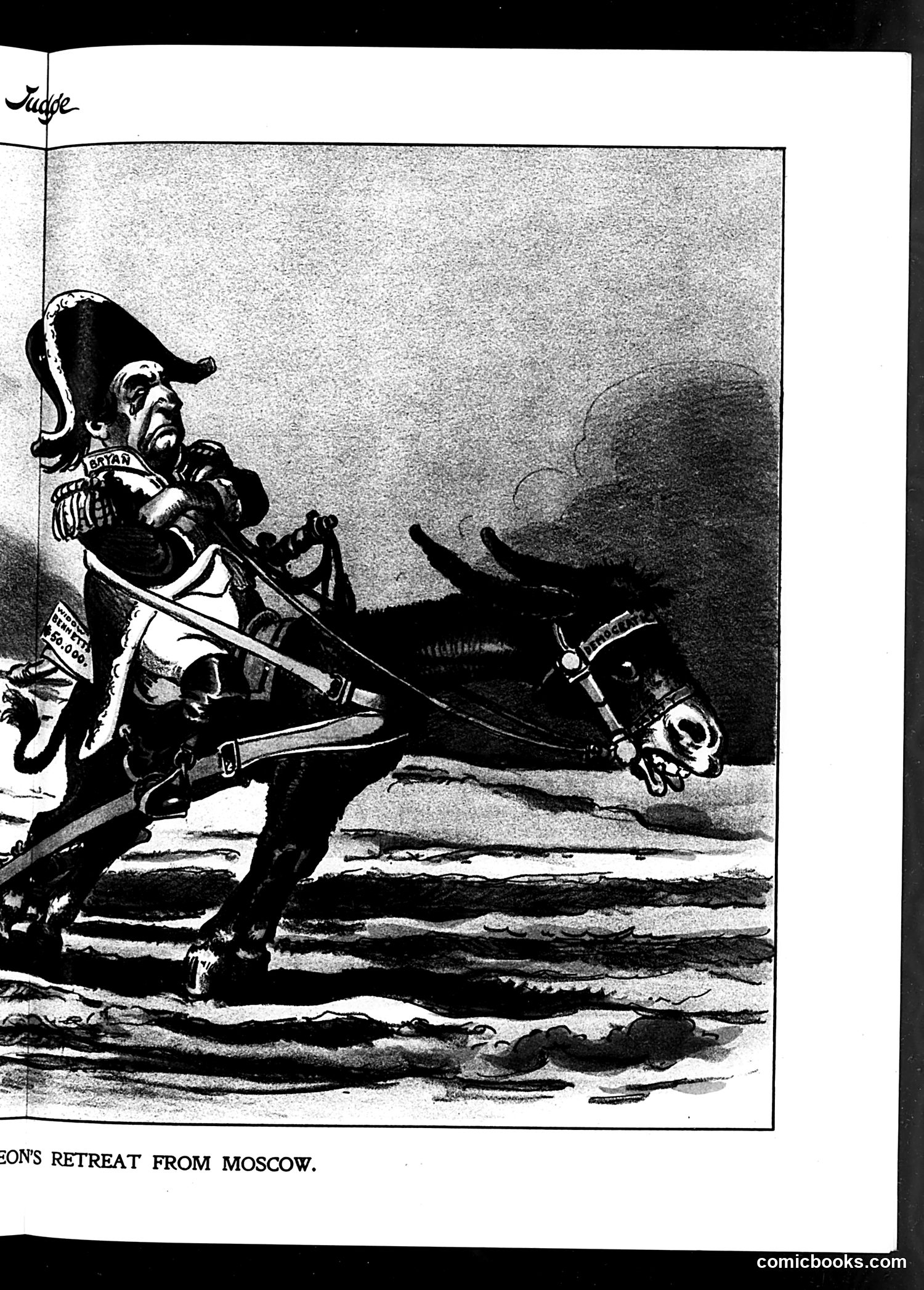
This cartoon depicts a military figure in Napoleonic-era uniform retreating on horseback, with his shadow looming large behind him. The caption reads "SON'S RETREAT FROM MOSCOW," referencing Napoleon Bonaparte's catastrophic 1812 retreat from Moscow—one of history's most devastating military defeats. The cartoon likely uses this historical analogy to comment on a contemporary political or military figure's failure or humiliating withdrawal from a campaign or position. By invoking Napoleon's iconic downfall, the satire suggests the subject has suffered a similarly ignominious defeat. The exaggerated shadow emphasizes the gap between the figure's former grandeur and present diminishment. Without knowing Judge magazine's publication date, the specific identity of "Son" remains unclear, though the Napoleon parallel suggests a significant historical or political failure is being mocked.
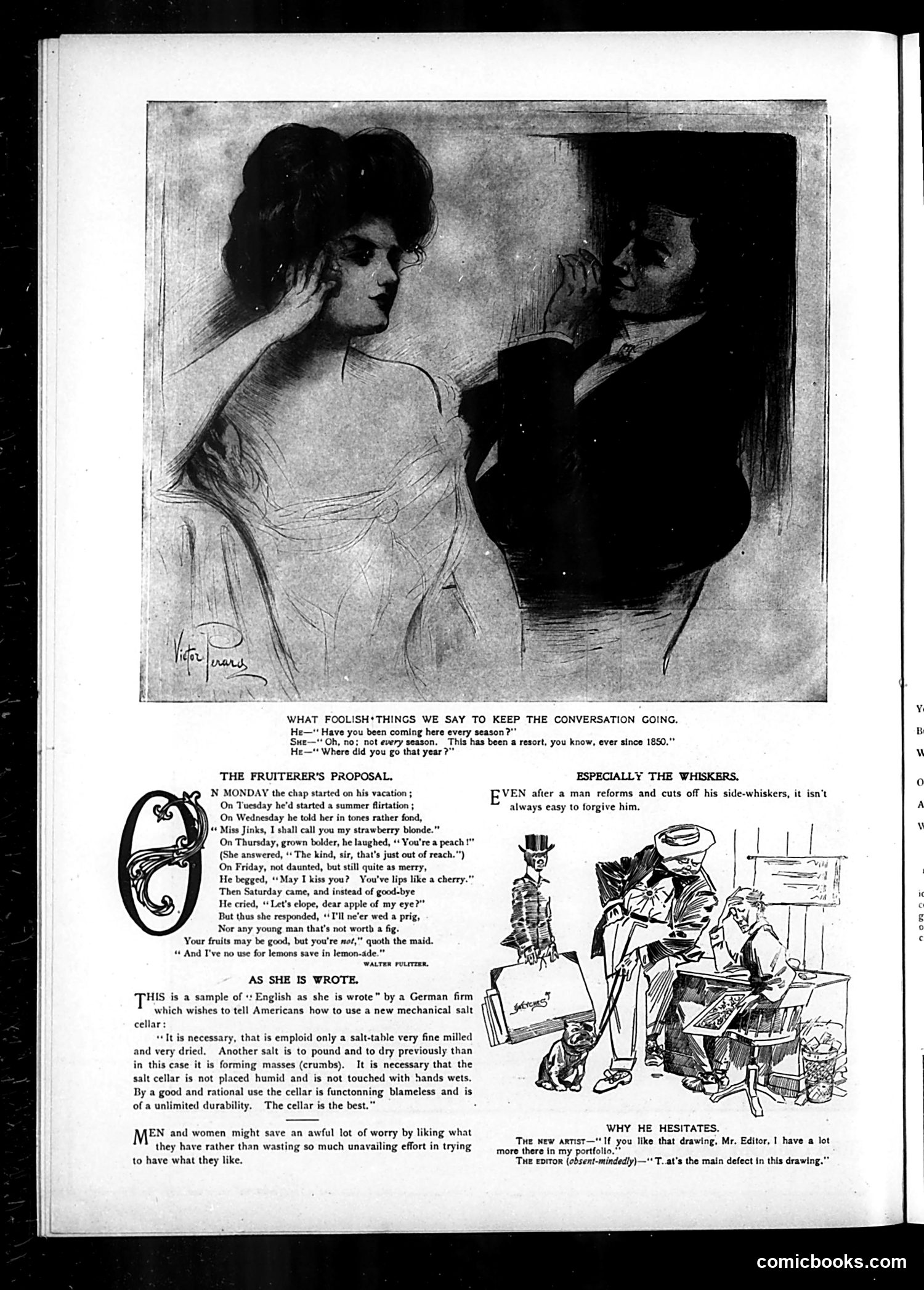
This page contains three satirical pieces typical of early 20th-century American humor: **Top illustration**: A sketch of a man and woman in conversation, captioned with banal small talk about resort seasons—mocking the vapid pleasantries people use to maintain social interaction. **"The Fruiterer's Proposal"**: A poem by Walther Pulitzer about a fruit vendor's clumsy romantic advances using fruit metaphors ("strawberry blonde," "peach," "cherry," "apple of my eye"). The woman rejects him, punning that while his fruits are good, he himself is worthless—satirizing both presumptuous suitors and overwrought romantic language. **"As She Is Wrote"**: Mock-German English instructions for a salt cellar, riddled with grammatical errors ("is emploid," "functonning"). This satirizes German mechanical products marketed to Americans, poking fun at both foreign manufacturing and broken English instruction manuals. **"Why He Hesitates"**: A cartoon showing an editor critiquing a young artist's portfolio, punning on artistic "defects"—gentle workplace humor about artistic insecurity. The page's overall theme: modern social awkwardness and communication failures.
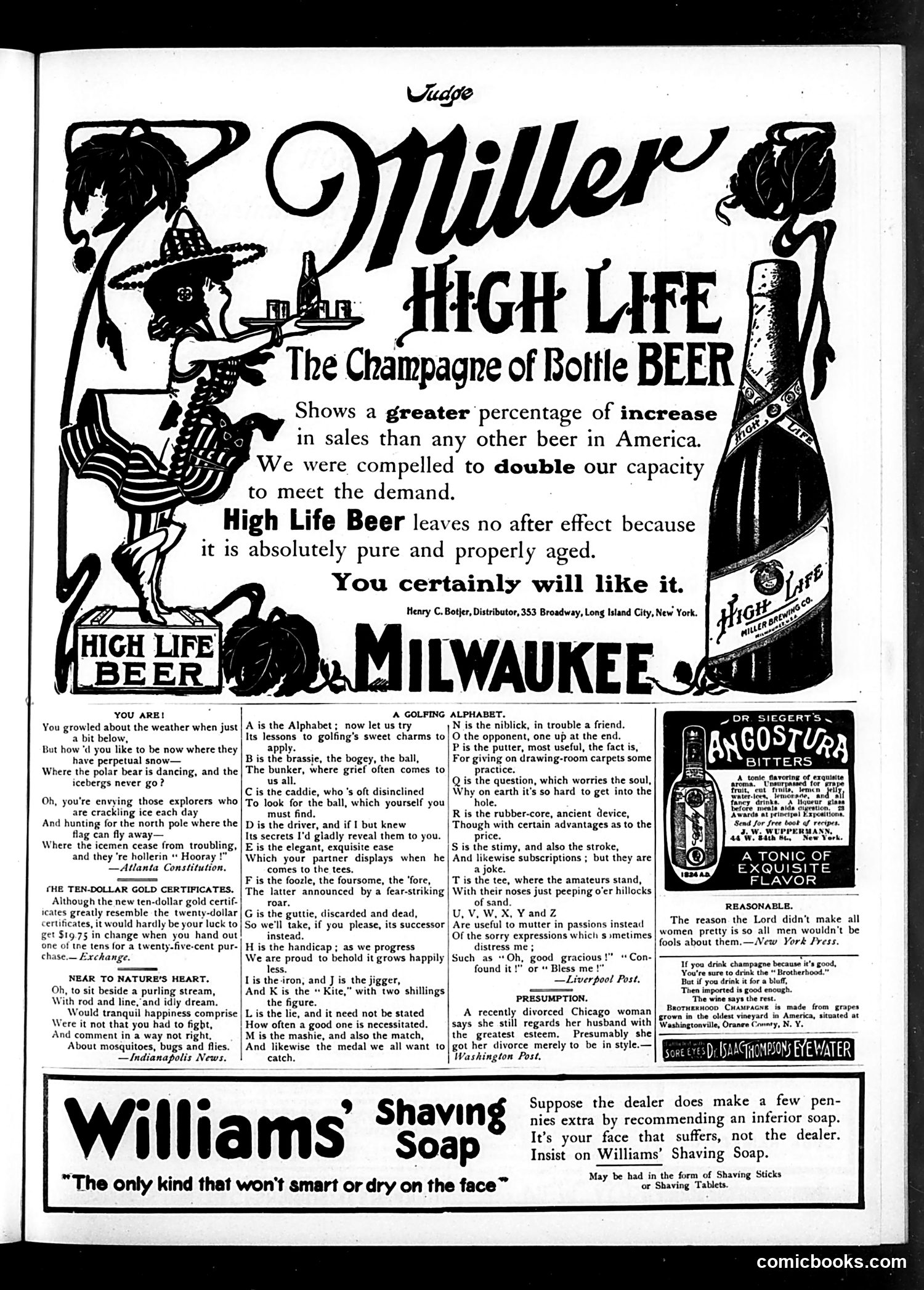
This is primarily a **satirical magazine page featuring advertisements and humorous columns** rather than political cartoons. The main content includes: 1. **Miller High Life Beer ad** — celebrates the beer's sales success and purity; uses decorative Art Nouveau-style figures. 2. **Multiple short humorous poems/columns** on everyday topics: - Complaints about weather vs. Arctic explorers - A joke about confusing $10 and $20 gold certificates - A "Golfing Alphabet" satirizing golf terminology and frustrations - Complaints about mosquitoes while fishing 3. **Williams' Shaving Soap ad** — emphasizes the product won't irritate skin. 4. **Minor advertisements** for Angostura Bitters and Brotherhood Champagne. The humor is **light and domestic** — poking fun at everyday annoyances (weather, golf, insects, money confusion) rather than political issues. This reflects Judge's role as a general-interest humor magazine mixing social satire with advertising.
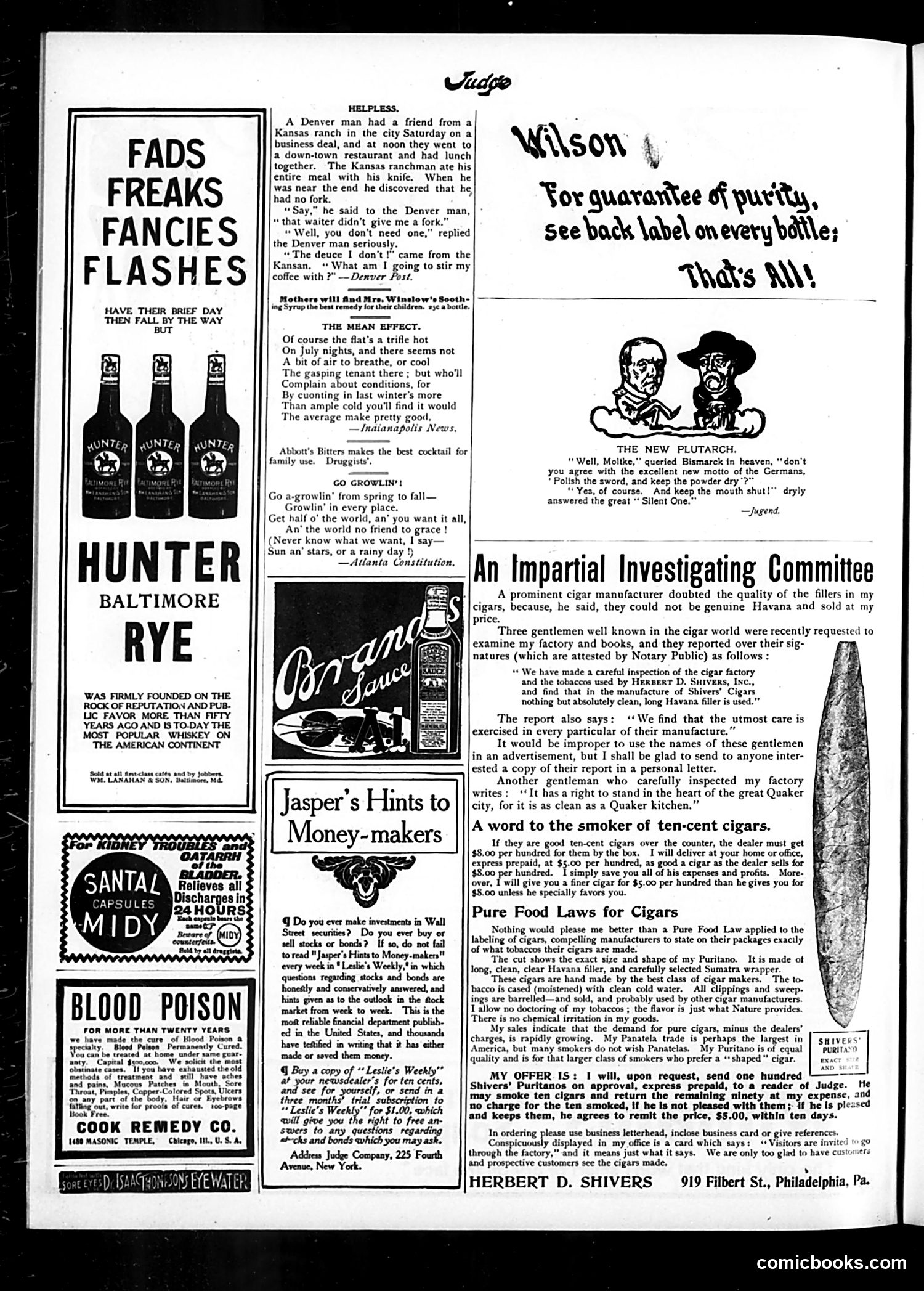
This page from *Judge* magazine contains several satirical pieces and advertisements typical of early 20th-century American humor. **Main Cartoon Content:** The "New Plutarch" cartoon depicts Bismarck and Moltke (famous Prussian military figures) in heaven, with Bismarck questioning Moltke about a German motto regarding military preparedness ("Polish the sword, and keep the powder dry"). This is political satire playing on German militarism and historical figures. **The Anecdote:** A short humor piece about a Kansas rancher eating an entire restaurant meal with only a knife, mocking rural/frontier unsophistication for a urban audience. **Primary Content:** The page is largely dominated by advertising—whiskey (Hunter Rye), patent medicines (Santal Capsules, Cook Remedy), and notably a lengthy cigar manufacturer's advertisement by Herbert D. Shivers defending his product quality with testimonials from industry inspectors. **Historical Context:** These ads reflect pre-FDA regulations when manufacturers made broad health claims and quality assertions without government verification—exactly what Shivers' defensive advertisement addresses.
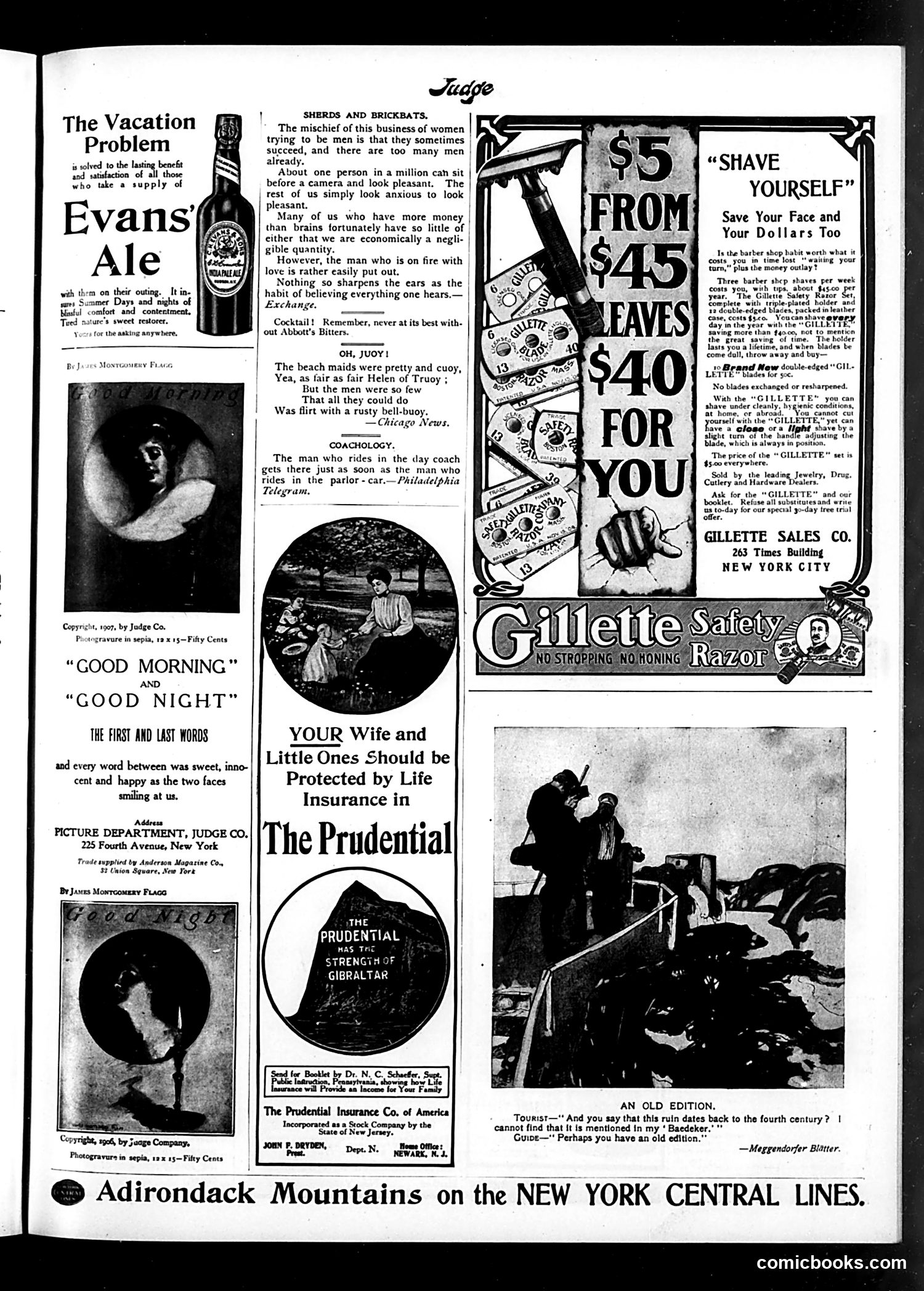
This page is primarily **advertising with minimal editorial content**. The dominant feature is a large Gillette Safety Razor advertisement promoting self-shaving to save money and time versus barber visits—a modernization pitch for early 1900s masculinity. The small editorial section labeled "Sherds and Brickbats" contains brief satirical observations: one jab at women attempting to enter male-dominated fields ("they sometimes succeed, and there are too many men already"), and quips about photography anxiety and wealth without intelligence. A humorous poem mocks beach romance ("Oh, Judy!") where lack of available men forces women to flirt with inanimate objects. The final cartoon jokes about tourists consulting outdated travel guides for historical ruins. The "Good Morning/Good Night" picture advertisement promotes Judge's picture department. **Overall context**: This reflects early-1900s consumer culture, gender anxieties, and advertising-driven magazine economics rather than substantive political satire.
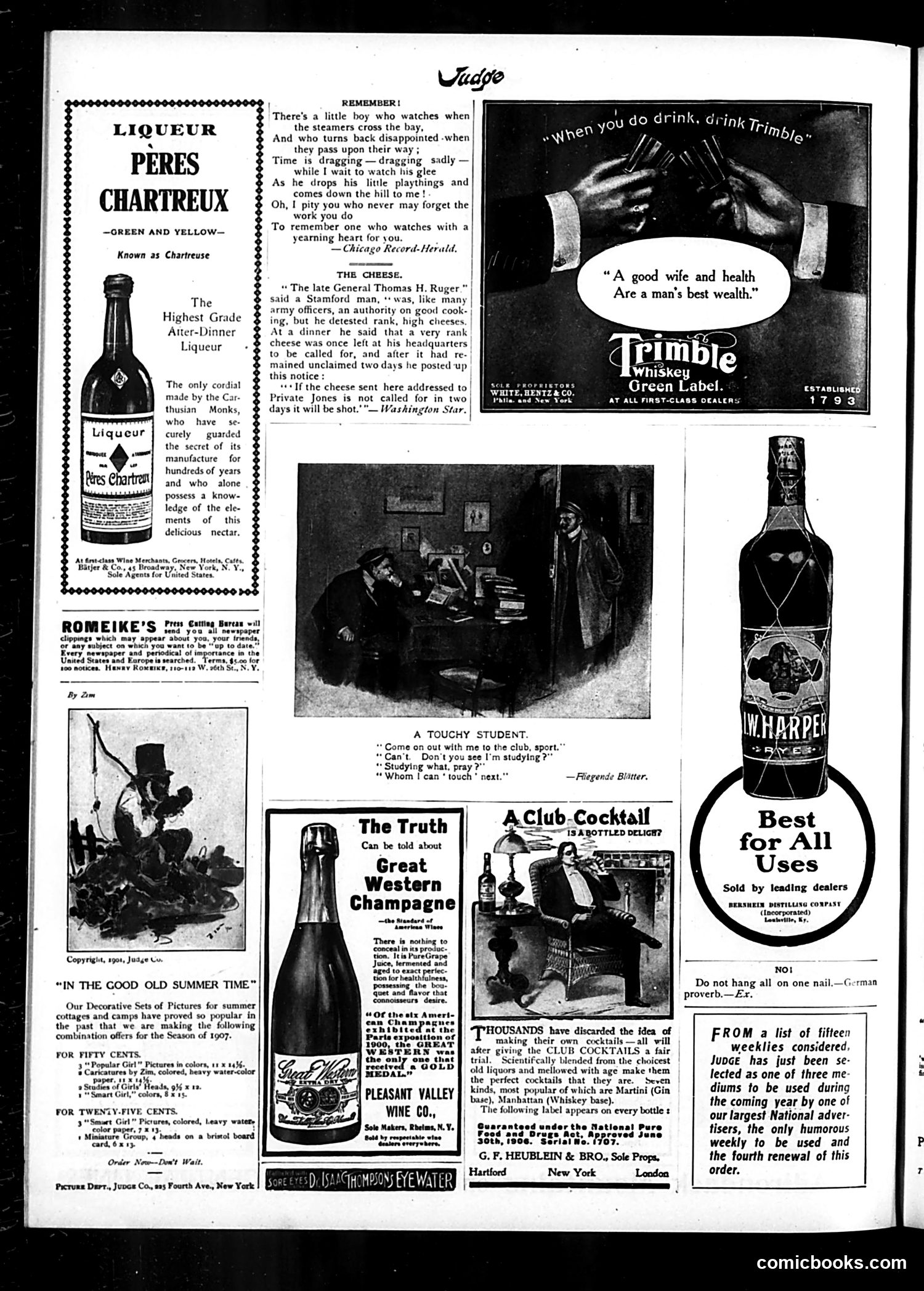
This page is primarily **advertising**, with minimal satirical content. The advertisements dominate, promoting liqueurs (Chartreuse, champagne, whiskey), cocktail mixes, and Judge magazine's own picture sets and clipping service. The only cartoon present is titled **"A Touchy Student,"** a small sketch showing a student refusing social invitation because he's "studying what" he can "touch" next—a play on words suggesting financial hardship or desperation. The humor is mild wordplay rather than political satire. The page includes sentimental poetry ("Remember!") about a waiting child, and an anecdote about General Thomas H. Ruger threatening to shoot an unclaimed cheese at his headquarters—gentle humor about military eccentricity. The content reflects **1907 Judge readership**: affluent enough to purchase expensive liqueurs and decorative artwork for summer homes. The heavy advertising suggests Judge relied substantially on commercial revenue rather than satirical editorial commentary on this particular page.
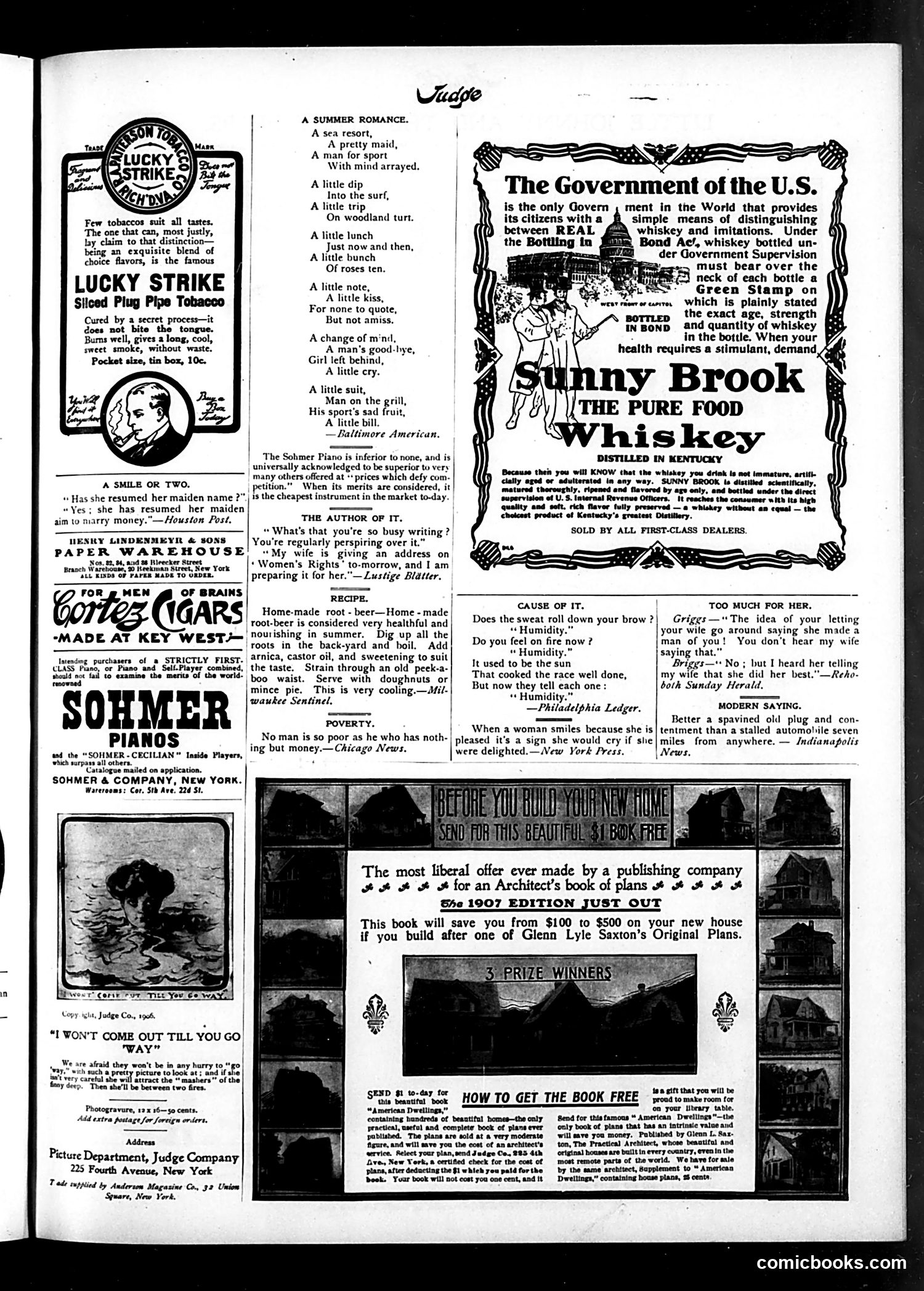
This page is primarily **advertising**, with brief humorous filler content typical of early 1900s magazines. The main advertisements include: - **Lucky Strike tobacco** and **Sohmer pianos** (products marketed to men of means) - **Sunny Brook whiskey**, emphasizing that U.S. government oversight distinguishes real whiskey from imitations—a reference to the **Pure Food and Drug Act** (1906), which required accurate labeling The short humor pieces are lightweight social commentary: - "A Summer Romance" satirizes a seaside flirtation ending in the man facing a bill ("His sport's sad fruit, / A little bill") - Several jokes mock marital dynamics and women's emerging public roles (one features a husband writing his wife's "Women's Rights" speech) - "Modern Saying" jokes about blaming humidity rather than the sun for heat The cartoons and content reflect **Progressive-era consumer culture**: government regulation as consumer protection, anxieties about authenticity in commercial products, and gentle satire of gender relations during a period of social change.
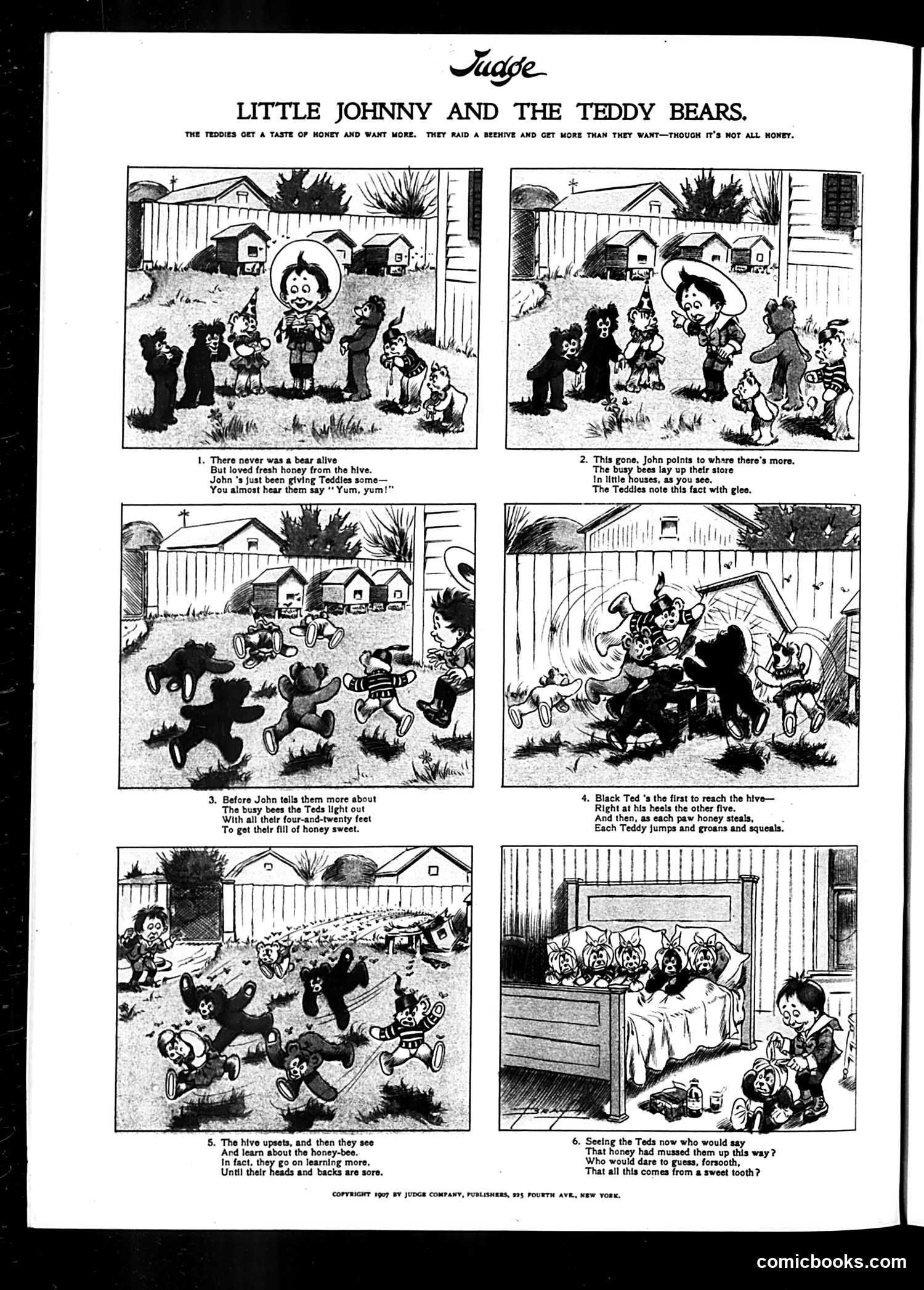
This is a children's comic strip with no political satire—it's a straightforward cautionary tale about consequences. "Little Johnny" introduces his teddy bears to a beehive, promising fresh honey. The bears raid the hive eagerly but learn a harsh lesson when angry bees attack them in retaliation. The "Teddy Bears" reference reflects the toy craze of the early 1900s, inspired by President Theodore Roosevelt. The story's moral is simple: greed leads to pain. The bears' enthusiastic pursuit of "more" honey results in getting "stung"—literally and figuratively. The final panel's rhetorical question drives home the lesson: outward appearance (mussed-up bears) reveals inward misbehavior (theft and gluttony). It's wholesome entertainment designed to amuse children while teaching restraint and respect for consequences.