
A complete issue · 16 pages · 1907
Judge — July 6, 1907
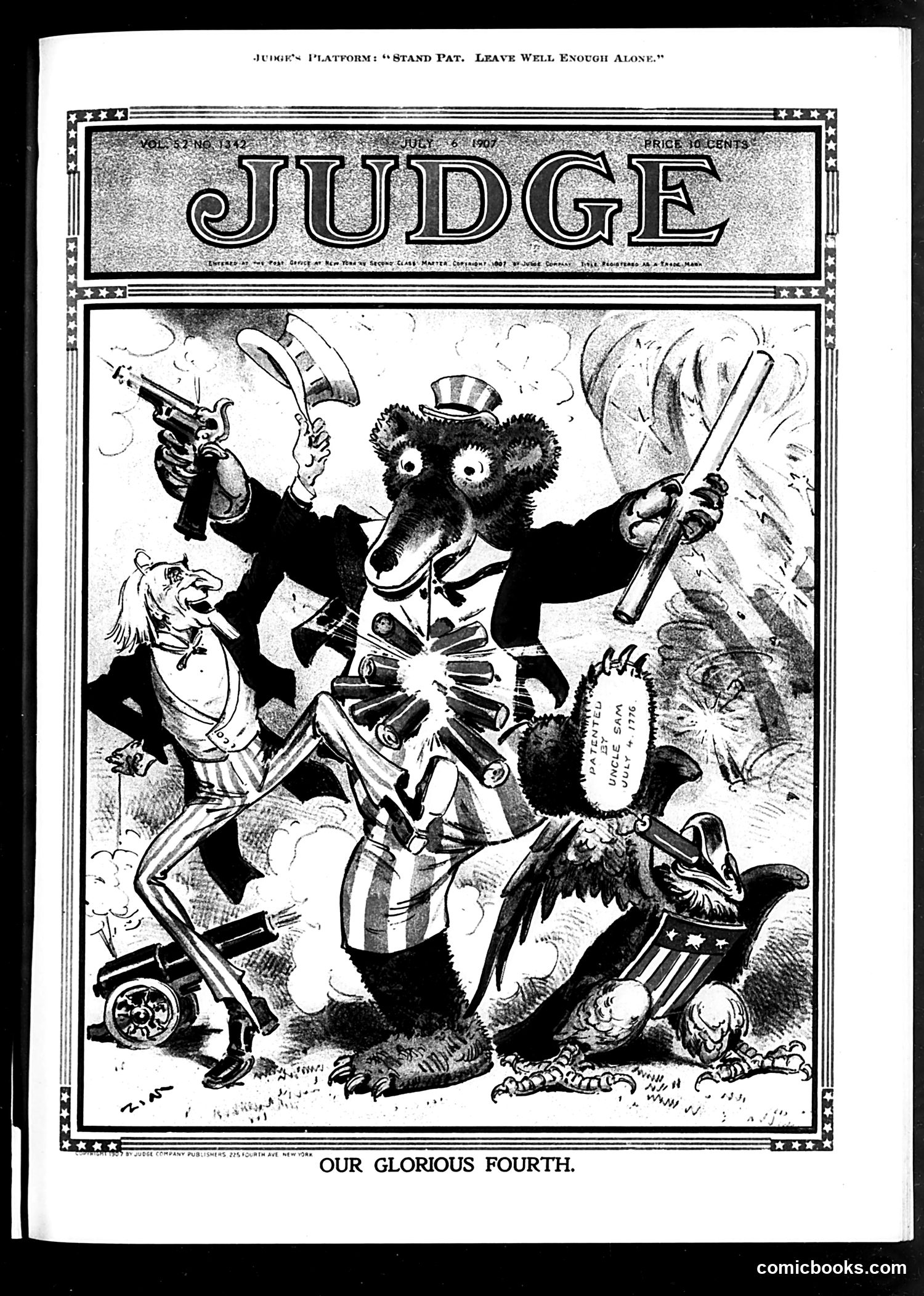
This Fourth of July satirical cover depicts chaotic violence masquerading as patriotic celebration. The central figure—a bear-headed character in Uncle Sam attire—wields weapons while surrounded by explosions, weapons, and destruction. To the left appears a caricatured figure (possibly representing an immigrant or lower-class person), and at bottom right sits what appears to be an eagle (representing America). The satire critiques how Independence Day celebrations, particularly among working-class and immigrant communities, had devolved into dangerous fireworks displays and street violence. The exaggerated bear-head and grotesque imagery mock the crude, destructive nature of these festivities, suggesting they represented a mockery of genuine patriotism rather than sincere national pride.
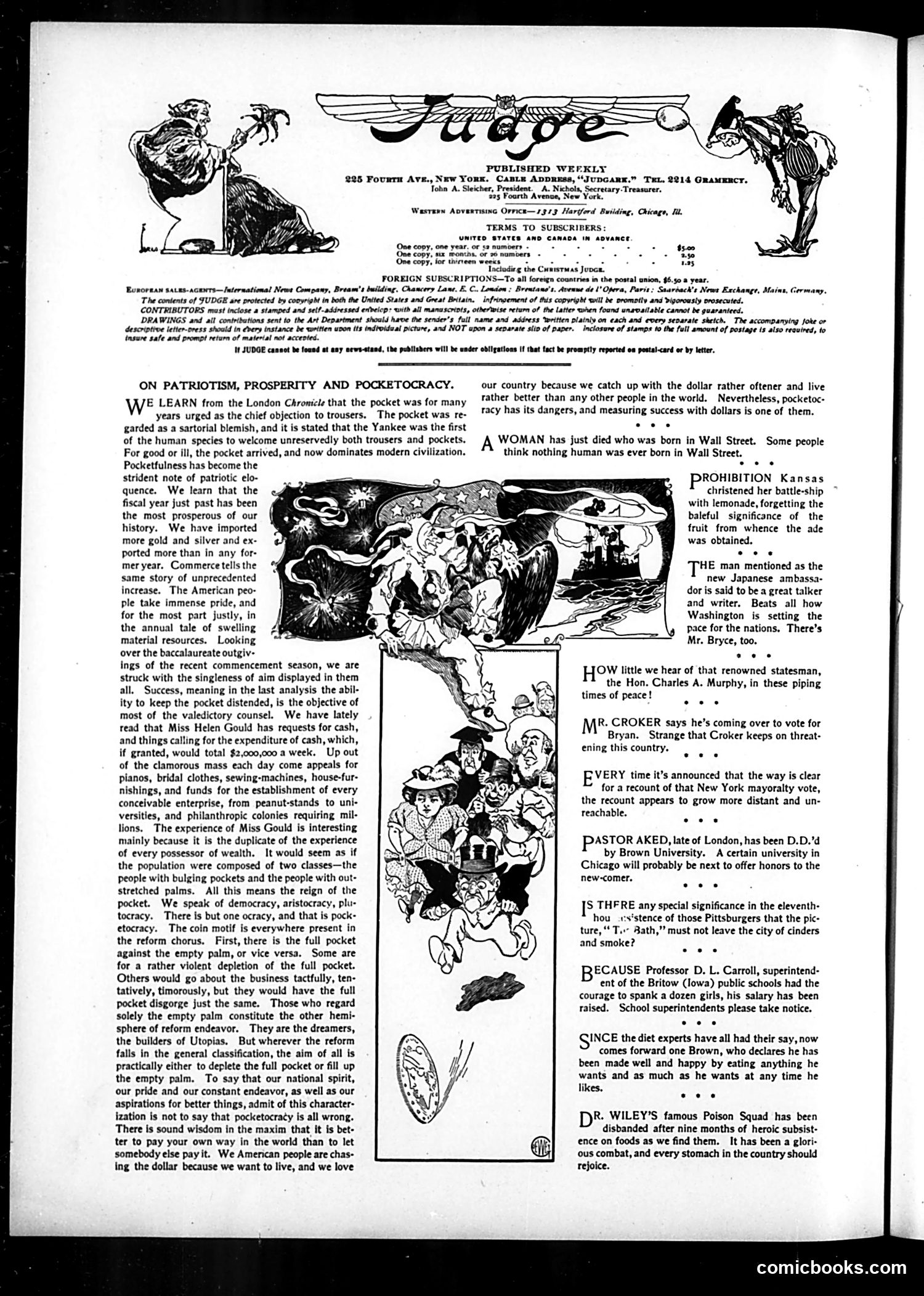
The main article "On Patriotism, Prosperity and Pocketocracy" critiques American materialism and the obsession with wealth. It argues that while Americans pride themselves on democracy and patriotic ideals, the nation is actually governed by money—"pocketocracy"—where the wealthy hold true power. The accompanying illustration depicts a grotesque pile of human figures climbing over each other, likely representing the masses struggling desperately for economic gain and social position. This visual metaphor emphasizes Judge's satirical point: that beneath America's democratic rhetoric lies a chaotic scramble for dollars and status. The smaller boxed items are society gossip and brief satirical notes about contemporary figures and events, typical of Judge's format.
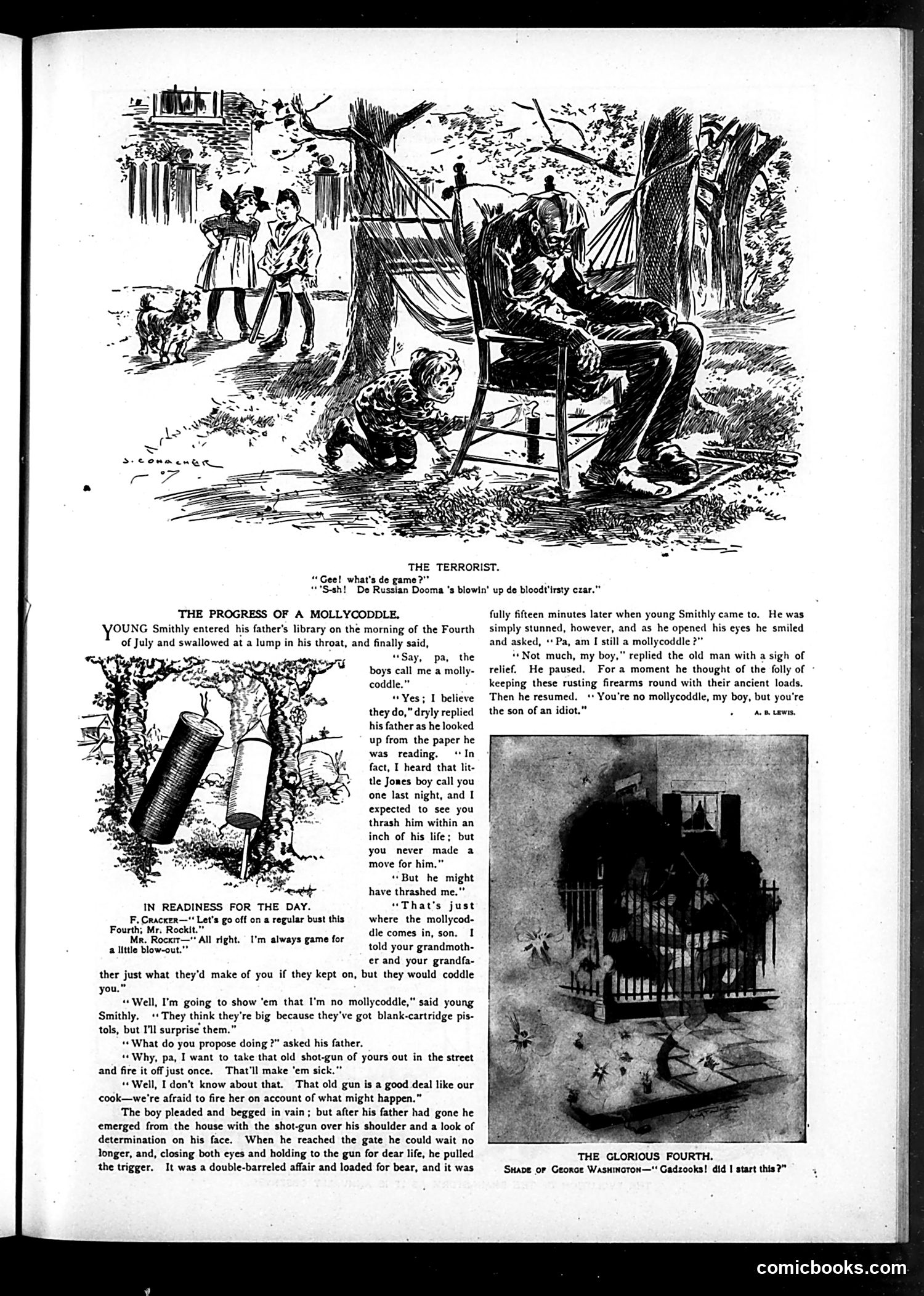
The page contains three distinct sections: **"The Terrorist"** (top cartoon): A man in military uniform sits relaxed while a small child plays nearby. The caption references Russian anarchist violence ("De Russian Dooma's blowin' up de blood'rusty czar"), satirizing American anxiety about foreign radicals and terrorism—a contemporary concern during the early 1900s. **"The Progress of a Mollycoddle"** (main story): A humorous narrative about young Smithby, who swallows a lump and claims it's a "mollycoddle"—slang for an effeminate or cowardly person. His father dismisses his concerns, ultimately allowing him to fire a shotgun, illustrating period anxieties about masculine weakness and parental permissiveness. **"The Glorious Fourth"** (bottom photo): Appears to reference Independence Day incidents, likely showing consequences of Fourth of July firearm accidents. The overall theme critiques American attitudes toward danger, masculinity, and proper child-rearing.
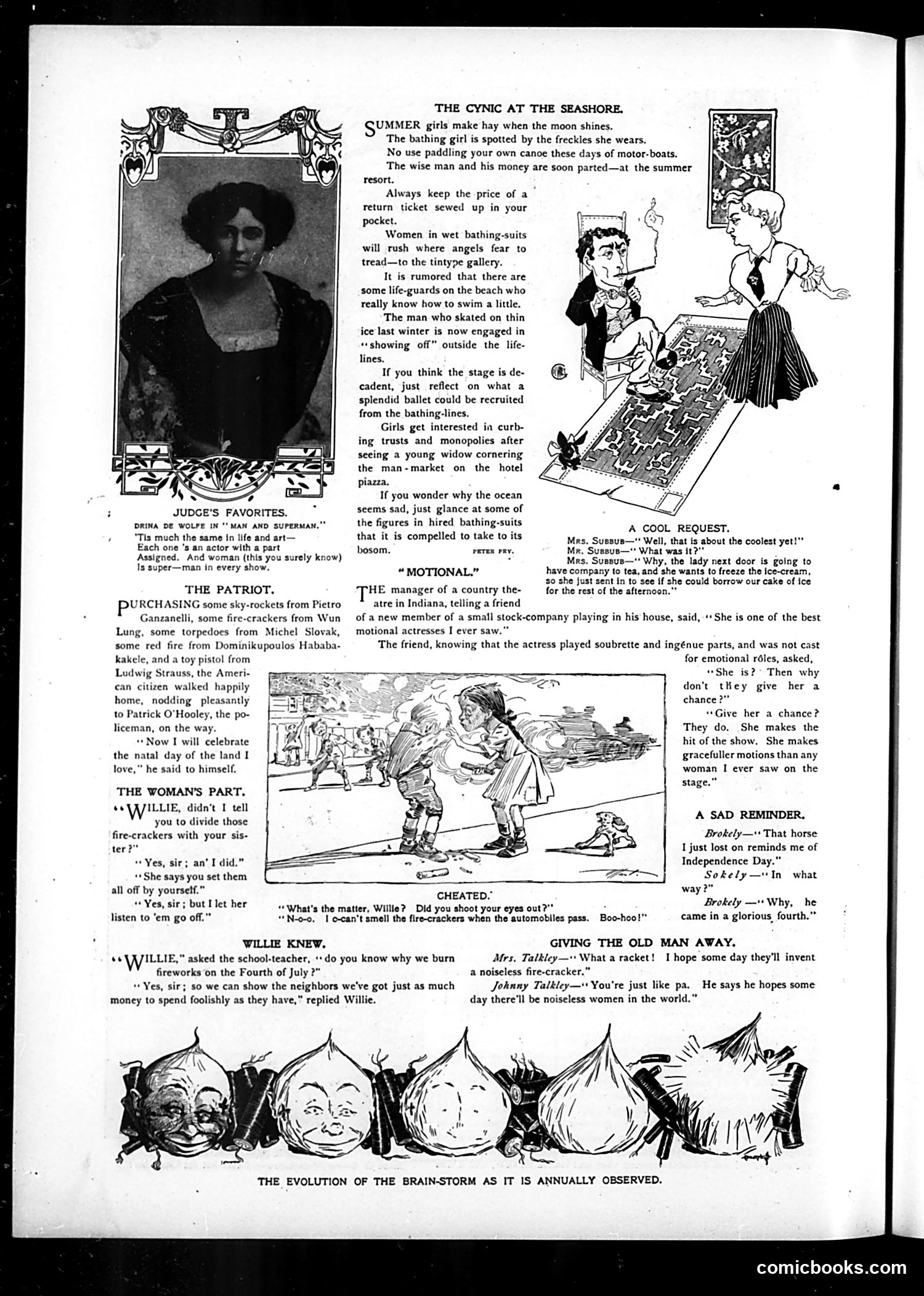
This page contains several short humorous pieces typical of early 20th-century American satirical magazines: **"The Cynic at the Seashore"** mocks summer resort culture—bathing girls, life-guards, fortune-seekers, and social climbers at beaches. **"The Patriot"** is a brief anecdote about an immigrant (Strauss) celebrating Independence Day by setting off firecrackers, suggesting satirical commentary on immigrant assimilation. **"Motional"** jokes about theatrical talent spotting at resorts. **"Willie Knew"** features a schoolboy's quip about fireworks spending, poking fun at neighborhood economics. The cartoon at bottom, "The Evolution of the Brain-Storm," depicts stylized heads showing supposed mental states during seasonal celebrations—likely satirizing holiday behavior. The satirical tone throughout targets social pretension, tourist culture, and consumerism rather than specific political figures or events.
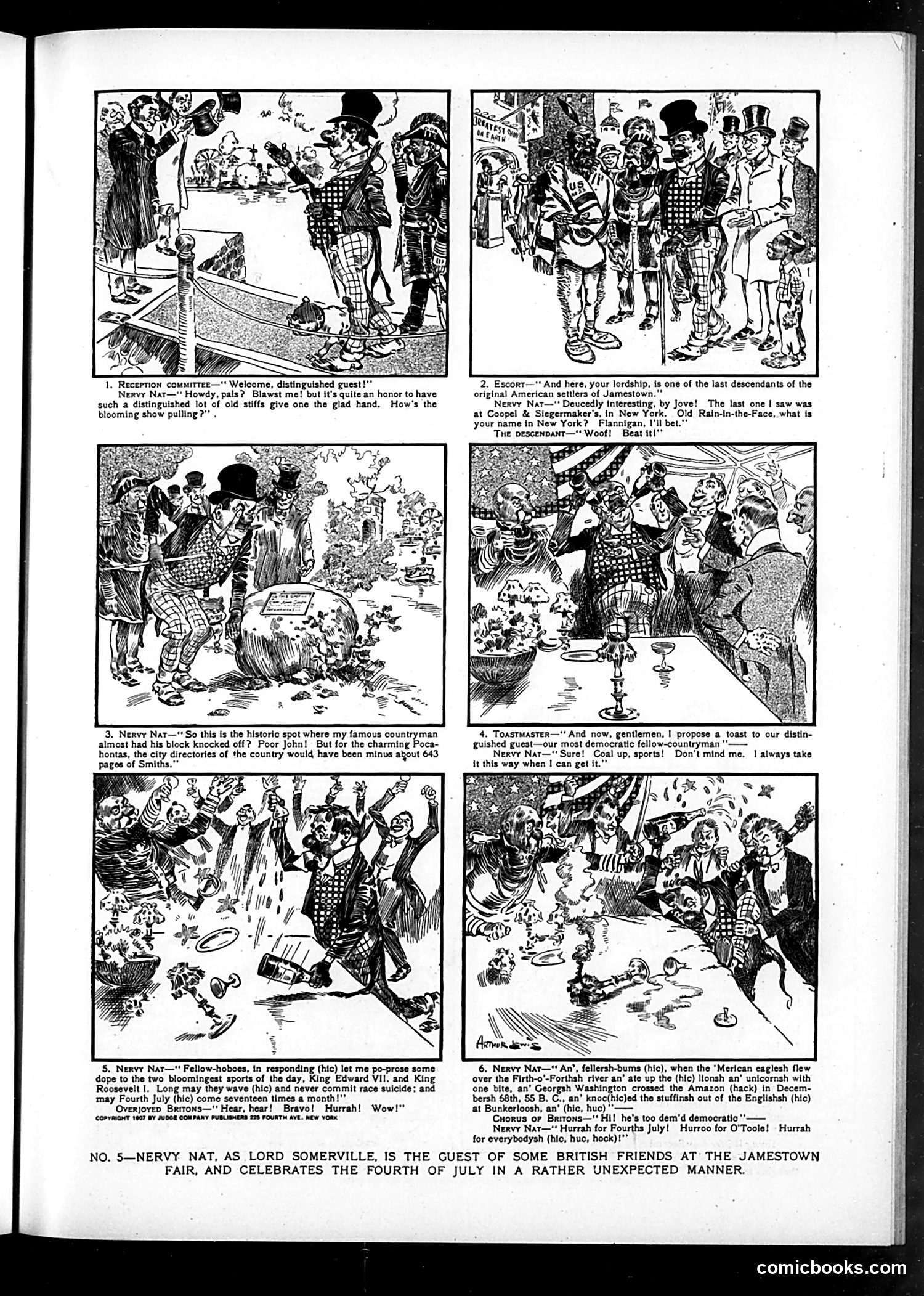
This six-panel comic strip satirizes an American character named "Nervy Nat" (Lord Somerville) attending a British Fourth of July celebration at Jamestown. The humor derives from fish-out-of-water culture clash: Nat's exaggerated patriotism and American mannerisms clash with stuffy British customs. Key jokes include: 1. Nat boasting about being descended from Jamestown settlers 2. British guests' condescending responses about "old Rain-in-the-Face" 3. Nat claiming Americans invented various things (seemingly exaggerated) 4. Escalating chaos as Nat's celebrations become increasingly wild 5. The finale showing complete pandemonium during fireworks The satire targets American braggadocio and perceived vulgarity versus British reserve, playing on early 20th-century Anglo-American cultural stereotypes for comedic effect.
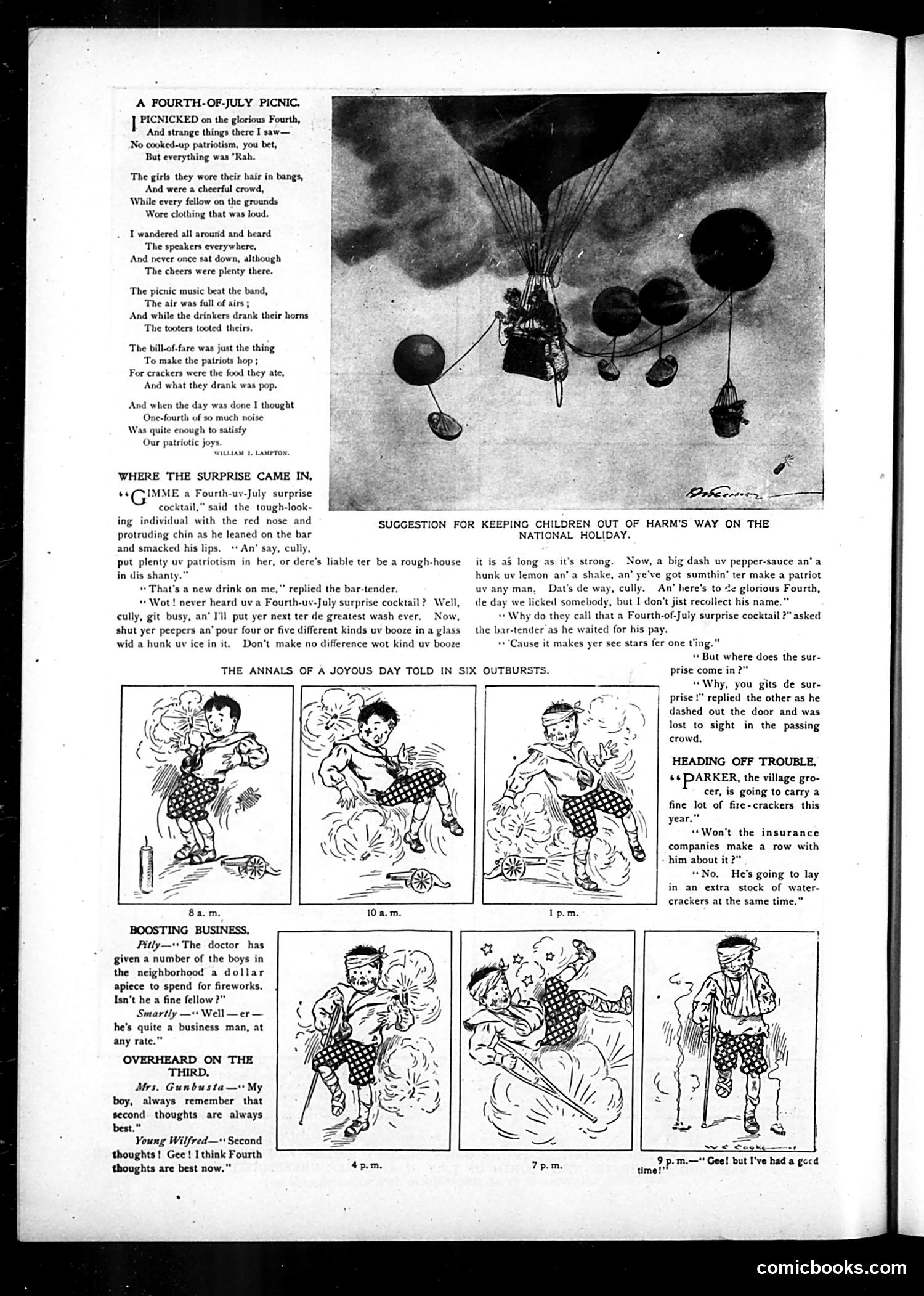
This page satirizes American Independence Day celebrations through multiple angles. The poem "A Fourth-of-July Picnic" mocks the predictable, commercialized nature of the holiday—loud clothing, clichéd patriotic speeches, and cheap food ("crackers" and "pop"). The cartoon series depicts a child's chaotic day launching fireworks at six different times, illustrating the genuine danger fireworks pose to children—the stated concern being "keeping children out of harm's way." Related humor pieces mock drinking culture around the holiday: a "Fourth-of-July surprise cocktail" is simply mixed liquor that makes drinkers "see stars" (implying injury), and a grocer's insurance workaround involves stocking water-crackers alongside firecrackers. Overall, the satire critiques how Fourth-of-July celebrations devolve into noisy excess, commercialism, and recklessness—particularly dangerous for children—rather than genuine patriotic reflection.
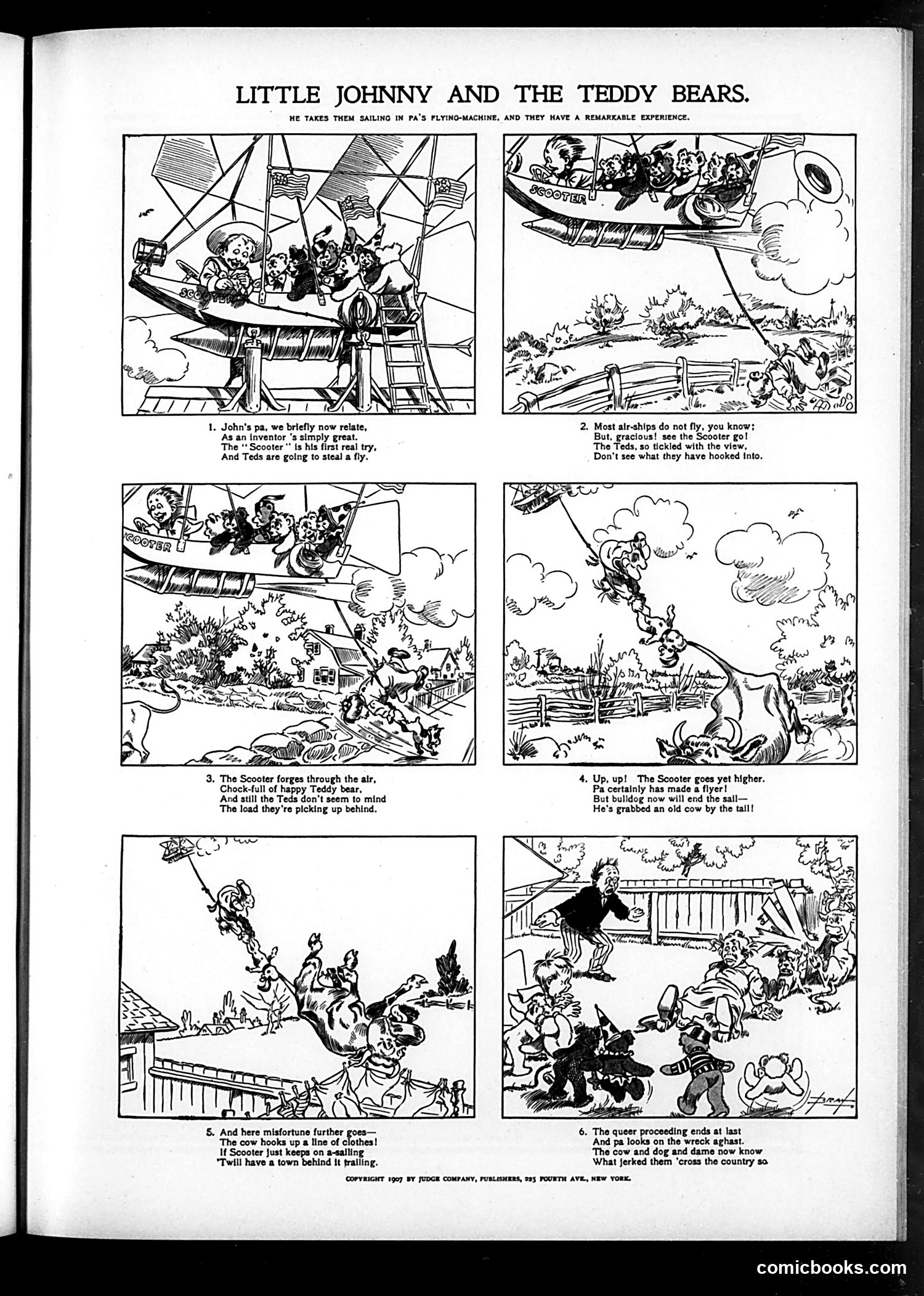
This is a humorous six-panel comic strip satirizing early aviation enthusiasm and the absurdity of homemade flying machines. A father invents "The Scooter," an airship he believes will fly successfully. Little Johnny and teddy bears board it, but the craft inadvertently hooks a clothesline, then a cow's tail (via a bulldog), creating a chaotic trail of debris across the countryside. The satire targets the era's aviation craze and overconfident amateur inventors. The joke escalates from technical failure to slapstick chaos—the "flying machine" becomes less a marvel of engineering than a runaway disaster dragging livestock and laundry behind it. By 1907, when powered flight was still novel, Judge mocks both inventors' grandiose claims and public gullibility about miraculous new technologies. The teddy bears reference the popular "Teddy Bear" craze of the era.
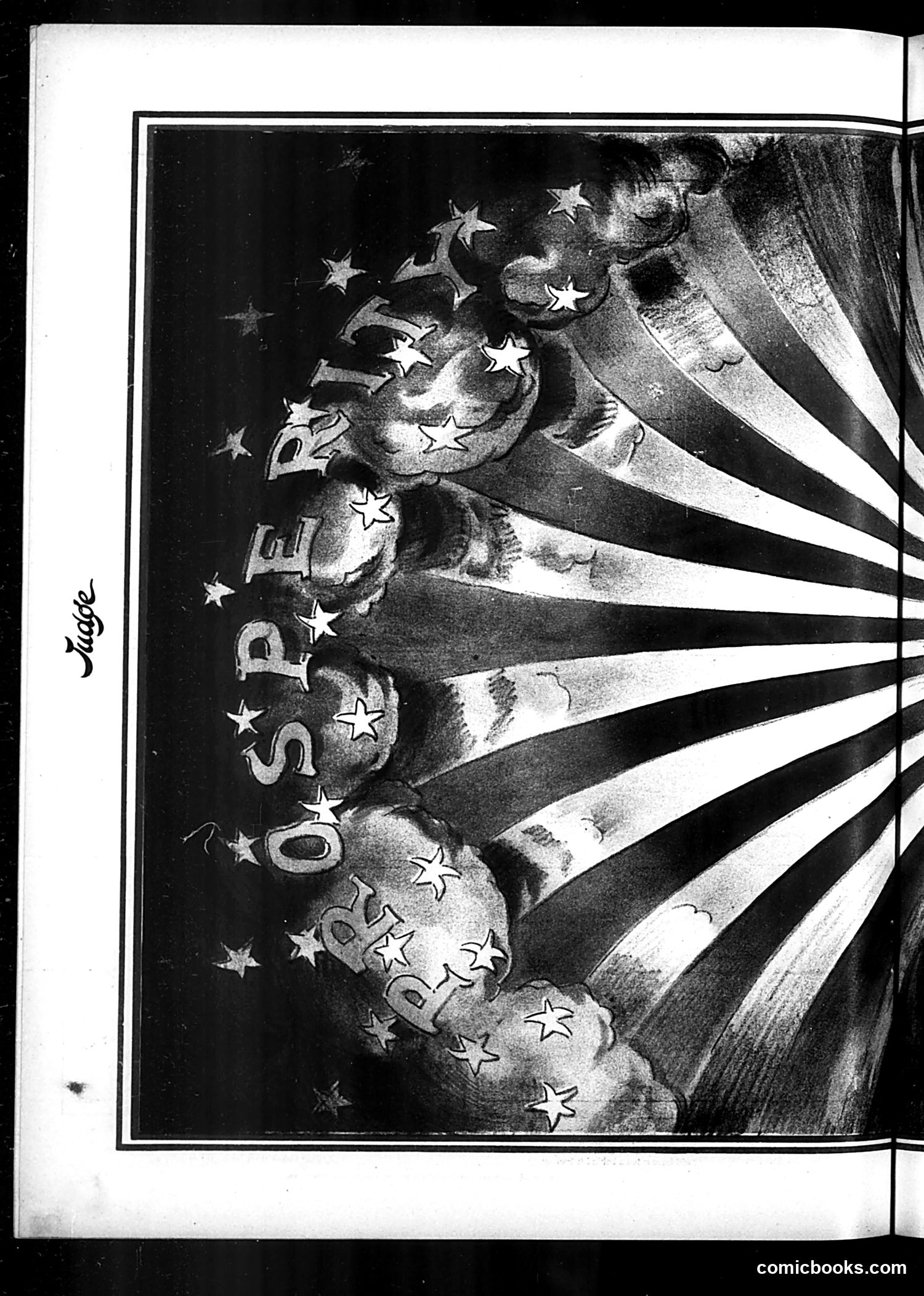
This appears to be a title page or cover from *Judge* magazine featuring an allegorical illustration. The image shows an eagle (representing America) with spread wings containing stars and stripes. The eagle's body displays the word "PROSPERITY" vertically through its center, with stars scattered throughout. The satire likely celebrates American prosperity and national pride, though without a date or additional context visible on the page, the specific historical moment remains unclear. It could reference various periods of American economic confidence—potentially the 1920s or another era of perceived national success. The patriotic imagery (eagle, stars, stripes) combined with the explicit "PROSPERITY" text suggests this was meant as optimistic political commentary or celebration of American economic conditions during whatever period it was published.
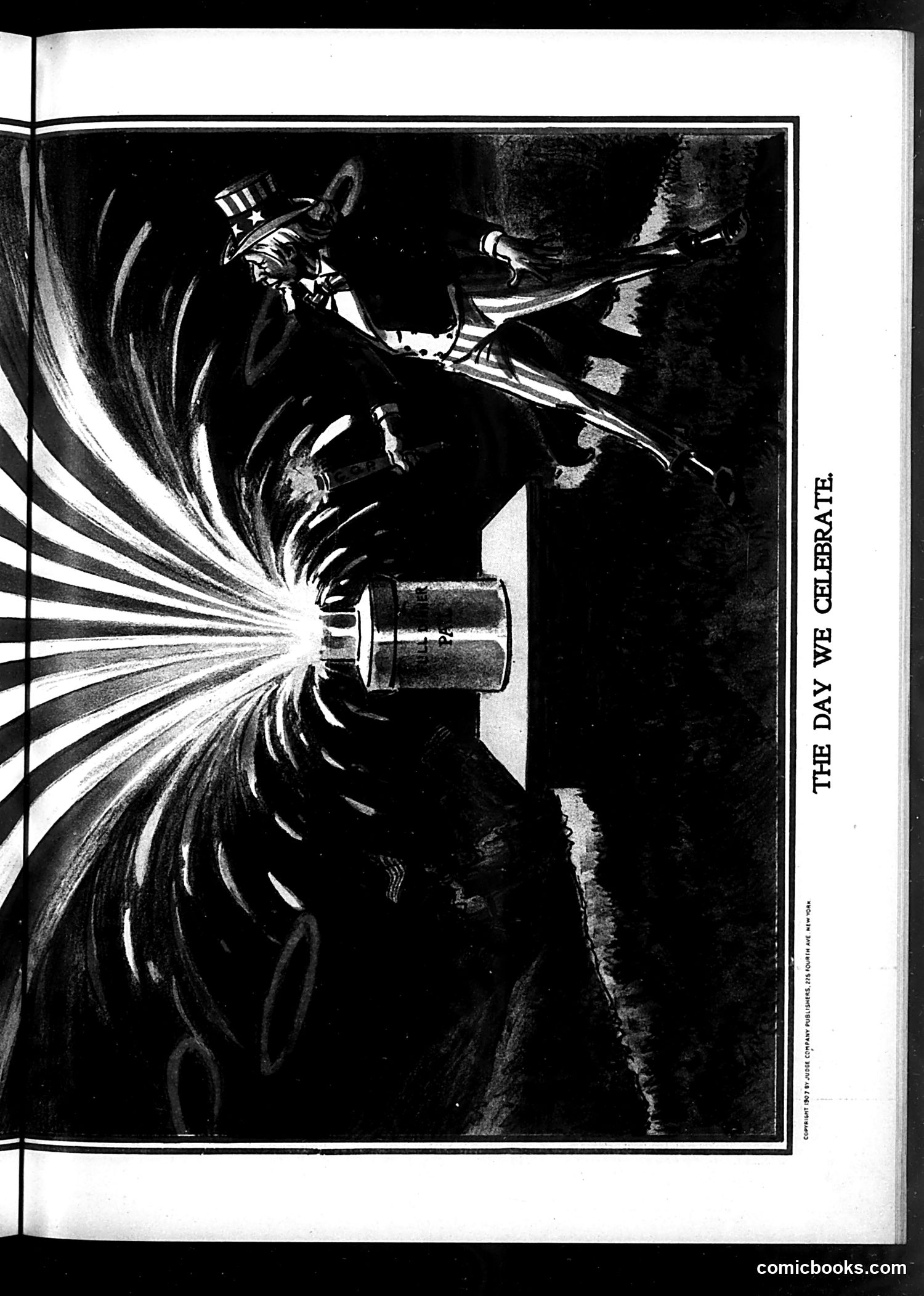
This is a satirical illustration showing Uncle Sam (identifiable by his top hat and stars-and-stripes clothing) emerging triumphantly from an explosion or burst of light emanating from what appears to be a cylindrical object—likely representing industrial power or military might. The dramatic radiating lines suggest explosive energy or illumination. The caption "The Day We Celebrate" suggests this is commenting on American patriotic celebration, possibly relating to industrial achievement, military strength, or national progress. Without a specific date visible, the exact historical event referenced is unclear, though *Judge* frequently used such imagery to satirize American imperialism, industrial power, or military expansion during the late 19th/early 20th century.
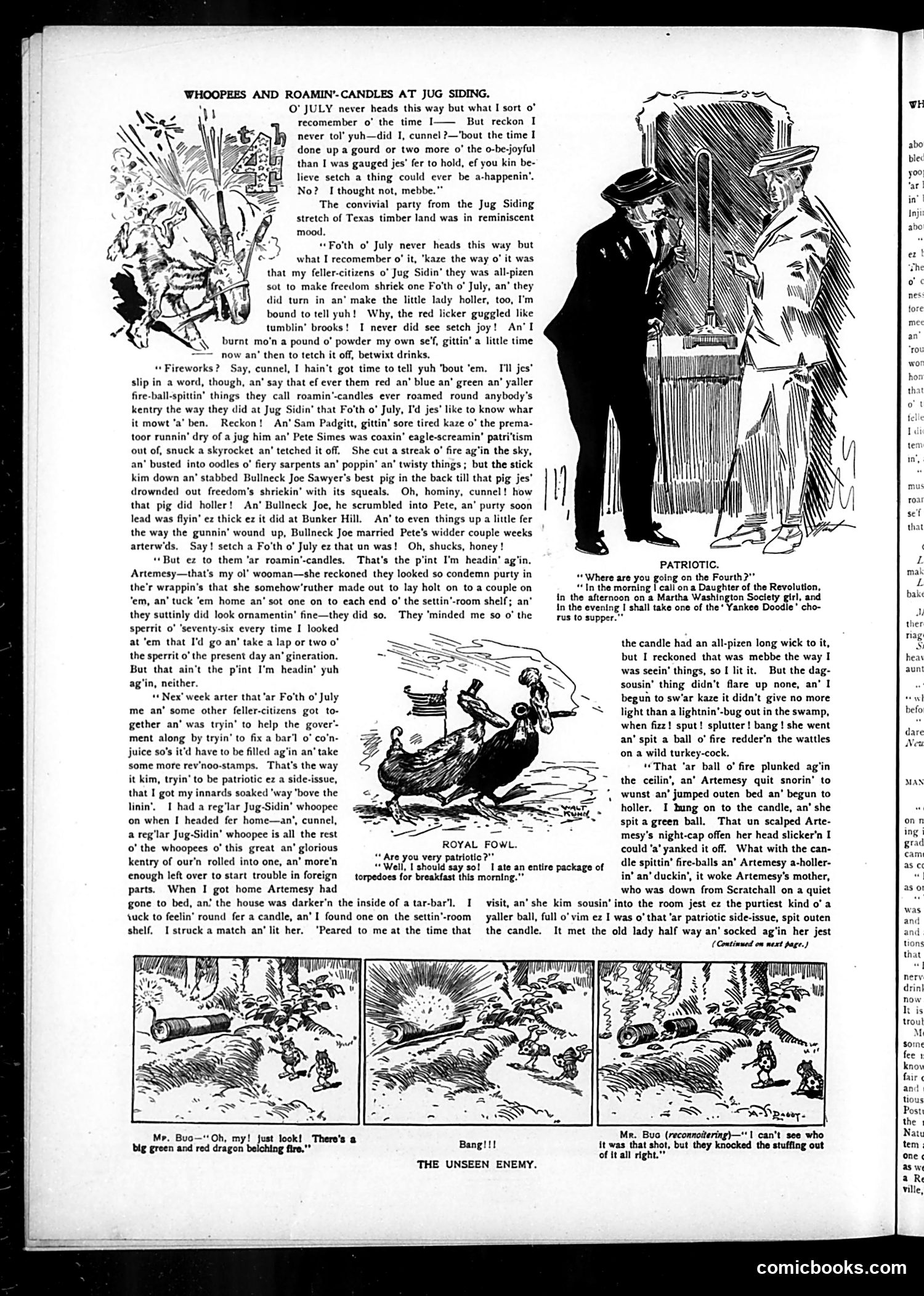
This page contains a tall tale about Fourth of July celebrations in rural Texas ("Jug Siding"), told in exaggerated dialect by a frontier character. The main narrative describes chaotic Independence Day festivities involving heavy drinking, fireworks mishaps, and violence—culminating in a pig's death, a murder, and a hasty marriage. The satire targets **rural American patriotism** as simultaneously crude, destructive, and comedically inept. The "roamin'-candles" (Roman candles) serve as a metaphor for uncontrolled enthusiasm: celebrants lack the sophistication to safely enjoy their own Independence Day. The smaller "Patriotic" inset mocks urban, educated society's manufactured patriotism—visiting Revolutionary and Martha Washington societies on the Fourth. This contrasts sharply with the backwoods violence, suggesting *all* American patriotic displays, whether rural or genteel, ring hollow. The comic strip "The Unseen Enemy" (bottom) appears unrelated.
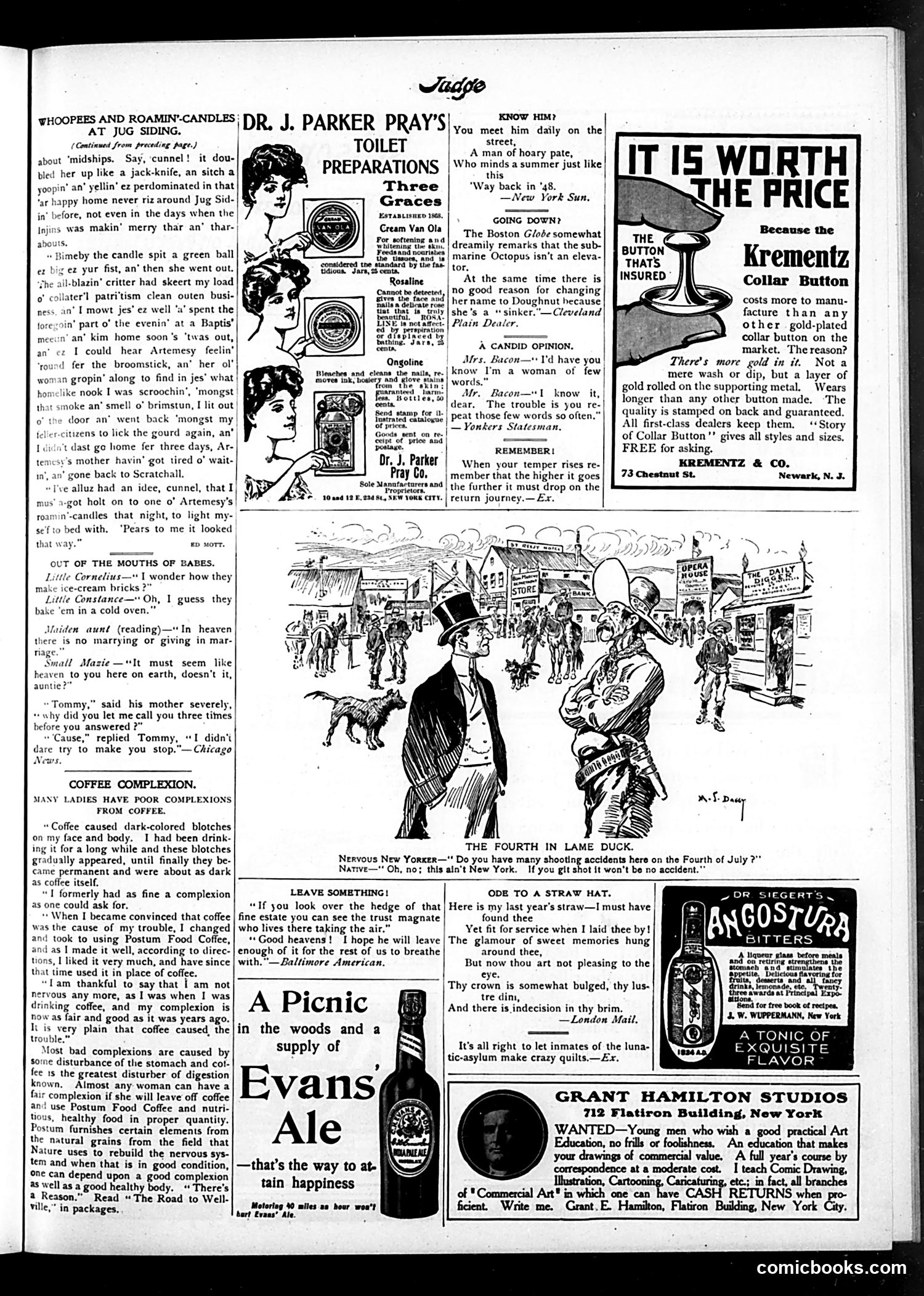
This page is primarily **advertising and miscellaneous humor content** rather than political satire. The main illustrated cartoon—"The Fourth in Lame Duck"—depicts two men on a city street observing Independence Day crowds. The caption suggests ironic commentary about New York's dangerous conditions ("Do you have many shooting accidents here on the Fourth of July?" / "No; this ain't New York. If you shot it won't be an accident"), contrasting New York's reputation for lawlessness with a presumably safer location. The rest of the page contains **period advertisements** (Dr. J. Parker Pray's toiletries, Evans Ale, Krementz collar buttons, Grant Hamilton Studios) and **light humor columns** about marriage, children's mispronunciousness, and coffee's effects on complexion. There's no coherent political argument or identifiable public figures—it's typical Judge magazine filler content from the early 1900s mixing ads with gentle domestic comedy.
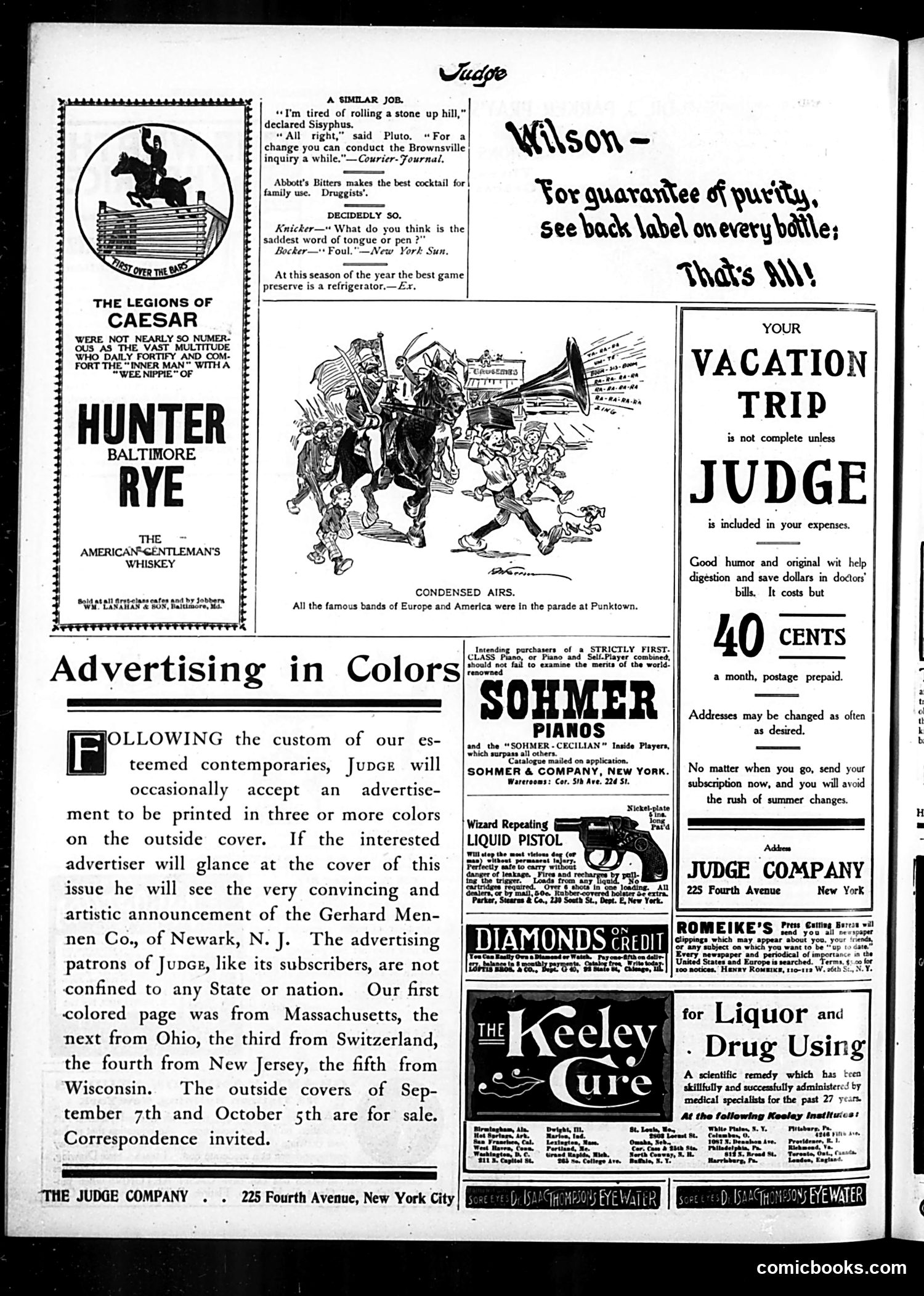
This page is primarily **advertising and editorial content** rather than satire requiring historical explanation. The main cartoon, "Condensed Airs," depicts the famous brass bands of Europe and America marching in a parade at "Punktown" (likely a fictional or playful reference). The cartoon appears to be simple visual humor about crowded, chaotic parade conditions. The notable satirical reference is in the "Similar Job" joke at top: it compares the mythological punishment of Sisyphus (eternally rolling a boulder uphill) to conducting the "Brownsville inquiry"—a real contemporary investigation. This suggests the inquiry was viewed as futile, endless bureaucratic tedium. The rest of the page consists of **advertisements** for liquor (Hunter Rye whiskey), pianos, firearms, diamonds, and a medical "cure" for drug addiction—typical of early-20th-century magazines. A house ad promotes Judge magazine subscriptions at 40 cents monthly.
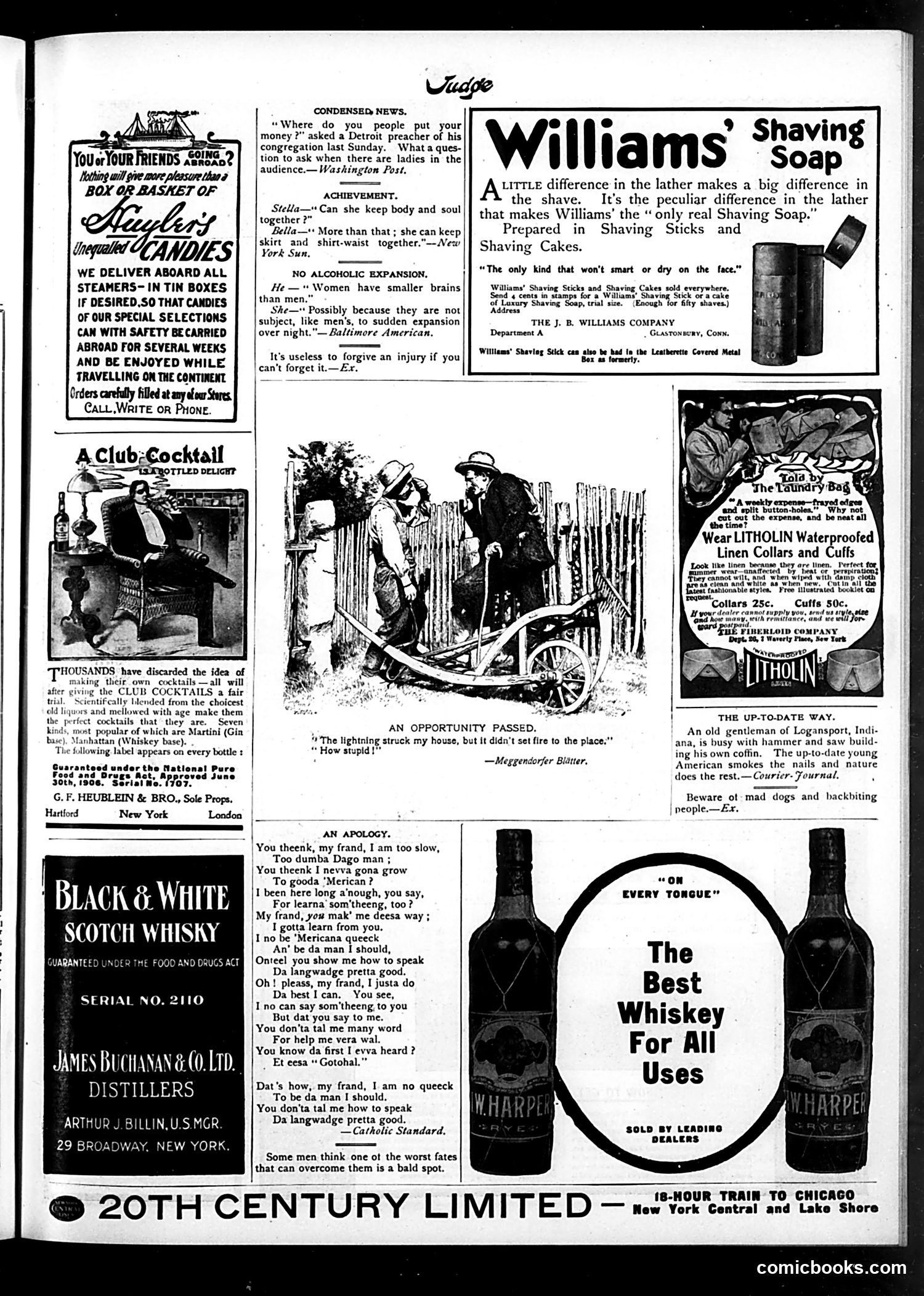
This page is primarily **advertising** with brief satirical snippets scattered throughout. The main illustrated cartoon, titled "An Opportunity Passed," depicts a man whose house was struck by lightning but didn't catch fire—he laments this as "stupid," the joke being the darkly ironic missed chance for insurance money. The condensed news items are brief gender-based jokes typical of the era: women's supposed smaller brains, a woman keeping herself together better than her clothing, etc.—standard early 20th-century sexist humor. The most notable text piece is "An Apology," a dialect poem featuring an Italian immigrant ("Dago") character speaking broken English. He apologizes for slow progress in America, claiming he can only learn by mimicking what Americans say to him—the implication being that Americans speak down to immigrants ("Gotohal" = "Go to hell"). This reflects period attitudes about immigration and assimilation, likely satirizing both immigrant experiences and American condescension. The page is otherwise dominated by product advertisements for whiskey, candies, shaving soap, and collars.
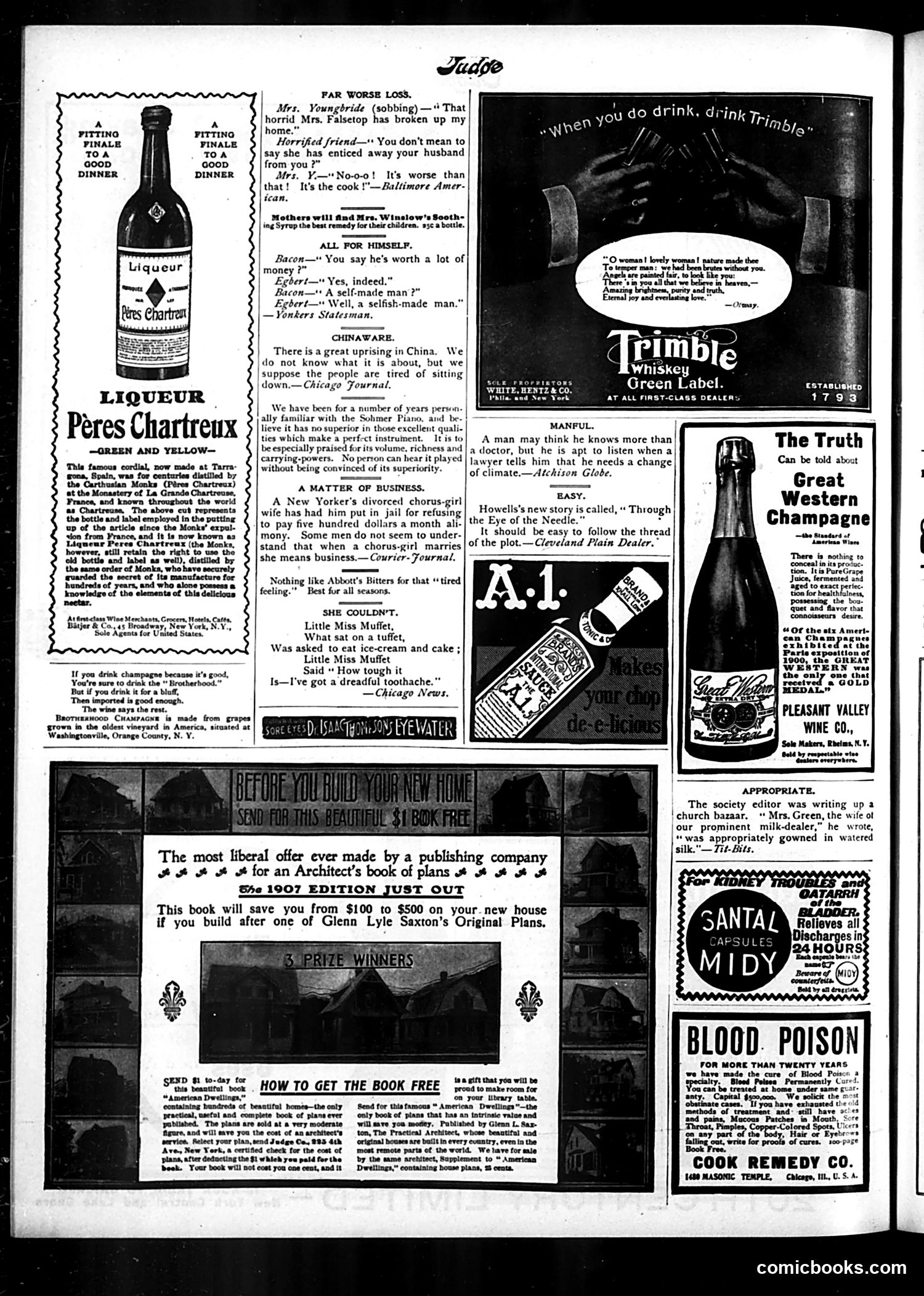
This is primarily **an advertising page** from Judge magazine with several short humor columns and jokes interspersed among ads. ## The Cartoons/Jokes: The page contains brief satirical commentary rather than visual cartoons: - **"Far Worse Loss"**: A newlywed woman's distress that a rival has stolen her cook, not her husband—satirizing that domestic servants were valued more highly than marital fidelity among wealthy couples. - **"All for Himself"**: Wordplay distinguishing between a "self-made man" and a "selfish-made man"—common American satire about wealthy businessmen's lack of generosity. - **"Chinaware"**: Cheap joke about China's "uprising" (likely the ongoing Boxer Rebellion context), reducing political unrest to speculation that Chinese people are "tired of sitting down." ## Advertisements: The page features period alcohol ads (liqueur, champagne, bitters) and patent medicine ads (soothing syrup, eyewash, blood poison remedies)—products common in this era with unregulated, often fraudulent health claims.
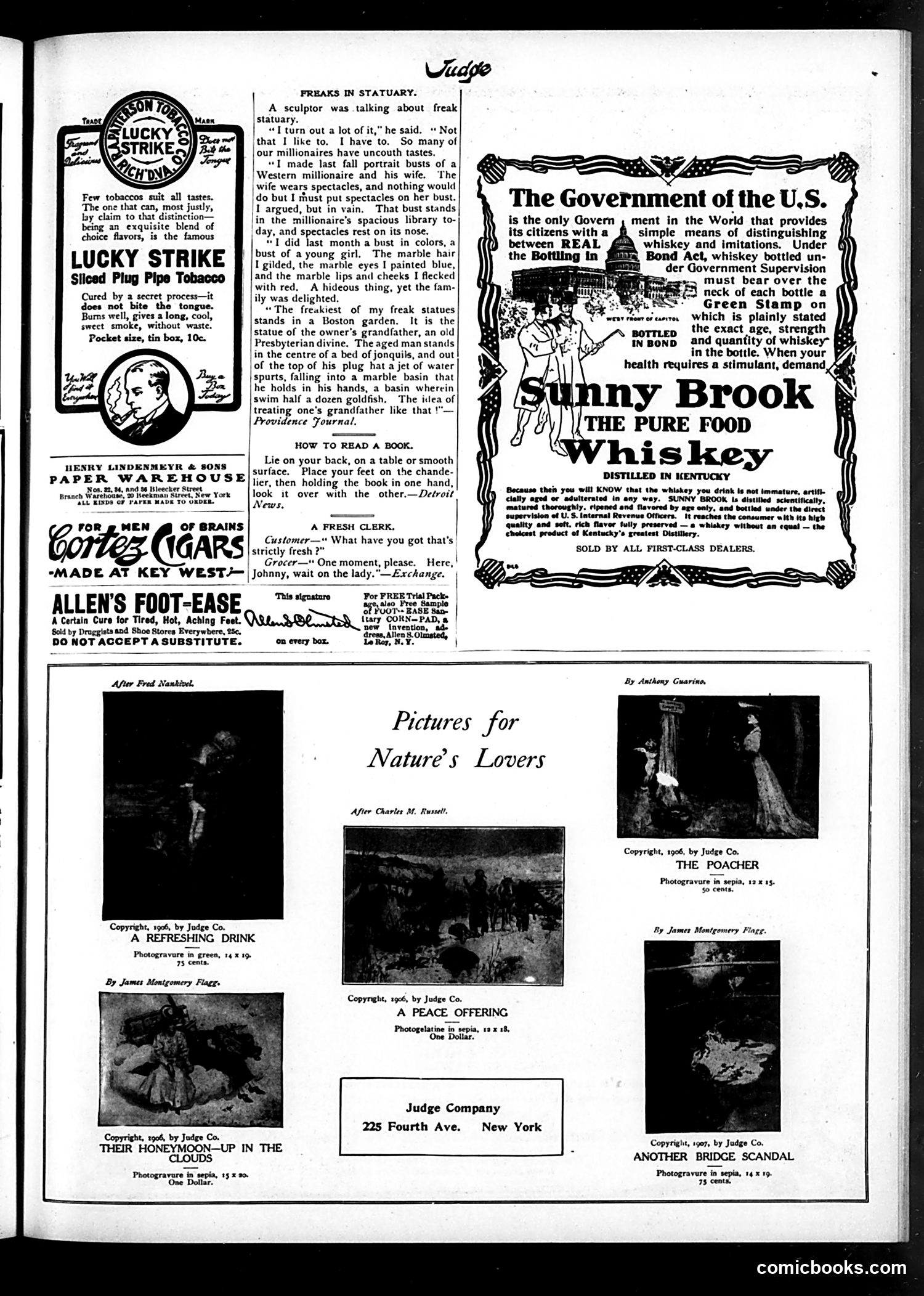
This page mixes humor columns with advertising. The main cartoon content is "Freaks in Statuary"—a satirical anecdote about wealthy industrialists commissioning bizarre sculptural portraits. The joke critiques *nouveau riche* taste: a Western millionaire's wife demands her portrait bust include her spectacles (resting on the marble nose), and a Boston grandfather's statue shoots water from a plug hat into a basin of goldfish. The satire targets the uncouth aesthetic preferences of the newly rich, suggesting their wealth hasn't brought refinement. The page also features substantial advertising for Sunny Brook Whiskey, exploiting the Pure Food and Drug Act (passed 1906) by emphasizing government bottling supervision as a mark of quality—selling safety as luxury. Lower sections show unrelated photographic art pieces and product ads (Lucky Strike tobacco, foot powder). This reflects Judge's mixed editorial-advertising format typical of early 1900s magazines.
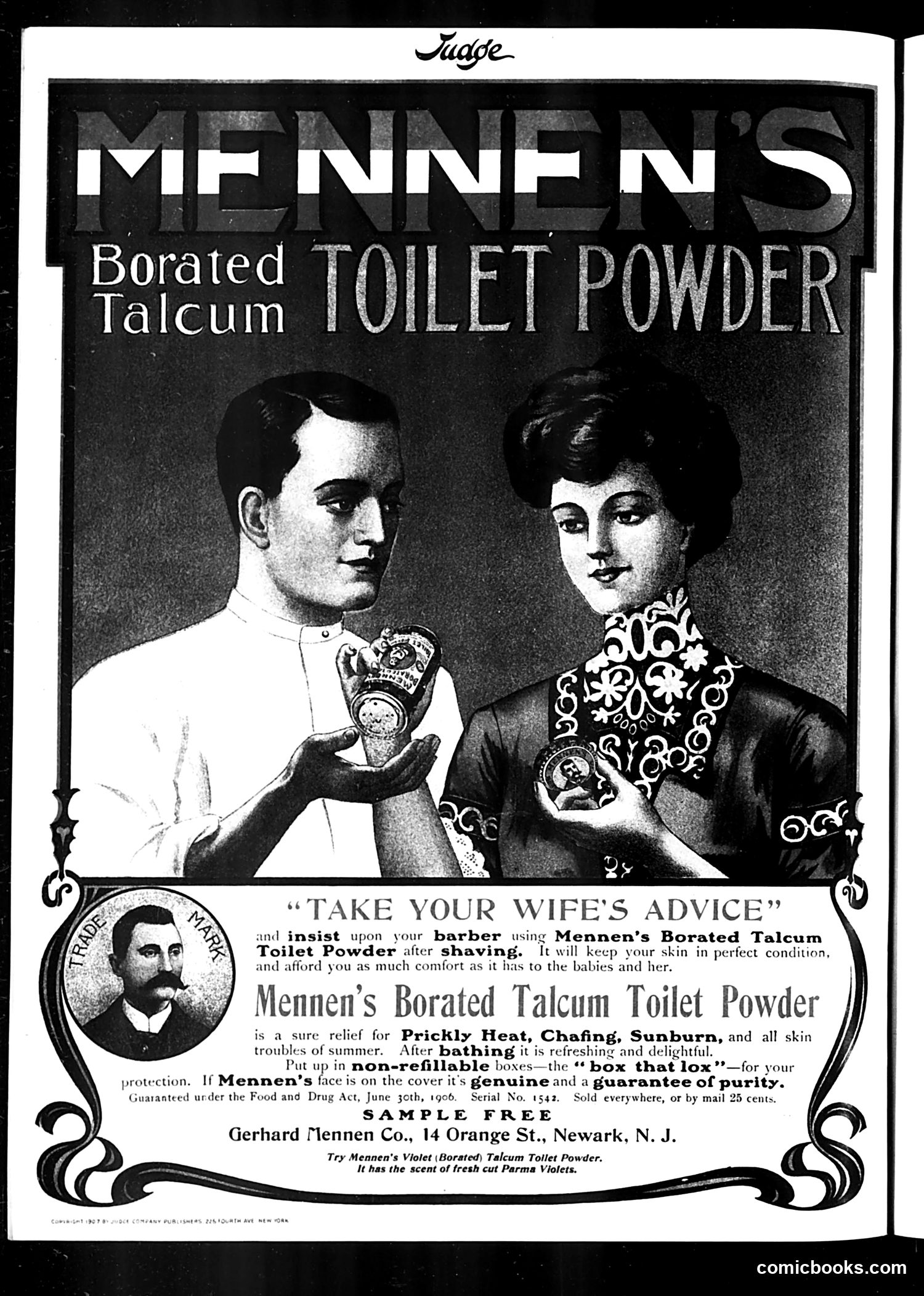
This is a full-page advertisement, not political satire. It promotes Mennen's talcum powder for men's grooming, specifically for use after shaving. The ad features an elegant couple—a man in formal white dress and a woman in dark clothing—each holding decorative powder containers. The headline "Take Your Wife's Advice" appeals to masculine vanity by suggesting wives endorse the product for their husbands' grooming. The copy emphasizes the powder relieves summer skin problems (prickly heat, chafing, sunburn) and promises purity under the 1906 Food and Drug Act. A small portrait of "Gerhard Mennen" appears as the brand's face, establishing trustworthiness. This reflects early-1900s marketing strategies: using social status imagery, appealing to domestic authority figures, and leveraging new consumer protection laws as credibility markers. The luxury presentation contrasts with the modest 25-cent price point.