
A complete issue · 19 pages · 1907
Judge — June 29, 1907
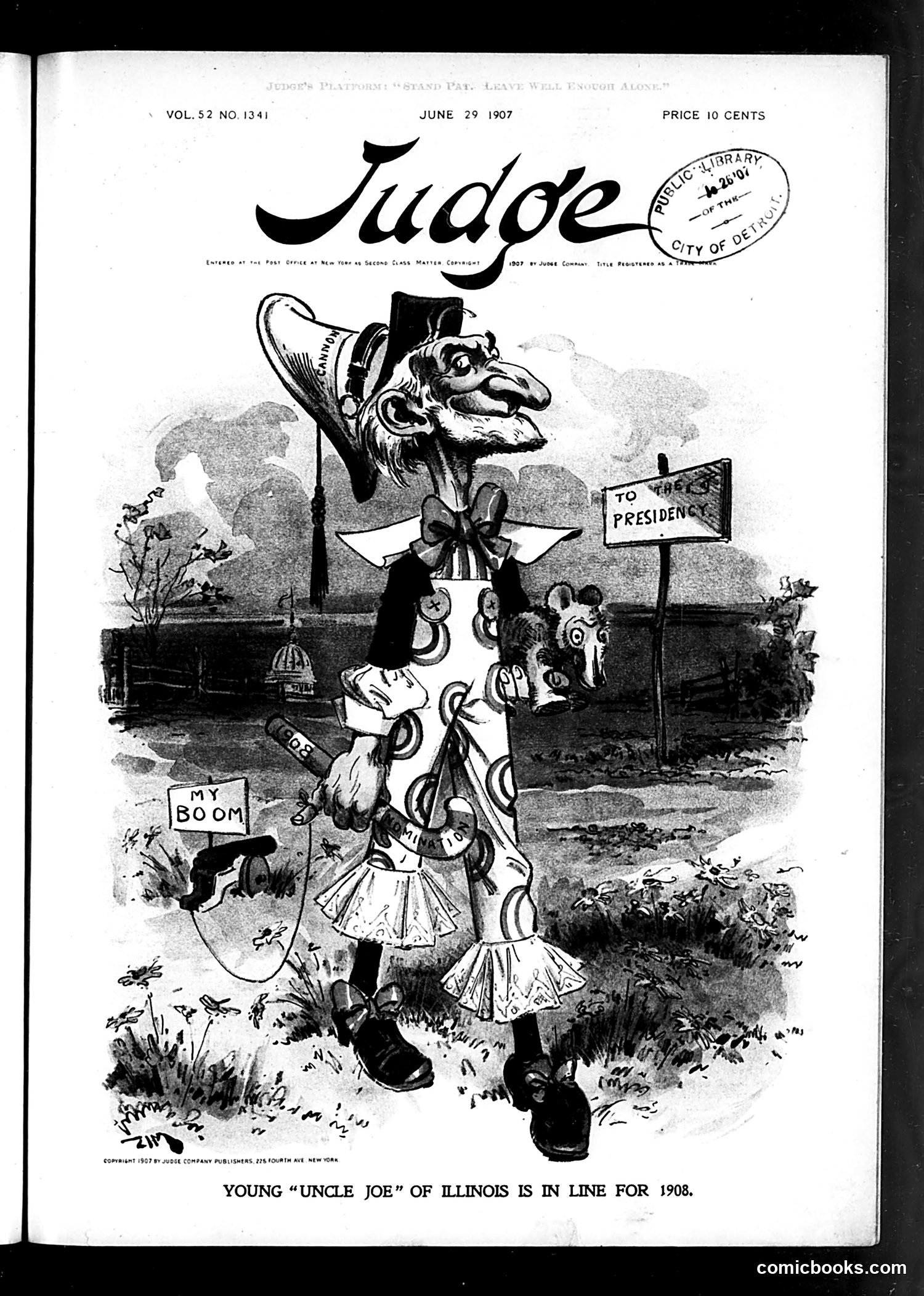
This cartoon satirizes **Joseph "Uncle Joe" Cannon**, Speaker of the House from Illinois, a powerful Republican figure of the era. The grotesque caricature depicts him as a jester or fool with exaggerated facial features, dressed in motley with dollar signs adorning his costume—suggesting corruption or financial self-interest. The sign reading "TO THE PRESIDENCY" indicates this cartoon mocks Cannon's apparent ambitions for the 1908 presidential election. The "MY BOOM" sign suggests his campaign efforts. The satire implies Cannon was an unseemly, foolish choice for higher office, criticizing both his character and his political influence. This reflects contemporary Progressive Era criticism of Cannon as an old-guard Republican obstacle to reform.
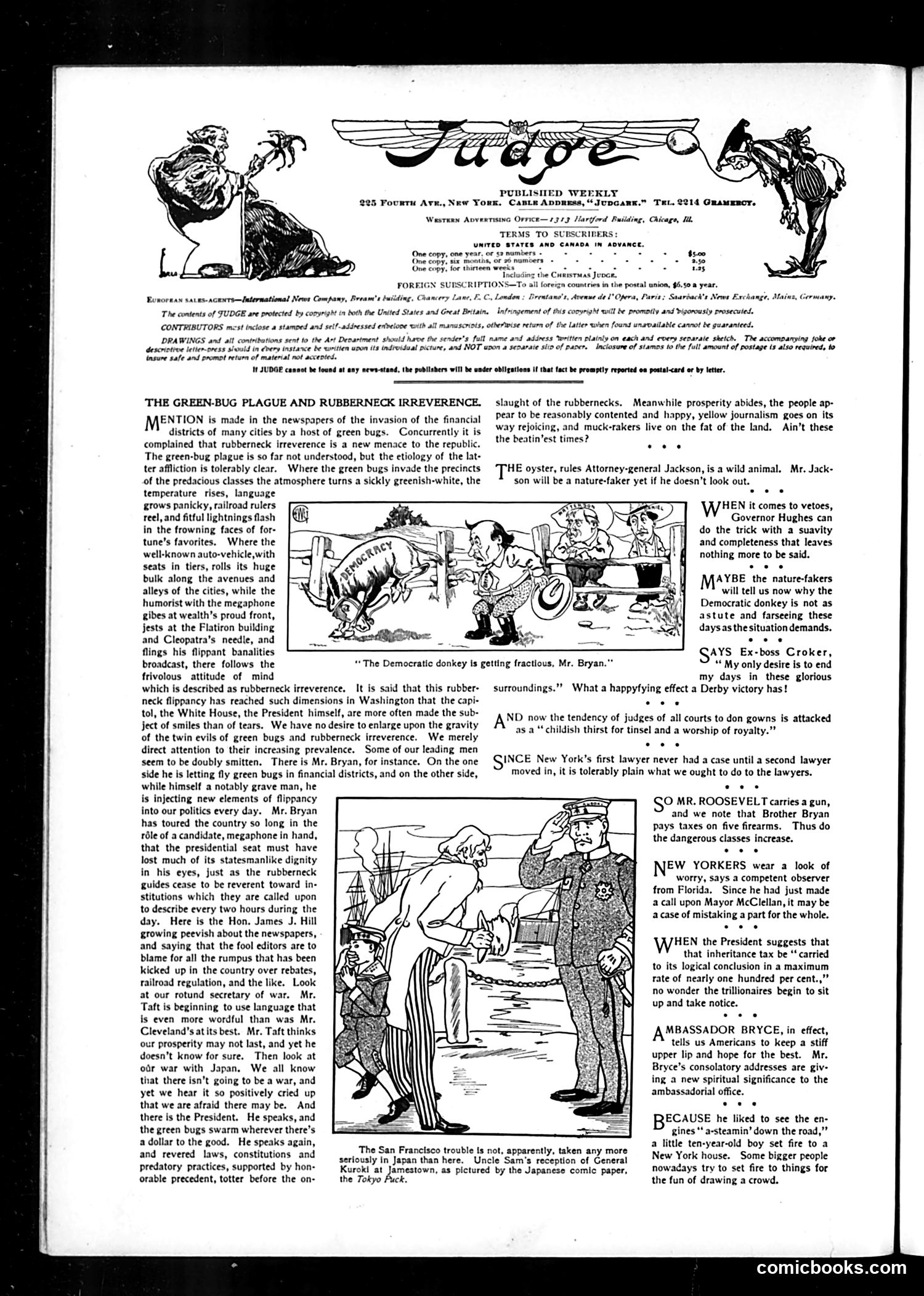
This page satirizes early 20th-century American political tensions. The main cartoon shows "The Democratic donkey is getting fractious, Mr. Bryan," depicting William Jennings Bryan attempting to control a stubborn Democratic party donkey—a standard political metaphor representing internal party discord. The accompanying text mocks various figures: Attorney-General Jackson as a "wild animal" and "nature-faker"; Governor Hughes's competence; and President Taft's policies. The satire targets Democratic infighting, Roosevelt's successor Taft, and broader Progressive Era conflicts. The "green-bug plague" reference appears to address agricultural/economic concerns, while editorial notes attack sensationalist newspapers and discuss inheritance taxes and firearms regulation—progressive policy debates of the period.
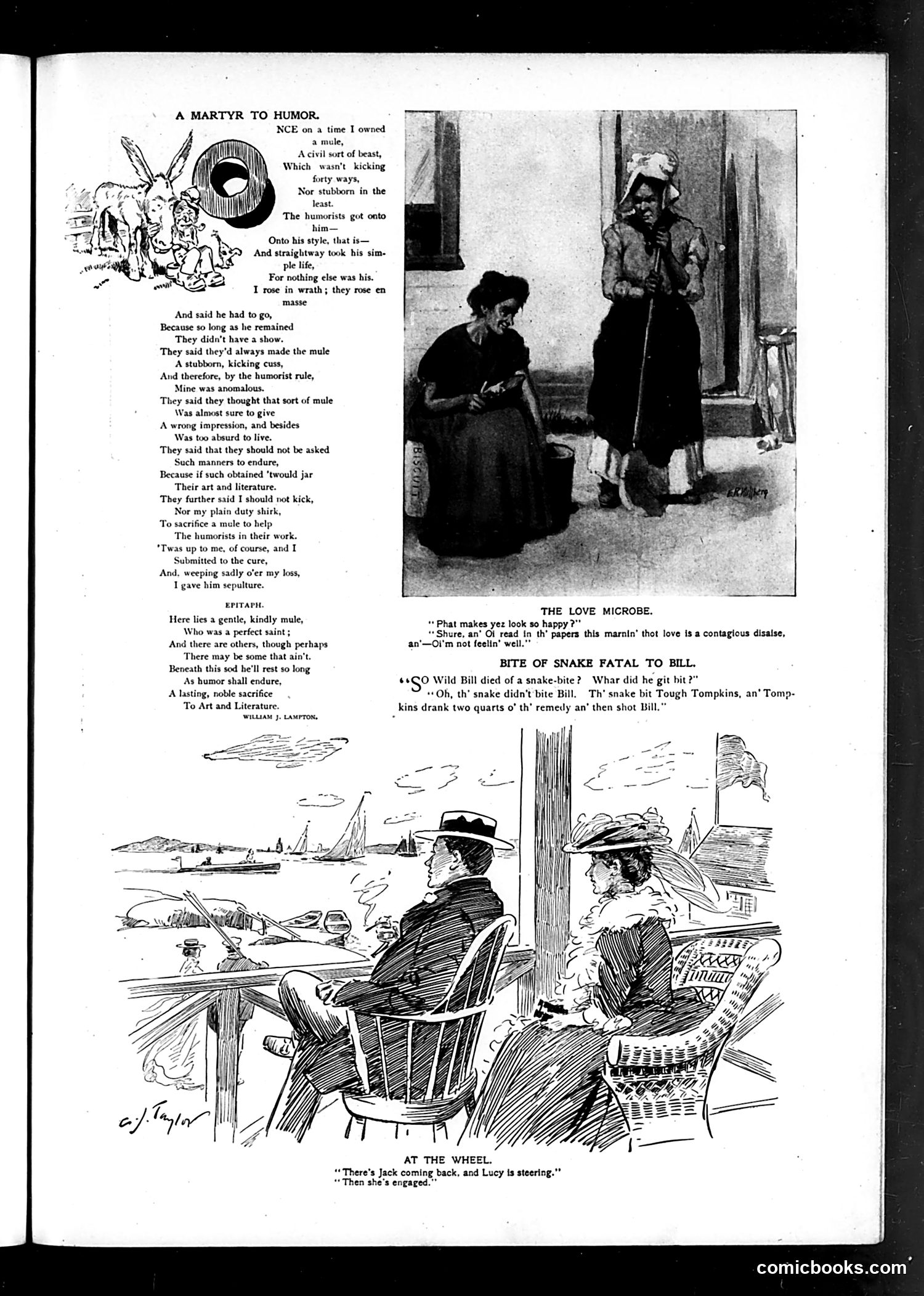
This page contains several humorous pieces rather than a single political cartoon: **"A Martyr to Humor"** is a poem about a humorist who sacrificed a mule to pursue his art, satirizing the supposed nobility of suffering artists. **"The Love Microbe"** shows a photograph with a caption joking that love is "a contagious disease"—typical turn-of-century humor about romance. **"Bite of Snake Fatal to Bill"** presents a folksy tall tale where Wild Bill supposedly survives a snake bite by drinking pumpkins and whiskey as remedy. **"At the Wheel"** is a sketch showing two people boating, with dialogue suggesting an engagement announcement. These pieces represent Judge's mix of literary satire, visual humor, and wordplay typical of early 20th-century American magazine comedy—not specifically political content.
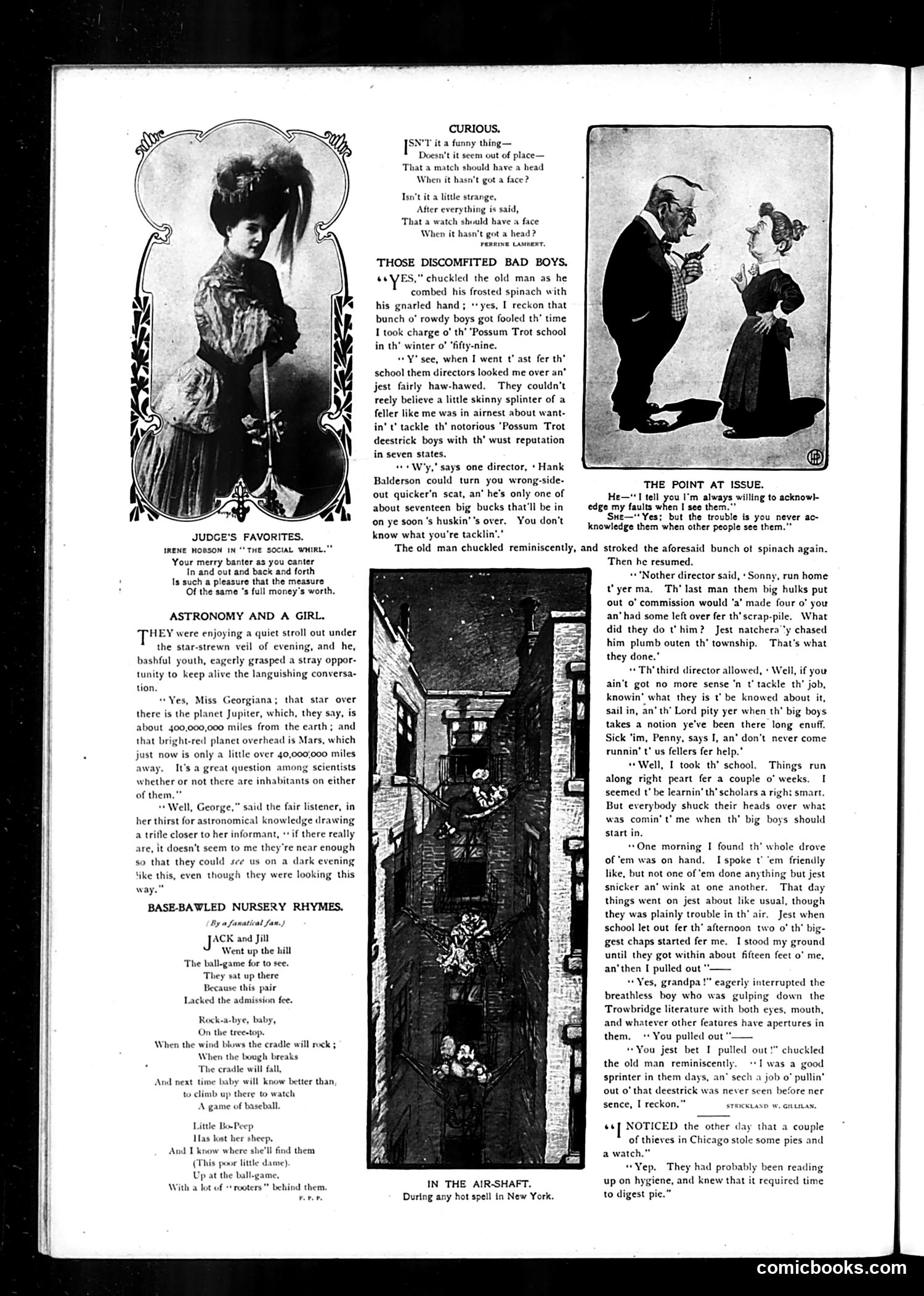
This page contains several satirical pieces and illustrations typical of Judge's humorous content: **"Curious"** (top left): A poem mocking the illogic of men wearing hats without heads—likely satirizing Victorian fashion absurdities. **"Those Discomfited Bad Boys"**: A narrative about rowdy schoolboys who disrupted their classroom, getting comeuppance from school directors. This appears to be social commentary on youth misbehavior and discipline. **"Astronomy and a Girl"**: A dialogue satirizing pseudo-intellectual posturing—a man lectures a woman about astronomy to impress her, but she deflates his pretensions with practical wisdom. **"Base-Bawled Nursery Rhymes"**: Humorous parodies of traditional nursery rhymes with deliberately crude language. The page also includes illustrations depicting domestic and social scenes. Overall, the content reflects Judge's focus on satirizing contemporary manners, education, and gender relations in late 19th/early 20th-century America.
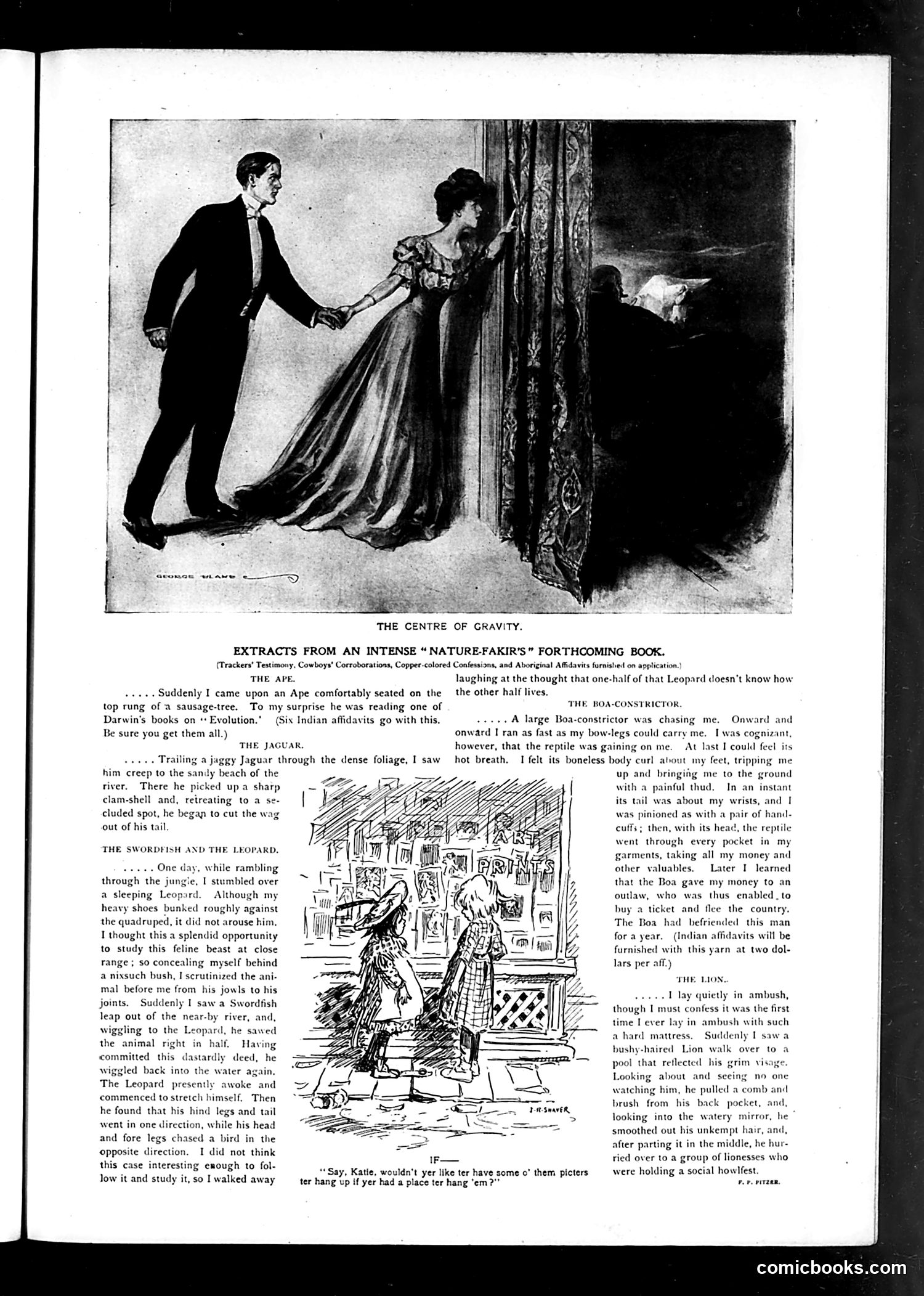
**Top Illustration ("The Centre of Gravity"):** Shows a man and woman in formal dress at what appears to be a doorway or curtain, with a shadowy figure visible beyond. The caption suggests domestic drama or infidelity, though specifics are unclear without additional context. **Main Content:** Four animal anecdotes titled "Extracts from an Intense 'Nature-Fakir's' Forthcoming Book": - *The Ape*: About an ape reading Darwin - *The Jaguar*: A jaguar's encounter in jungle foliage - *The Swordfish and the Leopard*: Swimming combat between creatures - *The Boa-Constrictor* and *The Lion*: Animal adventures These appear to satirize contemporary "nature-faker" literature—tall tales about animals presented as fact. The humor likely mocks popular exotic adventure writing of the era that exaggerated animal behavior.
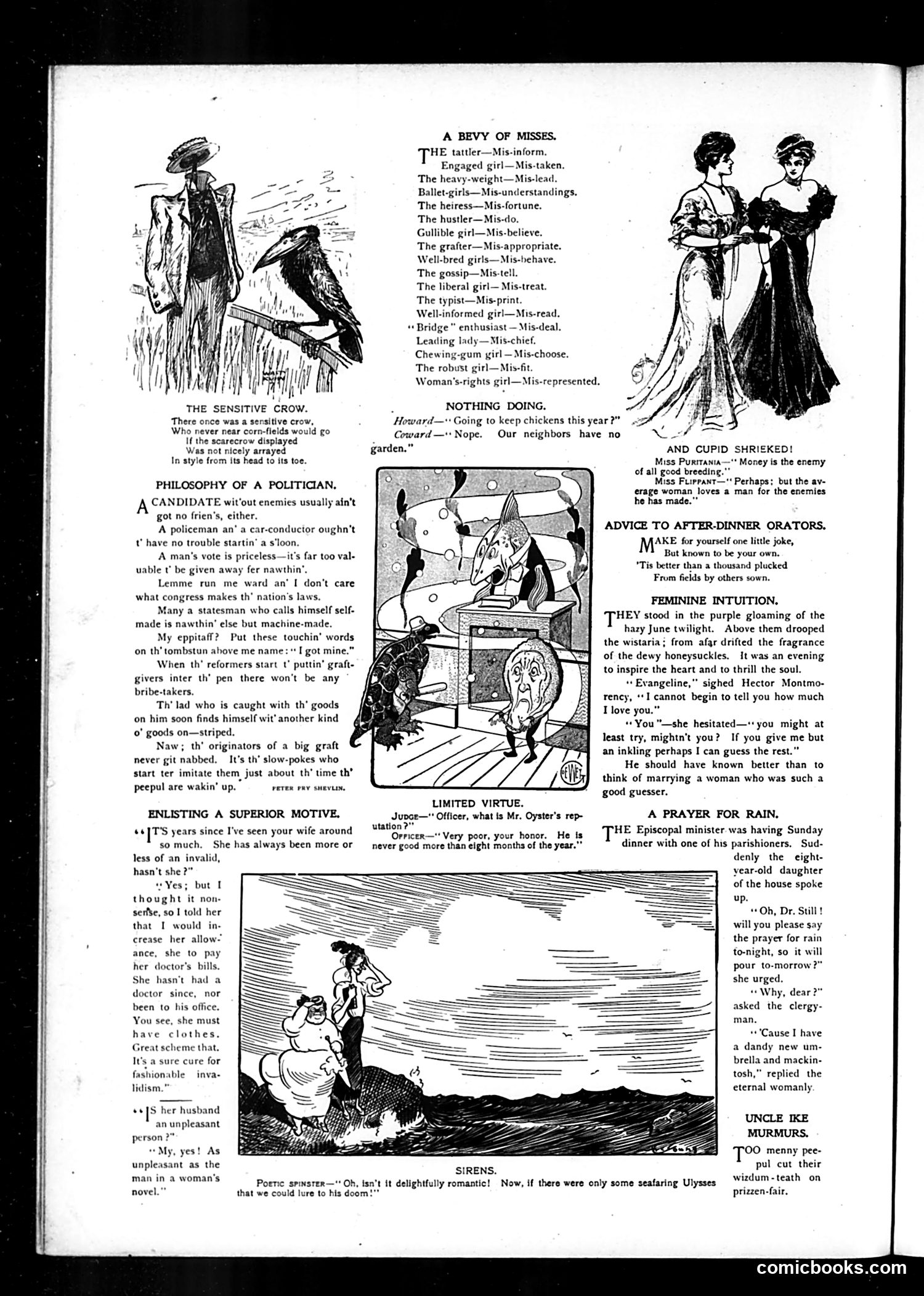
This satirical page contains multiple humor pieces targeting early 20th-century American society and politics: **"Philosophy of a Politician"** mocks corrupt machine politics through cynical maxims—politicians prioritizing personal gain ("I got mine") over constituents, dismissing reform efforts, and exploiting the electoral system. The satire suggests widespread graft and bribery in urban politics. **"A Bevy of Misses"** uses puns on "mis-" words to stereotype female types: the tattler, heiress, gossip, etc. This reflects period anxieties about women's social roles and behaviors. **"Enlisting a Superior Motive"** satirizes a man who solves his wife's hypochondria by threatening financial consequences—implying women use illness for attention or financial advantage, a common sexist trope. The remaining pieces—brief jokes about virtue, after-dinner speaking, romance, and rain prayers—offer lighter social commentary typical of Judge's humor formula: targeting politicians, women's stereotypes, and genteel social conventions. The page reflects Gilded Age cynicism about corruption and gender attitudes common to the era.
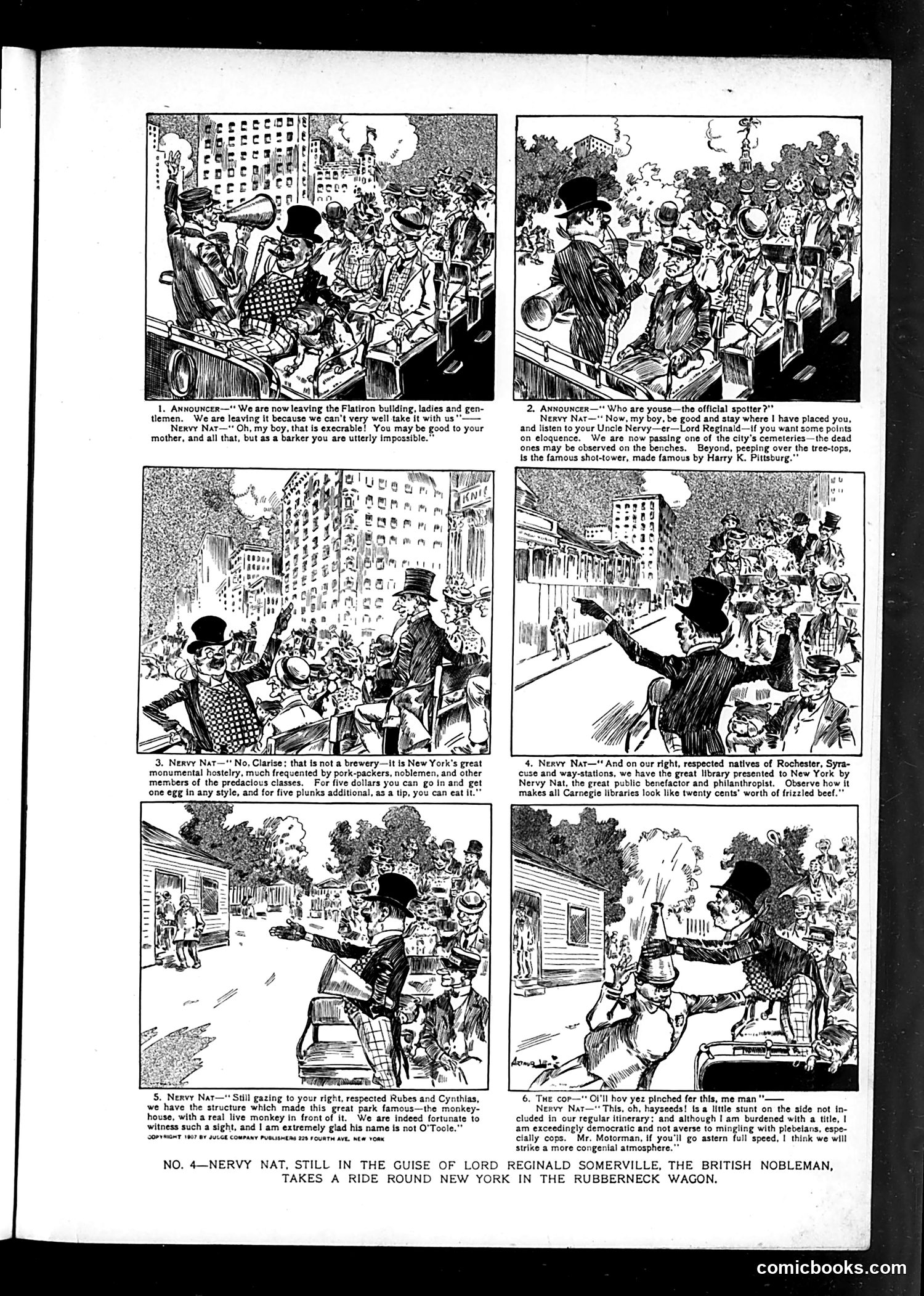
This 1907 Judge comic satirizes "rubberneck" tourist wagons—vehicles that transported visitors around New York City to see landmarks. The character "Nervy Nat," disguised as a fake British nobleman "Lord Reginald Somerville," serves as a tour guide offering deliberately absurd, insulting commentary. The satire targets multiple subjects: wealthy tourists ("Rubes and Cynthias"), New York's pretensions (mocking the Flatiron Building, grand hotels charging five dollars for an egg), and class snobbery (Nat boasts about a library while condescending to "plebeians" and cops). The cartoon mocks the commercialization of tourism and the fake sophistication peddled to gullible visitors. References to contemporary landmarks (Carnegie libraries, the Flatiron) and the "rubberneck wagon" itself—a genuine fixture of early 1900s New York tourism—ground this in specific historical context. The humor relies on recognizing these real locations and the era's class anxieties.
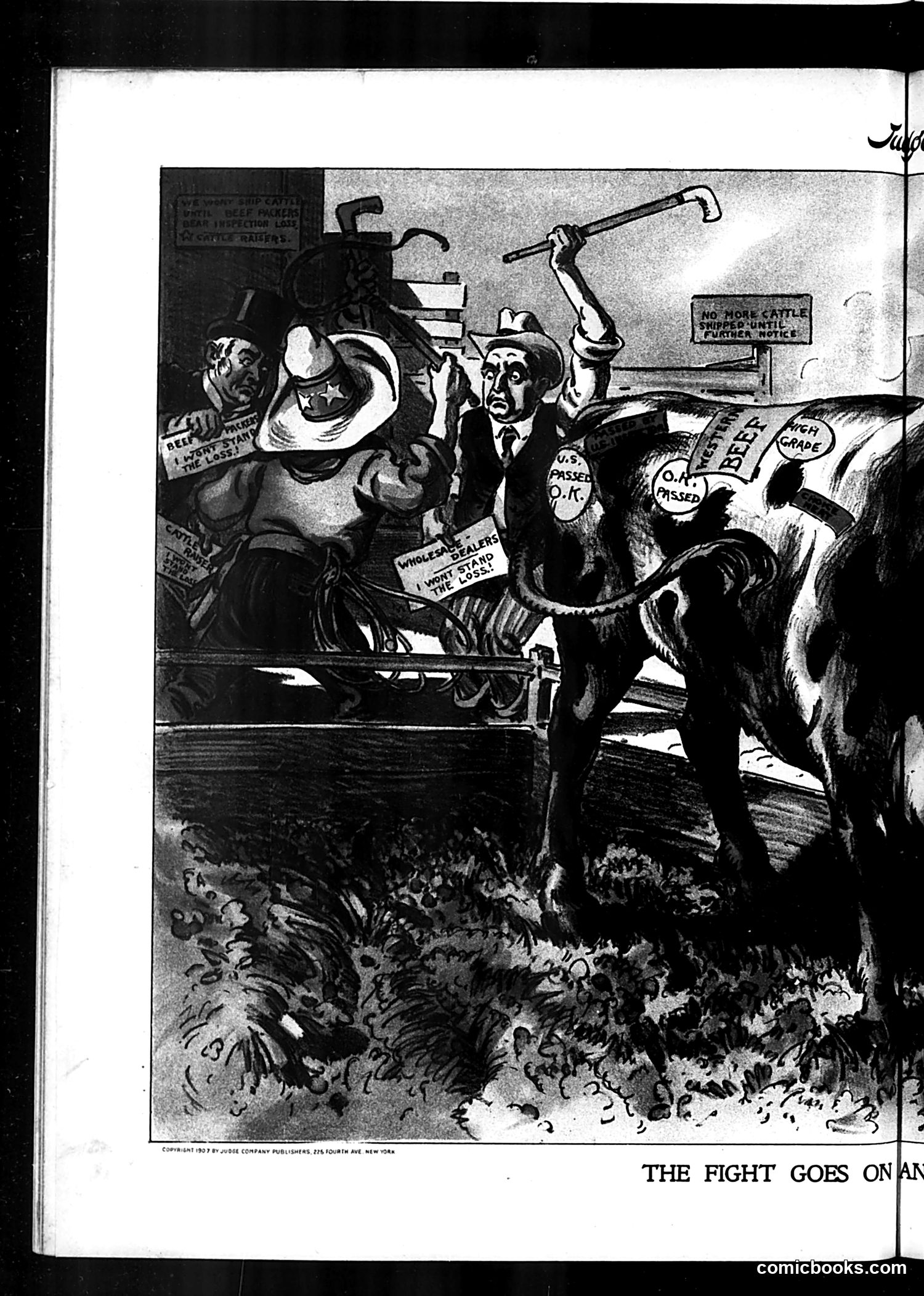
This political cartoon depicts a conflict over cattle transportation and regulation. A man in business attire (likely representing cattle industry interests or "Wheel Sealers") wields a club against a figure labeled "U.S. Passed O.K." and "O.M. Passed," suggesting government regulatory bodies. A sign reads "NO MORE CATTLE SHIPPED UNTIL FURTHER NOTICE," indicating a transportation halt, possibly due to safety or welfare regulations. The cartoon criticizes industry resistance to government oversight of livestock shipping practices. The satirical point appears to be that business interests are violently opposing legitimate regulatory protections, portrayed here as "the fight" between industry resistance and government authority. The date and specific legislative context remain unclear from the visible text.
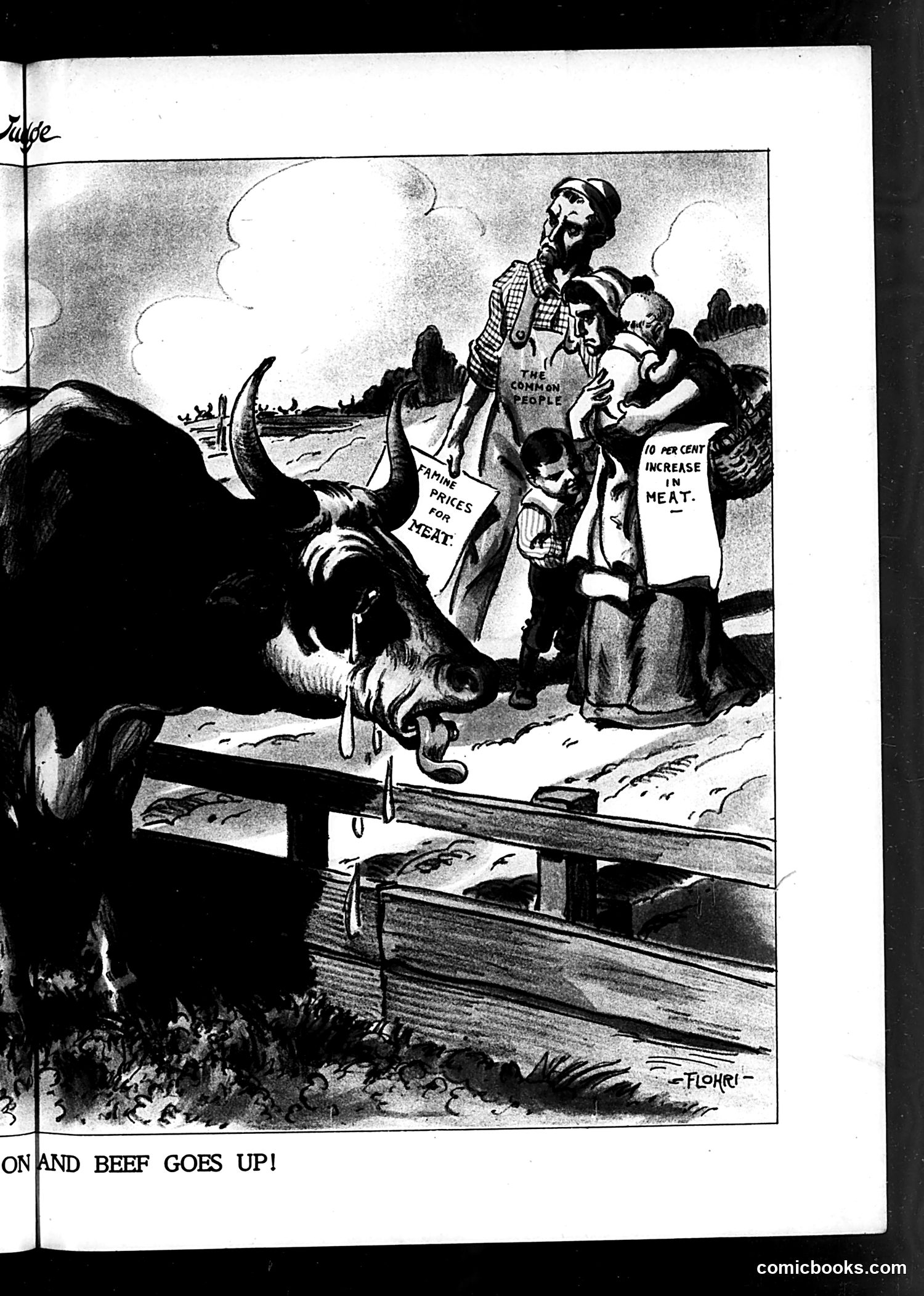
This appears to be a satirical cartoon about meat price inflation. A farmer/rancher figure (labeled "THE COMMON PEOPLE") holds two young children while standing between horned cattle. Signs reference "PACKING PRICES FOR MEAT" and "10 PER CENT INCREASE IN MEAT." The cartoon critiques how ordinary families suffer when meat prices rise—the farmer represents working-class people caught between livestock producers and price increases. The children emphasize the human cost of inflation on family budgets. The large horned cattle in the foreground suggest the livestock industry driving prices upward. The satirical point: while cattle industry profits grow, ordinary consumers and their families bear the burden of inflation. This likely reflects early 20th-century economic tensions over food prices and corporate agricultural practices.
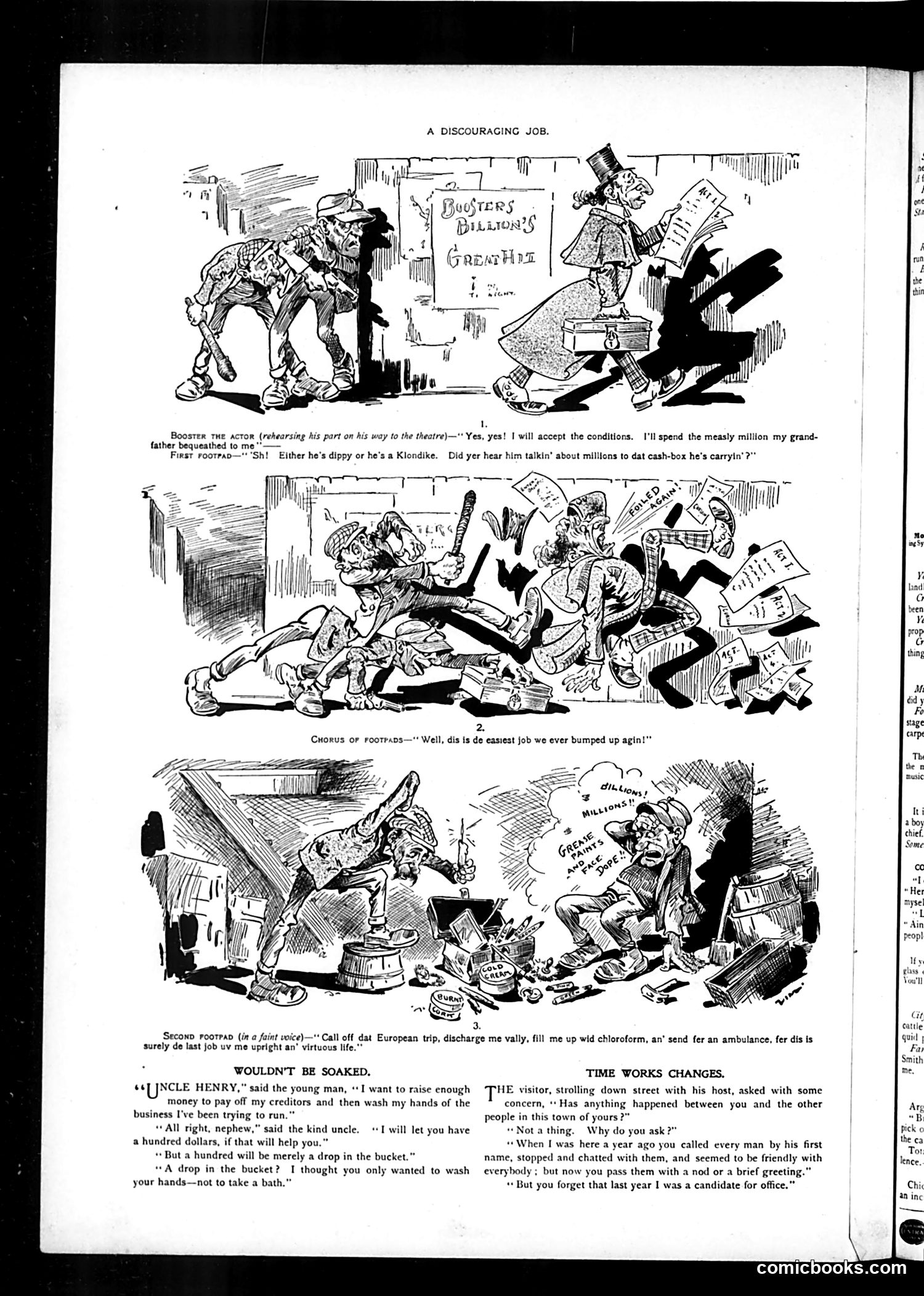
This page contains three satirical cartoons mocking American social pretension and hypocrisy circa early 1900s. **Top cartoon**: An actor rehearsing accepts conditions to spend his grandfather's inheritance, while stagehands mock him as either foolish or secretly wealthy ("Klondike" = gold strike). **Middle cartoon**: Stagehands collapse from the exhausting work, sarcastically declaring this "the easiest job we ever bumped up again." **Bottom two pieces**: "Wouldn't Be Soaked" jokes about a nephew seeking uncle's financial help; "Time Works Changes" satirizes political phoniness—a man who warmly greeted everyone by first name when running for office now ignores those same townspeople, having lost the election and no longer needing their votes. The overall theme: American opportunism, where friendliness and civility are purely transactional, abandoned once their utility ends.
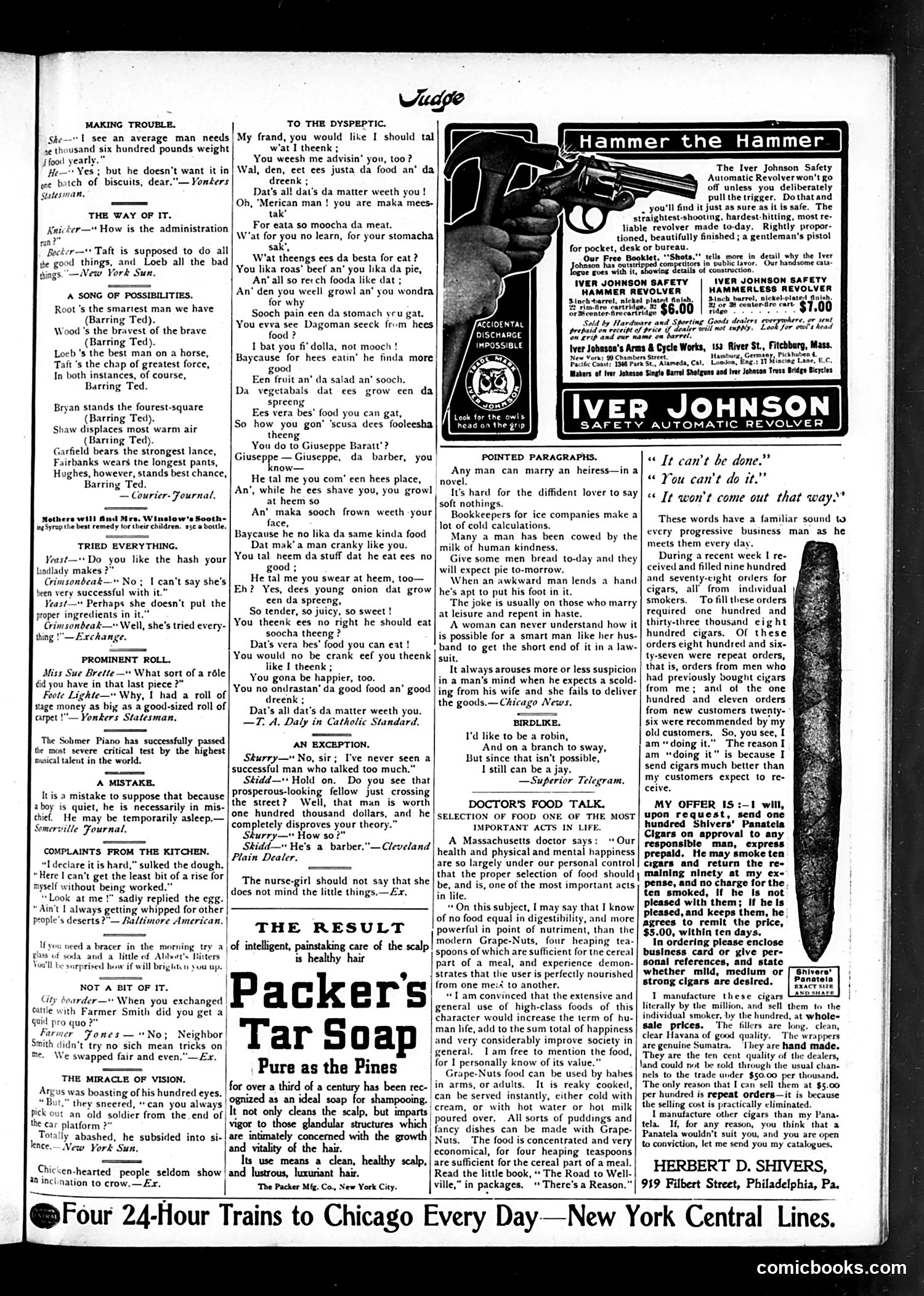
This page from the satirical magazine **Judge** contains multiple short jokes and comic pieces typical of early 20th-century American humor, plus advertisements. **Key content includes:** - Several brief dialogue jokes mocking everyday situations (a husband's food complaints, political administration under Taft, etc.) - A poem "A Song of Possibilities" that sarcastically compares various political figures while repeatedly noting they're all inferior to "Ted" (likely Theodore Roosevelt) - A dialect-heavy piece "To the Dyspeptic" featuring an Italian immigrant character (Giuseppe) giving humorous food advice in broken English—a common ethnic stereotype of the era - Various other quips about relationships, politics, and social behavior **The satire targets:** - American eating habits and dyspepsia (indigestion) - Political incompetence under President Taft - Social pretension and everyday complaints The page reflects early 1900s humor conventions: ethnic caricature through dialect, political commentary, and domestic comedy. Most jokes rely on wordplay and observed social behavior rather than sophisticated satire.
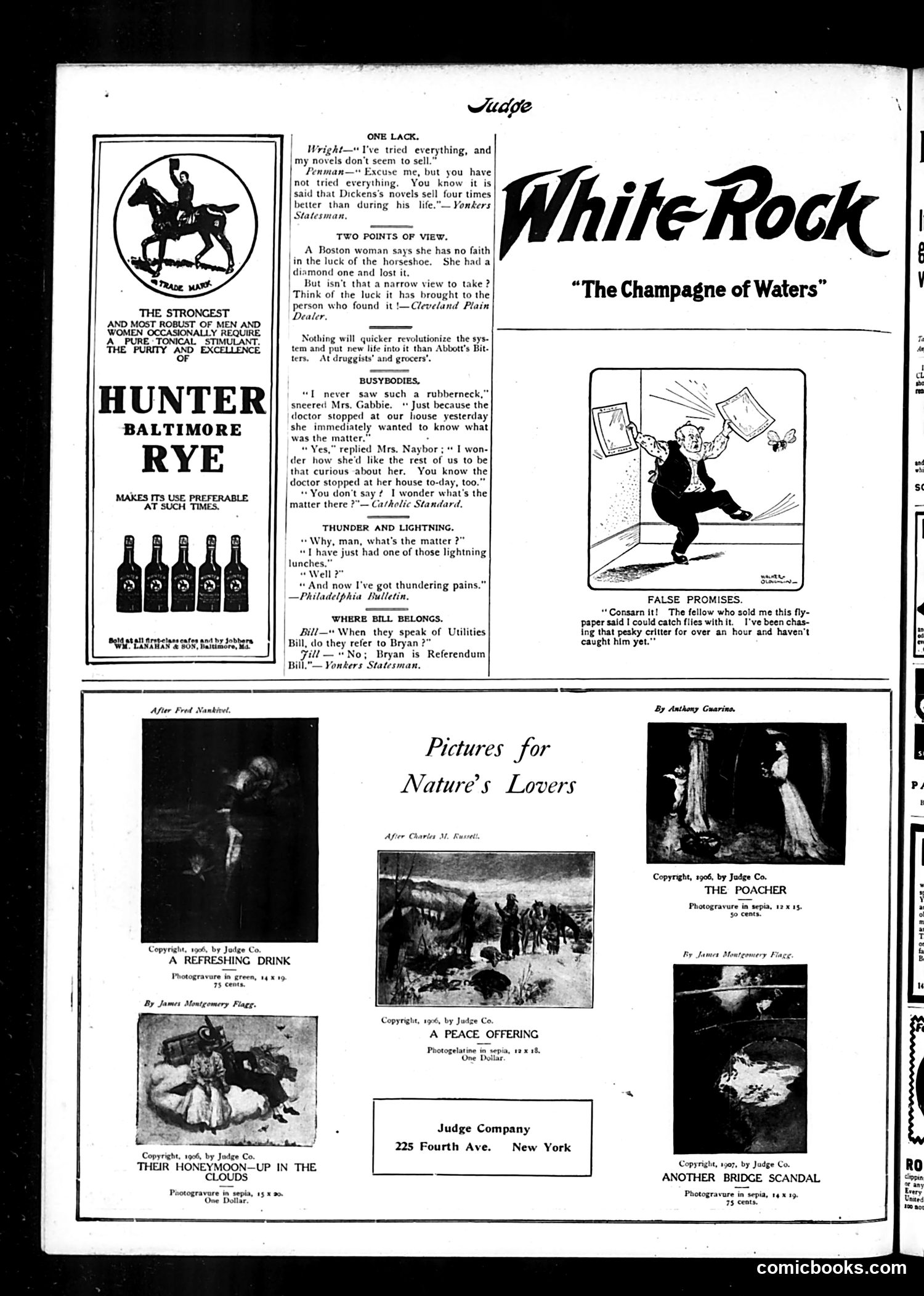
This page from Judge magazine (circa 1906-1907) contains several short satirical jokes and advertisements rather than a single unified cartoon. **The humor targets everyday social behaviors:** - "One Lack" mocks struggling writers seeking sales gimmicks - "Two Points of View" jokes about the irony of lost lucky charms - "Busybodies" ridicules gossipy neighbors who pry into each other's affairs - References to "Bryan" and "Referendum Bill" appear to be political jabs at William Jennings Bryan, a three-time presidential candidate known for populist positions **The "False Promises" cartoon** depicts a man frustrated trying to catch flies with flyaper—satirizing false advertising claims. **The lower half showcases art prints** for sale featuring nature scenes ("The Poacher," "A Peace Offering," etc.), targeting aesthetically-minded middle-class readers. The page exemplifies Judge's formula: brief jokes about middle-class life mixed with advertisements and art sales, reflecting early 1900s consumer culture and genteel humor.
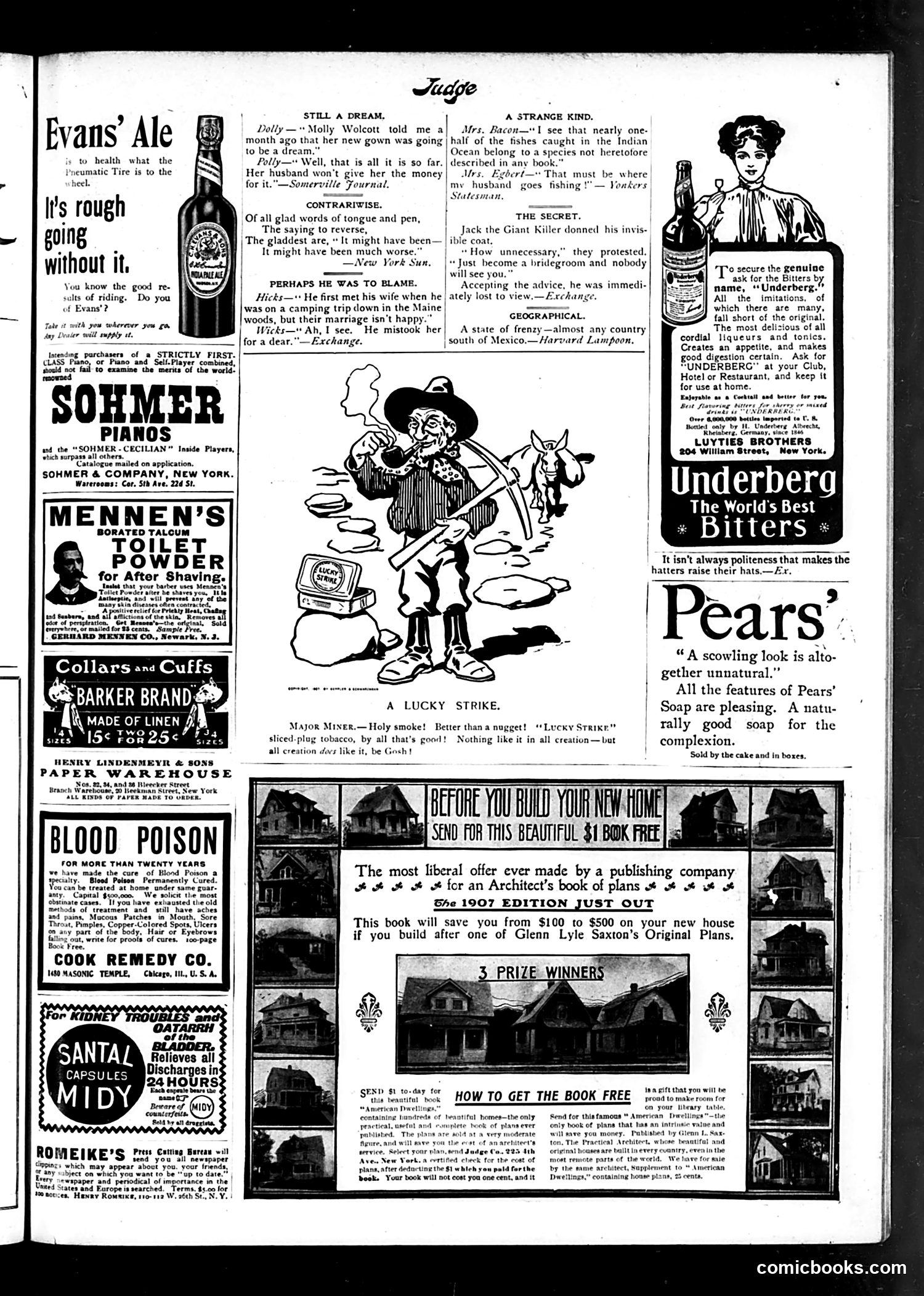
This is primarily an **advertising page** from Judge magazine, with several small humorous anecdotes scattered among commercial advertisements. The main cartoon depicts **"A Lucky Strike"**—a man who has found sliced-plug tobacco and exclaims over its quality. This is a straightforward product advertisement presented as a joke. The text anecdotes are brief social humor typical of the era: - "Still a Dream" jokes about a wife wanting a gown her husband won't finance - "Contrariwise" offers philosophical wit about counting blessings - "A Strange Kind" references a husband who finds fishing more interesting than his wife - "The Secret" plays on invisibility and being ignored by a spouse These represent **domestic humor** common to early 1900s magazines—jokes about marriage, gender relations, and the tension between spouses' interests. The page is overwhelmingly dominated by period product advertisements (ales, pianos, talcum powder, remedies for venereal disease, architectural plans), reflecting Judge's primary revenue model.
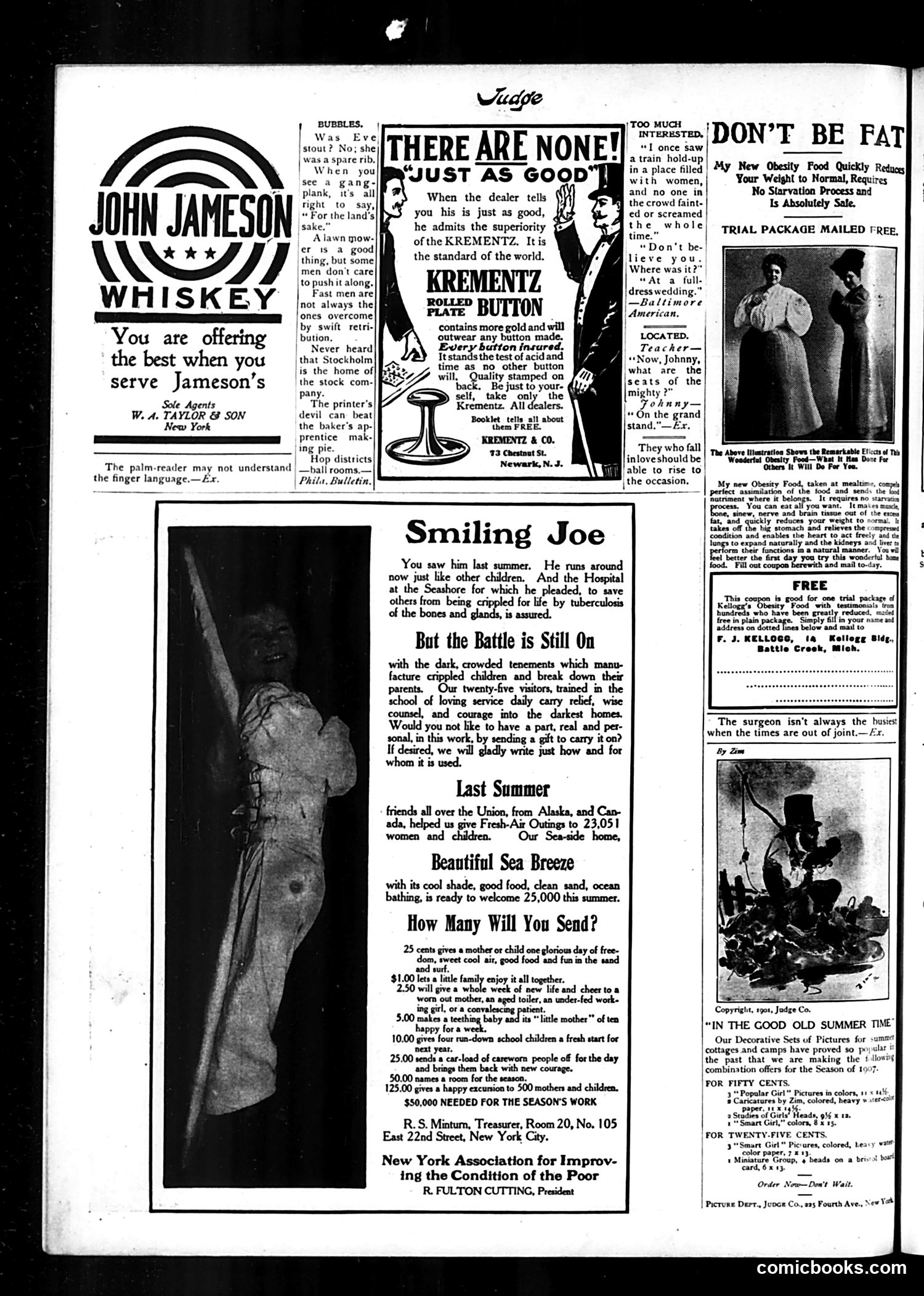
This page is primarily **advertising and charitable fundraising**, not political satire. The main content features: **"Smiling Joe" and Fresh-Air Campaign**: A charitable appeal from the New York Association for Improving the Condition of the Poor, seeking donations ($0.25–$50,000) to fund summer outings for poor women and children to a seaside location. "Smiling Joe" represents a beneficiary helped the previous summer. The campaign emphasizes moral uplift through exposure to "beautiful sea breeze" and nature—typical Progressive Era paternalism toward the poor. **Advertisements**: Prominent ads for John Jameson Whiskey, Krementz buttons, and an "Obesity Food" weight-reduction product. **Brief humor items** ("Bubbles"): Contain light jokes about palm readers, railroad gangplanks, and other minor observations. The page reflects early 1900s assumptions about poverty relief, consumerism, and middle-class benevolence toward the urban poor.
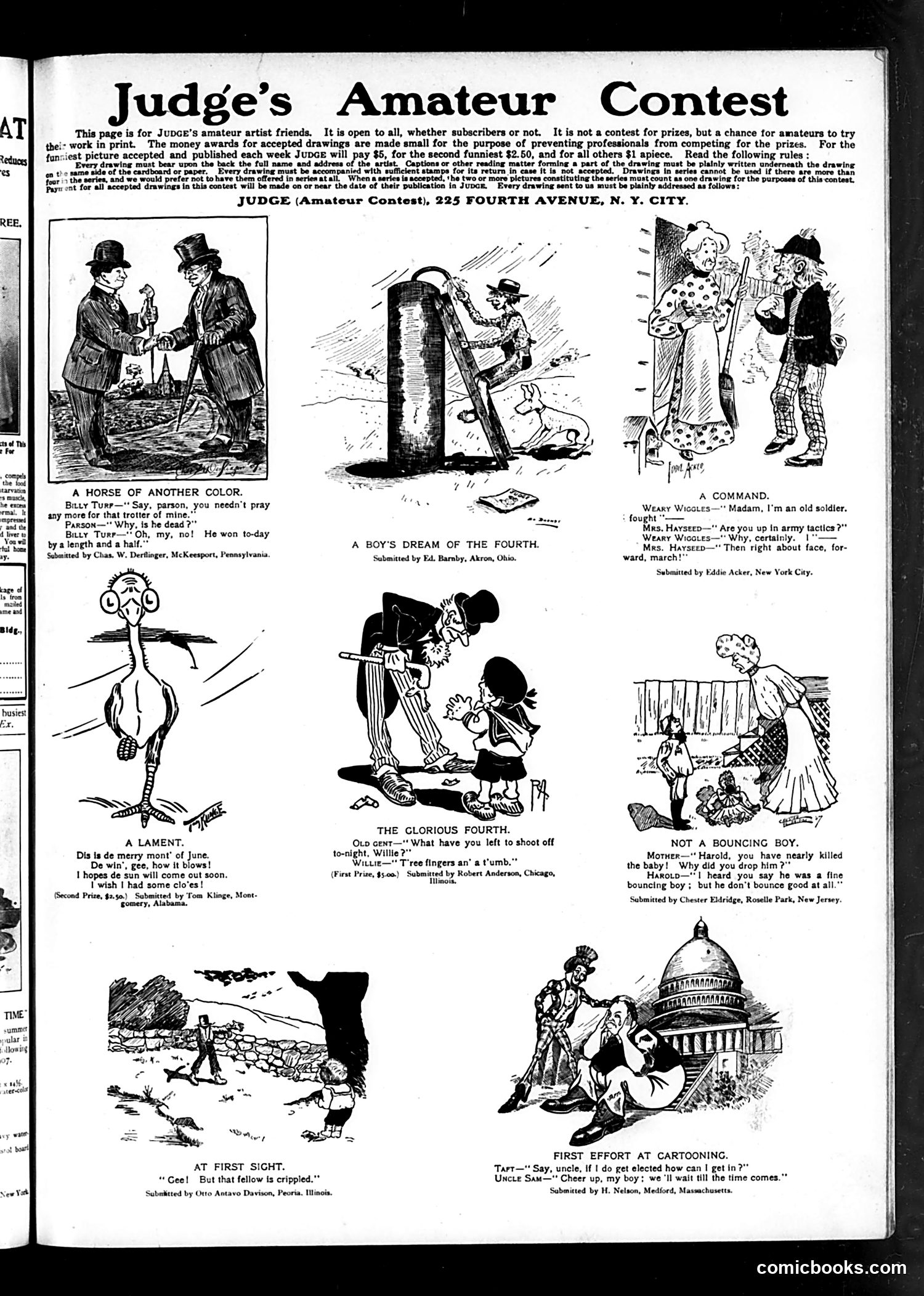
This is a reader-submission page for amateur cartoonists, not a political cartoon itself. The page contains eight humorous drawings with captions submitted by readers. Notable entries include: - **"The Glorious Fourth"** (first prize, $5.00): A joke about a child who has blown off his fingers with fireworks, treating Independence Day injuries darkly. - **"A Lament"** (second prize, $2.50): An African American dialect poem about poverty in June, using period stereotyping common to the era. - **"First Effort at Cartooning"**: Features Uncle Sam, representing America, encouraging someone (appears to be a political candidate) that election success is possible. Most cartoons employ simple domestic humor—betting on horses, military encounters, child misbehavior—typical of early 20th-century comic magazines. The racial dialect humor reflects attitudes of that historical period. These are genuinely amateur submissions being published to showcase reader talent.
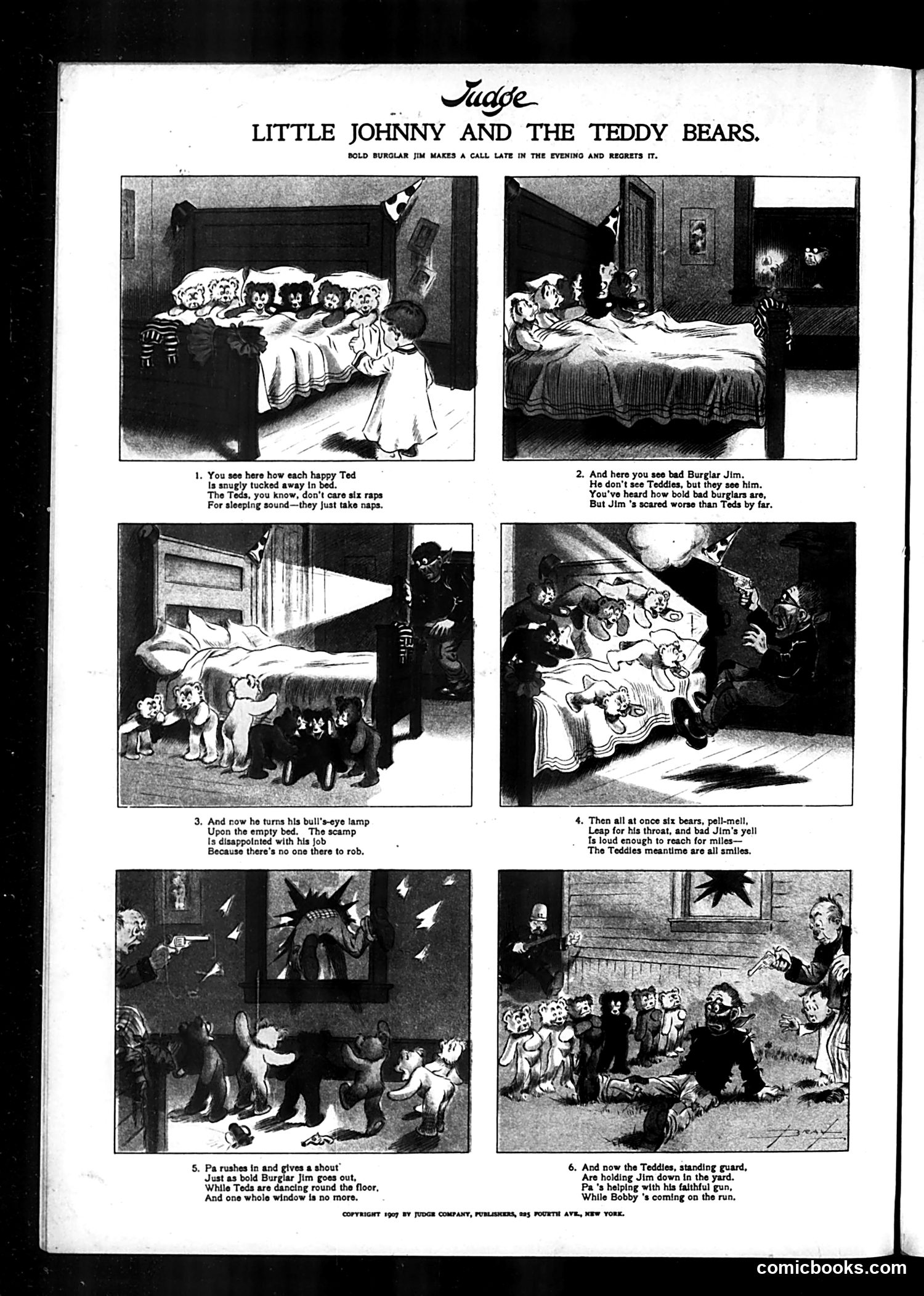
This is a humorous six-panel story about a burglar who breaks into a home where a child's stuffed teddy bears come to life to defend the household. **The Setup:** Bold burglar Jim enters at night, expecting an easy robbery. Instead, he discovers the home is protected by six animated teddy bears—the child's toys that apparently possess agency and intelligence. **The Joke:** The satire plays on the absurd notion that cuddly stuffed animals are more formidable defenders than actual people. Jim is terrified of the bears, who "leap for his throat," while the bears themselves remain cheerful ("all smiles"). The family (Pa with his gun, Bobby rushing to help) become secondary to the toys' heroic intervention. **Context:** This likely references the "Teddy Bear" craze of the early 1900s, named after President Theodore Roosevelt. The cartoon humorously exaggerates the toys' cultural significance by making them the actual household protectors—a playful commentary on American consumer culture and childhood sentimentality.
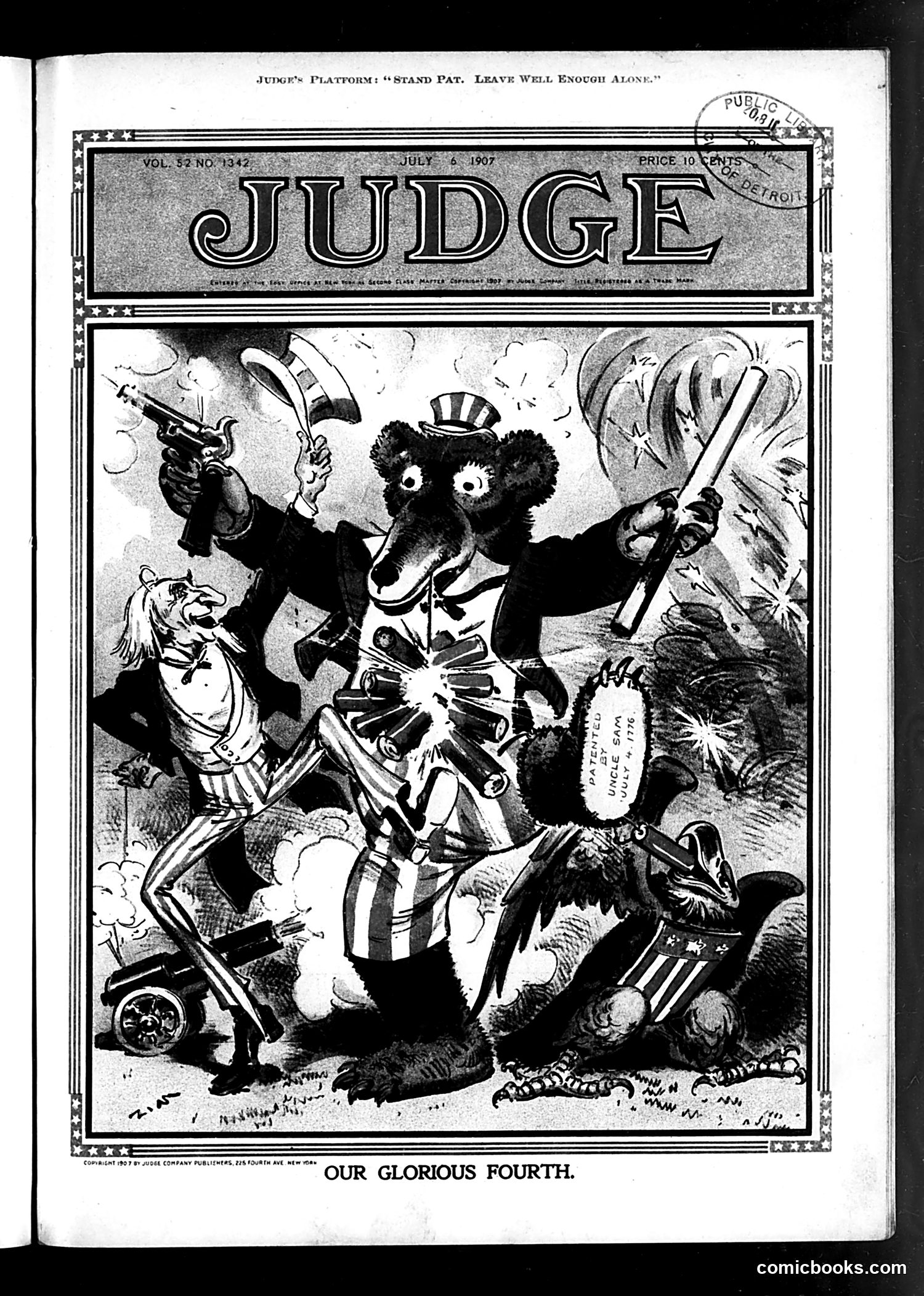
This July Fourth-themed satirical cartoon depicts a chaotic celebration featuring a figure in a top hat (likely representing Uncle Sam or American leadership) surrounded by anthropomorphized animals—bears and what appears to be other creatures—all wielding weapons, fireworks, and destructive implements. The title "Our Glorious Fourth" is ironic commentary on the messiness and danger of Independence Day celebrations, particularly the reckless use of fireworks and explosives that caused injuries and deaths. The cartoon appears to satirize both the chaos of holiday festivities and possibly the broader political climate, given Judge's masthead platform promising to "Stand Pat. Leave Well Enough Alone"—a conservative position. The exaggerated violence and disorder mock either uncontrolled celebration or political instability.
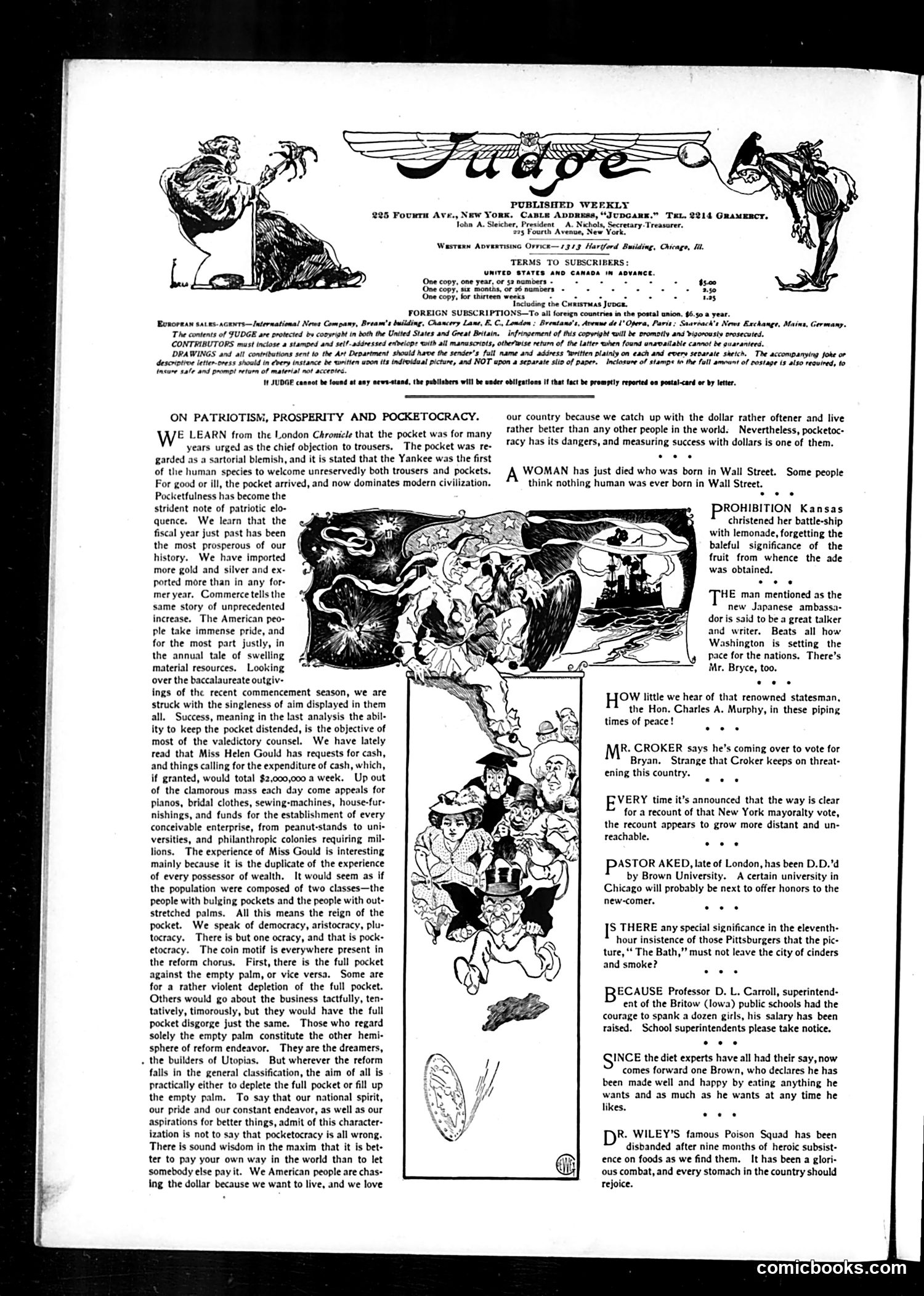
This is primarily the magazine's masthead and editorial content page rather than a cartoon page. The main editorial essay, "On Patriotism, Prosperity and Pocketocracy," satirizes American materialism and the equation of national success with wealth accumulation. The piece uses "pocketocracy" (rule by the pocket/money) as its central metaphor, tracing how pockets in trousers—supposedly an American innovation—have come to symbolize modern civilization's obsession with accumulating wealth. Judge mocks commencement speeches that reduce life's purpose to "keeping the pocket distended" (full of money). The brief satirical items below comment on contemporary figures: mentions of Prohibition, a Japanese ambassador known for talking, Charles A. Murphy (appearing to fade from public discourse), and references to Professor D.L. Carroll and Dr. Wiley's poison squad investigations regarding food safety. The overall message critiques American materialism during what appears to be an economically prosperous period, questioning whether monetary success should be society's primary measure of achievement.
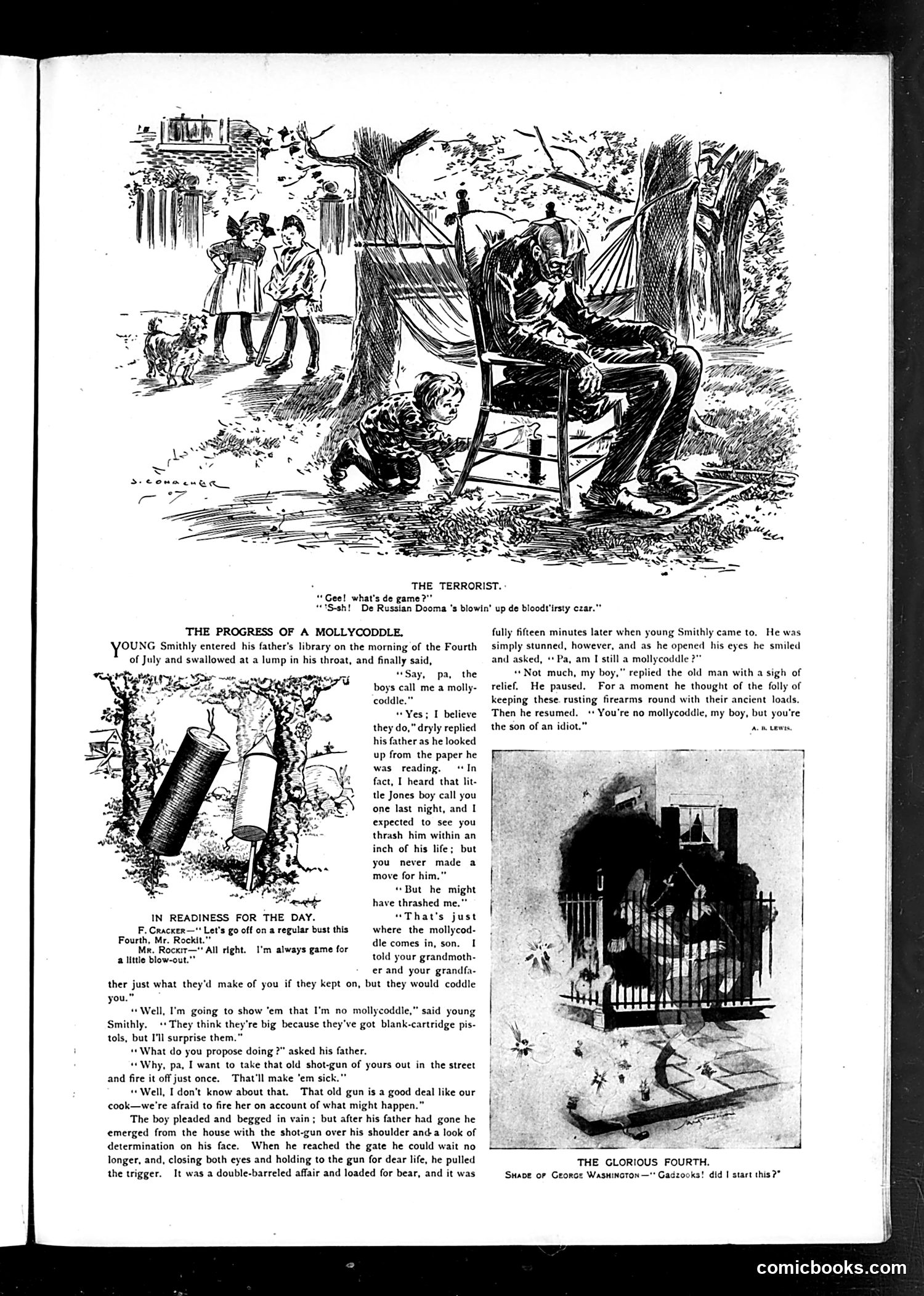
This page contains two satirical pieces about American masculinity and the Fourth of July: **"The Terrorist" (top cartoon):** A dark political joke about Russian revolutionary violence. Two figures discuss "De Russian Dooma 's blowin' up de bloodt'irsty czar"—referencing real Russian revolutionary attacks on the Tsar. The dialect suggests immigrant or working-class speakers, likely mocking contemporary anarchist/socialist rhetoric. **"The Progress of a Mollycoddle" (main story):** A coming-of-age narrative mocking overprotected boys. Young Smithly is called a "mollycoddle" (derogatory term for an effeminate or coddled male) by neighborhood boys. To prove his masculinity on Independence Day, he fires his father's shotgun—with recoil that stuns him unconscious. The father concludes he's no longer a mollycoddle but "the son of an idiot," satirizing both overindulgent parenting and reckless masculine posturing. **Context:** The satire targets Gilded Age anxieties about American boyhood, parental coddling, and performative toughness.