
Judge, 1907-06-29 · page 6 of 19
Judge — June 29, 1907 — page 6: what you’re looking at
What you’re looking at
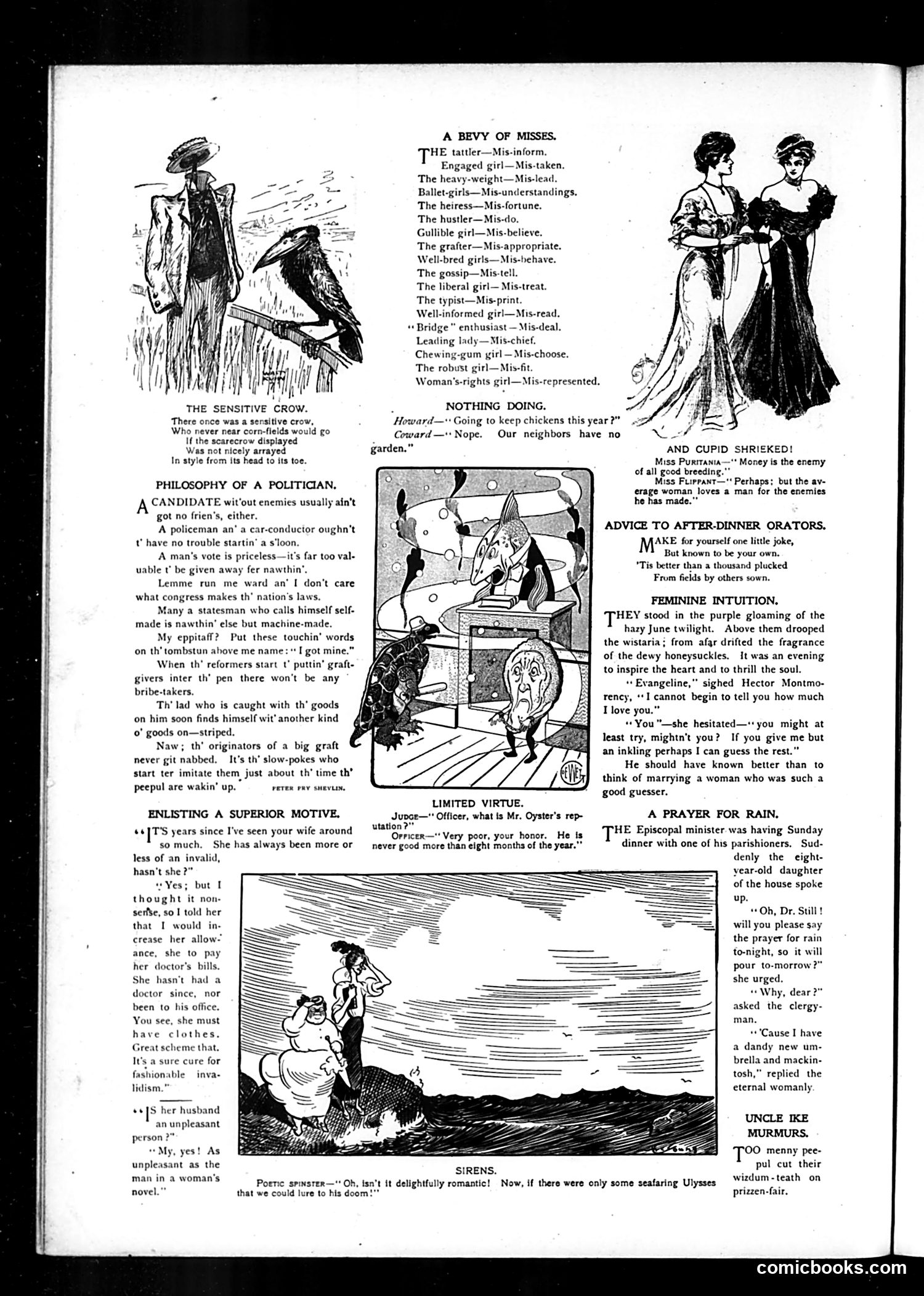
This satirical page contains multiple humor pieces targeting early 20th-century American society and politics: **"Philosophy of a Politician"** mocks corrupt machine politics through cynical maxims—politicians prioritizing personal gain ("I got mine") over constituents, dismissing reform efforts, and exploiting the electoral system. The satire suggests widespread graft and bribery in urban politics. **"A Bevy of Misses"** uses puns on "mis-" words to stereotype female types: the tattler, heiress, gossip, etc. This reflects period anxieties about women's social roles and behaviors. **"Enlisting a Superior Motive"** satirizes a man who solves his wife's hypochondria by threatening financial consequences—implying women use illness for attention or financial advantage, a common sexist trope. The remaining pieces—brief jokes about virtue, after-dinner speaking, romance, and rain prayers—offer lighter social commentary typical of Judge's humor formula: targeting politicians, women's stereotypes, and genteel social conventions. The page reflects Gilded Age cynicism about corruption and gender attitudes common to the era.
📄 Transcribed text from this page (OCR, searchable)
Machine-transcribed from the original scan — historical spelling and the odd misread are preserved.
fy)! rl THE SENSITIVE CROW. There once was a sensitive crow, Who never near corn-fields would go If the scarecrow displayed Was not nicely arrayed In style from its head to its toe. PHILOSOPHY OF A POLITICIAN. CANDIDATE wit‘out enemies usually ain't got no frien’s, either. A policeman an’ a car-conductor oughn’t t' have no trouble startin’ a s'loon. A man’s vote is priceless—it's far too val uable be given away fer nawthin’, Lemme run me ward an‘ I don't care what congress makes th’ nation’s laws. Many a statesman who calls himself self made is nawthin’ else but machine-made. My eppitaff? Put these touchin’ words on th’ tombstun above me name: * I got mine.” When th’ reformers start t’ puttin’ graft- givers inter th’ pen there won't be any bribe-takers. Th’ lad who is caught with th’ goods on him soon finds himself wit’ another kind 0’ goods on—striped. Naw; th’ originators of a big graft never git nabbed. It’s th’ slow-pokes who Start ter imitate them just about th’ time th’ peepul are wakin’ up.” PETER PRY SHEVLIN, ENLISTING A SUPERIOR MOTIVE, 44] TS years since I've seen your wife around She has always been more or less of an invalid, hasn’t she 2” “Yes; but I thought it non- serfse, so I told her so much, that I would in- crease her allow- to pay her doctor's bills. She hasn't had a ance, she doctor since, nor been to his office. You see, she must have clothes. Great scheme that, It’s a sure cure for fashionable inva- lidism.”" her husband an unpleasant person 2" “My, yes! As unpleasant as the man in a woman's novel.” that we could lure to his doom! A BEVY OF MISSES. THE tattler—Mis-inform. Engaged girl s-taken, The heavy-weight—Mis-lead. Ballet-girls—Mis-understandings. The heiress—Mis-fortune. The hustler—Mis-do. Gullible girl—Mis-believe, The grafter—Mis-appropriate. Well-bred girls—Mis-behave. The gossip—Mis-tell. The liberal girl— Mis-treat. The typist—Mis-print. Well-informed girl “« Bridge” enthusiast — Mis-deal. Leading lady—Mis-chief. ‘Mis-read. Chewing-gum girl —Mis-choose. The robust girl—Mis-fit. Woman's-rights girl—Mis-represented. NOTHING DOING. Coward —** Nope. garden.” LIMITED VIRTUE. Juvce—"* Officer, what is Mr. Oyster's rep- utation ?" Orricer—"' Very poor, your honor. He is never good more than eight months of the year.”” " Howard— Going to keep chickens this year?” Our neighbors have no AND CUPID SHRIEKED! Miss Puritania—‘* Money is the enemy of all good breeding. Miss Furrant—' Perhaps; but the av- erage woman loves a man for the enemies he has made."* ADVICE TO AFTER-DINNER ORATORS. MASE for yourself one litte joke, But known to be your own, ‘Tis better than a thousand plucked From fields by others sown, FEMININE INTUITION. THEY stood in the purple gloaming of the hazy June twilight. Above them drooped the wistaria; from afar drifted the fragrance of the dewy honeysuckles. it was an evening to inspire the heart and to thrill the soul. + Evangeline,” sighed Hector Montmo- rency, ‘1 cannot begin to tell you how much T love you.” «You "—she hesitated—* you might at least try, mightn’t you? If you give me but an inkling perhaps I can guess the rest.” He should have known better than to think of marrying a woman who was such a good guesser. A PRAYER FOR RAIN. HE Episcopal minister was having Sunday dinner with one of his parishioners, Sud- denly the eight- year-old daughter of the house spoke up. “Oh, Dr. Still! will you please say the prayer for rain to-night, so it will pour to-morrow?” she urged. “Why, dear?” asked the clergy man. «Cause I have a dandy new um- brella and mackin- SIRENS. Poenc srinster—‘* Oh, isn’t it delightfully romantic! Now, if there were only some seafaring Ulysses tosh,” replied the eternal womanly UNCLE IKE MURMURS. TOO menny pee- pul cut their wizdum-teath on prizzen-fair. comicbooks.com