
A complete issue · 16 pages · 1907
Judge — April 27, 1907
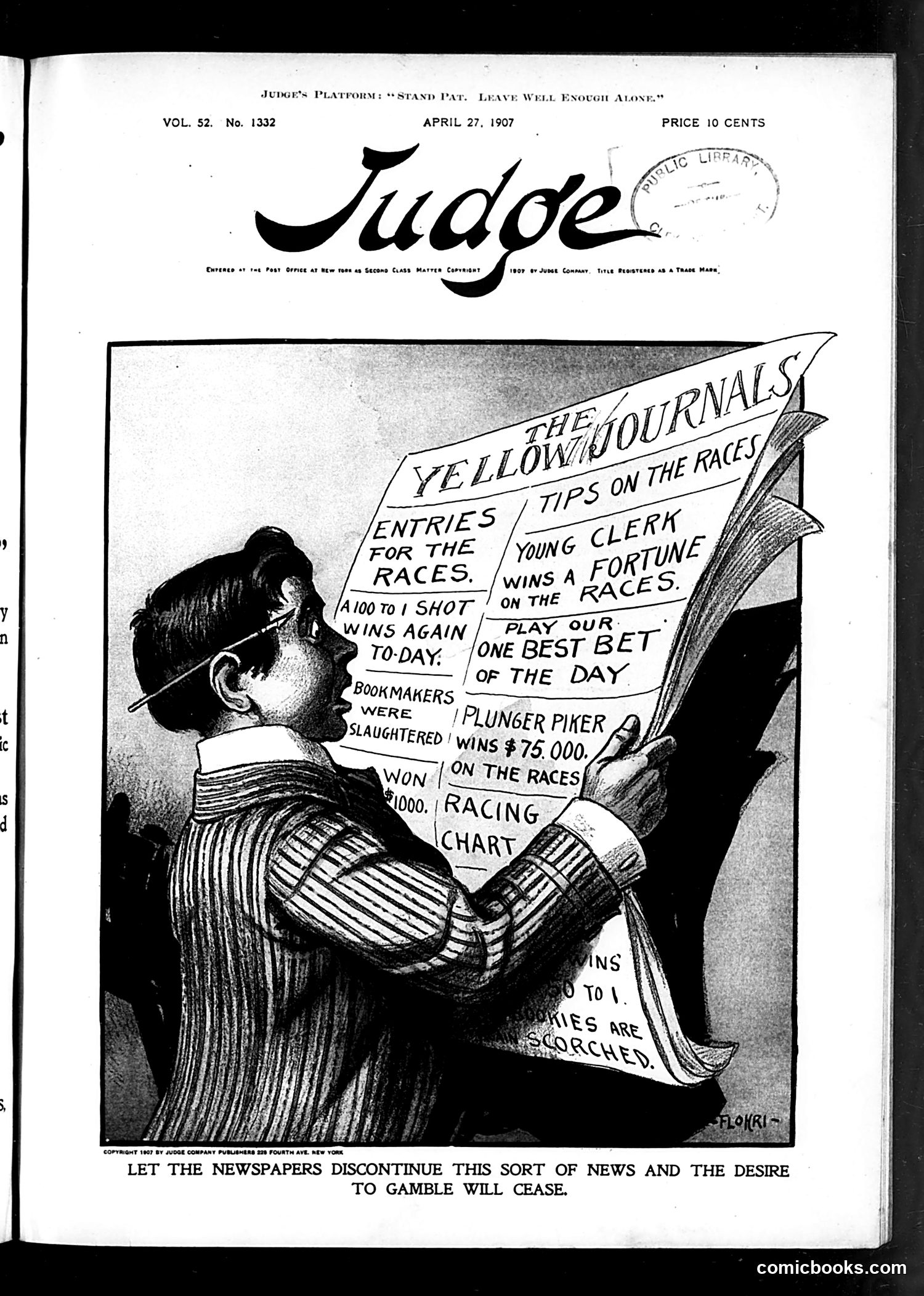
This political cartoon satirizes newspaper gambling coverage. A man reads a yellow journal displaying racing tips, entries, and betting advice—including claims that "a young clerk wins a fortune on the races" and "plunger piker wins $75,000." The satire targets how newspapers promoted gambling through sensationalized success stories and betting tips, creating false hope among readers seeking easy wealth. The cartoon's message, stated below: "Let the newspapers discontinue this sort of news and the desire to gamble will cease," advocates for responsible journalism. The "yellow journals" reference the sensationalist press of the era, known for exaggerated, attention-grabbing content. This reflects Progressive Era concerns about media manipulation and gambling's social harms.
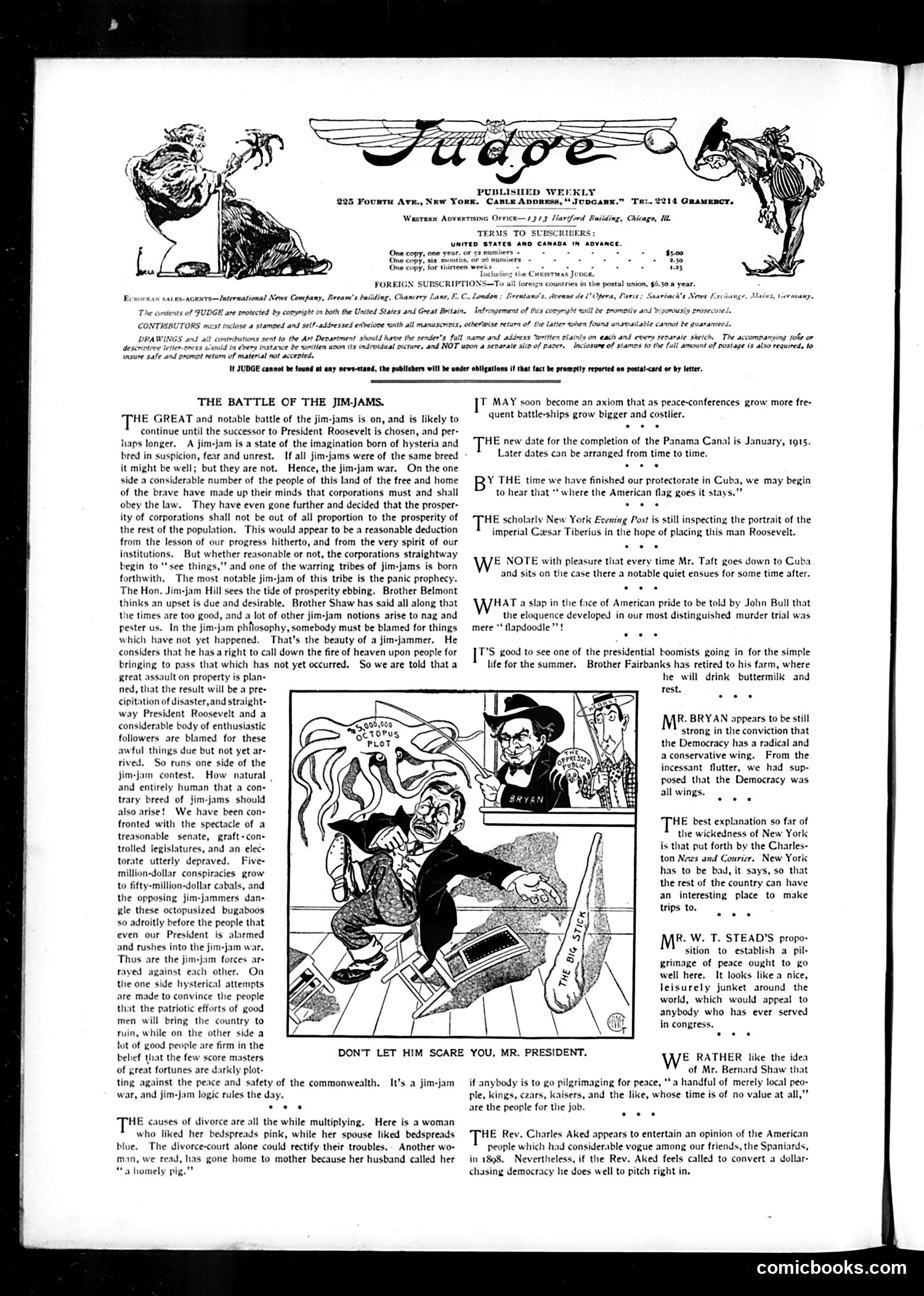
The main cartoon, titled "Don't Let Him Scare You, Mr. President," depicts an octopus labeled "Jim Jams" threatening President Roosevelt. The accompanying article "The Battle of the Jim-Jams" explains the satire: "Jim-jams" (nervousness/hysteria) represent unfounded public panic about economic disaster and social upheaval. The cartoon suggests Roosevelt shouldn't be intimidated by scaremongering predictions. The octopus's multiple tentacles symbolize various anxieties—divorce rates rising, financial conspiracies, revolutionary rhetoric—that critics claim are exaggerated threats used to undermine the president's policies. Judge is urging Roosevelt to ignore alarmist opposition and proceed confidently with his agenda, positioning progressive reform against reactionary fear-mongering. The satire targets those spreading panic rather than the president himself.
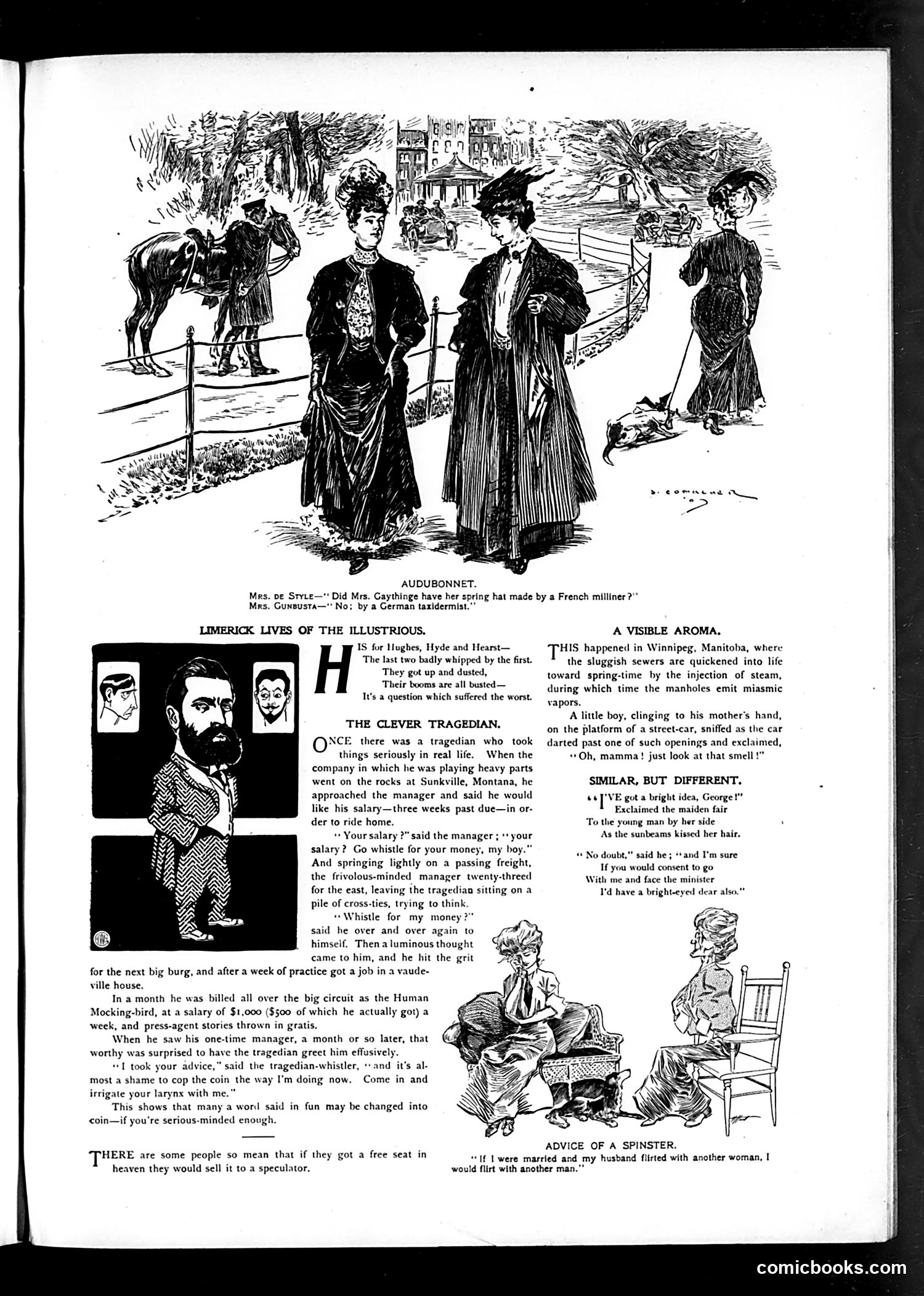
**Top Cartoon ("Audobonnet"):** This satirizes women's spring fashion, specifically a feud between French and German milliners over who created a particular hat style. The two fashionable women in the center represent this rivalry in the hat-making industry. **"Limerick Lives of the Illustrious":** Features a bearded man (likely a historical or theatrical figure, though identity is unclear from the image alone) in a humorous biographical limerick format—a popular Judge feature mocking notable personalities. **"The Clever Tragedian":** A story mocking an overly serious actor who takes theatrical roles so literally he becomes difficult to work with, eventually finding success in circus performance rather than legitimate theater. **"A Visible Aroma":** A brief anecdote about a child noticing an unpleasant smell from a streetcar's steam vents.
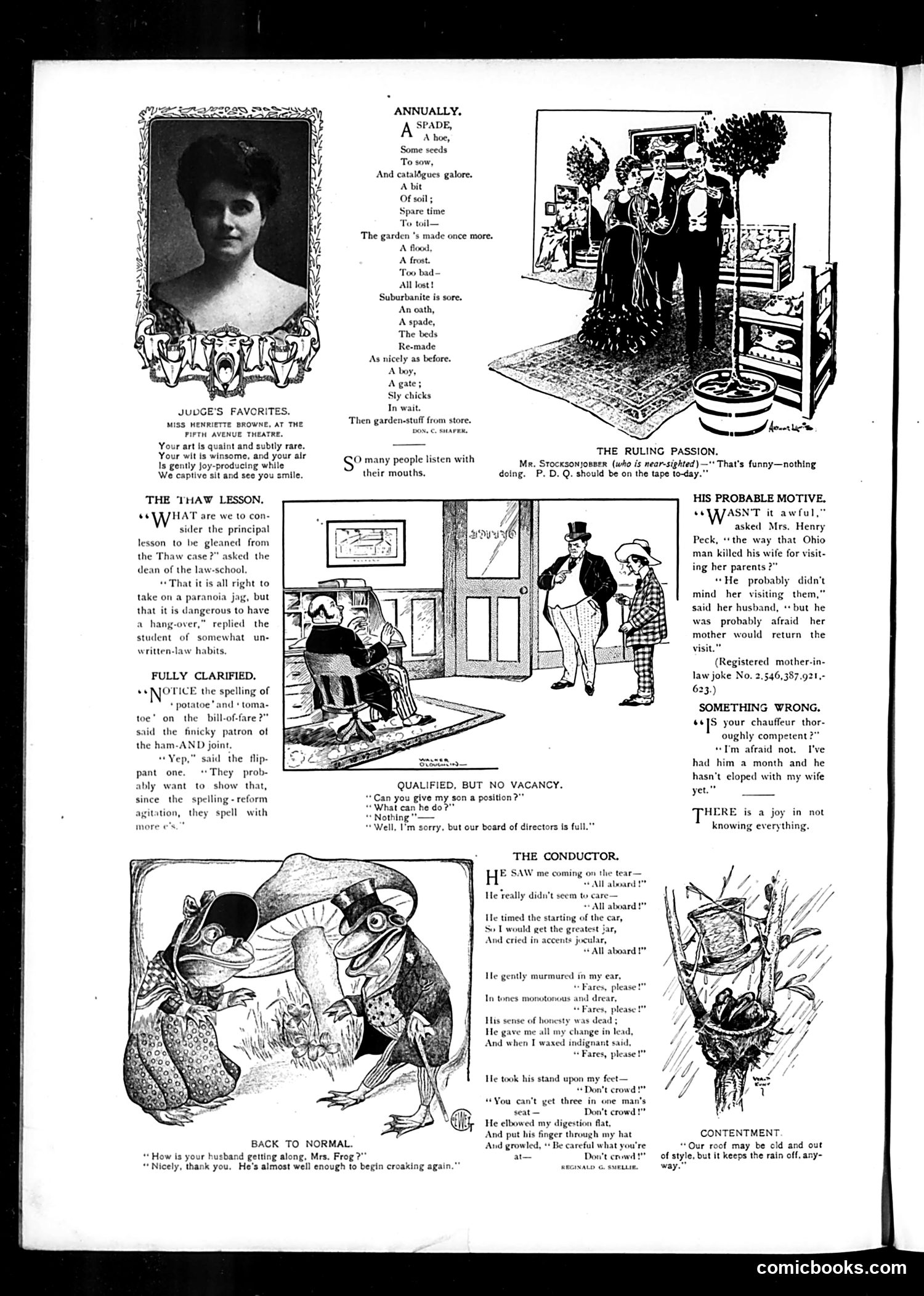
This page contains several standalone jokes and humorous anecdotes rather than political cartoons. The content includes: - **"Judge's Favorites"**: A portrait of Miss Henriette Browne at the Aidee Theatre, with verse praising her wit and charm. - **Comic sketches** illustrating various brief humorous scenarios: a student justifying his parasol use, spelling reform advocates, a landlord rejecting a tenant's son for employment, a chauffeur's incompetence, and a railroad conductor's overzealous crowd management. - **"The Ruling Passion"**: A garden scene with socialites. The humor relies on wordplay, social observations about class dynamics, professional incompetence, and domestic situations—typical early-20th-century magazine fare. There's no significant political content; it's primarily light entertainment and domestic satire.
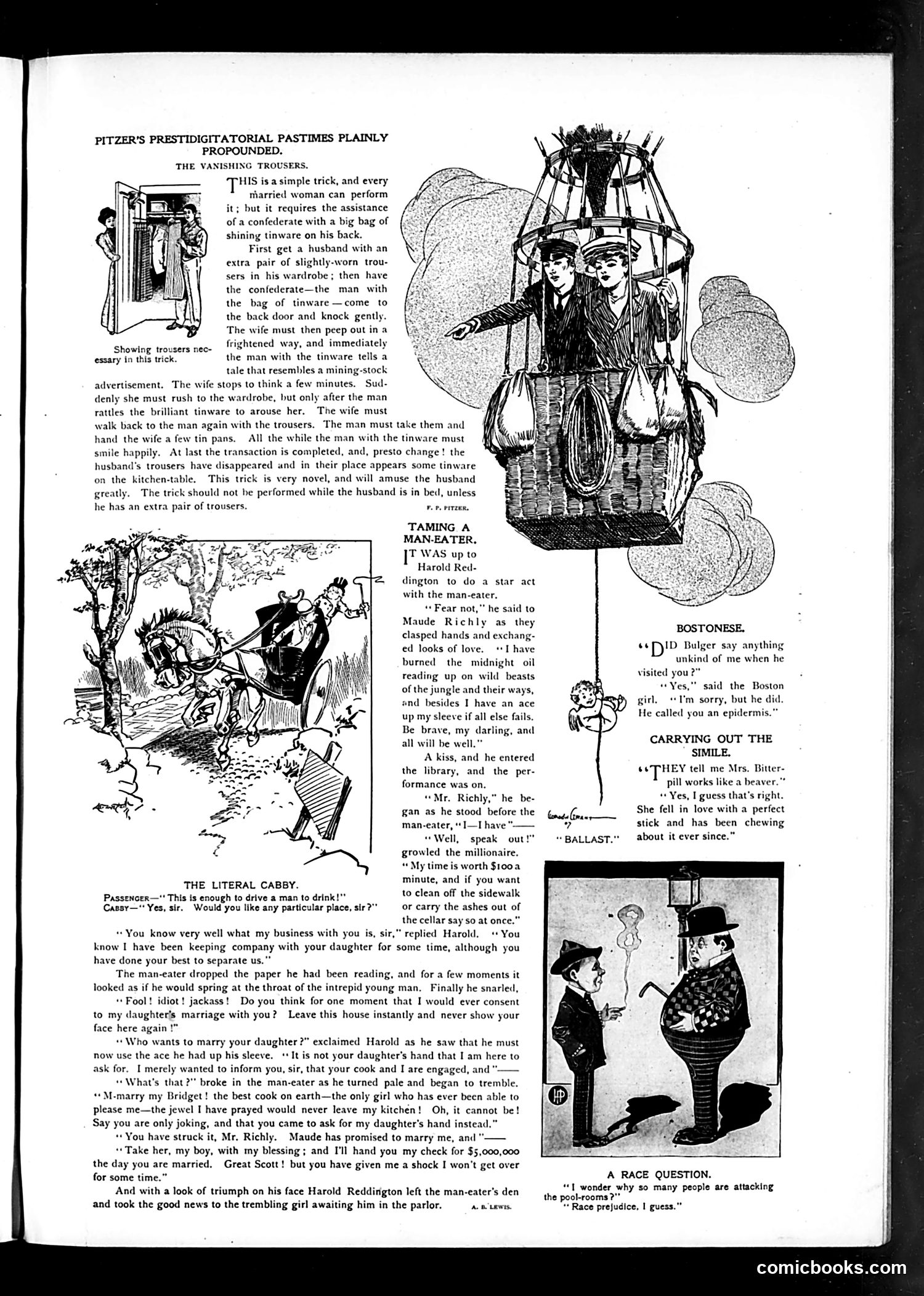
This page from *Judge* magazine contains three distinct satirical pieces: 1. **"The Vanishing Trousers"** - A humorous magic trick where a wife helps a confederate make her husband's trousers disappear, replacing them with worn ones. The satire mocks marital deception and domestic trickery. 2. **"Taming a Man-Eater"** - References Harold Reddington performing with "Maude Richly" (likely a stage performer). The narrative plays on romantic drama and theatrical pretension, satirizing the melodramatic language of romance. 3. **"The Literal Cabby"** - A cabdriver takes a passenger's instructions too literally, creating absurdist humor about miscommunication. The remaining items—"Bostonese," "Carrying Out the Smile," and "A Race Question"—appear to be brief humorous observations about regional dialects, social behavior, and likely racial attitudes of the era. These reflect early 20th-century American humor conventions.
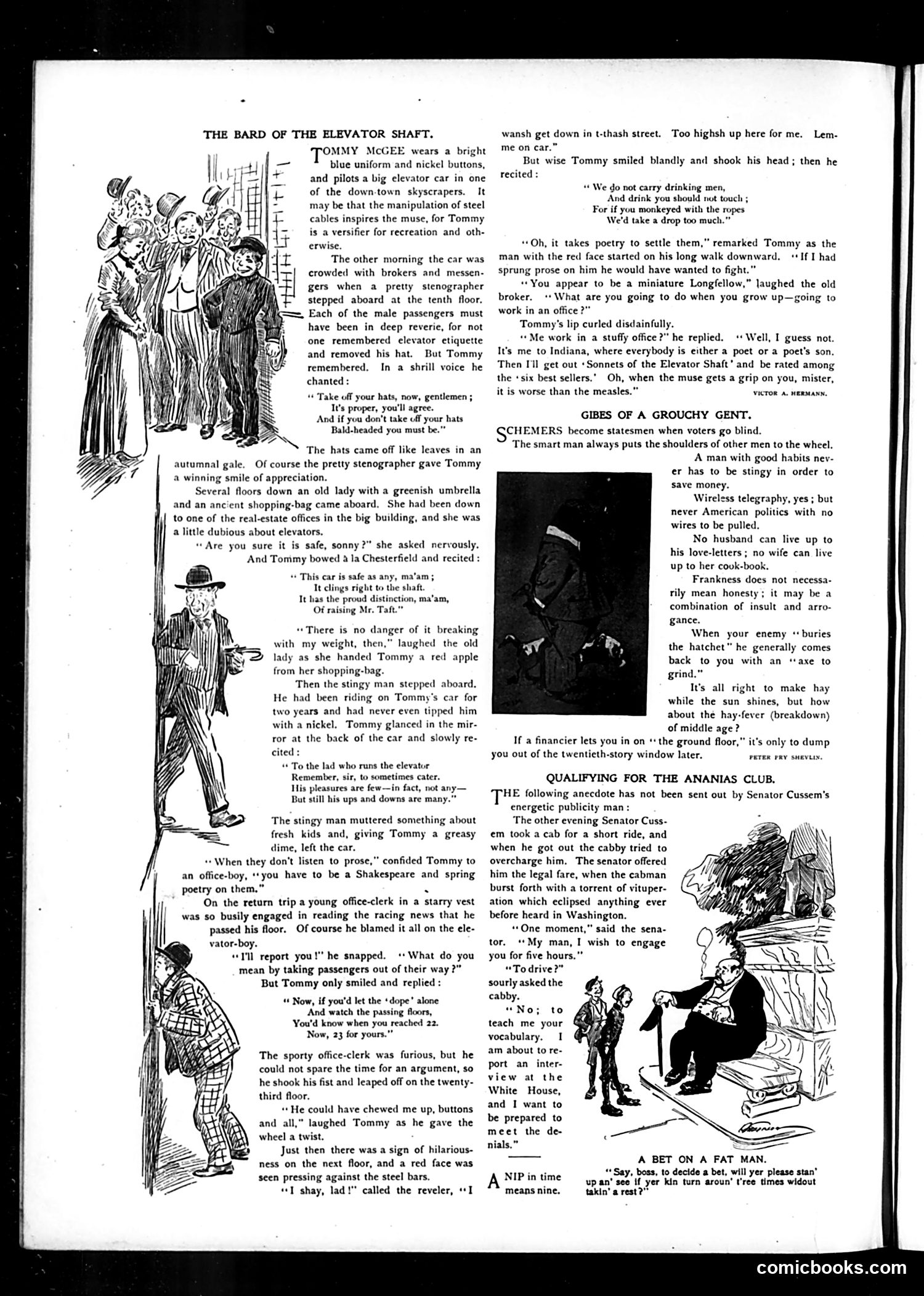
This humorous story satirizes the clever resourcefulness of a working-class elevator operator named Tommy McGee in an early 20th-century skyscraper. Tommy uses witty poetry and quips to manage passenger behavior—enforcing hat-removal etiquette with a pretty stenographer, reassuring an elderly woman by referencing President Taft, shaming a stingy regular passenger into tipping, redirecting a distracted office clerk, and cleverly refusing a drunk passenger. The satire gently mocks both the pretensions of white-collar office workers (who ignore social conventions until shamed, read racing news obsessively, and demand respect) and celebrates working-class ingenuity. Tommy's "Shakespearean" approach proves more effective than "prose"—suggesting wit trumps authority. The piece reflects the era's fascination with city life and class dynamics in modern office buildings.
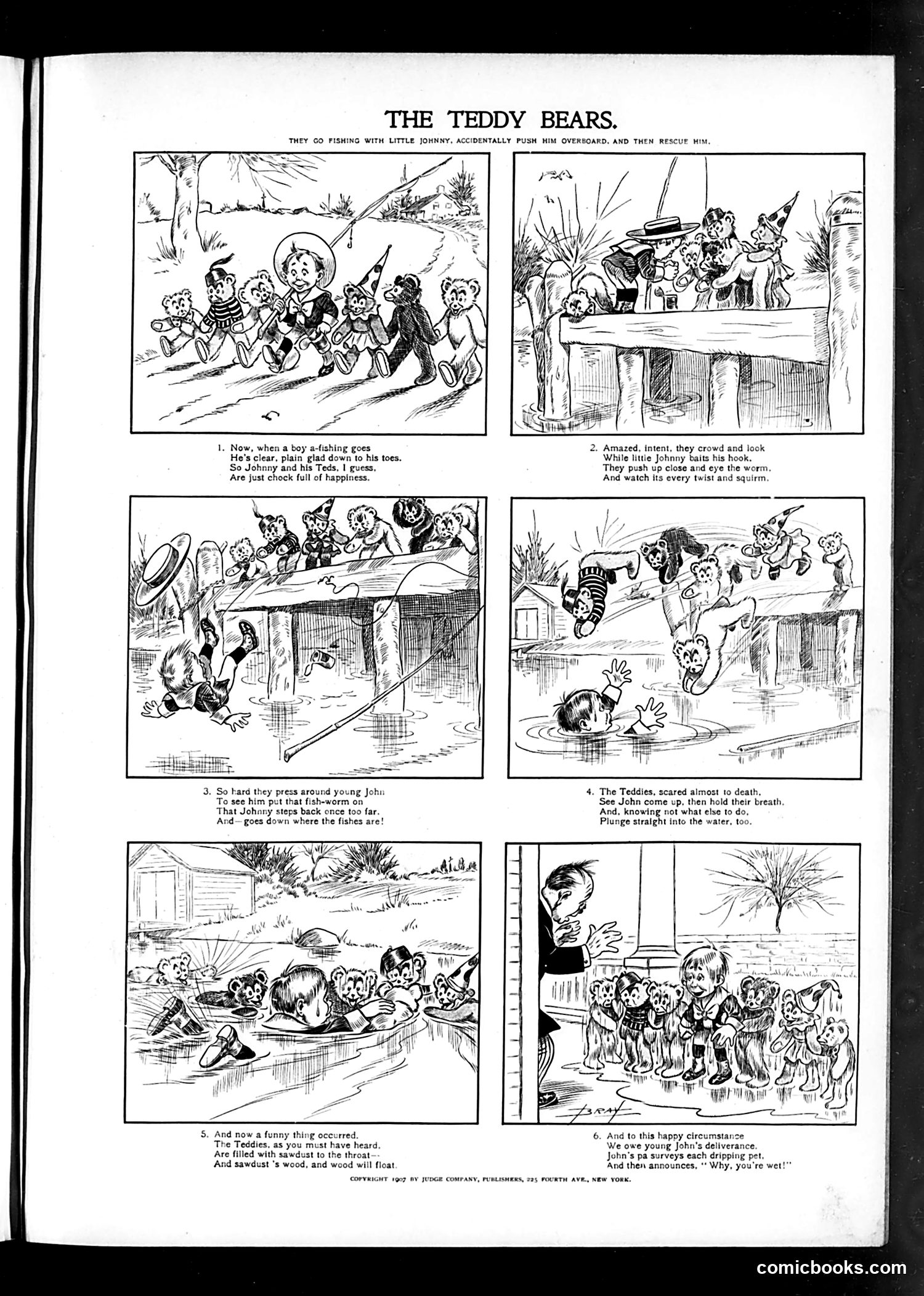
This is a whimsical six-panel comic strip about toy teddy bears. The narrative follows "Little Johnny" fishing with his stuffed bears: they crowd around to watch him bait his hook, accidentally push him into the water, panic and jump in after him, then rescue him—their sawdust filling acts as flotation. The humor is straightforward slapstick aimed at children: the bears' inadvertent rescue of Johnny, and the punchline where Johnny's father observes the soaking wet toys with deadpan surprise ("Why, you're wet!"). This appears to be simple entertainment rather than political satire. It likely capitalized on the "teddy bear" craze that began around 1902-1903, when President Theodore Roosevelt's hunting exploits made the toys fashionable. The strip uses the bears' popularity to tell an innocent, funny story for young readers.
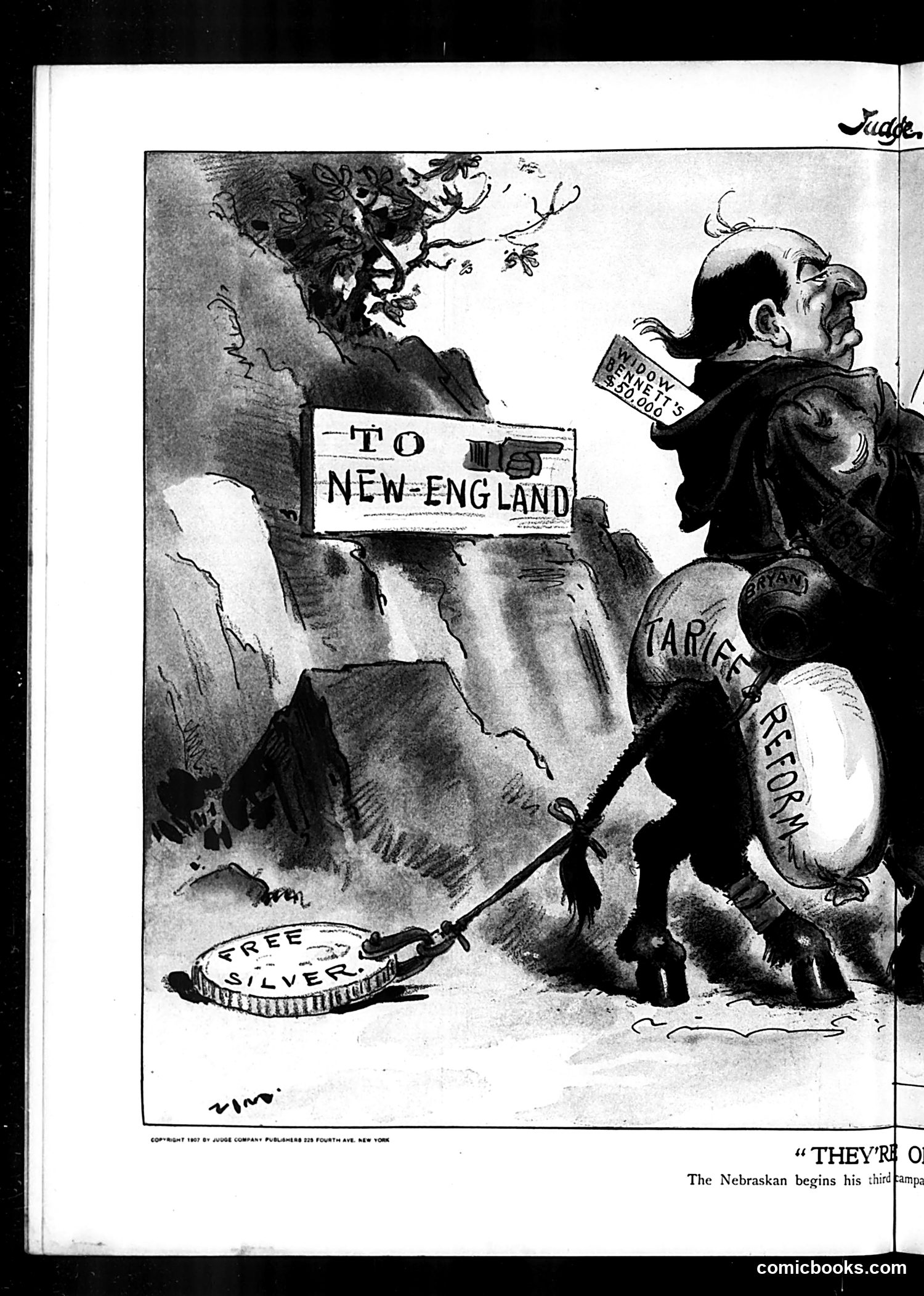
This 1907 Judge cartoon satirizes a political figure (identified as "The Nebraskan," likely William Jennings Bryan) pursuing a third campaign for presidency. The caricature shows a man being pulled toward New England by various economic interests—depicted as burdensome cargo labeled "tariff," "reform," and "free silver." The withered tree overhead suggests decay or failing prospects. The "Free Silver" chain around his ankle references Bryan's famous advocacy for unlimited silver coinage, a major political issue of the 1890s-1900s. The cartoon mocks Bryan's repeated electoral ambitions and suggests he's being manipulated by conflicting political forces and outdated policies, making him an unsuitable candidate for another national campaign.
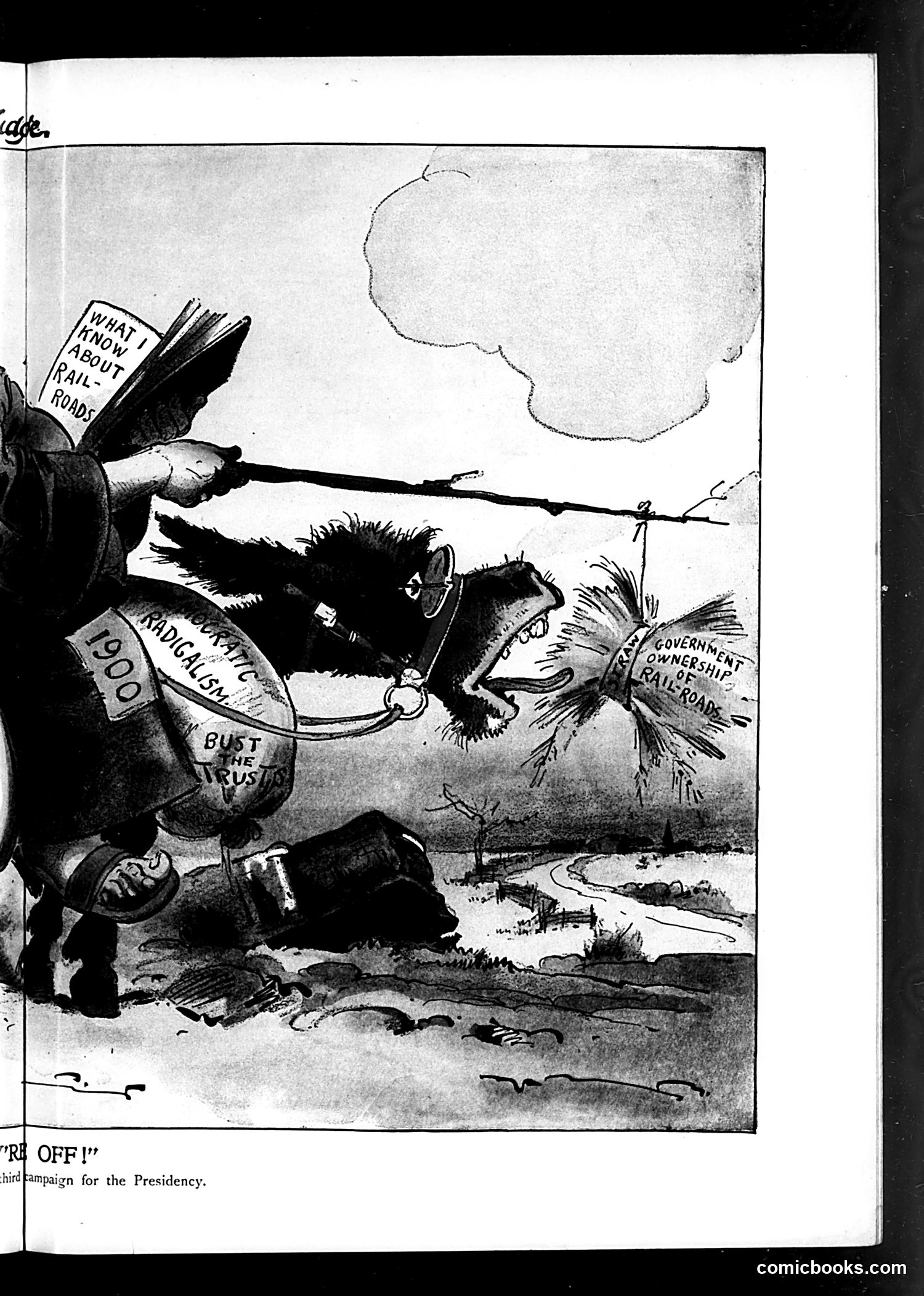
This cartoon satirizes railroad industry opposition to government regulation. A hand labeled "WHAT I KNOW ABOUT RAIL-ROADS" holds a stick controlling two donkeys representing railroad interests: one labeled "GOOD" with "RADICALISM" and "BUST THE TRUSTS," the other labeled "GOVERNMENT OWNERSHIP OF RAIL-ROADS." The satire suggests that someone (likely a political candidate) has only superficial knowledge of railroads yet attempts to manipulate railroad policy through populist rhetoric and radical proposals. The donkeys being pulled in opposite directions implies contradictory or cynical messaging designed to appease different audiences during a presidential campaign, while actual railroad expertise is absent. The cartoon criticizes campaign demagoguery on economic policy.
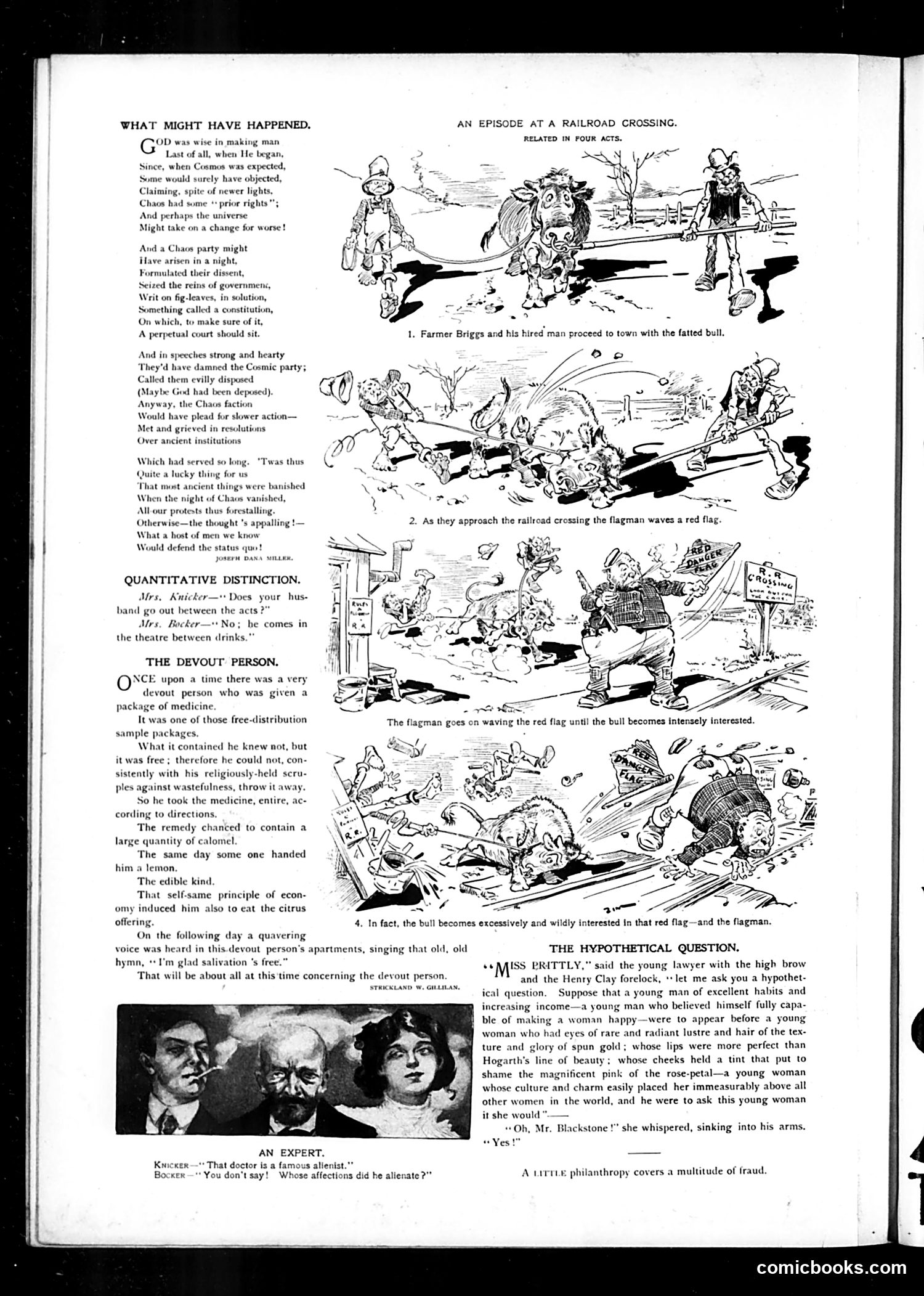
This page contains several distinct satirical pieces: **"What Might Have Happened"** presents philosophical satire about creation and governance. It imagines if God had allowed democratic debate during creation, chaos-faction politicians would have blocked progress through endless constitutional wrangling and obstruction—a jab at American politicians who invoke tradition and "prior rights" to block reform. **"An Episode at a Railroad Crossing"** (four-panel comic) depicts slapstick chaos: a farmer's prized bull escapes and becomes obsessed with a flagman's red flag at a railroad crossing, causing mayhem. It's pure visual comedy about animal folly and human incompetence. The remaining items are brief joke columns: "The Devout Person" mocks religious hypocrisy (a scrupulously devout man wastes no free medicine, despite harmful effects); "The Hypothetical Question" satirizes a lawyer's verbose seduction attempt; and snippets mock marriage, drinking, and medical charlatans. The overall tone is genteel Victorian satire targeting politics, social pretension, and human folly through wordplay and situation comedy.
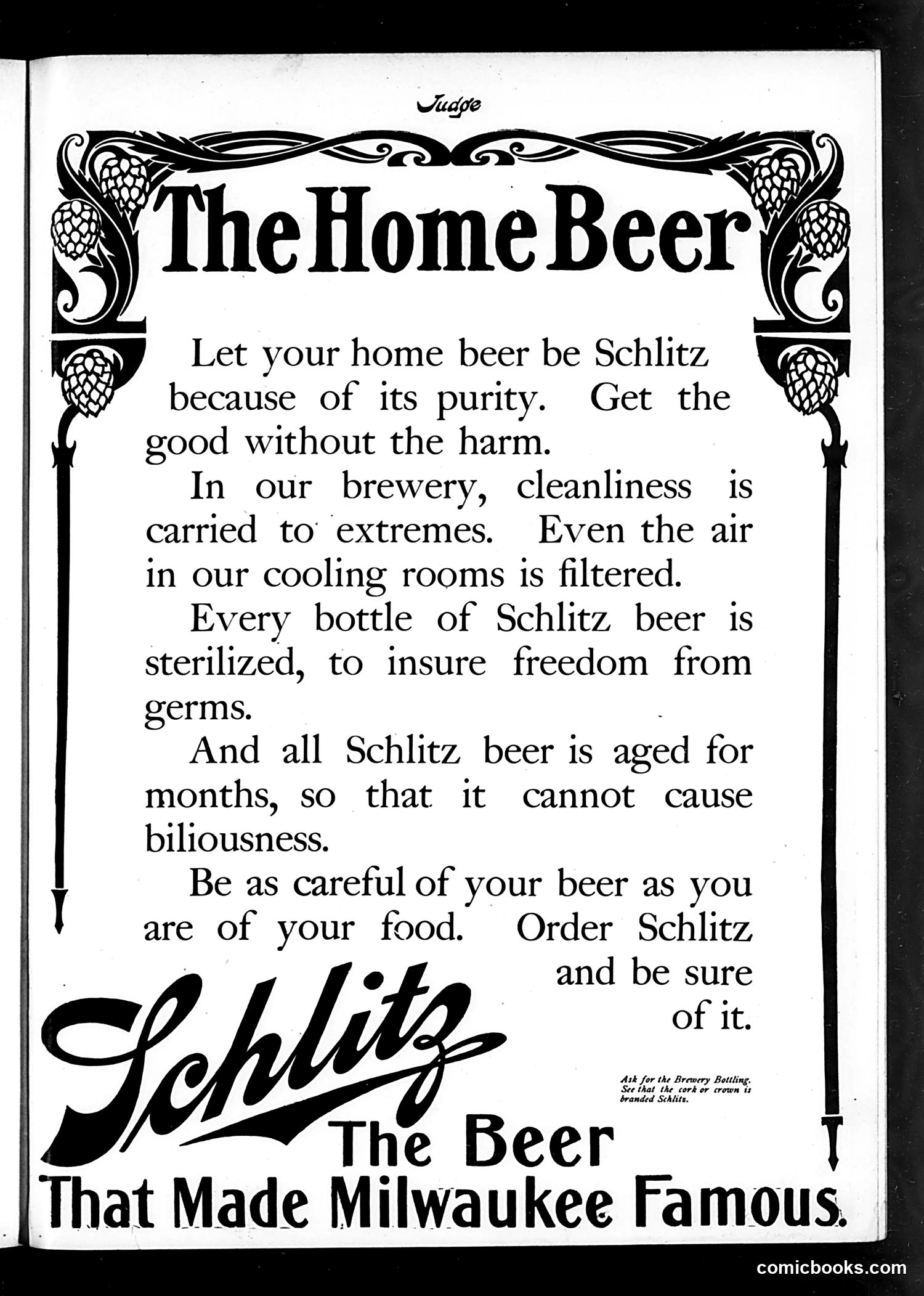
This is a **full-page advertisement**, not a political cartoon. It promotes Schlitz beer to home brewers during what appears to be the Prohibition era or shortly after repeal. The ad appeals to safety-conscious consumers by emphasizing industrial cleanliness: filtered air in cooling rooms, sterilized bottles, and months of aging to prevent "biliousness" (digestive upset). The slogan "The Beer That Made Milwaukee Famous" references Milwaukee's historical prominence as a brewing center. The message is essentially: commercial Schlitz is safer than homemade beer because of rigorous manufacturing standards. The decorative hop illustrations frame the text, reinforcing the brewing theme. There is no satire here—this is straightforward marketing positioning commercial beer production as superior to home brewing on health grounds, a notable marketing angle in early-to-mid twentieth-century advertising.
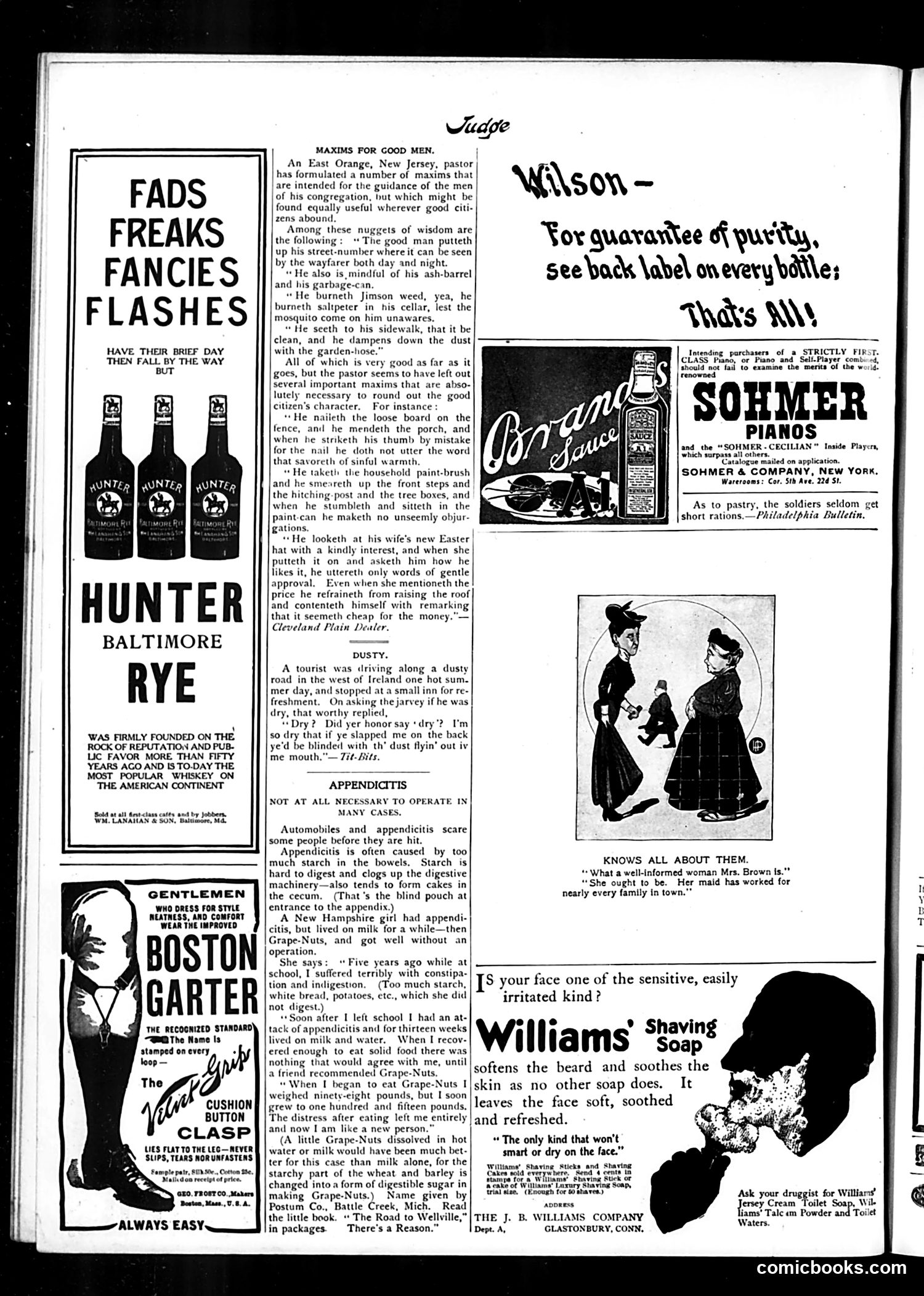
This page from *Judge* magazine contains primarily **advertisements and filler content** rather than political satire requiring historical context. The main editorial content—"Maxims for Good Men"—is gentle domestic humor about a New Jersey pastor's advice for household conduct. The satire gently mocks husbands' frustrations (profanity while hammering, reactions to wife's hat prices) presented as moral guidance. The cartoons are simple illustrative humor: one shows gossiping women ("knows all about them"), another depicts street children. Neither references specific political figures or events. **The page is dominated by product advertisements**: Hunter Rye whiskey, Boston Garter suspenders, Sohmer pianos, Wilson shaving soap, and Williams' shaving soap. These ads, with their period illustrations and claims, are the main content. The medical article on appendicitis is informational rather than satirical—discussing whether surgery is always necessary. **Overall**: This appears to be a routine issue page mixing light humor with commercial advertising, not a notable example of *Judge's* satirical commentary on contemporary politics or society.
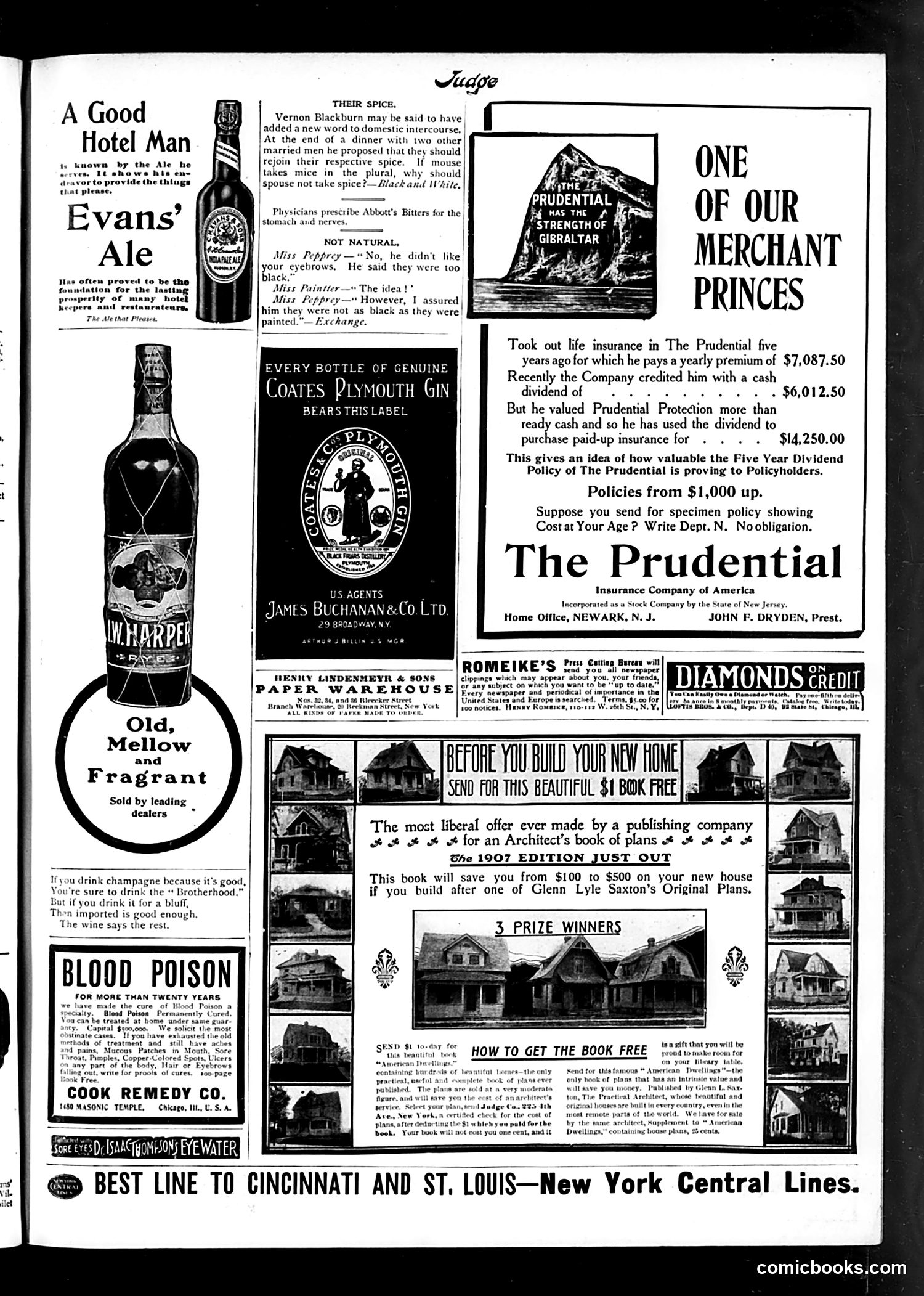
This page is primarily **advertising**, not satire or political commentary. It contains multiple product advertisements typical of early 1900s magazines. The notable content includes: **Evans' Ale** and **Old Mellow and Fragrant** liquor ads—straightforward product promotion with light humor about drinking champagne for show versus quality. **"Their Spice"** section—a mild domestic humor joke about a man proposing married couples rejoin their "spice" (a play on the word "spouse"), suggesting wives add flavor to marriage. **Cook Remedy Co.** ad—a period medical advertisement for treating "Blood Poison" (likely syphilis), reflecting the prevalence of such remedies in early 20th-century publications. **The Prudential Insurance** ad—promotes life insurance using a success story of a "merchant prince" whose dividend enabled additional coverage. The page also advertises **architectural house plans**, **diamonds on credit**, and **railroad service** to Cincinnati and St. Louis. No clear political cartoons or satire are evident—this is a commercial advertising page with minimal satirical content.
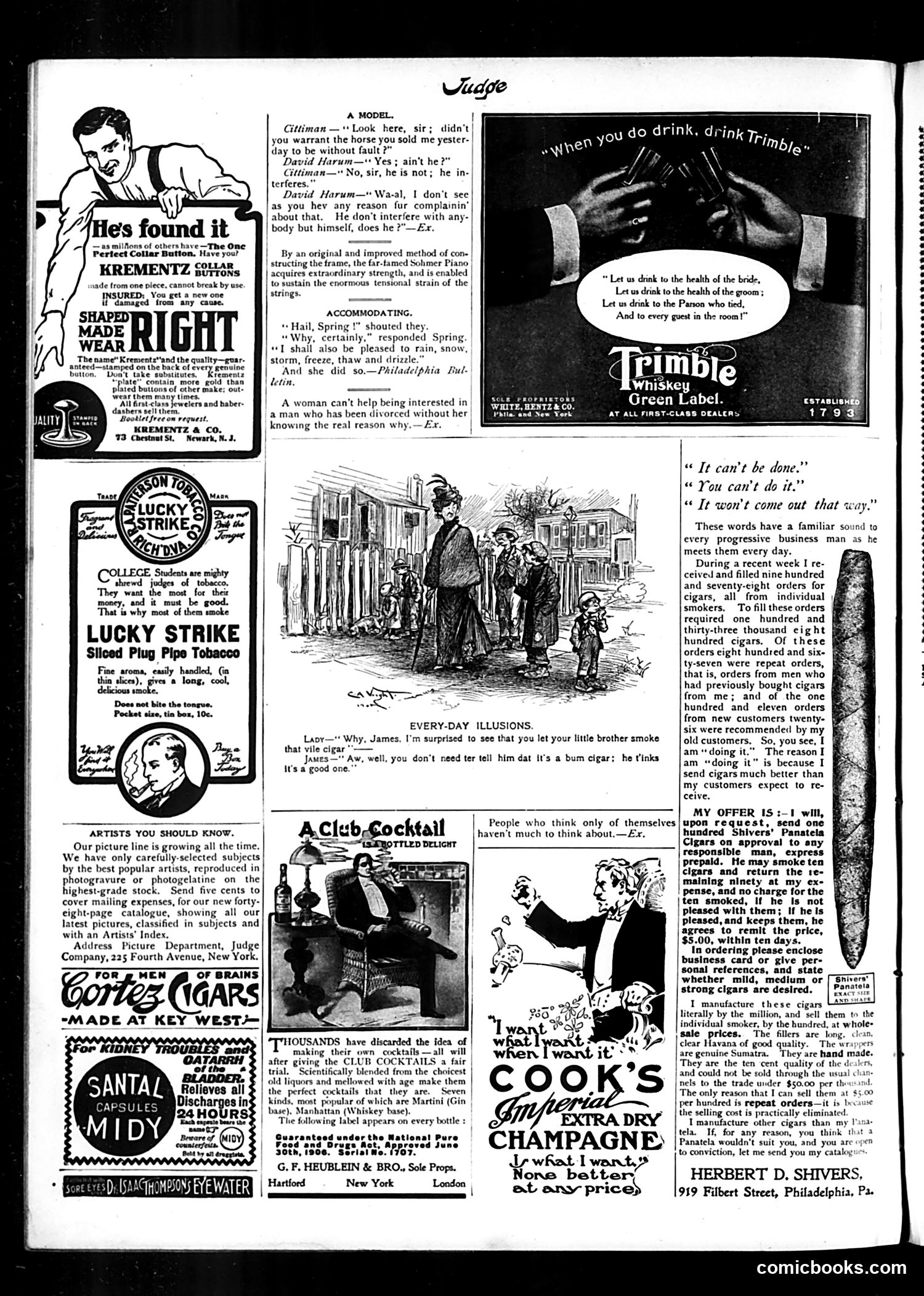
This page from *Judge* (a satirical weekly) consists primarily of **advertisements and humorous filler content** rather than political cartoons with substantive social commentary. The notable satire includes: **"A Model"** — A dialogue between "Citiziman" and "David Harum" (a character from Edward Noyes Westcott's popular rustic fiction). The joke: a buyer complains a horse "interferes" (a lameness condition); the seller dismissively responds the horse only interferes with itself, not others. The satire gently mocks rural shrewdness and evasive salesmanship. **"Every-Day Illusions"** — A child smokes a poor cigar believing it's good; the joke satirizes self-deception and parents enabling bad behavior. **"Accommodating"** — A brief piece playing on Spring (the season) personified as obligingly providing rain, snow, and storms—gentle wordplay rather than satire. The rest comprises **period advertising**: collar buttons, pipe tobacco, cigars, champagne, and pianos—reflecting early-20th-century consumer culture. The page exemplifies *Judge*'s mix of light humor and commercial content.
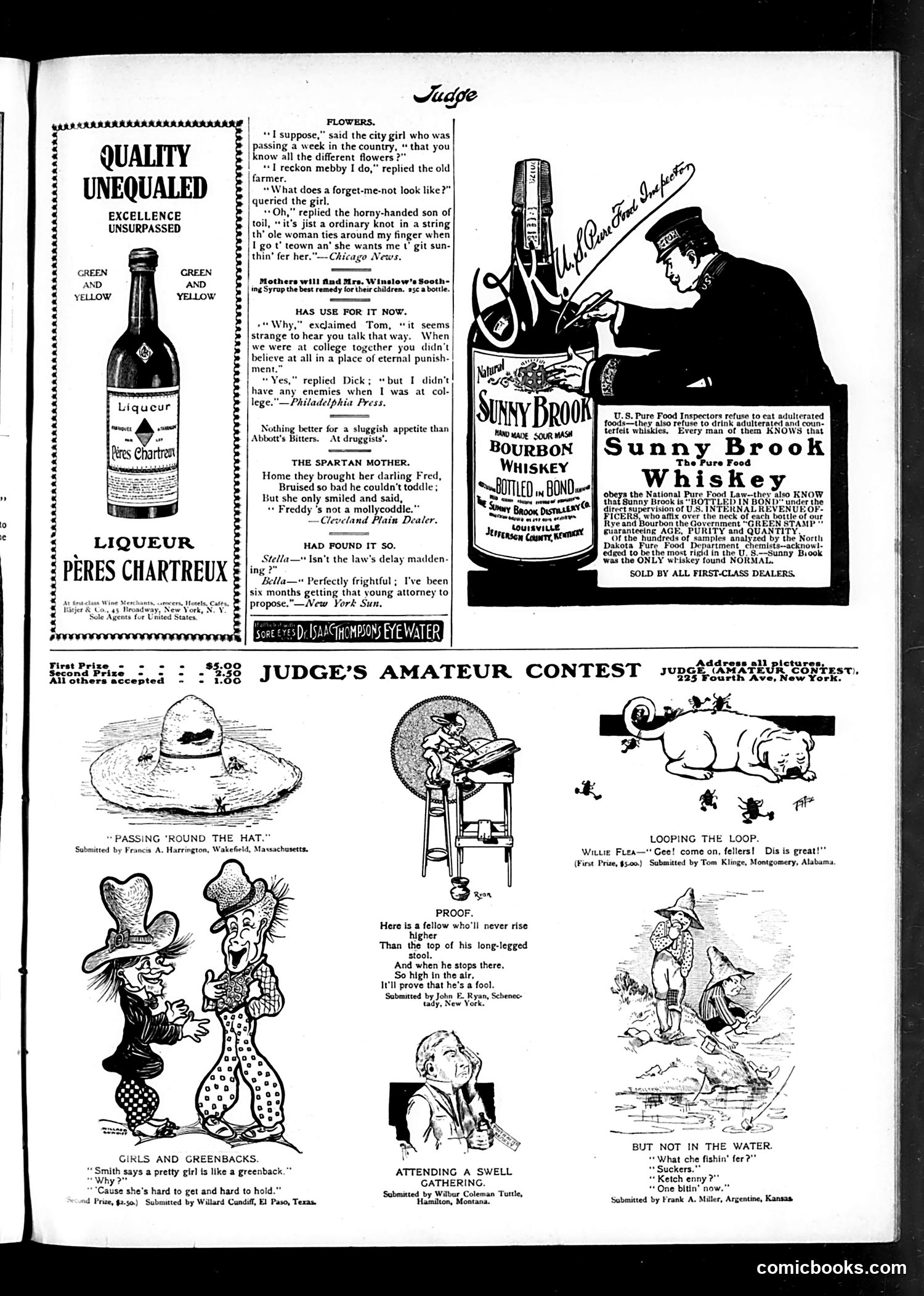
This page from the satirical magazine *Judge* contains multiple short humorous pieces and advertisements typical of early 20th-century American humor. **Main Content:** The page features "Judge's Amateur Contest"—reader-submitted cartoons and jokes competing for prizes ($5, $2.50, and $1.25). Topics include rural/urban contrasts (a city girl misunderstanding farm life), college attitudes toward religion, and various sight gags about courtship and fishing. **Notable Satire:** "The Spartan Mother" mocks overly sentimental Victorian domestic ideals through exaggerated verse. Several pieces play on romantic/marital themes—delays in proposals, courtship difficulties—reflecting contemporary dating anxieties. **Advertisements:** Liqueur and whiskey ads dominate, including "Sunny Brook Whiskey," which claims Pure Food Inspector approval, capitalizing on early 20th-century food safety concerns following the 1906 Pure Food and Drug Act. **Context:** The humor reflects period preoccupations: rural versus urban life, gender relations, alcohol consumption (pre-Prohibition), and emerging consumer trust in federally-inspected products. The amateur contest format was *Judge*'s signature feature, encouraging reader participation.
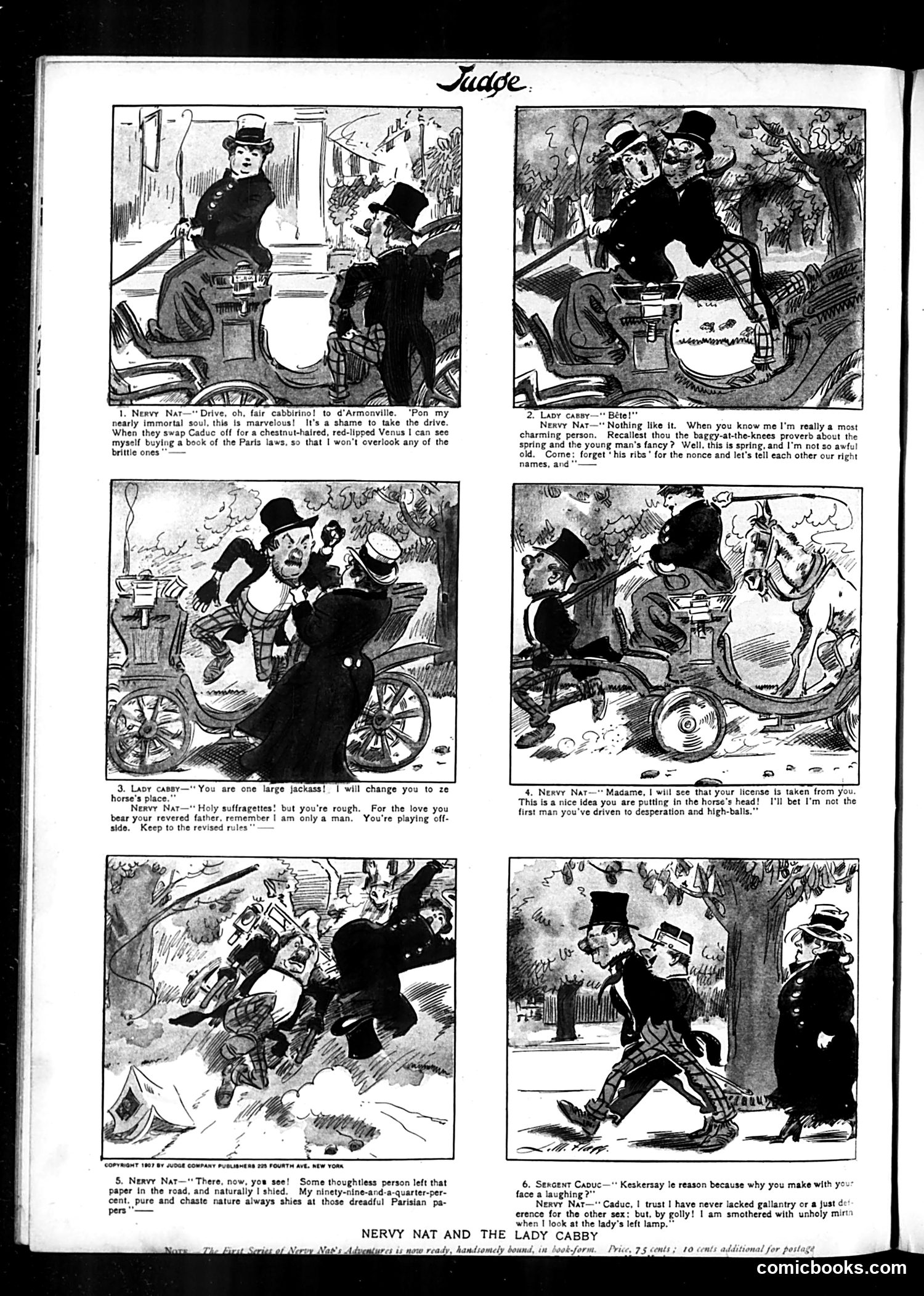
This 1907 Judge comic strip satirizes turn-of-the-century courtship conventions and gender roles. "Nervy Nat" is a flirtatious male character attempting to seduce "Lady Cabby," a female cab driver, through exaggerated gallantry and flattery. The humor derives from several sources: Nat's transparent romantic scheming, the absurdity of flirtation occurring in a moving cab, and the lady's increasingly hostile rejections. The strip mocks the era's courtship rituals and Nat's obliviousness to her anger. References to "suffragettes" (panel 3) and "revised rules" suggest contemporary debates about women's changing social roles. The final panels show physical chaos—the cab crashes, presumably from distraction—and the lady's exasperation with Nat's continued attempts at charm despite causing accident and damage. The satire targets both his relentless presumption and the outdated romantic conventions he represents.