
A complete issue · 16 pages · 1907
Judge — April 6, 1907
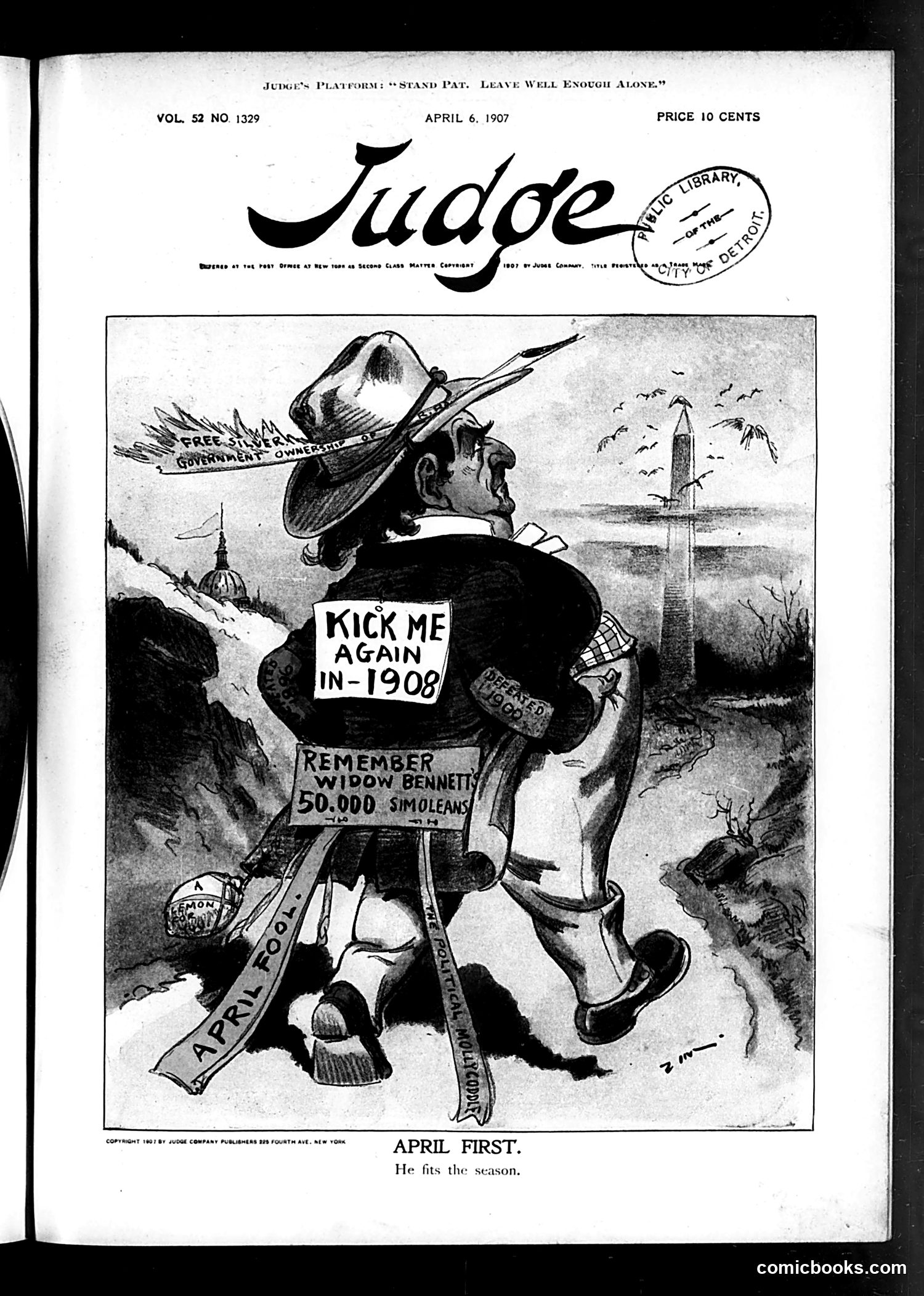
This April Fools' Day cartoon depicts a caricatured demon or devil figure wearing a cowboy hat labeled "FREE GOVERNMENT OWNERSHIP." The figure carries signs reading "KICK ME AGAIN IN 1908" and references "WIDOW BENNETT" and "5,000 SIMOLEANS" (slang for dollars). Additional labels include "APRIL FOOL," "DEMON," and "POLITICAL." The satire targets government ownership proposals—likely of railroads or utilities—which the cartoonist portrays as foolish and destructive. The 1908 reference suggests this relates to upcoming electoral politics. The figure's grotesque appearance and fool's costume mock advocates of government ownership as naive or villainous. The "widow Bennett" reference appears to invoke sympathy-based arguments from reform advocates, which Judge's conservative editors dismissed as sentimental trickery.
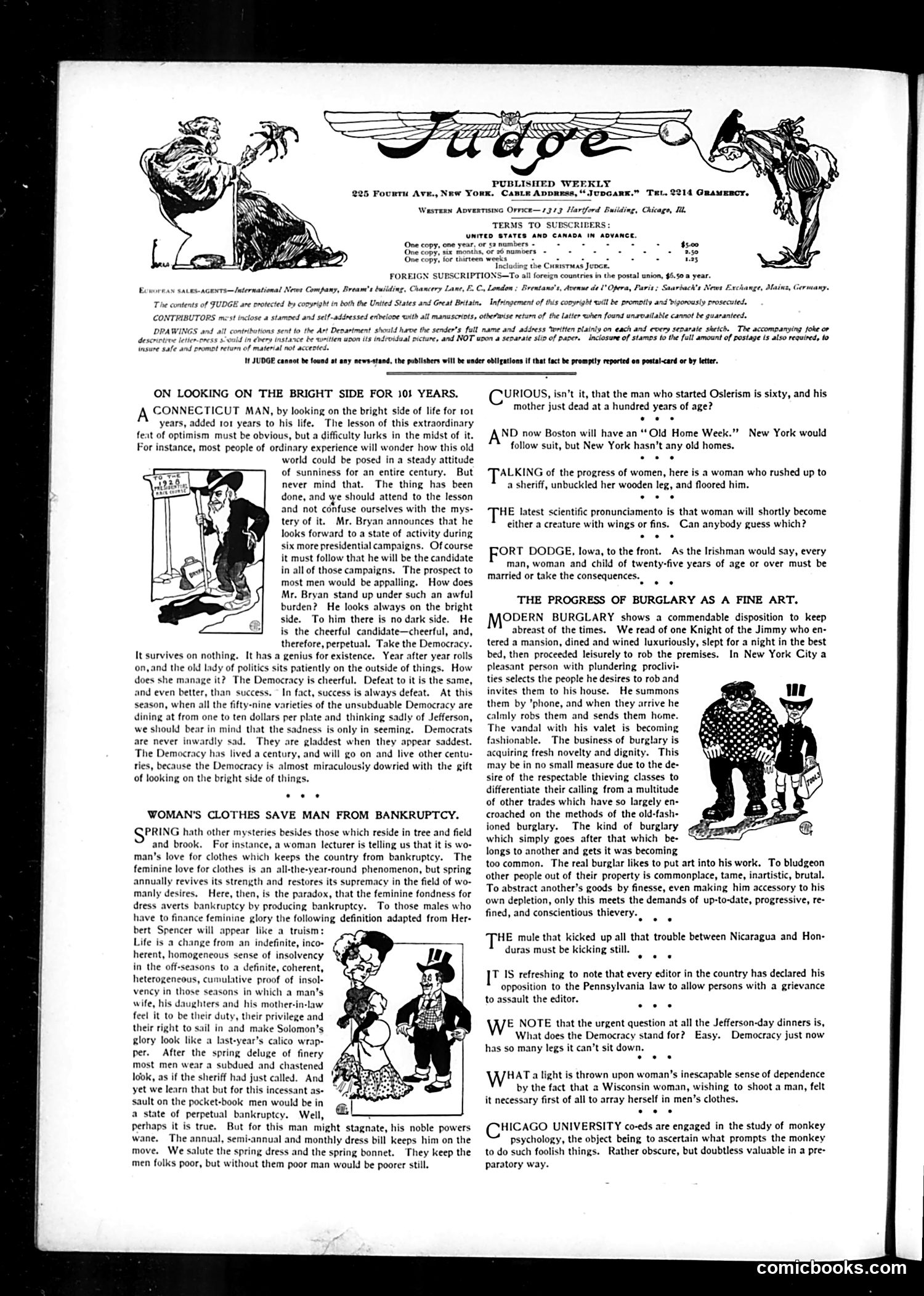
This page contains several satirical short pieces typical of Judge's political commentary. The main visible cartoon depicts a man in formal attire (top hat and coat) in what appears to be a domestic scene, likely mocking social hypocrisy or male behavior. The accompanying text sections include commentary on: - **Democracy's durability** - arguing Democracy survives despite its flaws - **Women's clothing and bankruptcy** - satirizing how women's fashion choices relate to male financial ruin - **Burglary as "fine art"** - mocking how burglars have become increasingly sophisticated and selective about targets - **Various social observations** about gender relations and institutional behavior The tone is characteristic of early-20th-century satirical humor: cynical about democracy, dismissive of women's autonomy, and amused by crime's "professionalization." Without specific dates or clearer figure identification visible, precise historical context remains unclear.
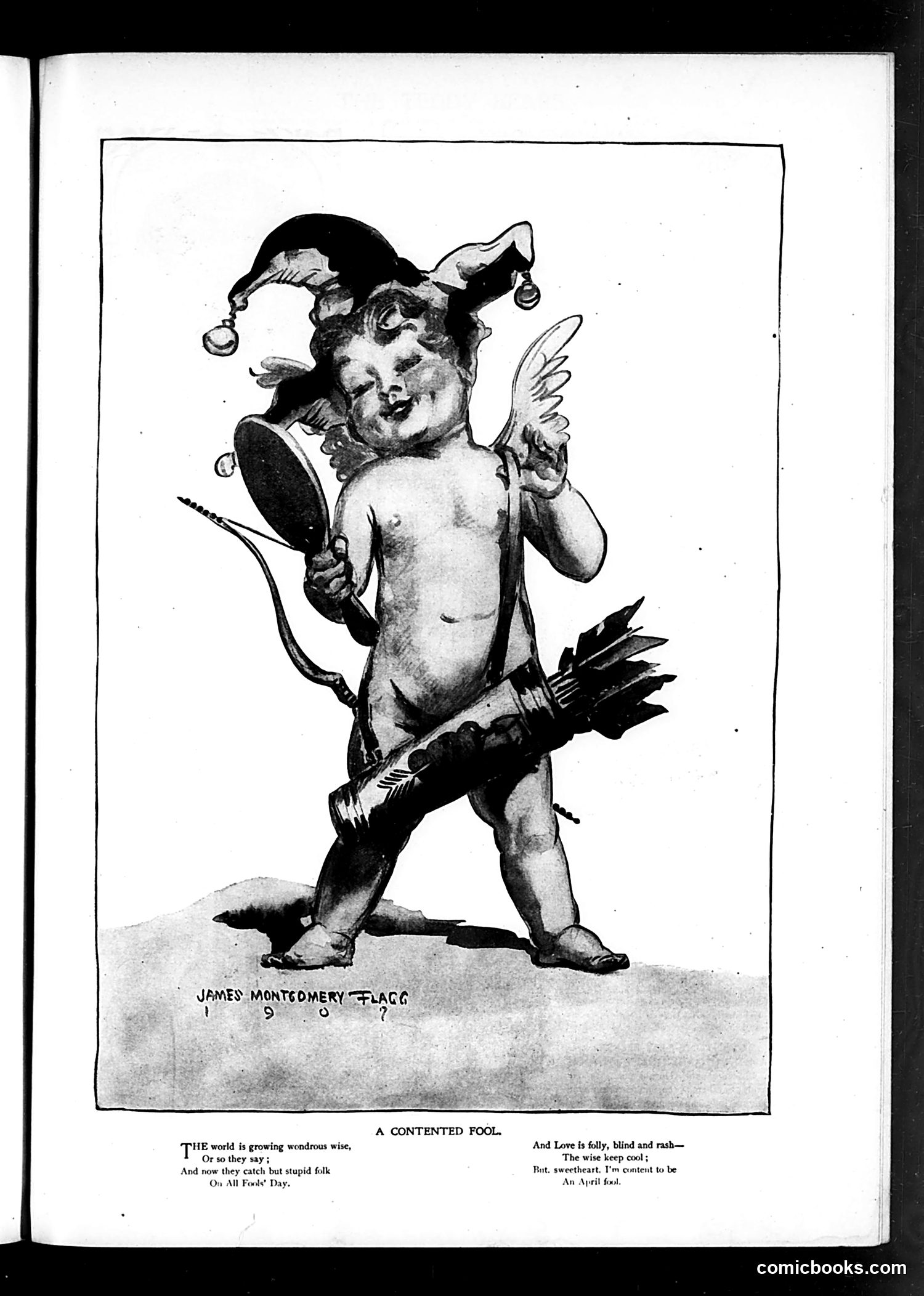
This illustration by James Montgomery Flagg depicts a cherubic figure dressed as a jester or fool, equipped with bow and arrows, a sword, and a lute—classical attributes of folly and merriment. The title "A Contented Fool" references the accompanying verse about a "world growing wondrous wise" where "stupid folk" are caught, yet this particular fool remains contentedly blind and rash—"an April fool." The satire likely mocks individuals or groups who remain willfully ignorant despite society's progress, choosing comfort in foolishness over engagement with contemporary issues. The jester's traditional costume emphasizes the mockery of those who embrace self-imposed ignorance, a common Judge magazine theme critiquing social complacency during the early 20th century.
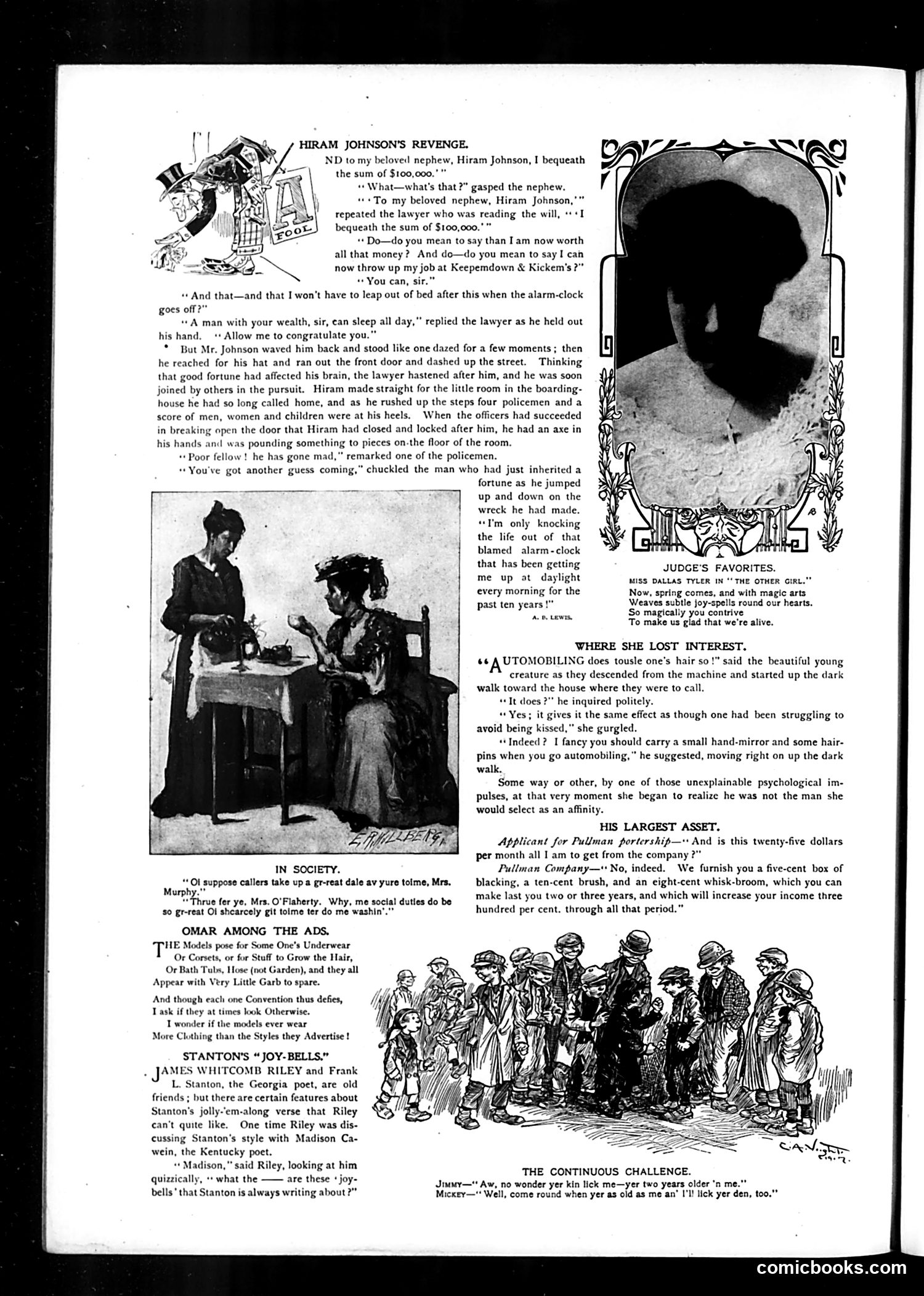
This page from *Judge* magazine contains primarily **fiction and advertising** rather than political satire. The main content includes: 1. **"Hiram Johnson's Revenge"** — a serialized story about a lawyer inheriting $100,000, with illustrations of the narrative's dramatic moments (the inheritance discovery, police breaking down a door). 2. **"Where She Lost Interest"** — a romantic comedy snippet about automobiling and courtship. 3. **"In Society"** — a brief social humor piece about etiquette. 4. **Advertisements** — including Pullman Company employment solicitation and various product ads. 5. **"Omar Among the Ads"** and **"Stanton's 'Joy-Bells'"** — light verse sections. 6. **Two cartoon illustrations** with captions about everyday social situations ("The Continuous Challenge"). The page is **not primarily satirical or political** but rather demonstrates *Judge*'s mix of serialized fiction, social humor, and advertising typical of early 20th-century magazine publishing.
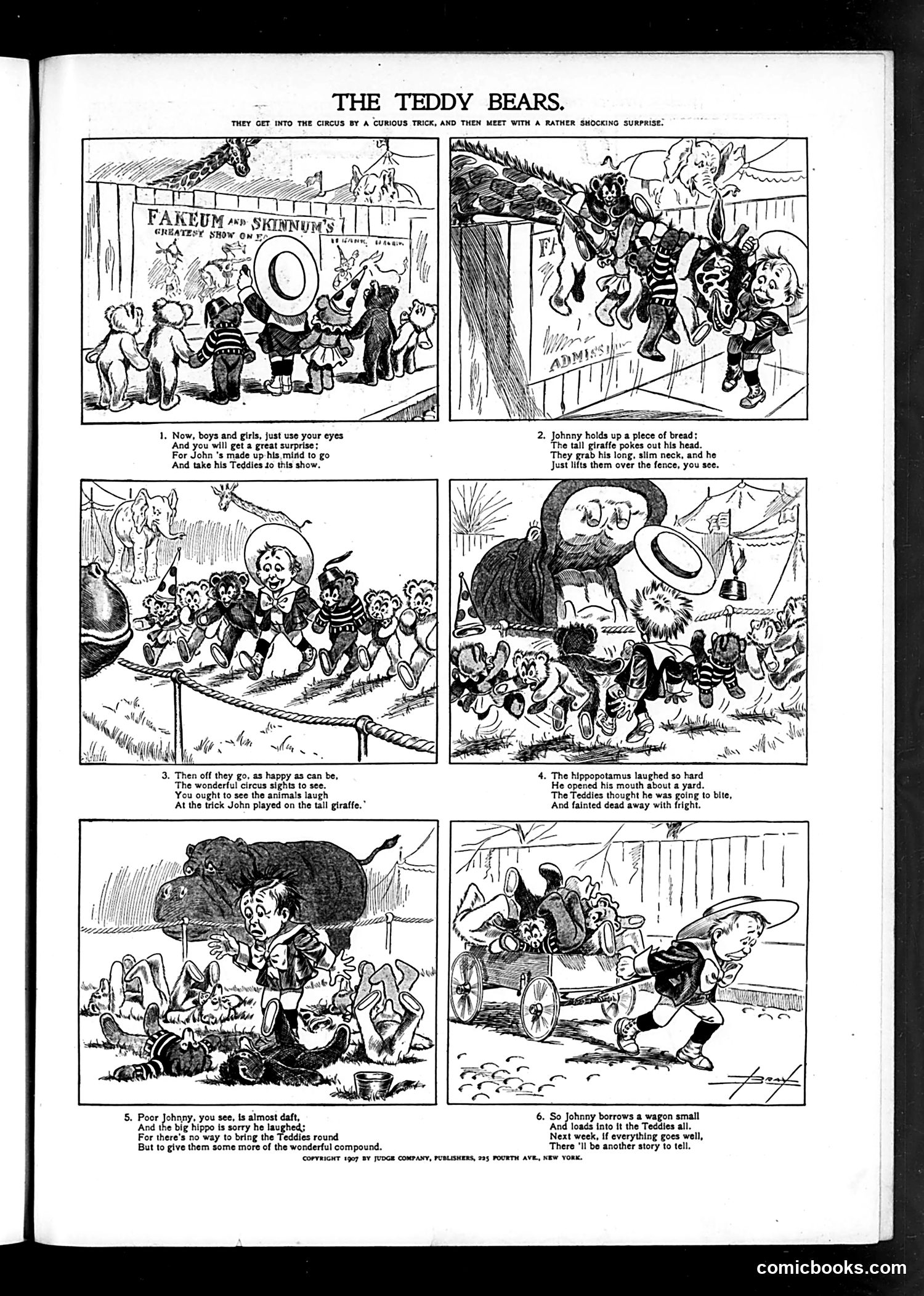
This is a whimsical children's comic strip with no apparent political satire. The narrative follows anthropomorphized teddy bears who sneak into a circus by hiding in a barrel, then cause chaos by disrupting performances—Johnny uses bread to distract a giraffe, they scare a hippopotamus, and eventually borrow a wagon to escape with their newfound animal companions. The strip appears to be pure entertainment rather than social commentary. The "Teddy Bears" reference likely alludes to the popularity of teddy bear toys (named after President Theodore Roosevelt), which were a cultural phenomenon in the early 1900s when this Judge issue was published. The comic simply capitalizes on this toy craze's appeal to young readers without embedding political meaning.
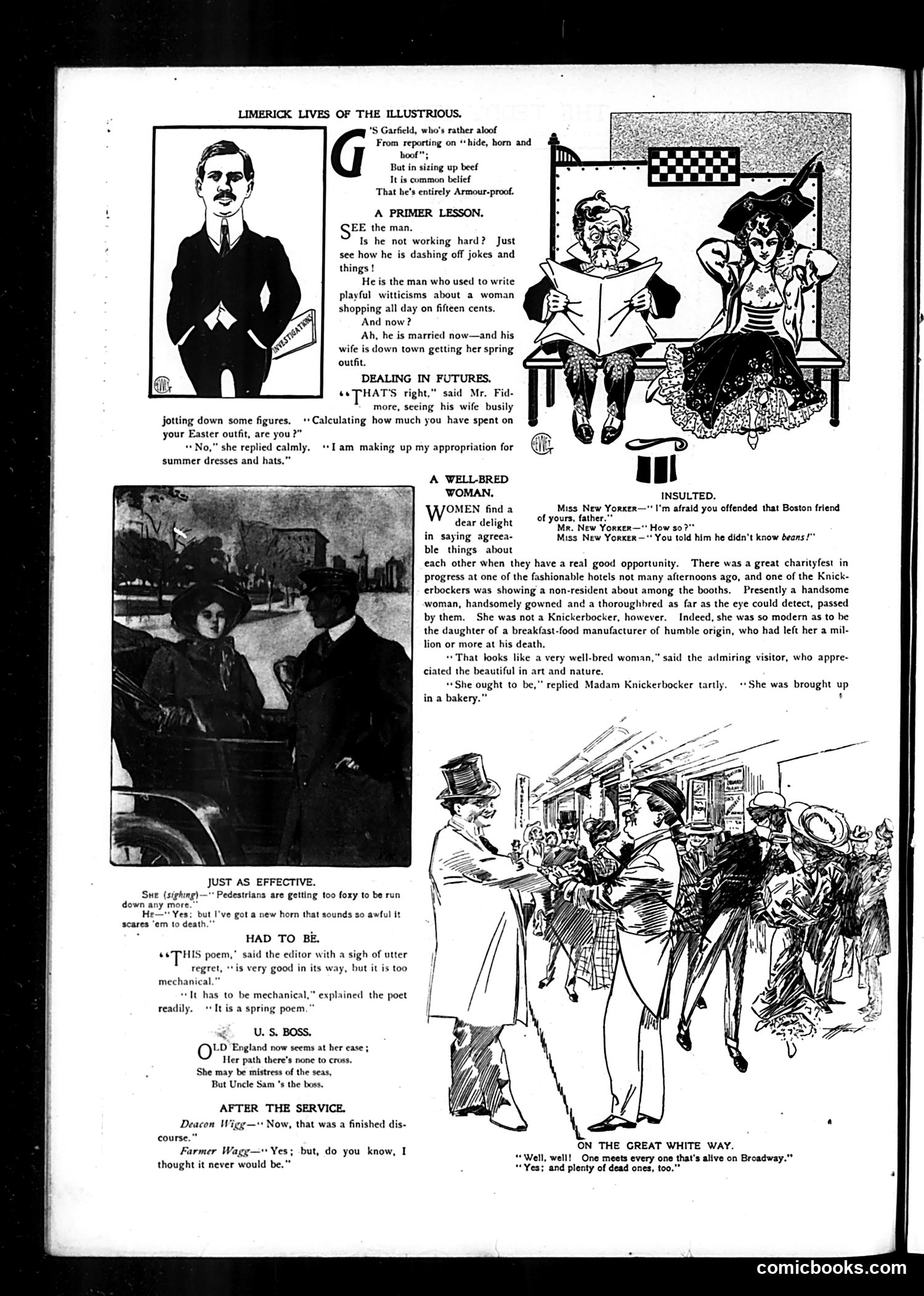
This page contains satirical commentary on early 20th-century American life, mixing limericks, jokes, and social observation: **"Garfield" limerick**: References someone in the beef industry (likely tied to Armour meat-packing), suggesting they're "armor-proof" against criticism—a swipe at corporate insulation from accountability. **"Primer Lesson"**: Mocks a writer whose marriage has reversed his economic complaints. He once satirized women's penny-pinching; now *his* wife spends freely on spring fashions—ironic comeuppance. **"Dealing in Futures"**: Jokes about wives calculating not past spending but *future* dress budgets—suggesting women's endless consumption planning. **"Well-Bred Woman"**: Satirizes Old Money (Knickerbocker) snobbery toward New Money. A wealthy woman's humble bakery origins disqualify her from "breeding," despite her wealth and appearance. **Minor jokes**: Address pedestrian safety, poetic mechanics, American naval dominance, and Broadway's social mixing. The tone throughout is comedic social criticism targeting class pretension, consumer culture, and gender dynamics of the era.
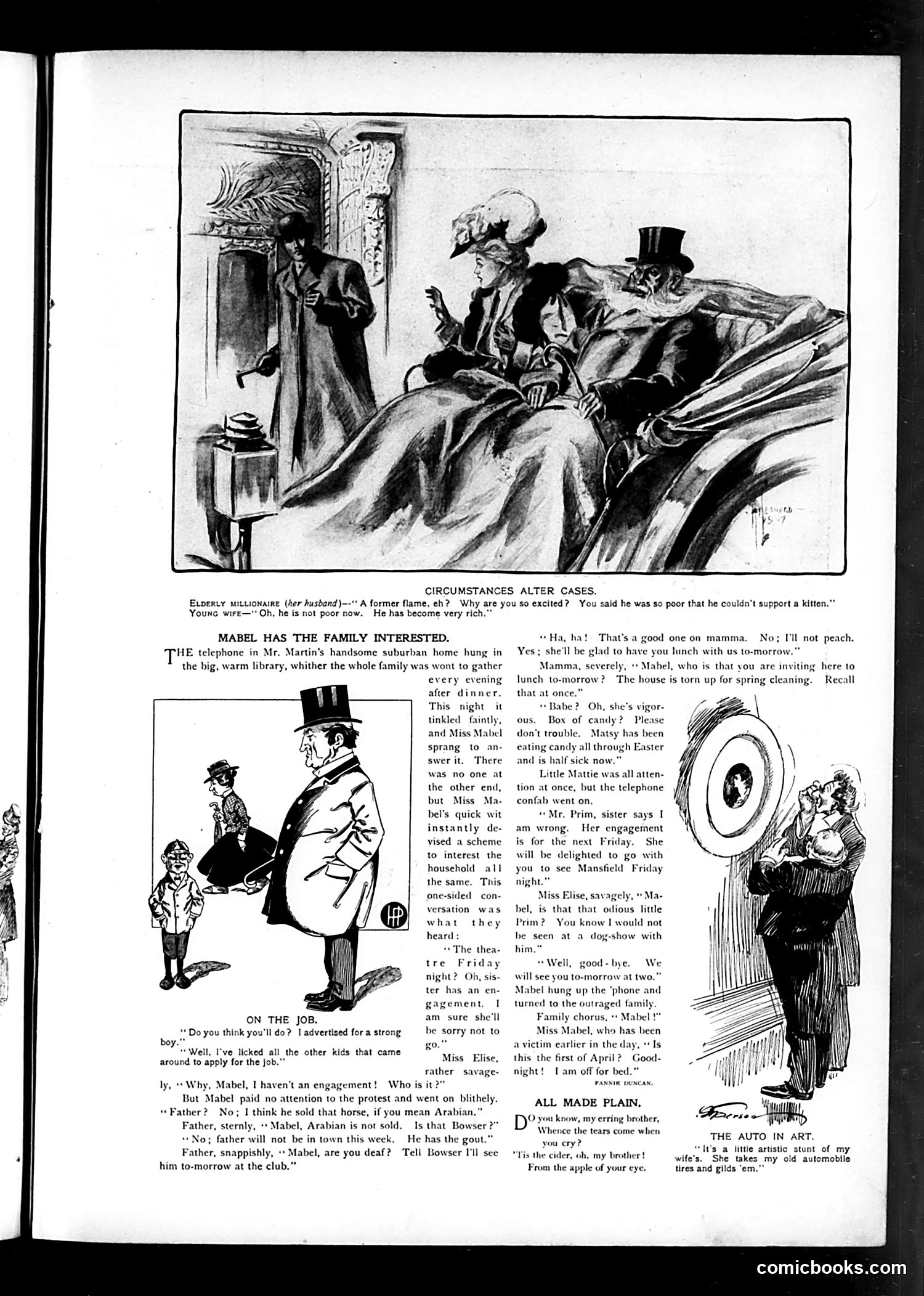
This page from *Judge* satirizes the telephone's disruptive effect on domestic life. The main story follows Mabel Martin, a young woman who receives a call and, finding no one on the line, improvises an elaborate one-sided conversation about social engagements—deliberately misleading her family about inviting various people to lunch and theater outings. The satire targets two things: first, the novelty and unreliability of early telephone technology (the disconnected call); second, adolescent mischief and modern girls' apparent disrespect for parental authority. Mabel exploits the telephone to trick her family for amusement, going "blithely" against her mother's and father's protests. The sidebar cartoons add commentary: "Circumstances Alter Cases" mocks materialistic women (a wife suddenly interested in a poor ex-lover once he becomes rich), while "On the Job" and "The Auto in Art" offer lighter domestic humor unrelated to the main narrative.
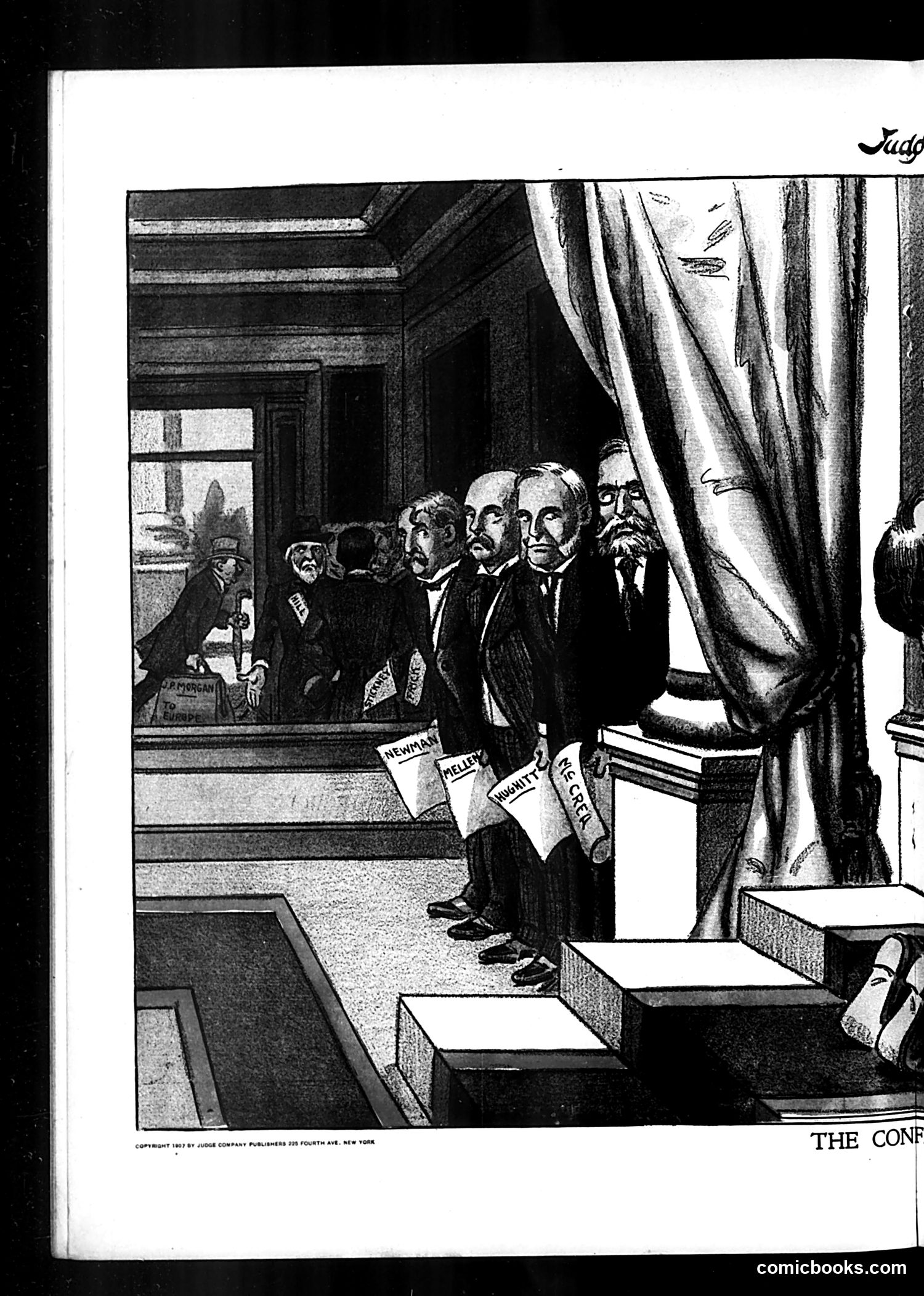
This appears to be a political cartoon from *Judge* magazine satirizing a legal or governmental proceeding. The image shows five men in formal attire holding papers labeled with what appear to be names or positions (text is partially legible as "BEWRAY," "JELLY," "MOUNT," and "CZAR"). They stand before a window where observers look on, suggesting a public hearing or trial scenario. The cartoon likely critiques political figures or officials through caricature and labeled placards, a common *Judge* satirical technique. However, without clearer text legibility and the specific publication date, I cannot definitively identify the individuals depicted or the exact political event being mocked. The formal courtroom-like setting suggests commentary on judicial or legislative proceedings.
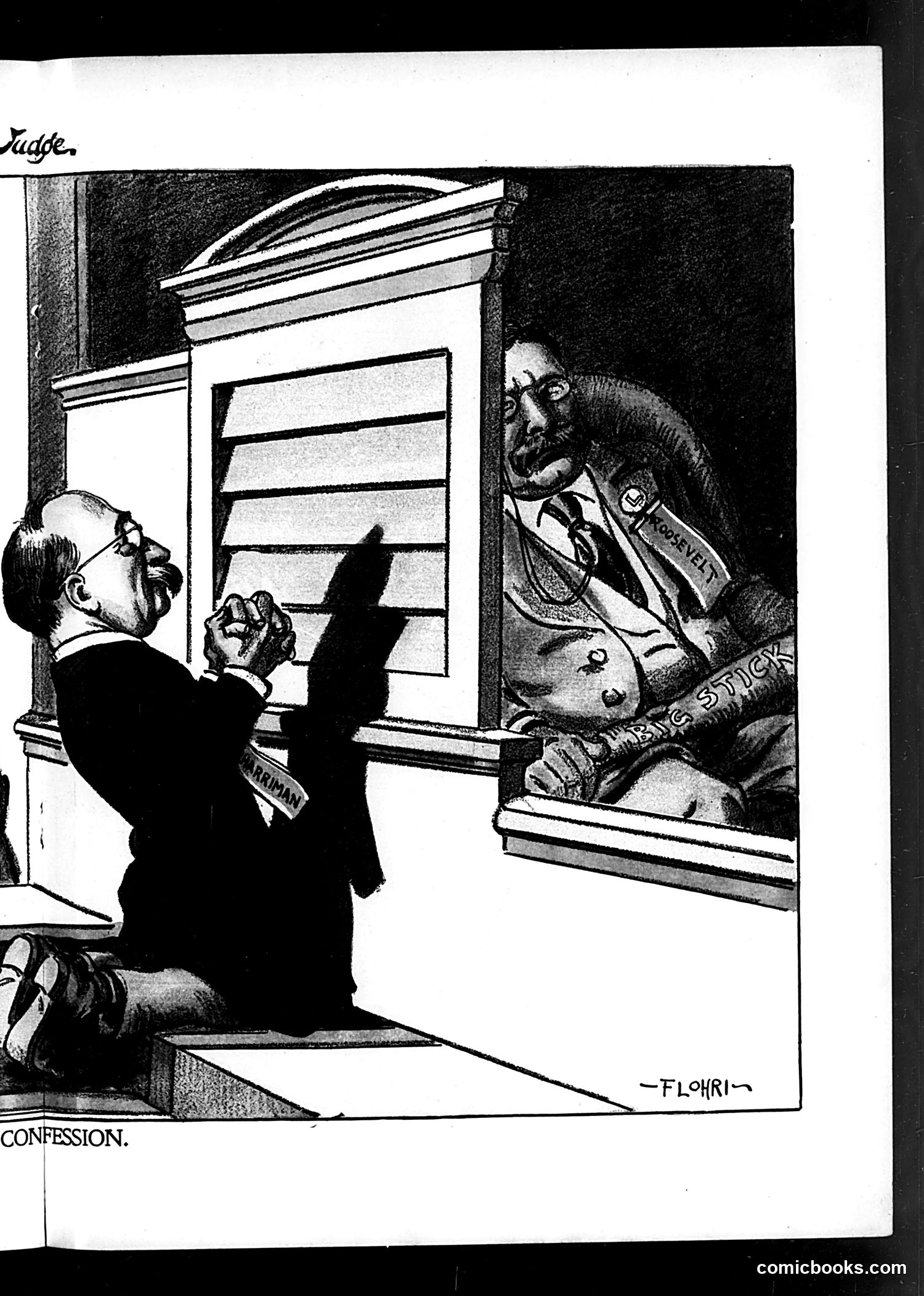
This political cartoon depicts a man in formal attire kneeling at a confessional window, speaking to a stern-faced priest inside. The priest wears what appears to be a sash labeled "authority" and displays a menacing expression. The cartoon's title "Confession" suggests commentary on forced admissions or coerced statements. The man's supplicant posture and the priest's intimidating demeanor imply satirical critique of institutional or governmental power—likely depicting someone being pressured to confess, possibly under duress. The Judge magazine context suggests this addresses contemporary political or social concerns about authority figures extracting confessions or using religious/institutional power to obtain compliance. Without additional context, the specific historical reference remains unclear, though the imagery critiques abuses of institutional authority.
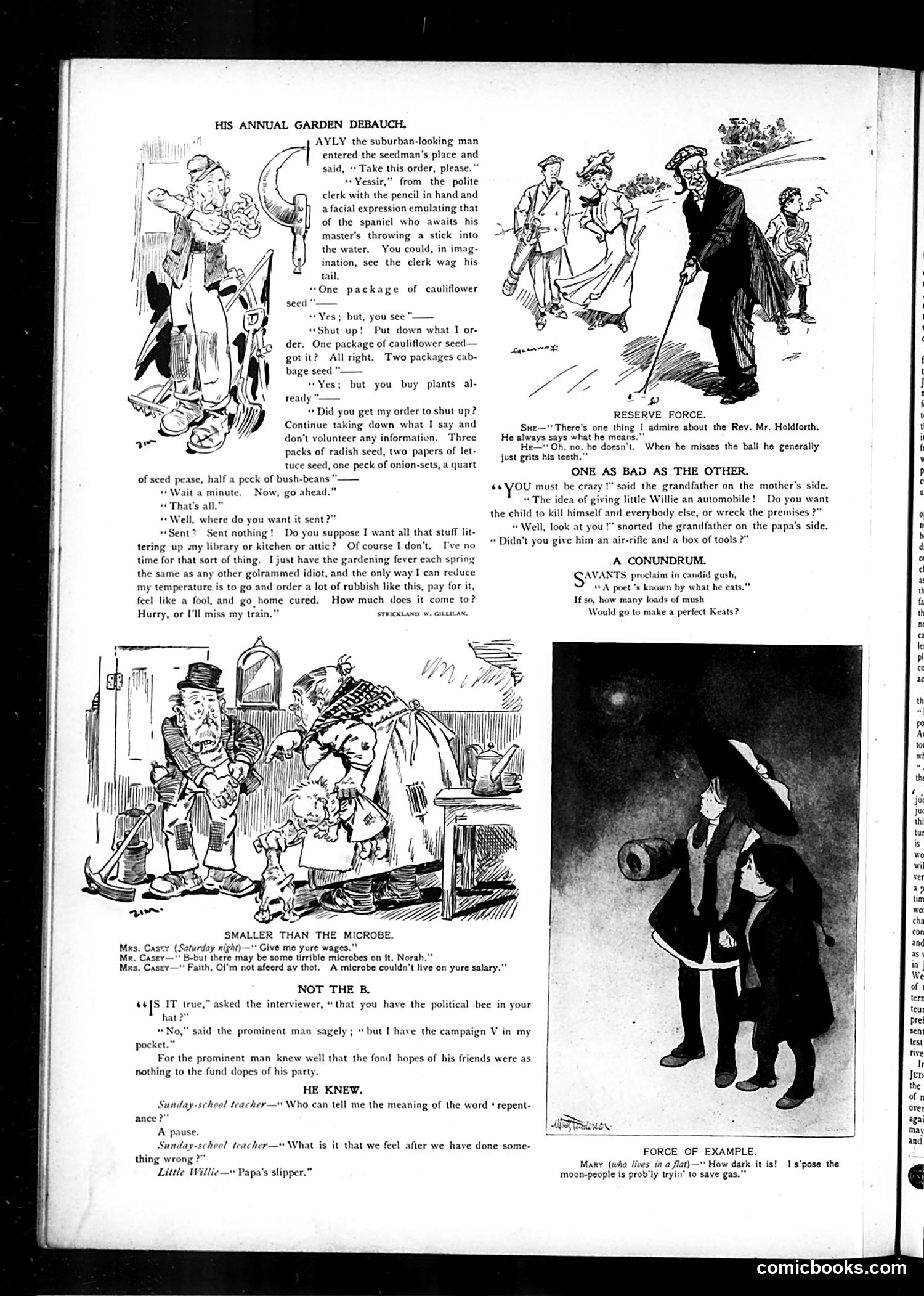
This page contains multiple satirical cartoons and humor pieces typical of early 20th-century Judge magazine: **"His Annual Garden Debauch"** depicts a suburban man's yearly obsession with ordering seeds from a seedsman, treating the clerk dismissively while indulging his gardening fever. The satire targets the irrational hobby-driven spending of middle-class men. **"Reserve Force"** and **"As Bad as the Other"** mock grandfathers debating whether to give a child an automobile and air-rifle—satirizing generational anxiety about modern technology's dangers. **"Not the B"** jokes about a politician carrying a "campaign V" (Roman numeral five) in his pocket, suggesting politicians prioritize party fundraising ("fund dopes") over constituents' hopes. **"He Knew"** is a Sunday school lesson joke where a child answers "repentance" means feeling papa's slipper—absurdist humor about punishment. **"Smaller than the Microbe"** depicts working-class Irish characters (Casey and Norah) joking that microbes couldn't survive on his meager salary. The page exemplifies Judge's mix of social commentary, class satire, and domestic humor.
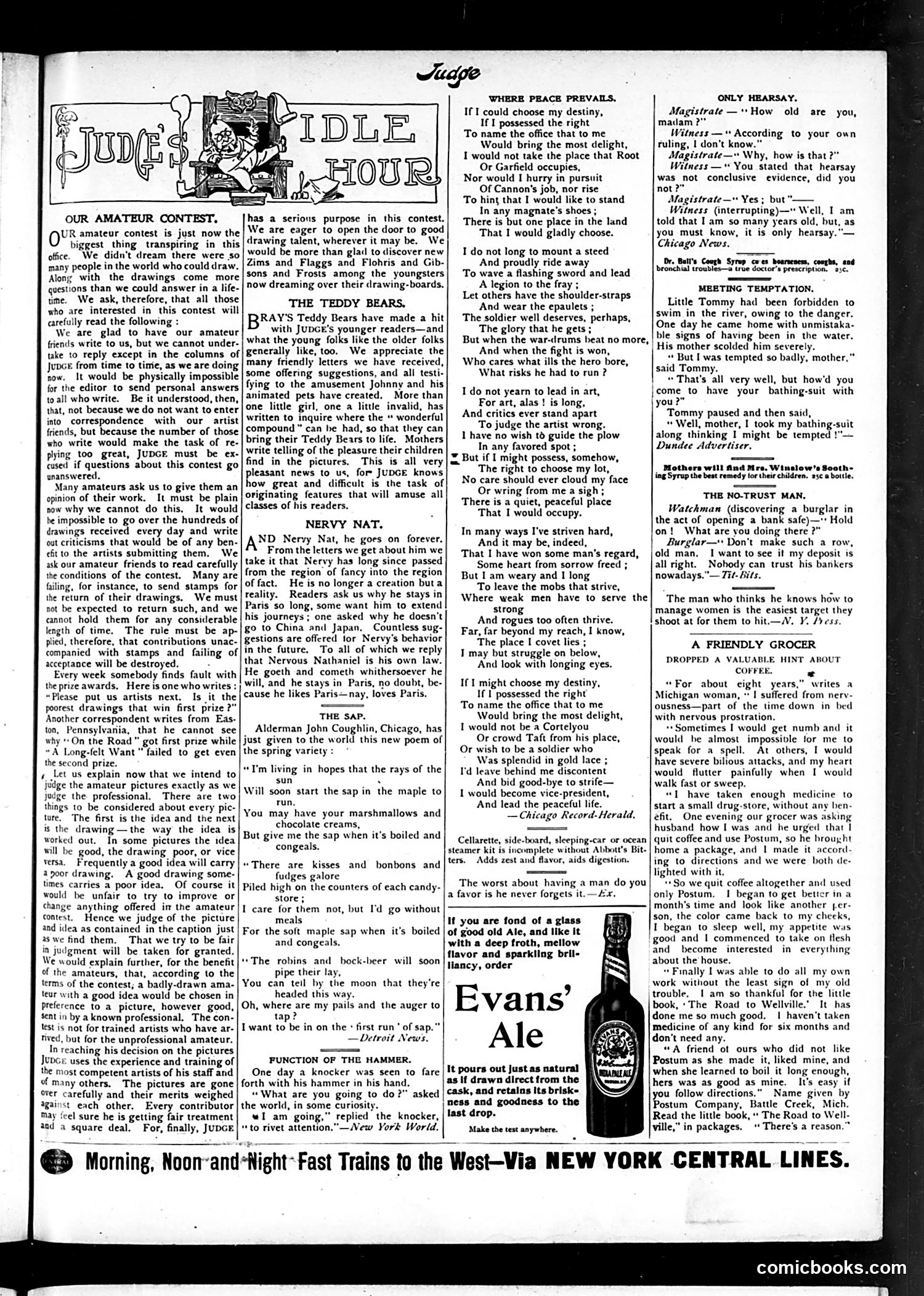
This page is primarily **instructional content** rather than a political cartoon. Judge magazine is running an amateur drawing contest and using this space to clarify rules and answer frequently asked questions from aspiring cartoonists. The key points explain that: - Judge receives hundreds of amateur submissions but cannot provide individual critiques due to volume - Submissions must include return postage or will be discarded - Judging considers both **idea and execution** equally—a good concept can outweigh poor drawing, and vice versa - Amateur work is deliberately preferred over professional submissions to discover new talent - The magazine references established cartoonists like "Zims and Flaggs and Flohris and Gibsons and Frosts" as the caliber of talent they hope to find The page also contains unrelated advertisements (Evans Ale, etc.) typical of magazine layouts from this era. This is essentially a **meta-editorial** explaining the contest mechanics to readers.
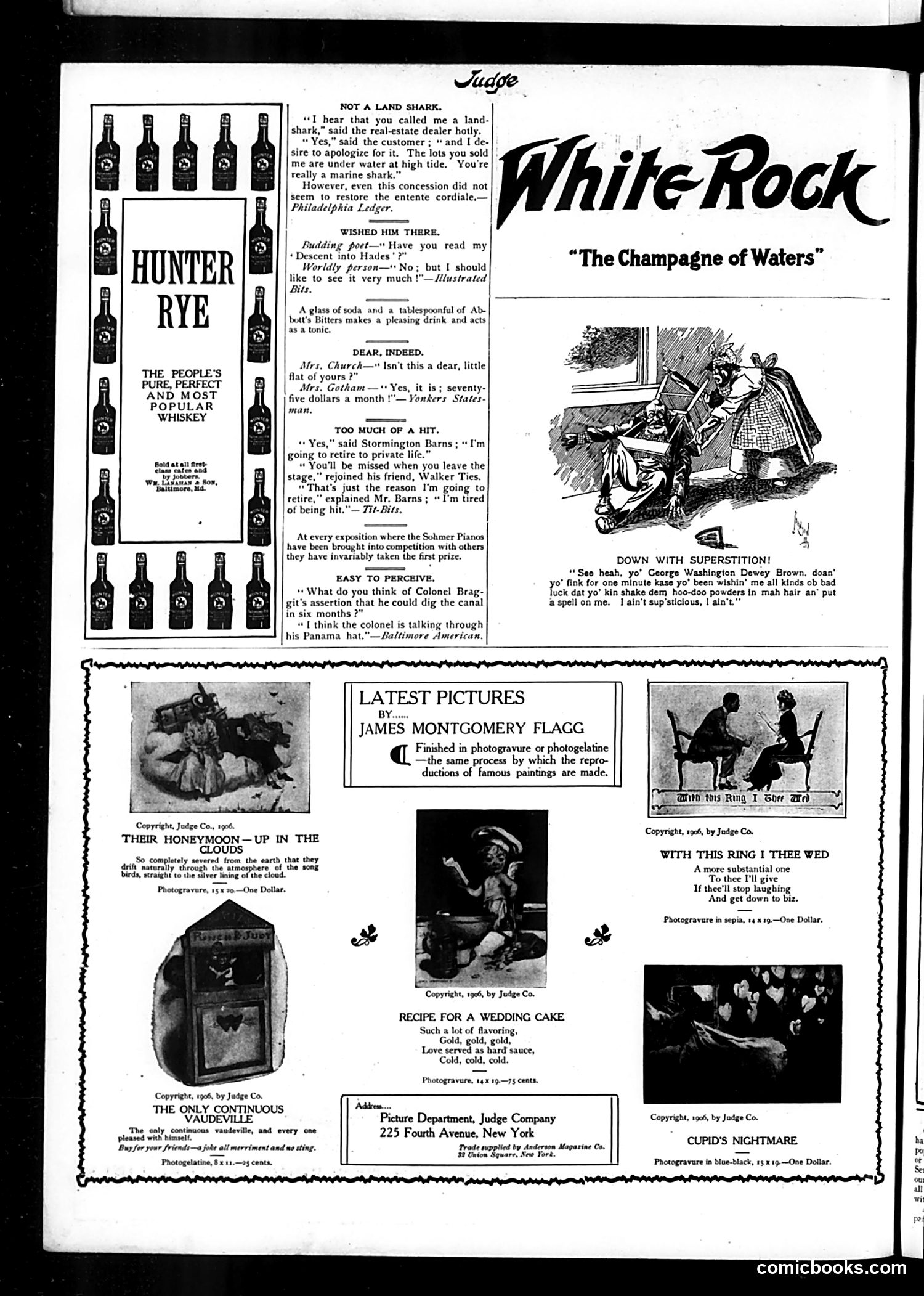
This page from Judge (circa 1906) contains several short satirical jokes and advertisements typical of the era: **The Cartoons/Jokes:** - "Not a Land Shark" mocks unscrupulous real-estate dealers who sell underwater lots at high tide - "Wished Him There" jokes about a poet's bad work - "Dear, Indeed" satirizes inflated New York City rent ($75/month for a small apartment) - "Too Much of a Hit" plays on a performer tired of audience applause/appreciation - "Easy to Perceive" puns on Colonel Braggit's "Panama hat" while discussing canal construction (likely referencing Theodore Roosevelt's Panama Canal project) - "Down with Superstition" depicts racist stereotypes of African Americans and folk magic beliefs **The Images** show wedding-themed photographs and vaudeville entertainment scenes. The page reflects early 20th-century American humor: real-estate fraud, failed artists, urban housing costs, and unfortunately, period-typical racial caricatures. Most jokes rely on wordplay and social observation rather than political commentary.
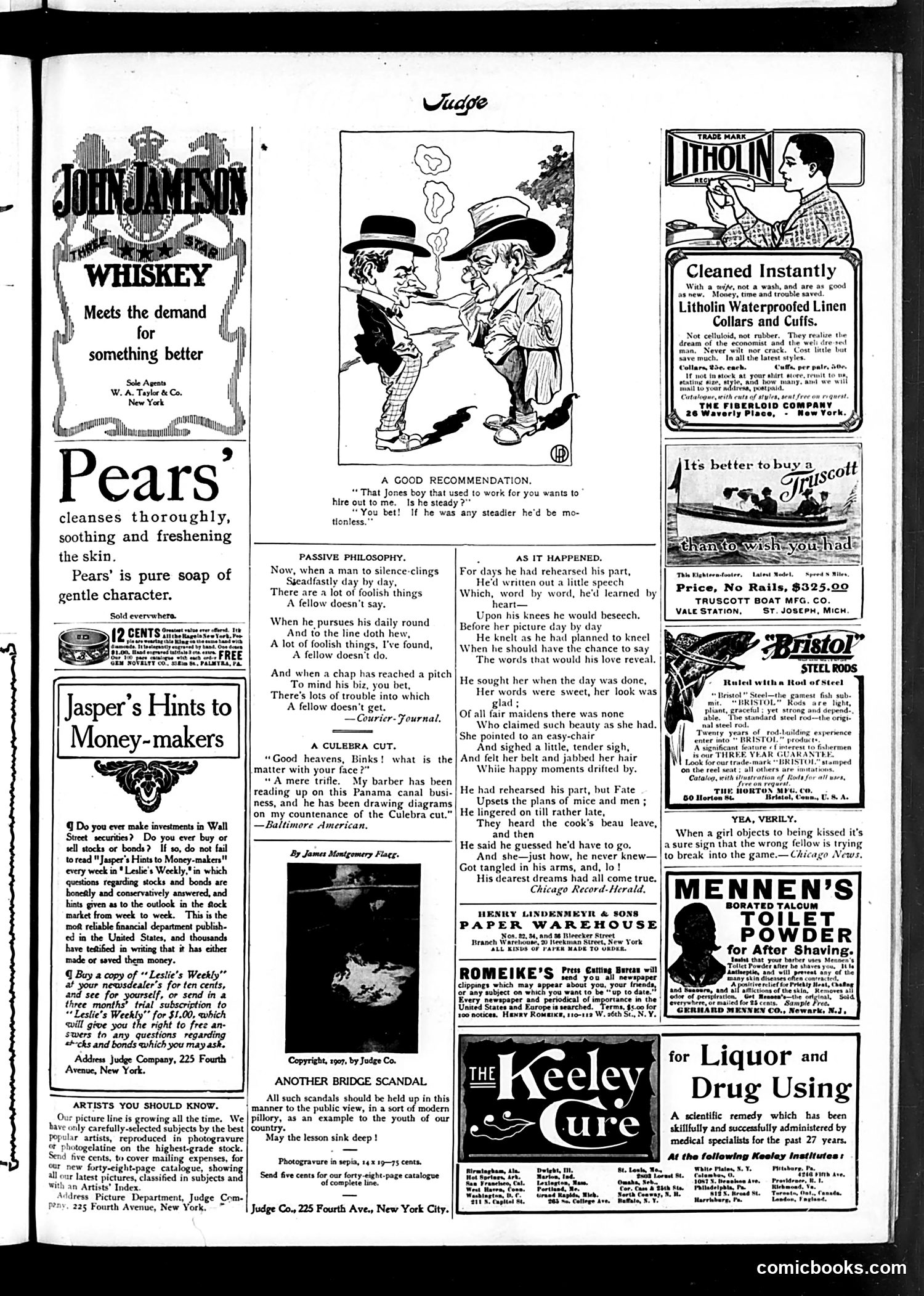
This page from *Judge* magazine is primarily **advertising and lighter content** rather than political satire. The main cartoon ("A Good Recommendation") depicts two working-class men discussing a job applicant—a mild joke about someone being so lazy that calling him "steady" would actually make him worse. Other notable content includes: - **"Passive Philosophy"**: A poem celebrating silence and minding one's business - **"A Culebra Cut"**: A joke referencing the Panama Canal construction, where a barber has supposedly drawn canal diagrams on a customer's face - **"As It Happened"**: A sentimental poem about a man's failed marriage proposal The page is dominated by period advertisements (Pears' soap, Litholin waterproof linen, Triscott boats, Bristol steel, Mennen's talc powder) and financial advice columns. There is **no clear political content or social commentary** beyond gentle humor at working-class expense and romantic mishaps typical of early 1900s magazines.
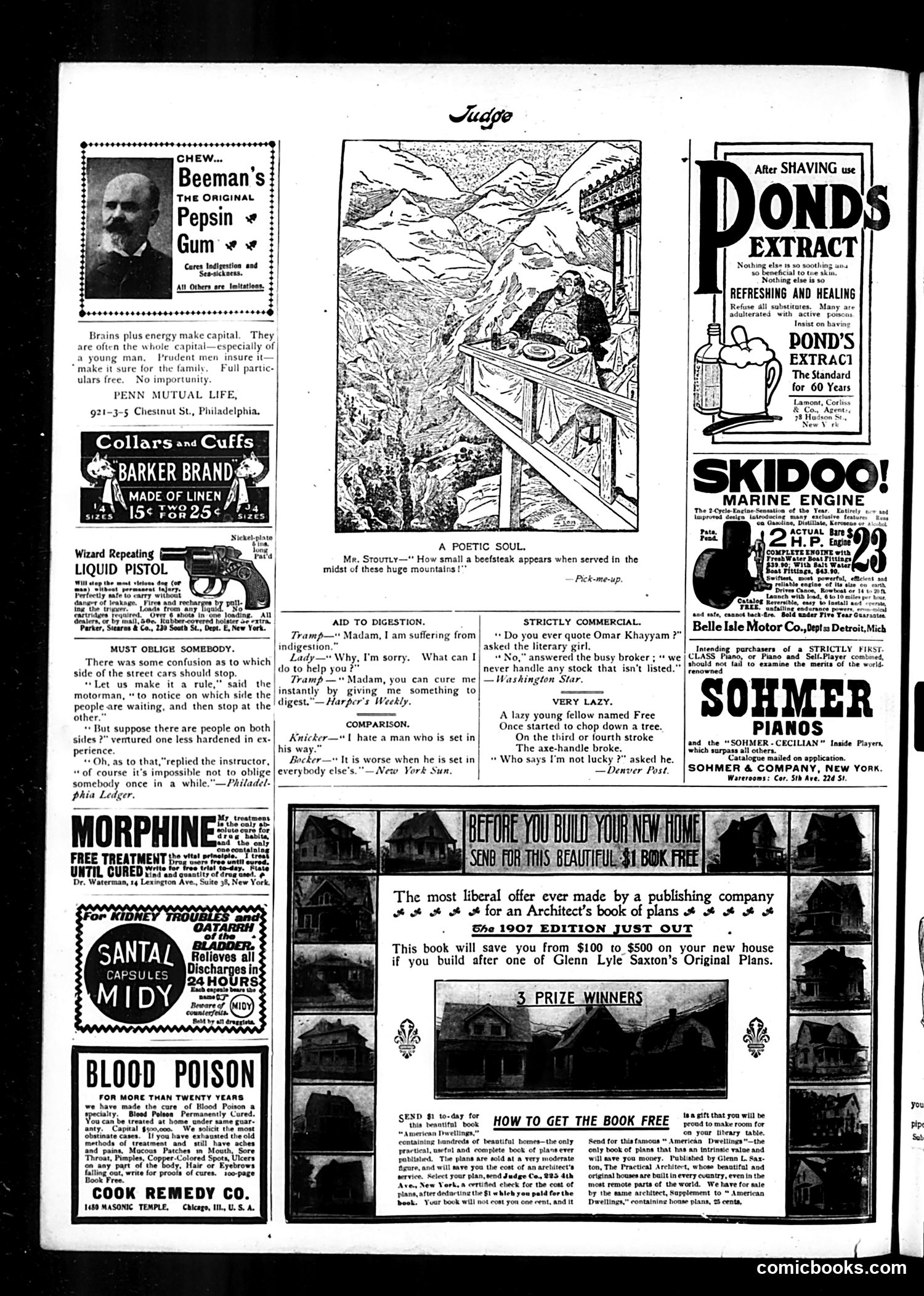
This page is primarily **advertising**, with one small cartoon and text snippets. The main cartoon titled "A POETIC SOUL" depicts a man (Mr. Stourty) in mountainous terrain, observing that a beefsteak appears small amid vast mountains. The humor is straightforward: the juxtaposition of a mundane dining concern against grand natural scenery, mocking affected romanticism. The page includes several joke snippets below, including exchanges between tramps and ladies, and commentary on romantic/literary pretension versus practical concerns. The bulk of the page features period advertisements for products (Beeman's Gum, Pond's Extract, collars, patent medicines for "blood poison") and services (pianos, house plans). Notably, the "Blood Poison" remedy ad reflects early-20th-century medical quackery—venereal disease treatments of dubious efficacy were commonly advertised in magazines of this era. The overall page reflects Judge's mix of light satire with aggressive patent-medicine advertising typical of 1907 magazines, before FDA regulations restricted such claims.
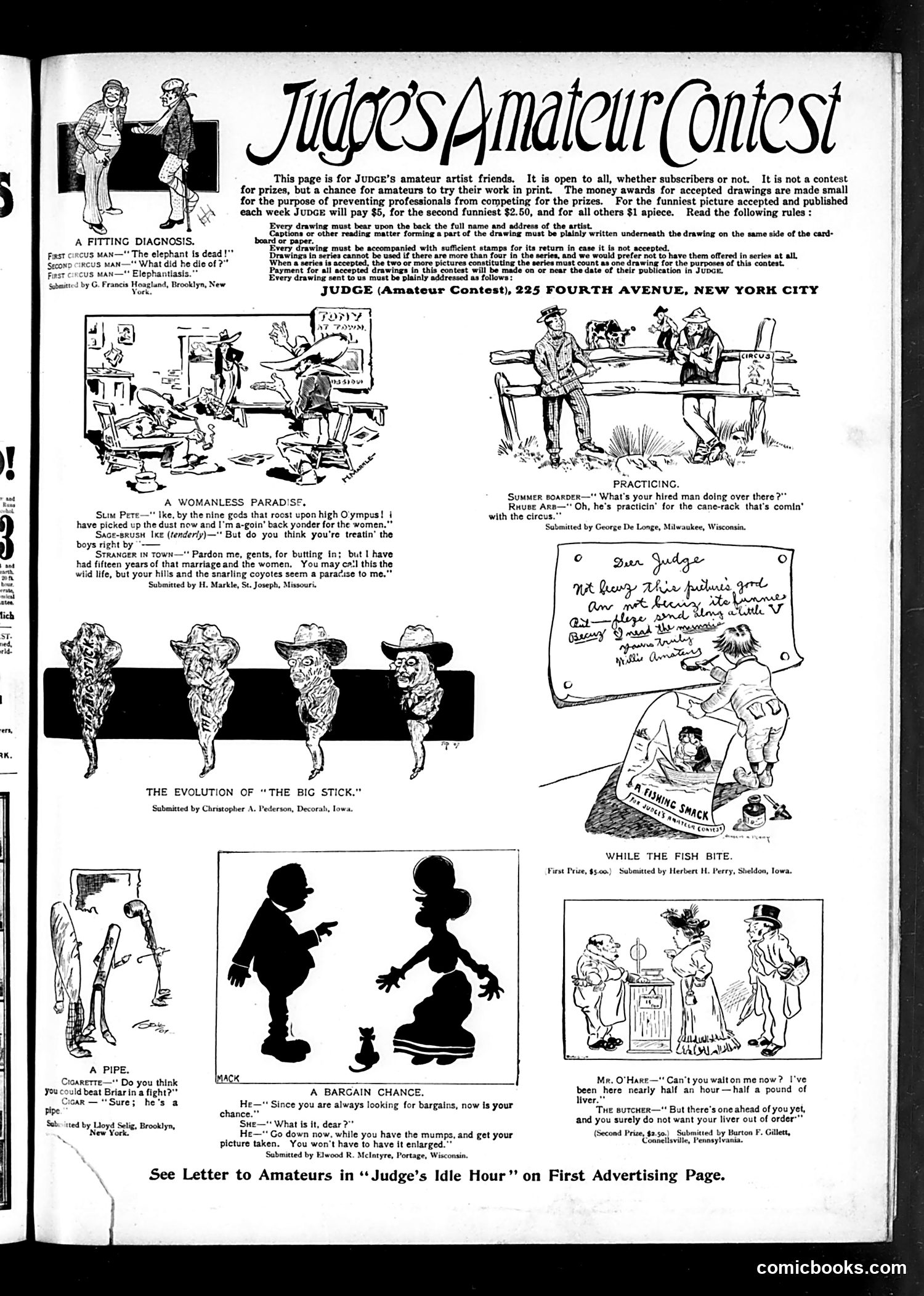
This page showcases amateur cartoons submitted to Judge magazine's contest for unpaid contributors. The cartoons employ simple visual gags and wordplay typical of early 20th-century humor: **Key cartoons include:** - "A Fitting Diagnosis": Circus performers discussing an elephant's death - "A Manless Paradise": A drifter rejecting civilization for wilderness life, contrasting rural freedom with marriage's constraints - "The Evolution of the Big Stick": Four bearded men's heads, likely referencing President Theodore Roosevelt's famous "speak softly and carry a big stick" foreign policy phrase - "While the Fish Bite": A man reading fishing magazines while his wife complains about his neglect - "A Bargain Chance": A husband suggesting his sick wife be photographed during mumps before recovery The humor reflects period preoccupations: gender relations, escape fantasies, and political references. The contest paid small amounts ($5 maximum) to prevent professionals from dominating amateur submissions.
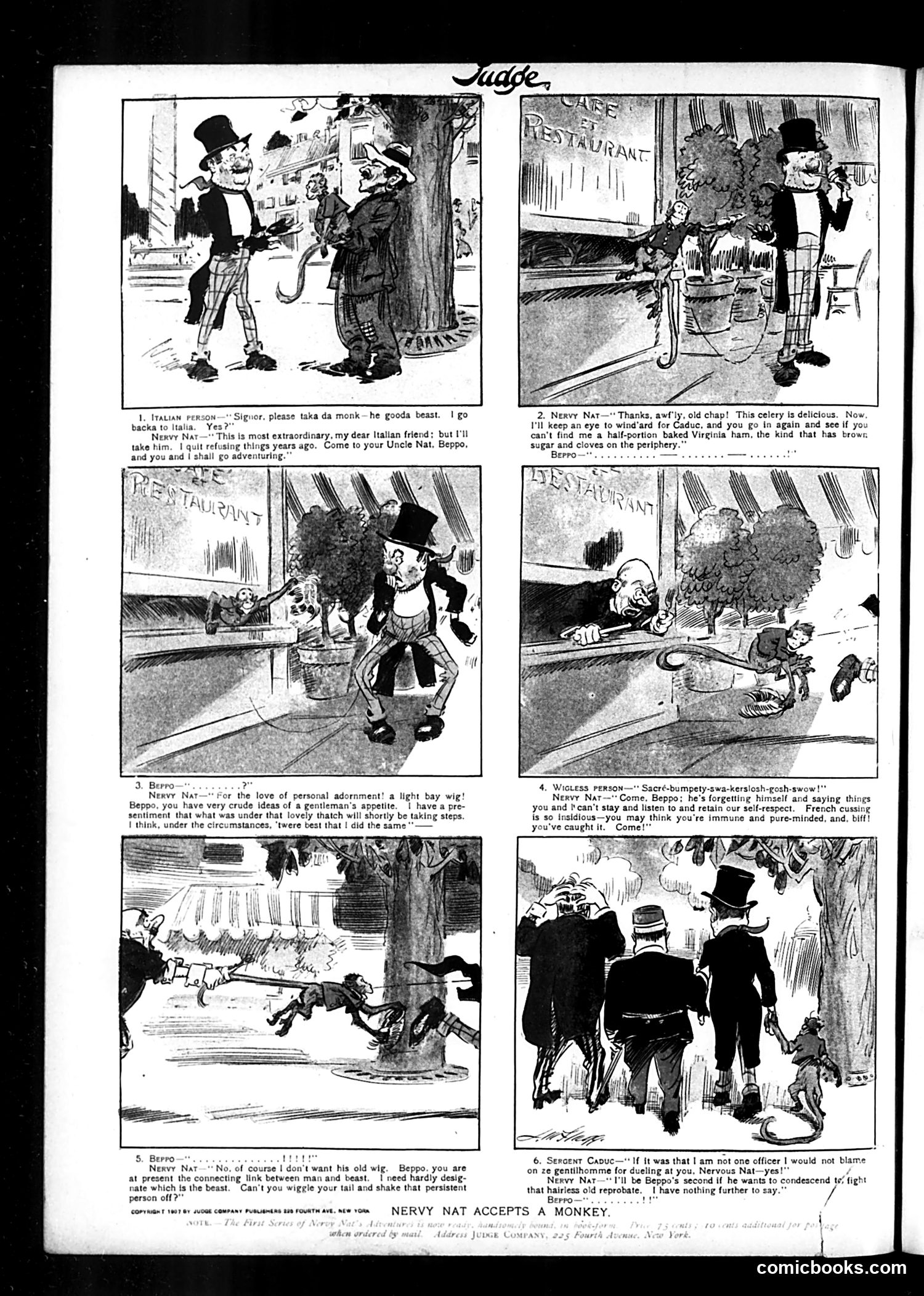
This comic strip satirizes Nervy Nat, an apparent character type—a perpetually unflappable gentleman adventurer who accepts outlandish situations with unruffled composure. The humor centers on his casual acceptance of absurdity: he agrees to care for a monkey (supposedly a "monk" in broken English), then remains unfazed by the chaos that ensues—a baked Virginia ham dispute at a restaurant, a Frenchman's profane outburst, the monkey's crude behavior linking "man and beast." The satire mocks both Nat's affected gentility (obsessing over wigs and refined dining) and his obliviousness to social disruption. His catchphrase-like responses ("I quit refusing things years ago") suggest he's a well-known figure readers would recognize. The joke is that his cool sophistication masks complete indifference to propriety—he'll second a monkey's duel with a "hairless old reprobate" without hesitation. The exaggerated ethnic caricatures (Italian and French stereotypes) reflect period attitudes in Judge's humor.