
A complete issue · 16 pages · 1907
Judge — March 23, 1907
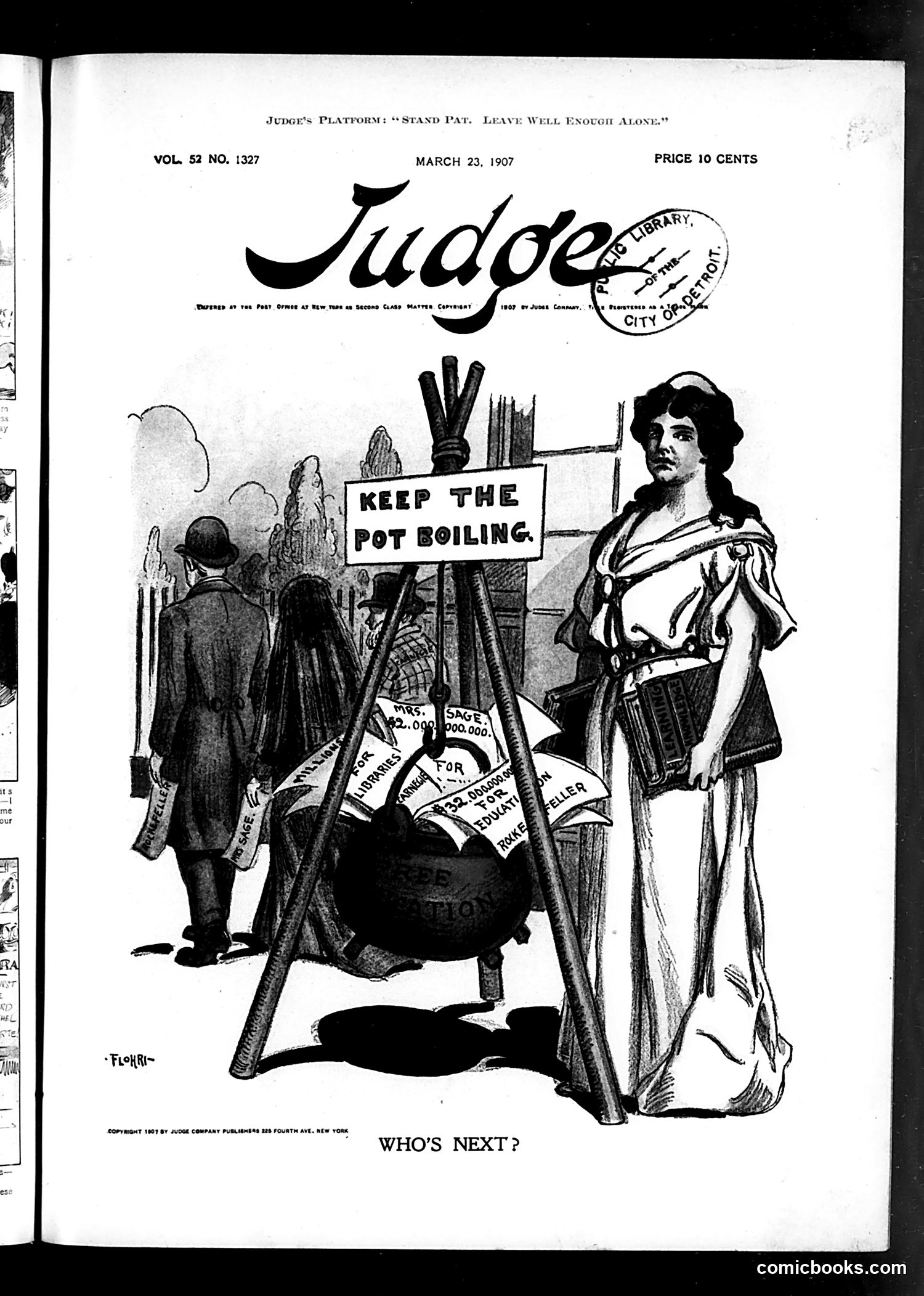
This cartoon depicts a cauldron labeled "SPECULATION" boiling over a fire, with papers inside bearing names like "SAGES," "WAGES," "LIABILITIES," and "POWER." A woman guards it with a sign reading "KEEP THE POT BOILING," while a well-dressed man approaches from behind. The satire targets financial speculation and market manipulation during the early 1900s. The "pot boiling" metaphor represents dangerous economic activity being deliberately stoked. The woman appears to represent those profiting from speculation, while the approaching figure (identity unclear from the image) represents the next potential victim or participant. The caption "WHO'S NEXT?" suggests the cartoon warns of ongoing financial danger and predatory practices affecting investors and workers alike.
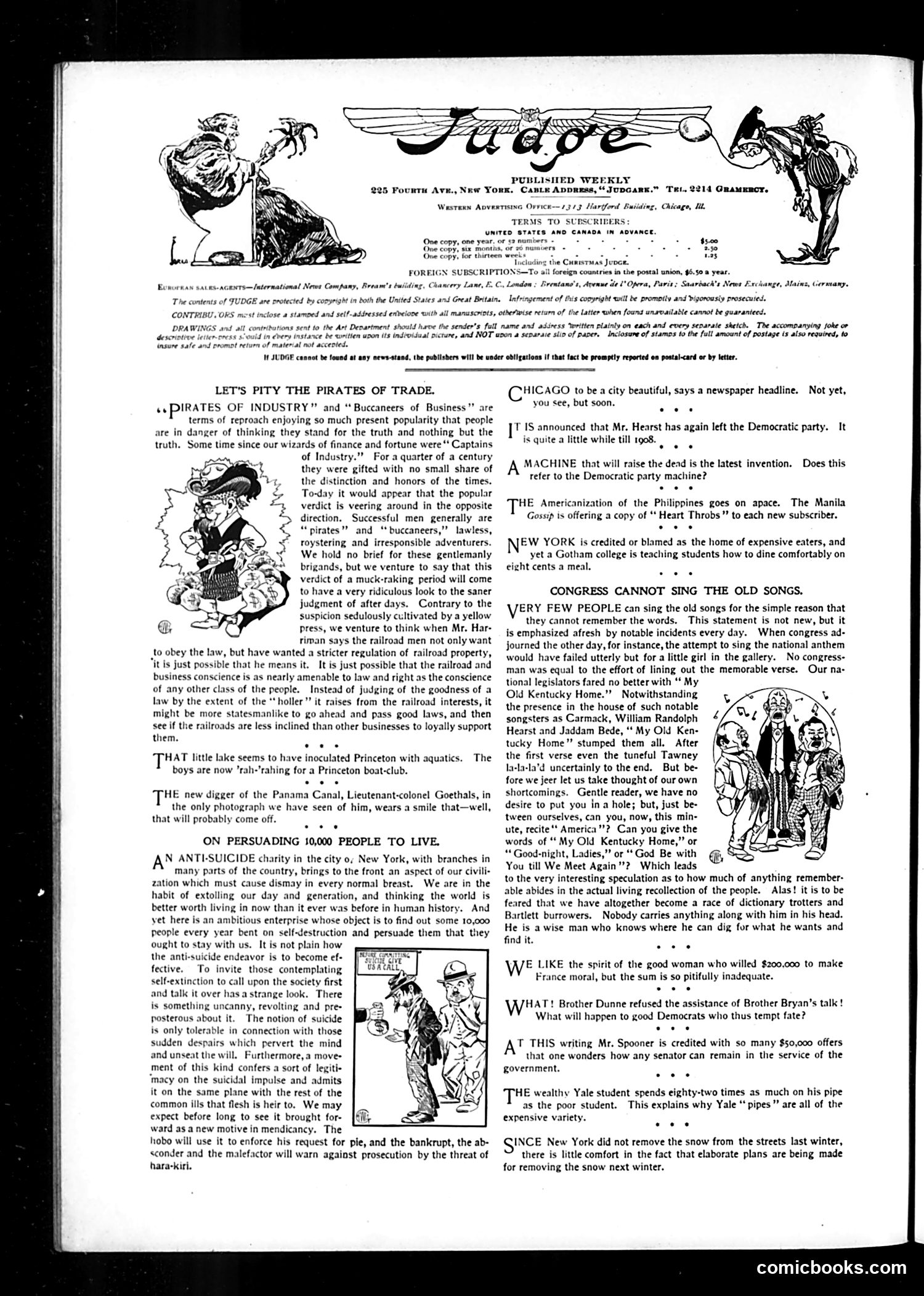
This satirical page from Judge targets multiple political and social issues of its era: **"Pirates of Trade"** (left column): Criticizes railroad monopolies and unethical business practices, suggesting that wealthy industrialists operated with the same disregard for law as pirates. The piece advocates for stricter railroad regulation, implying that conscience-driven self-regulation has failed. **Right-side editorials** touch on diverse targets: Chicago's urban development, Mr. Hearst leaving the Democratic Party, a supposed "machine" joke about the Democrats, expensive New York living conditions, and Congressional inability to remember patriotic songs. The cartoons feature exaggerated character drawings typical of Judge's style—caricatures emphasizing physical traits for satirical effect. Overall, the page reflects Progressive Era concerns about corporate power, political reliability, and urban social conditions. Specific figures remain unclear without additional context.
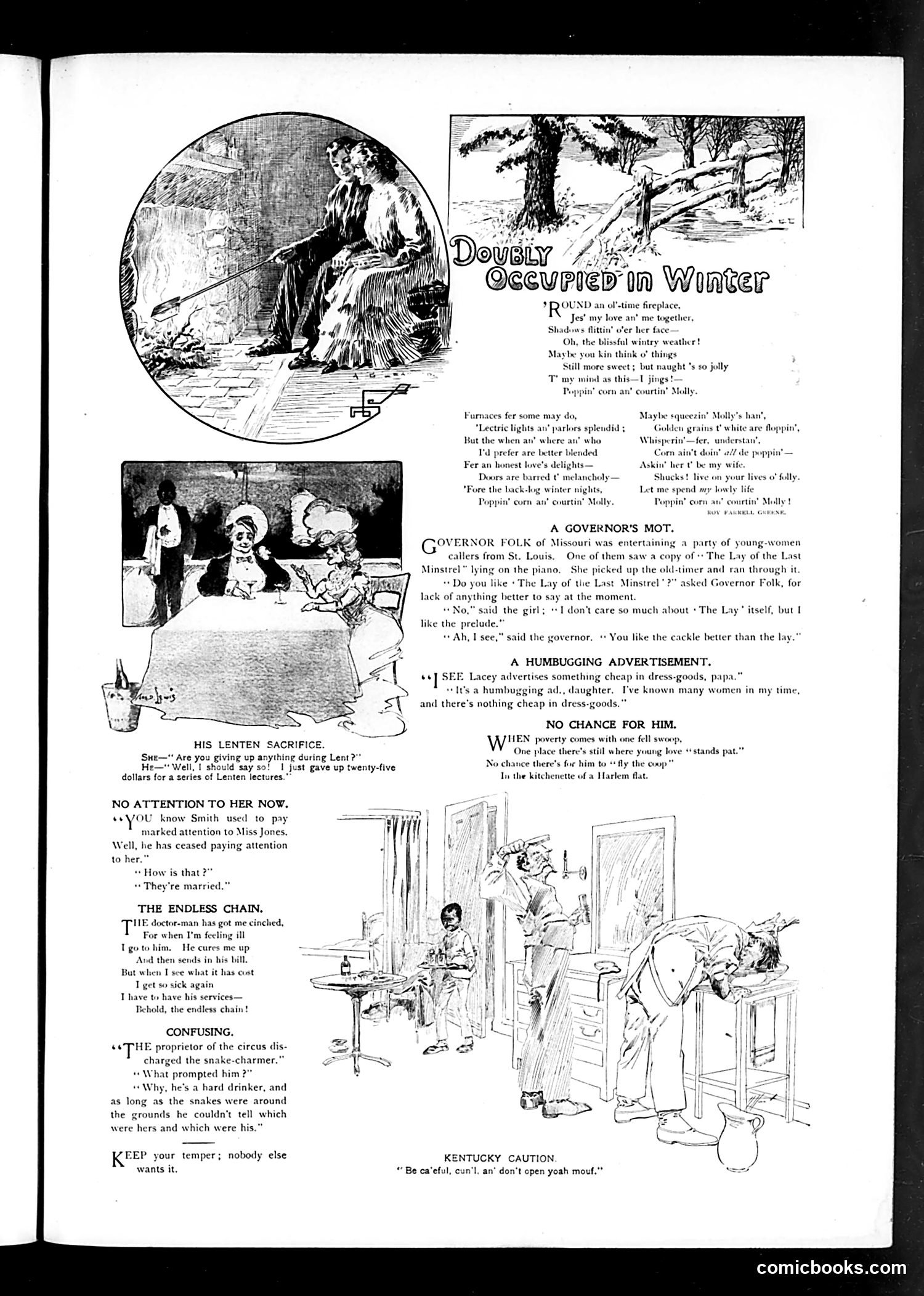
This page contains several unrelated humorous sketches and poems rather than a unified political cartoon. The content includes: **"Doubly Occupied in Winter"** - A poem about domestic life and winter comfort, illustrated with scenes of couples. **"A Governor's Mot"** - A brief anecdote about Missouri Governor Folk entertaining visitors, joking about preferring the "cackle" of a lay (woman) to a musical performance. **Various short comic pieces** with titles like "His Lenten Sacrifice," "No Attention to Her Now," "The Endless Chain," and "Confusing" - these appear to be domestic humor sketches about marriage, poverty, and social situations. **"A Humbugging Advertisement"** and **"Kentucky Caution"** - Brief satirical commentary on advertising and regional dialect. The illustrations show typical early-20th-century domestic scenes. This is primarily **light humor and social commentary** rather than sharp political satire, focusing on marriage, class, and everyday absurdities of the era.
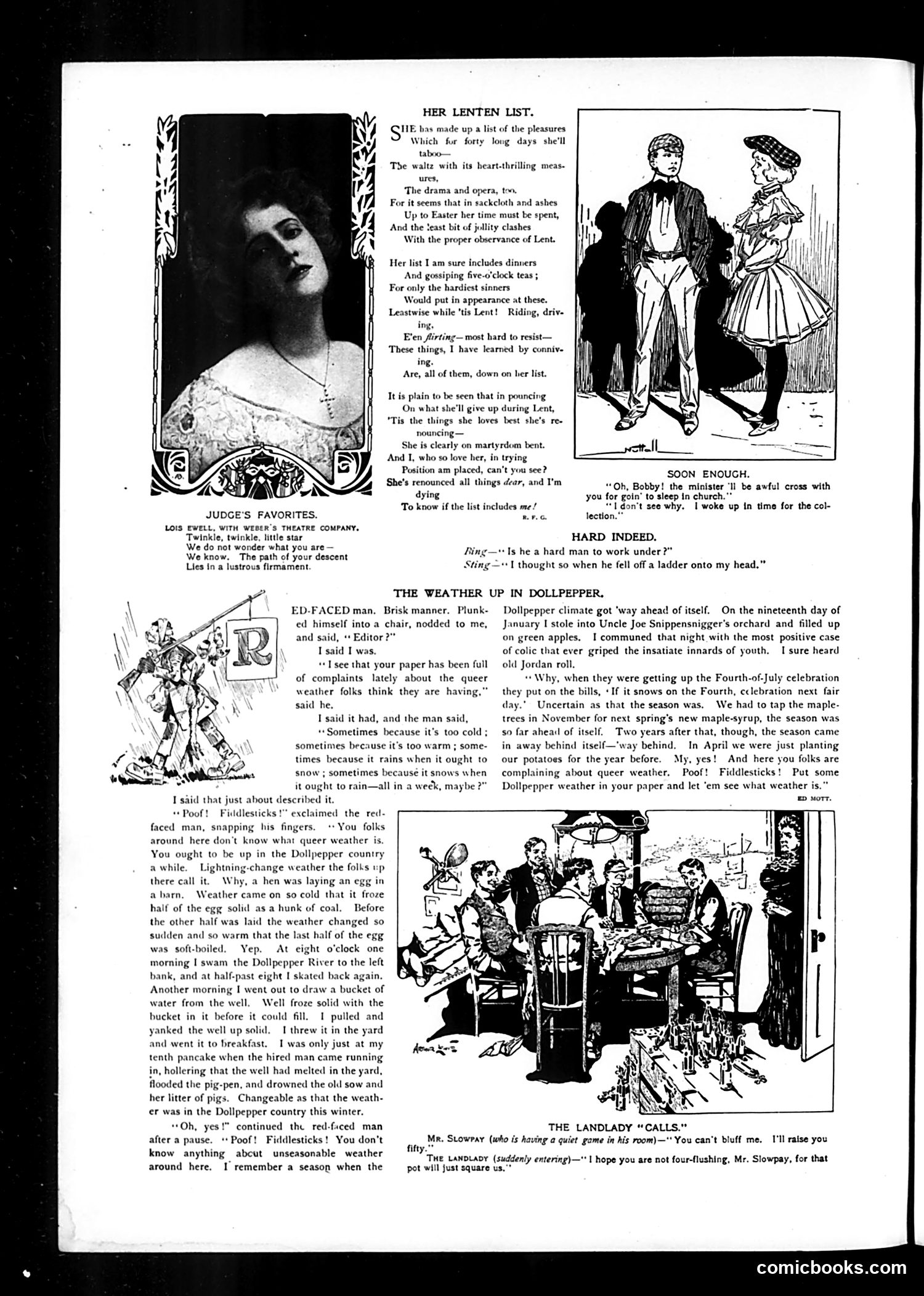
This page contains three distinct pieces of satirical content: **"Her Lenten List"** (top left): A poem mocking women's Lenten sacrifices during the Christian season of Lent. The satire suggests that women's supposed religious observances—avoiding theater, opera, dinners, and gossip—are merely performative, with the implication they'll resume these activities immediately after Easter. **"Soon Enough"** (top right): A cartoon about a young boy resisting church attendance, with an adult (likely his minister) attempting to compel him. **"The Weather Up in Dollpepper"** (main article): A humorous rural narrative where a red-faced man describes absurdly exaggerated weather conditions in his region—frozen wells, livestock complications, extreme seasonal variations. It's folksy humor satirizing rural life and tall-tale traditions. **"The Landlady Calls"** (bottom): A brief comic exchange between a landlord and tenant about unpaid rent.
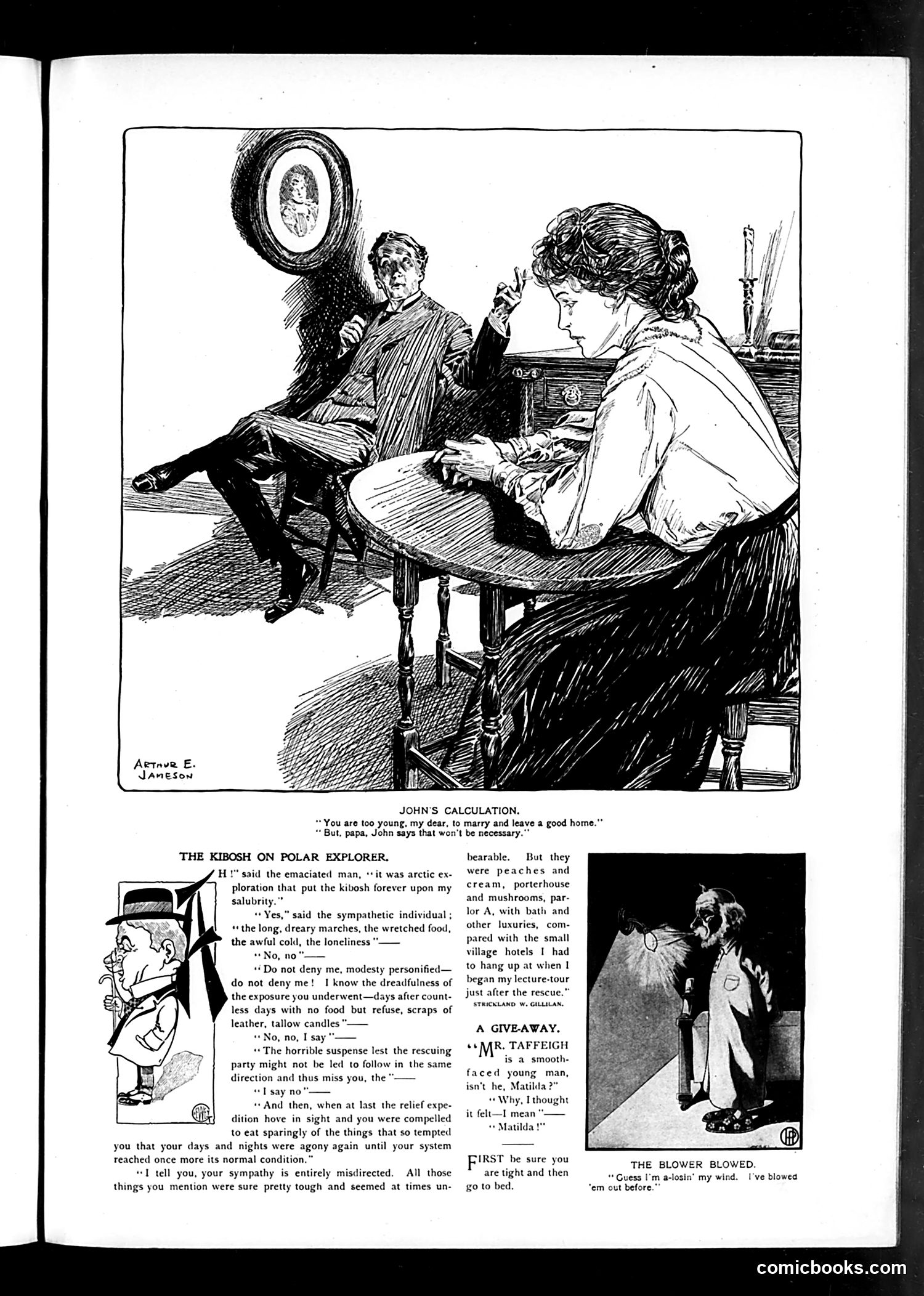
The main illustration depicts a domestic scene where a young woman discusses marriage prospects with her father. The dialogue reveals the father's reluctant consent to her marrying, though he expresses concern about her suitor's financial prospects ("that won't be necessary"). The accompanying text section titled "THE KIBOSH ON POLAR EXPLORER" features satirical commentary mocking an arctic explorer's hardship narrative. An editor or skeptical listener dismisses the explorer's complaints about deprivation and suffering, sarcastically questioning whether such ordeals truly warrant sympathy. The smaller illustration labeled "A GIVE-AWAY" and "THE BLOWER BLOWED" appears to satirize social pretension, likely mocking someone's affected manner or false claims. The overall page satirizes both romantic delusions and exaggerated personal narratives common in Edwardian-era society.
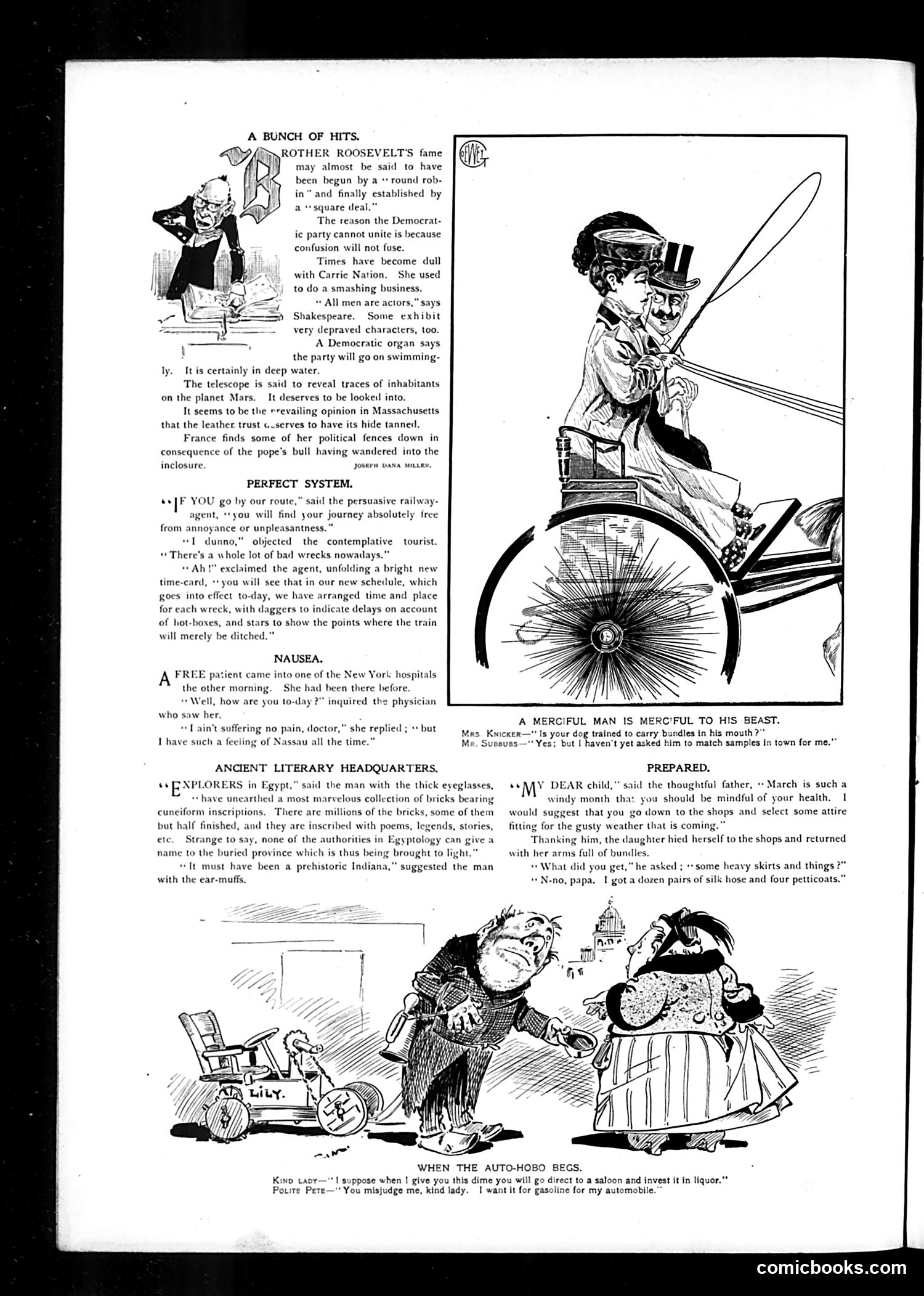
This page contains several short satirical pieces targeting early 1900s American politics and society: **"A Bunch of Hits"** opens with jokes about Theodore Roosevelt, referencing his "round robin" letter and "square deal" political platform. The Democratic Party jokes mock their inability to unify ("confusion will not fuse"). **"Perfect System"** satirizes railroad marketing—a travel agent promises a "perfect" journey while dismissively scheduling wrecks and derailments as inevitable parts of the route. **"Nausea"** contains a pun: a hospital patient says she feels "Nassau all the time" (likely referencing Nassau, Bahamas—a fashionable destination). **"Ancient Literary Headquarters"** jokes about Egypt discoveries, with a pun calling the excavation site "prehistoric Indiana." **"When the Auto-Hobo Begs"** mocks new automobile owners: a beggar claims he needs money for gasoline rather than liquor—reversing the usual judgment of poor people's spending habits. The cartoons use wordplay, puns, and social commentary typical of Judge's satirical approach to contemporary issues.
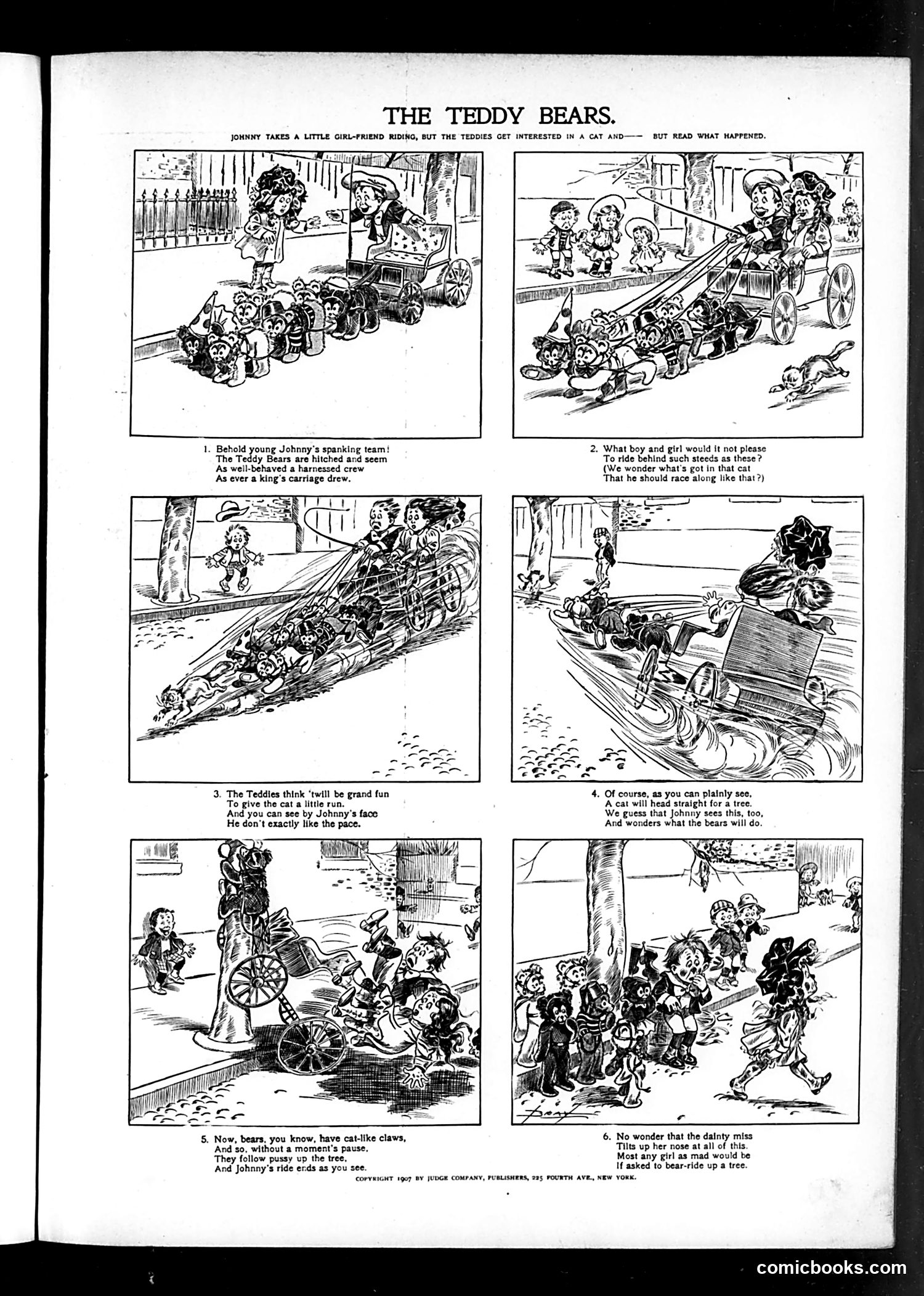
This 1907 *Judge* comic is a lighthearted visual pun exploiting the "teddy bear" craze. The joke conflates toy teddy bears (named after President Theodore Roosevelt's 1902 bear-hunting incident) with actual bears harnessed as a carriage team. The narrative follows young Johnny taking a girl on a ride pulled by these "teddy bears," which go wild chasing a cat up a tree—playing on the fact that real bears have claws and natural predatory instincts. The girl's dignified disgust at the chaotic ride undermines the romantic outing's charm. The humor relies on the contemporary popularity of teddy bears as fashionable toys and the absurdist premise of using actual animals for transportation. The final panel's wordplay ("bear-ride up a tree") drives home the satirical point about the impracticality of the scenario.
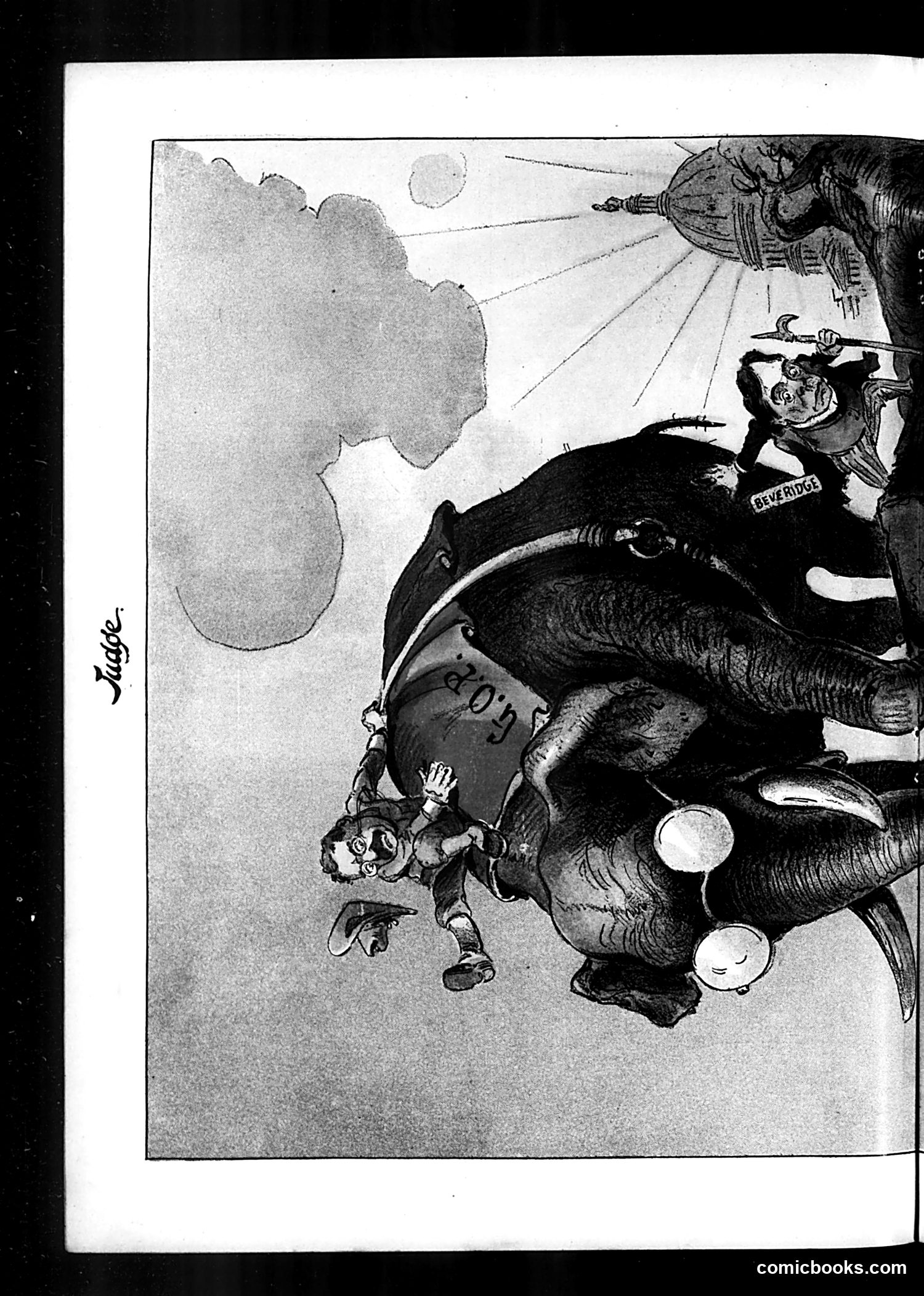
This appears to be a political cartoon satirizing financial or economic issues. The image shows a large, rotund figure labeled "2909" (possibly representing a bill number or financial instrument) being examined or manipulated by smaller figures. One figure is labeled "EVERIDGE" (possibly a political figure or banker of the era). A beam of light from above—likely representing scrutiny, investigation, or public attention—illuminates the scene. The cartoon's composition suggests criticism of financial dealings or legislative manipulation, with the smaller figures appearing to control or benefit from the large financial entity. Without clearer OCR text or additional context, the specific political moment remains unclear, but the satire targets what appears to be dubious financial or legislative practices.
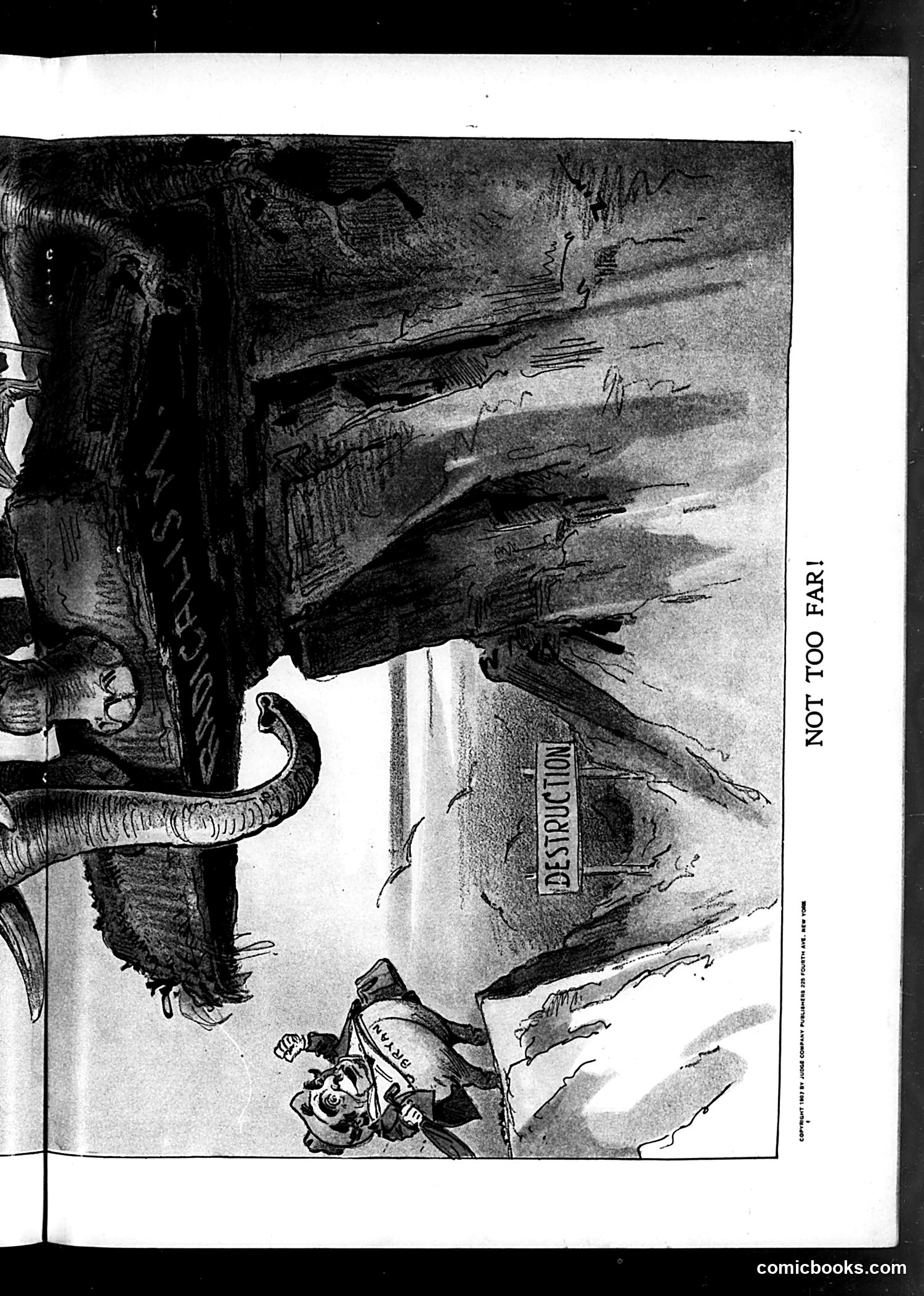
This 1907 Judge cartoon depicts an elephant (representing the Republican Party) being cautiously restrained by a small figure labeled "DESTRUCTION." The image warns against pushing political or social change too aggressively. The elephant's trunk reaches toward what appears to be industrial or governmental structures, suggesting expansive Republican policies or Theodore Roosevelt's progressive reforms. The caption "NOT TOO FAR" suggests the cartoonist's concern that reform movements—whether Roosevelt's trust-busting, labor policies, or industrial regulation—risk destabilizing American institutions if pursued too zealously. The small figure struggling to hold back the massive elephant implies that destructive forces threaten, but restraint is possible and necessary to preserve social stability.
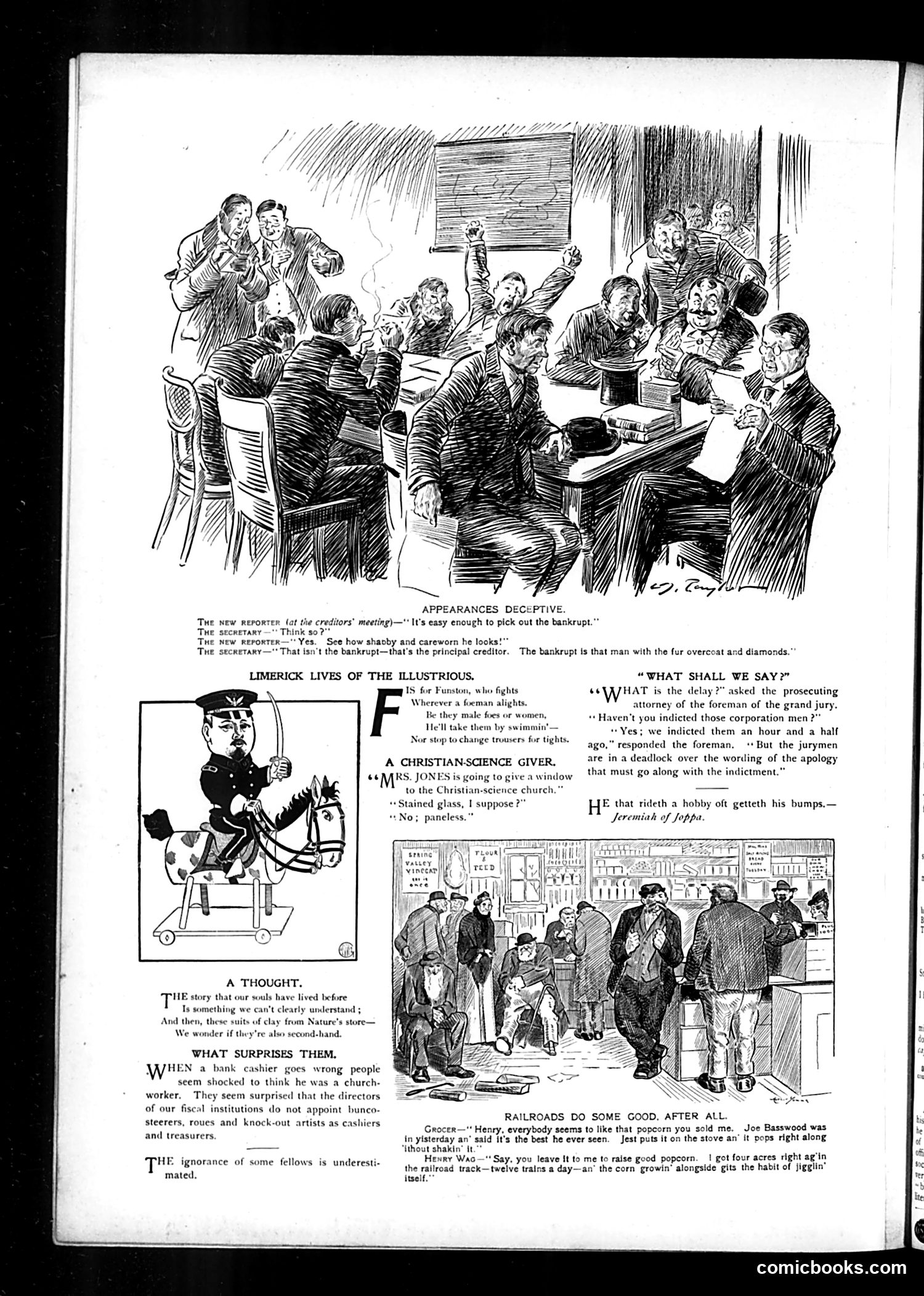
This page contains several satirical pieces mocking American institutions and society: **"Appearances Deceptive"** jokes that bankruptcy reveals moral inversion—the shabby-looking man is actually the wealthy creditor, while the well-dressed man in furs and diamonds is the bankrupt, suggesting financial fraud disguised by appearance. **"Limerick Lives"** appears to reference General Funston (a military figure), though the specific context is unclear from the image alone. **"What Shall We Say?"** satirizes corporate corruption and grand juries' inability to punish corporations—they indict executives but deadlock over wording an "apology," mocking the toothless legal consequences corporations faced. **"What Surprises Them"** critiques the hypocrisy of banks hiring church workers as cashiers, then acting shocked when these "moral" employees commit fraud—exposing that financial institutions don't actually value ethics. The page overall exposes corruption, class deception, and institutional hypocrisy in turn-of-the-century America.
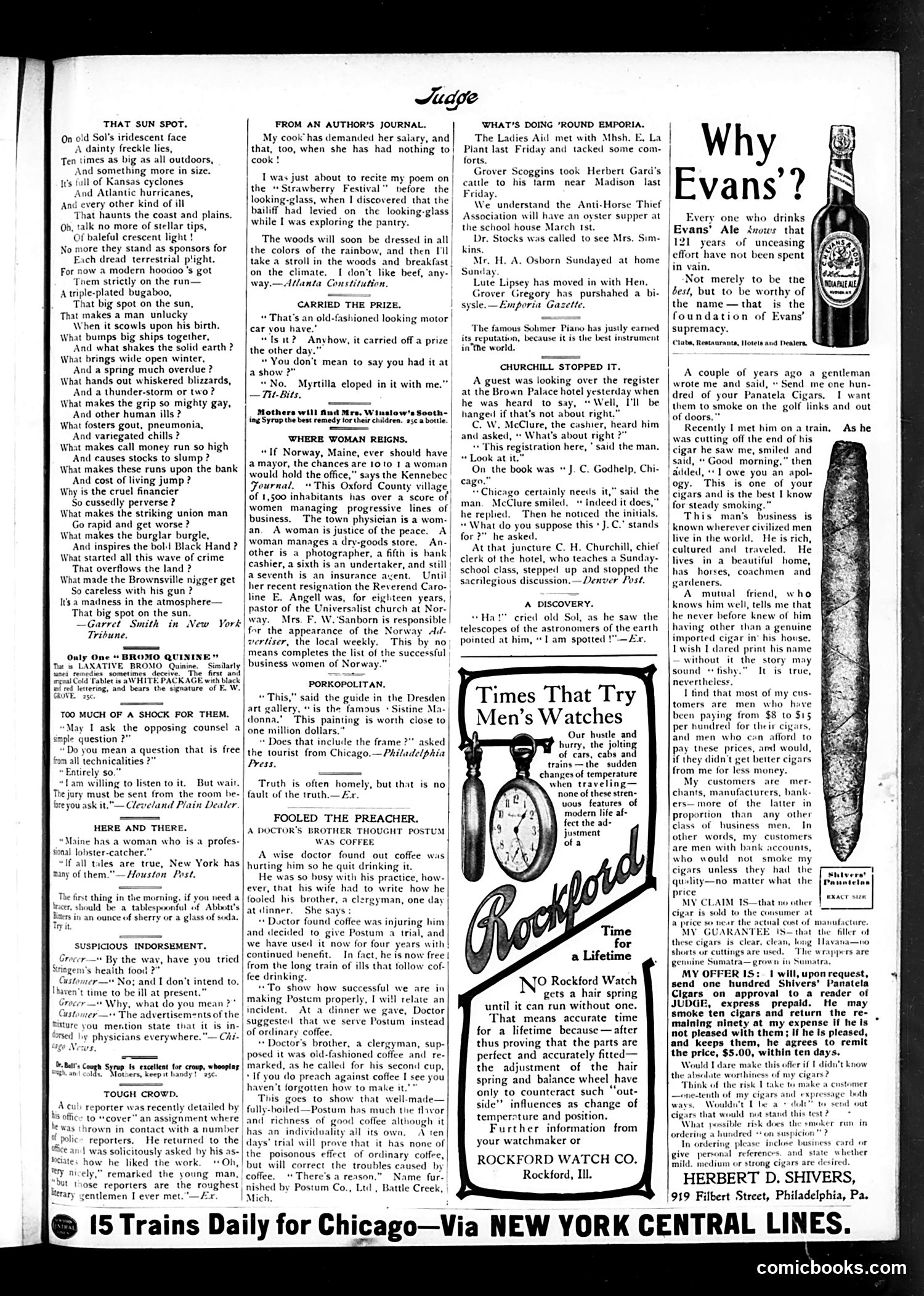
This page from *Judge* magazine (a satirical publication) contains multiple short pieces and advertisements typical of early 20th-century humor journalism. **Main Content:** The dominant poem, "That Sun Spot," uses a solar sunspot as absurdist scapegoat for contemporary social ills—crime, financial crises, labor unrest, weather disruptions, and disease. Rather than attributing problems to politics or society, the poet ironically blames an astronomical phenomenon, satirizing public tendency to find external explanations for complex problems. **Other Pieces:** Brief humor items mock everyday absurdities: a cook demanding salary despite the employer having "nothing to do," a woman lobster-catcher in Maine, and courtroom exchanges where judges must remove juries before asking "simple questions" due to technicality concerns. **Advertisements:** The page includes ads for Bromo Quinine, Rockford Watches, and Evans' Ale—typical period products. The overall tone reflects *Judge*'s satirical approach: mocking bureaucratic procedures, class pretension, and societal anxieties through exaggeration and irony rather than direct political commentary.
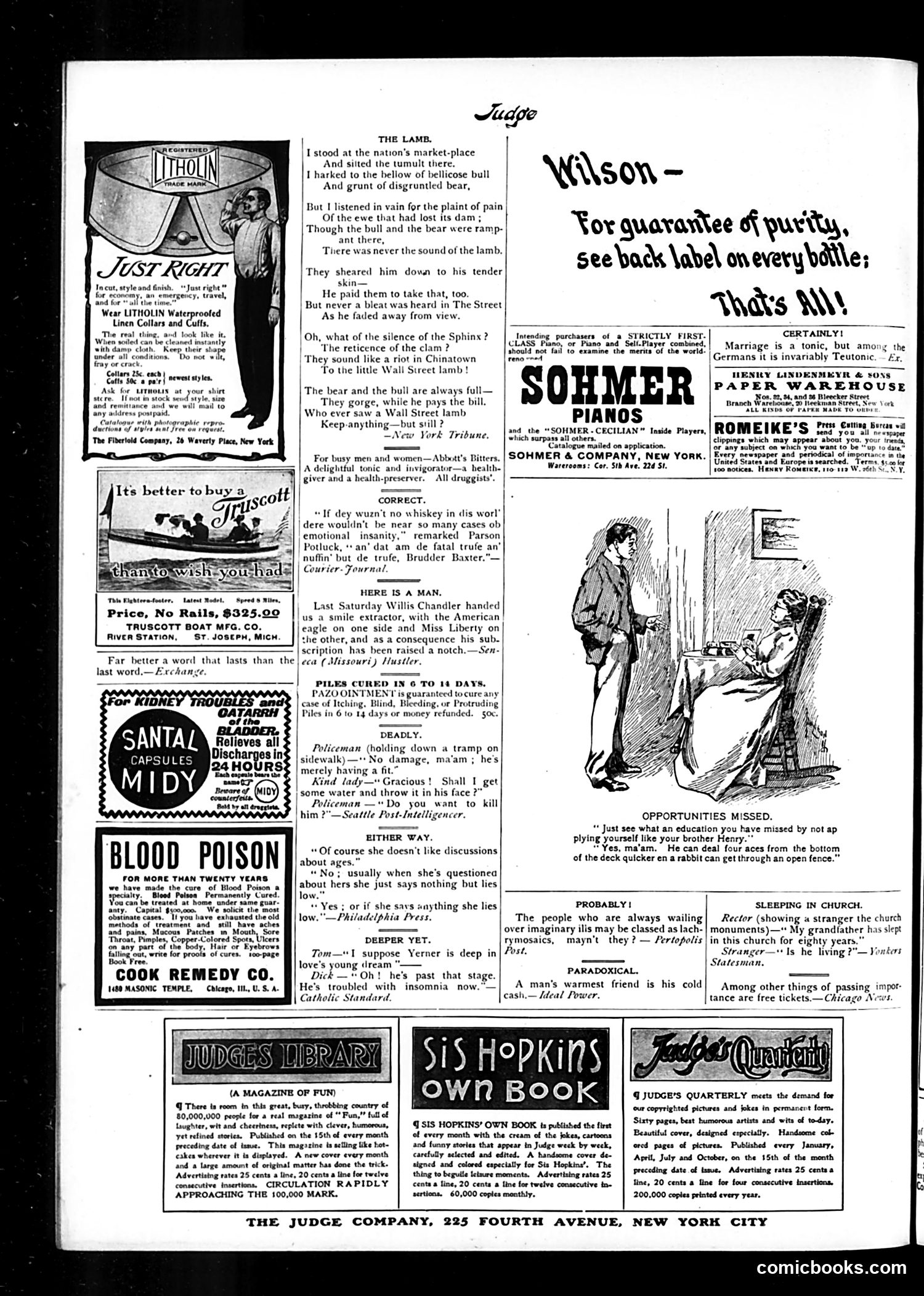
This page from *Judge* magazine is primarily advertising with some satirical content. The main illustrated piece is "The Lamb," a Wall Street allegory where the lamb represents ordinary investors being financially exploited by the "bull" and "bear" (stock market forces). The lamb silently surrenders his wealth—getting "sheared down to his tender skin"—while more aggressive market players "gorge" and profit. The satire critiques the powerlessness of small investors against Wall Street manipulation and their resigned acceptance of financial loss. The other items are mostly short humorous observations and medical advertisements typical of the era. The page reflects early-20th-century anxieties about stock market fairness and power imbalances between individual investors and institutional forces.
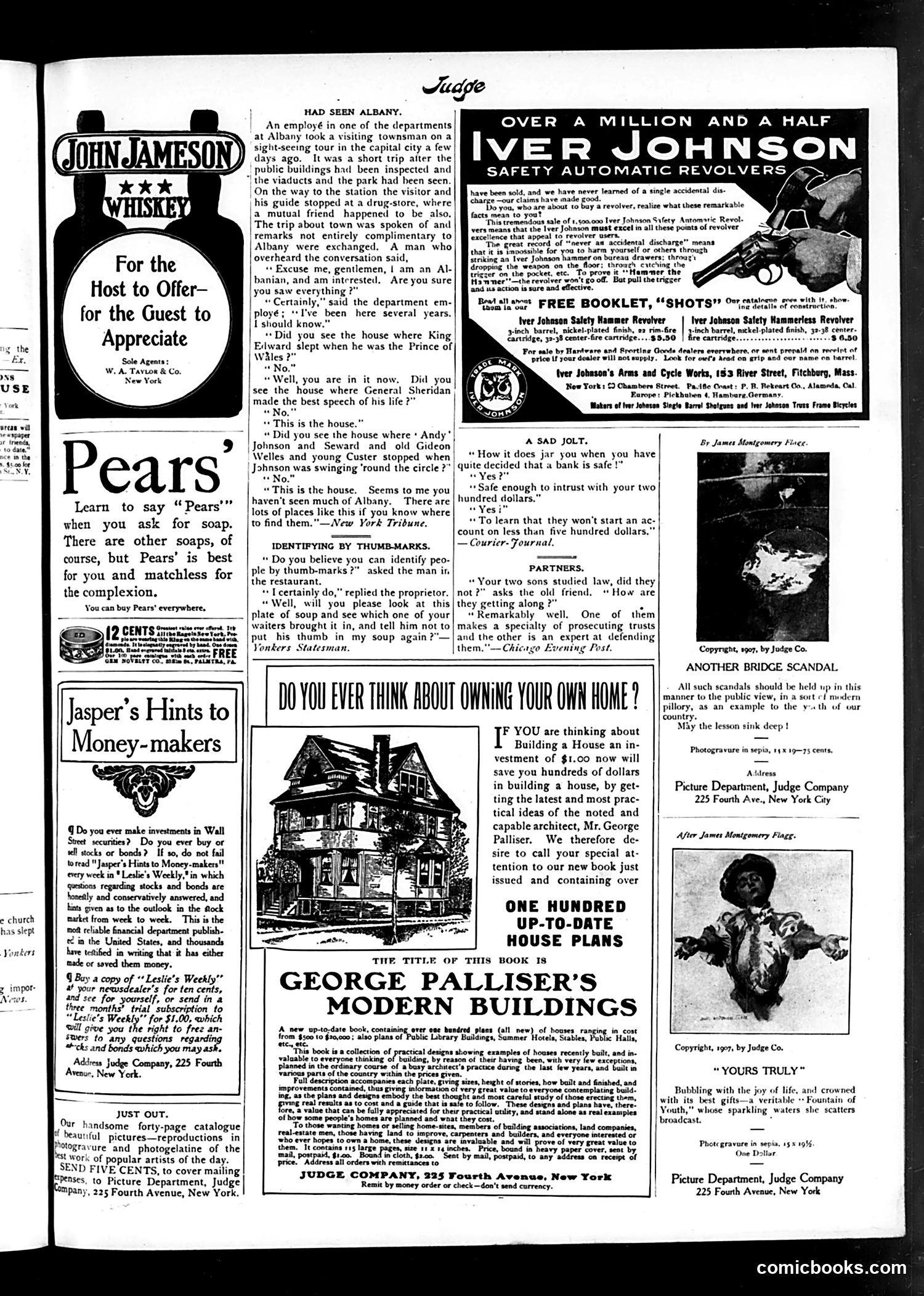
This page is primarily **advertising and humorous filler content** from Judge magazine, not political satire. The main elements are: 1. **Iver Johnson Revolver Advertisement** (top): A straightforward gun advertisement claiming over 1.5 million sales and emphasizing safety features—typical early 1900s marketing with no satirical intent. 2. **"Had Seen Albany"** (left column): A mild joke about an Albany tour guide who claims expertise but hasn't actually shown visitors the "important" historical sites. The humor relies on local references to Civil War-era politicians (Sheridan, Johnson, Seward, Custer) and a running gag about missed attractions. 3. **"Identifying by Thumb-Marks"**: A pun-based joke about a soup plate with a waiter's thumbprint—purely comedic wordplay. 4. **Pears' Soap and Jasper's Hints**: Standard product advertisements. 5. **George Palliser's Modern Buildings**: Book advertisement with house illustration. This page contains **no significant political commentary or social satire**—it's mostly advertisements interspersed with lighthearted jokes for filler content.
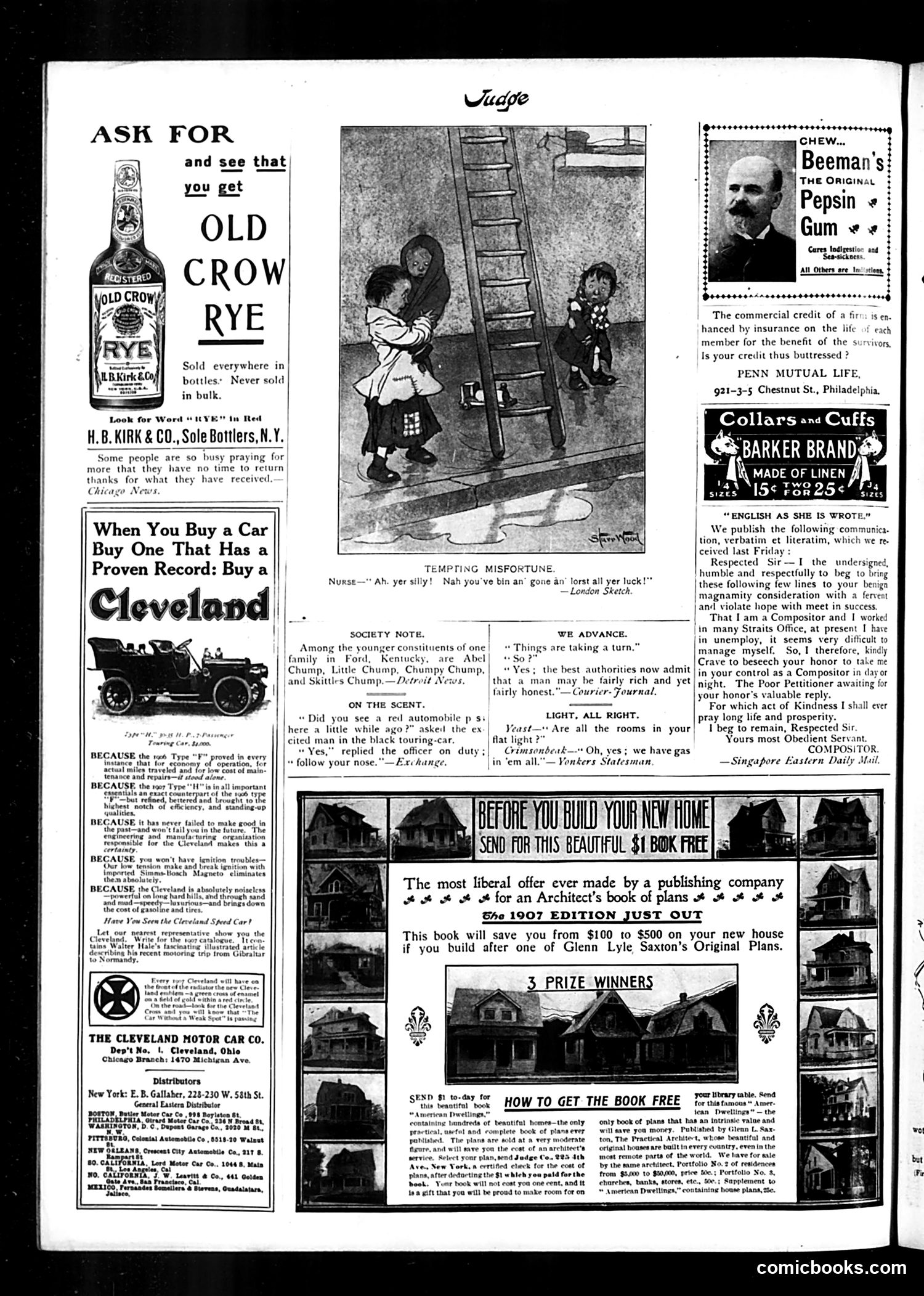
This page is primarily **advertisements and miscellaneous content** rather than editorial satire. The main cartoon, titled "TEMPTING MISFORTUNE," shows a nurse scolding a child for losing "all yer luck"—a visual gag playing on superstition about breaking mirrors or similar accidents. The humor is gentle domestic comedy rather than political satire. The page includes several brief "SOCIETY NOTES" and joke items with mild social commentary: one notes that a man can be "fairly rich and yet fairly honest" (suggesting wealthy people are typically dishonest), and another titled "ENGLISH AS SHE IS WROTE" prints a humorous letter from a compositor struggling with proper English—likely poking fun at working-class immigrants or the poorly educated. The bulk of the page features **period advertisements**: Old Crow Rye whiskey, Cleveland automobiles, Beeman's Pepsin Gum, insurance, and a prominent home-building book offer. These ads reveal early-1900s consumer culture and what products companies marketed to Judge's readers. The content reflects Judge's function as entertainment and advertising vehicle rather than hard-hitting political commentary.
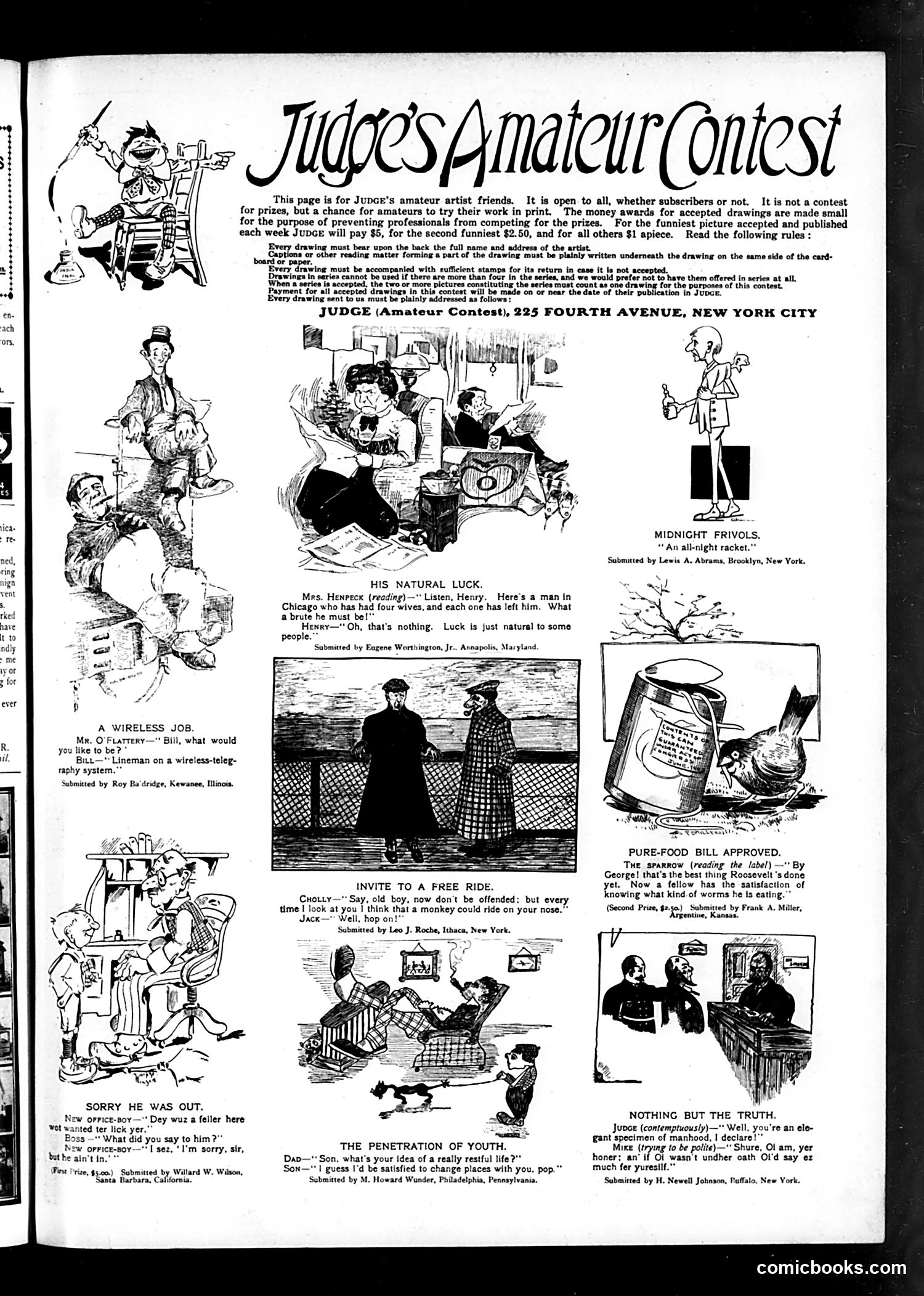
This page showcases Judge magazine's amateur cartoon competition, inviting readers to submit humorous drawings for publication and payment ($5 for the funniest, descending to $1). The cartoons themselves reflect early 20th-century humor and social commentary: - **"His Natural Luck"** jokes about serial divorce, treating marital failure as comedic misfortune - **"A Wireless Job"** plays on emerging wireless telegraph technology as a desirable modern career - **"Pure-Food Bill Approved"** references President Roosevelt's food safety legislation, sarcastically suggesting consumers can now identify what parasites they're eating—dark commentary on food quality before regulation - **"Midnight Frivols"** and **"Sorry He Was Out"** present workplace and street-level comedic scenarios typical of the era The humor relies on recognizable social situations—marriage troubles, technology fascination, food safety concerns, and class-based encounters—rather than specific political figures or events.
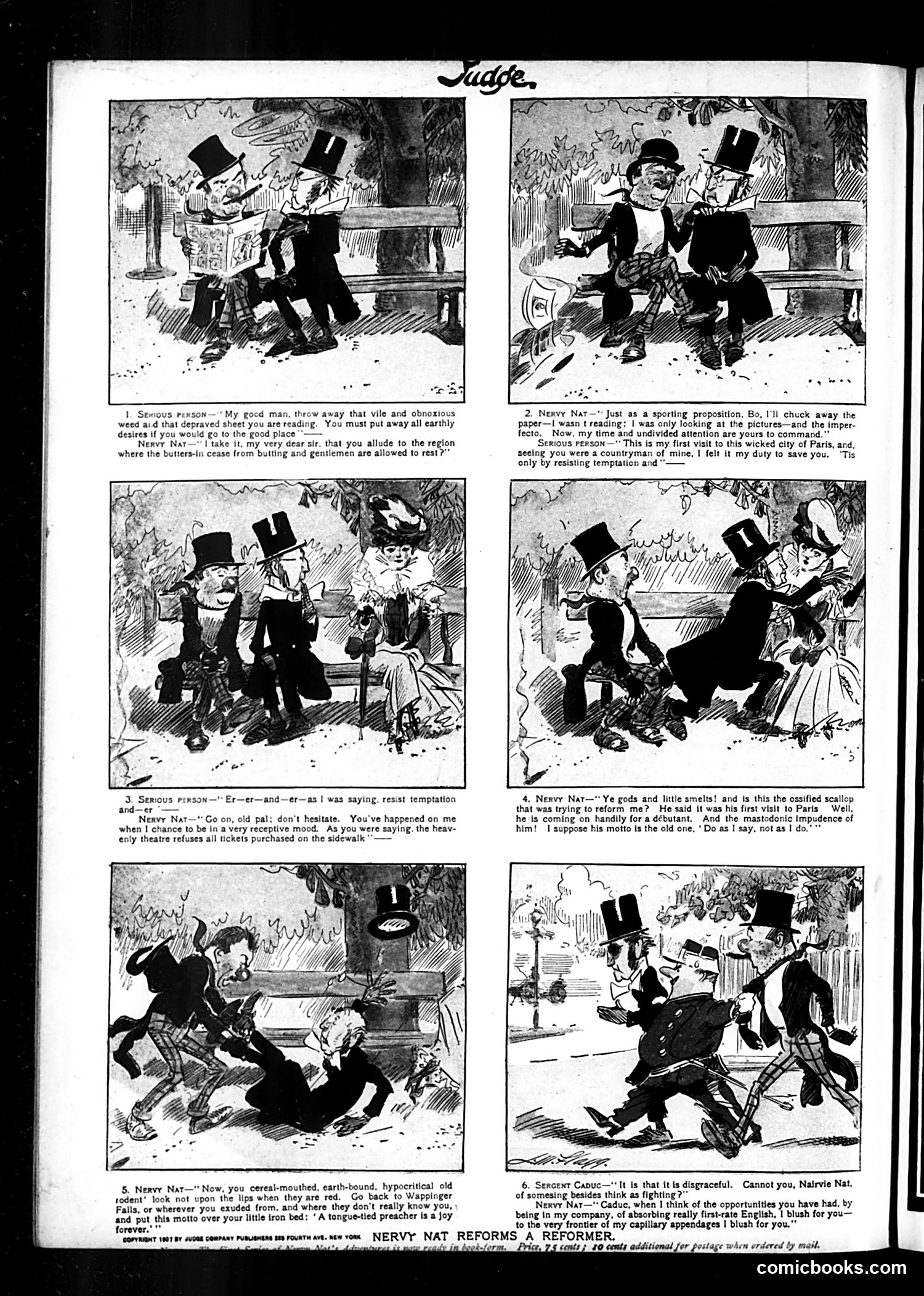
This six-panel comic from Judge satirizes moral hypocrisy through the character "Nervy Nat," a shrewd con artist who encounters "Serious Person," an earnest reformer visiting Paris. **The Setup:** Serious Person attempts to "save" Nervy Nat from vice and temptation, citing moral principles about resisting earthly desires. **The Satire:** Nervy Nat systematically exposes the reformer's own contradictions and pretensions—noting he was only "looking at pictures," mocking his self-righteousness about being a "countryman," and revealing his hypocrisy ("Do as I say, not as I do"). By the final panel, Nervy Nat turns the tables, lecturing Serious Person about wasting opportunities to learn proper English rather than constantly moralizing. **The Point:** Judge ridicules self-appointed moral reformers as fraudulent, pompous busybodies whose sanctimony masks their own flaws. The "clever rogue exposes the sanctimonious fool" was a standard satirical trope—here suggesting reformers accomplished little beyond annoying better men.