
A complete issue · 16 pages · 1907
Judge — March 2, 1907
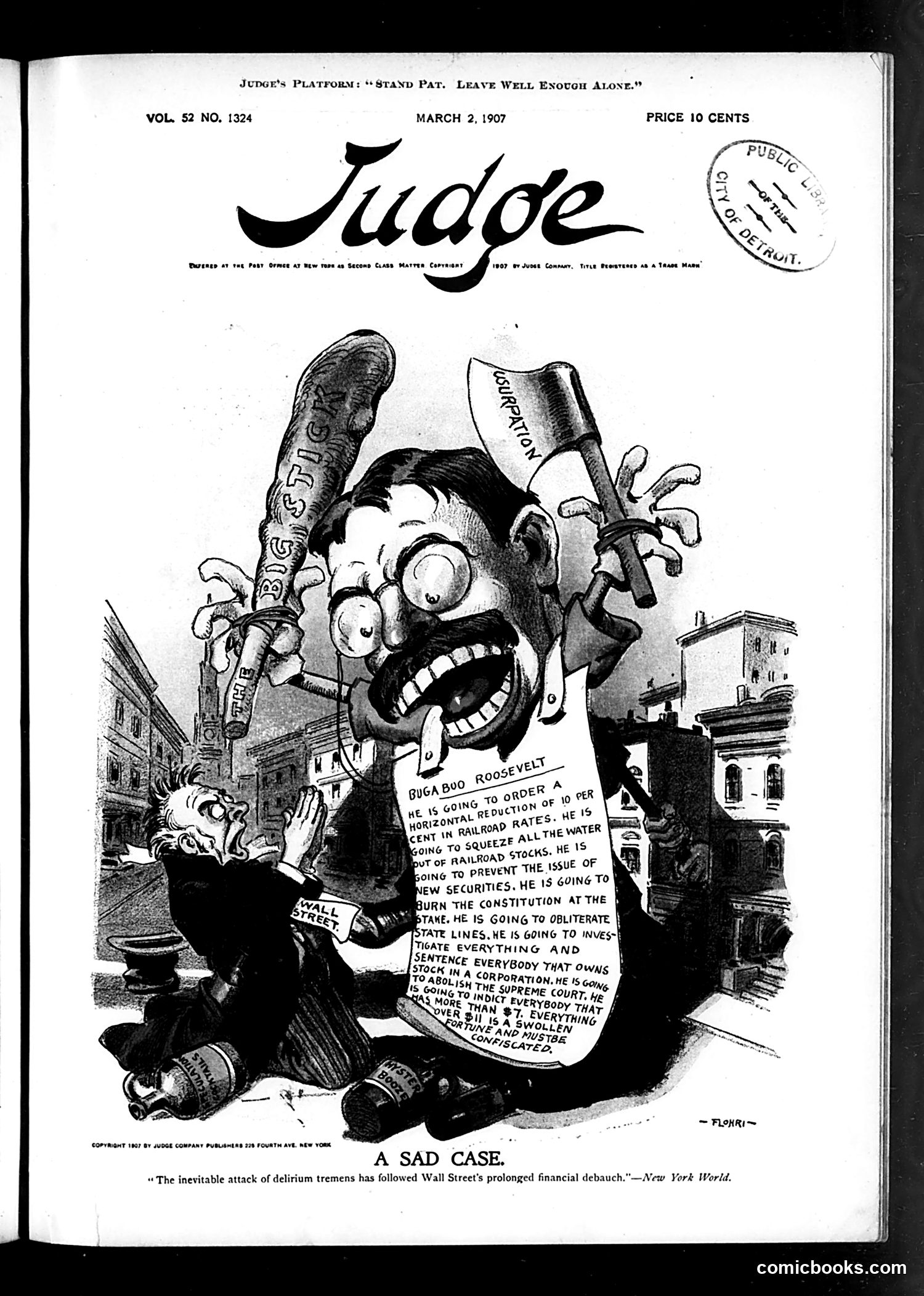
This political cartoon satirizes President Theodore Roosevelt's aggressive regulatory agenda. The grotesque caricatured figure labeled "Buga Boo Roosevelt" represents Roosevelt as a deranged, wild-eyed threat to Wall Street and business interests. The figure holds a flag labeled "Conservatism" while clutching what appears to be corporate stock certificates. The small figure labeled "Wall Street" cowers in fear below. The accompanying text lists Roosevelt's threatened actions: ordering horizontal railroad rate reductions, squeezing railroad stocks, preventing new securities issues, investigating corporations, and indicting every stockholder—presenting his regulatory program as chaotic and tyrannical. The caption attributes Wall Street's financial panic to Roosevelt's "delirium tremens," mocking both his aggressive policies and portraying business anxiety as justified hysteria.
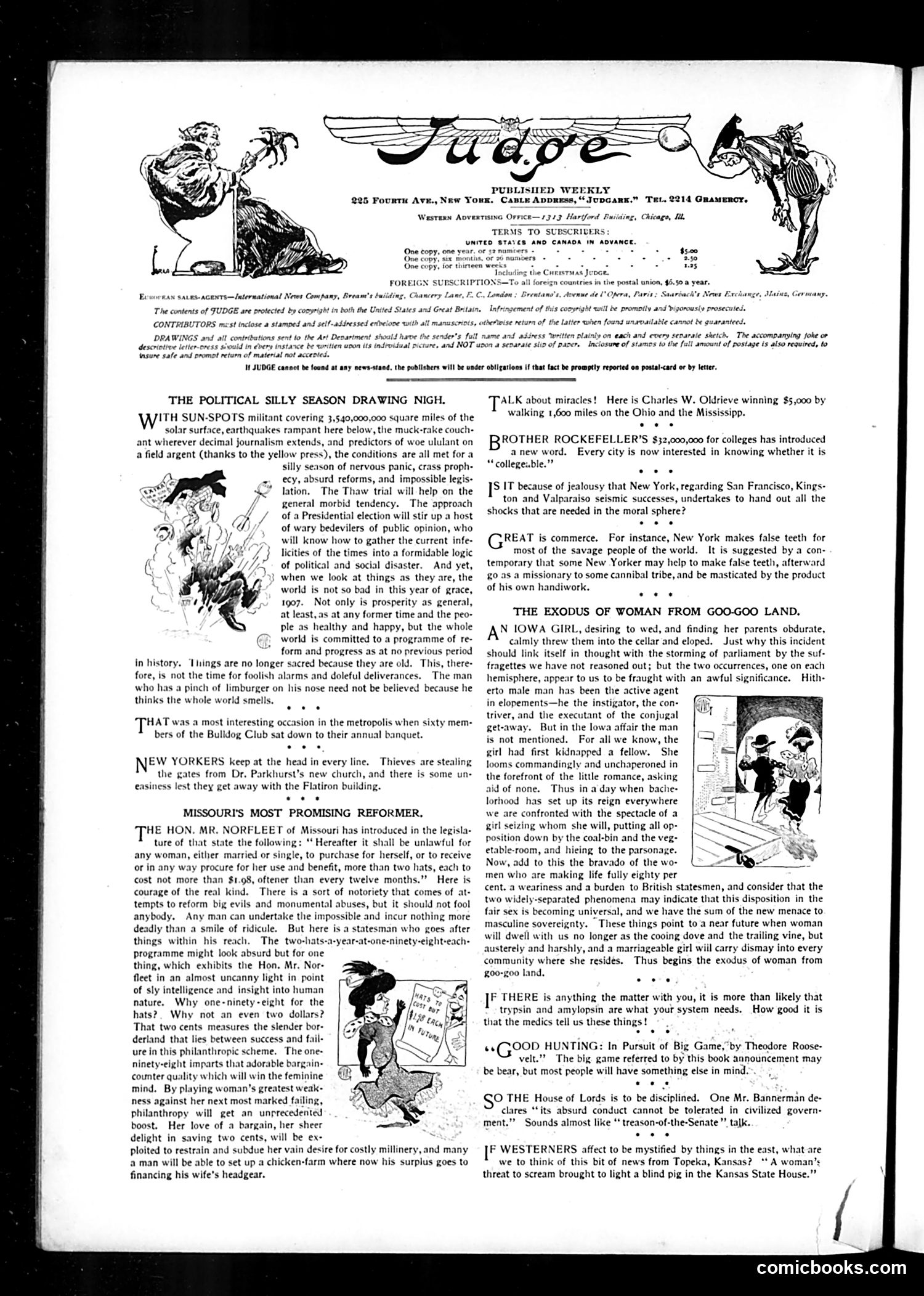
This satirical page from Judge magazine contains several short political commentaries rather than a single unified cartoon. The main pieces address: **"The Political Silly Season Drawing Nigh"** - A commentary on American politics before an election, criticizing both major parties for their absurd platforms and reforms. The accompanying illustration depicts politicians as grotesque figures engaged in foolish debates. **"Missouri's Most Promising Reformer"** - Satirizes a Missouri legislator introducing reform measures, suggesting such politicians pursue grandiose schemes while ignoring practical problems. The text mocks reformers as ineffective idealists. **Various brief items** - Including commentary on New York's jealousy of San Francisco, false teeth manufacturing, and aristocratic British attitudes toward the House of Lords. The overall tone is cynical about political reform movements and legislative posturing typical of Gilded Age American satire.
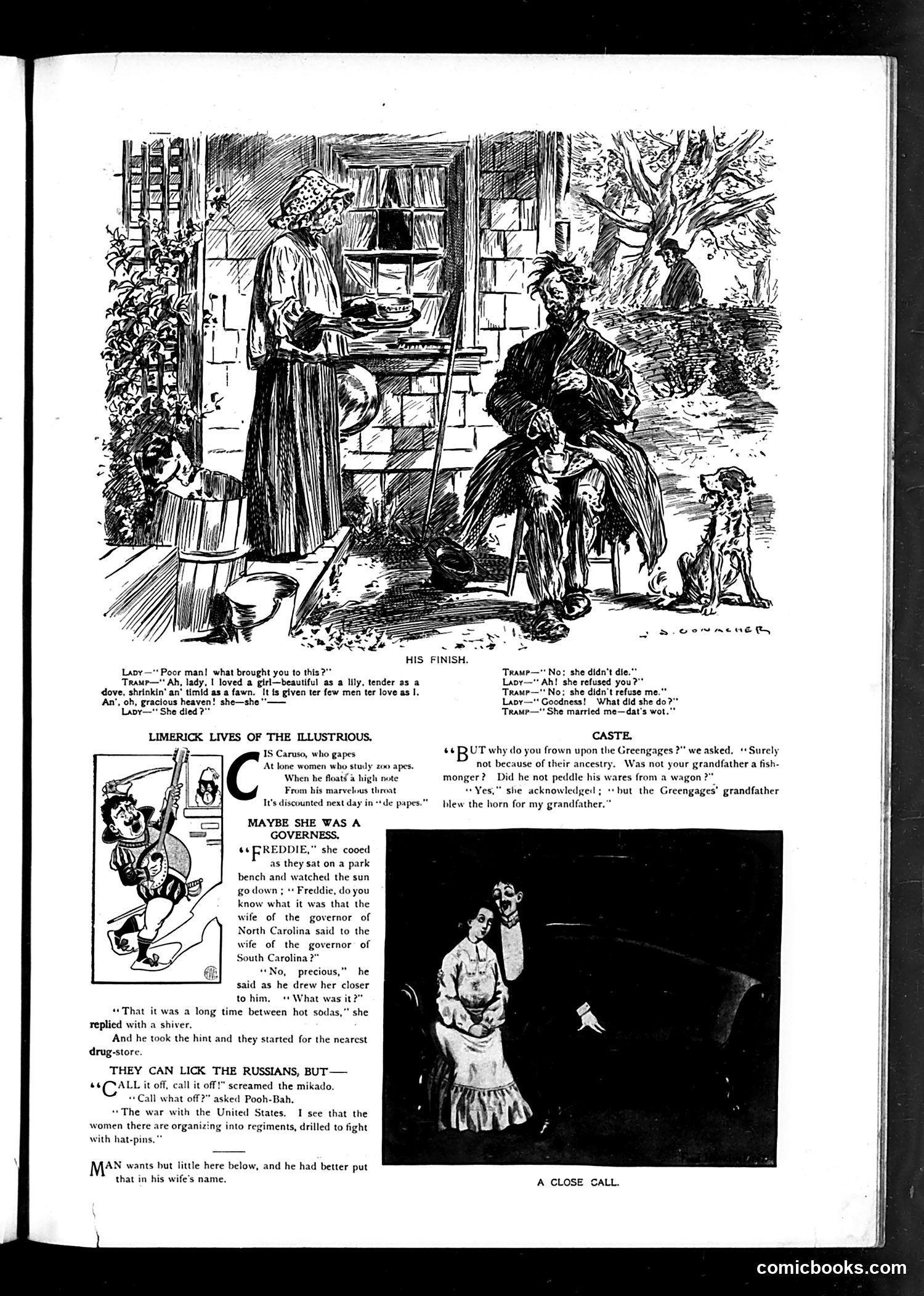
This page contains two distinct pieces of satirical content from an early 20th-century American magazine. **Top illustration ("His Finish")**: Depicts a romantic scene where a man appears to be serenading or courting a woman at a cottage. The dialogue suggests he's professing love, but she rejects him, ultimately revealing she's already married. The satire targets romantic delusion and the gap between male fantasy and reality. **"Limerick Lives of the Illustrious" section**: Uses humorous limericks and small illustrations to mock prominent figures. One references a woman of dubious ancestry ("Greenages"), mocking social pretension. Another ("They Can Lick the Russians, But") appears to satirize women's involvement in military or political organization during wartime, with a dismissive punchline about male priorities. The overall tone is dismissive toward both romantic aspirations and female political engagement.
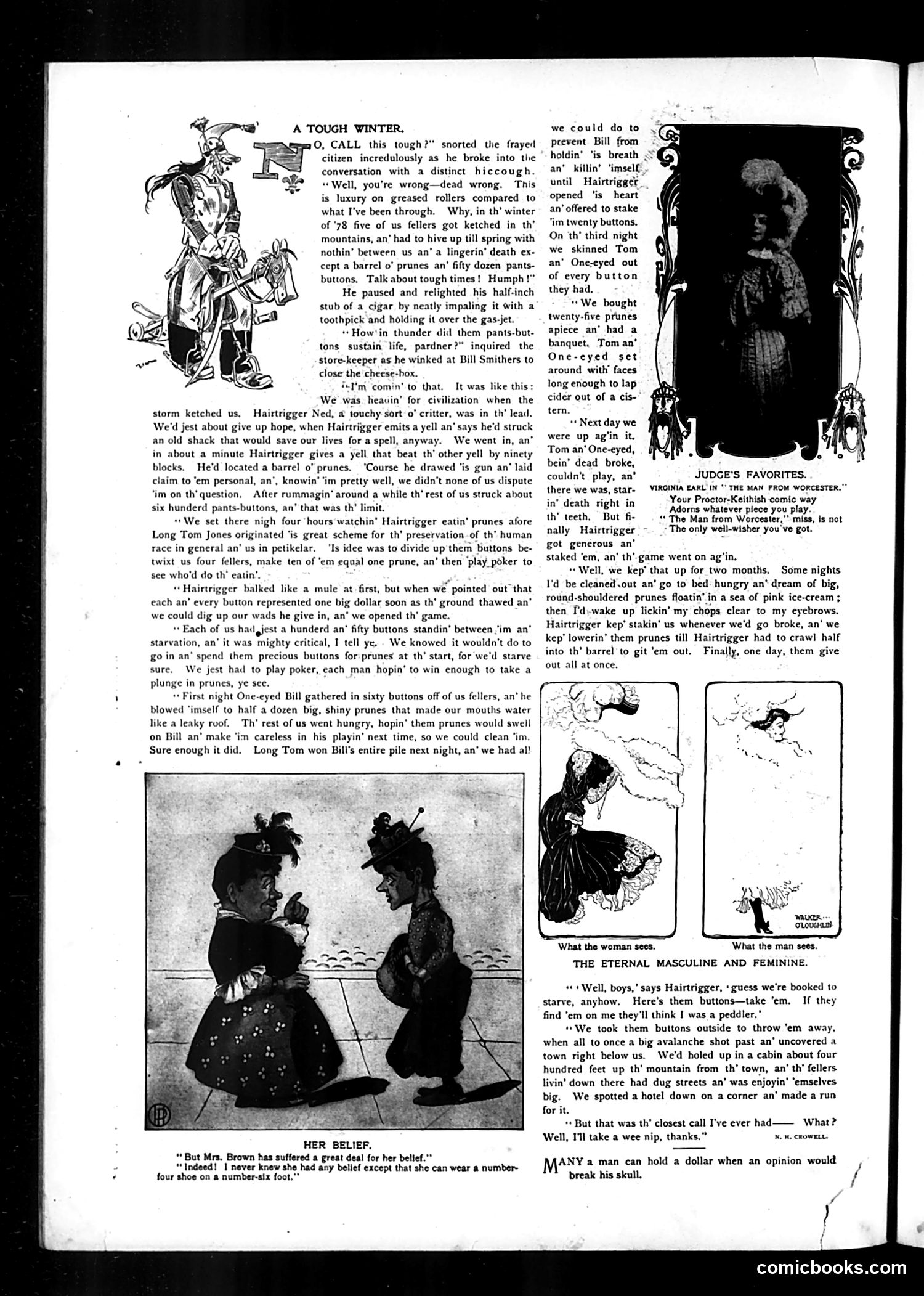
This page satirizes frontier hardship through humorous exaggeration. The main narrative describes prospectors surviving an extremely harsh winter by eating prunes—so many that one character becomes "One-eyed," having lost an eye from digestive distress. The satire mocks both the severity of frontier conditions and the absurdity of their survival strategy. **"Her Belief"** (bottom left) shows two women discussing Mrs. Brown's footwear beliefs—a visual gag about practical frontier life versus fashion. The illustrations labeled **"The Eternal Masculine and Feminine"** (right) contrast how men and women perceive the same snowy mountain scene differently. The page uses physical comedy and exaggeration typical of early-20th-century Judge humor, targeting frontier life's hardships and gender stereotypes of the era.
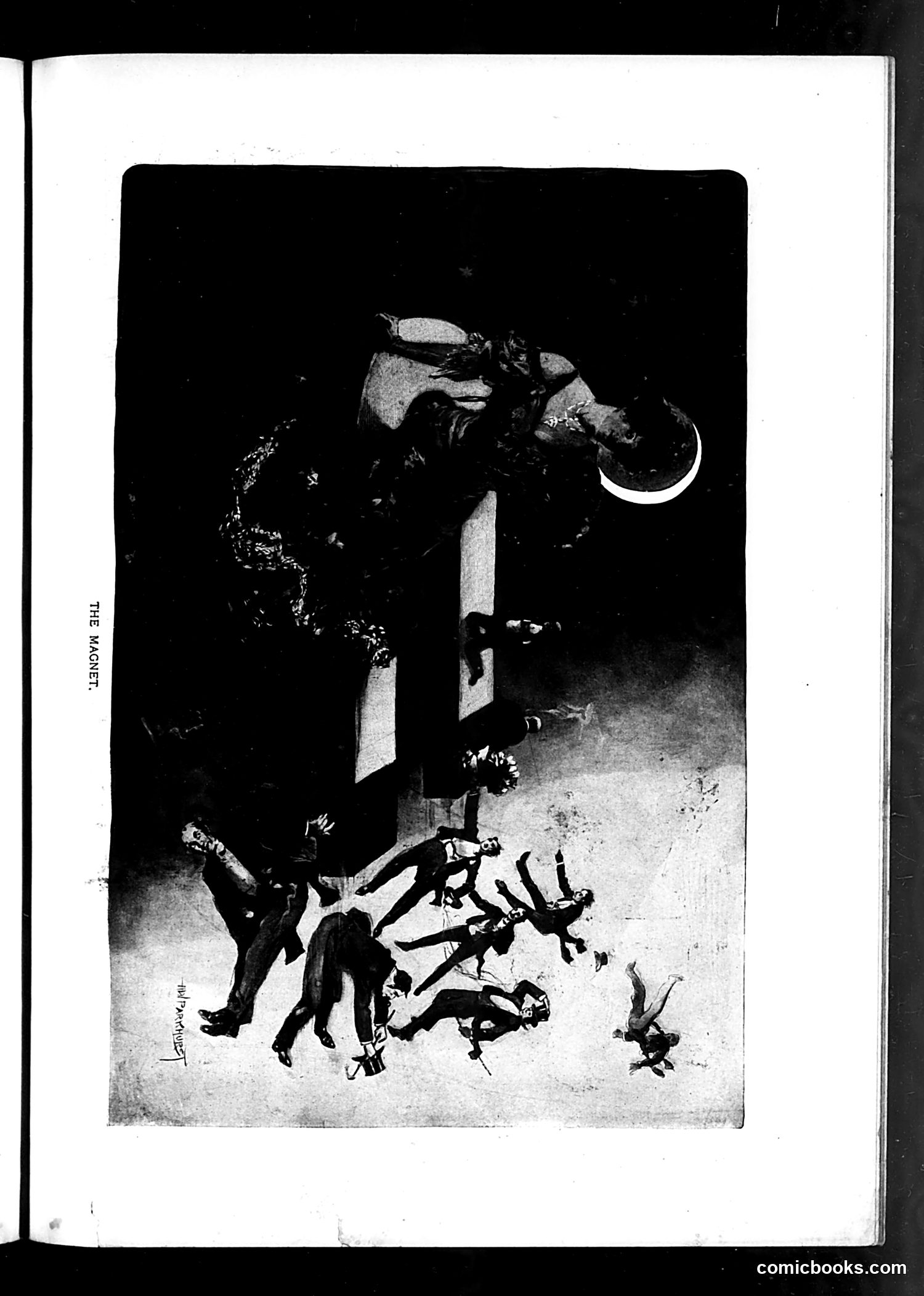
This cartoon depicts a chaotic stock market scene. A large, menacing figure looms above, wielding what appears to be a club or hammer—likely representing market forces, a financial panic, or manipulative speculation. Below, small human figures scatter in disarray, appearing to flee or be trampled. The title "The Market" suggests this critiques stock market volatility or manipulation. Given Judge magazine's satirical nature, this probably comments on either market crashes, price manipulation by powerful financiers, or the vulnerability of ordinary investors to sudden economic upheaval. The exaggerated scale difference between the towering force and the fleeing figures emphasizes the powerlessness of common people against larger economic forces. The specific historical event referenced is unclear without additional context or dating information.
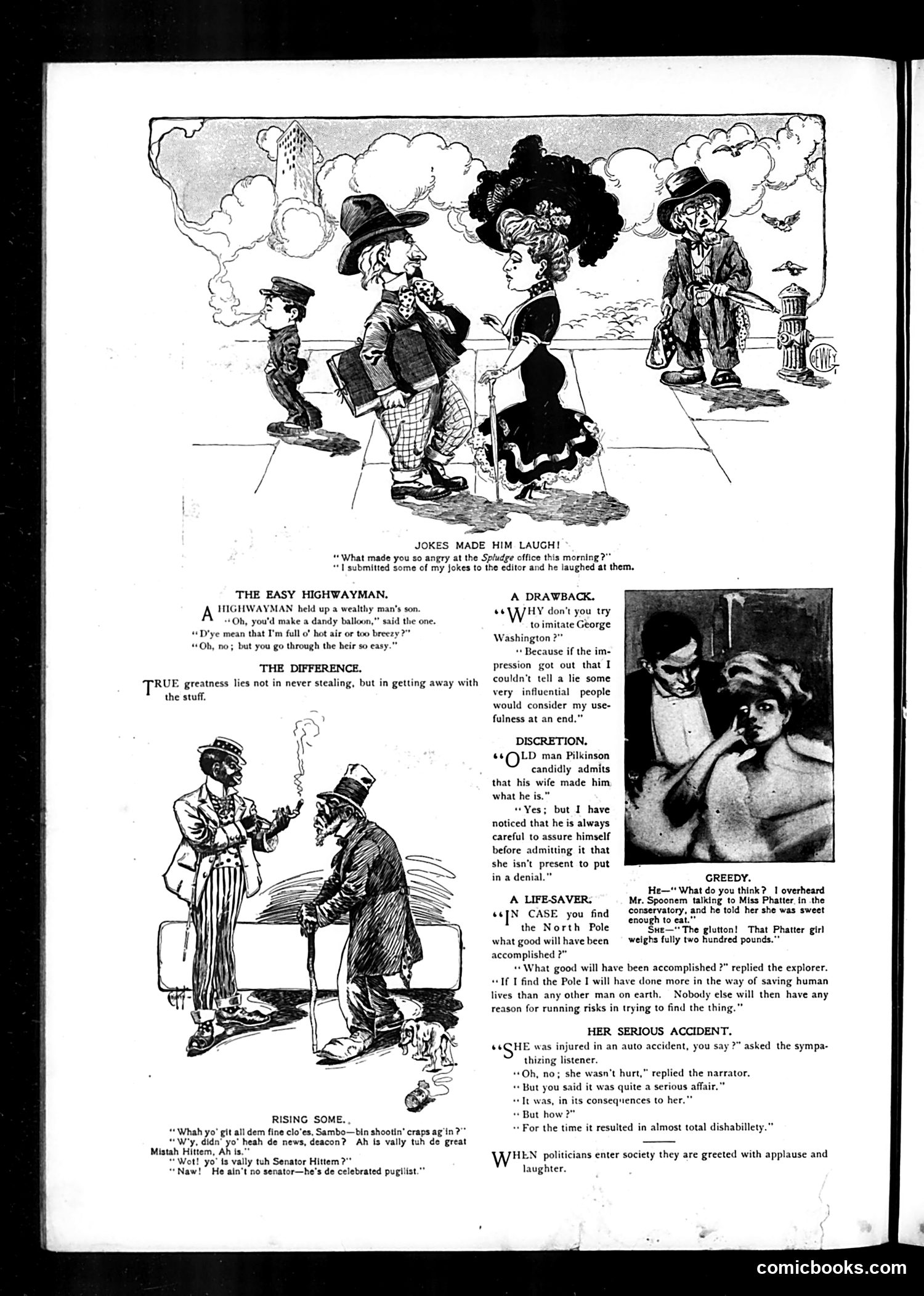
This page collects brief jokes and satirical observations typical of early-20th-century humor magazines. Key pieces include: **"The Easy Highwayman"**: A pun mocking a wealthy man's son as having no substance—he "goes through the heir so easy" (plays on "air" and inheritance). **"A Drawback"**: Jokes about imitating George Washington's honesty; the humor assumes readers know Washington's famous "I cannot tell a lie" legend. **"The Difference"**: Satirizes how wealthy people rationalize theft—"true greatness" isn't avoiding stealing, but escaping consequences. **"A Life-Saver"**: Mocks Arctic exploration as pointless risk-taking. **"Rising Some"**: Uses racial dialect humor (period-typical but offensive today) about a Black man claiming connection to "Senator Hittem," revealed as a prizefighter—satirizing social climbing through false associations. The page reflects Judge's formula: quick jabs at hypocrisy, social pretension, and contemporary figures, relying on readers' shared cultural references and assumptions.
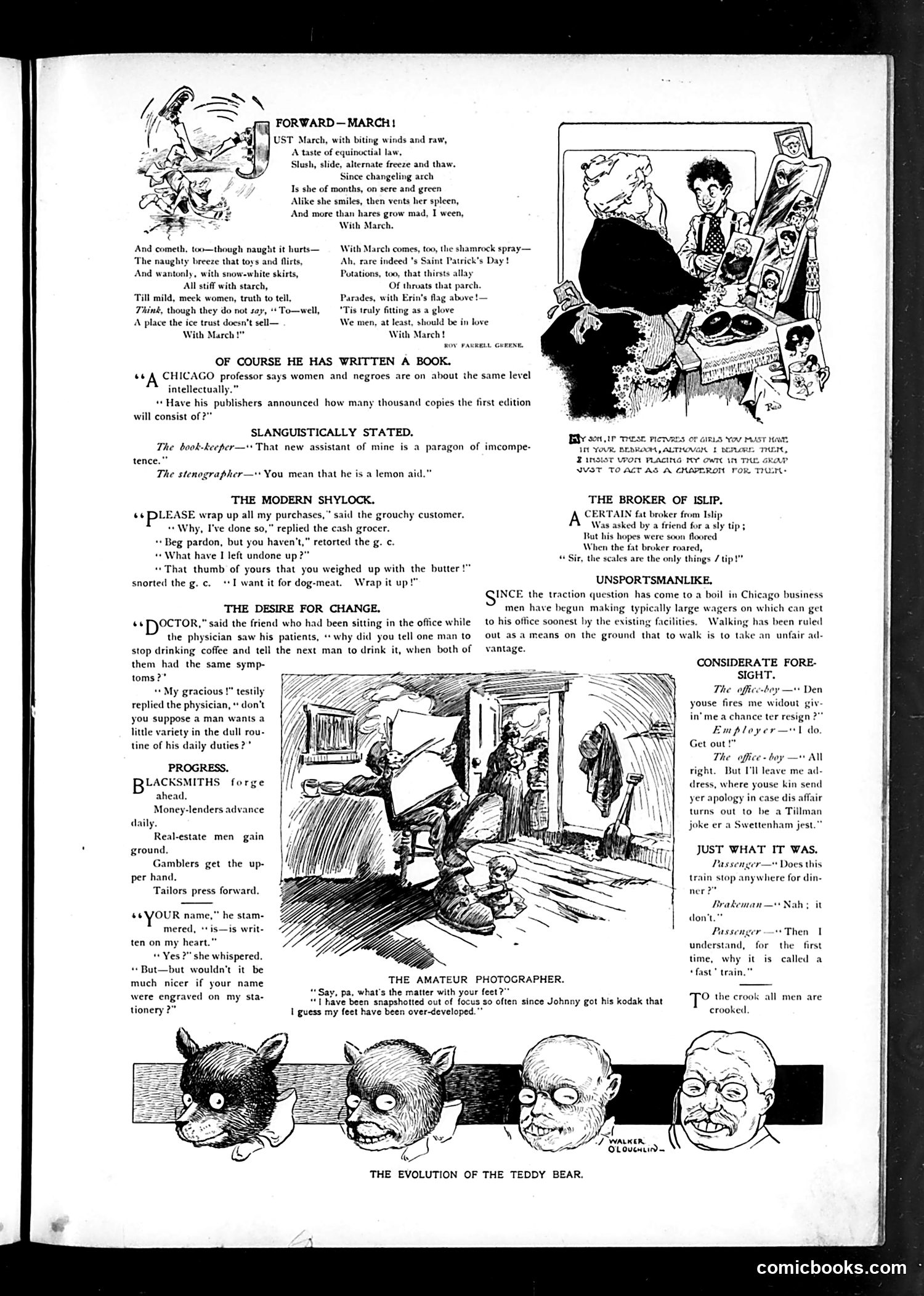
This satirical page from *Judge* contains multiple brief humorous pieces targeting early-20th-century society: **"Forward—March"** is a seasonal poem celebrating March and Saint Patrick's Day, notable mainly for its nostalgic tone. **The Chicago Professor Joke** satirizes racist academic pseudoscience—a professor claims women and Black people are intellectually equal, prompting the sarcastic question about publication numbers, implying the absurd claim merits only limited copies. **"Modern Shylock"** depicts a grocer caught cheating customers by weighing his thumb with butter, referencing Shylock (the villain from *The Merchant of Venice*) to suggest commercial dishonesty. **Chicago Traction Section** references a real dispute over public transportation monopolies in Chicago, with a jab at wealthy brokers making unfair bets. **Remaining Sections** include wordplay and light humor about photography, office dynamics, and trains—typical satirical fare mocking everyday absurdities. The page reflects *Judge's* focus on social and political commentary through humor.
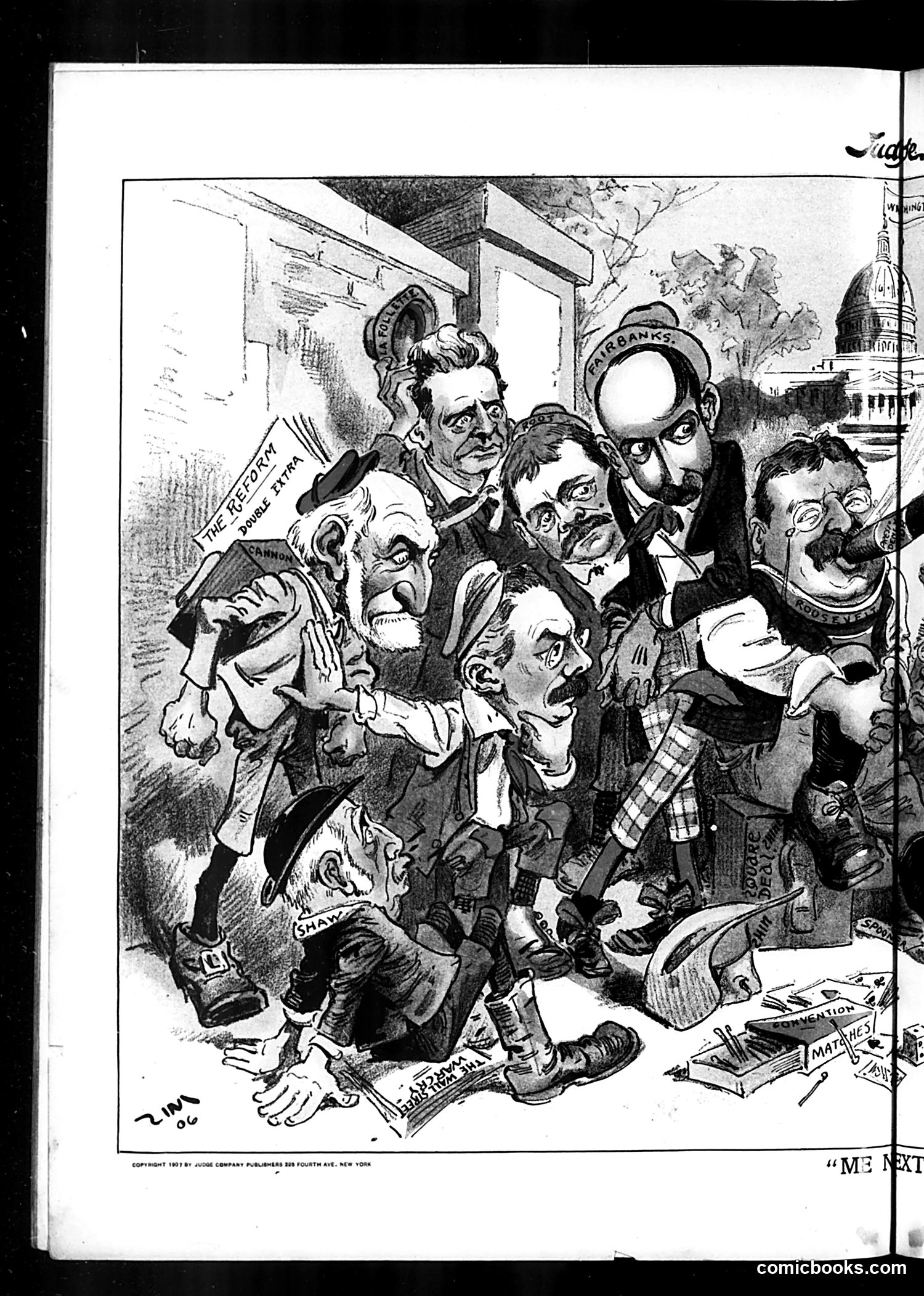
This 1907 Judge magazine cartoon depicts a group of exaggerated caricatured figures gathered outside what appears to be the U.S. Capitol building. The visible labels include "Fairbanks" (likely Vice President James Sherman or similar political figure) and references to "The Reform" and what appears to be political commentary. The cartoon uses grotesque caricature—a common satirical technique of the era—to mock a group of politicians or political figures. Without clearer text identifying each figure, the specific individuals and precise political issue remain unclear, though the gathering suggests commentary on legislative action, reform politics, or political scheming typical of early 20th-century American satire. The style is characteristic of Judge's sharp political commentary on contemporary Washington figures and debates.
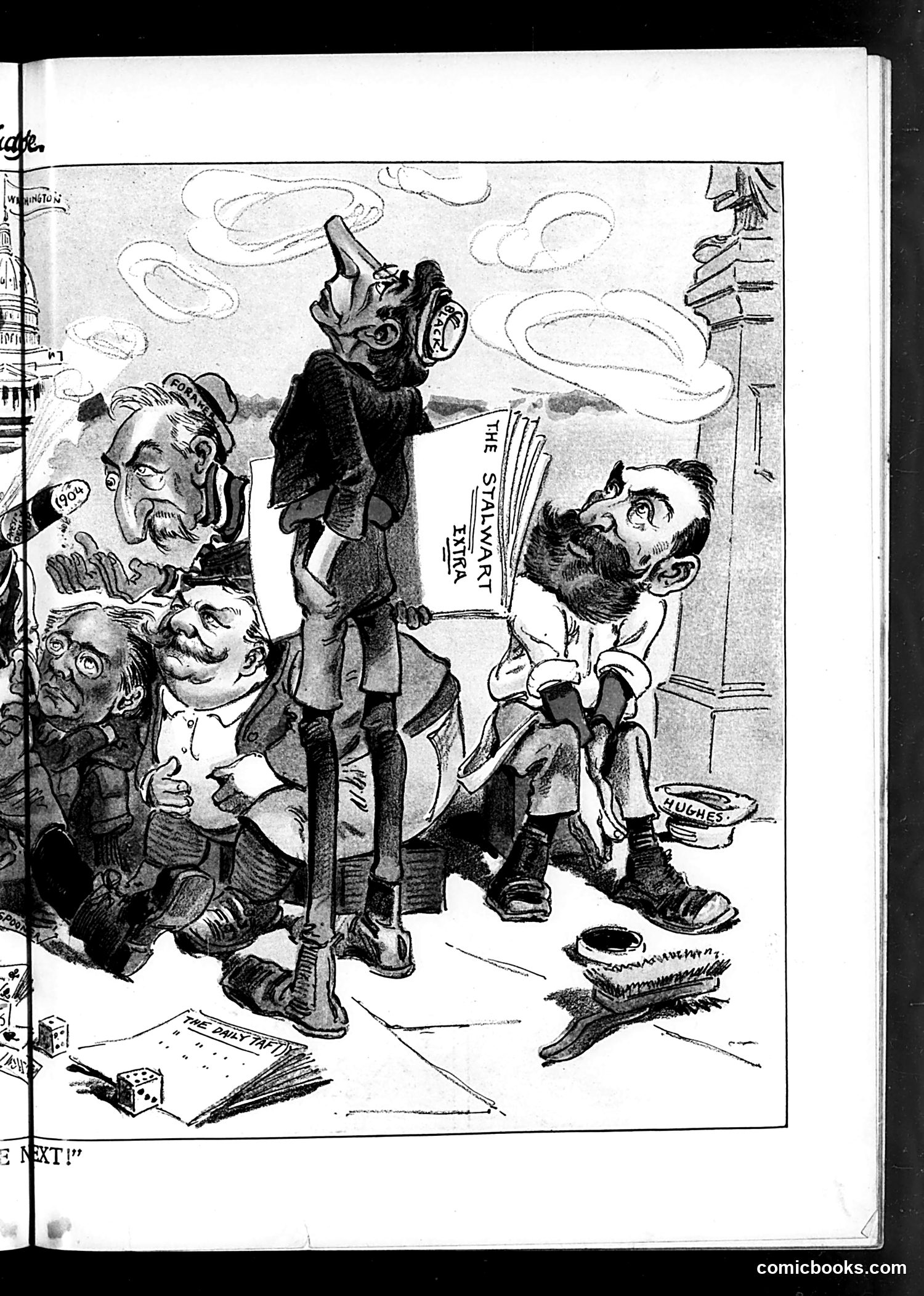
This satirical cartoon from *Judge* magazine depicts "The Stalwart" — likely referring to the Republican Party faction known as "Stalwarts" during the Gilded Age. A demonic or devil-like figure stands elevated, seemingly directing several caricatured politicians or party members below, who appear subservient or manipulated. The figures at ground level look distressed or complicit, suggesting they're being controlled by corrupt leadership symbolized by the monstrous central figure. Playing dice and other gaming implements scattered below indicate corruption, gambling, or moral compromise. The cartoon critiques machine politics and backroom dealing within the Republican party establishment, satirizing how party bosses manipulated subordinates and party machinery for personal gain rather than public interest — a common *Judge* theme during the Gilded Age's notoriously corrupt political era.
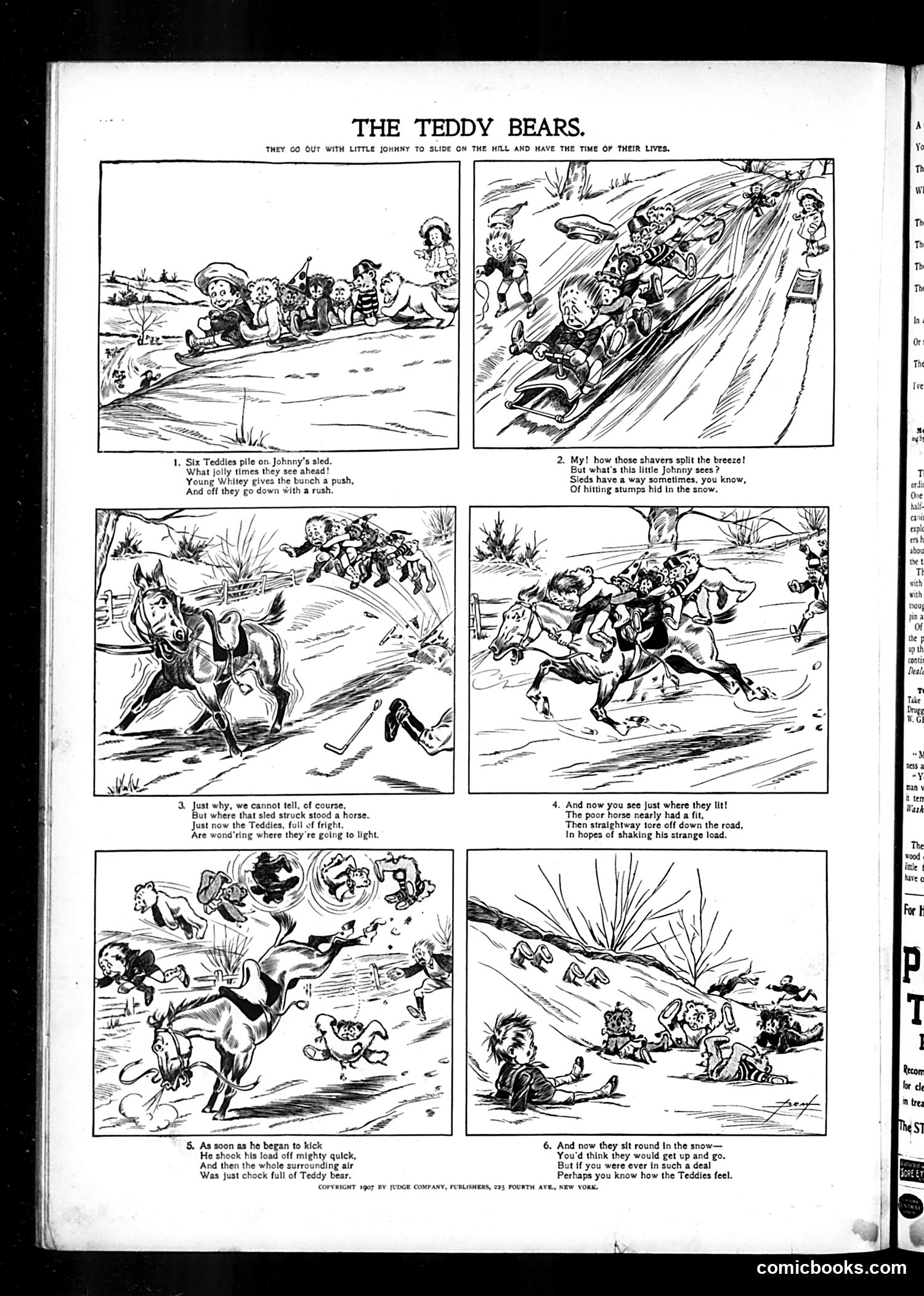
This is a six-panel comic strip from Judge magazine (1907) depicting teddy bears sledding with a child named Johnny. The narrative follows a slapstick sequence: six teddy bears pile onto Johnny's sled and slide downhill, but crash into a horse standing in the snow. The startled horse bucks violently, throwing the bears into the air in all directions. The final panels show the bears scattered and dazed in the snow, contemplating their misadventure. The humor is purely physical comedy—no political or social satire. This appears to be children's entertainment capitalizing on the then-recent "teddy bear" craze (named after President Theodore Roosevelt). The bears' anthropomorphic personalities and their chaotic misfortune create straightforward slapstick humor typical of early 1900s popular entertainment. The strip assumes reader familiarity with teddy bears as beloved toys.
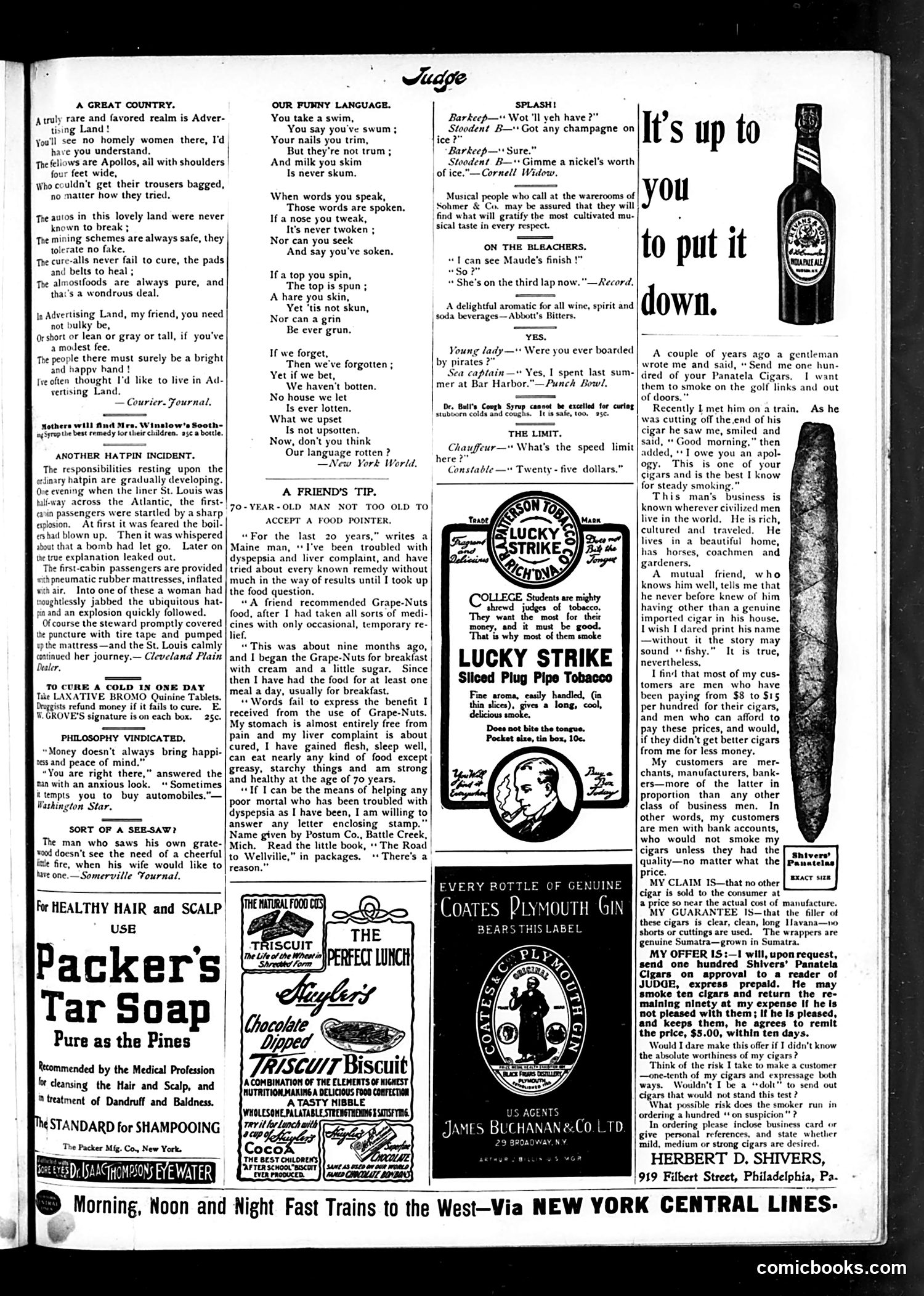
This page from the satirical magazine *Judge* contains several pieces mocking American advertising and language conventions: **"A Great Country"** satirizes the absurd claims of advertising, where products never fail, people are impossibly attractive, and automobiles never break down. The satire is straightforward: advertising presents a fantastical world divorced from reality. **"Another Hatpin Incident"** references the contemporary concern about women's large decorative hatpins being weapons or hazards. The joke: a woman's hatpin punctures an inflatable mattress on a steamship, causing an explosion—turning the hatpin into an accidental weapon, reflecting real anxieties about this fashion accessory. **"Our Funny Language"** humorously catalogs English's inconsistent verb conjugations (swim/swum vs. trim/trum), highlighting the illogical nature of English grammar rules. The page is predominantly **advertisements** for products like Packer's Tar Soap, Lucky Strike tobacco, and Grape-Nuts cereal—ironically positioned alongside the satire of advertising itself. This juxtaposition is likely intentional editorial commentary.
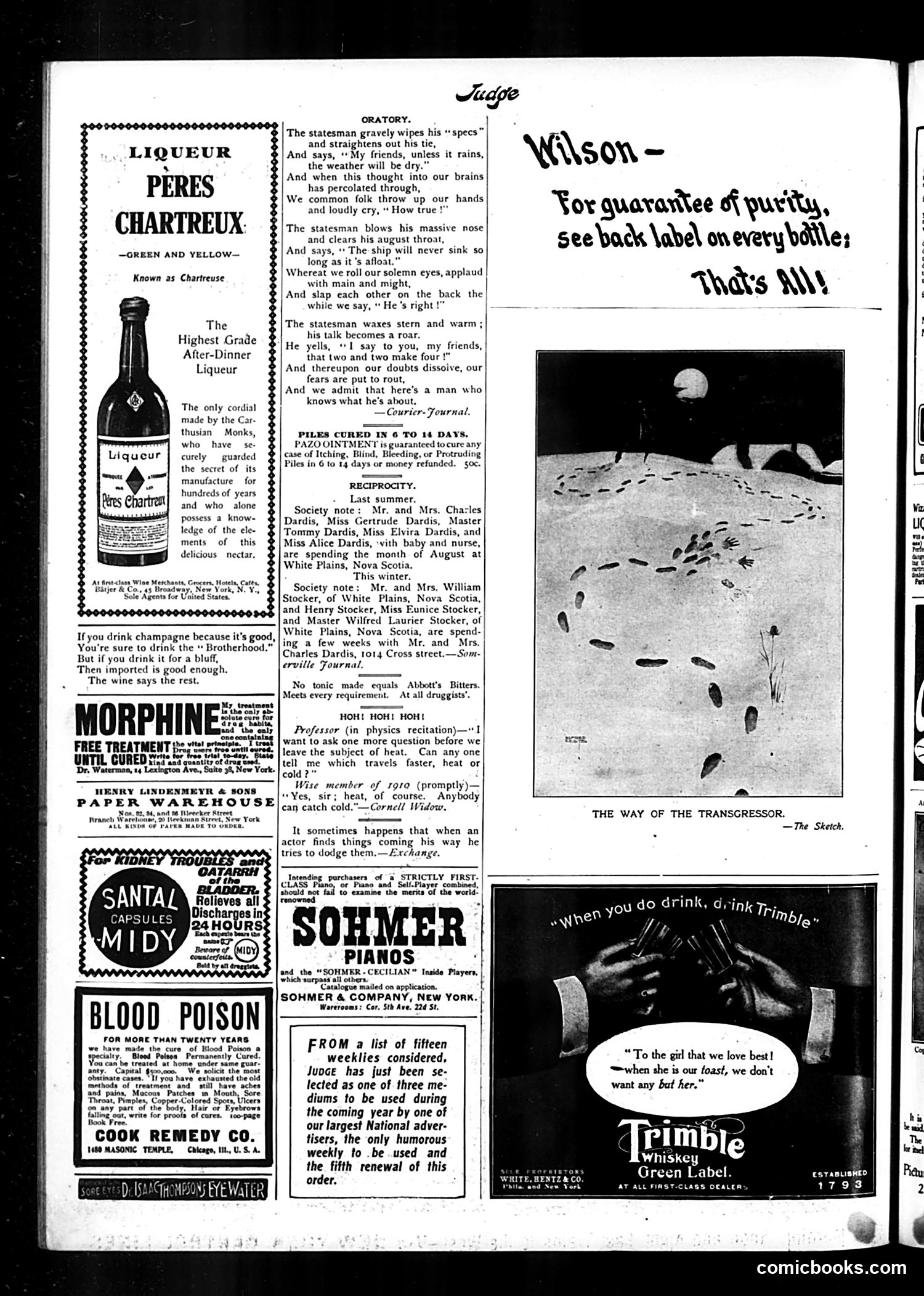
The main piece is a satirical poem mocking political speechmaking. It depicts a statesman making banal, self-evident statements ("the weather will be dry," "the ship will never sink so long as it's afloat," "two and two make four") that audiences treat as profound wisdom, applauding enthusiastically despite the empty content. The satire targets how voters are easily swayed by rhetorical bluster and theatrical delivery rather than substance—a common Progressive-era critique of political theater. The page is otherwise dominated by advertisements (liqueur, pianos, patent medicines) and brief social notes showing reciprocal visits among the Dardis and Stocker families. A physics classroom joke appears: when asked which travels faster—heat or cold—a student answers "heat," since "anybody can catch cold."
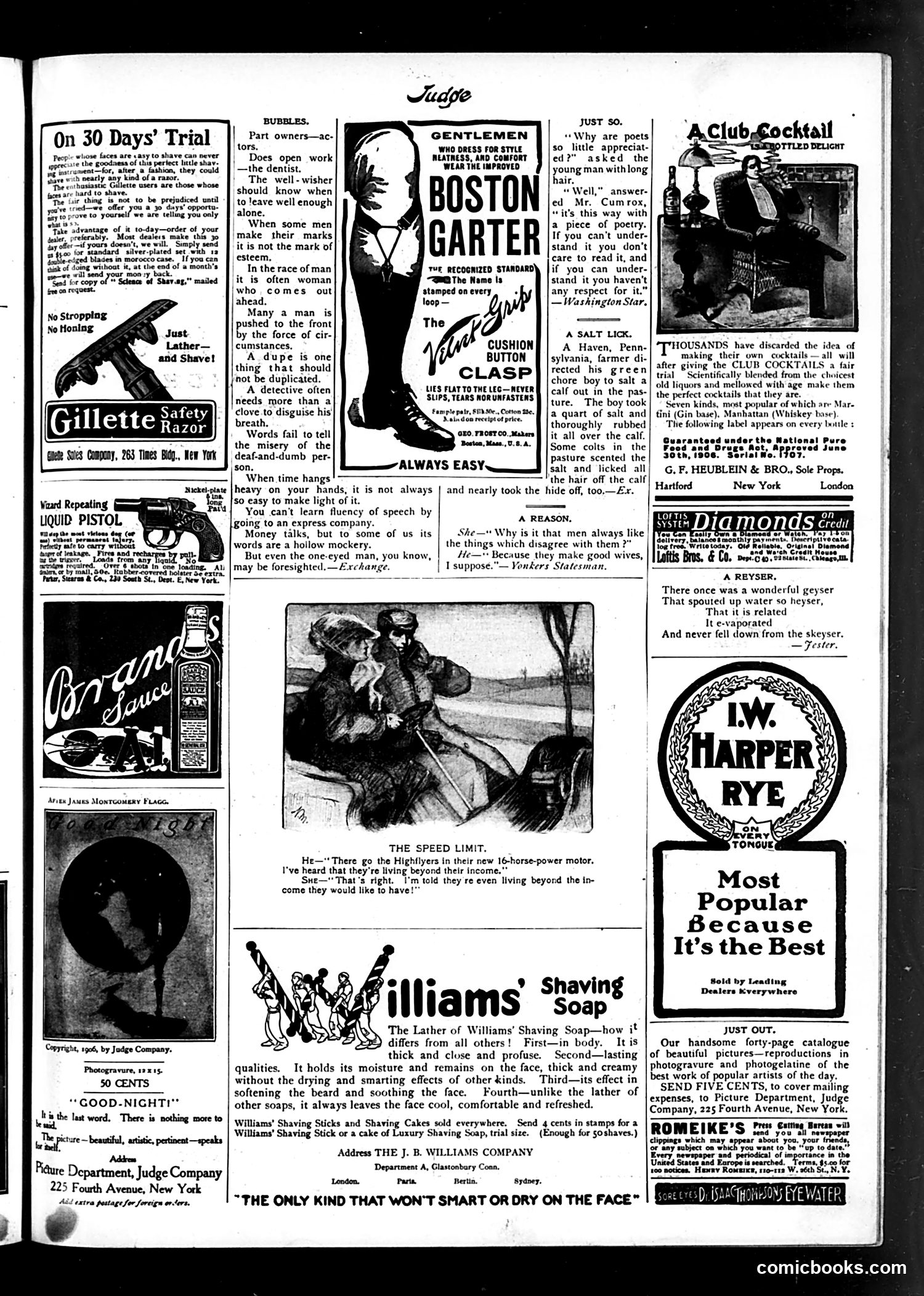
This page is primarily **advertisements and humor columns** rather than political satire. The content includes: **Main Elements:** - Product ads (Gillette razors, Williams' Shaving Soap, Boston Garter suspenders, I.W. Harper Rye whiskey) - "Bubbles" section: short humorous observations on human nature and social foibles - Brief comic anecdotes about poets, farmers, and wealthy people **The Humor:** The jokes target universal themes: pretension (poets lacking appreciation), naiveté (the farm boy salting a calf), marital dynamics, and the wealthy living beyond their means ("The Speed Limit" cartoon shows the newly rich Highflyers in their motor car). **Social Context:** The references reflect early 1900s concerns: automobiles as status symbols, class anxieties about new money, gender roles in marriage. The "Boston Garter" ad targets gentlemen concerned with fashionable appearance. This is typical Judge content—lighthearted social commentary wrapped around advertising, aimed at middle/upper-class male readers.
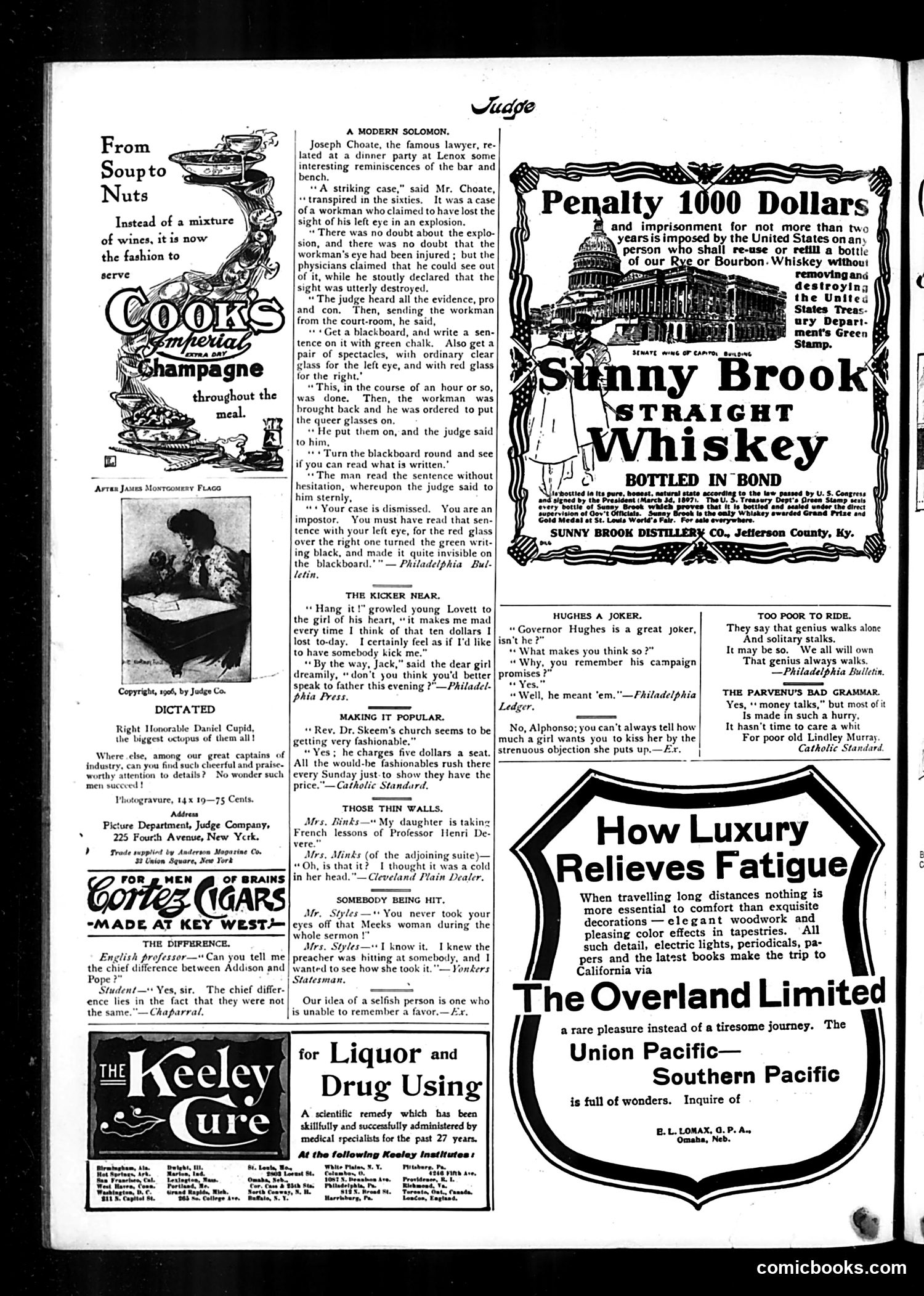
This is a **Judge magazine page from 1906** featuring satirical commentary and advertisements typical of the era. The main cartoon, "A Modern Solomon," tells an anecdote by lawyer Joseph Choate about a clever judicial trick: a plaintiff claiming blindness from an accident is exposed as a fraud when the judge uses red and clear glass spectacles to test him. The green chalk writing becomes invisible under the red glass but readable under the clear glass—proving the man could see all along. The "Solomon" reference invokes biblical wisdom; the satire criticizes frivolous legal cases and malingering. The surrounding pieces are short humorous anecdotes about marriage, professors, church fashion, and eavesdropping through thin walls—typical period humor relying on misunderstandings and domestic situations. **Historical context**: The advertisements for "Sunny Brook Whiskey," "Cortez Cigars," and the "Keeley Cure" for alcohol/drug addiction reflect an era before Prohibition when such products were legally advertised even in respectable publications—sometimes absurdly alongside cures for their own effects.
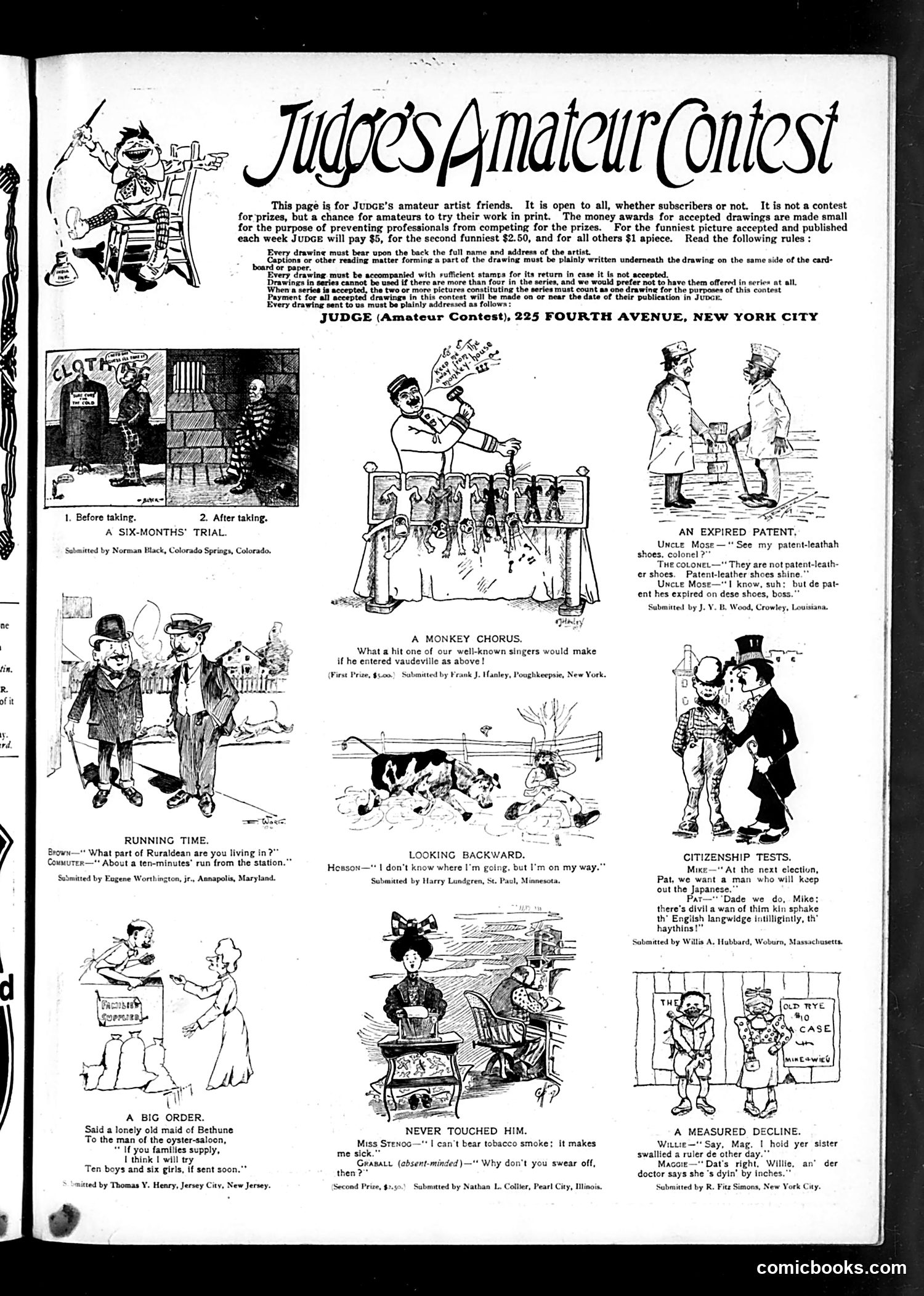
This is a **submissions page** for Judge magazine's amateur cartoon competition, not political commentary. It showcases humorous drawings submitted by readers, with small cash prizes ($5, $2.50, $1) awarded to the funniest entries. The cartoons depict everyday humor and social observation: - **"Six-Months' Trial"**: Before/after weight-loss comedy - **"Expired Patent"**: A Black man (Uncle Mose) jokes that patent-leather shoes' shine has worn off like an expired patent - **"Monkey Chorus"**: Absurdist humor about a famous singer performing with monkeys - **"Citizenship Tests"**: Irish immigrants (Pat, Mike, Dade) discussing excluding Japanese immigrants—reflecting anti-Japanese sentiment of the era - **"Running Time," "Never Touched Him," "Measured Decline"**: Domestic and romantic humor The page reflects early 20th-century casual racism and stereotyping in its depictions and dialect humor, particularly regarding immigrants and Black characters. These were typical of period humor magazines, now historically revealing attitudes we'd recognize as offensive.
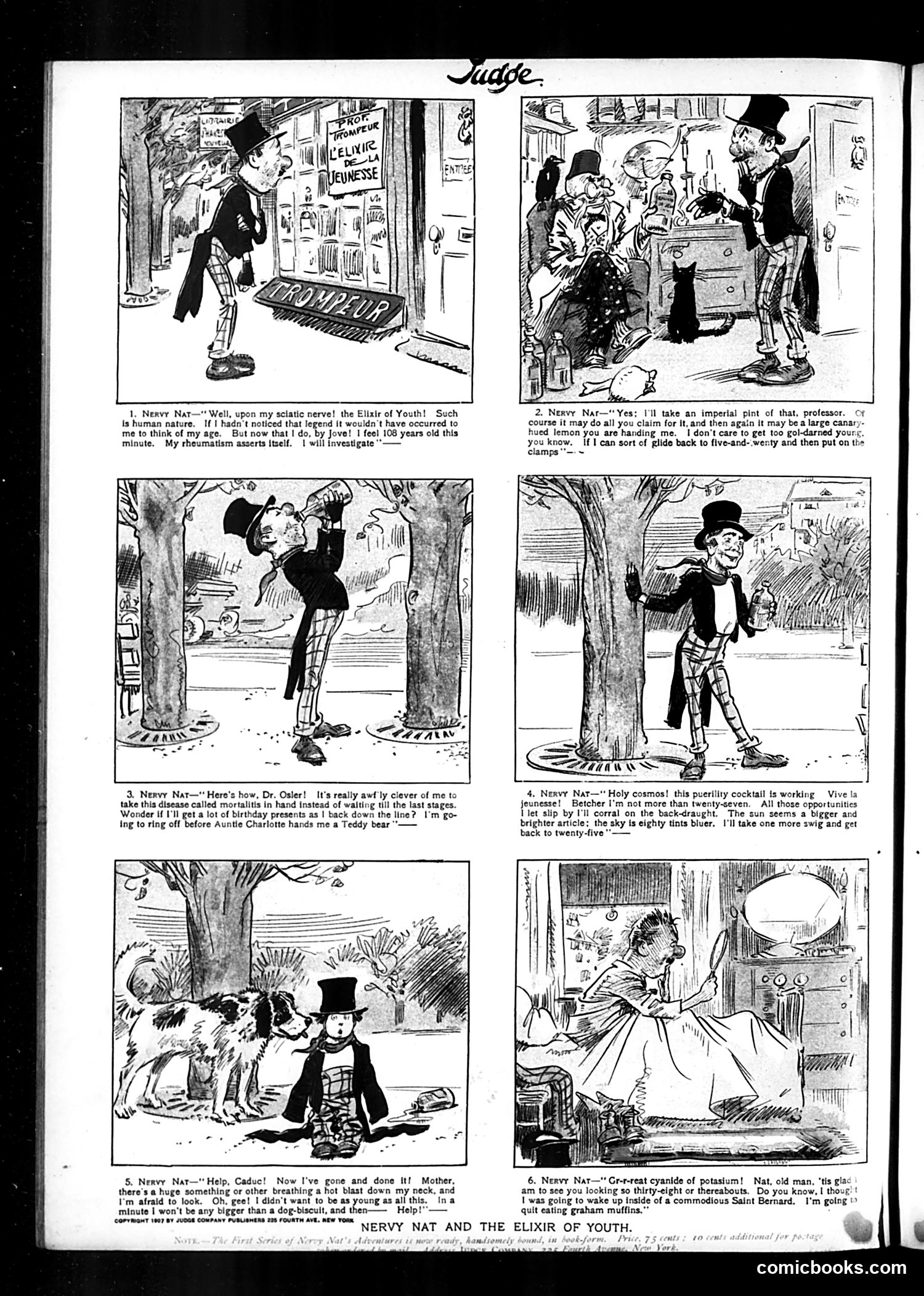
This six-panel comic satirizes the early 20th-century craze for "elixirs of youth" and anti-aging tonics—fraudulent patent medicines heavily marketed to the gullible. The protagonist, Nervy Nat, encounters a street vendor (likely a charlatan professor) hawking a youth potion. After purchasing and consuming it, Nat experiences a psychological cascade: merely *thinking* about his age makes him feel ancient; the elixir's placebo effect then makes him feel progressively younger. He becomes increasingly reckless and childish with each swig, ultimately shrinking (or believing he's shrinking) to infancy. The satire targets both the false promises of quack medicines and human vanity—our willingness to believe in magical rejuvenation despite reason. The exaggerated reactions underscore how suggestion and desire override logic. The final panel's reference to eating graham muffins (a "healthful" food) continues the joke about pursuing fountains of youth through marketed products.