
A complete issue · 16 pages · 1907
Judge — January 26, 1907
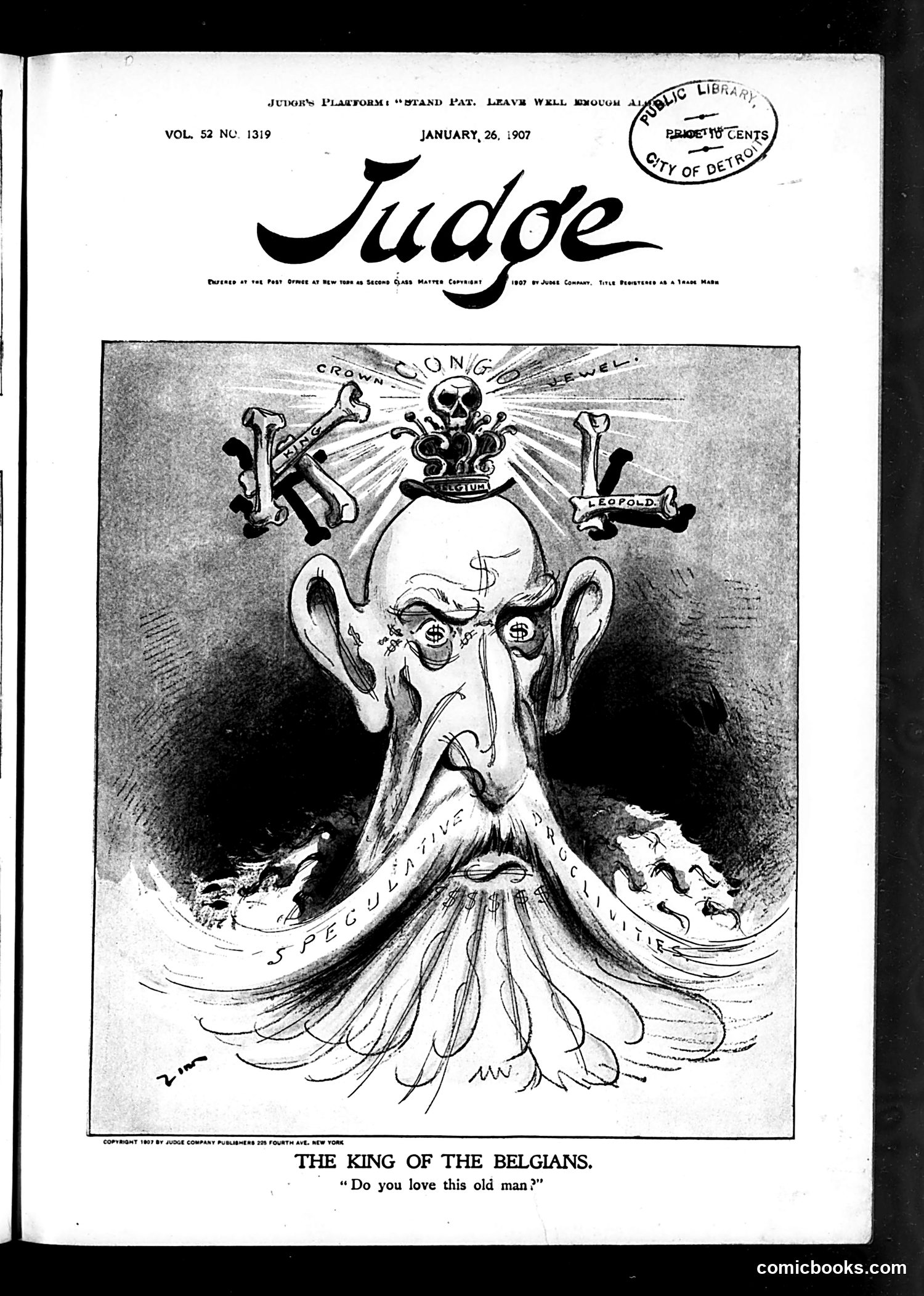
This 1907 Judge magazine cartoon satirizes Leopold II of Belgium. The grotesque caricature depicts him as a grotesquely decorated figure wearing a crown labeled "CONGO" and "JEWEL," with dollar signs for eyes. The labels "SPECULATIVE" and "SECURITIES" on flowing robes reference financial exploitation. The caption "Do you love this old man?" is sarcastic commentary on Leopold's brutal colonial rule in the Congo. Leopold personally owned the Congo as private property and extracted vast wealth through rubber production, resulting in mass suffering and death among Congolese people—a scandal that was becoming widely known in America by this period. The cartoon exposes Leopold as a greedy tyrant enriching himself through colonial violence.
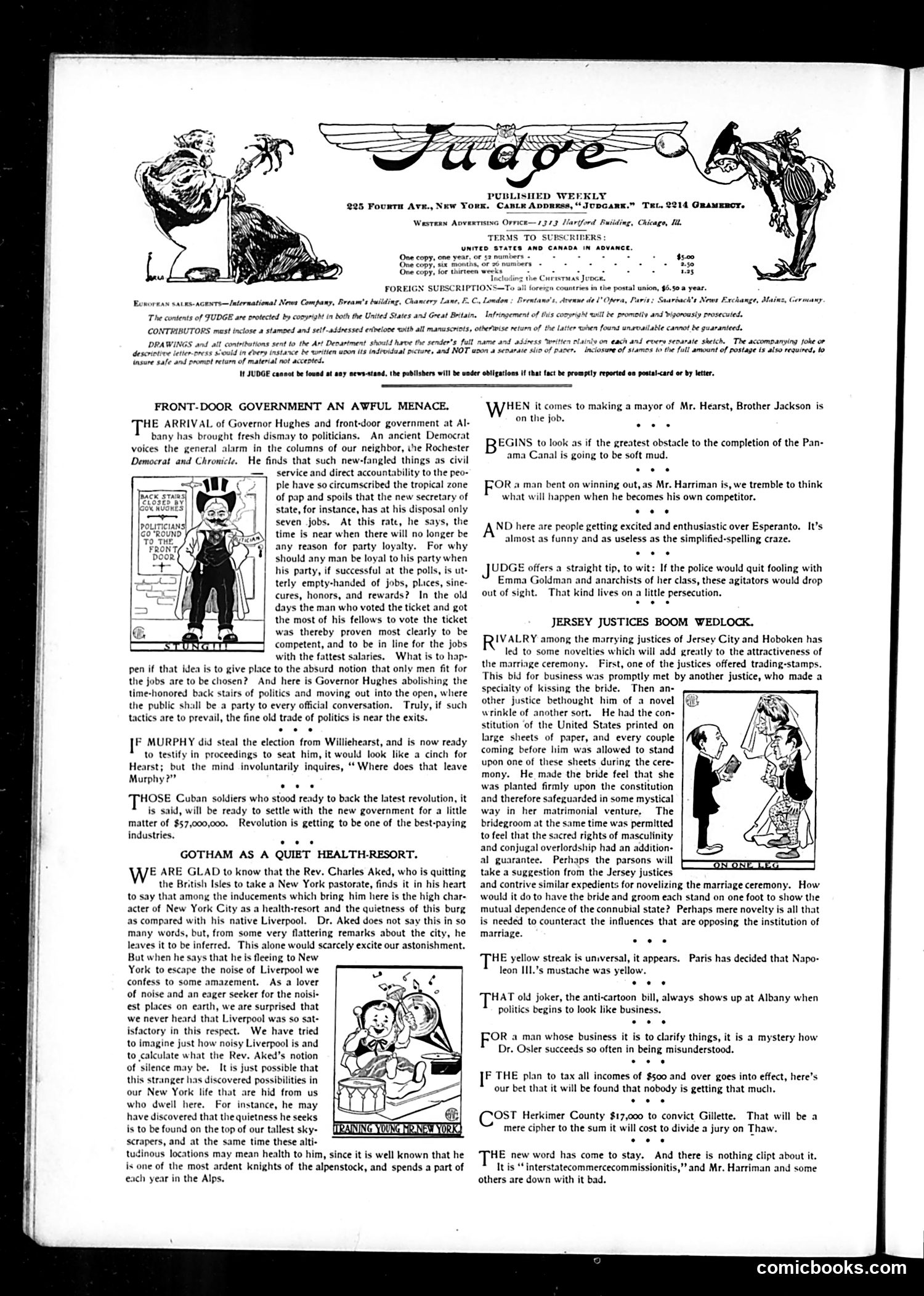
This page contains political commentary and editorial cartoons from an era when **Governor Hughes** and **front-door government** were contemporary issues. The left cartoon depicts a bloated political figure labeled with various government inefficiencies, satirizing what the text calls "an awful menace." The editorial discusses several topics: the Panama Canal, political figures like **Harriman** and **Emma Goldman**, and **Jersey City justices** involved in a controversial wedding ceremony where a bride and groom were made to stand on legal documents during their ceremony—apparently to "safeguard" marriage rights through unusual means. The satire targets governmental corruption, municipal politics, and what the writers view as absurd bureaucratic theatrics masquerading as reform or legal protection.
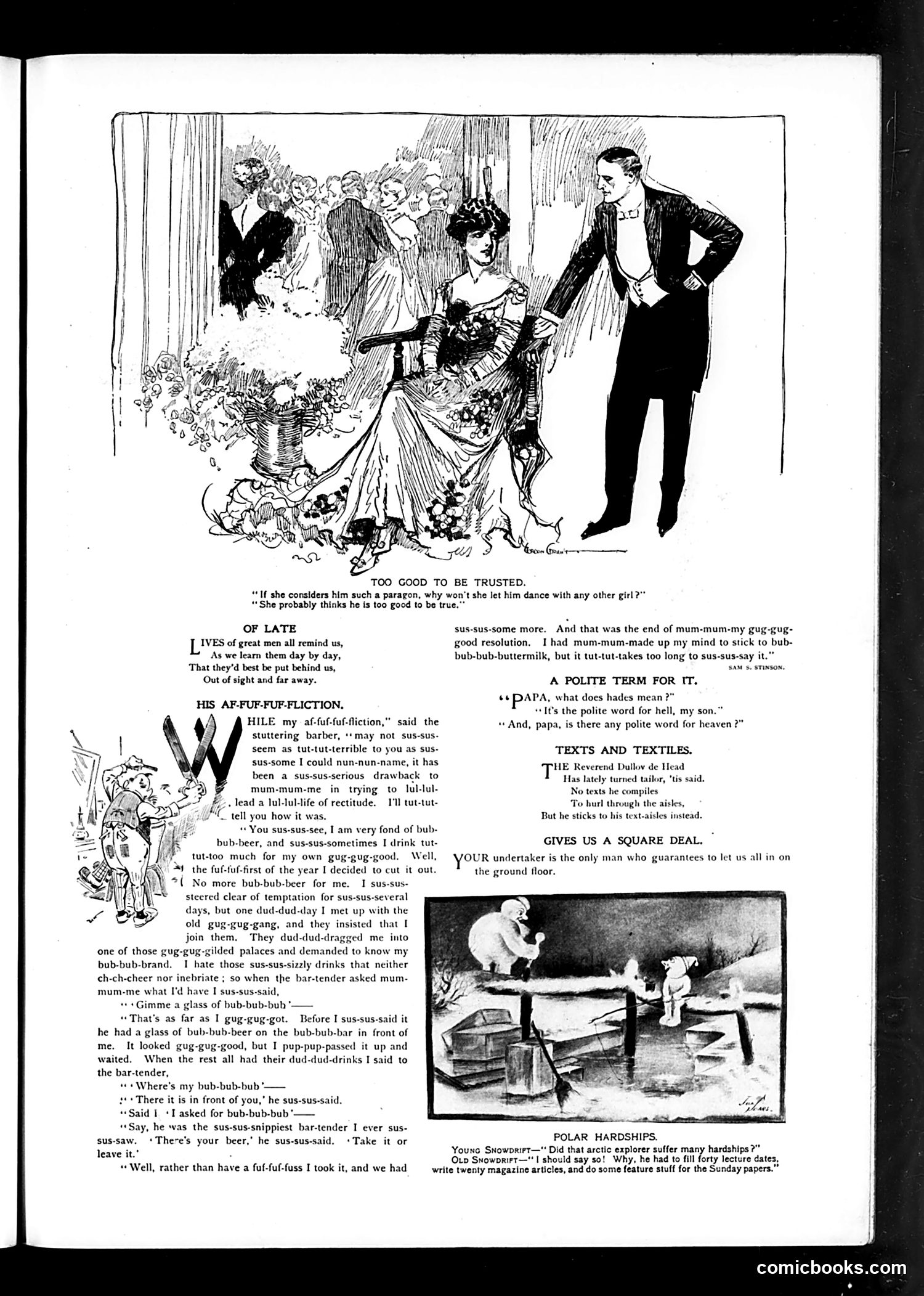
The top cartoon titled "Too Good to Be Trusted" depicts a wealthy woman in an elegant dress surrounded by admirers at what appears to be a social gathering. A well-dressed man stands apart, skeptical. The caption suggests the joke: if a man considers a woman "such a paragon," why won't he let her dance with other men? The answer: "She probably thinks he is too good to be true"—satirizing male jealousy and the double standards of courtship rituals among the wealthy elite. The remaining page contains humorous prose pieces about bar slang ("sus-sus-some"), etiquette terminology, and arctic exploration anecdotes, along with illustrations. These appear to be satirical commentary on contemporary social behaviors and speech affectations of early 20th-century American society.
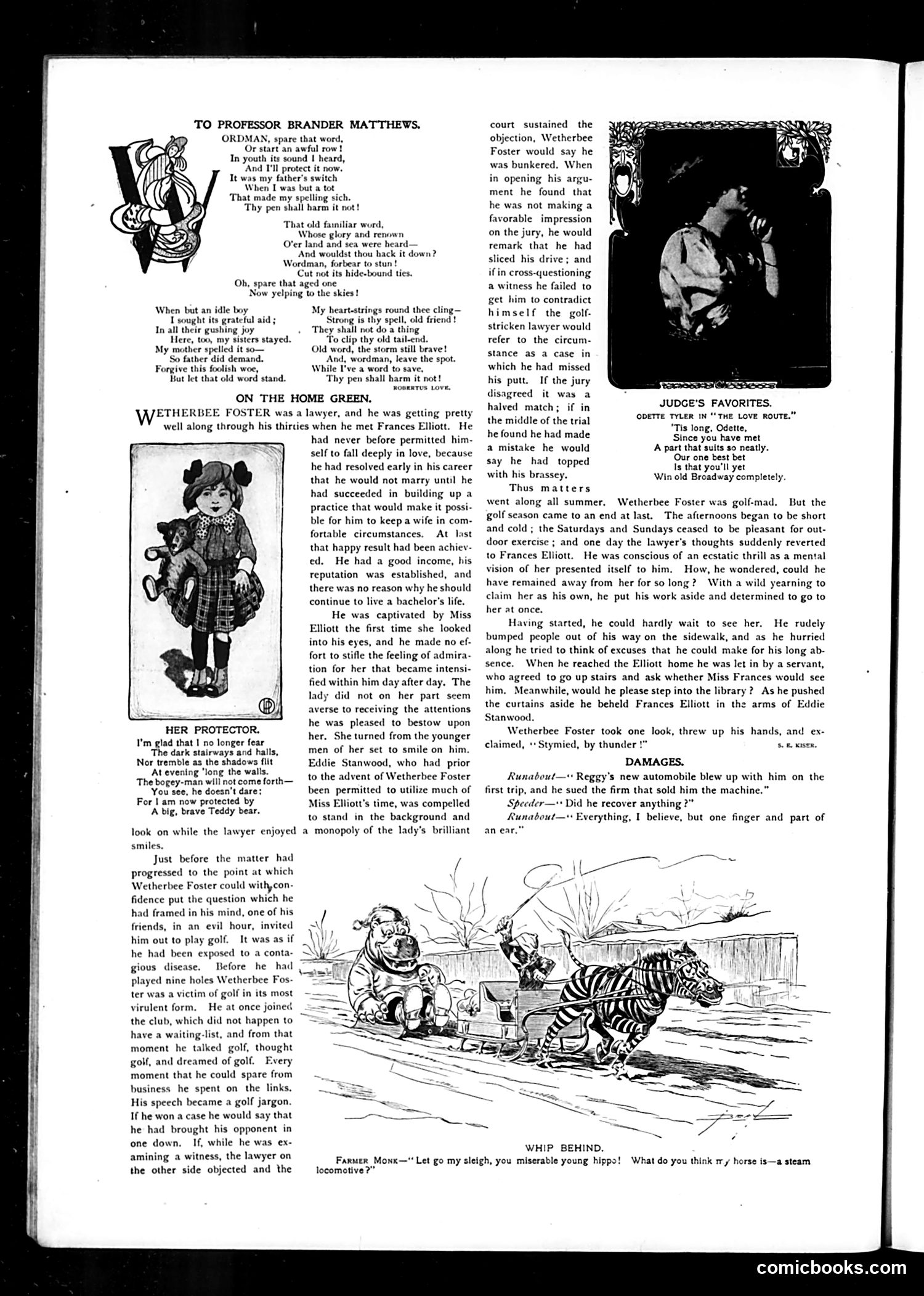
This page contains several satirical stories and illustrations from an early-20th-century American humor magazine. The content includes: **"On the Home Green"** depicts Wetherbee Foster pursuing Frances Elliott, with narrative focus on romantic entanglement and social courtship conventions. The accompanying illustration shows a young girl ("Her Protector") in period dress. **"Judge's Favorites"** quotes a poem titled "True Love Route." **"Damages"** presents a dialogue between characters named Runabout, Spender, and others discussing an automobile accident, likely satirizing emerging automotive mishaps and legal disputes from the early motor-car era. **"Whip Behind"** shows a cartoon of figures with what appears to be a horse or locomotive, with humor about transportation confusion—possibly mocking rural unfamiliarity with modern technology. The overall tone reflects typical Judge magazine satire targeting contemporary social situations, romantic conventions, and technological change.
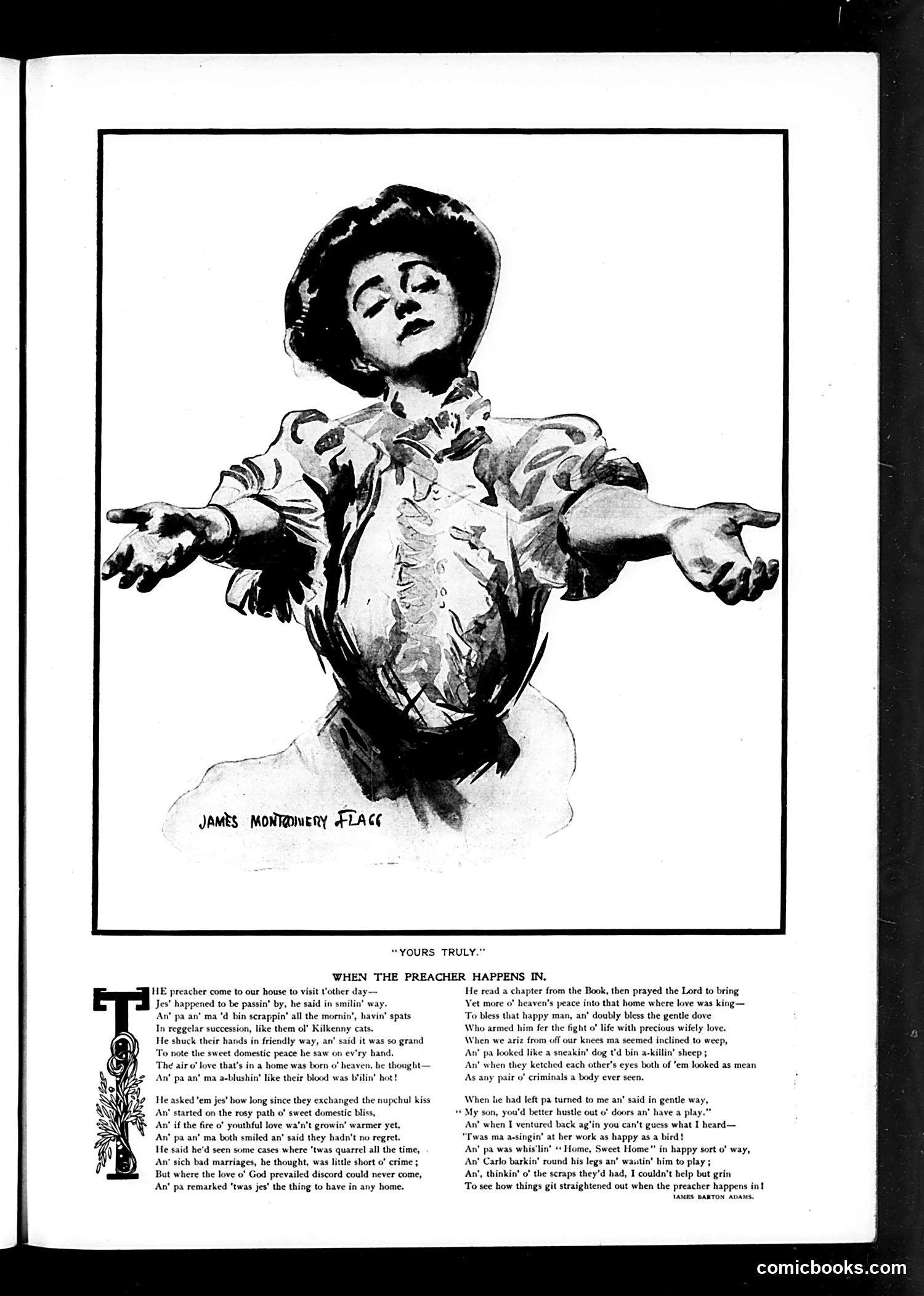
The page features an illustration by James Montgomery Flagg titled "Yours Truly" accompanying a poem called "When the Preacher Happens In." The verse humorously describes a family's chaotic reaction to an unexpected pastoral visit—they hastily conceal evidence of secular activities (card games, swearing, casual behavior) to present a pious facade to their clergyman visitor. The satire targets Victorian-era hypocrisy: the gap between public religious propriety and private domestic conduct. The illustration's theatrical pose with outstretched arms suggests performative respectability. The joke relies on the era's expectations that families maintain strict moral appearances before clergy, exposing how artificial such presentations could be.
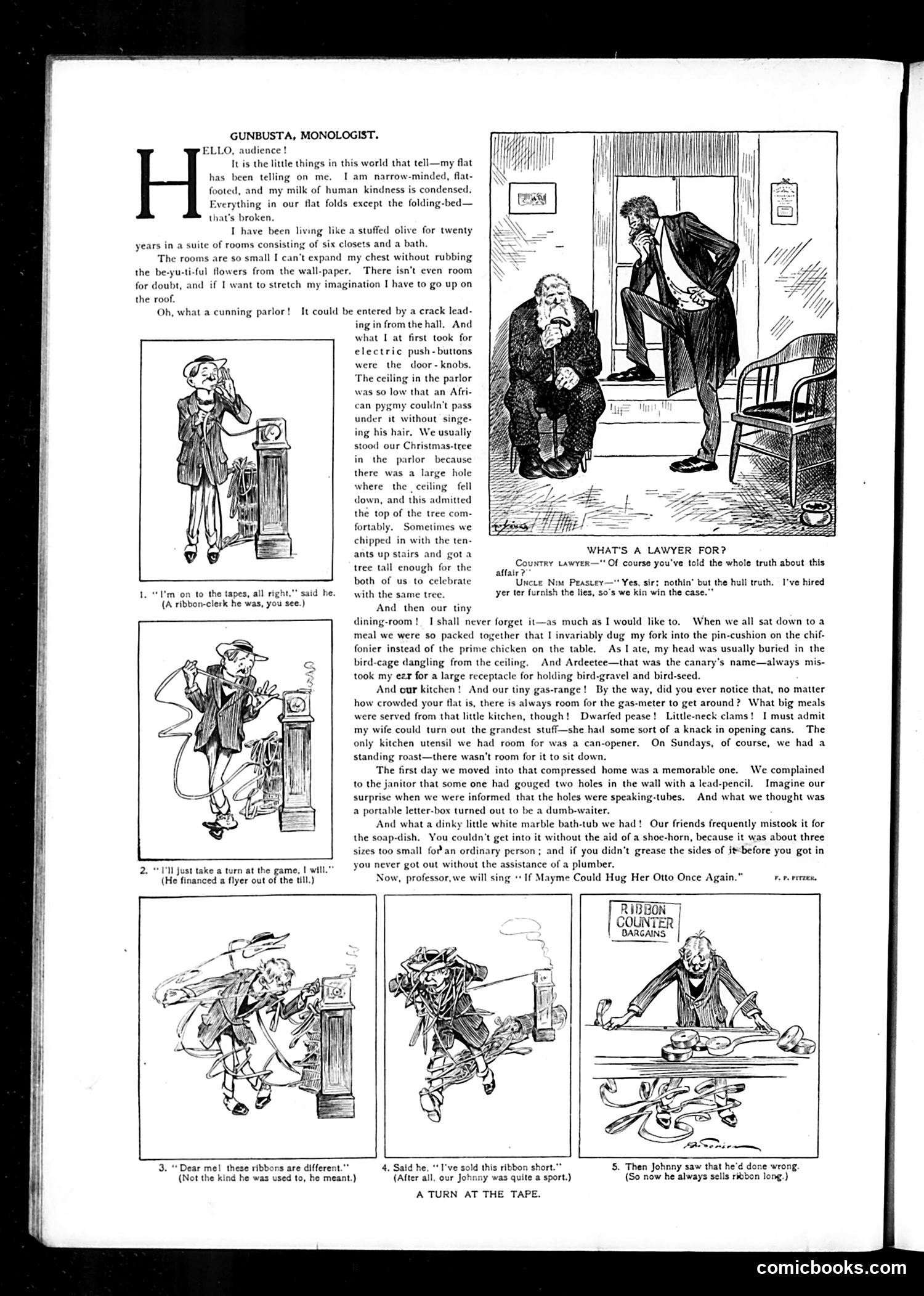
This page features a humorous monologue by a character named "Gunbusta" complaining about living in an extremely cramped urban apartment—a relatable joke for turn-of-the-century readers facing housing shortages in crowded cities. The accompanying cartoons mock a country lawyer and a ribbon-counter clerk. In the lawyer cartoon, a rural witness boasts he'll provide "lies" to win the case, satirizing the perception that lawyers help clients distort truth rather than seek justice. The ribbon-counter sequence shows a dishonest shop clerk selling "short" ribbon and miscounting change—a commentary on petty retail fraud and working-class dishonesty. The humor targets both cramped housing conditions and the moral failings of lower-class workers (lawyers, clerks), reflecting common turn-of-the-century anxieties about urbanization and professional ethics.
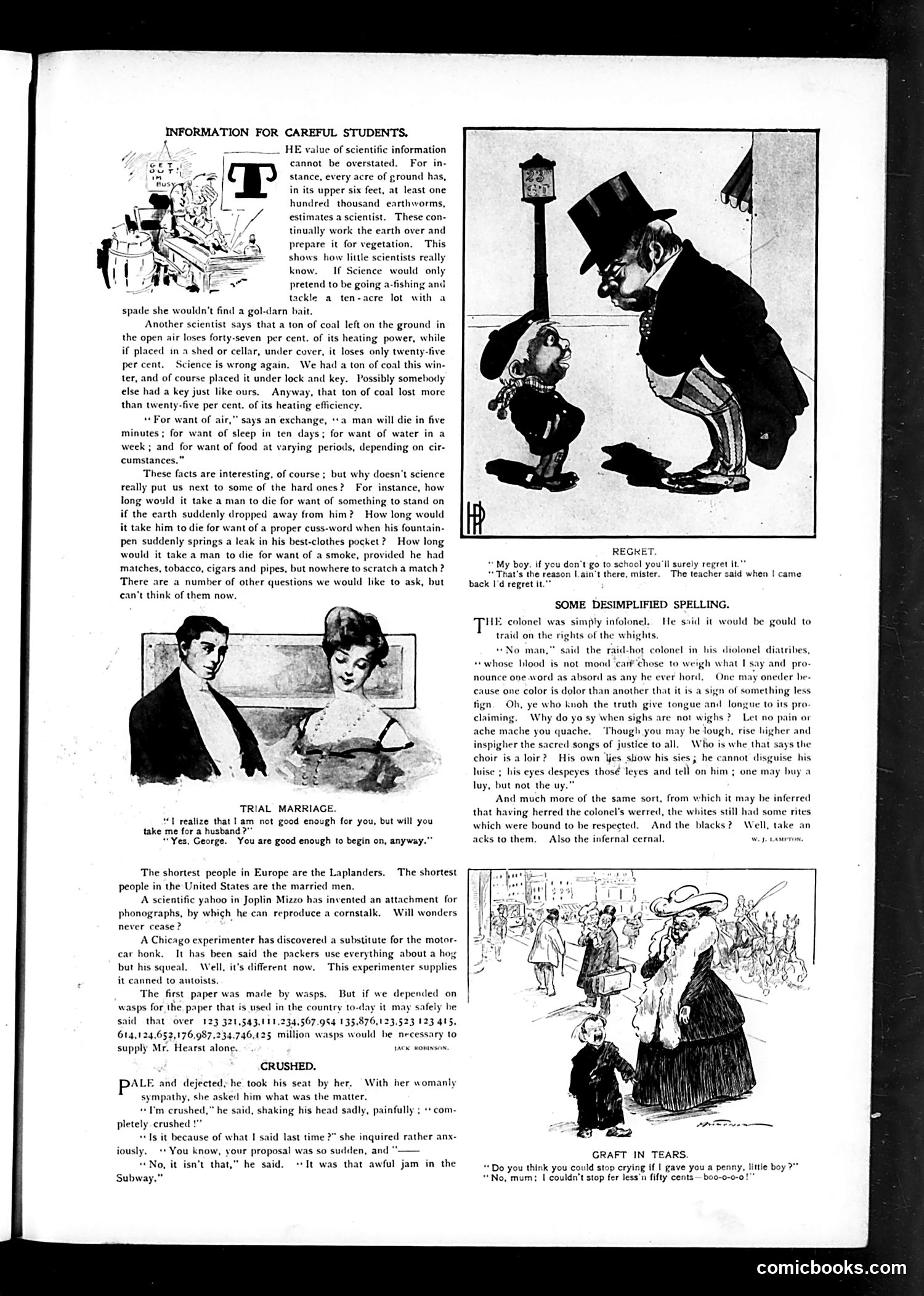
This page contains several short satirical pieces mocking pretensions to knowledge and logic: **"Information for Careful Students"** ridicules scientific experts who cite precise but useless facts (earthworms per acre) while missing practical truths. The joke: scientists can't answer real-world questions—like how long someone survives without footing if earth vanishes, or how to scratch a match without materials. **"Trial Marriage"** jokes about women's low expectations: a man proposes admitting he's "not good enough," and she accepts because he's "good enough to begin on"—satirizing both male inadequacy and female desperation in courtship. **"Regret"** features a schoolboy explaining he avoids school because the teacher warned he'd regret returning—a child's logical absurdity played for humor. **"Some Desimplified Spelling"** mocks simplified spelling reforms by intentionally mangling words ("infolonel," "gould," "traid"), suggesting reformers create more confusion than clarity. These reflect Judge's satirical style: poking fun at expert pretension, gender relations, and contemporary fads (simplified spelling was a real Progressive-era movement).
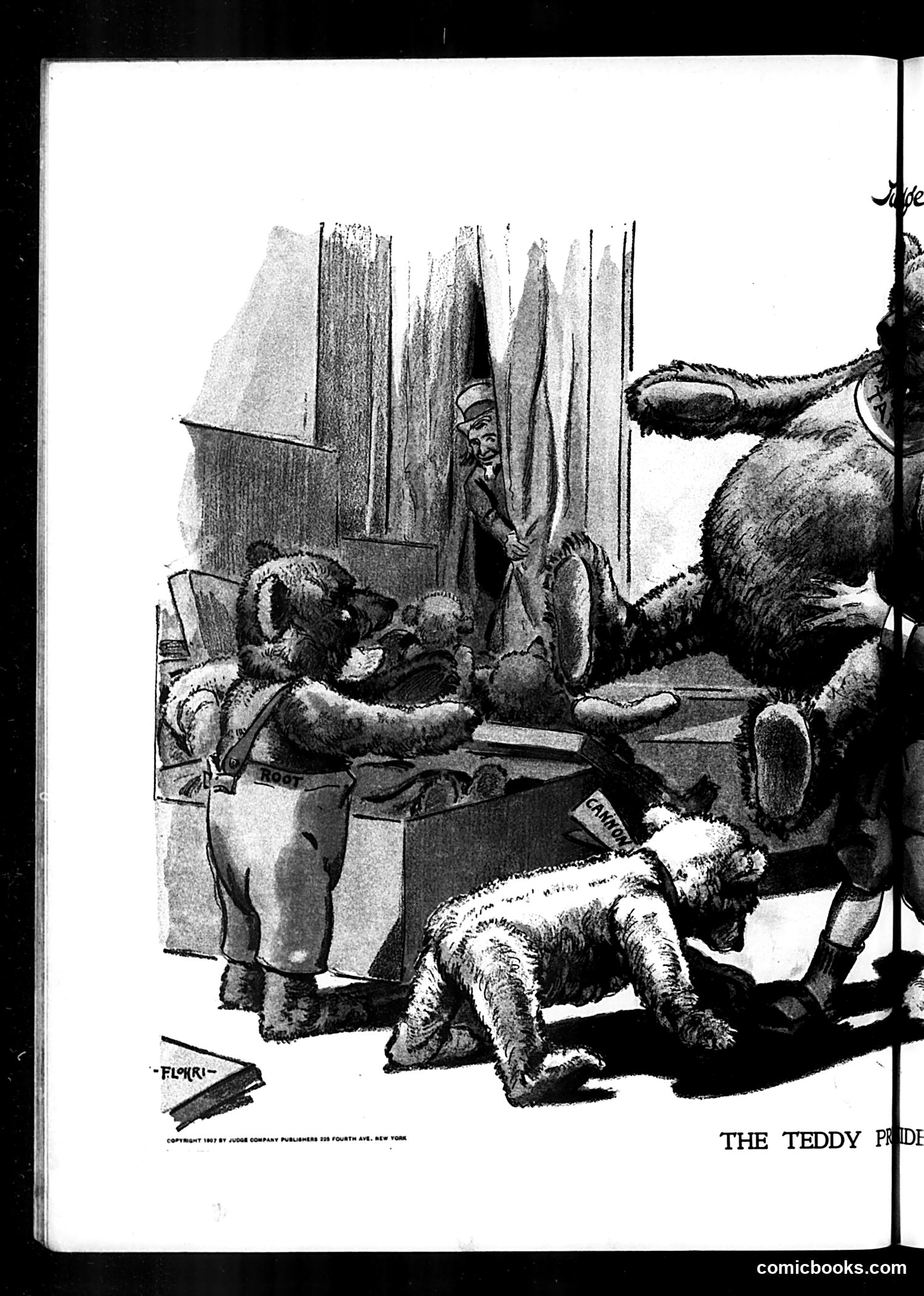
This 1907 Judge cartoon satirizes President Theodore Roosevelt's famous bear-hunting trip. The title "The Teddy Pride" references the teddy bear—a toy named after Roosevelt following his 1902 refusal to shoot a captured bear, which he deemed unsporting. The cartoon depicts Roosevelt (identifiable by his characteristic features and military attire) surrounded by anthropomorphic bears in what appears to be a tent or camp setting. The satire likely mocks Roosevelt's celebrated hunting prowess and masculine frontier image, or comments on how the teddy bear phenomenon had commercialized and domesticated his wilderness adventures. The bears' presence suggests commentary on the gap between Roosevelt's rugged hunter persona and the cute, cuddly cultural icon the teddy bear had become—undermining his tough-guy reputation through commercialization and popular sentimentality.
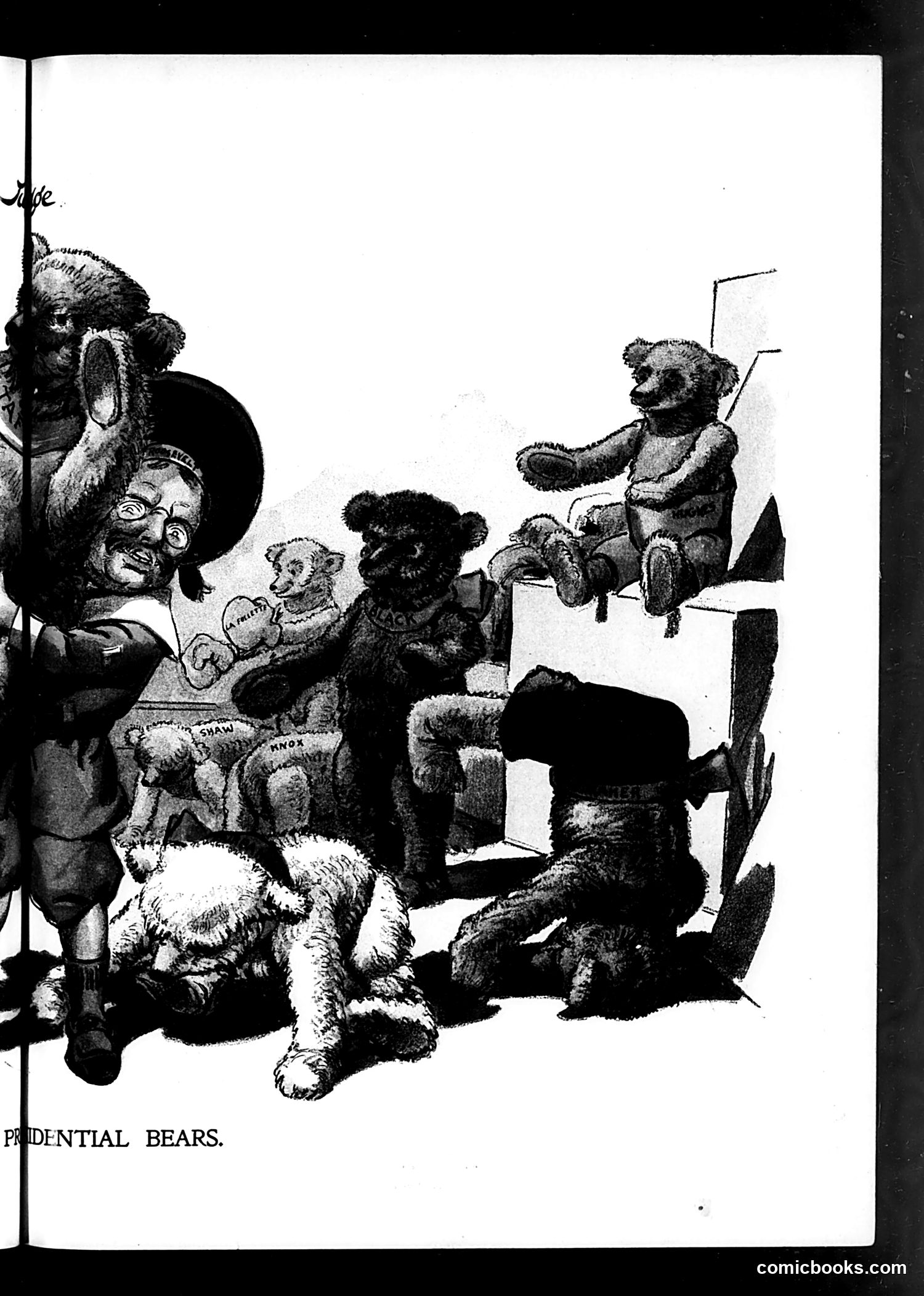
This political cartoon depicts anthropomorphized bears in formal dress engaged in what appears to be political activity or negotiation. The title "Presidential Bears" suggests satirical commentary on U.S. presidential politics, likely from the late 19th or early 20th century when *Judge* magazine was active. The bears wear human clothing and appear to be handling documents or signs, possibly referencing political dealings, campaigns, or policy debates of the era. One figure wears a distinctive hat. The satire likely mocks presidential candidates or sitting presidents by caricaturing them as animals engaged in foolish or undignified political behavior—a common *Judge* tactic. Without clearer identification markers or accompanying text, the specific politicians targeted remain unclear, though the humor relies on readers recognizing contemporary figures.
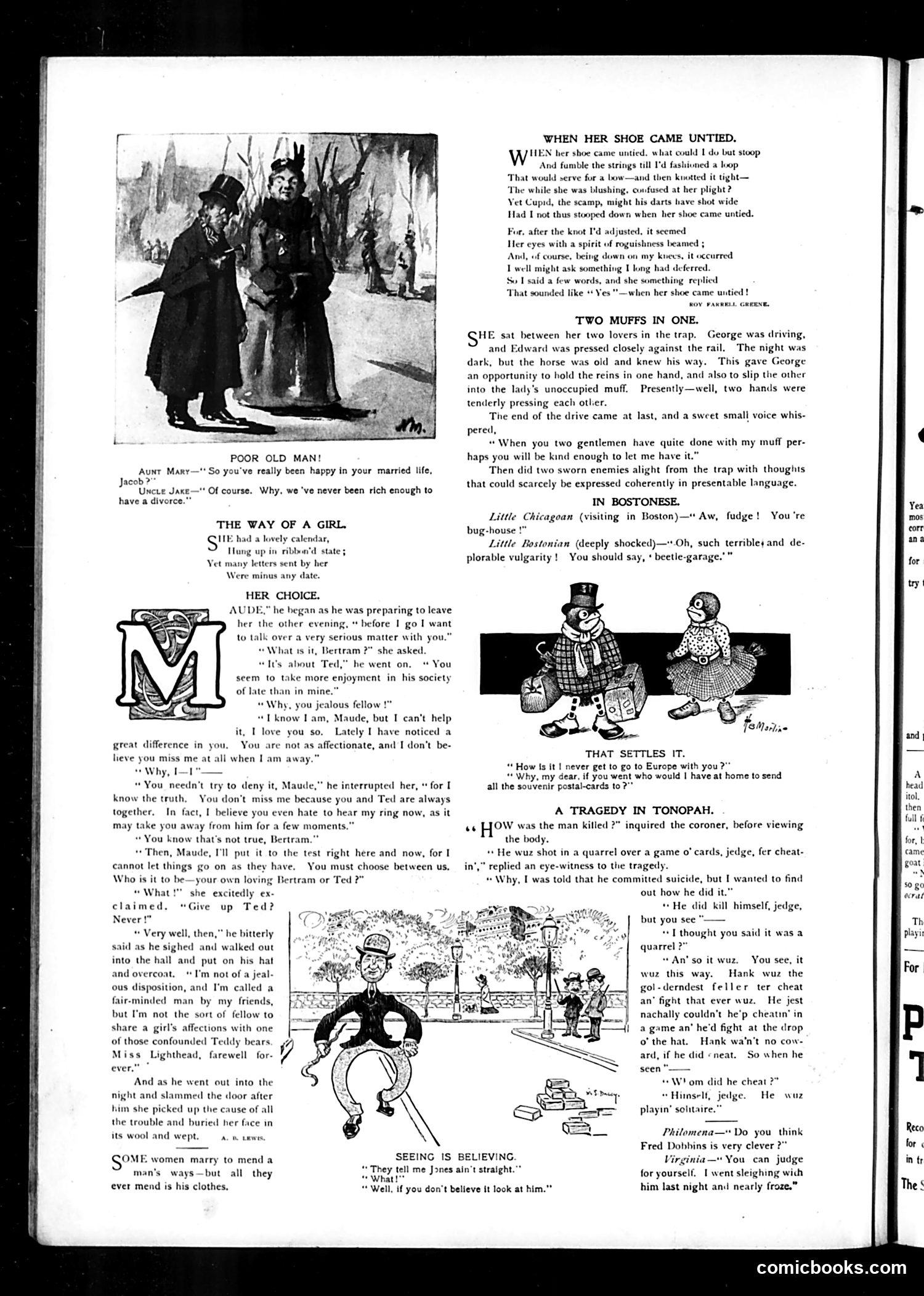
This page from Judge magazine contains several humorous sketches mocking romantic and marital situations circa early 1900s. **"Her Choice"** satirizes a jealous boyfriend discovering his girlfriend has been spending excessive time with "Teddy"—her teddy bear. The humor relies on the absurdity of a man jealously competing with a stuffed animal, ultimately storming out indignantly. **"Two Muffs in One"** depicts a woman riding between two suitors in a carriage, both secretly holding hands inside her muff. When discovered, she sardonically asks them to release it so she can use it herself—exposing their simultaneous courtship as ridiculous. **"Poor Old Man"** jokes that a couple stayed married only because divorce was financially unaffordable to the poor. **"When Her Shoe Came Untied"** romanticizes a moment where bending to tie a woman's shoe provides opportunity for a marriage proposal. The sketches mock Victorian courtship rituals, male jealousy, and financial constraints on marriage—reflecting period attitudes about romance, gender relations, and class distinctions.
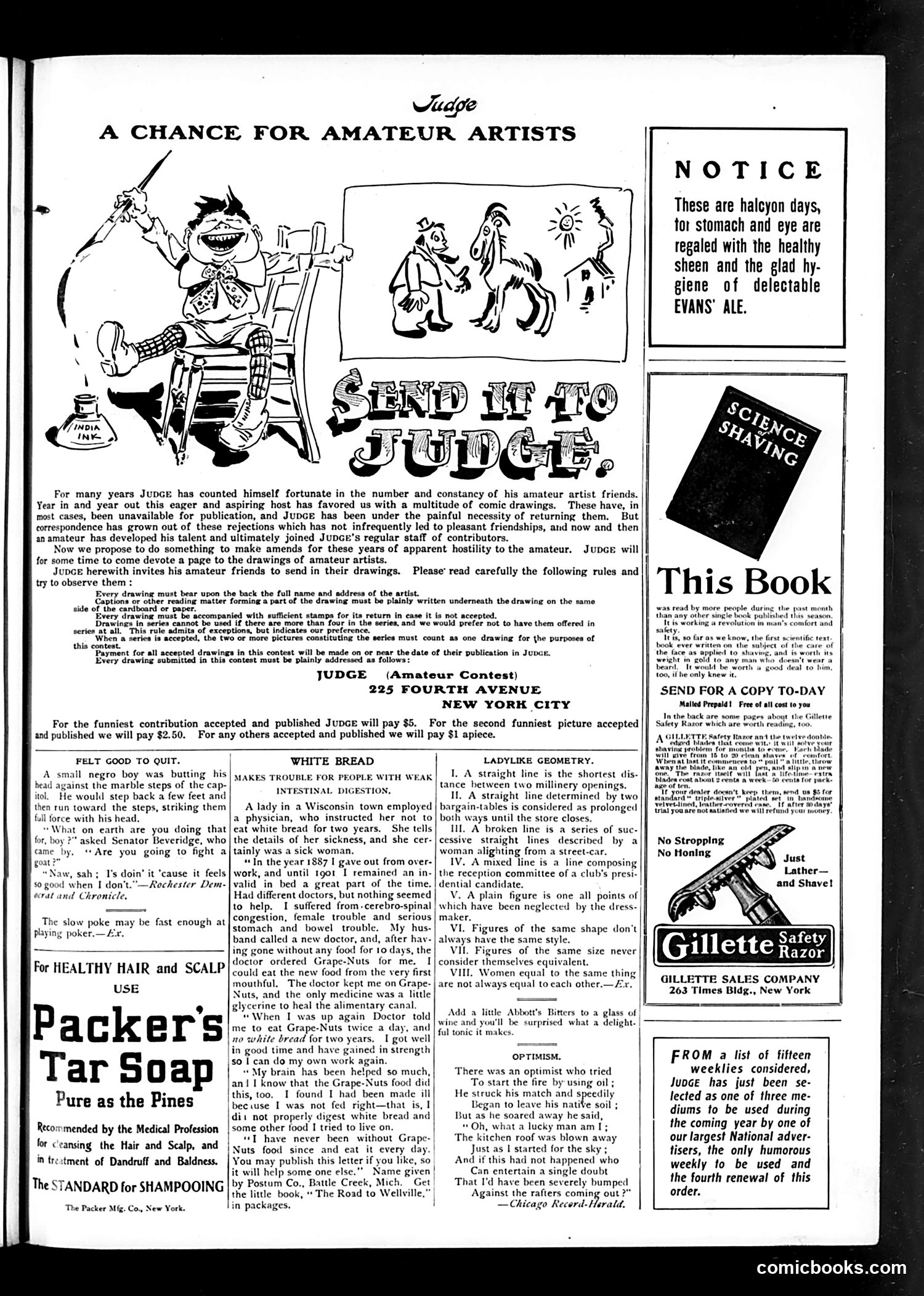
This page is primarily an **advertising and announcements issue**, not a political cartoon page. The main content announces Judge magazine's contest for amateur artists, inviting submissions with detailed submission rules. The text explains Judge has long received amateur drawings but couldn't publish most; now they're dedicating a page to amateur work, paying $5 for the funniest submission, $2.50 for second place, and $1 for others. The page includes **three humorous anecdotes** in the lower section: one about a Black boy hitting his head on capitol steps (a crude "feels good" joke), and testimonials for commercial products (Parker's Tar Soap, white bread digestion). The right side contains **period advertisements** for Evans' Ale, a "Science of Shaving" book, and Gillette Safety Razors. There is **no significant political satire** on this page—it's essentially a submission call and advertising filler typical of early 1900s magazine layouts.
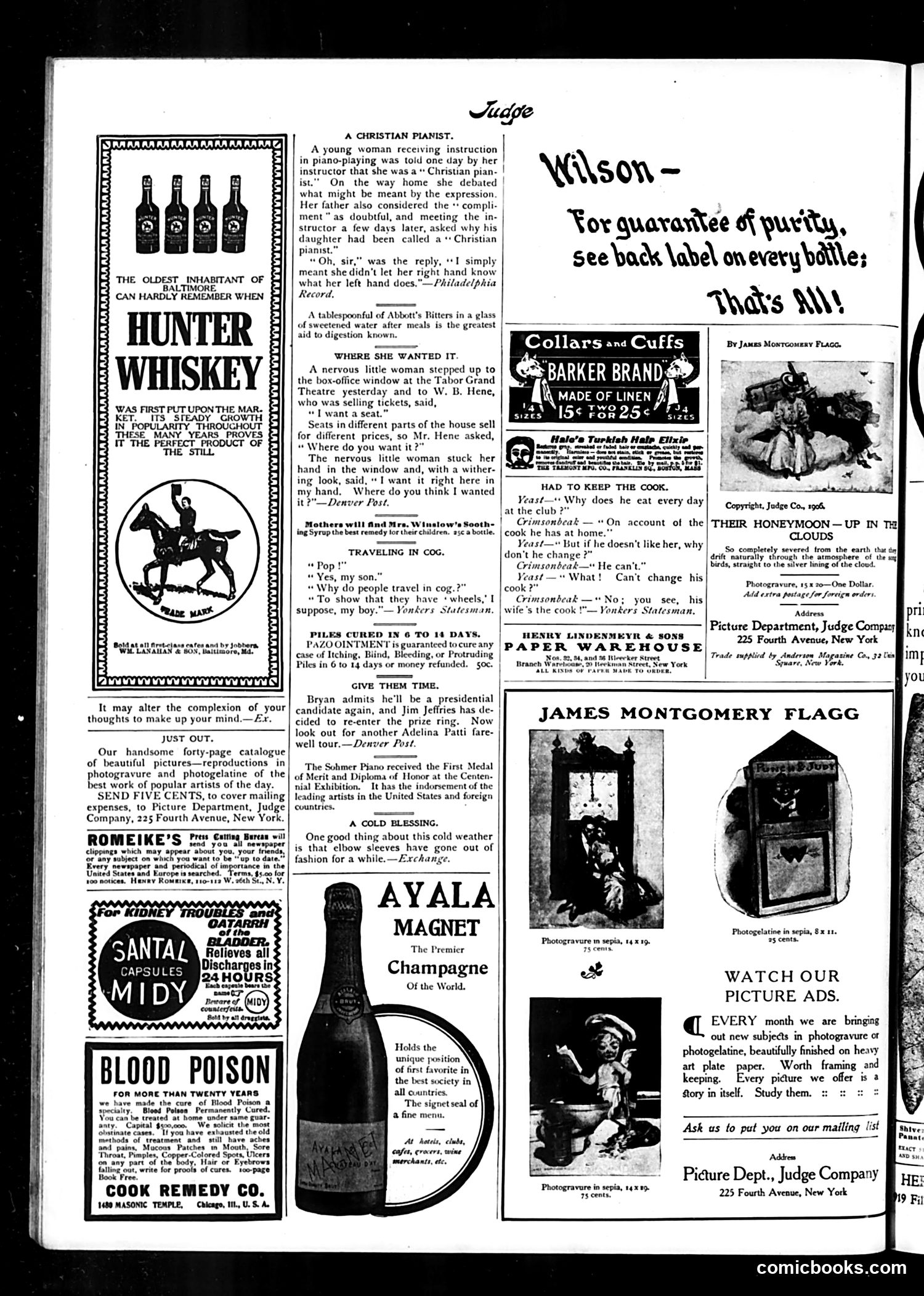
This page is primarily **advertising and humor fillers** typical of Judge magazine's format. Key content includes: **Main Humor Pieces:** - "A Christian Pianist" — a joke about Matthew 6:3 ("let not thy left hand know what thy right hand doeth"), punning on musical instruction - "Where She Wanted It" — a woman at a theater box office misunderstands the question about seat location - "Traveling in Cog" — wordplay on "cog" (perhaps "cognac"?) and having "wheels" (sophistication) **Advertisements:** The page features numerous patent medicines and commercial products typical of early 20th-century magazines: Hunter Whiskey, Santal-Midy (for digestive issues), Blood Poison cures, Ayala Magnet Champagne, and various other remedies. The humor is gentle, family-friendly wordplay. The advertisements reflect the era's unregulated marketing of dubious health tonics. No specific political satire is evident on this particular page.
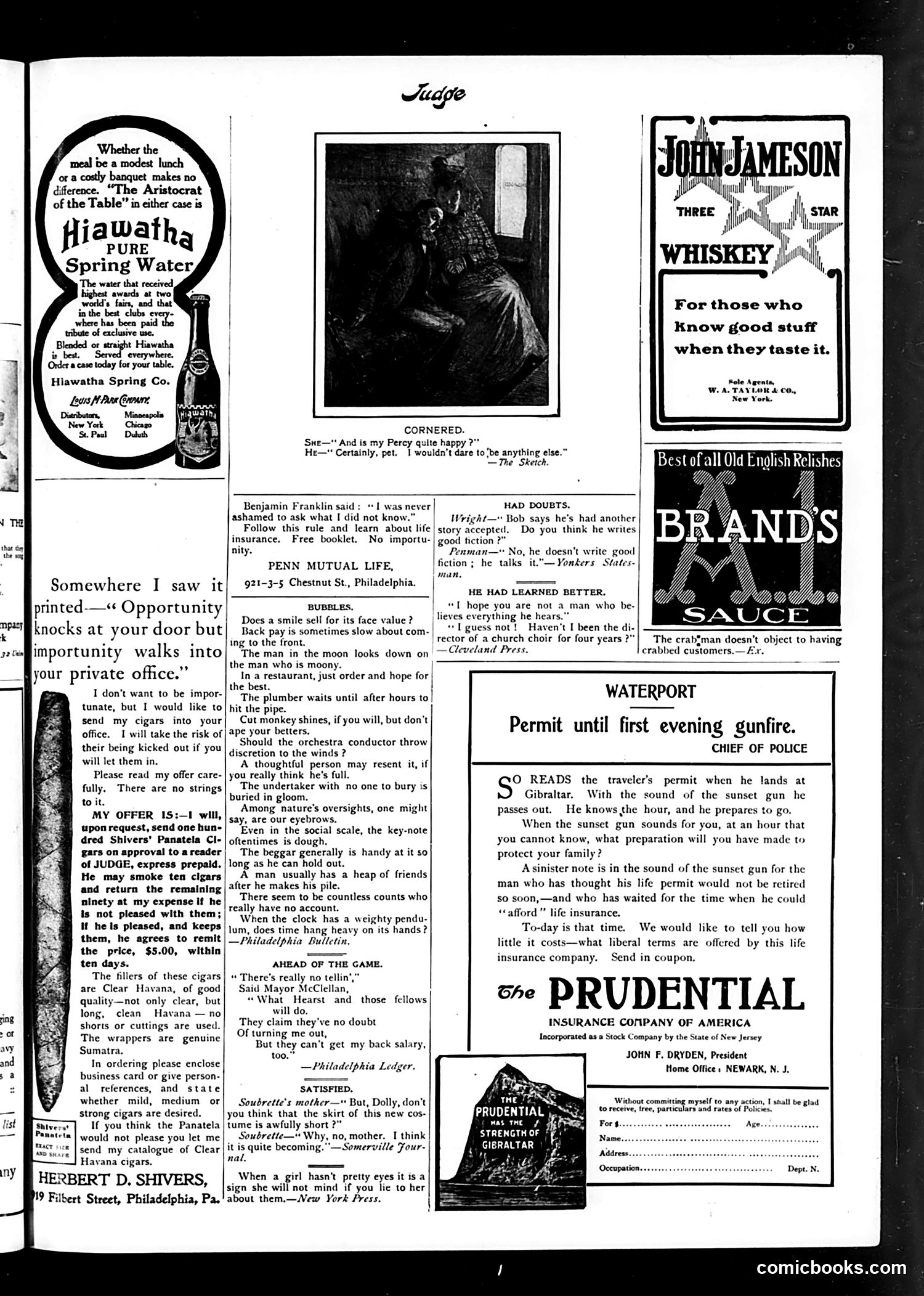
This page is primarily **advertising with brief satirical commentary**, typical of Judge magazine's format. The main cartoon titled "CORNERED" shows a domestic scene where a wife asks her husband if their son Percy is happy; he replies he "wouldn't dare be anything else"—a mild joke about marital obedience and social conformity. The "BUBBLES" section contains short, punchy one-liners on various topics (smiles, plumbers, orchestras, beggars, clocks)—typical satirical observations about everyday life and human nature. Other brief jokes mock Mayor McClellan (New York's mayor, apparently owing back salary), comment on theatrical costumes, and social behavior. The page is dominated by **period advertisements**: Hiawatha Spring Water, John Jameson Whiskey, Brands cigars, Herbert Shivers cigars, Penn Mutual Life Insurance, and Prudential Insurance. These ads reflect early 1900s consumer culture and were how satirical magazines funded operations. The content reflects Edwardian-era concerns: politics, social propriety, and consumerism.
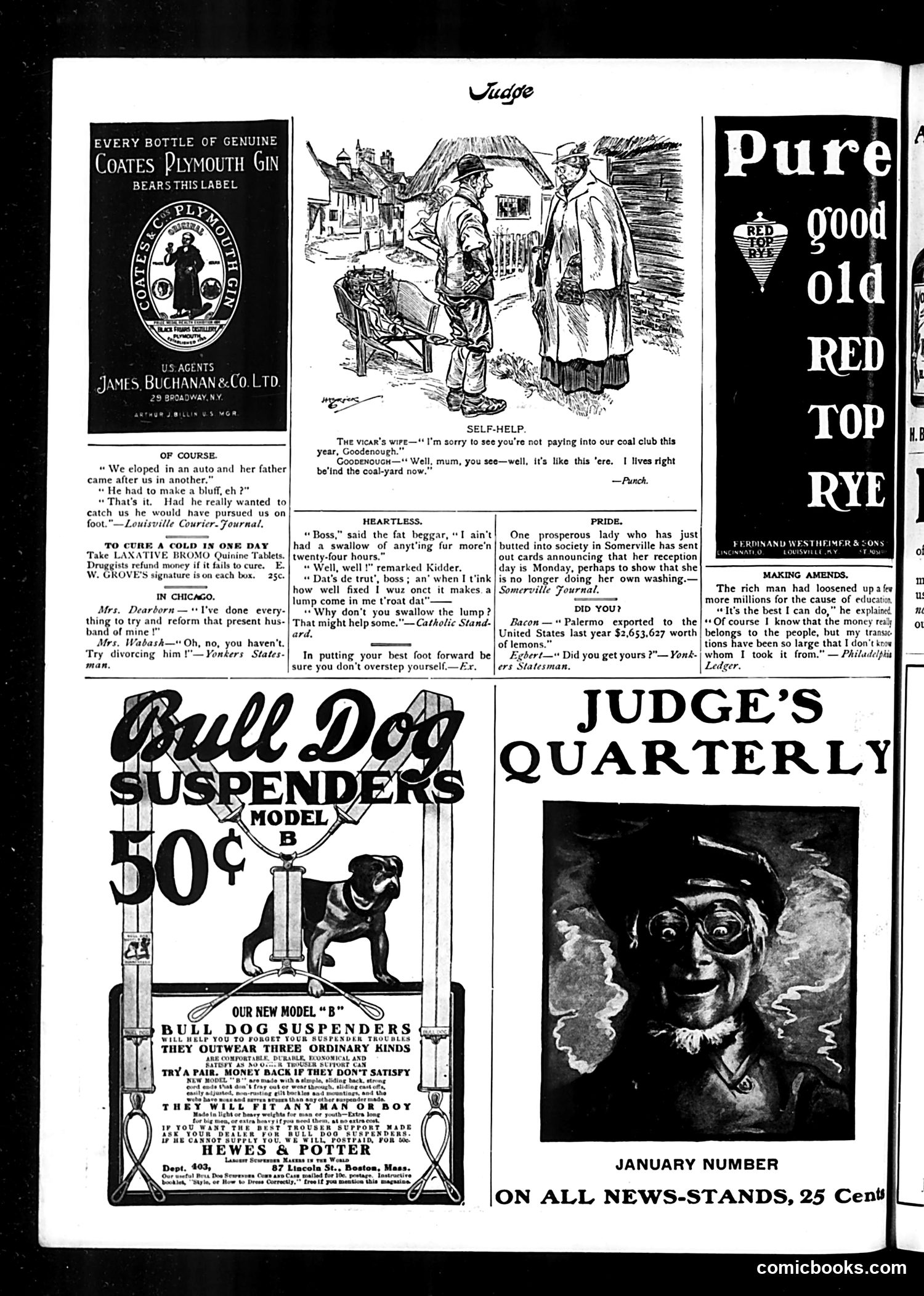
This is primarily an **advertising and humor page** from Judge magazine, a satirical weekly. The page contains multiple short humorous anecdotes and advertisements rather than a single political cartoon. The humor pieces satirize early 20th-century social pretension and economic disparities. "Pride" mocks a newly wealthy woman in Somerville who claims to no longer do her own housework. "Did You?" presents a brief exchange where a wealthy man admits he cannot track where money came from due to large transactions. "Making Amends" features a rich man donating to education while acknowledging the money actually belongs to common people. These pieces collectively lampoon **nouveaux riche** (newly rich) and the wealthy's cavalier relationship with money and labor. The page also includes vintage advertisements for **Coates Plymouth Gin** and **Bull Dog Suspenders** (Model B, 50¢)—typical commercial content in period magazines. The illustrations are period-appropriate line drawings.
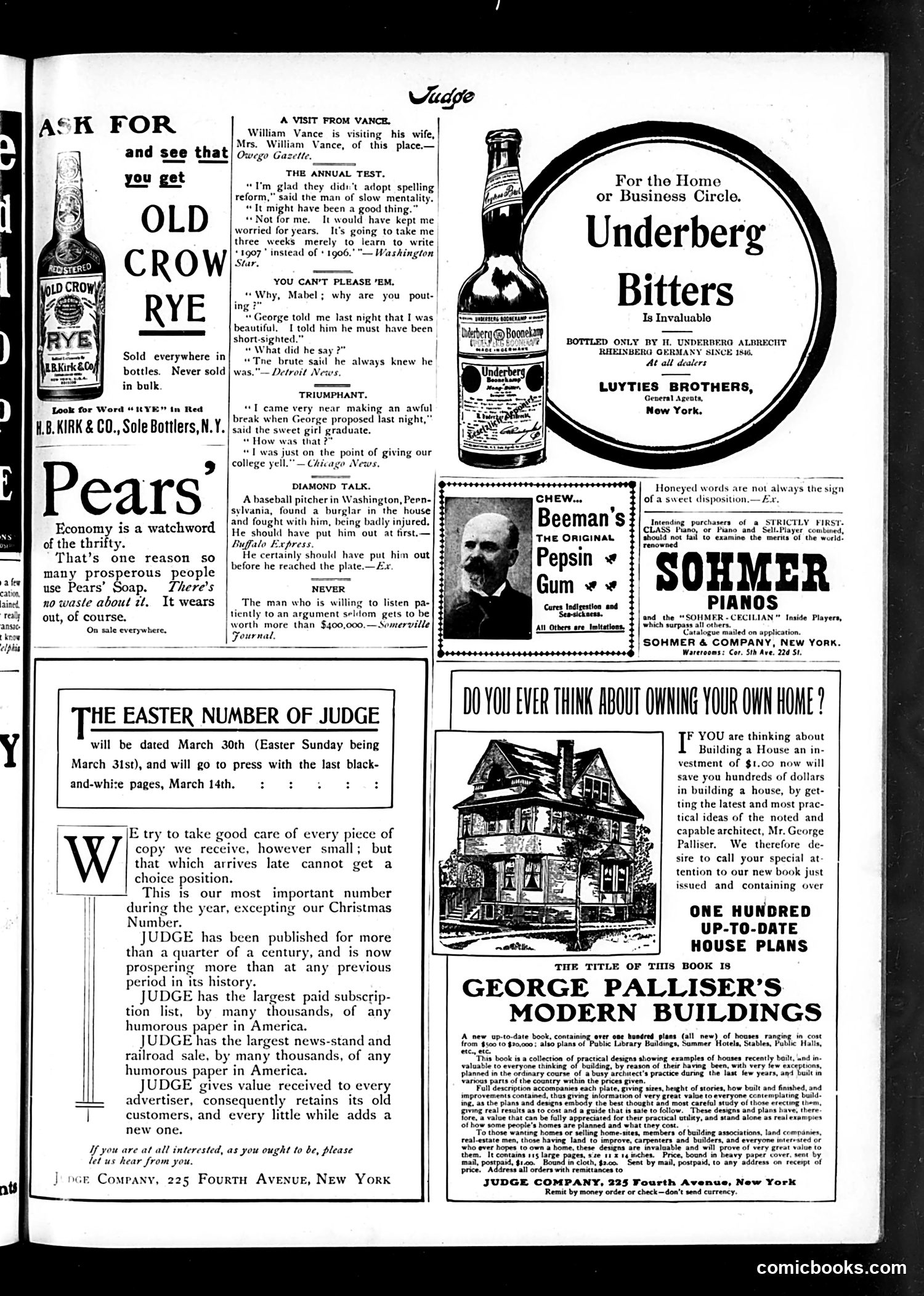
This page is primarily **advertising and editorial content**, not political satire. The main elements are: **Advertisements:** - Old Crow Rye whiskey, Pears' Soap, Underberg Bitters, Beeman's Pepsin Gum, Sohmer Pianos, and George Palliser's house-plan book **Editorial Section ("Madge"):** Contains brief humorous anecdotes and one-liners, typical of Judge's regular "joke page" format. Examples include wordplay about spelling reform, a baseball pitcher pun, and romantic misunderstandings. These are light social humor without targeting specific political figures or events. **Institutional Notice:** Information about Judge magazine's Easter issue and publishing details—essentially house copy advertising the magazine itself to potential advertisers. The page reflects Judge's dual nature as both satirical publication and commercial vehicle, mixing genuine humor writing with revenue-generating advertisements typical of early 20th-century magazines.
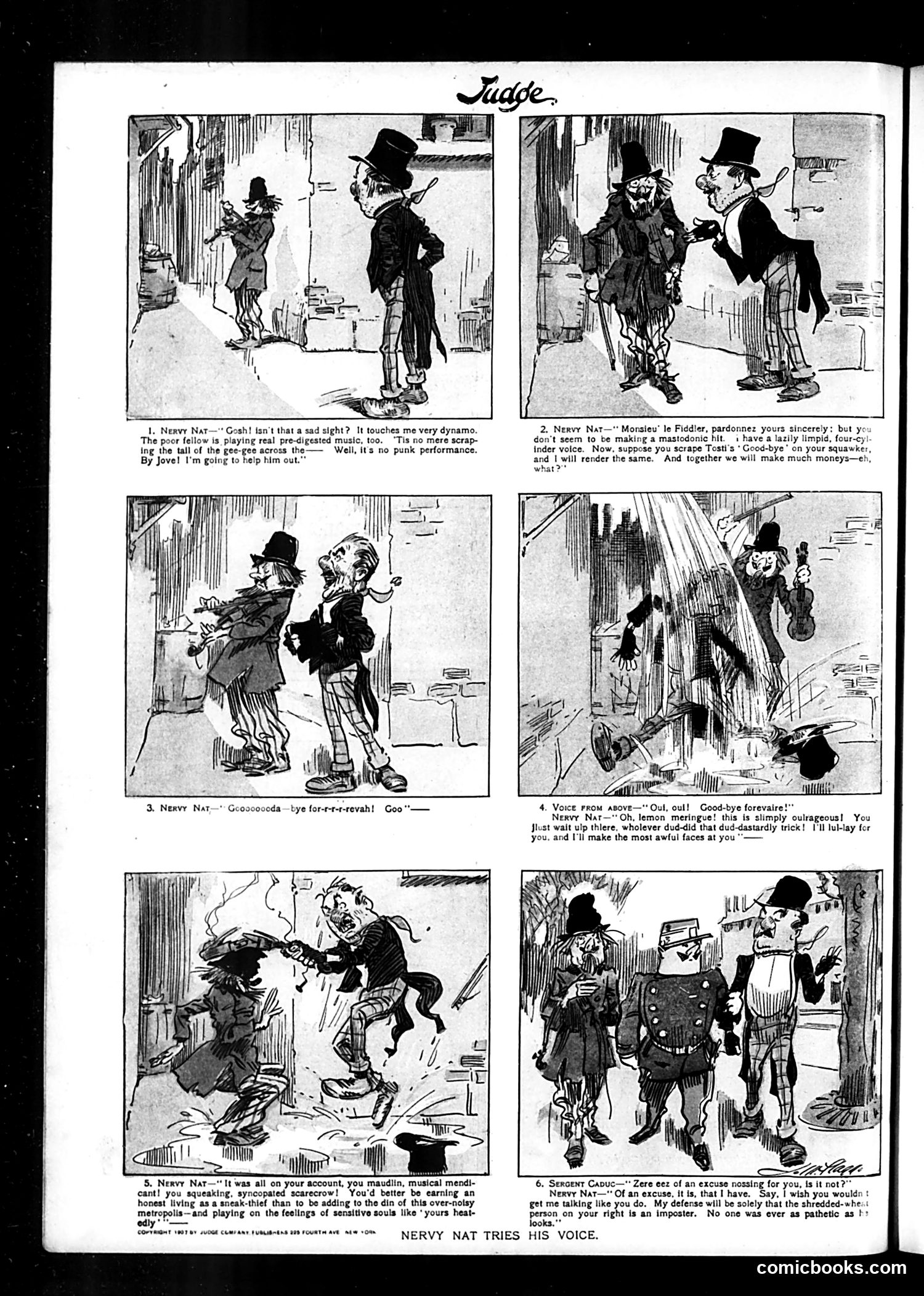
This comic strip follows "Nervy Nat," a brash character who encounters a street musician playing violin. Nat initially mocks the musician's sad performance, then offers to "help" by having the musician scrape out the song "Tosti's Good-bye" while Nat sings along to "make much moneys." The musician agrees but then dumps a bucket of water on Nat from above, causing him to threaten revenge with "awful faces." In the final panels, when confronted by a sergeant about the disturbance, Nat blames the musician (claiming he's an impostor), while the musician defends himself similarly. The satire mocks Nat's arrogant interference and his hypocritical attempt to avoid responsibility—he wanted to exploit the musician's talent for profit, got punished for it, then immediately deflected blame. The humor relies on slapstick and Nat's exaggerated outrage at being out-maneuvered.