
Judge, 1907-01-26 · page 4 of 16
Judge — January 26, 1907 — page 4: what you’re looking at
What you’re looking at
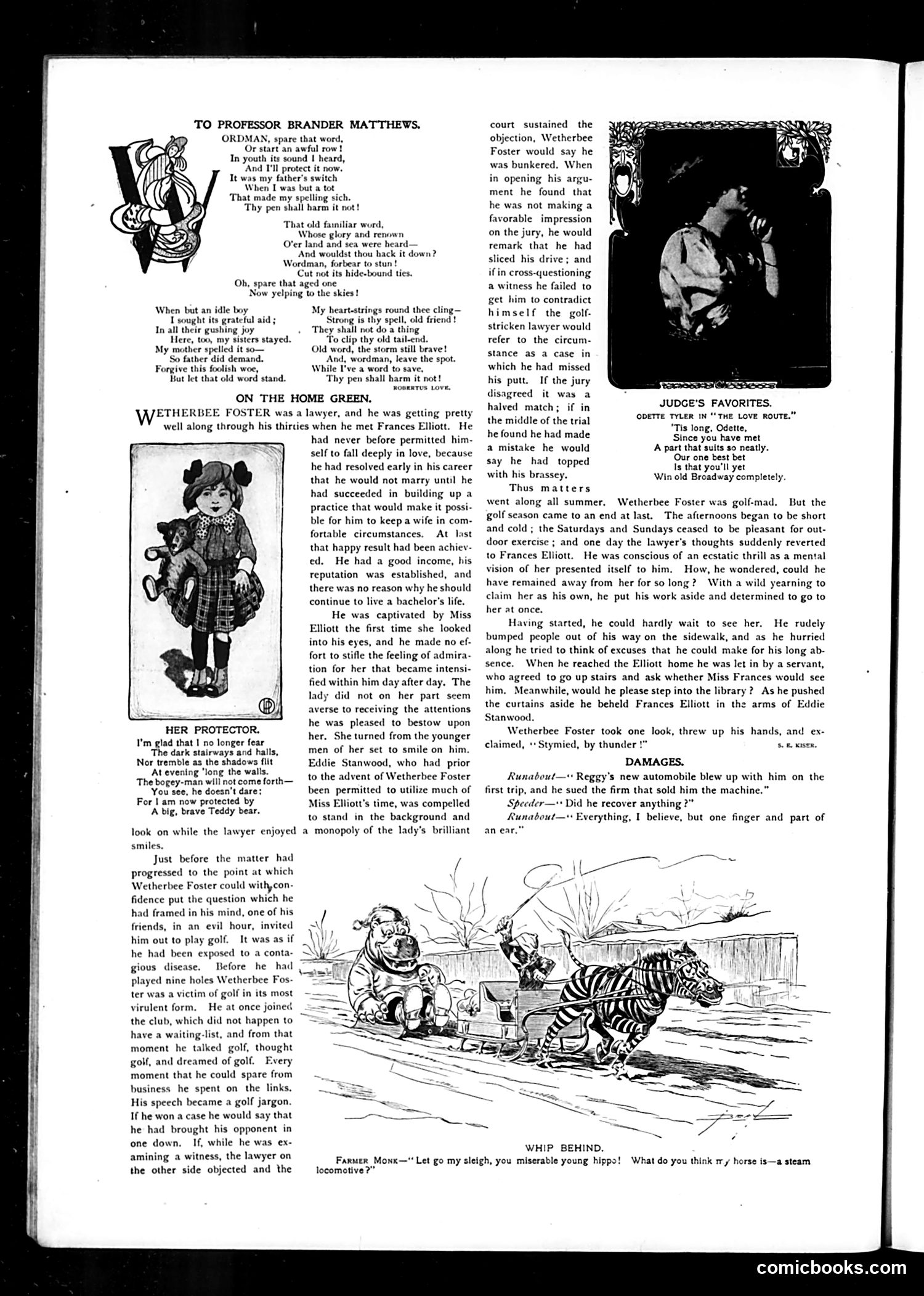
This page contains several satirical stories and illustrations from an early-20th-century American humor magazine. The content includes: **"On the Home Green"** depicts Wetherbee Foster pursuing Frances Elliott, with narrative focus on romantic entanglement and social courtship conventions. The accompanying illustration shows a young girl ("Her Protector") in period dress. **"Judge's Favorites"** quotes a poem titled "True Love Route." **"Damages"** presents a dialogue between characters named Runabout, Spender, and others discussing an automobile accident, likely satirizing emerging automotive mishaps and legal disputes from the early motor-car era. **"Whip Behind"** shows a cartoon of figures with what appears to be a horse or locomotive, with humor about transportation confusion—possibly mocking rural unfamiliarity with modern technology. The overall tone reflects typical Judge magazine satire targeting contemporary social situations, romantic conventions, and technological change.
📄 Transcribed text from this page (OCR, searchable)
Machine-transcribed from the original scan — historical spelling and the odd misread are preserved.
PROFESSOR BRANDER MATTHEWS. ORDMAN, spare that word, Or start an awful row! In youth its sound | heard, And I'll protect it now. It was my father’s switch When I was but a tot ‘That made my spelling sich. ‘Thy pen shall harm it not! That old familiar word, Whose glory and renown O'er land and sea were heard And wouldst thou hack it down? Wordman, forbear to stun! Cut not its hide-bound ties. Oh, spare that aged one ‘Now yelping to the skies! My heart-strings round thee cling— rong is thy spell, old friend! shall not doa ‘To clip thy old tail-end. Old word, the storm still brave! And, wordman, leave the spot. While I've a word to save, Thy pen shall harm it not! xoumRTUS LOVE. When but an idle boy I sought its grateful aid ; In all their gushing joy . Here, too, my sisters stayed. My mother spelled it so— So father did demand. Forgive this foolish woe, But let that old word stand. ON THE HOME GREEN. ETHERBEE FOSTER was a lawyer, and he was getting pretty well along through his thirties when he met Frances Elliott. He had never before permitted him- self to fall deeply in love, because he had resolved early in his career that he would not marry until he had succeeded in building up a practice that would make it possi- ble for him to keep a wife in com- fortable circumstances. At last that happy result had been achiev- ed. He had a good income, reputation was established, and there was no reason why he should continue to live a bachelor's life. He was captivated by Miss Elliott the first time she looked into his eyes, and he made no ef- fort to stifle the feeling of admira- tion for her that became intensi- fied within him day after day, The lady did not on her part seem averse to receiving the attentions he was pleased to bestow upon her. She turned from the younger men of her set to smile on him. Eddie Stanwood, who had prior to the advent of Wetherbee Foster been permitted to utilize much of Miss Elliott's time, was compelled to stand in the background and look on while the lawyer enjoyed a monopoly of the lady’s brilliant smiles, Just before the matter had progressed to the point at which Wetherbee Foster could withycon- fidence put the question which he had framed in his mind, one of his friends, in an evil hour, invited HER PROTECTOR. I'm glad that | no longer fear ‘The dark stairways and halls, Nor tremble as the shadows flit At evening ‘long the walls. The bogey-man will not come forth— You see, he doesn't dare: For | am now protected by A big, brave Teddy bear. court sustained the objection, Wetherbee Foster would say he was bunkered. When in opening his argu- ment he found that he was not making a favorable impression on the jury, he would remark that he had sliced his drive; and if in cross-questioning a witness he failed to get him to contradict himself the golf- stricken lawyer would refer to the circum- stance as a case in which he had missed his putt. If the jury disagreed it was a halved match; if in the middle of the trial he found he had made a mistake he would say he had topped with his brassey. Thus matters went along all summer, Wetherbee Foster was golf-mad. But the golf season came to an end at last. The afternoons began to be short and cold ; the Saturdays and Sundays ceased to be pleasant for out- door exercise ; and one day the lawyer's thoughts suddenly reverted to Frances Elliott. He was conscious of an ecstatic thrill as a mental vision of her presented itself to him. How, he wondered, could he have remained away from her for so long? With a wild yearning to claim her as his own, he put his work aside and determined to go to JUDGE'S FAVORITES. ODETTE TYLER IN ‘'THE LOVE ROUTE.” ‘Tis long, Odette, Since you have met A part that suits so neatly. Our one best bet Is that you'll yet Win old Broadway completely. her at once. Having started, he could hardly wait to see her. He rudely bumped people out of his way on the sidewalk, and as he hurried along he tried to think of excuses that he could make for his long ab- sence. When he reached the Elliott home he was let in by a servant, who agreed to go up stairs and ask whether Miss Frances would see him. Meanwhile, would he please step into the library? As he pushed the curtains aside he beheld Frances Elliott in the arms of Eddie Stanwood. Wetherbee Foster took one look, threw up his hands, and ex- tymied, by thunder !" DAMAGES. Runabout—« Reggy's new automobile blew up with him on the first trip, and he sued the firm that sold him the machine.” Speeder— Did he recover anything ?" Runabout—« Everything, I believe, but one finger and part of an ear.” med, him out to play golf, It was as if he had been exposed to a conta- gious disease. Before he had ( played nine holes Wetherbee Fos- ter was a victim of golf in its most virulent form. He at once joined the club, which did not happen to have a waiting-list, and from that moment he talked golf, thought golf, and dreamed of golf. Every moment that he could spare from business he spent on the links. His speech became a golf jargon. If he won a case he would say that he had brought his opponent in one down. If, while he was ex- amining a witness, the lawyer on the other side objected and the locomotive?” Farmer Monx—“‘ Let go my sleigh, you miserable young hippo! WHIP BEHIND. What do you think ry horse is—a steam comicbooks.com