
A complete issue · 16 pages · 1906
Judge — October 6, 1906
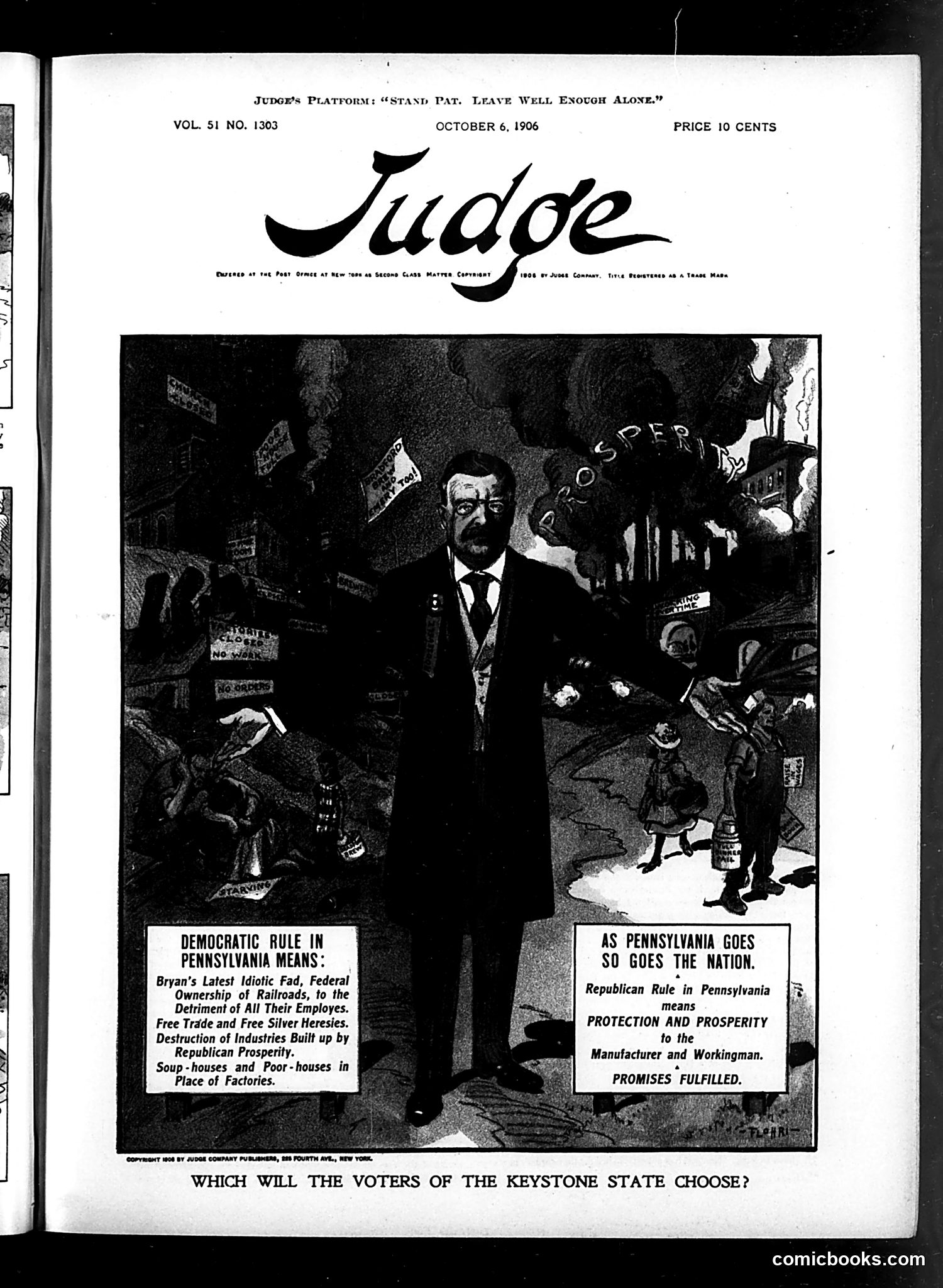
This is a **1906 Pennsylvania gubernatorial campaign cartoon** from *Judge* magazine. The central figure appears to be a politician (likely representing Democratic candidate William Jennings Bryan's influence in Pennsylvania politics) surrounded by apocalyptic imagery—destroyed factories, soup kitchens, and poverty. The left caption attacks "Democratic Rule in Pennsylvania," listing Bryan's "idiotic" policies: railroad nationalization, industry destruction, and poverty. The right caption promotes "Republican Rule," promising "Protection and Prosperity to the Manufacturer and Workingman." The cartoon presents a stark contrast: Democratic governance as leading to economic disaster versus Republican protection of business and workers. The phrase "Keystone State" refers to Pennsylvania's nickname. This reflects the protectionist trade debates central to early 20th-century American politics.
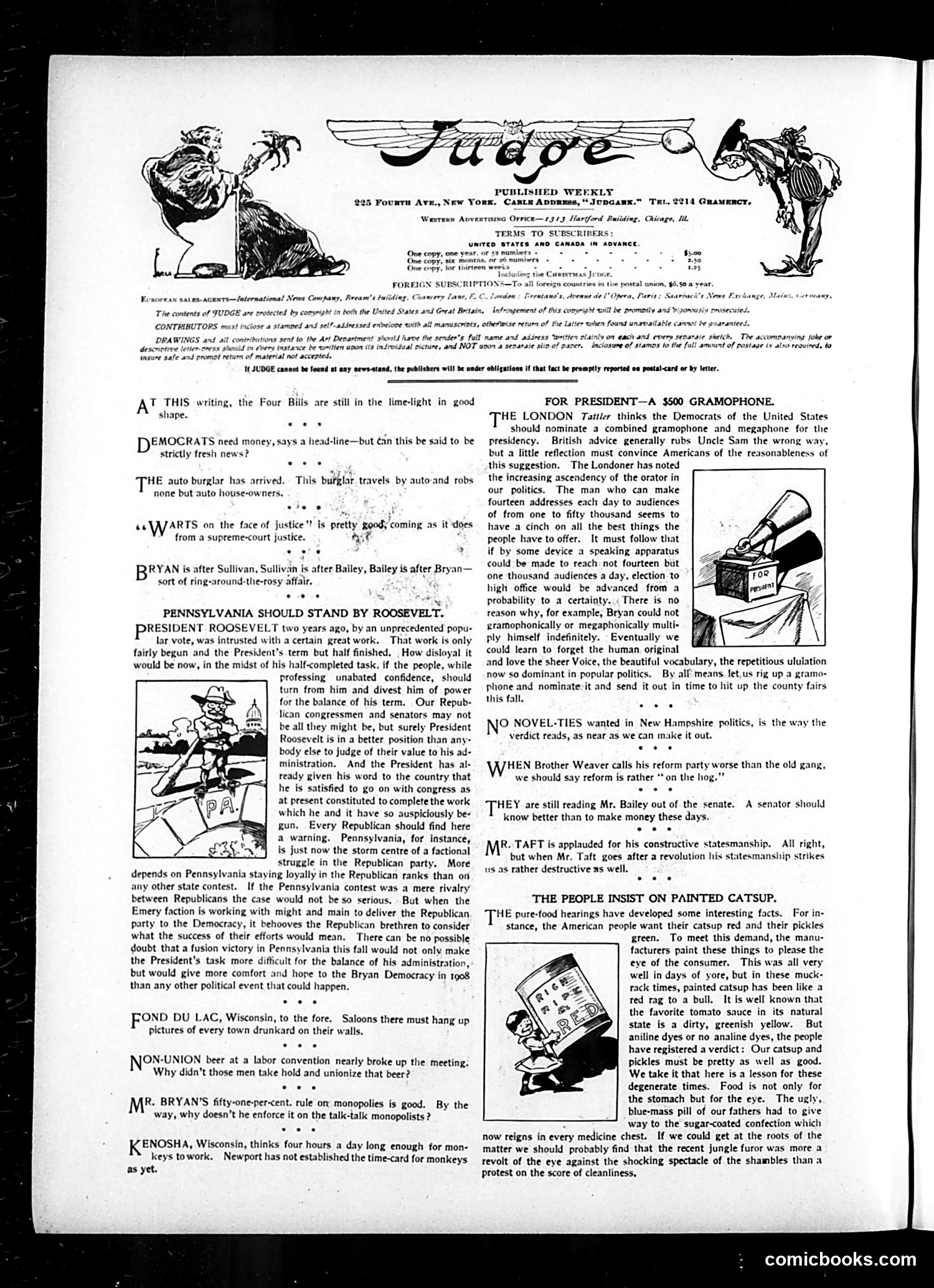
This page contains editorial commentary on early 20th-century American politics. The main cartoon depicts a figure riding a donkey labeled "BRYAN DEMOCRACY," suggesting Democratic Party leadership under William Jennings Bryan. The satire criticizes the party's internal divisions—"BRYAN is after Sullivan, Sullivan is after Bailey, Bailey is after Bryan"—indicating factional infighting over power and policy direction. The text discusses Pennsylvania Republican politics, Roosevelt's presidency, and labor issues. References to "Brother Weaver," "Mr. Taft," and debates over painted catsup suggest contemporary political and consumer protection controversies. The overall tone mocks Democratic disorganization while commenting on broader political and economic issues of the era.
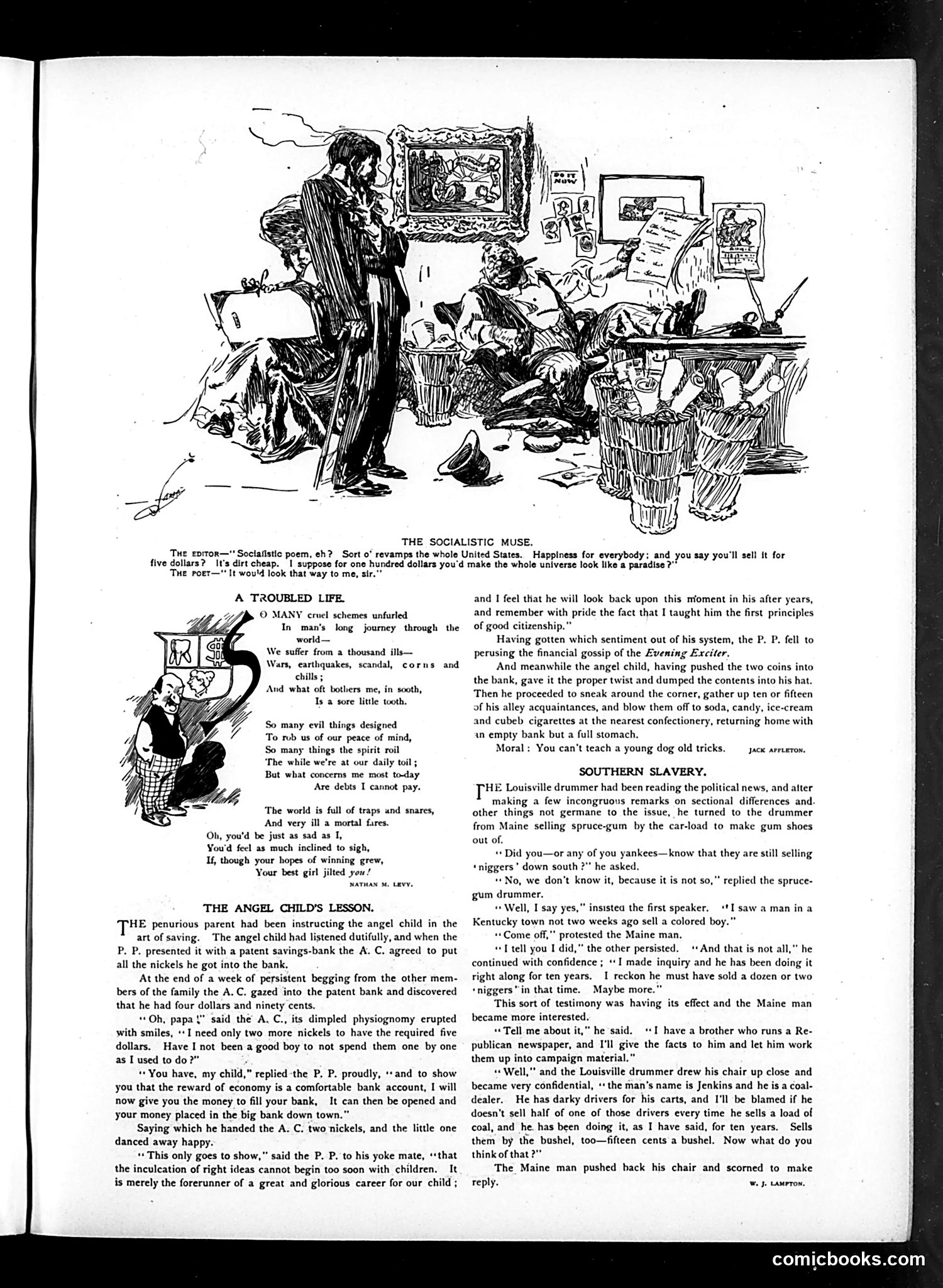
**Top Cartoon: "The Socialist Muse"** This satirizes socialist poetry and ideology. A well-dressed editor confronts a bohemian poet in a cluttered studio, dismissing socialist verse as cheap propaganda meant to sell utopian fantasies ("paradise") at inflated prices. The cartoon mocks both socialists' artistic pretensions and their perceived mercenary motives—suggesting they exploit idealism for profit. **"A Troubled Life"** A poem lamenting debts and financial hardship, illustrating working-class economic struggles of the era. **"The Angel Child's Lesson"** This story satirizes misguided parental benevolence. A parent teaches charity by demonstrating how saving money creates wealth, but the lesson backfires when the child learns self-interest instead of genuine altruism. **"Southern Slavery"** Discusses modern labor exploitation in the South, contrasting contemporary wage slavery with historical chattel slavery.
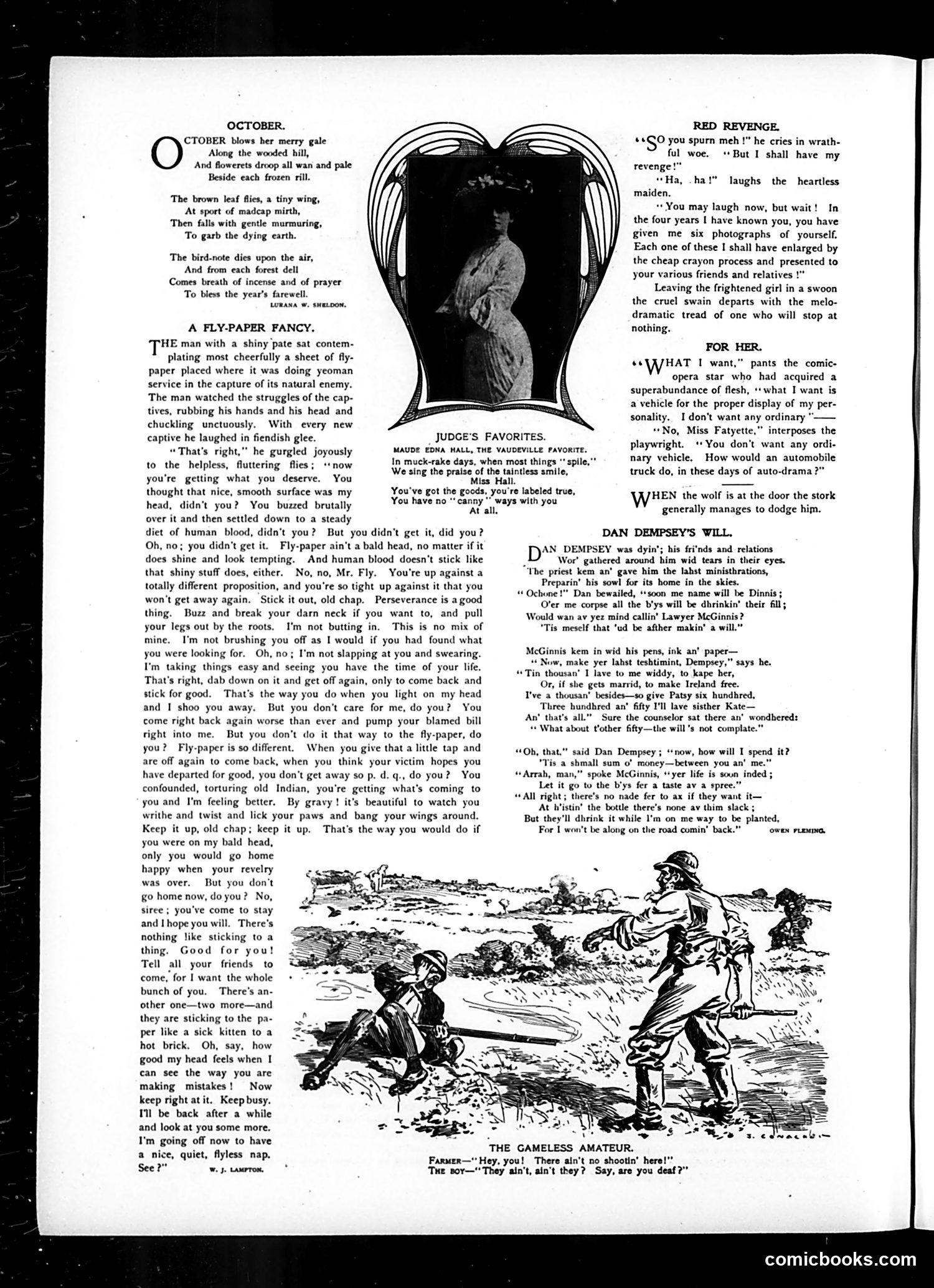
This page contains several short humorous pieces rather than political cartoons. "A Fly-Paper Fancy" depicts a man contemplating a sheet of fly-paper, using it as a metaphor for life's entrapments—how small mistakes lead to being "stuck" with consequences. The lengthy monologue satirizes self-deception and victim-blaming. "Red Revenge" mocks a jilted woman threatening to enlarge photographs of her ex-boyfriend and circulate them to embarrass him. "Judge's Favorites" and other brief items are light social humor about courtship and relationships. The bottom illustration, "The Gameless Amateur," shows a fishing scene where a boy asks his father if fish are "shy," suggesting the father's poor angling skills. Overall, this page offers domestic humor rather than political satire—typical of Judge's lighter content.
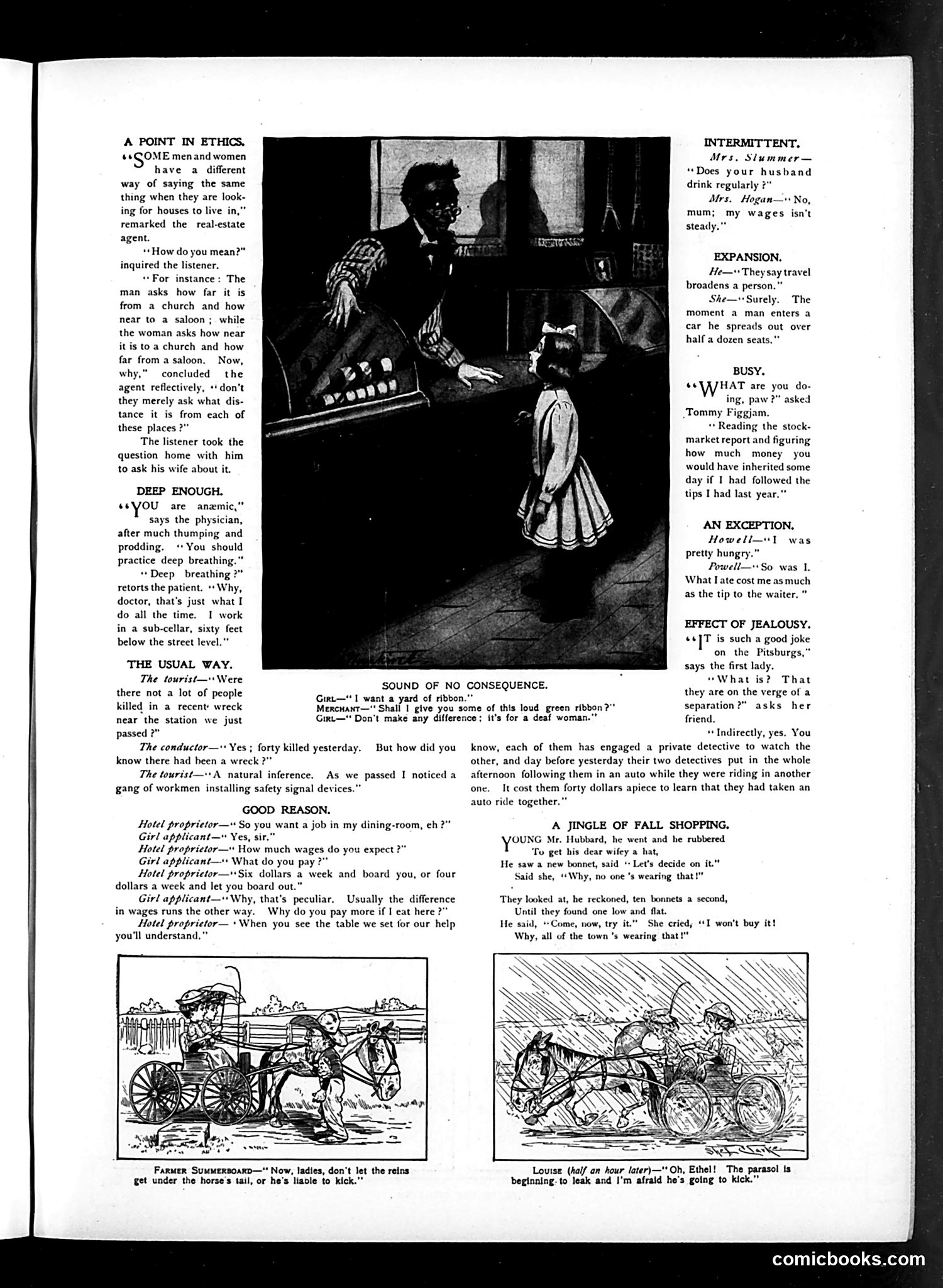
This page contains several short humorous anecdotes and two cartoons, rather than political commentary. The main illustrated section "Sound of No Consequence" depicts a merchant and conductor discussing train wreck casualties with dark humor—the joke being their indifference to deaths versus concern about property damage. The two cartoons below show rural/farming scenes. The left cartoon depicts a farmer warning ladies about a horse's tail and kicking hazard. The right shows a person getting wet in rain with a failing parasol—standard domestic humor. The right column contains brief joke exchanges about marriage, travel, shopping, and jealousy—typical light social satire of middle-class life. Overall, this appears to be a humor and entertainment page rather than political satire, reflecting early 20th-century magazine content priorities.
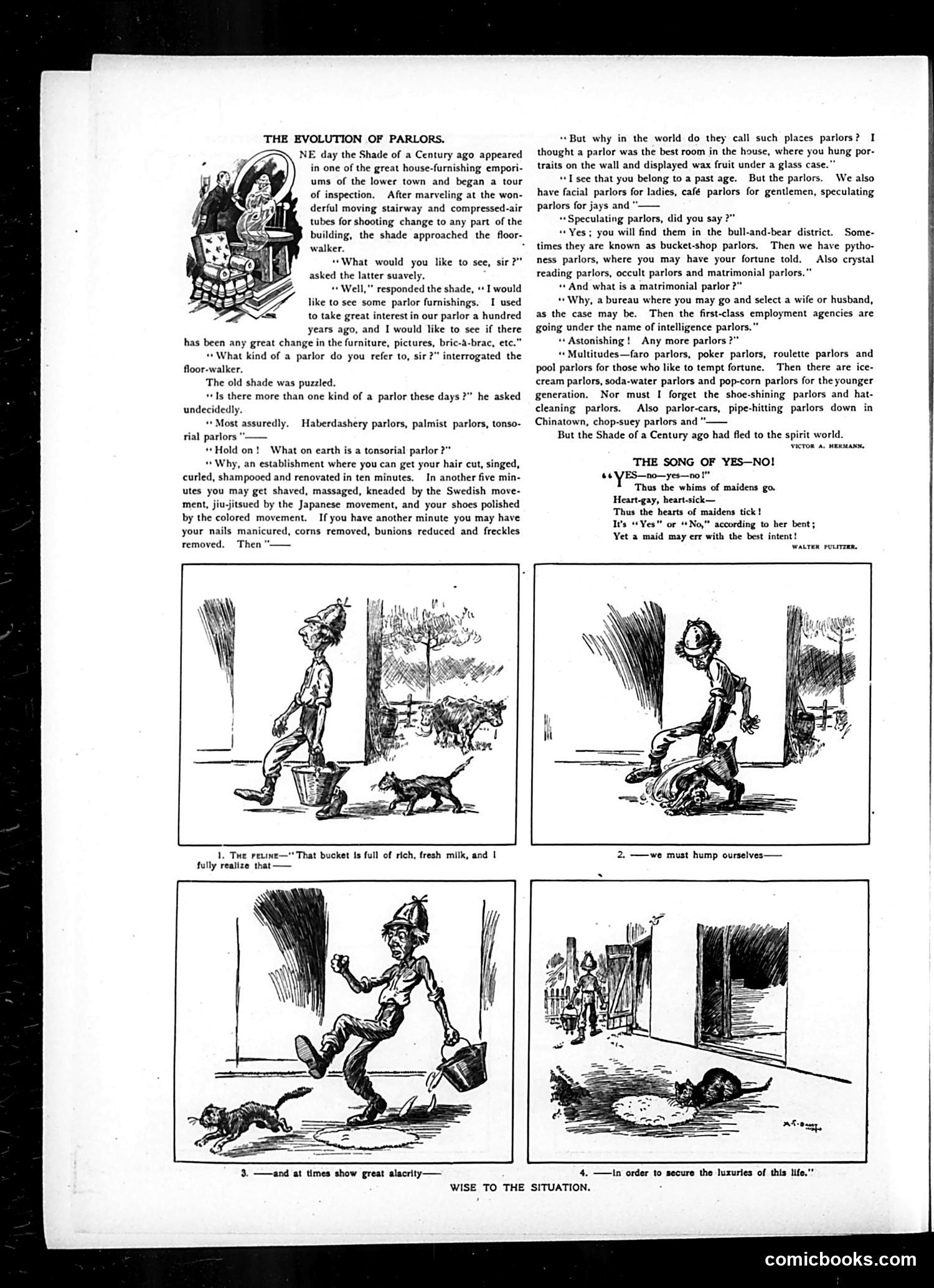
This page satirizes the American commercial obsession with rebranding ordinary services as fancy "parlors." A century-old ghost visits a modern department store seeking traditional parlor furniture, only to discover the term now applies to dozens of businesses: tonsorial (barber) parlors, facial parlors, matrimonial parlors (matchmaking services), bucket-shop parlors (stock speculation), and even ice-cream and shoe-shine parlors. The humor targets how merchants inflated mundane services with pretentious nomenclature to attract customers. References to "jays" (naive investors), "bull-and-bear district" (stock market), and "bucket-shops" (illegal gambling operations disguised as investment firms) suggest Gilded Age financial chicanery. The accompanying comic strip depicts slapstick poverty, likely contrasting the desperate poor's reality against this consumer-class pretension. The satire critiques both commercial hucksterism and class aspiration through linguistic inflation.
This page is primarily **advertising**, not political commentary. Judge Company is promoting discounted subscriptions to capitalize on heightened interest in upcoming state elections (described as "forerunners of the great Presidential contest two years hence"). The pitch explicitly targets **Republican voters**, urging them to subscribe to see Judge's "striking colored political cartoons" by "eminent caricaturists." Judge claims to be "the only publication of its kind in the United States"—meaning the only humor magazine with political cartoons. The offer: six weeks of Judge for 50 cents (versus $5.00 annual price). Additional bundles include Leslie's Weekly, Magazine of Fun, and Sis Hopkins' Own Book. The underlying message: **good humor provides relief from political trouble**—a selling point during contentious election seasons. Judge frames humor consumption as both entertainment and civic participation, encouraging families to stay informed through satire during an important political period.
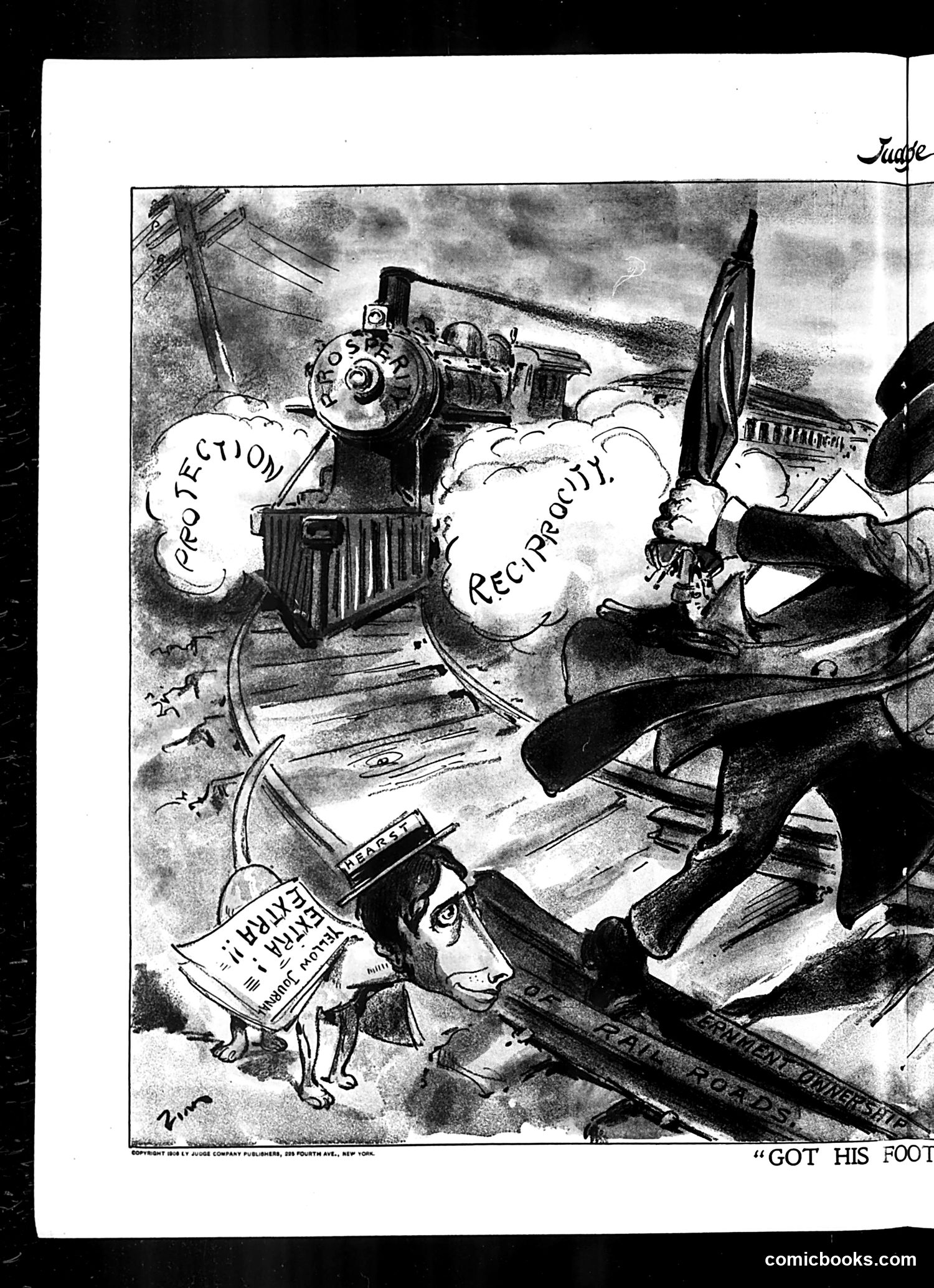
This Judge magazine cartoon appears to be satirizing a political or industrial figure's downfall. The central locomotive labeled "PRODIGAL" and "RECIPROCITY" suggests commentary on trade policy or economic overreach. A well-dressed man (likely a politician or industrialist) appears caught between conflicting forces—represented by the train and an airplane. A dog-like figure at the bottom holds a newspaper, possibly symbolizing the press or public scrutiny. The caption "GOT HIS FOOT" implies the subject has been caught or trapped. Without clear date markers visible, the specific political context—whether concerning tariff debates, monopoly practices, or trade agreements—cannot be definitively determined, though the "Reciprocity" label suggests early 20th-century trade policy debates.
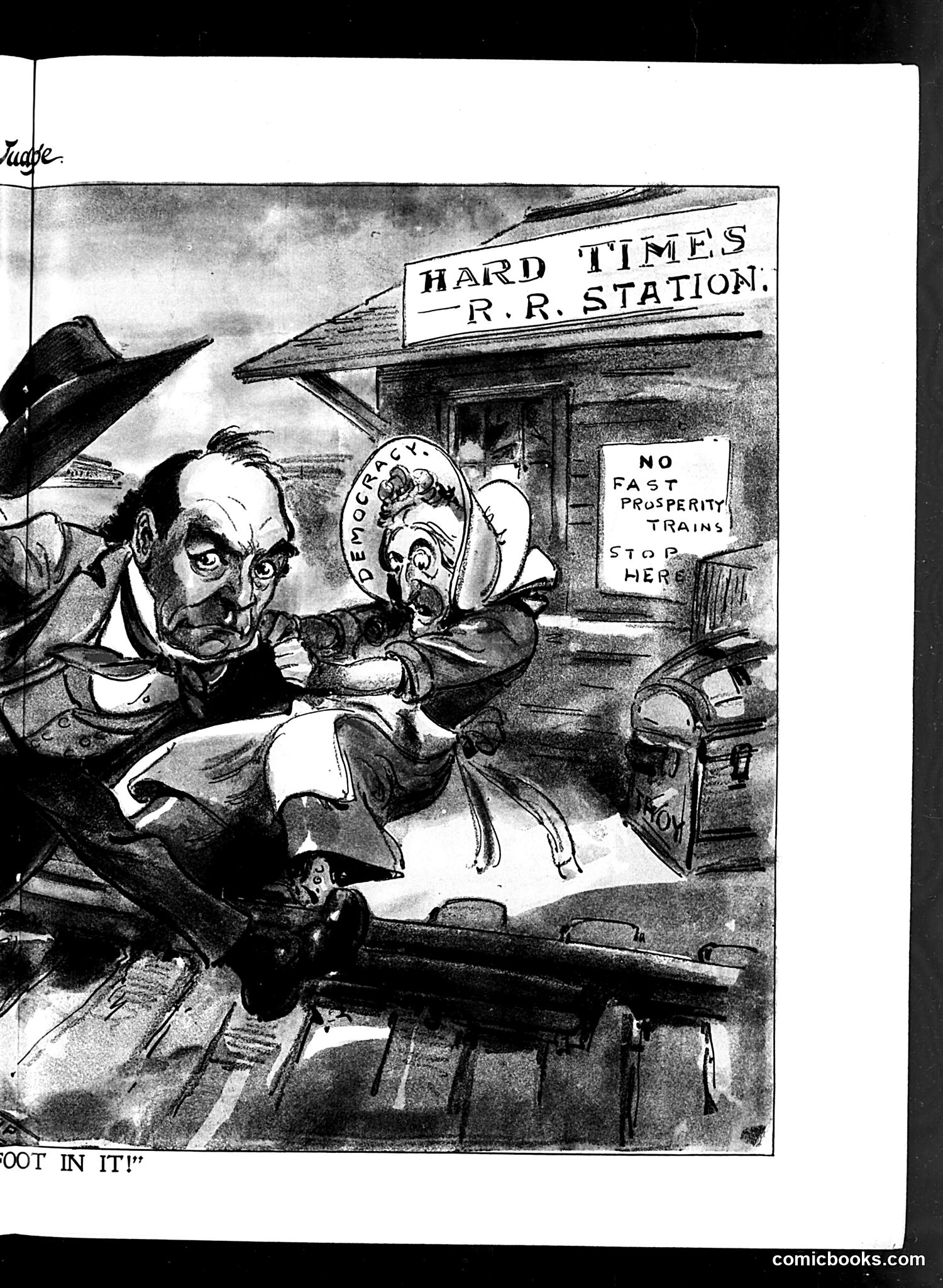
This cartoon satirizes economic hardship during what appears to be the Great Depression era. The station sign reads "Hard Times R.R. Station," and a posted notice declares "No Fast Prosperity Trains Stop Here"—a bitter joke about the absence of quick economic recovery. Two gaunt, caricatured figures (drawn with exaggerated, grotesque features typical of Depression-era political cartoons) stand dejected at the station. Their appearance suggests desperation and poverty. The "Prosperity" train they apparently hoped would arrive—symbolizing economic improvement—never comes to this station. The cartoon's point: common people seeking relief from hard times are disappointed, as no rapid economic recovery is forthcoming. It critiques the slow pace of economic improvement or government relief efforts.
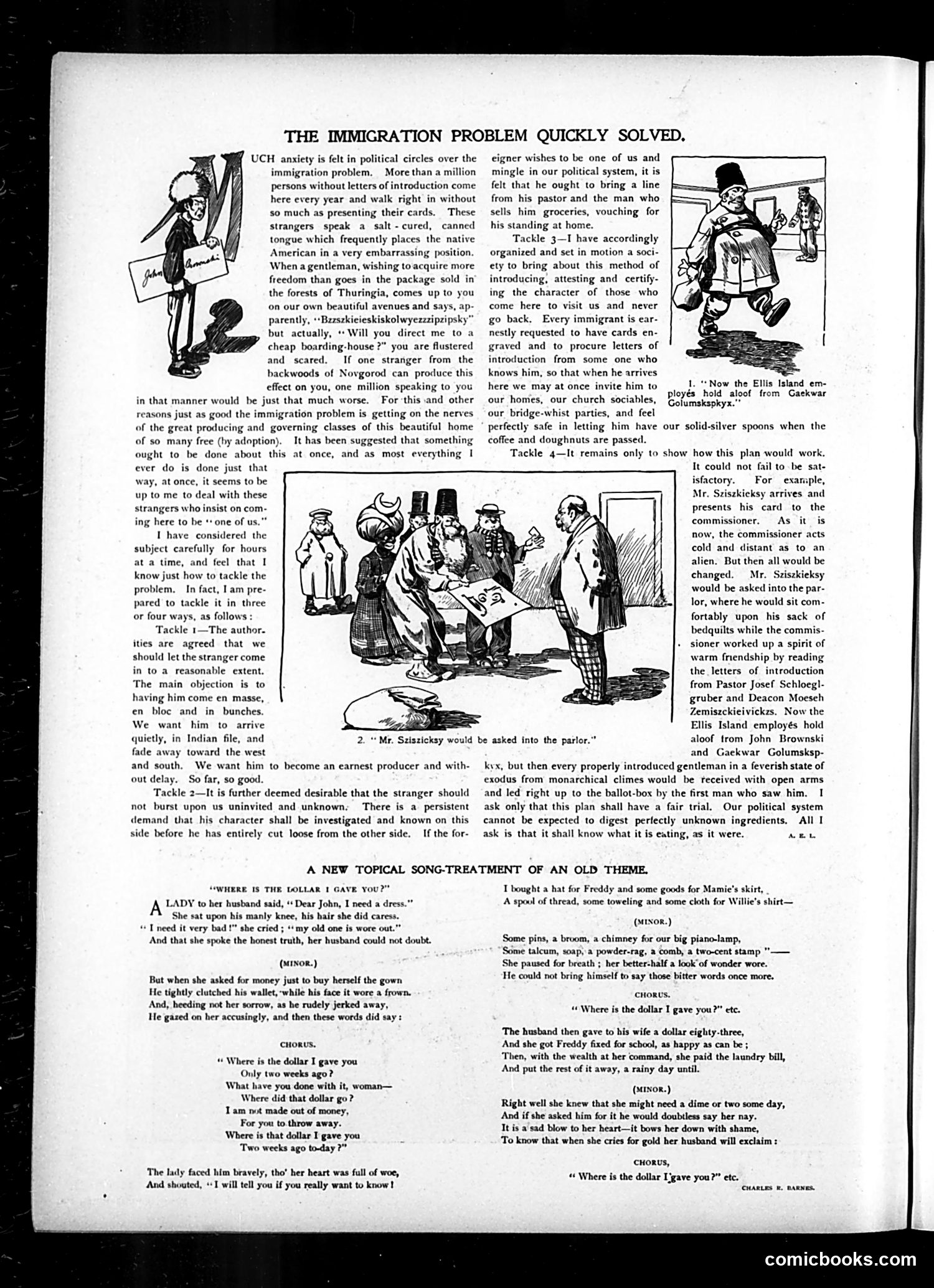
This 1900s Judge article satirizes proposed "solutions" to immigration anxieties. The author mockingly presents four escalating "tackles" to restrict immigration, culminating in requiring immigrants to obtain letters of introduction from their pastors and grocers—as if applying for high-society membership. The satire targets nativist anxiety about immigrants who speak foreign languages (the author ridicules Polish-sounding names like "Sziszicksy") and arrive in large groups. The joke exposes the absurdity of proposal #3: that Ellis Island officials should become warm friends with immigrants upon reading religious endorsements, when currently they treat foreign arrivals coldly. The cartoons show stereotypical immigrant figures with luggage and ethnic caricatures. The satire mocks both the era's snobbish gatekeeping mentality and the practical impossibility of the proposed "polite society" vetting system for mass immigration.
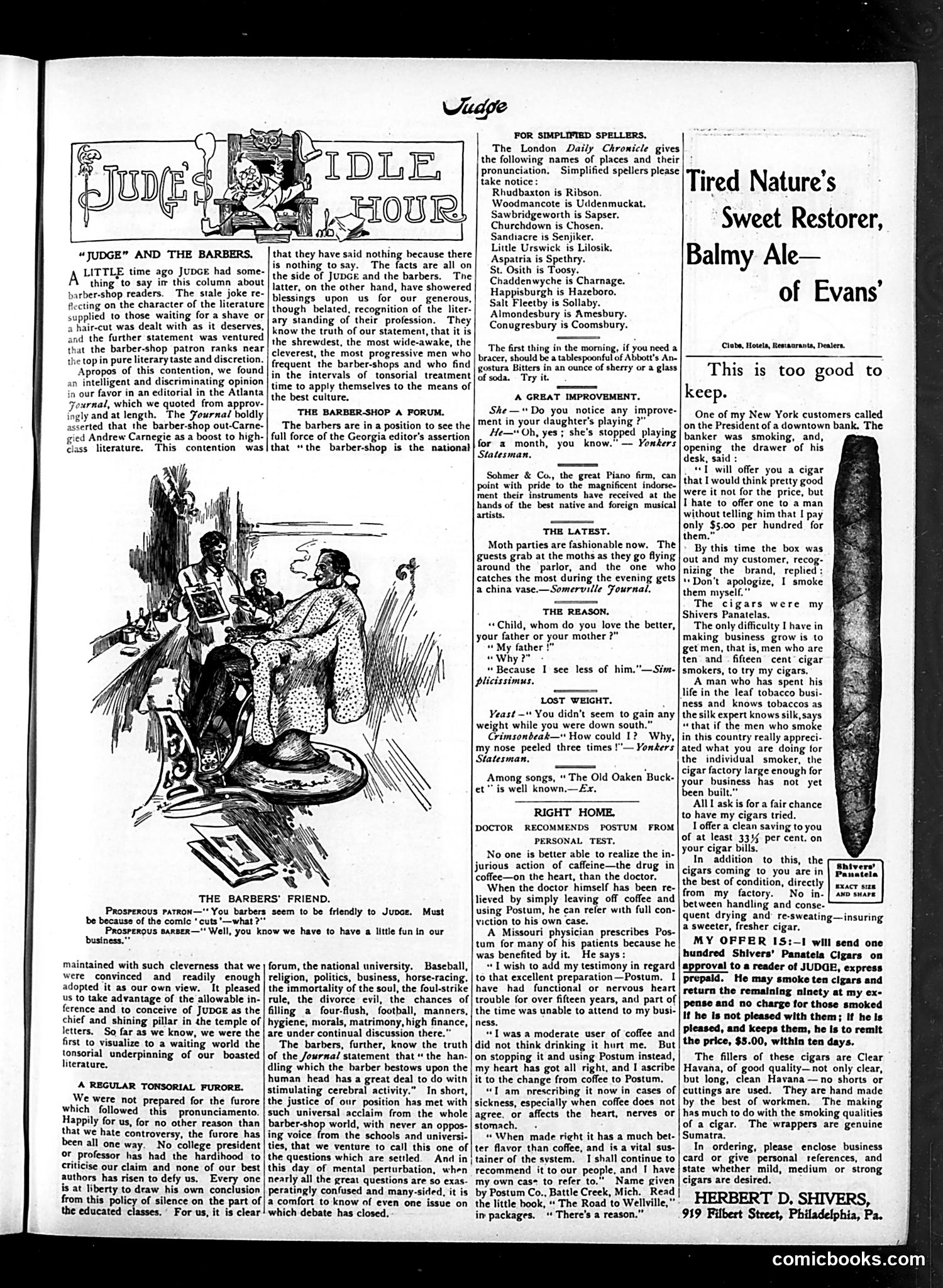
This page satirizes the cultural status of barbershops. *Judge* magazine had previously claimed barbershops serve as important forums for intellectual discussion and literary culture—arguing that barbers and their waiting customers represent society's most thoughtful, "progressive" citizens. The cartoon illustrates this conceit humorously: a well-dressed "Prosperous Patron" asks a barber why barbershops are so friendly to *Judge*, and the barber frankly admits, "Well, you know we have to have a little fun in our business"—a frank acknowledgment that barbershops provide entertainment and distraction, not serious intellectual engagement. The satire works on multiple levels: *Judge* had genuinely praised barber culture as a "national forum" discussing everything from philosophy to sports. The barber's casual reply deflates this pretension, suggesting the real appeal is simple amusement rather than refined literary taste. The editorial validates this by noting barbershops indeed discuss diverse topics, but through a lens of casual sociability rather than scholarly rigor.
This page from *Judge* (circa 1906) contains primarily **advertisements and short humorous anecdotes** rather than political cartoons requiring historical context. The notable content includes: **"Knew What to Do"** — A military joke playing on literal vs. figurative interpretation. A soldier consistently misunderstands his lieutenant's instructions, treating all situations (enemy battalion, cow, the officer himself) identically—shooting or capturing them. The humor derives from the soldier's inability to apply contextual reasoning, a common theme in turn-of-century comedy. **Other brief jokes** involve everyday scenarios: a speeding chauffeur, an absent-minded woman entering the wrong church, and wordplay about Irish scarecrows and lying. **Advertisements** dominate the page, promoting Hunter Baltimore Rye whiskey, Sohmer pianos, house-building plans, and trade schools—typical commerce for a 1906 magazine. The page contains **no identifiable political satire or caricature** of public figures. It represents *Judge*'s lighter, domestic humor content rather than its satirical editorial voice.
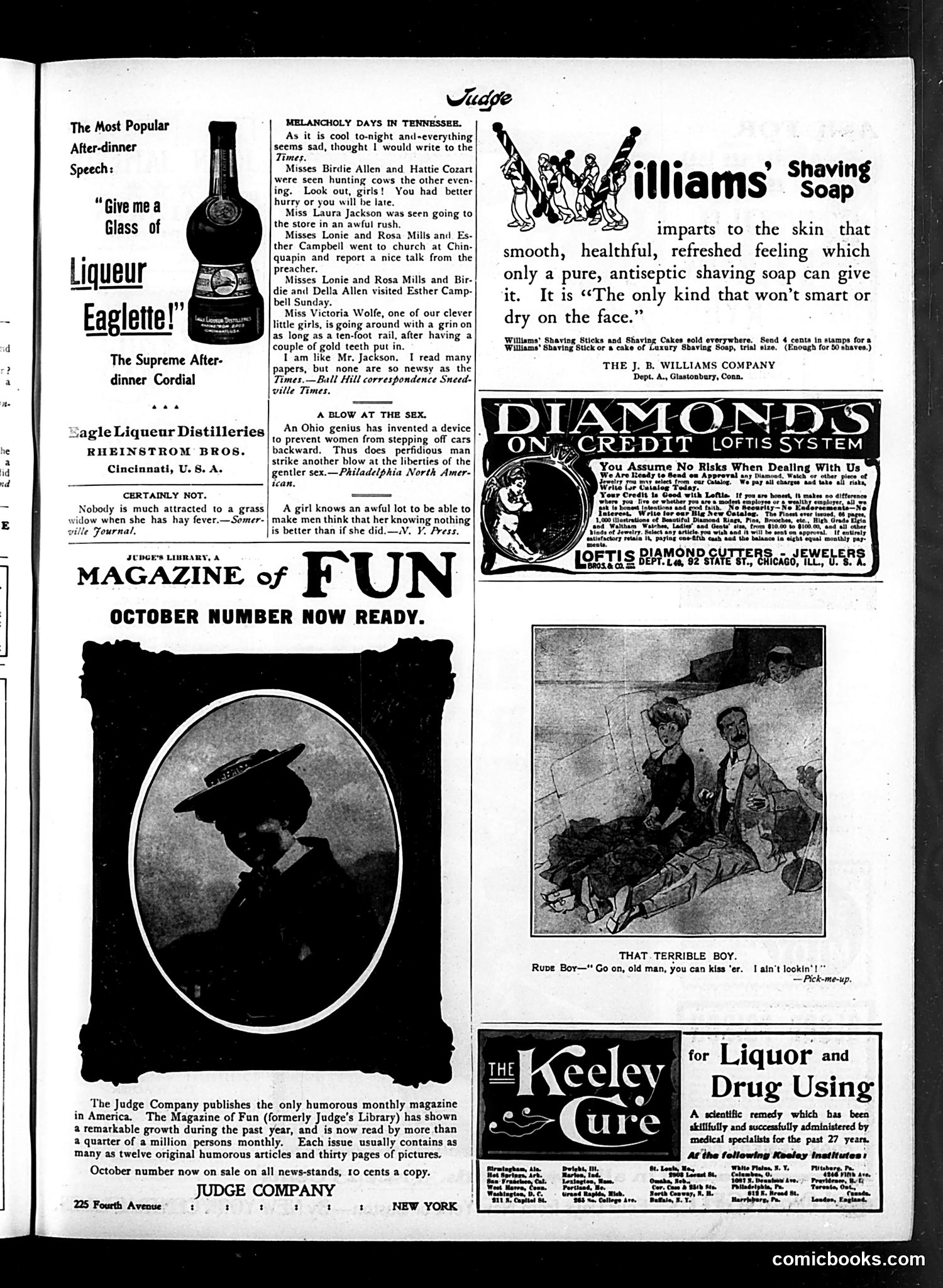
This page is primarily **advertisements and brief humorous snippets** rather than sustained political cartoons. The main content includes: **"Melancholy Days in Tennessee"** — A satirical letter-to-editor format mocking small-town gossip journalism, listing trivial local happenings (women hunting cows, visiting church) as if momentous news. **"A Blow at the Sex"** — A brief joke about a male inventor creating a device to prevent women from stepping backward off streetcars, framed as an attack on women's liberty — satire of both paternalistic "protection" and male condescension. **"A Girl Knows"** — A quip about female cunning: women manipulate men by pretending ignorance. The page is dominated by **period advertisements** for liqueur, shaving soap, diamond jewelry, and notably "The Keeley Cure" — a then-famous (now-infamous) treatment for alcoholism and drug addiction, reflecting contemporary concerns about substance abuse. The magazine promotes itself as humorous, monthly, and widely-read, selling for 10 cents.
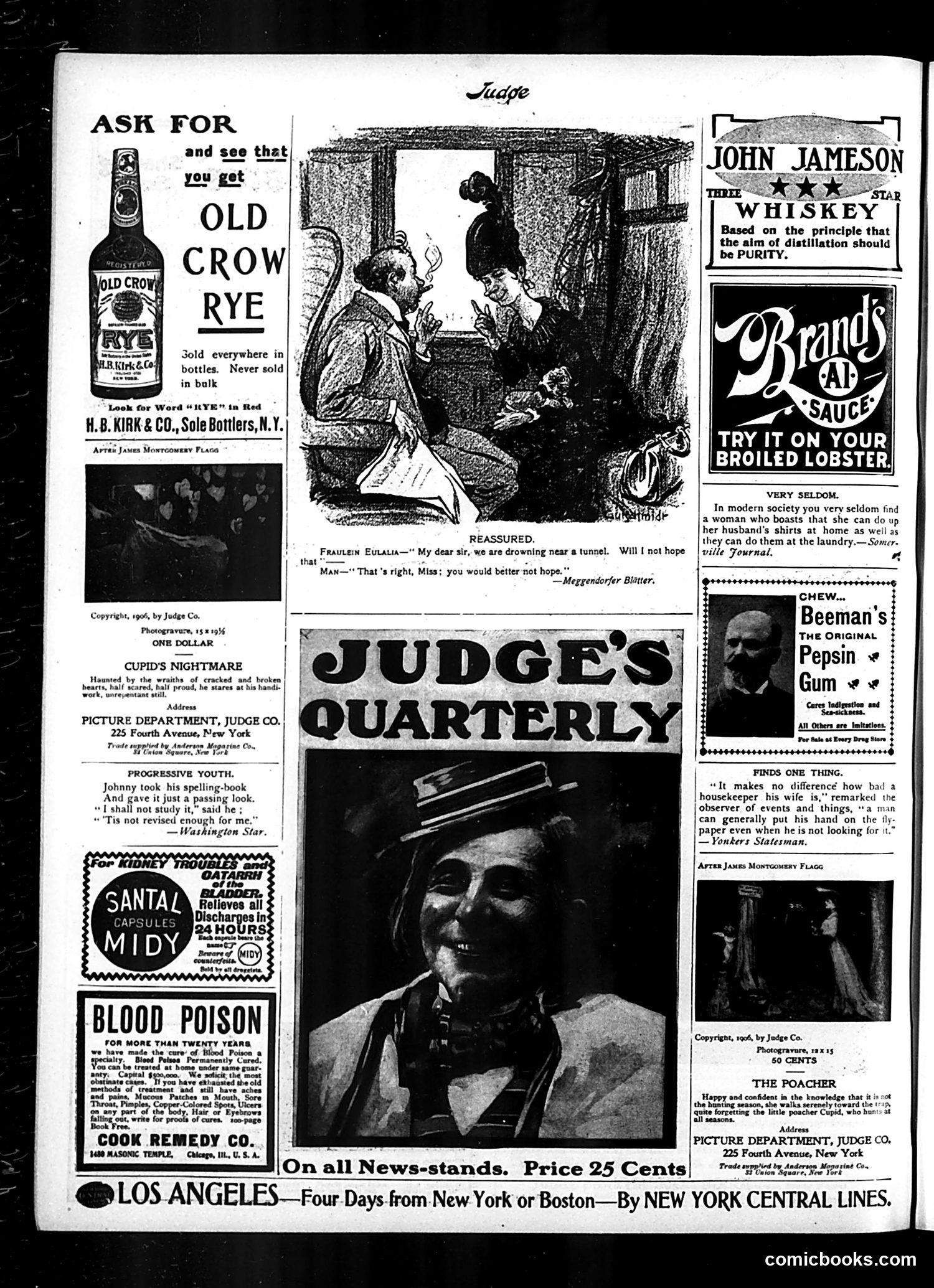
This page is primarily **advertising with scattered comic items** rather than political satire. The main content includes: **Central Cartoon ("Reassured"):** A couple approaches a tunnel by train; the woman expresses fear of drowning. The man replies she "would better not hope"—dark humor suggesting her pessimism is justified, likely mocking Victorian-era anxieties about new rail technology. **"Progressive Youth":** A brief joke about a boy dismissing his spelling book as "not revised enough"—satirizing either educational pretension or generational indifference to learning. **Other items:** "Cupid's Nightmare," "The Poacher," and a "Finds One Thing" quip about housekeeping—standard mild domestic humor typical of Judge's era. **The bulk of the page** consists of period advertisements for whiskey, medicinal products (blood poison cure, pepsin gum), and travel services—reflecting early 1900s commercial priorities. Copyright 1906.
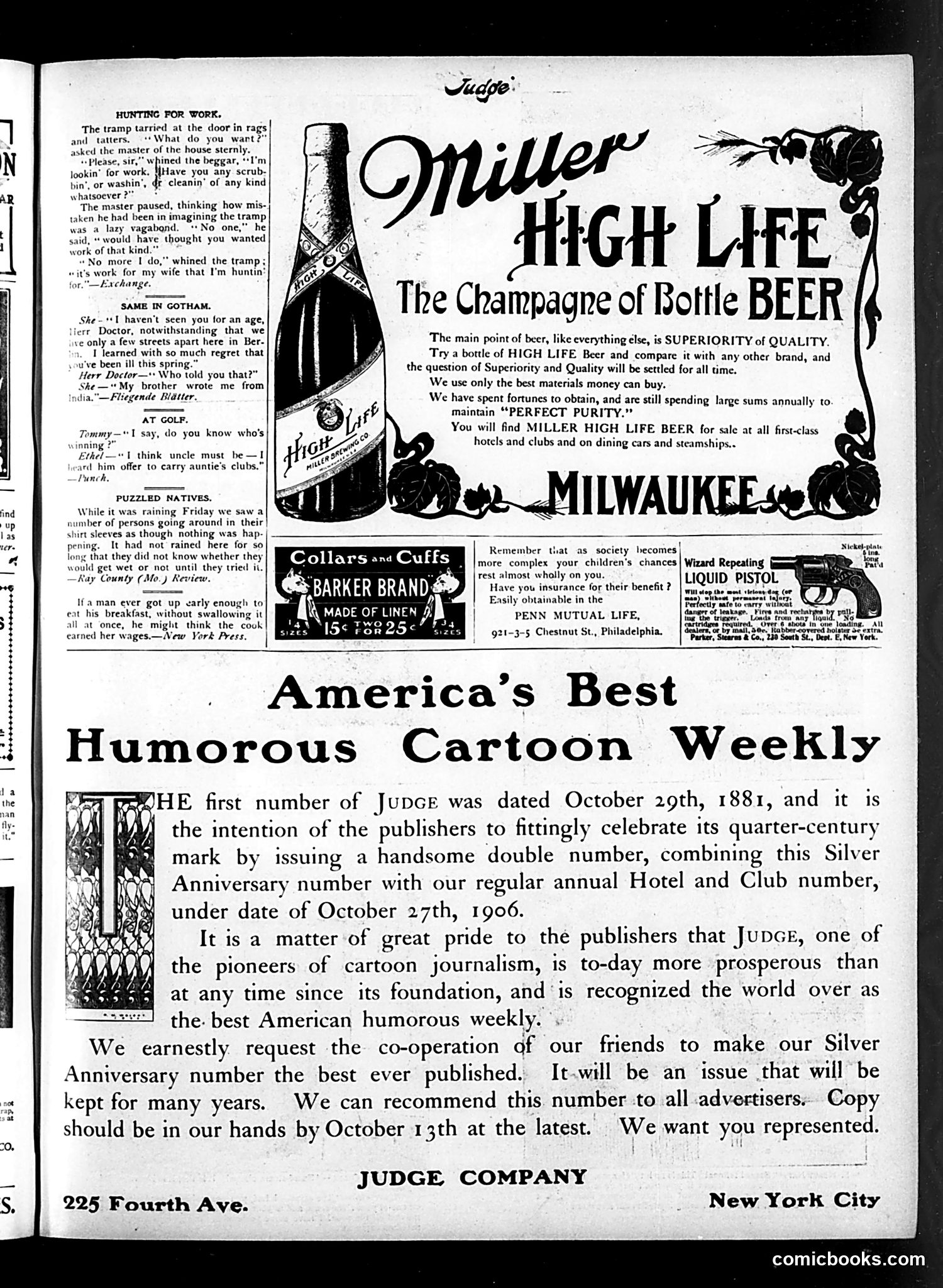
This is primarily an **advertising and promotional page** for Judge's 25th anniversary issue (October 1906), framed around the magazine's self-promotion as "America's Best Humorous Cartoon Weekly." The page contains **three brief comic vignettes** typical of Judge's satirical humor: 1. **"Hunting for Work"**: A tramp seeking employment claims to want legitimate work, but reveals he's actually looking for *his wife's* work—a joke about lazy wives or marital dynamics. 2. **"At Golf"**: A brief exchange where a man claims his uncle must be wealthy because he heard him "offer to carry auntie's clubs"—a pun on golf clubs vs. actual carrying. 3. **"Puzzled Natives"**: Observes people unaccountably wearing short sleeves in rain, joking about their uncertainty whether they'd get wet—likely satirizing immigrant or rural unfamiliarity with urban behavior. The **advertisements** (Miller High Life beer, Barker Brand collars, Penn Mutual Life insurance, Liquid Pistol) are period-typical product placement. The page demonstrates Judge's mix of mild domestic satire, wordplay, and commercial content targeting an early 1900s middle-class readership.
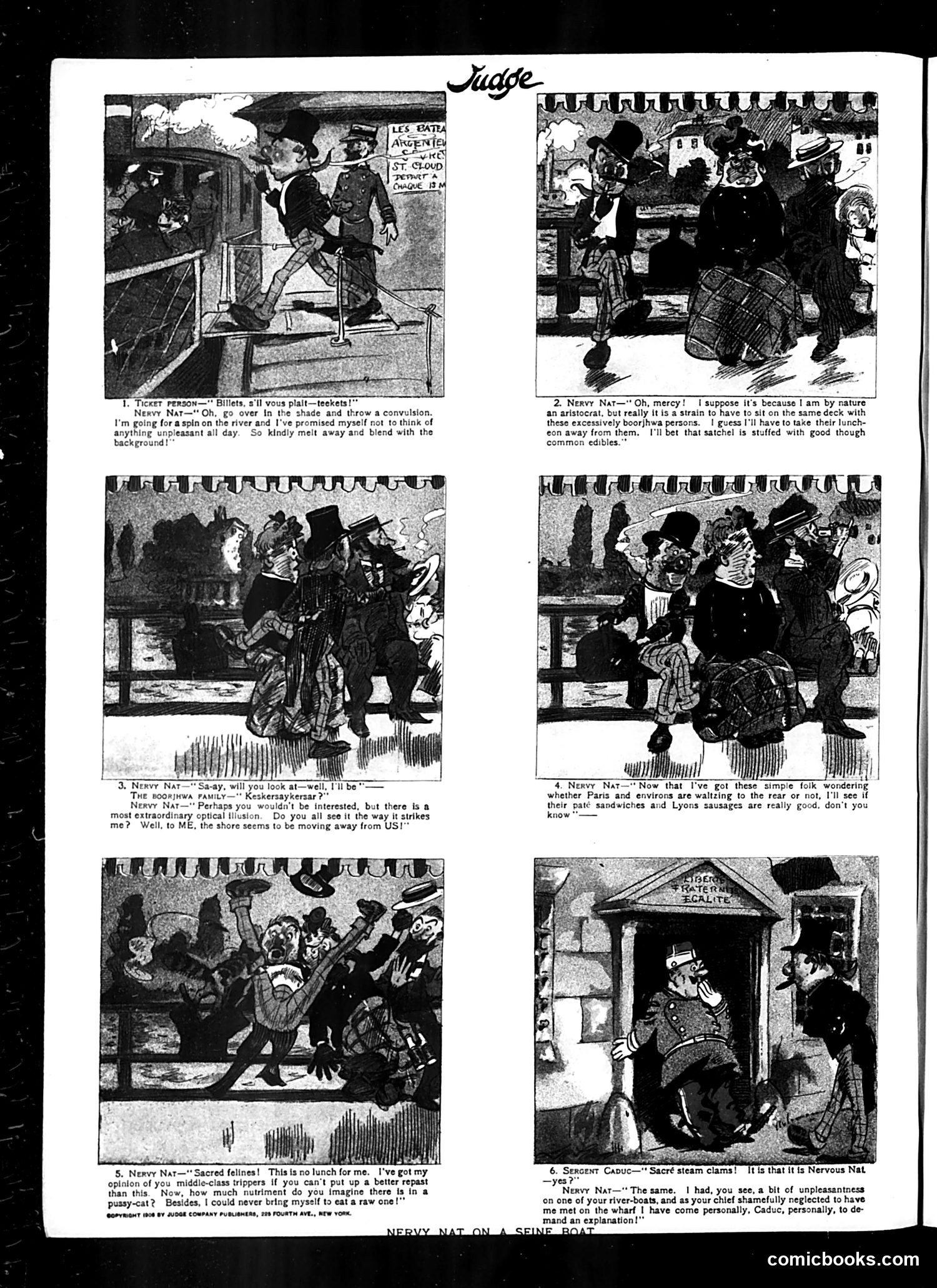
This six-panel satirical comic features "Nervy Nat," a recurring character type in Judge magazine—a brash American tourist abroad. The humor derives from his deliberately rude, entitled behavior toward French people and fellow travelers on a Seine river boat. Nat systematically antagonizes everyone: he dismisses a French ticket-taker, complains about sharing deck space with "bourgeois persons," plays optical illusion pranks on other passengers, steals their food, and later confronts a French sergeant demanding an "explanation" for his treatment. The satire targets American tourists' arrogance, snobbery (he claims aristocratic superiority while robbing people), and aggressive entitlement abroad. The French characters—depicted through accents and names like "Sergeant Caduc"—are portrayed as bewildered by his audacity. The joke positions American rudeness and self-importance as both contemptible and comically unstoppable, mocking a recognizable stereotype of the "Ugly American."