
Judge, 1906-10-06 · page 3 of 16
Judge — October 6, 1906 — page 3: what you’re looking at
What you’re looking at
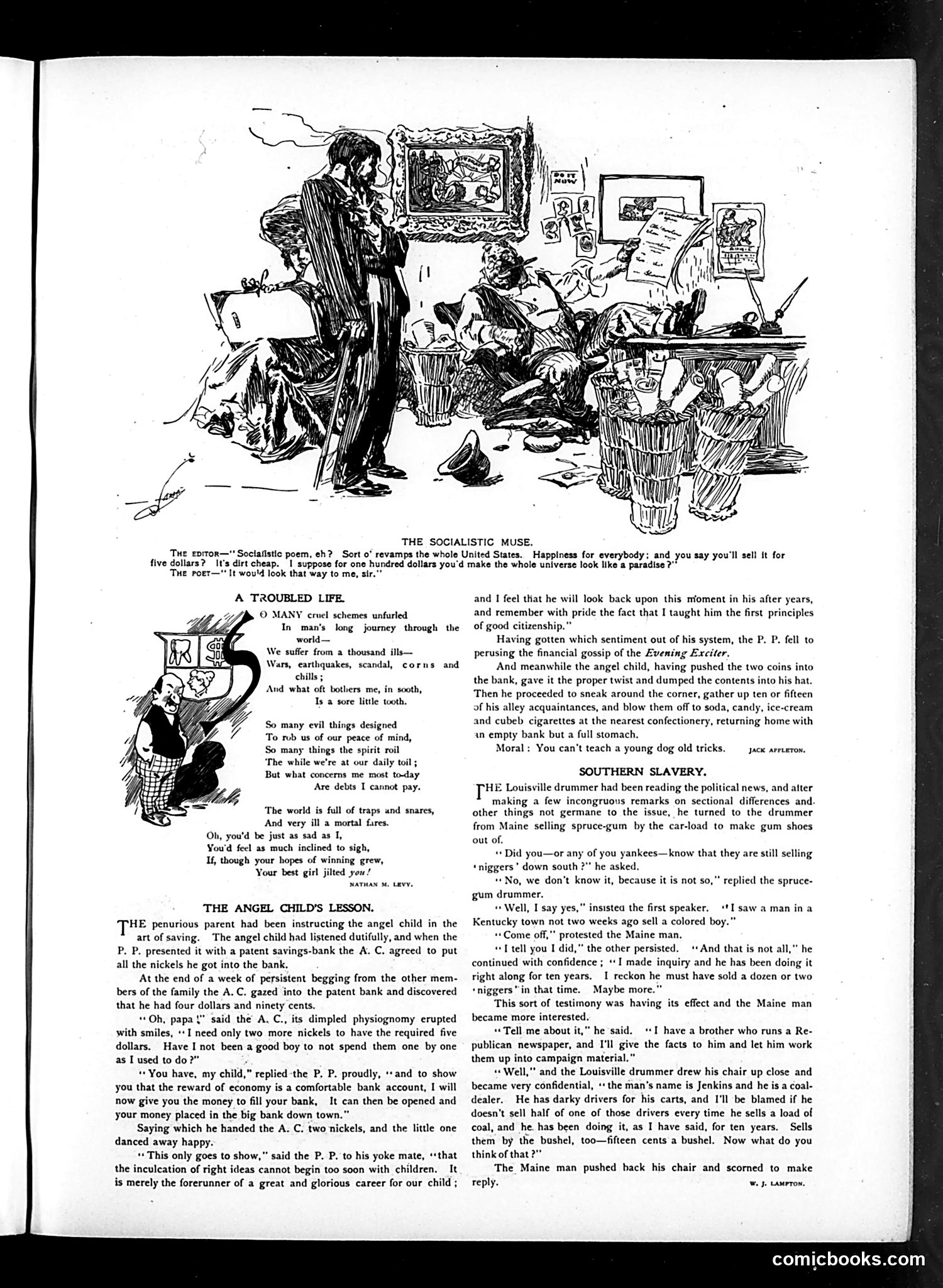
**Top Cartoon: "The Socialist Muse"** This satirizes socialist poetry and ideology. A well-dressed editor confronts a bohemian poet in a cluttered studio, dismissing socialist verse as cheap propaganda meant to sell utopian fantasies ("paradise") at inflated prices. The cartoon mocks both socialists' artistic pretensions and their perceived mercenary motives—suggesting they exploit idealism for profit. **"A Troubled Life"** A poem lamenting debts and financial hardship, illustrating working-class economic struggles of the era. **"The Angel Child's Lesson"** This story satirizes misguided parental benevolence. A parent teaches charity by demonstrating how saving money creates wealth, but the lesson backfires when the child learns self-interest instead of genuine altruism. **"Southern Slavery"** Discusses modern labor exploitation in the South, contrasting contemporary wage slavery with historical chattel slavery.
📄 Transcribed text from this page (OCR, searchable)
Machine-transcribed from the original scan — historical spelling and the odd misread are preserved.
THE SOCIALISTIC MUSE. Tue epitor: five dollars? It's dirt cheap. Tue Poer—"'It would look that way to me, sir.”” A TROUBLED LIFE. © MANY cruel schemes unfurled In man’s long journey through the world— We suffer from a thousand ills— Wars, earthquakes, scandal, corns and chills ; And what oft bothers me, in sooth, Is a sore little tooth. So many evil things designed To rub us of our peace of mind, So many things the spirit roil ‘The while we're at our daily toil ; But what concerns me most to-day Are debts I cannot pay. The world is full of traps and snares, And very ill a mortal fares. Oh, you'd be just as sad as I, You'd feel as much inclined to sigh, If, though your hopes of winning grew, Your best girl jilted you! NATHAN St. LEVY. THE ANGEL CHILD'S LESSON. THE penurious parent had been instructing the angel child in the art of saving. The angel child had listened dutifully, and when the P. P. presented it with a patent savings-bank the A. C. agreed to put all the nickels he got into the bank, At the end of a week of persistent begging from the other mem- bers of the family the A.C. gazed into the patent bank and discovered that he had four dollars and ninety cents. “Oh, papa {” said the A. C., its dimpled physiognomy erupted with smiles, I need only two more nickels to have the required five dollars. Have I not been a good boy to not spend them one by one as I used to do?” “You have, my child,” replied-the P. P. proudly, «sand to show you that the reward of economy is a comfortable bank account, I will now give you the money to fill your bank, It can then be opened and your money placed in the big bank down town.” Saying which he handed the A. C. two nickels, and the little one danced away happy. ‘« This only goes to show,” said the P. P. to his yoke mate, ‘that the inculcation of right ideas cannot begin too soon with children. It is merely the forerunner of a great and glorious career for our child ; “* Sociafistic poem, eh? Sort 0° revamps the whole United States. Happiness for everybody; and you say you'll sell it for 1 suppose for one hundred dollars you'd make the whole universe look like a paradise ?"* and I feel that he will look back upon this moment in his after years, and remember with pride the fact that I taught him the first principles of good citizenship.” Having gotten which sentiment out of his system, the P. P. fell to perusing the financial gossip of the Evening Exciter. And meanwhile the angel child, having pushed the two coins into the bank, gave it the proper twist and dumped the contents into his hat. ‘Then he proceeded to sneak around the corner, gather up ten or fifteen of his alley acquaintances, and blow them off to soda, candy, ice-cream and cubeb cigarettes at the nearest confectionery, returning home with an empty bank but a full stomach. Moral: You can't teach a young dog old tricks. JACK APPLETON. SOUTHERN SLAVERY. ‘HE Louisville drummer had been reading the political news, and alter making a few incongruous remarks on sectional differences and- other things not germane to the issue, he turned to the drummer from Maine selling spruce-gum by the car-load to make gum shoes out of, “Did you—or any of you yankees—know that they are still selling ‘niggers’ down south ?" he asked. «No, we don’t know it, because it is not so," replied the spruce- gum drummer. «Well, I say yes,” insistea the first speaker, ‘I saw a man ina Kentucky town not two weeks ago sell a colored boy.” «Come off,"" protested the Maine man, «+ [tell you I did,” the other persisted. ‘+ And that is not all,” he continued with confidence ; «I made inquiry and he has been doing it right along for ten years. I reckon he must have sold a dozen or two ‘niggers "in that time. Maybe more.” This sort of testimony was having its effect and the Maine man became more interested. “Tell me about it,” he sai: «I have a brother who runs a Re- publican newspaper, and I'll give the facts to him and let him work them up into campaign material.” + Well,” and the Louisville drummer drew his chair up close and became very confidential, «the man’s name is Jenkins and he is a coal- dealer. He has darky drivers for his carts, and I'll be blamed if he doesn't sell half of one of those drivers every time he sells a load of coal, and he. has been doing it, as I have said, for ten years. Sells them by the bushel, too—fifteen cents a bushel. Now what do you think of that 2”” The Maine man pushed back his chair and scorned to make reply. comicbooks.com