
Judge, 1906-10-06 · page 10 of 16
Judge — October 6, 1906 — page 10: what you’re looking at
What you’re looking at
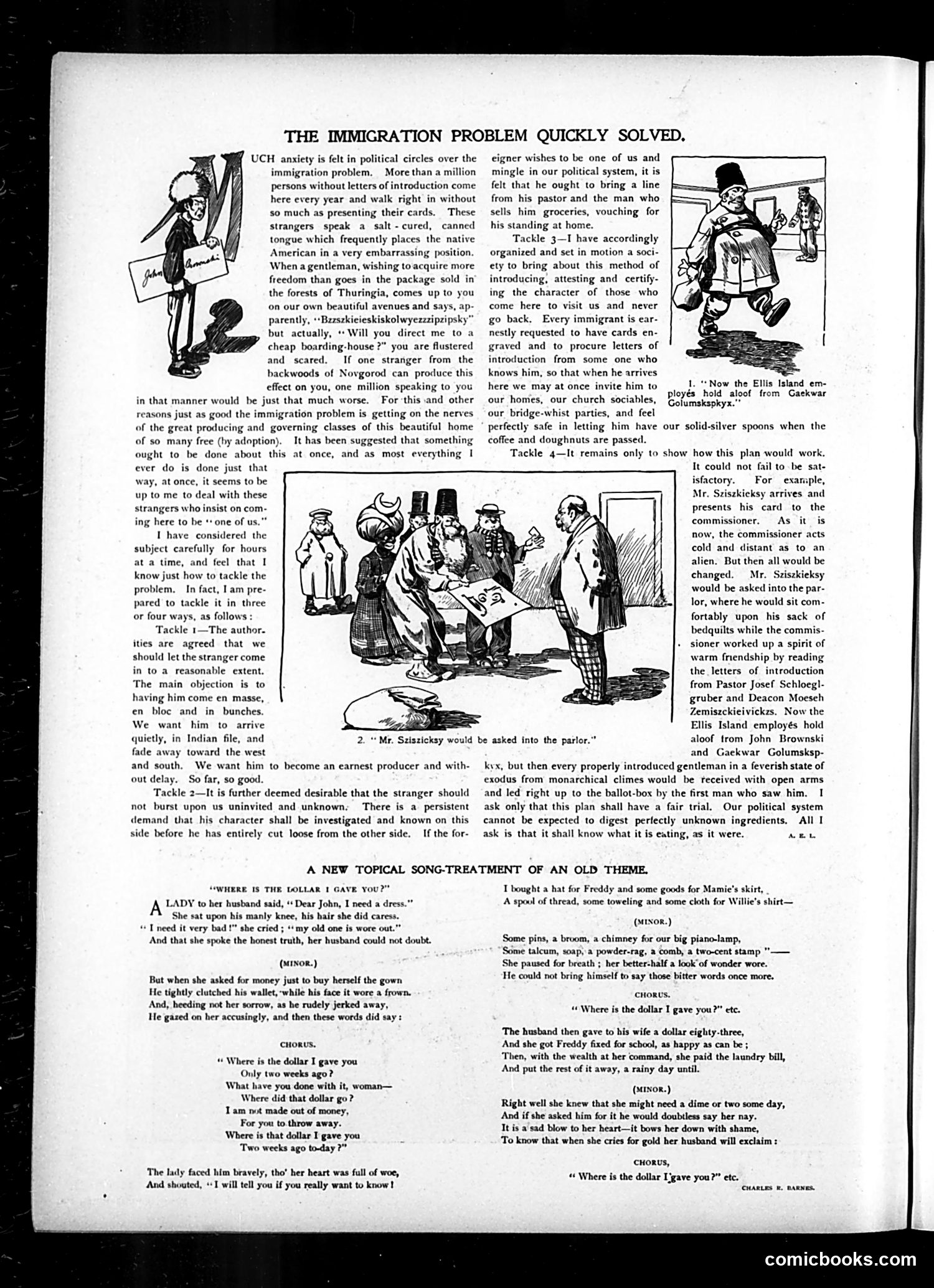
This 1900s Judge article satirizes proposed "solutions" to immigration anxieties. The author mockingly presents four escalating "tackles" to restrict immigration, culminating in requiring immigrants to obtain letters of introduction from their pastors and grocers—as if applying for high-society membership. The satire targets nativist anxiety about immigrants who speak foreign languages (the author ridicules Polish-sounding names like "Sziszicksy") and arrive in large groups. The joke exposes the absurdity of proposal #3: that Ellis Island officials should become warm friends with immigrants upon reading religious endorsements, when currently they treat foreign arrivals coldly. The cartoons show stereotypical immigrant figures with luggage and ethnic caricatures. The satire mocks both the era's snobbish gatekeeping mentality and the practical impossibility of the proposed "polite society" vetting system for mass immigration.
📄 Transcribed text from this page (OCR, searchable)
Machine-transcribed from the original scan — historical spelling and the odd misread are preserved.
THE IMMIGRATION PROBLEM QUICKLY SOLVED. ical circles over the More than a million UCH anxiety is felt in pol immigration problem. persons without letters of introduction come here every year and walk right in without so much as presenting their cards. These strangers speak a salt - cured, canned tongue which frequently places the native American in a very embarrassing position. When a gentleman, wishing to acquire more freedom than goes in the package sold in the forests of Thuringia, comes up to you on our own beautiful avenues and says, ap- parently, “Bzzszkicieskiskolwyezzzipzipsky” but actually, «Will you direct me to a cheap boarding-house 2” you are flustered and scared. If one stranger from the backwoods of Novgorod can produce this effect on you, one million speaking to you in that manner would be just that much worse. For ‘this and other reasons just as good the immigration problem is getting on the nerves of the great producing and governing classes of this beautiful home of so many free (by adoption). It has been suggested that something ought to be done about this at once, and as most everything I ever do is done just that way, at once, it seems to be up to me to deal with these strangers who insist on com- ing here to be one of us.” I have considered the subject carefully for hours at a time, and feel that I know just how to tackle the problem, In fact, lam pre- pared to tackle it in three or four ways, as follows : Tackle 1—The author. ities are agreed that we should let the stranger come in to a reasonable extent. The main objection is to having him come en masse, en bloc and in bunches. We want him to arrive quietly, in Indian file, and 2 fade away toward the west and south, We want him to become an earnest producer and with- out delay. So far, so good. Tackle 2—It is further deemed desirable that the stranger should not burst upon us uninvited and unknown, There is a persistent demand that his character shall be investigated and known on this side before he has entirely cut loose from the other side. If the for- * Mr. Sziszicksy would be asked into the parlor.” cigner wishes to be one of us and mingle in our political system, it felt that he ought to bring a line from his pastor and the man who sells him groceries, vouching for his standing at home. Tackle 3—I have accordingly organized and set in motion a soci- ety to bring about this method of introducing, attesting and_ certify. ing the character of those who come here to visit us and never go back. Every immigrant is ear- nestly requested to have cards en- graved and to procure letters of introduction from some one who knows him, so that when he arrives here we may at once invite him to our homes, our church sociables, our bridge-whist parties, and feel perfectly safe in letting him have our solid-silver spoons when the coffee and doughnuts are passed. Tackle 4—It remains only to show how this plan would work, It could not fail to be sat- isfactory. For example, Mr. Sziszkicksy arrives and presents his card to the commissioner. As it is now, the commissioner acts cold and distant as to an alien. But then all would be changed. Mr. Sziszkieksy would be asked into the par- lor, where he would sit com- fortably upon his sack of bedquilts while the commis- sioner worked up a spirit of warm fnendship by reading the letters of introduction from Pastor Josef Schloegl- gruber and Deacon Moeseh Zemiszckieivickzs. Now the Ellis Island employés hold aloof trom John Brownski and Gaekwar Golumsksp- kyx, but then every properly introduced gentleman in a feverish state of exodus from monarchical climes would be received with open arms and led right up to the ballot-box by the first man who saw him. I ask only that this plan shall have a fair trial. Our political system cannot be expected to digest perfectly unknown ingredients. All I ask is that it shall know what it is eating, as it were. Ane . "Now the Ellis Island em- ployés hold aloof from Gaekwar Golumskspkyx.”” A NEW TOPICAL SONG-TREATMENT OF AN OLD THEME. “WHERE IS THE LOLLAR I GAVE You?” LADY to her husband said, Dear John, I need a dress."* She sat upon his manly knee, his hair she did caress. “ [need it very bad !" she cried ; + my old one is wore out.” And that she spoke the honest truth, her husband could not doubt. (atxor.) But when she asked for money just to buy herself the gown He tightly clutched his wallet, -while his face it wore a frown. And, heeding not her sorrow, as he rudely jerked away, He gazed on her accusingly, and then these words did say : cuorvs. “ Where is the dollar I gave you Only two weeks ago? What have you done with it, woman— Where did that dollar go? Tam not made out of money, For you to. throw away. ‘Where is that dollar I gave you Two weeks ago to-day ?” The lady faced him bravely, tho’ her heart was full of woe, And shouted, «1 will tell you if you really want to know! T bought a hat for Freddy and some goods for Mamie’s skirt, A spool of thread, some toweling and some cloth for Willie's shirt— (sttxor.) Some pins, a broom, a chimney for our big piano-lamp, Some talcum, soap,,a powder-rag, a Comb, a two-cent stamp "— ‘She paused for breath ; her better-half a look’ of wonder wore. He could not bring himself to say those bitter words once more. cHorvs. “ Where is the dollar I gave you?” etc. The husband then gave to his wife a dollar eighty-three, And she got Freddy fixed for school, as happy as can be ; ‘Then, with the wealth at her command, she paid the laundry bill, And put the rest of it away, a rainy day until. (stuxoR.) Right well she knew that she might need a dime or two some day, And if she asked him for it he would doubtless say her nay. It is a'sad blow to her heart—it bows her down with shame, To know that when she cries for gold her husband will exclaii cuorvs, “ Where is the dollar Iigave you?” etc. CHARLES R, BARNES. comicbooks.com