
A complete issue · 16 pages · 1906
Judge — August 25, 1906
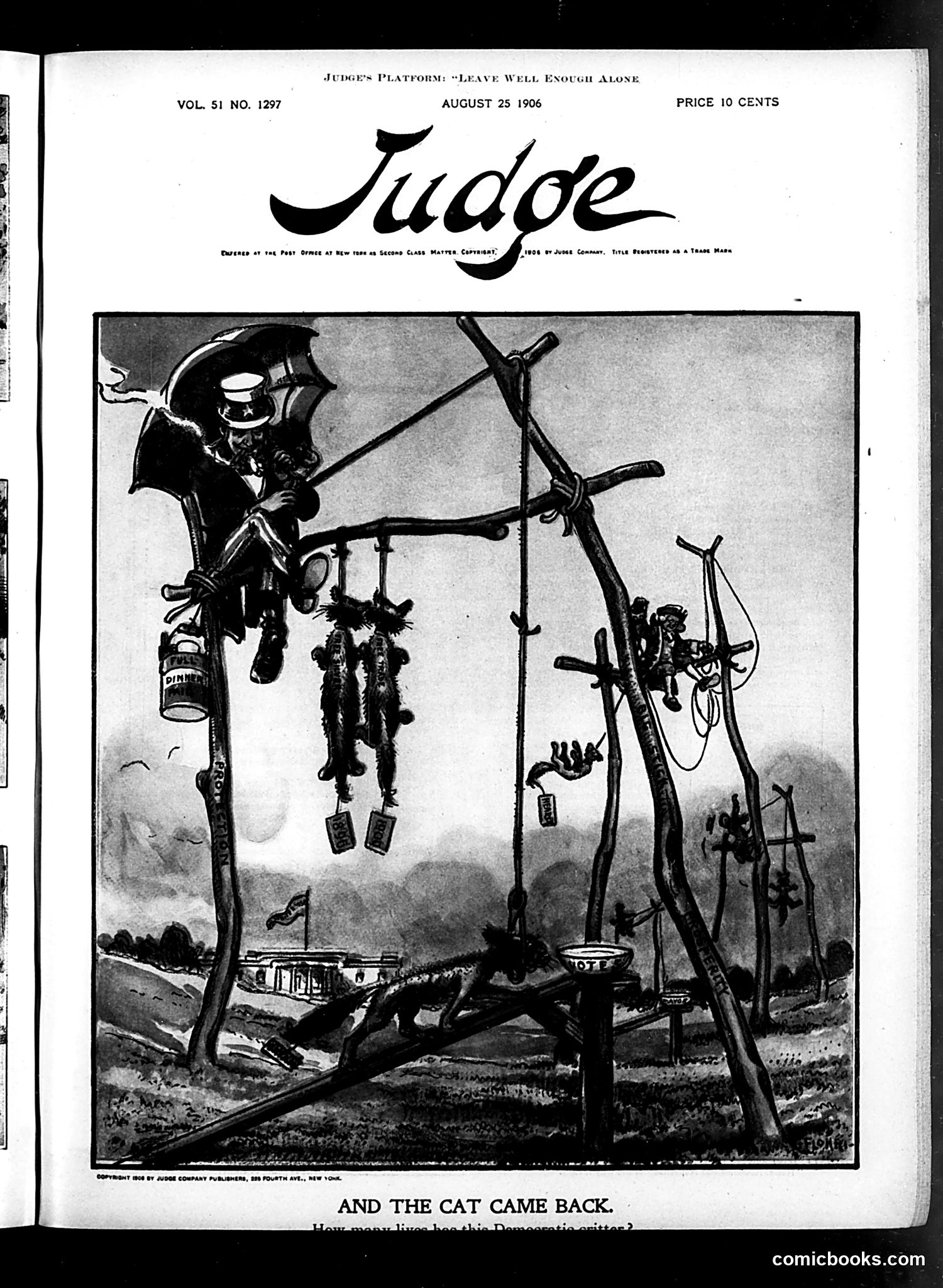
This is a darkly comic illustration titled "And the Cat Came Back," depicting execution by hanging. The image shows multiple figures suspended from gallows against a desolate landscape, with what appears to be an executioner or military figure on the left. The "cat came back" reference suggests this is political satire about a recurring problem or persistent threat that refuses to disappear despite attempts to eliminate it. Without additional context or clearer identifying labels, I cannot definitively identify which specific political figures or events this references. The illustration's grim tone indicates criticism of capital punishment or, alternatively, suggests that some problematic force keeps resurfacing despite efforts to destroy it. The satire's precise target remains unclear from the image alone.
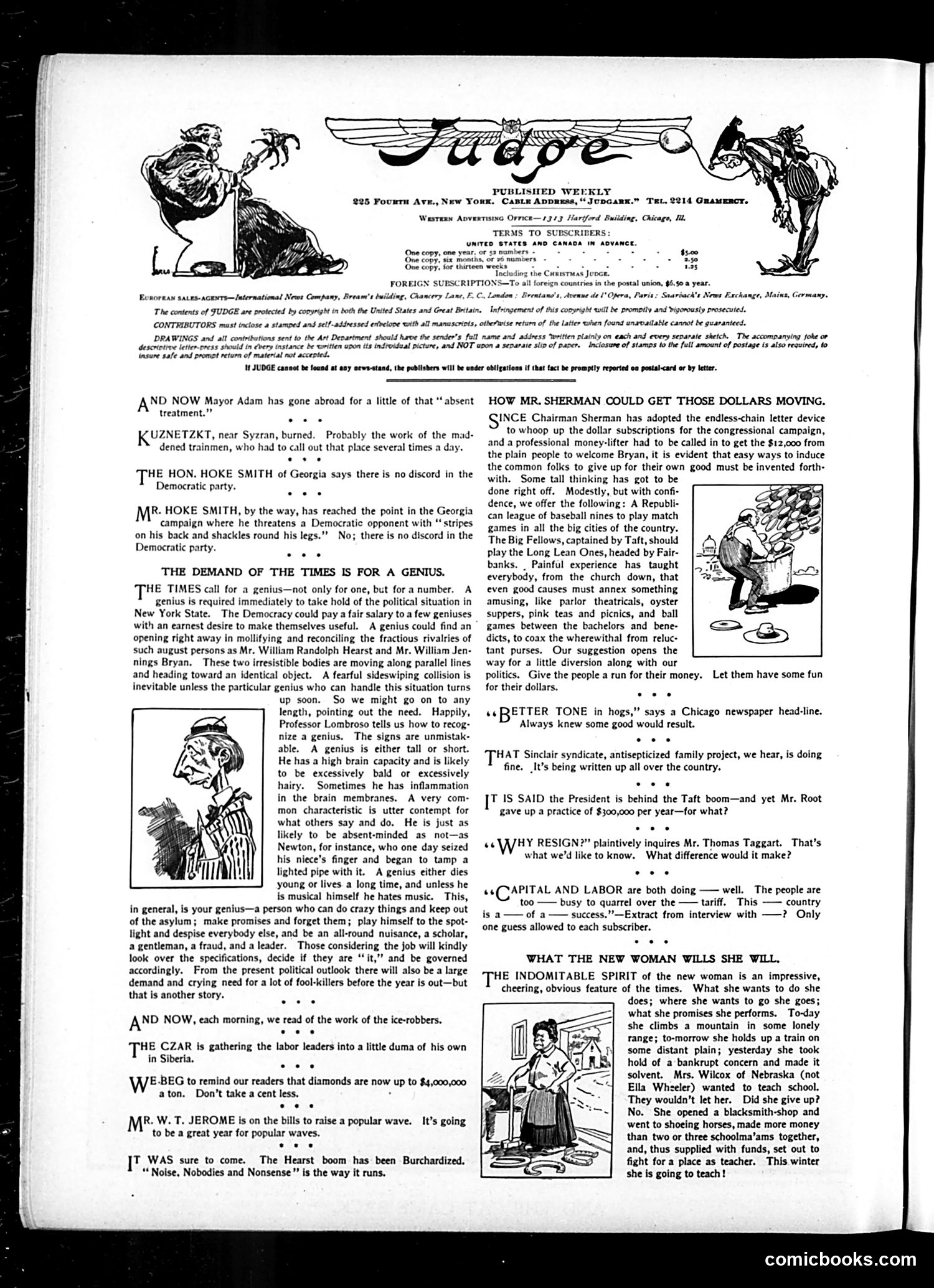
This page contains satirical commentary on early 20th-century American politics. The text references: **Mayor Adam** going abroad for "absent treatment" (likely referring to a New York mayor's absence or vacation). **Hon. Hoke Smith of Georgia** - apparently defending Democrats against accusations of discord. **The main editorial** argues that American politics needs "a genius" to resolve factional disputes between Democrats and Republicans, mentioning **William Randolph Hearst** and **William Jennings Bryan** as examples of political figures whose rivalry mirrors larger party divisions. **Sherman's dollar-raising efforts** for Bryan's campaign are satirized as unconvincing to ordinary people. The cartoons (left side) feature exaggerated facial caricatures typical of period satire, mocking political figures through grotesque portraiture—a standard Judge magazine technique. The overall tone criticizes political leadership and party infighting during what appears to be the Bryan era.
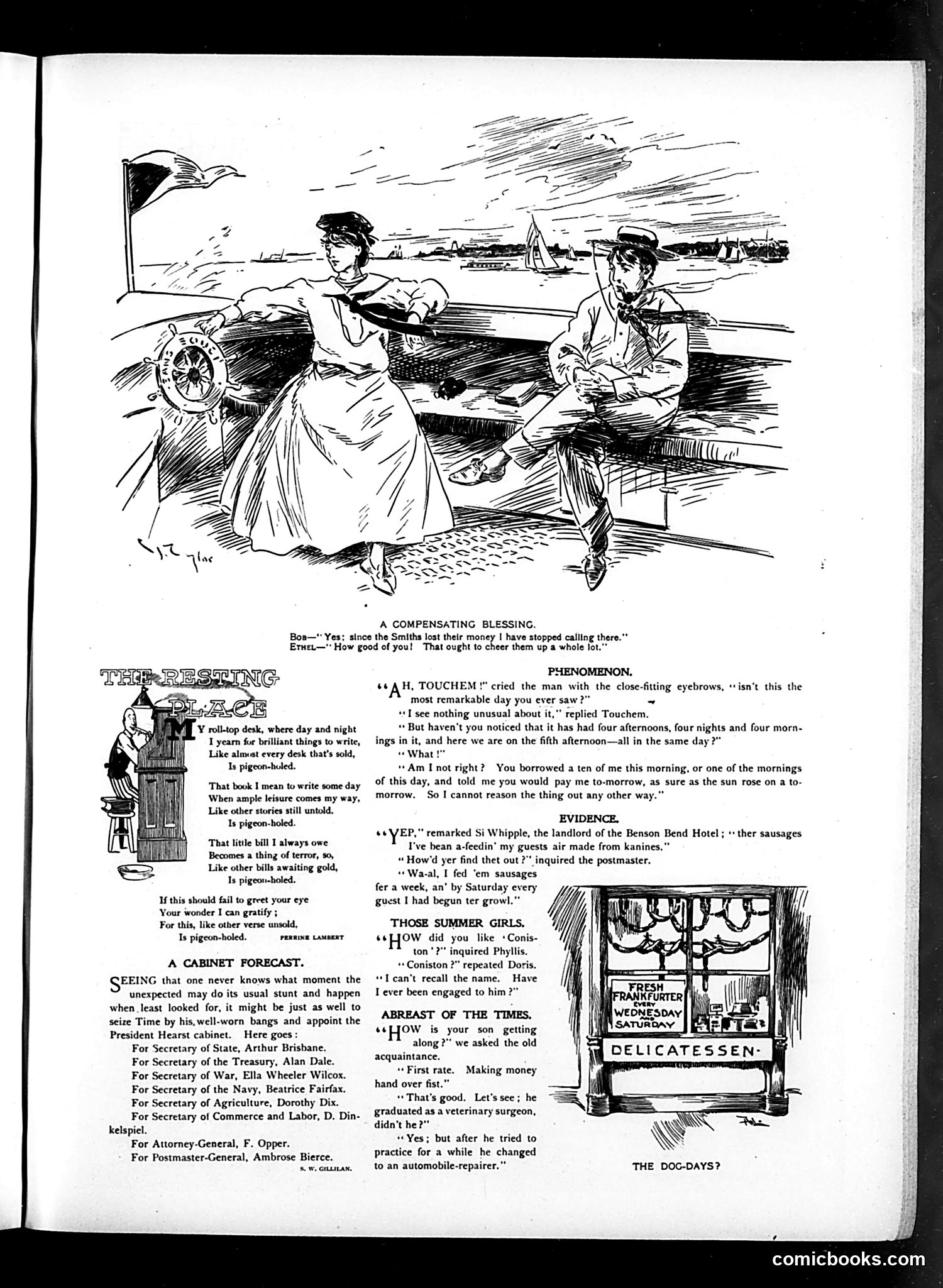
The top cartoon titled "A COMPENSATING BLESSING" shows a couple in a boat discussing the Smiths losing money—presented as oddly positive because it stops the Smiths from visiting them. The satire mocks social obligation and the burden of unwanted guests among the wealthy. The page contains multiple short satirical pieces and jokes about contemporary topics. "A Cabinet Forecast" humorously lists potential cabinet appointments under a future administration (appears to reference a presidential campaign). "Phenomenon," "Evidence," "Those Summer Girls," and "Arrest of the Times" are brief humorous anecdotes poking fun at social pretensions, dining establishments, and romantic entanglements. The content reflects early 20th-century leisure-class humor and social observation typical of Judge magazine's satirical approach.
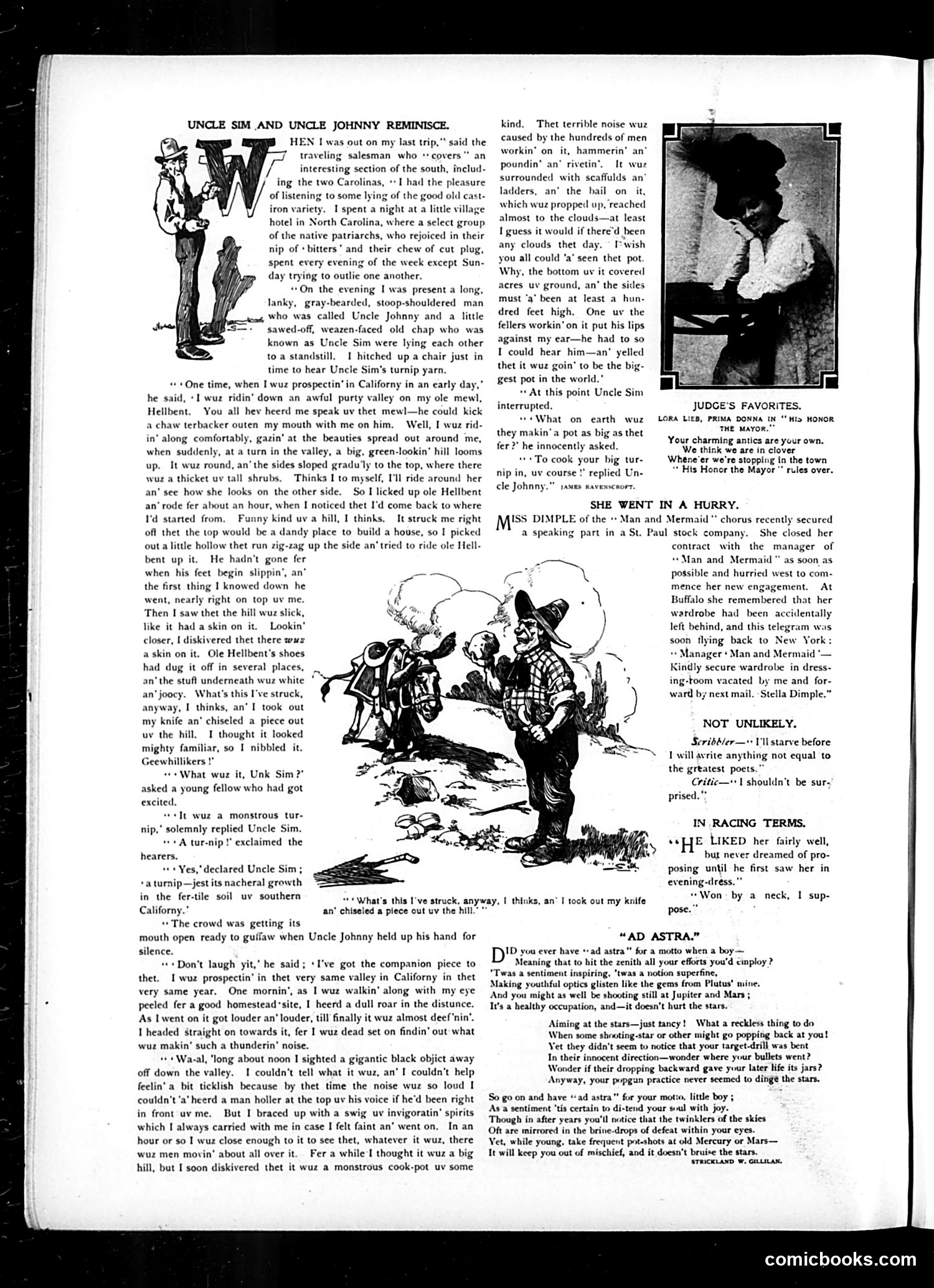
This page contains two distinct sections: **"Uncle Sim and Uncle Johnny Reminisce"** (left): A humorous tall tale where a traveling salesman describes witnessing massive construction in California involving enormous machinery and workers. The story uses exaggeration for comic effect, typical of period American folklore humor. "Uncle Sim" and "Uncle Johnny" appear to be generic rural character types rather than specific political figures. **Right column sections** include brief humor pieces: "Judge's Favorites," "She Went in a Hurry" (about an actress named Miss Dimple), and satirical poems like "Ad Astra" about astrology and "Not Unlikely" about poetry critics. The content is primarily **entertainment-focused humor** rather than political satire. No specific identifiable political figures or events are evident from the text or illustrations provided.
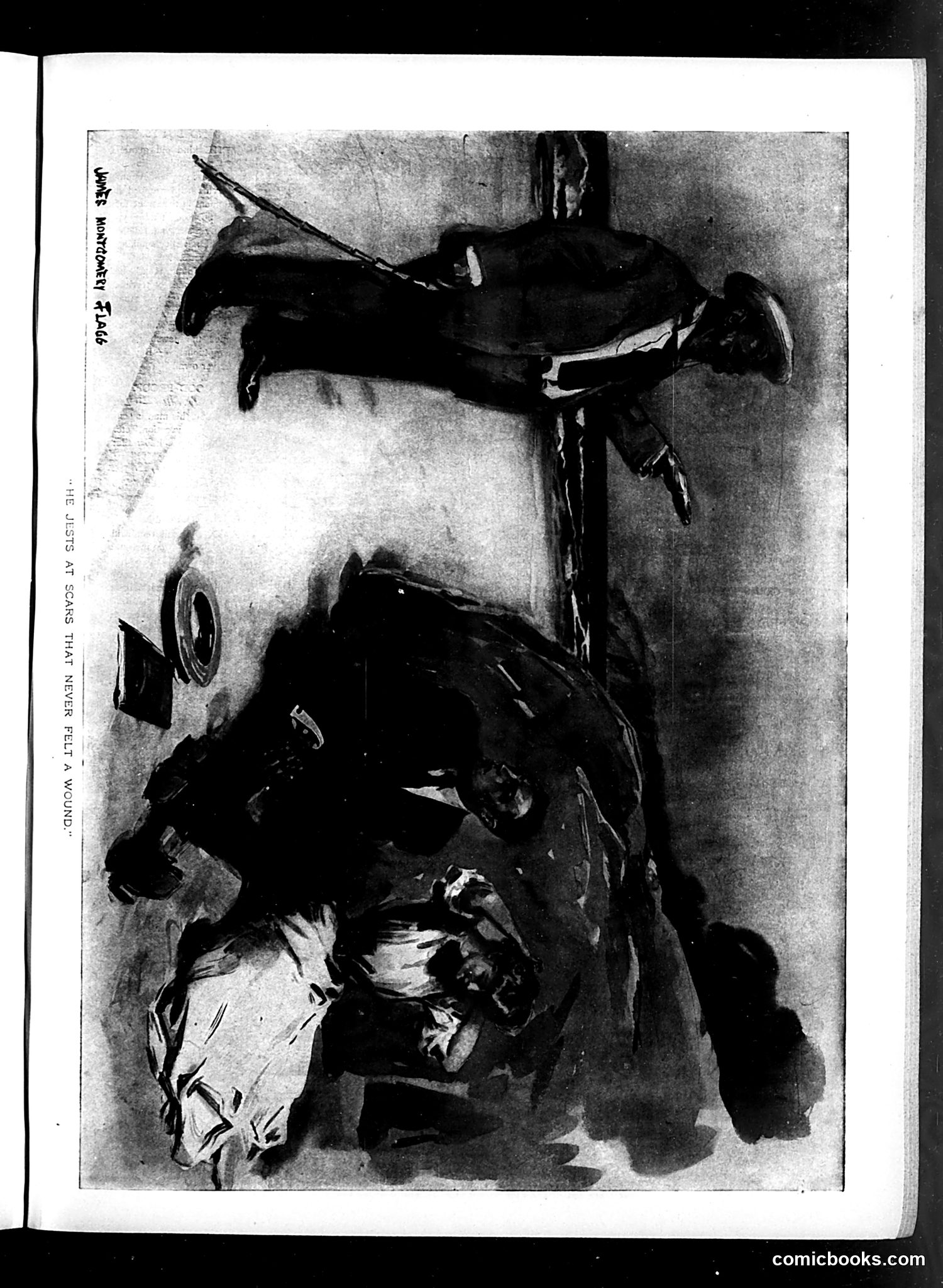
I can see this is a black and white illustration from Judge magazine, but the image is rotated 90 degrees, making it difficult to read clearly. The OCR text provided appears incomplete or corrupted, containing only fragmented characters that don't form coherent words. From what's visible in the illustration, there appear to be two figures in what looks like a satirical scene, rendered in a dramatic style typical of Judge's political cartoons. However, without legible text and with the image rotated, I cannot reliably identify the specific figures, the political event being referenced, or the satirical point being made. To properly explain this cartoon's meaning to a modern reader, I would need either a clearer, correctly-oriented image or accurate OCR text identifying the subject matter and date.
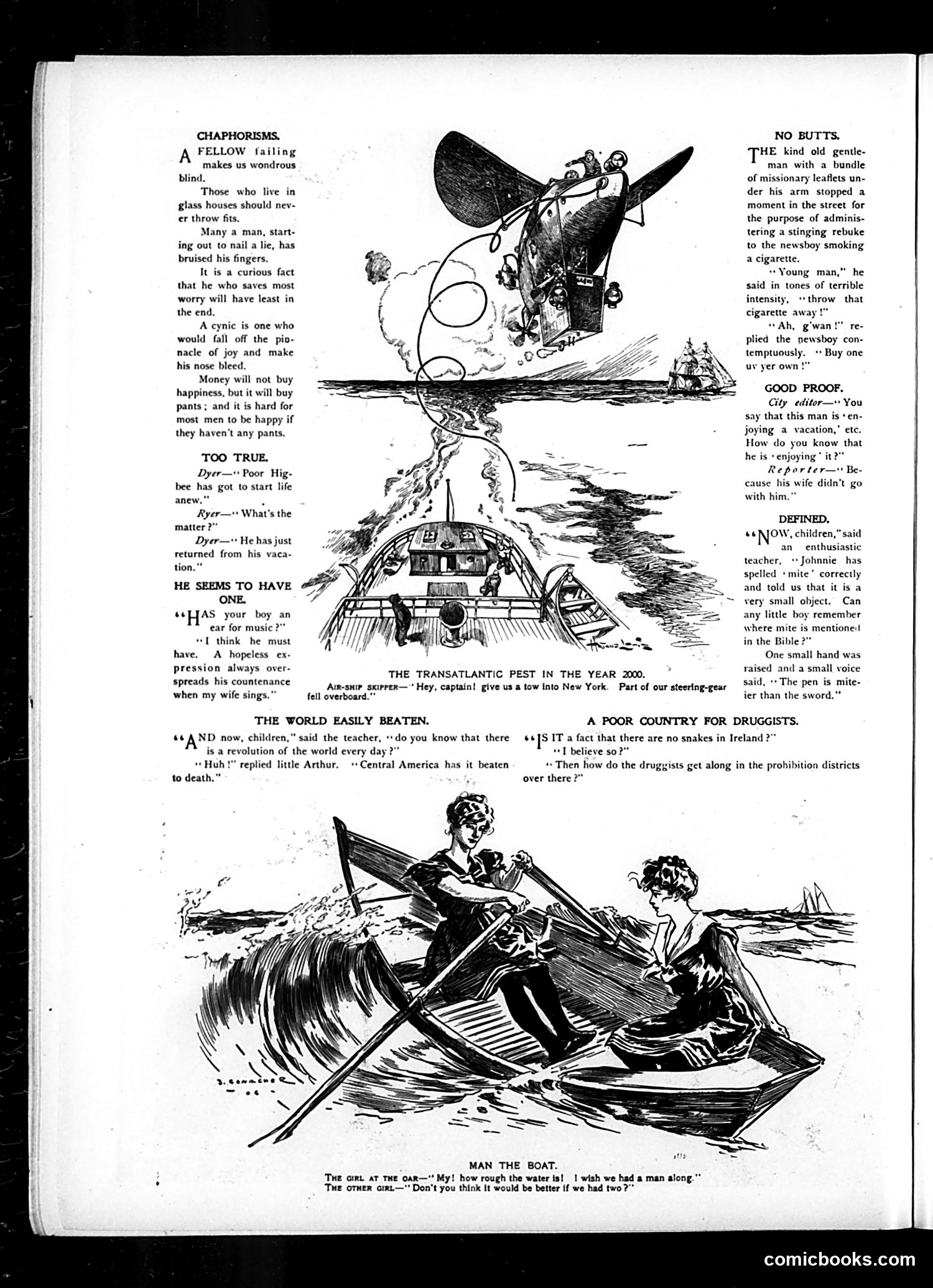
This page contains satirical commentary typical of early 20th-century American humor. The "Chaphorisms" section offers cynical observations on human nature—money can't buy happiness but can buy pants; those who save worry experience least in the end. The cartoons mock contemporary life: "No Butts" satirizes moral hypocrisy (a missionary lecturing a newsboy about cigarettes while ignoring larger issues); "Good Proof" jokes that a man enjoying vacation means his wife stayed home; "Defined" plays on a child's literalist misreading of "mite" in biblical context. The large central cartoon "The Transatlantic Pest in Year 2000" depicts futuristic airships, suggesting anxieties about technological change and transatlantic commerce. "Man the Boat" presents gender commentary through women discussing needing male assistance while rowing. The final exchange about Irish druggists and snakes appears to reference Prohibition-era smuggling jokes, playing on Ireland's reputation and America's alcohol ban.
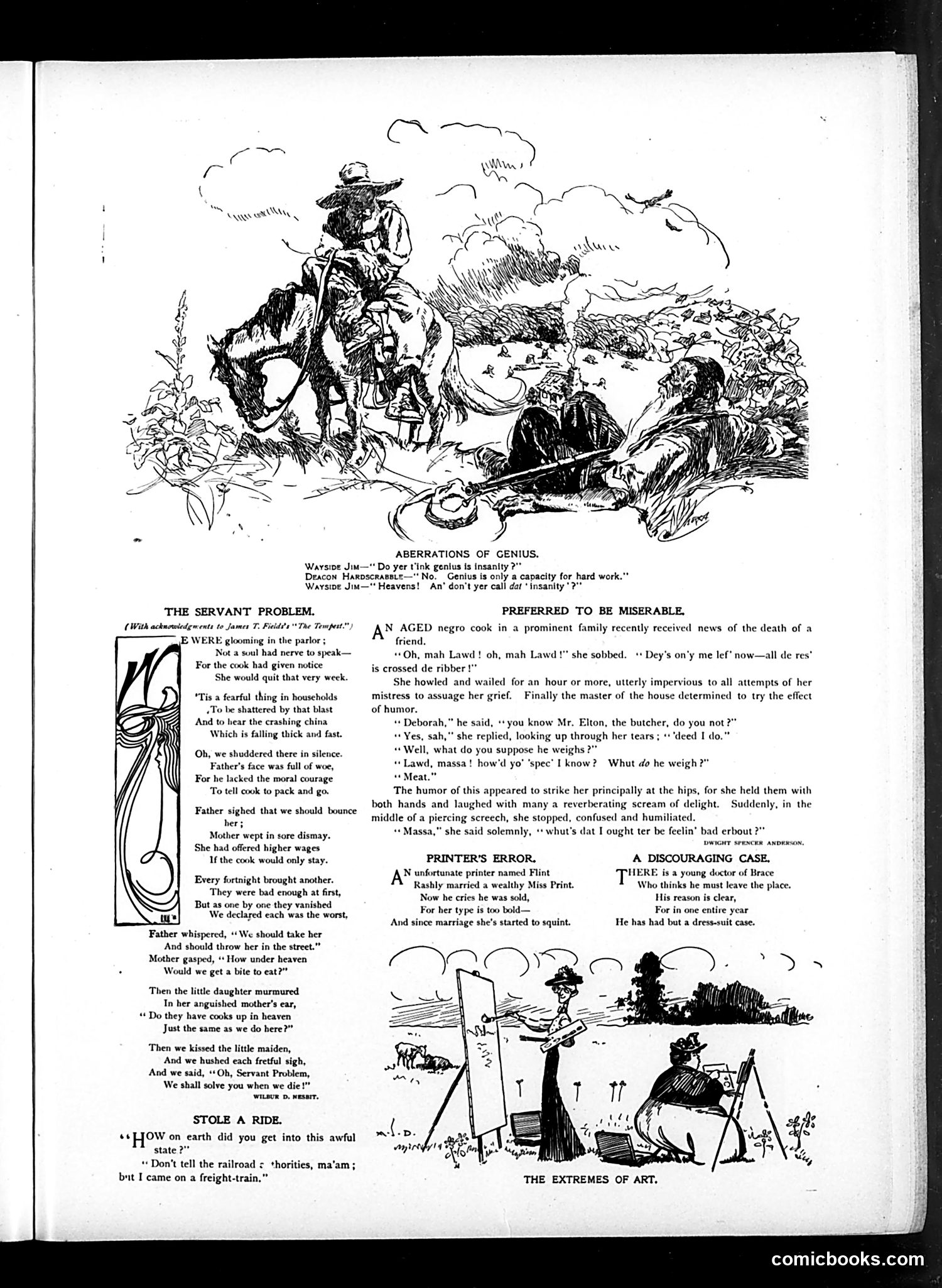
This page contains multiple short humorous pieces typical of Judge's satirical format: **"The Servant Problem"** is the main feature—a poem lamenting the era's domestic crisis. American households constantly lost kitchen staff, leaving families anxious about food and survival. The satire mocks both the servants' presumed ingratitude and the employers' helplessness; even their child's innocent question about afterlife cooks becomes a resigned joke about unsolvable social chaos. **"Preferred to Be Miserable"** uses racist dialect humor common to the period, depicting a Black cook's grief over a friend's death. The master attempts cheering her with a crude joke; she laughs, then guiltily remembers she "should" still be sad. The satire targets either the master's clumsy condescension or the cook's emotional confusion—likely both, through a modern-offensive lens. Minor pieces mock printer errors, freeloaders, and unsuccessful doctors. The top cartoon jokes about whether genius equals insanity. These were filler content for the magazine's satirical commentary on American social anxieties.
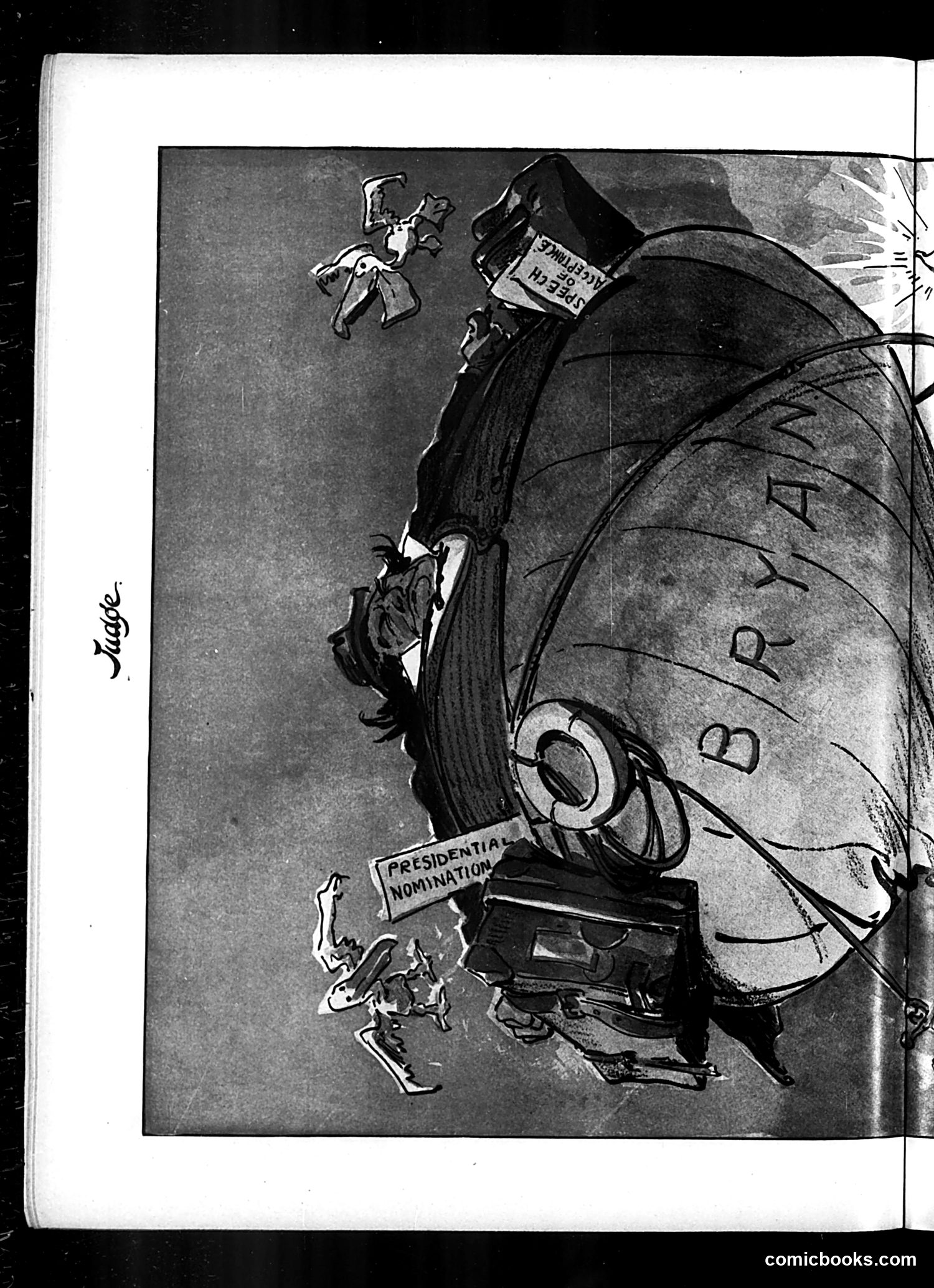
This appears to be a satirical cartoon from *Judge* magazine depicting a large elephant (the Republican Party symbol) carrying a small figure labeled "PRESIDENTIAL NOMINATION" on its back. The elephant is depicted as struggling or burdened by this weight. Small figures appear to be climbing on or falling from the elephant, suggesting internal party conflict or difficulty managing the nomination process. The text "PRESIDENTIAL NOMINATION" on what appears to be a platform or seat indicates the cartoon is satirizing Republican Party dynamics around selecting a presidential candidate. Without a visible date or clearer labels, the specific election year is unclear, but the composition suggests criticism of Republican internal strife or the challenging nature of their nomination process during this era.
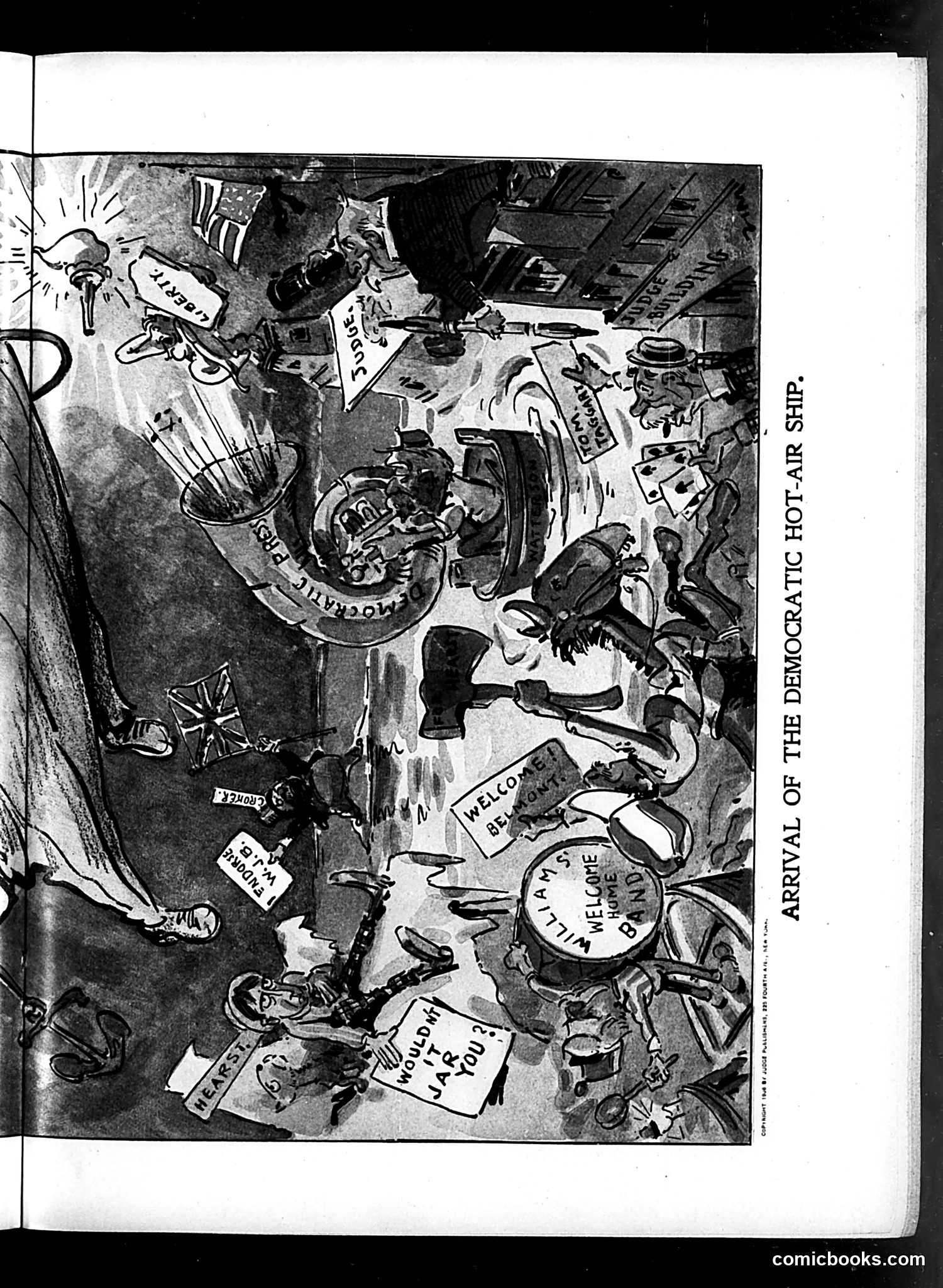
This is a political cartoon satirizing the Democratic Party's arrival or campaign strategy. The image depicts a fantastical airship labeled with Democratic references, populated by caricatured political figures. Various labels visible on the vessel and figures appear to reference Democratic politicians and party positions of the era. The satire centers on the notion that the Democratic Party operates on "hot air"—empty rhetoric and promises rather than substantive policy. The chaotic scene with multiple figures suggests internal disorder or competing interests within the party. Without clearer visibility of all specific labels and dates, I cannot definitively identify which election cycle or particular politicians are targeted, but the cartoon mocks Democratic political messaging as insubstantial performance rather than serious governance.
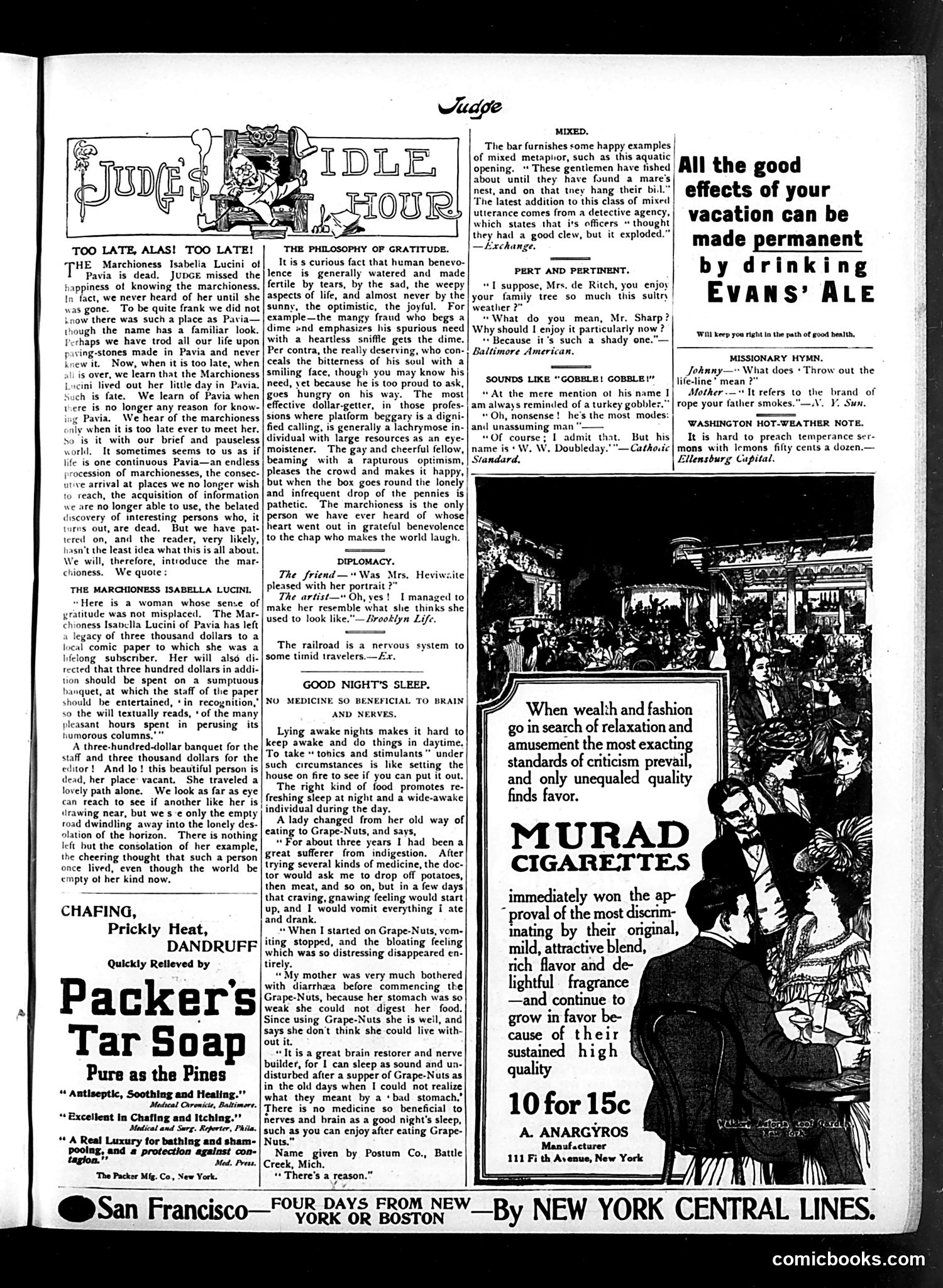
This page satirizes the human tendency to value people and things only after they're gone or lost. The central piece mocks the delayed recognition of the Marchioness Isabella Lucini of Pavia—a woman unknown to Judge magazine until her death, when they learned she'd generously bequeathed $3,000 to a local comic paper. The satire's point: Judge criticizes how society discovers worth too late. The magazine uses self-deprecating humor, admitting they didn't even know Pavia existed until learning of her legacy. The accompanying essay expands this critique, observing that human benevolence responds more to sadness and tears than to cheerful virtue. It's a commentary on misplaced gratitude and society's failure to appreciate goodness while people are alive—a bittersweet meditation on life's timing and human nature's flaws. The remainder of the page contains period advertisements for soap and cigarettes.
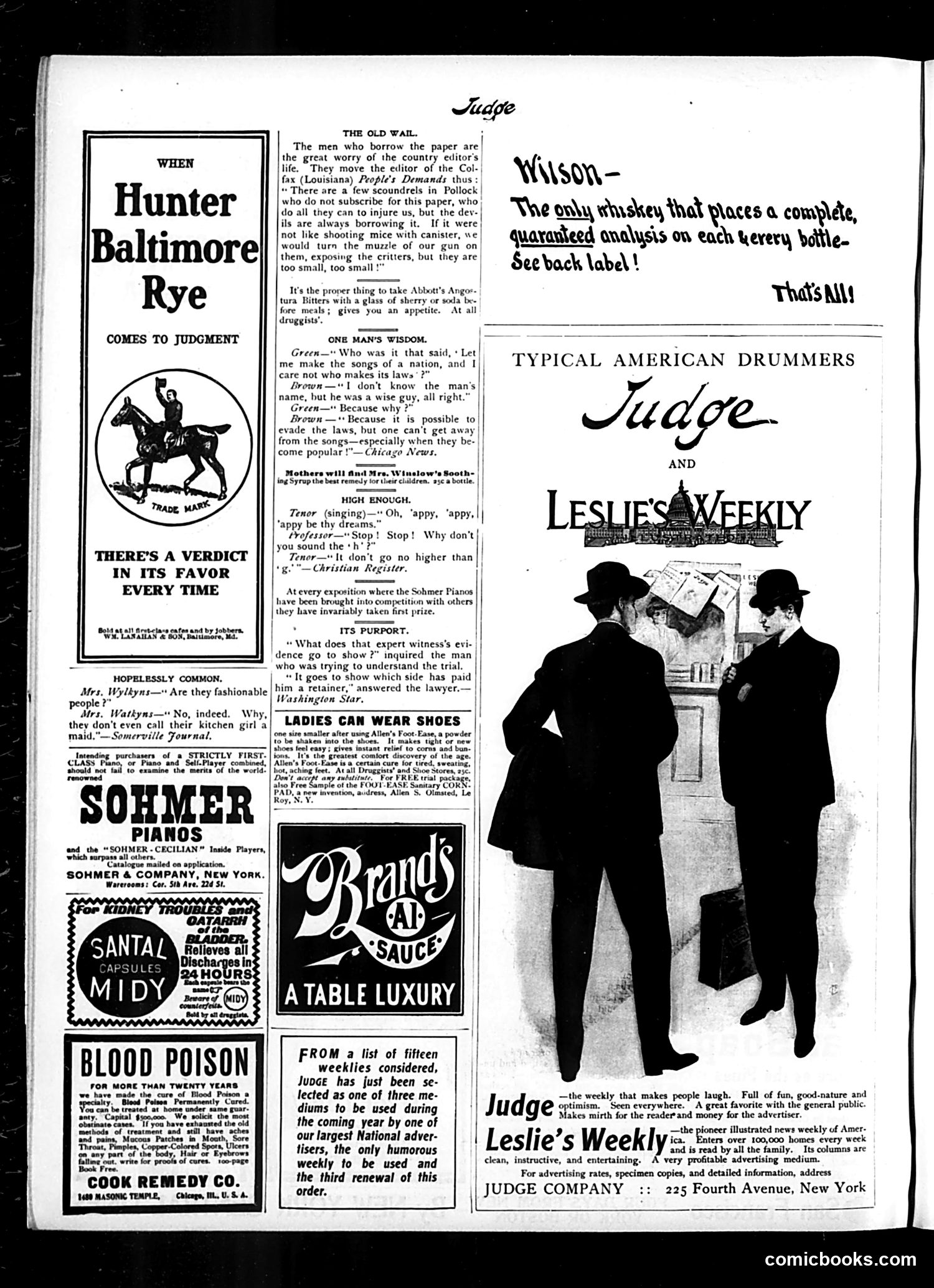
This is primarily an **advertising page** from Judge, a satirical weekly magazine. The page contains multiple product advertisements and small humorous snippets rather than a cohesive political cartoon. **Key content:** The left side features ads for Hunter Baltimore Rye whiskey, Sohmer pianos, and medical remedies (blood poison treatment, foot powder). The **satirical content** consists of brief jokes: - "The Old Wail" mocks rural newspaper editors frustrated by non-subscribers who borrow copies - "One Man's Wisdom" contrasts laws (evadable) with popular songs (inescapable) - "High Enough" jokes about a tenor's vocal range - "Its Purport" cynically suggests expert witnesses testify based on who paid them The right side advertises **Judge and Leslie's Weekly** magazines themselves, positioning them as profitable advertising mediums with large readerships. **Context for modern readers:** This reflects early 20th-century concerns (newspaper piracy, expert witness corruption) and demonstrates how satirical magazines funded themselves through dense advertising alongside editorial content.
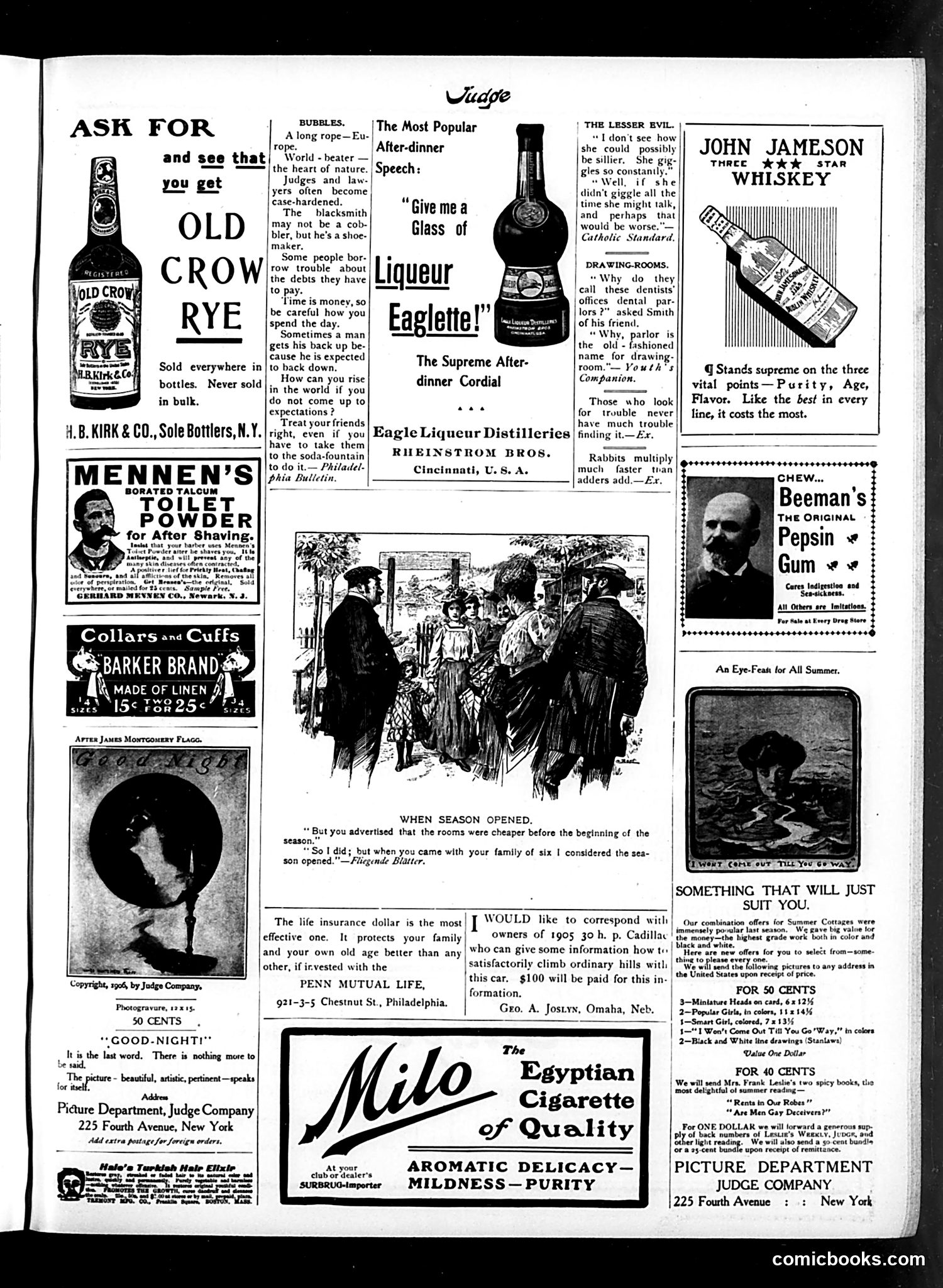
This is primarily an **advertising page** from Judge magazine (circa 1906, based on copyright notice). The page contains numerous product advertisements rather than political satire or editorial cartoons. The central cartoon—titled "When Season Opened"—shows a dialogue between a landlord and tenant: the tenant notes the landlord advertised cheaper rooms before the season started; the landlord replies that once the tenant arrived with his large family, "the season opened," implying he raised prices once the tenant was committed. This is gentle social satire about landlord exploitation and deceptive pricing practices common in the era. Otherwise, the page advertises whiskey, liqueurs, toilet powder, collars, cigarettes, gum, life insurance, and picture postcards. The small aphorisms scattered throughout are typical Judge filler—mild observations about human nature rather than political commentary. The page reflects early 20th-century consumer culture and leisure-class interests rather than serious political satire.
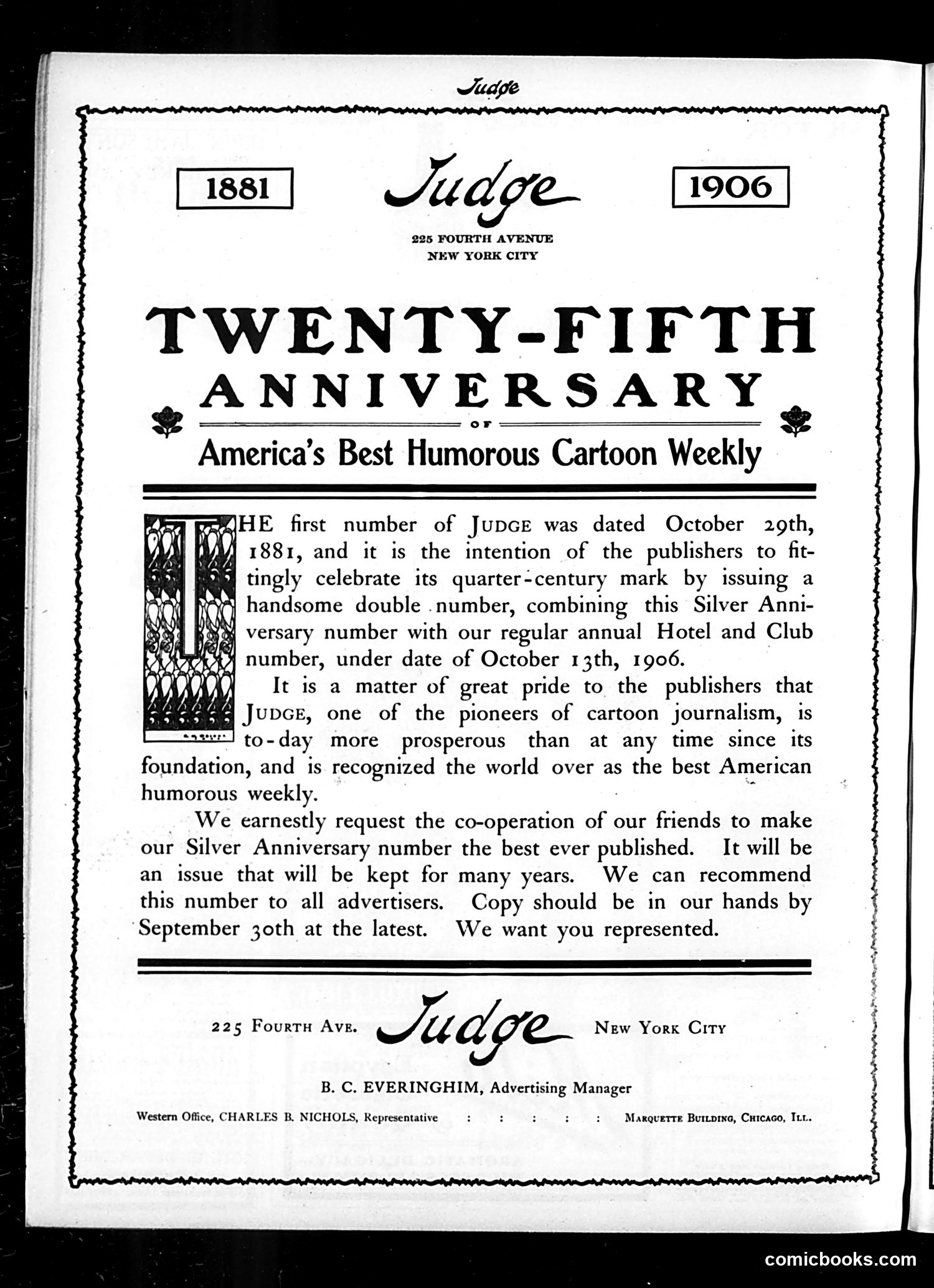
This is a **title page/advertisement**, not a political cartoon. It announces Judge magazine's twenty-fifth anniversary celebration in 1906 (founded October 29, 1881). The page is essentially a **call for advertisers**. Publishers proudly claim Judge is "America's Best Humorous Cartoon Weekly" and "recognized the world over" as the leading American humor publication. They're soliciting advertisements for a special double issue combining the anniversary celebration with their regular "Hotel and Club" number, due October 13, 1906. The publishers promise this will be a collectible issue "kept for many years" and appeal directly to businesses to participate. The deadline for ad copy submission is September 30th. Contact information lists B.C. Everinghim as Advertising Manager and Charles B. Nichols as Western Representative in Chicago. This reflects Judge's commercial success and status as a premier satirical publication in the early 1900s.
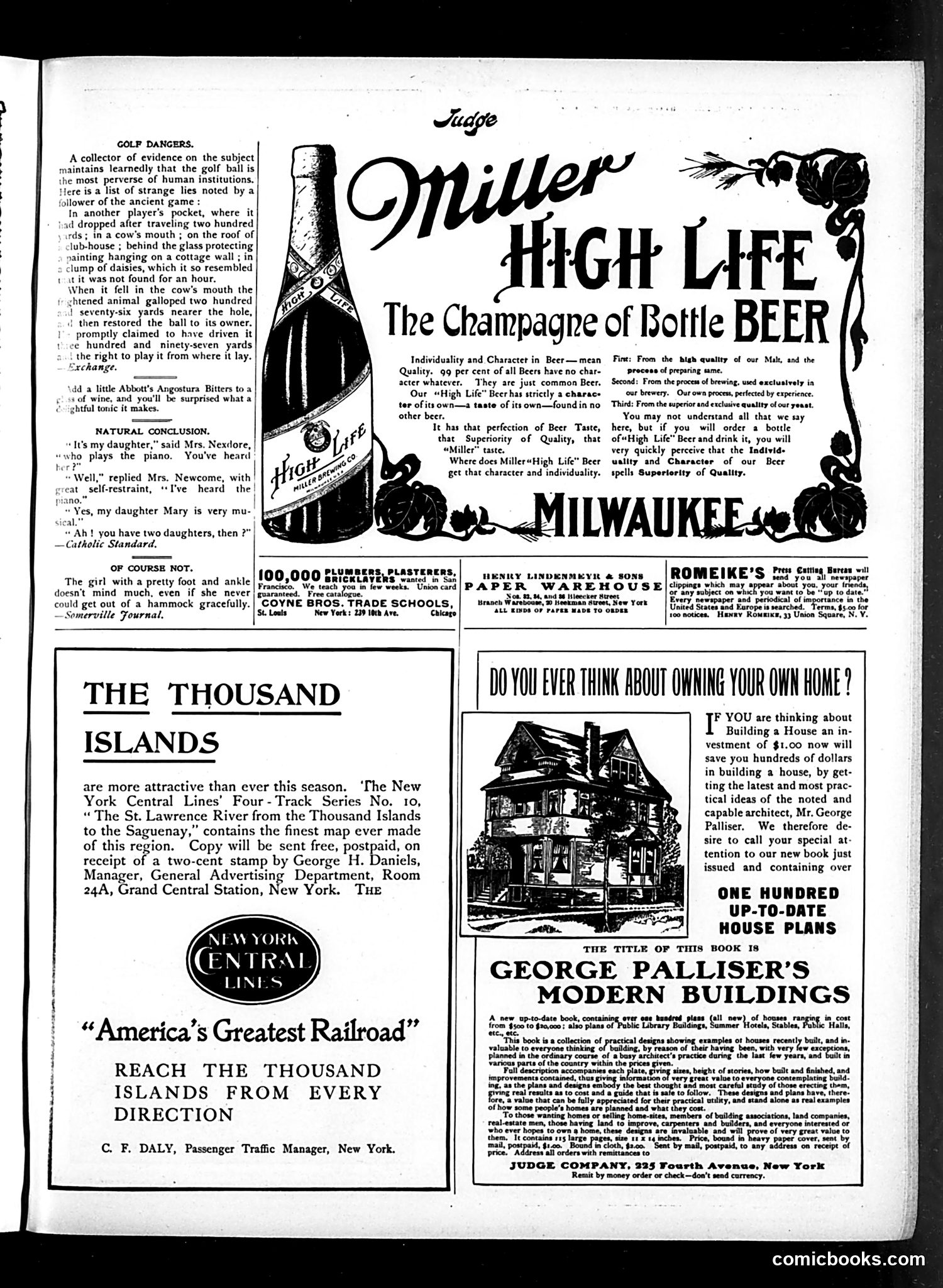
This page is primarily **advertising**, typical of early 20th-century American magazines. The main content is a large advertisement for **Miller High Life beer**, emphasizing its supposed superiority through quality ingredients, brewing process, and distinctive "character." The language reflects period marketing claiming scientific/technical superiority—common beer industry claims of the era. The page also includes several small **humorous snippets**: - "Golf Dangers" mocks the absurd obstacles golf balls encounter (a cow's mouth, cottage paintings) - "Natural Conclusion" is a joke about a piano-playing daughter, implying the piano itself is the real performer - "Of Course Not" is a light quip about women in hammocks The remaining advertisements promote tourism (New York Central Railroad's Thousand Islands route), home building plans by architect George Palliser, and trade services (plumbing schools, paper warehouses, news clipping services). **No political satire is evident.** This appears to be a typical Judge advertisements/humor page from the 1910s, reflecting consumer culture and leisure interests of prosperous American readers.
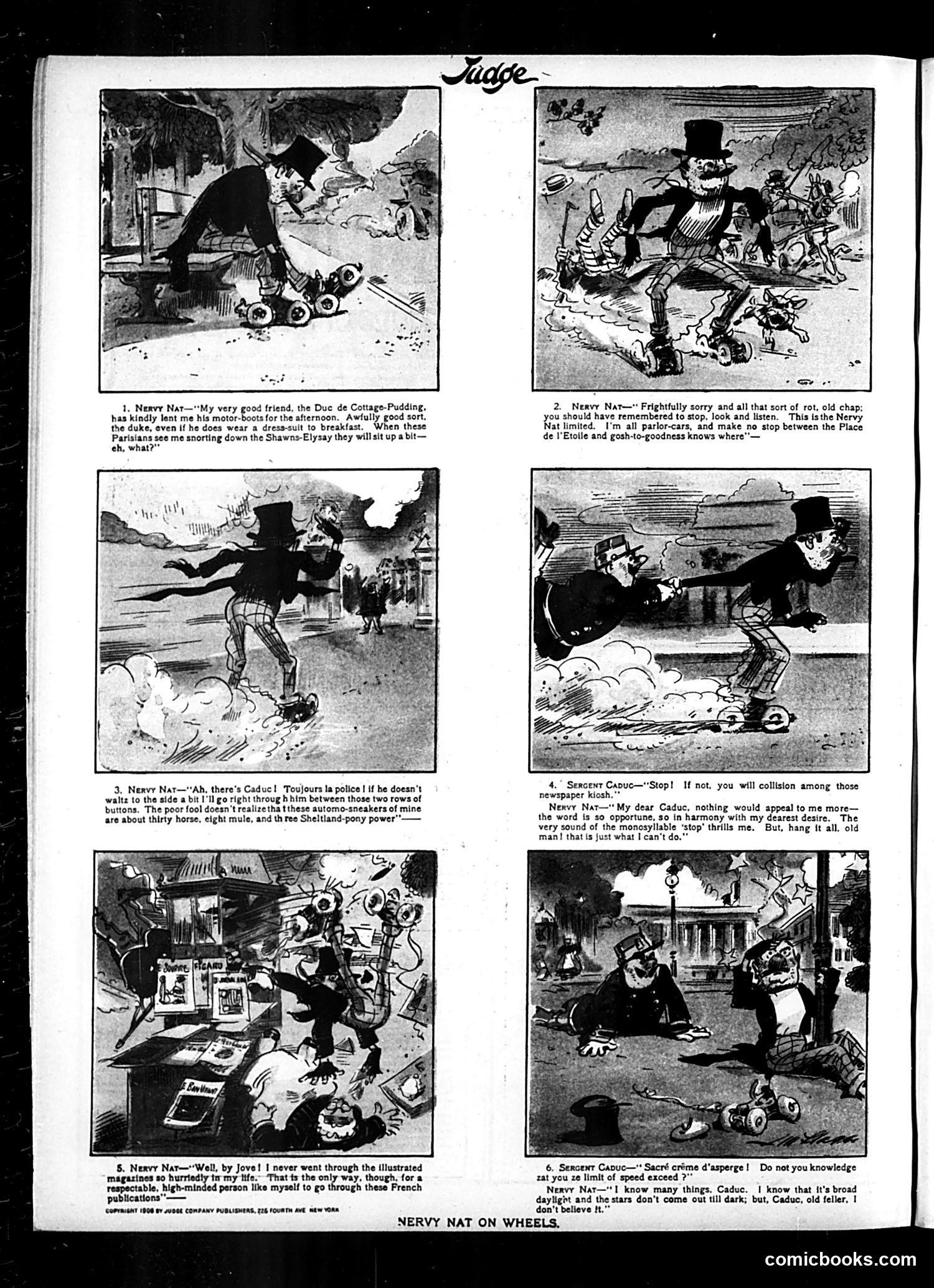
This is a satirical comic strip mocking an American tourist ("Nervy Nat") recklessly driving through Paris in a motorcar. The humor centers on his arrogant incompetence and disregard for local laws and safety. Nat boasts about his borrowed "motor-boots" and powerful vehicle while endangering pedestrians and police ("Caduc," likely a French officer). He nearly hits a policeman, dismisses traffic rules, and ignores speed limits—all while speaking in exaggerated, affected English ("eh, what?"). The satire targets: American tourists' cultural pretension and disrespect abroad; the dangers of early automobiles; and contempt for French authority. Nat's inability to stop his vehicle becomes a running joke symbolizing his complete lack of self-control. The French characters speak in caricatured accents ("Sacré créme d'asperge!"), reinforcing period stereotypes. Published in *Judge*, this reflects early-1900s anxieties about automotive safety and American tourists' perceived arrogance in Europe.