
Judge, 1906-08-25 · page 7 of 16
Judge — August 25, 1906 — page 7: what you’re looking at
What you’re looking at
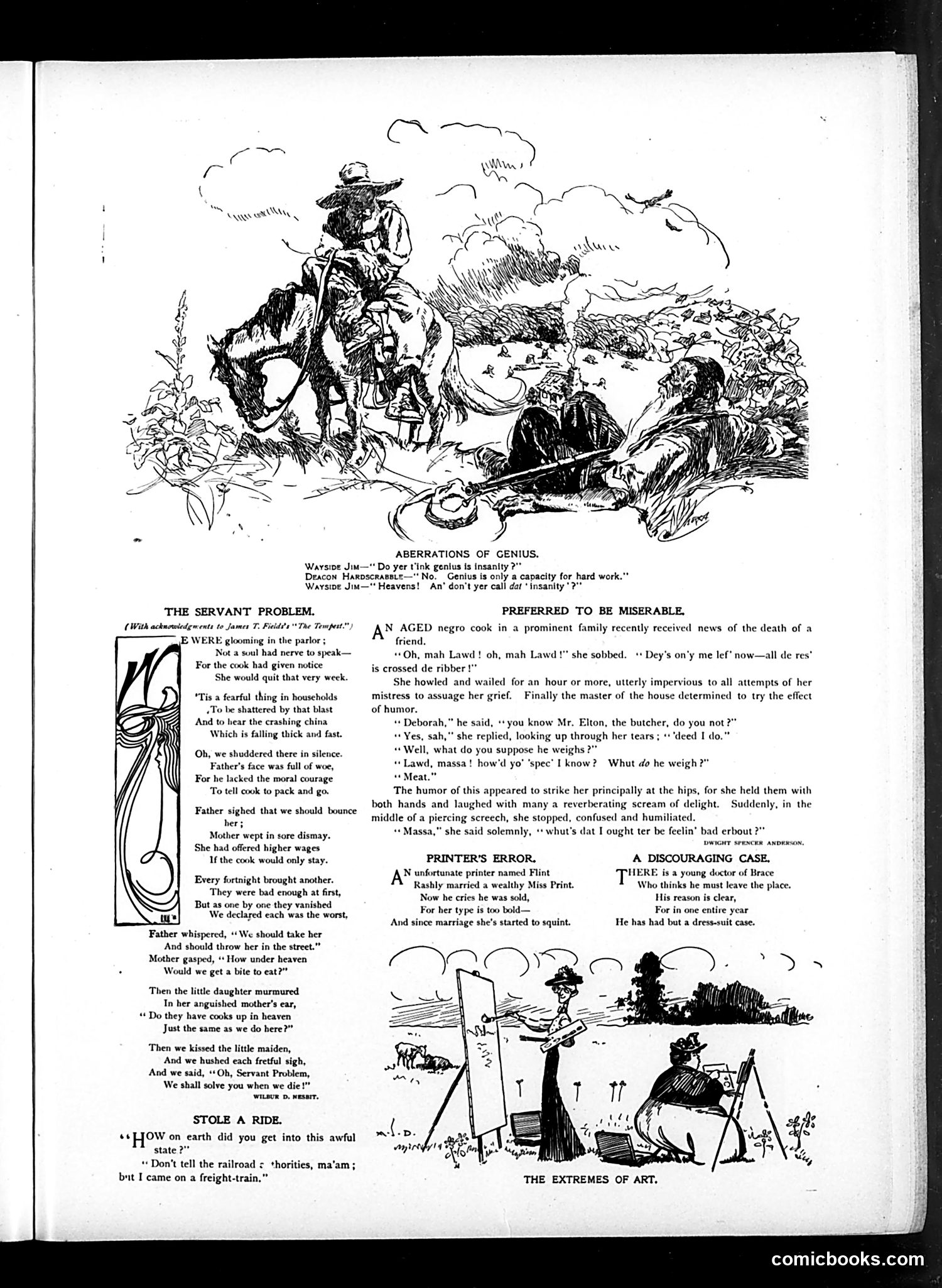
This page contains multiple short humorous pieces typical of Judge's satirical format: **"The Servant Problem"** is the main feature—a poem lamenting the era's domestic crisis. American households constantly lost kitchen staff, leaving families anxious about food and survival. The satire mocks both the servants' presumed ingratitude and the employers' helplessness; even their child's innocent question about afterlife cooks becomes a resigned joke about unsolvable social chaos. **"Preferred to Be Miserable"** uses racist dialect humor common to the period, depicting a Black cook's grief over a friend's death. The master attempts cheering her with a crude joke; she laughs, then guiltily remembers she "should" still be sad. The satire targets either the master's clumsy condescension or the cook's emotional confusion—likely both, through a modern-offensive lens. Minor pieces mock printer errors, freeloaders, and unsuccessful doctors. The top cartoon jokes about whether genius equals insanity. These were filler content for the magazine's satirical commentary on American social anxieties.
📄 Transcribed text from this page (OCR, searchable)
Machine-transcribed from the original scan — historical spelling and the odd misread are preserved.
——s c* Le vr ABERRATIONS OF GENIUS. Warsive Jim—"*Do yer t'ink genius is insanity ?" Deacon Harpscrassie—" No. Waysipe Jim—" Heavens! THE SERVANT PROBLEM. (With acknowledgments to James T. Fieidi's'*The Tempest") E WERE glooming in the parlor ; Not a soul had nerve to speak— For the cook had given notice She would quit that very week. ‘Tis a fearful thing in households .To be shattered by that blast And to hear the crashing china Which is falling thick and fast. Oh, we shuddered there in silence. Father's face was full of woe, For he lacked the moral courage To tell cook to pack and go. Father sighed that we should bounce her; Mother wept in sore dismay. She had offered higher wages If the cook would only stay. Every fortnight brought another. They were bad enough at first, But as one by one they vanished We declared each was the worst, Father whispered, ‘We should take her And should throw her in the street.” Mother gasped, ““ How under heaven Would we get a bite to eat?” ‘Then the little daughter murmured In her anguished mother’s ear, “Do they have cooks up in heaven Just the same as we do here?” ‘Then we kissed the little maiden, And we hushed each fretful sigh, And we said, ‘Oh, Servant Problem, We shall solve you when we die!” WILBUR D. wEsarr. STOLE A RIDE. ++} JOW on earth did you get into this awful state ?”” + Don't tell the railroad ¢ thorities, ma'am; but I came on a freight-train,” Genius is only a capacity for hard work.”* An‘ don't yer call dat * insanity?" PREFERRED TO BE MISERABLE. AN AGED negro cook in a prominent family recently received news of the death of a iend. «Oh, mah Lawd! oh, mah Lawd !" she sobbed. is crossed de ribber !" She howled and wailed for an hour or more, utterly impervious to all attempts of her mistress to assuage her grief. Finally the master of the house determined to try the effect of humor. “« Deborah,” he said, you know Mr. Elton, the butcher, do you not 2” “Yes, sah,” she replied, looking up through her tears ; ++ ‘deed I do.” “Well, what do you suppose he weighs ?"” “Lawd, massa! how'd yo’ ‘spec’ I know ? “« Meat.” The humor of this appeared to strike her principally at the hips, for she held them with both hands and laughed with many a reverberating scream of delight. Suddenly, in the middle of a piercing screech, she stopped, confused and humiliated. ** Massa,” she said solemnly, ** whut’s dat I ought ter be feelin’ bad erbout ?” DWIGHT SPENCER ANDERSON, ** Dey’s on'y me lef’ now—all de res" Whut do he weigh ?” A DISCOURAGING CASE, E is a young doctor of Brace Who thinks he must leave the place. His reason is clear, For in one entire year He has had but a dress-suit case. PRINTER'S ERROR. AN tnfortunate printer named Flint T Rashly married a wealthy Miss Print. Now he cries he was sold, For her type is too bold— And since marriage she’s started to squint. THE EXTREMES OF ART. comicbooks.com