
A complete issue · 16 pages · 1906
Judge — July 21, 1906
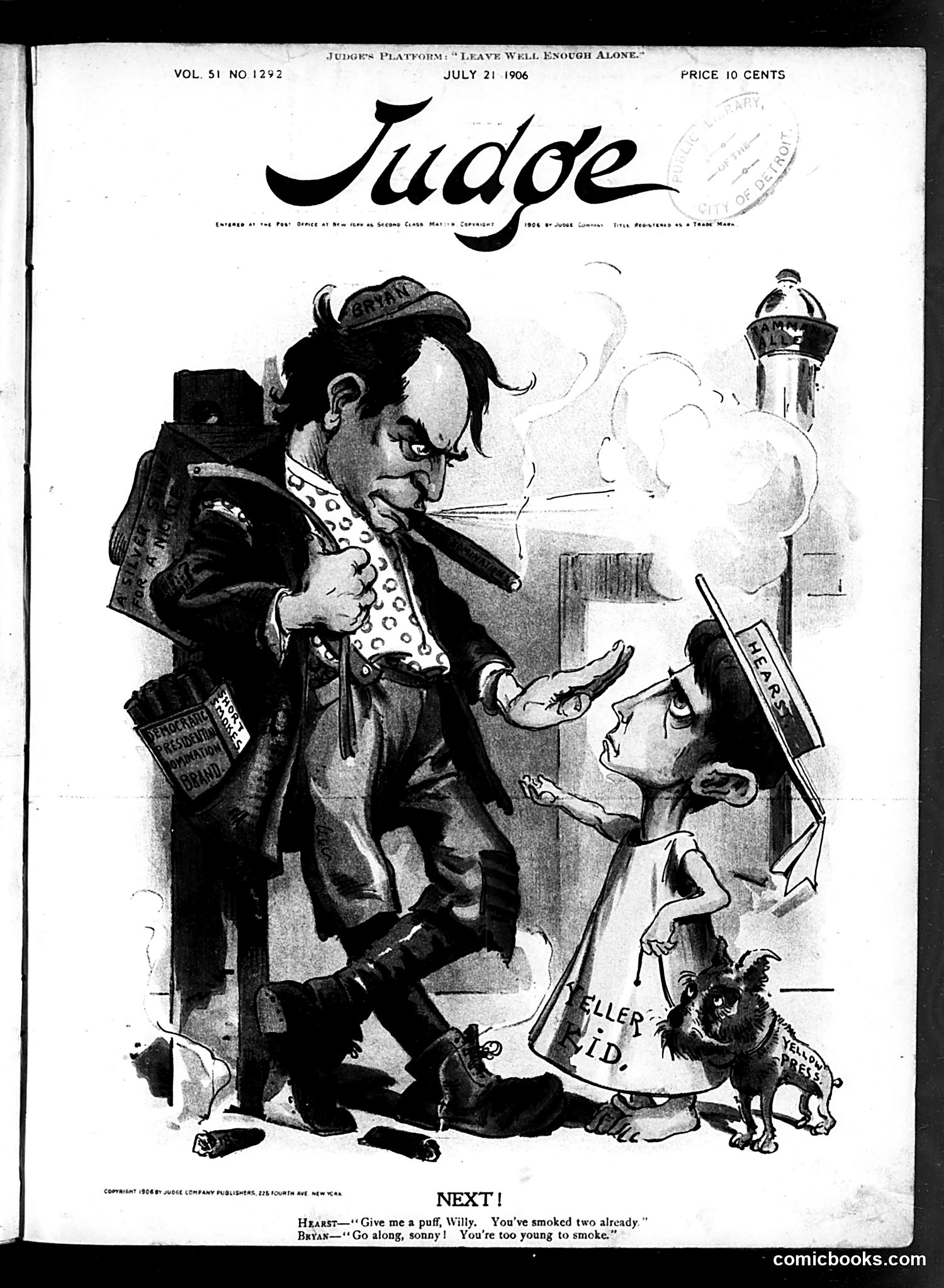
This Judge magazine cover from July 21, 1906 depicts a political cartoon titled "Leave Well Enough Alone." The central figure appears to be a well-dressed man smoking a cigar, confronted by a smaller figure (labeled "Willy") holding what looks like a rifle or gun marked "Heller Kid." A small dog is also present. The caption dialogue reads: Hearst says "Give me a puff, Willy. You've smoked two already" and Bryan responds "Go along, sonny! You're too young to smoke." This likely satirizes William Randolph Hearst (the man smoking) being rebuked by William Jennings Bryan regarding political ambitions or power-seeking. The cartoon suggests Hearst is overreaching or too inexperienced for his political aspirations, using the smoking metaphor to mock his pretensions.
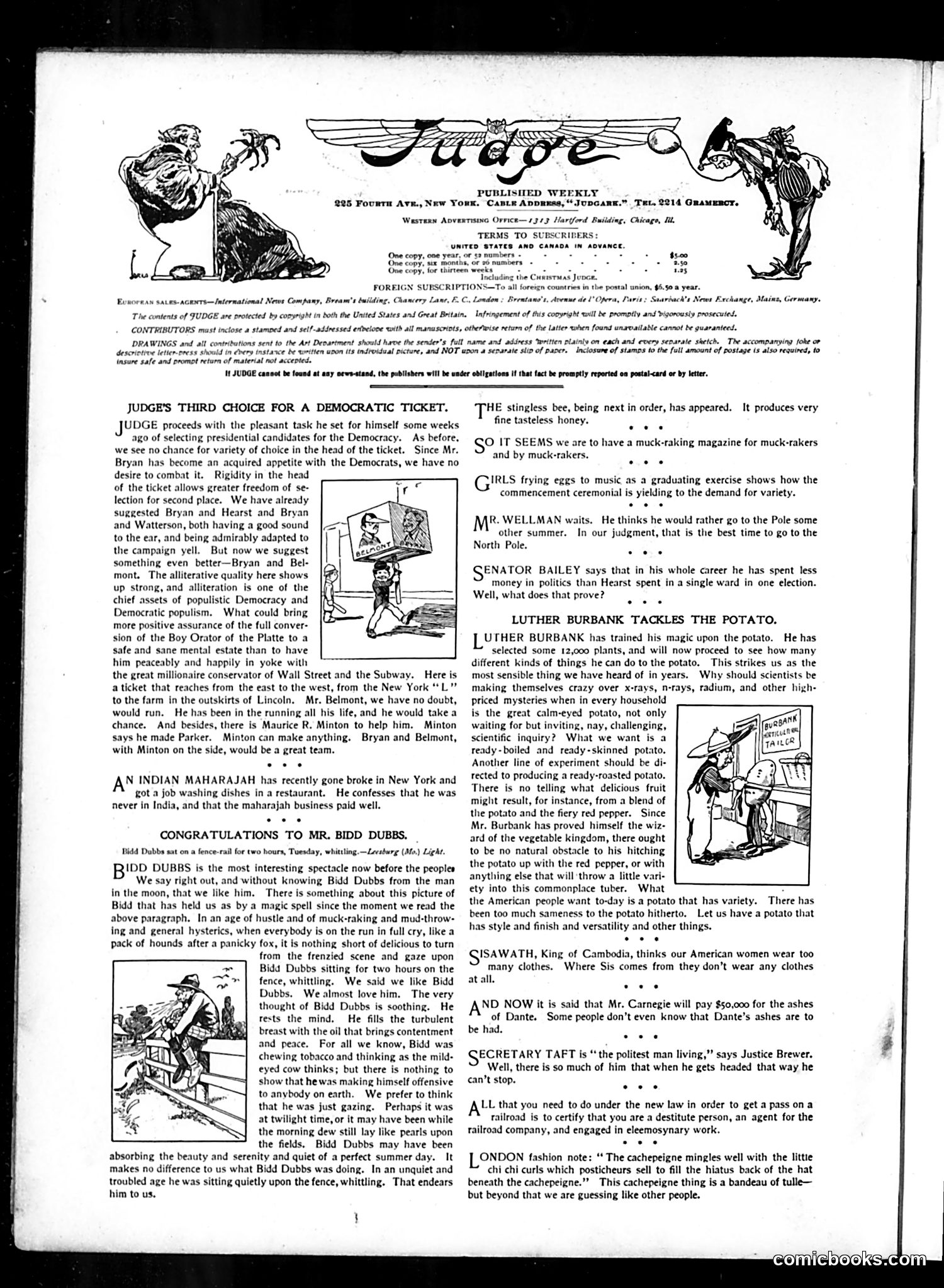
This page contains several brief satirical commentary pieces rather than a single cartoon. Key items include: **"Judge's Third Choice for a Democratic Ticket"**: A short editorial praising Bryan and Belmont as Democratic candidates, emphasizing their alliterative names and positive qualities. The accompanying cartoon appears to show a figure posting or considering a political notice. **"Luther Burbank Tackles the Potato"**: Satirizes the famous botanist's ambitious plant-breeding experiments, mocking the impracticality of creating a "ready-boiled" potato. The joke is that Burbank's scientific ambitions exceed common sense. **Other brief items** mock Senator Bailey's political spending, mock-raking magazine contributors, and fashion trends. The page reflects Judge's typical mix of political commentary and social satire from the early 20th century, targeting both political figures and contemporary trends with lighthearted mockery.
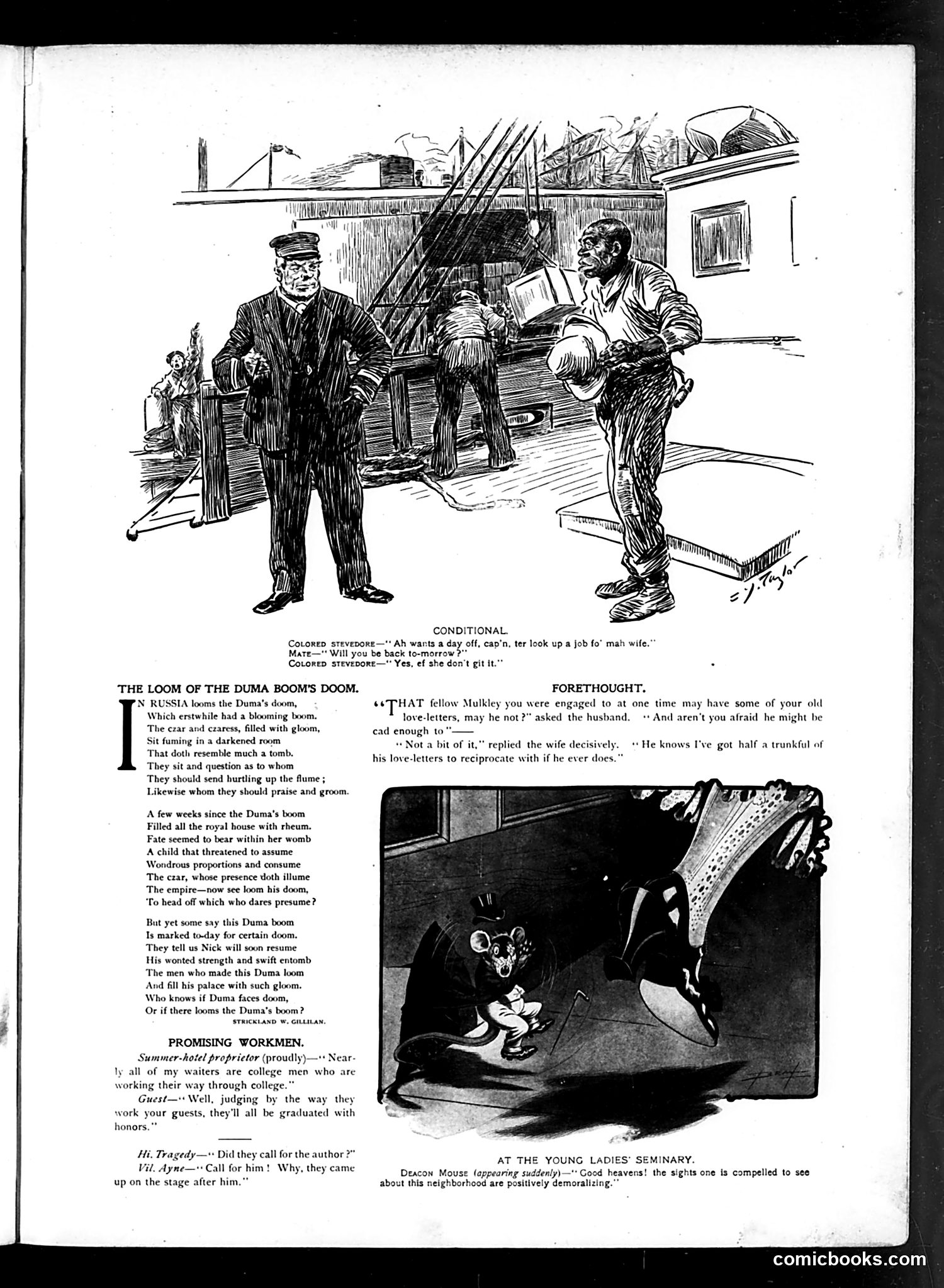
This page contains multiple satirical pieces from an early 20th-century American humor magazine. **Top cartoon** ("Conditional"): Shows a dock scene where a captain asks a colored stevedore to find his wife a job. The stevedore agrees only if the wife "doesn't git it"—racial satire mocking both working-class employment struggles and stereotypical dialect humor common to the era. **"The Loom of the Duma's Boom's Doom"**: A poem referencing Russia's Duma (parliament), likely commenting on early 20th-century Russian political turmoil and imperial instability. **Other sections** include brief comedic dialogue snippets about college workers and theatrical references, typical of Judge's mix of topical and generic humor. The page reflects period attitudes toward race, immigration, and international politics through satire.
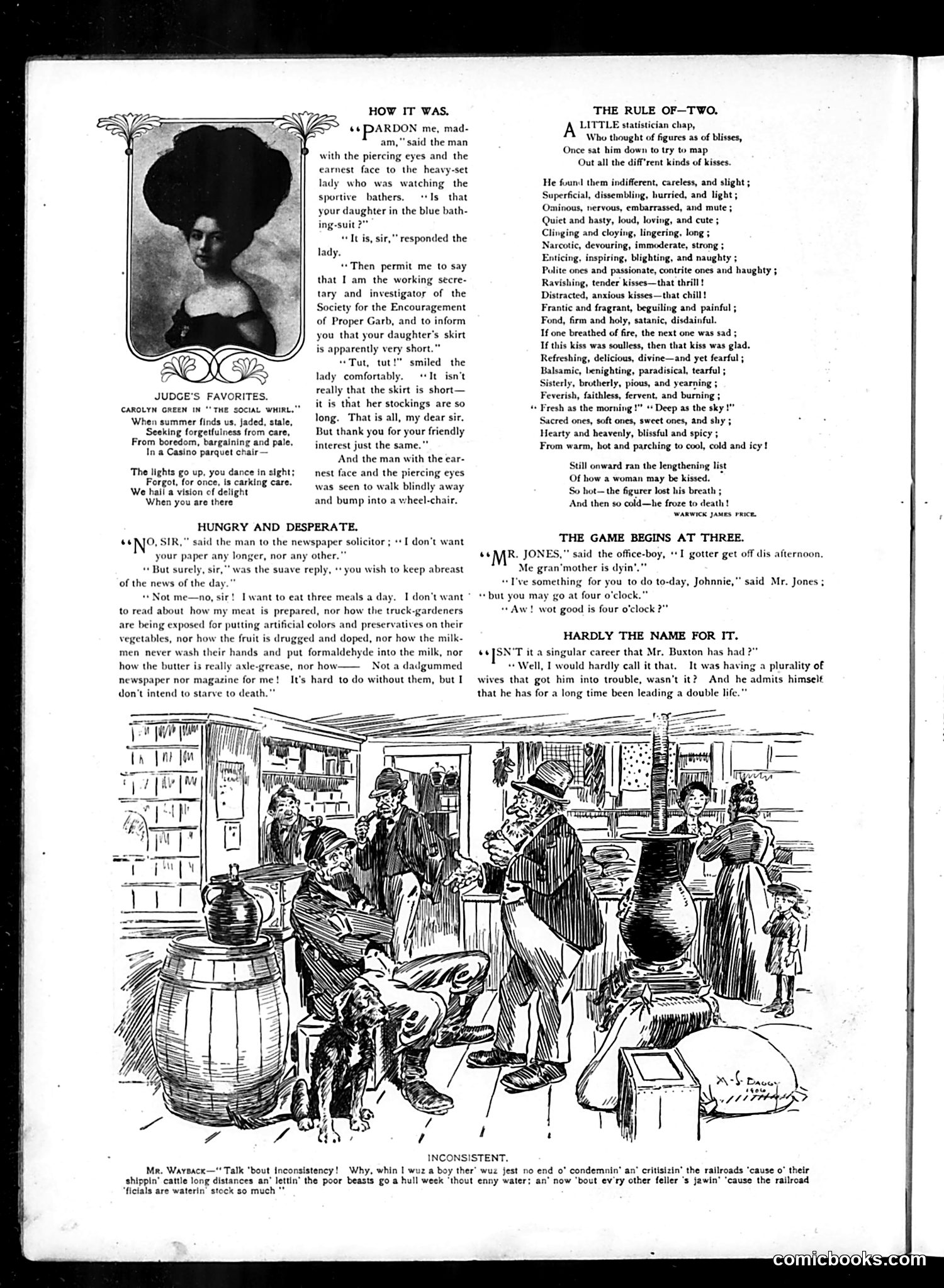
This page contains several satirical pieces rather than a single unified cartoon. **"Judge's Favorites"** features "Caroline Beale," described as "The Social Whirl," depicting a woman in fashionable dress—likely satirizing high-society women's concerns with fashion and social status. **"The Rule of Two"** is a poem mocking the indiscriminate kissing habits of women, listing various types of kisses (ravishing, tender, frantic, etc.) in exaggerated detail—social satire on changing courtship norms or women's behavior. **"Hungry and Desperate"** shows dialogue between a man and newspaper solicitor, with the man complaining about adulterated food and wanting three meals daily—likely satirizing economic hardship or labor conditions. **The bottom cartoon** depicts a crowded scene labeled "Inconsistent," with Mr. Wayback criticizing railroad policies using dialect speech—appears to be rural social commentary on business inconsistency.
I can see this is a black and white photograph or illustration from Judge magazine, but the image quality and contrast make it difficult to discern clear details. The OCR text appears to be missing or didn't capture properly from this page. Without legible text or clearer visual details, I cannot reliably identify specific figures, political references, or the satirical point of this cartoon. The image shows what appears to be figures in dramatic lighting or shadow, but I cannot make out enough detail to explain the joke or social commentary to a modern reader with accuracy. To properly analyze this page, I would need either: clearer image resolution, the actual OCR text that should accompany it, or additional context about the publication date.
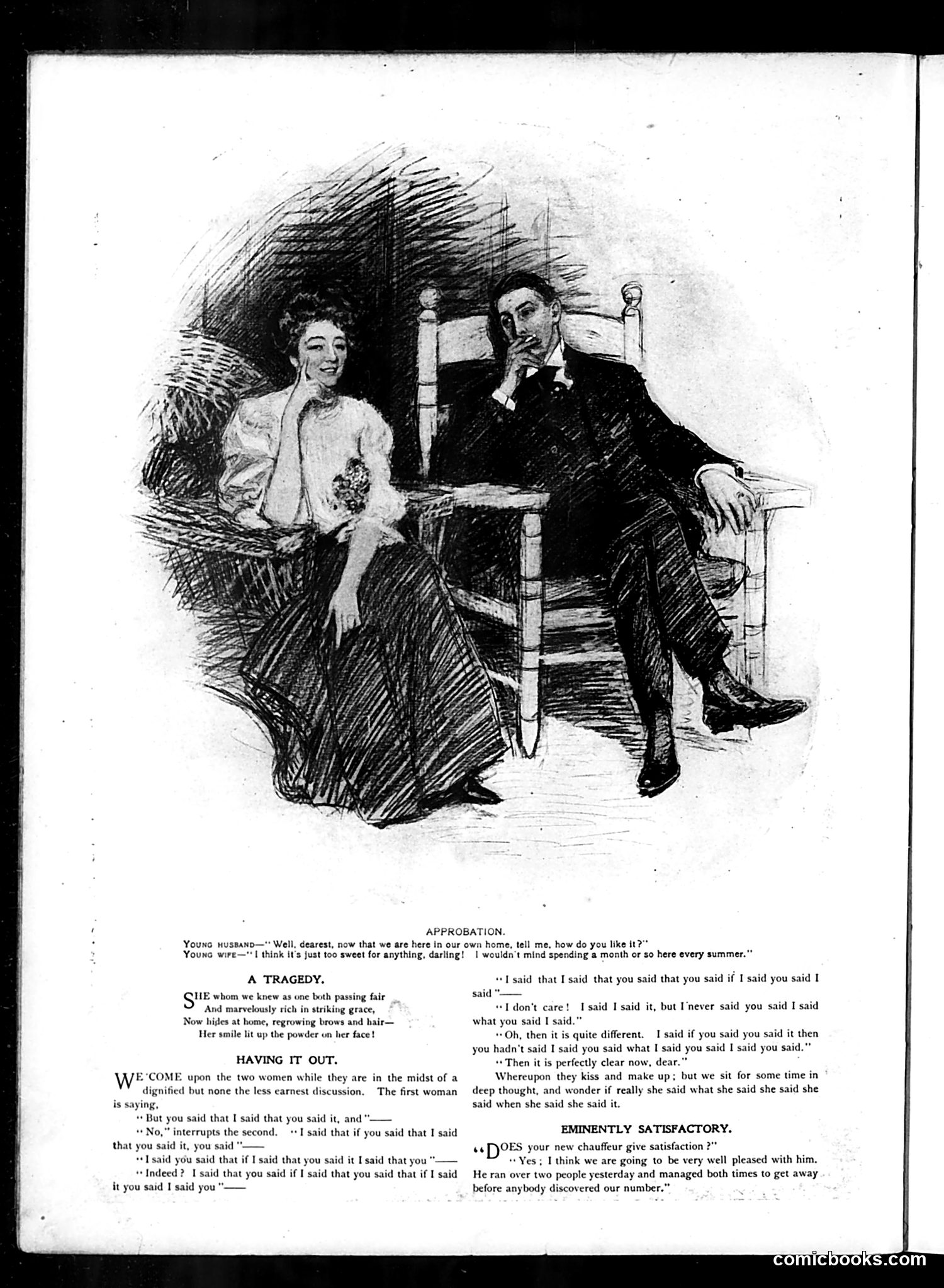
This page contains three satirical pieces mocking early 20th-century domestic life and social pretension. **"Approbation"** depicts newlyweds in their home—a simple joke about marital contentment and the wife's shallow enthusiasm for material comfort. **"A Tragedy"** mocks a once-beautiful woman whose appearance has deteriorated from age or illness. The cruel humor targets her vanity: she's now "regrowing brows and hair" at home while her smile is obscured by powder—suggesting she's become ridiculous or pathetic. **"Having It Out"** satirizes marital disputes and female gossip through deliberately circular, nonsensical dialogue where two women argue about who said what, becoming hopelessly tangled in their own contradictions. The joke mocks women's perceived tendency toward petty, illogical quarreling. **"Eminently Satisfactory"** darkly satirizes wealthy indifference to justice: a couple approves their new chauffeur specifically because he's hit pedestrians twice and escaped consequences—suggesting the wealthy believe themselves above accountability. These pieces reflect period attitudes toward women, class, and social propriety common to Gilded Age satire.
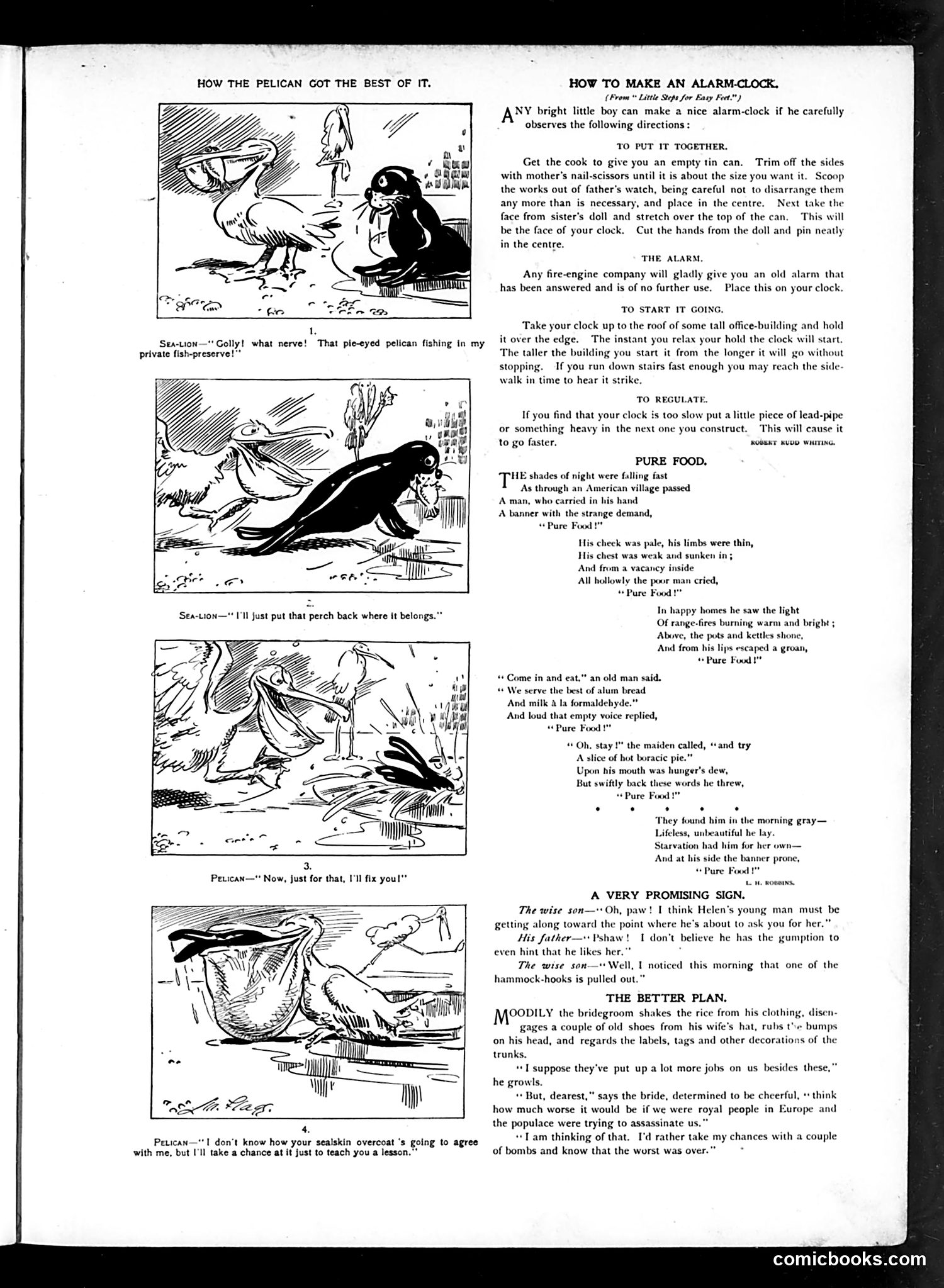
**"How the Pelican Got the Best of It"** is a humorous visual narrative with no apparent political content. A wealthy person complains about a pelican fishing in their private preserve; the pelican responds by swallowing the person's sealskin overcoat as revenge—a simple joke about comeuppance. **"Pure Food"** is sharp social satire addressing genuine Progressive Era concerns about food safety. A gaunt man wanders seeking "Pure Food" while being offered bread made with alum and milk with formaldehyde—real adulterants found in early 1900s food. He starves rather than consume poisoned food. This mocks both unscrupulous food manufacturers and the inadequacy of food regulations, reflecting anxieties that culminated in the 1906 Pure Food and Drug Act. The remaining pieces are lightweight domestic humor requiring no historical context. The page illustrates Judge's range: from pure comedy to serious social criticism of industrial-era consumer dangers.
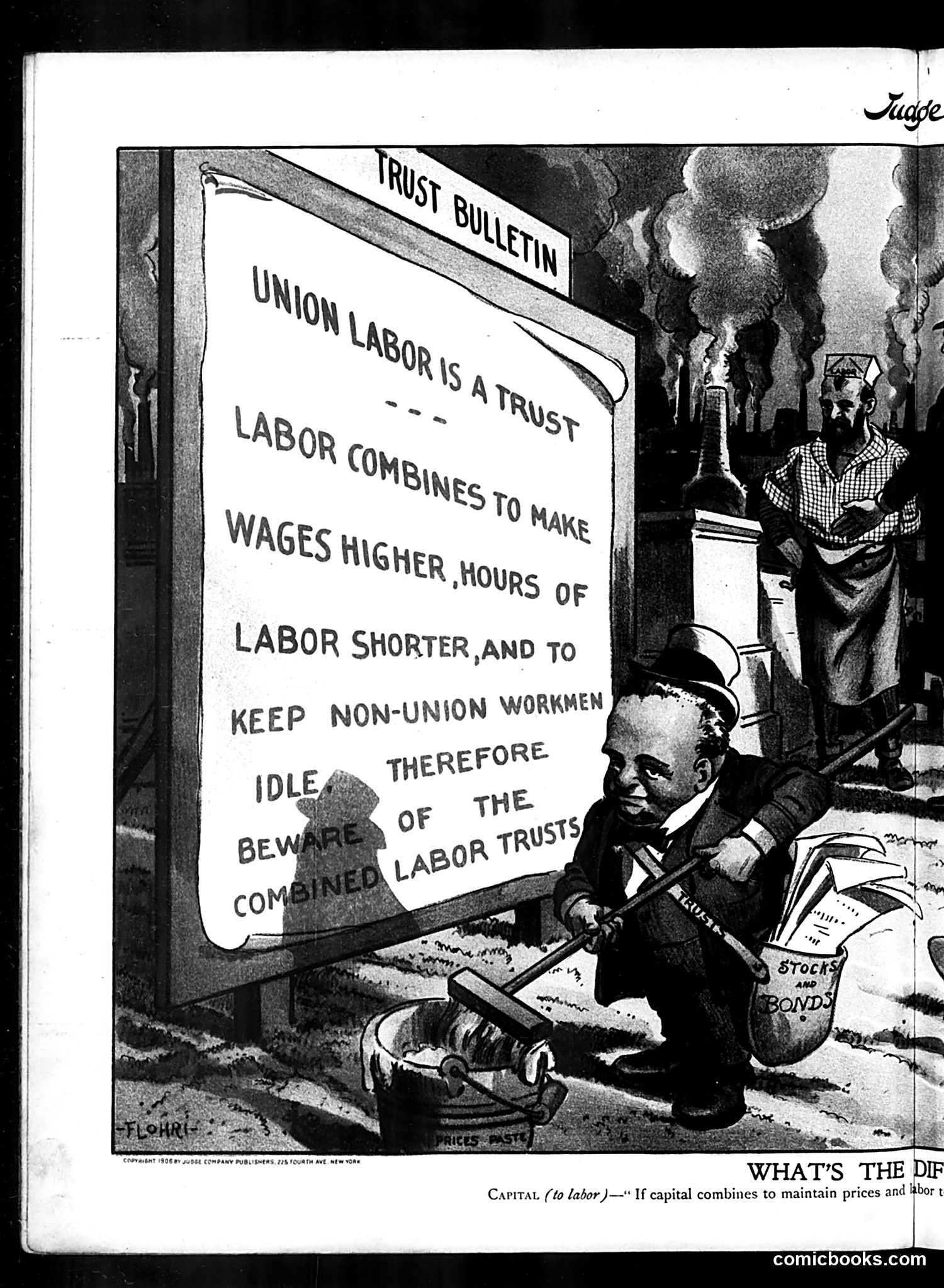
This Judge magazine cartoon satirizes labor unions by depicting them as trusts—monopolistic combinations comparable to corporate cartels. The "Trust Bulletin" billboard warns that unions function like capital trusts: combining workers to raise wages, shorten hours, and exclude non-union laborers from employment. The figure at bottom left (labeled "Capital") appears to be a capitalist or businessman examining financial documents. The cartoon's central irony—captured in the incomplete caption "What's the Dif[ference]"—suggests unions and capital trusts employ identical monopolistic tactics, questioning whether labor organizations genuinely differ from the corporate consolidations they oppose. This reflects early-20th-century anti-union sentiment portraying organized labor as economically harmful trusts rather than worker-protection organizations.
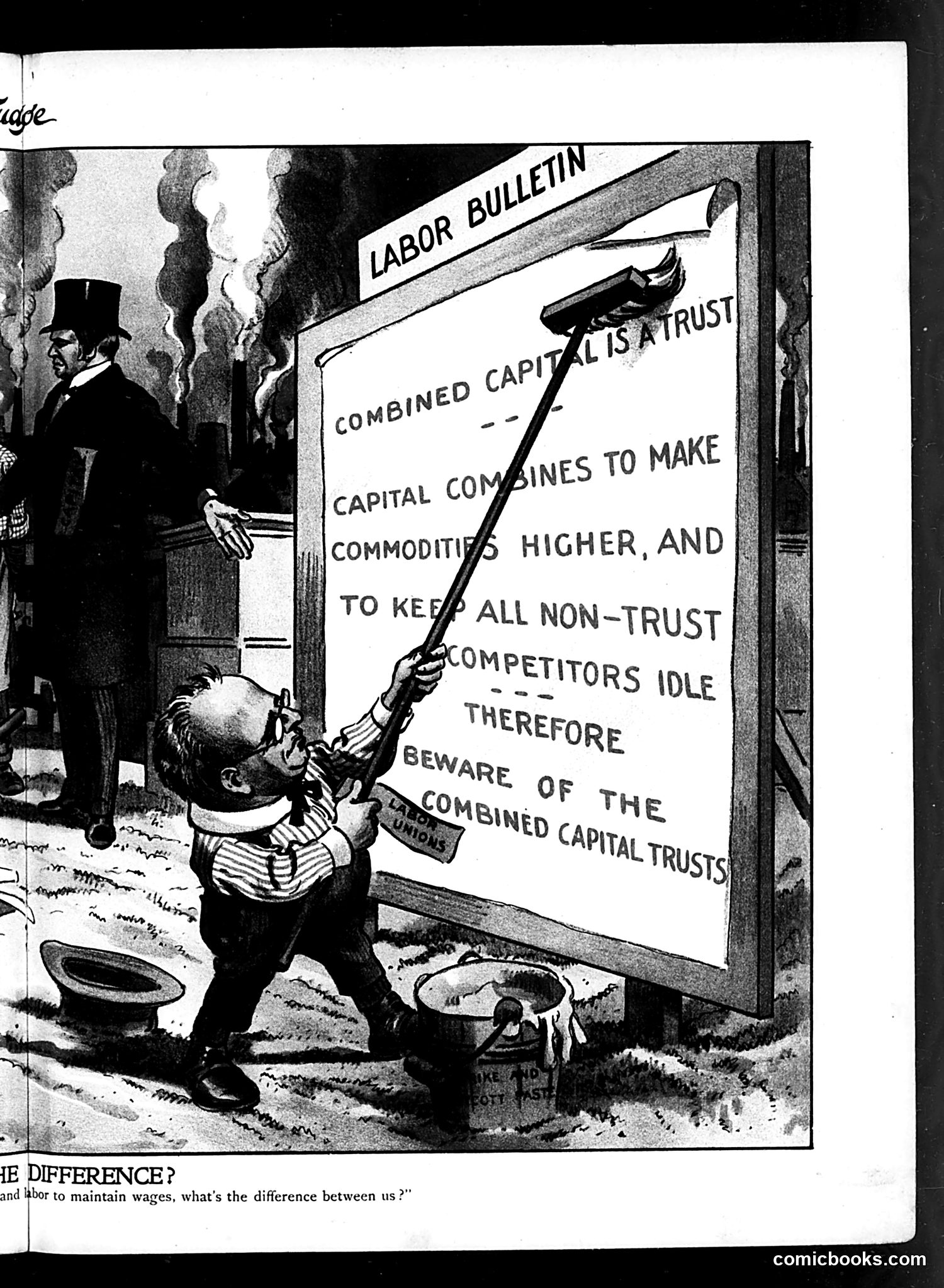
This cartoon critiques **monopolistic business practices** ("combined capital trusts"). A well-dressed capitalist (top left, in top hat) observes a worker posting a "Labor Bulletin" that warns against trusts. The bulletin explains that combined capital raises commodity prices and forces non-trust competitors out of business. The satire is sharp: the cartoon suggests **capitalists and trusts operate similarly to labor unions**—both combine to control markets and eliminate competition. The worker's posted message essentially argues: if trusts conspire to raise prices and crush competitors, why should workers not unionize to maintain wages? The half-visible text at bottom ("what's the difference between us?") makes the equation explicit. This reflects **early 20th-century debate over whether labor organizing was legitimate self-defense against monopolistic business practices**.
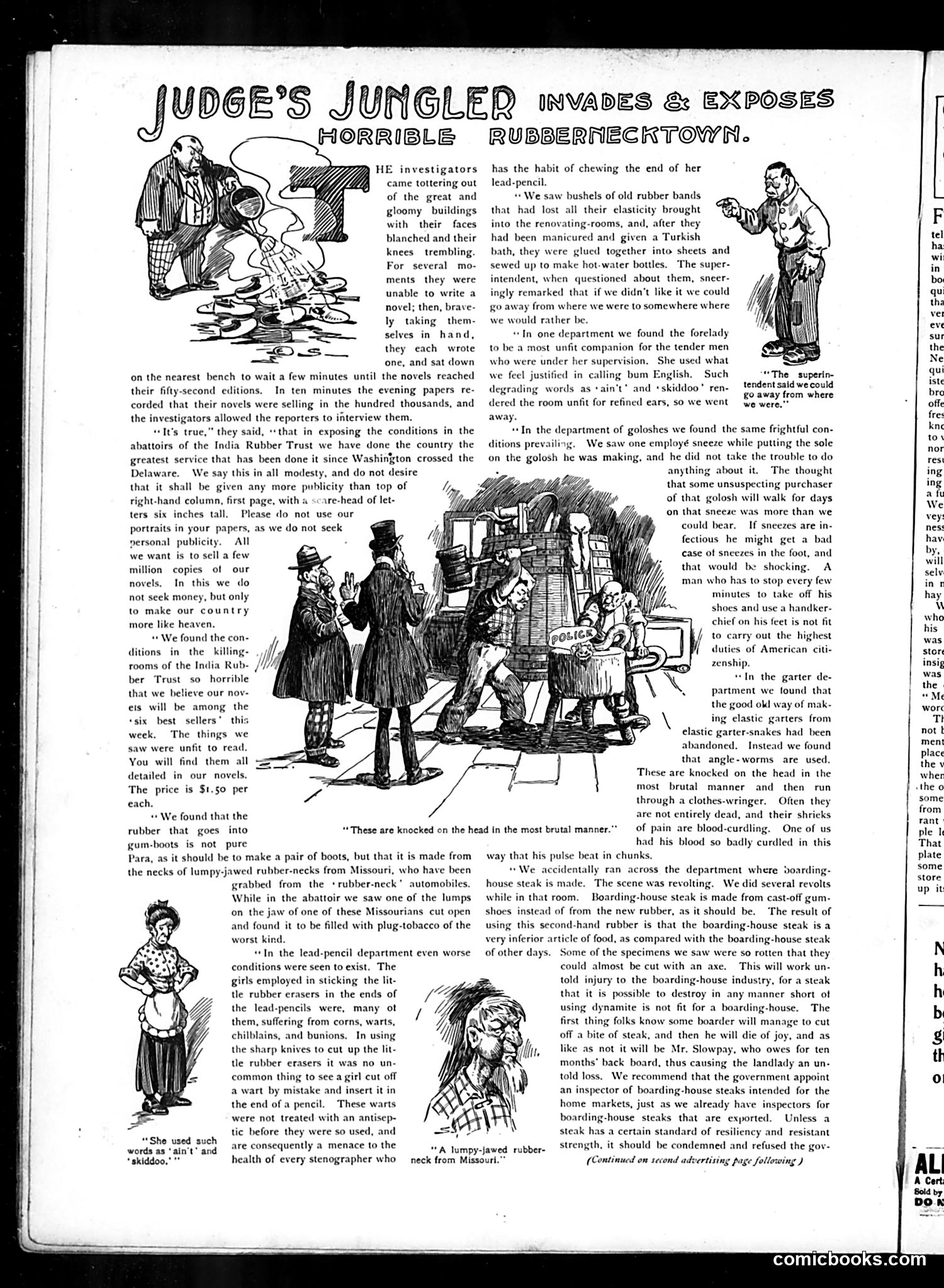
This satirical piece mocks muckraking journalists and reformers who investigate industrial abuses then immediately publish sensationalized novels about their findings for profit. The "investigators" emerge from inspecting the India Rubber Trust's facilities claiming to have uncovered horrific conditions—workers suffering foot ailments, unsanitary practices involving warts in pencils, contaminated materials—yet simultaneously admit their real goal is selling "a few million copies of our novels." The satire targets the contradiction between claimed moral outrage and naked commercial self-interest. The investigators deny seeking "personal publicity" while demanding front-page coverage with large headlines. The absurdist details (rubber made from "lumpy-jawed" Missourians, warts inserted into pencils) highlight how exaggerated and suspect these exposés appear. "Rubbernecktown" itself is a period term for tourist areas or sensational spectacles, making the title a pun: the reformers are themselves the "rubber-necks"—gawking opportunists rather than sincere advocates.
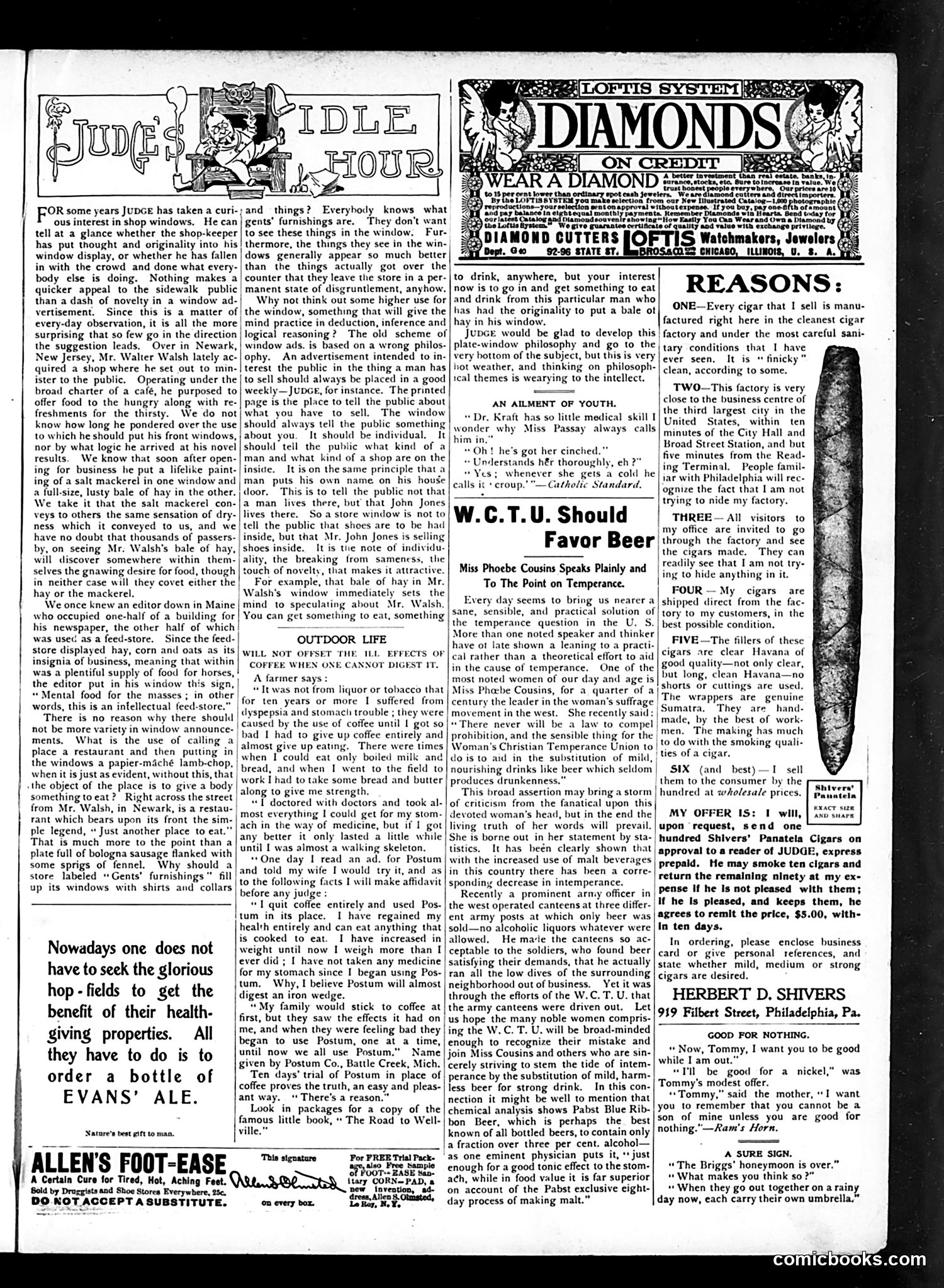
This page is primarily **editorial commentary on window display philosophy**, not a political cartoon. The main article critiques shop owners who use obvious product displays in storefronts. Judge argues that windows should appeal to customers' *psychology* rather than simply show merchandise. **The example**: Newark café owner Walter Walsh displayed a salt mackerel (evoking thirst) and hay bale (evoking hunger) instead of food itself—clever indirect advertising. Judge praises this approach but notes most businesses fail to think creatively, instead showing actual products (lamb chops, shirts, collars) that inevitably disappoint customers who find real merchandise inferior to window displays. **The satire**: Judge mocks conventional retail thinking, suggesting windows should reveal the *shopkeeper's character* and make customers think, rather than just showing what's for sale. The implicit joke: retailers are too unimaginative to understand this principle. The page also contains **period advertisements** (Evans' Ale, Allen's Foot-Ease, Loftis Diamonds) and unrelated articles on beer prohibition and cigars.
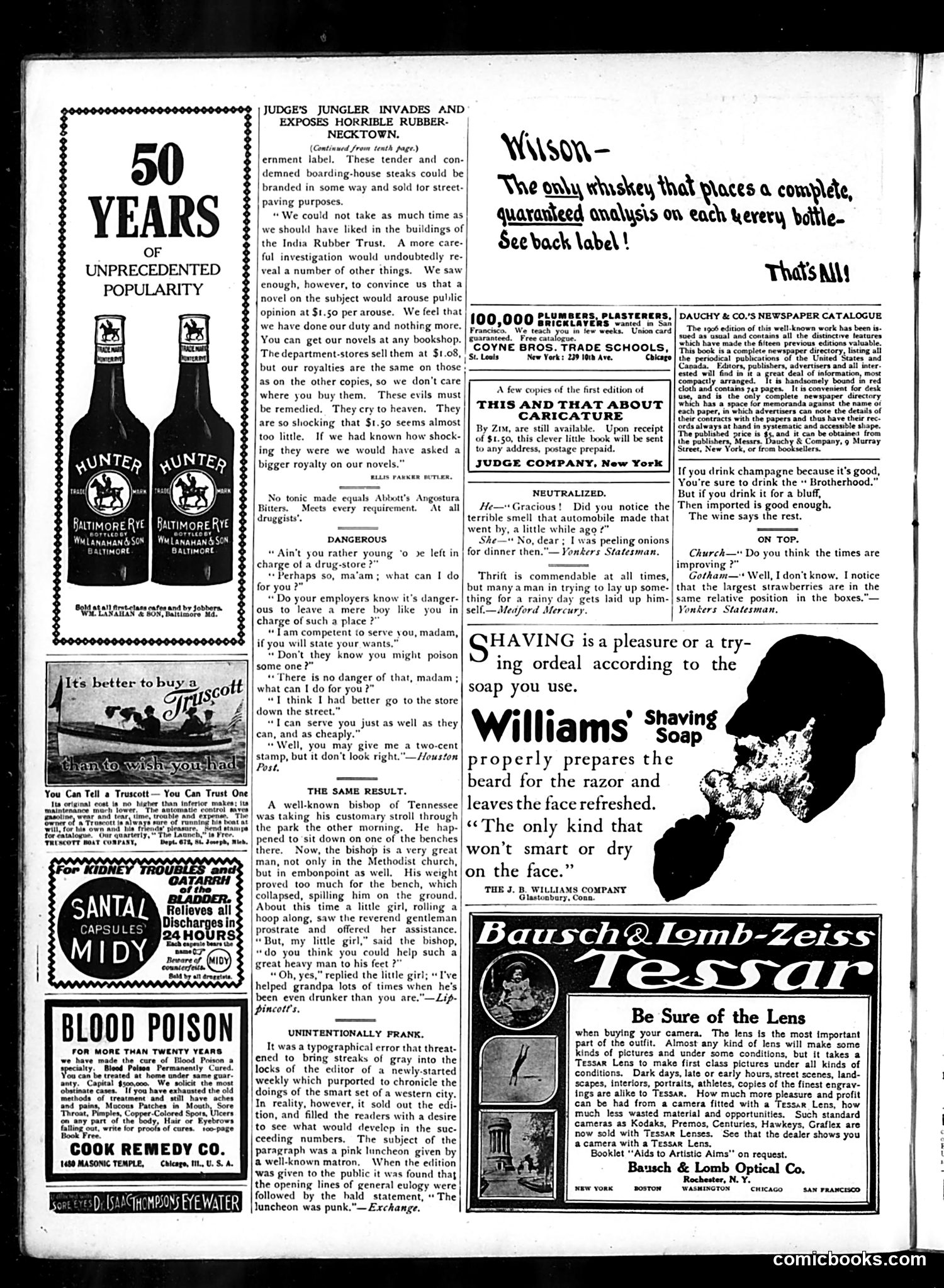
This page is primarily **advertisements and filler content** rather than political satire. The main pieces include: 1. **Hunter Whiskey ad** (left): Celebrates "50 years of unprecedented popularity," using bottle imagery typical of early 20th-century spirits marketing. 2. **"Judge's Jungler" article** (top): A satirical narrative about exposing corruption in "Rubberneck Town"—likely mocking sensationalist journalism and rubber-necking (gawking). The author mockingly notes he could publish findings as a novel at $1.50, satirizing both exposé literature and author vanity. 3. **Various humorous anecdotes**: Including a joke about a young pharmacist's competence and a bishop whose weight breaks a park bench. 4. **Patent medicine ads**: For blood poison cures and digestive remedies—common in this era, many promoting dubious treatments. The page reflects early-1900s concerns about patent medicine fraud, sensationalism, and social observation, but contains **no clear political cartoons or major political commentary**.
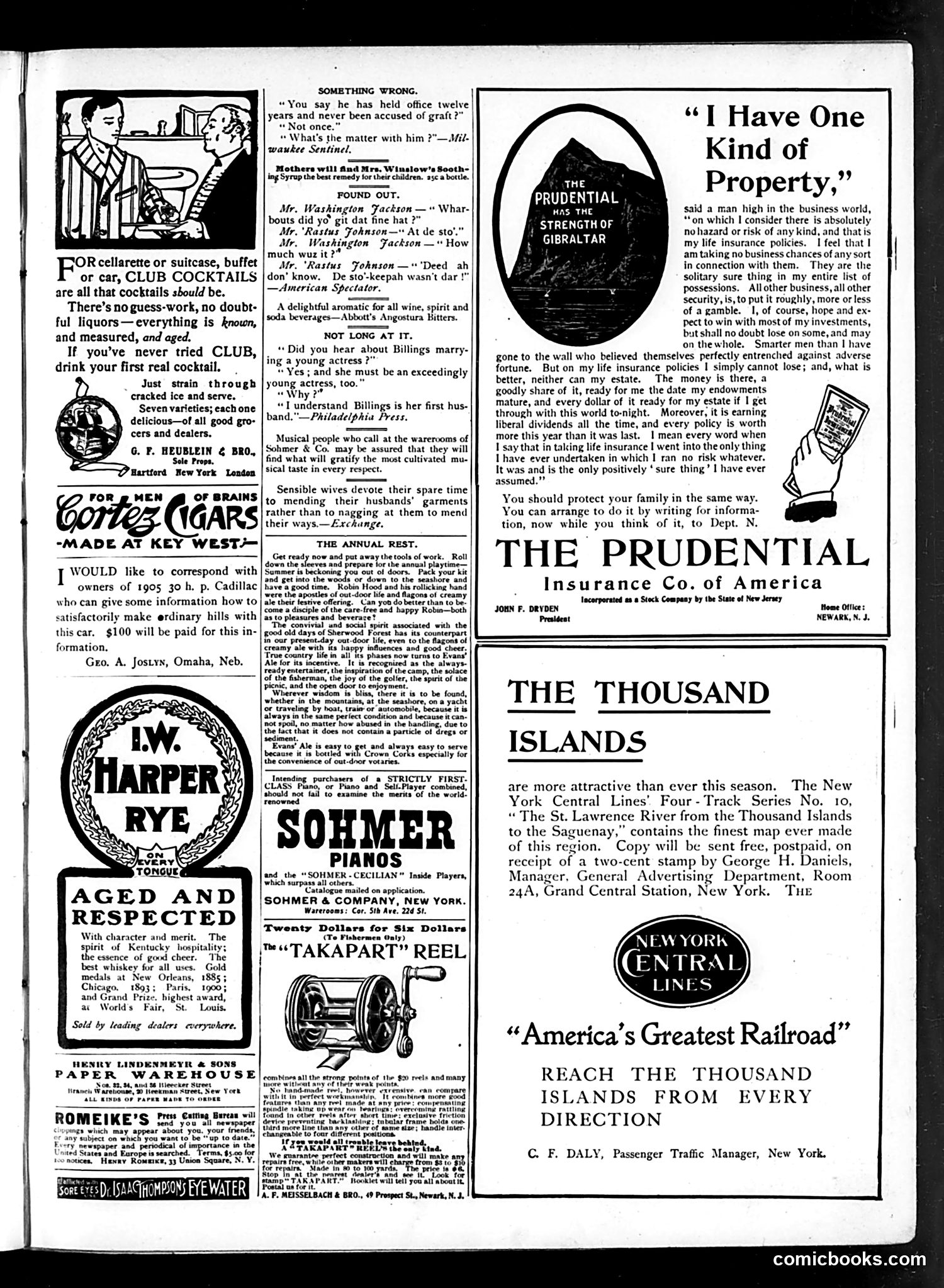
This page is primarily **advertising** for luxury goods and services circa early 1900s, with brief humorous filler content. The only cartoon is a small joke titled "SOMETHING WRONG" showing two men in conversation. The humor relies on a cynical political observation: a man has held public office for 12 years without *any* accusations of graft (corruption/bribery). His associate finds this suspicious—implying that honest, corruption-free public officials were so rare that never being accused of stealing was itself suspicious, suggesting something must be "wrong" with him. This satirizes widespread corruption in American politics of that era, where graft was so normalized among officeholders that an official's complete absence of scandal was treated as anomalous rather than admirable. The rest of the page contains period advertisements for cocktail mixes, cigars, pianos, whiskey, insurance, and railroad travel—typical Judge magazine filler content.
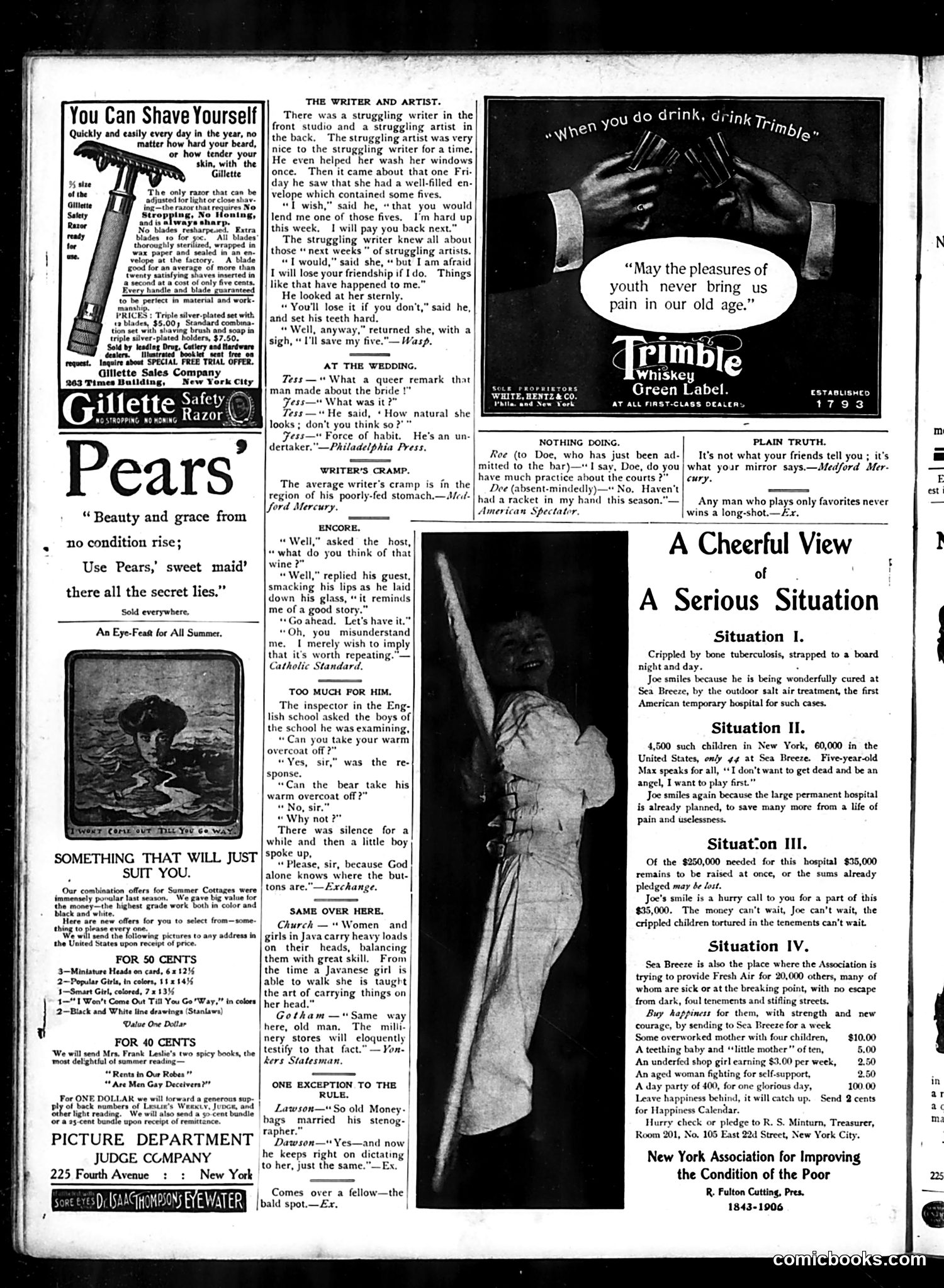
This page is primarily **advertisements and short humor pieces**, typical of Judge magazine's format. The main content includes: **Advertisements**: Gillette razors, Pears soap, and Trimble whiskey dominate the layout—standard early-1900s ads with product claims and pricing. **Short Jokes/Humor**: Several brief satirical pieces mock everyday situations: - "The Writer and Artist" satirizes struggling bohemians and the awkwardness of lending money between friends - "At the Wedding" jokes about an undertaker's habit of commenting on people's appearances - Other pieces poke fun at lawyers, wine connoisseurs, and social pretension **Serious Content**: "A Cheerful View of a Serious Situation" describes the New York Association for Improving the Condition of the Poor, detailing tuberculosis cases and fundraising efforts—contrasting sharply with the frivolous ads and humor. The page reflects Judge's mixed purpose: **satirizing middle-class social behavior while promoting consumer products and charitable awareness**.
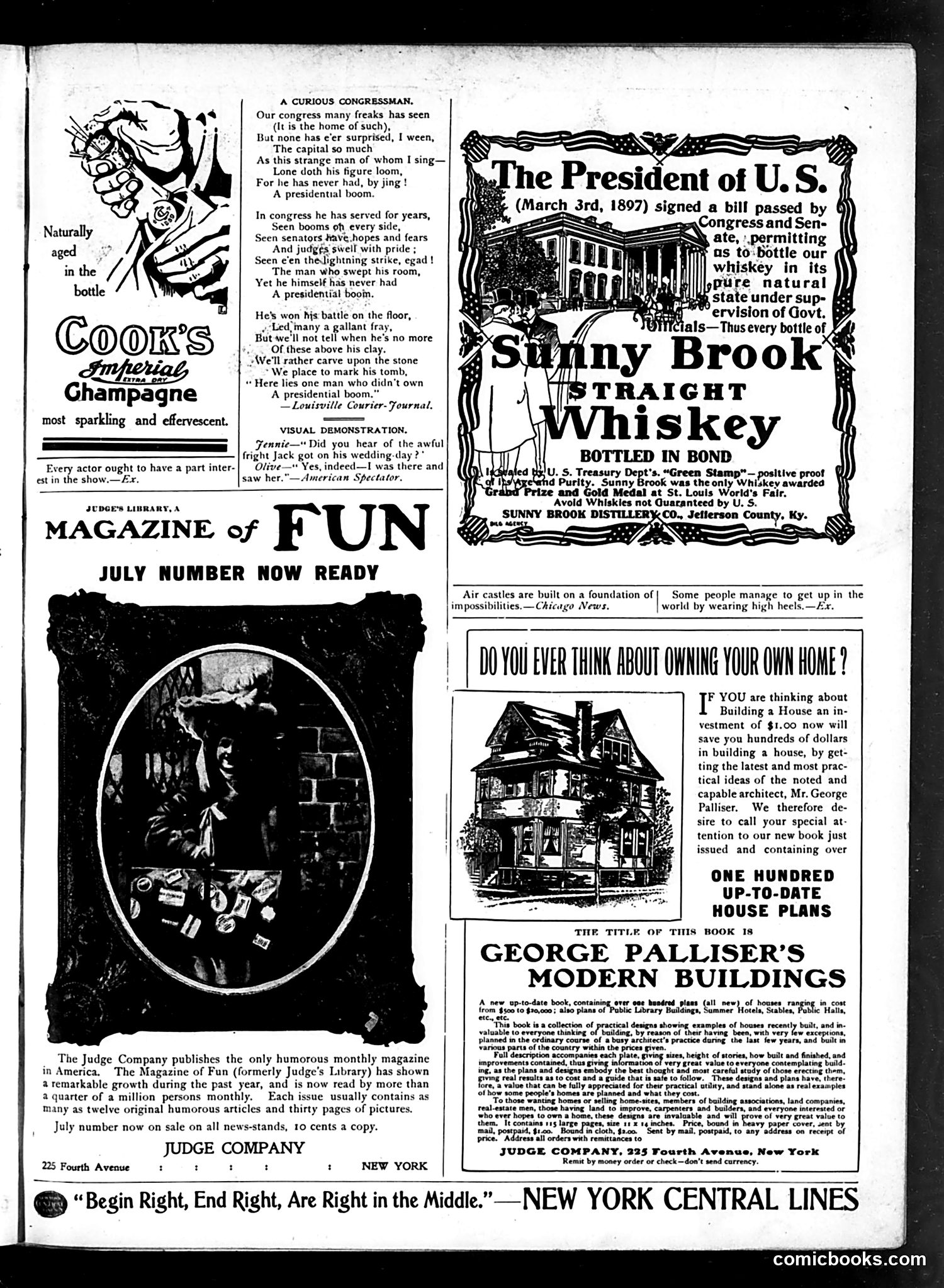
## "A Curious Congressman" (Left) This poem satirizes a congressman notable for his *lack* of presidential ambitions—a rarity in politics. The joke inverts typical Congressional behavior: while colleagues pursue "booms" (presidential campaigns), this man never has. The satire mocks the obsessive careerism of politicians, suggesting that even a congressman's tomb should commemorate his unusual disinterest in higher office. It's gentle mockery of American political ambition as the default state. ## Sunny Brook Whiskey (Center-Right) A product advertisement claiming the President signed legislation (March 3, 1897) permitting bottled whiskey under government supervision. This references actual federal bonding laws ensuring product authenticity and purity. The ad leverages government authority as a marketing tool, suggesting Sunny Brook earned prestigious medals at the St. Louis World's Fair. The remaining content is largely advertising for Judge's July issue and house-building plans.
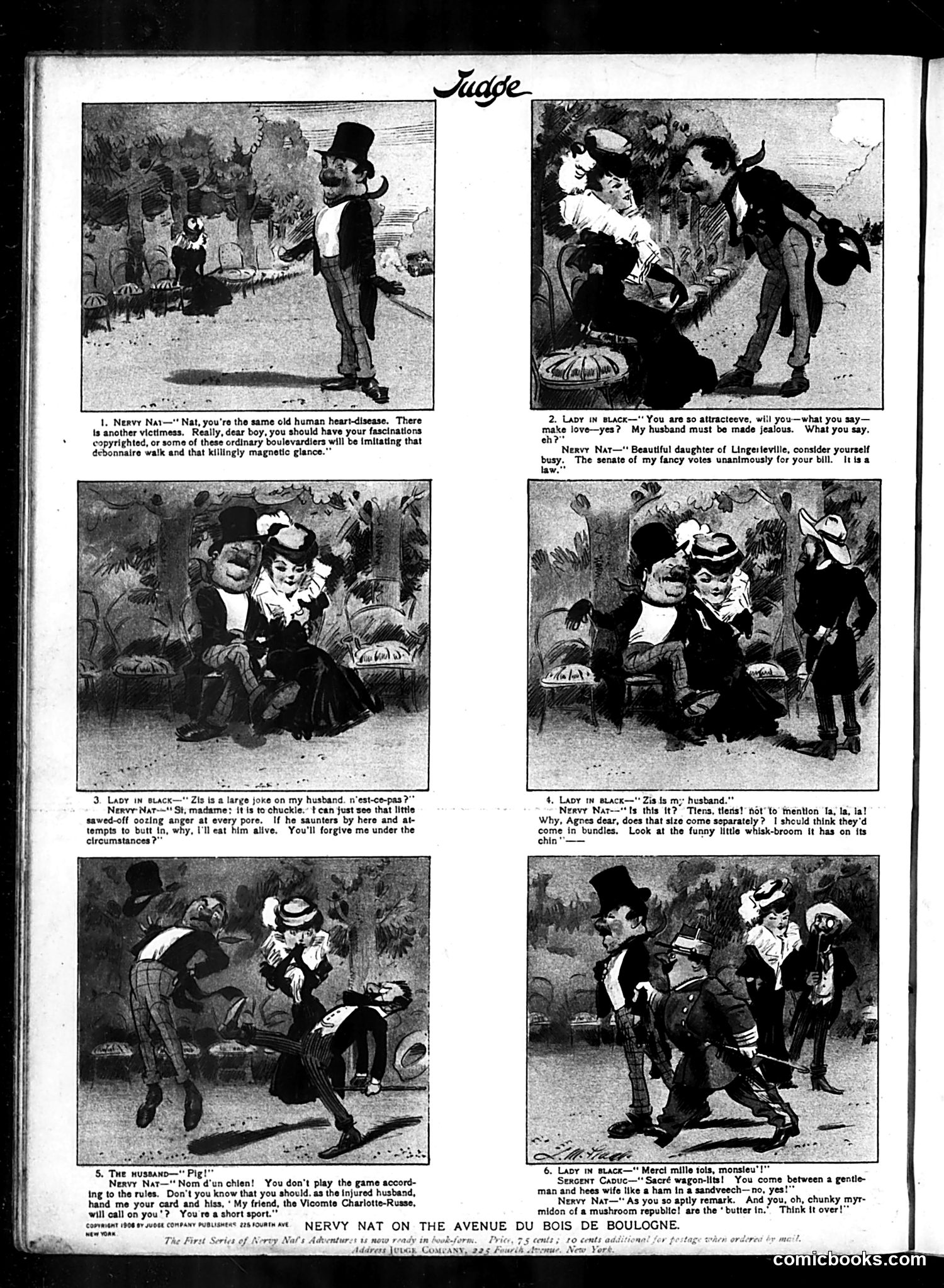
This is a comic strip satirizing a smooth-talking seducer ("Nervy Nat") operating in Paris's fashionable Bois de Boulogne district. Each panel shows Nat attempting to romance different women—a society lady, a woman in black, and others—using exaggerated flattery and flirtation. The humor derives from several sources: the affected French dialogue ("n'est-ce-pas," "sacré"), the absurd compliments (comparing a small husband to a "funny little whisk-broom"), and the escalating chaos when a jealous husband appears. In panel 5, the husband finally confronts Nat, calling him a "pig." The satire mocks both Nat's ridiculous seduction tactics and Parisian high society's affectations. The exaggerated French phrases and the bumbling, obvious nature of Nat's schemes suggest Judge's American audience would find Continental pretension laughable. This appears to be the first in a series about this character's romantic misadventures.