
Judge, 1906-07-21 · page 11 of 16
Judge — July 21, 1906 — page 11: what you’re looking at
What you’re looking at
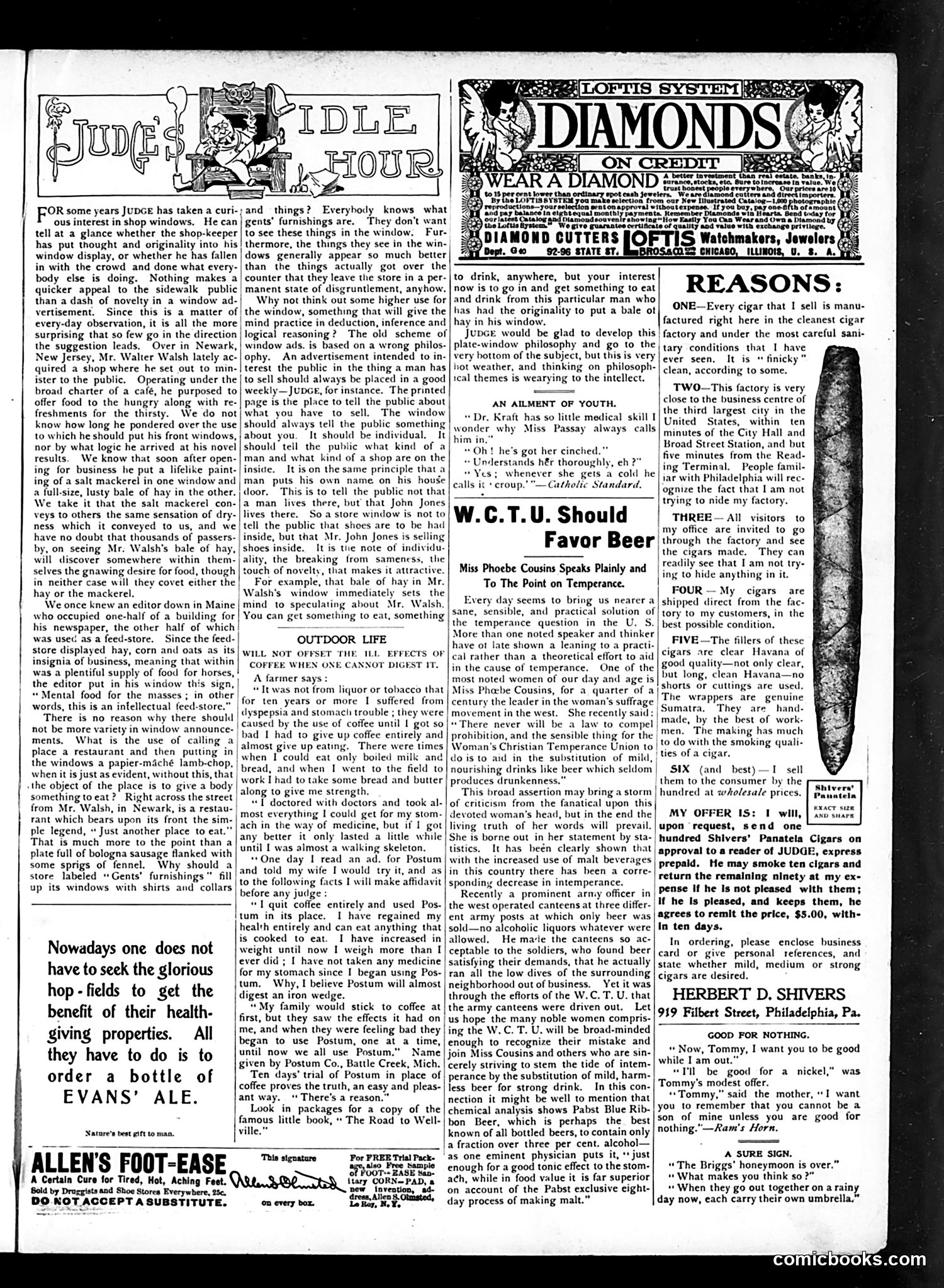
This page is primarily **editorial commentary on window display philosophy**, not a political cartoon. The main article critiques shop owners who use obvious product displays in storefronts. Judge argues that windows should appeal to customers' *psychology* rather than simply show merchandise. **The example**: Newark café owner Walter Walsh displayed a salt mackerel (evoking thirst) and hay bale (evoking hunger) instead of food itself—clever indirect advertising. Judge praises this approach but notes most businesses fail to think creatively, instead showing actual products (lamb chops, shirts, collars) that inevitably disappoint customers who find real merchandise inferior to window displays. **The satire**: Judge mocks conventional retail thinking, suggesting windows should reveal the *shopkeeper's character* and make customers think, rather than just showing what's for sale. The implicit joke: retailers are too unimaginative to understand this principle. The page also contains **period advertisements** (Evans' Ale, Allen's Foot-Ease, Loftis Diamonds) and unrelated articles on beer prohibition and cigars.
📄 Transcribed text from this page (OCR, searchable)
Machine-transcribed from the original scan — historical spelling and the odd misread are preserved.
FOR some years JUDGE has taken a curi- ous interest in shop windows. He can tell at a glance whether the shop-keeper has put thought and originality into his window display, or whether he has fallen in with the crowd and done what every- body else is doing. Nothing makes a quicker appeal to the sidewalk public than a dash of novelty in a window ad- vertisement. Since this is a matter of every-day observation, it is all the more| surprising that so few go in the direction the suggestion leads. Over in Newark, New Jersey, Mr. Walter Walsh lately ac- quired a shop where he set out to min- ister to the public. Operating under the broad charter of a café, he purposed to offer food to the hungry along with re- freshments for the thirsty. We do not know how long he pondered over the use to which he should put his front windows, nor by what logic he arrived at his novel results. We know that soon after open- ing for business he put a lifelike paint- ing of a salt mackerel in one window and a full-size, lusty bale of hay in the other. e take it that the salt mackerel con- veys to others the same sensation of dry- ness which it conveyed to us, and we have no doubt that thousands of passers- by, on seeing Mr. Walsh's bale of hay, will discover somewhere within them- selves the gnawing desire for food, though in neither case will they covet either the hay or the mackerel. We once knew an editor down in Maine who occupied one-half of a building for his newspaper, the other half of which was used as a feed-store. Since the feed- store displayed hay, corn and oats as its insignia of business, meaning that within was_a plentiful supply of food for horses, the editor put in his window this sign, | “Mental food for the masses ; in other words, this is an intellectual feed-store.” There is no reason why there should not be more variety in window announce- ments, What is the use of calling a place a restaurant and then putting in the windows a papier-maché lamb-chop, when it is just as evident, without this, that sthe object of the place is to give a body | something to eat? Right across the street from Mr. Walsh, in Newark, is a restau- rant which bears upon its front the sim- ple legend, « Just another place to eat.” That is much more to the point than a plate full of bologna sausage flanked with some sprigs of fennel. Why should a store labeled Gents’ furnishings” fill up its windows with shirts and collars Nowadays one does not have to seek the glorious hop - fields to get the benefit of their health- giving properties. All they have to do is to order a bottle of EVANS’ ALE. Nature's best gift to man. Everyhody knows what ) gents’ furnishings are. They don't want to see these things in the window. Fur- thermore, the things they see in the win- dows generally appear so much better than the things actually got over the counter that they leave the store in a per- manent state of disgruntlement, anyhow. Why not think out some higher use for the window, something that will give the mind practice in deduction, inference and logical reasoning? The old scheme of window ads. is based on a wrong philos- ophy. An advertisement intended to in- terest the public in the thing a man has to sell should always be placed in a good weekly—JUDGE, for instance. The printed page is the place to tell the public about what you have to sell. The window should always tell the public something about you. It should be individual. It should tell the public what kind of a man and what kind of a shop are on the inside. It is on the same principle that a man puts his own name on his house door, This is to tell the public not that a man lives there, but that John Jones lives there. So a store window is not to tell the public that shoes are to be had inside, but that Mr. John Jones is selling shoes inside. It is the note of individu- ality, the breaking from sameness, the touch of novelty, that makes it attractive. For example, that bale of hay in Mr. Walsh's window immediately sets the mind to speculating about Mr. Walsh, You can get something to eat, something ;and things? EFFECTS OF COFFEE WHEN ONE CANNOT DIGEST IT. A farmer says : “ Itwas not from liquor or tobacco that for ten years or more I suffered from dyspepsia and stomach trouble ; they were | caused by the use of coffee until 1 got so bad I had to give up coffee entirely and almost give up eating. There were times when I could eat only boiled milk and bread, and when I went to the field to work I had to take some bread and butter along to give me strength. “T doctored with doctors and took al- most everything I could get for my stom- ach in the way of medicine, but if 1 got any better it only lasted a little while until [ was almost a walking skeleton. “One day I read an ad. for Postum Jand told my wife I would try it, and as to the following facts I will make affidavit before any judg “1 quit coffee entirely and used Pos. tum in its place. I have regained my health entirely and can eat anything that is cooked to eat. I have increased in weight until now I weigh more than I ever did ; I have not taken any medicine for my stomach since I began using Pos-| tum. Why, I believe Postum will almost digest an iron wedge. My family would stick to coffee at first, but they saw the effects it had on me, and when they were feeling bad they | began to use Postum, one at a time,| until now we all use Postum.” Name ‘en by Postum Co., Battle Creek, Mich. Ten days’ trial of Postum in place of | coffee proves the truth, an easy and pleas- ant way.“ There's a reason. Look in packages for a copy of the Bmons little book, * The Road to Well- ville.” ALLEN'S FOOT-EASE A Certain Cure for Tired, Hot, Aching Feet. Gold by Druggists and Shoe Stores Everywhere, 2c. DO NOT ACCEPT A SUBSTITUTE. For FREE Trial Pack- ‘also Free Sample of FOOT-+ZASE San- itary CORN=PAD, a ‘This stgnatare [if to 15 percent lower than, ‘By (ne LOFTIS SYSTEM 700 rerroductions—) jection, ‘and pay balance | Sariatess the Lottis to drink, anywhere, but your interest now is to go in and get something to eat and drink from this particular man who has had the originality to put a bale ot hay in his window. Jupce would be glad to develop this plate-window philosophy and go to the very bottom of the subject, but this is very hot weather, and thinking on philosoph- ical themes is wearying to the intellect. AN AILMENT OF YOUTH. “Dr. Kraft has so little medical skill I wonder why Miss Passay always. calls | him in,” “Oh! he’s got her cinched.” “ Understands hér thoroughly, eh 2” “Yes; whenever she gets a cold he calls it * croup.’ "— holic Standard. W.C.T.U. Should Favor Beer Miss Phoebe Cousins Speaks Plainly and To The Point on Temperance. Every day seems to bring us nearer a the temperance question in the U. S. | More than one noted speaker and thinker have ot late shown a leaning to a practi- cal rather than a theoretical effort to aid in the cause of temperance. One of the most noted women of our day and age is Miss Phacbe Cousins, for a quarter of a century the leader in the woman's suffrage movement in the west. She recently “There never will be a law to compel prohibition, and the sensible thing for the Woman's Christian Temperance Union to do is to aid in the substitution of mild, nourishing drinks like beer which seldom produces drunkenness.” This broad assertion may bring a storm of criticism from the fanatical upon this devoted woman's head, but in the end the living truth of her words will prevail. She is borne out in her statement by sta- tistics, It has beén clearly shown that with the increased use of malt beverages in this country there has been a corre- sponding decrease in intemperance. Recently a prominent arny officer in the west operated canteens at three differ- ent army posts at which only beer wa sold—no alcoholic liquors whatever were allowed, He mare the canteens so ac- ceptable to the soldiers, who found beer tisfying their demands, that he actually ran all the low dives of the surrounding neighborhood out of business. Yet it was through the efforts of the W.C. T. U. that the army canteens were driven out. Let us hope the many noble women compris- ing the W. C. T. U. will be broad-minded enough to recognize their mistake and join Miss Cousins and others who are sin- cerely striving to stem the tide of intem- perance by the substitution of mild, harm- less beer for strong drink. In this con- nection it might be well to mention that chemical analysis shows Pabst Blue Rib- bon Beer, which is perhaps the best known of all bottled beers, to contain only a fraction over three per cent. alcohol— as one eminent physician puts it, ** just enough for a good tonic effect to the stom- ach, while in food value it is far superior on account of the Pabst exclusive eight- day process of making malt.” sane, sensible, and practical solution of | REASONS: ONE—Every cigar that I sell is manu- factured right here in the cleanest cigar factory and under the most careful sani- |tary conditions that I have ever seen, It is * finicky” clean, according to some. TWO —This factory is very close to the business centre of the third largest city in the United States, within ten minutes of the City Hall and Broad Street Station, and but five minutes from the Read- ing Terminal. People famil- iar with Philadelphia will rec- ognize the fact that I am not trying to nide my factory. THREE — All visitors to my office are invited to go through the factory and see |the cigars made. “They can readily see that Iam not try- ing to hide anything in it. FOUR — My cigars are | shipped direct from the fac- tory to my customers, in the best possible condition. FIVE—The fillers of these cigars are clear Havana of good quality—not only clear, but long, clean Havana—no shorts or cuttings are used. The wrappers are genuine Sumatra, They are hand- made, by the best of work- |men.’ The making has much | to do with the smoking quali- ties of a cigar. SIX (and best)—I- sell them to the consumer by the | hundred at wholesale prices. RxACT stm MY OFFER IS: I will, upon ‘request, send one hundred Shivers’ Panatela Cigars on approval to a reader of JUDGE, express Prepaid. He may smoke ten cigars and return the remaining ninety at my ex- pense if he Is not pleased with them; it he Is pleased, and keeps them, he agrees to remit the price, $5.00, with- In ten days. In ordering, please enclose business card or give personal references, and state whether mild, medium or strong cigars are desired. HERBERT D. SHIVERS 919 Filbert Street, Philadelphia, Pa. GOOD FOR NOTHING. « Now, Tommy, I want you to be good while I am out.” “Till be good for a nick Tommy's modest offer. “Tommy,” said the mother, 1 want you to remember that you cannot be a son of mine unless you are good for nothing."—Ram's Horn. was A SURE SIGN. “The Briggs’ honeymoon is What makes you think so “When they go out together on a rainy day now, each carry their own umbrella,”