
A complete issue · 16 pages · 1906
Judge — June 16, 1906
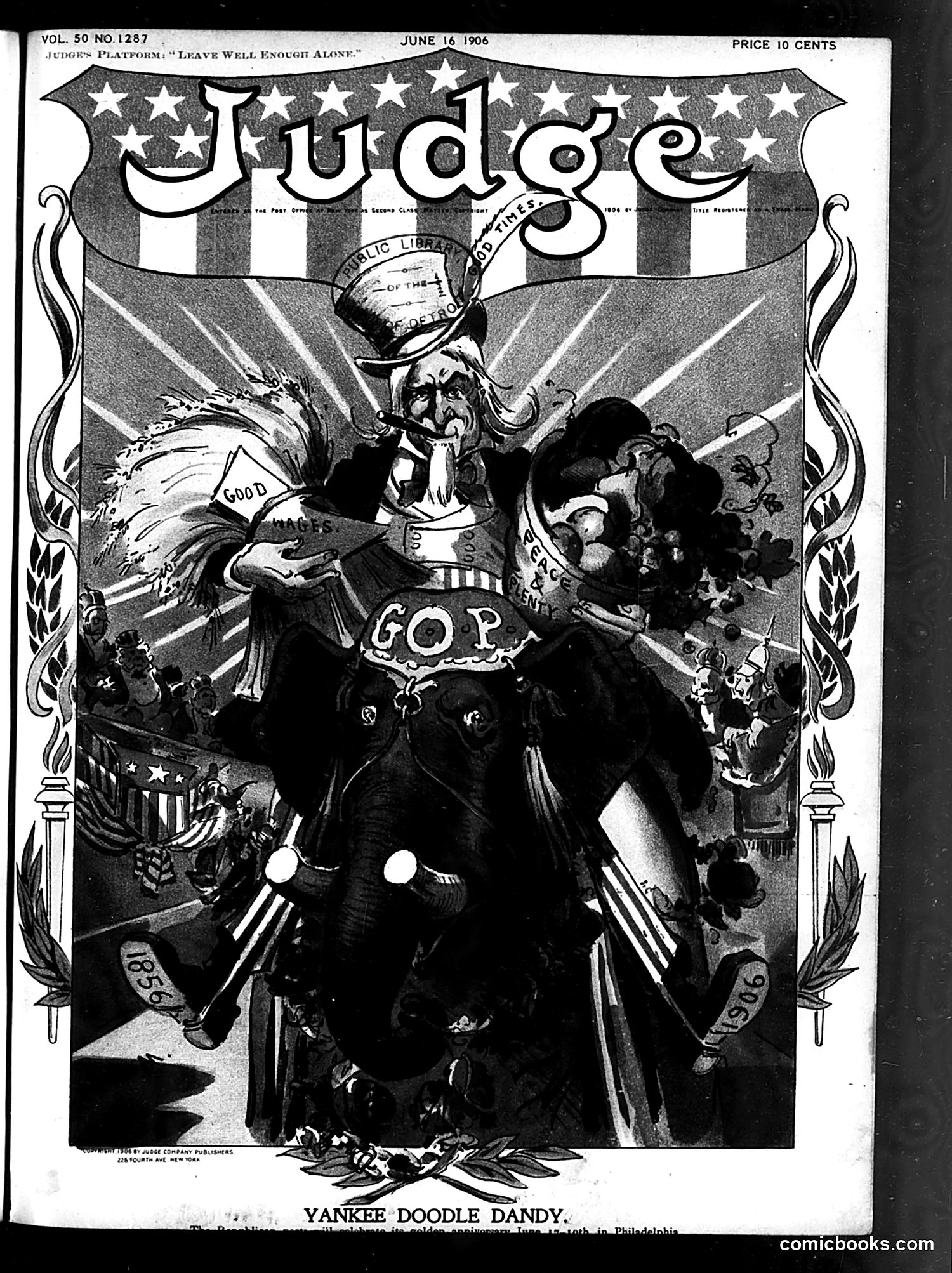
This political cartoon depicts Uncle Sam (the tall figure in top hat labeled "GOP") as a circus ringmaster or conductor, actively directing smaller figures representing various political factions or interest groups. The caption "Yankee Doodle Dandy" suggests commentary on American politics. The "GOP" label indicates this concerns Republican Party control. Uncle Sam appears to be orchestrating or manipulating these subordinate figures—likely representing different political constituencies or policy positions within the party. The theatrical staging (radiating lines, dramatic posing) emphasizes the performative nature of politics. The overall message appears satirical: the Republican establishment conducting political theater while controlling various groups beneath them. This reflects early 20th-century concerns about party machine politics and corporate influence.
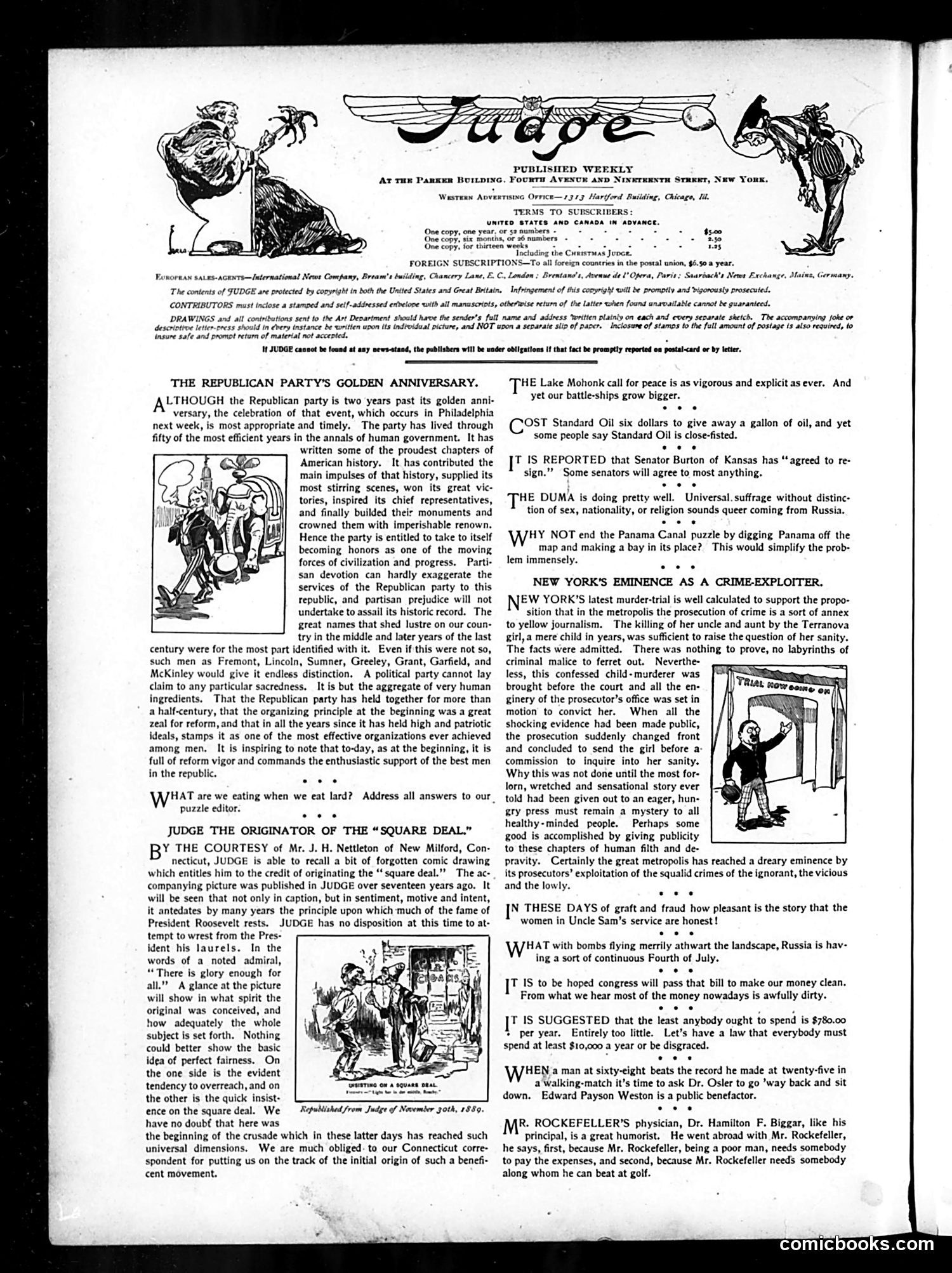
This page contains several editorial pieces rather than a single cartoon. The left column features an illustration about the Republican Party's "golden anniversary," showing what appears to be an elephant (the Republican mascot) alongside a figure, likely representing the party's historical legacy. The right column includes brief satirical commentary on contemporary issues, including mentions of Standard Oil's profits, Senator Burton of Kansas, and notably a detailed critique of a recent murder trial. The piece criticizes "yellow journalism" for sensationalizing a child murder case, arguing that media coverage prioritized scandal over justice. The page reflects turn-of-the-century concerns: corporate monopolies, political figures, and the corrupting influence of sensationalist press on the legal system.
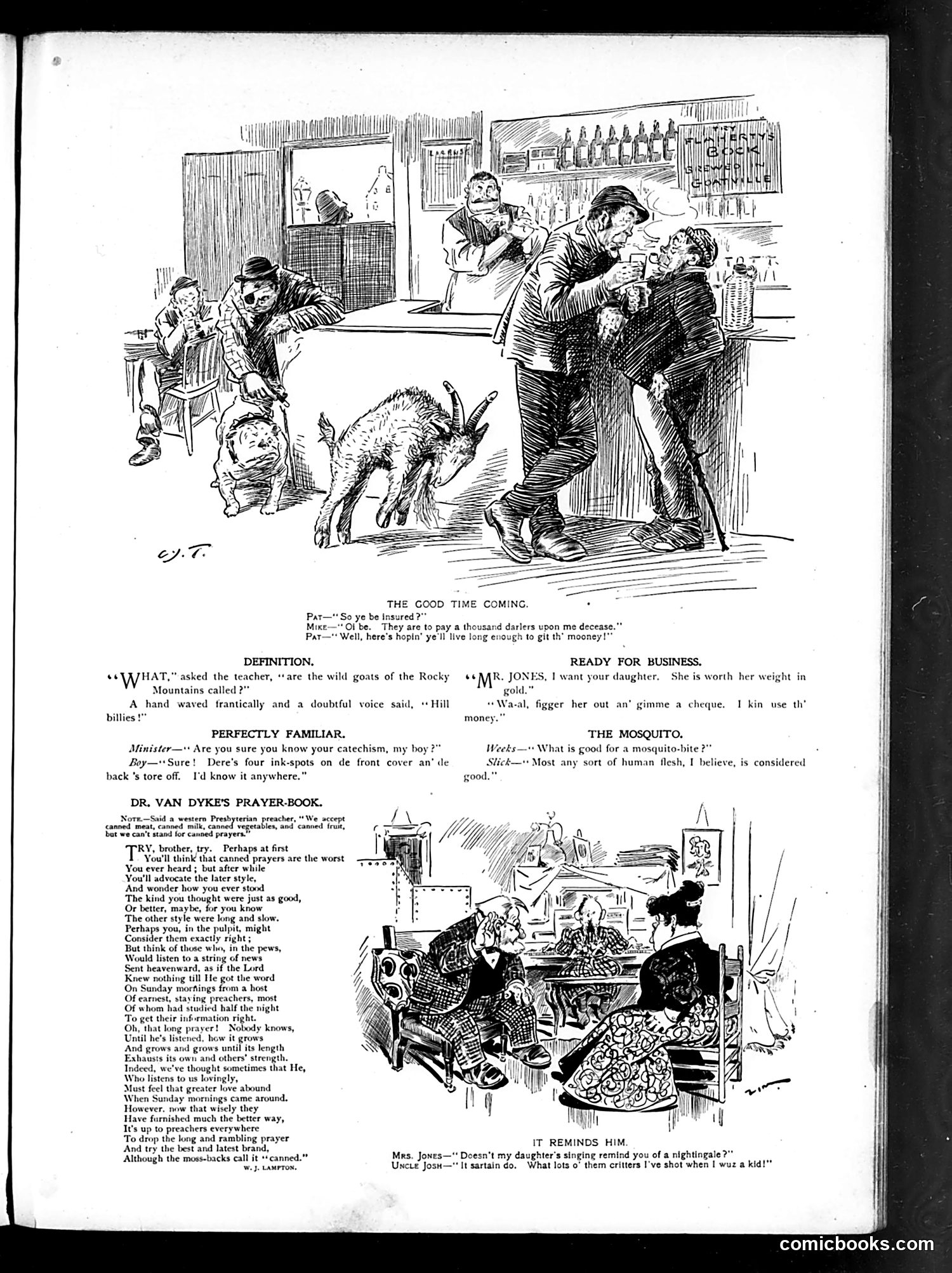
**Top Cartoon: "The Good Time Coming"** This depicts a bar scene where a patron claims he'll pay his debts once deceased. The bartender skeptically responds the customer should live long enough to settle accounts now. The satire mocks those who make empty financial promises they never intend to honor—a common social complaint about unreliable debtors. **Bottom Cartoon: "It Reminds Him"** Mrs. Jones mentions her daughter's nightingale-like singing, prompting Uncle John to recall crickets he heard as a child. The humor lies in the uncle's tactless comparison—sarcastically suggesting the daughter's singing resembles insects rather than the flattering nightingale reference intended. Both cartoons use everyday domestic situations to satirize human character flaws: dishonesty and rudeness.
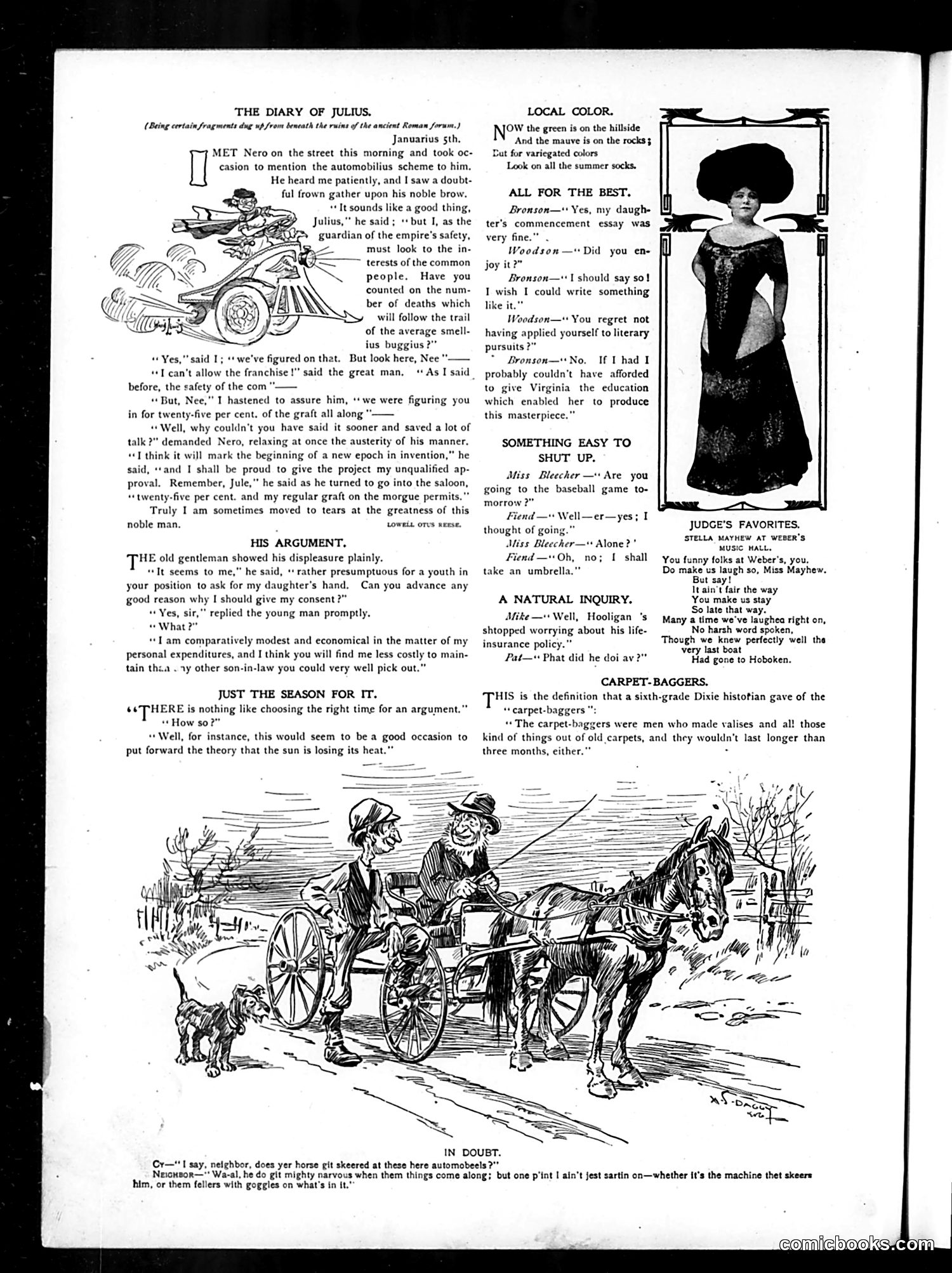
This page contains multiple satirical pieces typical of Judge's early 20th-century format. The main cartoon, "In Doubt," depicts two men on a horse-drawn wagon debating whether automobiles spook horses—a genuine contemporary concern as cars became common. The humor lies in the irony: they worry about machine-age technology frightening animals while using outdated transportation themselves. The surrounding text includes diary entries, social commentary pieces, and a portrait labeled "Judge's Favorites" featuring Stella Mayhew at Weber's Music Hall. The content reflects period preoccupations: automobiles, technological change, and entertainment. The overall tone is gently mocking of social anxieties about modernity rather than overtly political.
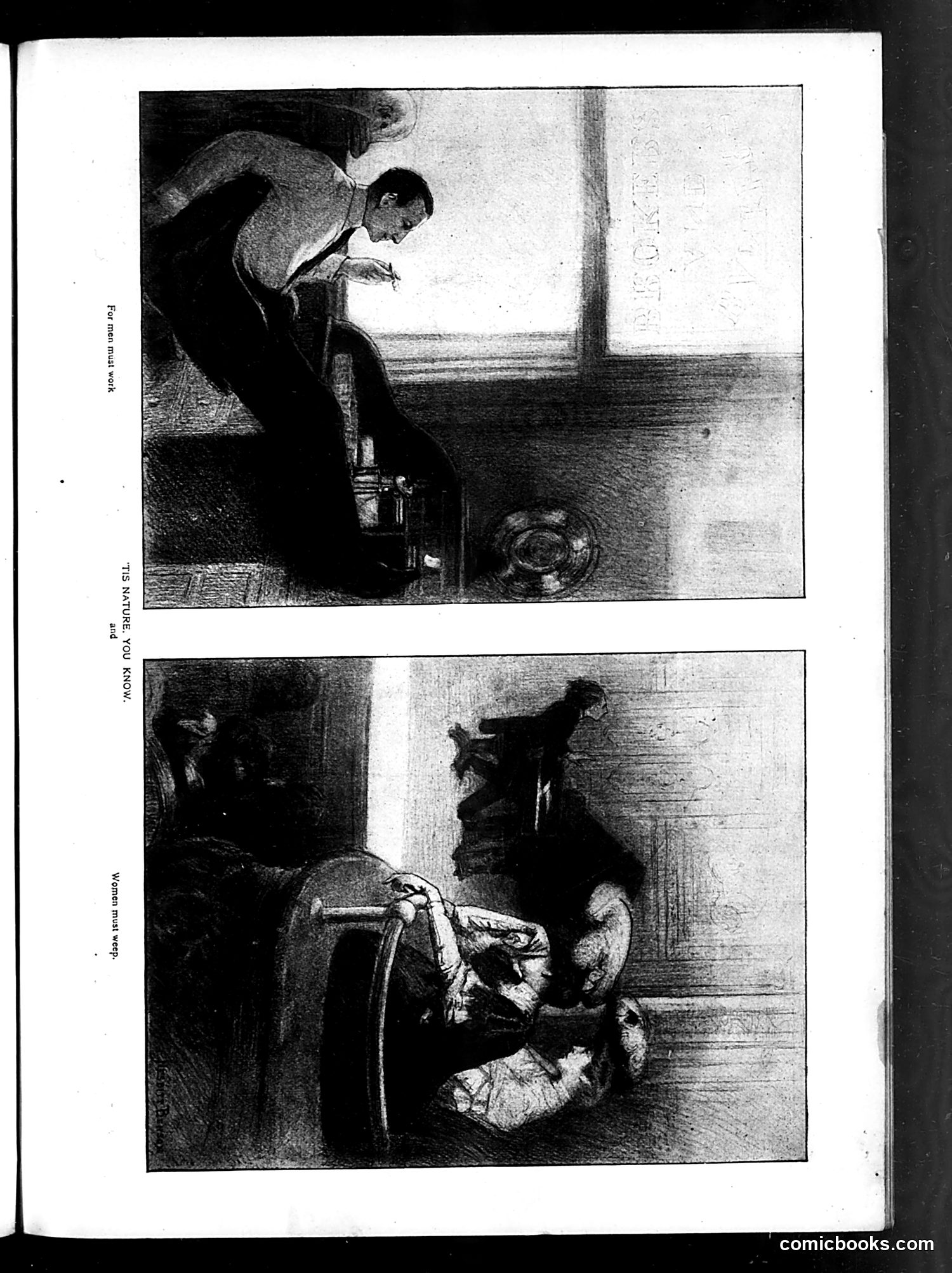
I can see this is a two-panel illustration from Judge magazine, but the OCR text provided contains no readable content—only formatting marks and page references. The images appear to be satirical scenes depicting figures in what looks like early 20th-century domestic or industrial settings. The top panel shows a man leaning over some kind of mechanical device or machinery. The bottom panel shows figures around what appears to be similar equipment. Without legible text identifying the subjects, figures, or the specific political/social context being satirized, I cannot reliably explain what these cartoons mean to a modern reader. The visual quality makes it difficult to discern caricatured features or identify specific individuals. To provide accurate historical context as requested, I would need either clearer image resolution or readable accompanying text.
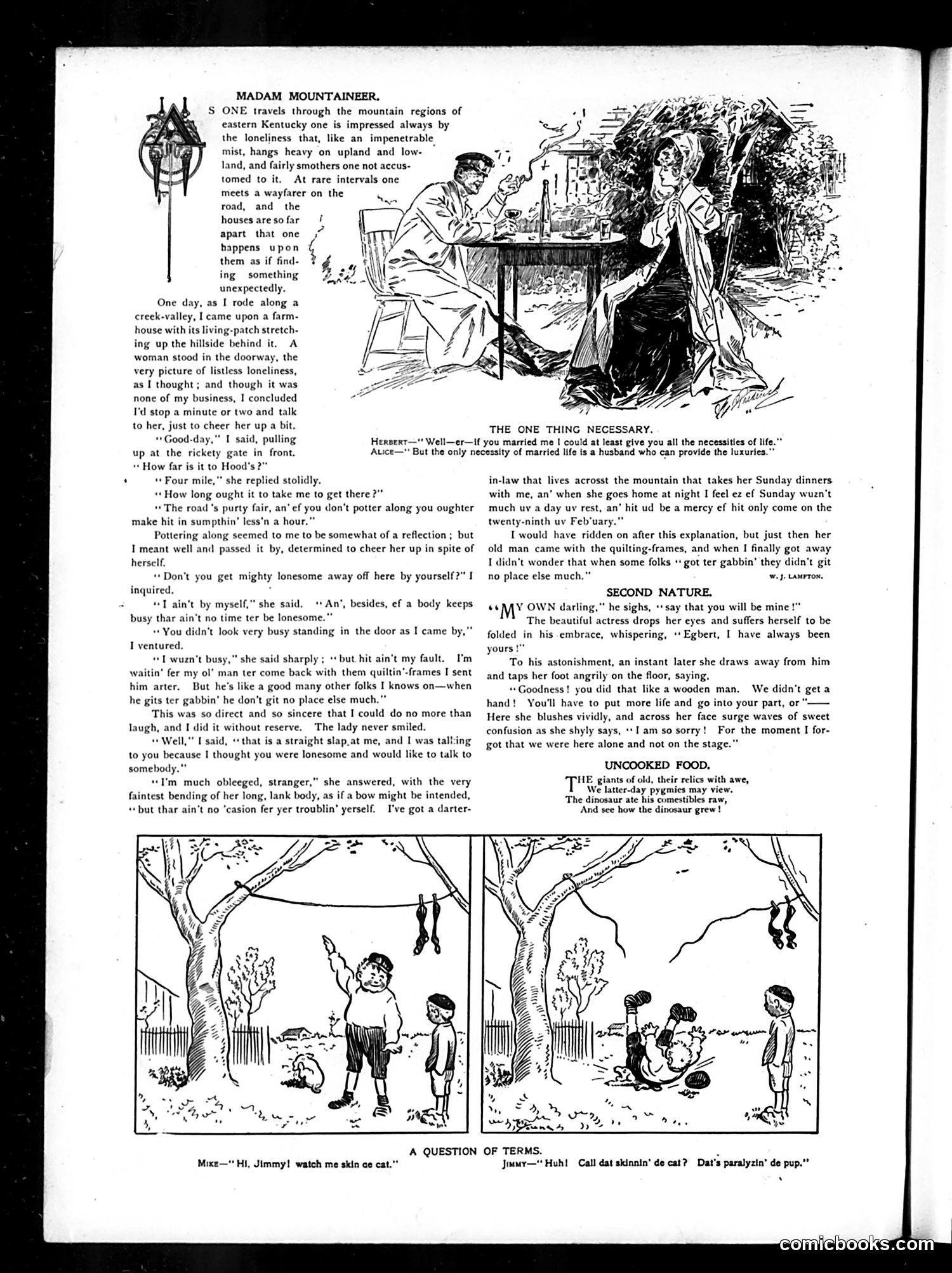
This page contains three distinct pieces of satirical content: **"Madam Mountaineer"** is a dialect-heavy short story mocking Appalachian mountain folk through exaggerated speech patterns. A traveling narrator attempts to "cheer up" an isolated woman, only to be rebuffed with sharp wit—she's not lonely because her troublemaking son-in-law visits constantly. The satire targets both condescending urban attitudes toward rural poverty and the verbosity of rural characters. **"The One Thing Necessary"** cartoon contrasts a suitor's claim he can provide "necessities of life" versus the woman's retort that luxuries (implicitly, an attentive husband) are what matter in marriage. This reflects contemporary debates about women's economic dependence and marriage expectations. **"Second Nature"** depicts an actress scolding her stage partner for wooden acting during an intimate scene, then—embarrassed—admitting she forgot they weren't onstage. The joke satirizes theatrical artificiality bleeding into real emotion. The bottom comic strip appears incomplete in the provided text but involves children's wordplay about "skinning the cat."
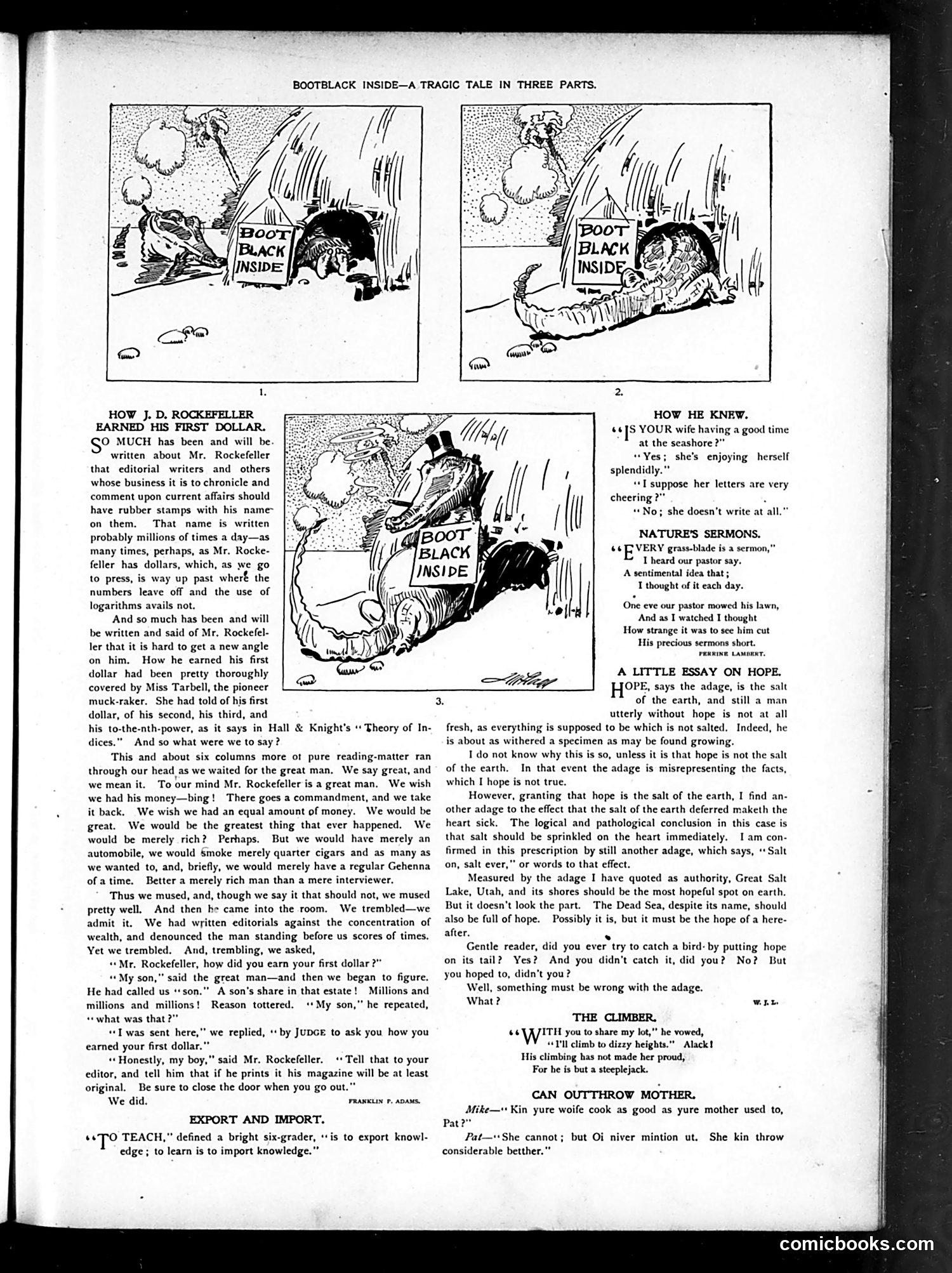
This three-panel cartoon satirizes the gap between J.D. Rockefeller's public image and reality. Panel 1 shows a bootblack outside in rain; Panel 2 reveals him sheltering *inside* a boot labeled "Bootblack Inside"—a visual pun suggesting the bootblack has literally become part of his own business. The accompanying article by Franklin P. Adams mocks the endless writing about Rockefeller's wealth and success. Adams describes an interview where Rockefeller, asked how he earned his first dollar, cryptically replies "Honestly, my boy"—which Adams sardonically notes is utterly unoriginal, yet the editor demands it be printed as such. The satire targets both Rockefeller's fortune (so vast "numbers leave off") and the media's obsession with celebrating his success, while hinting at skepticism about whether such wealth was truly earned honestly. The bootblack cartoon suggests those pursuing Rockefeller-like success end up consumed by their own enterprises.
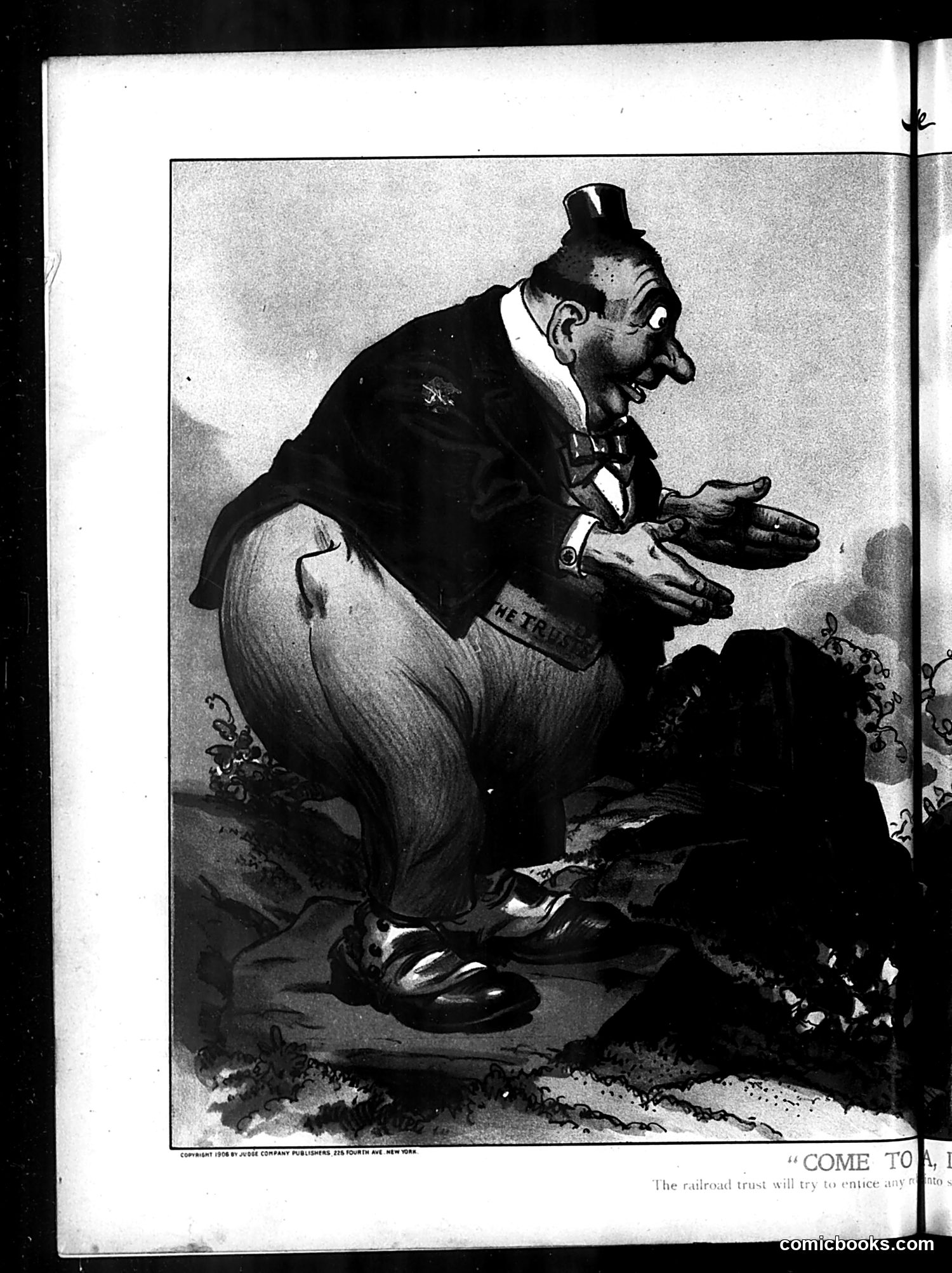
This 1908 Judge magazine cartoon satirizes railroad monopolies and their predatory practices. The exaggerated caricature depicts a well-dressed railroad magnate in formal attire crouching over what appears to be a trapped victim or struggling figure. The imagery suggests exploitation—the railroad trust "enticing" or trapping people, likely referring to unfair business practices against small competitors, workers, or the public. The visible text fragment ("The railroad trust will try to entice any") confirms the subject concerns railroad monopolistic behavior. During this Progressive Era period, railroad trusts were major targets of political criticism and reform efforts. The cartoon mocks the deceptive, predatory nature of corporate consolidation that characterized early 20th-century American business practices.
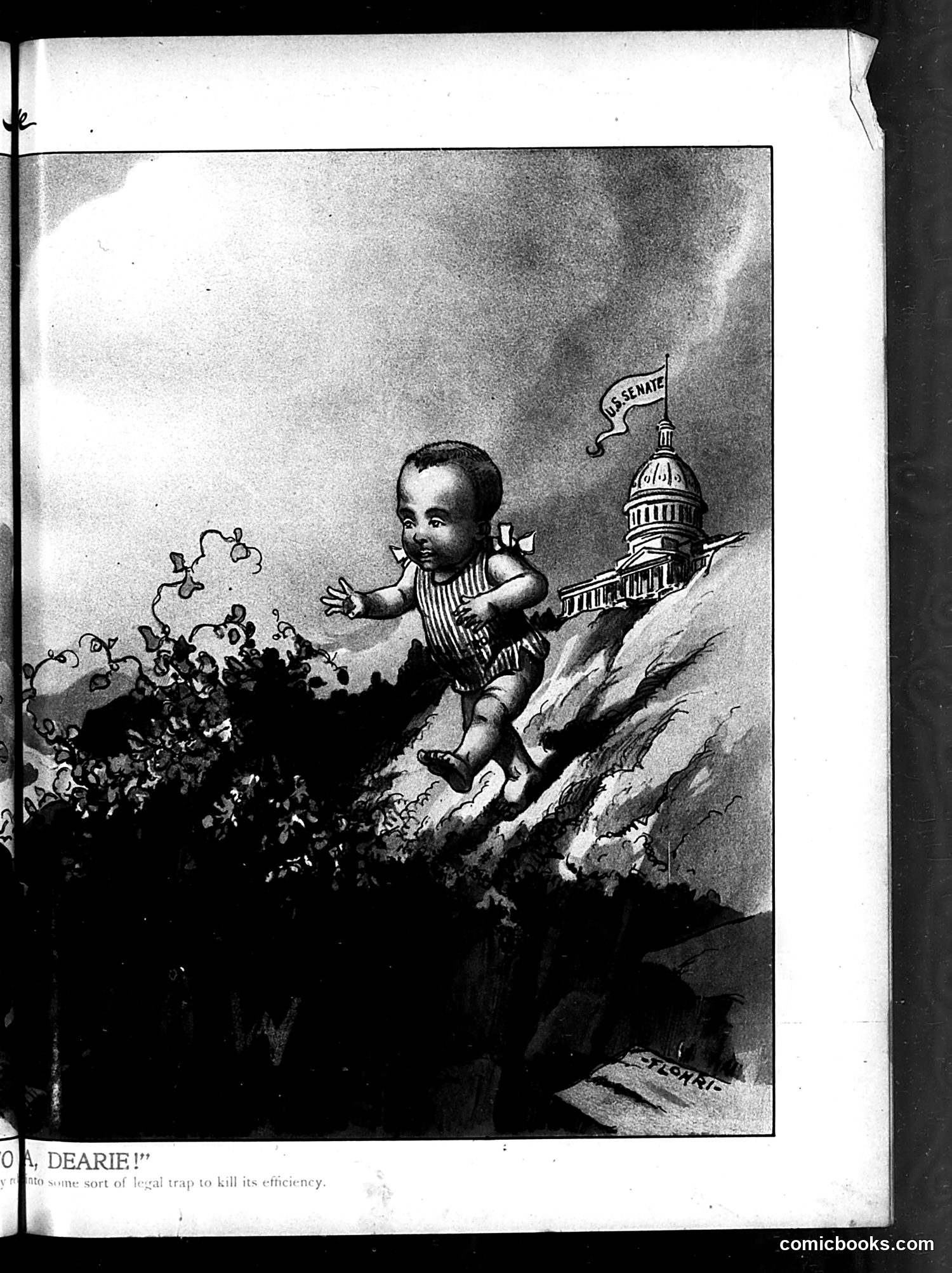
This appears to be a satirical cartoon from *Judge* magazine depicting a cherubic infant crawling toward the U.S. Capitol building (labeled "U.S. SENATE"). The child is surrounded by dark, thorny vegetation or obstacles on the left side of the image. The cartoon likely satirizes legislative inefficiency or corruption—suggesting that even an innocent baby could navigate toward the Senate, or conversely, that the Senate is being "infantilized" or rendered powerless. The thorny growth may represent the obstacles or "legal traps" mentioned in the partially visible caption below. Without the complete text or publication date, the specific political target remains unclear, though it critiques Senate operations or legislative gridlock of its era.
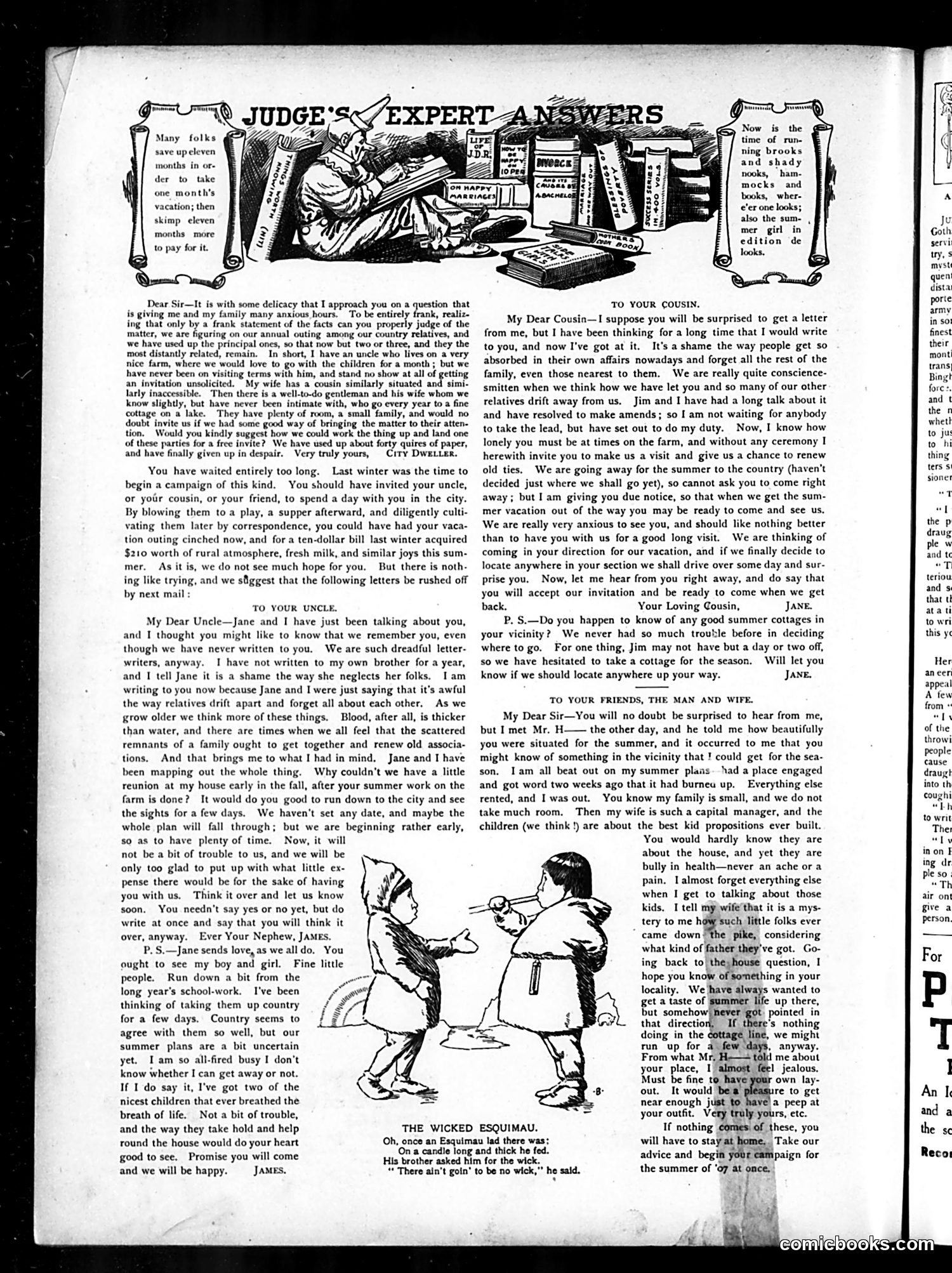
This advice column satirizes the American middle-class practice of cadging free vacations from relatives and acquaintances. A city dweller writes asking how to manipulate distant relatives—an uncle with a farm, a cousin, and wealthy friends with a lake cottage—into inviting his family for a free month-long stay without explicit invitation. The "Judge's" response is darkly comic: cultivate these people through calculated gestures (theater tickets, dinners, letters) over months to manufacture obligation. The accompanying cartoon titled "The Wicked Esquimau" (showing unidentified figures) reinforces the predatory theme. The satire mocks both the writer's shameless entitlement and the broader social hypocrisy of the era—how people maintained relationships strategically rather than genuinely, and how vacation-starved urbanites exploited family ties. The opening epigraph about saving eleven months to afford one month's vacation adds bitter context.
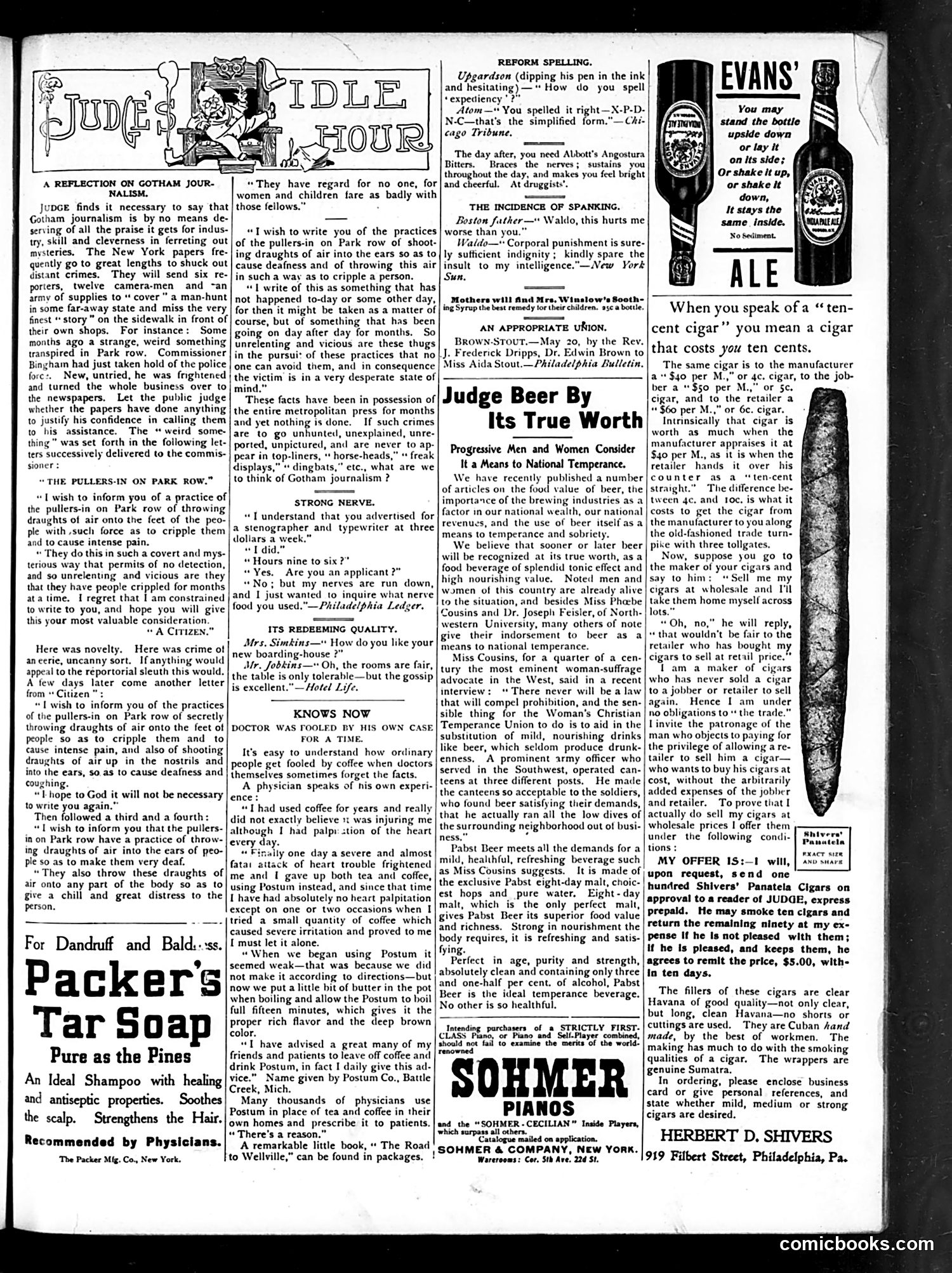
This piece satirizes New York City journalism's sensationalism and incompetence. Judge critiques how newspapers obsess over distant, dramatic crimes while ignoring bizarre happenings in their own backyard—Park Row, the newspaper district itself. The satire centers on absurd letters describing mysterious "pullers-in" who allegedly attack pedestrians by shooting air drafts at their feet, ears, and nostrils, causing crippling pain and deafness. These letters were apparently submitted to Police Commissioner Bingham over months. Judge's point: despite having exclusive access to this strange local story, New York's newspapers failed to investigate or report it meaningfully. The satire mocks journalists for their theatrical approach to crime coverage (demanding "top-liners," sensational headlines, photographs) while missing actual oddities happening literally outside their offices. It's a critique of journalism prioritizing spectacle over substantive local reporting.
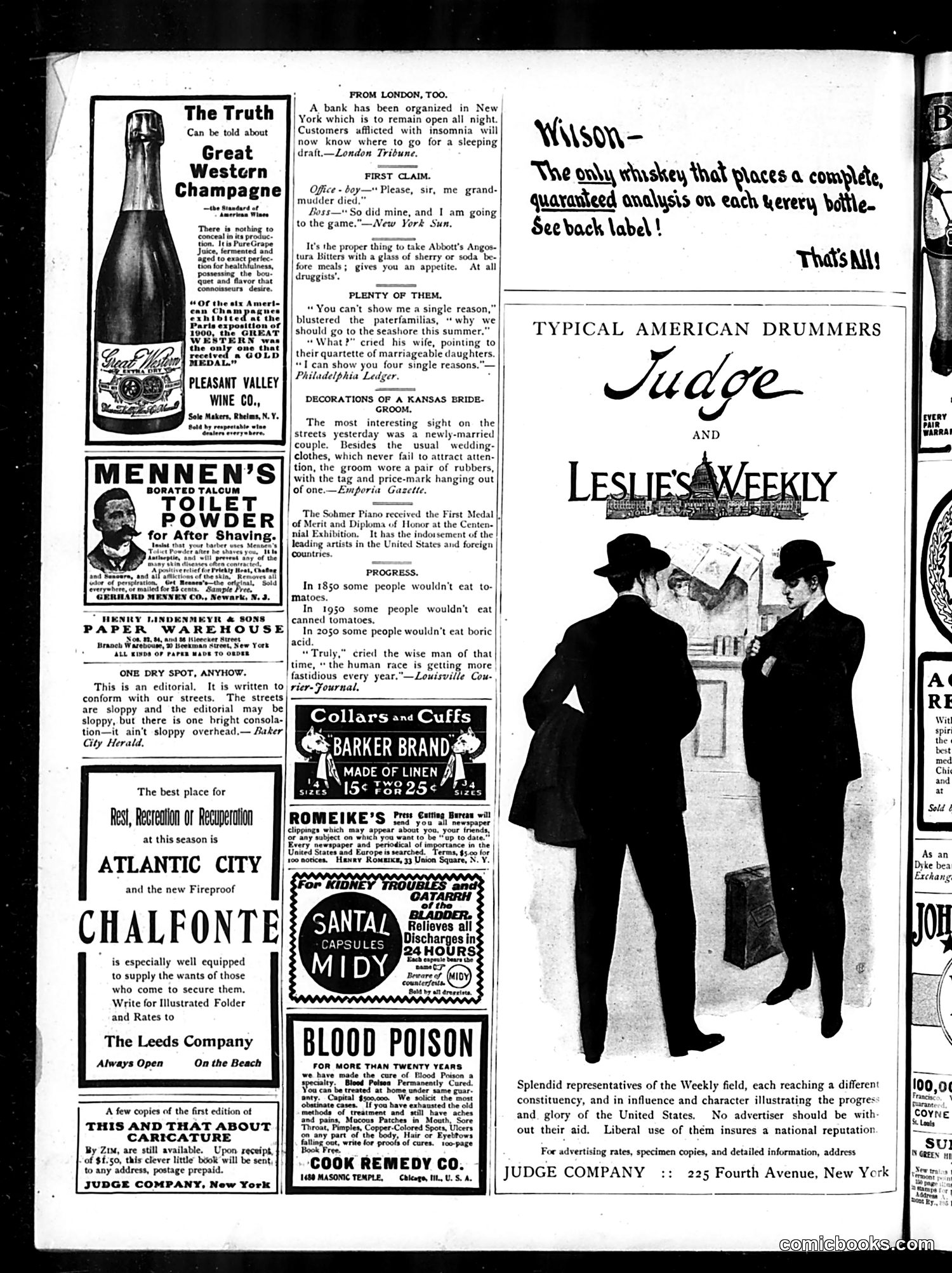
This is primarily an **advertising page** from an early 20th-century American satirical magazine, with brief humorous editorial snippets scattered among product ads. **The actual satirical content is minimal:** - **"One Dry Spot, Anyhow"** jokes that editorial quality matches sloppy street conditions—the only bright spot is the overhead, which "isn't sloppy." - **"Plenty of Them"** plays on a father dismissing vacation needs until his wife points to their "four single reasons"—their marriageable daughters. - **"Progress"** notes that each generation becomes more finicky; 1850s people rejected tomatoes, 1950s people will reject canned ones. - **"Decorations of a Kansas Bride"** satirizes a groom wearing new rubber boots with the price tag still hanging out—a symbol of tackiness. **The advertisements** promote period products: champagne, talcum powder, Atlantic City hotels, collars, remedies for syphilis ("blood poison"), and other goods. The **"Typical American Drummers"** section advertises Judge magazine itself, featuring traveling salesmen who promote national progress through advertising.
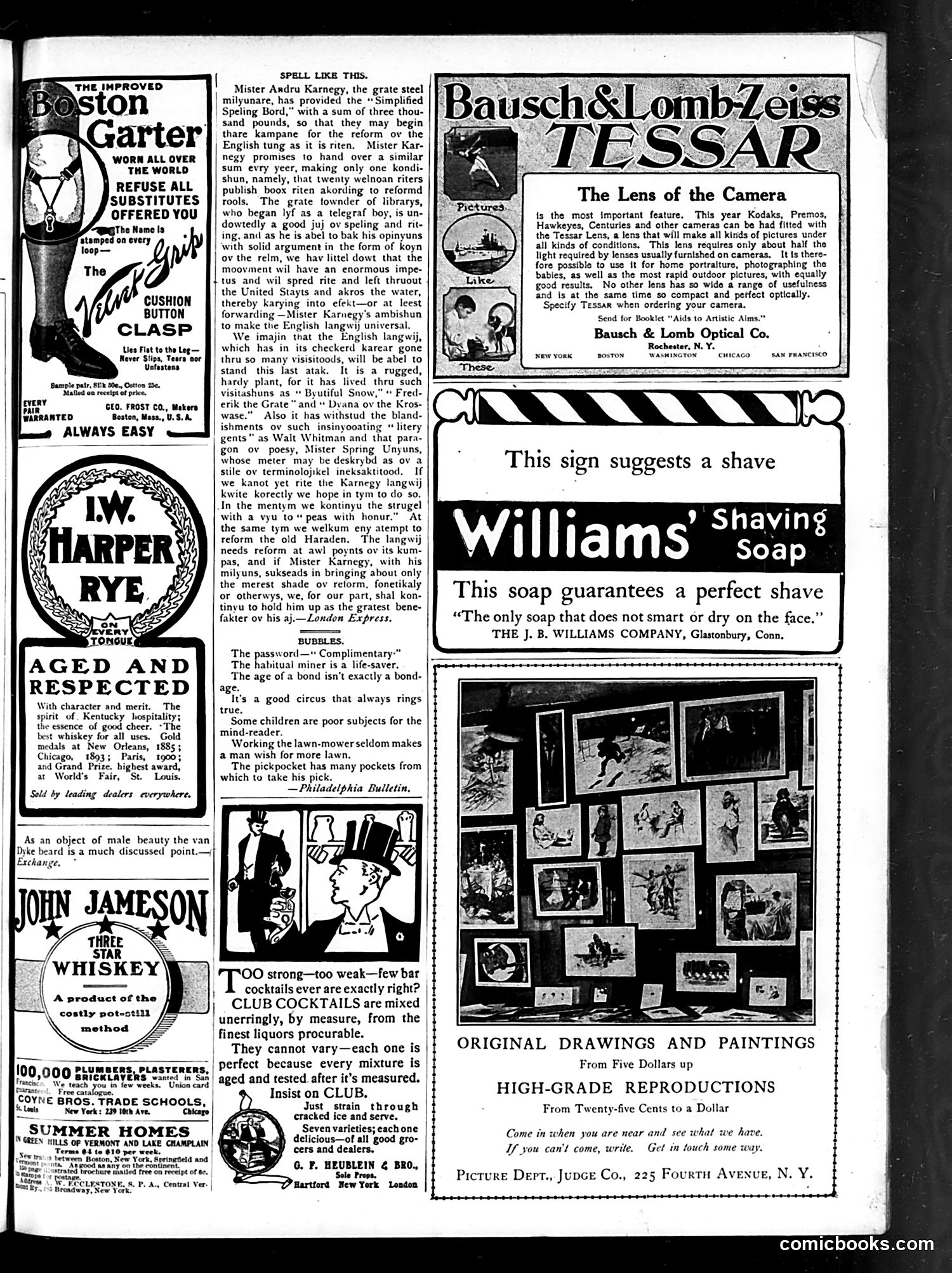
This page satirizes Andrew Carnegie's funding of the "Simplified Spelling Board," a real early-1900s effort to reform English orthography. The entire article is written in phonetic/simplified spelling—deliberately difficult to read—to mock the reform movement. The satire works on multiple levels: Carnegie, the steel magnate and philanthropist, has donated funds to promote simplified spelling, yet the reformers' actual proposal produces text that's *harder* to parse, not easier. By writing the commentary itself in mangled phonetics ("Karnegy," "langwij," "poesy"), Judge ridicules both the impracticality of the reform and the pretension of wealthy industrialists imposing linguistic change. The joke: a "grate" man with "milyuns" thinks he can improve English through sheer funding, but language doesn't work that way. The piece also mocks literary pretension, dismissing poets like Walt Whitman as examples of language already corrupted. The page is primarily this one sustained satirical piece, flanked by period advertisements.
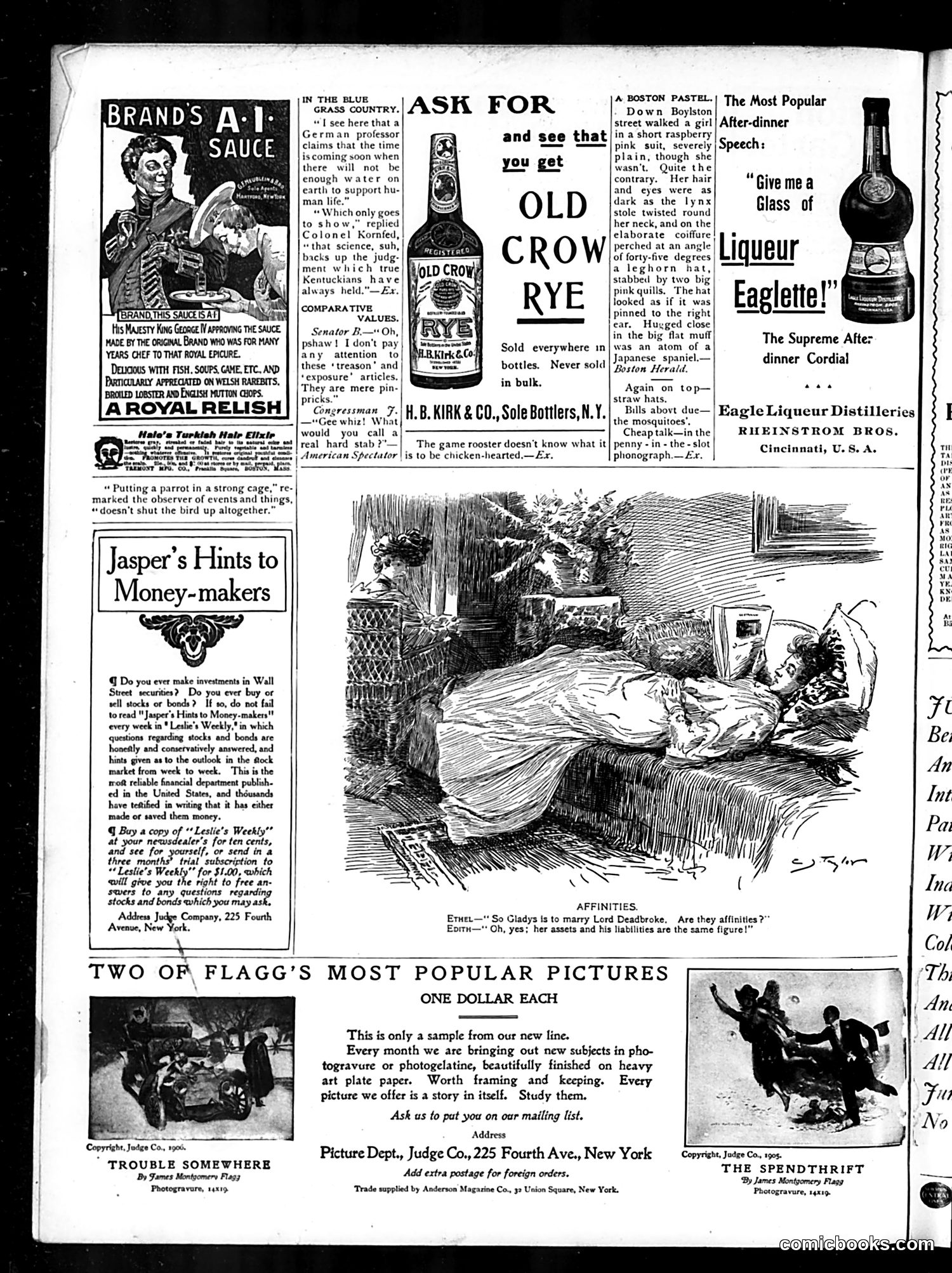
This page is primarily **advertising and commercial content** rather than political satire, typical of Judge magazine's revenue model. The main cartoon—"Affinities"—is a brief social joke: a man asks if an engaged couple are "affinities" (soulmates), and the response plays on double meaning: the woman's financial assets and the man's financial liabilities are numerically equal, making them compatible through mutual financial desperation rather than romance. This mocks both the romantic notion of "affinities" and the mercenary marriages common among the wealthy. The page otherwise consists of **liquor and patent medicine advertisements** (Brand's Sauce, Old Crow Rye, Eagle Liqueur, Hale's Turkish Hair Elixir), a "Jasper's Hints to Money-makers" column promoting Leslie's Weekly's investment advice, and promotional images for Flagg's picture prints. The remaining small jokes and quotes scattered throughout are generic humor unrelated to current events or politics. This reflects Judge's business model: satirical commentary shared pages with paid advertising.
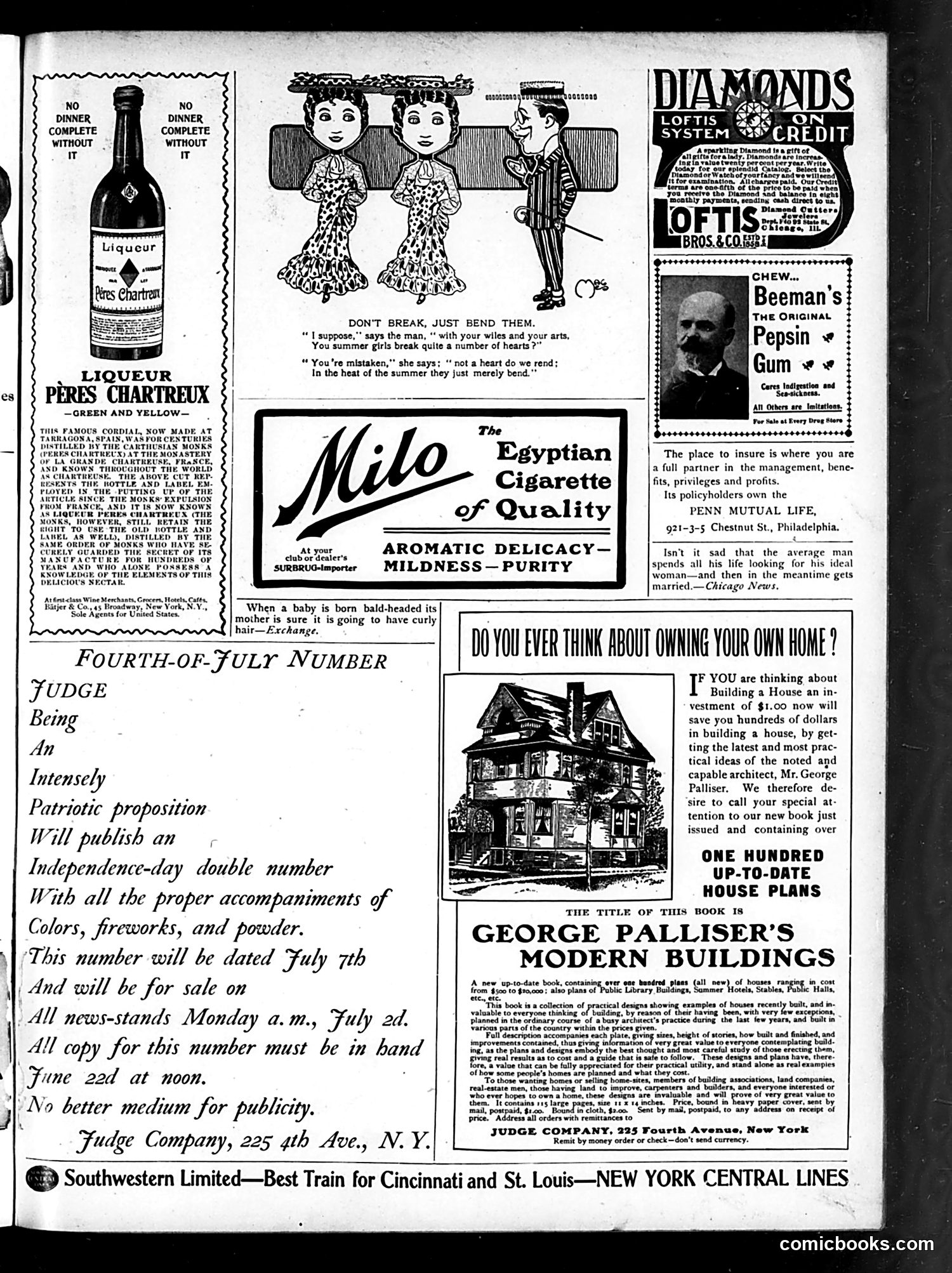
This page from *Judge* magazine contains mostly **advertisements and announcements** rather than satirical political cartoons. The central cartoon depicts a flirtation joke: a man asks a young woman if she "breaks hearts" with her "wiles and arts." She replies they don't break hearts—in summer heat, hearts merely "bend." It's a lighthearted play on romantic susceptibility, suggesting summer romance causes temporary rather than permanent emotional damage. The rest of the page is dominated by **product advertisements** (liqueur, cigarettes, chewing gum) and **announcements**, including promotion of *Judge*'s upcoming Fourth of July double issue and an advertisement for George Palliser's architectural book on home-building. One small ad uses mild social satire: questioning whether men spend their whole lives seeking an "ideal woman" only to marry someone else—a commentary on male indecision or romantic disappointment. The page reflects early 20th-century magazine layout, mixing editorial content with extensive advertising.
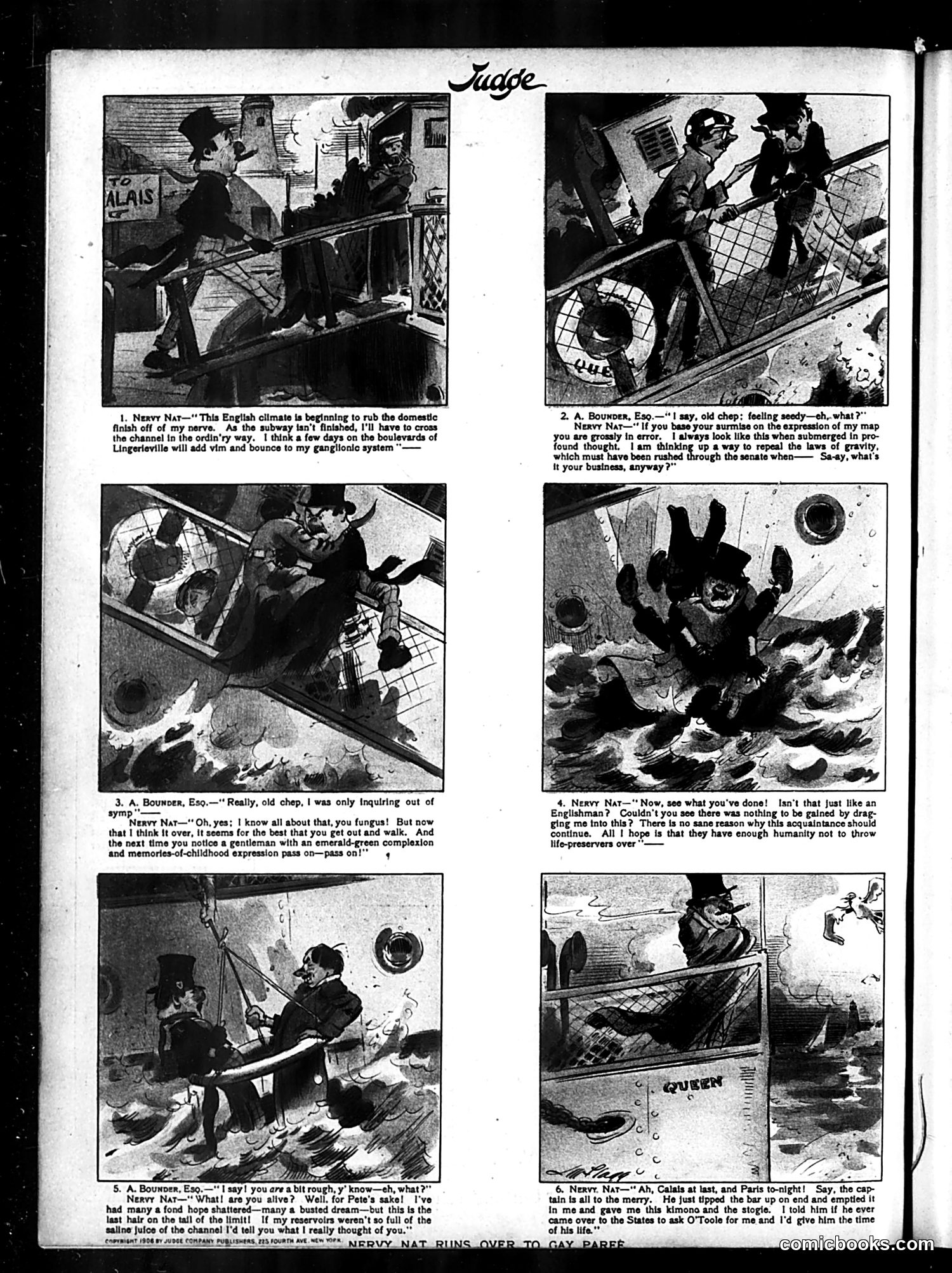
This six-panel comic strip follows "Nervy Nat," an American tourist, crossing the English Channel to France with "A. Bounder, Esq.," an irritable English gentleman. The satire plays on national stereotypes: Nervy Nat is a loud, irreverent American who complains about English weather and transit, makes bizarre non-sequiturs (planning to "repeal the laws of gravity"), and shows no regard for social niceties. Bounder represents the prim, fussy Englishman constantly exasperated by American rudeness. The humor culminates when Nat accidentally causes Bounder to fall overboard—then immediately befriends the ship's captain, typifying the American's ability to charm his way out of trouble while remaining oblivious to consequences. The underlying satire mocks American tourists abroad: loud, self-absorbed, tactless, yet somehow always landing on their feet through brash confidence.